

- Industry Size (2026)
- USD 5.5 Bn
- Forecast (2036)
- USD 19.0 Bn
- CAGR (2026 to 2036)
- 13.2%
5PL Solutions Market Size, Market Forecast and Outlook By FMI
The 5PL solutions market is expected to expand from USD 5.5 billion in 2026 to USD 19.0 billion by 2036. The market is anticipated to register a 13.2% CAGR during the forecast period. Transportation is likely to lead service type with a 49.0% share, while e-commerce is projected to account for 39.0% share of application demand in 2026.
Summary of the 5PL Solutions Market
- Demand and Growth Drivers
- E-commerce fulfilment complexity is expected to support wider use of orchestration-led logistics models.
- Digital freight visibility is likely to increase demand for platforms that coordinate carriers and inventory flows.
- Labour shortages are anticipated to strengthen adoption of automation-ready supply chain control systems.
- Product and Segment View
- Transportation is expected to lead the service type segment because routing variance directly affects delivery cost.
- E-commerce is likely to remain the main application as split shipments and returns require tighter network planning.
- Warehousing services are anticipated to gain support where automation and inventory positioning shape fulfilment performance.
- Geography and Competitive Outlook
- China is expected to lead country-level expansion due to logistics cost reduction programs and e-commerce scale.
- India is likely to record strong growth as public digital logistics interfaces improve data-led execution.
- Companies with stronger automation deployment and multi-carrier orchestration are anticipated to improve customer retention.
- Analyst Opinion
- Sudip Saha, Co-founder at Future Market Insights, suggests, “The 5PL solutions market is moving toward platforms that control logistics decisions rather than only coordinate physical movement. Providers that combine visibility, automation, and exception governance are likely to gain advantage as supply chains become more data dependent.”
- 5PL Solutions Market Value Analysis
- The 5PL solutions market is shifting from outsourced logistics coordination into a digital supply chain control layer.
- Demand is likely to rise as e-commerce companies need better routing, returns handling, and delivery-window protection.
- Adoption is expected to improve where orchestration platforms reduce service variance across carriers and fulfilment nodes.
- Spending is anticipated to be backed by automation, cross-border compliance, and growing demand for network-level logistics visibility.
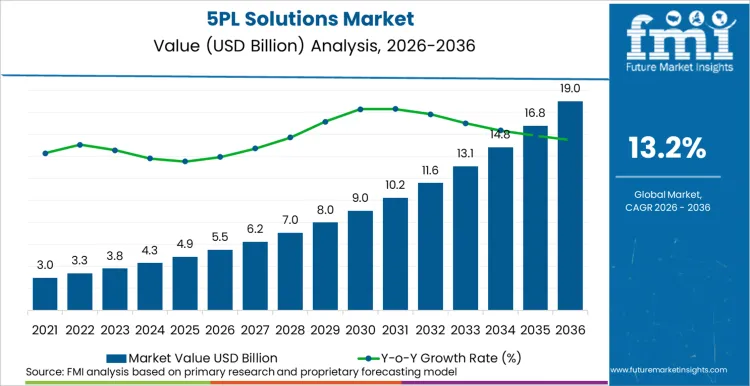
Key Takeaways, Market Size, and Forecast
| Metric | Value |
|---|---|
| Market Size (2026) | USD 5.5 Billion |
| Market Size (2036) | USD 19.0 Billion |
| CAGR (2026–2036) | 13.2% |
| Leading Service Type (2026) | Transportation |
| Transportation Share (2026) | 49.0% |
| Leading Application (2026) | E-Commerce |
| E-Commerce Share (2026) | 39.0% |
| Fastest-Growing Country | China |
| China CAGR | 19.8% |
5PL Solutions Market Key Takeaways
| Metric | Value |
|---|---|
| 5PL Solutions Market Size (2026E) | USD 5.5 billion |
| 5PL Solutions Market Value (2036F) | USD 19.0 billion |
| CAGR (2026–2036) | 13.2% |
Source: Future Market Insights’ proprietary forecasting model and primary research
What Factors are Pushing Expansion Prospects of the 5PL Solutions Market?
Various factors and developments contribute to the 5PL solutions market’s expansion prospects. Region-specific regulations especially influence growth prospects significantly. A case in point is of the EU inbound-security digitisation that is shifting the centre of gravity from moving freight to governing shipment data.
The Import Control System 2 requires a complete Entry Summary Declaration for goods moving to or through the EU prior to arrival, pushing earlier data capture and sharper responsibility splits across carriers, forwarders, and logistics intermediaries. The February 2025 Commission update extending ICS2 obligations to road and rail from April 1, 2025 reinforces that this is not an air-only compliance problem; it becomes a multimodal discipline that favours orchestrators capable of enforcing data completeness, exception handling, and partner accountability at network scale.
Paperless compliance in Europe is also moving from pilots into an implementation runway that materially benefits platform-led 5PL models. Under the EU’s eFTI framework, January 2026 marks the point when eFTI platforms and service providers can begin preparing for operations, while full applicability arrives on July 9, 2027, when authorities must accept information shared electronically via certified platforms.
This timetable rewards 5PL providers that sit above individual warehouse and carrier systems and can normalise documentation flows into a single operating layer, an advantage that compounds once embedded across multi-country networks.
How is the 5PL Solutions Market Segmented?
Which Capabilities keep Transportation at the Centre of Service Demand?
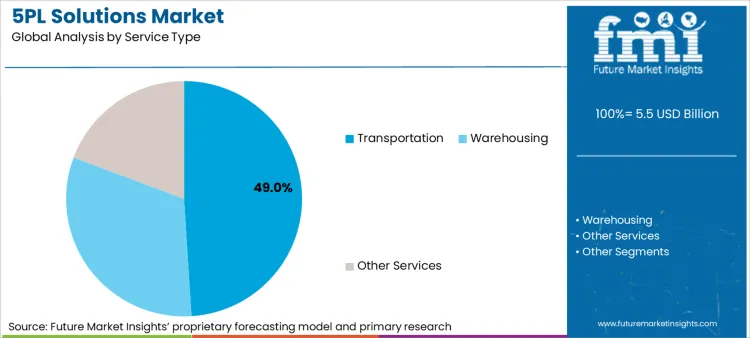
Transportation leads with a 49.0% share because it is the highest-variance cost line and the fastest lever for service-level recovery. 5PL end users prioritise routing governance, multi-carrier procurement logic, and capacity hedging because these mechanisms protect delivery promises when demand spikes or disruption hits. Robotics and automation investments reinforce this advantage by increasing dock and sort throughput, keeping line-haul and last-mile flows synchronised.
Which Fulfilment Requirements keep E-commerce as the Anchor Application?
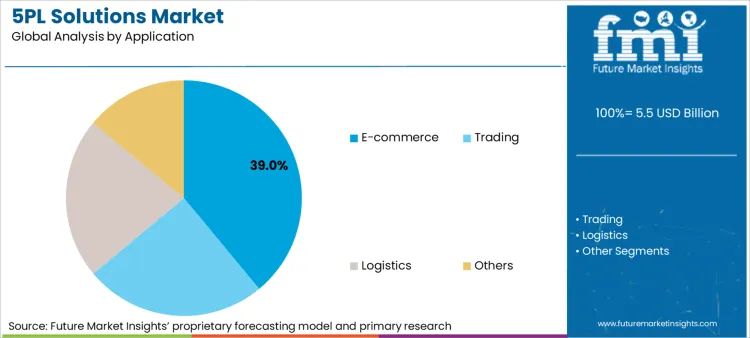
E-commerce holds a 39.0% share because fulfilment is now a system-level problem: inventory positioning, order routing, returns triage, and carrier selection must operate as one loop to meet promised windows at sustainable cost.
5PL value is strongest where omnichannel volatility is highest, with demand concentrating in e-commerce logistics and further reinforced by returns economics as reverse flows shift into managed programs rather than ad hoc processes.
Which Dynamics Play a Pivotal Role in Shaping 5PL Solutions Growth Prospects?
| Dynamics | Implications |
|---|---|
| E-commerce Omnichannel Complexity | Demand concentrates in orchestrators that can keep promise windows intact under peak volatility and returns pressure, because fulfilment variance becomes the dominant cost-to-serve driver. |
| Advanced technological integration (AI, IoT, blockchain) | Competitive differentiation shifts toward platforms that turn real-time signals into predictive decisions, reducing exception leakage and stabilising multi-node execution. |
| Sustainability Mandates (GoGreen, EV Battery Recycling) | Network design and supplier selection increasingly require measurable environmental optimisation, pulling 5PL into carbon-accountable routing and closed-loop programme control. |
| High Implementation Costs | Scaling favours providers that can industrialise integrations and amortise platform deployment, while smaller shippers face a higher barrier to entry. |
| Labour Shortages | Automation readiness becomes a prerequisite for service reliability, pushing adoption toward operators with proven labour-light operating models. |
| Security and Data Privacy | Orchestration scale is constrained by cybersecurity and cross-border compliance, making governance, auditability, and secure partner onboarding decisive in large programmes. |
Source: Future Market Insights analysis, supported by a proprietary forecasting model and primary research
What is the Trajectory for the 5PL Solutions Market in Key Countries?
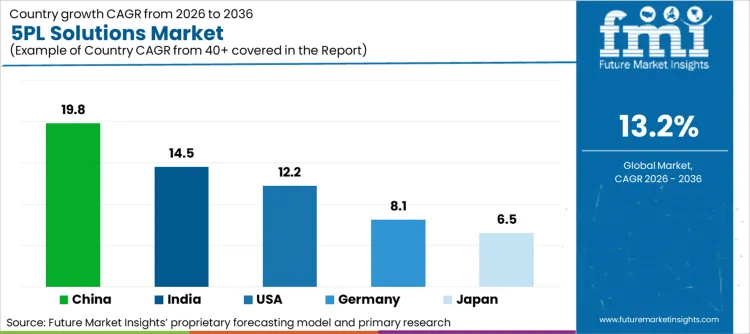
| Country | CAGR (2026-2036) |
|---|---|
| USA | 12.2% |
| China | 19.8% |
| Germany | 8.1% |
| Japan | 6.5% |
| India | 14.5% |
Source: Future Market Insights – analysis driven by proprietary forecasting models and primary research
Which Federal Data-sharing Rails are turning USA’s orchestration layer into a Board-Level Control System?
The USA’s adoption curve tightens around institutionalised visibility. The USA Department of Transportation’s Freight Logistics Optimization Works (FLOW) program concentrates port, ocean-carrier, and shipper data into a shared signal set, with public materials pointing to coverage of a large majority of U.S. containerised imports. This shifts value from rate access to decision latency; the winning model becomes the entity that can translate shared telemetry into live network reconfiguration across carriers, nodes, and service levels.
Customs modernisation reinforces the same direction. CBP’s 21st Century Customs Framework and the next-generation ACE roadmap push trade processes toward richer, more structured data and upgraded digital workflows. Orchestration vendors fuse compliance data, execution status, and cost-to-serve logic to become the operating system for omnichannel networks rather than a procurement adjunct. These trends are aptly reflected in the global supply chain management software landscape.
Which State-Led Cost-Compression Targets compel China’s 5PL Model toward National Network Optimisation?
China’s growth profile reflects policy that treats logistics cost as a macro lever. State Council and government communications frame an explicit agenda to reduce economy-wide logistics costs, strengthen national logistics hubs, and raise efficiency through coordinated infrastructure and operational upgrading. That policy posture rewards orchestrators that can arbitrage across modes, provinces, and carrier pools while meeting tighter service windows, especially where e-commerce variability drives peak volatility.
The practical constraint shifts from warehouse square metres to data continuity across nodes, making connected logistics a direct enabler of China’s 5PL expansion. The winners become platforms that can convert hub-and-corridor policy into measurable reductions in dwell time, empty miles, and exception leakage across multi-tier partner ecosystems.
Which Carbon-priced Road Economics are reshaping Germany’s Cost-to-Serve Architecture?
Germany’s demand pattern is priced by emissions. The federal HGV toll structure adds CO₂ differentiation and expands charging to smaller trucks, raising the penalty for fragmented routing and partial utilisation. This shifts the optimisation frontier from cheaper carriers to cheaper networks, pulling shippers toward orchestration layers that can consolidate flows, redesign lanes, and blend road with rail or inland waterway options where feasible.
As reverse flows and refurbishment loops grow in strategic importance, toll-linked cost-to-serve volatility pushes tighter control over returns, repair, and redeployment routing, an execution reality that naturally aligns with reverse logistics. The German opportunity concentrates in orchestrators that can prove carbon-and-cost outcomes at lane level while maintaining service discipline across regulated industrial supply chains.
Which Labour-Capacity caps and Statutory Reforms are Hardcoding Orchestration into Japan’s Distribution Model?
Japan’s constraint is structurally enforced capacity. The April 2024 overtime limits on drivers compress available linehaul hours, forcing a redesign of schedules, handoffs, and consolidation logic rather than incremental productivity tweaks.
Government-facing workstreams also frame reforms that designate regulated actors and require operational measures such as reducing waiting time and improving loading efficiency. These signals prove that compliance is moving inside everyday logistics operations.
Corporate response is already mapping onto those statutory rails. Yamato has disclosed selection under MLIT-related investment programming linked to the Act on integration/streamlining of distribution business, indicating capital is directed toward structural efficiency plays.
Prospects for 5PL solutions in Japan are tied to logistics automation, where orchestration platforms that synchronize slotting, automation, and multi-carrier planning serve as the mechanism for turning capacity constraints into stable, repeatable service performance.
Which Public Digital Interfaces are Turning India into an API-Addressable Logistics Network Hub?
India’s step-change driver is state-backed interoperability. ULIP surpassed 100 crore API transactions in March 2025 and integrates 43 systems across 11 ministries, creating a shared data spine for multi-agency logistics execution. Executive commentary from India’s commerce leadership explicitly frames ULIP as an enabling layer for national competitiveness and agility. This pushes the market toward orchestration that plugs into public rails rather than building isolated visibility stacks.
When networks become API-addressable, competitive advantage shifts to orchestration logic that can convert shared data into dynamic fulfilment decisions across partners. This execution pattern aligns with e-commerce logistics. Opportunity concentrates in platforms that industrialise exception management and compliance-grade traceability across fragmented carriers while maintaining peak resilience during demand surges.
Competitive Landscape
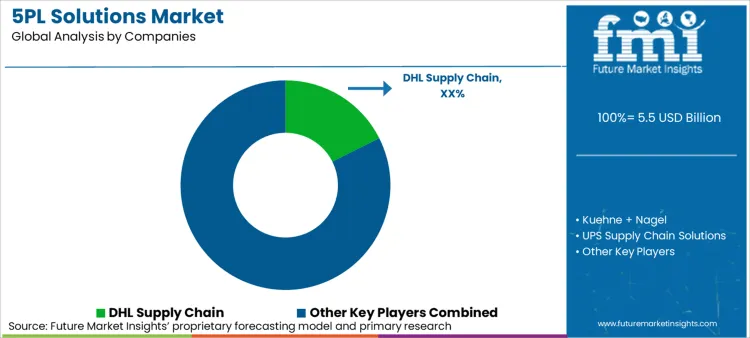
Competition in the 5PL solutions market involves operators converting network scale into repeatable decision quality. Over the next decade, structural moves combining execution, automation, and governance into one commercial offer are likely to set the performance bar.
The sale of Bolloré Logistics to CMA CGM is a watershed moment in the 5PL solutions landscape. With this integration, customers increasingly see a single counterparty capable of packaging ocean capacity, forwarding, customs, and contract logistics into one risk and performance envelope. That packaging changes tender design, because outcome commitments become easier to underwrite when execution sits inside one group.
A similar expansion pattern shows up in CEVA’s Turkey step via Borusan and its move toward project-logistics capability through Fagioli, where controllable capacity and higher-complexity execution increase contract duration and reduce the practicality of frequent provider switching.
DHL’s MoU with Boston Dynamics for an additional 1,000 robots frames automation as a cross-business operating model, not a site upgrade. This changes competitive proof points in 5PL-linked bids. Providers with standardised automation can commit to peak stability and faster recovery, then price against variance reduction rather than unit handling cost, which resets what “best-in-class” looks like in multi-year network contracts.
Key Companies Profiled
- DHL Supply Chain
- Kuehne + Nagel
- UPS Supply Chain Solutions
- XPO, Inc.
- DB Schenker
- C.H. Robinson
- CEVA Logistics
- Maersk
- FedEx Corporation
- Nippon Express Holdings
Scope of Report
| Items | Values |
|---|---|
| Quantitative Units | USD Billion |
| Service Type | Transportation; Warehousing; Other Services |
| Application | E-commerce; Trading; Logistics; Others |
| Region | North America; Latin America; Western Europe; Eastern Europe; East Asia; South Asia & Pacific; Middle East & Africa |
| Key Countries | USA; China: Germany; Japan; India |
| Key Companies | DHL Supply Chain; Kuehne + Nagel; UPS Supply Chain Solutions; XPO, Inc.; DB Schenker; C.H. Robinson; CEVA Logistics; Maersk; FedEx Corporation; Nippon Express Holdings |
5PL Solutions Market by Key Segments
By Service Type
- Transportation
- Warehousing
- Other Services
By Application
- E-commerce
- Trading
- Logistics
- Others
By Region
- North America
- Latin America
- Western Europe
- Eastern Europe
- East Asia
- South Asia & Pacific
- Middle East & Africa
Bibliography
- DHL. (2025, May 13). DHL Group signs MOU with Boston Dynamics for additional 1,000-robot deployment and accelerates cross-business automation strategy.
- Press Information Bureau, Government of India. (2025, March 19). ULIP surpasses 100 crore API transactions.
- CEVA Logistics. (2025, November 5). CEVA Logistics boosts growth potential in Turkey, closes Borusan Lojistik acquisition.
- CEVA Logistics. (2025, December 15). CEVA Logistics “goes big” in move to acquire global project logistics specialist Fagioli.
- Kuehne+Nagel. (2025, November 26). Road Customer Visibility platform now connects to 100 million devices.
Frequently Asked Questions
How big is the global 5PL solutions market?
The global 5PL solutions market is estimated at USD 5.5 billion in 2026 and is projected to reach USD 19.0 billion by 2036.
What is the growth outlook for the 5PL solutions market over the next 10 years?
The market is forecast to expand at a 13.2% CAGR from 2026 to 2036, reflecting accelerating adoption of orchestration-led logistics models.
Which industries or use cases drive adoption?
Adoption is led by e-commerce with a 39.0% application share, while transportation remains the primary monetisation layer with a 49.0% service-type share.
How does adoption differ by region or maturity level?
Growth is expected to be strongest in China (19.8% CAGR) and India (14.5%), versus more measured trajectories in Germany (8.1%) and Japan (6.5%)
What are the main barriers to adoption or scaling?
Scaling is constrained by high implementation costs, labour shortages in skilled logistics roles, and security and data-privacy requirements that tighten interoperability and cross-border deployment.
Preview the report firsthand - request a free sample
Get SampleGet the brochure for pricing and purchase details.
Get PDFTable of Content
- Executive Summary
- Global Market Outlook
- Demand-side Trends
- Supply-side Trends
- Technology Roadmap Analysis
- Analysis and Recommendations
- Market Overview
- Market Coverage / Taxonomy
- Market Definition / Scope / Limitations
- Research Methodology
- Chapter Orientation
- Analytical Lens and Working Hypotheses
- Market Structure, Signals, and Trend Drivers
- Benchmarking and Cross-market Comparability
- Market Sizing, Forecasting, and Opportunity Mapping
- Research Design and Evidence Framework
- Desk Research Programme (Secondary Evidence)
- Company Annual and Sustainability Reports
- Peer-reviewed Journals and Academic Literature
- Corporate Websites, Product Literature, and Technical Notes
- Earnings Decks and Investor Briefings
- Statutory Filings and Regulatory Disclosures
- Technical White Papers and Standards Notes
- Trade Journals, Industry Magazines, and Analyst Briefs
- Conference Proceedings, Webinars, and Seminar Materials
- Government Statistics Portals and Public Data Releases
- Press Releases and Reputable Media Coverage
- Specialist Newsletters and Curated Briefings
- Sector Databases and Reference Repositories
- Roots Internal Knowledge Base and Historical Datasets
- Subscription Datasets and Paid Sources
- Social Channels, Communities, and Digital Listening Inputs
- Additional Desk Sources
- Expert Input and Fieldwork (Primary Evidence)
- Primary Modes
- Qualitative Interviews and Expert Elicitation
- Quantitative Surveys and Structured Data Capture
- Blended A7oach
- Why Primary Evidence is Used
- Field Techniques
- Interviews
- Surveys
- Focus Groups
- Observational and In-context Research
- Social and Community Interactions
- Stakeholder Universe Engaged
- C-suite Leaders
- Board Members
- Presidents and Vice Presidents
- R&D and Innovation Heads
- Technical Specialists
- Domain Subject-matter Experts
- Scientists
- Physicians and Other Healthcare Professionals
- Governance, Ethics, and Data Stewardship
- Research Ethics
- Data Integrity and Handling
- Primary Modes
- Tooling, Models, and Reference Databases
- Desk Research Programme (Secondary Evidence)
- Data Engineering and Model Build
- Data Acquisition and Ingestion
- Cleaning, Normalisation, and Verification
- Synthesis, Triangulation, and Analysis
- Quality Assurance and Audit Trail
- Market Background
- Market Dynamics
- Drivers
- Restraints
- Opportunity
- Trends
- Scenario Forecast
- Demand in Optimistic Scenario
- Demand in Likely Scenario
- Demand in Conservative Scenario
- Opportunity Map Analysis
- Product Life Cycle Analysis
- Supply Chain Analysis
- Investment Feasibility Matrix
- Value Chain Analysis
- PESTLE and Porter’s Analysis
- Regulatory Landscape
- Regional Parent Market Outlook
- Production and Consumption Statistics
- Import and Export Statistics
- Market Dynamics
- Global Market Analysis 2021 to 2025 and Forecast, 2026 to 2036
- Historical Market Size Value (USD Million) Analysis, 2021 to 2025
- Current and Future Market Size Value (USD Million) Projections, 2026 to 2036
- Y-o-Y Growth Trend Analysis
- Absolute $ Opportunity Analysis
- Global Market Pricing Analysis 2021 to 2025 and Forecast 2026 to 2036
- Global Market Analysis 2021 to 2025 and Forecast 2026 to 2036, By Service Type
- Introduction / Key Findings
- Historical Market Size Value (USD Million) Analysis By Service Type , 2021 to 2025
- Current and Future Market Size Value (USD Million) Analysis and Forecast By Service Type , 2026 to 2036
- Transportation
- Warehousing
- Other Services
- Transportation
- Y-o-Y Growth Trend Analysis By Service Type , 2021 to 2025
- Absolute $ Opportunity Analysis By Service Type , 2026 to 2036
- Global Market Analysis 2021 to 2025 and Forecast 2026 to 2036, By Application
- Introduction / Key Findings
- Historical Market Size Value (USD Million) Analysis By Application, 2021 to 2025
- Current and Future Market Size Value (USD Million) Analysis and Forecast By Application, 2026 to 2036
- E-commerce
- Trading
- Logistics
- Others
- E-commerce
- Y-o-Y Growth Trend Analysis By Application, 2021 to 2025
- Absolute $ Opportunity Analysis By Application, 2026 to 2036
- Global Market Analysis 2021 to 2025 and Forecast 2026 to 2036, By Region
- Introduction
- Historical Market Size Value (USD Million) Analysis By Region, 2021 to 2025
- Current Market Size Value (USD Million) Analysis and Forecast By Region, 2026 to 2036
- North America
- Latin America
- Western Europe
- Eastern Europe
- East Asia
- South Asia and Pacific
- Middle East & Africa
- Market Attractiveness Analysis By Region
- North America Market Analysis 2021 to 2025 and Forecast 2026 to 2036, By Country
- Historical Market Size Value (USD Million) Trend Analysis By Market Taxonomy, 2021 to 2025
- Market Size Value (USD Million) Forecast By Market Taxonomy, 2026 to 2036
- By Country
- USA
- Canada
- Mexico
- By Service Type
- By Application
- By Country
- Market Attractiveness Analysis
- By Country
- By Service Type
- By Application
- Key Takeaways
- Latin America Market Analysis 2021 to 2025 and Forecast 2026 to 2036, By Country
- Historical Market Size Value (USD Million) Trend Analysis By Market Taxonomy, 2021 to 2025
- Market Size Value (USD Million) Forecast By Market Taxonomy, 2026 to 2036
- By Country
- Brazil
- Chile
- Rest of Latin America
- By Service Type
- By Application
- By Country
- Market Attractiveness Analysis
- By Country
- By Service Type
- By Application
- Key Takeaways
- Western Europe Market Analysis 2021 to 2025 and Forecast 2026 to 2036, By Country
- Historical Market Size Value (USD Million) Trend Analysis By Market Taxonomy, 2021 to 2025
- Market Size Value (USD Million) Forecast By Market Taxonomy, 2026 to 2036
- By Country
- Germany
- UK
- Italy
- Spain
- France
- Nordic
- BENELUX
- Rest of Western Europe
- By Service Type
- By Application
- By Country
- Market Attractiveness Analysis
- By Country
- By Service Type
- By Application
- Key Takeaways
- Eastern Europe Market Analysis 2021 to 2025 and Forecast 2026 to 2036, By Country
- Historical Market Size Value (USD Million) Trend Analysis By Market Taxonomy, 2021 to 2025
- Market Size Value (USD Million) Forecast By Market Taxonomy, 2026 to 2036
- By Country
- Russia
- Poland
- Hungary
- Balkan & Baltic
- Rest of Eastern Europe
- By Service Type
- By Application
- By Country
- Market Attractiveness Analysis
- By Country
- By Service Type
- By Application
- Key Takeaways
- East Asia Market Analysis 2021 to 2025 and Forecast 2026 to 2036, By Country
- Historical Market Size Value (USD Million) Trend Analysis By Market Taxonomy, 2021 to 2025
- Market Size Value (USD Million) Forecast By Market Taxonomy, 2026 to 2036
- By Country
- China
- Japan
- South Korea
- By Service Type
- By Application
- By Country
- Market Attractiveness Analysis
- By Country
- By Service Type
- By Application
- Key Takeaways
- South Asia and Pacific Market Analysis 2021 to 2025 and Forecast 2026 to 2036, By Country
- Historical Market Size Value (USD Million) Trend Analysis By Market Taxonomy, 2021 to 2025
- Market Size Value (USD Million) Forecast By Market Taxonomy, 2026 to 2036
- By Country
- India
- ASEAN
- Australia & New Zealand
- Rest of South Asia and Pacific
- By Service Type
- By Application
- By Country
- Market Attractiveness Analysis
- By Country
- By Service Type
- By Application
- Key Takeaways
- Middle East & Africa Market Analysis 2021 to 2025 and Forecast 2026 to 2036, By Country
- Historical Market Size Value (USD Million) Trend Analysis By Market Taxonomy, 2021 to 2025
- Market Size Value (USD Million) Forecast By Market Taxonomy, 2026 to 2036
- By Country
- Kingdom of Saudi Arabia
- Other GCC Countries
- Turkiye
- South Africa
- Other African Union
- Rest of Middle East & Africa
- By Service Type
- By Application
- By Country
- Market Attractiveness Analysis
- By Country
- By Service Type
- By Application
- Key Takeaways
- Key Countries Market Analysis
- USA
- Pricing Analysis
- Market Share Analysis, 2025
- By Service Type
- By Application
- Canada
- Pricing Analysis
- Market Share Analysis, 2025
- By Service Type
- By Application
- Mexico
- Pricing Analysis
- Market Share Analysis, 2025
- By Service Type
- By Application
- Brazil
- Pricing Analysis
- Market Share Analysis, 2025
- By Service Type
- By Application
- Chile
- Pricing Analysis
- Market Share Analysis, 2025
- By Service Type
- By Application
- Germany
- Pricing Analysis
- Market Share Analysis, 2025
- By Service Type
- By Application
- UK
- Pricing Analysis
- Market Share Analysis, 2025
- By Service Type
- By Application
- Italy
- Pricing Analysis
- Market Share Analysis, 2025
- By Service Type
- By Application
- Spain
- Pricing Analysis
- Market Share Analysis, 2025
- By Service Type
- By Application
- France
- Pricing Analysis
- Market Share Analysis, 2025
- By Service Type
- By Application
- India
- Pricing Analysis
- Market Share Analysis, 2025
- By Service Type
- By Application
- ASEAN
- Pricing Analysis
- Market Share Analysis, 2025
- By Service Type
- By Application
- Australia & New Zealand
- Pricing Analysis
- Market Share Analysis, 2025
- By Service Type
- By Application
- China
- Pricing Analysis
- Market Share Analysis, 2025
- By Service Type
- By Application
- Japan
- Pricing Analysis
- Market Share Analysis, 2025
- By Service Type
- By Application
- South Korea
- Pricing Analysis
- Market Share Analysis, 2025
- By Service Type
- By Application
- Russia
- Pricing Analysis
- Market Share Analysis, 2025
- By Service Type
- By Application
- Poland
- Pricing Analysis
- Market Share Analysis, 2025
- By Service Type
- By Application
- Hungary
- Pricing Analysis
- Market Share Analysis, 2025
- By Service Type
- By Application
- Kingdom of Saudi Arabia
- Pricing Analysis
- Market Share Analysis, 2025
- By Service Type
- By Application
- Turkiye
- Pricing Analysis
- Market Share Analysis, 2025
- By Service Type
- By Application
- South Africa
- Pricing Analysis
- Market Share Analysis, 2025
- By Service Type
- By Application
- USA
- Market Structure Analysis
- Competition Dashboard
- Competition Benchmarking
- Market Share Analysis of Top Players
- By Regional
- By Service Type
- By Application
- Competition Analysis
- Competition Deep Dive
- DHL Supply Chain
- Overview
- Product Portfolio
- Profitability by Market Segments (Product/Age /Sales Channel/Region)
- Sales Footprint
- Strategy Overview
- Marketing Strategy
- Product Strategy
- Channel Strategy
- Kuehne + Nagel
- UPS Supply Chain Solutions
- XPO, Inc.
- DB Schenker
- C.H. Robinson
- CEVA Logistics
- Maersk
- FedEx Corporation
- Nippon Express Holdings
- DHL Supply Chain
- Competition Deep Dive
- Assumptions & Acronyms Used


