

- Industry Size (2026)
- USD 9.2 Bn
- Forecast (2036)
- USD 18.7 Bn
- CAGR (2026 to 2036)
- 8.4%
E-tailing Solutions Market Size and Share Forecast Outlook 2026 to 2036
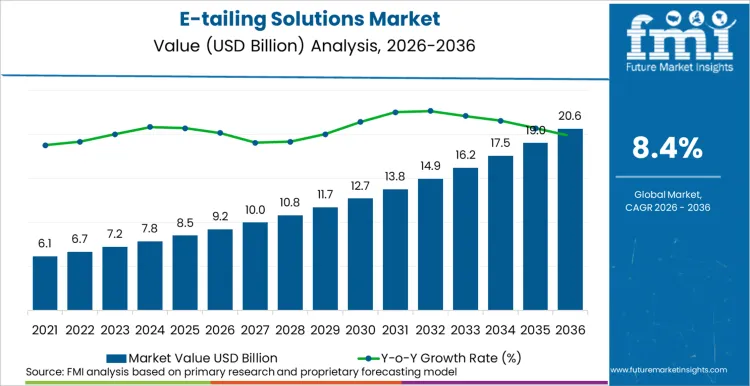
The global e-tailing solutions sector is projected to expand from USD 9.2 billion in 2026 to USD 18.7 billion by 2036, registering an 8.4% CAGR over the forecast period.
Regulation is now a design constraint, not a policy footnote. The EU Digital Services Act started applying to all online platforms in the EU from 17 February 2024, pushing marketplaces and commerce infrastructure providers to operationalise notice-and-action, trader traceability, and transparency workflows at scale.
Platform roadmaps are converging on AI-enabled productivity layers that reduce merchant operating friction. Shopify positions long-cycle product investment around democratizing commerce, with CEO Tobi Lütke stating, ‘We have spent more than a decade democratizing commerce, simplifying it, and making it accessible for businesses of all sizes.’ Adobe’s commerce stack is increasingly tied to enterprise experience operations, anchored by the general availability of Adobe Experience Platform AI Assistant for Experience Platform users. Salesforce is scaling agentic workflow execution as a commerce-adjacent layer, with CEO Marc Benioff describing Data Cloud and Agentforce as ‘a multibillion-dollar AI product line.’
Operational data confirms the structural pull toward digital transactions. In the United States, e-commerce accounted for 16.4% of total retail sales in Q3 2025, reinforcing continued retailer investment in platforms that synchronize catalogue, inventory, and fulfilment execution.
Summary of E-tailing Solutions Market
- The e-tailing solutions market comprises software platforms and enabling services used to operate digital storefronts, marketplaces, checkout, payments, catalogue, promotions, and order management across B2C and B2B commerce.
- The defined scope follows FMI taxonomy across platform type, deployment model, and end-user size, excluding physical POS hardware, standalone logistics services, and non-commerce ERP modules.
- The market is projected to grow at an 8.4% CAGR from 2026 to 2036, expanding from USD 9.2 billion in 2026 to USD 18.7 billion by 2036, supported by sustained digitisation of retail transactions and platform modernisation.
- Compliance-driven platform engineering is rising in importance as the Digital Services Act applies across the EU from 17 February 2024, increasing the baseline requirements for marketplace governance tooling.
- Product roadmaps are shifting toward AI assistants and agentic workflow automation, evidenced by Adobe’s Experience Platform AI Assistant general availability and Salesforce’s Agentforce platform launches.
- India is positioned for above-trend growth as government-backed network infrastructure expands the seller base and integration demand, with 1.16 lakh+ retail sellers live on ONDC as of 9 December 2025.
E-tailing Solutions Market Key Takeaways
| Metric | Value |
|---|---|
| Industry Size (2026) | USD 9.2 billion |
| Industry Value (2036) | USD 18.7 billion |
| CAGR (2026-2036) | 8.4% |
Market growth is being pulled by measurable digital transaction intensity and pushed by policy-driven platform accountability. In the United States, e-commerce represented 16.4% of total retail sales in Q3 2025, sustaining demand for unified storefront, order management, and payments architectures that can scale without breaking inventory truth. In the EU, the Digital Services Act applying from 17 February 2024 raises operational requirements for online intermediaries, increasing spend on governance workflows embedded into commerce stacks. In India, ONDC’s expanding seller participation creates integration work across catalogue, discovery, and fulfilment coordination, increasing demand for middleware, OMS connectors, and payment reconciliation tooling rather than only storefront features.
How is the E-tailing Solutions Market Segmented?
The e-tailing solutions market is segmented by platform type, deployment model, end-user, and region to reflect how digital selling requirements change by channel strategy, operating scale, and compliance exposure. By platform type, the market spans business-to-consumer, business-to-business, consumer-to-consumer, and marketplace solutions that map to different control needs for checkout, catalog governance, and seller onboarding. By deployment model, demand splits across cloud, on-premises, and hybrid architectures, which differ in release cadence, integration burden, and data-residency constraints. By end-user, adoption ranges from enterprise retailers and brands running multi-site inventory and complex promotions to SMEs and individual entrepreneurs prioritising speed-to-launch and lower operating overhead. By region, platform selection is shaped by payment rails maturity, cross-border trade rules, privacy and intermediary liability regimes, and logistics network density, which together determine integration priorities and the economics of omnichannel execution.
Why does Platform Type hold a dominant share in this market?
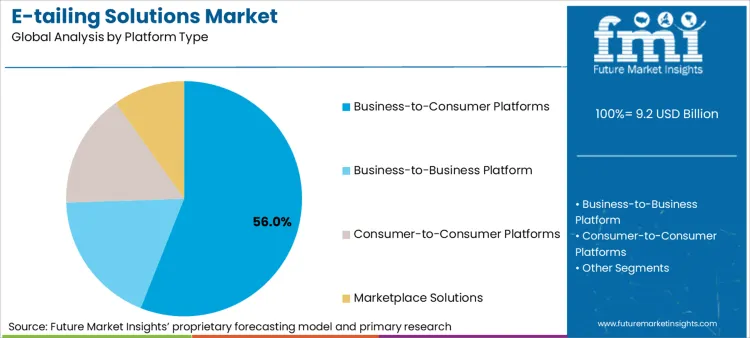
Business-to-consumer platforms lead with a 56.0% revenue share because retailers prioritise direct ownership of checkout, first-party customer identity, and merchandising logic that marketplaces do not optimise for individual brands. Marketplace solutions hold a 31.0% share because they compress time-to-demand in categories where discovery and cross-seller price comparison matter, but they impose governance and fee structures that limit margin control. The remaining share sits across B2B and C2C formats, where adoption is shaped by procurement workflow integration and trust mechanisms rather than pure traffic acquisition. This distribution reflects a structural trade-off: B2C platforms win when brands invest in retention economics and owned data, while marketplaces win when demand aggregation and fulfilment breadth outweigh brand control.
What explains the clear preference in Deployment Model selection?
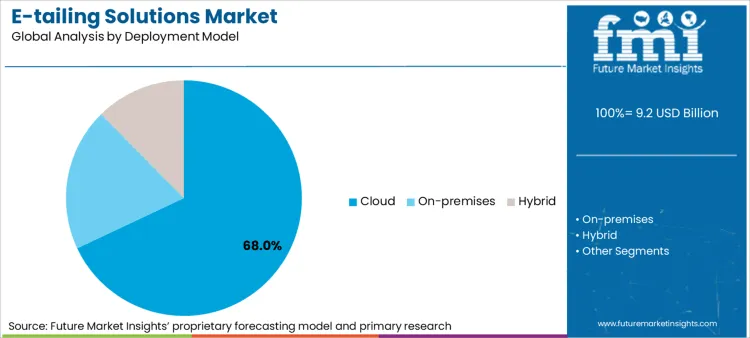
Cloud-based deployment dominates with a 68.0% share because retailers buy for peak-load elasticity, faster release cadence, and lower infrastructure ownership burden across multi-channel operations. On-premises deployments retain a 32.0% share mainly where large retailers carry long depreciation cycles on existing data centres, or where security and integration constraints make full cloud migration slower. The share split is therefore operational, not ideological. Cloud wins when uptime, scalability, and continuous feature shipping determine competitiveness. On-premises persists where legacy integration depth and internal controls remain procurement gates.
How do End-User categories shape revenue concentration and adoption behaviour?
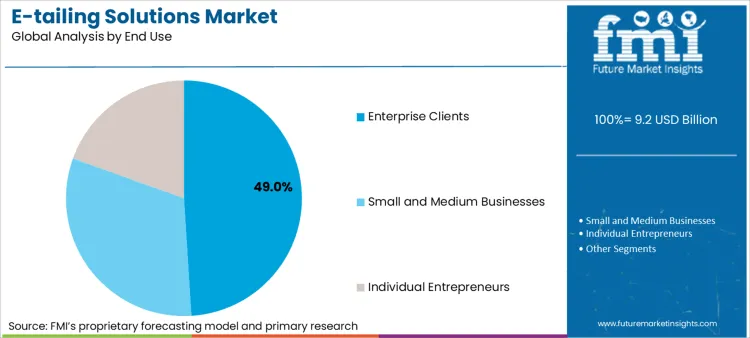
Enterprise clients account for 49.0% of total revenues because complex deployments pull higher attach rates across analytics, integration, governance, and automation layers, increasing platform and services intensity per account. Small and medium businesses represent 51.0% of user volume but contribute 34.0% of revenues because pricing is standardised, feature sets are lighter, and implementation cycles are shorter. The remainder comes from individual entrepreneurs and micro-sellers whose spend is constrained but who expand ecosystem breadth. This pattern signals that the market is monetised through enterprise complexity even when adoption volume is led by smaller merchants.
What are the key trends and restraints in E-tailing Solutions market?
Product strategy is shifting toward agentic operations and AI-assisted build workflows that compress merchant time-to-value. Shopify’s Winter ’26 Edition packages 150+ updates across AI, checkout, operations, and B2B, signalling continuous release cycles aimed at reducing merchant operating friction and expanding platform attach across functions. Salesforce’s Agentforce releases focus on deploying autonomous agents with visibility and control layers, aligning with retailer requirements for governed automation in service, marketing, and commerce-adjacent workflows. Adobe is scaling AI assistant capability inside Experience Platform, reinforcing the trend that commerce execution is increasingly tied to unified customer data and workflow productivity inside large retail organisations.
Constraint pressure is rising from compliance scope and accountability costs that land on platforms and sellers simultaneously. The DSA’s broad applicability from 17 February 2024 increases the operational burden for online intermediaries, raising implementation cost for governance workflows that smaller retailers and regional marketplaces struggle to amortise. In Germany, packaging compliance adds friction for cross-border sellers and marketplace operators because packaged goods distributors, including online retailers, must register with the LUCID Packaging Register and may face system participation and reporting obligations. These constraints shift procurement toward platforms with pre-built compliance tooling and partner ecosystems, while pushing long-tail merchants into cost containment trade-offs that slow feature adoption.
How will E-tailing Solutions Market expansion unfold across key countries from 2026 to 2036?
E-tailing solutions demand across major digital commerce economies is tracking payment-rail maturity, marketplace governance burdens, and enterprise re-platforming cycles rather than discretionary IT refresh alone. The global e-tailing solutions market expands at an 8.4% CAGR from 2026 to 2036, with country-level dispersion reflecting how regulatory exposure and transaction infrastructure convert into platform modernisation spend. India leads at 11.4% as UPI-led payment ubiquity and network-based commerce participation expand the integration surface for merchants and solution providers. China follows at 9.8% on the back of high online retail intensity and mobile-first retail operating models that require continuous platform optimisation at scale. The United States grows at 7.2%, driven by omnichannel execution needs, compliance engineering, and automation layers that compress cost-to-serve in mature retail. Germany records 6.8% as EU intermediary accountability rules and product compliance obligations raise the value of governance-ready platforms and structured reporting capabilities. Growth remains execution-anchored, not feature-led digitisation.
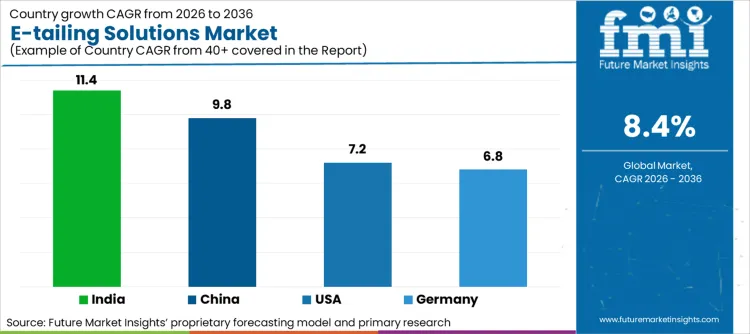
| Country | CAGR (2026-2036) |
|---|---|
| United States | 7.2% |
| China | 9.8% |
| India | 11.4% |
| Germany | 6.8% |
Source: Future Market Insights (FMI) analysis, based on proprietary forecasting model and primary research.
Why is the United States sustaining 7.2% growth through 2036?
USA growth is anchored in measurable e-commerce penetration and continued platform modernisation across retailers that run hybrid store and fulfilment models. E-commerce accounted for 16.4% of total retail sales in Q3 2025, keeping pressure on retailers to maintain unified inventory, promotions, and checkout performance across channels. Regulatory attention to pricing practices and data usage is also rising, increasing demand for governance layers and auditable decision logic inside commerce stacks. The FTC’s surveillance pricing spotlight documents how personalised pricing can be enabled by consumer data and analytics, pushing enterprises toward more controlled experimentation and disclosure-ready tooling. Platform strategy in the U.S. therefore favours vendors that can combine conversion infrastructure with compliant data handling and workflow automation, which aligns with the commercial push behind AI assistants and agentic service layers now being packaged into enterprise software roadmaps.
What explains China’s 9.8% CAGR over the forecast period?
China’s growth is structurally linked to the scale of online retail and policy-backed cross-border e-commerce enablement. China’s National Bureau of Statistics reports 2025 online retail sales of 15,972.2 billion yuan, with online retail sales of physical goods accounting for 26.1% of total retail sales of consumer goods, which sustains demand for platforms that can manage high-frequency merchandising, payments, and fulfilment coordination. Cross-border capacity also expands integration requirements, as MOFCOM states that the State Council had set up 165 cross-border e-commerce comprehensive pilot zones, supporting standardised customs and trade workflows that platforms must connect into. These mechanisms create platform demand beyond storefronts, including multi-currency settlement, compliance documentation, and order traceability across bonded and domestic networks. The result is a market where scale and policy-backed infrastructure amplify platform spend, and where vendors that localise governance and fulfilment orchestration capture procurement priority.
Why does India lead growth at 11.4% CAGR through 2036?
India’s trajectory is driven by payment rails and government-backed network participation that expand the addressable seller base and integration surface area. The Government of India notes that, as of FY 2024-2025, 56.86 crore QR codes were deployed to approximately 6.5 crore merchants, reinforcing digital acceptance infrastructure that directly supports online-to-offline commerce convergence. ONDC adds another growth engine by expanding network-based commerce participation, with 1.16 lakh+ retail sellers live on ONDC across 630+ cities and towns as of 9 December 2025, increasing demand for cataloguing, discovery, and fulfilment connectors that sit beside core storefront platforms. The platform implication is clear: Indian buyers procure for interoperability and reconciliation, not only front-end UX, because growth depends on stitching together sellers, logistics, and payments under shared protocols. This shifts vendor differentiation toward integration middleware, OMS capability, and compliance-grade transaction records.
How is Germany producing 6.8% CAGR despite mature retail penetration?
Germany’s growth is shaped by compliance-led platform requirements and cross-border seller obligations that increase the need for structured governance and reporting capabilities inside commerce operations. The Digital Services Act applying across the EU from 17 February 2024 raises baseline platform responsibilities, increasing demand for content moderation workflows, transparency reporting, and trader controls across online intermediaries operating in Germany. Packaging compliance further drives operational requirements for e-commerce sellers, because online retailers distributing packaged goods in Germany must register with the LUCID Packaging Register and may face system participation and reporting obligations. These mechanisms reward enterprise-grade platforms and service partners that can industrialise compliance tasks and automate documentation flows. Growth therefore concentrates in re-platforming programs, cross-border marketplace enablement, and operational automation investments that reduce administrative load per shipment while maintaining regulatory conformity.
What is defining the competitive landscape in the E-tailing Solutions market?
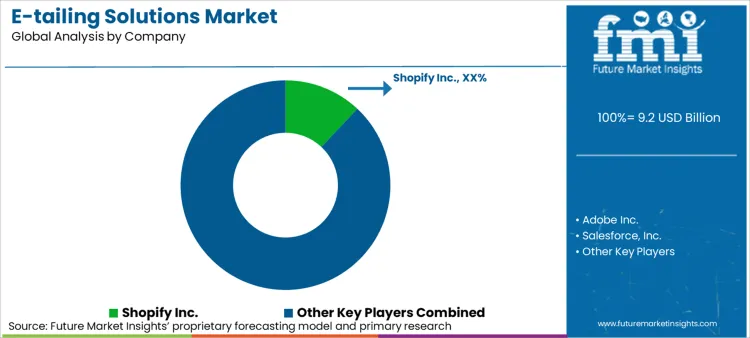
Scope includes commerce platforms, marketplace enablement, checkout and payment enablement, order management integration, and customer data and experience layers directly tied to digital selling. Scope excludes physical POS hardware, standalone last-mile logistics services, and ERP systems without commerce execution modules.
Global leadership is bifurcated by buyer type. Shopify is structurally advantaged in SMB and mid-market direct commerce through a single operating system narrative and continuous product shipping cadence, reinforced by its stated mission and CEO emphasis on simplifying commerce for businesses of all sizes. Adobe is advantaged in enterprise experience-led commerce where customer data, content operations, and workflow productivity are procurement priorities, supported by the general availability of Adobe Experience Platform AI Assistant. Salesforce is building a control-plane position around unified data and agentic workflow execution, with CEO Marc Benioff explicitly characterising Data Cloud and Agentforce as a scaled AI product line, which matters for large retailers running service, marketing, and commerce operations under one customer model. In Europe, compliance engineering under the DSA increases the value of governance-ready platforms and partners. In Asia, leadership is shaped by local scale and policy-aligned interoperability requirements, with China and India demanding deeper integration into national commerce and payment infrastructures. Japan often favours enterprise procurement cycles and domestic SI ecosystems, so global platform leadership does not automatically translate into regional dominance without local integration depth and partner delivery capacity.
Recent Developments:
- Salesforce announced Agentforce for Service and Sales general availability, expanding agentic workflow deployment as a platform layer.
- Shopify released Winter ’26 Edition with 150+ product updates across AI, checkout, operations, and B2B.
- Adobe announced the general availability of Adobe Experience Platform AI Assistant to drive productivity in Experience Platform workflows.
Key Players in the E-tailing Solutions Market
• Shopify Inc.
• Adobe Inc.
• Salesforce, Inc.
• SAP SE
• Oracle Corporation
• BigCommerce Holdings, Inc.
• Wix.com Ltd.
• Squarespace, Inc.
• Automattic (WooCommerce)
• PrestaShop S.A.
What is the Market Definition?
The e-tailing solutions market covers software platforms and enabling services that allow organisations to run digital commerce, including storefront creation, catalogue management, checkout, promotions, payments enablement, order capture, and operational integration into fulfilment and customer service. The market spans direct-to-consumer commerce, B2B commerce portals, and marketplace enablement where sellers operate through intermediated platforms. It includes functionality that ties customer identity and experience workflows to commerce execution, where those capabilities are sold as part of the commerce stack.
Inclusions comprise subscription and usage-based platform fees, payment enablement modules where packaged with the commerce platform, order management and integration layers sold as part of commerce operations, and experience and customer data tooling sold for commerce execution productivity. Included vendor actions are product releases that extend platform capability in AI, operations, and governance, such as Shopify’s Winter ’26 Edition updates and Salesforce Agentforce releases that expand workflow automation inside enterprise stacks.
Exclusions comprise physical POS terminals and hardware peripherals, standalone logistics and courier services sold independently of a commerce platform, and ERP suites without dedicated commerce execution modules. Also excluded are pure digital marketing services that do not include transaction execution and order lifecycle management. Compliance regimes referenced in this report relate to platform governance and seller obligations, such as DSA applicability and Germany’s LUCID registration obligations, rather than being treated as product categories.
Scope of Report
| Items | Values |
|---|---|
| Quantitative Units | USD 9.2 Billion |
| Platform Type | Business-to-Consumer Platforms; Business-to-Business Platforms; Consumer-to-Consumer Platforms; Marketplace Solutions |
| Deployment Model | Cloud; On-premises; Hybrid |
| End User | Enterprise Clients; Small and Medium Businesses; Individual Entrepreneurs |
| Industry Coverage | Retail & eCommerce; Consumer Brands; Wholesale & Distribution; Marketplace Operators; Others |
| Regions Covered | North America; Europe; Asia-Pacific; Latin America; Middle East & Africa |
| Countries Covered | United States; China; India; Germany; Others |
| Key Companies Profiled | Shopify; Adobe; Salesforce; SAP; Oracle; BigCommerce; Wix; Squarespace; WooCommerce; PrestaShop |
| Additional Attributes | Revenue analysis by platform type and deployment model; assessment of DSA-driven governance requirements; evaluation of network-based commerce participation effects such as ONDC; tracking of AI assistant and agentic workflow releases shaping platform differentiation |
E-tailing Solutions Market by Key Segments
By Platform Type:
- Business-to-Consumer Platforms
- Business-to-Business Platform
- Consumer-to-Consumer Platforms
- Marketplace Solutions
By Deployment Model:
- Cloud
- On-premises
- Hybrid
By End User:
- Enterprise Clients
- Small and Medium Businesses
- Individual Entrepreneurs
By Region:
- North America
- Europe
- Asia-Pacific
- Latin America
- Middle East and Africa
Bibliography
- European Commission. (2024, February 15). Digital Services Act starts applying to all online platforms in the EU.
- National Bureau of Statistics of China. (2026, January 20). Total retail sales of consumer goods in December 2025.
- Press Information Bureau, Government of India. (2025, December 8). UPI recognized as world’s largest real-time payment system.
- Press Information Bureau, Government of India. (2025, December 16). ONDC enables fair, transparent and inclusive e-commerce.
- USA Census Bureau. (2025, December 18). Quarterly retail e-commerce sales: 3rd quarter 2025.
- Adobe. (2024, June 6). Adobe announces general availability of Adobe Experience Platform AI Assistant.
- Salesforce. (2024, October 29). Salesforce announces general availability of Agentforce.
Frequently Asked Questions
How big is the global e-tailing solutions market?
The global e-tailing solutions market is valued at USD 9.2 billion in 2026 and is projected to reach USD 18.7 billion by 2036.
What is the growth outlook for the e-tailing solutions market over the next 10 years?
The market is forecast to expand at an 8.4% CAGR from 2026 to 2036, driven by rising e-commerce penetration and compliance-led platform engineering.
Which segment formats drive demand in this market?
Demand is led by direct commerce platforms and cloud deployments, reinforced by continuous vendor shipping of operations and AI capabilities.
Which country is projected to grow the fastest through 2036?
India is projected to grow the fastest at 11.4% CAGR, supported by payment infrastructure scale and ONDC network participation growth.
What are the main risks and constraints affecting this market?
Key constraints include rising governance and compliance costs under the EU Digital Services Act and operational obligations such as Germany’s LUCID registration requirements for packaged goods distribution.
Preview the report firsthand - request a free sample
Get SampleGet the brochure for pricing and purchase details.
Get PDFTable of Content
- Executive Summary
- Global Market Outlook
- Demand-side Trends
- Supply-side Trends
- Technology Roadmap Analysis
- Analysis and Recommendations
- Market Overview
- Market Coverage / Taxonomy
- Market Definition / Scope / Limitations
- Research Methodology
- Chapter Orientation
- Analytical Lens and Working Hypotheses
- Market Structure, Signals, and Trend Drivers
- Benchmarking and Cross-market Comparability
- Market Sizing, Forecasting, and Opportunity Mapping
- Research Design and Evidence Framework
- Desk Research Programme (Secondary Evidence)
- Company Annual and Sustainability Reports
- Peer-reviewed Journals and Academic Literature
- Corporate Websites, Product Literature, and Technical Notes
- Earnings Decks and Investor Briefings
- Statutory Filings and Regulatory Disclosures
- Technical White Papers and Standards Notes
- Trade Journals, Industry Magazines, and Analyst Briefs
- Conference Proceedings, Webinars, and Seminar Materials
- Government Statistics Portals and Public Data Releases
- Press Releases and Reputable Media Coverage
- Specialist Newsletters and Curated Briefings
- Sector Databases and Reference Repositories
- FMI Internal Proprietary Databases and Historical Market Datasets
- Subscription Datasets and Paid Sources
- Social Channels, Communities, and Digital Listening Inputs
- Additional Desk Sources
- Expert Input and Fieldwork (Primary Evidence)
- Primary Modes
- Qualitative Interviews and Expert Elicitation
- Quantitative Surveys and Structured Data Capture
- Blended Approach
- Why Primary Evidence is Used
- Field Techniques
- Interviews
- Surveys
- Focus Groups
- Observational and In-context Research
- Social and Community Interactions
- Stakeholder Universe Engaged
- C-suite Leaders
- Board Members
- Presidents and Vice Presidents
- R&D and Innovation Heads
- Technical Specialists
- Domain Subject-matter Experts
- Scientists
- Physicians and Other Healthcare Professionals
- Governance, Ethics, and Data Stewardship
- Research Ethics
- Data Integrity and Handling
- Primary Modes
- Tooling, Models, and Reference Databases
- Desk Research Programme (Secondary Evidence)
- Data Engineering and Model Build
- Data Acquisition and Ingestion
- Cleaning, Normalisation, and Verification
- Synthesis, Triangulation, and Analysis
- Quality Assurance and Audit Trail
- Market Background
- Market Dynamics
- Drivers
- Restraints
- Opportunity
- Trends
- Scenario Forecast
- Demand in Optimistic Scenario
- Demand in Likely Scenario
- Demand in Conservative Scenario
- Opportunity Map Analysis
- Product Life Cycle Analysis
- Supply Chain Analysis
- Investment Feasibility Matrix
- Value Chain Analysis
- PESTLE and Porter’s Analysis
- Regulatory Landscape
- Regional Parent Market Outlook
- Production and Consumption Statistics
- Import and Export Statistics
- Market Dynamics
- Global Market Analysis 2021 to 2025 and Forecast, 2026 to 2036
- Historical Market Size Value (USD Million) Analysis, 2021 to 2025
- Current and Future Market Size Value (USD Million) Projections, 2026 to 2036
- Y-o-Y Growth Trend Analysis
- Absolute $ Opportunity Analysis
- Global Market Pricing Analysis 2021 to 2025 and Forecast 2026 to 2036
- Global Market Analysis 2021 to 2025 and Forecast 2026 to 2036, By Platform Type
- Introduction / Key Findings
- Historical Market Size Value (USD Million) Analysis By Platform Type , 2021 to 2025
- Current and Future Market Size Value (USD Million) Analysis and Forecast By Platform Type , 2026 to 2036
- Business-to-Consumer Platforms
- Business-to-Business Platform
- Consumer-to-Consumer Platforms
- Marketplace Solutions
- Business-to-Consumer Platforms
- Y-o-Y Growth Trend Analysis By Platform Type , 2021 to 2025
- Absolute $ Opportunity Analysis By Platform Type , 2026 to 2036
- Global Market Analysis 2021 to 2025 and Forecast 2026 to 2036, By Deployment Model
- Introduction / Key Findings
- Historical Market Size Value (USD Million) Analysis By Deployment Model, 2021 to 2025
- Current and Future Market Size Value (USD Million) Analysis and Forecast By Deployment Model, 2026 to 2036
- Cloud
- On-premises
- Hybrid
- Cloud
- Y-o-Y Growth Trend Analysis By Deployment Model, 2021 to 2025
- Absolute $ Opportunity Analysis By Deployment Model, 2026 to 2036
- Global Market Analysis 2021 to 2025 and Forecast 2026 to 2036, By End Use
- Introduction / Key Findings
- Historical Market Size Value (USD Million) Analysis By End Use, 2021 to 2025
- Current and Future Market Size Value (USD Million) Analysis and Forecast By End Use, 2026 to 2036
- Enterprise Clients
- Small and Medium Businesses
- Individual Entrepreneurs
- Enterprise Clients
- Y-o-Y Growth Trend Analysis By End Use, 2021 to 2025
- Absolute $ Opportunity Analysis By End Use, 2026 to 2036
- Global Market Analysis 2021 to 2025 and Forecast 2026 to 2036, By Region
- Introduction
- Historical Market Size Value (USD Million) Analysis By Region, 2021 to 2025
- Current Market Size Value (USD Million) Analysis and Forecast By Region, 2026 to 2036
- North America
- Latin America
- Western Europe
- Eastern Europe
- East Asia
- South Asia and Pacific
- Middle East & Africa
- Market Attractiveness Analysis By Region
- North America Market Analysis 2021 to 2025 and Forecast 2026 to 2036, By Country
- Historical Market Size Value (USD Million) Trend Analysis By Market Taxonomy, 2021 to 2025
- Market Size Value (USD Million) Forecast By Market Taxonomy, 2026 to 2036
- By Country
- USA
- Canada
- Mexico
- By Platform Type
- By Deployment Model
- By End Use
- By Country
- Market Attractiveness Analysis
- By Country
- By Platform Type
- By Deployment Model
- By End Use
- Key Takeaways
- Latin America Market Analysis 2021 to 2025 and Forecast 2026 to 2036, By Country
- Historical Market Size Value (USD Million) Trend Analysis By Market Taxonomy, 2021 to 2025
- Market Size Value (USD Million) Forecast By Market Taxonomy, 2026 to 2036
- By Country
- Brazil
- Chile
- Rest of Latin America
- By Platform Type
- By Deployment Model
- By End Use
- By Country
- Market Attractiveness Analysis
- By Country
- By Platform Type
- By Deployment Model
- By End Use
- Key Takeaways
- Western Europe Market Analysis 2021 to 2025 and Forecast 2026 to 2036, By Country
- Historical Market Size Value (USD Million) Trend Analysis By Market Taxonomy, 2021 to 2025
- Market Size Value (USD Million) Forecast By Market Taxonomy, 2026 to 2036
- By Country
- Germany
- UK
- Italy
- Spain
- France
- Nordic
- BENELUX
- Rest of Western Europe
- By Platform Type
- By Deployment Model
- By End Use
- By Country
- Market Attractiveness Analysis
- By Country
- By Platform Type
- By Deployment Model
- By End Use
- Key Takeaways
- Eastern Europe Market Analysis 2021 to 2025 and Forecast 2026 to 2036, By Country
- Historical Market Size Value (USD Million) Trend Analysis By Market Taxonomy, 2021 to 2025
- Market Size Value (USD Million) Forecast By Market Taxonomy, 2026 to 2036
- By Country
- Russia
- Poland
- Hungary
- Balkan & Baltic
- Rest of Eastern Europe
- By Platform Type
- By Deployment Model
- By End Use
- By Country
- Market Attractiveness Analysis
- By Country
- By Platform Type
- By Deployment Model
- By End Use
- Key Takeaways
- East Asia Market Analysis 2021 to 2025 and Forecast 2026 to 2036, By Country
- Historical Market Size Value (USD Million) Trend Analysis By Market Taxonomy, 2021 to 2025
- Market Size Value (USD Million) Forecast By Market Taxonomy, 2026 to 2036
- By Country
- China
- Japan
- South Korea
- By Platform Type
- By Deployment Model
- By End Use
- By Country
- Market Attractiveness Analysis
- By Country
- By Platform Type
- By Deployment Model
- By End Use
- Key Takeaways
- South Asia and Pacific Market Analysis 2021 to 2025 and Forecast 2026 to 2036, By Country
- Historical Market Size Value (USD Million) Trend Analysis By Market Taxonomy, 2021 to 2025
- Market Size Value (USD Million) Forecast By Market Taxonomy, 2026 to 2036
- By Country
- India
- ASEAN
- Australia & New Zealand
- Rest of South Asia and Pacific
- By Platform Type
- By Deployment Model
- By End Use
- By Country
- Market Attractiveness Analysis
- By Country
- By Platform Type
- By Deployment Model
- By End Use
- Key Takeaways
- Middle East & Africa Market Analysis 2021 to 2025 and Forecast 2026 to 2036, By Country
- Historical Market Size Value (USD Million) Trend Analysis By Market Taxonomy, 2021 to 2025
- Market Size Value (USD Million) Forecast By Market Taxonomy, 2026 to 2036
- By Country
- Kingdom of Saudi Arabia
- Other GCC Countries
- Turkiye
- South Africa
- Other African Union
- Rest of Middle East & Africa
- By Platform Type
- By Deployment Model
- By End Use
- By Country
- Market Attractiveness Analysis
- By Country
- By Platform Type
- By Deployment Model
- By End Use
- Key Takeaways
- Key Countries Market Analysis
- USA
- Pricing Analysis
- Market Share Analysis, 2025
- By Platform Type
- By Deployment Model
- By End Use
- Canada
- Pricing Analysis
- Market Share Analysis, 2025
- By Platform Type
- By Deployment Model
- By End Use
- Mexico
- Pricing Analysis
- Market Share Analysis, 2025
- By Platform Type
- By Deployment Model
- By End Use
- Brazil
- Pricing Analysis
- Market Share Analysis, 2025
- By Platform Type
- By Deployment Model
- By End Use
- Chile
- Pricing Analysis
- Market Share Analysis, 2025
- By Platform Type
- By Deployment Model
- By End Use
- Germany
- Pricing Analysis
- Market Share Analysis, 2025
- By Platform Type
- By Deployment Model
- By End Use
- UK
- Pricing Analysis
- Market Share Analysis, 2025
- By Platform Type
- By Deployment Model
- By End Use
- Italy
- Pricing Analysis
- Market Share Analysis, 2025
- By Platform Type
- By Deployment Model
- By End Use
- Spain
- Pricing Analysis
- Market Share Analysis, 2025
- By Platform Type
- By Deployment Model
- By End Use
- France
- Pricing Analysis
- Market Share Analysis, 2025
- By Platform Type
- By Deployment Model
- By End Use
- India
- Pricing Analysis
- Market Share Analysis, 2025
- By Platform Type
- By Deployment Model
- By End Use
- ASEAN
- Pricing Analysis
- Market Share Analysis, 2025
- By Platform Type
- By Deployment Model
- By End Use
- Australia & New Zealand
- Pricing Analysis
- Market Share Analysis, 2025
- By Platform Type
- By Deployment Model
- By End Use
- China
- Pricing Analysis
- Market Share Analysis, 2025
- By Platform Type
- By Deployment Model
- By End Use
- Japan
- Pricing Analysis
- Market Share Analysis, 2025
- By Platform Type
- By Deployment Model
- By End Use
- South Korea
- Pricing Analysis
- Market Share Analysis, 2025
- By Platform Type
- By Deployment Model
- By End Use
- Russia
- Pricing Analysis
- Market Share Analysis, 2025
- By Platform Type
- By Deployment Model
- By End Use
- Poland
- Pricing Analysis
- Market Share Analysis, 2025
- By Platform Type
- By Deployment Model
- By End Use
- Hungary
- Pricing Analysis
- Market Share Analysis, 2025
- By Platform Type
- By Deployment Model
- By End Use
- Kingdom of Saudi Arabia
- Pricing Analysis
- Market Share Analysis, 2025
- By Platform Type
- By Deployment Model
- By End Use
- Turkiye
- Pricing Analysis
- Market Share Analysis, 2025
- By Platform Type
- By Deployment Model
- By End Use
- South Africa
- Pricing Analysis
- Market Share Analysis, 2025
- By Platform Type
- By Deployment Model
- By End Use
- USA
- Market Structure Analysis
- Competition Dashboard
- Competition Benchmarking
- Market Share Analysis of Top Players
- By Regional
- By Platform Type
- By Deployment Model
- By End Use
- Competition Analysis
- Competition Deep Dive
- Shopify Inc.
- Overview
- Product Portfolio
- Profitability by Market Segments (Product/Age /Sales Channel/Region)
- Sales Footprint
- Strategy Overview
- Marketing Strategy
- Product Strategy
- Channel Strategy
- Adobe Inc.
- Salesforce, Inc.
- SAP SE
- Oracle Corporation
- BigCommerce Holdings, Inc.
- Wix.com Ltd.
- Shopify Inc.
- Competition Deep Dive
- Assumptions & Acronyms Used


