

- Industry Size (2026)
- USD 1935.1 Mn
- Forecast (2036)
- USD 3034 Mn
- CAGR (2026 to 2036)
- 4.6%
DEF Storage and Dosing Tanks Market Forecast and Outlook 2026 to 2036
The DEF storage and dosing tanks market is valued at USD 1,935.1 million in 2026 and is forecast to reach USD 3,034 million by 2036, registering a CAGR of 4.6%. Value formation is directly linked to mandatory deployment of selective catalytic reduction systems in diesel-powered vehicles and equipment rather than discretionary adoption. Storage tanks and dosing assemblies perform a compliance-critical function by ensuring uninterrupted availability and accurate delivery of diesel exhaust fluid under regulated operating conditions. Tank capacity, material compatibility with urea solutions, freeze protection capability, and integration with aftertreatment controls define specification depth across heavy-duty trucks, buses, and off-highway platforms.
Demand behavior reflects operational risk management rather than fleet expansion dynamics. Failure of DEF containment or dosing systems leads to engine derate events, compliance violations, and unplanned downtime, elevating tolerance thresholds for material degradation, heater reliability, and sensor accuracy. Packaging constraints on crowded chassis architectures reinforce preference for molded polymer tanks with integrated heating and level monitoring. Replacement volumes track mileage accumulation, cold-weather exposure, and inspection outcomes, particularly in high-utilization freight corridors. Procurement decisions emphasize validated designs with predictable service life, regulatory certification, and compatibility with OEM aftertreatment architectures, anchoring growth in maintenance-led replacement and compliance continuity.
Quick Stats for DEF Storage and Dosing Tanks Market
- DEF Storage and Dosing Tanks Market Value (2026): USD 1,935.1 million
- DEF Storage and Dosing Tanks Market Forecast Value (2036): USD 3,034 million
- DEF Storage and Dosing Tanks Market Forecast CAGR 2026 to 2036: 4.6%
- Leading Tank Type by Demand Share: Plastic DEF Tanks
- Fastest-Growing Countries: China, Brazil, USA, Germany, South Korea
- Top Players in Global Demand: Plastic Omnium, TI Fluid Systems, Bosch, Continental, Cummins, Eberspächer, HELLA, Sogefi, Marelli, Yazaki
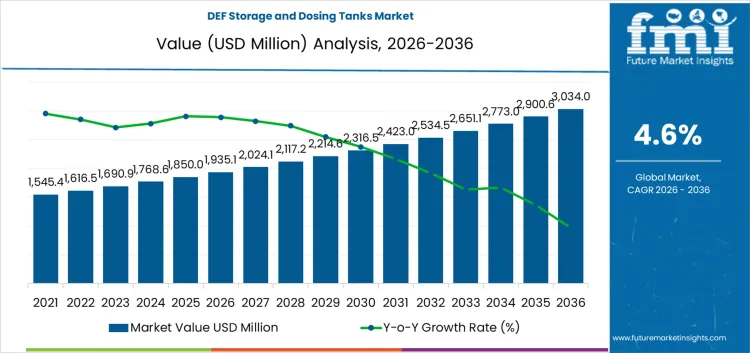
DEF Storage and Dosing Tanks Market Key Takeaways
| Metric | Value |
|---|---|
| Market Value (2026) | USD 1,935.1 million |
| Market Forecast Value (2036) | USD 3,034 million |
| Forecast CAGR 2026 to 2036 | 4.6% |
Why is the Demand for DEF Storage and Dosing Tanks Growing?
Demand for DEF storage and dosing tanks is increasing as commercial vehicle fleets and industrial operators implement systems to meet stringent emissions regulations that require reliable urea delivery for selective catalytic reduction. Truck and bus manufacturers specify tanks that maintain chemical stability and prevent crystallization because consistent DEF quality supports effective reduction of nitrogen oxide emissions under varied duty cycles. Engineers assess material compatibility, structural integrity, and thermal management features to ensure tanks perform in extreme ambient conditions without degradation. Procurement teams evaluate certification compliance, fill capacity, and integration with dosing modules to ensure systems align with vehicle architecture and serviceability expectations.
Regulatory enforcement of emissions limits influences specification of storage and dosing solutions that support predictable dosing accuracy and reduced risk of exhaust aftertreatment malfunctions. Growth in long haul and regional freight activity reinforces uptake of DEF tanks that align with sustained usage patterns and maintenance planning. Fleet maintenance professionals prioritize designs that minimize contamination risk and allow efficient access for inspection and fill operations during scheduled service intervals. Manufacturers coordinate with aftertreatment module suppliers to verify compatibility and ensure consistent dosing control under variable engine loads. These technical and operational factors support sustained demand for DEF storage and dosing tanks in evolving heavy duty transport and industrial segments.
How Are the Segments Classified in the DEF Storage and Dosing Tanks Market?
Demand for DEF storage and dosing tanks is shaped by emission regulation compliance, selective catalytic reduction system reliability, and cold-weather operability requirements. Adoption aligns with tightening nitrogen oxide limits across commercial vehicle platforms. System design prioritizes chemical compatibility, freeze protection, and dosing accuracy under varied operating conditions. Vehicle packaging constraints and service accessibility influence tank configuration choices. Segment classification reflects differentiation by tank design, vehicle application, and functional system role. Structure highlights how storage method, vehicle duty profile, and component function influence specification priorities, integration depth, and utilization patterns across emission control systems.
Which Tank Type Represents the Largest Share of Demand?
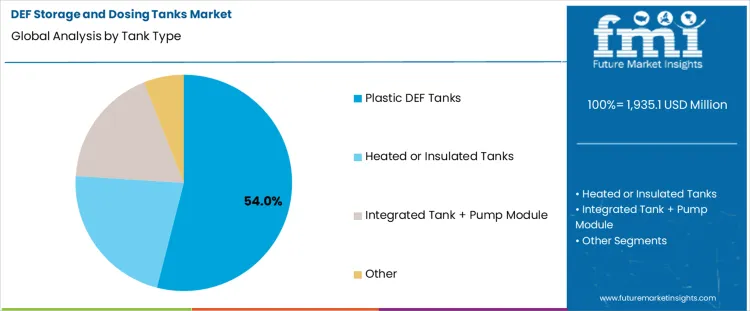
Plastic DEF tanks hold 54.0%, representing the largest share among tank types due to chemical resistance and weight efficiency. Polymer materials prevent corrosion and contamination when storing urea-based fluids. Molded designs support complex shapes enabling flexible vehicle packaging. Cost efficiency and manufacturing scalability reinforce widespread adoption. Heated or insulated tanks address freeze protection needs in cold climates with added system complexity. Integrated tank and pump modules combine storage and dosing functions for compact installations. Tank type segmentation reflects preference for lightweight, corrosion-resistant solutions supporting reliable DEF containment across diverse vehicle platforms.
Key Points
- Plastic tanks resist corrosion and chemical degradation.
- Lightweight design supports flexible vehicle packaging.
- Other tank types address freeze protection and integration needs.
Which Vehicle Segment Accounts for the Highest Share of Demand?
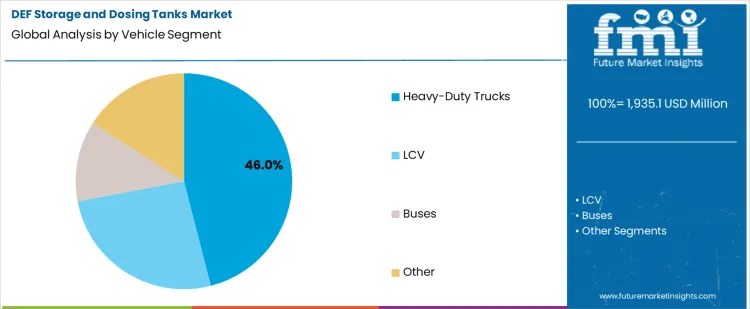
Heavy-duty trucks hold 46.0%, representing the largest share among vehicle segments using DEF storage and dosing systems. High engine output and extended duty cycles increase DEF consumption rates. Regulatory compliance for long-haul operations reinforces consistent system integration. Larger chassis space supports higher-capacity tanks required for extended range. Light commercial vehicles and buses apply DEF systems with lower consumption intensity. Other vehicle categories contribute varied demand. Vehicle segmentation reflects concentration of DEF system usage within heavy-duty platforms where emission control intensity and utilization remain highest.
Key Points
- Heavy-duty trucks consume DEF at higher rates.
- Long-haul operation requires larger storage capacity.
- Other segments operate under lower DEF usage intensity.
Which System Component Drives the Largest Share of Demand?

Storage tanks hold 44.0%, representing the largest share among system components due to fundamental containment role. Tanks ensure continuous availability of DEF for emission control operation. Structural integrity and volume capacity directly affect system reliability and service intervals. Dosing modules manage precise fluid delivery into exhaust aftertreatment systems. Lines and heaters support fluid transport and freeze prevention with secondary roles. Other components address auxiliary functions. System component segmentation reflects dominance of containment elements where capacity, durability, and compatibility remain critical for sustained emission system performance.
Key Points
- Storage tanks ensure continuous DEF availability.
- Capacity and integrity influence service intervals.
- Other components support dosing and freeze protection functions.
What are the Key Dynamics in the DEF Storage and Dosing Tanks Market?
Demand for DEF storage and dosing tanks reflects regulatory requirements for selective catalytic reduction systems in diesel vehicles and equipment. Adoption spans heavy-duty trucks, buses, off-highway machinery, and stationary diesel engines. Global scope aligns with emission control compliance and nitrogen oxide reduction mandates. Usage centers on polymer tanks, heaters, level sensors, pumps, and dosing interfaces designed to preserve fluid quality and ensure accurate delivery.
How do emission compliance and system reliability requirements shape adoption?
Selective catalytic reduction systems require precise DEF dosing to maintain nitrogen oxide conversion efficiency. Demand increases as emission standards enforce continuous compliance across varied duty cycles. Storage tanks must prevent contamination, crystallization, and thermal degradation of DEF. Integrated heaters support operation in low-temperature conditions where fluid freezing risks system failure. Accurate level sensing and quality monitoring reduce risk of derate events and operator noncompliance. Fleet operators prioritize tanks compatible with onboard diagnostics and warning systems. Adoption reflects operational dependence on reliable DEF availability to sustain engine performance and regulatory conformity across long service intervals.
How does material durability, cost pressure, and operating constraints influence market scalability?
DEF tanks require materials resistant to urea corrosion, thermal cycling, and vibration exposure. Demand sensitivity rises where higher-grade polymers increase system cost in price-competitive vehicle segments. Packaging constraints complicate tank placement on crowded chassis layouts. Heater and sensor failures elevate downtime and warranty risk. Cold climate operation increases energy draws and component stress. Validation requirements for emission-critical components extend development timelines. Supply chain dependence on molded plastics, electronics, and heating elements affects availability. Aftermarket quality variation influences replacement performance consistency, constraining scalable standardization.
How Is Demand for DEF Storage and Dosing Tanks Evolving Globally?
Demand for DEF storage and dosing tanks is expanding globally due to emission compliance requirements, sustained diesel fleet utilization, and maintenance-led replacement cycles. Consumption aligns with selective catalytic reduction adoption, dosing accuracy expectations, and durability under temperature variation. Electrified platforms do not offset SCR needs in heavy-duty applications, sustaining DEF system relevance. Fleet operators prioritize tank integrity, heating capability, and contamination control. Growth rates in China at 6.4%, Brazil at 6.2%, USA at 4.1%, Germany at 3.9%, and South Korea at 3.8% indicate steady expansion driven by regulatory enforcement, operating intensity, and lifecycle servicing rather than rapid fleet growth.
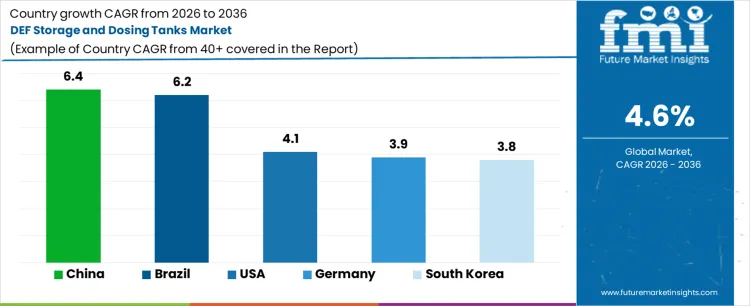
| Country | CAGR (%) |
|---|---|
| China | 6.4% |
| Brazil | 6.2% |
| USA | 4.1% |
| Germany | 3.9% |
| South Korea | 3.8% |
What Is Supporting DEF Storage and Dosing Tank Demand Growth in China?
DEF storage and dosing tank demand in China is growing at a CAGR of 6.4%, supported by stringent emission enforcement across commercial fleets. High utilization in logistics and construction accelerates DEF consumption, increasing stress on tanks, heaters, and dosing interfaces. Urban cold starts and regional temperature variation raise requirements for integrated heating and insulation. OEMs standardize SCR architectures to meet compliance checks. Inspection regimes encourage timely replacement to avoid derate events. Domestic manufacturing sustains OEM volumes, while maintenance programs reinforce aftermarket demand tied to high duty cycles.
- Tightened emission enforcement across diesel fleets
- High DEF consumption from intensive vehicle utilization
- Temperature variation increasing heating and insulation needs
- Strong OEM standardization and inspection oversight
Why Is Brazil Experiencing Steady Expansion in DEF Tank Demand?
Operating conditions shape DEF storage and dosing tank demand in Brazil, expanding at a CAGR of 6.2%. Long-haul freight and agricultural transport increase SCR usage frequency. Heat exposure and vibration affect tank materials, sensors, and dosing lines. Fleet operators prioritize robust designs to prevent crystallization and leakage. Regulatory alignment drives phased upgrades across existing fleets. Replacement demand rises as vehicles age under high utilization. Growth reflects operating stress and compliance needs rather than expansion in new diesel registrations.
- Long-haul and agricultural transport increasing SCR usage
- Heat and vibration impacting tank durability
- Compliance-driven phased upgrades across fleets
- Aging vehicles supporting aftermarket replacement
How Is the USA Sustaining Demand for DEF Storage and Dosing Tanks?
DEF storage and dosing tank demand in the USA is expanding at a CAGR of 4.1%, driven by high mileage accumulation and compliance maintenance. Diverse climates expose DEF systems to freezing and thermal cycling, increasing heater and tank wear. Fleet operators emphasize reliability to avoid power derates. Regulatory scrutiny sustains replacement aligned with maintenance schedules. Aftermarket demand dominates due to long vehicle service life. Growth remains measured, aligned with lifecycle servicing and staged fleet upgrades.
- Climate diversity stressing DEF heaters and tanks
- High mileage accelerating maintenance requirements
- Compliance focus to prevent derate events
- Strong aftermarket replacement orientation
What Factors Are Shaping DEF Tank Demand in Germany?
Engineering discipline influences DEF storage and dosing tank demand in Germany, growing at a CAGR of 3.9%. Strict emission testing and inspection regimes require consistent SCR performance. High-quality materials and precise integration extend service intervals, moderating replacement frequency. Cold-weather operation increases importance of reliable heating elements. Preventive maintenance schedules create predictable demand. Export-driven logistics sustain steady utilization without rapid fleet expansion. Growth reflects disciplined compliance within mature fleets rather than acceleration in diesel vehicle deployment.
- Strict emission testing and inspection standards
- Cold-weather reliability requirements for heaters
- Predictable replacement under preventive maintenance
- Stable utilization from export logistics
Why Is South Korea Showing Controlled Growth in DEF Tank Demand?
DEF storage and dosing tank demand in South Korea is growing at a CAGR of 3.8%, shaped by efficient fleet management and compact operating geography. Shorter routes reduce cumulative SCR duty cycles, moderating wear. Strong maintenance discipline limits premature failures. Port-centric logistics sustain steady diesel utilization. Regulatory alignment supports consistent adoption without rapid retrofit surges. Growth remains controlled, reflecting efficient operations and scheduled replacement rather than expansion of diesel fleet volumes.
- Shorter routes moderating SCR duty cycles
- Strong preventive maintenance discipline
- Port-centric logistics sustaining utilization
- Gradual regulatory-aligned replacement patterns
What is the competitive landscape of demand for the DEF storage and dosing tanks market globally?
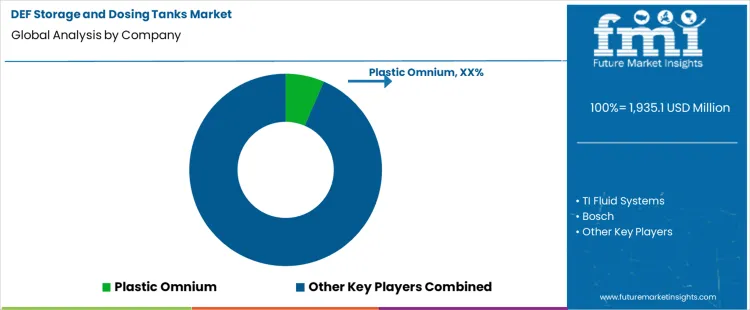
Demand for diesel exhaust fluid (DEF) storage and dosing tanks is driven by global emissions regulations requiring selective catalytic reduction (SCR) systems to reduce NOₓ emissions from diesel engines in commercial vehicles, buses, off-highway equipment, and industrial applications. DEF tanks and dosing modules must provide secure fluid containment, accurate metering, chemical compatibility (urea solution), and integration with exhaust aftertreatment systems. Buyers evaluate tank materials, dosing precision, freeze-thaw resilience, ease of integration with vehicle platforms, and compliance with automotive thermal and vibration standards. Procurement teams prioritize suppliers with OEM approvals, quality certifications, and the ability to support diverse vehicle architectures across regions. Trend in the global market reflects continued tightening of emissions standards and adoption of DEF dosing technology across medium and heavy-duty fleets.
Plastic Omnium holds leading positioning through engineered DEF storage and dosing solutions integrated into exhaust aftertreatment systems widely adopted by global OEMs. TI Fluid Systems supports demand with DEF modules and integrated fluid handling technologies designed for reliability and chemical compatibility. Bosch contributes dosing systems and control modules that ensure precise DEF injection and regulatory compliance. Continental participates with fluid storage and dosing components aligned with vehicle electrical and thermal management interfaces. Cummins supplies DEF dosing technologies supported by engine system integration and aftertreatment expertise. Competitive differentiation depends on tank material performance, dosing accuracy, integration ease, emissions compliance, and support for global service networks.
Key Players in the DEF Storage and Dosing Tanks Market
- Plastic Omnium
- TI Fluid Systems
- Bosch
- Continental
- Cummins
- Eberspächer
- HELLA
- Sogefi
- Marelli
- Yazaki
Scope of the Report
| Items | Values |
|---|---|
| Quantitative Units | USD million |
| Tank Type | Plastic DEF Tanks; Heated or Insulated Tanks; Integrated Tank + Pump Module; Other |
| Vehicle Segment | Heavy-Duty Trucks; LCV; Buses; Other |
| System Component | Storage Tanks; Dosing Modules; Lines or Heaters; Other |
| Sales Channel | OEM Line-Fit; Service or Replacement; Aftermarket; Other |
| Regions Covered | Asia Pacific, Europe, North America, Latin America, Middle East & Africa |
| Countries Covered | China, Brazil, USA, Germany, South Korea, and 40+ countries |
| Key Companies Profiled | Plastic Omnium; TI Fluid Systems; Bosch; Continental; Cummins; Eberspächer; HELLA; Sogefi; Marelli; Yazaki |
| Additional Attributes | Dollar sales by tank type and vehicle segment; adoption trends for integrated heated DEF tank-pump modules to ensure low-temperature operability and packaging efficiency; crystallization control, material compatibility with urea solutions, and thermal insulation performance metrics; dosing accuracy, freeze-thaw durability, and leak prevention considerations; integration with SCR aftertreatment architectures and onboard diagnostics; service intervals, contamination management, and aftermarket replacement demand; compliance with regional emissions regulations and OEM validation standards influencing DEF storage and dosing system specification. |
DEF Storage and Dosing Tanks Market by Segment
Tank Type:
- Plastic DEF Tanks
- Heated or Insulated Tanks
- Integrated Tank + Pump Module
- Other
Vehicle Segment:
- Heavy-Duty Trucks
- LCV
- Buses
- Other
System Component:
- Storage Tanks
- Dosing Modules
- Lines or Heaters
- Other
Sales Channel:
- OEM Line-Fit
- Service or Replacement
- Aftermarket
- Other
Region:
- Asia Pacific
- China
- Japan
- South Korea
- India
- Australia & New Zealand
- ASEAN
- Rest of Asia Pacific
- Europe
- Germany
- United Kingdom
- France
- Italy
- Spain
- Nordic
- BENELUX
- Rest of Europe
- North America
- United States
- Canada
- Mexico
- Latin America
- Brazil
- Chile
- Rest of Latin America
- Middle East & Africa
- Kingdom of Saudi Arabia
- Other GCC Countries
- Turkey
- South Africa
- Other African Union
- Rest of Middle East & Africa
Bibliography
-
European Parliament and Council of the European Union. (2009). Regulation (EC) No 595/2009 of 18 June 2009 on type-approval of motor vehicles and engines with respect to emissions from heavy duty vehicles (Euro VI) and on access to vehicle repair and maintenance information. Official Journal of the European Union, L 188, 1–13.
-
European Commission. (2011). Commission Regulation (EU) No 582/2011 of 25 May 2011 implementing and amending Regulation (EC) No 595/2009 (Euro VI). Official Journal of the European Union, L 167, 1–168.
-
International Organization for Standardization. (2019). ISO 22241-1:2019 Diesel engines — NOx reduction agent AUS 32 — Part 1: Quality requirements. ISO.
-
United Nations Economic Commission for Europe. (2011). Regulation No. 49 (UN/ECE): Uniform provisions concerning measures to be taken against the emission of gaseous and particulate pollutants from compression-ignition engines (and PI engines fuelled with NG/LPG) for use in vehicles (as published in the EU Official Journal compilation). Official Journal of the European Union, L 180, 53–69.
Frequently Asked Questions
How big is the def storage and dosing tanks market in 2026?
The global def storage and dosing tanks market is estimated to be valued at USD 1,935.1 million in 2026.
What will be the size of def storage and dosing tanks market in 2036?
The market size for the def storage and dosing tanks market is projected to reach USD 3,034.0 million by 2036.
How much will be the def storage and dosing tanks market growth between 2026 and 2036?
The def storage and dosing tanks market is expected to grow at a 4.6% CAGR between 2026 and 2036.
What are the key product types in the def storage and dosing tanks market?
The key product types in def storage and dosing tanks market are plastic def tanks, heated or insulated tanks, integrated tank + pump module and other.
Which vehicle segment segment to contribute significant share in the def storage and dosing tanks market in 2026?
In terms of vehicle segment, heavy-duty trucks segment to command 46.0% share in the def storage and dosing tanks market in 2026.
Preview the report firsthand - request a free sample
Get SampleGet the brochure for pricing and purchase details.
Get PDFTable of Content
- Executive Summary
- Global Market Outlook
- Demand-side Trends
- Supply-side Trends
- Technology Roadmap Analysis
- Analysis and Recommendations
- Market Overview
- Market Coverage / Taxonomy
- Market Definition / Scope / Limitations
- Market Background
- Market Dynamics
- Drivers
- Restraints
- Opportunity
- Trends
- Scenario Forecast
- Demand in Optimistic Scenario
- Demand in Likely Scenario
- Demand in Conservative Scenario
- Opportunity Map Analysis
- Product Life Cycle Analysis
- Supply Chain Analysis
- Investment Feasibility Matrix
- Value Chain Analysis
- PESTLE and Porter’s Analysis
- Regulatory Landscape
- Regional Parent Market Outlook
- Production and Consumption Statistics
- Import and Export Statistics
- Market Dynamics
- Global Market Analysis 2021 to 2025 and Forecast, 2026 to 2036
- Historical Market Size Value (USD Million) Analysis, 2021 to 2025
- Current and Future Market Size Value (USD Million) Projections, 2026 to 2036
- Y-o-Y Growth Trend Analysis
- Absolute $ Opportunity Analysis
- Global Market Pricing Analysis 2021 to 2025 and Forecast 2026 to 2036
- Global Market Analysis 2021 to 2025 and Forecast 2026 to 2036, By Tank Type
- Introduction / Key Findings
- Historical Market Size Value (USD Million) Analysis By Tank Type , 2021 to 2025
- Current and Future Market Size Value (USD Million) Analysis and Forecast By Tank Type , 2026 to 2036
- Plastic DEF Tanks
- Heated or Insulated Tanks
- Integrated Tank + Pump Module
- Other
- Plastic DEF Tanks
- Y-o-Y Growth Trend Analysis By Tank Type , 2021 to 2025
- Absolute $ Opportunity Analysis By Tank Type , 2026 to 2036
- Global Market Analysis 2021 to 2025 and Forecast 2026 to 2036, By Vehicle Segment
- Introduction / Key Findings
- Historical Market Size Value (USD Million) Analysis By Vehicle Segment, 2021 to 2025
- Current and Future Market Size Value (USD Million) Analysis and Forecast By Vehicle Segment, 2026 to 2036
- Heavy-Duty Trucks
- LCV
- Buses
- Other
- Heavy-Duty Trucks
- Y-o-Y Growth Trend Analysis By Vehicle Segment, 2021 to 2025
- Absolute $ Opportunity Analysis By Vehicle Segment, 2026 to 2036
- Global Market Analysis 2021 to 2025 and Forecast 2026 to 2036, By System Component
- Introduction / Key Findings
- Historical Market Size Value (USD Million) Analysis By System Component, 2021 to 2025
- Current and Future Market Size Value (USD Million) Analysis and Forecast By System Component, 2026 to 2036
- Storage Tanks
- Dosing Modules
- Lines or Heaters
- Other
- Storage Tanks
- Y-o-Y Growth Trend Analysis By System Component, 2021 to 2025
- Absolute $ Opportunity Analysis By System Component, 2026 to 2036
- Global Market Analysis 2021 to 2025 and Forecast 2026 to 2036, By Sales Channel
- Introduction / Key Findings
- Historical Market Size Value (USD Million) Analysis By Sales Channel, 2021 to 2025
- Current and Future Market Size Value (USD Million) Analysis and Forecast By Sales Channel, 2026 to 2036
- OEM Line-Fit
- Service or Replacement
- Aftermarket
- Other
- OEM Line-Fit
- Y-o-Y Growth Trend Analysis By Sales Channel, 2021 to 2025
- Absolute $ Opportunity Analysis By Sales Channel, 2026 to 2036
- Global Market Analysis 2021 to 2025 and Forecast 2026 to 2036, By Region
- Introduction
- Historical Market Size Value (USD Million) Analysis By Region, 2021 to 2025
- Current Market Size Value (USD Million) Analysis and Forecast By Region, 2026 to 2036
- North America
- Latin America
- Western Europe
- Eastern Europe
- East Asia
- South Asia and Pacific
- Middle East & Africa
- Market Attractiveness Analysis By Region
- North America Market Analysis 2021 to 2025 and Forecast 2026 to 2036, By Country
- Historical Market Size Value (USD Million) Trend Analysis By Market Taxonomy, 2021 to 2025
- Market Size Value (USD Million) Forecast By Market Taxonomy, 2026 to 2036
- By Country
- USA
- Canada
- Mexico
- By Tank Type
- By Vehicle Segment
- By System Component
- By Sales Channel
- By Country
- Market Attractiveness Analysis
- By Country
- By Tank Type
- By Vehicle Segment
- By System Component
- By Sales Channel
- Key Takeaways
- Latin America Market Analysis 2021 to 2025 and Forecast 2026 to 2036, By Country
- Historical Market Size Value (USD Million) Trend Analysis By Market Taxonomy, 2021 to 2025
- Market Size Value (USD Million) Forecast By Market Taxonomy, 2026 to 2036
- By Country
- Brazil
- Chile
- Rest of Latin America
- By Tank Type
- By Vehicle Segment
- By System Component
- By Sales Channel
- By Country
- Market Attractiveness Analysis
- By Country
- By Tank Type
- By Vehicle Segment
- By System Component
- By Sales Channel
- Key Takeaways
- Western Europe Market Analysis 2021 to 2025 and Forecast 2026 to 2036, By Country
- Historical Market Size Value (USD Million) Trend Analysis By Market Taxonomy, 2021 to 2025
- Market Size Value (USD Million) Forecast By Market Taxonomy, 2026 to 2036
- By Country
- Germany
- UK
- Italy
- Spain
- France
- Nordic
- BENELUX
- Rest of Western Europe
- By Tank Type
- By Vehicle Segment
- By System Component
- By Sales Channel
- By Country
- Market Attractiveness Analysis
- By Country
- By Tank Type
- By Vehicle Segment
- By System Component
- By Sales Channel
- Key Takeaways
- Eastern Europe Market Analysis 2021 to 2025 and Forecast 2026 to 2036, By Country
- Historical Market Size Value (USD Million) Trend Analysis By Market Taxonomy, 2021 to 2025
- Market Size Value (USD Million) Forecast By Market Taxonomy, 2026 to 2036
- By Country
- Russia
- Poland
- Hungary
- Balkan & Baltic
- Rest of Eastern Europe
- By Tank Type
- By Vehicle Segment
- By System Component
- By Sales Channel
- By Country
- Market Attractiveness Analysis
- By Country
- By Tank Type
- By Vehicle Segment
- By System Component
- By Sales Channel
- Key Takeaways
- East Asia Market Analysis 2021 to 2025 and Forecast 2026 to 2036, By Country
- Historical Market Size Value (USD Million) Trend Analysis By Market Taxonomy, 2021 to 2025
- Market Size Value (USD Million) Forecast By Market Taxonomy, 2026 to 2036
- By Country
- China
- Japan
- South Korea
- By Tank Type
- By Vehicle Segment
- By System Component
- By Sales Channel
- By Country
- Market Attractiveness Analysis
- By Country
- By Tank Type
- By Vehicle Segment
- By System Component
- By Sales Channel
- Key Takeaways
- South Asia and Pacific Market Analysis 2021 to 2025 and Forecast 2026 to 2036, By Country
- Historical Market Size Value (USD Million) Trend Analysis By Market Taxonomy, 2021 to 2025
- Market Size Value (USD Million) Forecast By Market Taxonomy, 2026 to 2036
- By Country
- India
- ASEAN
- Australia & New Zealand
- Rest of South Asia and Pacific
- By Tank Type
- By Vehicle Segment
- By System Component
- By Sales Channel
- By Country
- Market Attractiveness Analysis
- By Country
- By Tank Type
- By Vehicle Segment
- By System Component
- By Sales Channel
- Key Takeaways
- Middle East & Africa Market Analysis 2021 to 2025 and Forecast 2026 to 2036, By Country
- Historical Market Size Value (USD Million) Trend Analysis By Market Taxonomy, 2021 to 2025
- Market Size Value (USD Million) Forecast By Market Taxonomy, 2026 to 2036
- By Country
- Kingdom of Saudi Arabia
- Other GCC Countries
- Turkiye
- South Africa
- Other African Union
- Rest of Middle East & Africa
- By Tank Type
- By Vehicle Segment
- By System Component
- By Sales Channel
- By Country
- Market Attractiveness Analysis
- By Country
- By Tank Type
- By Vehicle Segment
- By System Component
- By Sales Channel
- Key Takeaways
- Key Countries Market Analysis
- USA
- Pricing Analysis
- Market Share Analysis, 2025
- By Tank Type
- By Vehicle Segment
- By System Component
- By Sales Channel
- Canada
- Pricing Analysis
- Market Share Analysis, 2025
- By Tank Type
- By Vehicle Segment
- By System Component
- By Sales Channel
- Mexico
- Pricing Analysis
- Market Share Analysis, 2025
- By Tank Type
- By Vehicle Segment
- By System Component
- By Sales Channel
- Brazil
- Pricing Analysis
- Market Share Analysis, 2025
- By Tank Type
- By Vehicle Segment
- By System Component
- By Sales Channel
- Chile
- Pricing Analysis
- Market Share Analysis, 2025
- By Tank Type
- By Vehicle Segment
- By System Component
- By Sales Channel
- Germany
- Pricing Analysis
- Market Share Analysis, 2025
- By Tank Type
- By Vehicle Segment
- By System Component
- By Sales Channel
- UK
- Pricing Analysis
- Market Share Analysis, 2025
- By Tank Type
- By Vehicle Segment
- By System Component
- By Sales Channel
- Italy
- Pricing Analysis
- Market Share Analysis, 2025
- By Tank Type
- By Vehicle Segment
- By System Component
- By Sales Channel
- Spain
- Pricing Analysis
- Market Share Analysis, 2025
- By Tank Type
- By Vehicle Segment
- By System Component
- By Sales Channel
- France
- Pricing Analysis
- Market Share Analysis, 2025
- By Tank Type
- By Vehicle Segment
- By System Component
- By Sales Channel
- India
- Pricing Analysis
- Market Share Analysis, 2025
- By Tank Type
- By Vehicle Segment
- By System Component
- By Sales Channel
- ASEAN
- Pricing Analysis
- Market Share Analysis, 2025
- By Tank Type
- By Vehicle Segment
- By System Component
- By Sales Channel
- Australia & New Zealand
- Pricing Analysis
- Market Share Analysis, 2025
- By Tank Type
- By Vehicle Segment
- By System Component
- By Sales Channel
- China
- Pricing Analysis
- Market Share Analysis, 2025
- By Tank Type
- By Vehicle Segment
- By System Component
- By Sales Channel
- Japan
- Pricing Analysis
- Market Share Analysis, 2025
- By Tank Type
- By Vehicle Segment
- By System Component
- By Sales Channel
- South Korea
- Pricing Analysis
- Market Share Analysis, 2025
- By Tank Type
- By Vehicle Segment
- By System Component
- By Sales Channel
- Russia
- Pricing Analysis
- Market Share Analysis, 2025
- By Tank Type
- By Vehicle Segment
- By System Component
- By Sales Channel
- Poland
- Pricing Analysis
- Market Share Analysis, 2025
- By Tank Type
- By Vehicle Segment
- By System Component
- By Sales Channel
- Hungary
- Pricing Analysis
- Market Share Analysis, 2025
- By Tank Type
- By Vehicle Segment
- By System Component
- By Sales Channel
- Kingdom of Saudi Arabia
- Pricing Analysis
- Market Share Analysis, 2025
- By Tank Type
- By Vehicle Segment
- By System Component
- By Sales Channel
- Turkiye
- Pricing Analysis
- Market Share Analysis, 2025
- By Tank Type
- By Vehicle Segment
- By System Component
- By Sales Channel
- South Africa
- Pricing Analysis
- Market Share Analysis, 2025
- By Tank Type
- By Vehicle Segment
- By System Component
- By Sales Channel
- USA
- Market Structure Analysis
- Competition Dashboard
- Competition Benchmarking
- Market Share Analysis of Top Players
- By Regional
- By Tank Type
- By Vehicle Segment
- By System Component
- By Sales Channel
- Competition Analysis
- Competition Deep Dive
- Plastic Omnium
- Overview
- Product Portfolio
- Profitability by Market Segments (Product/Age /Sales Channel/Region)
- Sales Footprint
- Strategy Overview
- Marketing Strategy
- Product Strategy
- Channel Strategy
- TI Fluid Systems
- Bosch
- Continental
- Cummins
- Eberspächer
- HELLA
- Sogefi
- Marelli
- Yazaki
- Plastic Omnium
- Competition Deep Dive
- Assumptions & Acronyms Used
- Research Methodology


