

- Industry Size (2026)
- USD 480 Mn
- Forecast (2036)
- USD 1115.7 Mn
- CAGR (2026 to 2036)
- 8.8%
NIAM-Compliant Coatings and Additives Market Forecast and Outlook 2026 to 2036
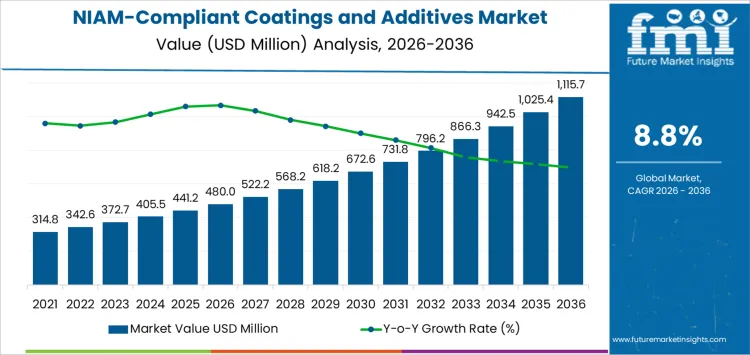
The NIAM-compliant coatings and additives market is expected to grow from USD 480 million in 2026 to USD 1,115.7 million by 2036, reflecting a compound annual growth rate (CAGR) of 8.8%. These coatings and additives are designed to meet the standards set by the National Institute of Additive Manufacturing (NIAM), ensuring that the materials used in manufacturing processes, particularly in industries such as automotive, aerospace, and construction, are compliant with environmental, safety, and performance regulations. The increasing demand for high-performance coatings that meet stricter regulatory standards and provide longer-lasting, environmentally friendly solutions is driving this market's growth.
The market’s growth is further fueled by the rapid expansion of additive manufacturing technologies, which are increasingly adopted across various sectors for creating more complex, lightweight, and customized parts. As industries move towards more sustainable and efficient manufacturing practices, NIAM-compliant coatings and additives will continue to play a crucial role in achieving regulatory compliance, improving product performance, and reducing the environmental impact of manufacturing processes.
Quick Stats of the NIAM-Compliant Coatings and Additives Market
- NIAM-Compliant Coatings and Additives Market Value (2026): USD 480 million
- NIAM-Compliant Coatings and Additives Market Forecast Value (2036): USD 1,115.7 million
- NIAM-Compliant Coatings and Additives Market Global Forecast CAGR (2026-2036): 8.8%
- NIAM-Compliant Coatings and Additives Market Leading Segment: Technology (Polymer-free dispersion & wax-based coatings) 55%
- Key Growth Regions in NIAM-Compliant Coatings and Additives Market: China
- Top Players in NIAM-Compliant Coatings and Additives Market: BASF, Siegwerk, Wanhua, UFlex Chemicals, Archroma, Dow, Henkel
What is the Growth Forecast for the NIAM-Compliant Coatings and Additives Market through 2036?
The breakpoint analysis for the NIAM-compliant coatings and additives market indicates a steady increase in adoption, with noticeable acceleration at key points in the forecast period. Starting at USD 480 million in 2026, the market grows to USD 522.8 million in 2027 and USD 569.8 million in 2028, showing gradual growth as industries begin to integrate NIAM-compliant solutions into their production processes to comply with regulatory standards.
From 2028 to 2030, the market sees a more substantial growth trajectory, reaching USD 621.9 million in 2029 and USD 679.1 million in 2030. This period marks the first major breakpoint, where adoption accelerates due to the increasing emphasis on sustainability and the need for more advanced coatings and additives in high-performance industries. Between 2030 and 2035, the market continues to expand rapidly, reaching USD 742.4 million in 2031, USD 812.1 million in 2032, and USD 888.3 million in 2033.
By 2035, the market is projected to reach USD 971.3 million, with the final projected value of USD 1,115.7 million expected by 2036. The breakpoint analysis highlights that while the market grows steadily, significant acceleration occurs as more industries adopt these compliant coatings and additives, driven by regulatory requirements, technological advancements, and a stronger emphasis on sustainability in manufacturing.
NIAM-Compliant Coatings and Additives Market Key Takeaways
| Metric | Value |
|---|---|
| Industry Sales Value (2026) | USD 480 million |
| Industry Forecast Value (2036) | USD 1,115.7 million |
| Industry Forecast CAGR (2026-2036) | 8.8% |
What Is Driving the Demand for NIAM-Compliant Coatings and Additives Market Globally?
The demand for NIAM compliant coatings and additives is driven by rising regulatory focus on Non Intentionally Added Materials (NIAM) and heightened scrutiny of chemical safety in coatings and additive chemistries. NIAM are substances not intentionally included during formulation but present at trace levels due to manufacturing, processing, or residual contaminants. Regulators in major markets such as the United States, Europe, and parts of Asia are increasingly requiring transparency about all components in coatings and additives, including NIAM content, to support safer end use in industries such as automotive, aerospace, consumer goods, pharmaceuticals, and food packaging. This regulatory shift compels formulators and raw material suppliers to redesign products with improved purity profiles and reduced undesired residues. Brand owners and OEMs are responding by specifying NIAM compliant solutions to mitigate compliance risk and protect product performance. Consumer and corporate sustainability commitments are also reinforcing this trend, as stricter chemical management standards and procurement policies reward suppliers that disclose and manage trace components. Performance requirements for durability, corrosion resistance, UV stability, and adhesion must be maintained even as formulations are adjusted for NIAM compliance, so demand is particularly strong for technologies that balance safety, performance, and regulatory alignment.
Future demand for NIAM compliant coatings and additives is expected to grow as global regulatory frameworks continue to evolve and harmonise around chemical disclosure and risk management. Adoption will be supported by advances in analytical methods that detect and quantify trace substances, enabling manufacturers to validate compliance with greater confidence and integrate NIAM criteria into quality management systems. As industries such as automotive electrification, medical devices, and food contact surfaces expand, coatings and additives that meet stringent safety and traceability requirements will be increasingly required. Digital product passports, extended producer responsibility regulations, and customer expectations for transparency will reinforce the value of NIAM compliant materials across supply chains. Innovation in raw materials and cleaner manufacturing processes will help suppliers meet performance and compliance needs without compromising cost or application versatility. Procurement practices that prioritise NIAM data reporting and risk mitigation will further accelerate uptake. As multinational companies align their global operations with evolving chemical safety standards, the market for NIAM compliant coatings and additives is poised for steady expansion.
What is the Segment Analysis for the NIAM-Compliant Coatings and Additives Market?
The NIAM-compliant coatings and additives market is driven by key segments based on packaging formats and materials. Among the packaging formats, coated films and paperboard lead the market, accounting for 45% of the share, followed by barrier-coated papers, flexible packaging, and laminated structures. These formats are commonly used in a variety of industries, such as food, pharmaceuticals, and consumer goods, where ensuring product integrity and meeting environmental regulations are key priorities. In terms of materials, NIAM-free barrier coatings dominate with 50% of the market share, followed by bio-based dispersions, acrylic-free formulations, and water-based coatings. These materials are selected for their ability to meet the stringent requirements of the NIAM (No Impact Additives and Materials) regulations, which focus on ensuring the safety and sustainability of packaging products. The growing focus on reducing the environmental impact of packaging materials and meeting regulatory standards is driving the adoption of NIAM-compliant coatings and additives. The market is further supported by the increasing demand for sustainable packaging solutions, particularly in regions like North America and Europe, where environmental concerns and regulatory requirements are top priorities.
What is Driving Growth in the Coated Films & Paperboard Segment of the NIAM-Compliant Coatings and Additives Market?
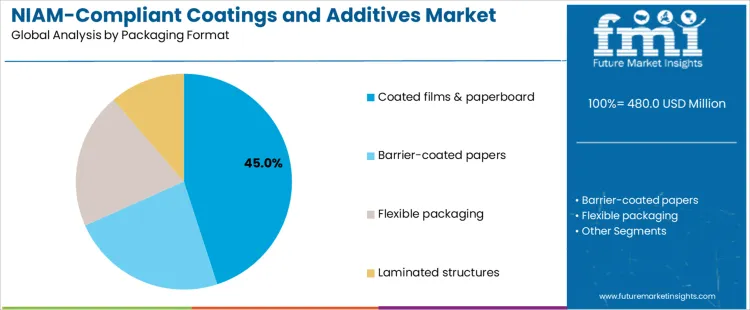
Coated films and paperboard are the leading packaging format in the NIAM-compliant coatings and additives market, comprising 45% of the market share. This growth is driven by the increasing demand for sustainable and compliant packaging solutions in industries such as food, beverages, and pharmaceuticals, where packaging performance and safety are crucial. Coated films and paperboard are often used to enhance the strength and protective properties of packaging while maintaining compliance with environmental standards. These materials are particularly well-suited for applications that require moisture, air, and light protection to ensure product integrity. The adoption of NIAM-compliant coatings, which are free from harmful additives and materials, is accelerating as businesses seek to meet increasingly stringent regulations regarding packaging safety and sustainability. Additionally, the flexibility of coated films and paperboard allows for easy integration with a variety of coatings, such as bio-based dispersions and water-based coatings, making them ideal for companies looking to enhance product appeal while minimizing their environmental footprint. As consumer and regulatory pressure increases, the demand for coated films and paperboard with NIAM-compliant coatings is expected to continue to grow, further establishing this segment as a market leader.
What is Contributing to the Growth of NIAM-Free Barrier Coatings in the Materials Segment?
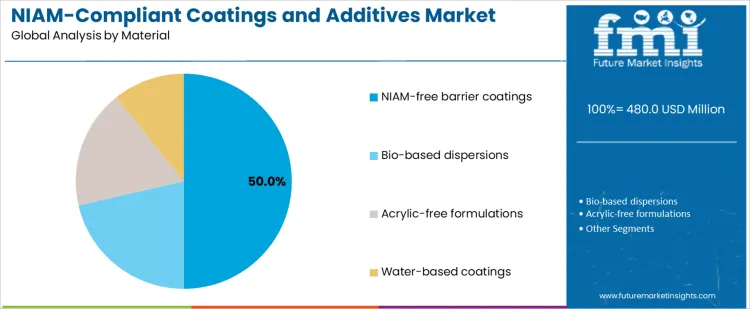
NIAM-free barrier coatings are the dominant material in the NIAM-compliant coatings and additives market, accounting for 50% of the market share. The growth of this material is largely driven by the increasing need for packaging solutions that adhere to environmental regulations while maintaining high performance. NIAM-free barrier coatings are designed to offer the same protective qualities as traditional coatings but without the use of harmful additives, ensuring the safety of the product and reducing the environmental impact. These coatings are especially important in industries such as food and pharmaceuticals, where contamination risks must be minimized, and packaging integrity is critical. The move towards bio-based and water-based alternatives has made NIAM-free barrier coatings an attractive option for manufacturers looking to comply with both environmental standards and consumer demands for sustainable products. As regulatory frameworks continue to evolve globally, the adoption of NIAM-free barrier coatings is expected to grow, particularly in regions with strong sustainability mandates. The ability of these coatings to provide excellent protection against moisture, oxygen, and light, while being free of harmful chemicals, positions them as a key growth driver in the NIAM-compliant coatings and additives market.
What are the Key Dynamics of the Global NIAM-Compliant Coatings and Additives Market?
The global NIAM compliant coatings and additives market is expanding as manufacturers respond to regulations and industry standards that require transparent handling of non intentionally added materials (NIAMs) in finished products. NIAM compliance helps ensure that residual substances from processing aids, catalysts or unintended reactions are identified, controlled and disclosed. Demand is rising in packaging, automotive, electronics and consumer goods where material safety and regulatory reporting are priorities. Growth reflects emphasis on product integrity, supply chain transparency and safer chemical management across production, distribution and end use worldwide, supporting broader adoption of compliant coatings and additives.
What are the Key Drivers for the Global NIAM Compliant Coatings and Additives Market?
Regulatory and industry expectations for safer, more traceable materials are major drivers. Standards and guidance that address NIAMs push formulators to select coatings and additives with known composition and low unintended residues. Brand owners prioritise compliant materials to support product safety declarations, environmental reporting and supply chain due diligence programmes. Growth in sectors such as food contact packaging, medical devices and electronics increases need for controlled chemistries with clear documentation. Advances in analytical testing and material characterisation support supplier transparency, helping manufacturers manage risk and meet stakeholder requirements for NIAM disclosure.
What are the Restraints for the Global NIAM Compliant Coatings and Additives Market?
Technical challenges in fully characterising and controlling NIAMs can restrain adoption. Detection of trace substances requires advanced analytical capabilities that may be costly or unavailable to smaller formulators. Reformulating existing coatings and additives to meet NIAM guidance can involve substantial research, validation and processing adjustments, which raises development cost and time. Companies may hesitate to invest in compliant alternatives if regulatory enforcement is uneven or timelines are uncertain. Variability in definitions and reporting requirements across regions also complicates global rollout of NIAM compliant solutions, creating planning and compliance challenges for multinational brands.
What is the Key Trends in the Global NIAM Compliant Coatings and Additives Market?
A key trend is integration of material transparency platforms that document ingredient sources, trace unintended residues and support compliance reporting for NIAMs. Suppliers are enhancing safety data and formulation disclosure to help downstream partners meet regulatory and customer expectations. Development of coatings and additives designed from the outset for low residuals and controlled impurity profiles is gaining attention. Collaboration among chemical producers, industry consortia and standards bodies is helping harmonise NIAM guidance and best practices. Use of digital tools to track supply chain data and material attributes supports faster decision making and aligns product portfolios with evolving compliance priorities.
What are the Key Insights from the NIAM-Compliant Coatings and Additives Market Analysis?
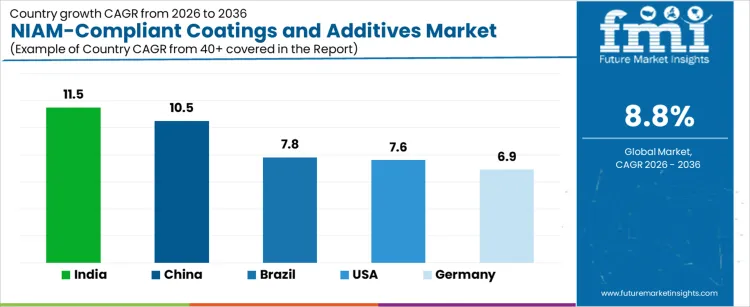
The NIAM-compliant coatings and additives market is projected to grow steadily across key regions, driven by increasing demand for coatings that meet environmental and regulatory standards. NIAM (National Institute of Additive Manufacturing) compliance ensures that coatings and additives are manufactured using safe, sustainable practices that adhere to strict environmental and safety guidelines. As industries such as automotive, construction, and consumer goods increasingly focus on sustainability and regulatory compliance, the demand for NIAM-compliant products is expected to rise. High-growth markets like China and India are seeing substantial increases in industrial production and environmental awareness, driving demand for compliant coatings. Meanwhile, developed markets like the USA and Germany are focusing on innovations in manufacturing processes and regulatory adherence, contributing to the market’s growth in these regions.
| Country | CAGR (2026 to 2036) |
|---|---|
| USA | 7.6% |
| Germany | 6.9% |
| China | 10.5% |
| India | 11.5% |
| Brazil | 7.8% |
What is the Growth Outlook for the NIAM-Compliant Coatings and Additives Market in the USA?
The market for NIAM-compliant coatings and additives in the United States is expected to grow at a moderate pace, with a projected CAGR of 7.6%. The U.S. manufacturing sector continues to emphasize compliance with environmental standards, which is driving the demand for coatings and additives that meet NIAM guidelines. The automotive, aerospace, and construction industries, in particular, are adopting more sustainable and eco-friendly coatings as part of their commitment to reducing environmental impact. As regulatory frameworks become more stringent, businesses in the U.S. are increasingly turning to NIAM-compliant products to meet compliance requirements. Furthermore, growing consumer and industry demand for environmentally responsible products will continue to support the market's expansion.
What is the Market Outlook for the NIAM-Compliant Coatings and Additives Market in Germany?
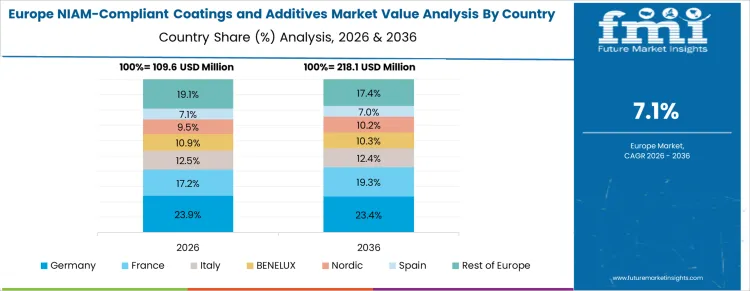
The NIAM-compliant coatings and additives market in Germany is projected to grow at a steady rate, with a projected CAGR of 6.9%. Germany's strong industrial base, particularly in automotive and manufacturing, drives demand for coatings and additives that comply with environmental regulations. The country’s commitment to sustainability and green technologies plays a significant role in the increasing adoption of NIAM-compliant products. As Germany’s manufacturing sector continues to innovate and comply with stricter environmental guidelines, the demand for compliant coatings will grow. Germany's regulatory landscape, which encourages the use of eco-friendly materials and manufacturing processes, supports the expansion of this market, particularly as industries strive to reduce their environmental footprint.
What is the Growth Forecast for the NIAM-Compliant Coatings and Additives Market in China?
The market for NIAM-compliant coatings and additives in China is expected to grow rapidly, with a projected CAGR of 10.5%. China’s large-scale manufacturing sector, particularly in industries like automotive, electronics, and construction, is a major driver of this market’s growth. As China continues to focus on environmental sustainability and adherence to global regulatory standards, there is an increasing demand for coatings and additives that meet NIAM guidelines. The government’s push for green manufacturing practices and sustainability initiatives is accelerating the shift towards environmentally friendly coatings. Additionally, China’s expanding consumer market and rising awareness of environmental issues contribute to the growing demand for NIAM-compliant coatings and additives in various industrial sectors.
What is the Market Outlook for the NIAM-Compliant Coatings and Additives Market in India?
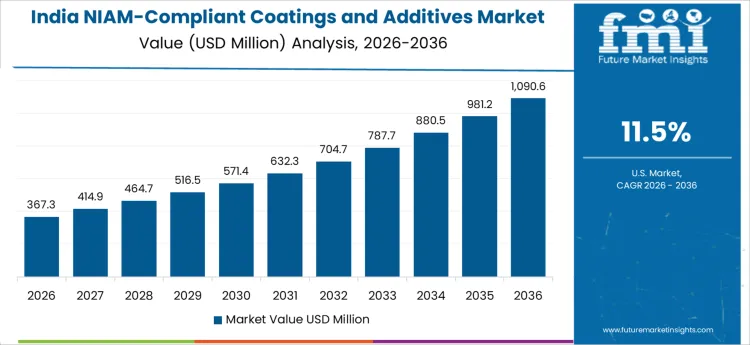
The market for NIAM-compliant coatings and additives in India is projected to grow at the highest rate, with a CAGR of 11.5%. India’s rapidly expanding industrial base, along with increasing regulatory focus on sustainability, is driving the demand for coatings and additives that adhere to NIAM standards. As industries such as automotive, construction, and consumer goods continue to grow, there is a growing need for environmentally friendly and compliant coatings. The Indian government’s initiatives to promote green manufacturing and sustainability are contributing to the adoption of NIAM-compliant products. Furthermore, as Indian manufacturers seek to align with international environmental standards, the demand for sustainable coatings and additives will continue to rise.
What are the Growth Prospects for the NIAM-Compliant Coatings and Additives Market in Brazil?
The market for NIAM-compliant coatings and additives in Brazil is expected to grow at a moderate pace, with a projected CAGR of 7.8%. Brazil’s manufacturing sector, particularly in automotive and construction, is increasingly adopting sustainable practices in line with global environmental regulations. As regulatory requirements become stricter, there is rising demand for coatings and additives that comply with NIAM standards. Brazil's focus on sustainability and eco-friendly products, combined with growing consumer demand for environmentally responsible packaging and manufacturing solutions, is expected to drive market growth. As industries in Brazil continue to align with international environmental standards, the adoption of NIAM-compliant coatings and additives will continue to increase.
What is the Competitive Landscape for the NIAM-Compliant Coatings and Additives Market?
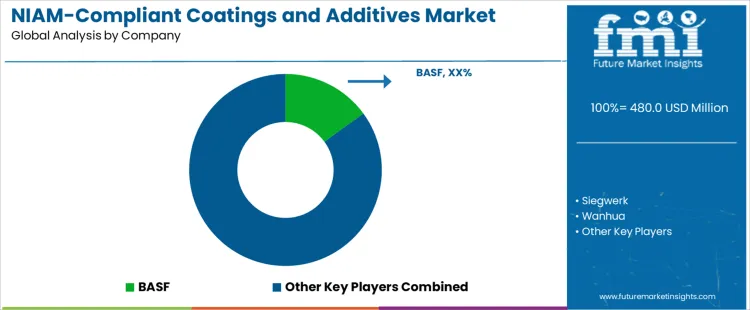
The NIAM-compliant coatings and additives market is growing rapidly, driven by the increasing demand for sustainable and environmentally friendly coatings solutions that adhere to regulatory standards. BASF leads the market with its innovative coatings and additives that meet National Institute for Agricultural Machinery (NIAM) compliance, offering high-performance solutions for various applications, including agriculture and packaging. Their commitment to sustainability and regulatory compliance has positioned them as a market leader. Siegwerk, Wanhua, and UFlex Chemicals are major competitors, each offering a range of coatings and additives designed to meet the evolving needs of environmentally-conscious industries. Siegwerk provides high-quality, eco-friendly coatings solutions, while Wanhua and UFlex Chemicals focus on delivering sustainable products that comply with NIAM standards.
Archroma, Dow, and Henkel add further competition to the market with their own environmentally compliant offerings. Archroma focuses on providing innovative, sustainable coatings and additives for textiles, while Dow delivers high-performance, eco-friendly chemical solutions for a variety of industries. Henkel brings expertise in creating NIAM-compliant coatings and additives for industrial and consumer goods applications, ensuring environmental safety and regulatory adherence. These companies compete by focusing on product innovation, regulatory compliance, and sustainability, offering coatings and additives that meet the growing demand for environmentally responsible solutions in the NIAM-compliant coatings market.
Key Players of the NIAM-Compliant Coatings and Additives Market
- BASF
- Siegwerk
- Wanhua
- UFlex Chemicals
- Archroma
- Dow
- Henkel
Scope of the Report
| Items | Values |
|---|---|
| Quantitative Units (2026) | USD Million |
| End-use / Application | Food & Beverage Packaging, Paper & Fibre Packaging, FMCG & Retail, Mass-Market Packaging, Foodservice, Specialty Packaging |
| Packaging Format / Type | Coated Films & Paperboard, Barrier-Coated Papers, Flexible Packaging, Laminated Structures, Others |
| Material | NIAM-Free Barrier Coatings, Bio-Based Dispersions, Acrylic-Free Formulations, Water-Based Coatings, Others |
| Technology | Polymer-Free Dispersion & Wax-Based Coatings, Repulpable Coating Systems, High-Solids Coating Application, Low-VOC Application |
| Companies | BASF, Siegwerk, Wanhua, UFlex Chemicals, Archroma, Dow, Henkel |
| Regions Covered | North America, Latin America, Western Europe, Eastern Europe, South Asia and Pacific, East Asia, Middle East & Africa |
| Countries Covered | United States, Canada, Mexico, Brazil, Argentina, Germany, France, United Kingdom, Italy, Spain, Netherlands, China, India, Japan, South Korea, ANZ, GCC Countries, South Africa |
| Additional Attributes | Dollar by sales by end-use/application, packaging format/type, material, technology, and region. Includes market trends in NIAM-compliant coatings and additives, focusing on barrier coatings, bio-based dispersions, and water-based formulations. Highlights the role of polymer-free dispersion, wax-based coatings, and low-VOC applications in food & beverage packaging, FMCG, and mass-market packaging. Focus on sustainability, regulatory compliance, market share, and competitive positioning of key companies in the packaging industry. |
NIAM-Compliant Coatings and Additives Market Segmentation
End-use / Application
- Food & beverage packaging
- Paper & fibre packaging
- FMCG & retail
- Mass-market packaging
- Foodservice
- Specialty packaging
Packaging Format / Type
- Coated films & paperboard
- Barrier-coated papers
- Flexible packaging
- Laminated structures
- Others
Material
- NIAM-free barrier coatings
- Bio-based dispersions
- Acrylic-free formulations
- Water-based coatings
- Others
Technology
- Polymer-free dispersion & wax-based coatings
- Repulpable coating systems
- High-solids coating application
- Low-VOC application
- Others
Region
- Asia Pacific
- China
- Japan
- South Korea
- India
- Australia & New Zealand
- ASEAN
- Rest of Asia Pacific
- Europe
- Germany
- United Kingdom
- France
- Italy
- Spain
- Nordic
- BENELUX
- Rest of Europe
- North America
- United States
- Canada
- Mexico
- Latin America
- Brazil
- Chile
- Rest of Latin America
- Middle East & Africa
- Kingdom of Saudi Arabia
- Other GCC Countries
- Turkey
- South Africa
- Other African Union
- Rest of Middle East & Africa
Frequently Asked Questions
How big is the NIAM-compliant coatings and additives market in 2026?
The global NIAM-compliant coatings and additives market is estimated to be valued at USD 480.0 million in 2026.
What will be the size of NIAM-compliant coatings and additives market in 2036?
The market size for the NIAM-compliant coatings and additives market is projected to reach USD 1,115.7 million by 2036.
How much will be the NIAM-compliant coatings and additives market growth between 2026 and 2036?
The NIAM-compliant coatings and additives market is expected to grow at a 8.8% CAGR between 2026 and 2036.
What are the key product types in the NIAM-compliant coatings and additives market?
The key product types in NIAM-compliant coatings and additives market are food & beverage packaging, paper & fibre packaging, FMCG & retail, mass-market packaging, foodservice and specialty packaging.
Which packaging format segment to contribute significant share in the NIAM-compliant coatings and additives market in 2026?
In terms of packaging format, coated films & paperboard segment to command 45.0% share in the NIAM-compliant coatings and additives market in 2026.
Preview the report firsthand - request a free sample
Get SampleGet the brochure for pricing and purchase details.
Get PDFTable of Content
- Executive Summary
- Global Market Outlook
- Demand-side Trends
- Supply-side Trends
- Technology Roadmap Analysis
- Analysis and Recommendations
- Market Overview
- Market Coverage / Taxonomy
- Market Definition / Scope / Limitations
- Market Background
- Market Dynamics
- Drivers
- Restraints
- Opportunity
- Trends
- Scenario Forecast
- Demand in Optimistic Scenario
- Demand in Likely Scenario
- Demand in Conservative Scenario
- Opportunity Map Analysis
- Product Life Cycle Analysis
- Supply Chain Analysis
- Investment Feasibility Matrix
- Value Chain Analysis
- PESTLE and Porter’s Analysis
- Regulatory Landscape
- Regional Parent Market Outlook
- Production and Consumption Statistics
- Import and Export Statistics
- Market Dynamics
- Global Market Analysis 2021 to 2025 and Forecast, 2026 to 2036
- Historical Market Size Value (USD Million) Analysis, 2021 to 2025
- Current and Future Market Size Value (USD Million) Projections, 2026 to 2036
- Y-o-Y Growth Trend Analysis
- Absolute $ Opportunity Analysis
- Global Market Pricing Analysis 2021 to 2025 and Forecast 2026 to 2036
- Global Market Analysis 2021 to 2025 and Forecast 2026 to 2036, By End-use
- Introduction / Key Findings
- Historical Market Size Value (USD Million) Analysis By End-use , 2021 to 2025
- Current and Future Market Size Value (USD Million) Analysis and Forecast By End-use , 2026 to 2036
- Food & beverage packaging
- Paper & fibre packaging
- FMCG & retail
- Mass-market packaging
- Foodservice
- Specialty packaging
- Y-o-Y Growth Trend Analysis By End-use , 2021 to 2025
- Absolute $ Opportunity Analysis By End-use , 2026 to 2036
- Global Market Analysis 2021 to 2025 and Forecast 2026 to 2036, By Packaging Format
- Introduction / Key Findings
- Historical Market Size Value (USD Million) Analysis By Packaging Format, 2021 to 2025
- Current and Future Market Size Value (USD Million) Analysis and Forecast By Packaging Format, 2026 to 2036
- Coated films & paperboard
- Barrier-coated papers
- Flexible packaging
- Laminated structures
- Y-o-Y Growth Trend Analysis By Packaging Format, 2021 to 2025
- Absolute $ Opportunity Analysis By Packaging Format, 2026 to 2036
- Global Market Analysis 2021 to 2025 and Forecast 2026 to 2036, By Material
- Introduction / Key Findings
- Historical Market Size Value (USD Million) Analysis By Material, 2021 to 2025
- Current and Future Market Size Value (USD Million) Analysis and Forecast By Material, 2026 to 2036
- NIAM-free barrier coatings
- Bio-based dispersions
- Acrylic-free formulations
- Water-based coatings
- Y-o-Y Growth Trend Analysis By Material, 2021 to 2025
- Absolute $ Opportunity Analysis By Material, 2026 to 2036
- Global Market Analysis 2021 to 2025 and Forecast 2026 to 2036, By Technology
- Introduction / Key Findings
- Historical Market Size Value (USD Million) Analysis By Technology, 2021 to 2025
- Current and Future Market Size Value (USD Million) Analysis and Forecast By Technology, 2026 to 2036
- Polymer-free dispersion & wax-based coatings
- Repulpable coating systems
- High-solids coating application
- Low-VOC application
- Y-o-Y Growth Trend Analysis By Technology, 2021 to 2025
- Absolute $ Opportunity Analysis By Technology, 2026 to 2036
- Global Market Analysis 2021 to 2025 and Forecast 2026 to 2036, By Region
- Introduction
- Historical Market Size Value (USD Million) Analysis By Region, 2021 to 2025
- Current Market Size Value (USD Million) Analysis and Forecast By Region, 2026 to 2036
- North America
- Latin America
- Western Europe
- Eastern Europe
- East Asia
- South Asia and Pacific
- Middle East & Africa
- Market Attractiveness Analysis By Region
- North America Market Analysis 2021 to 2025 and Forecast 2026 to 2036, By Country
- Historical Market Size Value (USD Million) Trend Analysis By Market Taxonomy, 2021 to 2025
- Market Size Value (USD Million) Forecast By Market Taxonomy, 2026 to 2036
- By Country
- USA
- Canada
- Mexico
- By End-use
- By Packaging Format
- By Material
- By Technology
- By Country
- Market Attractiveness Analysis
- By Country
- By End-use
- By Packaging Format
- By Material
- By Technology
- Key Takeaways
- Latin America Market Analysis 2021 to 2025 and Forecast 2026 to 2036, By Country
- Historical Market Size Value (USD Million) Trend Analysis By Market Taxonomy, 2021 to 2025
- Market Size Value (USD Million) Forecast By Market Taxonomy, 2026 to 2036
- By Country
- Brazil
- Chile
- Rest of Latin America
- By End-use
- By Packaging Format
- By Material
- By Technology
- By Country
- Market Attractiveness Analysis
- By Country
- By End-use
- By Packaging Format
- By Material
- By Technology
- Key Takeaways
- Western Europe Market Analysis 2021 to 2025 and Forecast 2026 to 2036, By Country
- Historical Market Size Value (USD Million) Trend Analysis By Market Taxonomy, 2021 to 2025
- Market Size Value (USD Million) Forecast By Market Taxonomy, 2026 to 2036
- By Country
- Germany
- UK
- Italy
- Spain
- France
- Nordic
- BENELUX
- Rest of Western Europe
- By End-use
- By Packaging Format
- By Material
- By Technology
- By Country
- Market Attractiveness Analysis
- By Country
- By End-use
- By Packaging Format
- By Material
- By Technology
- Key Takeaways
- Eastern Europe Market Analysis 2021 to 2025 and Forecast 2026 to 2036, By Country
- Historical Market Size Value (USD Million) Trend Analysis By Market Taxonomy, 2021 to 2025
- Market Size Value (USD Million) Forecast By Market Taxonomy, 2026 to 2036
- By Country
- Russia
- Poland
- Hungary
- Balkan & Baltic
- Rest of Eastern Europe
- By End-use
- By Packaging Format
- By Material
- By Technology
- By Country
- Market Attractiveness Analysis
- By Country
- By End-use
- By Packaging Format
- By Material
- By Technology
- Key Takeaways
- East Asia Market Analysis 2021 to 2025 and Forecast 2026 to 2036, By Country
- Historical Market Size Value (USD Million) Trend Analysis By Market Taxonomy, 2021 to 2025
- Market Size Value (USD Million) Forecast By Market Taxonomy, 2026 to 2036
- By Country
- China
- Japan
- South Korea
- By End-use
- By Packaging Format
- By Material
- By Technology
- By Country
- Market Attractiveness Analysis
- By Country
- By End-use
- By Packaging Format
- By Material
- By Technology
- Key Takeaways
- South Asia and Pacific Market Analysis 2021 to 2025 and Forecast 2026 to 2036, By Country
- Historical Market Size Value (USD Million) Trend Analysis By Market Taxonomy, 2021 to 2025
- Market Size Value (USD Million) Forecast By Market Taxonomy, 2026 to 2036
- By Country
- India
- ASEAN
- Australia & New Zealand
- Rest of South Asia and Pacific
- By End-use
- By Packaging Format
- By Material
- By Technology
- By Country
- Market Attractiveness Analysis
- By Country
- By End-use
- By Packaging Format
- By Material
- By Technology
- Key Takeaways
- Middle East & Africa Market Analysis 2021 to 2025 and Forecast 2026 to 2036, By Country
- Historical Market Size Value (USD Million) Trend Analysis By Market Taxonomy, 2021 to 2025
- Market Size Value (USD Million) Forecast By Market Taxonomy, 2026 to 2036
- By Country
- Kingdom of Saudi Arabia
- Other GCC Countries
- Turkiye
- South Africa
- Other African Union
- Rest of Middle East & Africa
- By End-use
- By Packaging Format
- By Material
- By Technology
- By Country
- Market Attractiveness Analysis
- By Country
- By End-use
- By Packaging Format
- By Material
- By Technology
- Key Takeaways
- Key Countries Market Analysis
- USA
- Pricing Analysis
- Market Share Analysis, 2025
- By End-use
- By Packaging Format
- By Material
- By Technology
- Canada
- Pricing Analysis
- Market Share Analysis, 2025
- By End-use
- By Packaging Format
- By Material
- By Technology
- Mexico
- Pricing Analysis
- Market Share Analysis, 2025
- By End-use
- By Packaging Format
- By Material
- By Technology
- Brazil
- Pricing Analysis
- Market Share Analysis, 2025
- By End-use
- By Packaging Format
- By Material
- By Technology
- Chile
- Pricing Analysis
- Market Share Analysis, 2025
- By End-use
- By Packaging Format
- By Material
- By Technology
- Germany
- Pricing Analysis
- Market Share Analysis, 2025
- By End-use
- By Packaging Format
- By Material
- By Technology
- UK
- Pricing Analysis
- Market Share Analysis, 2025
- By End-use
- By Packaging Format
- By Material
- By Technology
- Italy
- Pricing Analysis
- Market Share Analysis, 2025
- By End-use
- By Packaging Format
- By Material
- By Technology
- Spain
- Pricing Analysis
- Market Share Analysis, 2025
- By End-use
- By Packaging Format
- By Material
- By Technology
- France
- Pricing Analysis
- Market Share Analysis, 2025
- By End-use
- By Packaging Format
- By Material
- By Technology
- India
- Pricing Analysis
- Market Share Analysis, 2025
- By End-use
- By Packaging Format
- By Material
- By Technology
- ASEAN
- Pricing Analysis
- Market Share Analysis, 2025
- By End-use
- By Packaging Format
- By Material
- By Technology
- Australia & New Zealand
- Pricing Analysis
- Market Share Analysis, 2025
- By End-use
- By Packaging Format
- By Material
- By Technology
- China
- Pricing Analysis
- Market Share Analysis, 2025
- By End-use
- By Packaging Format
- By Material
- By Technology
- Japan
- Pricing Analysis
- Market Share Analysis, 2025
- By End-use
- By Packaging Format
- By Material
- By Technology
- South Korea
- Pricing Analysis
- Market Share Analysis, 2025
- By End-use
- By Packaging Format
- By Material
- By Technology
- Russia
- Pricing Analysis
- Market Share Analysis, 2025
- By End-use
- By Packaging Format
- By Material
- By Technology
- Poland
- Pricing Analysis
- Market Share Analysis, 2025
- By End-use
- By Packaging Format
- By Material
- By Technology
- Hungary
- Pricing Analysis
- Market Share Analysis, 2025
- By End-use
- By Packaging Format
- By Material
- By Technology
- Kingdom of Saudi Arabia
- Pricing Analysis
- Market Share Analysis, 2025
- By End-use
- By Packaging Format
- By Material
- By Technology
- Turkiye
- Pricing Analysis
- Market Share Analysis, 2025
- By End-use
- By Packaging Format
- By Material
- By Technology
- South Africa
- Pricing Analysis
- Market Share Analysis, 2025
- By End-use
- By Packaging Format
- By Material
- By Technology
- USA
- Market Structure Analysis
- Competition Dashboard
- Competition Benchmarking
- Market Share Analysis of Top Players
- By Regional
- By End-use
- By Packaging Format
- By Material
- By Technology
- Competition Analysis
- Competition Deep Dive
- BASF
- Overview
- Product Portfolio
- Profitability by Market Segments (Product/Age /Sales Channel/Region)
- Sales Footprint
- Strategy Overview
- Marketing Strategy
- Product Strategy
- Channel Strategy
- Siegwerk
- Wanhua
- UFlex Chemicals
- Archroma
- Dow
- Henkel
- BASF
- Competition Deep Dive
- Assumptions & Acronyms Used
- Research Methodology


