

- Industry Size (2026)
- USD 1340.4 Mn
- Forecast (2036)
- USD 2920.7 Mn
- CAGR (2026 to 2036)
- 8.1%
Immunosuppressants Kits Market Forecast and Outlook 2026 to 2036
The immunosuppressants kits market is forecasted to reach USD 1,340.4 million in 2026 and expand to USD 2,920.7 million by 2036, at a CAGR of 8.1%. Value behavior reflects the structural requirement for routine therapeutic drug monitoring in transplant medicine and chronic autoimmune care, where dosing precision directly affects clinical risk. Spending remains anchored to repeat testing volumes rather than episodic diagnostics, with laboratories prioritizing assay reliability, lot consistency, and uninterrupted reagent supply. Capital allocation favors platforms supporting standardized workflows across inpatient and outpatient monitoring, reinforcing stable procurement cycles within hospital networks and reference laboratories.
Adoption patterns are shaped by regulatory oversight, assay validation demands, and integration with automated laboratory systems. Utilization intensity increases where transplant programs scale longitudinal follow-up and where combination immunosuppressive regimens require frequent exposure assessment. Cost sensitivity persists in smaller centers due to reagent expense and validation overhead, limiting indiscriminate expansion. Market structure remains constrained by requirements for analytical specificity, cross-platform comparability, and continuous quality control. These constraints reinforce predictable growth tied to protocolized care pathways, long-term patient management, and institutional monitoring obligations rather than expansion of therapeutic indications.
Quick Stats for Immunosuppressants Kits Market
- Immunosuppressants Kits Market Value (2026): USD 1,340.4 million
- Immunosuppressants Kits Market Forecast Value (2036): USD 2,920.7 million
- Immunosuppressants Kits Market Forecast CAGR 2026 to 2036: 8.1%
- Leading Test Kit Type by Demand Share: Tacrolimus TDM kits
- Fastest-Growing Countries: India, Brazil, China, USA, Germany
- Top Players in Global Demand: Abbott, Roche Diagnostics, Siemens Healthineers, Thermo Fisher Scientific, Waters
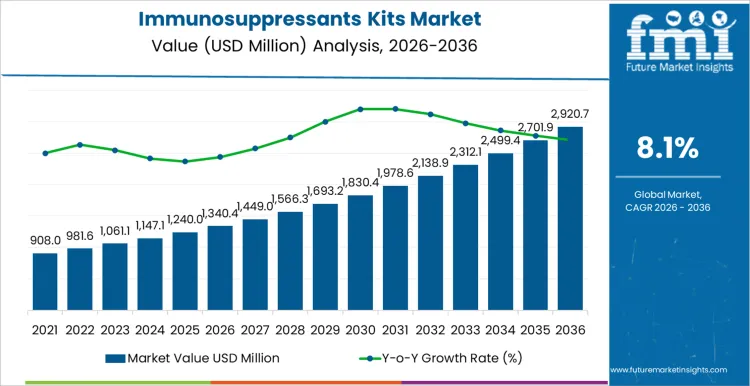
Immunosuppressants Kits Market Key Takeaways
| Metric | Value |
|---|---|
| Market Value (2026) | USD 1,340.4 million |
| Market Forecast Value (2036) | USD 2,920.7 million |
| Forecast CAGR 2026 to 2036 | 8.1% |
Why is the Demand for Immunosuppressants Kits Growing?
Demand for immunosuppressants kits is expanding as healthcare providers and transplant centers require standardized panels to support therapeutic drug monitoring and dose optimization in patients undergoing organ transplantation and treatment for autoimmune disorders. These kits include reagents, controls, and calibrators designed to measure blood concentrations of immunosuppressive agents such as tacrolimus, cyclosporine, and sirolimus, enabling clinicians to maintain drug levels within narrow therapeutic ranges that prevent rejection while minimizing toxicity. Clinical pharmacology laboratories value kits that deliver reproducible results with minimal assay variability because precise measurement influences dosing decisions that affect graft survival and patient outcomes. Procurement teams assess kit stability, lot-to-lot consistency, and compatibility with various analytical platforms to ensure integration with existing instrumentation and laboratory workflows under routine and high-volume testing conditions.
Growth in solid organ transplant procedures, rising prevalence of autoimmune conditions requiring long-term immunosuppression, and expanded use of personalized medicine strategies reinforce adoption of comprehensive monitoring solutions that reduce complications and readmissions. Providers are implementing structured immunosuppressant testing algorithms that support early detection of subtherapeutic or supratherapeutic exposure, which reduces incidence of opportunistic infections and drug-related organ toxicity. Research into drug interactions, pharmacogenomics, and immune response variability encourages laboratories to adopt multi-analyte kits that support broader clinical interpretation. Training for clinical laboratory scientists on assay performance and interpretation enhances confidence in therapeutic monitoring. These clinical performance, workflow integration, and patient management considerations are driving sustained demand growth in the immunosuppressants kits market.
How Is the Immunosuppressants Kits Industry Segmented by Test Kits, Clinical Applications, and End User?
Demand for immunoassay kits is shaped by therapeutic drug monitoring requirements, narrow therapeutic windows, and post-transplant outcome optimization. Laboratories prioritize analytical accuracy, turnaround time, and method standardization to support dose adjustment decisions. Adoption reflects growth in transplant procedures, broader use of combination regimens, and expansion of LC-MS/MS workflows. Selection decisions emphasize assay specificity, cross-reactivity control, and integration with laboratory systems. Segmentation clarifies how kit focus, monitoring objective, and testing environment influence utilization patterns across transplant medicine and immunotherapy management.
Which Test Kit Categories Represent the Largest Share in Immunosuppressants Monitoring?
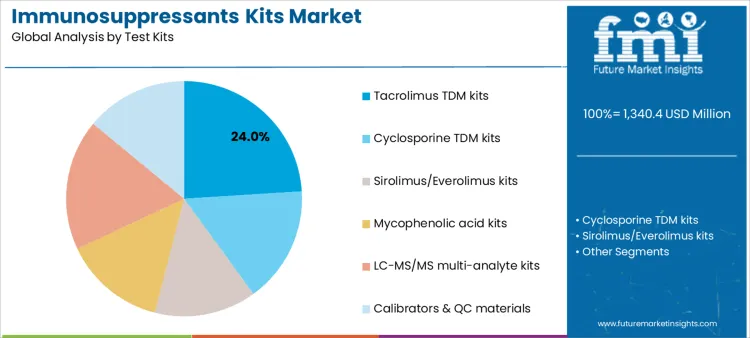
Tacrolimus TDM kits account for 24.0%, reflecting widespread use as a first-line calcineurin inhibitor in solid organ transplantation. These kits support routine trough level monitoring and frequent dose adjustments. LC-MS/MS multi-analyte kits at 18.0% enable simultaneous quantification of multiple immunosuppressants, improving efficiency and comparability. Cyclosporine TDM kits at 16.0% remain relevant in specific transplant protocols. Sirolimus or everolimus kits and mycophenolic acid kits each at 14.0% support mTOR inhibitor and antiproliferative monitoring. Calibrators and QC materials at 14.0% underpin assay reliability. Kit segmentation reflects emphasis on high-volume drugs supported by multiplexing and quality control.
Key Points:
- Tacrolimus kits dominate routine transplant monitoring.
- Multi-analyte LC-MS/MS kits improve workflow efficiency.
- QC materials ensure assay accuracy and consistency.
How Do Clinical Applications Shape Demand for Immunosuppressants Kits?
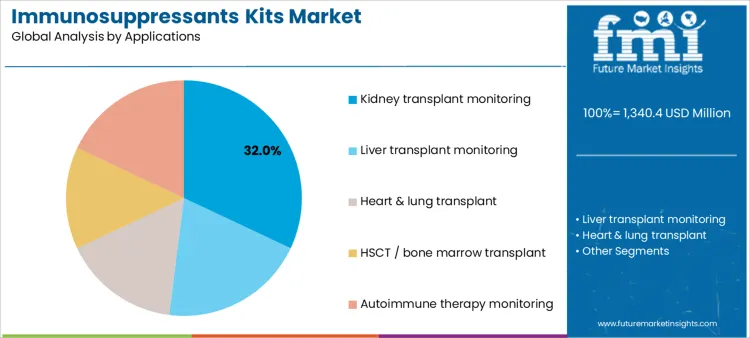
Kidney transplant monitoring represents 32.0%, driven by high transplant volumes and long-term immunosuppression management. Liver transplant monitoring at 20.0% requires close exposure control due to variable metabolism. Autoimmune therapy monitoring at 18.0% reflects expanding off-transplant use of immunosuppressants. Heart and lung transplant applications at 16.0% involve complex regimens and critical dosing precision. HSCT or bone marrow transplant at 14.0% applies monitoring during conditioning and graft maintenance. Application-based segmentation highlights concentration where dosing precision directly affects graft survival, toxicity risk, and therapeutic outcomes.
Key Points:
- Kidney transplants generate sustained monitoring demand.
- Liver transplants require careful exposure management.
- Autoimmune use expands beyond transplant settings.
Which End User Settings Drive Utilization of Immunosuppressants Kits?
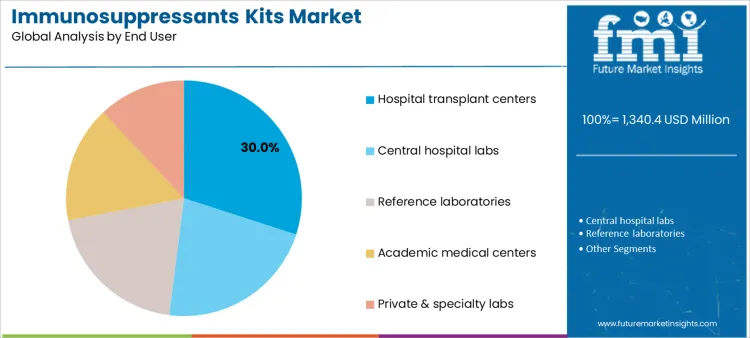
Hospital transplant centers account for 30.0%, reflecting proximity to patients and need for rapid therapeutic decisions. Central hospital laboratories at 22.0% provide high-throughput testing supporting multiple clinical units. Reference laboratories at 20.0% offer standardized methods and LC-MS/MS expertise for external clients. Academic medical centers at 16.0% support complex cases and protocol-driven care. Private and specialty laboratories at 12.0% address outpatient monitoring needs. End-user segmentation indicates concentration where clinical urgency, testing volume, and analytical capability guide kit adoption.
Key Points:
- Transplant centers require rapid, patient-proximate testing.
- Central labs support volume-driven hospital workflows.
- Reference labs provide standardized, high-complexity testing.
What are the Key Dynamics in the Immunosuppressants Kits Market?
Demand for immunosuppressants kits reflects clinical monitoring requirements for drugs with narrow therapeutic windows used in transplantation and autoimmune disease management. Adoption concentrates in hospital laboratories, transplant centers, and specialized diagnostic facilities. Global scope aligns with long-term graft survival protocols and chronic immunosuppression management. Usage centers on assay kits designed to quantify immunosuppressive drug levels in blood to support dose optimization and toxicity avoidance.
How do therapeutic drug monitoring needs and clinical risk management shape adoption?
Immunosuppressive therapies require precise dosing to balance rejection prevention against infection and organ toxicity risk. Demand increases where interpatient variability affects drug metabolism and exposure. Kits enable standardized measurement of drug concentrations to guide individualized dosing decisions. Transplant programs rely on routine monitoring to maintain stable immunosuppression during early post-transplant and maintenance phases. Autoimmune disease management uses monitoring to adjust long-term therapy and reduce adverse effects. Assay reliability, turnaround time, and compatibility with existing analyzers influence laboratory selection. Integration into routine clinical workflows supports frequent testing without excessive burden. Adoption reflects clinical dependence on objective drug level data to manage high-risk therapies safely.
How do assay specificity, regulatory requirements, and cost exposure influence market scalability?
Immunosuppressant assays must distinguish parent drugs from metabolites to avoid dosing error. Demand sensitivity rises where cross-reactivity or analytical variability affects clinical confidence. Regulatory oversight requires validation, quality control, and proficiency testing, increasing operational burden for laboratories. Reagent cost and instrument compatibility influence adoption in smaller centers. Method standardization varies across platforms, complicating result comparison between institutions. Supply continuity remains critical due to uninterrupted monitoring needs. Staff training and assay calibration add overhead. Scalability remains constrained by regulatory compliance demands, assay performance expectations, and economic considerations tied to sustained testing volume.
How Is Demand for Immunosuppressants Kits Evolving Globally?
Demand for immunosuppressants kits is expanding globally as transplant programs, autoimmune disease management, and therapeutic drug monitoring gain clinical importance. Routine monitoring of drug levels supports dose optimization, toxicity prevention, and long-term graft survival. Laboratory standardization and automation improve testing consistency across hospital networks. Reimbursement frameworks and guideline inclusion influence testing frequency. Growth rates in India at 10.6%, Brazil at 10.1%, China at 9.6%, the USA at 6.6%, and Germany at 6.5% indicate sustained expansion driven by transplant volume growth, protocolized monitoring, and laboratory capacity scaling rather than increases in disease incidence.
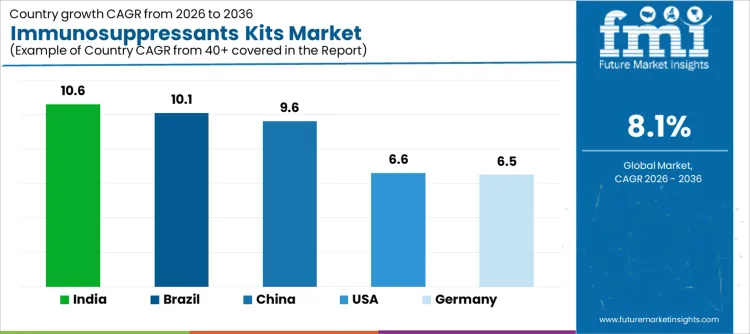
| Country | CAGR (%) |
|---|---|
| India | 10.6% |
| Brazil | 10.1% |
| China | 9.6% |
| USA | 6.6% |
| Germany | 6.5% |
What Is Driving Accelerated Growth of Immunosuppressants Kit Demand in India?
Demand for immunosuppressants kits in India is growing at a CAGR of 10.6%, supported by rising organ transplant activity and post-transplant care standardization. Tertiary hospitals expand therapeutic drug monitoring to manage calcineurin inhibitors and mTOR inhibitors effectively. Growth of private transplant centers increases routine testing volumes. Improved access to automated immunoassay platforms reduces turnaround time. Gradual insurance coverage expansion supports sustained monitoring. Growth reflects transplant program maturation and protocol adherence rather than episodic testing linked to acute complications.
- Rising kidney and liver transplant volumes
- Expansion of private transplant care centers
- Routine therapeutic drug monitoring protocols
- Increased availability of automated immunoassays
Why Is Brazil Experiencing Strong Uptake of Immunosuppressants Kits?
Immunosuppressants kit demand in Brazil is expanding at a CAGR of 10.1%, driven by public transplant programs and long-term graft management. Public hospitals require regular drug level monitoring to support universal transplant coverage. Standardized follow-up protocols increase testing consistency. Regional laboratories expand access beyond major metropolitan centers. Government procurement supports stable kit supply. Growth reflects institutional commitment to transplant outcomes and monitoring discipline rather than expansion of transplant indications.
- Publicly funded transplant follow-up programs
- Standardized long-term monitoring protocols
- Regional laboratory network expansion
- Centralized government procurement mechanisms
How Is China Sustaining Growth in Immunosuppressants Kit Utilization?
Demand for immunosuppressants kits in China is growing at a CAGR of 9.6%, aligned with expanding transplant infrastructure and hospital capacity. Large transplant centers integrate drug monitoring within routine inpatient and outpatient care. Reimbursement inclusion for therapeutic monitoring improves access. Domestic kit manufacturers supply cost-competitive assays at scale. Centralized hospital laboratories support high-throughput testing. Growth reflects systematized transplant care delivery and laboratory scaling rather than decentralized testing expansion.
- Expansion of high-volume transplant centers
- Reimbursement support for monitoring assays
- Cost-competitive domestic kit manufacturing
- Centralized laboratory testing models
What Factors Are Supporting Immunosuppressants Kit Demand in United States?
Immunosuppressants kit demand in the United States is expanding at a CAGR of 6.6%, supported by established transplant programs and guideline-driven care. Therapeutic drug monitoring remains integral to post-transplant management across organ types. Broad payer coverage ensures routine testing continuity. Advanced laboratory automation supports assay precision and throughput. Replacement demand and assay upgrades sustain volumes. Growth reflects protocol adherence and quality assurance rather than growth in transplant rates.
- Guideline-mandated post-transplant monitoring
- Broad insurance reimbursement coverage
- Advanced automated laboratory infrastructure
- Stable replacement and assay upgrade demand
Why Is Germany Showing Steady Expansion in Immunosuppressants Kits?
Immunosuppressants kit demand in Germany is growing at a CAGR of 6.5%, shaped by evidence-based transplant care and reimbursement governance. Certified transplant centers apply standardized monitoring schedules. Statutory insurance covers approved assays for long-term therapy management. Central laboratory services ensure analytical consistency and quality control. Emphasis on clinical utility moderates testing intensity. Growth remains steady, reflecting structured adoption and health system oversight rather than rapid expansion of testing volumes.
- Certified transplant center monitoring standards
- Statutory insurance reimbursement coverage
- Centralized laboratory quality assurance
- Focus on clinical utility and outcomes
What is the competitive landscape of demand for the immunosuppressants kits market globally?
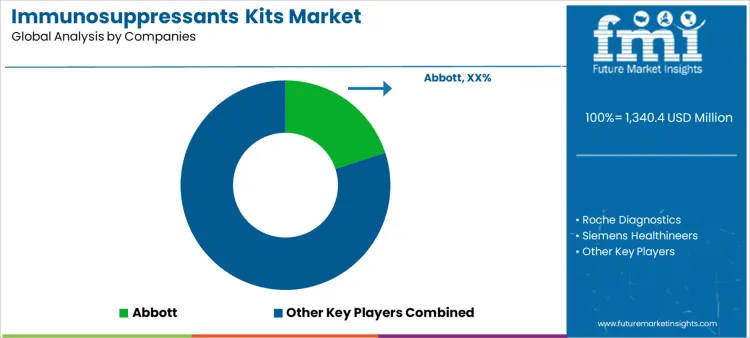
Demand for immunosuppressants kits is driven by organ transplantation volumes, therapeutic drug monitoring requirements, and long-term graft survival management. Clinical laboratories evaluate assay accuracy at low trough levels, cross-reactivity control, turnaround time, and compatibility with immunoassay or chromatography platforms. Buyer assessment includes calibration stability, reagent lot consistency, sample matrix flexibility, and compliance with clinical guidelines. Procurement behavior reflects hospital standardization strategies, long-term reagent contracts, and preference for kits integrated with existing analyzers. Trend in the immunosuppressants kits market shows sustained monitoring intensity supported by protocol-driven dosing and increasing transplant program complexity.
Abbott leads competitive positioning through immunosuppressant monitoring kits embedded within high-throughput clinical chemistry and immunoassay systems. Roche Diagnostics competes with standardized kits aligned with automated laboratory workflows and centralized testing environments. Siemens Healthineers supports demand by offering assays integrated with scalable laboratory automation and data management systems. Thermo Fisher Scientific maintains relevance through chromatography-based kits supporting high specificity monitoring in reference laboratories. Waters participates by aligning immunosuppressant kits with LC-MS workflows used for precise therapeutic drug monitoring. Competitive differentiation centers on analytical accuracy, workflow integration, regulatory compliance, and reliability of long-term supply.
Key Players in the Immunosuppressants Kits Market
- Abbott
- Roche Diagnostics
- Siemens Healthineers
- Thermo Fisher Scientific
- Waters
- Others
Scope of the Report
| Items | Values |
|---|---|
| Quantitative Units | USD million |
| Test Kits | Tacrolimus TDM kits; Cyclosporine TDM kits; Sirolimus/Everolimus kits; Mycophenolic acid kits; LC-MS/MS multi-analyte kits; Calibrators & QC materials |
| Applications | Kidney transplant monitoring; Liver transplant monitoring; Heart & lung transplant; HSCT / bone marrow transplant; Autoimmune therapy monitoring |
| End User | Hospital transplant centers; Central hospital labs; Reference laboratories; Academic medical centers; Private & specialty labs |
| Regions Covered | Asia Pacific, Europe, North America, Latin America, Middle East & Africa |
| Countries Covered | India, Brazil, China, USA, Germany, and 40+ countries |
| Key Companies Profiled | Abbott; Roche Diagnostics; Siemens Healthineers; Thermo Fisher Scientific; Waters; Others |
| Additional Attributes | Dollar sales by test kit type, application, and end user; analytical accuracy and inter-assay precision for immunosuppressant therapeutic drug monitoring across immunoassay and LC-MS/MS platforms; turnaround time and workflow integration in transplant laboratories; role of calibrators and QC materials in maintaining longitudinal result consistency; clinical decision support for dose optimization and toxicity avoidance; procurement dynamics shaped by transplant volumes, centralized lab testing, and regulatory quality requirements. |
Immunosuppressants Kits Market by Segment
Test Kits:
- Tacrolimus TDM kits
- Cyclosporine TDM kits
- Sirolimus/Everolimus kits
- Mycophenolic acid kits
- LC-MS/MS multi-analyte kits
- Calibrators & QC materials
Applications:
- Kidney transplant monitoring
- Liver transplant monitoring
- Heart & lung transplant
- HSCT / bone marrow transplant
- Autoimmune therapy monitoring
End User:
- Hospital transplant centers
- Central hospital labs
- Reference laboratories
- Academic medical centers
- Private & specialty labs
Region:
- Asia Pacific
- China
- Japan
- South Korea
- India
- Australia & New Zealand
- ASEAN
- Rest of Asia Pacific
- Europe
- Germany
- United Kingdom
- France
- Italy
- Spain
- Nordic
- BENELUX
- Rest of Europe
- North America
- United States
- Canada
- Mexico
- Latin America
- Brazil
- Chile
- Rest of Latin America
- Middle East & Africa
- Kingdom of Saudi Arabia
- Other GCC Countries
- Turkey
- South Africa
- Other African Union
- Rest of Middle East & Africa
Bibliography
- International Organization for Standardization. (2023). ISO 15189: Medical laboratories – Requirements for quality and competence (latest edition). ISO.
- United States Food and Drug Administration. (2023). Bioanalytical method validation: Guidance for industry (revised edition). U.S. Department of Health and Human Services.
- European Medicines Agency. (2024). Guideline on the clinical investigation of medicinal products for the prevention of transplant rejection (current revision). EMA.
- World Health Organization. (2023). WHO technical report on laboratory support for organ transplantation and immunosuppressive therapy monitoring. WHO.
Frequently Asked Questions
How big is the immunosuppressants kits market in 2026?
The global immunosuppressants kits market is estimated to be valued at USD 1,340.4 million in 2026.
What will be the size of immunosuppressants kits market in 2036?
The market size for the immunosuppressants kits market is projected to reach USD 2,920.7 million by 2036.
How much will be the immunosuppressants kits market growth between 2026 and 2036?
The immunosuppressants kits market is expected to grow at a 8.1% CAGR between 2026 and 2036.
What are the key product types in the immunosuppressants kits market?
The key product types in immunosuppressants kits market are tacrolimus tdm kits, cyclosporine tdm kits, sirolimus/everolimus kits, mycophenolic acid kits, lc-ms/ms multi-analyte kits and calibrators & qc materials.
Which applications segment to contribute significant share in the immunosuppressants kits market in 2026?
In terms of applications, kidney transplant monitoring segment to command 32.0% share in the immunosuppressants kits market in 2026.
Preview the report firsthand - request a free sample
Get SampleGet the brochure for pricing and purchase details.
Get PDFTable of Content
- Executive Summary
- Global Market Outlook
- Demand-side Trends
- Supply-side Trends
- Technology Roadmap Analysis
- Analysis and Recommendations
- Market Overview
- Market Coverage / Taxonomy
- Market Definition / Scope / Limitations
- Market Background
- Market Dynamics
- Drivers
- Restraints
- Opportunity
- Trends
- Scenario Forecast
- Demand in Optimistic Scenario
- Demand in Likely Scenario
- Demand in Conservative Scenario
- Opportunity Map Analysis
- Product Life Cycle Analysis
- Supply Chain Analysis
- Investment Feasibility Matrix
- Value Chain Analysis
- PESTLE and Porter’s Analysis
- Regulatory Landscape
- Regional Parent Market Outlook
- Production and Consumption Statistics
- Import and Export Statistics
- Market Dynamics
- Global Market Analysis 2021 to 2025 and Forecast, 2026 to 2036
- Historical Market Size Value (USD Million) Analysis, 2021 to 2025
- Current and Future Market Size Value (USD Million) Projections, 2026 to 2036
- Y-o-Y Growth Trend Analysis
- Absolute $ Opportunity Analysis
- Global Market Pricing Analysis 2021 to 2025 and Forecast 2026 to 2036
- Global Market Analysis 2021 to 2025 and Forecast 2026 to 2036, By Test Kits
- Introduction / Key Findings
- Historical Market Size Value (USD Million) Analysis By Test Kits , 2021 to 2025
- Current and Future Market Size Value (USD Million) Analysis and Forecast By Test Kits , 2026 to 2036
- Tacrolimus TDM kits
- Cyclosporine TDM kits
- Sirolimus/Everolimus kits
- Mycophenolic acid kits
- LC-MS/MS multi-analyte kits
- Calibrators & QC materials
- Tacrolimus TDM kits
- Y-o-Y Growth Trend Analysis By Test Kits , 2021 to 2025
- Absolute $ Opportunity Analysis By Test Kits , 2026 to 2036
- Global Market Analysis 2021 to 2025 and Forecast 2026 to 2036, By Applications
- Introduction / Key Findings
- Historical Market Size Value (USD Million) Analysis By Applications, 2021 to 2025
- Current and Future Market Size Value (USD Million) Analysis and Forecast By Applications, 2026 to 2036
- Kidney transplant monitoring
- Liver transplant monitoring
- Heart & lung transplant
- HSCT / bone marrow transplant
- Autoimmune therapy monitoring
- Kidney transplant monitoring
- Y-o-Y Growth Trend Analysis By Applications, 2021 to 2025
- Absolute $ Opportunity Analysis By Applications, 2026 to 2036
- Global Market Analysis 2021 to 2025 and Forecast 2026 to 2036, By End User
- Introduction / Key Findings
- Historical Market Size Value (USD Million) Analysis By End User, 2021 to 2025
- Current and Future Market Size Value (USD Million) Analysis and Forecast By End User, 2026 to 2036
- Hospital transplant centers
- Central hospital labs
- Reference laboratories
- Academic medical centers
- Private & specialty labs
- Hospital transplant centers
- Y-o-Y Growth Trend Analysis By End User, 2021 to 2025
- Absolute $ Opportunity Analysis By End User, 2026 to 2036
- Global Market Analysis 2021 to 2025 and Forecast 2026 to 2036, By Region
- Introduction
- Historical Market Size Value (USD Million) Analysis By Region, 2021 to 2025
- Current Market Size Value (USD Million) Analysis and Forecast By Region, 2026 to 2036
- North America
- Latin America
- Western Europe
- Eastern Europe
- East Asia
- South Asia and Pacific
- Middle East & Africa
- Market Attractiveness Analysis By Region
- North America Market Analysis 2021 to 2025 and Forecast 2026 to 2036, By Country
- Historical Market Size Value (USD Million) Trend Analysis By Market Taxonomy, 2021 to 2025
- Market Size Value (USD Million) Forecast By Market Taxonomy, 2026 to 2036
- By Country
- USA
- Canada
- Mexico
- By Test Kits
- By Applications
- By End User
- By Country
- Market Attractiveness Analysis
- By Country
- By Test Kits
- By Applications
- By End User
- Key Takeaways
- Latin America Market Analysis 2021 to 2025 and Forecast 2026 to 2036, By Country
- Historical Market Size Value (USD Million) Trend Analysis By Market Taxonomy, 2021 to 2025
- Market Size Value (USD Million) Forecast By Market Taxonomy, 2026 to 2036
- By Country
- Brazil
- Chile
- Rest of Latin America
- By Test Kits
- By Applications
- By End User
- By Country
- Market Attractiveness Analysis
- By Country
- By Test Kits
- By Applications
- By End User
- Key Takeaways
- Western Europe Market Analysis 2021 to 2025 and Forecast 2026 to 2036, By Country
- Historical Market Size Value (USD Million) Trend Analysis By Market Taxonomy, 2021 to 2025
- Market Size Value (USD Million) Forecast By Market Taxonomy, 2026 to 2036
- By Country
- Germany
- UK
- Italy
- Spain
- France
- Nordic
- BENELUX
- Rest of Western Europe
- By Test Kits
- By Applications
- By End User
- By Country
- Market Attractiveness Analysis
- By Country
- By Test Kits
- By Applications
- By End User
- Key Takeaways
- Eastern Europe Market Analysis 2021 to 2025 and Forecast 2026 to 2036, By Country
- Historical Market Size Value (USD Million) Trend Analysis By Market Taxonomy, 2021 to 2025
- Market Size Value (USD Million) Forecast By Market Taxonomy, 2026 to 2036
- By Country
- Russia
- Poland
- Hungary
- Balkan & Baltic
- Rest of Eastern Europe
- By Test Kits
- By Applications
- By End User
- By Country
- Market Attractiveness Analysis
- By Country
- By Test Kits
- By Applications
- By End User
- Key Takeaways
- East Asia Market Analysis 2021 to 2025 and Forecast 2026 to 2036, By Country
- Historical Market Size Value (USD Million) Trend Analysis By Market Taxonomy, 2021 to 2025
- Market Size Value (USD Million) Forecast By Market Taxonomy, 2026 to 2036
- By Country
- China
- Japan
- South Korea
- By Test Kits
- By Applications
- By End User
- By Country
- Market Attractiveness Analysis
- By Country
- By Test Kits
- By Applications
- By End User
- Key Takeaways
- South Asia and Pacific Market Analysis 2021 to 2025 and Forecast 2026 to 2036, By Country
- Historical Market Size Value (USD Million) Trend Analysis By Market Taxonomy, 2021 to 2025
- Market Size Value (USD Million) Forecast By Market Taxonomy, 2026 to 2036
- By Country
- India
- ASEAN
- Australia & New Zealand
- Rest of South Asia and Pacific
- By Test Kits
- By Applications
- By End User
- By Country
- Market Attractiveness Analysis
- By Country
- By Test Kits
- By Applications
- By End User
- Key Takeaways
- Middle East & Africa Market Analysis 2021 to 2025 and Forecast 2026 to 2036, By Country
- Historical Market Size Value (USD Million) Trend Analysis By Market Taxonomy, 2021 to 2025
- Market Size Value (USD Million) Forecast By Market Taxonomy, 2026 to 2036
- By Country
- Kingdom of Saudi Arabia
- Other GCC Countries
- Turkiye
- South Africa
- Other African Union
- Rest of Middle East & Africa
- By Test Kits
- By Applications
- By End User
- By Country
- Market Attractiveness Analysis
- By Country
- By Test Kits
- By Applications
- By End User
- Key Takeaways
- Key Countries Market Analysis
- USA
- Pricing Analysis
- Market Share Analysis, 2025
- By Test Kits
- By Applications
- By End User
- Canada
- Pricing Analysis
- Market Share Analysis, 2025
- By Test Kits
- By Applications
- By End User
- Mexico
- Pricing Analysis
- Market Share Analysis, 2025
- By Test Kits
- By Applications
- By End User
- Brazil
- Pricing Analysis
- Market Share Analysis, 2025
- By Test Kits
- By Applications
- By End User
- Chile
- Pricing Analysis
- Market Share Analysis, 2025
- By Test Kits
- By Applications
- By End User
- Germany
- Pricing Analysis
- Market Share Analysis, 2025
- By Test Kits
- By Applications
- By End User
- UK
- Pricing Analysis
- Market Share Analysis, 2025
- By Test Kits
- By Applications
- By End User
- Italy
- Pricing Analysis
- Market Share Analysis, 2025
- By Test Kits
- By Applications
- By End User
- Spain
- Pricing Analysis
- Market Share Analysis, 2025
- By Test Kits
- By Applications
- By End User
- France
- Pricing Analysis
- Market Share Analysis, 2025
- By Test Kits
- By Applications
- By End User
- India
- Pricing Analysis
- Market Share Analysis, 2025
- By Test Kits
- By Applications
- By End User
- ASEAN
- Pricing Analysis
- Market Share Analysis, 2025
- By Test Kits
- By Applications
- By End User
- Australia & New Zealand
- Pricing Analysis
- Market Share Analysis, 2025
- By Test Kits
- By Applications
- By End User
- China
- Pricing Analysis
- Market Share Analysis, 2025
- By Test Kits
- By Applications
- By End User
- Japan
- Pricing Analysis
- Market Share Analysis, 2025
- By Test Kits
- By Applications
- By End User
- South Korea
- Pricing Analysis
- Market Share Analysis, 2025
- By Test Kits
- By Applications
- By End User
- Russia
- Pricing Analysis
- Market Share Analysis, 2025
- By Test Kits
- By Applications
- By End User
- Poland
- Pricing Analysis
- Market Share Analysis, 2025
- By Test Kits
- By Applications
- By End User
- Hungary
- Pricing Analysis
- Market Share Analysis, 2025
- By Test Kits
- By Applications
- By End User
- Kingdom of Saudi Arabia
- Pricing Analysis
- Market Share Analysis, 2025
- By Test Kits
- By Applications
- By End User
- Turkiye
- Pricing Analysis
- Market Share Analysis, 2025
- By Test Kits
- By Applications
- By End User
- South Africa
- Pricing Analysis
- Market Share Analysis, 2025
- By Test Kits
- By Applications
- By End User
- USA
- Market Structure Analysis
- Competition Dashboard
- Competition Benchmarking
- Market Share Analysis of Top Players
- By Regional
- By Test Kits
- By Applications
- By End User
- Competition Analysis
- Competition Deep Dive
- Abbott
- Overview
- Product Portfolio
- Profitability by Market Segments (Product/Age /Sales Channel/Region)
- Sales Footprint
- Strategy Overview
- Marketing Strategy
- Product Strategy
- Channel Strategy
- Roche Diagnostics
- Siemens Healthineers
- Thermo Fisher Scientific
- Waters
- Others
- Abbott
- Competition Deep Dive
- Assumptions & Acronyms Used
- Research Methodology


