

- Market Size (2026)
- USD 0.6 Bn
- Forecast (2036)
- USD 1.2 Bn
- CAGR (2026 to 2036)
- 7.1%
Retail Food Waste-to-Biogas Logistics and Treatment Networks in Europe Market Size, Forecast, and Growth Outlook
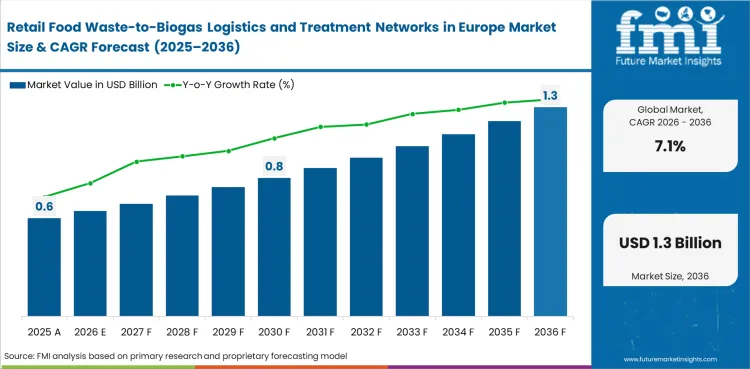
The retail food waste-to-biogas logistics and treatment networks in Europe market reached a valuation of USD 0.5 billion in 2025 and is expected to reach USD 0.6 billion in 2026 and USD 1.2 billion by 2036. The market is projected to expand at 7.1% from 2026 to 2036 and an incremental opportunity of USD 0.6 billion. This outlook reflects a narrow service segment inside waste management and excludes the wider organics and energy complex.
Summary of Retail Food Waste-to-Biogas Logistics and Treatment Networks in Europe Market
- Retail Food Waste-to-Biogas Logistics and Treatment Networks in Europe Market is forecast to reach USD 0.6 billion in 2026 and USD 1.2 billion by 2036.
- The industry is forecast to expand at 7.1% CAGR through 2036, with value growth supported by source segregation and regional treatment access.
- Estimated 2025 value stands at USD 0.5 billion, reflecting a specialist service layer within Europe’s commercial organics handling and energy recovery system.
- Leading segments in 2026 include supermarkets at 38.0%, anaerobic digestion at 31.0%, packaged waste at 36.0%, and grid biomethane at 42.0%.
Key Takeaways, Market Size, and Forecast
- The Retail Food Waste‑to‑Biogas Logistics and Treatment Networks in Europe Market is forecast to expand from USD 0.6 billion in 2026 to approximately USD 1.2 billion by 2036, reflecting a compound annual growth rate (CAGR) of 7.1%.
- In 2025, the market was valued at USD 0.5 billion, underscoring its position as a specialized segment within Europe’s commercial organics recovery ecosystem.
- By 2036, overall market value is anticipated to reach USD 1.2 billion, supported by tighter source‑separation rules and rising biomethane monetization.
- Over the period from 2026 to 2036, the industry is expected to register steady expansion at a 7.1% CAGR, driven by wider retail participation and regional treatment access.
- Across the forecast horizon, the market is predicted to generate an incremental opportunity of USD 0.6 billion, as organized collection and treatment coverage deepens.
- In 2026, supermarkets are likely to remain the dominant waste source, accounting for an estimated 38.0% share of total market value.
- Poland and Spain are projected to be among the fastest‑growing national markets, with anticipated CAGRs of 9.2% and 9.0%, respectively, supported by policy reform and infrastructure catch‑up.
Retail Food Waste-to-Biogas Logistics and Treatment Networks in Europe Market Key Takeaways
| Parameter | Details |
|---|---|
| Market value (2026) | USD 0.6 billion |
| Forecast value (2036) | USD 1.2 billion |
| CAGR (2026 to 2036) | 7.1% |
| Estimated market value (2025) | USD 0.5 billion |
| Incremental opportunity | USD 0.6 billion |
| Leading waste source | Supermarkets: 38.0% share in 2026 |
| Leading service type | Anaerobic digestion: 31.0% share in 2026 |
| Leading waste stream | Packaged waste: 36.0% share in 2026 |
| Leading energy pathway | Grid biomethane: 42.0% share in 2026 |
| Leading contract model | Direct contracts: 47.0% share in 2026 |
| Key players | Veolia. SUEZ SARIA ReFood Renewi Biogen Anaergia Entsorga |
Source: Future Market Insights, 2026
Rising source segregation and tighter commercial control of expiries and returns support cost recovery, and value expansion comes from products from food waste and associated digestate utilization chains. Eurostat reported slightly below 5 million tonnes of retail and other distribution food waste in the EU for 2023. And broader EU capture of food waste remained low leaving room for organised collection and treatment networks to expand.
Commercial waste generators face tighter source-separation requirements before collection. This requirement increases demand for specialist networks handling mixed retail residues with lower contamination loss.
Spain is anticipated to record 9.0% CAGR through 2036 as new food waste rules and treatment gaps pull in new infrastructure. Poland is predicted to post 9.2% CAGR through 2036 as low current digestion levels leave more room for expansion. The United Kingdom is likely to advance at 8.8% CAGR through 2036 as business food waste separation rules and household collection rollout raise feedstock visibility. France is estimated to grow at 8.3% CAGR through 2036, and Germany is estimated to expand at a near 7.1% CAGR as mature waste systems and slower incremental buildout keep the pace more measured.
Retail Food Waste-to-Biogas Logistics and Treatment Networks in Europe Market Definition
Retail food waste-to-biogas logistics and treatment networks in Europe market includes paid services and infrastructure used to move retail food residues from point of discard into anaerobic digestion and biomethane or power recovery systems. Scope includes packaged and unpackaged food waste. Scheduled collections transfer or preprocessing hubs depackaging lines digestion assets and linked recovery of gas carbon dioxide or digestate. Retail users include supermarket groups. Hypermarkets convenience chains wholesalers and distribution depots
Retail Food Waste-to-Biogas Logistics and Treatment Networks in Europe Market Inclusions
Scope includes expired food collection. Damaged stock handling returns from chilled and frozen assortments bin or tanker logistics depackaging slurry preparation anaerobic digestion treatment biomethane upgrading digestate management and traceability services required for commercial compliance. Coverage includes operator-owned transfer points and treatment hubs serving multiple retail accounts across a regional catchment.
Retail Food Waste-to-Biogas Logistics and Treatment Networks in Europe Market Exclusions
Scope excludes upstream food waste prevention software. Food donation platforms animal feed recovery home composting general mixed municipal waste collection and energy generation from landfill gas unrelated to dedicated retail food waste streams. Standalone composting activity without a biogas pathway is excluded from primary market value estimates used in this study.
Retail Food Waste-to-Biogas Logistics and Treatment Networks in Europe Market Research Methodology
- Primary Research involved structured review of operator footprints. Treatment models official company statements and policy changes affecting commercial organics collection across main European countries.
- Desk Research relied on Eurostat. The European Commission EEA country profiles national waste authorities and official company releases covering treatment capacity and rollout activity.
- Market Sizing and Forecasting used retail food waste tonnage. Capture assumptions anaerobic digestion allocation average service values and country policy support for gas or power recovery.
- Data Validation and Update Cycle used cross checks against plant counts. Collection mandates operator scale and current country-level waste treatment indicators published during 2024 to 2026.
Why Is the Retail Food Waste-to-Biogas Logistics and Treatment Networks in Europe Market Growing?
- Separate collection rules across Europe are widening access to retail organics and improving feedstock visibility for specialist collection and treatment operators.
- Biomethane policy support is raising the value of retail residues for gas injection and for renewable fuel supply across regional energy systems.
- Large retailers prefer fewer waste partners, which supports networks offering collection depackaging treatment and reporting under one contract.
Eurostat reported about 57.1 million tonnes of food waste in the EU during 2023, and retail and other distribution contributed just under 5 million tonnes or 8% of the total. Retail waste is easier to contract and trace than household discards, so operators are expanding scheduled pickups and regional treatment capacity linked with formal waste management. Zero Waste Europe reported only 26% of EU food waste entered separate collection during 2025. Which reflects large untapped volume across formal commercial collection systems.
Biomethane policy is improving outlet quality for gas produced from retail food residues across Europe. The European Commission keeps its 35 bcm biomethane target for 2030. And Europe counted 1 620 biomethane-producing facilities at the end of 2024. Higher plant availability reduces haul risk for aggregators serving retailers and wholesalers, which supports wider investment across circular smart city waste management systems. Local energy demand strengthens project economics through linked use of renewable heating fuels
Segmental Analysis
- Supermarkets are expected to command 38.0% share in 2026, and network design often begins around large-format stores with predictable waste calendars.
- Anaerobic digestion is expected to contribute 31.0% of service type demand in 2026, reflecting fee depth and energy recovery value.
- Direct contracts are anticipated to hold 47.0% share in 2026 as major chains prefer fewer counterparties and tighter audit control.
Segment structure in the industry reflects how retail residues are collected, processed and monetized across different service models. Store format shapes waste volume and packaging burden, and local treatment access influences the preferred energy outlet. Some regions support grid injection more strongly, and others rely on power generation or preprocessing before digestion. Packaged chilled food adds handling pressure and lifts spending on sorting and slurry preparation Contract design affects value capture since national retailers often place many stores and depots under one agreement.
Insights into the Supermarkets Segment
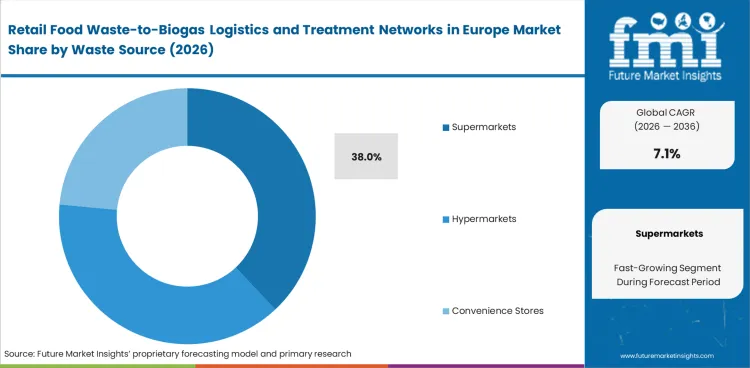
Supermarkets generate the largest share of retail food waste across this industry through broad chilled assortments and heavier expiry pressure in fresh lines. Scheduled pickup programs work well in this segment as waste output is regular and internal controls are usually stronger than in smaller stores. Market estimates place Supermarkets at 38.0% share in 2026 Operators favor this business since one agreement can cover multiple stores and depots and reduce empty mileage. Retail chains require dependable handling for packaged meals and dairy items with a short shelf life. These service needs support added investment in regional depackaging capacity, and linked digestion assets
Insights into the Anaerobic Digestion Segment
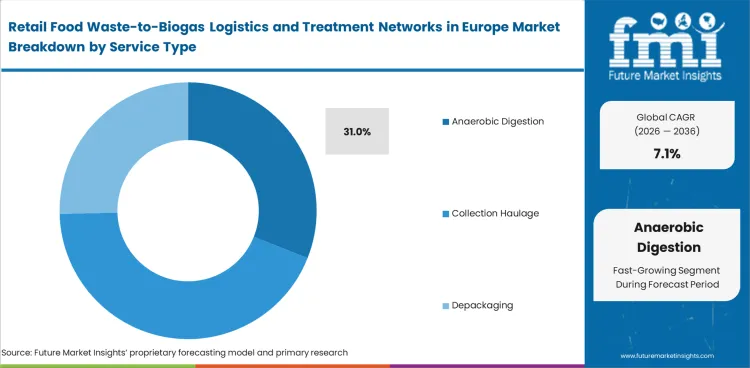
Anaerobic digestion holds the largest service value position since treatment fees and energy recovery form the core revenue pool in the industry. Collection services carry value on their own, although treatment performance has greater influence on contract quality and long-run investment returns. Biogen reported 19 anaerobic digestion facilities recycling more than 600,000 tonnes of organic waste per year in the United Kingdom. In 2026 Anaerobic Digestion is projected to contribute 31.0% of total market share Retail waste performs well in digestion after depackaging removes contamination and improves slurry consistency Revenue potential improves in areas with gas injection or solid farm demand linked with organic fertilizer.
Insights into the Packaged Waste Segment
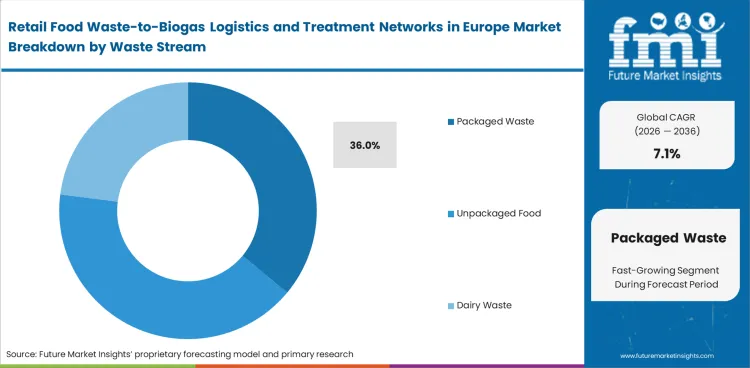
Packaged waste leads this segment since modern food retail relies heavily on wrapped chilled goods and date-coded inventory across many store formats. These residues arrive in mixed formats and require preprocessing before treatment can begin at a reliable operating standard. Operators able to process films and damaged outer packs can command better pricing as service quality rests on depackaging efficiency and contamination control. Packaged Waste is forecast to represent 36.0% of the market in 2026 SUEZ reported 10 depackaging units with total capacity of 150,000 tonnes per year in 2025. The operating profile underscores the central role of preprocessing in maintaining plant uptime and enhancing digestate quality.
Insights into the Grid Biomethane Segment
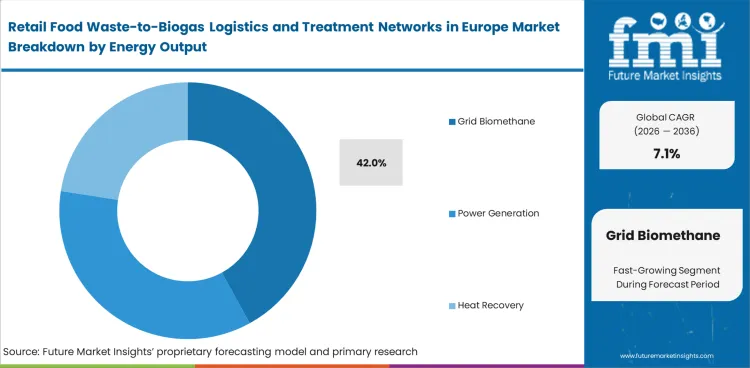
Grid biomethane leads the energy pathway split since gas injection often delivers stronger value realization than on-site electricity in several European countries. Revenue certainty improves in areas with stable policy support and rising renewable gas demand from transport or heating. France illustrates this direction as the Cour des Comptes reported 9.1 TWh of injected biomethane during 2023. Europe’s wider plant buildout supports the same direction through more grid connections and higher production depth. Share contribution from grid biomethane is anticipated to reach 42.0% in 2026 It supports auxiliary demand for compost turning machine equipment and related post-treatment handling for solids.
Insights into the Direct Contracts Segment
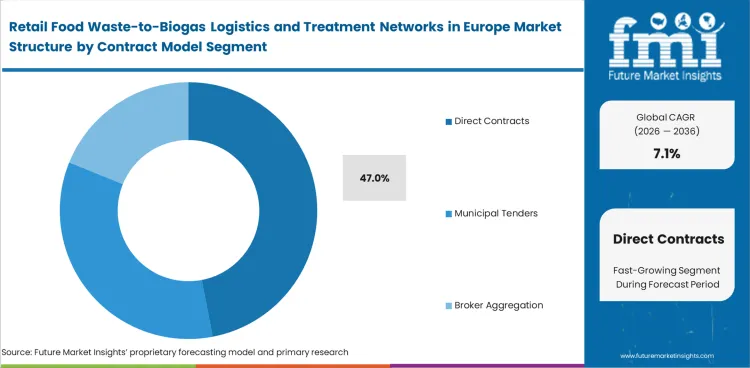
Direct contracts lead contract structure since large retailers prefer national reporting and scheduled pickups across many sites under one accountable service model. Companies often favor one named partner instead of a patchwork of local contractors across separate territories. Such pattern is strongest in countries with chain-led food retail and stricter expectations around packaged food disposal. Direct contracting improves treatment planning as operators can aggregate store and depot volumes under one commercial agreement. By 2026, the market share for Direct Contracts is predicted to reach 47.0% Providers with fleet control and secure plant access are in a stronger position to defend margins and retain renewals over time.
What Are the Drivers, Restraints, and Key Trends in the Retail Food Waste-to-Biogas Logistics and Treatment Networks in Europe Market?
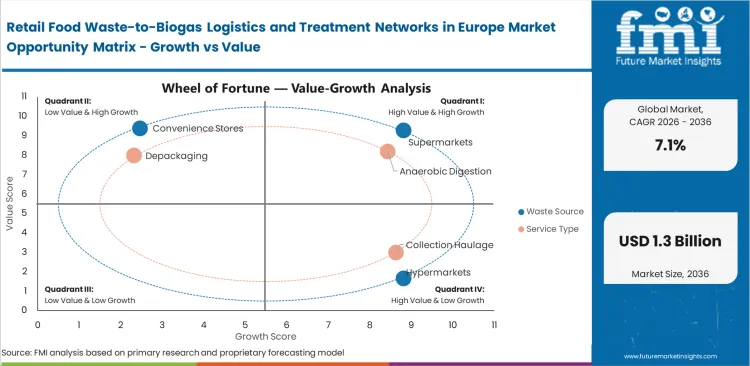
- Separate collection reform across Europe is improving access to cleaner retail organics for specialist collection and treatment operators.
- Contamination and packaging complexity raise preprocessing cost and reduce plant efficiency across mixed retail food waste streams.
- Operators are moving toward biomethane and depackaging with multi-output platforms producing gas digestate and biogenic carbon dioxide.
Retail food waste delivers better recovery economics only under collection and treatment systems preserving feedstock quality at scale. Operators need disciplined logistics and solid preprocessing since mixed packaged goods can lower gas yield and reduce digestate acceptance under high contamination. Regulation is improving feedstock access although local infrastructure gaps keep a large share outside dedicated organics systems. Zero Waste Europe estimated nearly 75% of EU food waste entered landfill or incineration during 2025, showing how much volume stayed outside formal recovery. Current investment is concentrating on transfer hubs depackaging lines and treatment sites built for higher-quality organics recovery.
Rising Collection and Preprocessing Demand Across Retail Food Waste Streams
Collection cost pressure rises with distance and contamination and with the need for specialized vehicles serving stores with modest daily tonnage. Packaged residues are more expensive to process if depackaging is weak or local treatment capacity is limited. SUEZ’s 2026 Digelis FoodWaste launch exhibits effort, and anaerobic-digester digestate upgrading additive points to rising interest in tools improving digestate quality during treatment. Operators able to limit reject rates and protect digestate quality can hold better pricing discipline across retail-heavy contracts. Better preprocessing reduces water use and energy demand across digestion systems handling mixed packaged food waste.
Compliance Costs Increase as Food Waste Rules Become More Structured
Policy change is improving feedstock access though compliance can add cost before service value improves. England introduced workplace food waste separation from 31 March 2025, and councils received support for weekly household collections by 31 March 2026. Spain passed Law 1/2025 on food loss and waste prevention, and this is pushing food chain operators toward tighter surand control. Sites targeting lower emissions are drawing attention to methane oxidation catalysts and additives as gas handling systems become more sophisticated. Regulatory tightening improves market visibility and raises reporting standards for operators serving large retail accounts.
Integrated Recovery Systems Gain Ground Beyond Basic Digestion Output
Treatment platforms are moving toward integrated recovery instead of basic digestion followed by low-value disposal. SUEZ opened a biogenic carbon dioxide recovery unit in Gironde in June 2025 and announced European certification of digestate. France had 1. 911 methanisation units by the end of 2023 and Italy treated 6.9 million tonnes of separately collected organic fraction during the same year. Larger multi-output systems and stronger local offtake planning are supported, and steam methane reforming of biogas to hydrogen highlights future interest in gas conversion. Operators with stronger recovery depth can widen value capture beyond gas sales alone across retail-linked treatment networks.
Analysis of Retail Food Waste-to-Biogas Logistics and Treatment Networks in Europe Market by Key Countries
- Poland is likely to record 9.2% CAGR through 2036, reflecting low current digestion penetration and fresh capacity additions in municipal organics treatment.
- Spain is estimated to post 9.0% CAGR through 2036, supported by food waste law reform and stronger pressure to divert biodegradable waste from disposal.
- United Kingdom is expected to register 8.8% CAGR through 2036 as commercial food waste separation rules widen feedstock capture and collection demand.
- Germany is estimated near 7.1% CAGR through 2036, since mature waste systems create a larger base and a steadier pace of network expansion.
.webp "Top Country Growth Comparison Retail Food Waste To Biogas Logistics And Treatment Networks In Europe Market Cagr (2026 2036)")
| Country | CAGR |
|---|---|
| Germany | 7.1% |
| France | 8.3% |
| Italy | 7.8% |
| Spain | 9.0% |
| Netherlands | 8.1% |
| Poland | 9.2% |
| United Kingdom | 8.8% |
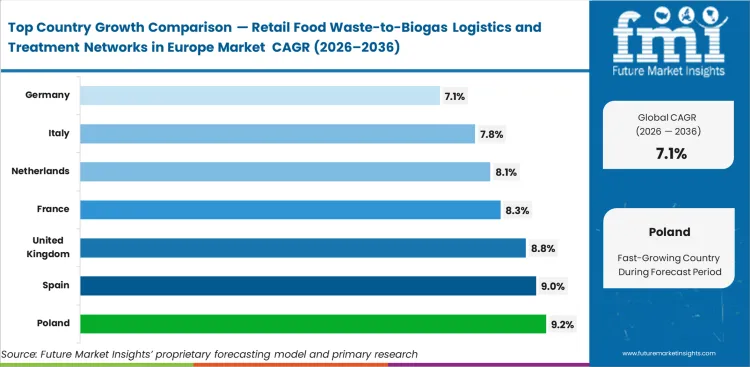
Country performance reflects two forces Mature systems such as Germany and the Netherlands have better collection coverage and treatment discipline, which supports value stability but limits very fast expansion. France. Spain Poland and the United Kingdom present stronger upside due to policy change or infrastructure catchup. Italy holds a middle position. Since organics treatment capacity is large although regional imbalances continue to create transport strain and uneven plant access across the country.
Demand Outlook for Retail Food Waste-to-Biogas Logistics and Treatment Networks in Europe Market in Germany
Germany is projected to record a 7.1% CAGR through 2036 as mature waste systems support steady contract expansion for retail organics handling. Municipal waste generation reached 606 kg per capita in 2022 and landfill disposal was near 1%, which reflects solid recovery infrastructure across the country. Future demand should come from better packaged food handling and service upgrades instead of first-stage system rollout. Large retail chains in urban regions are expected to favor integrated operators able to manage reporting and treatment access under one contract. Feedstock quality should improve as plastic packaging recycling is above 50% across German recovery systems.
Retail Food Waste-to-Biogas Logistics and Treatment Networks in Europe Market Analysis in France
France is building a stronger base for retail food waste collection and digestion through policy support and deeper biomethane penetration. Demand for this sector in France is forecast to rise at a 8.3% CAGR during the forecast period. Public data reveals 1,911 methanisation units in place at the end of 2023 and injected biomethane output of 9.1 TWh during the same year. Source segregation for bio-waste entered broader public rollout from January 2024, which should improve capture from households and nearby commercial activity. Retail contracts are expected to expand fastest in territories with existing digestion assets and room for depackaging or carbon dioxide recovery upgrades.
Sales Analysis of Retail Food Waste-to-Biogas Logistics and Treatment Networks in Europe Market in Italy
Italy already handles large organics volumes and this provides the country a solid operating base for retail residue treatment. ISPRA reported 6.9 million tonnes of separately collected organic fraction treated during 2023, and integrated anaerobic and aerobic plants handled 56.8% of this flow. Sales of this segment in Italy are expected to increase at a CAGR of 7.8% through 2036. Contract economics vary across the country as northern regions have denser plant infrastructure and southern regions face longer hauling distances. Operators with transfer capability and regional balancing strength should benefit most, and this outlook supports linked demand in food waste management.
In-Depth Analysis of Retail Food Waste-to-Biogas Logistics and Treatment Networks in Europe Market in Spain
Spain combines new policy pressure with a visible need for additional treatment depth across retail and municipal organics flows. Law 1/2025 has pushed food chain operators toward formal prevention and management practices across food loss and waste handling. EEA data reveals municipal waste recycling at 39% in 2022 and continued reliance on disposal across the Spanish system. Retail food waste-to-biogas logistics and treatment networks in europe industry in Spain is set to expand at a CAGR of 9.0% over the assessment period. Better enforcement and higher disposal costs should improve diversion into organics recovery, and related packaging alignment supports compostable packaging demand across affected waste streams.
Industry Analysis of Retail Food Waste-to-Biogas Logistics and Treatment Networks in Europe Market in the Netherlands
The Netherlands benefits from very solid collection coverage and long-standing controls on biodegradable waste disposal across the national system. Around 90% of Dutch households are served by bio-waste collection, and door-to-door service applies nationwide for residual waste and bio-waste. Future gains should come from better separation quality in dense urban areas and stronger recovery of commercial food residues. Disposal economics support formal diversion, with a landfill and incineration tax of EUR 39.23 per tonne in 2024. The Netherlands is anticipated to post 8.1% CAGR in this sector from 2026 to 2036, and mature digestion fleets support linked handling demand for gas holders across gas storage applications.
Demand Outlook for Retail Food Waste-to-Biogas Logistics and Treatment Networks in Europe Market in Poland
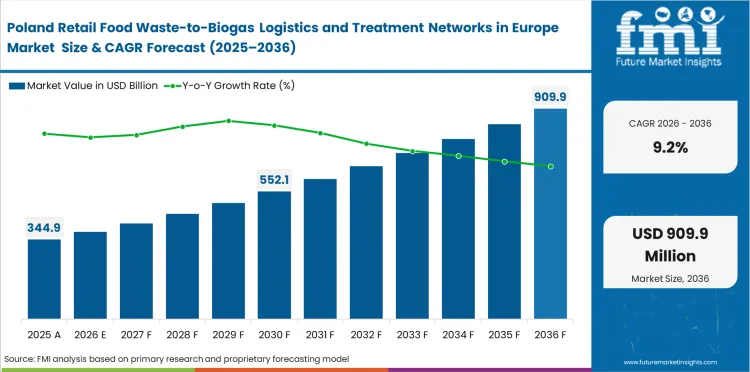
Poland is predicted to register 9.2% CAGR over the forecast period as separate bio-waste collection expands from a lower treatment base. EEA data indicate that municipal waste recycling stood at 41% in 2022, and composting and anaerobic digestion accounted for only 14% of municipal waste. This leaves room for additional treatment capacity and stronger retail contracting across cleaner source-segregated organics flows. Entsorga’s Bydgoszcz project adds practical evidence of new infrastructure. With an anaerobic digestion section sized for at least 45 000 tonnes per year. New site additions should support related demand in gas generating systems serving digestion and energy recovery facilities.
Retail Food Waste-to-Biogas Logistics and Treatment Networks in Europe Market Analysis in the United Kingdom
The United Kingdom has a solid commercial base for this industry through retail concentration and current food waste separation reforms. WRAP estimated 10.7 million tonnes of total UK food waste for 2021, and retail accounted for 2% of the total. The United Kingdom is likely to register 8.8% CAGR by 2036 England requires workplace food waste separation from 31 March 2025, and public support of up to £295 million is backing weekly household food waste collections by 31 March 2026.
Competitive Landscape of Retail Food Waste-to-Biogas Logistics and Treatment Networks in Europe Market
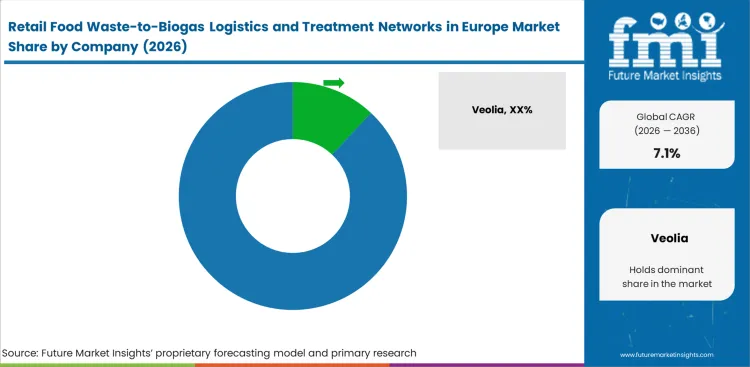
- Competition is moderately fragmented, with large waste groups and specialist organics operators each holding distinct strengths.
- Leading firms compete on collection density. Depackaging quality treatment access compliance reporting and biomethane or electricity offtake.
- Room remains for specialists with local treatment assets and solid packaged waste handling, especially in catchments lacking large national coverage.
Competition is moderately fragmented across the retail food waste-to-biogas logistics and treatment networks in Europe, with large waste groups and specialist organics operators bringing different operating strengths. Leading firms compete on collection density and depackaging quality, along with treatment access and compliance reporting across retail food waste contracts. Biomethane or electricity offtake influences competitive standing, especially in regions with uneven local treatment infrastructure. Room exists for specialists with local assets and stronger packaged waste handling in catchments lacking broad national coverage. Competition does not rest on fleet size alone, as operators must control contamination and protect gas yield and securing dependable outlets for digestate or upgraded gas.
Veolia and SUEZ hold solid positions through full waste chain coverage and organics recovery capability across multiple European markets. Veolia states it operates in 8 countries with more than 120 composting and anaerobic digestion sites for organic waste recovery. The scale helps large groups offer multinational retailers fewer counterparties and stronger reporting discipline across several geographies. Specialists can outperform larger firms in packaged food handling and organics-specific plant design serving retail-heavy waste streams. Biogen describes itself as the United Kingdom’s leading AD operator for food waste recycling and states food waste is collected from supermarkets and restaurants, along with manufacturers and households. ReFood focuses on end-to-end food waste collections and closed-loop treatment, which appeals to retailers seeking simpler contract management. Biffa offers retailers and food manufacturers a combined package including waste reduction and redistribution, with sorting and grading machines becoming more important as packaged residues rise.
Technology providers are taking a larger role as Europe expands biomethane and multi-output recovery across organics treatment systems. SUEZ launched Digelis FoodWaste in 2026 to improve digestion performance, and EnviTec commissioned its 40th gas upgrading plant in France during 2025. Nordsol expanded bio-LNG technology into Norway during the same year, adding another example of technical specialization across adjacent energy recovery platforms. Entsorga signed the Bydgoszcz expansion deal in Poland for at least 45,000 tonnes per year of digestion capacity. Technical credibility therefore carries more weight in markets with new municipal organics assets or retail volumes high in packaging contamination, and bioenzyme fertilizer could receive added support as digestate utilization improves.
Competitive Benchmarking: Retail Food Waste-to-Biogas Logistics and Treatment Networks in Europe Market
| Company | Collection Network Density | Packaged Waste Handling | Biomethane Valorization | Geographic Footprint |
|---|---|---|---|---|
| Veolia | High | High | Strong | Global |
| SUEZ | High | High | Strong | Global |
| SARIA ReFood | High | High | Moderate | Multi-region |
| Renewi | Medium | Medium | Strong | Multi-region |
| Biogen | Medium | High | Moderate | Country-focused |
| Biffa | Medium | Medium | Moderate | Country-focused |
| Anaergia | Low | Medium | Strong | Multi-region |
| Entsorga | Low | Medium | Moderate | Multi-region |
| EnviTec Biogas | Low | Medium | Strong | Multi-region |
| Nordsol | Low | Low | Strong | Multi-region |
Source: Future Market Insights, 2026
Key Developments in Retail Food Waste-to-Biogas Logistics and Treatment Networks in Europe Market
- In April 2026. SUEZ launched Digelis FoodWaste and highlighted 12 anaerobic digestion plants with 400 000 tonnes per year of treatment capacity and 10 depackaging units.
- In June 2025. SUEZ opened a biogenic CO₂ recovery unit at Saint-Selve and announced European certification of digestate described as a first in France.
- In August 2025, EnviTec commissioned its 40th gas upgrading plant in France with 400 Nm³/h biomethane capacity and local grid injection.
Key Players in the Retail Food Waste-to-Biogas Logistics and Treatment Networks in Europe Market
Major Global Players
- Veolia
- SUEZ
- SARIA ReFood
- Renewi
- Biffa
Key Emerging Players/Startups
- Biogen
- Anaergia
- Entsorga
- EnviTec Biogas
- Nordsol
Scope of the Report
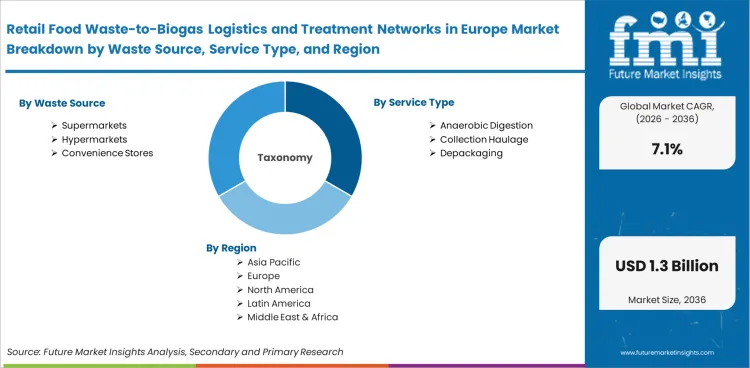
| Metric | Value |
|---|---|
| Quantitative Units | USD Billion for market value and CAGR for 2026 to 2036 |
| Market Definition | Specialist collection. Preprocessing and biogas recovery networks handling retail food waste across Europe |
| Segmentation |
|
| Regions Covered | Europe |
| Countries Covered | Germany. France Italy Spain Netherlands Poland United Kingdom |
| Key Companies Profiled | Veolia. SUEZ SARIA ReFood Renewi Biogen Biffa Anaergia Entsorga EnviTec Biogas Nordsol |
| Forecast Period | 2026 to 2036 |
| Approach | Bottom-up service value estimation using retail food waste tonnage. Capture rates digestion allocation and country policy and infrastructure cross-checks |
Retail Food Waste-to-Biogas Logistics and Treatment Networks in Europe Market by Segments
Retail Food Waste-to-Biogas Logistics and Treatment Networks in Europe Market Segmented as Waste Source:
- Supermarkets
- Hypermarkets
- Convenience Stores
- Distribution Centers
- Wholesale Clubs
Retail Food Waste-to-Biogas Logistics and Treatment Networks in Europe Market Classified by Service Type:
- Collection Haulage
- Depackaging
- Anaerobic Digestion
- Biomethane Upgrading
- Digestate Management
Retail Food Waste-to-Biogas Logistics and Treatment Networks in Europe Market Analysed by Waste Stream:
- Packaged Waste
- Produce Waste
- Bakery Waste
- Prepared Food
- Dairy Meat
Retail Food Waste-to-Biogas Logistics and Treatment Networks in Europe Market Classified by Contract Model:
- Direct Contracts
- Municipal Tenders
- Broker Aggregation
- Utility Partnerships
Retail Food Waste-to-Biogas Logistics and Treatment Networks in Europe Market by Region and Country:
- Western Europe
- Germany
- UK
- Italy
- Spain
- France
- Nordic
- BENELUX
- Rest of Western Europe
- Eastern Europe
- Russia
- Poland
- Hungary
- Balkan & Baltic
- Rest of Eastern Europe
Bibliography
- Eurostat. (2025, September). Food waste and food waste prevention - estimates
- Eurostat. (2025, October 16) 130 kg of food wasted per person annually in the EU
- Zero Waste Europe (2025, January 31) Mandatory yet makeshift: bio-waste management across the EU in 2025
- European Environment Agency (2025). Germany country profile on municipal and packaging waste management
- Service-Public.fr. (2024, January 1) Source sorting of bio-waste: how will it be implemented from 1 January 2024?
- Boletín Oficial del Estado (2025). Ley 1/2025, de 1 de abril, de prevención de las pérdidas y el desperdicio alimentario.
- European Environment Agency (2025). Spain country profile on municipal and packaging waste management
- European Environment Agency (2025). Netherlands country profile on municipal and packaging waste management
- European Environment Agency (2025). Poland country profile on municipal and packaging waste management
- WRAP. (2025, July 2) UK Food Waste & Food Surplus – Key Facts.
- Department for Environment, Food & Rural Affairs (2024, March 25) New £295m for councils to introduce weekly food waste collections
- Department for Environment, Food & Rural Affairs (2025). Simpler recycling: workplace recycling in England
- SUEZ. (2026). SUEZ launches Digelis FoodWaste
- SUEZ. (2025, June 30). Inauguration of the biogenic CO₂ unit from anaerobic digestion at Terres d’Aquitaine, Gironde, France.
- Entsorga. (2025, April 14) Back to Poland with a new anaerobic digestion plant
- EnviTec Biogas. (2025, August 26) Successful first feed-in of the 40th EnviThan gas upgrading plant in France
- Nordsol. (2025, October 8) Vireo selects Nordsol technology for new Norwegian LBG plant
Bibliography is provided for reader reference and source tracing across policy. Country data and company activity.
Frequently Asked Questions
What is the 2026 market size for Retail Food Waste-to-Biogas Logistics and Treatment Networks in Europe Market?
FMI estimates the market at USD 0.6 billion in 2026. Reflecting specialist collection preprocessing and digestion-linked services serving retail food waste streams across Europe.
What will the market be worth by 2036?
FMI projects the market at USD 1.2 billion by 2036 as policy support. Cleaner collection and biomethane uptake expand service value.
What CAGR is projected for 2026 to 2036?
Forecast expansion is estimated at 7.1% CAGR during 2026 to 2036, supported by separate collection and stronger regional treatment depth.
Which waste source segment leads this market?
Supermarkets lead the waste source split and are expected to account for 38.0% share in 2026 due to larger and steadier discard volumes.
Which service type leads the market?
Anaerobic digestion leads service type demand with an estimated 31.0% share in 2026, since treatment revenue forms the largest fee pool.
Which country is estimated to grow fastest through 2036?
Poland is estimated to post the fastest pace at 9.2% CAGR through 2036 due to low current digestion depth and new infrastructure additions.
What does this market include?
Coverage includes collection. Transfer depackaging preprocessing digestion gas upgrading and digestate handling for retail food residues sent into biogas recovery systems.
How were the forecast values developed?
Forecasts were built from retail food waste tonnage. Capture rates digestion allocation average service values and country policy and infrastructure cross-checks.
Preview the report firsthand - request a free sample
Get SampleGet the brochure for pricing and purchase details.
Get PDFTable of Content
- Executive Summary
- Global Market Outlook
- Demand-side Trends
- Supply-side Trends
- Market Overview
- Market Coverage / Taxonomy
- Market Definition / Scope / Limitations
- Research Methodology
- Chapter Orientation
- Analytical Lens and Working Hypotheses
- Market Structure, Signals, and Trend Drivers
- Benchmarking and Cross-market Comparability
- Market Sizing, Forecasting, and Opportunity Mapping
- Research Design and Evidence Framework
- Desk Research Programme (Secondary Evidence)
- Company Annual and Sustainability Reports
- Peer-reviewed Journals and Academic Literature
- Corporate Websites, Product Literature, and Technical Notes
- Earnings Decks and Investor Briefings
- Statutory Filings and Regulatory Disclosures
- Technical White Papers and Standards Notes
- Trade Journals, Industry Magazines, and Analyst Briefs
- Conference Proceedings, Webinars, and Seminar Materials
- Government Statistics Portals and Public Data Releases
- Press Releases and Reputable Media Coverage
- Specialist Newsletters and Curated Briefings
- Sector Databases and Reference Repositories
- FMI Internal Proprietary Databases and Historical Market Datasets
- Subscription Datasets and Paid Sources
- Social Channels, Communities, and Digital Listening Inputs
- Additional Desk Sources
- Desk Research Programme (Secondary Evidence)
- Expert Input and Fieldwork (Primary Evidence)
- Primary Modes
- Qualitative Interviews and Expert Elicitation
- Focus Groups
- Observational and In-context Research
- Social and Community Interactions
- Stakeholder Universe Engaged
- C-suite Leaders
- Board Members
- Presidents and Vice Presidents
- R&D and Innovation Heads
- Technical Specialists
- Domain Subject-matter Experts
- Scientists
- Physicians and Other Healthcare Professionals
- Governance, Ethics, and Data Stewardship
- Research Ethics
- Data Integrity and Handling
- Tooling, Models, and Reference Databases
- Data Engineering and Model Build
- Data Acquisition and Ingestion
- Cleaning, Normalisation, and Verification
- Synthesis, Triangulation, and Analysis
- Quality Assurance and Audit Trail
- Primary Modes
- Market Background
- Market Dynamics
- Drivers
- Restraints
- Opportunity
- Trends
- Scenario Forecast
- Demand in Optimistic Scenario
- Demand in Likely Scenario
- Demand in Conservative Scenario
- Opportunity Map Analysis
- Product Life Cycle Analysis
- Supply Chain Analysis
- Investment Feasibility Matrix
- Value Chain Analysis
- PESTLE and Porter’s Analysis
- Regulatory Landscape
- Regional Parent Market Outlook
- Production and Consumption Statistics
- Import and Export Statistics
- Market Dynamics
- Global Market Analysis 2021 to 2025 and Forecast, 2026 to 2036
- Historical Market Size Value (USD Million) Analysis, 2021 to 2025
- Current and Future Market Size Value (USD Million) Projections, 2026 to 2036
- Y-o-Y Growth Trend Analysis
- Absolute $ Opportunity Analysis
- Global Market Pricing Analysis 2021 to 2025 and Forecast 2026 to 2036
- Global Market Analysis 2021 to 2025 and Forecast 2026 to 2036, By Material
- Introduction / Key Findings
- Historical Market Size Value (USD Million) Analysis By Material , 2021 to 2025
- Current and Future Market Size Value (USD Million) Analysis and Forecast By Material , 2026 to 2036
- Organics
- Aluminum
- Plastic
- Y-o-Y Growth Trend Analysis By Material , 2021 to 2025
- Absolute $ Opportunity Analysis By Material , 2026 to 2036
- Global Market Analysis 2021 to 2025 and Forecast 2026 to 2036, By Collection Model
- Introduction / Key Findings
- Historical Market Size Value (USD Million) Analysis By Collection Model, 2021 to 2025
- Current and Future Market Size Value (USD Million) Analysis and Forecast By Collection Model, 2026 to 2036
- B2B Pickup
- Store Drop-off
- Mail-Back
- Y-o-Y Growth Trend Analysis By Collection Model, 2021 to 2025
- Absolute $ Opportunity Analysis By Collection Model, 2026 to 2036
- Global Market Analysis 2021 to 2025 and Forecast 2026 to 2036, By End Output
- Introduction / Key Findings
- Historical Market Size Value (USD Million) Analysis By End Output, 2021 to 2025
- Current and Future Market Size Value (USD Million) Analysis and Forecast By End Output, 2026 to 2036
- Compost
- Bioenergy
- Recycled Aluminum
- Y-o-Y Growth Trend Analysis By End Output, 2021 to 2025
- Absolute $ Opportunity Analysis By End Output, 2026 to 2036
- Global Market Analysis 2021 to 2025 and Forecast 2026 to 2036, By Region
- Introduction
- Historical Market Size Value (USD Million) Analysis By Region, 2021 to 2025
- Current Market Size Value (USD Million) Analysis and Forecast By Region, 2026 to 2036
- North America
- Latin America
- Western Europe
- Eastern Europe
- East Asia
- South Asia and Pacific
- Middle East & Africa
- Market Attractiveness Analysis By Region
- North America Market Analysis 2021 to 2025 and Forecast 2026 to 2036, By Country
- Historical Market Size Value (USD Million) Trend Analysis By Market Taxonomy, 2021 to 2025
- Market Size Value (USD Million) Forecast By Market Taxonomy, 2026 to 2036
- By Country
- USA
- Canada
- Mexico
- By Material
- By Collection Model
- By End Output
- By Country
- Market Attractiveness Analysis
- By Country
- By Material
- By Collection Model
- By End Output
- Key Takeaways
- Latin America Market Analysis 2021 to 2025 and Forecast 2026 to 2036, By Country
- Historical Market Size Value (USD Million) Trend Analysis By Market Taxonomy, 2021 to 2025
- Market Size Value (USD Million) Forecast By Market Taxonomy, 2026 to 2036
- By Country
- Brazil
- Chile
- Rest of Latin America
- By Material
- By Collection Model
- By End Output
- By Country
- Market Attractiveness Analysis
- By Country
- By Material
- By Collection Model
- By End Output
- Key Takeaways
- Western Europe Market Analysis 2021 to 2025 and Forecast 2026 to 2036, By Country
- Historical Market Size Value (USD Million) Trend Analysis By Market Taxonomy, 2021 to 2025
- Market Size Value (USD Million) Forecast By Market Taxonomy, 2026 to 2036
- By Country
- Germany
- UK
- Italy
- Spain
- France
- Nordic
- BENELUX
- Rest of Western Europe
- By Material
- By Collection Model
- By End Output
- By Country
- Market Attractiveness Analysis
- By Country
- By Material
- By Collection Model
- By End Output
- Key Takeaways
- Eastern Europe Market Analysis 2021 to 2025 and Forecast 2026 to 2036, By Country
- Historical Market Size Value (USD Million) Trend Analysis By Market Taxonomy, 2021 to 2025
- Market Size Value (USD Million) Forecast By Market Taxonomy, 2026 to 2036
- By Country
- Russia
- Poland
- Hungary
- Balkan & Baltic
- Rest of Eastern Europe
- By Material
- By Collection Model
- By End Output
- By Country
- Market Attractiveness Analysis
- By Country
- By Material
- By Collection Model
- By End Output
- Key Takeaways
- East Asia Market Analysis 2021 to 2025 and Forecast 2026 to 2036, By Country
- Historical Market Size Value (USD Million) Trend Analysis By Market Taxonomy, 2021 to 2025
- Market Size Value (USD Million) Forecast By Market Taxonomy, 2026 to 2036
- By Country
- China
- Japan
- South Korea
- By Material
- By Collection Model
- By End Output
- By Country
- Market Attractiveness Analysis
- By Country
- By Material
- By Collection Model
- By End Output
- Key Takeaways
- South Asia and Pacific Market Analysis 2021 to 2025 and Forecast 2026 to 2036, By Country
- Historical Market Size Value (USD Million) Trend Analysis By Market Taxonomy, 2021 to 2025
- Market Size Value (USD Million) Forecast By Market Taxonomy, 2026 to 2036
- By Country
- India
- ASEAN
- Australia & New Zealand
- Rest of South Asia and Pacific
- By Material
- By Collection Model
- By End Output
- By Country
- Market Attractiveness Analysis
- By Country
- By Material
- By Collection Model
- By End Output
- Key Takeaways
- Middle East & Africa Market Analysis 2021 to 2025 and Forecast 2026 to 2036, By Country
- Historical Market Size Value (USD Million) Trend Analysis By Market Taxonomy, 2021 to 2025
- Market Size Value (USD Million) Forecast By Market Taxonomy, 2026 to 2036
- By Country
- Kingdom of Saudi Arabia
- Other GCC Countries
- Turkiye
- South Africa
- Other African Union
- Rest of Middle East & Africa
- By Material
- By Collection Model
- By End Output
- By Country
- Market Attractiveness Analysis
- By Country
- By Material
- By Collection Model
- By End Output
- Key Takeaways
- Key Countries Market Analysis
- USA
- Pricing Analysis
- Market Share Analysis, 2025
- By Material
- By Collection Model
- By End Output
- Canada
- Pricing Analysis
- Market Share Analysis, 2025
- By Material
- By Collection Model
- By End Output
- Mexico
- Pricing Analysis
- Market Share Analysis, 2025
- By Material
- By Collection Model
- By End Output
- Brazil
- Pricing Analysis
- Market Share Analysis, 2025
- By Material
- By Collection Model
- By End Output
- Chile
- Pricing Analysis
- Market Share Analysis, 2025
- By Material
- By Collection Model
- By End Output
- Germany
- Pricing Analysis
- Market Share Analysis, 2025
- By Material
- By Collection Model
- By End Output
- UK
- Pricing Analysis
- Market Share Analysis, 2025
- By Material
- By Collection Model
- By End Output
- Italy
- Pricing Analysis
- Market Share Analysis, 2025
- By Material
- By Collection Model
- By End Output
- Spain
- Pricing Analysis
- Market Share Analysis, 2025
- By Material
- By Collection Model
- By End Output
- France
- Pricing Analysis
- Market Share Analysis, 2025
- By Material
- By Collection Model
- By End Output
- India
- Pricing Analysis
- Market Share Analysis, 2025
- By Material
- By Collection Model
- By End Output
- ASEAN
- Pricing Analysis
- Market Share Analysis, 2025
- By Material
- By Collection Model
- By End Output
- Australia & New Zealand
- Pricing Analysis
- Market Share Analysis, 2025
- By Material
- By Collection Model
- By End Output
- China
- Pricing Analysis
- Market Share Analysis, 2025
- By Material
- By Collection Model
- By End Output
- Japan
- Pricing Analysis
- Market Share Analysis, 2025
- By Material
- By Collection Model
- By End Output
- South Korea
- Pricing Analysis
- Market Share Analysis, 2025
- By Material
- By Collection Model
- By End Output
- Russia
- Pricing Analysis
- Market Share Analysis, 2025
- By Material
- By Collection Model
- By End Output
- Poland
- Pricing Analysis
- Market Share Analysis, 2025
- By Material
- By Collection Model
- By End Output
- Hungary
- Pricing Analysis
- Market Share Analysis, 2025
- By Material
- By Collection Model
- By End Output
- Kingdom of Saudi Arabia
- Pricing Analysis
- Market Share Analysis, 2025
- By Material
- By Collection Model
- By End Output
- Turkiye
- Pricing Analysis
- Market Share Analysis, 2025
- By Material
- By Collection Model
- By End Output
- South Africa
- Pricing Analysis
- Market Share Analysis, 2025
- By Material
- By Collection Model
- By End Output
- Market Structure Analysis
- Competition Dashboard
- Competition Benchmarking
- Market Share Analysis of Top Players
- By Regional
- By Material
- By Collection Model
- By End Output
- USA
- Competition Analysis
- Competition Deep Dive
- Nespresso
- Overview
- Product Portfolio
- Profitability by Market Segments (Product/Age /Sales Channel/Region)
- Sales Footprint
- Strategy Overview
- Marketing Strategy
- Product Strategy
- Channel Strategy
- Veolia
- SUEZ
- TerraCycle
- TOMRA
- NAFIGATE
- Envar
- Nespresso
- Competition Deep Dive
- Assumptions & Acronyms Used


