

- Industry Size (2026)
- USD 10.3 Bn
- Forecast (2036)
- USD 19.7 Bn
- CAGR (2026 to 2036)
- 6.7%
Demand for Water Treatment System in South Korea Forecast and Outlook 2026 to 2036
The demand for water treatment systems in South Korea is expected to reach USD 19.7 billion by 2036, growing at a CAGR of 6.7% from USD 10.3 billion in 2026. Dominant players in this market leverage economies of scale, advanced technologies, and long-term contracts to defend their pricing power. They maintain entry barriers by investing in proprietary technologies and securing regulatory certifications, making it challenging for new entrants to compete on an equal footing. While the industry remains fragmented, the persistence of smaller players is due to niche applications and regional variations in demand. The industry is gradually consolidating as larger firms expand their service offerings and regional footprint. Fragmentation may continue in certain segments, but as larger players improve their competitive positioning through innovation and better economies of scale, the overall market control will likely become more concentrated over the forecast period.
Quick Stats for the Demand for Water Treatment System in South Korea
- Water Treatment System in South Korea Value (2026): USD 10.3 billion
- Water Treatment System in South Korea Forecast Value (2036): USD 19.7 billion
- Water Treatment System in South Korea Forecast CAGR 2026 to 2036: 6.7%
- Water Treatment System in South Korea Leading Segment: Reverse Osmosis (35%)
- Key Growth Regions of Water Treatment System in South Korea: Jeju (leading CAGR ~8.1%)
- Top Players of Water Treatment System in South Korea: Veolia Water Technologies, SUEZ Water Technologies, Xylem Inc., Pentair PLC, Evoqua Water Technologies
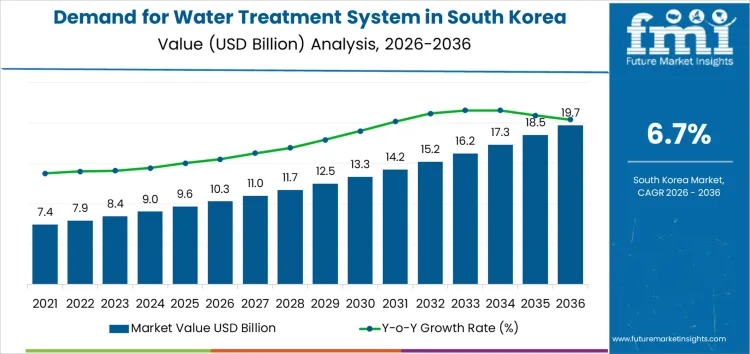
What is the Growth Forecast for the Water Treatment System Market in South Korea through 2036?
The water treatment system industry in South Korea is expected to expand steadily through the forecast period, supported by strong demand from urban utilities, industrial facilities, and municipal infrastructure upgrades. Rising focus on water security, stricter environmental standards, and the need to improve drinking water quality are encouraging consistent investment in advanced treatment technologies. As population density remains high in major cities, demand for efficient purification, filtration, and wastewater management systems continues to strengthen across both public and private sectors.
Over the long term, growth will be reinforced by modernization of aging water infrastructure and increased adoption of smart and energy-efficient treatment solutions. Industrial activity, including electronics, chemicals, and manufacturing, will further support demand for reliable water treatment systems that ensure compliance and operational continuity. Continued government initiatives focused on sustainability and resource management will also contribute to long-term expansion, positioning water treatment technologies as a critical pillar of South Korea’s environmental resilience and economic stability.
Key Takeaways of Water Treatment System in South Korea
| Metric | Value |
|---|---|
| Industry Sales Value (2026) | USD 10.3 billion |
| Industry Forecast Value (2036) | USD 19.7 billion |
| Industry Forecast CAGR 2026 to 2036 | 6.7% |
Why is the Demand for Water Treatment Systems Growing in South Korea?
The demand for water treatment systems in South Korea has increased due to growing concerns over water quality, environmental sustainability, and regulatory pressure. Historically, the country faced challenges related to water pollution from industrial and agricultural activities, which led to a rise in the need for effective water treatment solutions. The industrial boom in South Korea, particularly in the chemical, petrochemical, and manufacturing sectors, contributed significantly to water pollution, creating a demand for advanced water treatment systems to meet stringent environmental standards. Additionally, the government has implemented policies aimed at improving water quality and managing water resources more efficiently, driving demand for water treatment technologies. As urbanization and population density increased, municipal water treatment systems also had to evolve to accommodate the growing demand for clean water, especially in densely populated areas like Seoul.
Looking ahead, the demand for water treatment systems in South Korea is expected to grow as water conservation and environmental protection become even more critical. The government’s push for sustainable practices and stricter environmental regulations will likely continue to drive investments in water treatment infrastructure. Advances in water purification technologies, such as reverse osmosis and membrane filtration, are also expected to boost market growth, as they offer more efficient and cost-effective solutions for both industrial and municipal applications. Furthermore, the increasing focus on water reuse and recycling, particularly in industries with high water consumption such as semiconductor manufacturing, will further fuel demand for advanced water treatment systems in the coming years.
What Are the Key Segments in Demand for Water Treatment Systems in South Korea?
Demand for water treatment systems in South Korea is driven by various technologies and applications. Key technologies include reverse osmosis, ultrafiltration, UV purification, chemical treatment, and desalination, with reverse osmosis holding the largest share at 35%. On the application side, municipal water treatment and industrial process water treatment are the leading sectors, each contributing 35%. The need for effective and efficient water treatment solutions across residential, industrial, and municipal sectors is a key factor driving the growth in this market.
What Is the Demand Pattern for Water Treatment Systems in South Korea by Technology?
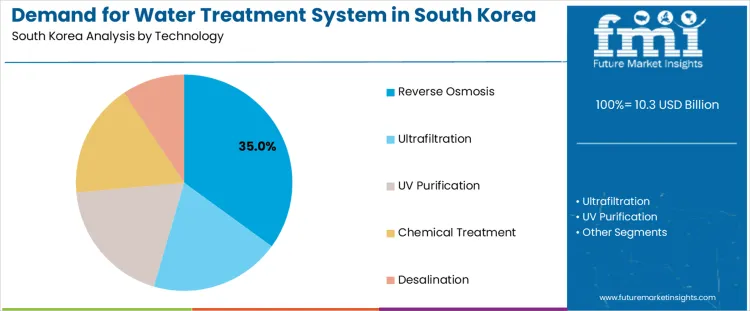
The demand for water treatment systems in South Korea by technology is primarily driven by reverse osmosis (RO), which holds a 35% share. RO technology is widely adopted due to its effectiveness in removing impurities, salts, and other contaminants from water. This makes it ideal for applications such as municipal water treatment, industrial process water purification, and residential water systems. The high efficiency of RO systems in producing clean water from both surface and underground sources is a significant driver behind its widespread use. As South Korea faces increasing water scarcity issues, the demand for RO systems has grown, particularly in urban areas where reliable access to clean water is essential. Ultrafiltration (UF) follows as another prominent technology used in water treatment systems. While UF has a smaller share than RO, it plays a key role in various applications, including industrial process water treatment. UF is valued for its ability to filter out fine particles, bacteria, and suspended solids without the need for chemicals, making it an environmentally friendly option for industrial water purification. UV purification technology is also gaining traction, especially for residential water purification, where its ability to disinfect water without chemicals is appreciated. Chemical treatment remains vital for wastewater treatment systems, helping remove harmful chemicals and pollutants, which is critical in industries such as food processing and chemicals.
What Is the Demand Pattern for Water Treatment Systems in South Korea by Application?
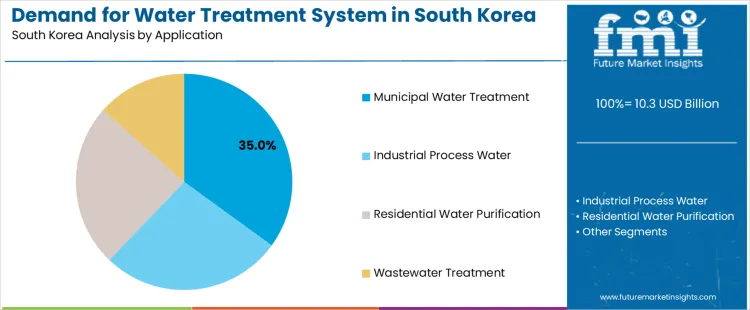
In South Korea, the demand for water treatment systems by application is driven by municipal water treatment and industrial process water treatment, both accounting for 35% of the industry. Municipal water treatment systems ensure that the public receives clean and safe water, essential for health and sanitation. With rapid urbanization and the growing population, the need for effective water treatment systems to manage large-scale municipal water treatment plants is becoming increasingly urgent. Reverse osmosis and ultrafiltration technologies are particularly significant in this area due to their ability to produce high-quality potable water. The industrial sector also requires water treatment systems for process water, where water quality directly impacts manufacturing efficiency and product quality. As industries such as semiconductor manufacturing, chemicals, and food processing continue to grow in South Korea, the demand for reliable and efficient water purification technologies is expected to rise. UV purification systems are seeing greater demand in residential water purification, where consumer concerns about water quality and safety are high. The chemical treatment sector supports wastewater treatment systems, playing a crucial role in industries that generate large amounts of wastewater, such as petrochemicals and textiles. As water management becomes more critical in South Korea, the industry for water treatment systems is expanding across multiple sectors, driven by technological advancements and the need for sustainable water solutions.
What are the Key Dynamics in the Demand for Water Treatment Systems in South Korea?
Demand for water treatment systems in South Korea is driven by both industrial and municipal needs. The country's strong industrial base, particularly in petrochemicals, manufacturing, and electronics, requires efficient water treatment solutions to manage wastewater and ensure compliance with environmental regulations. South Korea's rapid urbanization and population growth have also placed increased pressure on municipal water infrastructure, boosting demand for advanced treatment technologies. Additionally, the government’s focus on sustainability and improving water quality has contributed to a rising demand for systems that provide safe, clean water for both consumption and industrial use. The shift towards stricter environmental regulations and water reuse initiatives further fuels this market.
What are the Drivers of Demand for Water Treatment Systems in South Korea?
The key drivers for water treatment systems in South Korea include the country’s growing industrial needs and the need to maintain strict environmental standards. Industries such as petrochemicals, automotive manufacturing, and electronics require efficient water management systems to treat wastewater and minimize the environmental impact of their operations. South Korea's commitment to reducing water pollution and enhancing public health through better sanitation standards also plays a significant role in driving demand. Government regulations promoting water conservation, recycling, and reuse have further spurred the adoption of advanced water treatment technologies. The country’s emphasis on smart cities and sustainable urban planning also promotes the development and implementation of innovative water management solutions.
What are the Restraints on Demand for Water Treatment Systems in South Korea?
Despite growing demand, several challenges limit the widespread adoption of water treatment systems in South Korea. High capital and operational costs associated with advanced water treatment technologies may deter small and medium-sized enterprises (SMEs) from investing in these systems. Additionally, the complexity and maintenance requirements of some water treatment technologies can be a barrier to entry for companies with limited technical expertise or financial resources. The potential for market saturation in certain urban areas, where water treatment infrastructure is already highly developed, may further limit growth opportunities. Fluctuations in global supply chains and rising costs of raw materials could also impact the affordability and availability of water treatment systems in the short term.
What Key Trends Affect Demand for Water Treatment Systems in South Korea?
A growing trend in South Korea is the adoption of advanced technologies such as membrane filtration, reverse osmosis, and ultraviolet (UV) disinfection, driven by the need for cleaner water and improved environmental sustainability. The increasing focus on water reuse and recycling, particularly in industrial and municipal sectors, is another key trend, aligning with global sustainability goals. South Korea is also adopting smart water management systems that use real-time monitoring and data analytics to optimize water treatment processes and reduce waste. The rise of smart cities and eco-friendly urban development initiatives further supports the growth of water treatment systems as part of broader environmental sustainability efforts. Increased investment in research and development also promises the introduction of more cost-effective and efficient treatment technologies.
What is the Regional Analysis of Demand for Water Treatment Systems in South Korea?
The demand for water treatment systems in South Korea varies across its regions, reflecting local water management challenges, industrial activities, and environmental priorities. South Gyeongsang, with a CAGR of 7.1%, shows strong demand, driven by its industrial base, which requires effective water management systems. North Jeolla, with a growth rate of 5.4%, demonstrates moderate demand, largely due to its agricultural focus and increasing industrial activities. South Jeolla, with a projected CAGR of 6.4%, experiences steady demand growth, driven by its manufacturing and shipbuilding sectors. Jeju, with the highest demand growth of 8.1%, reflects its emphasis on sustainability and tourism-driven water management solutions. The demand in all regions is influenced by factors such as industrial expansion, government regulations, and environmental concerns, all of which highlight the critical need for efficient water treatment technologies.
CAGR 2026 to 2036 by Region
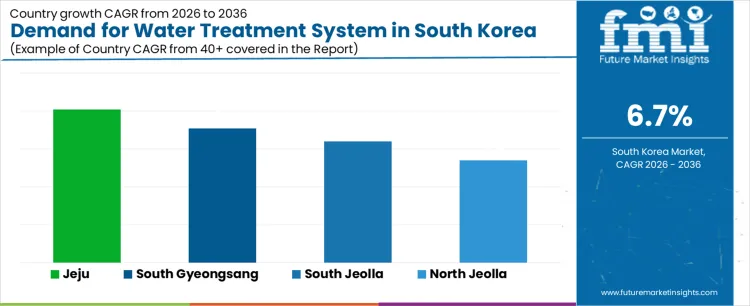
| Region | CAGR 2026 to 2036 |
|---|---|
| South Gyeongsang | 7.1% |
| North Jeolla | 5.4% |
| South Jeolla | 6.4% |
| Jeju | 8.1% |
What is the Demand for Water Treatment Systems in South Gyeongsang?
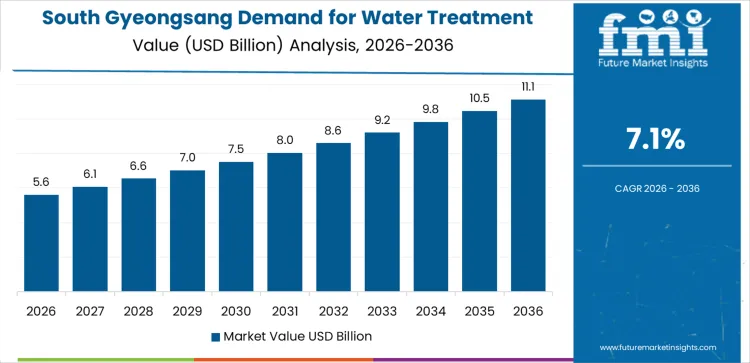
South Gyeongsang is projected to experience strong demand growth for water treatment systems, with a CAGR of 7.1% from 2026 to 2036. The region’s significant industrial base, including petrochemicals, shipbuilding, and heavy manufacturing, drives the need for effective water treatment solutions. These industries require systems to ensure water quality and compliance with environmental regulations. As South Gyeongsang’s industrial output continues to increase, the demand for advanced water treatment technologies is expected to grow in line with rising environmental concerns and industrial needs. The region’s continued industrial development and emphasis on sustainable practices are key factors behind this robust demand growth.
What is the Demand for Water Treatment Systems in North Jeolla?
North Jeolla, with a projected CAGR of 5.4%, demonstrates moderate demand for water treatment systems. The region is known for its agricultural output, as well as growing industrial activities in sectors like automotive and machinery. While water treatment demand is generally lower compared to industrially dense regions, North Jeolla’s increasing industrial activities and investment in sustainable practices are expected to drive gradual growth in demand. As the region continues to expand its industrial and agricultural sectors, the need for efficient water treatment solutions to support both sectors is expected to rise, contributing to steady demand growth in the coming years.
What is the Demand for Water Treatment Systems in South Jeolla?
South Jeolla is projected to experience steady demand growth for water treatment systems, with a CAGR of 6.4%. The region’s focus on manufacturing, shipbuilding, and petrochemicals drives a significant need for water treatment technologies that ensure operational efficiency and compliance with environmental standards. As South Jeolla’s industrial base grows, particularly in energy and manufacturing sectors, the demand for water treatment systems is expected to continue increasing. The region’s investment in industrial modernization and environmental management also supports the growth in demand for sustainable water solutions. This steady rise reflects South Jeolla’s commitment to both industrial expansion and environmental sustainability.
What is the Demand for Water Treatment Systems in Jeju?
Jeju shows the highest demand growth for water treatment systems, with a CAGR of 8.1% from 2026 to 2036. The region’s emphasis on tourism, agriculture, and environmental sustainability has led to a growing focus on water resource management. As tourism continues to be a major economic driver, the need for efficient water treatment systems to manage water consumption and waste has become increasingly important. Additionally, Jeju’s agricultural and manufacturing sectors require advanced water treatment solutions to address local water scarcity and pollution concerns. The region’s commitment to sustainability and environmental protection positions it for continued growth in water treatment system demand over the next decade.
What is the Competitive Landscape for Water Treatment Systems in South Korea?
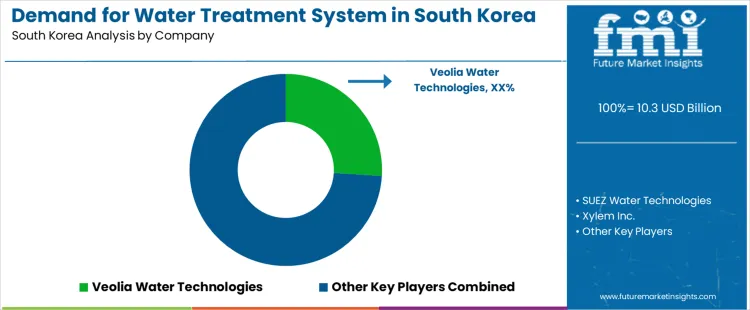
Demand for water treatment systems in South Korea is growing across municipal, industrial, and commercial segments at a measured pace. The overall water treatment system market is projected to increase significantly in revenue terms over the coming decade, supported by investments in water infrastructure and expanding requirements for potable water and wastewater management. Growth projections indicate that the water treatment system market may reach a multibillion-dollar scale by the early 2030s, with annual growth rates above historical averages. Requirements for advanced filtration, biological treatment, and disinfection technologies have risen in response to regulatory standards for water quality and public health protection. Industrial sectors, including manufacturing and energy, have continued to adopt systems that deliver consistent performance under rigorous operating conditions. Municipal utilities have invested in upgrades to primary and secondary treatment facilities to accommodate population demands and environmental discharge standards. The need for efficient reuse and recycling of treated water in urban and industrial settings has contributed to expanding adoption of advanced membrane systems and modular treatment platforms. Overall, demand is underpinned by sustained government focus on improving water management and regulatory compliance across treatment processes.
Major suppliers have responded with portfolios that address varied water treatment requirements while emphasising documented system performance. Veolia Water Technologies is recognised as a leading provider, with product brochures that outline modular treatment trains, membrane separation units, and process control features. SUEZ Water Technologies product literature describes membrane filtration systems and chemical dosing technologies, with specification sheets on capacity ranges and treatment efficacy. Xylem Inc. brochures present pumping solutions integrated with treatment modules, highlighting energy-efficient designs and system compatibility. Pentair PLC documentation focuses on point-of-use and industrial filtration systems, detailing material specifications and service intervals. Evoqua Water Technologies materials emphasise customizable treatment platforms and service offerings tailored to sector-specific needs. Brochures from these companies typically provide technical data on flow capacities, removal efficiencies, power requirements, and compliance with local and international water quality standards to inform purchasing decisions by South Korean utilities and industrial users.
Key Players of the Demand for Water Treatment System in South Korea
- Veolia Water Technologies
- SUEZ Water Technologies
- Xylem Inc.
- Pentair PLC
- Evoqua Water Technologies
Scope of the Report
| Items | Values |
|---|---|
| Quantitative Units (2026) | USD Billion |
| Technology | Reverse Osmosis, Ultrafiltration, UV Purification, Chemical Treatment, Desalination |
| Application | Municipal Water Treatment, Industrial Process Water, Residential Water Purification, Wastewater Treatment |
| End-User | Municipalities, Industries, Commercial Establishments, Households |
| Companies | Veolia Water Technologies, SUEZ Water Technologies, Xylem Inc., Pentair PLC, Evoqua Water Technologies |
| Region Covered | South Korea |
| Provinces Covered | South Gyeongsang, North Jeolla, South Jeolla, Jeju |
| Additional Attributes | Dollar sales by technology, application, and end-user. Growth is driven by rising demand for advanced purification systems, stricter water quality regulations, and the expansion of industrial and municipal wastewater treatment infrastructure across the country. |
Key Segments of Demand for Water Treatment System in South Korea
Technology
- Reverse Osmosis
- Ultrafiltration
- UV Purification
- Chemical Treatment
- Desalination
- Other
Application
- Municipal Water Treatment
- Industrial Process Water
- Residential Water Purification
- Wastewater Treatment
- Other
End-User
- Municipalities
- Industries
- Commercial Establishments
- Households
- Other
Provinces
- South Gyeongsang
- North Jeolla
- South Jeolla
- Jeju
Bibliography
- Korea Environment Corporation. (2024). Annual report on water quality management and wastewater infrastructure in South Korea. Government of the Republic of Korea.
- Ministry of Environment. (2025). National water resource management and reuse strategy 2030. Government of the Republic of Korea.
- Organisation for Economic Co-operation and Development (OECD). (2024). Water security and sustainable management in OECD countries. OECD Publishing.
Frequently Asked Questions
How big is the demand for water treatment system in south korea in 2026?
The demand for water treatment system in south korea is estimated to be valued at USD 10.3 billion in 2026.
What will be the size of water treatment system in south korea in 2036?
The market size for the water treatment system in south korea is projected to reach USD 19.7 billion by 2036.
How much will be the demand for water treatment system in south korea growth between 2026 and 2036?
The demand for water treatment system in south korea is expected to grow at a 6.7% CAGR between 2026 and 2036.
What are the key product types in the water treatment system in south korea?
The key product types in water treatment system in south korea are reverse osmosis, ultrafiltration, uv purification, chemical treatment and desalination.
Which application segment is expected to contribute significant share in the water treatment system in south korea in 2026?
In terms of application, municipal water treatment segment is expected to command 35.0% share in the water treatment system in south korea in 2026.
Preview the report firsthand - request a free sample
Get SampleGet the brochure for pricing and purchase details.
Get PDFTable of Content
- Executive Summary
- South Korea Market Outlook
- Demand-side Trends
- Supply-side Trends
- Technology Roadmap Analysis
- Analysis and Recommendations
- Market Overview
- Market Coverage / Taxonomy
- Market Definition / Scope / Limitations
- Market Background
- Market Dynamics
- Drivers
- Restraints
- Opportunity
- Trends
- Scenario Forecast
- Demand in Optimistic Scenario
- Demand in Likely Scenario
- Demand in Conservative Scenario
- Opportunity Map Analysis
- Product Life Cycle Analysis
- Supply Chain Analysis
- Investment Feasibility Matrix
- Value Chain Analysis
- PESTLE and Porter’s Analysis
- Regulatory Landscape
- Regional Parent Market Outlook
- Production and Consumption Statistics
- Import and Export Statistics
- Market Dynamics
- South Korea Market Analysis 2021 to 2025 and Forecast, 2026 to 2036
- Historical Market Size Value (USD Million) Analysis, 2021 to 2025
- Current and Future Market Size Value (USD Million) Projections, 2026 to 2036
- Y-o-Y Growth Trend Analysis
- Absolute $ Opportunity Analysis
- South Korea Market Pricing Analysis 2021 to 2025 and Forecast 2026 to 2036
- South Korea Market Analysis 2021 to 2025 and Forecast 2026 to 2036, By Technology
- Introduction / Key Findings
- Historical Market Size Value (USD Million) Analysis By Technology, 2021 to 2025
- Current and Future Market Size Value (USD Million) Analysis and Forecast By Technology, 2026 to 2036
- Reverse Osmosis
- Ultrafiltration
- UV Purification
- Chemical Treatment
- Desalination
- Reverse Osmosis
- Y-o-Y Growth Trend Analysis By Technology, 2021 to 2025
- Absolute $ Opportunity Analysis By Technology, 2026 to 2036
- South Korea Market Analysis 2021 to 2025 and Forecast 2026 to 2036, By Application
- Introduction / Key Findings
- Historical Market Size Value (USD Million) Analysis By Application, 2021 to 2025
- Current and Future Market Size Value (USD Million) Analysis and Forecast By Application, 2026 to 2036
- Municipal Water Treatment
- Industrial Process Water
- Residential Water Purification
- Wastewater Treatment
- Municipal Water Treatment
- Y-o-Y Growth Trend Analysis By Application, 2021 to 2025
- Absolute $ Opportunity Analysis By Application, 2026 to 2036
- South Korea Market Analysis 2021 to 2025 and Forecast 2026 to 2036, By End-User
- Introduction / Key Findings
- Historical Market Size Value (USD Million) Analysis By End-User, 2021 to 2025
- Current and Future Market Size Value (USD Million) Analysis and Forecast By End-User, 2026 to 2036
- Municipalities
- Industries
- Commercial Establishments
- Households
- Municipalities
- Y-o-Y Growth Trend Analysis By End-User, 2021 to 2025
- Absolute $ Opportunity Analysis By End-User, 2026 to 2036
- Market Structure Analysis
- Competition Dashboard
- Competition Benchmarking
- Market Share Analysis of Top Players
- By Regional
- By Technology
- By Application
- By End-User
- Competition Analysis
- Competition Deep Dive
- Veolia Water Technologies
- Overview
- Product Portfolio
- Profitability by Market Segments (Product/Age /Sales Channel/Region)
- Sales Footprint
- Strategy Overview
- Marketing Strategy
- Product Strategy
- Channel Strategy
- SUEZ Water Technologies
- Xylem Inc.
- Pentair PLC
- Evoqua Water Technologies
- Veolia Water Technologies
- Competition Deep Dive
- Assumptions & Acronyms Used
- Research Methodology


