

- Industry Size (2026)
- USD 35.2 Bn
- Forecast (2036)
- USD 72.5 Bn
- CAGR (2026 to 2036)
- 7.5%
Demand for Water Treatment System in United Kingdom Forecast and Outlook 2026 to 2036
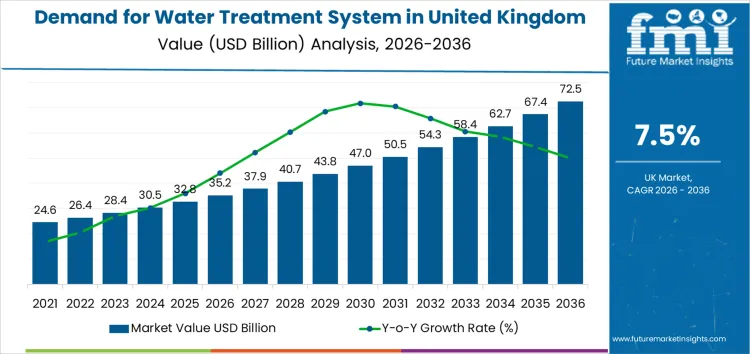
The water treatment system market in the United Kingdom is forecast to grow from USD 35.2 billion in 2026 to USD 72.5 billion by 2036, at a CAGR of 7.5%. Dominant players in the sector defend pricing power through economies of scale, established supplier networks, and technological innovations that offer distinct performance advantages. These players typically maintain strong customer loyalty through long-term contracts, ensuring steady revenue streams and minimizing price sensitivity. Barriers to entry remain high, driven by the need for significant capital investment, regulatory compliance, and specialized expertise.
Smaller competitors struggle to meet these requirements, creating a competitive moat for established players. Despite this, market fragmentation persists as customers demand increasingly customized solutions, opening opportunities for niche suppliers to capture market share. Fragmentation is unlikely to narrow significantly unless larger players pursue consolidation strategies or diversify into specialized offerings that cater to emerging, high-growth market segments.
Quick Stats for the Demand for Water Treatment System in United Kingdom
- Water Treatment System in United Kingdom Value (2026): USD 35.2 billion
- Water Treatment System in United Kingdom Forecast Value (2036): USD 72.5 billion
- Water Treatment System in United Kingdom Forecast CAGR (2026 to 2036): 7.5%
- Water Treatment System in United Kingdom Leading Segment: Municipalities (50% share)
- Key Growth Regions of Water Treatment System in United Kingdom: England
- Top Players of Water Treatment System in United Kingdom: Veolia Water Technologies, SUEZ Water Technologies, Xylem Inc., Pentair PLC, Evoqua Water Technologies
What is the Growth Forecast for Water Treatment System in United Kingdom through 2036?
The demand for water treatment systems in the United Kingdom is expected to rise from USD 35.2 billion in 2026 to USD 72.5 billion by 2036, reflecting a compound annual growth rate (CAGR) of 7.5%. Between 2026 and 2031, the industry will experience steady growth, with values increasing from USD 35.2 billion to USD 50.5 billion. From 2031 to 2036, the growth will continue, reaching USD 72.5 billion by the end of the forecast period.
The half-decade weighted growth analysis indicates a strong upward trajectory, with the most significant growth observed during the first half of the forecast period (2026-2031). This phase is expected to benefit from accelerated infrastructure investments and increased adoption of advanced treatment technologies. The second half (2031-2036) will continue to see steady growth, driven by the maturation of water treatment technologies, increased implementation in residential and industrial applications, and continued demand for sustainable solutions. The industry will accumulate substantial value through both increased adoption and rising investment in infrastructure development.
Key Takeaways for Demand for Water Treatment System in United Kingdom
| Metric | Value |
|---|---|
| Industry Sales Value (2026) | USD 35.2 billion |
| Industry Forecast Value (2036) | USD 72.5 billion |
| Industry Forecast CAGR (2026 to 2036) | 7.5% |
Why is Demand for Water Treatment System in United Kingdom Growing?
Demand for water treatment systems in the United Kingdom has strengthened as regulatory requirements and industrial expectations regarding water quality have evolved. Historically, municipal water authorities invested in conventional filtration and disinfection systems to meet basic public health standards. Over recent years, tightening regulations on contaminants such as microplastics, heavy metals, and nitrates have required more advanced treatment technologies. Industrial sectors including food and beverage, pharmaceuticals, and chemicals also expanded use of specialized water treatment systems to maintain process integrity and product quality.
Manufacturers operating high precision equipment adopted closed loop water systems and deionization units to reduce corrosion and scale. Wastewater treatment obligations for industrial effluent discharge drove demand for tailored systems capable of meeting stringent environmental compliance criteria. Plant engineers and facility managers placed priority on solutions that deliver consistent water quality, minimize downtime, and reduce risk of regulatory violations.
Looking ahead, demand for water treatment systems in the United Kingdom is expected to continue growing as companies seek resilient and efficient solutions. Drivers include industry focus on resource optimization and cost control amid fluctuating energy and raw material prices. Water intensive sectors such as horticulture and food processing increasingly require systems that improve reuse and recovery rates to reduce reliance on external water supply. Retrofit opportunities in ageing municipal infrastructure present avenues for suppliers to offer modular and scalable treatment technologies that integrate with existing assets.
Procurement teams in industrial companies will assess systems based on lifecycle costs, ease of maintenance, and ability to deliver reliable performance under variable load conditions. Innovations in membrane technology, automated control, and digital monitoring create additional value for end users by enabling predictive maintenance and operational transparency. Continued emphasis on environmental stewardship and operational resilience positions water treatment systems as essential investments for UK businesses across sectors.
What Are the Key Segments in the Demand for Water Treatment Systems in the United Kingdom?
Demand for water treatment systems in the United Kingdom is primarily driven by application and end-user. Municipal water treatment leads the application segment with 45%, while municipalities dominate the end-user segment with 50%. Other applications, such as industrial process water, residential water purification, and wastewater treatment, also contribute significantly. These trends reflect the essential role of water treatment in ensuring safe, clean water for various sectors, including municipal, industrial, and residential needs.
What Is the Application Segment of Demand for Water Treatment Systems in the United Kingdom?
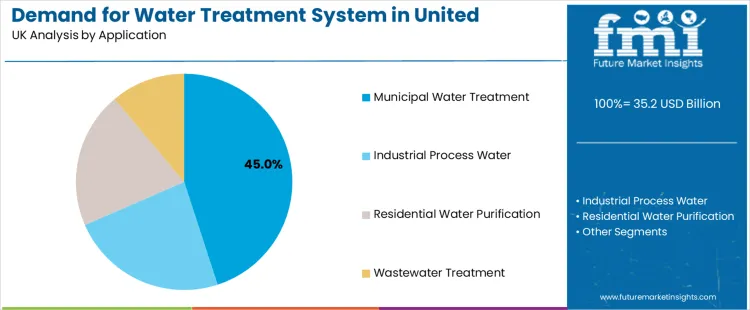
The application segment for water treatment systems in the United Kingdom is dominated by municipal water treatment, which accounts for 45% of the industry share. Municipal water treatment systems are responsible for ensuring that water supplied to homes, businesses, and industries meets quality standards for safe consumption and use. With an increasing population and growing urbanization, the demand for advanced water treatment technologies is expected to rise to meet the challenges of clean water supply.
These systems are essential in treating raw water from rivers, lakes, and reservoirs, removing contaminants and making it safe for drinking and everyday use. Industrial process water follows as a significant application, with industries relying on water treatment systems to purify water used in manufacturing processes. Industries such as food and beverage, chemicals, and pharmaceuticals require high-quality water for their operations, and water treatment systems help ensure that the water meets specific purity standards. Residential water purification is another growing application, driven by the increasing consumer awareness of water quality.
Systems designed for home use, such as water filters and purifiers, are gaining popularity among households that want to ensure safe and clean drinking water. Wastewater treatment also represents a key application, where systems are used to treat wastewater before it is returned to the environment. The growing focus on sustainability and environmental protection is driving the demand for efficient wastewater treatment systems to ensure that effluent is treated and safe for disposal or reuse. As water quality standards and environmental regulations become more stringent, demand for water treatment systems across all applications is expected to increase.
What Is the End-User Segment of Demand for Water Treatment Systems in the United Kingdom?
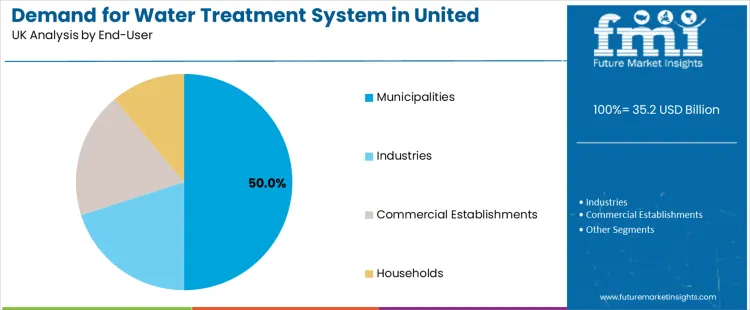
The end-user segment for water treatment systems in the United Kingdom is led by municipalities, which account for 50% of the industry share. Municipalities play a critical role in providing clean and safe drinking water to the public, and water treatment systems are essential in meeting regulatory requirements and public health standards. The demand for water treatment systems in municipal settings is driven by factors such as population growth, aging infrastructure, and the increasing need to address water contamination issues. Municipalities are also investing in advanced technologies for wastewater treatment and water recycling, further driving demand for water treatment solutions.
Industries follow as another important end user, utilizing water treatment systems for both their manufacturing processes and environmental compliance. Industries such as food processing, chemical production, and pharmaceuticals require treated water to meet specific operational standards. They also need to treat wastewater to comply with environmental regulations. Commercial establishments, including hotels, restaurants, and office buildings, also represent a significant market for water treatment systems. These establishments use water treatment solutions to provide clean water for drinking and hygiene purposes, as well as for heating and cooling systems.
Households, while a smaller segment, continue to adopt water purification systems to ensure the quality of their drinking water. The increasing focus on health and safety, along with rising concerns over water contamination, is driving the demand for residential water purification systems. As the need for water quality assurance grows across sectors, the demand for water treatment systems in the United Kingdom is expected to continue expanding across municipalities, industries, commercial establishments, and households.
What are the Key Dynamics in the Demand for Water Treatment Systems in the United Kingdom?
Demand for water treatment systems in the United Kingdom is driven by stringent regulatory requirements for potable water quality, wastewater discharge standards, and industrial effluent control. Municipal authorities, manufacturing facilities, food and beverage processors, and utilities prioritize solutions that deliver reliable contaminant removal, regulatory compliance, and operational efficiency. Demand patterns respond to infrastructure investment cycles, urban growth, drought resilience planning, and environmental permitting timelines. The shift toward integrated water management strategies is encouraging deployment of advanced treatment technologies across public and private sector projects.
What are the Key Drivers for Water Treatment System Demand in the United Kingdom?
Several factors are sustaining demand for water treatment systems in the United Kingdom. Regulatory frameworks, including drinking water quality standards and wastewater consents, compel adoption of modern treatment technologies such as membrane filtration, UV disinfection, and biological nutrient removal. Urban development and population growth drive expansion of municipal treatment capacity. Industrial sectors, particularly food processing, pharmaceuticals, chemicals, and energy, require bespoke systems to meet specific effluent quality criteria. Corporate commitments to sustainability and water stewardship influence investment in reuse and recycling systems that reduce freshwater intake and discharge volumes. Increased capital expenditure on infrastructure modernization also supports system acquisitions.
What are the Restraints on Water Treatment System Demand in the United Kingdom?
Despite strong underlying demand, several restraints affect the water treatment system market in the United Kingdom. High upfront capital costs for complex treatment technologies can limit adoption, especially for small and medium sized enterprises with constrained budgets. Long planning and permitting timelines for municipal and industrial installations can delay project execution. Skilled labor shortages in commissioning, operations, and maintenance of sophisticated systems can increase total cost of ownership and inhibit uptake. Competition from lower cost modular or packaged systems that may offer reduced performance capacity can further complicate procurement decisions. Variable public funding cycles for infrastructure projects also influence the timing and scale of investments.
What are the Key Trends in Water Treatment System Demand in the United Kingdom?
Key trends shaping water treatment system demand in the United Kingdom include increased deployment of digital monitoring and automation platforms that support real time water quality tracking and predictive maintenance. There is growing adoption of advanced membrane technologies for desalination, microfiltration, and ultrafiltration to address emerging contaminants and microplastics concerns. Water reuse and zero liquid discharge solutions are gaining traction in industrial facilities seeking to reduce environmental impact and freshwater costs. Suppliers are developing scalable and modular systems that can be tailored to specific site conditions and phased investment strategies. Partnerships between technology vendors, engineering firms, and water utilities are becoming more common to deliver integrated solutions that align with long term asset management plans.
What is the Country-Wise Demand for Water Treatment Systems in the United Kingdom?
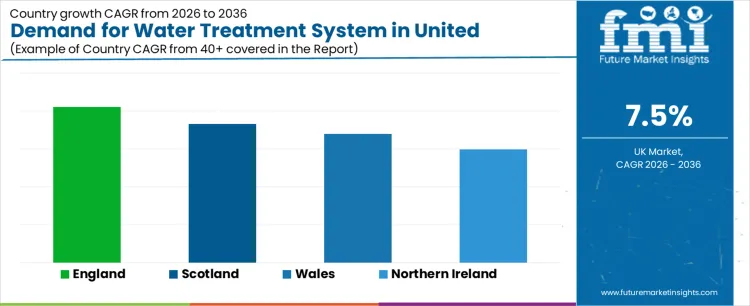
The country-wise demand for water treatment systems in the United Kingdom shows regional differences, with England leading the industry. The demand in England is primarily driven by its large population, extensive industrial base, and increasing environmental regulations that require better water quality management. Scotland, Wales, and Northern Ireland follow with strong demand, supported by regional water scarcity concerns, stricter regulatory standards, and the need for improved wastewater treatment solutions. As water treatment technologies continue to evolve and the need for sustainable water management solutions increases, all regions in the UK are expected to see growth. England remains the dominant market due to its scale, while other regions experience growth in line with regional industrial and environmental needs.
| Country | CAGR (2026 to 2036) |
|---|---|
| England | 8.2% |
| Scotland | 7.3% |
| Wales | 6.8% |
| Northern Ireland | 6.0% |
What is Driving the Demand for Water Treatment Systems in England?
The demand for water treatment systems in England is expected to grow at a CAGR of 8.2% from 2026 to 2036. England’s large population, combined with its extensive industrial and agricultural sectors, makes efficient water management essential. The increasing pressure to meet stringent environmental regulations and reduce water wastage is driving the adoption of advanced water treatment technologies. Additionally, the growing concerns regarding water quality in both urban and rural areas are prompting investments in new systems for drinking water, wastewater treatment, and industrial applications. The expansion of urban infrastructure, coupled with industrial growth, is further fueling the demand for water treatment solutions. As the UK government continues to introduce stricter water quality standards, England’s demand for water treatment systems is expected to grow rapidly, driven by both residential and industrial needs for sustainable water management.
How is the Demand for Water Treatment Systems Performing in Scotland?
In Scotland, the demand for water treatment systems is projected to grow at a CAGR of 7.3% from 2026 to 2036. Scotland’s focus on improving water quality and addressing water scarcity concerns in certain areas is contributing to the growing need for efficient water treatment solutions. The Scottish government’s investment in environmental sustainability and the focus on upgrading water infrastructure are key factors in the industry’s expansion. With a commitment to achieving high environmental standards, Scotland is increasingly adopting advanced water treatment technologies for drinking water and wastewater treatment. As industries, particularly in food and beverage, pharmaceuticals, and energy, expand in Scotland, the demand for reliable and efficient water treatment systems will continue to rise. The need to meet regulatory standards and reduce water usage in industrial applications will drive further adoption of water treatment systems across the region.
What Are the Growth Drivers for Water Treatment Systems in Wales?
The demand for water treatment systems in Wales is expected to grow at a CAGR of 6.8% through 2036. The demand is primarily driven by Wales’ ongoing investment in upgrading water infrastructure to meet both residential and industrial needs. Wales has experienced increasing pressure to improve water quality in both urban and rural areas, which is leading to the adoption of more advanced treatment technologies. Additionally, Wales' growing focus on environmental sustainability is encouraging the use of systems that improve water reuse and reduce wastewater discharge. With industrial growth in sectors such as food processing, chemicals, and energy, the need for efficient water management systems is becoming more pronounced. As regulatory requirements for water treatment become more stringent, Welsh businesses are investing in cutting-edge solutions to maintain compliance and improve water management practices, driving the demand for water treatment systems in the region.
What is the Outlook for Water Treatment Systems Demand in Northern Ireland?
Northern Ireland’s demand for water treatment systems is projected to grow at a CAGR of 6.0% from 2026 to 2036. While Northern Ireland represents the smallest market in the United Kingdom, its demand is steadily increasing due to growing concerns over water quality and increasing regulatory standards. As industrial sectors in Northern Ireland, particularly in manufacturing and food processing, expand, the need for efficient water management systems is becoming more critical. The growing demand for sustainable and energy-efficient water treatment solutions is also contributing to the industry’s growth. Additionally, the Northern Irish government’s focus on improving infrastructure and water quality standards in both urban and rural areas is driving the adoption of advanced water treatment technologies. As industries and municipalities seek solutions that help reduce environmental impact and comply with stringent regulations, Northern Ireland’s market for water treatment systems is expected to see steady growth in the coming years.
What is the Competitive Landscape for Demand for Water Treatment Systems in the United Kingdom?
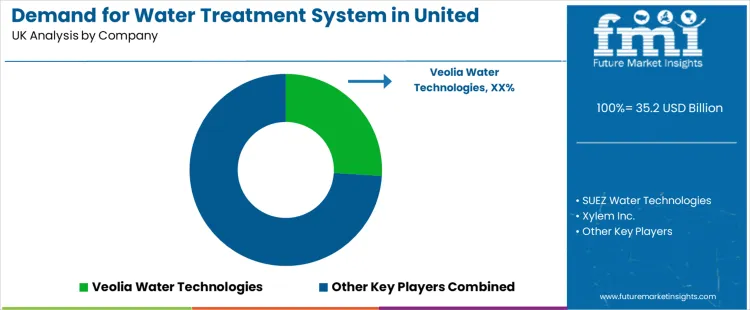
Demand for water treatment systems in the United Kingdom spans municipal utilities, industrial facilities, and commercial developments where regulatory compliance, water quality performance, and long term operational costs are primary decision factors. Veolia Water Technologies is regarded as a leading supplier, with documented system portfolios that cover membrane filtration, biological treatment, and advanced oxidation. Product brochures supplied by Veolia detail system capacities, target contaminant removal rates, and energy efficiency parameters. These documents are routinely reviewed by technical procurement teams when evaluating solutions for specific treatment objectives.
SUEZ Water Technologies competes with a broad range of modular and custom treatment platforms. Technical literature from SUEZ outlines performance metrics such as permeate quality, chemical dosing specifications, and footprint requirements. Engineering teams use this documentation to assess how a supplier’s technology fits within existing plant layouts and compliance regimes. Xylem Inc. differentiates through products focused on pumping, filtration, and analytical instrumentation, with datasheets that record pump curves, sensor accuracy values, and service interval recommendations. Procurement professionals in the UK consult these specifications to ensure interoperability with process control systems and to align maintenance planning with operational targets.
Pentair PLC offers treatment systems supported by technical brochures that list flow capacities, membrane types, and retrofit options. These materials help buyers compare how various solutions perform under variable feed water conditions and seasonal demand fluctuations. Evoqua Water Technologies supplies solutions documented for industrial wastewater, potable reuse, and commercial water systems. Product documentation from Evoqua includes removal efficiency ratings, media service life data, and typical installation schematics. Companies and facilities in the United Kingdom assess this information to gauge operational uptime and life cycle cost profiles.
Procurement cycles in the United Kingdom incorporate documented performance data, documented quality benchmarks, and documented service support terms from these suppliers. Buyers place emphasis on documented compliance with UK drinking water standards, effluent discharge requirements, and environmental permits. Lead times and documented commissioning support services are factored into selection processes. For industrial buyers, technical teams match documented system performance against production continuity needs. Competitive behaviour in the UK market is grounded in measurable technical specifications and documented supply terms, providing clarity to stakeholders during tender evaluations and long term partnership assessments.
Key Players of the Demand for Water Treatment System in United Kingdom
- Veolia Water Technologies
- SUEZ Water Technologies
- Xylem Inc.
- Pentair PLC
- Evoqua Water Technologies
Scope of the Report
| Items | Values |
|---|---|
| Quantitative Units (2026) | USD Billion |
| Technology | Reverse Osmosis, Ultrafiltration, UV Purification, Chemical Treatment, Desalination |
| Application | Municipal Water Treatment, Industrial Process Water, Residential Water Purification, Wastewater Treatment |
| End-User | Municipalities, Industries, Commercial Establishments, Households |
| Companies | Veolia Water Technologies, SUEZ Water Technologies, Xylem Inc., Pentair PLC, Evoqua Water Technologies |
| Regions Covered | United Kingdom |
| Countries Covered | England, Scotland, Wales, Northern Ireland |
| Additional Attributes | Dollar by sales by technology, application, end-user, and region. Includes market trends towards sustainability, water conservation, and the role of water treatment systems in enhancing water quality across various sectors. |
Key Segments of Demand for Water Treatment System in United Kingdom
Technology
- Reverse Osmosis
- Ultrafiltration
- UV Purification
- Chemical Treatment
- Desalination
Application
- Municipal Water Treatment
- Industrial Process Water
- Residential Water Purification
- Wastewater Treatment
End-User
- Municipalities
- Industries
- Commercial Establishments
- Households
Countries
- England
- Scotland
- Wales
- Northern Ireland
Bibliography
- Department for Environment, Food & Rural Affairs. (2024). Strategic policy statement to Ofwat: Water industry priorities for England. UK Government.
- Drinking Water Inspectorate. (2024). Drinking water safety and quality regulations: Guidance for water suppliers. UK Government.
- Environment Agency. (2024). Water abstraction, treatment and environmental permitting in England. UK Government.
- Organisation for Economic Co-operation and Development. (2024). Financing water supply, sanitation and flood protection: Challenges in advanced economies. OECD Publishing.
- World Health Organization. (2024). Guidelines for drinking-water quality (4th ed., incorporating first addendum). World Health Organization.
Frequently Asked Questions
How big is the demand for water treatment system in united kingdom in 2026?
The demand for water treatment system in united kingdom is estimated to be valued at USD 35.2 billion in 2026.
What will be the size of water treatment system in united kingdom in 2036?
The market size for the water treatment system in united kingdom is projected to reach USD 72.5 billion by 2036.
How much will be the demand for water treatment system in united kingdom growth between 2026 and 2036?
The demand for water treatment system in united kingdom is expected to grow at a 7.5% CAGR between 2026 and 2036.
What are the key product types in the water treatment system in united kingdom?
The key product types in water treatment system in united kingdom are reverse osmosis, ultrafiltration, uv purification, chemical treatment and desalination.
Which application segment is expected to contribute significant share in the water treatment system in united kingdom in 2026?
In terms of application, municipal water treatment segment is expected to command 45.0% share in the water treatment system in united kingdom in 2026.
Preview the report firsthand - request a free sample
Get SampleGet the brochure for pricing and purchase details.
Get PDFTable of Content
- Executive Summary
- UK Market Outlook
- Demand-side Trends
- Supply-side Trends
- Technology Roadmap Analysis
- Analysis and Recommendations
- Market Overview
- Market Coverage / Taxonomy
- Market Definition / Scope / Limitations
- Market Background
- Market Dynamics
- Drivers
- Restraints
- Opportunity
- Trends
- Scenario Forecast
- Demand in Optimistic Scenario
- Demand in Likely Scenario
- Demand in Conservative Scenario
- Opportunity Map Analysis
- Product Life Cycle Analysis
- Supply Chain Analysis
- Investment Feasibility Matrix
- Value Chain Analysis
- PESTLE and Porter’s Analysis
- Regulatory Landscape
- Regional Parent Market Outlook
- Production and Consumption Statistics
- Import and Export Statistics
- Market Dynamics
- UK Market Analysis 2021 to 2025 and Forecast, 2026 to 2036
- Historical Market Size Value (USD Million) Analysis, 2021 to 2025
- Current and Future Market Size Value (USD Million) Projections, 2026 to 2036
- Y-o-Y Growth Trend Analysis
- Absolute $ Opportunity Analysis
- UK Market Pricing Analysis 2021 to 2025 and Forecast 2026 to 2036
- UK Market Analysis 2021 to 2025 and Forecast 2026 to 2036, By Technology
- Introduction / Key Findings
- Historical Market Size Value (USD Million) Analysis By Technology , 2021 to 2025
- Current and Future Market Size Value (USD Million) Analysis and Forecast By Technology , 2026 to 2036
- Reverse Osmosis
- Ultrafiltration
- UV Purification
- Chemical Treatment
- Desalination
- Reverse Osmosis
- Y-o-Y Growth Trend Analysis By Technology , 2021 to 2025
- Absolute $ Opportunity Analysis By Technology , 2026 to 2036
- UK Market Analysis 2021 to 2025 and Forecast 2026 to 2036, By Application
- Introduction / Key Findings
- Historical Market Size Value (USD Million) Analysis By Application, 2021 to 2025
- Current and Future Market Size Value (USD Million) Analysis and Forecast By Application, 2026 to 2036
- Municipal Water Treatment
- Industrial Process Water
- Residential Water Purification
- Wastewater Treatment
- Municipal Water Treatment
- Y-o-Y Growth Trend Analysis By Application, 2021 to 2025
- Absolute $ Opportunity Analysis By Application, 2026 to 2036
- UK Market Analysis 2021 to 2025 and Forecast 2026 to 2036, By End-User
- Introduction / Key Findings
- Historical Market Size Value (USD Million) Analysis By End-User, 2021 to 2025
- Current and Future Market Size Value (USD Million) Analysis and Forecast By End-User, 2026 to 2036
- Municipalities
- Industries
- Commercial Establishments
- Households
- Municipalities
- Y-o-Y Growth Trend Analysis By End-User, 2021 to 2025
- Absolute $ Opportunity Analysis By End-User, 2026 to 2036
- Market Structure Analysis
- Competition Dashboard
- Competition Benchmarking
- Market Share Analysis of Top Players
- By Regional
- By Technology
- By Application
- By End-User
- Competition Analysis
- Competition Deep Dive
- Veolia Water Technologies
- Overview
- Product Portfolio
- Profitability by Market Segments (Product/Age /Sales Channel/Region)
- Sales Footprint
- Strategy Overview
- Marketing Strategy
- Product Strategy
- Channel Strategy
- SUEZ Water Technologies
- Xylem Inc.
- Pentair PLC
- Evoqua Water Technologies
- Veolia Water Technologies
- Competition Deep Dive
- Assumptions & Acronyms Used
- Research Methodology


