

- Industry Size (2026)
- USD 459.2 Mn
- Forecast (2036)
- USD 1191.0 Mn
- CAGR (2026 to 2036)
- 10.0%
Closed-Loop Centesis Systems Market Forecast and Outlook 2026 to 2036
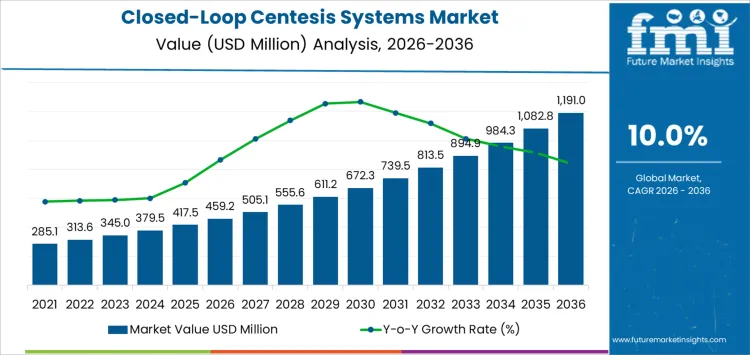
The closed-loop centesis systems market is poised to increase from USD 459.2 million in 2026 to approximately USD 1,191.0 million by 2036, reflecting a compound annual growth rate (CAGR) of 10%. Growth is primarily driven by the adoption of these systems in hospitals and specialized clinics looking to enhance safety, minimize procedural contamination, and optimize fluid removal processes.
The selection of devices in the sector hinges more on performance characteristics such as vacuum control, tubing integrity, and cartridge handling than on brand loyalty. Once a closed-loop system is approved for clinical use, hospitals typically maintain consistent specifications for future purchases, thereby reducing the need for retraining staff. Effective workflow planning involves consideration of the layout of procedure rooms, disposal routes, and staff assignments.
In the procurement phase, considerations include service agreements, availability of training support, and the provision of refill kits. Operational efficacy proves to be a more influential factor in the decision to adopt these systems than marketing efforts. Device manufacturers are concentrating on aspects such as valve reliability, flexibility of tubing, and effective sealing of cartridges to ensure consistent fluid flow and uphold patient safety standards.
Distribution strategies place these essential devices and their consumables near hospitals with high patient volumes. Technical support teams play a critical role by managing calibration, maintenance, and training. The frequency of procedures and the throughput of hospitals significantly influence the adoption rate, while profitability is linked more to system reliability, minimal rework, and steady replenishment cycles than to aggressive marketing strategies or frequent product launches. Additionally, readiness for compliance and audits plays a pivotal role in the selection of suppliers.
Quick Stats for Closed-Loop Centesis Systems Market
- Closed-Loop Centesis Systems Market Value (2026): USD 459.2 million
- Closed-Loop Centesis Systems Market Forecast Value (2036): USD 1,191.0 million
- Closed-Loop Centesis Systems Market Forecast CAGR (2026-2036): 10.0%
- Leading Type in Closed-Loop Centesis Systems Market: Vacuum-assisted systems
- Key Growth Regions in Closed-Loop Centesis Systems Market: Asia Pacific, North America, Europe
- Top Players in Closed-Loop Centesis Systems Market: Merit Medical, AngioDynamics, Cook Medical, BD, Argon Medical
What Is the Growth Forecast for the Closed Loop Centesis Systems Market through 2036?
Procurement cycles and hospital equipment standardization govern growth in the closed loop centesis systems market more than overall procedure counts. Increasing focus on malignant ascites procedures supports broader adoption of drainage solutions. In 2026, at about USD 459.2 million, demand is concentrated in tertiary care hospitals and specialty liver clinics that adopt closed loop systems to minimize infection and handling risk. Purchases are coordinated with capital equipment planning and staff training programs, which ties device uptake to planned unit expansions rather than daily case load.
Enhanced thoracic drainage approaches reflect the clinical emphasis on safe effusion management. Volume rises as more wards incorporate automated drainage systems, and multi room deployments become standard across networks. The trajectory reflects progressive hospital adoption and system integration rather than replacement of legacy devices.
Logistics and operational efficiency shape the later stage of the closed loop centesis systems market. Use of peritoneal catheter solutions in serial paracentesis reinforces fluid control trends in advanced care. As value moves toward roughly USD 1,191.0 million by 2036, attention centers on supplier reliability, component shelf life, and workflow integration within sterile supply chains. Manufacturers invest in modular designs, scalable kits, and support networks that reduce setup time and minimize clinical disruption. The rise from under five hundred million into the low one point four billion reflects accumulated hospital procurement services across multiple systems rather than a single regulatory push. Suppliers that combine dependable delivery, consistent product quality, and robust service coverage retain repeat placements across long term clinical programs.
Closed-Loop Centesis Systems Market Key Takeaways
| Metric | Value |
|---|---|
| Market Value (2026) | USD 459.2 million |
| Forecast Value (2036) | USD 1,191.0 million |
| Forecast CAGR (2026-2036) | 10.0% |
How Is the Closed-Loop Centesis Systems Market Enhancing Safety and Efficiency in Fluid Management?
Closed-loop centesis systems are designed to provide controlled drainage of ascites, pleural disease procedures, and other body fluids while maintaining sterility and minimizing contamination risk. Earlier drainage methods relied on open systems with intermittent suction, which increased infection potential and required constant supervision. Modern systems integrate catheter solutions, one-way valves, and controlled flow mechanisms to support continuous or intermittent drainage with minimal procedural interruption. Hospitals and outpatient procedural solutions prioritize device reliability, ease of handling, and compatibility with existing monitoring systems. Adoption is highest in hepatology, oncology, and critical care units, where frequent drainage procedures occur, staff efficiency is critical, and patient safety outcomes directly affect operational workflows and resource allocation.
Supplier differentiation focuses on material durability, valve integrity, and consistent performance across production batches. Early market trials were limited in scale, often site-specific, which restricted repeatable feedback and data for device improvement. Current demand favors standardized designs that reduce training requirements, simplify consumable management, and allow multi-ward or multi-site deployment. Clinical teams assess total cost by evaluating procedure duration, risk of complications, and device reliability, rather than unit price alone. Distributors add value through technical support, training programs, and rapid replacement of consumables. Growth in the sector is expected to track the increasing prevalence of chronic liver disease, cancer care volumes, and expansion of outpatient interventional procedures, where predictable, sterile fluid management solutions improve both safety and operational efficiency for healthcare providers.
What Factors Are Shaping the Demand for Closed-Loop Centesis Systems Market in 2026 by Product Type and Application?
Demand in the Closed-Loop Centesis Systems Market is influenced by patient safety priorities, procedural efficiency, and infection prevention standards rather than short-term purchasing trends. Hospitals and outpatient clinics require devices that provide consistent fluid removal, integrate with monitoring systems, and comply with regulatory protocols. Variations in automation, portability, and disposable versus reusable design define segment demand. Suppliers that offer preventive maintenance, consumable logistics, and staff training can secure long-term contracts. Growth is concentrated in high-volume thoracentesis and image-guided drainage procedures, creating predictable adoption cycles. Manufacturers with scalable service models, reliable devices, and regulatory support are best positioned to capture share in this specialized clinical market.
How Does Product Type Influence Supplier Responsibilities and Operational Planning in the Closed-Loop Centesis Systems Market?
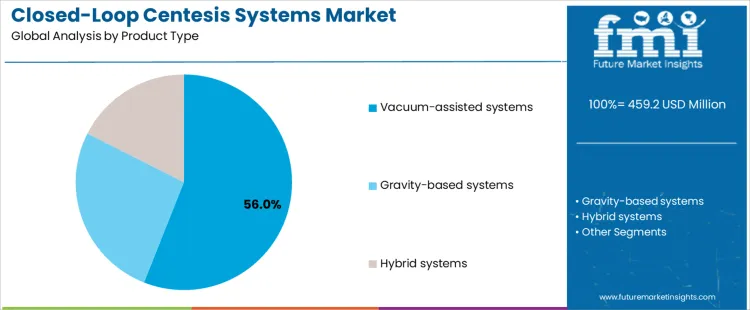
Vacuum-assisted systems dominate demand because they provide precise fluid removal and reduce operator variability, creating consistent outcomes across multiple clinical settings. Manufacturers supporting these devices must deliver calibration services, preventive maintenance, and consumable management programs to maintain clinical reliability. Gravity-based systems are adopted in lower-acuity or short-duration procedures where mobility and simplicity are key, but supplier training and flexible service agreements remain critical. Hybrid systems combine vacuum and gravity functionality, increasing technical support requirements. Device type affects not only procurement strategy but also supplier involvement in preventive maintenance, inventory planning, and staff education, making comprehensive support a competitive differentiator.
Operational efficiency and workflow impact are significant when selecting product types. Vacuum-assisted devices reduce procedural errors and standardize high-volume thoracentesis and paracentesis workflows, improving patient throughput. Gravity-based systems allow portable, flexible operation, which suits bedside or short-term procedures but increases dependence on staff skill. Hybrid devices require additional monitoring, calibration, and periodic validation to ensure proper performance. Once hospitals integrate a device type into clinical protocols, changes are limited due to training, validation, and regulatory documentation requirements. Suppliers providing modular services, training packages, and reliable consumable delivery gain advantage in both routine and specialized deployments.
Why Does Application Mix Determine Volume Concentration and Supplier Strategy in the Closed-Loop Centesis Systems Market?

Thoracentesis procedures drive the largest volume because they are performed frequently in hospitals and outpatient facilities, requiring consistent performance and reliability. Devices supporting these procedures must integrate with monitoring systems and minimize infection risk. Paracentesis applications, while smaller in volume, demand portable and accurate fluid management systems, creating opportunities for suppliers to differentiate through flexibility and reliability. Device adoption in these applications informs inventory planning, preventive maintenance schedules, and technical support allocation. Suppliers that align solutions with high-volume thoracentesis and targeted paracentesis needs can optimize market penetration, streamline service delivery, and maximize account retention.
Clinical application requirements also affect revenue potential and operational planning for suppliers. High-volume thoracentesis programs emphasize predictable service cycles, standardized consumables, and integrated staff training. Paracentesis programs require portable, easy-to-use devices with reliable performance in variable clinical settings, creating opportunities for specialized service contracts. Hybrid or niche applications present additional support needs for calibration, consumables, and technical guidance. Segment distribution is therefore influenced by procedure frequency, workflow integration, and compliance requirements rather than short-term hospital purchasing behavior. Suppliers that align their offerings with these operational realities can secure higher market share and recurring revenue streams.
How is the Closed-Loop Centesis Systems Market Being Defined by Patient Safety and Procedure Efficiency?
The Closed-Loop Centesis Systems Market is shaped by how hospitals, clinics, and outpatient centers manage safe and controlled fluid drainage for patients with ascites or other effusions. Devices are evaluated based on closed-system reliability, fluid containment, ease of use, and compatibility with bedside monitoring. Selection decisions involve interventional radiology procedures, nursing teams, and procurement departments. Suppliers that offer validated, easy-to-use systems with minimal contamination risk are preferred. This positions closed-loop centesis systems as critical clinical tools rather than optional accessories, emphasizing operational safety, consistency, and supply reliability.
How are Standardized Clinical Protocols Influencing Supplier Expectations in the Closed-Loop Centesis Systems Market?
Healthcare providers increasingly adopt uniform drainage protocols to reduce infection risk and improve efficiency across multiple units. This shifts expectations in the Closed-Loop Centesis Systems Market toward devices that reliably perform under repeated use, support variable fluid volumes, and integrate with hospital infection control standards. Buyers prefer systems with clear handling instructions, secure connectors, and predictable flow behavior. Suppliers are evaluated on product consistency, documentation quality, and technical support rather than on isolated feature improvements. Devices that align with standardized workflows are more likely to be adopted across hospital departments.
Where is Recurring Demand Being Built in the Closed-Loop Centesis Systems Market?
Recurring demand comes from hospitals, specialty clinics, and outpatient facilities that manage patients requiring repeated paracentesis or thoracentesis. Each procedure consumes a closed-loop device or disposable component, creating predictable repeat orders. The Closed-Loop Centesis Systems Market also benefits from multi-site healthcare systems that standardize on a single supplier or device model. Suppliers that provide training, quality assurance, and consistent product availability secure long-term business. Being embedded into clinical protocols ensures ongoing demand tied to patient volumes and procedure frequency.
Why do Cost Constraints and Clinical Risk Management Limit Broader Adoption in the Closed-Loop Centesis Systems Market?
Closed-loop devices carry higher per-procedure costs compared with traditional open systems, which can limit adoption in smaller hospitals or low-volume centers. Clinicians are cautious about introducing new systems mid-protocol due to potential workflow disruption or training requirements. Regulatory scrutiny for sterility, device labeling, and performance validation further slows adoption of alternative devices. The Closed-Loop Centesis Systems Market therefore sees concentrated use in high-acuity facilities and specialized units, while lower-volume settings may continue using conventional systems to manage costs and perceived risk.
What is the Demand for Closed Loop Centesis Systems by Country?
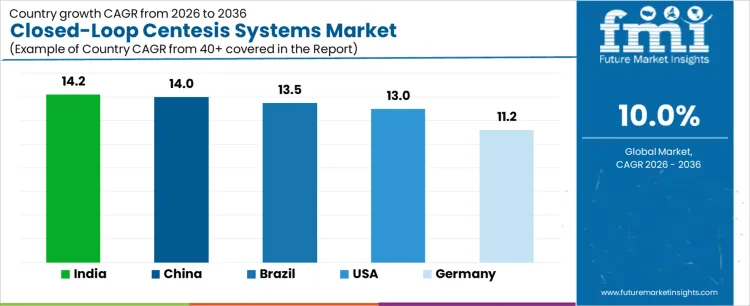
| Country | CAGR |
|---|---|
| USA | 13.0% |
| Brazil | 13.5% |
| China | 14.0% |
| India | 14.2% |
| Germany | 11.2% |
Demand for closed loop centesis systems is rising as hospitals and specialty clinics seek safer, more efficient methods for fluid drainage in patients with ascites, pleural effusions, and other medical conditions. India leads with a 14.2% CAGR, supported by expansion of hospital infrastructure, increasing chronic disease cases, and adoption of minimally invasive, closed system devices that reduce infection risk. China follows at 14.0%, driven by rising patient volumes, regulatory support for safer medical devices, and hospital modernization initiatives. Brazil records 13.5%, reflecting growing use in private and public healthcare facilities. The USA grows at 13.0%, shaped by demand in tertiary care hospitals and outpatient centers. Germany, at 11.2%, reflects steady adoption in a mature healthcare system focused on device safety and efficiency.
How Are Interventional Procedure Programs Driving Demand in the Closed-Loop Centesis Systems Market in the United States?
Expanding interventional care programs and outpatient fluid management protocols align with a 13% CAGR for closed-loop centesis systems in United States. Hospital procurement committees and interventional teams control most purchases. Adoption focuses on ascites, pleural effusion, and critical care drainage procedures. Device selection emphasizes sterility, integrated fluid control, and safety features. Once approved, systems standardize across multiple hospital networks. Training, protocol adherence, and procedure workflow influence utilization. Import products dominate high specification applications while domestic suppliers cover routine cases. Budget allocations track service line growth and new procedure adoption. Replacement cycles follow usage intensity. Commercial success depends on inclusion in hospital standard procurement lists and interventional program frameworks rather than isolated departmental purchases.
Why Are Hospital Network Expansions Influencing Demand in the Closed-Loop Centesis Systems Market in Brazil?
Hospital network expansion and private clinic upgrades support a 13.5% CAGR for closed-loop centesis systems in Brazil. Procurement authority sits with central hospital committees, interventional service lines, and capital boards. Adoption focuses on safe, reproducible drainage procedures for ascites and pleural effusions. Import systems dominate high specification applications while local suppliers cover routine setups. Once validated, deployment extends across affiliated hospitals. Training, documentation, and workflow compliance affect utilization. Capital spending aligns with new hospital openings and service line growth. Replacement cycles follow procedural volumes. Commercial success depends on framework inclusion and reference site adoption rather than ad hoc clinic purchases or small hospital transactions. Safety protocol compliance influences early adoption decisions.
What Institutional Programs Are Driving Growth in the Closed-Loop Centesis Systems Market in China?
Expansion of tertiary hospitals and chronic disease management programs supports a 14% CAGR for closed-loop centesis systems demand in China. Large hospital networks and specialty clinics control procurement. Adoption targets paracentesis, pleural drainage, and critical care interventions. Domestic suppliers dominate routine systems while international brands retain positions in high specification units. Tender cycles and multi-year capital allocation plans govern purchase timing. Once approved, systems replicate across departments and multiple hospitals. Training programs and clinical guideline adherence influence usage. Replacement cycles follow procedural frequency rather than device age. Capital allocation aligns with hospital network expansions. Commercial success depends on inclusion in approved hospital catalogs and reference programs rather than individual facility purchases.
Why Are Service Line Expansions Driving Growth in the Closed-Loop Centesis Systems Market in India?
Expansion of interventional procedures and dedicated hepatic and critical care units drives a 14.2% CAGR for closed-loop centesis systems in India. Large private hospitals and specialty centers lead procurement. Device selection emphasizes sterility, flow control, and integrated safety features. Import products serve high specification procedures while domestic suppliers cover routine hospital needs. Procurement authority rests with service line committees and capital planning boards. Once approved, systems are deployed across affiliated hospital networks. Training and workflow alignment influence adoption. Replacement cycles track procedure volume. Budget allocation follows department expansions and new hospital openings. Commercial success depends on network approved equipment lists and framework agreements rather than individual site or single department sales.
How Are Regulatory Guidelines and Hospital Standardization Shaping Demand in the Closed-Loop Centesis Systems Market in Germany?
Compliance with hospital regulations and procedural guidelines supports an 11.2% CAGR for closed-loop centesis systems in Germany. University hospitals and large medical centers control most procurement. Adoption focuses on paracentesis, pleural effusions, and other drainage procedures. Device evaluation emphasizes sterility, safety, and workflow integration. Procurement follows health technology assessment processes and capital approval cycles. Import suppliers dominate premium systems while domestic suppliers cover standard applications. Once approved, deployment spreads across departments and hospitals. Training, documentation, and guideline adherence influence utilization. Replacement cycles track procedural volume. Budget allocation aligns with hospital expansion and program upgrades. Commercial success depends on framework inclusion and reference site adoption rather than isolated purchases or individual physician preference.
How Do Suppliers Compete for Clinical Adoption in the Closed Loop Centesis Systems Market?

Closed loop centesis system adoption is driven by workflow integration, infection control protocols, and patient safety requirements rather than product catalog range. Clinical teams define fluid volume handling, suction control, catheter compatibility, and monitoring feedback before approving devices. Merit Medical, AngioDynamics, Cook Medical, BD, Argon Medical compete at this evaluation stage through different procedural alignment strategies. Once a system is integrated into standard operating procedures, staff training, device maintenance, and documentation practices anchor the choice. Merit Medical leverages procedure kits and compatibility with existing drainage workflows. AngioDynamics positions products for minimally invasive and rapid deployment applications. Cook Medical emphasizes multi-modality device compatibility. BD supports hospitals with standardized protocols and training programs. Argon Medical targets efficiency and reliability in high throughput centers.
Competitive outcomes reflect safety record, procedural reliability, and support coverage rather than price alone. Clinicians assess catheter placement accuracy, flow consistency, ease of use, and leak prevention during trials. Hospital procurement teams review disposable inventory management, sterilization compatibility, and documentation completeness. Facilities favor suppliers with predictable delivery and service response. Merit Medical benefits from established procedure familiarity and technical support networks. AngioDynamics holds positions in emergency and interventional units requiring rapid readiness. Cook Medical competes where versatility across patient populations is critical. BD secures adoption through integration with clinical protocols and training consistency. Argon Medical gains placement in centers prioritizing operational efficiency and reliability. Market share varies by hospital type, procedure volume, and regulatory compliance requirements.
Key Players in the Closed-Loop Centesis Systems Market
- Merit Medical
- AngioDynamics
- Cook Medical
- BD
- Argon Medical
- Others
Scope of the Report
| Items | Values |
|---|---|
| Quantitative Units (2026) | USD Million |
| Product Type | Vacuum-assisted systems; Gravity-based systems; Hybrid systems |
| Application | Thoracentesis; Paracentesis |
| End User | Hospitals; ASCs; Clinics |
| Region | Asia Pacific; Europe; North America; Latin America; Middle East & Africa |
| Countries Covered | United States, Canada, Mexico, Germany, United Kingdom, France, Italy, Spain, Nordic, BENELUX, China, Japan, South Korea, India, Australia & New Zealand, ASEAN, Brazil, Chile, Saudi Arabia, Turkey, South Africa, Rest of regions |
| Key Companies Profiled | Merit Medical; AngioDynamics; Cook Medical; BD; Argon Medical |
| Additional Attributes | Dollar by sales by product and application, vacuum versus gravity mix, consumables attachment rates, procedure volume driven demand, service and training intensity, inventory turnover cycles, sterility and compliance requirements, multi-site standardization patterns, uptime and replenishment lead times |
Closed-Loop Centesis Systems Market Segmentation
Product Type:
- Vacuum-assisted systems
- Gravity-based systems
- Hybrid systems
Application:
- Thoracentesis
- Paracentesis
End User:
- Hospitals
- ASCs
- Clinics
Region:
- Asia Pacific
- China
- Japan
- South Korea
- India
- Australia & New Zealand
- ASEAN
- Rest of Asia Pacific
- Europe
- Germany
- United Kingdom
- France
- Italy
- Spain
- Nordic
- BENELUX
- Rest of Europe
- North America
- United States
- Canada
- Mexico
- Latin America
- Brazil
- Chile
- Rest of Latin America
- Middle East & Africa
- Kingdom of Saudi Arabia
- Other GCC Countries
- Turkey
- South Africa
- Other African Union
- Rest of Middle East & Africa
Bibliography
- Centers for Disease Control and Prevention. (2024). Guidelines for the prevention of intravascular catheter-related infections. U.S. Department of Health and Human Services.
- British Thoracic Society. (2023). BTS guideline for pleural disease and pleural procedures. British Thoracic Society.
- American Association for the Study of Liver Diseases. (2023). Diagnosis, evaluation, and management of ascites and related complications in cirrhosis. AASLD.
- World Health Organization. (2023). Global strategy on infection prevention and control. World Health Organization.
- National Institute of Diabetes and Digestive and Kidney Diseases. (2024). Cirrhosis and its complications. National Institutes of Health.
Frequently Asked Questions
How big is the closed-loop centesis systems market in 2026?
The global closed-loop centesis systems market is estimated to be valued at USD 459.2 million in 2026.
What will be the size of closed-loop centesis systems market in 2036?
The market size for the closed-loop centesis systems market is projected to reach USD 1,191.0 million by 2036.
How much will be the closed-loop centesis systems market growth between 2026 and 2036?
The closed-loop centesis systems market is expected to grow at a 10.0% CAGR between 2026 and 2036.
What are the key product types in the closed-loop centesis systems market?
The key product types in closed-loop centesis systems market are vacuum-assisted systems, gravity-based systems and hybrid systems.
Which application segment to contribute significant share in the closed-loop centesis systems market in 2026?
In terms of application, thoracentesis segment to command 54.0% share in the closed-loop centesis systems market in 2026.
Preview the report firsthand - request a free sample
Get SampleGet the brochure for pricing and purchase details.
Get PDFTable of Content
- Executive Summary
- Global Market Outlook
- Demand-side Trends
- Supply-side Trends
- Technology Roadmap Analysis
- Analysis and Recommendations
- Market Overview
- Market Coverage / Taxonomy
- Market Definition / Scope / Limitations
- Market Background
- Market Dynamics
- Drivers
- Restraints
- Opportunity
- Trends
- Scenario Forecast
- Demand in Optimistic Scenario
- Demand in Likely Scenario
- Demand in Conservative Scenario
- Opportunity Map Analysis
- Product Life Cycle Analysis
- Supply Chain Analysis
- Investment Feasibility Matrix
- Value Chain Analysis
- PESTLE and Porter’s Analysis
- Regulatory Landscape
- Regional Parent Market Outlook
- Production and Consumption Statistics
- Import and Export Statistics
- Market Dynamics
- Global Market Analysis 2021 to 2025 and Forecast, 2026 to 2036
- Historical Market Size Value (USD Million) Analysis, 2021 to 2025
- Current and Future Market Size Value (USD Million) Projections, 2026 to 2036
- Y-o-Y Growth Trend Analysis
- Absolute $ Opportunity Analysis
- Global Market Pricing Analysis 2021 to 2025 and Forecast 2026 to 2036
- Global Market Analysis 2021 to 2025 and Forecast 2026 to 2036, By Product Type
- Introduction / Key Findings
- Historical Market Size Value (USD Million) Analysis By Product Type , 2021 to 2025
- Current and Future Market Size Value (USD Million) Analysis and Forecast By Product Type , 2026 to 2036
- Vacuum-assisted systems
- Gravity-based systems
- Hybrid systems
- Vacuum-assisted systems
- Y-o-Y Growth Trend Analysis By Product Type , 2021 to 2025
- Absolute $ Opportunity Analysis By Product Type , 2026 to 2036
- Global Market Analysis 2021 to 2025 and Forecast 2026 to 2036, By Application
- Introduction / Key Findings
- Historical Market Size Value (USD Million) Analysis By Application, 2021 to 2025
- Current and Future Market Size Value (USD Million) Analysis and Forecast By Application, 2026 to 2036
- Thoracentesis
- Paracentesis
- Thoracentesis
- Y-o-Y Growth Trend Analysis By Application, 2021 to 2025
- Absolute $ Opportunity Analysis By Application, 2026 to 2036
- Global Market Analysis 2021 to 2025 and Forecast 2026 to 2036, By End User
- Introduction / Key Findings
- Historical Market Size Value (USD Million) Analysis By End User, 2021 to 2025
- Current and Future Market Size Value (USD Million) Analysis and Forecast By End User, 2026 to 2036
- Hospitals
- ASCs
- Clinics
- Hospitals
- Y-o-Y Growth Trend Analysis By End User, 2021 to 2025
- Absolute $ Opportunity Analysis By End User, 2026 to 2036
- Global Market Analysis 2021 to 2025 and Forecast 2026 to 2036, By Region
- Introduction
- Historical Market Size Value (USD Million) Analysis By Region, 2021 to 2025
- Current Market Size Value (USD Million) Analysis and Forecast By Region, 2026 to 2036
- North America
- Latin America
- Western Europe
- Eastern Europe
- East Asia
- South Asia and Pacific
- Middle East & Africa
- Market Attractiveness Analysis By Region
- North America Market Analysis 2021 to 2025 and Forecast 2026 to 2036, By Country
- Historical Market Size Value (USD Million) Trend Analysis By Market Taxonomy, 2021 to 2025
- Market Size Value (USD Million) Forecast By Market Taxonomy, 2026 to 2036
- By Country
- USA
- Canada
- Mexico
- By Product Type
- By Application
- By End User
- By Country
- Market Attractiveness Analysis
- By Country
- By Product Type
- By Application
- By End User
- Key Takeaways
- Latin America Market Analysis 2021 to 2025 and Forecast 2026 to 2036, By Country
- Historical Market Size Value (USD Million) Trend Analysis By Market Taxonomy, 2021 to 2025
- Market Size Value (USD Million) Forecast By Market Taxonomy, 2026 to 2036
- By Country
- Brazil
- Chile
- Rest of Latin America
- By Product Type
- By Application
- By End User
- By Country
- Market Attractiveness Analysis
- By Country
- By Product Type
- By Application
- By End User
- Key Takeaways
- Western Europe Market Analysis 2021 to 2025 and Forecast 2026 to 2036, By Country
- Historical Market Size Value (USD Million) Trend Analysis By Market Taxonomy, 2021 to 2025
- Market Size Value (USD Million) Forecast By Market Taxonomy, 2026 to 2036
- By Country
- Germany
- UK
- Italy
- Spain
- France
- Nordic
- BENELUX
- Rest of Western Europe
- By Product Type
- By Application
- By End User
- By Country
- Market Attractiveness Analysis
- By Country
- By Product Type
- By Application
- By End User
- Key Takeaways
- Eastern Europe Market Analysis 2021 to 2025 and Forecast 2026 to 2036, By Country
- Historical Market Size Value (USD Million) Trend Analysis By Market Taxonomy, 2021 to 2025
- Market Size Value (USD Million) Forecast By Market Taxonomy, 2026 to 2036
- By Country
- Russia
- Poland
- Hungary
- Balkan & Baltic
- Rest of Eastern Europe
- By Product Type
- By Application
- By End User
- By Country
- Market Attractiveness Analysis
- By Country
- By Product Type
- By Application
- By End User
- Key Takeaways
- East Asia Market Analysis 2021 to 2025 and Forecast 2026 to 2036, By Country
- Historical Market Size Value (USD Million) Trend Analysis By Market Taxonomy, 2021 to 2025
- Market Size Value (USD Million) Forecast By Market Taxonomy, 2026 to 2036
- By Country
- China
- Japan
- South Korea
- By Product Type
- By Application
- By End User
- By Country
- Market Attractiveness Analysis
- By Country
- By Product Type
- By Application
- By End User
- Key Takeaways
- South Asia and Pacific Market Analysis 2021 to 2025 and Forecast 2026 to 2036, By Country
- Historical Market Size Value (USD Million) Trend Analysis By Market Taxonomy, 2021 to 2025
- Market Size Value (USD Million) Forecast By Market Taxonomy, 2026 to 2036
- By Country
- India
- ASEAN
- Australia & New Zealand
- Rest of South Asia and Pacific
- By Product Type
- By Application
- By End User
- By Country
- Market Attractiveness Analysis
- By Country
- By Product Type
- By Application
- By End User
- Key Takeaways
- Middle East & Africa Market Analysis 2021 to 2025 and Forecast 2026 to 2036, By Country
- Historical Market Size Value (USD Million) Trend Analysis By Market Taxonomy, 2021 to 2025
- Market Size Value (USD Million) Forecast By Market Taxonomy, 2026 to 2036
- By Country
- Kingdom of Saudi Arabia
- Other GCC Countries
- Turkiye
- South Africa
- Other African Union
- Rest of Middle East & Africa
- By Product Type
- By Application
- By End User
- By Country
- Market Attractiveness Analysis
- By Country
- By Product Type
- By Application
- By End User
- Key Takeaways
- Key Countries Market Analysis
- USA
- Pricing Analysis
- Market Share Analysis, 2025
- By Product Type
- By Application
- By End User
- Canada
- Pricing Analysis
- Market Share Analysis, 2025
- By Product Type
- By Application
- By End User
- Mexico
- Pricing Analysis
- Market Share Analysis, 2025
- By Product Type
- By Application
- By End User
- Brazil
- Pricing Analysis
- Market Share Analysis, 2025
- By Product Type
- By Application
- By End User
- Chile
- Pricing Analysis
- Market Share Analysis, 2025
- By Product Type
- By Application
- By End User
- Germany
- Pricing Analysis
- Market Share Analysis, 2025
- By Product Type
- By Application
- By End User
- UK
- Pricing Analysis
- Market Share Analysis, 2025
- By Product Type
- By Application
- By End User
- Italy
- Pricing Analysis
- Market Share Analysis, 2025
- By Product Type
- By Application
- By End User
- Spain
- Pricing Analysis
- Market Share Analysis, 2025
- By Product Type
- By Application
- By End User
- France
- Pricing Analysis
- Market Share Analysis, 2025
- By Product Type
- By Application
- By End User
- India
- Pricing Analysis
- Market Share Analysis, 2025
- By Product Type
- By Application
- By End User
- ASEAN
- Pricing Analysis
- Market Share Analysis, 2025
- By Product Type
- By Application
- By End User
- Australia & New Zealand
- Pricing Analysis
- Market Share Analysis, 2025
- By Product Type
- By Application
- By End User
- China
- Pricing Analysis
- Market Share Analysis, 2025
- By Product Type
- By Application
- By End User
- Japan
- Pricing Analysis
- Market Share Analysis, 2025
- By Product Type
- By Application
- By End User
- South Korea
- Pricing Analysis
- Market Share Analysis, 2025
- By Product Type
- By Application
- By End User
- Russia
- Pricing Analysis
- Market Share Analysis, 2025
- By Product Type
- By Application
- By End User
- Poland
- Pricing Analysis
- Market Share Analysis, 2025
- By Product Type
- By Application
- By End User
- Hungary
- Pricing Analysis
- Market Share Analysis, 2025
- By Product Type
- By Application
- By End User
- Kingdom of Saudi Arabia
- Pricing Analysis
- Market Share Analysis, 2025
- By Product Type
- By Application
- By End User
- Turkiye
- Pricing Analysis
- Market Share Analysis, 2025
- By Product Type
- By Application
- By End User
- South Africa
- Pricing Analysis
- Market Share Analysis, 2025
- By Product Type
- By Application
- By End User
- USA
- Market Structure Analysis
- Competition Dashboard
- Competition Benchmarking
- Market Share Analysis of Top Players
- By Regional
- By Product Type
- By Application
- By End User
- Competition Analysis
- Competition Deep Dive
- Merit Medical
- Overview
- Product Portfolio
- Profitability by Market Segments (Product/Age /Sales Channel/Region)
- Sales Footprint
- Strategy Overview
- Marketing Strategy
- Product Strategy
- Channel Strategy
- AngioDynamics
- Cook Medical
- BD
- Argon Medical
- Others
- Merit Medical
- Competition Deep Dive
- Assumptions & Acronyms Used
- Research Methodology


