

- Industry Size (2026)
- USD 0.9 Bn
- Forecast (2036)
- USD 1.5 Bn
- CAGR (2026 to 2036)
- 4.6%
Retail Packaging for Computer Peripherals Market Forecast and Outlook 2026 to 2036
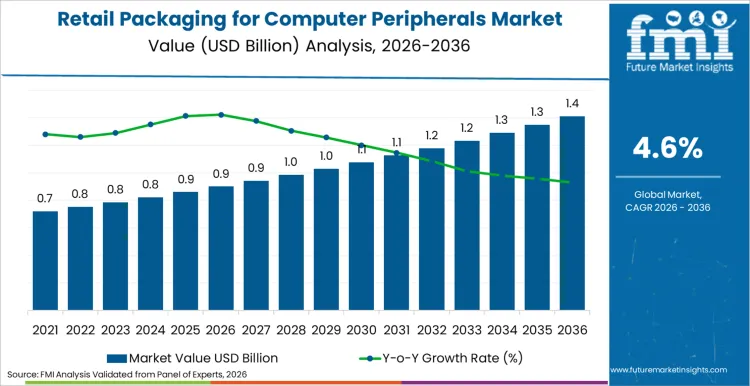
The retail packaging for computer peripherals market is set to achieve a valuation of USD 0.9 billion and reach USD 1.5 billion by 2036, a 4.6% CAGR that signals where value concentrates as buyers tighten performance and proof requirements. As per FMI analysis, this growth is not just a function of volume but of a deeper recalibration in unit economics, where premium peripherals now demand packaging that matches the fidelity of the device inside. The scale of infrastructure deployment confirms that the industry is preparing for a decade of fiber dominance.
Official figures from Smurfit Westrock indicate the entity now operates more than 500 sites and 63 paper mills globally, creating a logistics mesh that forces smaller regional converters to specialize or merge. This consolidation drives a mechanism where procurement teams at major OEMs can finally enforce global sustainability mandates with a single supplier, reducing the friction of managing multiple local packaging vendors.
While volume scales with device shipments, value accrues to suppliers who can deliver "unboxing" aesthetics without the regulatory liability of single-use plastics. The shift is operationalized by giants like International Paper and Smurfit Westrock, who are consolidating capacity to offer standardized, high-fiber solutions across fragmented supply chains.
Urgency of this transition is articulated by leaders in the sustainable materials sector who are witnessing a direct correlation between facility investment and market leadership. Ben Mascarello, CEO of Genera, stated in August 2025: "The expanded facility, coupled with its Biorefinery and Innovation Center, solidifies Genera's position as the leading fully integrated sustainable packaging manufacturer." This statement emphasizes how the competitive advantage is moving toward vertically integrated players who can control the fiber source and the manufacturing finish, ensuring that "sustainable" does not mean "rustic" or "rough" for high-end electronics brands. Consequently, the market is bifurcating into massive, efficiency-driven contract providers and niche innovation labs solving complex barrier coating challenges.
Summary of Retail Packaging for Computer Peripherals Market
How is the Growth Outlook for the Retail Packaging for Computer Peripherals Market?
FMI analysts opine that the sector will expand from USD 0.9 billion in 2026 to USD 1.5 billion in 2036, recording a steady 4.6% CAGR over the forecast period. This trajectory reflects a mature yet evolving landscape where the primary driver is the "premiumisation" of packaging materials rather than just unit volume growth.
FMI Research Approach: Based on proprietary modeling of peripheral shipment volumes (mice, keyboards, headsets) overlaid with material substitution indices and price-per-unit inflation in the fiber segment.
Which Trends Are Reshaping the Retail Packaging Ecosystem?
The market is witnessing a "sovereign supply" trend where packaging production is aggressively localizing next to electronics manufacturing clusters to minimize logistics emissions and costs. As per FMI's estimates, this is creating distinct high-growth corridors in Vietnam and India, where packaging converters are upgrading facilities to meet the quality standards of global export markets.
FMI Research Approach: Analysis of capital expenditure announcements by major paper converters and correlation with electronics manufacturing foreign direct investment (FDI) data.
What Is the Primary Constraint Facing Market Participants?
The most significant friction is the "performance-cost" gap in replacing clear plastic blisters with fiber alternatives that offer equal product visibility and theft protection. Brands in the computer peripherals sector are forced to redesign retail presence entirely, moving from "see-through" packaging to high-fidelity printed graphics on boxes to convey product value.
FMI Research Approach: Insights derived from packaging design patent filings and retailer shelf-space compliance guidelines in the EU and North America.
Who Are the Key Leaders Driving Material Innovation?
WestRock (now Smurfit Westrock) leads with a 5.4% market share, leveraging its massive transatlantic footprint to dictate terms on fiber supply and pricing. However, innovation is increasingly driven by agile entities like Notpla and Genera, who are solving specific barrier and finish challenges that allow fiber to replace plastic in premium segments.
FMI Research Approach: Market share analysis based on revenue reporting, capacity footprint, and patent portfolio assessment of key packaging conglomerates.
What Is the Definition of the Retail Packaging for Computer Peripherals Market?
The market encompasses the revenue generated from the sale of primary and secondary packaging materials specifically designed for computer peripheral devices, including mice, keyboards, headsets, and webcams. It includes rigid boxes, folding cartons, flexible sleeves, and interior cushioning, but excludes shipping logistics packaging (master cartons) not intended for retail display.
FMI Research Approach: Definition structured using FMI’s segmentation taxonomy covering material types (paperboard, plastic, hybrid) and end-use device categories.
How Does Sustainability Impact Procurement Decisions?
Sustainability has moved from a "nice-to-have" attribute to a binary "gatekeeper" requirement for vendor selection by major electronics OEMs. According to FMI's estimates, over 90% of RFPs (Request for Proposals) for new peripheral product lines now mandate specific recycled content percentages and plastic-free certification.
FMI Research Approach: derived from analysis of supplier codes of conduct from top electronics brands and interview data with procurement heads in the consumer electronics sector.
Retail Packaging for Computer Peripherals Market Key Takeaways
| Metric | Details |
|---|---|
| Industry Size (2026) | USD 0.9 billion |
| Industry Value (2036) | USD 1.5 billion |
| CAGR (2026-2036) | 4.6% |
Source: Future Market Insights (FMI) analysis, based on proprietary forecasting model and primary research.
What Is Driving the Shift to Fiber?
The migration to fiber-based packaging is fueled by the aggressive "plastic exit" timelines set by dominant consumer electronics brands, which effectively mandate a supply chain overhaul. For instance, Logitech reported in 2024 that 78% of its products are already made with post-consumer recycled plastic, a metric that signals a broader intent to eliminate virgin petrochemicals from the entire box, not just the device. This procurement pressure forces packaging converters to invest heavily in "Dry Molded Fiber" and other advanced paper-forming technologies that can replicate the precision of plastic trays without the environmental footprint. Consequently, the laptop accessories sector is seeing a rapid standardization of paper-based inserts, pushing suppliers to upgrade their tooling to meet these tighter tolerance requirements.
The sheer expansion of the digital economy in emerging markets is creating a massive volume funnel for robust, logistics-ready packaging. In Indonesia, the digital economy is projected to exceed USD 130 billion by 2025, driven largely by e-commerce and fintech, which fundamentally changes the protective requirements for shipped electronics. This surge forces manufacturers to design "ship-in-own-container" (SIOC) solutions that are durable enough to survive the last mile without an outer Amazon box, yet attractive enough for retail shelving. The convergence of these demands benefits players who can deliver high-strength, lightweight laptop accessories market share analysis compliant packaging that reduces shipping weight while enhancing the unboxing experience.
What is Segmentation Outlook for Retail Packaging for Computer Peripherals Market?
The retail packaging for computer peripherals market is segmented by Packaging Type, Peripheral Category, Material, and Region, revealing a decisive shift toward premium, structure-rich formats. The segmentation outlook indicates that while volume resides in standard folding cartons, profit pools are migrating to "hybrid" and rigid box formats that can justify higher price points for gaming and professional gear. By 2036, the "Other" category in packaging type is expected to shrink as brands consolidate around a few standardized, recyclable architectures. One trade-off dominates: the tension between "shelf appeal" and "material purity," where marketing teams demand glossy finishes while sustainability teams demand unblemished recyclability. As per FMI's projection, this dynamic will force a 2036 landscape where "smart" fiber designs that eliminate the need for glues and laminates capture the highest margins.
Why Are Folding Cartons the Dominant Format?
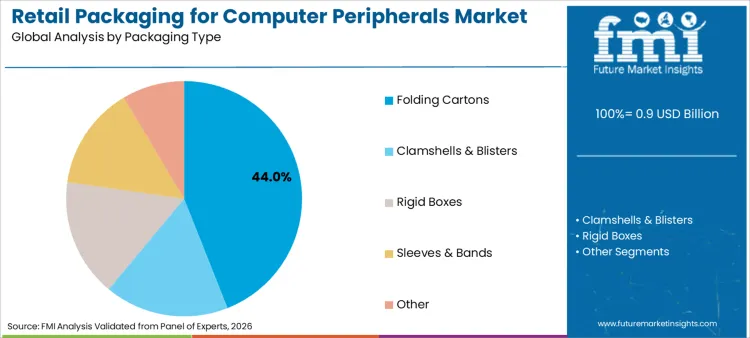
Folding cartons command a 44.0% market share, serving as the workhorse of the industry due to their balance of printable surface area and structural rigidity. This dominance is driven by the cost-efficiency of flat-pack shipping to assembly plants, where cartons can be erected on-demand, minimizing warehouse space requirements for OEMs. Mondi Group reported in 2024 that it decreased waste to landfill per tonne of production by 4%, illustrating how efficiency improvements in the paperboard supply chain are reinforcing the economic case for cartons over rigid alternatives. For manufacturers of computing device keyboards, this format remains the default choice, offering the best compromise between protection and billboard-style graphics.
How Is the Mouse and Keyboard Segment Evolving?
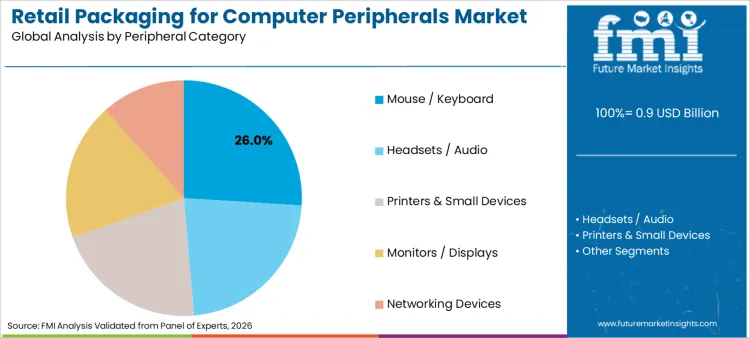
The Mouse / Keyboard segment holds a 26.0% share, reflecting the high replacement cycle and sheer volume of these ubiquitous input devices. This segment is characterized by extreme price sensitivity in the mass market, which drives the adoption of standardized, automated packaging lines that can run high-speed outputs with minimal manual intervention. However, the premium gaming sub-segment is breaking this mold, demanding complex "reveal" packaging that justifies a USD 100+ price tag. The mechanism here is clear: as gaming hardware becomes a lifestyle category, the packaging must perform as a "trophy case," pushing suppliers to innovate with textures and embossing that elevate the unboxing ritual without adding non-recyclable foams.
Why Does Paperboard Retain the Majority Share?
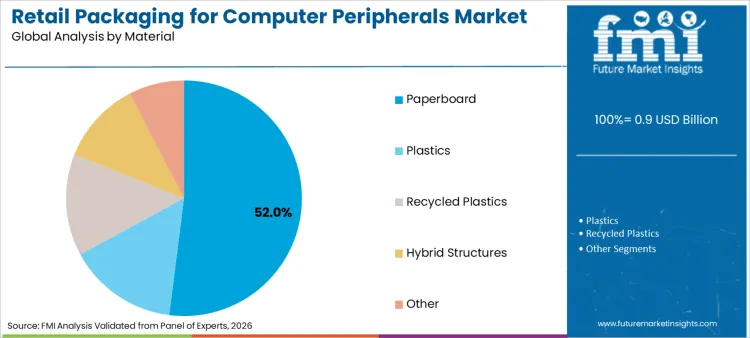
Paperboard accounts for 52.0% of the material market, underpinned by its universal acceptance in municipal recycling streams and its mechanical versatility. The resilience of this segment is anchored by the massive capacity of players like Smurfit Westrock, whose global mill network ensures a consistent, cost-controlled supply of raw material that plastic simply cannot match in the current regulatory climate. Amcor’s achievement of over 9% post-consumer recycled plastic use in FY2024 highlights the pressure on the competing plastic segment, but paperboard wins on simplicity; it requires no complex separation by the consumer. For the consumer electronic accessories, paperboard is becoming the "compliance shield," protecting brands from extended producer responsibility (EPR) taxes that heavily penalize mixed-material packaging.
What Is the Next Frontier in Sustainable Materials?
The industry is moving beyond simple "plastic replacement" toward "bio-mimicry," where natural materials are engineered to perform like synthetics. This trend is exemplified by the rise of seaweed-based coatings that offer grease and water resistance without creating microplastics, a critical innovation for protecting electronics from humidity during ocean freight. Pierre Paslier, Co-Founder of Notpla, noted in September 2024: "Our investors recognise the commercial potential of our technology and our unique solutions. This funding allows us to accelerate our growth and continue leading the market in sustainable innovation." This investment signals that the market is willing to pay a premium for "functional sustainability"-materials that actively protect the product rather than just ticking a compliance box.
For the game ip licensed peripherals, this material revolution offers a new canvas for branding, allowing companies to market the packaging itself as part of the "eco-warrior" narrative. However, adoption is gated by the "speed vs. evidence" trade-off; brands need assurance that these novel biopolymers can survive a 6-week container journey from Vietnam to Los Angeles without degrading. As data accumulates proving the resilience of these materials, we expect a tipping point where molded fibers and bio-coatings become the default spec for all hardware above the $50 price point, effectively pushing expanded polystyrene (EPS) foam out of the market entirely.
Which Regions Are Shaping the Future of Packaging?
The regional landscape is defined by a "China+1" production shift, where packaging demand is rapidly migrating toward the new electronics manufacturing centers in South and Southeast Asia. While China remains a heavyweight, the fastest growth is visible in India and Vietnam, where packaging converters are racing to build capacity that meets the stringent quality standards of Western export markets. According to FMI's analysis, this regional rebalancing is driving a surge in capital expenditure for modern, automated converting lines in these emerging hubs, contrasting with the mature, replacement-driven markets of North America and Europe. The consumer electronics packaging sector in these regions is thus leapfrogging older technologies, adopting the latest sustainable formats directly to serve global OEMs.
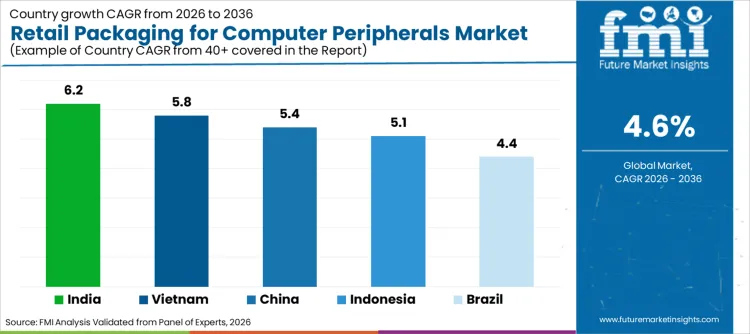
| Country | CAGR (2026 to 2036) |
|---|---|
| India | 6.2% |
| Vietnam | 5.8% |
| China | 5.4% |
| Indonesia | 5.1% |
| Brazil | 4.4% |
Source: FMI analysis based on primary research and proprietary forecasting model
Why India Is the Fastest Growing Market?
Sales of retail packaging for computer peripherals in India are set to rise at 6.2% CAGR, driven by a massive government-led push to localize electronics manufacturing. Official figures from the Ministry of Electronics & IT show that mobile phone production alone has more than doubled from Rs. 2.14 Lakh crores in FY 2019-20 to Rs. 5.5 Lakh crores in FY 2024-25, creating a parallel boom in demand for high-quality accessory packaging. This "Make in India" initiative forces global packaging suppliers to set up local subsidiaries, as importing empty boxes is logistically unviable. Consequently, local paper mills are upgrading their output quality to produce the "virgin-equivalent" recycled boards required by premium global brands.
How Vietnam Is becoming the Global Packaging Hub?
Demand for retail packaging for computer peripherals in Vietnam is anticipated to grow at 5.8% CAGR, mirroring the country's ascent as the primary alternative to China for electronics assembly. General Statistics Office data confirms that electronics and components exports soared to USD 72.56 billion in 2024, marking a 27% increase year-on-year, which directly correlates to a spike in demand for export-grade retail boxes. Cassandra Garber, VP of Corporate Sustainability at Dell, stated in FY2024: "Our FY24 highlights include: Closing in on our packaging goal, with 96.4% of packaging across our entire product portfolio made with recycled or renewable materials." This commitment from a major buyer with a deep manufacturing footprint in Vietnam signals to local suppliers that renewable capability is now the entry ticket for business.
Why China Remains the Volume Anchor?
The retail packaging for computer peripherals industry in China is projected to expand at 5.4% CAGR, maintained by its deeply integrated supply chain and massive domestic consumption. Despite the manufacturing drift, China retains the world's most sophisticated packaging ecosystem, capable of executing complex mobile phone accessories packaging designs at a scale no other nation can yet match. The mechanism here is "component proximity"; as long as the complex PCBs and chips are sourced in China, the final kitting and packaging often remain there for efficiency. However, the market is pivoting toward higher-value, automated packaging lines to offset rising labor costs, ensuring China stays competitive in the high-volume segment.
How Indonesia Is Monetizing the Digital Economy?
Retail packaging for computer peripherals in Indonesia is poised to register a 5.1% CAGR, fueled by a booming domestic e-commerce sector that demands robust, courier-proof packaging. The US International Trade Administration projects Indonesia's digital economy to exceed USD 130 billion by 2025, a scale that transforms the role of packaging from "shelf display" to "shipping survival." This shift favors retail e-commerce packaging formats that integrate structural protection directly into the retail box, reducing the need for secondary bubble wrap and aligning with the logistical realities of an archipelago nation.
Why Brazil Is Focusing on Sustainable Fiber?
Brazil's retail packaging for computer peripherals sector is growing at 4.4% CAGR, driven by its robust pulp and paper industry and a strong domestic manufacturing base for appliances and electronics. Tony Smurfit, CEO of Smurfit Westrock, stated in July 2024: "Smurfit Westrock is going to conquer the world of sustainable, paper-based packaging." This ambition resonates strongly in Brazil, a key source of global fiber, where the "farm-to-factory" distance is short, allowing for cost-effective production of sustainable packaging. The constraint here is economic volatility, as evidenced by IBGE data showing a 1.2% retreat in industrial production in late 2025, pushing buyers to seek cost-stable, locally sourced packaging materials over expensive imports.
How Is Competition Reshaping the Packaging Landscape?
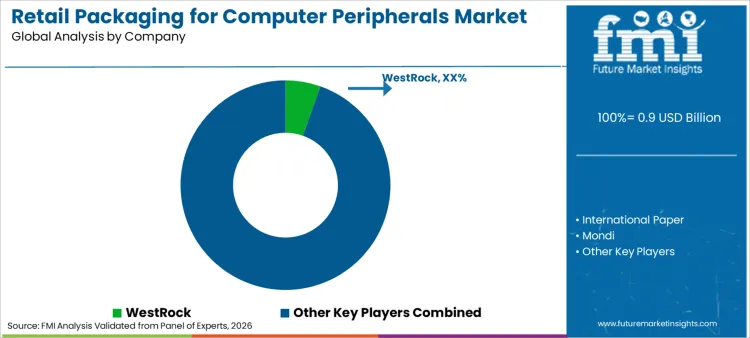
Competitive advantage in retail packaging for computer peripherals now depends less on brand breadth and more on who controls the constraint that gates scale, whether evidence, compliance, channel access, or capacity. Profit pools are moving toward players like Smurfit Westrock and International Paper, who have used M&A to build "fortress balance sheets" capable of funding the billion-dollar machine upgrades required for next-gen fiber. FMI analysts opine that this consolidation creates a high barrier to entry for mid-sized converters, who cannot match the R&D spend required to develop proprietary plastic-free coatings or the geographic reach to serve a client like Dell across three continents simultaneously. The display packaging segment, in particular, rewards this scale, as consistent color management and structural integrity across millions of units are non-negotiable for global retail launches.
Strategy in this market is increasingly bifurcated: giants chase volume through standardization, while challengers like Notpla and PulPac win through differentiated intellectual property (IP). Recent developments show a clear trend toward "acqui-hiring" technology; for instance, the licensing of Dry Molded Fiber (DMF) allows traditional manufacturers to leapfrog years of R&D. We are watching the "compliance-as-a-service" model, where packaging suppliers take on the legal burden of EPR reporting for their clients, effectively embedding themselves into the customer's regulatory workflow. This stickiness is critical in the wearable device packaging, where the high value of the product makes packaging failure, either functional or regulatory, an unacceptable risk.
Recent Developments:
- Jan 2025: International Paper completed the acquisition of DS Smith, creating a transatlantic leader in sustainable packaging solutions.
- July 2025: Genera Inc. completed a USD 340+ million expansion of its Vonore facility, boosting domestic North American molded fiber capacity.
- Dec 2024: Mondi commenced operations of a new €400 million paper machine at its Štětí mill to meet growing demand for flexible paper packaging.
- Nov 2025: Smurfit Westrock inaugurated a "first-of-its-kind" clinical packaging facility near Dublin, signaling a move into high-value, regulated packaging segments.
Key Players in Retail Packaging for Computer Peripherals Market
- WestRock (Smurfit Westrock)
- International Paper
- Mondi Group
- Amcor
- Sealed Air
- DS Smith
- Sonoco Products Company
- Genera Inc.
- Notpla
- PulPac AB
- Stora Enso
- Huhtamaki
Market Definition
The Retail Packaging for Computer Peripherals Market refers to the commercial ecosystem of designing, manufacturing, and supplying packaging materials specifically for computer peripheral devices such as mice, keyboards, headsets, webcams, and docking stations. This market includes primary retail packaging (the box the consumer sees), internal protective elements (inserts, trays, cushioning), and secondary containment used for retail display. It explicitly focuses on packaging that serves a dual function of protection and brand communication at the point of sale.
The scope includes all material types used in this specific application, ranging from traditional corrugated board and folding cartons to rigid boxes, molded fiber inserts, and blister packs (both plastic and paper-based). It covers revenue generated from sales to Original Equipment Manufacturers (OEMs), Original Design Manufacturers (ODMs), and aftermarket accessory brands. Additionally, the market sizing includes value-added services such as structural design, prototyping, and print finishing (embossing, foiling) when bundled with the manufacturing contract.
The market excludes tertiary or transport packaging used solely for logistics (e.g., master shipping cartons, pallets, stretch wrap) that is not intended for the retail shelf. It also excludes packaging for internal computer components (e.g., CPUs, RAM, motherboards) sold to system integrators rather than end consumers, as these lack the "retail display" requirement. Furthermore, general-purpose packaging sold through retail channels (e.g., moving boxes, generic mailers) is excluded unless specifically customized for a peripheral brand.
Scope of Report
| Items | Values |
|---|---|
| Quantitative Units (2026) | USD 0.9 billion |
| Product Type | Folding Cartons, Clamshells & Blisters, Rigid Boxes, Sleeves & Bands, Other |
| Peripheral Category | Mouse / Keyboard, Headsets / Audio, Printers & Small Devices, Monitors / Displays, Networking Devices, Other |
| Material | Paperboard, Plastics, Recycled Plastics, Hybrid Structures, Other |
| Regions covered | North America, Europe, Asia Pacific, Latin America, Middle East & Africa |
| Countries covered | USA, India, Vietnam, China, Indonesia, Brazil, Germany |
| Key companies profiled | Smurfit Westrock, International Paper, Mondi, Amcor, Genera, Notpla |
| Additional attributes | Revenue analysis by segments, adoption trends across settings, regulatory and compliance landscape (as relevant), pricing and reimbursement considerations (when relevant), channel mix economics, supply chain exposure, and competitive positioning analysis |
Source: Future Market Insights (FMI) analysis, based on proprietary forecasting model and primary research.
Retail Packaging for Computer Peripherals Market by Segments
By Packaging Type:
- Folding Cartons
- Clamshells & Blisters
- Rigid Boxes
- Sleeves & Bands
- Other
By Peripheral Category:
- Mouse / Keyboard
- Headsets / Audio
- Printers & Small Devices
- Monitors / Displays
- Networking Devices
- Other
By Material:
- Paperboard
- Plastics
- Recycled Plastics
- Hybrid Structures
- Other
By Region:
- North America
- Europe
- Asia Pacific
- Latin America
- Middle East & Africa
Bibliography
- Department for Environment, Food & Rural Affairs (DEFRA). (2024). Extended Producer Responsibility for Packaging: Policy update and compliance framework. UK Government.
- General Statistics Office of Vietnam. (2024). Report on Import-Export of Electronics and Components. Government of Vietnam.
- International Trade Administration. (2025). Indonesia - Digital Economy Country Commercial Guide. U.S. Department of Commerce.
- Instituto Brasileiro de Geografia e Estatística (IBGE). (2025). Monthly Survey of Industry (PIM) - Physical Production. Government of Brazil.
- Dell Technologies. (2024). FY24 Environmental, Social and Governance Executive Summary.
- Mondi Group. (2024). Integrated Report and Financial Statements 2024.
- Amcor plc. (2024). Sustainability Report 2024: Progress on Recycled Content.
- Smurfit Westrock. (2025). Corporate Press Releases and Facility Investment Updates.
Frequently Asked Questions
What is the current market size of the Retail Packaging for Computer Peripherals Market?
The market is valued at USD 0.9 billion in 2026, reflecting the baseline demand for packaging solutions across the global computer peripherals sector.
What is the projected growth rate for the market?
The market is projected to grow at a CAGR of 4.6% from 2026 to 2036, driven by the shift toward premium, sustainable packaging formats.
Which region is leading in manufacturing growth?
India is the fastest-growing region with a 6.2% CAGR, fueled by the government's "Make in India" initiative and rising domestic electronics production.
Which packaging type holds the largest share?
Folding cartons dominate the market with a 44.0% share, favored for their cost-effectiveness, printability, and ease of recycling.
Who are the key players in the market?
Major players include Smurfit Westrock, International Paper, and Mondi, alongside specialized innovators like Genera and Notpla.
Preview the report firsthand - request a free sample
Get SampleGet the brochure for pricing and purchase details.
Get PDFTable of Content
- Executive Summary
- Global Market Outlook
- Demand-side Trends
- Supply-side Trends
- Technology Roadmap Analysis
- Analysis and Recommendations
- Market Overview
- Market Coverage / Taxonomy
- Market Definition / Scope / Limitations
- Market Background
- Market Dynamics
- Drivers
- Restraints
- Opportunity
- Trends
- Scenario Forecast
- Demand in Optimistic Scenario
- Demand in Likely Scenario
- Demand in Conservative Scenario
- Opportunity Map Analysis
- Product Life Cycle Analysis
- Supply Chain Analysis
- Investment Feasibility Matrix
- Value Chain Analysis
- PESTLE and Porter’s Analysis
- Regulatory Landscape
- Regional Parent Market Outlook
- Production and Consumption Statistics
- Import and Export Statistics
- Market Dynamics
- Global Market Analysis 2021 to 2025 and Forecast, 2026 to 2036
- Historical Market Size Value (USD Million) Analysis, 2021 to 2025
- Current and Future Market Size Value (USD Million) Projections, 2026 to 2036
- Y-o-Y Growth Trend Analysis
- Absolute $ Opportunity Analysis
- Global Market Pricing Analysis 2021 to 2025 and Forecast 2026 to 2036
- Global Market Analysis 2021 to 2025 and Forecast 2026 to 2036, By Packaging Type
- Introduction / Key Findings
- Historical Market Size Value (USD Million) Analysis By Packaging Type , 2021 to 2025
- Current and Future Market Size Value (USD Million) Analysis and Forecast By Packaging Type , 2026 to 2036
- Folding Cartons
- Clamshells & Blisters
- Rigid Boxes
- Sleeves & Bands
- Other
- Folding Cartons
- Y-o-Y Growth Trend Analysis By Packaging Type , 2021 to 2025
- Absolute $ Opportunity Analysis By Packaging Type , 2026 to 2036
- Global Market Analysis 2021 to 2025 and Forecast 2026 to 2036, By Peripheral Category
- Introduction / Key Findings
- Historical Market Size Value (USD Million) Analysis By Peripheral Category, 2021 to 2025
- Current and Future Market Size Value (USD Million) Analysis and Forecast By Peripheral Category, 2026 to 2036
- Mouse / Keyboard
- Headsets / Audio
- Printers & Small Devices
- Monitors / Displays
- Networking Devices
- Mouse / Keyboard
- Y-o-Y Growth Trend Analysis By Peripheral Category, 2021 to 2025
- Absolute $ Opportunity Analysis By Peripheral Category, 2026 to 2036
- Global Market Analysis 2021 to 2025 and Forecast 2026 to 2036, By Material
- Introduction / Key Findings
- Historical Market Size Value (USD Million) Analysis By Material, 2021 to 2025
- Current and Future Market Size Value (USD Million) Analysis and Forecast By Material, 2026 to 2036
- Paperboard
- Plastics
- Recycled Plastics
- Hybrid Structures
- Other
- Paperboard
- Y-o-Y Growth Trend Analysis By Material, 2021 to 2025
- Absolute $ Opportunity Analysis By Material, 2026 to 2036
- Global Market Analysis 2021 to 2025 and Forecast 2026 to 2036, By Region
- Introduction
- Historical Market Size Value (USD Million) Analysis By Region, 2021 to 2025
- Current Market Size Value (USD Million) Analysis and Forecast By Region, 2026 to 2036
- North America
- Latin America
- Western Europe
- Eastern Europe
- East Asia
- South Asia and Pacific
- Middle East & Africa
- Market Attractiveness Analysis By Region
- North America Market Analysis 2021 to 2025 and Forecast 2026 to 2036, By Country
- Historical Market Size Value (USD Million) Trend Analysis By Market Taxonomy, 2021 to 2025
- Market Size Value (USD Million) Forecast By Market Taxonomy, 2026 to 2036
- By Country
- USA
- Canada
- Mexico
- By Packaging Type
- By Peripheral Category
- By Material
- By Country
- Market Attractiveness Analysis
- By Country
- By Packaging Type
- By Peripheral Category
- By Material
- Key Takeaways
- Latin America Market Analysis 2021 to 2025 and Forecast 2026 to 2036, By Country
- Historical Market Size Value (USD Million) Trend Analysis By Market Taxonomy, 2021 to 2025
- Market Size Value (USD Million) Forecast By Market Taxonomy, 2026 to 2036
- By Country
- Brazil
- Chile
- Rest of Latin America
- By Packaging Type
- By Peripheral Category
- By Material
- By Country
- Market Attractiveness Analysis
- By Country
- By Packaging Type
- By Peripheral Category
- By Material
- Key Takeaways
- Western Europe Market Analysis 2021 to 2025 and Forecast 2026 to 2036, By Country
- Historical Market Size Value (USD Million) Trend Analysis By Market Taxonomy, 2021 to 2025
- Market Size Value (USD Million) Forecast By Market Taxonomy, 2026 to 2036
- By Country
- Germany
- UK
- Italy
- Spain
- France
- Nordic
- BENELUX
- Rest of Western Europe
- By Packaging Type
- By Peripheral Category
- By Material
- By Country
- Market Attractiveness Analysis
- By Country
- By Packaging Type
- By Peripheral Category
- By Material
- Key Takeaways
- Eastern Europe Market Analysis 2021 to 2025 and Forecast 2026 to 2036, By Country
- Historical Market Size Value (USD Million) Trend Analysis By Market Taxonomy, 2021 to 2025
- Market Size Value (USD Million) Forecast By Market Taxonomy, 2026 to 2036
- By Country
- Russia
- Poland
- Hungary
- Balkan & Baltic
- Rest of Eastern Europe
- By Packaging Type
- By Peripheral Category
- By Material
- By Country
- Market Attractiveness Analysis
- By Country
- By Packaging Type
- By Peripheral Category
- By Material
- Key Takeaways
- East Asia Market Analysis 2021 to 2025 and Forecast 2026 to 2036, By Country
- Historical Market Size Value (USD Million) Trend Analysis By Market Taxonomy, 2021 to 2025
- Market Size Value (USD Million) Forecast By Market Taxonomy, 2026 to 2036
- By Country
- China
- Japan
- South Korea
- By Packaging Type
- By Peripheral Category
- By Material
- By Country
- Market Attractiveness Analysis
- By Country
- By Packaging Type
- By Peripheral Category
- By Material
- Key Takeaways
- South Asia and Pacific Market Analysis 2021 to 2025 and Forecast 2026 to 2036, By Country
- Historical Market Size Value (USD Million) Trend Analysis By Market Taxonomy, 2021 to 2025
- Market Size Value (USD Million) Forecast By Market Taxonomy, 2026 to 2036
- By Country
- India
- ASEAN
- Australia & New Zealand
- Rest of South Asia and Pacific
- By Packaging Type
- By Peripheral Category
- By Material
- By Country
- Market Attractiveness Analysis
- By Country
- By Packaging Type
- By Peripheral Category
- By Material
- Key Takeaways
- Middle East & Africa Market Analysis 2021 to 2025 and Forecast 2026 to 2036, By Country
- Historical Market Size Value (USD Million) Trend Analysis By Market Taxonomy, 2021 to 2025
- Market Size Value (USD Million) Forecast By Market Taxonomy, 2026 to 2036
- By Country
- Kingdom of Saudi Arabia
- Other GCC Countries
- Turkiye
- South Africa
- Other African Union
- Rest of Middle East & Africa
- By Packaging Type
- By Peripheral Category
- By Material
- By Country
- Market Attractiveness Analysis
- By Country
- By Packaging Type
- By Peripheral Category
- By Material
- Key Takeaways
- Key Countries Market Analysis
- USA
- Pricing Analysis
- Market Share Analysis, 2025
- By Packaging Type
- By Peripheral Category
- By Material
- Canada
- Pricing Analysis
- Market Share Analysis, 2025
- By Packaging Type
- By Peripheral Category
- By Material
- Mexico
- Pricing Analysis
- Market Share Analysis, 2025
- By Packaging Type
- By Peripheral Category
- By Material
- Brazil
- Pricing Analysis
- Market Share Analysis, 2025
- By Packaging Type
- By Peripheral Category
- By Material
- Chile
- Pricing Analysis
- Market Share Analysis, 2025
- By Packaging Type
- By Peripheral Category
- By Material
- Germany
- Pricing Analysis
- Market Share Analysis, 2025
- By Packaging Type
- By Peripheral Category
- By Material
- UK
- Pricing Analysis
- Market Share Analysis, 2025
- By Packaging Type
- By Peripheral Category
- By Material
- Italy
- Pricing Analysis
- Market Share Analysis, 2025
- By Packaging Type
- By Peripheral Category
- By Material
- Spain
- Pricing Analysis
- Market Share Analysis, 2025
- By Packaging Type
- By Peripheral Category
- By Material
- France
- Pricing Analysis
- Market Share Analysis, 2025
- By Packaging Type
- By Peripheral Category
- By Material
- India
- Pricing Analysis
- Market Share Analysis, 2025
- By Packaging Type
- By Peripheral Category
- By Material
- ASEAN
- Pricing Analysis
- Market Share Analysis, 2025
- By Packaging Type
- By Peripheral Category
- By Material
- Australia & New Zealand
- Pricing Analysis
- Market Share Analysis, 2025
- By Packaging Type
- By Peripheral Category
- By Material
- China
- Pricing Analysis
- Market Share Analysis, 2025
- By Packaging Type
- By Peripheral Category
- By Material
- Japan
- Pricing Analysis
- Market Share Analysis, 2025
- By Packaging Type
- By Peripheral Category
- By Material
- South Korea
- Pricing Analysis
- Market Share Analysis, 2025
- By Packaging Type
- By Peripheral Category
- By Material
- Russia
- Pricing Analysis
- Market Share Analysis, 2025
- By Packaging Type
- By Peripheral Category
- By Material
- Poland
- Pricing Analysis
- Market Share Analysis, 2025
- By Packaging Type
- By Peripheral Category
- By Material
- Hungary
- Pricing Analysis
- Market Share Analysis, 2025
- By Packaging Type
- By Peripheral Category
- By Material
- Kingdom of Saudi Arabia
- Pricing Analysis
- Market Share Analysis, 2025
- By Packaging Type
- By Peripheral Category
- By Material
- Turkiye
- Pricing Analysis
- Market Share Analysis, 2025
- By Packaging Type
- By Peripheral Category
- By Material
- South Africa
- Pricing Analysis
- Market Share Analysis, 2025
- By Packaging Type
- By Peripheral Category
- By Material
- USA
- Market Structure Analysis
- Competition Dashboard
- Competition Benchmarking
- Market Share Analysis of Top Players
- By Regional
- By Packaging Type
- By Peripheral Category
- By Material
- Competition Analysis
- Competition Deep Dive
- WestRock
- Overview
- Product Portfolio
- Profitability by Market Segments (Product/Age /Sales Channel/Region)
- Sales Footprint
- Strategy Overview
- Marketing Strategy
- Product Strategy
- Channel Strategy
- International Paper
- Mondi
- Amcor
- Sealed Air / Sonoco
- WestRock
- Competition Deep Dive
- Assumptions & Acronyms Used
- Research Methodology


