

- Industry Size (2026)
- USD 470 Mn
- Forecast (2036)
- USD 758 Mn
- CAGR (2026 to 2036)
- 4.9%
Export Packaging for Computer Accessories Market Size and Share Forecast Outlook 2026 to 2036
The export packaging for computer accessories market is estimated to be valued at USD 470 million, and it is projected to grow to USD 758 million by 2036, reflecting a compound annual growth rate (CAGR) of 4.9%. This demand trend indicates a shift in value concentration as consumers become more stringent regarding performance and proof standards. Arising surge forces logistics providers to abandon standard commodity boxes in favor of heavy-duty solutions capable of surviving complex, multi-modal transit routes without compromising component integrity. Official figures from the Ministry of Commerce & Industry reveal that India's electronics exports rose 35.11% to USD 3.58 billion in December 2024, a metric that fundamentally reshapes the demand curve for high-performance packaging. As per FMI's projection, the market is pivoting from simple containment to "protection-as-a-service," where the packaging itself is the primary insurance against the 24-month high shipment volumes now exiting South Asian ports.
Investment strategies are shifting to match this new volume velocity, with leaders doubling down on infrastructure. Tony Smurfit, Group CEO of Smurfit Kappa Group, noted in May 2024: "Smurfit Kappa Group has delivered a very strong first quarter. These results reflect the continuing benefits of our multi-year capital plans and the dedication and commitment of our people, providing the most sustainable and innovative packaging solutions for our customers." This statement underscores a critical operational reality: success in this decade depends on the capacity to scale sustainable solutions rapidly. For competitors, the implication is clear capital expenditure must be directed toward regions with the highest export throughput to capture the margin benefits of these multi-year plans.
Financial pressures are forcing a ruthless optimization of cost structures among major incumbents. DS Smith reported a 96% decrease in operating profit for the year ended April 2025, a sharp contraction driven by lower average sales prices that necessitates an immediate strategic pivot. Manufacturers are responding by implementing aggressive efficiency programs, such as Sealed Air’s "CTO2Grow" initiative targeting USD 140–160 million in savings, to protect margins while funding necessary digital upgrades. This dynamic suggests that by 2036, the market will be dominated by players who can balance the capital intensity of capacity expansion with the operational discipline required to survive distinct pricing troughs.
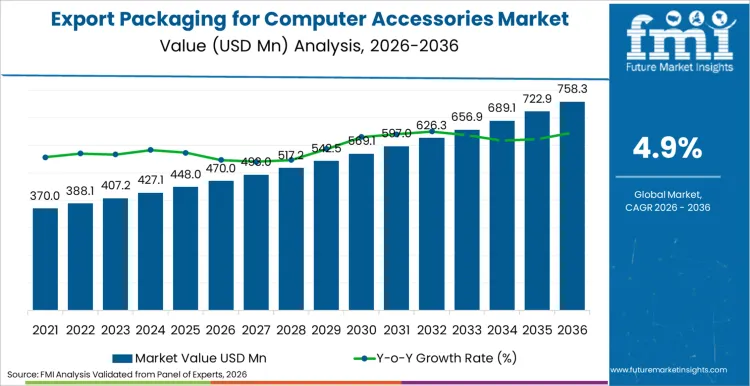
Summary of Export Packaging for Computer Accessories Market
What Is the Growth Outlook for the Export Packaging for Computer Accessories Market as per Future Market Insights Projection?
As per FMI's estimates, the global export packaging for computer accessories market is projected to grow from USD 470 million in 2026 to USD 758 million by 2036, representing a 4.9% CAGR over the forecast period. FMI Research Approach: Based on FMI’s proprietary global modeling framework incorporating major packaging operator revenue (Smurfit Kappa, Amcor), electronics export trade volume indices, and regulatory compliance cost models.
How Do FMI Analysts Perceive the Export Packaging for Computer Accessories Market to Evolve?
FMI analysts opine that the market is transitioning away from standard brown boxes toward "smart" and sustainable packaging ecosystems integrated with digital product passports. FMI Research Approach: Developed using analysis of patent filings (Aegis Packaging O2X), sustainability reports (Amcor’s 95% recyclability goal), and logistics procurement trends for computer peripherals.
Which Country Holds the Largest Share in the Global Export Packaging for Computer Accessories Market?
India is emerging as a dominant growth engine, supported by a 6.1% CAGR and a record-breaking export surge of USD 3.58 billion in December 2024. FMI Research Approach: Built using country-level export data (Ministry of Commerce India), manufacturing output indices, and mapping of packaging infrastructure investments by global players.
How Large Will the Export Packaging for Computer Accessories Market Be by 2036?
The global export packaging for computer accessories market is expected to reach USD 758 million by 2036, with the Heavy-Duty Corrugated segment currently commanding a 42.0% share. FMI Research Approach: Long-term forecasts rely on demographic trends (global IT spending), disposal income projections, and the scaling of transport packaging solutions.
What Is the Definition of the Export Packaging for Computer Accessories Market?
The export packaging for computer accessories market encompasses revenue generated from commercial packaging solutions designed specifically for the cross-border logistics of IT peripherals. FMI Research Approach: Definition structured using FMI’s segmentation taxonomy covering material types (corrugated, foam, wood), transport modes, and end-user categories.
What Are Globally Unique Trends Shaping the Export Packaging for Computer Accessories Market?
Globally, the sector is shaped by the "Green Compliance" mandate in Europe and the "Nearshoring" shift in North America, where sustainability and speed determine supplier selection. FMI Research Approach: Insights derived from global sustainability reports (Amcor), regulatory updates (India import rules), and consumer behavior analysis regarding eco-friendly packaging.
Export Packaging for Computer Accessories Market Key Takeaways
| Metric | Details |
|---|---|
| Industry Size (2026) | USD 470 million |
| Industry Value (2036) | USD 758 million |
| CAGR (2026-2036) | 4.9% |
Source: Future Market Insights (FMI) analysis, based on proprietary forecasting model and primary research.
Why Are Electronics Export Surges Driving Packaging Demand?
The exponential rise in electronics manufacturing from "Alt-Asia" hubs is the primary engine propelling demand for specialized logistics packaging. General Statistics Office (GSO) data indicates that Vietnam’s electronics industry achieved an export turnover of USD 126.5 billion in 2024, accounting for one-third of the nation's total exports. Such volume expansion forces logistics providers to upgrade from standard boxes to high-performance solutions capable of protecting high-value components against humidity and physical shock during long sea voyages. Consequently, packaging suppliers are realigning production footprints to serve these new manufacturing epicenters, ensuring that capacity matches the explosive velocity of component trade flows out of Southeast Asia.
How Is Sustainability Reshaping Material Selection?
Environmental compliance is no longer optional but a critical gatekeeper for market access, driving a rigorous shift toward packaging materials that meet circular economy standards. Amcor reported in FY24 that 74% of its production by weight met widely accepted recyclability standards, generating USD 8.1 billion in revenue, which underscores the financial viability of green portfolios. Buyers in Europe and North America now mandate packaging that avoids single-use plastics and utilizes recycled content, forcing exporters to adopt mono-material designs that simplify disposal. Regulatory pressure thus transforms sustainability from a corporate social responsibility initiative into a core operational requirement, where failure to comply risks exclusion from premium supply chains.
Segmentation of Export Packaging for Computer Accessories Market
How Is Segment Mix Evolving By 2036?
The export packaging for computer accessories market is segmented by packaging solution, export mode, customer type, and companies, with the heavy-duty corrugated segment currently holding a dominant 42.0% share due to its balance of protection and cost. FMI analysts opine that the segment mix is shifting toward returnable transport packaging and advanced moisture barrier systems as exporters seek to minimize waste and damage rates. By 2036, share will concentrate in solutions that offer "smart" features like traceability and certified recyclability, driven by stricter customs enforcement and the need for supply chain transparency across all major trade corridors.
Why Does Heavy-Duty Corrugated Packaging Dominate?
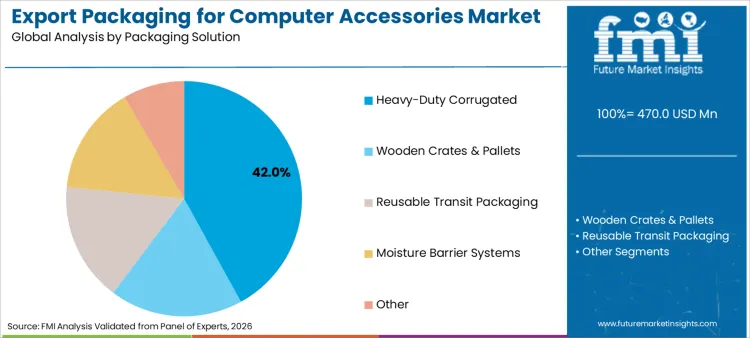
Heavy-duty corrugated solutions command a 42.0% market share, serving as the backbone of global component trade by offering superior stacking strength and shock absorption. Smurfit Kappa reported box volume growth of approximately 3% in Europe and 2% in the Americas in Q1 2024, validating the sustained reliance on high impact corrugated boxes for protecting fragile electronics. Manufacturers favor this format because it integrates easily with automated packing lines and meets international phytosanitary standards without requiring complex treatment. Cost pressures further entrench this dominance, as corrugated material remains significantly cheaper than rigid alternatives while providing sufficient protection for the majority of standard sea-freight shipments.
How Is Nearshoring Boosting Reusable Transit Packaging?
Reusable transit packaging (RTP) is gaining significant traction in North America, driven by the acceleration of nearshoring activities that make closed-loop logistics financially viable. Banco de México reported in July 2024 that 12.9% of large companies in Mexico experienced favorable impacts from nearshoring, increasing the flow of goods via road and rail where transport cases and boxes can be efficiently returned and reused. Unlike trans-oceanic routes where return logistics are cost-prohibitive, the cross-border trucking corridor allows OEMs to replace disposable packaging with durable crates and pallets. This shift reduces long-term operational costs and waste, positioning RTP as a strategic asset for manufacturers optimizing their regional supply chains.
Why Are Moisture Barrier Systems Critical?
Demand for advanced moisture barrier systems is accelerating as high-value semiconductor and component manufacturing migrates to humid tropical climates in Southeast Asia. Startups like Aegis Packaging are commercializing O2X technologies that offer superior oxygen and moisture protection, a critical requirement for protective packaging preventing corrosion in sensitive electronics. Standard cardboard offers insufficient defense against the "container rain" phenomenon experienced during weeks-long ocean journeys, forcing exporters to invest in specialized coatings and liners. Consequently, the adoption of these barrier technologies is becoming a standard insurance policy for protecting millions of dollars in inventory from environmental damage during transit.
Where Is Value Concentrating In Sea Freight Logistics?
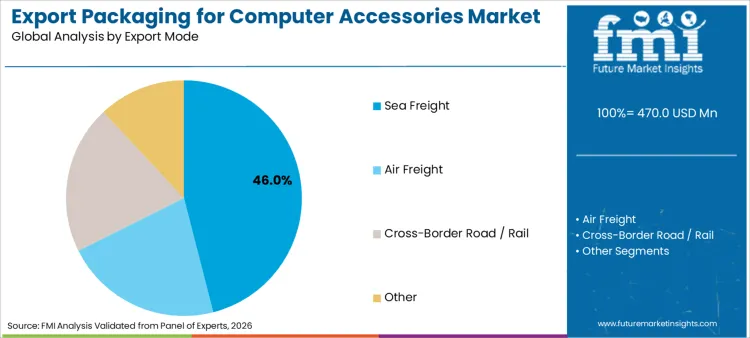
Sea freight remains the dominant export mode, accounting for 46.0% of the market, as manufacturers prioritize cost-effective bulk transport for high-volume accessories. Unlike bulk liquid transport packaging which requires specialized tankers, computer accessory logistics rely on standardized containerization that maximizes density and minimizes per-unit shipping costs. Vietnam’s electronics export boom, which reached USD 126.5 billion in 2024, is primarily moved via ocean routes, sustaining immense demand for durable, stackable packaging formats. Operators are therefore optimizing designs to withstand the specific rigors of maritime transport, including compression forces and prolonged humidity exposure, to secure their position in this volume-heavy channel.
How Are OEM Exporters Driving Premiumisation?
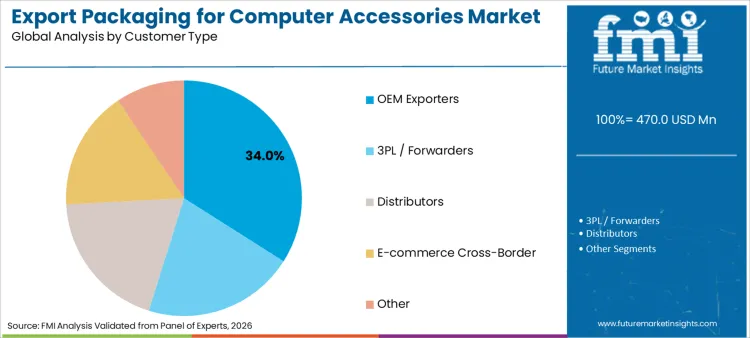
OEM exporters represent a crucial 34.0% of the customer base, driving demand for premium packaging that ensures zero-defect delivery of critical components. Sealed Air reported net sales of USD 1.38 billion in Q3 2023, reflecting the scale of demand from major industrial players who require reliable corrugated boxes and protective inserts. Procurement teams at these large OEMs enforce stringent quality standards, requiring suppliers to provide evidence of drop-test performance and material certification. This scrutiny forces packaging vendors to invest in testing labs and quality assurance processes, creating a barrier to entry for lower-tier competitors unable to meet the exacting specifications of global technology brands.
How Is The "Mexico-to-US" Corridor Reshaping Logistics?
The intensification of trade between Mexico and the United States is fundamentally altering packaging requirements, favoring overland solutions over maritime formats. USA Department of State data confirms that exports from Mexico to the United States grew 2.6% in 2023, creating a density of trade that supports the use of United States and Canada protective packaging standards centered on truck transport. Suppliers are responding by expanding production of pallets and bins optimized for 53-foot trailers rather than 40-foot shipping containers. That shift reduces the need for heavy weatherproofing associated with sea freight, allowing budget allocation to shift toward structural durability and rapid loading capabilities.
Why Is Intra-Asian Trade Demanding Bio-Based Innovation?
Intra-Asian trade flows are driving a unique demand for affordable, climate-resilient packaging that avoids the high costs of premium barrier films. Startups in Singapore and India are capitalizing on this by introducing compostable alternatives, effectively creating a tiered market where regional logistics utilize distinct, sustainable specifications compared to long-haul exports. BPS-Statistics Indonesia reported that manufacturing exports increased by 3.75% during January-October 2024, fueling a regional exchange of components that often utilizes corrugated bin boxes for short-sea or air transit. Cost sensitivity in these emerging markets pushes buyers toward bio-based coatings and locally sourced materials that offer "good enough" protection against humidity without the price premium of complex polymers.
What Is Driving Regional Growth Divergence?
North America and Asia Pacific are exhibiting distinct growth behaviors, with the former driven by nearshoring efficiency and the latter by massive manufacturing capacity expansion. FMI analysts opine that while Asia focuses on volume scaling for global export, North American demand is pivoting toward packaging foam and reusable systems that support tight cross-border integration. Official data highlights this divergence, with India’s exports growing at double-digit rates necessitating robust sea-freight packaging, whereas Mexico’s steady growth supports truck-based logistics. Investment flows follow this logic, with capital expenditure in Asia targeting barrier technologies and capacity, while North American spending prioritizes automation and returnable asset tracking.
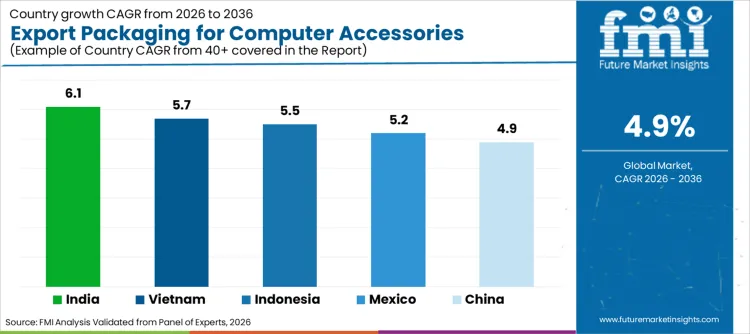
| Country | CAGR (2026 to 2036) |
|---|---|
| India | 6.1% |
| Vietnam | 5.7% |
| Indonesia | 5.5% |
| Mexico | 5.2% |
| China | 4.9% |
Source: Future Market Insights (FMI) analysis, based on proprietary forecasting model and primary research.
Why India Is Witnessing Accelerating Demand?
Sales of export packaging for computer accessories in India are set to rise at 6.1% CAGR, fueled by the government’s aggressive "Make in India" initiatives and production-linked incentives (PLI). Ministry of Commerce & Industry statistics show that electronics exports hit a 24-month high of USD 3.58 billion in December 2024, directly translating into increased consumption of anti-static foam packaging. This export surge forces local manufacturers to upgrade from basic materials to export-grade solutions that comply with international safety and quality standards. Consequently, packaging suppliers are establishing new facilities near electronics clusters in Tamil Nadu and Karnataka to minimize lead times and secure contracts with expanding mobile and component assembly plants.
What Fuels Vietnam’s Export Dominance?
Demand for export packaging for computer accessories in Vietnam is anticipated to grow at 5.7% CAGR, driven by its cemented status as a primary alternative manufacturing hub to China. Political stability and supply chain resilience have become the deciding factors for investors, as highlighted by Nguyen Tri Hieu, an economist, in January 2025: "Political stability and security as important factors helping Viet Nam attract international investors in the electronics support industry." This confidence effectively de-risks long-term capital projects for packaging converters, who can now invest in high-volume protective wrapping paper machinery with the assurance of sustained demand. The result is a rapidly maturing local infrastructure that can support global tech giants relocating production to Vietnamese industrial zones.
How Indonesia Is Scaling Capacity?
The export packaging for computer accessories industry in Indonesia is projected to expand at 5.5% CAGR, supported by a rapid increase in electrical machinery shipments. BPS-Statistics Indonesia reported a 26.66% month-over-month increase in electrical machinery exports in May 2024, a spike that creates immediate pressure for scalable flexible protective packaging. Manufacturers are responding by increasing inventory of flexible films and cushioning materials to accommodate fluctuating order volumes from regional buyers. This responsiveness is critical for Indonesian exporters aiming to capture a larger share of the ASEAN market, where speed and reliability of packaging supply often determine the ability to fulfill short-notice contracts.
Why Mexico Favors Nearshoring Solutions?
Export packaging for computer accessories in Mexico is poised to register a 5.2% CAGR, largely due to the structural shift of supply chains toward the US border. Rise in manufacturing density drives the adoption of packaging inserts compatible with "just-in-time" assembly lines. The localized impact of this shift on the workforce and infrastructure is profound, as noted by Banco de México researchers in July 2024: "Our results indicate that nearshoring is potentially generating early gains in manufacturing jobs but has not led to improvements in earnings. Furthermore, we do not observe a consistent impact on productivity, although some specifications suggest a modest positive effect in industries with a higher nearshoring propensity." Suppliers must therefore tailor their logistics to support high-frequency, road-based deliveries that align with the operational rhythm of maquiladoras serving the North American market.
Where China Is Consolidating Value?
China continues to play a pivotal role, with the market expected to grow at 4.9% CAGR, even as it transitions up the value chain toward high-tech components. The Ministry of Finance imposed a 30% anti-dumping duty on Printed Circuit Boards (PCBs) in March 2024, a regulatory move that encourages domestic production of higher-value electronics requiring specialized epe foam packaging. That policy shift drives demand for premium, anti-static, and precision-molded packaging solutions that protect sensitive, high-margin goods. As a result, Chinese packaging firms are moving away from commodity exports toward serving sophisticated local OEMs who demand world-class protection standards to maintain their competitive edge in global markets.
How Is Consolidation Reshaping the Competitive Landscape?
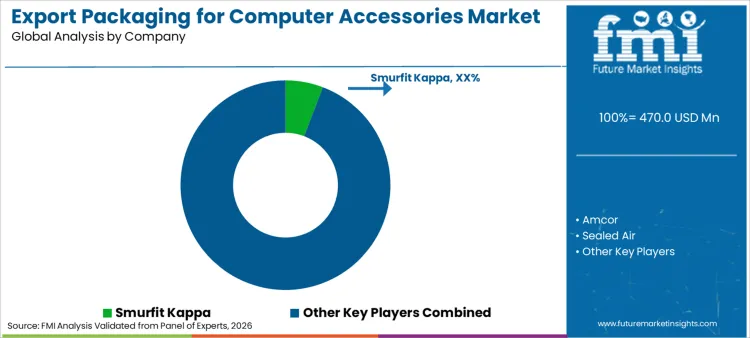
As per FMI's projection, competitive advantage in the export packaging for computer accessories market now depends less on brand breadth and more on who controls the constraint that gates scale, whether evidence, compliance, or capacity. Profit pools are moving toward players that can execute large-scale M&A to secure geographic reach, evidenced by DS Smith’s acquisition of Stora Enso De Hoop B.V. for £10 million in December 2024. This consolidation strategy allows major incumbents to integrate raw material supply with converting operations, thereby defending margins against volatility. For buyers, this trend implies fewer but more capable suppliers who can offer standardized packaging inserts and global contracts, effectively raising the barrier to entry for smaller, localized competitors.
What Role Does Innovation Play In Strategy?
Competition in the market increasingly concentrates around control points that buyers cannot bypass, from audit readiness to sustainability certification. Amcor’s launch of the AmFiniti™ recycled flexible packaging portfolio in December 2024 exemplifies how innovation is used to capture value in a compliance-driven environment. By developing proprietary materials that meet global recyclability standards, companies differentiate themselves from commodity producers. Startups like Aegis Packaging are disrupting the niche for barrier coatings, forcing giants to either acquire or innovate. Consequently, the strategic focus is shifting toward R&D investments that deliver measurable performance improvements in moisture protection and waste reduction, directly addressing the critical pain points of high-tech exporters.
Recent Developments:
- In April 2025, Logitech completed its global transition from plastic clamshells to fully paper-based cartons for computer mice and other peripherals packaging. This redesign incorporates reinforced fiber structures optimized for international export, providing enhanced stacking strength and moisture resistance during long-distance sea and air freight while reducing weight for lower shipping costs and carbon emissions in global supply chains.
- In January 2026, HP showcased at CES its advanced sustainable export packaging for computer accessories and laptops, utilizing 100% responsibly sourced forest fiber materials with custom molded pulp inserts. These solutions are engineered for compliance with international export standards, offering superior vibration damping and humidity barriers to protect products during extended global transit without relying on plastic components.
- In January 2026, Dell expanded its renewable molded pulp packaging initiative at CES for exported computer peripherals and docking stations, featuring bagasse-based trays certified for high-stackability and impact resistance in multipack export configurations. This advancement supports compliance with stringent international shipping regulations, minimizing damage in cross-border logistics while achieving significant reductions in packaging weight and environmental footprint for worldwide distribution.
Key Players in Export Packaging for Computer Accessories Market
- Smurfit Kappa
- Amcor
- Sealed Air
- Sonoco
- Huhtamaki
- DS Smith
- Aegis Packaging
- Packmile
- Urban Box
- BioPak
- The Mend Packaging
Market Definition
The export packaging for computer accessories market encompasses revenue generated from the sale of commercial packaging materials and systems used specifically for the international transport of computer peripherals and accessories. This includes heavy-duty corrugated boxes, protective foam, moisture barrier bags, and reusable transit packaging designed to protect goods such as keyboards, mice, cables, and external drives during air, sea, and land freight. The definition focuses on the B2B packaging layer, excluding primary retail packaging unless it serves a dual function as transport protection.
The market explicitly includes revenue from both disposable and returnable packaging formats utilized by OEMs, contract manufacturers, and third-party logistics providers. It covers value-added services such as kitting and custom design when bundled with the sale of physical packaging products. Furthermore, the market sizing incorporates spending on specialized protective elements like anti-static foam packaging and desiccants that are essential for preserving the functionality of electronic components in transit.
Excluded from this market are general-purpose shipping supplies sold through retail channels for consumer use, such as standard postal boxes. The market also excludes the value of the computer accessories themselves and logistics services fees (freight charges), focusing solely on the packaging materials and associated design services. Additionally, packaging for complete computer systems (laptops, desktops) is excluded to maintain a strict focus on the accessories and peripherals segment.
Scope of Report
| Items | Values |
|---|---|
| Quantitative Units (2026) | USD 470 million |
| Product Type | Heavy-Duty Corrugated, Wooden Crates & Pallets, Reusable Transit Packaging, Moisture Barrier Systems, Other |
| Application or Procedure type | Sea Freight, Air Freight, Cross-Border Road/Rail, Other |
| End user | OEM Exporters, 3PL / Forwarders, Distributors, E-commerce Cross-Border |
| Regions covered | North America, Europe, Asia Pacific, Latin America, Middle East & Africa |
| Countries covered | India, Vietnam, Indonesia, Mexico, China |
| Key companies profiled | Smurfit Kappa, Amcor, Sealed Air, Sonoco, Huhtamaki, DS Smith |
| Additional attributes | Revenue analysis by segments, adoption trends across settings, regulatory and compliance landscape (as relevant), pricing and reimbursement considerations (when relevant), channel mix economics, supply chain exposure, and competitive positioning analysis |
Source: Future Market Insights (FMI) analysis, based on proprietary forecasting model and primary research.
Export Packaging for Computer Accessories Market by Segments
By Packaging Solution:
- Heavy-Duty Corrugated
- Wooden Crates & Pallets
- Reusable Transit Packaging
- Moisture Barrier Systems
- Other
By Export Mode:
- Sea Freight
- Air Freight
- Cross-Border Road / Rail
- Other
By Customer Type:
- OEM Exporters
- 3PL / Forwarders
- Distributors
- E-commerce Cross-Border
By Region:
- North America
- Europe
- Asia Pacific
- Latin America
- Middle East & Africa
Bibliography
- Directorate General of Commercial Intelligence and Statistics (India). (2024). Monthly Foreign Trade Statistics (HS-wise). Government of India.
- Statistics Malaysia (DOSM). (2024). External Trade Statistics: Electrical & Electronic Products. Government of Malaysia.
- Philippine Statistics Authority (PSA). (2024). Commodity Flow in the Philippines Report. Government of the Philippines.
- Instituto Nacional de Estadística y Geografía (INEGI). (2024). Manufacturing Industry Survey: Paper and Packaging Inputs. Government of Mexico.
- USA International Trade Commission (USITC). (2024). Interactive Tariff and Trade DataWeb: Paperboard and Packaging Materials. USA Government.
- Japan Ministry of Economy, Trade and Industry (METI). (2024). Current Survey of Production: Pulp, Paper and Processed Paper Products. Government of Japan.
Frequently Asked Questions
What is the current market size of the export packaging for computer accessories industry?
The market is valued at USD 470 million in 2026, driven by the rapid expansion of electronics manufacturing in Southeast Asia and India.
Which packaging material dominates the market?
Heavy-duty corrugated material holds the largest share at 42.0%, favored for its cost-effectiveness and ability to protect goods during sea freight.
Which region is expected to lead market growth?
India is projected to grow at the fastest CAGR of 6.1%, supported by government PLI schemes and surging electronics exports.
Who are the key players in the export packaging for computer accessories market?
Key players include Smurfit Kappa, Amcor, Sealed Air, Sonoco, and DS Smith, who are actively investing in sustainable and high-performance solutions.
What is the primary driver for reusable transit packaging?
Nearshoring trends, particularly in the Mexico-US corridor, are driving the adoption of reusable transit packaging to optimize cross-border road logistics costs.
Preview the report firsthand - request a free sample
Get SampleGet the brochure for pricing and purchase details.
Get PDFTable of Content
- Executive Summary
- Global Market Outlook
- Demand-side Trends
- Supply-side Trends
- Technology Roadmap Analysis
- Analysis and Recommendations
- Market Overview
- Market Coverage / Taxonomy
- Market Definition / Scope / Limitations
- Market Background
- Market Dynamics
- Drivers
- Restraints
- Opportunity
- Trends
- Scenario Forecast
- Demand in Optimistic Scenario
- Demand in Likely Scenario
- Demand in Conservative Scenario
- Opportunity Map Analysis
- Product Life Cycle Analysis
- Supply Chain Analysis
- Investment Feasibility Matrix
- Value Chain Analysis
- PESTLE and Porter’s Analysis
- Regulatory Landscape
- Regional Parent Market Outlook
- Production and Consumption Statistics
- Import and Export Statistics
- Market Dynamics
- Global Market Analysis 2021 to 2025 and Forecast, 2026 to 2036
- Historical Market Size Value (USD Million) Analysis, 2021 to 2025
- Current and Future Market Size Value (USD Million) Projections, 2026 to 2036
- Y-o-Y Growth Trend Analysis
- Absolute $ Opportunity Analysis
- Global Market Pricing Analysis 2021 to 2025 and Forecast 2026 to 2036
- Global Market Analysis 2021 to 2025 and Forecast 2026 to 2036, By Packaging Solution
- Introduction / Key Findings
- Historical Market Size Value (USD Million) Analysis By Packaging Solution , 2021 to 2025
- Current and Future Market Size Value (USD Million) Analysis and Forecast By Packaging Solution , 2026 to 2036
- Heavy-Duty Corrugated
- Wooden Crates & Pallets
- Reusable Transit Packaging
- Moisture Barrier Systems
- Other
- Heavy-Duty Corrugated
- Y-o-Y Growth Trend Analysis By Packaging Solution , 2021 to 2025
- Absolute $ Opportunity Analysis By Packaging Solution , 2026 to 2036
- Global Market Analysis 2021 to 2025 and Forecast 2026 to 2036, By Export Mode
- Introduction / Key Findings
- Historical Market Size Value (USD Million) Analysis By Export Mode, 2021 to 2025
- Current and Future Market Size Value (USD Million) Analysis and Forecast By Export Mode, 2026 to 2036
- Sea Freight
- Air Freight
- Cross-Border Road / Rail
- Other
- Sea Freight
- Y-o-Y Growth Trend Analysis By Export Mode, 2021 to 2025
- Absolute $ Opportunity Analysis By Export Mode, 2026 to 2036
- Global Market Analysis 2021 to 2025 and Forecast 2026 to 2036, By Customer Type
- Introduction / Key Findings
- Historical Market Size Value (USD Million) Analysis By Customer Type, 2021 to 2025
- Current and Future Market Size Value (USD Million) Analysis and Forecast By Customer Type, 2026 to 2036
- OEM Exporters
- 3PL / Forwarders
- Distributors
- E-commerce Cross-Border
- Other
- OEM Exporters
- Y-o-Y Growth Trend Analysis By Customer Type, 2021 to 2025
- Absolute $ Opportunity Analysis By Customer Type, 2026 to 2036
- Global Market Analysis 2021 to 2025 and Forecast 2026 to 2036, By Region
- Introduction
- Historical Market Size Value (USD Million) Analysis By Region, 2021 to 2025
- Current Market Size Value (USD Million) Analysis and Forecast By Region, 2026 to 2036
- North America
- Latin America
- Western Europe
- Eastern Europe
- East Asia
- South Asia and Pacific
- Middle East & Africa
- Market Attractiveness Analysis By Region
- North America Market Analysis 2021 to 2025 and Forecast 2026 to 2036, By Country
- Historical Market Size Value (USD Million) Trend Analysis By Market Taxonomy, 2021 to 2025
- Market Size Value (USD Million) Forecast By Market Taxonomy, 2026 to 2036
- By Country
- USA
- Canada
- Mexico
- By Packaging Solution
- By Export Mode
- By Customer Type
- By Country
- Market Attractiveness Analysis
- By Country
- By Packaging Solution
- By Export Mode
- By Customer Type
- Key Takeaways
- Latin America Market Analysis 2021 to 2025 and Forecast 2026 to 2036, By Country
- Historical Market Size Value (USD Million) Trend Analysis By Market Taxonomy, 2021 to 2025
- Market Size Value (USD Million) Forecast By Market Taxonomy, 2026 to 2036
- By Country
- Brazil
- Chile
- Rest of Latin America
- By Packaging Solution
- By Export Mode
- By Customer Type
- By Country
- Market Attractiveness Analysis
- By Country
- By Packaging Solution
- By Export Mode
- By Customer Type
- Key Takeaways
- Western Europe Market Analysis 2021 to 2025 and Forecast 2026 to 2036, By Country
- Historical Market Size Value (USD Million) Trend Analysis By Market Taxonomy, 2021 to 2025
- Market Size Value (USD Million) Forecast By Market Taxonomy, 2026 to 2036
- By Country
- Germany
- UK
- Italy
- Spain
- France
- Nordic
- BENELUX
- Rest of Western Europe
- By Packaging Solution
- By Export Mode
- By Customer Type
- By Country
- Market Attractiveness Analysis
- By Country
- By Packaging Solution
- By Export Mode
- By Customer Type
- Key Takeaways
- Eastern Europe Market Analysis 2021 to 2025 and Forecast 2026 to 2036, By Country
- Historical Market Size Value (USD Million) Trend Analysis By Market Taxonomy, 2021 to 2025
- Market Size Value (USD Million) Forecast By Market Taxonomy, 2026 to 2036
- By Country
- Russia
- Poland
- Hungary
- Balkan & Baltic
- Rest of Eastern Europe
- By Packaging Solution
- By Export Mode
- By Customer Type
- By Country
- Market Attractiveness Analysis
- By Country
- By Packaging Solution
- By Export Mode
- By Customer Type
- Key Takeaways
- East Asia Market Analysis 2021 to 2025 and Forecast 2026 to 2036, By Country
- Historical Market Size Value (USD Million) Trend Analysis By Market Taxonomy, 2021 to 2025
- Market Size Value (USD Million) Forecast By Market Taxonomy, 2026 to 2036
- By Country
- China
- Japan
- South Korea
- By Packaging Solution
- By Export Mode
- By Customer Type
- By Country
- Market Attractiveness Analysis
- By Country
- By Packaging Solution
- By Export Mode
- By Customer Type
- Key Takeaways
- South Asia and Pacific Market Analysis 2021 to 2025 and Forecast 2026 to 2036, By Country
- Historical Market Size Value (USD Million) Trend Analysis By Market Taxonomy, 2021 to 2025
- Market Size Value (USD Million) Forecast By Market Taxonomy, 2026 to 2036
- By Country
- India
- ASEAN
- Australia & New Zealand
- Rest of South Asia and Pacific
- By Packaging Solution
- By Export Mode
- By Customer Type
- By Country
- Market Attractiveness Analysis
- By Country
- By Packaging Solution
- By Export Mode
- By Customer Type
- Key Takeaways
- Middle East & Africa Market Analysis 2021 to 2025 and Forecast 2026 to 2036, By Country
- Historical Market Size Value (USD Million) Trend Analysis By Market Taxonomy, 2021 to 2025
- Market Size Value (USD Million) Forecast By Market Taxonomy, 2026 to 2036
- By Country
- Kingdom of Saudi Arabia
- Other GCC Countries
- Turkiye
- South Africa
- Other African Union
- Rest of Middle East & Africa
- By Packaging Solution
- By Export Mode
- By Customer Type
- By Country
- Market Attractiveness Analysis
- By Country
- By Packaging Solution
- By Export Mode
- By Customer Type
- Key Takeaways
- Key Countries Market Analysis
- USA
- Pricing Analysis
- Market Share Analysis, 2025
- By Packaging Solution
- By Export Mode
- By Customer Type
- Canada
- Pricing Analysis
- Market Share Analysis, 2025
- By Packaging Solution
- By Export Mode
- By Customer Type
- Mexico
- Pricing Analysis
- Market Share Analysis, 2025
- By Packaging Solution
- By Export Mode
- By Customer Type
- Brazil
- Pricing Analysis
- Market Share Analysis, 2025
- By Packaging Solution
- By Export Mode
- By Customer Type
- Chile
- Pricing Analysis
- Market Share Analysis, 2025
- By Packaging Solution
- By Export Mode
- By Customer Type
- Germany
- Pricing Analysis
- Market Share Analysis, 2025
- By Packaging Solution
- By Export Mode
- By Customer Type
- UK
- Pricing Analysis
- Market Share Analysis, 2025
- By Packaging Solution
- By Export Mode
- By Customer Type
- Italy
- Pricing Analysis
- Market Share Analysis, 2025
- By Packaging Solution
- By Export Mode
- By Customer Type
- Spain
- Pricing Analysis
- Market Share Analysis, 2025
- By Packaging Solution
- By Export Mode
- By Customer Type
- France
- Pricing Analysis
- Market Share Analysis, 2025
- By Packaging Solution
- By Export Mode
- By Customer Type
- India
- Pricing Analysis
- Market Share Analysis, 2025
- By Packaging Solution
- By Export Mode
- By Customer Type
- ASEAN
- Pricing Analysis
- Market Share Analysis, 2025
- By Packaging Solution
- By Export Mode
- By Customer Type
- Australia & New Zealand
- Pricing Analysis
- Market Share Analysis, 2025
- By Packaging Solution
- By Export Mode
- By Customer Type
- China
- Pricing Analysis
- Market Share Analysis, 2025
- By Packaging Solution
- By Export Mode
- By Customer Type
- Japan
- Pricing Analysis
- Market Share Analysis, 2025
- By Packaging Solution
- By Export Mode
- By Customer Type
- South Korea
- Pricing Analysis
- Market Share Analysis, 2025
- By Packaging Solution
- By Export Mode
- By Customer Type
- Russia
- Pricing Analysis
- Market Share Analysis, 2025
- By Packaging Solution
- By Export Mode
- By Customer Type
- Poland
- Pricing Analysis
- Market Share Analysis, 2025
- By Packaging Solution
- By Export Mode
- By Customer Type
- Hungary
- Pricing Analysis
- Market Share Analysis, 2025
- By Packaging Solution
- By Export Mode
- By Customer Type
- Kingdom of Saudi Arabia
- Pricing Analysis
- Market Share Analysis, 2025
- By Packaging Solution
- By Export Mode
- By Customer Type
- Turkiye
- Pricing Analysis
- Market Share Analysis, 2025
- By Packaging Solution
- By Export Mode
- By Customer Type
- South Africa
- Pricing Analysis
- Market Share Analysis, 2025
- By Packaging Solution
- By Export Mode
- By Customer Type
- USA
- Market Structure Analysis
- Competition Dashboard
- Competition Benchmarking
- Market Share Analysis of Top Players
- By Regional
- By Packaging Solution
- By Export Mode
- By Customer Type
- Competition Analysis
- Competition Deep Dive
- Smurfit Kappa
- Overview
- Product Portfolio
- Profitability by Market Segments (Product/Age /Sales Channel/Region)
- Sales Footprint
- Strategy Overview
- Marketing Strategy
- Product Strategy
- Channel Strategy
- Amcor
- Sealed Air
- Sonoco
- Huhtamaki / DS Smith
- Smurfit Kappa
- Competition Deep Dive
- Assumptions & Acronyms Used
- Research Methodology


