

- Industry Size (2026)
- USD 410 Mn
- Forecast (2036)
- USD 721 Mn
- CAGR
- 5.8%% (2026 to 2036)
Peggable Packaging for IT Accessories Market Forecast and Outlook 2026 to 2036
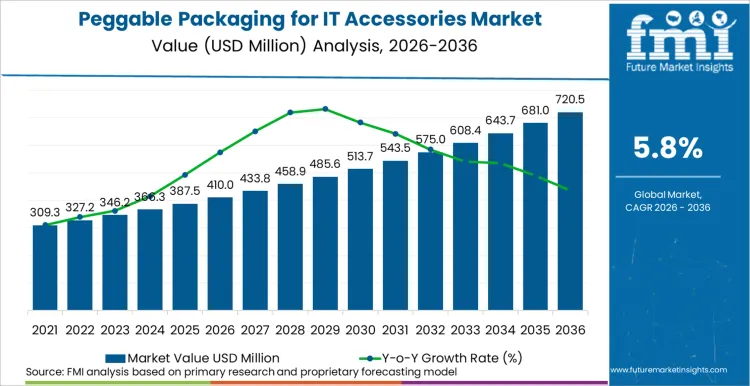
The peggable packaging for IT accessories market is anticipated to cross valuation of USD 410 million and reach USD 721 million by 2036, a 5.8% CAGR that signals where value concentrates as buyers tighten performance and proof requirements. As per FMI's projection, this growth trajectory is defined not by unit volume alone but by the rapid displacement of legacy blister formats in favor of higher-value paperboard architectures that integrate security features directly into the fiber substrate.
United States Census Bureau data from late 2025 indicates that e-commerce revenue grew 5.1% in the third quarter alone, creating an immediate operational need for packaging that withstands courier handling while eliminating the "wrap rage" associated with traditional heat-sealed plastics.
Procurement teams at major accessory OEMs are responding to this shift by embedding sustainability targets directly into supplier contracts, effectively turning packaging specifications into a license to trade. Delphine Donné, General Manager, Personal Workspace Solutions, Logitech (April 2025), stated:
"Shifting away from plastic clamshell packaging marks a significant step toward our goal of completely eliminating single-use plastics from our portfolio. This milestone is about 90% complete and is our largest packaging endeavor to date. Before this transition, we successfully eliminated 1,800 tons of packaging material by implementing design modifications in other areas across our packaging."
For packaging converters, the implication is that capital expenditure must pivot immediately toward die-cutting and folding capacity for heavy-caliper boards, as brands will no longer accept the reputational risk of plastic-heavy localized solutions. The acceleration of this trend is visible in the operational reports of market leaders, where virgin plastic reduction has become a primary key performance indicator reported to shareholders.
Belkin International reported in its 2024 impact assessment that overall single-use plastic packaging decreased by 89% since 2019, a metric that surpasses their original 2025 reduction targets and sets a new baseline for competitor compliance. This drastic reduction forces a complete redesign of the supply chain, as manufacturers move away from thermoformed bubbles toward complex folded carton structures that secure cables and peripherals through friction and geometric locking rather than adhesives.
Summary of Peggable Packaging for IT Accessories Market
What Is the Growth Outlook for the Peggable Packaging for IT Accessories Market as per Future Market Insights Projection?
According to FMI's estimates, the global peggable packaging for IT accessories market is projected to expand from USD 410 million in 2026 to USD 721 million by 2036, registering a CAGR of 5.8%.
FMI Research Approach: Forecasts are built using accessory shipment volumes from major OEMs (Logitech, Belkin), retail shelf-space analysis, and regulatory impact modeling on plastic reduction.
How Do FMI Analysts Perceive the Market Evolution?
FMI analysts opine that the sector is transitioning from a "protect and display" model using transparent plastic to a "communicate and secure" model using printed fiber surfaces.
FMI Research Approach: Insights are derived from patent filings for paper-based locking mechanisms (Graphic Packaging, Stora Enso) and procurement trends in mobile phone accessories packaging.
Which Country Holds the Demand Anchor in the Global Market?
India is emerging as a critical demand anchor, projected to grow at 7.4% CAGR, driven by a massive expansion in domestic electronics manufacturing that requires localized, compliant packaging solutions.
FMI Research Approach: Analysis tracks production data from India's Ministry of Electronics & IT and packaging consumption rates in the burgeoning wearable device packaging sector.
How Large Will the Paperboard Segment Be by 2036?
The Paperboard Card + Hang Hole format currently commands a 36.0% share, a figure expected to surpass 50% by 2036 as it becomes the default standard for global retail compliance.
FMI Research Approach: Market sizing relies on material substitution rates observed in recent product launches and the phasing out of protective packaging foams.
What Is the Definition of the Peggable Packaging for IT Accessories Market?
The market encompasses packaging formats specifically designed for retail suspension (pegging) containing IT peripherals, excluding bulk shipping containers or non-retail industrial packaging.
FMI Research Approach: The definition is structured around the "final mile" retail presentation, capturing revenue from converters selling to accessory OEMs and distributors.
What Are Globally Unique Trends Shaping Adoption?
Globally, the "Right-Sizing" trend is reshaping adoption, where brands reduce package volume to minimize logistics costs, effectively killing demand for oversized clamshell packaging.
FMI Research Approach: Trends are validated through logistics efficiency reports and consumer feedback on frustration-free unboxing experiences.
Peggable Packaging for IT Accessories Market Key Takeaways
| Metric | Value |
|---|---|
| Industry Size (2026) | USD 410 million |
| Industry Value (2036) | USD 721 million |
| CAGR (2026 to 2036) | 5.8% |
Source: Future Market Insights (FMI) analysis, based on proprietary forecasting model and primary research
How Regulatory Tightening Drives Material Substitution?
As per FMI's projection, the patchwork of global plastic regulations is acting as the primary catalyst for the widespread abandonment of PVC and PET blisters in favor of compliant fiber alternatives. In China, the implementation of national mandatory standard GB 23350-2021 regarding excessive packaging now explicitly targets the void space and layer count in electronics packaging, making traditional blister packs legally risky for domestic sales. This regulatory constraint forces manufacturers to adopt high-density, fold-flat designs that minimize air and maximize material efficiency, fundamentally altering the economics of production lines that were previously optimized for thermoforming. For e-commerce packaging suppliers, this shift requires immediate investment in precision paper converting equipment to meet the dual needs of regulatory compliance and product protection.
Simultaneously, the demand for standardized, frustration-free formats in the United States is accelerating the obsolescence of rigid plastics that are difficult to open and recycle. USA Census Bureau data confirms that the Electronic Shopping and Mail-Order Houses industry grew by 106.0% between 2017 and 2022, creating a logistics environment where package durability and "shippability" are paramount. This operational reality privileges semi-rigid paperboard structures that can withstand the rigors of automated sorting centers without cracking, unlike brittle plastic shells. Consequently, the market is witnessing a rapid migration toward retail e-commerce packaging solutions that integrate the hanging tab directly into the box structure, eliminating the need for separate plastic hooks that complicate recycling streams.
What is the Segmentation Outlook for Peggable Packaging for IT Accessories Market?
The segmentation landscape is defined by a rigorous focus on material efficiency and recyclability, covering Format, Material, and Product Type dimensions. The mix reveals a decisive shift away from mixed-material structures toward monomaterial paperboard solutions, driven by retailer mandates for 100% curbside recyclability. Currently, the Cables & Adapters segment leads product type adoption, utilizing high-volume, automated packaging lines that demand uniform feedstock. By 2036, the material dimension is expected to be almost entirely dominated by advanced fiber substrates, as recycled plastics fail to meet the "plastic-free" marketing claims increasingly demanded by consumers, 61% of whom explicitly seek recyclable packaging according to 2025 consumer studies.
Why Does the Paperboard Card + Hang Hole Format Lead?
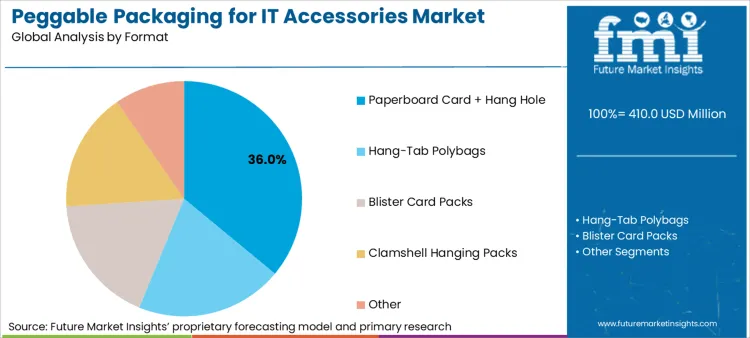
According to FMI's estimates, the Paperboard Card + Hang Hole format commands a dominant 36.0% share of the market, serving as the industry standard for lightweight accessories due to its low cost and high printability. This dominance is reinforced by corporate actions like Logitech's elimination of 660 tons of plastic annually, a volume largely achieved by transitioning mouse and cable SKUs to this specific fiber format. The mechanism driving this share is the format's inherent compatibility with automated retail pegs and its ability to act as a tamper-evident seal without additional packaging inserts. For retailers, this translates into reduced shrinkage and lower waste disposal costs, cementing the format's position as the preferred choice for high-velocity inventory.
Why Is Paperboard Material Outpacing Plastics?
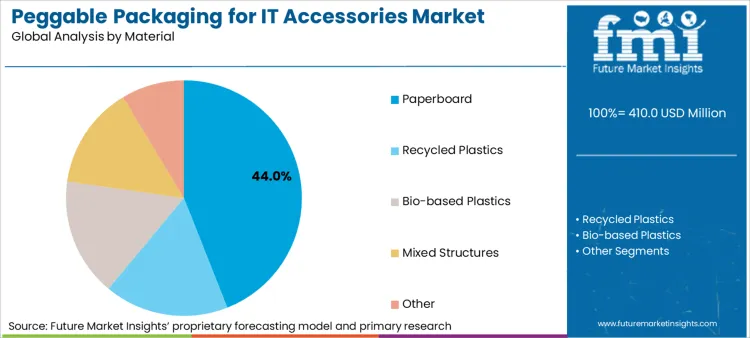
Paperboard material accounts for 44.0% of the market value, a share that is expanding rapidly as manufacturers seek to immunize their supply chains against fluctuating plastic taxes and EPR fees. Data from Indonesia's Statistics Bureau in Q1 2024 showed a contraction in paper goods production that has since reversed, indicating a broader industrial pivot where fiber capacity is being reallocated to meet the surging demand for paperboard mailer alternatives. This shift reduces the compliance burden for exporters, as paperboard generally faces lower tariff barriers and fewer disposal restrictions than bio-based or recycled plastics in key destination markets like the EU. Consequently, converters are prioritizing fiber sourcing to secure long-term contracts with risk-averse global OEMs.
How Are Cables & Adapters Driving Volume?
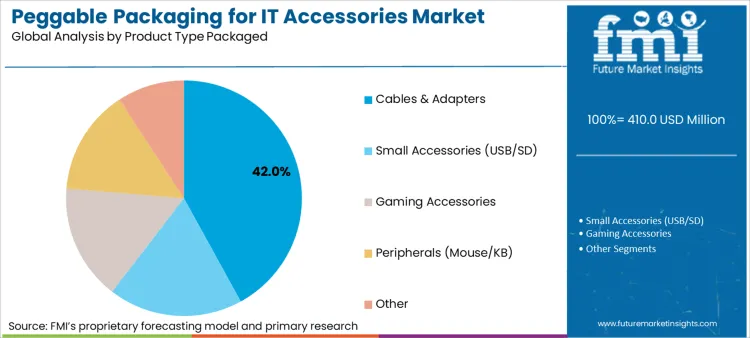
Cables & Adapters represent 42.0% of the packaged product volume, driven by the sheer ubiquity of these peripherals and the industry-wide move to unbundle chargers from smartphone boxes. US import data from November 2025 highlights a USD 3.0 billion fluctuation in computer accessories, underscoring the massive, albeit cyclical, volume of consumer electronics packaging required to support this segment. The mechanism here is pure volume economics; these products are durable, low-margin items that require minimal cushioning, making them the ideal candidates for simple, automated paperboard sleeves. This high throughput ensures that even marginal savings in material costs translate into significant profitability improvements for manufacturers.
How Design Innovation Is Solving the Security Challenge?
The primary technical barrier to replacing plastic clamshells has historically been the loss of product visibility and theft prevention, but new "smart fiber" designs are overcoming these limitations through structural ingenuity. Manufacturers are now deploying high-tensile paperboards treated with technologies like Stora Enso's "FiberLight Tec," which reduces board weight by 5% while maintaining the stiffness required to prevent crushing or tearing on the peg. This material advancement allows for the creation of fiber-based blister pack alternatives that feature integrated die-cut windows and locking tabs, offering the consumer a view of the product without compromising the package's tamper-evident integrity. By engineering these security features directly into the fold patterns, brands can eliminate the need for secondary heat seal pouch components, simplifying the recycling process for the end-user.
In parallel, the industry is witnessing a strategic pivot toward "telescoping" designs that adjust to the product's size, thereby reducing the amount of air shipped and improving pallet density. Samantha Upham, Sustainability Business Partner, DS Smith (July 2022), commented:
"All 700 of our designers have been trained in our Circular Design Principles, which means we can design out problem plastics at inception stage and find alternative fibre-based solutions which deliver the required attributes."
This statement highlights a critical operational mechanism: the design phase is now the primary locus of value creation, where material reduction translates directly to logistics savings. For accessories manufacturers, adopting these adaptive designs means they can utilize a single industrial electronics packaging SKU for multiple cable lengths or mouse sizes, significantly reducing inventory complexity and packaging waste.
Where Is Regional Demand Concentrating?
While North America remains a stronghold for design innovation, the sheer volume of demand is shifting decisively toward Asia, where manufacturing clusters are integrating upstream packaging production to shorten lead times. Official production data from India's Ministry of Electronics & IT shows a five-fold increase in domestic electronics output to USD 115 billion by FY 2023 to 2024, creating a massive, localized ecosystem for flexible packaging and rigid boxes that must meet international export standards. This creates a "two-speed" market where Western regions focus on premium, plastic-free designs for retail, while Asian hubs prioritize scalability and cost-efficiency to feed global supply chains. The divergence forces multinational converters to maintain dual capabilities: high-end prototyping in Europe/USA and high-volume converting lines in Vietnam and India.
Country CAGR Table
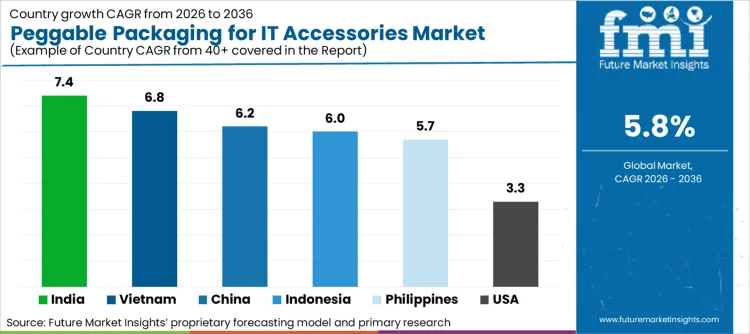
| Country | CAGR (2026 to 2036) |
|---|---|
| India | 7.4% |
| Vietnam | 6.8% |
| China | 6.2% |
| Indonesia | 6.0% |
| Philippines | 5.7% |
Source: Future Market Insights’ proprietary forecasting model and primary research
Why Is India Leading Growth?
FMI analysts opine that sales of peggable packaging for IT accessories in India are set to rise at 7.4% CAGR, fueled by the government's rigorous enforcement of plastic waste management rules. The 2024 amendment to plastic waste rules mandates a minimum thickness of 120 microns for carry bags, effectively signaling a regulatory crackdown that is pushing manufacturers toward compliant paper-based blister pack solutions for small electronics. This policy pressure, combined with the rapid expansion of the domestic accessory market, creates a lucrative environment for local paper converters who can guarantee regulatory adherence. Consequently, international players are entering joint ventures to capture this burgeoning demand for compliant retail packaging.
How Is Vietnam Becoming an Export Hub?
Demand for peggable packaging for IT accessories in Vietnam is anticipated to grow at 6.8% CAGR, directly correlated with the country's ascent as a primary alternative to China for electronics assembly. Pham Minh Tuan, CEO, FPT Software (Feb 2025), noted: "With their forward-thinking strategy, the company focuses on researching the latest technologies and strongly shifting towards higher stages in the technology value chain. Revenue from digital transformation services accounts for nearly 50% of total IT service revenue from foreign markets." Such export-led growth model demands high-quality esd clamshell and fiber alternatives that meet the stringent EPR requirements of destination markets in Europe and North America. As Vietnamese factories move up the value chain, the packaging that leaves these facilities is increasingly sophisticated, designed to go straight to a Best Buy or MediaMarkt shelf without repacking.
Why Is China Tightening Standards?
The peggable packaging for IT accessories industry in China is projected to expand at 6.2% CAGR, driven by a dual engine of robust domestic consumption and aggressive regulatory standardization. National Bureau of Statistics data from August 2025 indicates a 12.1% growth in the information transmission and IT services sector, fueling domestic hardware sales that require standardized retail packaging. The enforcement of GB 23350-2021 regarding excessive packaging acts as a hard constraint, forcing local manufacturers to abandon oversized blister packaging in favor of compact, material-efficient designs. This regulatory mechanism ensures that sustainability is not just a branding exercise but a market access requirement for domestic brands.
How Is Indonesia Navigating Policy Shifts?
Peggable packaging for IT accessories in Indonesia is poised to register a 6.0% CAGR, shaped by a complex interplay between industrial policy and manufacturing cost structures. The government's subsequent abandonment of the plastic excise tax reflects a tension between cost competitiveness and environmental goals, yet the market is organically shifting toward flexible plastic packaging alternatives that offer better printability and shelf appeal.
Fajar Budiono, Secretary-General, Inaplas (Oct 2024), stated: "Consumers would bear the burden of the higher product costs, while micro, small and medium enterprises would be hit hardest, as they were the biggest users of plastics. Food and beverage producers might then not produce here." Such uncertainty drives larger players to adopt fiber-based solutions voluntarily to "future-proof" their operations against inevitable policy swings.
Why Is the Philippines Focusing on EPR?
The peggable packaging for IT accessories market in the Philippines is expected to grow at 5.7% CAGR, anchored by the rigorous implementation of the Extended Producer Responsibility (EPR) Act of 2022. Large enterprises are now legally obliged to recover and divert a significant portion of their plastic packaging footprint, a mandate that makes traditional thermoformed skin packaging a liability for balance sheets. This compliance cost mechanism is pushing accessory importers and local brands to switch to biodegradable or fiber-based peg formats that are exempt from the most punitive EPR fees. As a result, the market is witnessing a rapid professionalization of the recycling value chain to support these new material flows.
How Are Competitors Securing Profit Pools?
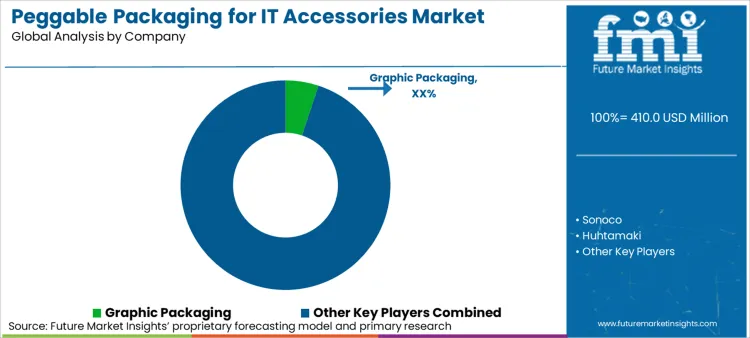
As per FMI's projection, competitive advantage in the peggable packaging for IT accessories market now depends less on brand breadth and more on who controls the constraint that gates scale, whether evidence, compliance, channel access, or capacity. Incumbents like Graphic Packaging and Stora Enso are leveraging their massive paperboard capacities to lock in long-term supply agreements with tech giants, effectively creating a barrier to entry for smaller converters who lack access to premium "virgin-equivalent" recycled fibers.
Logitech’s operational shift to eliminate 90% of plastics involves deep integration with these suppliers, proving that the profit pool belongs to those who can deliver millions of anti-static bubble pouch replacements that run seamlessly on existing automated packing lines. For suppliers, the winning strategy involves vertically integrating the production of proprietary secure-fold designs that prevent theft without requiring plastic, thereby capturing the high-margin "security" segment of the market.
Startups are entering the market through specialized innovation in material science, focusing on coating technologies that give paper the barrier properties of plastic without the environmental penalty. Innovation in "hydrophobic" paper treatments allows new entrants to offer perforated packaging solutions that resist humidity in tropical logistics chains, a critical differentiator for the Asian export market.
Stora Enso’s launch of "FiberLight Tec" exemplifies this strategy, offering a lighter board that reduces shipping weight—a direct operational saving for OEMs that translates into market share gains. This bifurcation of the market suggests that while giants will own the volume, agile players will capture value in niche, high-performance applications where standard board fails.
Recent Developments:
- In April 2025, Logitech fully transitioned to 100% paper-based packaging across its entire product range, including peggable carded designs with euro holes for retail display of IT accessories such as mice, keyboards, and webcams. This shift replaces traditional plastic blisters with recyclable fiber-based alternatives, maintaining hangable functionality while significantly reducing plastic waste in the peggable packaging segment.
- In April 2025, Amcor completed its all-stock merger with Berry Global, forming a global packaging powerhouse with advanced flexible film technologies. This combination enhances innovation in sustainable blister and carded peggable packaging solutions, offering improved protective and recyclable options for small IT accessories in retail environments.
Key Players in Peggable Packaging for IT Accessories Market
- Graphic Packaging International
- Sonoco Products Company
- Huhtamaki Oyj
- Stora Enso Oyj
- DS Smith
- Pregis
- Berry Global
- NEFAB Group
- WestRock (Smurfit WestRock)
- International Paper
Market Definition
The peggable packaging for IT accessories market is defined as the commercial ecosystem of packaging formats specifically engineered to be suspended from retail display hooks (pegs) containing information technology peripherals. This includes primary retail packaging for products such as cables, chargers, mice, keyboards, webcams, and external storage devices. The definition explicitly encompasses both the material substrate (paperboard, plastic, hybrid) and the structural format (blister, clamshell, box with integrated hang-tab) used to secure and display the product in a retail environment.
Revenue within this market is calculated based on the sales value of the packaging materials and converted units sold by packaging manufacturers to IT accessory OEMs, distributors, and aftermarket brands. The scope includes value-added features such as tamper-evident seals, anti-theft mechanisms, and high-fidelity printing that facilitates brand communication. It also captures the revenue from sustainable alternatives, such as molded fiber trays and paper-based locking sleeves, which are increasingly replacing traditional plastic formats.
The market explicitly excludes bulk shipping containers, master cartons, and industrial protective packaging used solely for inter-facility transport that does not reach the retail shelf. Furthermore, it excludes general-purpose polybags or unbranded generic packaging used for low-value bulk components sold B2B, unless they are specifically designed for retail display. Packaging for major hardware units like laptops, monitors, or desktop towers is also excluded, as these are typically shelf-stacked rather than pegged due to weight and size constraints.
Scope of Report
| Items | Values |
|---|---|
| Quantitative Units (2026) | USD 410 million |
| Product Type | Cables & Adapters, Small Accessories (USB/SD), Gaming Accessories, Peripherals (Mouse/KB), Other |
| Application or Procedure type | Retail Display, E-commerce Fulfillment, Anti-Theft Security |
| End user | IT Accessory OEMs, Consumer Electronics Retailers, Aftermarket Distributors |
| Regions covered | North America, Europe, Asia Pacific, Latin America, Middle East & Africa |
| Countries covered | USA, China, India, Vietnam, Indonesia, Philippines, Germany, UK, Japan |
| Key companies profiled | Graphic Packaging, Sonoco, Huhtamaki, Stora Enso, DS Smith, Pregis |
| Additional attributes | Revenue analysis by segments, adoption trends across settings, regulatory and compliance landscape (as relevant), pricing and reimbursement considerations (when relevant), channel mix economics, supply chain exposure, and competitive positioning analysis |
Source: Future Market Insights (FMI) analysis, based on proprietary forecasting model and primary research
Peggable Packaging for IT Accessories Market by Segments
By Format:
- Paperboard Card + Hang Hole
- Hang-Tab Polybags
- Blister Card Packs
- Clamshell Hanging Packs
- Other
By Material:
- Paperboard
- Recycled Plastics
- Bio-based Plastics
- Mixed Structures
- Other
By Product Type Packaged:
- Cables & Adapters
- Small Accessories (USB/SD)
- Gaming Accessories
- Peripherals (Mouse/KB)
- Other
By Region:
- North America
- Europe
- Asia Pacific
- Latin America
- Middle East & Africa
Bibliography
- Ministry of Electronics & Information Technology (MeitY), Government of India. (2025). Annual Report 2024–25: Electronics manufacturing, PLI schemes, and domestic value chain development. Government of India.
- USA Census Bureau. (2025). Quarterly Retail E-Commerce Sales: Fourth Quarter 2024 and Annual Summary. USA Department of Commerce.
- National Bureau of Statistics of China. (2025). Index of Services Production: Information Transmission, Software, and Information Technology Services, 2024 Annual Release. Government of the People’s Republic of China.
- Ministry of Information and Communications, Vietnam. (2025). Vietnam ICT Industry White Book 2025: Exports, digital manufacturing, and global value chains. Government of Vietnam.
- BPS-Statistics Indonesia. (2024). Growth of Manufacturing Production Index by Industry Group, Quarterly Statistical Bulletin. Government of Indonesia.
- Department of Environment and Natural Resources (DENR), Philippines. (2024). Implementing Rules and Compliance Guidelines for the Extended Producer Responsibility Act of 2022. Government of the Philippines.
- World Trade Organization (WTO). (2024). World Trade Statistical Review 2024: Electronics, ICT goods, and intermediate inputs. WTO.
- International Telecommunication Union (ITU). (2024). Measuring Digital Development: ICT Manufacturing, Trade, and Sustainability Indicators. ITU.
Frequently Asked Questions
What is the current value of the peggable packaging for IT accessories market?
The global market is valued at USD 410 million in 2026, driven by the high-volume turnover of cables, adapters, and peripherals in retail channels.
What is the projected growth rate for this packaging market?
The market is expected to grow at a CAGR of 5.8% through 2036, reaching USD 721 million as sustainable fiber-based formats gain widespread adoption.
Which segment currently dominates the market?
Paperboard Card + Hang Hole formats hold the largest share at 36.0%, favored for their cost-effectiveness and compliance with plastic reduction mandates.
Which region is expected to witness the fastest growth?
India is projected to be the fastest-growing market with a 7.4% CAGR, supported by a booming domestic electronics manufacturing sector and strict plastic regulations.
Who are the leading players in the peggable packaging for IT accessories market?
Key players include Graphic Packaging, Sonoco, Huhtamaki, and Stora Enso, all of whom are aggressively expanding their fiber-based security packaging portfolios.
Preview the report firsthand - request a free sample
Get SampleGet the brochure for pricing and purchase details.
Get PDFTable of Content
- Executive Summary
- Global Market Outlook
- Demand-side Trends
- Supply-side Trends
- Technology Roadmap Analysis
- Analysis and Recommendations
- Market Overview
- Market Coverage / Taxonomy
- Market Definition / Scope / Limitations
- Research Methodology
- Chapter Orientation
- Analytical Lens and Working Hypotheses
- Market Structure, Signals, and Trend Drivers
- Benchmarking and Cross-market Comparability
- Market Sizing, Forecasting, and Opportunity Mapping
- Research Design and Evidence Framework
- Desk Research Programme (Secondary Evidence)
- Company Annual and Sustainability Reports
- Peer-reviewed Journals and Academic Literature
- Corporate Websites, Product Literature, and Technical Notes
- Earnings Decks and Investor Briefings
- Statutory Filings and Regulatory Disclosures
- Technical White Papers and Standards Notes
- Trade Journals, Industry Magazines, and Analyst Briefs
- Conference Proceedings, Webinars, and Seminar Materials
- Government Statistics Portals and Public Data Releases
- Press Releases and Reputable Media Coverage
- Specialist Newsletters and Curated Briefings
- Sector Databases and Reference Repositories
- FMI Internal Proprietary Databases and Historical Market Datasets
- Subscription Datasets and Paid Sources
- Social Channels, Communities, and Digital Listening Inputs
- Additional Desk Sources
- Expert Input and Fieldwork (Primary Evidence)
- Primary Modes
- Qualitative Interviews and Expert Elicitation
- Quantitative Surveys and Structured Data Capture
- Blended Approach
- Why Primary Evidence is Used
- Field Techniques
- Interviews
- Surveys
- Focus Groups
- Observational and In-context Research
- Social and Community Interactions
- Stakeholder Universe Engaged
- C-suite Leaders
- Board Members
- Presidents and Vice Presidents
- R&D and Innovation Heads
- Technical Specialists
- Domain Subject-matter Experts
- Scientists
- Physicians and Other Healthcare Professionals
- Governance, Ethics, and Data Stewardship
- Research Ethics
- Data Integrity and Handling
- Primary Modes
- Tooling, Models, and Reference Databases
- Desk Research Programme (Secondary Evidence)
- Data Engineering and Model Build
- Data Acquisition and Ingestion
- Cleaning, Normalisation, and Verification
- Synthesis, Triangulation, and Analysis
- Quality Assurance and Audit Trail
- Market Background
- Market Dynamics
- Drivers
- Restraints
- Opportunity
- Trends
- Scenario Forecast
- Demand in Optimistic Scenario
- Demand in Likely Scenario
- Demand in Conservative Scenario
- Opportunity Map Analysis
- Product Life Cycle Analysis
- Supply Chain Analysis
- Investment Feasibility Matrix
- Value Chain Analysis
- PESTLE and Porter’s Analysis
- Regulatory Landscape
- Regional Parent Market Outlook
- Production and Consumption Statistics
- Import and Export Statistics
- Market Dynamics
- Global Market Analysis 2021 to 2025 and Forecast, 2026 to 2036
- Historical Market Size Value (USD Million) Analysis, 2021 to 2025
- Current and Future Market Size Value (USD Million) Projections, 2026 to 2036
- Y-o-Y Growth Trend Analysis
- Absolute $ Opportunity Analysis
- Global Market Pricing Analysis 2021 to 2025 and Forecast 2026 to 2036
- Global Market Analysis 2021 to 2025 and Forecast 2026 to 2036, By Format
- Introduction / Key Findings
- Historical Market Size Value (USD Million) Analysis By Format , 2021 to 2025
- Current and Future Market Size Value (USD Million) Analysis and Forecast By Format , 2026 to 2036
- Paperboard Card + Hang Hole
- Hang-Tab Polybags
- Blister Card Packs
- Clamshell Hanging Packs
- Other
- Paperboard Card + Hang Hole
- Y-o-Y Growth Trend Analysis By Format , 2021 to 2025
- Absolute $ Opportunity Analysis By Format , 2026 to 2036
- Global Market Analysis 2021 to 2025 and Forecast 2026 to 2036, By Material
- Introduction / Key Findings
- Historical Market Size Value (USD Million) Analysis By Material, 2021 to 2025
- Current and Future Market Size Value (USD Million) Analysis and Forecast By Material, 2026 to 2036
- Paperboard
- Recycled Plastics
- Bio-based Plastics
- Mixed Structures
- Other
- Paperboard
- Y-o-Y Growth Trend Analysis By Material, 2021 to 2025
- Absolute $ Opportunity Analysis By Material, 2026 to 2036
- Global Market Analysis 2021 to 2025 and Forecast 2026 to 2036, By Product Type Packaged
- Introduction / Key Findings
- Historical Market Size Value (USD Million) Analysis By Product Type Packaged, 2021 to 2025
- Current and Future Market Size Value (USD Million) Analysis and Forecast By Product Type Packaged, 2026 to 2036
- Cables & Adapters
- Small Accessories (USB/SD)
- Gaming Accessories
- Peripherals (Mouse/KB)
- Other
- Cables & Adapters
- Y-o-Y Growth Trend Analysis By Product Type Packaged, 2021 to 2025
- Absolute $ Opportunity Analysis By Product Type Packaged, 2026 to 2036
- Global Market Analysis 2021 to 2025 and Forecast 2026 to 2036, By Region
- Introduction
- Historical Market Size Value (USD Million) Analysis By Region, 2021 to 2025
- Current Market Size Value (USD Million) Analysis and Forecast By Region, 2026 to 2036
- North America
- Latin America
- Western Europe
- Eastern Europe
- East Asia
- South Asia and Pacific
- Middle East & Africa
- Market Attractiveness Analysis By Region
- North America Market Analysis 2021 to 2025 and Forecast 2026 to 2036, By Country
- Historical Market Size Value (USD Million) Trend Analysis By Market Taxonomy, 2021 to 2025
- Market Size Value (USD Million) Forecast By Market Taxonomy, 2026 to 2036
- By Country
- USA
- Canada
- Mexico
- By Format
- By Material
- By Product Type Packaged
- By Country
- Market Attractiveness Analysis
- By Country
- By Format
- By Material
- By Product Type Packaged
- Key Takeaways
- Latin America Market Analysis 2021 to 2025 and Forecast 2026 to 2036, By Country
- Historical Market Size Value (USD Million) Trend Analysis By Market Taxonomy, 2021 to 2025
- Market Size Value (USD Million) Forecast By Market Taxonomy, 2026 to 2036
- By Country
- Brazil
- Chile
- Rest of Latin America
- By Format
- By Material
- By Product Type Packaged
- By Country
- Market Attractiveness Analysis
- By Country
- By Format
- By Material
- By Product Type Packaged
- Key Takeaways
- Western Europe Market Analysis 2021 to 2025 and Forecast 2026 to 2036, By Country
- Historical Market Size Value (USD Million) Trend Analysis By Market Taxonomy, 2021 to 2025
- Market Size Value (USD Million) Forecast By Market Taxonomy, 2026 to 2036
- By Country
- Germany
- UK
- Italy
- Spain
- France
- Nordic
- BENELUX
- Rest of Western Europe
- By Format
- By Material
- By Product Type Packaged
- By Country
- Market Attractiveness Analysis
- By Country
- By Format
- By Material
- By Product Type Packaged
- Key Takeaways
- Eastern Europe Market Analysis 2021 to 2025 and Forecast 2026 to 2036, By Country
- Historical Market Size Value (USD Million) Trend Analysis By Market Taxonomy, 2021 to 2025
- Market Size Value (USD Million) Forecast By Market Taxonomy, 2026 to 2036
- By Country
- Russia
- Poland
- Hungary
- Balkan & Baltic
- Rest of Eastern Europe
- By Format
- By Material
- By Product Type Packaged
- By Country
- Market Attractiveness Analysis
- By Country
- By Format
- By Material
- By Product Type Packaged
- Key Takeaways
- East Asia Market Analysis 2021 to 2025 and Forecast 2026 to 2036, By Country
- Historical Market Size Value (USD Million) Trend Analysis By Market Taxonomy, 2021 to 2025
- Market Size Value (USD Million) Forecast By Market Taxonomy, 2026 to 2036
- By Country
- China
- Japan
- South Korea
- By Format
- By Material
- By Product Type Packaged
- By Country
- Market Attractiveness Analysis
- By Country
- By Format
- By Material
- By Product Type Packaged
- Key Takeaways
- South Asia and Pacific Market Analysis 2021 to 2025 and Forecast 2026 to 2036, By Country
- Historical Market Size Value (USD Million) Trend Analysis By Market Taxonomy, 2021 to 2025
- Market Size Value (USD Million) Forecast By Market Taxonomy, 2026 to 2036
- By Country
- India
- ASEAN
- Australia & New Zealand
- Rest of South Asia and Pacific
- By Format
- By Material
- By Product Type Packaged
- By Country
- Market Attractiveness Analysis
- By Country
- By Format
- By Material
- By Product Type Packaged
- Key Takeaways
- Middle East & Africa Market Analysis 2021 to 2025 and Forecast 2026 to 2036, By Country
- Historical Market Size Value (USD Million) Trend Analysis By Market Taxonomy, 2021 to 2025
- Market Size Value (USD Million) Forecast By Market Taxonomy, 2026 to 2036
- By Country
- Kingdom of Saudi Arabia
- Other GCC Countries
- Turkiye
- South Africa
- Other African Union
- Rest of Middle East & Africa
- By Format
- By Material
- By Product Type Packaged
- By Country
- Market Attractiveness Analysis
- By Country
- By Format
- By Material
- By Product Type Packaged
- Key Takeaways
- Key Countries Market Analysis
- USA
- Pricing Analysis
- Market Share Analysis, 2025
- By Format
- By Material
- By Product Type Packaged
- Canada
- Pricing Analysis
- Market Share Analysis, 2025
- By Format
- By Material
- By Product Type Packaged
- Mexico
- Pricing Analysis
- Market Share Analysis, 2025
- By Format
- By Material
- By Product Type Packaged
- Brazil
- Pricing Analysis
- Market Share Analysis, 2025
- By Format
- By Material
- By Product Type Packaged
- Chile
- Pricing Analysis
- Market Share Analysis, 2025
- By Format
- By Material
- By Product Type Packaged
- Germany
- Pricing Analysis
- Market Share Analysis, 2025
- By Format
- By Material
- By Product Type Packaged
- UK
- Pricing Analysis
- Market Share Analysis, 2025
- By Format
- By Material
- By Product Type Packaged
- Italy
- Pricing Analysis
- Market Share Analysis, 2025
- By Format
- By Material
- By Product Type Packaged
- Spain
- Pricing Analysis
- Market Share Analysis, 2025
- By Format
- By Material
- By Product Type Packaged
- France
- Pricing Analysis
- Market Share Analysis, 2025
- By Format
- By Material
- By Product Type Packaged
- India
- Pricing Analysis
- Market Share Analysis, 2025
- By Format
- By Material
- By Product Type Packaged
- ASEAN
- Pricing Analysis
- Market Share Analysis, 2025
- By Format
- By Material
- By Product Type Packaged
- Australia & New Zealand
- Pricing Analysis
- Market Share Analysis, 2025
- By Format
- By Material
- By Product Type Packaged
- China
- Pricing Analysis
- Market Share Analysis, 2025
- By Format
- By Material
- By Product Type Packaged
- Japan
- Pricing Analysis
- Market Share Analysis, 2025
- By Format
- By Material
- By Product Type Packaged
- South Korea
- Pricing Analysis
- Market Share Analysis, 2025
- By Format
- By Material
- By Product Type Packaged
- Russia
- Pricing Analysis
- Market Share Analysis, 2025
- By Format
- By Material
- By Product Type Packaged
- Poland
- Pricing Analysis
- Market Share Analysis, 2025
- By Format
- By Material
- By Product Type Packaged
- Hungary
- Pricing Analysis
- Market Share Analysis, 2025
- By Format
- By Material
- By Product Type Packaged
- Kingdom of Saudi Arabia
- Pricing Analysis
- Market Share Analysis, 2025
- By Format
- By Material
- By Product Type Packaged
- Turkiye
- Pricing Analysis
- Market Share Analysis, 2025
- By Format
- By Material
- By Product Type Packaged
- South Africa
- Pricing Analysis
- Market Share Analysis, 2025
- By Format
- By Material
- By Product Type Packaged
- USA
- Market Structure Analysis
- Competition Dashboard
- Competition Benchmarking
- Market Share Analysis of Top Players
- By Regional
- By Format
- By Material
- By Product Type Packaged
- Competition Analysis
- Competition Deep Dive
- Graphic Packaging
- Overview
- Product Portfolio
- Profitability by Market Segments (Product/Age /Sales Channel/Region)
- Sales Footprint
- Strategy Overview
- Marketing Strategy
- Product Strategy
- Channel Strategy
- Sonoco
- Huhtamaki
- Stora Enso
- DS Smith Pregis
- Berry Global NEFAB
- Graphic Packaging
- Competition Deep Dive
- Assumptions & Acronyms Used


