

- Industry Size (2026)
- USD 0.7 Bn
- Forecast (2036)
- USD 1.0 Bn
- CAGR (2026 to 2036)
- 4.0%
Transit Packaging Solutions for IT Hardware Accessories Market Forecast and Outlook 2026 to 2036
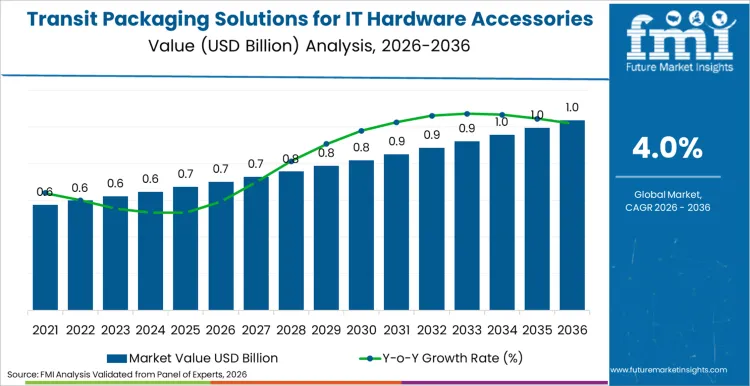
In 2026, the transit packaging solutions for IT hardware accessories market is estimated around USD 0.7 billion and is estimated to reach USD 1.0 billion by 2036, at a 4.0% CAGR. Steady expansion indicates a shift in where value is concentrated as buyers become more stringent about performance and proof requirements. This is not owing to just the volume but also the fundamental re-pricing of protection, as the industry accounts for the 1.67 billion mobile phones produced annually, each requiring specialized transit shielding. As per FMI's projection, the decoupling of hardware volume from packaging volume, driven by miniaturization and right-sizing, means that revenue growth will increasingly depend on premium, automated, and sustainable material innovation rather than simple tonnage.
Operational realities are forcing incumbent leaders to make hard choices about their portfolio mix, particularly as industrial volumes face cyclical headwinds. Patrick Kivits, CEO of Sealed Air, noted in November 2024: "Volumes decreased $28 million, or 6%, resulting from continued weakness in our industrial and fulfillment portfolios. Price had an unfavorable impact of $13 million, or 3%." This statement highlights the urgent pressure on manufacturers to pivot away from commoditized protective formats that are vulnerable to pricing erosion and demand volatility, pushing them toward high-value automation and specialized fulfillment services that lock in customer loyalty through operational integration.
The shift toward automation is further validated by the 15% annual growth rate currently witnessed in the warehouse automation sector. As labor availability tightens and throughput speeds increase, manual packing stations are becoming the primary bottleneck in IT hardware distribution, forcing a transition to automated cartoning and void-fill systems. This dynamic reshapes the competitive landscape, rewarding players who can deliver machine-integrated paper solutions that reduce cycle times while simultaneously addressing the "empty space" penalties imposed by new freight dimensional weight pricing models.
Summary of Transit Packaging Solutions for IT Hardware Accessories Market
What Is the Growth Outlook for the Transit Packaging Solutions for IT Hardware Accessories Market as per Future Market Insights Projection?
Future Market Insights projects the global transit packaging solutions for IT hardware accessories market to grow from USD 0.7 billion in 2026 to USD 1.0 billion by 2036, representing a 4.0% CAGR over the forecast period.
FMI Research Approach: Based on FMI’s proprietary global modeling framework incorporating major operator capex plans (Nefab, Sonoco), household spending indices on electronics, and funding inflows into the sustainable packaging startup ecosystem.
How Do FMI Analysts Perceive the Transit Packaging Solutions for IT Hardware Accessories Market to Evolve?
FMI analysts perceive the market transitioning away from single-use fossil-based foams toward "packaging-as-a-service" models and fiber-based automation.
FMI Research Approach: Developed using analysis of patent filings (Ranpak’s thermal dunnage), venture capital trends in material science (Woola, LivingPackets), and procurement data from major electronics OEMs.
Which Country Holds the Largest Share in the Global Transit Packaging Solutions for IT Hardware Accessories Market?
The United States holds a dominant value share, supported by record-breaking electronics import volumes and the presence of global e-commerce giants investing billions in domestic transport packaging infrastructure.
FMI Research Approach: Built using country-level trade reports (Data México), analysis of logistics revenue streams, and mapping of automation spending by institutions like Walmart.
How Large Will the Transit Packaging Solutions for IT Hardware Accessories Market Be by 2036?
The global transit packaging solutions for IT hardware accessories market is expected to reach USD 1.0 billion by 2036, with the Corrugated Shippers segment currently commanding a 46.0% share.
FMI Research Approach: Long-term forecasts rely on demographic trends (mobile subscription rates), disposable income projections for consumer electronics, and the scaling of returnable transport packaging platforms.
What Is the Definition of the Transit Packaging Solutions for IT Hardware Accessories Market?
The market encompasses revenue generated from commercial packaging solutions designed specifically for the protection and transport of IT hardware accessories, including peripherals, cables, and components.
FMI Research Approach: Definition structured using FMI’s segmentation taxonomy covering material types (corrugated, foam, plastic), shipment modes, and end-use sectors.
What Are Globally Unique Trends Shaping the Transit Packaging Solutions for IT Hardware Accessories Market?
Globally, the sector is shaped by the "Right-Sizing" mandates in developed markets and the "China Plus One" logistics surge in emerging Asian economies, where durability is becoming a key differentiator.
FMI Research Approach: Insights derived from global sustainability reports (Mondi Group), startup funding patterns in Europe, and consumer behavior analysis regarding eco-friendly unboxing experiences.
Transit Packaging Solutions for IT Hardware Accessories Market Key Takeaways
| Metric | Value |
|---|---|
| Industry Size (2026) | USD 0.7 Billion |
| Industry Value (2036) | USD 1.0 Billion |
| CAGR (2026-2036) | 4.0% |
Source: Future Market Insights (FMI) analysis, based on proprietary forecasting model and primary research.
Why E-commerce Density Is Driving Change?
The rapid acceleration of e-commerce channels is fundamentally altering the economic equation of transport cases and boxes, as shipping density becomes a critical profit driver. With 37% of 2024 sales for major players like Ranpak now generated directly by e-commerce end users, the market is pivoting from bulk palletization to individual parcel optimization. This shift forces operators to abandon "one-size-fits-all" boxes in favor of on-demand, variable-dimension packaging that minimizes air transport costs, effectively turning the packaging line into a direct extension of the logistics profit pool.
Simultaneously, the sheer volume of direct-to-consumer shipments is exposing the fragility of traditional manual packing workflows. As logistics packaging throughput requirements surge, retailers are discovering that manual void-fill processes cannot scale without incurring prohibitive labor costs. This bottleneck is driving the adoption of automated dispensing systems that integrate seamlessly with warehouse management software, ensuring that high-velocity IT accessories are protected with precision and speed that manual labor cannot match, thereby reducing damage rates and return logistics costs.
What is the Segmentation Outlook for Transit Packaging Solutions for IT Hardware Accessories Market?
The market segmentation, covering Packaging Type, Shipment Mode, and End Use, reveals a decisive shift toward materials that balance structural integrity with curb-side recyclability. With Corrugated Shippers holding a dominant 46.0% share, followed closely by Parcel/Express modes at 44.0%, the industry is clearly optimizing for the "last mile" rather than the warehouse shelf. As per FMI's estimates, the 2036 outlook points to a decline in static foam inserts as global protective packaging standards tighten, creating a distinct advantage for adaptable, fiber-based solutions that can serve both OEM distribution and direct consumer fulfillment channels.
Why Do Corrugated Shippers Dominate the Mix?
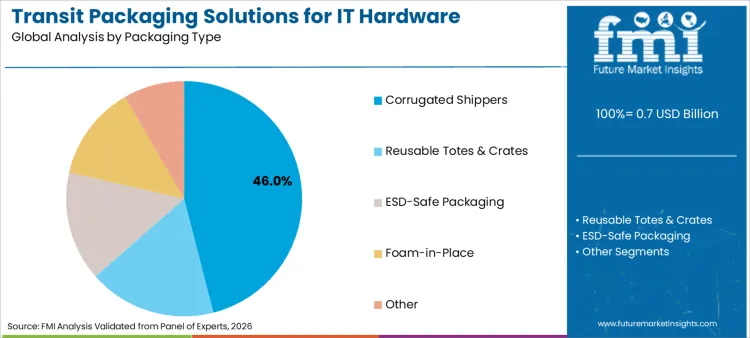
Corrugated shippers command 46.0% of the market, serving as the backbone of the global electronics trade due to their unique ability to offer structural rigidity without the environmental penalty of plastics. This dominance is reinforced by the European Union’s legislative push, which introduces a requirement by 2030 to comply with a minimization measure that caps the empty space ratio to a maximum of 50%. Consequently, manufacturers are re-engineering corrugated designs to be smarter and denser, using flexible protective packaging mechanics to eliminate void fill and ensure that every cubic inch of the shipper is utilized for product protection rather than air.
What Drives the Parcel and Express Segment?
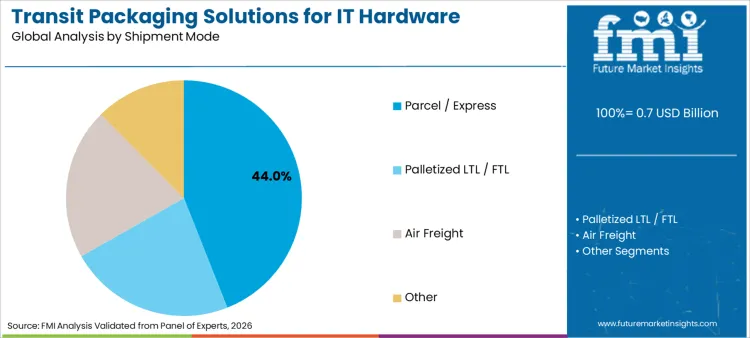
The parcel and express segment accounts for 44.0% of shipment volumes, driven by the fragmentation of IT supply chains and the rise of "just-in-time" consumer delivery expectations. Regulatory pressure is accelerating this shift; EU countries are mandated to reduce packaging inserts waste per capita by 5% by 2030, a target that disproportionately affects high-frequency parcel flows. This constraint forces logistics providers to adopt lighter, thinner, and stronger materials that can withstand the rigors of automated sorting hubs while meeting strict waste reduction targets, effectively making the parcel segment the primary laboratory for material innovation.
Where Is Value Concentrating in OEM Distribution?
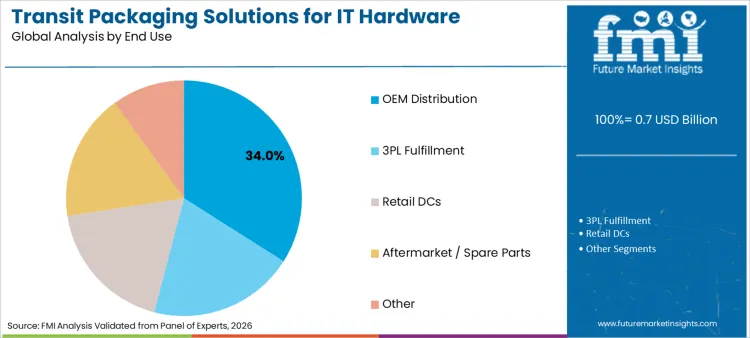
OEM distribution retains a 34.0% share, anchored by the massive inter-factory flows of components across the Asian manufacturing belt. In the first 9 months of 2024 alone, Vietnam’s export of electronic computers and components reached over USD 52.75 billion, highlighting the sheer scale of anti-static foam packaging required to move sensitive hardware between assembly nodes. For distributors, the critical capability is now "ESD-safe density", the ability to pack semiconductors and peripherals densely enough to lower freight costs while maintaining the electrostatic shielding necessary to prevent catastrophic yield losses during transit.
How Is Sustainability Reshaping Material Choice?
The material footprint of transit packaging is under intense scrutiny, driving a shift toward eco-conscious "hard goods" and influencing the purchasing decisions of institutional buyers. In May 2025, Per Öhagen, President and CEO of Nefab Group, stated: "In 2024, we made significant strides in executing our strategy leading up to 2030, solidifying sustainability as a core pillar for Nefab. Recognizing that approximately 20% of global CO2 emissions stem from transportation, we continue to focus on a holistic approach to supply chains. Our primary focus is on increasing investments in sustainable packaging and logistics services, helping our customers achieve their sustainability targets." This commitment signals a departure from purely cost-based procurement, forcing suppliers to audit their protective wrapping paper supply chains and prove carbon reduction.
This pressure is creating a competitive advantage for operators who can demonstrate a closed-loop sustainability model, turning eco-friendly practices from a regulatory burden into a marketable brand asset. With 66% of global consumers now willing to pay more for sustainable goods, the "unboxing experience" for IT accessories has become a frontline for brand differentiation. Consequently, the market is witnessing a rapid substitution of expanded polystyrene with bulk container packaging solutions made from molded pulp and wool, proving that environmental compliance is now inextricably linked to commercial viability in the premium hardware sector.
Where Is Regional Demand Concentrating?
The global market exhibits distinct regional drivers, from the "China Plus One" manufacturing surge in Asia to the automation-led fulfillment revolution in North America. While Asia dominates the production of industrial electronics packaging due to its entrenchment in the hardware supply chain, North America drives the demand for high-velocity, e-commerce-ready solutions. FMI analysts opine that the divergence in growth rates, India’s 5.6% versus the USA’s steady demand, reflects a decoupling where emerging markets invest in "heavy" export infrastructure, while mature markets pivot toward "smart" domestic distribution networks that prioritize speed and waste reduction.
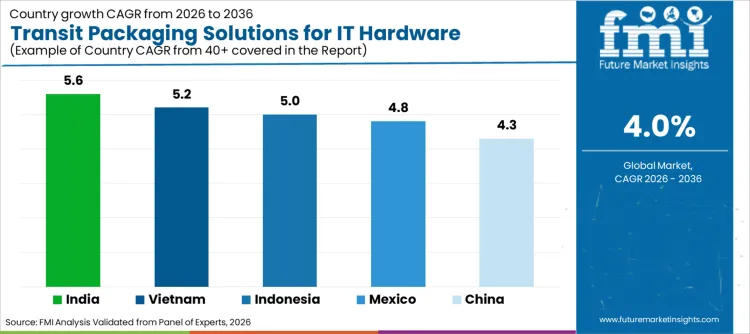
| Country | CAGR (2026 to 2036) |
|---|---|
| India | 5.6% |
| Vietnam | 5.2% |
| Mexico | 4.8% |
| China | 4.3% |
| USA | 4.1% |
Source: Future Market Insights (FMI) analysis, based on proprietary forecasting model and primary research.
Why India Is Scaling Export Infrastructure?
Transit packaging demand in India is projected to expand at a CAGR of 5.6%, fueled by a structural shift where the country is positioning itself as a primary alternative for electronics assembly. Electronic goods exports surged by 23.64% to USD 29.12 billion in FY 2023-24, creating an immediate need for global-standard computer peripherals protection that meets Western import criteria. This growth forces local manufacturers to upgrade from basic corrugated boxes to engineered protective solutions, ensuring that high-value hardware survives the long logistical journey to US and EU markets without damage.
How Vietnam Is Capturing Hardware Volume?
Sales of transit packaging in Vietnam are set to rise at 5.2% CAGR, driven by the massive influx of hardware manufacturing that requires specialized export shielding. In the first 9 months of 2024, the export turnover of phones and components reached over USD 41.89 billion, a volume that demands a highly responsive local packaging supply chain capable of JIT delivery. The implication for suppliers is clear: success in Vietnam requires localized production capacity that can match the frantic pace of mobile phone assembly cycles, moving beyond simple box-making to integrated logistics support.
What Is Driving Mexico's Nearshoring Boom?
The transit packaging market in Mexico is anticipated to grow at 4.8% CAGR, defined by the "nearshoring" wave that is pulling Asian supply chains closer to the US border. With total electrical and electronic equipment trade reaching USD 237.8 billion in 2024, Mexico has become the critical node for North American hardware supply, necessitating robust cross-border packaging solutions. This trend favors operators who can provide "US-standard" automation and material quality within Mexican industrial zones, bridging the gap between low-cost manufacturing and high-compliance American retail expectations.
Why The USA Prioritizes Material Innovation?
Demand for transit packaging in the USA is poised to register a 4.1% CAGR, driven by an acute focus on sustainability and the elimination of single-use plastics in retail supply chains. Companies are increasingly looking for innovative alternatives that align with sustainability goals while still meeting the demands of performance and cost-effectiveness. David Murgio, Chief Sustainability Officer at Ranpak, highlighted the urgency of this shift in 2024: "The plastic crisis is more urgent than you think. The world produces more than 400 million tons of plastics every year, and only 9% is recycled. People are demanding change, and companies are taking notice." This regulatory and consumer pressure forces US distributors to adopt fiber-based cushioning at scale, effectively making the US the global testing ground for plastic-free logistics.
How Germany Is enforcing Circularity?
The transit packaging industry in Germany is projected to expand at 4.0% CAGR, reflecting a steady demand for circular economy compliance and high-efficiency logistics. Andrew King, CEO of Mondi Group, noted in February 2025: “In 2021, as part of MAP2030, we set a target of 100 % of packaging and paper revenue to be reusable, recyclable or compostable by 2025. We have increased the proportion of Mondi revenue from reusable, recyclable or compostable products to 87 % (2023: 85 %). With customer adoption rates slower than expected due to a number of factors including the weak macroeconomic environment, we recognize that achieving 100 % in the coming year is unlikely.” German buyers, bound by the strictest packaging waste laws in the world, are prioritizing suppliers who can offer verifiable recyclability data, turning compliance into the primary gatekeeper for market access.
How Competition Is Shifting to Control Points?
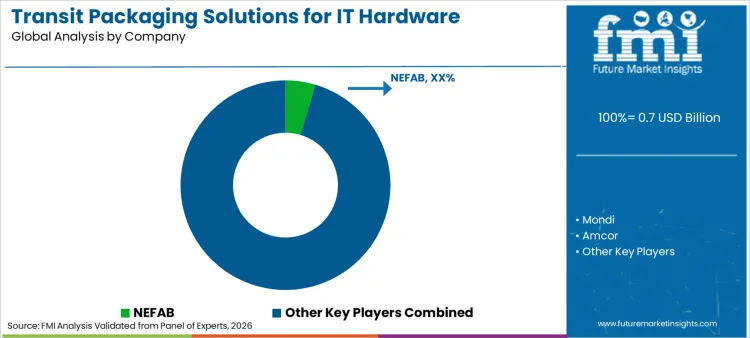
Competitive advantage in the transit packaging solutions for IT hardware accessories market now depends less on brand breadth and more on who controls the constraint that gates scale, whether it is sustainable material supply or automation technology. Incumbents like Sealed Air are actively restructuring to defend their margins against this reality; the company incurred $16 million in restructuring costs in Q3 2024 alone to streamline its "cost to grow" program. This level of spending on operational fitness creates a high barrier for players who cannot balance the capital intensity of automation R&D with the price sensitivity of the e-commerce packaging sector, effectively bifurcating the market into scaled integrators and niche material specialists.
A new range of players are entering the market from the bottom up, leveraging subsidies and grants to commercialize alternative materials that traditional players have ignored. Startups like Woola are bypassing the traditional polymer supply chain entirely, securing EU grants of €7,500 in 2025 to develop machinery that converts waste wool into bubble wrap alternatives. This strategy moves beyond mere competition on price; it changes the rules of engagement by offering a material story that resonates with the "plastic-free" mandates of European regulators, forcing legacy cold chain packaging providers to either acquire these innovations or risk obsolescence in the premium tier.
Competitive advantage in the transit packaging solutions for IT hardware accessories market now depends less on brand breadth and more on who controls the constraint that gates scale, whether it is sustainable material supply or automation technology. Incumbents like Sealed Air are actively restructuring to defend their margins against this reality; the company incurred $16 million in restructuring costs in Q3 2024 alone to streamline its "cost to grow" program. This level of spending on operational fitness creates a high barrier for players who cannot balance the capital intensity of automation R&D with the price sensitivity of the e-commerce packaging sector, effectively bifurcating the market into scaled integrators and niche material specialists.
A new range of players are entering the market from the bottom up, leveraging subsidies and grants to commercialize alternative materials that traditional players have ignored. Startups like Woola are bypassing the traditional polymer supply chain entirely, securing EU grants of €7,500 in 2025 to develop machinery that converts waste wool into bubble wrap alternatives. This strategy moves beyond mere competition on price; it changes the rules of engagement by offering a material story that resonates with the "plastic-free" mandates of European regulators, forcing legacy cold chain packaging providers to either acquire these innovations or risk obsolescence in the premium tier.
Recent Developments:
- In January 2026, Mondi received a WorldStar Award for its "3 in 1 Separator," a versatile corrugated packaging solution specifically designed to securely separate and protect multiple electronic components during transit. This innovation provides robust cushioning and immobilization for fragile IT hardware accessories like cables, adapters, and hubs, reducing damage risks in shipping while using fully recyclable materials to support sustainable transit packaging.
- In January 2026, HP introduced enhanced molded pulp inserts in its plastic-free transit packaging for IT hardware accessories, such as USB-C hubs and chargers, showcased at CES. These custom-fit, fiber-based cushions absorb vibrations and shocks effectively during shipping, preventing up to significant damage rates and eliminating plastic foam alternatives for more sustainable global distribution.
- In January 2026, Dell expanded its use of bagasse-derived molded pulp cushioning in transit packaging for computer peripherals and accessories, including monitors and docking stations, as part of its renewable materials initiative. This solution offers superior impact protection during long-distance shipping, replacing traditional plastics and aligning with high-volume order multipack designs for reduced environmental impact in logistics.
Key Players in Transit Packaging Solutions for IT Hardware Accessories Market
- Nefab Group
- Mondi Group
- Sonoco Products Company
- Sealed Air Corporation
- Ranpak Holdings Corp.
- Huhtamaki Oyj
- Amcor plc
- Smurfit WestRock
- DS Smith plc
- LivingPackets
- Woola
Market Definition
The transit packaging solutions for IT hardware accessories market encompasses revenue generated from commercial packaging systems designed to protect, transport, and store information technology peripherals and components. This definition focuses on the service component of the value chain, measuring the revenue generated from the sale of secondary and tertiary packaging materials, such as corrugated boxes, protective inserts, dunnage, and pallets, that are used specifically for the logistics of items like keyboards, mice, cables, chargers, and external drives. The scope explicitly includes revenue streams derived from both single-use protective materials and returnable transport packaging pooling services.
It explicitly includes revenue from automation equipment when sold as part of a "packaging-as-a-service" contract, as well as the specialized material consumables (paper, air pillows, foam) that run through these systems. Furthermore, the market sizing incorporates spending on "right-sizing" software and design services that optimize freight density for e-commerce and B2B distribution. The definition also covers the burgeoning sector of sustainable alternatives, such as molded pulp and wool-based protective layers, which are increasingly replacing traditional petrochemical foams in the IT supply chain.
The market explicitly excludes revenue generated from the primary retail packaging (the "shelf box") unless it serves a dual purpose as the transit shipper. Similarly, general-purpose logistics containers that are not specifically configured for electronics protection are excluded to maintain sector precision. Finally, the market valuation excludes the value of the IT hardware itself, focusing strictly on the packaging ecosystem that facilitates its movement through the global supply chain.
Scope of Report
| Items | Values |
|---|---|
| Quantitative Units (2026) | USD 0.7 Billion |
| Product Type | Corrugated Shippers, Protective Inserts, Polybags, Crates, Pallets |
| Shipment Mode | Parcel / Express, Palletized LTL / FTL, Air Freight |
| End Use | OEM Distribution, 3PL Fulfillment, Retail DCs, Aftermarket / Spare Parts |
| Regions Covered | North America, Europe, Asia Pacific, Latin America, Middle East & Africa |
| Countries Covered | USA, India, China, Mexico, Germany |
| Key Companies Profiled | Nefab, Mondi, Sonoco, Sealed Air, Ranpak, Woola |
| Additional Attributes | Revenue analysis by segments, adoption trends across settings, regulatory and compliance landscape (as relevant), pricing and reimbursement considerations (when relevant), channel mix economics, supply chain exposure, and competitive positioning analysis |
Transit Packaging Solutions for IT Hardware Accessories Market by Segments
By Packaging Type
- Corrugated Shippers
- Protective Inserts (Foam, Molded Pulp, Paper)
- Polybags & Envelopes
- Reusable Totes & Crates
- Pallets
By Shipment Mode
- Parcel / Express
- Palletized LTL / FTL
- Air Freight
- Other
By End Use
- OEM Distribution
- 3PL Fulfillment
- Retail DCs
- Aftermarket / Spare Parts
- E-commerce Direct-to-Consumer
By Region
-
North America
- Europe
- Asia Pacific
- Latin America
- Middle East & Africa
Bibliography
- General Statistics Office of Vietnam. (2024). Monthly Statistical Information: Exports of Phones and Components. GSO.
- Ministry of Commerce & Industry, Government of India. (2024). Trade Statistics for Electronic Goods FY 2023-24.
- State Council Information Office, People's Republic of China. (2025). 2024 Industrial Output Reports: Electronic Information Manufacturing.
- Secretaría de Economía, Mexico. (2024). Data México: Trade Balance of Electrical and Electronic Equipment.
- European Commission. (2024). Packaging and Packaging Waste Regulation (PPWR) Impact Assessment.
- USA Census Bureau. (2024). USA International Trade in Goods and Services: Electronics Imports.
Frequently Asked Questions
What is the current global market size for Transit Packaging Solutions for IT Hardware Accessories?
The global market is valued at USD 0.7 billion in 2026, driven by the expansion of global electronics trade and e-commerce fulfillment density.
What is the projected CAGR for the Transit Packaging Solutions for IT Hardware Accessories market?
The market is projected to grow at a steady 4.0% CAGR from 2026 to 2036, supported by automation adoption and the shift to fiber-based materials.
Which segment dominates the market by packaging type?
Corrugated Shippers account for the largest share at 46.0%, as regulatory pressure for empty space reduction drives innovation in right-sized boxing.
Which country is experiencing the fastest growth?
India is growing at the fastest rate of 5.6%, fueled by a surge in domestic electronics assembly and export-grade packaging requirements.
Who are the leading players in the Transit Packaging Solutions for IT Hardware Accessories market?
Nefab Group and Mondi Group are key leaders, alongside US-based innovators like Ranpak and Sealed Air who dominate the automation landscape.
Preview the report firsthand - request a free sample
Get SampleGet the brochure for pricing and purchase details.
Get PDFTable of Content
- Executive Summary
- Global Market Outlook
- Demand-side Trends
- Supply-side Trends
- Technology Roadmap Analysis
- Analysis and Recommendations
- Market Overview
- Market Coverage / Taxonomy
- Market Definition / Scope / Limitations
- Market Background
- Market Dynamics
- Drivers
- Restraints
- Opportunity
- Trends
- Scenario Forecast
- Demand in Optimistic Scenario
- Demand in Likely Scenario
- Demand in Conservative Scenario
- Opportunity Map Analysis
- Product Life Cycle Analysis
- Supply Chain Analysis
- Investment Feasibility Matrix
- Value Chain Analysis
- PESTLE and Porter’s Analysis
- Regulatory Landscape
- Regional Parent Market Outlook
- Production and Consumption Statistics
- Import and Export Statistics
- Market Dynamics
- Global Market Analysis 2021 to 2025 and Forecast, 2026 to 2036
- Historical Market Size Value (USD Million) Analysis, 2021 to 2025
- Current and Future Market Size Value (USD Million) Projections, 2026 to 2036
- Y-o-Y Growth Trend Analysis
- Absolute $ Opportunity Analysis
- Global Market Pricing Analysis 2021 to 2025 and Forecast 2026 to 2036
- Global Market Analysis 2021 to 2025 and Forecast 2026 to 2036, By Packaging Type
- Introduction / Key Findings
- Historical Market Size Value (USD Million) Analysis By Packaging Type , 2021 to 2025
- Current and Future Market Size Value (USD Million) Analysis and Forecast By Packaging Type , 2026 to 2036
- Corrugated Shippers
- Reusable Totes & Crates
- ESD-Safe Packaging
- Foam-in-Place
- Other
- Corrugated Shippers
- Y-o-Y Growth Trend Analysis By Packaging Type , 2021 to 2025
- Absolute $ Opportunity Analysis By Packaging Type , 2026 to 2036
- Global Market Analysis 2021 to 2025 and Forecast 2026 to 2036, By Shipment Mode
- Introduction / Key Findings
- Historical Market Size Value (USD Million) Analysis By Shipment Mode, 2021 to 2025
- Current and Future Market Size Value (USD Million) Analysis and Forecast By Shipment Mode, 2026 to 2036
- Parcel / Express
- Palletized LTL / FTL
- Air Freight
- Other
- Parcel / Express
- Y-o-Y Growth Trend Analysis By Shipment Mode, 2021 to 2025
- Absolute $ Opportunity Analysis By Shipment Mode, 2026 to 2036
- Global Market Analysis 2021 to 2025 and Forecast 2026 to 2036, By End Use
- Introduction / Key Findings
- Historical Market Size Value (USD Million) Analysis By End Use, 2021 to 2025
- Current and Future Market Size Value (USD Million) Analysis and Forecast By End Use, 2026 to 2036
- OEM Distribution
- 3PL Fulfillment
- Retail DCs
- Aftermarket / Spare Parts
- Other
- OEM Distribution
- Y-o-Y Growth Trend Analysis By End Use, 2021 to 2025
- Absolute $ Opportunity Analysis By End Use, 2026 to 2036
- Global Market Analysis 2021 to 2025 and Forecast 2026 to 2036, By Region
- Introduction
- Historical Market Size Value (USD Million) Analysis By Region, 2021 to 2025
- Current Market Size Value (USD Million) Analysis and Forecast By Region, 2026 to 2036
- North America
- Latin America
- Western Europe
- Eastern Europe
- East Asia
- South Asia and Pacific
- Middle East & Africa
- Market Attractiveness Analysis By Region
- North America Market Analysis 2021 to 2025 and Forecast 2026 to 2036, By Country
- Historical Market Size Value (USD Million) Trend Analysis By Market Taxonomy, 2021 to 2025
- Market Size Value (USD Million) Forecast By Market Taxonomy, 2026 to 2036
- By Country
- USA
- Canada
- Mexico
- By Packaging Type
- By Shipment Mode
- By End Use
- By Country
- Market Attractiveness Analysis
- By Country
- By Packaging Type
- By Shipment Mode
- By End Use
- Key Takeaways
- Latin America Market Analysis 2021 to 2025 and Forecast 2026 to 2036, By Country
- Historical Market Size Value (USD Million) Trend Analysis By Market Taxonomy, 2021 to 2025
- Market Size Value (USD Million) Forecast By Market Taxonomy, 2026 to 2036
- By Country
- Brazil
- Chile
- Rest of Latin America
- By Packaging Type
- By Shipment Mode
- By End Use
- By Country
- Market Attractiveness Analysis
- By Country
- By Packaging Type
- By Shipment Mode
- By End Use
- Key Takeaways
- Western Europe Market Analysis 2021 to 2025 and Forecast 2026 to 2036, By Country
- Historical Market Size Value (USD Million) Trend Analysis By Market Taxonomy, 2021 to 2025
- Market Size Value (USD Million) Forecast By Market Taxonomy, 2026 to 2036
- By Country
- Germany
- UK
- Italy
- Spain
- France
- Nordic
- BENELUX
- Rest of Western Europe
- By Packaging Type
- By Shipment Mode
- By End Use
- By Country
- Market Attractiveness Analysis
- By Country
- By Packaging Type
- By Shipment Mode
- By End Use
- Key Takeaways
- Eastern Europe Market Analysis 2021 to 2025 and Forecast 2026 to 2036, By Country
- Historical Market Size Value (USD Million) Trend Analysis By Market Taxonomy, 2021 to 2025
- Market Size Value (USD Million) Forecast By Market Taxonomy, 2026 to 2036
- By Country
- Russia
- Poland
- Hungary
- Balkan & Baltic
- Rest of Eastern Europe
- By Packaging Type
- By Shipment Mode
- By End Use
- By Country
- Market Attractiveness Analysis
- By Country
- By Packaging Type
- By Shipment Mode
- By End Use
- Key Takeaways
- East Asia Market Analysis 2021 to 2025 and Forecast 2026 to 2036, By Country
- Historical Market Size Value (USD Million) Trend Analysis By Market Taxonomy, 2021 to 2025
- Market Size Value (USD Million) Forecast By Market Taxonomy, 2026 to 2036
- By Country
- China
- Japan
- South Korea
- By Packaging Type
- By Shipment Mode
- By End Use
- By Country
- Market Attractiveness Analysis
- By Country
- By Packaging Type
- By Shipment Mode
- By End Use
- Key Takeaways
- South Asia and Pacific Market Analysis 2021 to 2025 and Forecast 2026 to 2036, By Country
- Historical Market Size Value (USD Million) Trend Analysis By Market Taxonomy, 2021 to 2025
- Market Size Value (USD Million) Forecast By Market Taxonomy, 2026 to 2036
- By Country
- India
- ASEAN
- Australia & New Zealand
- Rest of South Asia and Pacific
- By Packaging Type
- By Shipment Mode
- By End Use
- By Country
- Market Attractiveness Analysis
- By Country
- By Packaging Type
- By Shipment Mode
- By End Use
- Key Takeaways
- Middle East & Africa Market Analysis 2021 to 2025 and Forecast 2026 to 2036, By Country
- Historical Market Size Value (USD Million) Trend Analysis By Market Taxonomy, 2021 to 2025
- Market Size Value (USD Million) Forecast By Market Taxonomy, 2026 to 2036
- By Country
- Kingdom of Saudi Arabia
- Other GCC Countries
- Turkiye
- South Africa
- Other African Union
- Rest of Middle East & Africa
- By Packaging Type
- By Shipment Mode
- By End Use
- By Country
- Market Attractiveness Analysis
- By Country
- By Packaging Type
- By Shipment Mode
- By End Use
- Key Takeaways
- Key Countries Market Analysis
- USA
- Pricing Analysis
- Market Share Analysis, 2025
- By Packaging Type
- By Shipment Mode
- By End Use
- Canada
- Pricing Analysis
- Market Share Analysis, 2025
- By Packaging Type
- By Shipment Mode
- By End Use
- Mexico
- Pricing Analysis
- Market Share Analysis, 2025
- By Packaging Type
- By Shipment Mode
- By End Use
- Brazil
- Pricing Analysis
- Market Share Analysis, 2025
- By Packaging Type
- By Shipment Mode
- By End Use
- Chile
- Pricing Analysis
- Market Share Analysis, 2025
- By Packaging Type
- By Shipment Mode
- By End Use
- Germany
- Pricing Analysis
- Market Share Analysis, 2025
- By Packaging Type
- By Shipment Mode
- By End Use
- UK
- Pricing Analysis
- Market Share Analysis, 2025
- By Packaging Type
- By Shipment Mode
- By End Use
- Italy
- Pricing Analysis
- Market Share Analysis, 2025
- By Packaging Type
- By Shipment Mode
- By End Use
- Spain
- Pricing Analysis
- Market Share Analysis, 2025
- By Packaging Type
- By Shipment Mode
- By End Use
- France
- Pricing Analysis
- Market Share Analysis, 2025
- By Packaging Type
- By Shipment Mode
- By End Use
- India
- Pricing Analysis
- Market Share Analysis, 2025
- By Packaging Type
- By Shipment Mode
- By End Use
- ASEAN
- Pricing Analysis
- Market Share Analysis, 2025
- By Packaging Type
- By Shipment Mode
- By End Use
- Australia & New Zealand
- Pricing Analysis
- Market Share Analysis, 2025
- By Packaging Type
- By Shipment Mode
- By End Use
- China
- Pricing Analysis
- Market Share Analysis, 2025
- By Packaging Type
- By Shipment Mode
- By End Use
- Japan
- Pricing Analysis
- Market Share Analysis, 2025
- By Packaging Type
- By Shipment Mode
- By End Use
- South Korea
- Pricing Analysis
- Market Share Analysis, 2025
- By Packaging Type
- By Shipment Mode
- By End Use
- Russia
- Pricing Analysis
- Market Share Analysis, 2025
- By Packaging Type
- By Shipment Mode
- By End Use
- Poland
- Pricing Analysis
- Market Share Analysis, 2025
- By Packaging Type
- By Shipment Mode
- By End Use
- Hungary
- Pricing Analysis
- Market Share Analysis, 2025
- By Packaging Type
- By Shipment Mode
- By End Use
- Kingdom of Saudi Arabia
- Pricing Analysis
- Market Share Analysis, 2025
- By Packaging Type
- By Shipment Mode
- By End Use
- Turkiye
- Pricing Analysis
- Market Share Analysis, 2025
- By Packaging Type
- By Shipment Mode
- By End Use
- South Africa
- Pricing Analysis
- Market Share Analysis, 2025
- By Packaging Type
- By Shipment Mode
- By End Use
- USA
- Market Structure Analysis
- Competition Dashboard
- Competition Benchmarking
- Market Share Analysis of Top Players
- By Regional
- By Packaging Type
- By Shipment Mode
- By End Use
- Competition Analysis
- Competition Deep Dive
- NEFAB
- Overview
- Product Portfolio
- Profitability by Market Segments (Product/Age /Sales Channel/Region)
- Sales Footprint
- Strategy Overview
- Marketing Strategy
- Product Strategy
- Channel Strategy
- Mondi
- Amcor
- Sealed Air
- Sonoco / Huhtamaki
- NEFAB
- Competition Deep Dive
- Assumptions & Acronyms Used
- Research Methodology


