

- Industry Size (2026)
- USD 1.5 Bn
- Forecast (2036)
- USD 4.7 Bn
- CAGR (2026 to 2036)
- 11.80%
Writing Instrument Packaging Market Forecast and Outlook 2026 to 2036
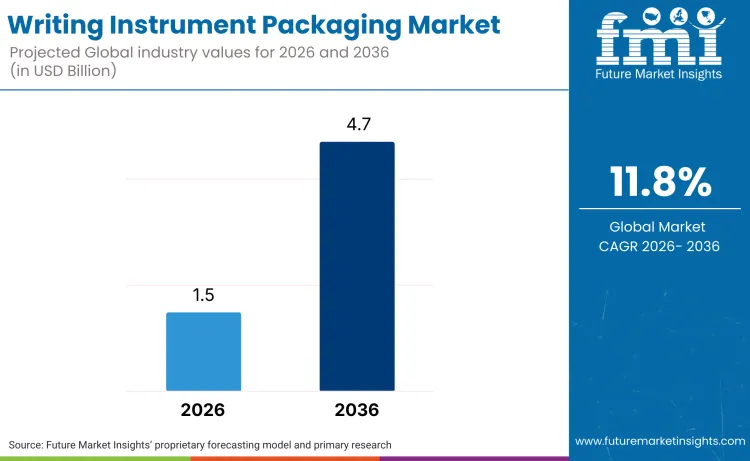
Global valuation for the writing instrument packaging market is estimated to reach USD 1.5 billion in 2026, with forecasts projecting a surge to USD 4.7 billion by 2036. The industry is poised to expand at an 11.80% CAGR over the coming decade. Underpinning this robust trajectory is sustained industrial demand; the USA Census Bureau reported that new orders for manufactured goods increased by USD 16.2 billion (2.7%) in November 2025, reaching USD 621.6 billion. This data signals strong underlying demand for manufacturing inputs, including the packaging materials essential for mass-market and premium digital pen distribution.
Leading manufacturers are responding to these signals by restructuring operations to capture value across diverse material types. Howard Coker, President and CEO of Sonoco, emphasized this strategic evolution in January 2025:
"This new structure will create a much simpler and more efficient operating model that will also allow our teams to be agnostic about the substrates we offer to our customers. I truly believe this integrated structure, driven geographically, will lead to further innovation, collaboration and growth opportunities."
This operational agility is proving essential for suppliers attempting to service global stationery giants that now require identical packaging specifications across multiple continents. Supply chains are consequently witnessing a consolidation of capabilities, exemplified by Amcor’s USD 8.4 billion acquisition of Berry Global in November 2024. This merger combines protective packaging expertise with global sustainability platforms, allowing companies to serve multinational stationery product brands with integrated, eco-compliant solutions that can navigate complex regulatory landscapes like the EU's PPWR.
Summary of Writing Instrument Packaging Market
What Is the Growth Outlook for the Writing Instrument Packaging Market?
Future Market Insights projects the industry to grow at a CAGR of 11.80% from 2026 to 2036, expanding from USD 1.5 billion in 2026 to USD 4.7 billion by 2036.
Which Country Holds the Highest Growth Potential?
India is projected to lead global expansion with a 14.80% CAGR, driven by the National Education Policy and a massive increase in school supply requirements.
What Are the Key Regulatory Drivers?
The enforcement of the EU Packaging and Packaging Waste Regulation (PPWR) in February 2025 and plastic taxation policies are the primary regulatory forces compelling a shift to recycled materials.
Who Are the Leading Players?
Sonoco, Graphic Packaging International, Amcor (including Berry Global), and Avery Dennison lead the market through global scale and sustainable material innovation.
Writing Instrument Packaging Market Key Takeaways
| Metric | Details |
|---|---|
| Industry Size (2026) | USD 1.5 billion |
| Industry Value (2036) | USD 4.7 billion |
| CAGR (2026-2036) | 11.80% |
Source: Future Market Insights (FMI) analysis, based on proprietary forecasting model and primary research
Why Is Regulatory Elimination of Single-Use Plastics Reshaping the Market?
The enforcement of the EU Packaging and Packaging Waste Regulation (PPWR) on February 11, 2025, has radically altered the compliance landscape by mandating that all packaging must be recyclable by 2030. Manufacturers facing the EU "Plastic Tax" of €0.80 per kilogram on non-recycled plastic waste are rapidly migrating toward certified paperboard and rPET solutions. This regulatory pressure is forcing a redesign of the traditional art and office marker pen blister pack, pushing brands to eliminate virgin plastic backing cards entirely.
Major industry players are moving faster than regulation requires to secure their market position. BIC reported in May 2025 that 99% of its cardboard packaging now originates from certified or recycled sources, setting a new benchmark for mass-market compliance. Gonzalve Bich, CEO of BIC, emphasized the strategic nature of this commitment:
"For us, sustainability is more than a commitment, it is a core responsibility that guides every aspect of our operations. I remain confident in BIC's continued ability to drive long-term growth, deliver value responsibly and sustainably and maintain the quality and safety of our trusted products."
Such top-level commitment ensures that sustainability targets are treated as immutable operational KPIs rather than optional marketing initiatives. By proactively adopting these standards, companies are ensuring their cosmetic pencil and pen packaging formats remain viable in strictly regulated regions, avoiding potential market exclusion penalties while appealing to eco-conscious consumers.
How Is the Writing Instrument Packaging Market Segmented?
The market is dissected by end-use channel, material composition, and packaging format to address the specific needs of retail and logistics. The market is dissected by end-use channel, material composition, and packaging format, because performance requirements split cleanly between retail visibility + anti-theft discipline and logistics protection + shelf-life integrity. Demand is therefore concentrating around (a) channels where shoppers must validate colour payoff and tip integrity before purchase, (b) substrates that can deliver stiffness, seal strength, and print clarity while meeting plastic-reduction mandates, and (c) formats that preserve product geometry (point, cap fit, sharpener compatibility) and withstand handling from DC to shelf. This segmentation outlook explains why pack designs for pencil-format eye cosmetics are increasingly engineered as a “display system” rather than a simple primary pack.
What is driving office supply retail to remain the dominant end-use channel?
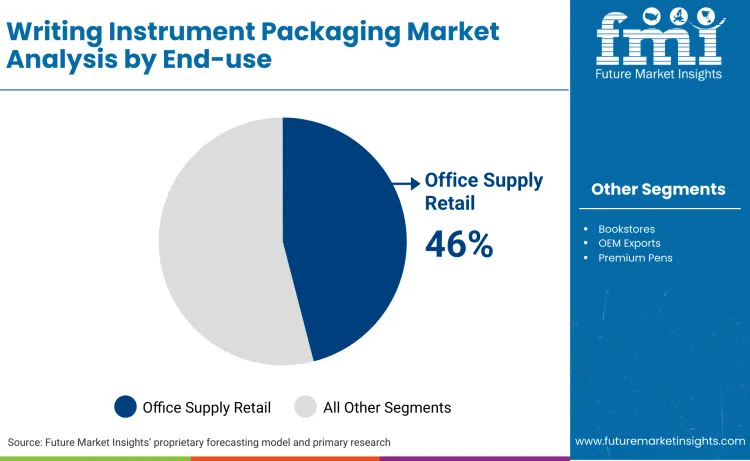
Office supply retail dominates with a 46% market share, serving as the critical touchpoint for consumer evaluation. USA Census Bureau data from January 2026 indicates a 0.7% rise in retail sales for hobby, book, and office supply stores in November 2025, confirming that physical retail remains a vital channel. High-visibility formats like eyeliner and kajal sculpting pencil packaging are essential in these self-service environments to deter theft while displaying product quality.
How is packaging format leadership accelerating material substitution?
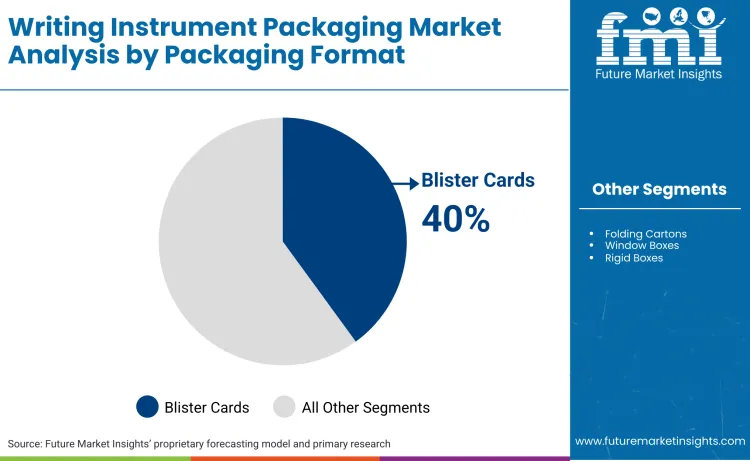
Blister cards constitute 40% of the packaging format share, favored for their balance of protection and visibility. However, the material composition of these cards is undergoing a revolution. Innovation is focused on replacing the plastic backing with rigid paperboard while maintaining the "see-through" utility consumers expect. Eye cosmetic packaging trends suggest that molded pulp and transparent cellulose films are increasingly replacing traditional PVC, allowing brands to offer a plastic-free unboxing experience without compromising on the visual appeal necessary for high-volume sales.
Why Is the Consolidation of Global Manufacturers Accelerating?
Strategic M&A activity is reshaping the supply chain as leaders seek to unify production capabilities and secure sustainable material sources. The acquisition of Berry Global by Amcor in November 2024 created a powerhouse capable of delivering both protective films and rigid containers at a global scale. Peter Konieczny, CEO of Amcor, stated:
"This combination delivers on our strategy to accelerate growth by putting the customer first, elevating the role of sustainability, and orienting the portfolio toward faster growing, higher margin categories."
This consolidation allows for the standardized production of insulin pen packaging, where regulatory compliance and safety are paramount, by leveraging the combined entity's massive R&D budget. Smaller regional converters are increasingly being absorbed by these giants to ensure access to capital-intensive recycling technologies.
How Are Intelligent Labels Transforming Inventory Management?
The integration of RFID and NFC technology into secondary packaging is becoming standard for high-volume logistics. Avery Dennison reported robust growth in its Intelligent Labels segment in February 2025, driven by the retail sector's need for granular inventory tracking. This technology is particularly vital for the injection pen and high-value stationery segments, where preventing counterfeiting and ensuring stock availability are critical. Digital tagging allows retailers to automate restocking processes, reducing the labor burden in warehouse clubs and big-box stores.
Why Are Premium Brands Pivoting to Rigid Paperboard?
High-end writing instruments are moving away from mixed-material boxes toward mono-material rigid paperboard containers that double as gift packaging. Sonoco’s strategic consolidation of its rigid paper container units reflects this rising demand for "keepsake" quality packaging that is also fully recyclable. This trend is mirrored in the inkjet coders sector, where industrial clients are demanding packaging that aligns with corporate sustainability goals. The "unboxing" experience is now a critical part of the value proposition for luxury pens, driving investment in high-quality, printable fiber substrates.
How Will Writing Instrument Packaging Market Expansion Unfold Across Key Global Regions?
Market expansion varies significantly across regions, influenced by educational policy, retail infrastructure, and environmental mandates. Developed markets like the USA and Germany are prioritizing material innovation and supply chain security. Emerging economies such as India and China are witnessing volume-driven growth fueled by rising literacy rates and government spending. FMI analysis suggests that while the West focuses on premiumization and circularity, the East is rapidly modernizing its retail packaging to support booming export and domestic consumption sectors.
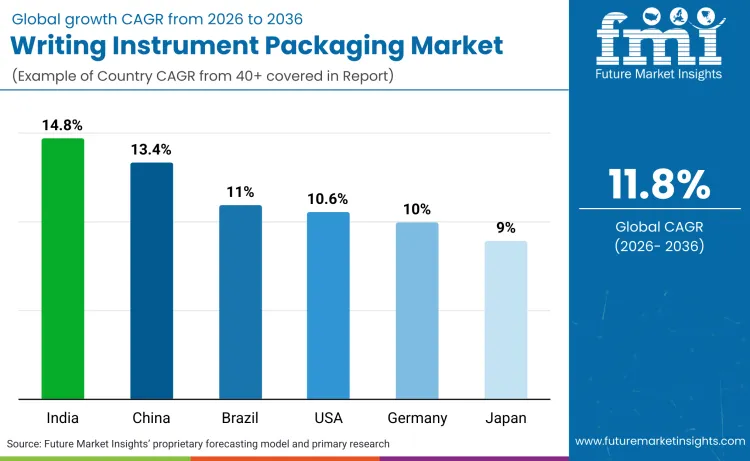
| Country | CAGR (2026 to 2036) |
|---|---|
| USA | 10.60% |
| Germany | 10.00% |
| China | 13.40% |
| Japan | 9.00% |
| India | 14.80% |
| Brazil | 11.00% |
Why Does the USA Represent a Mature, High-Value Market?
The United States is forecast to expand at a 10.60% CAGR, anchored by a resilient retail sector and significant investments in domestic manufacturing capacity. Companies like Graphic Packaging International are bolstering this growth, with their new Waco, Texas facility producing its first saleable recycled paperboard rolls in October 2025. This domestic capacity is crucial for meeting the demands of e-commerce giants utilizing polyethylene mailers. Deon Stander, President and CEO of Avery Dennison, highlighted the strength of this market in February 2025:
"We delivered strong results in 2024, achieving nineteen percent earnings growth. We remain well-positioned to continue our long track record of strong earnings growth in 2025, including accelerating growth in our high-value categories, which now account for almost half of our portfolio." Sustained earnings growth in these high-value segments provides the necessary capital for American firms to lead the global transition toward smart, connected packaging ecosystems.
Why Is India Leading Global Growth?
India leads the global forecast with a projected 14.80% CAGR, driven by the massive scale of the National Education Policy (NEP). The Ministry of Education's budget allocation rose to ₹1.2 lakh crore (approx. USD 14.4 billion) for FY 2024-25, directly funding the procurement of school kits and basic topical applicators for rural health initiatives. As literacy rates climb-global youth literacy hit 94% in 2024, the demand for blister-packed pen sets in modern retail formats is replacing loose sales, spurring volume growth for local and international converters.
Why Does Germany Focus on Premium Sustainability?
Germany remains a hub for premium innovation, growing at a 10.00% CAGR as heritage brands adapt to the EU's strict circular economy rules. The writing instrument packaging market is defined by the convergence of luxury and sustainability, exemplified by Mitsubishi Pencil's acquisition of Heidelberg-based C. Josef Lamy GmbH in February 2024. This merger ensures that German design engineering is applied to sustainable cosmetic tubes and writing instruments. Retaining local manufacturing expertise while leveraging global distribution networks allows German brands to command premium pricing based on heritage and environmental integrity.
Why Is China Pivoting to Export-Led Quality?
China is poised to register a 13.40% CAGR, leveraging its dominance in manufacturing to capture the global teeth whitening pens and stationery export markets. Data from China Customs and the Japan Writing Instruments Manufacturers Association highlights significant growth in high-value exports, driven by cross-border e-commerce. Chinese manufacturers are increasingly moving up the value chain, adopting automated packaging lines that utilize rigid boxes to serve the gifting culture, thereby enhancing the perceived value of domestic brands in international markets.
Why Does Japan Maintain Premium Maturity?
Japan is anticipated to expand at a 9.00% CAGR, reflecting a mature market deeply rooted in a culture of gifting and precision. JWIMA data estimates that the value of writing instrument exports reached 120 billion yen in 2023, a 15% increase from 2018. Companies like Pilot Pen are integrating sustainability into this premium framework; their "Clean Oceans" initiative now utilizes pin marking machine precision to reduce packaging voids, ensuring that the unboxing experience remains luxurious while minimizing environmental impact.
Why is Brazil Recovering through Industrial Expansion?
Brazil is anticipated to grow at an 11.00% CAGR, supported by a recovery in industrial production and education funding. IBGE reported a 3.0% expansion in the pulp and paper sector in November 2024, signaling robust raw material availability. The World Bank increased education funding for the region by 15% in 2024, fueling demand for affordable, secure packaging for student kits. Sonoco’s consolidation of its Americas business unit further positions it to serve this growing demand for reliable polyethylene naphthalate pen packaging.
How is the Competition in the Writing Instrument Packaging Market?
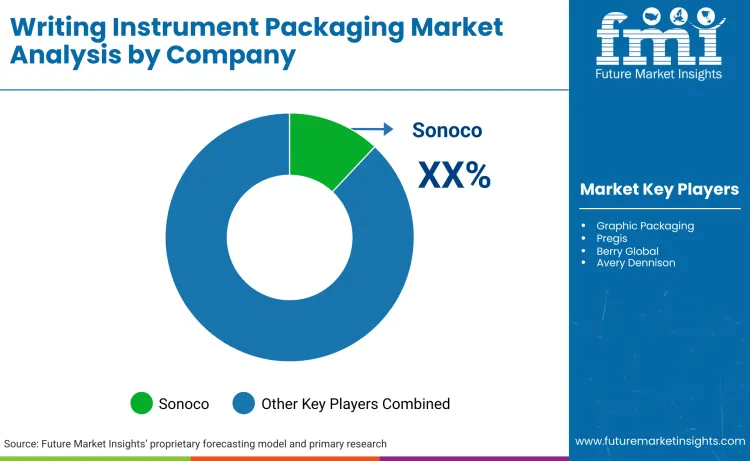
Intense consolidation and a race for vertical integration currently define the competitive landscape of the writing instrument packaging market. The 2024 merger of Amcor and Berry Global fundamentally altered the supply chain by creating a fiber-based powerhouse capable of servicing global airline alliances and stationery giants with uniform, plastic-free solutions. Smaller regional converters now face intense pressure to either merge or specialize in niche sustainable materials to survive against such scale.
Sustainability and digitalization have become the primary battlegrounds for market share. Graphic Packaging International is aggressively securing the fiber substrate market with its new Waco facility, while Avery Dennison is capitalizing on the need for supply chain visibility. Financial discipline is also evident; GPI's CFO Stephen Scherger noted in June 2025 the company's aggressive inventory management to ensure market stability. This focus on efficiency extends to the contact lens solution packaging sector, where cross-industry best practices in sterility and material reduction are being applied to high-end stationery.
Recent Developments:
- In April 2025, Amcor completed its all-stock acquisition of Berry Global, creating a global leader in consumer packaging with enhanced capabilities in flexible films, closures, and containers. This merger strengthens Amcor's position in sustainable and innovative packaging solutions, potentially expanding options for writing instrument packaging through combined R&D and supply chain efficiencies.
- In September 2025, Avery Dennison launched new labeling solutions at Labelexpo Europe, advancing recycling, connectivity, and safety features with RFID-enabled inlays for smart packaging. These innovations support eco-friendly and interactive labels, offering enhanced branding and traceability for writing instrument packaging in retail and e-commerce settings.
- In November 2025, Sonoco consolidated its consumer packaging businesses under two geographies, EMEA/APAC and the Americas, following the integration of its acquisition of Eviosys. This restructuring simplifies operations and enhances focus on sustainable metal and rigid paper packaging, which could improve scalability for specialized applications like writing instrument boxes and cases.
Key Players in Writing Instrument Packaging Market
- Sonoco Products Company
- Graphic Packaging International
- Amcor plc (including Berry Global)
- Avery Dennison Corporation
- Pregis Corporation
- BIC
- Pilot Pen
- Staedtler
- Mitsubishi Pencil Co Ltd
Market Definition
The writing instrument packaging market represents revenue generated from packaging solutions specifically designed for writing instruments such as pens, pencils, markers, and highlighters. As operationally defined in the article, the market measures rigid and flexible packaging formats including blister cards, rigid boxes, flexible pouches, and paper sleeves sold to manufacturers, wholesalers, and retailers. Market sizing reflects the wholesale value of packaging materials, analyzed by end-use channel and material composition, and expressed in USD billion.
The market includes primary packaging for consumer distribution, bulk office supply packaging, and premium gift sets. It covers adoption by mass-market retail, office supply wholesale, and e-commerce fulfillment channels. Revenue from intelligent labeling systems (RFID/NFC) is included when integrated into packaging solutions. The market excludes packaging for ink cartridges sold separately and general office supplies not related to writing instruments.
Scope of Report
| Items | Values |
|---|---|
| Quantitative Units (2026) | USD 1.5 billion |
| Product Type | Blister Cards, Rigid Boxes, Flexible Pouches, Paper Sleeves |
| Material Type | PET (44%), Paperboard (35%), Polypropylene (21%) |
| End Use | Office Supply Retail (46%), Bulk / Wholesale (28%), E-commerce |
| Regions Covered | North America, Europe, Asia Pacific, Latin America, Middle East & Africa |
| Countries Covered | United States, Germany, China, Japan, India, Brazil |
| Key Companies Profiled | Sonoco, Graphic Packaging, Amcor, Avery Dennison, BIC |
| Additional Attributes | Revenue and volume analysis by product and material type, channel-wise demand assessment across retail, wholesale, and e-commerce, material mix optimization and downgauging trends, recyclability and plastic-reduction compliance analysis, private-label penetration in office supplies, packaging cost and margin sensitivity analysis, and competitive positioning across global stationery and office products brands |
Writing Instrument Packaging Market by Segments
By End-Use Channel:
- Office Supply Retail
- Bulk/Wholesale Distribution
- E-commerce Fulfillment
By Material Composition:
- PET and rPET
- Paperboard (virgin and recycled)
- Polypropylene
By Packaging Format:
- Blister Cards
- Rigid Boxes
- Flexible Pouches
- Paper Sleeves
By Region:
- North America
- Europe
- Asia Pacific
- Latin America
- Middle East & Africa
Bibliography
- United Nations Educational, Scientific and Cultural Organization. (2024). Global youth literacy rates. UNESCO Institute for Statistics.
- Ministry of Education, Government of India. (2024). Union budget 2024-25: Education sector allocations. Government of India.
- United Nations Comtrade Database. (2024). International trade statistics for writing instruments and stationery. UN Comtrade.
- Ministry of Economy, Trade and Industry, Japan. (2024, March). Indices of industrial production. METI.
- Instituto Brasileiro de Geografia e Estatística. (2026, January). Industrial production survey November 2024. IBGE.
- World Bank. (2024). Education finance and public expenditure data. World Bank.
- European Parliament. (2024). Packaging and packaging waste regulation (PPWR). Official Journal of the European Union.
- Sonoco Products Company. (2025). Corporate sustainability report 2024. Sonoco Investor Relations.
- BIC. (2025). Sustainability report 2024. BIC.
- Avery Dennison. (2025). Q4 and full year 2024 results. Avery Dennison Investor Relations.
- Graphic Packaging International. (2025). Q3 2025 financial results. Graphic Packaging Investor Relations.
Frequently Asked Questions
What is the current global market size for Writing Instrument Packaging?
Global sales reached USD 1.5 billion in 2026, driven by retail recovery and the transition to sustainable materials.
What is the projected CAGR for the Writing Instrument Packaging market?
Market revenues are projected to grow at an 11.80% CAGR from 2026 to 2036, reaching USD 4.7 billion.
Which segment currently dominates the industry?
Office supply retail holds the dominant share of 46%, as high-visibility packaging remains critical for sales in self-service environments.
What are the primary risks or barriers to market growth?
Supply chain concentration of sustainable fiber and the high capital cost of transitioning manufacturing lines to plastic-free formats remain significant barriers.
Who are the leading players in the Writing Instrument Packaging space?
Sonoco, Amcor (following the Berry Global acquisition), and Graphic Packaging International lead the sector through global scale and sustainability platforms.
Preview the report firsthand - request a free sample
Get SampleGet the brochure for pricing and purchase details.
Get PDFTable of Content
- Executive Summary
- Global Market Outlook
- Demand Side Trends
- Supply Side Trends
- Technology Roadmap Analysis
- Analysis and Recommendations
- Market Overview
- Market Coverage / Taxonomy
- Market Definition / Scope / Limitations
- Research Methodology
- Chapter Orientation
- Analytical Lens and Working Hypotheses
- Market Structure, Signals, and Trend Drivers
- Benchmarking and Cross-market Comparability
- Market Sizing, Forecasting, and Opportunity Mapping
- Research Design and Evidence Framework
- Desk Research Programme (Secondary Evidence)
- Expert Input and Fieldwork (Primary Evidence)
- Data Engineering and Model Build
- Quality Assurance and Audit Trail
- Market Background
- Market Dynamics
- Drivers
- Restraints
- Opportunity
- Trends
- Scenario Forecast
- Demand in Optimistic Scenario
- Demand in Likely Scenario
- Demand in Conservative Scenario
- Opportunity Map Analysis
- Product Life Cycle Analysis
- Supply Chain Analysis
- Investment Feasibility Matrix
- Value Chain Analysis
- PESTLE and Porter's Analysis
- Regulatory Landscape
- Regional Parent Market Outlook
- Production and Consumption Statistics
- Import and Export Statistics
- Market Dynamics
- Global Market Analysis 2021 to 2025 and Forecast, 2026 to 2036
- Historical Market Size Value (USD Billion) Analysis, 2021 to 2025
- Current and Future Market Size Value (USD Billion) Projections, 2026 to 2036
- Y-o-Y Growth Trend Analysis
- Absolute $ Opportunity Analysis
- Global Market Pricing Analysis 2021 to 2025 and Forecast 2026 to 2036
- Y-o-Y Growth Trend Analysis 2021 to 2025
- Absolute $ Opportunity Analysis 2026 to 2036
- Global Market Analysis 2021 to 2025 and Forecast 2026 to 2036, By End-Use Channel
- Introduction / Key Findings
- Historical Market Size Value (USD Billion) Analysis By End-Use Channel, 2021 to 2025
- Current and Future Market Size Value (USD Billion) Analysis and Forecast By End-Use Channel, 2026 to 2036
- Office Supply Retail
- Bulk/Wholesale Distribution
- E-commerce Fulfillment
- Y-o-Y Growth Trend Analysis By End-Use Channel, 2021 to 2025
- Absolute $ Opportunity Analysis By End-Use Channel, 2026 to 2036
- Global Market Analysis 2021 to 2025 and Forecast 2026 to 2036, By Material Composition
- Introduction / Key Findings
- Historical Market Size Value (USD Billion) Analysis By Material Composition, 2021 to 2025
- Current and Future Market Size Value (USD Billion) Analysis and Forecast By Material Composition, 2026 to 2036
- PET and rPET
- Paperboard (virgin and recycled)
- Polypropylene
- Y-o-Y Growth Trend Analysis By Material Composition, 2021 to 2025
- Absolute $ Opportunity Analysis By Material Composition, 2026 to 2036
- Global Market Analysis 2021 to 2025 and Forecast 2026 to 2036, By Packaging Format
- Introduction / Key Findings
- Historical Market Size Value (USD Billion) Analysis By Packaging Format, 2021 to 2025
- Current and Future Market Size Value (USD Billion) Analysis and Forecast By Packaging Format, 2026 to 2036
- Blister Cards
- Rigid Boxes
- Flexible Pouches
- Paper Sleeves
- Y-o-Y Growth Trend Analysis By Packaging Format, 2021 to 2025
- Absolute $ Opportunity Analysis By Packaging Format, 2026 to 2036
- Global Market Analysis 2021 to 2025 and Forecast 2026 to 2036, By Region
- Introduction
- Historical Market Size Value (USD Billion) Analysis By Region, 2021 to 2025
- Current Market Size Value (USD Billion) Analysis and Forecast By Region, 2026 to 2036
- North America
- Latin America
- Western Europe
- Eastern Europe
- East Asia
- South Asia and Pacific
- Middle East & Africa
- Market Attractiveness Analysis By Region
- North America Market Analysis 2021 to 2025 and Forecast 2026 to 2036, By Country
- Historical Market Size Value (USD Billion) Trend Analysis By Market Taxonomy, 2021 to 2025
- Market Size Value (USD Billion) Forecast By Market Taxonomy, 2026 to 2036
- By Country
- USA
- Canada
- Mexico
- By End-Use Channel
- By Material Composition
- By Packaging Format
- By Country
- Market Attractiveness Analysis
- By Country
- By End-Use Channel
- By Material Composition
- By Packaging Format
- Key Takeaways
- Latin America Market Analysis 2021 to 2025 and Forecast 2026 to 2036, By Country
- Historical Market Size Value (USD Billion) Trend Analysis By Market Taxonomy, 2021 to 2025
- Market Size Value (USD Billion) Forecast By Market Taxonomy, 2026 to 2036
- By Country
- Brazil
- Chile
- Rest of Latin America
- By End-Use Channel
- By Material Composition
- By Packaging Format
- By Country
- Market Attractiveness Analysis
- By Country
- By End-Use Channel
- By Material Composition
- By Packaging Format
- Key Takeaways
- Western Europe Market Analysis 2021 to 2025 and Forecast 2026 to 2036, By Country
- Historical Market Size Value (USD Billion) Trend Analysis By Market Taxonomy, 2021 to 2025
- Market Size Value (USD Billion) Forecast By Market Taxonomy, 2026 to 2036
- By Country
- Germany
- UK
- Italy
- Spain
- France
- Nordic
- BENELUX
- Rest of Western Europe
- By End-Use Channel
- By Material Composition
- By Packaging Format
- By Country
- Market Attractiveness Analysis
- By Country
- By End-Use Channel
- By Material Composition
- By Packaging Format
- Key Takeaways
- Eastern Europe Market Analysis 2021 to 2025 and Forecast 2026 to 2036, By Country
- Historical Market Size Value (USD Billion) Trend Analysis By Market Taxonomy, 2021 to 2025
- Market Size Value (USD Billion) Forecast By Market Taxonomy, 2026 to 2036
- By Country
- Russia
- Poland
- Hungary
- Balkan & Baltic
- Rest of Eastern Europe
- By End-Use Channel
- By Material Composition
- By Packaging Format
- By Country
- Market Attractiveness Analysis
- By Country
- By End-Use Channel
- By Material Composition
- By Packaging Format
- Key Takeaways
- East Asia Market Analysis 2021 to 2025 and Forecast 2026 to 2036, By Country
- Historical Market Size Value (USD Billion) Trend Analysis By Market Taxonomy, 2021 to 2025
- Market Size Value (USD Billion) Forecast By Market Taxonomy, 2026 to 2036
- By Country
- China
- Japan
- South Korea
- By End-Use Channel
- By Material Composition
- By Packaging Format
- By Country
- Market Attractiveness Analysis
- By Country
- By End-Use Channel
- By Material Composition
- By Packaging Format
- Key Takeaways
- South Asia and Pacific Market Analysis 2021 to 2025 and Forecast 2026 to 2036, By Country
- Historical Market Size Value (USD Billion) Trend Analysis By Market Taxonomy, 2021 to 2025
- Market Size Value (USD Billion) Forecast By Market Taxonomy, 2026 to 2036
- By Country
- India
- ASEAN
- Australia & New Zealand
- Rest of South Asia and Pacific
- By End-Use Channel
- By Material Composition
- By Packaging Format
- By Country
- Market Attractiveness Analysis
- By Country
- By End-Use Channel
- By Material Composition
- By Packaging Format
- Key Takeaways
- Middle East & Africa Market Analysis 2021 to 2025 and Forecast 2026 to 2036, By Country
- Historical Market Size Value (USD Billion) Trend Analysis By Market Taxonomy, 2021 to 2025
- Market Size Value (USD Billion) Forecast By Market Taxonomy, 2026 to 2036
- By Country
- Kingdom of Saudi Arabia
- Other GCC Countries
- Turkiye
- South Africa
- Other African Union
- Rest of Middle East & Africa
- By End-Use Channel
- By Material Composition
- By Packaging Format
- By Country
- Market Attractiveness Analysis
- By Country
- By End-Use Channel
- By Material Composition
- By Packaging Format
- Key Takeaways
- Key Countries Market Analysis
- USA
- Pricing Analysis
- Market Share Analysis, 2025
- By End-Use Channel
- By Material Composition
- By Packaging Format
- Canada
- Pricing Analysis
- Market Share Analysis, 2025
- By End-Use Channel
- By Material Composition
- By Packaging Format
- Mexico
- Pricing Analysis
- Market Share Analysis, 2025
- By End-Use Channel
- By Material Composition
- By Packaging Format
- Brazil
- Pricing Analysis
- Market Share Analysis, 2025
- By End-Use Channel
- By Material Composition
- By Packaging Format
- Germany
- Pricing Analysis
- Market Share Analysis, 2025
- By End-Use Channel
- By Material Composition
- By Packaging Format
- China
- Pricing Analysis
- Market Share Analysis, 2025
- By End-Use Channel
- By Material Composition
- By Packaging Format
- Japan
- Pricing Analysis
- Market Share Analysis, 2025
- By End-Use Channel
- By Material Composition
- By Packaging Format
- India
- Pricing Analysis
- Market Share Analysis, 2025
- By End-Use Channel
- By Material Composition
- By Packaging Format
- USA
- Market Structure Analysis
- Competition Dashboard
- Competition Benchmarking
- Market Share Analysis of Top Players
- By Regional
- By End-Use Channel
- By Material Composition
- By Packaging Format
- Competition Analysis
- Competition Deep Dive
- Sonoco Products Company
- Graphic Packaging International
- Amcor plc (including Berry Global)
- Avery Dennison Corporation
- Pregis Corporation
- BIC
- Pilot Pen
- Staedtler
- Mitsubishi Pencil Co Ltd
- Competition Deep Dive
- Assumptions & Acronyms Used


