

- Industry Size (2026)
- USD 1.2 Bn
- Forecast (2036)
- USD 2.1 Bn
- CAGR (2026 to 2036)
- 5.7%
Instrument Reprocessing Detergents Market Forecast and Outlook 2026 to 2036
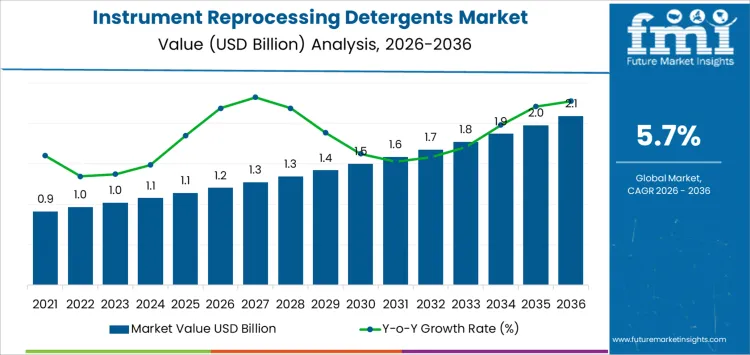
The global instrument reprocessing detergents market, valued at USD 1.2 billion in 2026, is projected to reach USD 2.1 billion by 2036, growing at a 5.7% CAGR. The demand for effective cleaning solutions in healthcare settings, particularly for surgical and diagnostic equipment reprocessing, is driving market expansion. Enzymatic detergents, which hold a 42% market share, are the preferred choice due to their superior ability to break down organic materials like blood and tissue. The hospital SPD/CSSD sector dominates, accounting for 58% of the market, driven by the need for reliable cleaning and sterilization in medical environments.
Quick Stats for Instrument Reprocessing Detergents Market
- Instrument Reprocessing Detergents Market Value (2026): USD 1.2 billion
- Instrument Reprocessing Detergents Market Forecast Value (2036): USD 2.1 billion
- Instrument Reprocessing Detergents Market Forecast CAGR (2026-2036): 5.7%
- Leading Detergent Type in Instrument Reprocessing Detergents Market: Enzymatic Detergents
- Key Growth Regions in Instrument Reprocessing Detergents Market: Asia Pacific, North America
- Top Players in Instrument Reprocessing Detergents Market: STERIS, Getinge, Ecolab, 3M, Advanced Sterilization Products (ASP), Belimed, Metrex, Schülke & Mayr, Paul Hartmann, Steelco
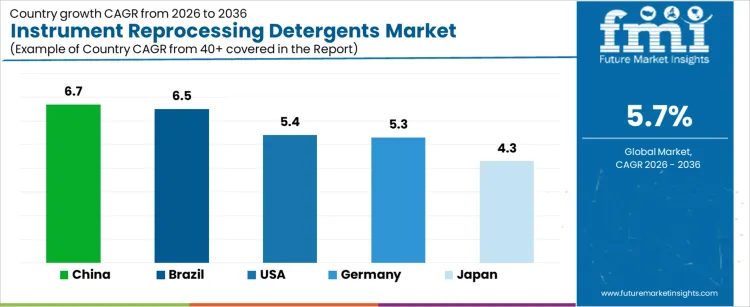
Regionally, China leads with a 6.7% CAGR, supported by the rapid expansion of its healthcare infrastructure and the increasing demand for high-quality reprocessing detergents. Brazil follows with a 6.5% growth rate, driven by healthcare modernization and infection control initiatives. The USA and Germany exhibit steady growth, at 5.4% and 5.3% CAGR, respectively, backed by stringent regulations and high demand in healthcare facilities. Japan's market grows at a slower pace of 4.3%, driven by its established healthcare system and rigorous hygiene standards. Key trends shaping the market include advancements in enzymatic formulations, the development of low-toxicity detergents, and the integration of detergents with automated reprocessing equipment for improved efficiency and compliance.
Instrument Reprocessing Detergents Market Key Takeaways
| Metric | Value |
|---|---|
| Industry Value (2026) | USD 1.2 billion |
| Forecast Value (2036) | USD 2.1 billion |
| Forecast CAGR (2026-2036) | 5.7% |
How is the Global Instrument Reprocessing Detergents Sector Advancing?
The global instrument reprocessing detergents market is expanding, driven by the increasing demand for effective and safe cleaning solutions in healthcare settings, particularly in surgical and diagnostic equipment reprocessing. These detergents are crucial for removing bioburden, soil, and organic matter from medical instruments to ensure proper sterilization and prevent cross-contamination. Initially, the market primarily focused on detergents for cleaning reusable medical devices, but as healthcare standards evolved, the demand for detergents that are compatible with advanced reprocessing systems has grown. Innovations in detergent formulations, which include enzymatic and non-enzymatic agents, have further improved their effectiveness in breaking down complex soils without damaging delicate instruments.
Instrument reprocessing detergents market will continue to grow as healthcare providers prioritize infection control and patient safety. The increasing focus on stringent regulatory standards for sterilization and reprocessing procedures will drive demand for high-performance detergents. Technological advancements in detergent formulations, such as products that are more efficient at low concentrations and compatible with automated reprocessing equipment, will also support market expansion. Challenges such as the rising cost of raw materials, the need for product differentiation, and compliance with regulatory standards will shape the future of the market. As infection prevention and medical device safety remain priorities, instrument reprocessing detergents will play a crucial role in maintaining the highest standards of cleanliness in healthcare facilities worldwide.
What is the Segment-Wise Analysis for the Global Instrument Reprocessing Detergents Market?
The global instrument reprocessing detergents market is driven by detergent types and customer types. Enzymatic detergents lead with a 42% share, as they are highly effective in breaking down organic material, such as blood and tissue, that commonly adheres to surgical instruments. Other significant detergent types include alkaline detergents, neutral detergents, and various specialized formulations. In terms of customer types, hospital SPD/CSSD (Sterile Processing Department/ Central Sterile Supply Department) accounts for 58% of the market, driven by the high demand for instrument reprocessing solutions in hospital settings.
Why Do Enzymatic Detergents Lead the Global Instrument Reprocessing Detergents Market?
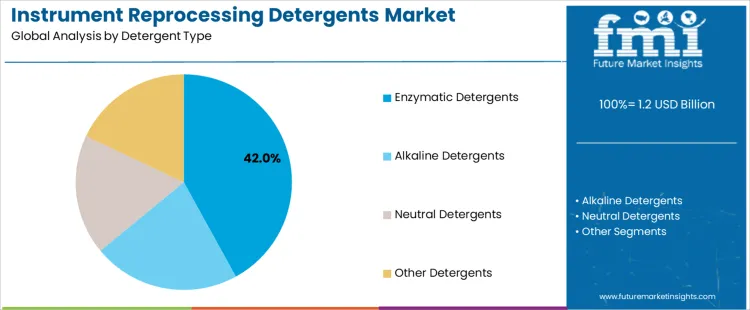
Enzymatic detergents hold a 42% share of the global instrument reprocessing detergents market due to their superior ability to break down organic matter, such as blood, proteins, and tissue, which commonly adheres to surgical instruments. These detergents play a critical role in ensuring that medical instruments are effectively cleaned and prepared for sterilization, thus meeting stringent infection control standards. Enzymatic detergents are particularly valuable in the healthcare industry, where sterilization is paramount to patient safety. As infection control protocols tighten, the demand for effective, efficient, and safe cleaning solutions for surgical instruments continues to rise. This growing need for high-performance detergents that provide thorough cleaning without damaging delicate equipment has made enzymatic detergents the preferred choice in hospitals, clinics, and other healthcare settings, reinforcing their leadership in the market.
Why Does the Hospital SPD/CSSD Sector Hold the Largest Share in the Global Instrument Reprocessing Detergents Market?
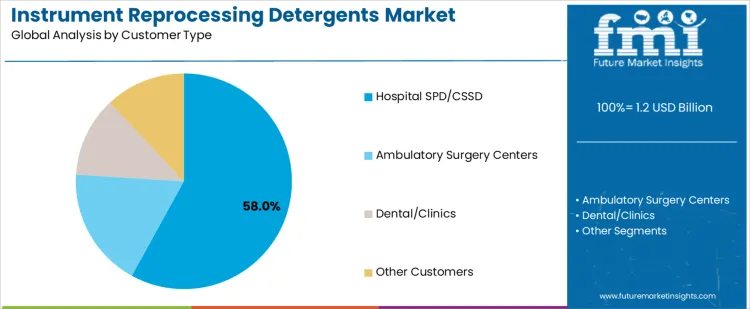
Hospital SPD/CSSD (Sterile Processing Department/Central Sterile Supply Department) holds the largest share at 58% in the global instrument reprocessing detergents market, largely due to the critical role these departments play in maintaining the sterility and cleanliness of medical instruments. The SPD/CSSD is responsible for the decontamination, cleaning, and sterilization of surgical instruments used across hospital settings, requiring detergents that can thoroughly clean and disinfect equipment. With the high volume of instruments processed in hospitals, coupled with the stringent infection control standards in place, there is significant demand for reliable and effective reprocessing detergents. As hospitals continue to focus on preventing hospital-acquired infections (HAIs) and improving patient safety, SPD/CSSD remains the largest customer sector in the market, driving the demand for specialized and effective cleaning solutions.
What is Shaping the Instrument Reprocessing Detergents Market?
The instrument reprocessing detergents market is shaped by the growing emphasis on infection control and patient safety across healthcare facilities globally. Reprocessing detergents are essential for the cleaning phase of medical instruments before sterilization, ensuring removal of soil, biofilm, and contaminants. As surgical procedures, diagnostic tests, and outpatient treatments increase, there is greater demand for effective detergents that deliver consistent cleanliness without damaging sensitive medical instruments. Regulatory requirements and stringent hygiene protocols further elevate the need for specialized reprocessing solutions that meet efficacy, compatibility, and safety standards in clinical environments.
What Are the Key Drivers for the Instrument Reprocessing Detergents Market?
The market is driven by the imperative to prevent healthcare‑associated infections and ensure reliable instrument hygiene. Hospitals, surgical centers, and diagnostic facilities demand detergents that can thoroughly clean complex devices such as endoscopes, surgical tools, and implants. Technological advancements in formulations that remove organic and inorganic soils while preserving instrument integrity support increased adoption. Expansion of healthcare infrastructure in emerging regions and rising procedural volumes also fuel demand. Regulatory guidelines and accreditation standards promoting thorough instrument reprocessing are key drivers, prompting facilities to invest in specialized detergents that enhance clinical safety and quality assurance.
What Are the Constraints Limiting the Adoption of Instrument Reprocessing Detergents?
Adoption of instrument reprocessing detergents is limited by concerns over formulation compatibility and cost. Some powerful detergents may interact adversely with delicate instrument materials, leading to corrosion, surface damage, or reduced service life, which can deter healthcare providers. High‑quality detergents with advanced cleaning capabilities often carry premium prices, presenting budget challenges for smaller hospitals and clinics. Comprehensive validation and training requirements for proper use can create barriers, as facilities must ensure staff proficiency and compliance with protocols. Regulatory complexities and varied regional approval processes can also slow product introduction and uptake.
What is the Growth Outlook for the Instrument Reprocessing Detergents Market by Country?
| Country | CAGR (%) |
|---|---|
| USA | 5.4% |
| Japan | 4.3% |
| Germany | 5.3% |
| China | 6.7% |
| Brazil | 6.5% |
The instrument reprocessing detergents market is experiencing strong growth globally, with China leading at a 6.7% CAGR, driven by the expanding healthcare sector and increasing demand for effective cleaning solutions in medical device reprocessing. Brazil follows closely at 6.5%, supported by rising healthcare infrastructure and regulations demanding high sanitation standards. The USA and Germany show steady growth at 5.4% and 5.3%, respectively, reflecting ongoing demand in hospitals and healthcare facilities. Japan’s market grows at a moderate 4.3%, supported by stringent healthcare regulations and a focus on sanitation.
Why is the Instrument Reprocessing Detergents Market Growing in China?
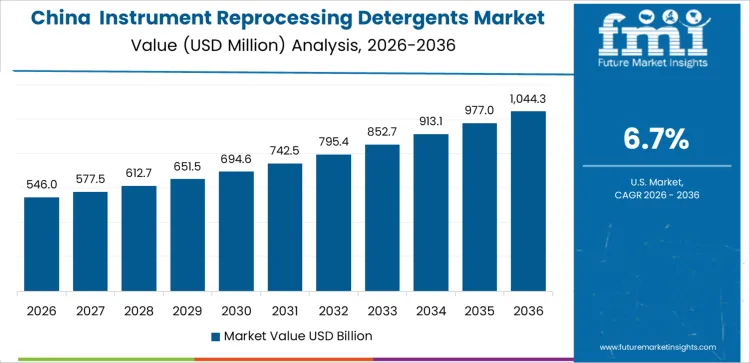
China’s instrument reprocessing detergents market is growing at a 6.7% CAGR, driven by the rapid expansion of its healthcare infrastructure and increasing demand for high-quality cleaning solutions for medical instruments. As China’s healthcare sector grows, particularly in hospitals and surgical centers, the need for effective instrument reprocessing detergents is rising. The government’s focus on improving healthcare standards and infection control practices is also contributing to market growth. China’s expanding middle class and urbanization are driving the adoption of advanced medical technologies, further increasing the demand for reprocessing detergents. With the government’s continued emphasis on public health, infection prevention, and sanitation, China’s market for instrument reprocessing detergents is expected to experience sustained growth.
What is Contributing to the Growth of the Instrument Reprocessing Detergents Market in Brazil?
Brazil’s instrument reprocessing detergents market is growing at a 6.5% CAGR, driven by the country’s expanding healthcare sector and rising awareness of infection control in medical settings. As Brazil modernizes its healthcare infrastructure and increases the number of hospitals and surgical centers, the demand for high-performance detergents to clean medical instruments is increasing. Brazil’s strong focus on improving healthcare sanitation standards and regulations for infection control is contributing to market growth. The growing adoption of medical technologies and the rising demand for preventive healthcare solutions in Brazil further accelerate the need for effective reprocessing detergents. As the healthcare sector continues to expand, Brazil’s market for instrument reprocessing detergents is expected to see sustained growth.
How is the Instrument Reprocessing Detergents Market Expanding in the USA?
The USA’s instrument reprocessing detergents market is growing at a 5.4% CAGR, supported by the increasing demand for cleaning solutions in hospitals, clinics, and surgical centers. With stringent regulations on infection control and sanitation, there is a constant need for effective detergents to clean and disinfect medical instruments. The rising awareness of healthcare-associated infections (HAIs) and the importance of proper reprocessing in preventing the spread of infections are key drivers of market growth. As healthcare providers prioritize safety and efficiency in instrument cleaning, the demand for high-performance detergents is rising. The USA’s well-established healthcare system and regulatory environment continue to support steady market growth, ensuring the ongoing demand for instrument reprocessing detergents.
Why is the Instrument Reprocessing Detergents Market Growing in Brazil?
Brazil’s instrument reprocessing detergents market is growing at a 6.5% CAGR, driven by the increasing demand for sanitation and infection control in Brazil’s growing healthcare industry. The need for efficient reprocessing of medical instruments, particularly in hospitals and surgical centers, is contributing to market expansion. Brazil’s government regulations and healthcare initiatives focusing on infection prevention and improving medical standards are encouraging the use of high-quality detergents in medical settings. The rising middle class and increasing access to healthcare services also play a key role in fueling the demand for medical equipment reprocessing and effective detergents. As Brazil’s healthcare sector continues to grow, the market for instrument reprocessing detergents is expected to maintain a strong growth trajectory.
What is Shaping the Instrument Reprocessing Detergents Market Growth in Japan?
Japan’s instrument reprocessing detergents market is growing at a 4.3% CAGR, driven by the country’s well-established healthcare system and strict hygiene regulations. Japan’s focus on maintaining high standards of infection control in hospitals and clinics is a key factor contributing to the market’s growth. With an aging population and increasing demand for medical procedures, there is a rising need for safe and effective instrument reprocessing solutions. The Japanese healthcare sector’s strong emphasis on preventing healthcare-associated infections (HAIs) and maintaining sanitation further accelerates the adoption of high-quality detergents. While growth is slower compared to other regions, Japan’s market remains steady, driven by stringent regulations and the continued importance of infection control in medical facilities.
How are Leading Firms Competing in the Instrument Reprocessing Detergents Market?
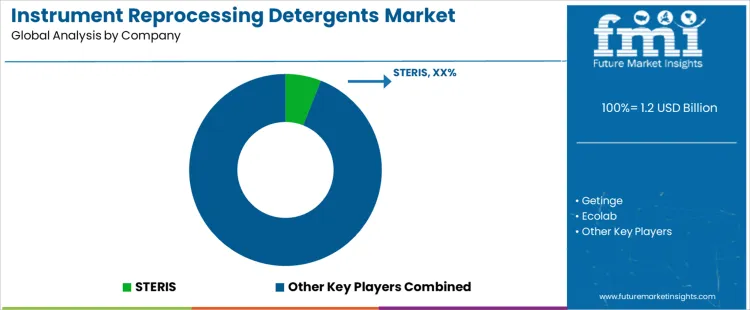
STERIS, Getinge, Ecolab, 3M, Advanced Sterilization Products (ASP), Belimed, Metrex, Schülke & Mayr, Paul Hartmann, and Steelco each strive for differentiation in the instrument reprocessing detergents sector with compelling product brochures and targeted strategies. STERIS highlights a broad range of instrument cleaning chemistries from point‑of‑use pre‑treatments to automated wash solutions designed to tackle tough soils and protect delicate instruments. Getinge promotes comprehensive reprocessing workflows that include its detergent range alongside washer‑disinfectors and consulting services to enhance sterile processing productivity.
Ecolab positions its cleaners for automated instrument reprocessing with emphasis on residue‑free performance and material compatibility, appealing to central sterile processing departments. 3M’s portfolio supports cleaning and disinfecting needs with enzymatic and detergent products and pairs these with monitoring technologies that reinforce process confidence. Metrex stands out with multi‑enzymatic detergents and innovative pre‑cleaning tools that simplify organic soil removal.
Schülke & Mayr focuses on high‑efficacy formulations that meet stringent hygiene demands in manual and automated reprocessing. Belimed and Steelco leverage joint ventures and integrated solutions that blend advanced detergents with reprocessing equipment to deliver seamless cleaning performance. Paul Hartmann emphasizes reliable reprocessing chemicals backed by clinical support. Unique product brochures stress validated cleaning action, regulatory compliance, and compatibility across device materials.
Key Players in Instrument Reprocessing Detergents Market
- STERIS
- Getinge
- Ecolab
- 3M
- Advanced Sterilization Products (ASP)
- Belimed
- Metrex
- Schülke & Mayr
- Paul Hartmann
- Steelco
Scope of Report
| Items | Values |
|---|---|
| Quantitative Units (2026) | USD billion |
| Detergent Type | Enzymatic Detergents, Alkaline Detergents, Neutral Detergents, Other Detergents |
| Process Step | Manual Cleaning, Washer-Disinfector Detergents, Ultrasonic Cleaning, Other Steps |
| Instrument Category | General Surgical Instruments, Robotic/Complex Instruments, Dental Instruments, Other Instruments |
| Customer Type | Hospital SPD/CSSD, Ambulatory Surgery Centers, Dental/Clinics, Other Customers |
| Regions Covered | Asia Pacific, Europe, North America, Latin America, Middle East & Africa |
| Countries Covered | USA, China, Japan, South Korea, India, Australia & New Zealand, ASEAN, Germany, UK, France, Italy, Spain, Nordic, BENELUX, Brazil, Chile, Mexico, Saudi Arabia, Other GCC Countries, Turkey, South Africa, Other African Union, Rest of Regions |
| Key Companies Profiled | STERIS, Getinge, Ecolab, 3M, Advanced Sterilization Products (ASP), Belimed, Metrex, Schülke & Mayr, Paul Hartmann, Steelco |
| Additional Attributes | Dollar sales by detergent type, process step, and instrument category; regional CAGR and growth outlook; distribution channels including hospital contracts, GPO/IDN programs, and distributor supply; innovation trends in enzymatic a |
Instrument Reprocessing Detergents Market by Segments
Detergent Type
- Enzymatic Detergents
- Alkaline Detergents
- Neutral Detergents
- Other Detergents
Process Step
- Manual Cleaning
- Washer-Disinfector Detergents
- Ultrasonic Cleaning
- Other Steps
Instrument Category
- General Surgical Instruments
- Robotic/Complex Instruments
- Dental Instruments
- Other Instruments
Customer Type
- Hospital SPD/CSSD
- Ambulatory Surgery Centers
- Dental/Clinics
- Other Customers
Region
- Asia Pacific
- China
- Japan
- South Korea
- India
- Australia & New Zealand
- ASEAN
- Rest of Asia Pacific
- Europe
- Germany
- United Kingdom
- France
- Italy
- Spain
- Nordic
- BENELUX
- Rest of Europe
- North America
- United States
- Canada
- Mexico
- Latin America
- Brazil
- Chile
- Rest of Latin America
- Middle East & Africa
- Kingdom of Saudi Arabia
- Other GCC Countries
- Turkey
- South Africa
- Other African Union
- Rest of Middle East & Africa
Frequently Asked Questions
How big is the instrument reprocessing detergents market in 2026?
The global instrument reprocessing detergents market is estimated to be valued at USD 1.2 billion in 2026.
What will be the size of instrument reprocessing detergents market in 2036?
The market size for the instrument reprocessing detergents market is projected to reach USD 2.1 billion by 2036.
How much will be the instrument reprocessing detergents market growth between 2026 and 2036?
The instrument reprocessing detergents market is expected to grow at a 5.7% CAGR between 2026 and 2036.
What are the key product types in the instrument reprocessing detergents market?
The key product types in instrument reprocessing detergents market are enzymatic detergents, alkaline detergents, neutral detergents and other detergents.
Which process step segment to contribute significant share in the instrument reprocessing detergents market in 2026?
In terms of process step, manual cleaning segment to command 34.0% share in the instrument reprocessing detergents market in 2026.
Preview the report firsthand - request a free sample
Get SampleGet the brochure for pricing and purchase details.
Get PDFTable of Content
- Executive Summary
- Global Market Outlook
- Demand-side Trends
- Supply-side Trends
- Technology Roadmap Analysis
- Analysis and Recommendations
- Market Overview
- Market Coverage / Taxonomy
- Market Definition / Scope / Limitations
- Market Background
- Market Dynamics
- Drivers
- Restraints
- Opportunity
- Trends
- Scenario Forecast
- Demand in Optimistic Scenario
- Demand in Likely Scenario
- Demand in Conservative Scenario
- Opportunity Map Analysis
- Product Life Cycle Analysis
- Supply Chain Analysis
- Investment Feasibility Matrix
- Value Chain Analysis
- PESTLE and Porter’s Analysis
- Regulatory Landscape
- Regional Parent Market Outlook
- Production and Consumption Statistics
- Import and Export Statistics
- Market Dynamics
- Global Market Analysis 2021 to 2025 and Forecast, 2026 to 2036
- Historical Market Size Value (USD Million) Analysis, 2021 to 2025
- Current and Future Market Size Value (USD Million) Projections, 2026 to 2036
- Y-o-Y Growth Trend Analysis
- Absolute $ Opportunity Analysis
- Global Market Pricing Analysis 2021 to 2025 and Forecast 2026 to 2036
- Global Market Analysis 2021 to 2025 and Forecast 2026 to 2036, By Detergent Type
- Introduction / Key Findings
- Historical Market Size Value (USD Million) Analysis By Detergent Type , 2021 to 2025
- Current and Future Market Size Value (USD Million) Analysis and Forecast By Detergent Type , 2026 to 2036
- Enzymatic Detergents
- Alkaline Detergents
- Neutral Detergents
- Other Detergents
- Y-o-Y Growth Trend Analysis By Detergent Type , 2021 to 2025
- Absolute $ Opportunity Analysis By Detergent Type , 2026 to 2036
- Global Market Analysis 2021 to 2025 and Forecast 2026 to 2036, By Process Step
- Introduction / Key Findings
- Historical Market Size Value (USD Million) Analysis By Process Step, 2021 to 2025
- Current and Future Market Size Value (USD Million) Analysis and Forecast By Process Step, 2026 to 2036
- Manual Cleaning
- Washer-Disinfector Detergents
- Ultrasonic Cleaning
- Other Steps
- Y-o-Y Growth Trend Analysis By Process Step, 2021 to 2025
- Absolute $ Opportunity Analysis By Process Step, 2026 to 2036
- Global Market Analysis 2021 to 2025 and Forecast 2026 to 2036, By Instrument Category
- Introduction / Key Findings
- Historical Market Size Value (USD Million) Analysis By Instrument Category, 2021 to 2025
- Current and Future Market Size Value (USD Million) Analysis and Forecast By Instrument Category, 2026 to 2036
- General Surgical Instruments
- Robotic/Complex Instruments
- Dental Instruments
- Other Instruments
- Y-o-Y Growth Trend Analysis By Instrument Category, 2021 to 2025
- Absolute $ Opportunity Analysis By Instrument Category, 2026 to 2036
- Global Market Analysis 2021 to 2025 and Forecast 2026 to 2036, By Customer Type
- Introduction / Key Findings
- Historical Market Size Value (USD Million) Analysis By Customer Type, 2021 to 2025
- Current and Future Market Size Value (USD Million) Analysis and Forecast By Customer Type, 2026 to 2036
- Hospital SPD/CSSD
- Ambulatory Surgery Centers
- Dental/Clinics
- Other Customers
- Y-o-Y Growth Trend Analysis By Customer Type, 2021 to 2025
- Absolute $ Opportunity Analysis By Customer Type, 2026 to 2036
- Global Market Analysis 2021 to 2025 and Forecast 2026 to 2036, By Region
- Introduction
- Historical Market Size Value (USD Million) Analysis By Region, 2021 to 2025
- Current Market Size Value (USD Million) Analysis and Forecast By Region, 2026 to 2036
- North America
- Latin America
- Western Europe
- Eastern Europe
- East Asia
- South Asia and Pacific
- Middle East & Africa
- Market Attractiveness Analysis By Region
- North America Market Analysis 2021 to 2025 and Forecast 2026 to 2036, By Country
- Historical Market Size Value (USD Million) Trend Analysis By Market Taxonomy, 2021 to 2025
- Market Size Value (USD Million) Forecast By Market Taxonomy, 2026 to 2036
- By Country
- USA
- Canada
- Mexico
- By Detergent Type
- By Process Step
- By Instrument Category
- By Customer Type
- By Country
- Market Attractiveness Analysis
- By Country
- By Detergent Type
- By Process Step
- By Instrument Category
- By Customer Type
- Key Takeaways
- Latin America Market Analysis 2021 to 2025 and Forecast 2026 to 2036, By Country
- Historical Market Size Value (USD Million) Trend Analysis By Market Taxonomy, 2021 to 2025
- Market Size Value (USD Million) Forecast By Market Taxonomy, 2026 to 2036
- By Country
- Brazil
- Chile
- Rest of Latin America
- By Detergent Type
- By Process Step
- By Instrument Category
- By Customer Type
- By Country
- Market Attractiveness Analysis
- By Country
- By Detergent Type
- By Process Step
- By Instrument Category
- By Customer Type
- Key Takeaways
- Western Europe Market Analysis 2021 to 2025 and Forecast 2026 to 2036, By Country
- Historical Market Size Value (USD Million) Trend Analysis By Market Taxonomy, 2021 to 2025
- Market Size Value (USD Million) Forecast By Market Taxonomy, 2026 to 2036
- By Country
- Germany
- UK
- Italy
- Spain
- France
- Nordic
- BENELUX
- Rest of Western Europe
- By Detergent Type
- By Process Step
- By Instrument Category
- By Customer Type
- By Country
- Market Attractiveness Analysis
- By Country
- By Detergent Type
- By Process Step
- By Instrument Category
- By Customer Type
- Key Takeaways
- Eastern Europe Market Analysis 2021 to 2025 and Forecast 2026 to 2036, By Country
- Historical Market Size Value (USD Million) Trend Analysis By Market Taxonomy, 2021 to 2025
- Market Size Value (USD Million) Forecast By Market Taxonomy, 2026 to 2036
- By Country
- Russia
- Poland
- Hungary
- Balkan & Baltic
- Rest of Eastern Europe
- By Detergent Type
- By Process Step
- By Instrument Category
- By Customer Type
- By Country
- Market Attractiveness Analysis
- By Country
- By Detergent Type
- By Process Step
- By Instrument Category
- By Customer Type
- Key Takeaways
- East Asia Market Analysis 2021 to 2025 and Forecast 2026 to 2036, By Country
- Historical Market Size Value (USD Million) Trend Analysis By Market Taxonomy, 2021 to 2025
- Market Size Value (USD Million) Forecast By Market Taxonomy, 2026 to 2036
- By Country
- China
- Japan
- South Korea
- By Detergent Type
- By Process Step
- By Instrument Category
- By Customer Type
- By Country
- Market Attractiveness Analysis
- By Country
- By Detergent Type
- By Process Step
- By Instrument Category
- By Customer Type
- Key Takeaways
- South Asia and Pacific Market Analysis 2021 to 2025 and Forecast 2026 to 2036, By Country
- Historical Market Size Value (USD Million) Trend Analysis By Market Taxonomy, 2021 to 2025
- Market Size Value (USD Million) Forecast By Market Taxonomy, 2026 to 2036
- By Country
- India
- ASEAN
- Australia & New Zealand
- Rest of South Asia and Pacific
- By Detergent Type
- By Process Step
- By Instrument Category
- By Customer Type
- By Country
- Market Attractiveness Analysis
- By Country
- By Detergent Type
- By Process Step
- By Instrument Category
- By Customer Type
- Key Takeaways
- Middle East & Africa Market Analysis 2021 to 2025 and Forecast 2026 to 2036, By Country
- Historical Market Size Value (USD Million) Trend Analysis By Market Taxonomy, 2021 to 2025
- Market Size Value (USD Million) Forecast By Market Taxonomy, 2026 to 2036
- By Country
- Kingdom of Saudi Arabia
- Other GCC Countries
- Turkiye
- South Africa
- Other African Union
- Rest of Middle East & Africa
- By Detergent Type
- By Process Step
- By Instrument Category
- By Customer Type
- By Country
- Market Attractiveness Analysis
- By Country
- By Detergent Type
- By Process Step
- By Instrument Category
- By Customer Type
- Key Takeaways
- Key Countries Market Analysis
- USA
- Pricing Analysis
- Market Share Analysis, 2025
- By Detergent Type
- By Process Step
- By Instrument Category
- By Customer Type
- Canada
- Pricing Analysis
- Market Share Analysis, 2025
- By Detergent Type
- By Process Step
- By Instrument Category
- By Customer Type
- Mexico
- Pricing Analysis
- Market Share Analysis, 2025
- By Detergent Type
- By Process Step
- By Instrument Category
- By Customer Type
- Brazil
- Pricing Analysis
- Market Share Analysis, 2025
- By Detergent Type
- By Process Step
- By Instrument Category
- By Customer Type
- Chile
- Pricing Analysis
- Market Share Analysis, 2025
- By Detergent Type
- By Process Step
- By Instrument Category
- By Customer Type
- Germany
- Pricing Analysis
- Market Share Analysis, 2025
- By Detergent Type
- By Process Step
- By Instrument Category
- By Customer Type
- UK
- Pricing Analysis
- Market Share Analysis, 2025
- By Detergent Type
- By Process Step
- By Instrument Category
- By Customer Type
- Italy
- Pricing Analysis
- Market Share Analysis, 2025
- By Detergent Type
- By Process Step
- By Instrument Category
- By Customer Type
- Spain
- Pricing Analysis
- Market Share Analysis, 2025
- By Detergent Type
- By Process Step
- By Instrument Category
- By Customer Type
- France
- Pricing Analysis
- Market Share Analysis, 2025
- By Detergent Type
- By Process Step
- By Instrument Category
- By Customer Type
- India
- Pricing Analysis
- Market Share Analysis, 2025
- By Detergent Type
- By Process Step
- By Instrument Category
- By Customer Type
- ASEAN
- Pricing Analysis
- Market Share Analysis, 2025
- By Detergent Type
- By Process Step
- By Instrument Category
- By Customer Type
- Australia & New Zealand
- Pricing Analysis
- Market Share Analysis, 2025
- By Detergent Type
- By Process Step
- By Instrument Category
- By Customer Type
- China
- Pricing Analysis
- Market Share Analysis, 2025
- By Detergent Type
- By Process Step
- By Instrument Category
- By Customer Type
- Japan
- Pricing Analysis
- Market Share Analysis, 2025
- By Detergent Type
- By Process Step
- By Instrument Category
- By Customer Type
- South Korea
- Pricing Analysis
- Market Share Analysis, 2025
- By Detergent Type
- By Process Step
- By Instrument Category
- By Customer Type
- Russia
- Pricing Analysis
- Market Share Analysis, 2025
- By Detergent Type
- By Process Step
- By Instrument Category
- By Customer Type
- Poland
- Pricing Analysis
- Market Share Analysis, 2025
- By Detergent Type
- By Process Step
- By Instrument Category
- By Customer Type
- Hungary
- Pricing Analysis
- Market Share Analysis, 2025
- By Detergent Type
- By Process Step
- By Instrument Category
- By Customer Type
- Kingdom of Saudi Arabia
- Pricing Analysis
- Market Share Analysis, 2025
- By Detergent Type
- By Process Step
- By Instrument Category
- By Customer Type
- Turkiye
- Pricing Analysis
- Market Share Analysis, 2025
- By Detergent Type
- By Process Step
- By Instrument Category
- By Customer Type
- South Africa
- Pricing Analysis
- Market Share Analysis, 2025
- By Detergent Type
- By Process Step
- By Instrument Category
- By Customer Type
- USA
- Market Structure Analysis
- Competition Dashboard
- Competition Benchmarking
- Market Share Analysis of Top Players
- By Regional
- By Detergent Type
- By Process Step
- By Instrument Category
- By Customer Type
- Competition Analysis
- Competition Deep Dive
- STERIS
- Overview
- Product Portfolio
- Profitability by Market Segments (Product/Age /Sales Channel/Region)
- Sales Footprint
- Strategy Overview
- Marketing Strategy
- Product Strategy
- Channel Strategy
- Getinge
- Ecolab
- 3M
- Advanced Sterilization Products (ASP)
- Belimed
- Metrex
- Schülke & Mayr
- Paul Hartmann
- Steelco
- STERIS
- Competition Deep Dive
- Assumptions & Acronyms Used
- Research Methodology


