

- Industry Size (2026)
- USD 0.6 Bn
- Forecast (2036)
- USD 1.1 Bn
- CAGR (2026 to 2036)
- 6.7%
Drop-Test-Compliant Packaging for Computer Products Market Size and Share Forecast Outlook 2026 to 2036
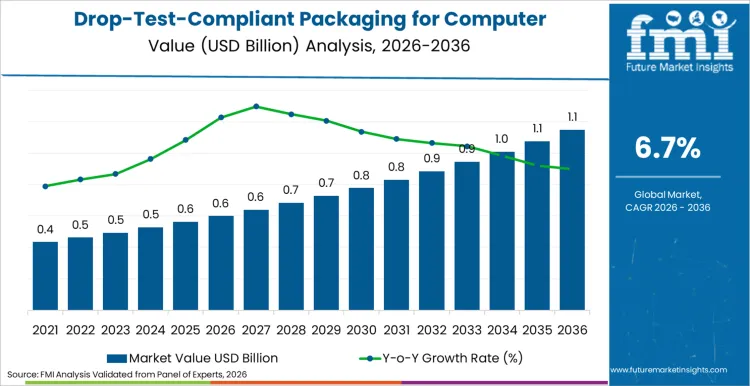
The drop-test-compliant packaging for computer products market is set to be valued at USD 0.6 billion in 2026 and is projected to grow to USD 1.1 billion by 2036, reflecting a compound annual growth rate (CAGR) of 6.7%. The positive trajectory is reshaped by a dual-engine growth model: massive capital expenditures in testing infrastructure to certify transit resilience, and a simultaneous surge in demand for sustainable materials that meet "ships in own container" protocols. As per FMI's projection, the scale of this shift is best illustrated by recent automation trends; Ranpak Holdings reported that their automated packaging system placement reached approximately 142.7 thousand machines by the end of 2024, signaling a definitive move away from manual void-fill toward standardized, machine-verified protection. This automation is becoming the prerequisite for scaling compliant packaging solutions across high-volume fulfillment centers without sacrificing throughput speed or drop-test reliability.
The shift in procurement logic is visible in how major packaging providers are describing their operational wins, particularly within the North American e-commerce theater where speed and protection must coexist. Procurement teams are no longer just buying boxes; they are buying drop-performance guarantees, a reality that incumbent leaders are aggressively capitalizing on.
Omar Asali, Chairman & CEO of Ranpak, noted in March 2025: "We are pleased to finish 2024 on a really positive note with the fourth quarter delivering double digit volume and top-line growth. Volume growth of 12% and 16% net revenue growth across the organization was driven by North American e-commerce activity which experienced a strong holiday season overall as well as the impact of plastic to paper shift among strategic accounts". Consequently, packaging converters are investing heavily in paper engineering capabilities to capture this margin, realizing that the ability to replace plastic with fiber in high-stress transit environments is now a definitive competitive advantage.
Institutional buyers are increasingly mandating evidence-based validation for every stock-keeping unit (SKU) to minimize reverse logistics costs associated with transit damage, which fundamentally alters the supplier qualification process. Manufacturers who previously relied on uncertified foam blocks are now required to prove compliance with ISTA 6-Amazon standards before a single unit is shipped, creating a bottleneck that only technically advanced suppliers can resolve by leveraging third-party packaging testing services.
Smurfit WestRock’s formation in July 2024 creates a transatlantic entity specifically designed to standardize these compliance capabilities across borders, ensuring that a laptop packaged in Vietnam survives the last-mile drop in Germany. This standardization pressure compresses the vendor landscape, favoring integrated players who can offer both material supply and the requisite laboratory certification to indemnify brands against breakage claims.
Summary of Drop-Test-Compliant Packaging for Computer Products Market
What Is the Growth Outlook for the Drop-Test-Compliant Packaging for Computer Products Market as per Future Market Insights Projection?
Future Market Insights projects the global Drop-Test-Compliant Packaging for Computer Products market to grow from USD 0.6 billion in 2026 to USD 1.1 billion by 2036, representing a 6.7% CAGR over the forecast period.
FMI Research Approach: Based on FMI’s proprietary global modeling framework incorporating electronics export volumes from APAC, molded fiber adoption rates in consumer electronics, and regulatory timelines for EPS bans in the EU and North America.
How Do FMI Analysts Perceive the Drop-Test-Compliant Packaging for Computer Products Market to Evolve?
According to FMI's estimates, the market is transitioning away from "over-boxing" with excessive plastic filler toward "right-sized" engineered fiber solutions that pass drop tests without secondary cartons.
FMI Research Approach: Developed using analysis of patent filings (PulPac’s dry molded fiber), corporate sustainability reports (Sealed Air, Nefab), and vendor guidelines from logistics giants like Amazon (SIPP program).
Which Country Holds the Largest Share in the Global Drop-Test-Compliant Packaging for Computer Products Market?
India is poised to be a high-growth anchor with an 8.9% CAGR, supported by a massive surge in domestic electronics manufacturing (exports up 127x since 2014) and government incentives for component localization.
FMI Research Approach: Built using country-level export data (Ministry of Commerce & Industry), analysis of manufacturing FDI inflows, and mapping of packaging plant expansions by global players like Mondi and Smurfit WestRock.
How Large Will the Drop-Test-Compliant Packaging for Computer Products Market Be by 2036?
The global Drop-Test-Compliant Packaging for Computer Products market is expected to reach USD 1.1 billion by 2036, with the Laptops & Tablets segment currently commanding a significant 34.0% share of demand.
FMI Research Approach: Long-term forecasts rely on device shipment projections (IDC), replacement cycle analysis for IT hardware, and the increasing penetration of certified refurbished electronics requiring transit packaging.
What Is the Definition of the Drop-Test-Compliant Packaging for Computer Products Market?
The Drop-Test-Compliant Packaging for Computer Products market encompasses revenue generated from protective packaging solutions (foam, fiber, corrugated, air cushions) specifically engineered and certified to survive impact testing standards (such as ISTA, ASTM) for computing hardware.
FMI Research Approach: Definition structured using FMI’s segmentation taxonomy covering material types (engineered foam, molded pulp), product applications (servers, monitors, laptops), and certification levels (retail-ready vs. transit).
What Are Globally Unique Trends Shaping the Drop-Test-Compliant Packaging for Computer Products Market?
FMI analysts opine that the sector is shaped by the "Fiber-for-Foam" substitution trend in export hubs and the integration of smart tools to simulate complex transit hazards beyond simple vertical drops.
FMI Research Approach: Insights derived from global regulatory scans (China’s green packaging mandate), startup funding patterns (Woola, Cruz Foam), and consumer behavior analysis regarding unboxing experiences and recyclability.
Drop-Test-Compliant Packaging for Computer Products Market Key Takeaways
| Metric | Details |
|---|---|
| Industry Size (2026) | USD 0.6 billion |
| Industry Value (2036) | USD 1.1 billion |
| CAGR (2026-2036) | 6.7% |
Source: Future Market Insights (FMI) analysis, based on proprietary forecasting model and primary research.
Why Is E-Commerce Certification Redefining Protection?
Procurement teams now evaluate protective packaging based on its ability to pass rigorous carrier mandates like the ISTA 6-Amazon test, which has effectively monetized the drop-test performance of materials. This shift is driven by the realization that damages during transit cost retailers significantly more in replacement logistics and brand equity than the marginal savings on cheaper, non-compliant fillers. Data from investment platforms in 2024 indicates that Amazon reduced its use of single-use plastic packaging in North America from 65% in 2023 to 37% in 2024, forcing vendors to adopt packaging testing services compliant fiber alternatives to maintain their "Frustration-Free" status. Consequently, packaging suppliers are re-engineering corrugated structures to absorb higher G-forces, as failing to meet these certification thresholds now risks delisting or non-compliance fees from major marketplaces.
As per FMI's projection, this certification pressure forces a bifurcation in the market where premium value accumulates with suppliers who can offer pre-certified "drop-ready" designs. Startups like Flexi-Hex are capitalizing on this by expanding into electronics with patented honeycomb sleeves that mimic the shock absorption of plastic but meet strict recyclability criteria. By replacing generic bubble wrap with engineered paper structures that have verified packaging burst strength test performance, these companies solve a dual constraint for electronics OEMs: eliminating plastic tax liabilities while ensuring the device survives the sorting facility's conveyor drops. This dynamic pushes the entire supply chain toward materials that offer predictable, testable mechanical properties, effectively phasing out inconsistent artisan packing methods in favor of standardized, lab-validated protection.
How is Drop-Test-Compliant Packaging for Computer Products Market Segmented?
The market is segmented by product class, certification need, and protection technology, revealing a clear concentration of value where high unit costs intersect with fragility risks. Laptops and tablets dominate the product mix, while the demand for ISTA/Parcel certified solutions outpaces general retail packaging, driven by the direct-to-consumer shift. Engineered foam systems remain a large incumbent category, but molded pulp and honeycomb structures are rapidly gaining share as regulatory pressure mounts. By 2036, the mix will shift heavily toward "retail-ready + drop tested" hybrid formats that serve both shelf display and shipping resilience, reducing total packaging SKUs for manufacturers.
Why Laptops and Tablets Command the Largest Share?
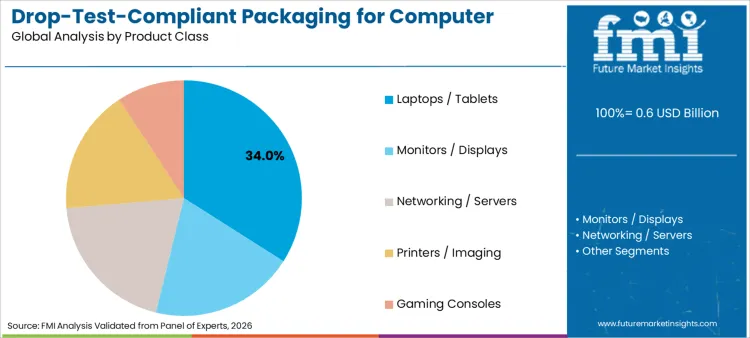
Laptops and tablets account for 34.0% of the market value, a dominance driven by the sheer volume of global shipments and the high replacement cost of screen-based devices. Manufacturers prioritize computer peripherals protection because a single cracked screen during transit results in a complete unit write-off, making the investment in premium drop-compliant packaging a rational insurance policy. Statistics from Vietnam’s General Statistics Office show computer and electronics exports reached over USD 52.75 billion in the first nine months of 2024 alone, highlighting the massive scale of hardware requiring transit protection. This volume incentivizes packaging engineers to develop specific shock testing system protocols for clamshell designs that suspend the device away from impact zones, ensuring that thin-bezel designs survive corner drops.
Why ISTA and Parcel Certification Is the Primary Growth Engine?
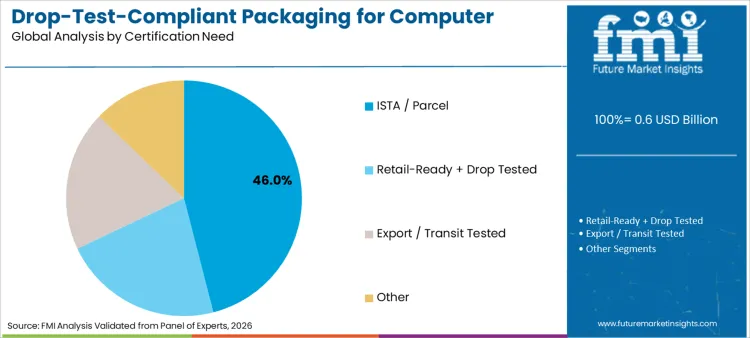
The ISTA/Parcel certification segment captures 46.0% of the market, reflecting the industry-wide mandate to ruggedize packaging for the chaotic environment of courier networks. As logistics giants enforce strict "Ships in Product Packaging" (SIPP) rules, brands are forced to eliminate the outer shipping box, transferring the entire burden of protection to the primary product packaging. Amazon’s updated SIPP guidelines in April 2024 explicitly require vendors to pass ISTA 6 testing to avoid chargebacks, effectively making this certification a license to operate in the e-commerce channel. This requirement drives demand for packaging inspection systems that can verify structural integrity at scale, pushing suppliers to integrate automated quality checks that ensure every box meets the certified standard before leaving the factory.
Why Engineered Foam Systems Face Substitution Pressure?
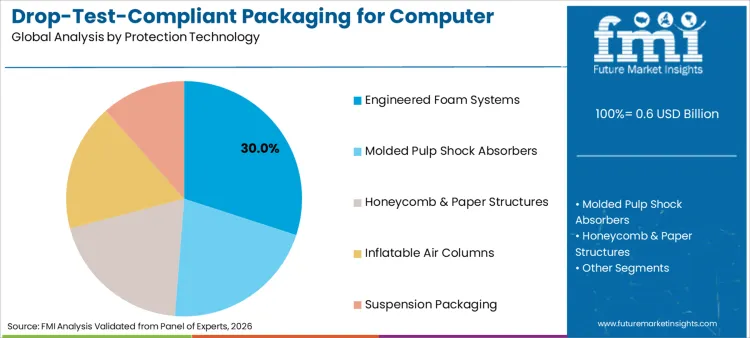
According to FMI's estimates, engineered foam systems currently hold a 30.0% share, sustained by their superior shock absorption capabilities for heavy servers and workstations, but they face an existential threat from high-performance fiber alternatives. While foam offers unmatched cushioning per dollar, the inability to easily recycle expanded polyethylene (EPE) or polyurethane curbs its long-term viability in regions with extended producer responsibility (EPR) laws. PulPac’s expansion of its dry molded fiber patent portfolio to nearly 400 grants by early 2025 demonstrates the intense R&D focus on creating fiber geometries that match foam’s protective packaging performance. Consequently, the segment is evolving toward bio-based foams and hybrid assemblies where foam is used only in critical load-bearing corners, while the bulk of the dunnage shifts to paper, balancing performance with the urgent need for plastic reduction.
How Are Bio-Materials Displacing Petrochemical Foams?
Material scientists are radically rethinking impact dissipation by moving from petrochemical foams to engineered natural fibers that offer equivalent "drop-test" performance without the environmental penalty. This shift is essential because traditional anti-static foam packaging relies on fossil fuels and often ends up in landfills, creating a disconnect with the carbon-neutral goals of major tech firms. Innovative startups like Woola are redirecting waste streams, specifically the 200,000 tonnes of coarse sheep wool burned annually in Europe, into protective sleeves that rival the cushioning metrics of bubble wrap. That change reduces reliance on virgin plastic while providing a thermal and shock barrier that is naturally elastic, proving that waste-to-value models can satisfy strict engineering requirements for fragility protection.
The commercialization of these bio-materials changes the economics of packaging foam by introducing price stability decoupled from volatile oil markets. Cruz Foam, for instance, utilizes chitin from shrimp shells to create a compostable alternative that meets ASTM drop standards, allowing electronics companies to switch materials without redesigning their box dimensions. This substitution dynamic drives investment into "wet" and "dry" molding technologies that can form these organic pulps into complex geometries capable of nesting packaging inserts securely. As these sustainable options achieve price parity through scale, the justification for using non-degradable expanded polystyrene (EPS) evaporates, pushing the entire sector toward regenerative materials that protect both the product and the brand's reputation.
Where Is Regional Demand Concentrating?
Regional demand is bifurcating between the "manufacturing powerhouses" of Asia, which require massive volumes of outbound transit packaging, and the "regulatory fortresses" of Europe and North America that dictate material standards. India and Vietnam are rapidly building out their corrugated boxes infrastructure to support exploding electronics exports, transforming from assembly hubs into centers of packaging innovation. Meanwhile, the European market acts as the global standard-setter for sustainability, effectively forcing Asian exporters to upgrade their testing apparatus to meet EU recyclability directives. Official trade statistics confirm this linkage, as compliance with destination market rules becomes the primary driver for local capex in drop-test capabilities.
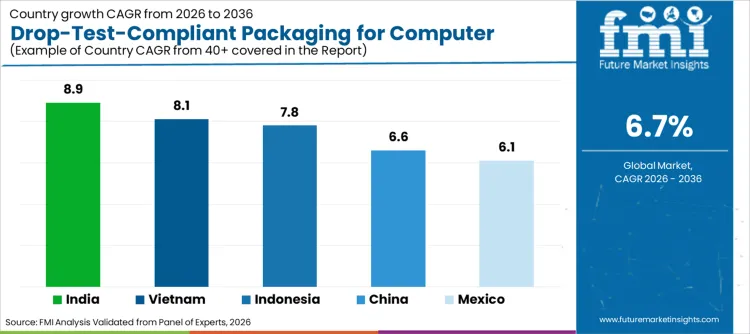
| Country | CAGR (2026 to 2036) |
|---|---|
| India | 8.9% |
| Vietnam | 8.1% |
| Indonesia | 7.8% |
| China | 6.6% |
| Mexico | 6.1% |
Source: Future Market Insights’ proprietary forecasting model and primary research.
Why India Is Leading Growth?
The Drop-Test-Compliant Packaging for Computer Products industry in India is projected to expand at 8.9% CAGR, driven by the government's "Make in India" initiative which has supercharged local hardware production. Official data from the Ministry of Electronics & IT reveals that electronics exports rose 127 times from 2014 to reach substantial volumes by 2025, creating an urgent need for export-grade certified solutions. This boom forces local converters to upgrade from low-grade fillers to ISTA-compliant solutions to prevent damage claims from global buyers. Consequently, the market sees a surge in investment for testing labs within manufacturing zones, ensuring that locally assembled smartphones and laptops meet global durability standards before export.
Why Vietnam Is a Critical Export Hub?
Sales of Drop-Test-Compliant Packaging for Computer Products in Vietnam are set to rise at 8.1% CAGR, reflecting the country's status as a primary alternative for electronics supply chains diversifying away from China. To serve this high-stakes market, global packaging leaders are establishing local service centers that offer full-cycle design and testing. Nefab Management, in their 2024 sustainability update, emphasized this circular approach: "Our goal is to ensure that all waste streams, wood, metal, corrugated & paper, plastics & foam, and general mixed waste, remain within the loop and are given a second life, minimizing the amount of waste sent to landfills". This capability allows Vietnam-based manufacturers to use dunnage trays that meet strict Western sustainability specs while ensuring product safety during trans-Pacific shipping.
Why Indonesia Is Seeing High-Tech Adoption?
Demand for Drop-Test-Compliant Packaging for Computer Products in Indonesia is anticipated to grow at 7.8% CAGR, fueled by a rising digital economy and increasing high-tech exports. BPS-Statistics Indonesia recorded a 26.66% month-over-month increase in electrical machinery exports in May 2024, signaling a sharp uptake in the movement of sensitive electronic components. This export growth necessitates a shift toward anti-static bubble pouch solutions that can withstand the humidity and handling challenges of the archipelago's logistics network. Suppliers are responding by integrating moisture-resistant coatings into their drop-test designs, ensuring that components remain functional even after enduring the rigors of inter-island and international transit.
Why China Remains the Regulatory Heavyweight?
The drop-test-compliant packaging for computer products industry in China is projected to expand at 6.6% CAGR, constrained by maturity but accelerated by aggressive green logistics targets. FMI analysts opine that the State Post Bureau's 2025 target to establish a standard system for green courier packaging effectively bans toxic materials, mandating recyclability for parcel networks. This regulatory gate forces the massive domestic e-commerce sector to abandon cheap dunnage packaging in favor of standardized, reusable, or fully biodegradable formats. As a result, Chinese manufacturers are pivoting toward automated packaging lines that use AI to optimize material usage, ensuring compliance with both state mandates and the drop-protection needs of global clients.
Why Mexico Is the Nearshoring Fortress?
Drop-test-compliant packaging for computer products in Mexico is poised to register a 6.1% CAGR, serving as the essential "protection layer" for the booming cross-border trade with the United States. Major players are restructuring to align with this nearshoring reality, focusing on cost-efficiency and automation to serve the US market.
Emile Z. Chammas, Interim Co-CEO of Sealed Air, stated in February 2024: “We are refocusing our strategy on creating long-term, value-added partnerships with our customers to advance sustainable, automated, and digital packaging solutions. We launched the cost take-out to grow program (CTO2Grow Program) in 2023, which targets annualized cost reductions of $140 to $160 million by the end of 2025.” Such strategic pivot ensures that Mexico’s output meets the stringent automation and protection standards required by North American distribution centers, driving the adoption of heavy-duty united-states-and-canada-protective-packaging solutions.
Why Control Points Are Shifting to Material Science?
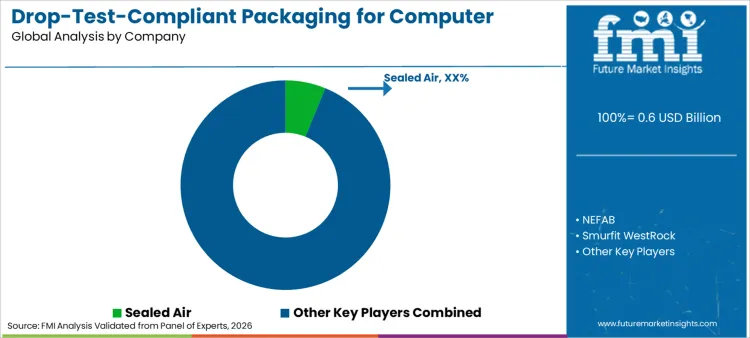
Competitive outlook for drop-test-compliant packaging for computer products consists on brand breadth and who controls the constraint that gates scale, whether evidence, compliance, or sustainable material IP. Incumbents like Smurfit WestRock and Mondi are leveraging their immense paper-milling scale to offer integrated packaging testing equipment that smaller converters cannot replicate, effectively locking in global accounts through multi-region supply agreements.
The completion of the Smurfit Kappa and WestRock merger in July 2024 exemplifies this consolidation, creating a giant capable of servicing the entire electronics value chain with standardized drop-test compliant designs. This scale allows them to invest in proprietary testing labs that mimic the specific distribution hazards of clients, creating a high barrier to entry for local players who lack the capital to certify their packaging against ISTA 6 standards.
As per FMI's estimates, challengers are disrupting this landscape by owning the intellectual property for next-generation materials that outperform traditional foams. Companies like Cruz Foam and PulPac are not just selling packaging; they are licensing technology that allows manufacturers to produce foam packaging inserts from bio-waste or dry fiber, bypassing the volatility of petrochemical supply chains. Woola, for example, raised €2.5 million in early 2024 to scale its wool-based protective sleeves, proving that niche, waste-to-value materials can attract venture capital by solving the specific problem of "plastic-free impact protection". The strategic battleground is moving toward "material-as-a-service," where the value lies in the patent-protected formulation that enables a paper tray to survive a 3-foot drop, rather than the commodity production of the box itself.
Recent Developments:
- In January 2026, HP unveiled at CES its next-generation molded pulp cushioning system for laptops and computer products, engineered to fully comply with ISTA 3A drop test standards. This sustainable solution uses custom-fit, bagasse-based inserts that absorb impacts from multiple 30-inch drops on edges, corners, and faces, matching the protective performance of expanded polystyrene (EPS) foam while eliminating plastic and enabling full recyclability in standard curbside streams.
- In January 2026, Dell demonstrated at CES its expanded use of renewable molded fiber packaging for commercial laptops and desktops, certified to pass ASTM D4169 and ISTA 6-Amazon-SIOC drop tests. The bamboo- and wheat straw-derived pulp trays withstand repeated drops from heights up to 36 inches without product damage, supporting Dell's goal of 100% sustainable transit packaging for IT hardware by reducing reliance on petroleum-based foams.
- In November 2025, Ranpak introduced the PadPak Guardian system, a paper-based alternative to air pillows specifically optimized for drop-test-compliant protection of computer products like monitors and towers. This on-demand cushioning solution forms protective wraps that meet ISTA 3E and similar unitized load standards, delivering equivalent shock absorption during free-fall drops while using 100% recycled paper for enhanced sustainability in e-commerce and B2B shipping of electronics.
Key Players in Drop-Test-Compliant Packaging for Computer Products Market
- Sealed Air Corporation
- Smurfit WestRock
- Mondi Group
- Nefab Group
- Ranpak Holdings Corp.
- Sonoco Products Company
- Amcor plc
- Cruz Foam
- Woola
- Flexi-Hex
- PulPac AB
- Transcend Packaging
Market Definition
The drop-test-compliant packaging for computer products market is defined as the ecosystem of protective packaging materials and engineered systems specifically designed, tested, and certified to protect computing hardware from shock, vibration, and impact during transit. This includes primary and secondary packaging solutions such as molded fiber trays, engineered foam inserts, inflatable air columns, and honeycomb paper structures that have passed industry-standard protocols like ISTA (International Safe Transit Association) Series 6 or ASTM D5276.
The market valuation explicitly covers revenue generated from the sale of these specialized packaging materials, as well as the associated design and testing services when bundled with supply contracts. It encompasses packaging for a wide range of devices including laptops, tablets, servers, monitors, printers, and gaming consoles, catering to both bulk B2B shipments and individual B2C e-commerce deliveries.
The scope excludes general-purpose shipping supplies (like standard unrated cardboard boxes) that are not engineered or certified for specific drop-protection ratings for electronics. It also excludes packaging machinery sales revenue, focusing instead on the consumable protective materials and the value-added engineering embedded in them. Revenue from raw material sales (e.g., raw paper pulp or resin pellets) is excluded unless sold as a finished protective packaging component.
Scope of Report
| Items | Values |
|---|---|
| Quantitative Units (2026) | USD 0.6 billion |
| Product Type | Laptops / Tablets, Monitors / Displays, Networking / Servers, Printers / Imaging, Gaming Consoles |
| Certification Need | ISTA / Parcel, Retail-Ready + Drop Tested, Export / Transit Tested, Other |
| Protection Technology | Engineered Foam Systems, Molded Pulp Shock Absorbers, Honeycomb & Paper Structures, Inflatable Air Columns, Suspension Packaging |
| Regions covered | North America, Latin America, Europe, East Asia, South Asia & Pacific, Middle East & Africa |
| Countries covered | India, Vietnam, Indonesia, China, Mexico, USA, Germany, UK, and others |
| Key companies profiled | Sealed Air, Nefab, Smurfit WestRock, Mondi, Ranpak, Cruz Foam |
| Additional attributes | Revenue analysis by segments, adoption trends across settings, regulatory and compliance landscape (as relevant), pricing and reimbursement considerations (when relevant), channel mix economics, supply chain exposure, and competitive positioning analysis |
Source: Future Market Insights – analysis driven by proprietary forecasting models and primary research.
Drop-Test-Compliant Packaging for Computer Products Market by Segments
By Product Class:
- Laptops / Tablets
- Monitors / Displays
- Networking / Servers
- Printers / Imaging
- Gaming Consoles
By Certification Need:
- ISTA / Parcel
- Retail-Ready + Drop Tested
- Export / Transit Tested
- Other
By Protection Technology:
- Engineered Foam Systems
- Molded Pulp Shock Absorbers
- Honeycomb & Paper Structures
- Inflatable Air Columns
- Suspension Packaging
Bibliography
- General Statistics Office of Vietnam. (2024). Export and Import Data of Electronic Goods.
- Ministry of Electronics & Information Technology, Government of India. (2025). Annual Report on Electronics Production and Exports.
- BPS-Statistics Indonesia. (2024). Foreign Trade Statistics Bulletin, May 2024 Edition.
- National Institute of Statistics and Geography (INEGI), Mexico. (2024). Quarterly Export Indicators by State.
- USA Securities and Exchange Commission. (2024). Sealed Air Corporation Annual Report (Form 10-K).
- Ranpak Holdings Corp. (2025). Fourth Quarter and Full Year 2024 Financial Results.
Frequently Asked Questions
What is the current global market size for Drop-Test-Compliant Packaging for Computer Products?
The global market is valued at USD 0.6 billion in 2026, driven by strict e-commerce shipping standards and rising electronics exports.
What is the projected CAGR for the Drop-Test-Compliant Packaging for Computer Products market?
The market is projected to grow at a steady 6.7% CAGR from 2026 to 2036, supported by the shift from plastic foam to certified fiber alternatives.
Which country is experiencing the fastest growth?
India is growing at the fastest rate of 8.9%, fueled by a 127-fold increase in electronics exports and new manufacturing incentives.
Who are the leading players in the Drop-Test-Compliant Packaging for Computer Products market?
Key players include Sealed Air, Smurfit WestRock, and Nefab, along with innovators like Ranpak and Woola.
Which protection technology segment dominates the market?
Engineered Foam Systems currently hold a 30.0% share, though Molded Pulp and Honeycomb structures are rapidly gaining ground due to sustainability mandates.
Preview the report firsthand - request a free sample
Get SampleGet the brochure for pricing and purchase details.
Get PDFTable of Content
- Executive Summary
- Global Market Outlook
- Demand-side Trends
- Supply-side Trends
- Technology Roadmap Analysis
- Analysis and Recommendations
- Market Overview
- Market Coverage / Taxonomy
- Market Definition / Scope / Limitations
- Market Background
- Market Dynamics
- Drivers
- Restraints
- Opportunity
- Trends
- Scenario Forecast
- Demand in Optimistic Scenario
- Demand in Likely Scenario
- Demand in Conservative Scenario
- Opportunity Map Analysis
- Product Life Cycle Analysis
- Supply Chain Analysis
- Investment Feasibility Matrix
- Value Chain Analysis
- PESTLE and Porter’s Analysis
- Regulatory Landscape
- Regional Parent Market Outlook
- Production and Consumption Statistics
- Import and Export Statistics
- Market Dynamics
- Global Market Analysis 2021 to 2025 and Forecast, 2026 to 2036
- Historical Market Size Value (USD Million) Analysis, 2021 to 2025
- Current and Future Market Size Value (USD Million) Projections, 2026 to 2036
- Y-o-Y Growth Trend Analysis
- Absolute $ Opportunity Analysis
- Global Market Pricing Analysis 2021 to 2025 and Forecast 2026 to 2036
- Global Market Analysis 2021 to 2025 and Forecast 2026 to 2036, By Protection Technology
- Introduction / Key Findings
- Historical Market Size Value (USD Million) Analysis By Protection Technology , 2021 to 2025
- Current and Future Market Size Value (USD Million) Analysis and Forecast By Protection Technology , 2026 to 2036
- Engineered Foam Systems
- Molded Pulp Shock Absorbers
- Honeycomb & Paper Structures
- Inflatable Air Columns
- Suspension Packaging
- Engineered Foam Systems
- Y-o-Y Growth Trend Analysis By Protection Technology , 2021 to 2025
- Absolute $ Opportunity Analysis By Protection Technology , 2026 to 2036
- Global Market Analysis 2021 to 2025 and Forecast 2026 to 2036, By Product Class
- Introduction / Key Findings
- Historical Market Size Value (USD Million) Analysis By Product Class, 2021 to 2025
- Current and Future Market Size Value (USD Million) Analysis and Forecast By Product Class, 2026 to 2036
- Laptops / Tablets
- Monitors / Displays
- Networking / Servers
- Printers / Imaging
- Gaming Consoles
- Laptops / Tablets
- Y-o-Y Growth Trend Analysis By Product Class, 2021 to 2025
- Absolute $ Opportunity Analysis By Product Class, 2026 to 2036
- Global Market Analysis 2021 to 2025 and Forecast 2026 to 2036, By Certification Need
- Introduction / Key Findings
- Historical Market Size Value (USD Million) Analysis By Certification Need, 2021 to 2025
- Current and Future Market Size Value (USD Million) Analysis and Forecast By Certification Need, 2026 to 2036
- ISTA / Parcel
- Retail-Ready + Drop Tested
- Export / Transit Tested
- Other
- ISTA / Parcel
- Y-o-Y Growth Trend Analysis By Certification Need, 2021 to 2025
- Absolute $ Opportunity Analysis By Certification Need, 2026 to 2036
- Global Market Analysis 2021 to 2025 and Forecast 2026 to 2036, By Region
- Introduction
- Historical Market Size Value (USD Million) Analysis By Region, 2021 to 2025
- Current Market Size Value (USD Million) Analysis and Forecast By Region, 2026 to 2036
- North America
- Latin America
- Western Europe
- Eastern Europe
- East Asia
- South Asia and Pacific
- Middle East & Africa
- Market Attractiveness Analysis By Region
- North America Market Analysis 2021 to 2025 and Forecast 2026 to 2036, By Country
- Historical Market Size Value (USD Million) Trend Analysis By Market Taxonomy, 2021 to 2025
- Market Size Value (USD Million) Forecast By Market Taxonomy, 2026 to 2036
- By Country
- USA
- Canada
- Mexico
- By Protection Technology
- By Product Class
- By Certification Need
- By Country
- Market Attractiveness Analysis
- By Country
- By Protection Technology
- By Product Class
- By Certification Need
- Key Takeaways
- Latin America Market Analysis 2021 to 2025 and Forecast 2026 to 2036, By Country
- Historical Market Size Value (USD Million) Trend Analysis By Market Taxonomy, 2021 to 2025
- Market Size Value (USD Million) Forecast By Market Taxonomy, 2026 to 2036
- By Country
- Brazil
- Chile
- Rest of Latin America
- By Protection Technology
- By Product Class
- By Certification Need
- By Country
- Market Attractiveness Analysis
- By Country
- By Protection Technology
- By Product Class
- By Certification Need
- Key Takeaways
- Western Europe Market Analysis 2021 to 2025 and Forecast 2026 to 2036, By Country
- Historical Market Size Value (USD Million) Trend Analysis By Market Taxonomy, 2021 to 2025
- Market Size Value (USD Million) Forecast By Market Taxonomy, 2026 to 2036
- By Country
- Germany
- UK
- Italy
- Spain
- France
- Nordic
- BENELUX
- Rest of Western Europe
- By Protection Technology
- By Product Class
- By Certification Need
- By Country
- Market Attractiveness Analysis
- By Country
- By Protection Technology
- By Product Class
- By Certification Need
- Key Takeaways
- Eastern Europe Market Analysis 2021 to 2025 and Forecast 2026 to 2036, By Country
- Historical Market Size Value (USD Million) Trend Analysis By Market Taxonomy, 2021 to 2025
- Market Size Value (USD Million) Forecast By Market Taxonomy, 2026 to 2036
- By Country
- Russia
- Poland
- Hungary
- Balkan & Baltic
- Rest of Eastern Europe
- By Protection Technology
- By Product Class
- By Certification Need
- By Country
- Market Attractiveness Analysis
- By Country
- By Protection Technology
- By Product Class
- By Certification Need
- Key Takeaways
- East Asia Market Analysis 2021 to 2025 and Forecast 2026 to 2036, By Country
- Historical Market Size Value (USD Million) Trend Analysis By Market Taxonomy, 2021 to 2025
- Market Size Value (USD Million) Forecast By Market Taxonomy, 2026 to 2036
- By Country
- China
- Japan
- South Korea
- By Protection Technology
- By Product Class
- By Certification Need
- By Country
- Market Attractiveness Analysis
- By Country
- By Protection Technology
- By Product Class
- By Certification Need
- Key Takeaways
- South Asia and Pacific Market Analysis 2021 to 2025 and Forecast 2026 to 2036, By Country
- Historical Market Size Value (USD Million) Trend Analysis By Market Taxonomy, 2021 to 2025
- Market Size Value (USD Million) Forecast By Market Taxonomy, 2026 to 2036
- By Country
- India
- ASEAN
- Australia & New Zealand
- Rest of South Asia and Pacific
- By Protection Technology
- By Product Class
- By Certification Need
- By Country
- Market Attractiveness Analysis
- By Country
- By Protection Technology
- By Product Class
- By Certification Need
- Key Takeaways
- Middle East & Africa Market Analysis 2021 to 2025 and Forecast 2026 to 2036, By Country
- Historical Market Size Value (USD Million) Trend Analysis By Market Taxonomy, 2021 to 2025
- Market Size Value (USD Million) Forecast By Market Taxonomy, 2026 to 2036
- By Country
- Kingdom of Saudi Arabia
- Other GCC Countries
- Turkiye
- South Africa
- Other African Union
- Rest of Middle East & Africa
- By Protection Technology
- By Product Class
- By Certification Need
- By Country
- Market Attractiveness Analysis
- By Country
- By Protection Technology
- By Product Class
- By Certification Need
- Key Takeaways
- Key Countries Market Analysis
- USA
- Pricing Analysis
- Market Share Analysis, 2025
- By Protection Technology
- By Product Class
- By Certification Need
- Canada
- Pricing Analysis
- Market Share Analysis, 2025
- By Protection Technology
- By Product Class
- By Certification Need
- Mexico
- Pricing Analysis
- Market Share Analysis, 2025
- By Protection Technology
- By Product Class
- By Certification Need
- Brazil
- Pricing Analysis
- Market Share Analysis, 2025
- By Protection Technology
- By Product Class
- By Certification Need
- Chile
- Pricing Analysis
- Market Share Analysis, 2025
- By Protection Technology
- By Product Class
- By Certification Need
- Germany
- Pricing Analysis
- Market Share Analysis, 2025
- By Protection Technology
- By Product Class
- By Certification Need
- UK
- Pricing Analysis
- Market Share Analysis, 2025
- By Protection Technology
- By Product Class
- By Certification Need
- Italy
- Pricing Analysis
- Market Share Analysis, 2025
- By Protection Technology
- By Product Class
- By Certification Need
- Spain
- Pricing Analysis
- Market Share Analysis, 2025
- By Protection Technology
- By Product Class
- By Certification Need
- France
- Pricing Analysis
- Market Share Analysis, 2025
- By Protection Technology
- By Product Class
- By Certification Need
- India
- Pricing Analysis
- Market Share Analysis, 2025
- By Protection Technology
- By Product Class
- By Certification Need
- ASEAN
- Pricing Analysis
- Market Share Analysis, 2025
- By Protection Technology
- By Product Class
- By Certification Need
- Australia & New Zealand
- Pricing Analysis
- Market Share Analysis, 2025
- By Protection Technology
- By Product Class
- By Certification Need
- China
- Pricing Analysis
- Market Share Analysis, 2025
- By Protection Technology
- By Product Class
- By Certification Need
- Japan
- Pricing Analysis
- Market Share Analysis, 2025
- By Protection Technology
- By Product Class
- By Certification Need
- South Korea
- Pricing Analysis
- Market Share Analysis, 2025
- By Protection Technology
- By Product Class
- By Certification Need
- Russia
- Pricing Analysis
- Market Share Analysis, 2025
- By Protection Technology
- By Product Class
- By Certification Need
- Poland
- Pricing Analysis
- Market Share Analysis, 2025
- By Protection Technology
- By Product Class
- By Certification Need
- Hungary
- Pricing Analysis
- Market Share Analysis, 2025
- By Protection Technology
- By Product Class
- By Certification Need
- Kingdom of Saudi Arabia
- Pricing Analysis
- Market Share Analysis, 2025
- By Protection Technology
- By Product Class
- By Certification Need
- Turkiye
- Pricing Analysis
- Market Share Analysis, 2025
- By Protection Technology
- By Product Class
- By Certification Need
- South Africa
- Pricing Analysis
- Market Share Analysis, 2025
- By Protection Technology
- By Product Class
- By Certification Need
- USA
- Market Structure Analysis
- Competition Dashboard
- Competition Benchmarking
- Market Share Analysis of Top Players
- By Regional
- By Protection Technology
- By Product Class
- By Certification Need
- Competition Analysis
- Competition Deep Dive
- Sealed Air
- Overview
- Product Portfolio
- Profitability by Market Segments (Product/Age /Sales Channel/Region)
- Sales Footprint
- Strategy Overview
- Marketing Strategy
- Product Strategy
- Channel Strategy
- NEFAB
- Smurfit WestRock
- Mondi
- Amcor / Sonoco
- Sealed Air
- Competition Deep Dive
- Assumptions & Acronyms Used
- Research Methodology


