

- Industry Size (2026)
- USD 310 Mn
- Forecast (2036)
- USD 413 Mn
- CAGR (2026 to 2036)
- 2.9%
Physical Media Packaging for Software Products Market Forecast and Outlook 2026 to 2036
Physical media packaging for software products market is witnessing gradual growth, reflecting shifts in consumer preferences and technological advancements. In 2026, the market is valued at approximately USD 310 million, with projections indicating a substantial rise to USD 413 million by 2036.
While the CAGR of 2.9% appears modest, it masks a significant structural pivot where the installed base of legacy hardware continues to demand physical formats despite the digital tide. As per FMI's projection, the survival of the sector now hinges on its ability to justify its existence as a premium collectible rather than a mere delivery vessel. Manufacturers are responding to this by decoupling the packaging value from the disc itself, often selling high-quality boxes that contain digital codes.
Haruhiro Tsujimoto, President & COO of Capcom Co., Ltd., highlighted this digital dominance in May 2024:
"We sold 51.87 million units for fiscal year 2024 with a significant increase in PC sales year. In fiscal year 2025, we plan to increase our sales volume to 54 million units. We are aiming to achieve our long-term goal of 100 million units in annual sales. As you can see, unit sales volume has increased since fiscal year 2014 for 10 consecutive years due to promoting catalog tile sales and more recently the steady release of major hit titles." This trajectory forces packaging suppliers to abandon volume-based strategies in favor of high-margin "trophy" packaging that appeals to the minority of consumers who still purchase physical copies for their tangible value.
Financial viability for packaging converters is becoming inextricably linked to their ratio of collector-grade output versus standard plastic cases. Data from FY2024 shows that while Capcom sold nearly 52 million games, only roughly 5.42 million were physical units, representing a sparse 10 percent physical ratio that is expected to compress further.
This contraction drives a "survival of the fittest" dynamic among suppliers, where only those capable of producing complex, multi-material collector sets can command sustainable margins. Consequently, the industry is witnessing a consolidation where generic plastic molders exit the sector, leaving specialized firms to capture the remaining value through elaborate, limited-edition designs that retail at significant markups.
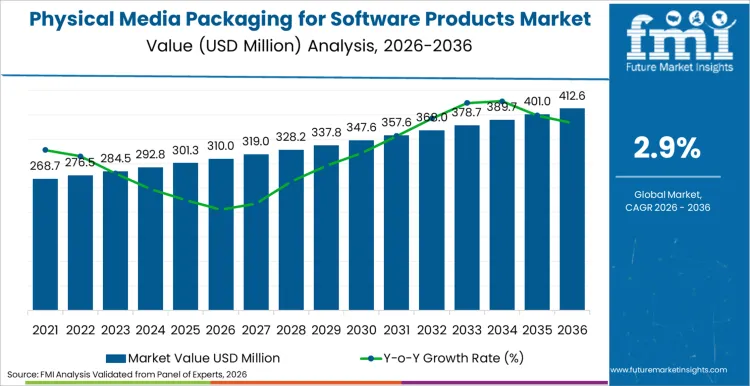
Summary of Physical Media Packaging for Software Products Market
What Is the Growth Outlook for the Physical Media Packaging for Software Products Market as per Future Market Insights Projection?
Future Market Insights projects the global physical media packaging for software products market to grow from USD 310 million in 2026 to USD 413 million by 2036, representing a 2.9% CAGR over the forecast period.
FMI Research Approach: Based on FMI’s proprietary global modeling framework incorporating hardware shipment forecasts (Nintendo, Sony), digital-to-physical split ratios, and raw material cost indices for polymer and paperboard.
How Do FMI Analysts Perceive the Physical Media Packaging for Software Products Market to Evolve?
FMI analysts perceive the market transitioning away from utilitarian duplication disc market dependency toward a "luxury collectible" model driven by high-value steelbooks and eco-friendly paper alternatives.
FMI Research Approach: Developed using analysis of publisher financial reports (Capcom, Ubisoft), regulatory filings on packaging waste (EU PPWR), and specialized vendor product roadmaps (Scanavo).
Which Country Holds the Largest Share in the Global Physical Media Packaging for Software Products Market?
India holds a significant production and consumption share, growing at 4.6%, supported by a massive localized gaming demographic and its role as a cost-effective manufacturing hub for global exports.
FMI Research Approach: Built using country-level manufacturing output data, plastic waste compliance reports (MoEFCC), and export volumes of packaged software media.
How Large Will the Physical Media Packaging for Software Products Market Be by 2036?
The global physical media packaging for software products market is expected to reach USD 413 million by 2036, with the Game Discs segment currently commanding a 56.0% share of the volume.
FMI Research Approach: Long-term forecasts rely on console lifecycle projections, gamer demographic shifts toward digital-first behaviors, and the substitution rate of plastic cases with digital codes.
What Is the Definition of the Physical Media Packaging for Software Products Market?
The market encompasses revenue generated from the manufacturing and sale of primary and secondary packaging solutions specifically designed for physical software media, including video games, enterprise software, and educational content.
FMI Research Approach: Definition structured using FMI’s segmentation taxonomy covering material types (plastic, paper, metal), end-use sectors, and packaging formats.
What Are Globally Unique Trends Shaping the Physical Media Packaging for Software Products Market?
Globally, the sector is shaped by the "Code-in-Box" phenomenon in retail channels and the "Green Packaging" mandate, where regulations like the EU's PPWR force a switch to recordable optical disc alternatives like biodegradable sleeves.
FMI Research Approach: Insights derived from global sustainability reports, major publisher retail strategies, and legislative timelines for packaging waste reduction.
Physical Media Packaging for Software Products Market Key Takeaways
| Metric | Details |
|---|---|
| Industry Size (2026) | USD 310 million |
| Industry Value (2036) | USD 413 million |
| CAGR (2026-2036) | 2.9% |
Source: Future Market Insights (FMI) analysis, based on proprietary forecasting model and primary research.
Why Is Regulatory Compliance Reshaping Packaging Designs?
As per FMI's projection, strict environmental mandates are forcing a fundamental redesign of software packaging, moving the industry away from traditional polymers toward strictly regulated material standards. In China, the State Administration for Market Regulation (SAMR) enforced the GB43284-2023 standard in 2024, which explicitly limits packaging for specific consumer goods to no more than three layers and caps packaging costs at 20 percent of the sales price. This regulatory ceiling creates a direct pressure on manufacturers to strip away excessive plastic wraps and decorative inserts that do not add functional value. Consequently, suppliers effectively servicing the consumer electronics packaging must now innovate within tight weight and layer constraints or face market exclusion.
Compliance costs are further escalating due to the implementation of circularity targets in export markets, which penalize non-recyclable formats. The EU’s Packaging and Packaging Waste Regulation (PPWR) has set a clear trajectory, with targets for 100 percent recyclable packaging by 2030, effectively signaling the end for mixed-material cases that cannot be easily separated. For manufacturing hubs in Asia, this shifts the competitive advantage toward those who can source certified packaging materials options like mono-material polypropylene or recycled paperboard. Manufacturers that fail to adapt their supply chains to these new "green gates" risk losing access to lucrative Western retail shelves, where retailer procurement policies increasingly mandate full EPR compliance before a product is even listed.
How is Physical Media Packaging for Software Products Market Segmented?
The market is segmented by media format, packaging form, and end use, revealing a distinct concentration of value in console gaming formats and rigid packaging structures despite the digital shift. The Game Discs segment dominates the media format landscape, while Keep Cases retain the bulk of packaging form volume, and Gaming Publishers account for the majority of end-use revenue. By 2036, the mix will pivot as Keep Cases lose ground to sustainable Paperboard Sleeves and high-value Collector Packs, driven by the dual pressures of environmental regulation and the need for premium retail differentiation. Data from 2024 indicates that while unit volumes for standard discs may flatten, the revenue-per-unit for specialized packaging is climbing, supported by a 6.0% market share held by leaders like Amcor who are actively re-engineering their polymer portfolios.
Why Game Discs Retain Dominant Share?
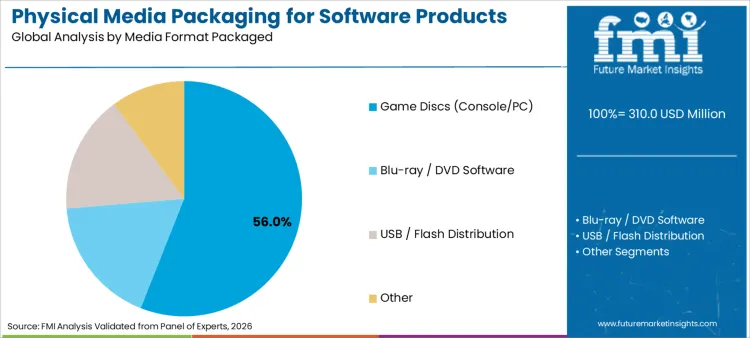
Game Discs (Console/PC) command a 56.0% share of the market, serving as the primary revenue engine for the physical packaging sector even as digital downloads rise. This segment's resilience is underpinned by the massive installed base of hardware that relies on optical media, exemplified by Nintendo's shipment of 1.26 million Switch units in late 2024 alone. For packaging suppliers, this volume translates into a steady, albeit slowly declining, demand for duplication disc compatible cases that must meet precise automated insertion standards. The mechanism sustaining this share is the "gifting and collecting" behavior of the gaming demographic, where the physical disc serves as a tangible asset that digital files cannot replicate. Consequently, publishers continue to invest in physical runs for flagship titles, ensuring that manufacturing lines for disc cases remain a critical, cash-generating component of the broader supply chain.
How Are Keep Cases Adapting To Plastic Rules?
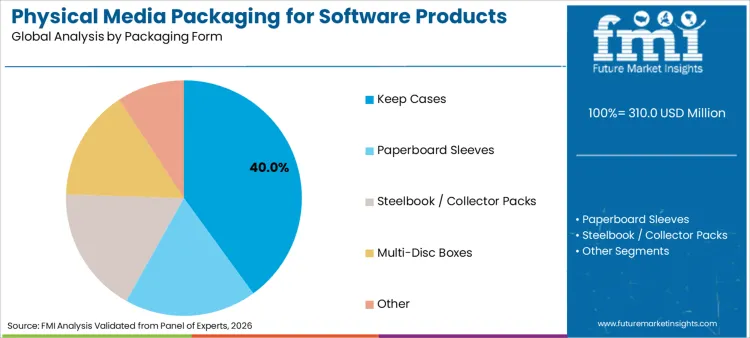
Keep Cases hold a 40.0% share of the packaging form segment, but this dominance is under siege from aggressive plastic reduction mandates in key markets. In India, the Ministry of Environment, Forest and Climate Change (MoEFCC) enforced new rules in 2024 mandating that plastic packaging must be at least 75 microns in thickness to ensure recyclability and waste management efficiency. This regulatory floor forces manufacturers to upgrade their molding equipment to produce thicker, more durable, and fully recyclable rigid boxes compliant cases, driving up unit costs but ensuring market access. The shift changes the economic equation for suppliers, who must now balance the low-cost expectations of mass-market software with the higher material requirements of the new laws. As a result, the segment is bifurcating, with standard keep cases becoming more expensive to produce, incentivizing a gradual shift toward paper-based alternatives for budget titles.
Why Gaming Publishers Drive End Use Demand?
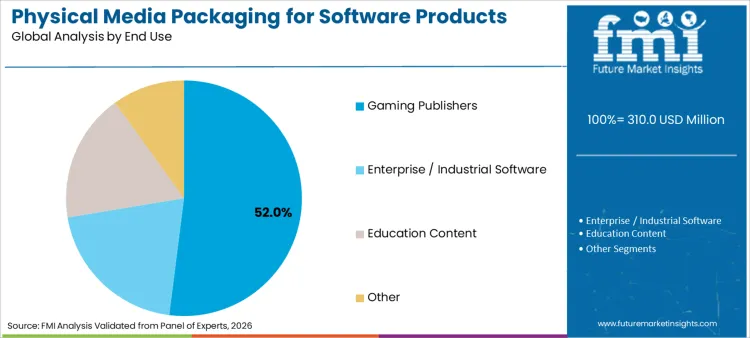
Gaming Publishers account for 52.0% of the market's end-use demand, dictating the design trends and material choices for the entire industry. This dominance is fueled by the strategic need for publishers like Ubisoft, despite a 17.5% revenue drop in FY2024, to maintain a retail presence that captures casual buyers and collectors alike. The mechanism here is the "retail anchor" effect; without a physical box on a shelf, a game loses visibility to a significant segment of the walk-in consumer base, regardless of digital availability. This reality forces publishers to continue procuring recordable optical disc compatible packaging, even as they push digital sales. However, the nature of this demand is changing, with publishers increasingly requesting "code-in-box" solutions that utilize the physical package purely as a merchandising tool rather than a media carrier.
Why Is Premiumization Reshaping Profit Pools?
According to FMI's estimates, the contraction of the mass market is driving a decisive shift toward high-margin, limited-edition packaging that serves as a collectible asset. As standard plastic cases become commoditized and regulated, value is migrating to the "Superfan" segment, where consumers are willing to pay premiums of USD 100 or more for elaborate physical sets. A clear indicator of this trend is the 2024 launch of the "Worlds 2024 Collector's Edition" by Riot Games, priced at USD 499.99, which utilizes packaging not just as a container but as a central part of the product's value proposition. This dynamic forces packaging providers to upgrade their capabilities from simple injection molding to complex multi-material assembly involving metal, high-grade folding boxboard stocks, and intricate finishing techniques. The longevity of this premium segment is reinforced by the cultural attachment gamers have to tangible ownership in an increasingly ephemeral digital world.
Scanavo Corporate Blog, Corporate Communications at Scanavo, noted in December 2024:
"This year, we honor a milestone in the world of Home Entertainment and gaming collectibles, the 20th anniversary of the very first SteelBook edition on PS2." This statement underscores how branded, durable packaging formats like SteelBook have transcended their utility to become longevity brands in their own right. For suppliers, the implication is that profitability now depends on securing licensing deals for these premium formats rather than competing on volume for standard custom boxes contracts.
Which Constraint Is Reshaping Regional Growth?
Regional divergence is widening as Asian manufacturing hubs grapple with new circular economy laws while Western markets focus on premium collector value. Investments in local recycling infrastructure and compliance certification are becoming the new gatekeepers for market entry. Official data from Vietnam’s Ministry of Natural Resources and Environment indicates a mandated recycling ratio of 10–22% for packaging producers in 2024, creating a direct cost burden that reshapes the region's export competitiveness.
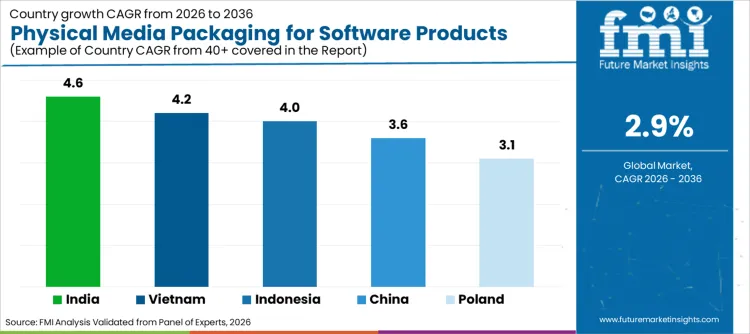
| Country | CAGR (2026 to 2036) |
|---|---|
| India | 4.6% |
| Vietnam | 4.2% |
| Indonesia | 4.0% |
| China | 3.6% |
| Poland | 3.1% |
Source: Future Market Insights (FMI) analysis, based on proprietary forecasting model and primary research.
Why India Demands Thicker Plastic?
Sales of physical media packaging in India are set to rise at 4.6% CAGR, driven by a rigid regulatory framework that is eliminating low-grade plastics from the supply chain. The Ministry of Environment, Forest and Climate Change (MoEFCC) enforced rules in 2024 that ban packaging material under 75 microns, a move that fundamentally alters the cost structure for domestic manufacturers of paper packaging and plastic alternatives. This thickness mandate forces local converters to invest in upgraded extrusion machinery, pushing the market toward higher-quality, durable packaging solutions that comply with the new "waste-to-wealth" standards. For international publishers selling into India, this means that standard global packaging SKUs may no longer be compliant, necessitating India-specific production runs that meet the higher material specifications.
How Vietnam Targets Circularity?
Demand for physical media packaging in Vietnam is anticipated to grow at 4.2% CAGR, anchored by the country's aggressive implementation of Extended Producer Responsibility (EPR) schemes. In 2024, the government enforced a recycling ratio of 10-22% for various packaging types, requiring manufacturers to either recycle their waste output or pay into a national environmental protection fund. This policy creates a "pay-to-pollute" mechanism that incentivizes the adoption of packing boxes designs made from easily recyclable materials like mono-material plastics or certified paperboard. Consequently, Vietnam is positioning itself as a "green manufacturing" hub, attracting contracts from global software publishers who need to ensure their supply chains meet strict international sustainability criteria.
Why China Faces Tariff Headwinds?
The physical media packaging industry in China is projected to expand at 3.6% CAGR, though growth is tempered by external trade pressures and internal excessive packaging curbs. Nintendo Management, Corporate Management at Nintendo Co., Ltd., stated in May 2025:
"Nintendo is assuming for projections that USA government tariffs introduced last month will be in place for the entire fiscal year and will adjust their projections if circumstances change."
This geopolitical friction forces Chinese manufacturers to navigate a volatile export landscape where tariff costs can suddenly erode margins. Simultaneously, domestic regulations limiting packaging to three layers for consumer goods push local producers to strip complexity from their designs, favoring minimalist custom packaging boxes solutions that reduce material usage while maintaining structural integrity.
How Indonesia Enforces Waste Responsibility?
Physical media packaging in Indonesia is poised to register a 4.0% CAGR, fueled by a nascent but firm regulatory timeline for producer accountability. To avoid future penalties, companies are pre-emptively upgrading their boxboard packaging portfolios to include higher percentages of recycled content, ensuring they are audit-ready when the new compliance gates officially close in 2026. Agus Rusli, Director of Waste Reduction at the Ministry of Environment (KLH), noted in December 2025:
"However, the initiative permit has not yet been issued, and we have been asked to complete it within the first half of 2026. The technical aspects have been finalized. What remains is a series of inter-ministerial discussions." This imminent finalization of EPR rules signals a mandatory shift for all packaging suppliers operating in or exporting to Indonesia.
Why Poland Leads EU Compliance?
The physical media packaging market in Poland is growing at 3.1% CAGR, acting as the primary European fortress for compliant manufacturing under the new EU PPWR regime. With a forecasted packaging fee introduction in 2026 expected to start at 8% of the product fee and rise to 20% the following year, Polish converters are rapidly pivoting to mono-material solutions. This cost escalation mechanism drives a clear wedge between compliant and non-compliant suppliers, forcing the entire software supply chain in Europe to adopt united states boxboard packaging style standards of recyclability. As a result, Poland is consolidating its role as the preferred hub for high-quality, audit-safe packaging production for the entire European continent.
How Is Competition Shifting Toward Capability?
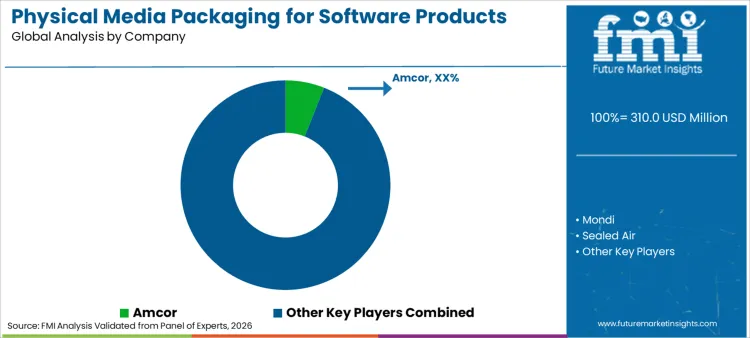
FMI analysts opine that competitive advantage in the physical media packaging market now depends less on brand breadth and more on who controls the constraint that gates scale, whether it be circularity certification or high-end design capability. The market is bifurcating between volume players like Amcor, who hold significant market share by leveraging massive economies of scale to absorb regulatory compliance costs, and agile specialists who focus on the collector niche. This dominance of large players in the standard segment is driven by their ability to invest in expensive computer peripherals compatible automation that ensures error-free insertion of discs and leaflets at high speeds. For smaller entrants, the barrier to entry is no longer just capital but the "green qualification" required to even bid for contracts with major global publishers who can not afford supply chain compliance risks.
Conversely, the profit pools for challenger brands are concentrating in the "super-premium" tier where design IP trumps manufacturing volume. Companies like Scanavo and Limited Run Games are executing a strategy of vertical integration, controlling everything from the artistic concept to the final hi-fi systems compatible metal casing. A clear signal of this strategic vector is Scanavo's win at the BASE Awards 2024 for their "Gladiator" packaging, validating the thesis that superior aesthetic execution commands pricing power that defies broader market deflation. This forces incumbents to either acquire these boutique capabilities or risk being relegated to the low-margin commodity business of standard plastic cases.
Recent Developments:
- In January 2026, Limited Run Games released a physical console version of Capcom Arcade Stadium Vol. 1, complete with custom boxed packaging and retro-inspired designs, supporting ongoing demand for tangible physical editions of digital arcade collections in the software products segment.
- In October 2025, Limited Run Games hosted its LRG3 2025 event, announcing over 25 new physical releases for Nintendo Switch, PlayStation, and other platforms, featuring premium collector's editions with enhanced packaging elements like steelbooks, art cards, and soundtracks to appeal to collectors in the physical software market.
- In February 2025, Fresh Brewed Games launched exclusive steelbook editions for select indie titles, introducing durable metal case packaging that elevates the premium feel and collectibility of physical game releases, targeting enthusiasts seeking high-quality physical media.
Key Players in Physical Media Packaging for Software Products Market
- Amcor
- Mondi
- Sealed Air
- Sonoco
- Huhtamaki / DS Smith
- Scanavo
- Limited Run Games
- Graphic Packaging International
- Printful
- R.R. Donnelley & Sons
- Smurfit WestRock
Market Definition
The physical media packaging for software products market encompasses a comprehensive commercial ecosystem that focuses on the intricate processes involved in the design, manufacturing, and supply of both primary and secondary packaging solutions specifically tailored for physical software media. This market segment plays a crucial role in the software industry, providing consumers with recognizable and functional packaging that not only protects the software contained within but also enhances its aesthetic appeal. Primary packaging refers to the immediate packaging that holds the product, while secondary packaging includes additional layers designed for branding and protection during distribution
The collection of packaging types within this market not only fulfills functional requirements but also serves as a medium for marketing and branding, thus playing an essential role in attracting consumers. Rigid plastic keep cases, often used for CDs and DVDs, provide a secure, transparent display that helps consumers easily identify the product while safeguarding it from scratches and damage. Paperboard sleeves, on the other hand, offer a more eco-friendly alternative, appealing to environmentally conscious consumers while also allowing for colorful graphics and branding opportunities. Steelbooks are a premium option that appeals to collectors, often featuring unique artwork and special finishes that enhance their value and desirability.
It is important to note that this market specifically excludes digital distribution platforms, which have gained significant traction in recent years due to the convenience and immediacy they offer users. Unlike physical media packaging, digital distribution eliminates the need for tangible packaging and relies entirely on software downloads or streaming services, which fundamentally alters the consumer experience and engagement with the product. Furthermore, general-purpose packaging that is not specifically designed for optical or flash media storage is also beyond the scope of this market. This includes packaging solutions that lack the functional design elements necessary for securely holding and protecting physical media such as discs or USB drives.
Report Scope
| Items | Values |
|---|---|
| Quantitative Units (2026) | USD 310 million |
| Product Type | Keep Cases, Paperboard Sleeves, Steelbook/Collector Packs, Multi-Disc Boxes |
| Application or Procedure type | Game Discs (Console/PC), Blu-ray / DVD Software, USB / Flash Distribution |
| End user | Gaming Publishers, Enterprise / Industrial Software, Education Content |
| Regions covered | North America, Latin America, Europe, East Asia, South Asia & Pacific, Middle East & Africa |
| Countries covered | India, Vietnam, China, Indonesia, Poland, USA, Germany, Japan, UK |
| Key companies profiled | Amcor, Mondi, Scanavo, Sealed Air, Huhtamaki |
| Additional attributes | Revenue analysis by segments, adoption trends across settings, regulatory and compliance landscape (as relevant), pricing and reimbursement considerations (when relevant), channel mix economics, supply chain exposure, and competitive positioning analysis |
Source: Future Market Insights (FMI) analysis, based on proprietary forecasting model and primary research.
Physical Media Packaging for Software Products Market by Segments
By Media Format:
- Game Discs (Console/PC)
- Blu-ray / DVD Software
- USB / Flash Distribution
- Other
By Packaging Form:
- Keep Cases
- Paperboard Sleeves
- Steelbook / Collector Packs
- Multi-Disc Boxes
- Other
By End Use:
- Gaming Publishers
- Enterprise / Industrial Software
- Education Content
- Other
Bibliography
- Ministry of Environment, Forest and Climate Change (MoEFCC). (2024). Plastic Waste Management (Amendment) Rules, 2024. Government of India.
- State Administration for Market Regulation (SAMR). (2023). GB 23350-2021 Requirements of Restricting Excessive Package. Government of China.
- Ministry of Natural Resources and Environment (MONRE). (2024). National Environmental Protection Strategy and EPR Decrees. Government of Vietnam.
- Nintendo Co., Ltd. (2025). Consolidated Financial Statements and Dividend Policy.
- Capcom Co., Ltd. (2024). Integrated Report and Financial Review 2024.
- European Parliament. (2024). Packaging and Packaging Waste Regulation (PPWR) Adoption Texts. EU Publications.
- Ministry of National Development Planning (Bappenas). (2025). National Circular Economy Roadmap 2025-2045. Government of Indonesia.
Frequently Asked Questions
What is the current market size for Physical Media Packaging for Software Products?
The global market is valued at USD 310 million in 2026, stabilized by the "long tail" of legacy hardware and the premium collector economy.
What is the projected CAGR for the Physical Media Packaging market?
The market is projected to grow at a modest 2.9% CAGR from 2026 to 2036, reflecting a balance between declining mass volumes and rising unit prices for collector editions.
Which country is a key manufacturing hub for this market?
India is a critical production center growing at 4.6%, leveraging its industrial plastic capacity to service both domestic education needs and export markets.
Which segment dominates the market by volume?
Game Discs (Console/PC) account for 56.0% of the market share, driven by the continued retail presence of major console platforms like Nintendo Switch and PlayStation.
What are the key trends shaping the market globally?
The market is being reshaped by the "Code-in-Box" retail trend and strict "Green Packaging" regulations like the EU's PPWR that mandate 100% recyclability.
Preview the report firsthand - request a free sample
Get SampleGet the brochure for pricing and purchase details.
Get PDFTable of Content
- Executive Summary
- Global Market Outlook
- Demand-side Trends
- Supply-side Trends
- Technology Roadmap Analysis
- Analysis and Recommendations
- Market Overview
- Market Coverage / Taxonomy
- Market Definition / Scope / Limitations
- Market Background
- Market Dynamics
- Drivers
- Restraints
- Opportunity
- Trends
- Scenario Forecast
- Demand in Optimistic Scenario
- Demand in Likely Scenario
- Demand in Conservative Scenario
- Opportunity Map Analysis
- Product Life Cycle Analysis
- Supply Chain Analysis
- Investment Feasibility Matrix
- Value Chain Analysis
- PESTLE and Porter’s Analysis
- Regulatory Landscape
- Regional Parent Market Outlook
- Production and Consumption Statistics
- Import and Export Statistics
- Market Dynamics
- Global Market Analysis 2021 to 2025 and Forecast, 2026 to 2036
- Historical Market Size Value (USD Million) Analysis, 2021 to 2025
- Current and Future Market Size Value (USD Million) Projections, 2026 to 2036
- Y-o-Y Growth Trend Analysis
- Absolute $ Opportunity Analysis
- Global Market Pricing Analysis 2021 to 2025 and Forecast 2026 to 2036
- Global Market Analysis 2021 to 2025 and Forecast 2026 to 2036, By Media Format Packaged
- Introduction / Key Findings
- Historical Market Size Value (USD Million) Analysis By Media Format Packaged , 2021 to 2025
- Current and Future Market Size Value (USD Million) Analysis and Forecast By Media Format Packaged , 2026 to 2036
- Game Discs (Console/PC)
- Blu-ray / DVD Software
- USB / Flash Distribution
- Other
- Game Discs (Console/PC)
- Y-o-Y Growth Trend Analysis By Media Format Packaged , 2021 to 2025
- Absolute $ Opportunity Analysis By Media Format Packaged , 2026 to 2036
- Global Market Analysis 2021 to 2025 and Forecast 2026 to 2036, By Packaging Form
- Introduction / Key Findings
- Historical Market Size Value (USD Million) Analysis By Packaging Form, 2021 to 2025
- Current and Future Market Size Value (USD Million) Analysis and Forecast By Packaging Form, 2026 to 2036
- Keep Cases
- Paperboard Sleeves
- Steelbook / Collector Packs
- Multi-Disc Boxes
- Other
- Keep Cases
- Y-o-Y Growth Trend Analysis By Packaging Form, 2021 to 2025
- Absolute $ Opportunity Analysis By Packaging Form, 2026 to 2036
- Global Market Analysis 2021 to 2025 and Forecast 2026 to 2036, By End Use
- Introduction / Key Findings
- Historical Market Size Value (USD Million) Analysis By End Use, 2021 to 2025
- Current and Future Market Size Value (USD Million) Analysis and Forecast By End Use, 2026 to 2036
- Gaming Publishers
- Enterprise / Industrial Software
- Education Content
- Other
- Gaming Publishers
- Y-o-Y Growth Trend Analysis By End Use, 2021 to 2025
- Absolute $ Opportunity Analysis By End Use, 2026 to 2036
- Global Market Analysis 2021 to 2025 and Forecast 2026 to 2036, By Region
- Introduction
- Historical Market Size Value (USD Million) Analysis By Region, 2021 to 2025
- Current Market Size Value (USD Million) Analysis and Forecast By Region, 2026 to 2036
- North America
- Latin America
- Western Europe
- Eastern Europe
- East Asia
- South Asia and Pacific
- Middle East & Africa
- Market Attractiveness Analysis By Region
- North America Market Analysis 2021 to 2025 and Forecast 2026 to 2036, By Country
- Historical Market Size Value (USD Million) Trend Analysis By Market Taxonomy, 2021 to 2025
- Market Size Value (USD Million) Forecast By Market Taxonomy, 2026 to 2036
- By Country
- USA
- Canada
- Mexico
- By Media Format Packaged
- By Packaging Form
- By End Use
- By Country
- Market Attractiveness Analysis
- By Country
- By Media Format Packaged
- By Packaging Form
- By End Use
- Key Takeaways
- Latin America Market Analysis 2021 to 2025 and Forecast 2026 to 2036, By Country
- Historical Market Size Value (USD Million) Trend Analysis By Market Taxonomy, 2021 to 2025
- Market Size Value (USD Million) Forecast By Market Taxonomy, 2026 to 2036
- By Country
- Brazil
- Chile
- Rest of Latin America
- By Media Format Packaged
- By Packaging Form
- By End Use
- By Country
- Market Attractiveness Analysis
- By Country
- By Media Format Packaged
- By Packaging Form
- By End Use
- Key Takeaways
- Western Europe Market Analysis 2021 to 2025 and Forecast 2026 to 2036, By Country
- Historical Market Size Value (USD Million) Trend Analysis By Market Taxonomy, 2021 to 2025
- Market Size Value (USD Million) Forecast By Market Taxonomy, 2026 to 2036
- By Country
- Germany
- UK
- Italy
- Spain
- France
- Nordic
- BENELUX
- Rest of Western Europe
- By Media Format Packaged
- By Packaging Form
- By End Use
- By Country
- Market Attractiveness Analysis
- By Country
- By Media Format Packaged
- By Packaging Form
- By End Use
- Key Takeaways
- Eastern Europe Market Analysis 2021 to 2025 and Forecast 2026 to 2036, By Country
- Historical Market Size Value (USD Million) Trend Analysis By Market Taxonomy, 2021 to 2025
- Market Size Value (USD Million) Forecast By Market Taxonomy, 2026 to 2036
- By Country
- Russia
- Poland
- Hungary
- Balkan & Baltic
- Rest of Eastern Europe
- By Media Format Packaged
- By Packaging Form
- By End Use
- By Country
- Market Attractiveness Analysis
- By Country
- By Media Format Packaged
- By Packaging Form
- By End Use
- Key Takeaways
- East Asia Market Analysis 2021 to 2025 and Forecast 2026 to 2036, By Country
- Historical Market Size Value (USD Million) Trend Analysis By Market Taxonomy, 2021 to 2025
- Market Size Value (USD Million) Forecast By Market Taxonomy, 2026 to 2036
- By Country
- China
- Japan
- South Korea
- By Media Format Packaged
- By Packaging Form
- By End Use
- By Country
- Market Attractiveness Analysis
- By Country
- By Media Format Packaged
- By Packaging Form
- By End Use
- Key Takeaways
- South Asia and Pacific Market Analysis 2021 to 2025 and Forecast 2026 to 2036, By Country
- Historical Market Size Value (USD Million) Trend Analysis By Market Taxonomy, 2021 to 2025
- Market Size Value (USD Million) Forecast By Market Taxonomy, 2026 to 2036
- By Country
- India
- ASEAN
- Australia & New Zealand
- Rest of South Asia and Pacific
- By Media Format Packaged
- By Packaging Form
- By End Use
- By Country
- Market Attractiveness Analysis
- By Country
- By Media Format Packaged
- By Packaging Form
- By End Use
- Key Takeaways
- Middle East & Africa Market Analysis 2021 to 2025 and Forecast 2026 to 2036, By Country
- Historical Market Size Value (USD Million) Trend Analysis By Market Taxonomy, 2021 to 2025
- Market Size Value (USD Million) Forecast By Market Taxonomy, 2026 to 2036
- By Country
- Kingdom of Saudi Arabia
- Other GCC Countries
- Turkiye
- South Africa
- Other African Union
- Rest of Middle East & Africa
- By Media Format Packaged
- By Packaging Form
- By End Use
- By Country
- Market Attractiveness Analysis
- By Country
- By Media Format Packaged
- By Packaging Form
- By End Use
- Key Takeaways
- Key Countries Market Analysis
- USA
- Pricing Analysis
- Market Share Analysis, 2025
- By Media Format Packaged
- By Packaging Form
- By End Use
- Canada
- Pricing Analysis
- Market Share Analysis, 2025
- By Media Format Packaged
- By Packaging Form
- By End Use
- Mexico
- Pricing Analysis
- Market Share Analysis, 2025
- By Media Format Packaged
- By Packaging Form
- By End Use
- Brazil
- Pricing Analysis
- Market Share Analysis, 2025
- By Media Format Packaged
- By Packaging Form
- By End Use
- Chile
- Pricing Analysis
- Market Share Analysis, 2025
- By Media Format Packaged
- By Packaging Form
- By End Use
- Germany
- Pricing Analysis
- Market Share Analysis, 2025
- By Media Format Packaged
- By Packaging Form
- By End Use
- UK
- Pricing Analysis
- Market Share Analysis, 2025
- By Media Format Packaged
- By Packaging Form
- By End Use
- Italy
- Pricing Analysis
- Market Share Analysis, 2025
- By Media Format Packaged
- By Packaging Form
- By End Use
- Spain
- Pricing Analysis
- Market Share Analysis, 2025
- By Media Format Packaged
- By Packaging Form
- By End Use
- France
- Pricing Analysis
- Market Share Analysis, 2025
- By Media Format Packaged
- By Packaging Form
- By End Use
- India
- Pricing Analysis
- Market Share Analysis, 2025
- By Media Format Packaged
- By Packaging Form
- By End Use
- ASEAN
- Pricing Analysis
- Market Share Analysis, 2025
- By Media Format Packaged
- By Packaging Form
- By End Use
- Australia & New Zealand
- Pricing Analysis
- Market Share Analysis, 2025
- By Media Format Packaged
- By Packaging Form
- By End Use
- China
- Pricing Analysis
- Market Share Analysis, 2025
- By Media Format Packaged
- By Packaging Form
- By End Use
- Japan
- Pricing Analysis
- Market Share Analysis, 2025
- By Media Format Packaged
- By Packaging Form
- By End Use
- South Korea
- Pricing Analysis
- Market Share Analysis, 2025
- By Media Format Packaged
- By Packaging Form
- By End Use
- Russia
- Pricing Analysis
- Market Share Analysis, 2025
- By Media Format Packaged
- By Packaging Form
- By End Use
- Poland
- Pricing Analysis
- Market Share Analysis, 2025
- By Media Format Packaged
- By Packaging Form
- By End Use
- Hungary
- Pricing Analysis
- Market Share Analysis, 2025
- By Media Format Packaged
- By Packaging Form
- By End Use
- Kingdom of Saudi Arabia
- Pricing Analysis
- Market Share Analysis, 2025
- By Media Format Packaged
- By Packaging Form
- By End Use
- Turkiye
- Pricing Analysis
- Market Share Analysis, 2025
- By Media Format Packaged
- By Packaging Form
- By End Use
- South Africa
- Pricing Analysis
- Market Share Analysis, 2025
- By Media Format Packaged
- By Packaging Form
- By End Use
- USA
- Market Structure Analysis
- Competition Dashboard
- Competition Benchmarking
- Market Share Analysis of Top Players
- By Regional
- By Media Format Packaged
- By Packaging Form
- By End Use
- Competition Analysis
- Competition Deep Dive
- Amcor
- Overview
- Product Portfolio
- Profitability by Market Segments (Product/Age /Sales Channel/Region)
- Sales Footprint
- Strategy Overview
- Marketing Strategy
- Product Strategy
- Channel Strategy
- Mondi
- Sealed Air
- Sonoco
- Huhtamaki / DS Smith
- Amcor
- Competition Deep Dive
- Assumptions & Acronyms Used
- Research Methodology


