

- Industry Size (2026)
- USD 860 Mn
- Forecast (2036)
- USD 2740 Mn
- CAGR (2026 to 2036)
- 12.3%
Secure Media Packaging for Data Storage Devices Market Forecast and Outlook 2026 to 2036
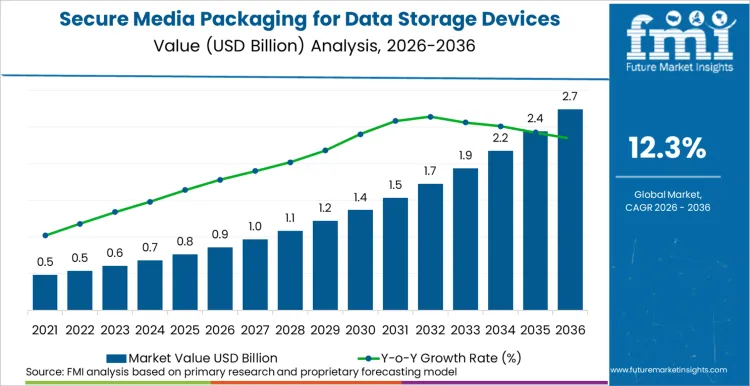
Secure media packaging for data storage devices market revenue is projected to total USD 860 million in 2026, increasing to USD 2,740 million by 2036, at a CAGR of 12.3%. FMI analysis indicates the market is undergoing a fundamental shift from generic protective packaging to engineered solutions tailored for specific device form factors, data sensitivity levels, and logistics environments. The landscape is defined by the large-scale adoption of next-generation storage media like QLC NAND and HAMR HDDs, which are more susceptible to physical shock and environmental factors, demanding higher-performance packaging.
Expansion is supported by rapid expansion of global data creation and the resulting physical movement of storage hardware for installation, maintenance, secure transport, and archival. As data is distributed across edge data centers and regional facilities, storage devices frequently move between controlled environments for cloning, replacement, and secure handling. In regulated sectors such as finance, healthcare, and government, packaging for these devices is treated as a risk-mitigation asset rather than a discretionary cost, driving demand for solutions that combine physical protection, ESD control, and traceability.
Tekni Plex participates in this market through its broader capabilities in thermoformed and specialty protective packaging, including materials engineered for electronics protection. While the company does not publicly position products as enterprise storage-specific, its documented focus on material performance, cleanliness, and controlled properties reflects the requirements of IT hardware distribution environments where contamination and ESD risk must be minimized.
Technical innovation across the sector is increasingly focused on lightweighting, durability, and reuse, rather than on embedding electronics into the packaging itself. Sonoco Products Company has emphasized protective packaging designs that improve handling efficiency and incorporate recycled content, aligning with corporate sustainability objectives while maintaining the mechanical robustness required for repeated logistics cycles. These developments support secure transport use cases without relying on unverified claims of integrated electronic shielding features.
In Europe, custom engineering and application-specific qualification rather than standardized products shape competition. Allfo GmbH is active in designing rigid transport cases and protective systems used across industrial and electronics logistics. Its market relevance stems from tailoring foam configurations, case geometries, and protection levels to customer specifications, an approach that supports long-term supplier relationships in secure equipment transport, even where formal OEM validation disclosures are not public.
In Asia, scale manufacturing and cost efficiency remain dominant competitive levers. Suppliers serving electronics OEM ecosystems focus on high-volume protective packaging formats that balance clarity, impact resistance, and recyclability. Rather than beverage-focused players, regional plastics converters and case manufacturers that adapt mono-material designs and anti-static treatments to meet growing regulatory and sustainability expectations for electronics logistics packaging serve this space.
Summary of Secure Media Packaging for Data Storage Devices Market
- The secure media packaging for data storage devices market comprises protective packaging solutions specifically designed for HDDs, SSDs, backup tapes, and other storage media during transport and distribution, with features including ESD protection, shock absorption, crush resistance, and tamper evidence.
- The defined scope follows FMI taxonomy, covering primary packaging that is in direct contact with the device, including clamshells, rigid cases, foam inserts, and custom solutions. It excludes tertiary shipping boxes, bulk palletization, and retail blister packs unless specifically designed for data storage media security.
- The market is projected to grow at a CAGR of 12.3% from 2026 to 2036, expanding from USD 860 million in 2026 to USD 2,740 million by 2036, based on FMI proprietary modeling incorporating global data storage hardware shipment forecasts, corporate data governance policies, and primary interviews with logistics managers and OEM procurement teams.
- The sector is transitioning from passive protection to active, intelligent custody assurance, with solutions segmenting by data criticality from cost-optimized packs for consumer SSDs to militarized-grade cases for encrypted enterprise drives.
- Competition is concentrated between specialized technical packaging firms and broad-line industrial packaging giants, with differentiation driven by material science expertise, OEM qualification success, and value-added services like kitting and serialization.
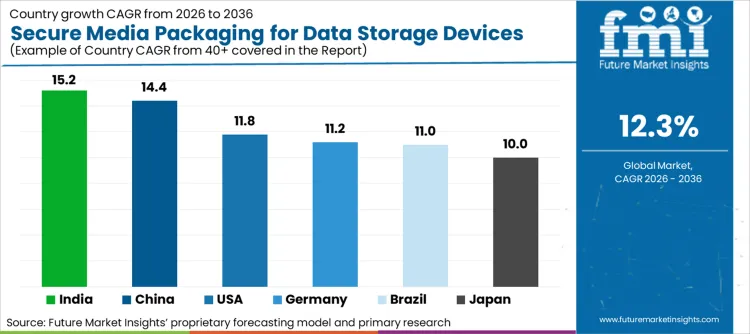
- India records the fastest growth at 15.2% CAGR through 2036, driven by its emergence as a global IT hardware manufacturing and data center hub, while North America remains the largest value market, shaped by stringent corporate data governance and the density of enterprise storage vendors.
Secure Media Packaging for Data Storage Devices Market Key Takeaways
| Metrics | Values |
|---|---|
| Expected Value (2026E) | USD 860 million |
| Projected Value (2036F) | USD 2,740 million |
| CAGR (2026 to 2036) | 12.3% |
Source: Future Market Insights (FMI) analysis, based on proprietary forecasting model and primary research
Why is the Secure Media Packaging for Data Storage Devices Market Growing?
The hardening of corporate and regulatory data governance policies is a primary demand driver. Standards such as ISO 27001 and regulations like GDPR implicitly mandate secure physical handling of storage devices. Failure to protect data in transit can result in compliance breaches. Secure, tamper-evident packaging provides auditable proof of due care, transforming packaging from a logistics item into a compliance instrument.
The rising financial value of data recovery versus device replacement elevates packaging requirements. The cost of recovering data from a physically damaged enterprise HDD can far exceed the cost of the drive itself. Investment in packaging that guarantees a higher probability of device survival through the supply chain offers a direct and calculable ROI, particularly for managed service providers and data center operators handling client data.
The global fragmentation of the electronics supply chain necessitates more robust inter-factory transit. Storage media may be manufactured, tested, and assembled in different countries before reaching the end customer. Each leg of this journey increases handling risk. Packaging solutions that can withstand multiple logistics cycles without degradation are essential, driving demand for more durable materials like engineered polycarbonates and advanced foams over single-use alternatives.
How is the Secure Media Packaging for Data Storage Devices Market Segmented?
The packaging format, the dominant protective material, and the end-use application, reflecting a hierarchy of cost, protection level, and customization, segment the market. Anti-static clamshells lead in format share (38%), favored for their balance of cost-effectiveness, clear product visibility, and good ESD protection for high-volume distribution. Rigid cases and custom solutions capture higher value in applications where maximum physical security and tamper evidence are required.
How is the Dominance of PET & ESD Plastics Sustained in High-Volume Applications?
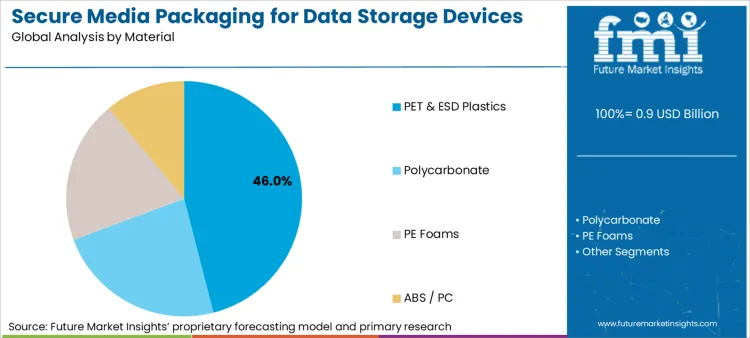
PET-based materials with permanent or coated ESD properties account for a leading 46% material share. This dominance is rooted in an optimal performance-to-cost ratio and manufacturing versatility. PET offers excellent clarity for barcode scanning and visual inspection, good rigidity for crush resistance, and can be easily thermoformed into precise clamshell shapes.
When compounded with permanent anti-static agents or coated, it provides reliable ESD protection without the contamination risks of loose carbon-filled bags. For the volume-driven IT hardware distribution and OEM electronics segments, this material combination represents the standard, cost-effective solution that meets essential protection benchmarks.
Which Factors are Concentrating Market Value in the IT Hardware Distribution Segment?
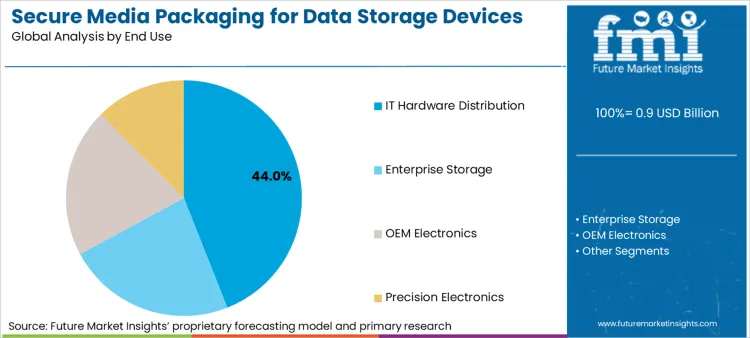
The IT Hardware Distribution end-use segment commands a 44% share, acting as the central volume channel and innovation filter. Distributors handle a vast SKU range from multiple OEMs, requiring packaging that is versatile, readily available, and easy to implement. Their demand prioritizes standardization, ease of automation in packing lines, and clarity for warehouse picking.
Successful packaging solutions in this segment often become de facto standards, influencing OEM choices. Furthermore, distributors are increasingly demanding sustainable options, pushing suppliers to develop recyclable mono-material ESD solutions that maintain performance, thereby driving upstream material innovation for the entire market.
What Role does Regional Manufacturing and Regulatory Clout Play in North America's Market Leadership?
North America holds a dominant 34% regional share, a position sustained not merely by consumption but by its role as the command center for global data storage technology. The region hosts the headquarters and primary R&D centers of most leading storage OEMs including Seagate, Western Digital, and Micron.
Packaging specifications and qualification standards are set here, creating a captive, high-value market for suppliers like Tekni-Plex and Sonoco that work in direct partnership with these OEMs. Stringent U.S. corporate data protection laws and defense contracts requiring MIL-SPEC packaging create a premium segment for high-assurance solutions, further elevating the region's average selling price and value share.
What Drivers, Restraints, Opportunities, and Trends Prevail in the Market?
Market expansion is supported by the insourcing of critical data infrastructure by national governments. "Data sovereignty" laws are prompting governments to build domestic data centers and storage archives. The secure transport of core infrastructure components for these projects often requires packaging that meets classified or governmental security standards, opening a high-margin niche for suppliers with relevant certifications and experience.
While demand is robust, a key restraint is the intense cost pressure from electronics OEMs, especially for consumer-grade devices. The packaging is often viewed as a pure cost item, leading to fierce margin compression for suppliers and a reluctance to adopt newer, more performant but expensive materials, potentially stifling innovation in the volume segment.
Technical innovation is defined by the integration of digital identity. Packaging is becoming a physical anchor for digital twin systems. QR codes or NFC tags embedded in the package are linked to the serial number of the device inside, enabling real-time tracking of custody, temperature, and shock events throughout the logistics chain, adding a layer of digital security and supply chain visibility.
The emergence of performant, bio-based polymers for rigid applications represents a disruptive opportunity. Developments in bio-PET and bio-polycarbonates that meet clarity and ESD requirements could allow suppliers to cater to the strong sustainability mandates of large tech corporations, creating a new differentiator and potentially restructuring material supply chains.
Analysis of Secure Media Packaging Market by Key Countries
| Country | CAGR (2026–2036) |
|---|---|
| USA | 11.8% |
| Germany | 11.2% |
| China | 14.4% |
| Japan | 10.0% |
| India | 15.2% |
| Brazil | 11.0% |
Source: FMI’s proprietary forecasting model and primary research
How do OEM Specification Powers and Defense Contracts Define the US Market?
USA, growing at an 11.8% CAGR, is characterized by the specification power of its domestic storage OEMs and the demands of the defense-industrial base. Packaging suppliers must navigate rigorous qualification processes set by OEMs, which can take years and require extensive testing data. Success in this market grants global credibility.
Contracts with the Department of Defense and federal agencies require packaging that meets MIL-STD-2073 or other standards, fostering a subset of suppliers skilled in producing certified, high-assurance cases. This dual dynamic, serving commercial OEMs and the government, creates a deep but demanding market with high barriers to entry.
What Role does Precision Engineering and Circular Economy Regulation Play in Germany?
Leadership in precision engineering for enterprise and industrial applications drives Germany’s 11.2% CAGR. German packaging firms like Allfo excel in creating custom, foam-in-place or thermoformed solutions that perfectly cradle intricate storage arrays or sensitive research equipment. The focus is on maximizing protection with minimal material use an exercise in engineering efficiency.
The EU’s stringent circular economy regulations, such as the Packaging and Packaging Waste Regulation (PPWR), are forcing innovation in design-for-recyclability. German suppliers are pioneering take-back schemes and mono-material complex cases to comply, setting technical standards that will eventually diffuse across the European region.
How is China's Market Evolving from Low-Cost Manufacturing to Domestic Tech Security?
China’s high 14.4% CAGR reflects a transition from being the world's low-cost packaging workshop to serving its own burgeoning demand for tech security. While export-oriented manufacturing remains a volume pillar, the fastest growth is in serving domestic data center builders, state-owned enterprises, and Chinese storage OEMs like Huawei's storage division.
These customers are increasingly concerned with securing the supply chain against geopolitical disruptions, favoring domestic suppliers like Greatview and Huilong. The packaging required often emphasizes cost-competitiveness but with rapidly improving quality standards, and increasingly incorporates requirements from China's own evolving data security laws.
How are Japan's Miniaturization Trends and Quality Culture Influencing Packaging?
Japan’s market, growing at a 10.0% CAGR, is uniquely shaped by the relentless miniaturization of electronics and a cultural emphasis on flawless quality. The packaging for storage devices used in robotics, medical imaging, and compact servers must be incredibly precise, often featuring micro-sized foam inserts or ultra-slim, rigid cases.
Suppliers like Toppan compete on micron-level tolerances and flawless, particulate-free production environments. The market is less driven by raw volume and more by the ability to meet exacting, often unwritten, quality standards and to collaborate intimately with Japanese OEMs on the design of next-generation device packaging.
How is India's Emergence as an IT Manufacturing Hub Catalyzing Local Packaging Demand?
India exhibits the highest CAGR at 15.2%, directly correlated with its successful Production Linked Incentive scheme for IT hardware. As global and domestic storage device assembly ramps up, it creates immediate, large-scale demand for compliant packaging.
Initially, imports or multinational suppliers may meet this demand, but it is rapidly catalyzing the growth of local technical packaging industries. The opportunity lies in developing solutions that are cost-optimized for the Indian market, potentially using different material blends, while still meeting the technical specifications passed down from global OEMs setting up local production.
Which Import Substitution and Regional Logistics Demands Shape Brazil's Market?
Brazil’s 11.0% CAGR is influenced by high import tariffs on finished goods and the complexities of its domestic logistics. There is strong economic incentive to produce packaging locally rather than import bulky, low-value items. Furthermore, the challenging domestic freight environment, with longer transit times and rougher handling, elevates the required performance standard for packaging compared to more streamlined logistics networks.
Brazilian suppliers like Klabin focus on developing robust, often heavier-duty solutions using local material sources to ensure devices survive the domestic supply chain, serving both the local subsidiaries of global tech firms and a growing domestic data center industry.
What is the Competition Outlook for Secure Media Packaging?
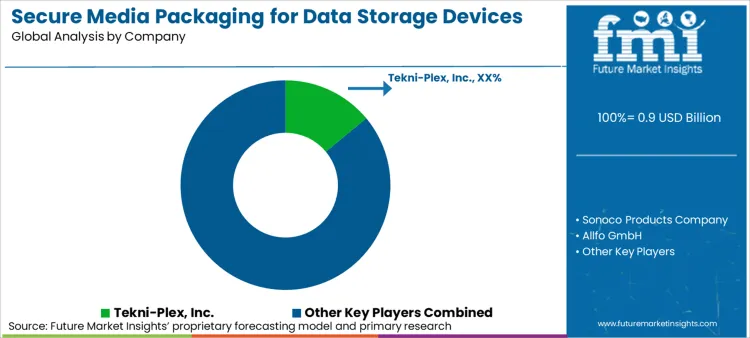
Competitive intensity is increasing as the market segments into high-volume, cost-optimized formats including standard trays, clamshells, and cushioning and low-volume, high-performance specialty packaging such as ESD-controlled, tamper-evident, returnable systems for sensitive or high-value devices. The key differentiator is shifting from simply supplying packaging to delivering qualification-ready solutions, materials and designs that come with test rationale, performance validation, and application guidance that reduce customer qualification cycles and security-risk exposure.
The observable strategic direction is materials know-how and process capability, notably ESD control, mechanical robustness, and fit-to-device geometry. Suppliers that control dissipative/conductive material formulations and repeatable conversion processes can deliver more consistent surface resistivity, lower failure rates, and better long-term handling performance attributes that matter when storage devices move through multi-node distribution and service logistics.
Strategic leadership is also moving toward closed-loop and reusable programs, especially where enterprise IT spares/returns generate repeat shipping lanes. Reusable ESD packaging (validated for repeated handling cycles) reduces both waste and damage risk, and it creates stickier supplier relationships when packaging is treated as an operational system rather than a consumable.
Recent Developments
- Corplex (AkyPak®) introduced “closed edge” technology for its AkyPak reusable packaging range (Dec 2024), strengthening durability and safety for repeat-use logistics highly relevant for returnable protective packaging used in sensitive equipment distribution loops.
- Utz Group published an updated technical position on ESD protection in packaging (Apr 2025), reinforcing the role of consistent ESD-safe packaging designs (e.g., trays/containers) in protecting electronic components during transport and storage.
Key Players Profiled
- Tekni-Plex, Inc.
- Sonoco Products Company
- Allfo GmbH
- Mondi Group
- Greatview Aseptic Packaging Co., Ltd.
- Huilong New Material Co., Ltd.
- Toppan Printing Co., Ltd.
- Berry Global, Inc.
- Klabin S.A.
- UFP Technologies, Inc.
Market Definition
The secure media packaging for data storage devices market comprises revenue generated from the design, manufacture, and sale of protective packaging solutions specifically engineered for the safe transport, storage, and handling of data storage hardware. This includes primary packaging such as rigid clamshells, thermoformed trays, cushioned cases, foam-in-place systems, and anti-static bags or wraps that provide protection against ESD, physical shock, vibration, crushing, and environmental contaminants.
The market scope covers packaging used for new device distribution, device returns (RMA), and secure inter-facility transfers within enterprise and government contexts. It excludes generic shipping boxes, bulk pallet wraps, and retail-focused blister packs not specifically designed to mitigate ESD or meet the precise physical protection standards required for data storage media.
Scope of Report
| Items | Values |
|---|---|
| Quantitative Units | USD 860 million |
| Packaging Format | Anti-Static Clamshells, Rigid Cases, Foam-in-Place Packs, Custom Cases, Others |
| Material | PET / ESD Plastics, Polycarbonate, PE Foams, ABS / PC, Others |
| End Use | IT Hardware Distribution, Enterprise Storage, OEM Electronics, Precision Electronics, Others |
| Regions Covered | North America, Europe, East Asia, Japan, South Asia, Latin America, Middle East & Africa |
| Countries | USA, Germany, China, Japan, India, Brazil and 40+ countries |
| Key Companies | Tekni-Plex, Sonoco, Allfo, Mondi, Greatview, Huilong, Toppan, Berry Global, Klabin, UFP Technologies |
Source: Future Market Insights (FMI) analysis, based on proprietary forecasting model and primary research
Secure Media Packaging for Data Storage Devices Market Key Segments
By Packaging Format
- Anti-Static Clamshells
- Rigid Cases
- Foam-in-Place Packs
- Custom Cases
- Others
By Material
- PET / ESD Plastics
- Polycarbonate
- PE Foams
- ABS / PC
- Others
By End Use
- IT Hardware Distribution
- Enterprise Storage
- OEM Electronics
- Precision Electronics
- Others
By Region
- North America
- Europe
- East Asia
- Japan
- South Asia
- Latin America
- Middle East & Africa
Bibliography
- JEDEC Solid State Technology Association. (2025). JESD22-A114: Electrostatic Discharge (ESD) Sensitivity Testing - Human Body Model. JEDEC.
- U.S. Department of Defense. (2025). MIL-STD-2073-1F: Standard Practice for Military Packaging. Department of Defense.
- Information Technology Industry Council. (2026). Supply Chain Security and Hardware Integrity Guidelines for ICT Equipment. ITI.
- National Institute of Standards and Technology (NIST). (2025). Supply Chain Risk Management Practices for Information and Communications Technology. NIST Special Publication.
- China Electronics Standardization Institute. (2025). Technical Requirements for Protective and ESD-Safe Packaging of Electronic Storage Equipment. CESI.
- Japan Electronics and Information Technology Industries Association (JEITA). (2025). Guidelines for Packaging and Transport of High-Reliability Electronic Components. JEITA.
- Brazilian Packaging Association (ABRE). (2025). Technical Packaging Requirements for Electronics and Data Storage Devices. ABRE.
Frequently Asked Questions
How big is the secure media packaging for data storage devices market in 2026?
The global secure media packaging for data storage devices market is estimated to be valued at USD 0.9 billion in 2026.
What will be the size of secure media packaging for data storage devices market in 2036?
The market size for the secure media packaging for data storage devices market is projected to reach USD 2.7 billion by 2036.
How much will be the secure media packaging for data storage devices market growth between 2026 and 2036?
The secure media packaging for data storage devices market is expected to grow at a 12.3% CAGR between 2026 and 2036.
What are the key product types in the secure media packaging for data storage devices market?
The key product types in secure media packaging for data storage devices market are pet & esd plastics , polycarbonate, pe foams and abs / pc.
Which end use segment to contribute significant share in the secure media packaging for data storage devices market in 2026?
In terms of end use, it hardware distribution segment to command 44.0% share in the secure media packaging for data storage devices market in 2026.
Preview the report firsthand - request a free sample
Get SampleGet the brochure for pricing and purchase details.
Get PDFTable of Content
- Executive Summary
- Global Market Outlook
- Demand-side Trends
- Supply-side Trends
- Technology Roadmap Analysis
- Analysis and Recommendations
- Market Overview
- Market Coverage / Taxonomy
- Market Definition / Scope / Limitations
- Research Methodology
- Chapter Orientation
- Analytical Lens and Working Hypotheses
- Market Structure, Signals, and Trend Drivers
- Company Annual and Sustainability Reports
- Peer-reviewed Journals and Academic Literature
- Corporate Websites, Product Literature, and Technical Notes
- Earnings Decks and Investor Briefings
- Statutory Filings and Regulatory Disclosures
- Technical White Papers and Standards Notes
- Trade Journals, Industry Magazines, and Analyst Briefs
- Conference Proceedings, Webinars, and Seminar Materials
- Government Statistics Portals and Public Data Releases
- Press Releases and Reputable Media Coverage
- Specialist Newsletters and Curated Briefings
- Sector Databases and Reference Repositories
- FMI Internal Proprietary Databases and Historical Market Datasets
- Subscription Datasets and Paid Sources
- Social Channels, Communities, and Digital Listening Inputs
- Additional Desk Sources
- Expert Input and Fieldwork (Primary Evidence)
- Primary Modes
- Qualitative Interviews and Expert Elicitation
- Quantitative Surveys and Structured Data Capture
- Blended Approach
- Why Primary Evidence is Used
- Field Techniques
- Interviews
- Surveys
- Focus Groups
- Observational and In-context Research
- Social and Community Interactions
- Stakeholder Universe Engaged
- C-suite Leaders
- Board Members
- Presidents and Vice Presidents
- R&D and Innovation Heads
- Technical Specialists
- Domain Subject-matter Experts
- Scientists
- Physicians and Other Healthcare Professionals
- Governance, Ethics, and Data Stewardship
- Research Ethics
- Data Integrity and Handling
- Primary Modes
- Tooling, Models, and Reference Databases
- Data Engineering and Model Build
- Data Acquisition and Ingestion
- Cleaning, Normalisation, and Verification
- Synthesis, Triangulation, and Analysis
- Quality Assurance and Audit Trail
- Market Background
- Market Dynamics
- Drivers
- Restraints
- Opportunity
- Trends
- Scenario Forecast
- Demand in Optimistic Scenario
- Demand in Likely Scenario
- Demand in Conservative Scenario
- Opportunity Map Analysis
- Product Life Cycle Analysis
- Supply Chain Analysis
- Investment Feasibility Matrix
- Value Chain Analysis
- PESTLE and Porter’s Analysis
- Regulatory Landscape
- Regional Parent Market Outlook
- Production and Consumption Statistics
- Import and Export Statistics
- Market Dynamics
- Global Market Analysis 2021 to 2025 and Forecast, 2026 to 2036
- Historical Market Size Value (USD Million) Analysis, 2021 to 2025
- Current and Future Market Size Value (USD Million) Projections, 2026 to 2036
- Y-o-Y Growth Trend Analysis
- Absolute $ Opportunity Analysis
- Global Market Pricing Analysis 2021 to 2025 and Forecast 2026 to 2036
- Global Market Analysis 2021 to 2025 and Forecast 2026 to 2036, By Material
- Introduction / Key Findings
- Historical Market Size Value (USD Million) Analysis By Material , 2021 to 2025
- Current and Future Market Size Value (USD Million) Analysis and Forecast By Material , 2026 to 2036
- PET & ESD Plastics
- Polycarbonate
- PE Foams
- ABS / PC
- PET & ESD Plastics
- Y-o-Y Growth Trend Analysis By Material , 2021 to 2025
- Absolute $ Opportunity Analysis By Material , 2026 to 2036
- Global Market Analysis 2021 to 2025 and Forecast 2026 to 2036, By End Use
- Introduction / Key Findings
- Historical Market Size Value (USD Million) Analysis By End Use, 2021 to 2025
- Current and Future Market Size Value (USD Million) Analysis and Forecast By End Use, 2026 to 2036
- IT Hardware Distribution
- Enterprise Storage
- OEM Electronics
- Precision Electronics
- IT Hardware Distribution
- Y-o-Y Growth Trend Analysis By End Use, 2021 to 2025
- Absolute $ Opportunity Analysis By End Use, 2026 to 2036
- Global Market Analysis 2021 to 2025 and Forecast 2026 to 2036, By Region
- Introduction
- Historical Market Size Value (USD Million) Analysis By Region, 2021 to 2025
- Current Market Size Value (USD Million) Analysis and Forecast By Region, 2026 to 2036
- North America
- Latin America
- Western Europe
- Eastern Europe
- East Asia
- South Asia and Pacific
- Middle East & Africa
- Market Attractiveness Analysis By Region
- North America Market Analysis 2021 to 2025 and Forecast 2026 to 2036, By Country
- Historical Market Size Value (USD Million) Trend Analysis By Market Taxonomy, 2021 to 2025
- Market Size Value (USD Million) Forecast By Market Taxonomy, 2026 to 2036
- By Country
- USA
- Canada
- Mexico
- By Material
- By End Use
- By Country
- Market Attractiveness Analysis
- By Country
- By Material
- By End Use
- Key Takeaways
- Latin America Market Analysis 2021 to 2025 and Forecast 2026 to 2036, By Country
- Historical Market Size Value (USD Million) Trend Analysis By Market Taxonomy, 2021 to 2025
- Market Size Value (USD Million) Forecast By Market Taxonomy, 2026 to 2036
- By Country
- Brazil
- Chile
- Rest of Latin America
- By Material
- By End Use
- By Country
- Market Attractiveness Analysis
- By Country
- By Material
- By End Use
- Key Takeaways
- Western Europe Market Analysis 2021 to 2025 and Forecast 2026 to 2036, By Country
- Historical Market Size Value (USD Million) Trend Analysis By Market Taxonomy, 2021 to 2025
- Market Size Value (USD Million) Forecast By Market Taxonomy, 2026 to 2036
- By Country
- Germany
- UK
- Italy
- Spain
- France
- Nordic
- BENELUX
- Rest of Western Europe
- By Material
- By End Use
- By Country
- Market Attractiveness Analysis
- By Country
- By Material
- By End Use
- Key Takeaways
- Eastern Europe Market Analysis 2021 to 2025 and Forecast 2026 to 2036, By Country
- Historical Market Size Value (USD Million) Trend Analysis By Market Taxonomy, 2021 to 2025
- Market Size Value (USD Million) Forecast By Market Taxonomy, 2026 to 2036
- By Country
- Russia
- Poland
- Hungary
- Balkan & Baltic
- Rest of Eastern Europe
- By Material
- By End Use
- By Country
- Market Attractiveness Analysis
- By Country
- By Material
- By End Use
- Key Takeaways
- East Asia Market Analysis 2021 to 2025 and Forecast 2026 to 2036, By Country
- Historical Market Size Value (USD Million) Trend Analysis By Market Taxonomy, 2021 to 2025
- Market Size Value (USD Million) Forecast By Market Taxonomy, 2026 to 2036
- By Country
- China
- Japan
- South Korea
- By Material
- By End Use
- By Country
- Market Attractiveness Analysis
- By Country
- By Material
- By End Use
- Key Takeaways
- South Asia and Pacific Market Analysis 2021 to 2025 and Forecast 2026 to 2036, By Country
- Historical Market Size Value (USD Million) Trend Analysis By Market Taxonomy, 2021 to 2025
- Market Size Value (USD Million) Forecast By Market Taxonomy, 2026 to 2036
- By Country
- India
- ASEAN
- Australia & New Zealand
- Rest of South Asia and Pacific
- By Material
- By End Use
- By Country
- Market Attractiveness Analysis
- By Country
- By Material
- By End Use
- Key Takeaways
- Middle East & Africa Market Analysis 2021 to 2025 and Forecast 2026 to 2036, By Country
- Historical Market Size Value (USD Million) Trend Analysis By Market Taxonomy, 2021 to 2025
- Market Size Value (USD Million) Forecast By Market Taxonomy, 2026 to 2036
- By Country
- Kingdom of Saudi Arabia
- Other GCC Countries
- Turkiye
- South Africa
- Other African Union
- Rest of Middle East & Africa
- By Material
- By End Use
- By Country
- Market Attractiveness Analysis
- By Country
- By Material
- By End Use
- Key Takeaways
- Key Countries Market Analysis
- USA
- Pricing Analysis
- Market Share Analysis, 2025
- By Material
- By End Use
- Canada
- Pricing Analysis
- Market Share Analysis, 2025
- By Material
- By End Use
- Mexico
- Pricing Analysis
- Market Share Analysis, 2025
- By Material
- By End Use
- Brazil
- Pricing Analysis
- Market Share Analysis, 2025
- By Material
- By End Use
- Chile
- Pricing Analysis
- Market Share Analysis, 2025
- By Material
- By End Use
- Germany
- Pricing Analysis
- Market Share Analysis, 2025
- By Material
- By End Use
- UK
- Pricing Analysis
- Market Share Analysis, 2025
- By Material
- By End Use
- Italy
- Pricing Analysis
- Market Share Analysis, 2025
- By Material
- By End Use
- Spain
- Pricing Analysis
- Market Share Analysis, 2025
- By Material
- By End Use
- France
- Pricing Analysis
- Market Share Analysis, 2025
- By Material
- By End Use
- India
- Pricing Analysis
- Market Share Analysis, 2025
- By Material
- By End Use
- ASEAN
- Pricing Analysis
- Market Share Analysis, 2025
- By Material
- By End Use
- Australia & New Zealand
- Pricing Analysis
- Market Share Analysis, 2025
- By Material
- By End Use
- China
- Pricing Analysis
- Market Share Analysis, 2025
- By Material
- By End Use
- Japan
- Pricing Analysis
- Market Share Analysis, 2025
- By Material
- By End Use
- South Korea
- Pricing Analysis
- Market Share Analysis, 2025
- By Material
- By End Use
- Russia
- Pricing Analysis
- Market Share Analysis, 2025
- By Material
- By End Use
- Poland
- Pricing Analysis
- Market Share Analysis, 2025
- By Material
- By End Use
- Hungary
- Pricing Analysis
- Market Share Analysis, 2025
- By Material
- By End Use
- Kingdom of Saudi Arabia
- Pricing Analysis
- Market Share Analysis, 2025
- By Material
- By End Use
- Turkiye
- Pricing Analysis
- Market Share Analysis, 2025
- By Material
- By End Use
- South Africa
- Pricing Analysis
- Market Share Analysis, 2025
- By Material
- By End Use
- USA
- Market Structure Analysis
- Competition Dashboard
- Competition Benchmarking
- Market Share Analysis of Top Players
- By Regional
- By Material
- By End Use
- Competition Analysis
- Competition Deep Dive
- Tekni-Plex, Inc.
- Overview
- Product Portfolio
- Profitability by Market Segments (Product/Age /Sales Channel/Region)
- Sales Footprint
- Strategy Overview
- Marketing Strategy
- Product Strategy
- Channel Strategy
- Sonoco Products Company
- Allfo GmbH
- Mondi Group
- Greatview Aseptic Packaging Co., Ltd.
- Huilong New Material Co., Ltd.
- Tekni-Plex, Inc.
- Competition Deep Dive
- Assumptions & Acronyms Used


