

- Industry Size (2026)
- USD 1480 Mn
- Forecast (2036)
- USD 4920 Mn
- CAGR (2026 to 2036)
- 12.8%
Secure Document Packaging Market Forecast and Outlook 2026 to 2036
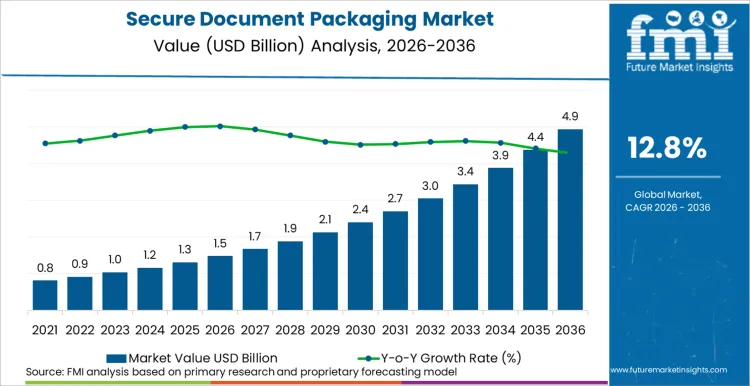
The global secure document packaging market is estimated at USD 1,480 million in 2026 and is projected to reach USD 4,920 million by 2036, expanding at a 12.8% CAGR. FMI analysis indicates that growth is not volume-led but specification-led. While total physical mail volumes are stable or declining in some regions, the proportion of documents requiring high-security packaging is increasing steadily.
Institutions are selective about which communications remain physical. However, those that do remain physical are typically the most sensitive, legally binding, or high-risk documents. This selection bias increases security expectations per document, driving demand for higher-value secure packaging formats with tamper evidence, opacity assurance, and irreversible opening features.
Another factor shaping the outlook is regulatory diffusion. Data protection and procedural governance requirements increasingly extend accountability to delivery mechanisms. Secure document packaging is therefore being embedded into compliance budgets rather than treated as operational overhead, supporting long-term, non-cyclical demand growth.
Summary of Secure Document Packaging Market
- The secure document packaging market comprises packaging formats engineered to protect sensitive physical documents against tampering, interception, unauthorized access, and content exposure during transit across government, legal, financial, and regulated corporate communication workflows.
- The defined scope is structured under FMI taxonomy with segmentation across end use, packaging format, material, and region, focusing on high-security envelopes, mailers, and pouches used for legally binding, confidential, and compliance-critical documents, while excluding commodity mailers, non-secure envelopes, and reusable closed-loop courier cases.
- The secure document packaging market is projected to grow at a CAGR of 12.8% from 2026 to 2036, expanding from USD 1,480 million in 2026 to USD 4,920 million by 2036, based on FMI proprietary forecasting integrating institutional correspondence requirements, governance-driven specification upgrades, and rising security intensity per document rather than overall mail volume growth.
- The sector is transitioning from logistics-driven mailing solutions toward compliance-embedded security systems, where tamper evidence, opacity assurance, and audit defensibility are treated as procedural safeguards integral to legal validity, risk mitigation, and regulatory accountability.
- Competition is concentrated among established secure packaging suppliers such as Unipak, Sealed Air SecurePak, Bong Group, Mondi, Huilong, Zhejiang Jialan, Toppan Forms, ITC PSPD, and Metalgráfica Iguaçu, with competitive advantage defined by security credibility, regulatory fluency, material performance consistency, and long-term institutional supply reliability.
- India is projected to record the fastest growth at a 15.6% CAGR through 2036, while North America retains the largest value share, supported by high litigation exposure, strict procedural enforcement, and sustained reliance on physically delivered, legally defensible documentation.
Secure Document Packaging Market Key Takeaways
| Metric | Value |
|---|---|
| Expected Value (2026E) | USD 1,480 million |
| Projected Value (2036F) | USD 4,920 million |
| CAGR (2026-2036) | 12.8% |
Source: Future Market Insights’ proprietary forecasting model and primary research
Why is the Secure Document Packaging Market Growing?
The fundamental driver of the secure document packaging market is the continued legal and procedural indispensability of physical documents in regulated systems. Courts, government agencies, financial institutions, and certain corporate functions still rely on physical delivery to establish legal notice, consent, enforceability, and evidentiary records. In many jurisdictions, physical receipt remains a legally defensible trigger for timelines, obligations, or rights. Secure document packaging ensures that these documents arrive in a condition that preserves procedural validity, making packaging integrity inseparable from legal integrity.
A second, increasingly powerful growth driver is institutional risk management. Document interception, identity theft, and unauthorized disclosure are no longer treated as rare incidents but as systemic operational risks. Secure document packaging functions as a visible, auditable control that reduces exposure to these risks. FMI analysis shows that organizations are strengthening physical safeguards even as they digitize other processes, because high-risk communications are often deliberately retained in physical form to avoid cyber vulnerabilities. This selective physicalization increases security expectations per document, driving demand for higher-specification packaging.
Regulatory accountability further accelerates growth. Data protection regimes and governance frameworks increasingly extend responsibility beyond content creation to content handling and delivery. Organizations are expected to demonstrate that reasonable technical and organizational measures were taken to protect sensitive information throughout its lifecycle, including during physical transit. Secure packaging supports this requirement by embedding confidentiality, tamper evidence, and traceability into the delivery process. This shifts procurement authority from logistics teams toward compliance, legal, and risk functions, stabilizing demand and reducing price sensitivity.
Hybrid communication models sustain long-term relevance. Many institutions operate parallel digital and physical systems, using physical delivery as a redundancy mechanism or legal safeguard. As a result, while overall mail volumes may plateau, the proportion of documents requiring secure packaging continues to rise. FMI observes that this structural shift supports durable growth, as secure document packaging is tied to governance intensity rather than communication volume.
What is the Segment Profile of the Secure Document Packaging Market?
Why do government and legal institutions dominate end-use demand?
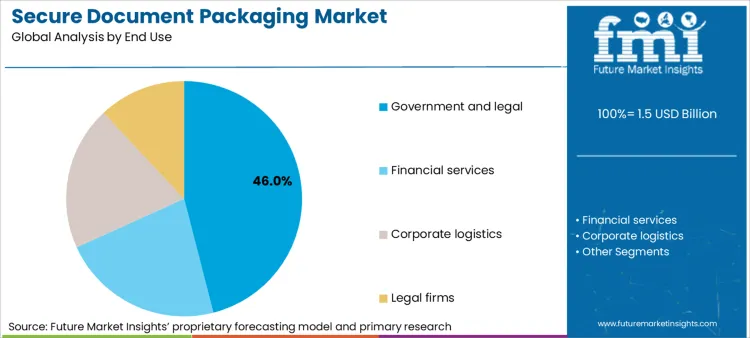
Government and legal institutions account for 46% of total end-use demand, reflecting their absolute dependence on procedural integrity and chain-of-custody assurance. Courts, regulatory agencies, tax authorities, and public administrations rely heavily on physical documents for summons, notices, rulings, licenses, and statutory correspondence. In these contexts, the integrity of delivery is inseparable from the legitimacy of the process itself. Secure document packaging therefore functions as a procedural safeguard, not a protective convenience.
A second structural factor is evidentiary defensibility. Government and legal bodies must be able to demonstrate that reasonable measures were taken to protect documents in transit. FMI finds that secure packaging specifications are often codified into procurement frameworks, with approved formats, materials, and security features mandated across agencies. This institutionalisation creates recurring, non-discretionary demand that is largely insulated from short-term budget pressures.
Why do tamper-evident envelopes dominate packaging format selection?
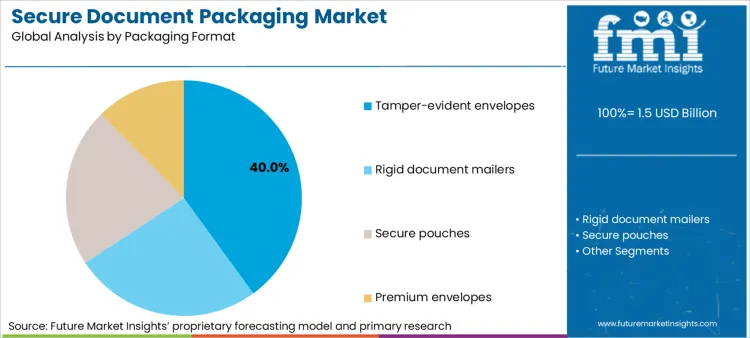
Tamper-evident envelopes represent 40% of packaging format demand because they deliver visible, binary proof of interference without disrupting existing delivery systems. Their value lies in immediacy. Any unauthorised opening attempt leaves irreversible evidence, enabling recipients to reject compromised documents and triggering procedural safeguards.
Operational compatibility reinforces dominance. Tamper-evident envelopes can be processed through standard postal and courier infrastructure without additional handling requirements. FMI observes that institutions strongly favour security solutions that enhance integrity without increasing process complexity or training burden. This balance between security effectiveness and operational neutrality sustains tamper-evident envelopes as the dominant format.
Why does security paper dominate material selection?
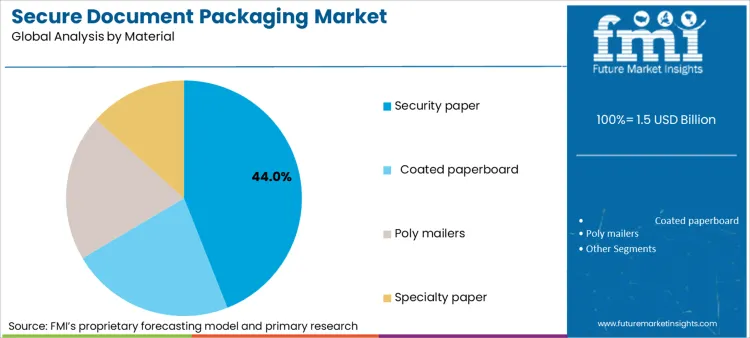
Security paper holds a 44% share of material demand because it provides multi-layered protection aligned with regulatory familiarity. Opacity prevents content visibility, while resistance to erasure, tearing, or substitution protects document integrity. These characteristics are essential for sensitive correspondence where even partial exposure can constitute a breach.
A second driver is institutional trust. Security paper has long been associated with official documents, making it easier to justify in audits and compliance reviews. FMI finds that procurement teams prefer materials with established performance histories and recognised security properties, reinforcing security paper’s dominance despite higher costs relative to commodity substrates.
Why does North America lead regional demand?
North America accounts for 34% of global demand, driven by high litigation intensity and strict procedural accountability. Institutions in the region face significant legal exposure if documents are mishandled or compromised. This incentivises conservative security margins and widespread adoption of high-specification secure packaging.
Additionally, regulatory enforcement and class-action risk elevate the importance of defensible delivery practices. FMI observes that secure packaging is often selected as a preventative control to mitigate downstream legal and reputational costs, sustaining North America’s leadership position.
What Drivers, Restraints, Opportunities, and Trends Prevail in the Secure Document Packaging Market?
The dominant driver is compliance-led procurement. Secure document packaging is increasingly specified as part of institutional governance frameworks, particularly in government, legal, and financial services. Another key driver is litigation and reputational risk. Organizations face significant downstream costs if document integrity is challenged, making preventive investment in secure packaging economically rational. Fraud mitigation is also a strong driver, especially in jurisdictions with rising identity theft and document manipulation incidents.
The primary restraint is cost sensitivity in lower-risk correspondence. Not all physical documents justify high-security packaging, which can limit penetration in corporate or administrative use cases with lower exposure. Digital substitution also acts as a partial restraint, particularly for routine communications. FMI finds that substitution disproportionately affects low-risk documents, leaving high-risk, high-value correspondence firmly anchored in physical channels. Operational inertia can also restrain adoption where institutions rely on legacy procurement frameworks or outdated mailing standards.
Significant opportunity exists in standardization and audit integration. Packaging solutions that align with institutional audit requirements and integrate smoothly into compliance documentation processes are increasingly valued. There is also opportunity in sustainability-aligned secure materials. Institutions are seeking to reduce environmental impact without compromising security, opening space for innovation in recyclable security paper, coated paperboard, and reduced-plastic secure formats. Emerging markets present additional opportunity as legal and financial systems formalize and require standardized secure communication tools.
Key trends include deeper specification rather than format proliferation. Institutions are not adopting a wider variety of packaging formats but are demanding higher performance from a narrower set of approved solutions. Another trend is the formal inclusion of packaging standards into governance manuals and procurement policies. FMI also observes a gradual convergence between physical security and digital tracking, with secure packaging increasingly designed to complement tracking and chain-of-custody documentation without becoming technology-dependent.
How is the Secure Document Packaging Market Analyzed across Key Countries?
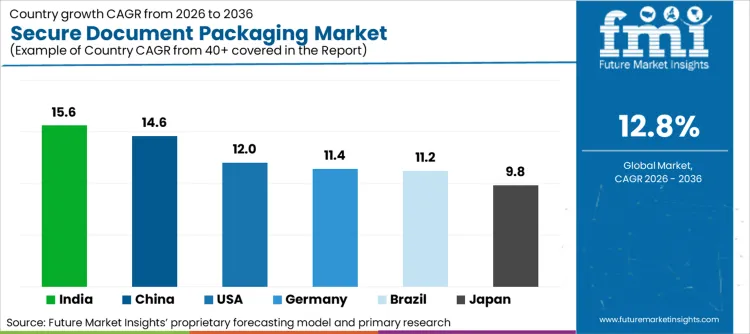
| Country | CAGR (2026–2036) |
|---|---|
| USA | 12.0% |
| Germany | 11.4% |
| China | 14.6% |
| Japan | 9.8% |
| India | 15.6% |
| Brazil | 11.2% |
Source: FMI analysis based on primary research and proprietary forecasting model
How is USA sustaining demand through litigation exposure and compliance defensibility?
USA is projected to grow at a 12.0% CAGR, anchored in its litigation-intensive legal environment and strong procedural enforcement norms. Courts, regulatory agencies, and financial institutions continue to rely on physical documentation to establish notice, consent, and evidentiary validity. Secure document packaging is therefore embedded directly into legal workflows, functioning as a preventive control that protects institutions from procedural challenges related to document tampering or loss.
A second structural driver is compliance defensibility. Organizations operating in the United States face significant liability exposure if sensitive documents are intercepted or compromised. FMI analysis shows that secure packaging specifications are increasingly dictated by legal, risk, and compliance teams rather than logistics departments. This results in systematic, organization-wide adoption of tamper-evident envelopes and opaque materials across institutions, sustaining stable and recurring demand irrespective of fluctuations in overall mail volumes.
Why is Germany advancing through administrative formalism and data protection discipline?
Germany is expected to expand at an 11.4% CAGR, driven by a deeply institutionalized culture of administrative formalism and strict data protection enforcement. Secure document packaging is treated as an integral component of procedural correctness, particularly in public administration, judicial systems, and regulated financial correspondence. Packaging specifications are frequently standardized at the agency or ministry level, creating predictable demand patterns.
A second driver is Germany’s emphasis on confidentiality and traceability. FMI finds that institutions prioritize materials and formats that support auditable chain-of-custody and minimize exposure to data breaches. This reinforces demand for security paper and rigorously specified tamper-evident formats, even where digital alternatives exist. Growth is therefore sustained not by volume expansion, but by deepening specification requirements within existing communication frameworks.
How is China leveraging corporate formalization and cross-border documentation growth?
China is projected to grow at a 14.6% CAGR, reflecting rapid formalization of corporate governance and document control practices. As enterprises scale and regulatory oversight intensifies, physical documentation remains critical for contracts, financial disclosures, and compliance filings. Secure document packaging adoption increases as organizations seek to reduce operational risk associated with document interception or alteration.
Cross-border correspondence is a second major growth driver. International trade, overseas investment, and export documentation require higher standards of document integrity. FMI observes that secure packaging is increasingly specified for international transactions to meet foreign compliance expectations and protect against disputes. This combination of domestic formalization and international exposure sustains strong growth momentum.
Why does Japan follow a precision-driven but conservative adoption trajectory?
Japan is forecast to grow at a 9.8% CAGR, shaped by cultural expectations around precision, formality, and presentation in official correspondence. Secure document packaging emphasizes material quality, clean execution, and subtle trust signaling rather than overt security features. Institutions favor premium envelopes and specialty papers that reinforce professionalism and reliability.
Adoption is deliberate and incremental. FMI analysis indicates that Japanese organizations prioritize long-term consistency and reputational assurance over rapid security upgrades. As a result, growth remains steady but moderated, driven by gradual upgrades in material quality and specification rather than broad format substitution.
Why is India emerging as the fastest-growing secure document packaging market?
India leads growth at a 15.6% CAGR, driven by rapid expansion of government services, financial inclusion initiatives, and legal formalization. Rising volumes of official correspondence, contracts, and identity-related documentation are increasing exposure to fraud and procedural risk, accelerating adoption of standardized secure packaging formats.
Regulatory modernization further reinforces growth. FMI finds that as compliance expectations tighten, secure document packaging is transitioning from an optional safeguard to a baseline requirement across government departments and financial institutions. Growth is therefore supported by both volume expansion and rising specification depth.
How is Brazil developing through institutional strengthening and governance alignment?
Brazil is expected to grow at an 11.2% CAGR, supported by gradual strengthening of legal, financial, and administrative institutions. Secure document packaging adoption increases as organizations seek to improve governance credibility, reduce fraud exposure, and support modernization of public services.
A second driver is reputational risk management. FMI observes that institutions increasingly view secure packaging as a means of reinforcing public trust and procedural reliability. While adoption remains cost-sensitive, growth accelerates where secure packaging demonstrably reduces document-related disputes and administrative inefficiencies.
How Competitive is the Secure Document Packaging Market?
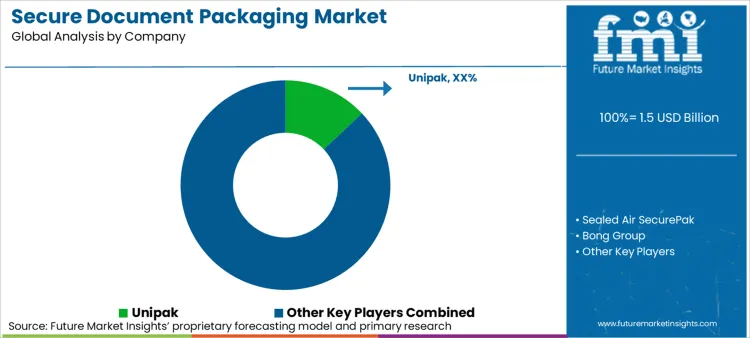
The competitive landscape of the secure document packaging market is defined primarily by trust, compliance capability, and operational reliability, rather than by price competition or rapid product innovation. Buyers are institutional entities with high risk exposure, and procurement decisions are shaped by governance logic. Suppliers compete on their ability to deliver consistent security performance, documented compliance alignment, and long-term supply stability.
A critical competitive differentiator is security credibility. Institutions favor suppliers with proven track records in tamper-evident performance, material opacity, and resistance to unauthorized access. FMI analysis shows that buyers often require test documentation, performance validation, or historical references before approving suppliers. This creates high entry barriers and favors established players with institutional relationships. Failure rates or quality inconsistencies carry disproportionate reputational risk, further reinforcing preference for trusted vendors.
Another axis of competition is regulatory fluency. Suppliers that understand legal, financial, and governmental documentation requirements are better positioned to advise on packaging specifications and prevent compliance failures. In many cases, packaging suppliers act as quasi-consultants, helping institutions align delivery practices with regulatory expectations. This advisory capability strengthens customer stickiness and reduces supplier churn.
Operational resilience is equally important. Secure document packaging is often procured through long-term or framework contracts to ensure continuity and consistency. Suppliers must demonstrate stable access to security paper, controlled manufacturing processes, and dependable delivery performance. FMI finds that supply disruptions or quality lapses can trigger immediate contract reviews, making operational discipline a core competitive advantage.
Customization within standardization also shapes competition. Institutions frequently require packaging that fits specific document formats, branding conventions, or procedural workflows, while maintaining standardized security features. Suppliers that can offer configurable solutions without increasing complexity or weakening security are advantaged. This capability is particularly important for multinational organizations seeking consistency across regions.
Geographic footprint further differentiates competitors. Institutions operating across borders prefer suppliers that can deliver equivalent secure packaging solutions in multiple regions. This favors companies with international manufacturing networks or strong regional partnerships.
Key Players Profiled
- Unipak
- Sealed Air SecurePak
- Bong Group
- Mondi
- Huilong
- Zhejiang Jialan
- Toppan Forms
- ITC PSPD
- Metalgráfica Iguaçu
Market Definition
The secure document packaging market comprises revenues generated from packaging solutions engineered to protect sensitive physical documents against tampering, interception, unauthorized access, and content exposure during transit and handling. The market includes formats used to preserve document integrity, confidentiality, and defensible chain-of-custody across institutional correspondence workflows.
The scope covers secure packaging used by government agencies, courts, legal firms, financial services, and corporate logistics functions for documents such as legal notices, contracts, identity-related correspondence, regulatory filings, and high-sensitivity mail. Secure document packaging solutions are characterized by tamper-evident performance, opacity and confidentiality assurance, and material structures that support auditability and procedural defensibility. The market excludes general mailers, commodity envelopes, and non-secure packaging formats that do not provide defined security performance in transit. It also excludes reusable courier cases used exclusively in closed-loop internal mail systems.
Scope of Report
| Items | Values |
|---|---|
| Quantitative Units (2026) | USD 1,480 million |
| CAGR 2026 to 2036 | 12.8% |
| End Use | Government and legal, Financial services, Corporate logistics, Legal firms, Others |
| Packaging Format | Tamper-evident envelopes, Rigid document mailers, Secure pouches, Premium envelopes, Others |
| Material | Security paper, Coated paperboard, Poly mailers, Specialty paper, Others |
| Regions Covered | North America, Europe, East Asia, Japan, South Asia, Rest of World |
| Countries Covered | USA, Germany, China, Japan, India, Brazil and 40 plus countries |
| Key Companies | Unipak, Sealed Air SecurePak, Bong Group, Mondi, Huilong, Zhejiang Jialan, Toppan Forms, ITC PSPD, Metalgráfica Iguaçu |
Source: Future Market Insights analysis based on proprietary forecasting model and primary research
Secure Document Packaging Market Key Segments
End Use
- Government and legal
- Financial services
- Corporate logistics
- Legal firms
- Others
Packaging Format
- Tamper-evident envelopes
- Rigid document mailers
- Secure pouches
- Premium envelopes
- Others
Material
- Security paper
- Coated paperboard
- Poly mailers
- Specialty paper
- Others
Region
- North America
- Europe
- East Asia
- Japan
- South Asia
- Rest of the World
Bibliography
- International Telecommunication Union. (2024). Global perspectives on identity protection, fraud risk, and trusted communication channels. ITU Publications.
- Organisation for Economic Co-operation and Development. (2025). Consumer and commercial fraud trends and policy responses affecting secure communications. OECD Publishing.
- USA Department of Justice. (2024). Identity theft and mail-related fraud risk patterns and prevention measures. U.S. DOJ.
- USA Federal Trade Commission. (2025). Consumer Sentinel Network Data Book 2024: Identity theft and fraud indicators relevant to document interception risk. FTC.
- European Banking Authority. (2024). Operational resilience and information security expectations for regulated financial institutions. EBA.
- Council of the European Union. (2025). Data protection and integrity expectations for handling sensitive personal information in institutional communications. Official Journal of the European Union.
- Bureau of Indian Standards. (2024). Specifications for envelopes, paper-based packaging, and security-oriented material performance requirements for official use. BIS.
Frequently Asked Questions
How big is the secure document packaging market in 2026?
The global secure document packaging market is estimated to be valued at USD 1.5 billion in 2026.
What will be the size of secure document packaging market in 2036?
The market size for the secure document packaging market is projected to reach USD 4.9 billion by 2036.
How much will be the secure document packaging market growth between 2026 and 2036?
The secure document packaging market is expected to grow at a 12.8% CAGR between 2026 and 2036.
What are the key product types in the secure document packaging market?
The key product types in secure document packaging market are government and legal, financial services, corporate logistics and legal firms.
Which packaging format segment to contribute significant share in the secure document packaging market in 2026?
In terms of packaging format, tamper-evident envelopes segment to command 40.0% share in the secure document packaging market in 2026.
Preview the report firsthand - request a free sample
Get SampleGet the brochure for pricing and purchase details.
Get PDFTable of Content
- Executive Summary
- Global Market Outlook
- Demand-side Trends
- Supply-side Trends
- Technology Roadmap Analysis
- Analysis and Recommendations
- Market Overview
- Market Coverage / Taxonomy
- Market Definition / Scope / Limitations
- Research Methodology
- Chapter Orientation
- Analytical Lens and Working Hypotheses
- Market Structure, Signals, and Trend Drivers
- Benchmarking and Cross-market Comparability
- Market Sizing, Forecasting, and Opportunity Mapping
- Research Design and Evidence Framework
- Desk Research Programme (Secondary Evidence)
- Company Annual and Sustainability Reports
- Peer-reviewed Journals and Academic Literature
- Corporate Websites, Product Literature, and Technical Notes
- Earnings Decks and Investor Briefings
- Statutory Filings and Regulatory Disclosures
- Technical White Papers and Standards Notes
- Trade Journals, Industry Magazines, and Analyst Briefs
- Conference Proceedings, Webinars, and Seminar Materials
- Government Statistics Portals and Public Data Releases
- Press Releases and Reputable Media Coverage
- Specialist Newsletters and Curated Briefings
- Sector Databases and Reference Repositories
- FMI Internal Proprietary Databases and Historical Market Datasets
- Subscription Datasets and Paid Sources
- Social Channels, Communities, and Digital Listening Inputs
- Additional Desk Sources
- Expert Input and Fieldwork (Primary Evidence)
- Primary Modes
- Qualitative Interviews and Expert Elicitation
- Quantitative Surveys and Structured Data Capture
- Blended Approach
- Why Primary Evidence is Used
- Field Techniques
- Interviews
- Surveys
- Focus Groups
- Observational and In-context Research
- Social and Community Interactions
- Stakeholder Universe Engaged
- C-suite Leaders
- Board Members
- Presidents and Vice Presidents
- R&D and Innovation Heads
- Technical Specialists
- Domain Subject-matter Experts
- Scientists
- Physicians and Other Healthcare Professionals
- Governance, Ethics, and Data Stewardship
- Research Ethics
- Data Integrity and Handling
- Primary Modes
- Tooling, Models, and Reference Databases
- Desk Research Programme (Secondary Evidence)
- Data Engineering and Model Build
- Data Acquisition and Ingestion
- Cleaning, Normalisation, and Verification
- Synthesis, Triangulation, and Analysis
- Quality Assurance and Audit Trail
- Market Background
- Market Dynamics
- Drivers
- Restraints
- Opportunity
- Trends
- Scenario Forecast
- Demand in Optimistic Scenario
- Demand in Likely Scenario
- Demand in Conservative Scenario
- Opportunity Map Analysis
- Product Life Cycle Analysis
- Supply Chain Analysis
- Investment Feasibility Matrix
- Value Chain Analysis
- PESTLE and Porter’s Analysis
- Regulatory Landscape
- Regional Parent Market Outlook
- Production and Consumption Statistics
- Import and Export Statistics
- Market Dynamics
- Global Market Analysis 2021 to 2025 and Forecast, 2026 to 2036
- Historical Market Size Value (USD Million) Analysis, 2021 to 2025
- Current and Future Market Size Value (USD Million) Projections, 2026 to 2036
- Y-o-Y Growth Trend Analysis
- Absolute $ Opportunity Analysis
- Global Market Pricing Analysis 2021 to 2025 and Forecast 2026 to 2036
- Global Market Analysis 2021 to 2025 and Forecast 2026 to 2036, By End Use
- Introduction / Key Findings
- Historical Market Size Value (USD Million) Analysis By End Use , 2021 to 2025
- Current and Future Market Size Value (USD Million) Analysis and Forecast By End Use , 2026 to 2036
- Government and legal
- Financial services
- Corporate logistics
- Legal firms
- Government and legal
- Y-o-Y Growth Trend Analysis By End Use , 2021 to 2025
- Absolute $ Opportunity Analysis By End Use , 2026 to 2036
- Global Market Analysis 2021 to 2025 and Forecast 2026 to 2036, By Packaging Format
- Introduction / Key Findings
- Historical Market Size Value (USD Million) Analysis By Packaging Format, 2021 to 2025
- Current and Future Market Size Value (USD Million) Analysis and Forecast By Packaging Format, 2026 to 2036
- Tamper-evident envelopes
- Rigid document mailers
- Secure pouches
- Premium envelopes
- Tamper-evident envelopes
- Y-o-Y Growth Trend Analysis By Packaging Format, 2021 to 2025
- Absolute $ Opportunity Analysis By Packaging Format, 2026 to 2036
- Global Market Analysis 2021 to 2025 and Forecast 2026 to 2036, By Material
- Introduction / Key Findings
- Historical Market Size Value (USD Million) Analysis By Material, 2021 to 2025
- Current and Future Market Size Value (USD Million) Analysis and Forecast By Material, 2026 to 2036
- Security paper
- Coated paperboard
- Poly mailers
- Specialty paper
- Security paper
- Y-o-Y Growth Trend Analysis By Material, 2021 to 2025
- Absolute $ Opportunity Analysis By Material, 2026 to 2036
- Global Market Analysis 2021 to 2025 and Forecast 2026 to 2036, By Region
- Introduction
- Historical Market Size Value (USD Million) Analysis By Region, 2021 to 2025
- Current Market Size Value (USD Million) Analysis and Forecast By Region, 2026 to 2036
- North America
- Latin America
- Western Europe
- Eastern Europe
- East Asia
- South Asia and Pacific
- Middle East & Africa
- Market Attractiveness Analysis By Region
- North America Market Analysis 2021 to 2025 and Forecast 2026 to 2036, By Country
- Historical Market Size Value (USD Million) Trend Analysis By Market Taxonomy, 2021 to 2025
- Market Size Value (USD Million) Forecast By Market Taxonomy, 2026 to 2036
- By Country
- USA
- Canada
- Mexico
- By End Use
- By Packaging Format
- By Material
- By Country
- Market Attractiveness Analysis
- By Country
- By End Use
- By Packaging Format
- By Material
- Key Takeaways
- Latin America Market Analysis 2021 to 2025 and Forecast 2026 to 2036, By Country
- Historical Market Size Value (USD Million) Trend Analysis By Market Taxonomy, 2021 to 2025
- Market Size Value (USD Million) Forecast By Market Taxonomy, 2026 to 2036
- By Country
- Brazil
- Chile
- Rest of Latin America
- By End Use
- By Packaging Format
- By Material
- By Country
- Market Attractiveness Analysis
- By Country
- By End Use
- By Packaging Format
- By Material
- Key Takeaways
- Western Europe Market Analysis 2021 to 2025 and Forecast 2026 to 2036, By Country
- Historical Market Size Value (USD Million) Trend Analysis By Market Taxonomy, 2021 to 2025
- Market Size Value (USD Million) Forecast By Market Taxonomy, 2026 to 2036
- By Country
- Germany
- UK
- Italy
- Spain
- France
- Nordic
- BENELUX
- Rest of Western Europe
- By End Use
- By Packaging Format
- By Material
- By Country
- Market Attractiveness Analysis
- By Country
- By End Use
- By Packaging Format
- By Material
- Key Takeaways
- Eastern Europe Market Analysis 2021 to 2025 and Forecast 2026 to 2036, By Country
- Historical Market Size Value (USD Million) Trend Analysis By Market Taxonomy, 2021 to 2025
- Market Size Value (USD Million) Forecast By Market Taxonomy, 2026 to 2036
- By Country
- Russia
- Poland
- Hungary
- Balkan & Baltic
- Rest of Eastern Europe
- By End Use
- By Packaging Format
- By Material
- By Country
- Market Attractiveness Analysis
- By Country
- By End Use
- By Packaging Format
- By Material
- Key Takeaways
- East Asia Market Analysis 2021 to 2025 and Forecast 2026 to 2036, By Country
- Historical Market Size Value (USD Million) Trend Analysis By Market Taxonomy, 2021 to 2025
- Market Size Value (USD Million) Forecast By Market Taxonomy, 2026 to 2036
- By Country
- China
- Japan
- South Korea
- By End Use
- By Packaging Format
- By Material
- By Country
- Market Attractiveness Analysis
- By Country
- By End Use
- By Packaging Format
- By Material
- Key Takeaways
- South Asia and Pacific Market Analysis 2021 to 2025 and Forecast 2026 to 2036, By Country
- Historical Market Size Value (USD Million) Trend Analysis By Market Taxonomy, 2021 to 2025
- Market Size Value (USD Million) Forecast By Market Taxonomy, 2026 to 2036
- By Country
- India
- ASEAN
- Australia & New Zealand
- Rest of South Asia and Pacific
- By End Use
- By Packaging Format
- By Material
- By Country
- Market Attractiveness Analysis
- By Country
- By End Use
- By Packaging Format
- By Material
- Key Takeaways
- Middle East & Africa Market Analysis 2021 to 2025 and Forecast 2026 to 2036, By Country
- Historical Market Size Value (USD Million) Trend Analysis By Market Taxonomy, 2021 to 2025
- Market Size Value (USD Million) Forecast By Market Taxonomy, 2026 to 2036
- By Country
- Kingdom of Saudi Arabia
- Other GCC Countries
- Turkiye
- South Africa
- Other African Union
- Rest of Middle East & Africa
- By End Use
- By Packaging Format
- By Material
- By Country
- Market Attractiveness Analysis
- By Country
- By End Use
- By Packaging Format
- By Material
- Key Takeaways
- Key Countries Market Analysis
- USA
- Pricing Analysis
- Market Share Analysis, 2025
- By End Use
- By Packaging Format
- By Material
- Canada
- Pricing Analysis
- Market Share Analysis, 2025
- By End Use
- By Packaging Format
- By Material
- Mexico
- Pricing Analysis
- Market Share Analysis, 2025
- By End Use
- By Packaging Format
- By Material
- Brazil
- Pricing Analysis
- Market Share Analysis, 2025
- By End Use
- By Packaging Format
- By Material
- Chile
- Pricing Analysis
- Market Share Analysis, 2025
- By End Use
- By Packaging Format
- By Material
- Germany
- Pricing Analysis
- Market Share Analysis, 2025
- By End Use
- By Packaging Format
- By Material
- UK
- Pricing Analysis
- Market Share Analysis, 2025
- By End Use
- By Packaging Format
- By Material
- Italy
- Pricing Analysis
- Market Share Analysis, 2025
- By End Use
- By Packaging Format
- By Material
- Spain
- Pricing Analysis
- Market Share Analysis, 2025
- By End Use
- By Packaging Format
- By Material
- France
- Pricing Analysis
- Market Share Analysis, 2025
- By End Use
- By Packaging Format
- By Material
- India
- Pricing Analysis
- Market Share Analysis, 2025
- By End Use
- By Packaging Format
- By Material
- ASEAN
- Pricing Analysis
- Market Share Analysis, 2025
- By End Use
- By Packaging Format
- By Material
- Australia & New Zealand
- Pricing Analysis
- Market Share Analysis, 2025
- By End Use
- By Packaging Format
- By Material
- China
- Pricing Analysis
- Market Share Analysis, 2025
- By End Use
- By Packaging Format
- By Material
- Japan
- Pricing Analysis
- Market Share Analysis, 2025
- By End Use
- By Packaging Format
- By Material
- South Korea
- Pricing Analysis
- Market Share Analysis, 2025
- By End Use
- By Packaging Format
- By Material
- Russia
- Pricing Analysis
- Market Share Analysis, 2025
- By End Use
- By Packaging Format
- By Material
- Poland
- Pricing Analysis
- Market Share Analysis, 2025
- By End Use
- By Packaging Format
- By Material
- Hungary
- Pricing Analysis
- Market Share Analysis, 2025
- By End Use
- By Packaging Format
- By Material
- Kingdom of Saudi Arabia
- Pricing Analysis
- Market Share Analysis, 2025
- By End Use
- By Packaging Format
- By Material
- Turkiye
- Pricing Analysis
- Market Share Analysis, 2025
- By End Use
- By Packaging Format
- By Material
- South Africa
- Pricing Analysis
- Market Share Analysis, 2025
- By End Use
- By Packaging Format
- By Material
- USA
- Market Structure Analysis
- Competition Dashboard
- Competition Benchmarking
- Market Share Analysis of Top Players
- By Regional
- By End Use
- By Packaging Format
- By Material
- Competition Analysis
- Competition Deep Dive
- Unipak
- Overview
- Product Portfolio
- Profitability by Market Segments (Product/Age /Sales Channel/Region)
- Sales Footprint
- Strategy Overview
- Marketing Strategy
- Product Strategy
- Channel Strategy
- Sealed Air SecurePak
- Bong Group
- Mondi
- Huilong
- Unipak
- Competition Deep Dive
- Assumptions & Acronyms Used


