

- Industry Size (2026)
- USD 720 Mn
- Forecast (2036)
- USD 2460 Mn
- CAGR (2026 to 2036)
- 13.1%
Privacy Packaging for Identity Documents Market Forecast and Outlook 2026 to 2036
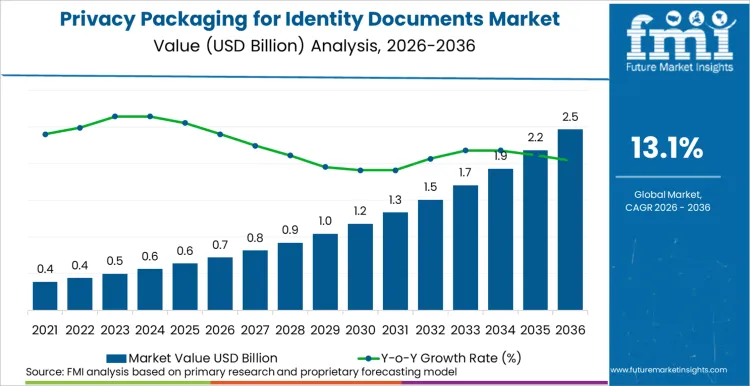
Privacy packaging for identity documents market revenue is projected to total USD 720 million in 2026, increasing to USD 2,460 million by 2036, at a CAGR of 13.1%. FMI analysis indicates the market is undergoing a shift from generic opaque mailers to biometric-verified, smart packaging that interfaces with digital identity platforms. The 2026 to 2027 period will be defined by the global rollout of next-generation biometric passports and national ID cards with embedded chips, necessitating packaging that shields against digital skimming and physical compromise during distribution.
Growth is anchored in the escalating global emphasis on data privacy, identity protection, and secure credential issuance, driven by regulatory frameworks such as the EU Digital Identity Wallet initiative and strengthened identity governance regimes in North America and Asia. While these regulations do not prescribe specific packaging technologies, they materially increase issuer liability for credential loss, interception, or tampering during physical distribution. As a result, privacy packaging has shifted from a logistical consideration to a risk-mitigation and compliance support function, stimulating sustained demand for validated, tamper-evident, and process-reliable mailers.
International Paper participates in this market through its portfolio of secure and specialty mailing solutions, including opaque paper-based mailers and tamper-evident constructions used in transactional and sensitive document distribution. Public disclosures emphasize material integrity, opacity, and runnability on automated inserting equipment rather than claims of RFID blocking or formal security certifications, aligning with issuer requirements for reliability and scalability in large ID and financial mailings.
Technical innovation across the sector is increasingly focused on enhanced tamper evidence, controlled material structures, and compatibility with automated inserting systems. Mondi Group has publicly positioned its paper-based and hybrid mailer solutions around secure closure systems, tear-resistant structures, and privacy opacity for regulated communications. These developments respond to growing concern over sophisticated mail interception while remaining compatible with high-speed document production and mailing workflows.
In North America, financial institutions and identity service providers continue to drive demand for two-way secure document mailers that support onboarding, verification, and return logistics. Berry Global supplies specialty films and mailer materials used in privacy and security envelopes, with an emphasis on seal integrity, durability, and automation compatibility. Rather than branded “KYC wallets,” Berry’s role is centered on material supply and conversion capabilities that enable secure mailer performance at scale.
In Asia, large-scale identity and government communication programs emphasize volume scalability, rapid authentication, and postal handling efficiency. Regional plastics and materials manufacturers are increasingly supplying specialty films with visual security features and durability enhancements for privacy mailers used in official communications. These solutions support high-throughput distribution environments without relying on publicly disclosed, campaign-specific product launches.
Summary of Privacy Packaging for Identity Documents Market
- The privacy packaging for identity documents market comprises secure packaging solutions designed for the distribution of sensitive physical credentials, including passports, national ID cards, driver's licenses, banking KYC documents, and municipal IDs, with features ensuring opacity, tamper evidence, RFID shielding, and chain-of-custody integrity.
- The defined scope follows FMI taxonomy, covering primary packaging in direct contact with the document, including opaque mailers, secure envelopes, tamper-evident pouches, and premium presentation carriers. It excludes tertiary shipping boxes and non-secure standard postal envelopes.
- The market is projected to grow at a CAGR of 13.1% from 2026 to 2036, expanding from USD 720 million in 2026 to USD 2,460 million by 2036, based on FMI proprietary modeling incorporating global identity document issuance forecasts, regulatory timelines for secure distribution, and primary interviews with government procurement agencies and secure print bureaus.
- The sector is transitioning from passive concealment to active integrity assurance, with solutions segmenting by risk profile from cost-optimized bulk mailers for voter ID cards to biometric-secured packaging for diplomatic passports.
- Competition is concentrated between specialized security paper converters, integrated packaging giants, and national print houses, with differentiation driven by security feature sophistication, regulatory certification, and integration with document personalization and mailing lines.
- India records the fastest growth at 16.4% CAGR through 2036, driven by its unprecedented national digital ID linking and physical credential redistribution projects, while Europe remains the largest value market, shaped by its harmonized, high-security standards for cross-border identity documents.
Privacy Packaging for Identity Documents Market Key Takeaways
| Metrics | Values |
|---|---|
| Expected Value (2026E) | USD 720 million |
| Projected Value (2036F) | USD 2,460 million |
| CAGR (2026 to 2036) | 13.1% |
Source: Future Market Insights (FMI) analysis, based on proprietary forecasting model and primary research
Why is the Privacy Packaging for Identity Documents Market Growing?
The global rise of synthetic identity fraud is forcing a re-evaluation of the entire credential issuance chain. Fraudsters increasingly target mailboxes to intercept blank or newly issued documents. Secure packaging with overt and covert tamper evidence acts as a critical deterrent and detection layer, making interception visibly evident and thus preventing the use of stolen credentials, directly reducing institutional fraud losses.
The integration of digital and physical identity systems creates new vulnerabilities. Many national ID programs now involve mailing activation codes or QR cards linked to digital wallets. Packaging must prevent visual hacking of these codes through the envelope while also shielding any embedded contactless chips from unauthorized scanning. This dual-threat environment demands multi-layered packaging solutions that address both analog and digital snooping, creating a higher-value product segment.
The expansion of remote and digital government services paradoxically increases physical mail volume for initial credential issuance. As countries shift services online, the first step for citizen authentication often involves mailing a secure physical token or code. This "last-mile" physical delivery becomes the most vulnerable link in an otherwise digital process, elevating its security requirements and driving investment in specialized packaging to protect the entire digital onboarding ecosystem.
How is the Privacy Packaging for Identity Documents Market Segmented?
The market is segmented by the packaging format, core material technology, and the end-use application, reflecting a hierarchy of security level, volume, and regulatory scrutiny. Opaque mailers lead in format share (42%), favored by high-volume government programs for their balance of cost, basic privacy, and sufficient security for lower-risk documents. Secure envelopes and tamper pouches capture higher value in applications where evidence of interference is legally critical, such as banking or high-security IDs.
How is the Dominance of Security Paper Sustained in Regulated Government Programs?
Security paper, incorporating features like watermarks, security threads, and chemical sensitivity, accounts for a leading 44% material share. This dominance is rooted in its long-established trust, regulatory precedence, and forensic auditability. Many national postal and identity laws were written with paper-based security features in mind.
The material provides a physical, hard-to-replicate base that integrates seamlessly with traditional printing and franking systems used by government print bureaus. For high-stakes, legislatively defined programs like passport issuance, security paper remains the mandated or de facto standard, ensuring continued demand despite the growth of polymer alternatives.
Which Operational and Scale Factors are Concentrating Value in Government ID Programs?
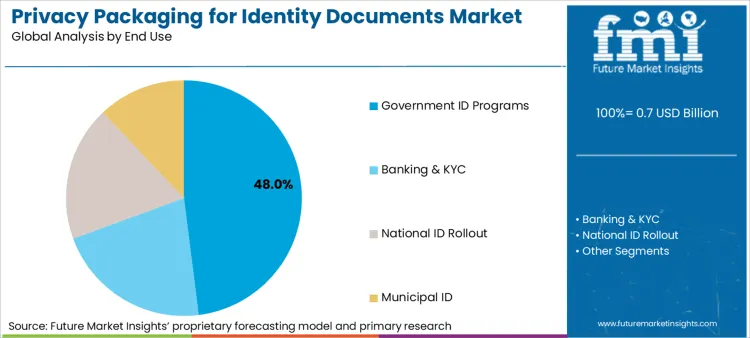
The Government ID Programs end-use segment commands a dominant 48% share, acting as the primary driver of innovation and volume. These programs involve the centralized procurement of millions of units, setting the technical and commercial benchmarks for the entire industry. Their requirements are unique: packaging must be compatible with high-speed, automated personalization and insertion lines; it must withstand varied international postal conditions; and it must meet stringent, often classified, security specifications.
Success in this segment requires deep understanding of bureaucratic procurement cycles, the ability to supply at a continental scale, and investments in R&D that align with multi-year government roadmaps for identity security.
What Role do Harmonized Regional Standards Play in Europe's Market Leadership?
Europe holds a dominant 36% regional share, a position sustained by its role as the global incubator for harmonized identity security standards. Regulations such as the European Union's Regulation on Strengthening the Security of Identity Cards and the technical standards set by the International Civil Aviation Organization (ICAO) for passports are deeply influenced by European consensus.
Packaging suppliers operating in Europe, like International Paper and Mondi, must design products to meet these cross-border requirements, giving them a first-mover advantage in other markets that later adopt similar standards. Furthermore, Europe’s dense network of international borders increases the risk and consequence of document interception during transit, justifying higher investment in secure packaging per document issued.
What Drivers, Restraints, Opportunities, and Trends Prevail in the Market?
Market expansion is supported by the escalating liability of institutions for data breaches. Courts are increasingly holding governments and banks financially liable for identity theft resulting from insecure document distribution. This shifts secure packaging from a cost center to a liability mitigation tool, with expenditures justified by risk management and insurance models, particularly in the banking & KYC segment.
While demand is robust, a key restraint is the inertia and lengthy certification cycles of government procurement. The process to approve a new packaging material or security feature for a national ID program can take 3-5 years, stifling rapid technological adoption and favoring incumbent suppliers with already-certified solutions, even if newer alternatives offer superior performance or lower cost.
Technical innovation is defined by the integration of forensic-level traceability. Packaging is being engineered with unique, random material signatures (e.g., fiber patterns in paper, micro-particle distributions in polymer) that can be digitally photographed at point of pack. This creates an unforgeable "fingerprint" for each mailer, enabling absolute verification of authenticity and detecting even the most skillful resealing attempts, moving beyond adhesive-based tamper evidence.
The emergence of "active" packaging with integrated electronics represents a disruptive opportunity. Prototypes include mailers with simple LCD displays that only reveal a one-time delivery code upon correct biometric authentication by the postal carrier, or packages that log GPS and light-exposure data during transit. While currently cost-prohibitive for mass rollout, they point to a future of interactive, intelligent document distribution.
Analysis of Privacy Packaging Market by Key Countries
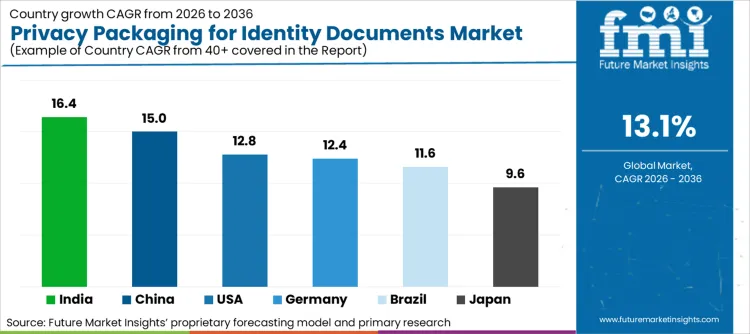
| Country | CAGR (2026–2036) |
|---|---|
| Germany | 12.4% |
| USA | 12.8% |
| China | 15.0% |
| Japan | 9.6% |
| India | 16.4% |
| Brazil | 11.6% |
Source: Future Market Insights (FMI) analysis, based on proprietary forecasting model and primary research
How do Federalized Administration and Export of Standards Shape Germany's Market?
Germany’s market, growing at a 12.4% CAGR, is characterized by its federalized structure and its role as a global exporter of security printing standards. Domestically, the need to coordinate secure document distribution across 16 federal states creates a complex, high-volume demand for standardized yet flexible packaging solutions.
German engineering and security certification bodies like the Bundesdruckerei set benchmarks that are adopted worldwide. German packaging suppliers, therefore, operate in a dual-capacity: serving a demanding domestic multi-state system while also developing products that meet the "German-engineered" security expectations of export markets, particularly within the EU and for international passports.
Which Decentralized Issuance and Legal Liability Dynamics Define the US Market?
The USA, expanding at a 12.8% CAGR, presents a unique landscape of decentralized issuance and high legal liability. Thousands of county offices issue driver’s licenses and state IDs, while passports are federal. This fragmentation requires packaging solutions that are scalable for massive federal print runs yet also adaptable for smaller county-level volumes.
The litigious environment means that any breach leading to identity theft can result in class-action lawsuits. This drives demand for packaging with unambiguous tamper evidence and detailed chain-of-custody logging, as these features provide crucial legal defensibility for the issuing authority.
How is China's Market Driven by Centralized Tech-Integration and Population Scale?
China’s high growth rate of 15.0% CAGR is fueled by its centralized, technology-integrated approach to identity management and its sheer population scale. The rollout of next-generation national ID cards and e-passports is a centrally planned, high-speed operation. Packaging is not an isolated product but a integrated component of a fully automated line encompassing printing, personalization, inspection, and mailing.
Suppliers must provide packaging that fits this highly automated ecosystem, often with machine-readable tags for sorting. The scale is immense, favoring domestic suppliers like Huilong who can ramp up production rapidly and meet the specific technical mandates of state-owned print bureaus.
How are Japan's Cultural Expectations of Perfection and Presentation Influencing Design?
Japan’s market, growing at a 9.6% CAGR, is uniquely shaped by cultural expectations of impeccable quality and respectful presentation. The packaging for municipal IDs, residence cards, and other official documents is not merely secure; it is designed to convey authority and care.
Suppliers like Toppan Forms specialize in premium envelopes that feature exquisite print quality, precise folding, and a tactile feel that reinforces the document's importance. Security is achieved through subtle, high-tech means like proprietary translucent coatings and micro-printing, aligning with a cultural preference for sophisticated, discreet protection over overt, industrial-looking tamper seals.
How is India's Transformative Digital-Physical ID Integration Catalyzing Unprecedented Demand?
India exhibits the highest CAGR at 16.4%, directly tied to the world's largest and most ambitious identity project: the integration of its Aadhaar digital ID with physical documents. As the government reissues and links various credentials (PAN cards, passports, voter IDs), it necessitates the secure physical redistribution of hundreds of millions of documents.
The packaging requirement is monumental, driving innovation in ultra-cost-effective yet secure solutions. Domestic leaders like TCPL Secure Print are pioneering hybrid paper-polymer mailers that survive India's diverse climatic and postal conditions while incorporating simple, mass-producible tamper-evident features suitable for deployment at a sub-billion unit scale.
Which Combative Fraud Environment and Regional Leadership Shape Brazil's Market?
A high-fraud environment and its leadership role in Latin America influence Brazil’s market expansion at an 11.6% CAGR. Document forgery and interception are significant problems, pushing packaging solutions to incorporate multiple overt security features recognizable by the general public, such as holographic strips and color-shifting inks.
As the region's largest economy and home to a major state print works (Casa da Moeda), Brazil often sets the security standard for neighboring countries. Brazilian packaging is therefore designed to be fraud-proof in a challenging local context while also serving as a benchmark for regional export, creating a market for robust, feature-rich solutions.
What is the Competition Outlook for Privacy Packaging for Identity Documents Market?
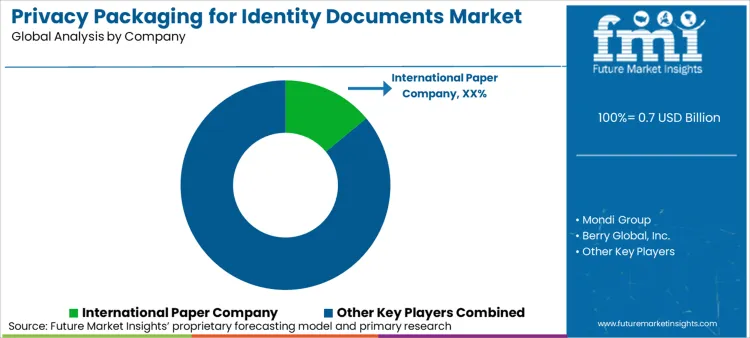
Competitive intensity is increasing as the market bifurcates into high-security, low-volume specialists and high-volume, cost-optimized suppliers. A key differentiator is system integration, the ability to deliver privacy and security mailers that run reliably on high-throughput inserting and card-mailing systems used by print bureaus and issuing bodies (e.g., platforms from BÖWE SYSTEC and Kern). Providers that co-develop formats with both print operations and equipment ecosystems can reduce misfeeds, improve integrity control, and shorten qualification cycles, creating meaningful barriers to entry.
The observable strategic direction is a stronger emphasis on security feature compatibility and supply assurance rather than standalone packaging supply. Demand is rising for solutions that combine privacy opacity, tamper evidence, and process reliability, often supported by standardized materials, validated adhesive performance, and integrity controls that align with automated document assembly and mailing.
Strategic leadership is also moving toward managed programs that simplify secure issuance logistics (secure stock handling, controlled delivery to print sites, and traceability practices). While “Security-as-a-Service” varies by vendor and contract structure, issuing bodies increasingly prefer partners that can reduce operational risk across the distribution layer, not just supply envelopes.
Recent Developments
- BÖWE SYSTEC showcased a new card inserting system “One4All” in December 2024, positioned to automate attachment of up to four cards to documents while meeting high security requirements-relevant to identity document issuance where privacy packaging must be compatible with automated card/document inserting workflows.
- At Hunkeler Innovationdays 2025, BÖWE SYSTEC highlighted its Fusion Speed Inserter (with Boxit and unwinder integration) emphasizing reliability and precision in inserting-reinforcing the market’s shift toward packaging formats that are qualified for high-performance automated inserting environments.
Key Players Profiled
- International Paper Company
- Mondi Group
- Berry Global, Inc.
- Huilong New Material Co., Ltd.
- Zhejiang Jialan Package Materials Co., Ltd.
- Toppan Forms Co., Ltd.
- TCPL Secure Print (A part of TCPL Packaging Ltd.)
- Casa da Moeda do Brasil
- CCL Industries Inc. (Secure Services Division)
- DS Smith Plc
Market Definition
The privacy packaging for identity documents market comprises revenue generated from the design, manufacture, and sale of packaging solutions specifically engineered to protect the confidentiality, integrity, and authenticity of sensitive identity credentials during distribution via mail or courier. This includes primary packaging such as opaque security mailers, tamper-evident envelopes and pouches, RFID-shielded carriers, and premium presentation folders that prevent unauthorized viewing, scanning, or alteration.
The market scope covers packaging used by government agencies, financial institutions, and other authorized bodies for the initial issuance, renewal, or reissuance of physical identity documents. It excludes standard postal stationery, retail packaging for blank photo albums or frames, and general-purpose shipping boxes.
Scope of Report
| Items | Values |
|---|---|
| Quantitative Units | USD 720 million |
| Packaging Format | Opaque Mailers, Secure Envelopes, Tamper Pouches, Premium Envelopes, Others |
| Material | Security Paper, Poly-Paper Blends, Polymer Films, Specialty Paper, Others |
| End Use | Government ID Programs, Banking & KYC, National ID Rollout, Municipal ID, Others |
| Regions Covered | Europe, North America, East Asia, Japan, South Asia, Latin America, Middle East & Africa |
| Countries | Germany, USA, China, Japan, India, Brazil and 40+ countries |
| Key Companies | International Paper, Mondi, Berry Global, Huilong, Zhejiang Jialan, Toppan Forms, TCPL Secure Print, Casa da Moeda, CCL Industries, DS Smith |
Source: Future Market Insights (FMI) analysis, based on proprietary forecasting model and primary research
Privacy Packaging for Identity Documents Market Key Segments
By Packaging Format
- Opaque Mailers
- Secure Envelopes
- Tamper Pouches
- Premium Envelopes
- Others
By Material
- Security Paper
- Poly-Paper Blends
- Polymer Films
- Specialty Paper
- Others
By End Use
- Government ID Programs
- Banking & KYC
- National ID Rollout
- Municipal ID
- Others
By Region
- Europe
- North America
- East Asia
- Japan
- South Asia
- Latin America
- Middle East & Africa
Bibliography
- German Federal Office for Information Security (BSI). (2025). BSI TR-03126: Technical Guideline for Secure Packaging and Distribution of Official Documents. BSI.
- National Institute of Standards and Technology (NIST). (2025). Supply Chain Risk Management Practices for Sensitive Physical and Digital Assets. NIST Special Publication.
- European Committee for Standardization (CEN). (2026). CEN/TS 18172: Secure Distribution and Tamper Evidence for Sensitive Documents. CEN.
- U.S. Department of Homeland Security (DHS). (2025). Physical Security and Chain-of-Custody Requirements for Identity Credential Issuance. DHS.
- Reserve Bank of India (RBI). (2025). Master Direction on KYC – Secure Handling and Transmission of Identity Documents. RBI.
- Japan Ministry of Internal Affairs and Communications (MIC). (2025). Guidelines for Secure Issuance and Delivery of Official Identity Documents. Government of Japan.
- Brazilian Central Bank. (2025). Operational Security Guidelines for Customer Identification and Document Distribution. BCB.
Frequently Asked Questions
How big is the privacy packaging for identity documents market in 2026?
The global privacy packaging for identity documents market is estimated to be valued at USD 0.7 billion in 2026.
What will be the size of privacy packaging for identity documents market in 2036?
The market size for the privacy packaging for identity documents market is projected to reach USD 2.5 billion by 2036.
How much will be the privacy packaging for identity documents market growth between 2026 and 2036?
The privacy packaging for identity documents market is expected to grow at a 13.1% CAGR between 2026 and 2036.
What are the key product types in the privacy packaging for identity documents market?
The key product types in privacy packaging for identity documents market are security paper , poly-paper blends, polymer films and specialty paper.
Which end use segment to contribute significant share in the privacy packaging for identity documents market in 2026?
In terms of end use, government id programs segment to command 48.0% share in the privacy packaging for identity documents market in 2026.
Preview the report firsthand - request a free sample
Get SampleGet the brochure for pricing and purchase details.
Get PDFTable of Content
- Executive Summary
- Global Market Outlook
- Demand-side Trends
- Supply-side Trends
- Technology Roadmap Analysis
- Analysis and Recommendations
- Market Overview
- Market Coverage / Taxonomy
- Market Definition / Scope / Limitations
- Research Methodology
- Chapter Orientation
- Analytical Lens and Working Hypotheses
- Market Structure, Signals, and Trend Drivers
- Benchmarking and Cross-market Comparability
- Market Sizing, Forecasting, and Opportunity Mapping
- Research Design and Evidence Framework
- Desk Research Programme (Secondary Evidence)
- Company Annual and Sustainability Reports
- Peer-reviewed Journals and Academic Literature
- Corporate Websites, Product Literature, and Technical Notes
- Earnings Decks and Investor Briefings
- Statutory Filings and Regulatory Disclosures
- Technical White Papers and Standards Notes
- Trade Journals, Industry Magazines, and Analyst Briefs
- Conference Proceedings, Webinars, and Seminar Materials
- Government Statistics Portals and Public Data Releases
- Press Releases and Reputable Media Coverage
- Specialist Newsletters and Curated Briefings
- Sector Databases and Reference Repositories
- FMI Internal Proprietary Databases and Historical Market Datasets
- Subscription Datasets and Paid Sources
- Social Channels, Communities, and Digital Listening Inputs
- Additional Desk Sources
- Expert Input and Fieldwork (Primary Evidence)
- Primary Modes
- Qualitative Interviews and Expert Elicitation
- Quantitative Surveys and Structured Data Capture
- Blended Approach
- Why Primary Evidence is Used
- Field Techniques
- Interviews
- Surveys
- Focus Groups
- Observational and In-context Research
- Social and Community Interactions
- Stakeholder Universe Engaged
- C-suite Leaders
- Board Members
- Presidents and Vice Presidents
- R&D and Innovation Heads
- Technical Specialists
- Domain Subject-matter Experts
- Scientists
- Physicians and Other Healthcare Professionals
- Governance, Ethics, and Data Stewardship
- Research Ethics
- Data Integrity and Handling
- Primary Modes
- Tooling, Models, and Reference Databases
- Desk Research Programme (Secondary Evidence)
- Data Engineering and Model Build
- Data Acquisition and Ingestion
- Cleaning, Normalisation, and Verification
- Synthesis, Triangulation, and Analysis
- Quality Assurance and Audit Trail
- Market Background
- Market Dynamics
- Drivers
- Restraints
- Opportunity
- Trends
- Scenario Forecast
- Demand in Optimistic Scenario
- Demand in Likely Scenario
- Demand in Conservative Scenario
- Opportunity Map Analysis
- Product Life Cycle Analysis
- Supply Chain Analysis
- Investment Feasibility Matrix
- Value Chain Analysis
- PESTLE and Porter’s Analysis
- Regulatory Landscape
- Regional Parent Market Outlook
- Production and Consumption Statistics
- Import and Export Statistics
- Market Dynamics
- Global Market Analysis 2021 to 2025 and Forecast, 2026 to 2036
- Historical Market Size Value (USD Million) Analysis, 2021 to 2025
- Current and Future Market Size Value (USD Million) Projections, 2026 to 2036
- Y-o-Y Growth Trend Analysis
- Absolute $ Opportunity Analysis
- Global Market Pricing Analysis 2021 to 2025 and Forecast 2026 to 2036
- Global Market Analysis 2021 to 2025 and Forecast 2026 to 2036, By Material
- Introduction / Key Findings
- Historical Market Size Value (USD Million) Analysis By Material , 2021 to 2025
- Current and Future Market Size Value (USD Million) Analysis and Forecast By Material , 2026 to 2036
- Security Paper
- Poly-Paper Blends
- Polymer Films
- Specialty Paper
- Security Paper
- Y-o-Y Growth Trend Analysis By Material , 2021 to 2025
- Absolute $ Opportunity Analysis By Material , 2026 to 2036
- Global Market Analysis 2021 to 2025 and Forecast 2026 to 2036, By End Use
- Introduction / Key Findings
- Historical Market Size Value (USD Million) Analysis By End Use, 2021 to 2025
- Current and Future Market Size Value (USD Million) Analysis and Forecast By End Use, 2026 to 2036
- Government ID Programs
- Banking & KYC
- National ID Rollout
- Municipal ID
- Government ID Programs
- Y-o-Y Growth Trend Analysis By End Use, 2021 to 2025
- Absolute $ Opportunity Analysis By End Use, 2026 to 2036
- Global Market Analysis 2021 to 2025 and Forecast 2026 to 2036, By Region
- Introduction
- Historical Market Size Value (USD Million) Analysis By Region, 2021 to 2025
- Current Market Size Value (USD Million) Analysis and Forecast By Region, 2026 to 2036
- North America
- Latin America
- Western Europe
- Eastern Europe
- East Asia
- South Asia and Pacific
- Middle East & Africa
- Market Attractiveness Analysis By Region
- North America Market Analysis 2021 to 2025 and Forecast 2026 to 2036, By Country
- Historical Market Size Value (USD Million) Trend Analysis By Market Taxonomy, 2021 to 2025
- Market Size Value (USD Million) Forecast By Market Taxonomy, 2026 to 2036
- By Country
- USA
- Canada
- Mexico
- By Material
- By End Use
- By Country
- Market Attractiveness Analysis
- By Country
- By Material
- By End Use
- Key Takeaways
- Latin America Market Analysis 2021 to 2025 and Forecast 2026 to 2036, By Country
- Historical Market Size Value (USD Million) Trend Analysis By Market Taxonomy, 2021 to 2025
- Market Size Value (USD Million) Forecast By Market Taxonomy, 2026 to 2036
- By Country
- Brazil
- Chile
- Rest of Latin America
- By Material
- By End Use
- By Country
- Market Attractiveness Analysis
- By Country
- By Material
- By End Use
- Key Takeaways
- Western Europe Market Analysis 2021 to 2025 and Forecast 2026 to 2036, By Country
- Historical Market Size Value (USD Million) Trend Analysis By Market Taxonomy, 2021 to 2025
- Market Size Value (USD Million) Forecast By Market Taxonomy, 2026 to 2036
- By Country
- Germany
- UK
- Italy
- Spain
- France
- Nordic
- BENELUX
- Rest of Western Europe
- By Material
- By End Use
- By Country
- Market Attractiveness Analysis
- By Country
- By Material
- By End Use
- Key Takeaways
- Eastern Europe Market Analysis 2021 to 2025 and Forecast 2026 to 2036, By Country
- Historical Market Size Value (USD Million) Trend Analysis By Market Taxonomy, 2021 to 2025
- Market Size Value (USD Million) Forecast By Market Taxonomy, 2026 to 2036
- By Country
- Russia
- Poland
- Hungary
- Balkan & Baltic
- Rest of Eastern Europe
- By Material
- By End Use
- By Country
- Market Attractiveness Analysis
- By Country
- By Material
- By End Use
- Key Takeaways
- East Asia Market Analysis 2021 to 2025 and Forecast 2026 to 2036, By Country
- Historical Market Size Value (USD Million) Trend Analysis By Market Taxonomy, 2021 to 2025
- Market Size Value (USD Million) Forecast By Market Taxonomy, 2026 to 2036
- By Country
- China
- Japan
- South Korea
- By Material
- By End Use
- By Country
- Market Attractiveness Analysis
- By Country
- By Material
- By End Use
- Key Takeaways
- South Asia and Pacific Market Analysis 2021 to 2025 and Forecast 2026 to 2036, By Country
- Historical Market Size Value (USD Million) Trend Analysis By Market Taxonomy, 2021 to 2025
- Market Size Value (USD Million) Forecast By Market Taxonomy, 2026 to 2036
- By Country
- India
- ASEAN
- Australia & New Zealand
- Rest of South Asia and Pacific
- By Material
- By End Use
- By Country
- Market Attractiveness Analysis
- By Country
- By Material
- By End Use
- Key Takeaways
- Middle East & Africa Market Analysis 2021 to 2025 and Forecast 2026 to 2036, By Country
- Historical Market Size Value (USD Million) Trend Analysis By Market Taxonomy, 2021 to 2025
- Market Size Value (USD Million) Forecast By Market Taxonomy, 2026 to 2036
- By Country
- Kingdom of Saudi Arabia
- Other GCC Countries
- Turkiye
- South Africa
- Other African Union
- Rest of Middle East & Africa
- By Material
- By End Use
- By Country
- Market Attractiveness Analysis
- By Country
- By Material
- By End Use
- Key Takeaways
- Key Countries Market Analysis
- USA
- Pricing Analysis
- Market Share Analysis, 2025
- By Material
- By End Use
- Canada
- Pricing Analysis
- Market Share Analysis, 2025
- By Material
- By End Use
- Mexico
- Pricing Analysis
- Market Share Analysis, 2025
- By Material
- By End Use
- Brazil
- Pricing Analysis
- Market Share Analysis, 2025
- By Material
- By End Use
- Chile
- Pricing Analysis
- Market Share Analysis, 2025
- By Material
- By End Use
- Germany
- Pricing Analysis
- Market Share Analysis, 2025
- By Material
- By End Use
- UK
- Pricing Analysis
- Market Share Analysis, 2025
- By Material
- By End Use
- Italy
- Pricing Analysis
- Market Share Analysis, 2025
- By Material
- By End Use
- Spain
- Pricing Analysis
- Market Share Analysis, 2025
- By Material
- By End Use
- France
- Pricing Analysis
- Market Share Analysis, 2025
- By Material
- By End Use
- India
- Pricing Analysis
- Market Share Analysis, 2025
- By Material
- By End Use
- ASEAN
- Pricing Analysis
- Market Share Analysis, 2025
- By Material
- By End Use
- Australia & New Zealand
- Pricing Analysis
- Market Share Analysis, 2025
- By Material
- By End Use
- China
- Pricing Analysis
- Market Share Analysis, 2025
- By Material
- By End Use
- Japan
- Pricing Analysis
- Market Share Analysis, 2025
- By Material
- By End Use
- South Korea
- Pricing Analysis
- Market Share Analysis, 2025
- By Material
- By End Use
- Russia
- Pricing Analysis
- Market Share Analysis, 2025
- By Material
- By End Use
- Poland
- Pricing Analysis
- Market Share Analysis, 2025
- By Material
- By End Use
- Hungary
- Pricing Analysis
- Market Share Analysis, 2025
- By Material
- By End Use
- Kingdom of Saudi Arabia
- Pricing Analysis
- Market Share Analysis, 2025
- By Material
- By End Use
- Turkiye
- Pricing Analysis
- Market Share Analysis, 2025
- By Material
- By End Use
- South Africa
- Pricing Analysis
- Market Share Analysis, 2025
- By Material
- By End Use
- USA
- Market Structure Analysis
- Competition Dashboard
- Competition Benchmarking
- Market Share Analysis of Top Players
- By Regional
- By Material
- By End Use
- Competition Analysis
- Competition Deep Dive
- International Paper Company
- Overview
- Product Portfolio
- Profitability by Market Segments (Product/Age /Sales Channel/Region)
- Sales Footprint
- Strategy Overview
- Marketing Strategy
- Product Strategy
- Channel Strategy
- Mondi Group
- Berry Global, Inc.
- Huilong New Material Co., Ltd.
- Zhejiang Jialan Package Materials Co., Ltd.
- Toppan Forms Co., Ltd.
- International Paper Company
- Competition Deep Dive
- Assumptions & Acronyms Used


