

- Industry Size (2025)
- USD 8.8 Bn
- Forecast (2035)
- USD 27.2 Bn
- CAGR (2025 to 2035)
- 12.0%
Document Management Software Market Outlook from 2025 to 2035
The Document Management Software market is experiencing significant growth driven by the increasing need for efficient digital document handling and streamlined workflow management across organizations of all sizes. The future outlook for this market is shaped by the rapid adoption of cloud technologies, heightened emphasis on data security, and the growing demand for regulatory compliance across industries. Businesses are increasingly prioritizing digital transformation initiatives, which has elevated the importance of centralized document storage, version control, and automated workflow capabilities.
The integration of advanced features such as AI-powered search, analytics, and collaboration tools has further enhanced the operational efficiency offered by document management solutions. Additionally, the ongoing shift from traditional paper-based processes to digital document handling is reducing operational costs and improving accessibility for remote and hybrid work models.
Organizations are leveraging these solutions to ensure seamless collaboration, secure information sharing, and improved productivity, positioning document management software as a critical component in enterprise IT strategies Continuous technological advancements and the rising trend toward digital workplaces are expected to sustain market growth in the coming years.
Quick Stats for Document Management Software Market
- Document Management Software Market Industry Value (2025): USD 8.8 billion
- Document Management Software Market Forecast Value (2035): USD 27.2 billion
- Document Management Software Market Forecast CAGR: 12.0%
- Leading Segment in Document Management Software Market in 2025: Integrated Document Management Software (55.0%)
- Key Growth Region in Document Management Software Market: North America, Asia-Pacific, Europe
- Top Key Players in Document Management Software Market: Microsoft Corporation, Google LLC, Adobe, Inc., Dropbox, Inc., IBM Corporation, Autodesk, Inc., Toshiba Corporation, Open Text Corporation, MasterControl Solutions, Inc., Zoho Corporation, DocuWare Europe GmbH, Laserfiche, Ideagen, Revver, Inc.
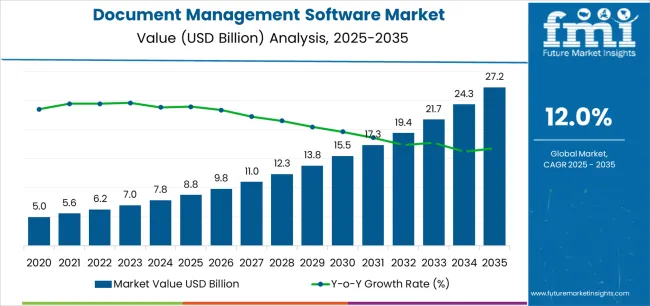
| Metric | Value |
|---|---|
| Document Management Software Market Estimated Value in (2025 E) | USD 8.8 billion |
| Document Management Software Market Forecast Value in (2035 F) | USD 27.2 billion |
| Forecast CAGR (2025 to 2035) | 12.0% |
Segmental Analysis
The market is segmented by Solution, Deployment, Enterprise Size, and Industry and region. By Solution, the market is divided into Integrated Document Management Software and Standalone Software. In terms of Deployment, the market is classified into Cloud-Based and On-Premise. Based on Enterprise Size, the market is segmented into Small Enterprises (10-99 Employees), Small Offices (1-9 Employees), Medium-Sized Enterprise (100-499 Employees), Large Enterprises (500-999 Employees), and Very Large Enterprises (1,000+ Employees). By Industry, the market is divided into Finance, Manufacturing & Resources, Distribution Services, Services, Public Sector, and Infrastructure. Regionally, the market is classified into North America, Latin America, Western Europe, Eastern Europe, Balkan & Baltic Countries, Russia & Belarus, Central Asia, East Asia, South Asia & Pacific, and the Middle East & Africa.
Insights into the Integrated Document Management Software Solution Segment

The integrated document management software solution segment is projected to hold 55.00% of the market revenue share in 2025, making it the leading solution type. This dominance is attributed to the comprehensive capabilities offered by integrated platforms, which combine document storage, workflow automation, and collaboration tools in a single solution.
Organizations benefit from centralized management of their digital assets, ensuring version control, audit trails, and secure access. The adoption of integrated solutions has been accelerated by the need to reduce operational inefficiencies, improve compliance with industry regulations, and facilitate seamless collaboration across departments.
Additionally, these solutions provide scalable functionalities suitable for organizations of varying sizes, enabling businesses to optimize document handling processes while minimizing IT overhead The growing focus on automation, productivity enhancement, and secure document management continues to reinforce the strong position of integrated solutions in the market.
Insights into the Cloud-Based Deployment Segment
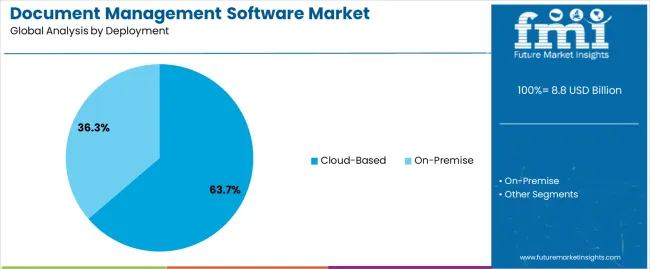
The cloud-based deployment segment is expected to capture 63.70% of the Document Management Software market revenue share in 2025, positioning it as the leading deployment model. The growth of this segment is driven by the flexibility and scalability offered by cloud solutions, which allow organizations to manage documents remotely and access information in real time from multiple locations.
Cloud-based deployments eliminate the need for significant upfront IT infrastructure investment, making them attractive to organizations seeking cost-effective and easily deployable solutions. Enhanced data security, automated updates, and disaster recovery capabilities further support adoption.
The increasing prevalence of remote and hybrid work models has reinforced the demand for cloud-based solutions, as businesses seek secure and accessible document management systems The ability to integrate with other enterprise applications and provide centralized control over organizational documents continues to drive the prominence of the cloud-based deployment segment.
Insights into the Small Enterprises End-Use Industry Segment
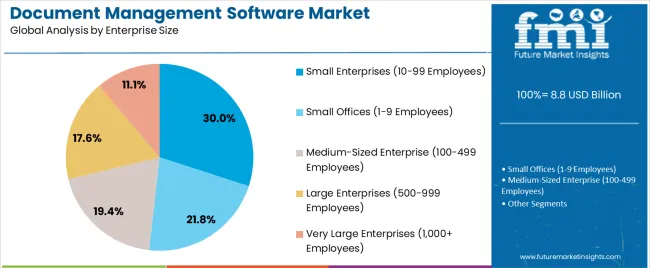
The small enterprises segment, representing organizations with 10-99 employees, is anticipated to account for 30.00% of the market revenue in 2025, making it a key contributor to growth. The adoption of document management software by small enterprises is driven by the need to optimize operational efficiency while minimizing IT costs.
These organizations benefit from streamlined workflows, centralized storage, and improved collaboration capabilities that support productivity and scalability. Cloud-based and integrated solutions are particularly appealing to small enterprises due to their low implementation complexity and flexibility.
Additionally, regulatory compliance, data security, and remote accessibility are increasingly becoming critical priorities for small businesses, further accelerating software adoption The focus on cost-effective digital transformation initiatives and the need to remain competitive in dynamic business environments continue to propel the uptake of document management solutions among small enterprises.
Semi Annual Market Update
This below table presents the expected CAGR for the Global document management software market over several semi-annual periods spanning from 2025 to 2035. In the first half (H1) of the year from 2025 to 2035, the industry is predicted to surge at a CAGR of 12.2%, followed by a slightly lower growth rate of 11.9% in the second half (H2) of the same year.
| Particular | Value CAGR |
|---|---|
| H1, 2025 | 12.2% (2025 to 2035) |
| H2, 2025 | 11.9% (2025 to 2035) |
| H1, 2025 | 12.6% (2025 to 2035) |
| H2, 2025 | 11.7% (2025 to 2035) |
Moving into the subsequent period, from H1 2025 to H2 2035, the CAGR is projected to hold at 12.6% in the first half from 2025 to 2035 and remain considerably decrease at 11.7% in the second half 2025 to 2035. In the first half (H1) 2025 to 2035 the market witnessed an increase of 40 BPS while in the second half (H2) 2025 to 2035 the market witnessed a decrease of 20 BPS.
Key Industry Highlights
Emergence of Data Security and Risk Management with Rise in Security Breaches
The threat of cyber-attacks keep rising with the increase in user data. As businesses hold the sensitive information, the demand of secured document storage and retrieval systems is quite high. The average cost of a data breach reached USD 8.8 million in 2025, which shows the emergence of robust security measures.
Modern document management systems use AI and blockchain to improve security. AI helps to quickly spot any unusual activity and security risks, while blockchain creates a secure record of documents, making sure data stays accurate and can't be changed by unauthorized people.
As businesses need to access data remotely and scale their operations, they are moving to cloud-based DMS solutions. This shift has made security in the cloud a big concern, leading companies to use unified security platforms that bring together different security tools.
This makes it easier to coordinate security and reduces the chances of being vulnerable. Cybersecurity Mesh Architecture (CSMA) is a good example of this approach, as it offers integrated security layers that make the overall system stronger.
These changes aren't just about technology but also include strategic aspect. Organizations are realizing the potential financial and reputational harm of data breaches. Therefore, data security is becoming a key focus in Document Management Systems (DMS).
This focus on security is not only influencing the types of products available but also leading to market growth, as the DMS market is projected to increase considerably in the coming years due to these security concerns.
Businesses are Seeking out Efficiency and Productivity Gains
Businesses are increasingly looking for solutions to ease the operations and reduce manual tasks. Document management software includes a key capability of automation, which eliminates the time-consuming processes like manual document filing, extraction and data entry.
For example, DMS solutions incorporate AI and ML to automate document classification and workflow management, which considerably reduces the time consumed to complete individual tasks.
Syndifi Inc. launced new document management software functionalities in 2025, especially designed to enhance productivity through quicker document uploads and drag and drop features. This aligns with the trend of integrating user-friendly interfaces that reduce the challenges in document handling, which allows employees to focus on higher-value tasks.
On the other hand, the adoption of cloud-based DMS also enables the remote access to documents, which is a necessity among remote and hybrid work environments. This not only ensures the efficient collaborations among teams but also workflow improvement and project turnaround time reduction. For instance, IBM cloud-based DMS is widely used for work environments that requires real-time collaboration.
Dependence on a Single Vendor Might Raise Concerns in the Market
Dependence on a single vendor can lead to several risks and limitations for organizations. When a company depends heavily on a single vendor, it becomes vulnerable to the vendors business developments, decisions, services and change in prices. This reliability could result in a “lock-in” effect, where switching to another vendor becomes quite difficult due to high migration costs or loss of data continuity.
For instance, if DMS provider raise its prices or changes its service offerings, the customer has very little leverage to negotiate better terms, which results in higher operational costs. If the vendor experiences technological issues, outages or security breach, the customer may face the similar changes, disrupting their document management processes.
These challenges may become even more distinct when the vendor decides to discontinue a product or service, which forces customer to costly undertaking and time-consuming shift to new systems.
In 2025, many companies pointed out the risks of relying on just one vendor for document management software. When these vendors experienced long periods of downtime, it caused business disruptions and problems accessing data. This showed that companies should think about using multiple vendors or choosing adaptable, compatible solutions to reduce the dangers of being tied to one vendor.
Regulatory needs and compliance pressures can make vendor dependence risks worse. If a vendor doesn't follow new rules, customers could get fines or have legal problems. To deal with these issues, businesses are looking more at hybrid models. They use on-site and cloud-based solutions from different vendors to make sure things keep running, stay flexible, and follow the rules.
Decentralized Storage Distributes the Data while Storing in the Clusters
Decentralized storage holds the potential to improve data security, privacy and system resilience. It distribute the data across multiple nodes in a network unlike traditional centralized storage systems, where data is stored on a single server. This reduces the data breaches risk and system fails with no single point of vulnerability. The key advantage of decentralized storage is its ability to offer higher data security and privacy.
In a decentralized system, data is encrypted and fragmented, with information stored across various nodes. It makes unauthorized access quite difficult for unwanted user to access complete data sets. In order to access that particular information, they would need to breach the multiple locations of data storage. This model is quite appealing in industries with strict data security requirements including healthcare and finance.
2020 to 2024 Global Document Management Software Sales Outlook Compared to Demand Forecasts from 2025 to 2035
The document management software market went through notable fluctuations and technological advancements in the historical period. The industry was valued at a valuation of USD 4,902.7 million in 2020 to reach USD 7,101.2 million in 2025 with a CAGR of 9.7% from 2020 to 2025.
During pandemic, DMS solutions became more popular as companies shifted to remote and hybrid work setups. There was a greater need for secure, easy-to-use, and collaborative document management tools during this time. Growing concerns about keeping data safe and following rules like GDPR, CCPA, and HIPAA LED more companies to use DMS solutions with strong security and compliance tracking features.
Document management software market witnessed a considerable growth during the forecasting period between 2025 and 2035. The market reached the valuation of USD 24,322.8 million in 2035 from USD 7,830.3 million in 2025 with the CAGR of 12.0%.
More and more small and medium-sized businesses will start using DMS solutions because there are cheaper cloud-based choices available and they need to stay competitive in the digital economy. As blockchain technology gets better, integrating it to DMS for secure and unchangeable document records will become a major selling point, especially in industries like finance, legal, and healthcare.
Market Concentration
Tier 1 companies have acquired substantial share of 45% to 50% in the document management software market. These companies are driving global expansion with partnerships and large-scale acquisitions. Adobe Inc., Google LLC, Dropbox, Inc. and Microsoft Corporation are top Tier 1 companies that hold the largest market share globally. These vendors are providing wide range of DMS solutions with features laced with latest technology.
Tier 2 vendors in the global document management software market are focusing on enhancing their end-to-end solutions capability. These vendors have the global market reach but lack in competing owing to the gaps in features and capabilities. The vendors in tier 2 bracket includes Autodesk, Inc., Toshiba Corporation, Open Text Corporation among others. These vendors hold around 20% to 25% market share.
Tier 3 companies represent 30% to 35% of share of total document management software industry. These vendors focus on the market expansion and providing end-user specific solutions. The vendors in the bracket includes Revver, Inc, Zoho Corporation, Ideagen among others.
Country-wise Insights
The below country-wise market analysis of the document management software explains the recent developments and different government approaches in the market. The analysis also gives an idea of the country’s expected progress in the market landscape.
The data describes key highlights, growth factors, and CAGRs of these countries.
| Countries | CAGR from 2025 to 2035 |
|---|---|
| India | 15.1% |
| China | 13.8% |
| USA | 12.7% |
| Germany | 12.8% |
Digital Transformation Initiatives and Push for Cloud Technologies Paves the Way for Document Management Software in India
India is pushing for digital transformation initiatives while increasing the cloud technologies. Indian government is also focusing on bringing encouraging regulations in the market. These factors are creating the favorable landscape for the success of document management software in the country. The Digital India initiative also is a major factor, as it encourages businesses and government organizations to switch to digital records, creating more need for DMS solutions.
Recent developments in the country are highlighting this trend. For example, in 2025, Cybernetik Technologies used a DMS to bring all document management together in one place, making sure everything followed the rules and worked better. Also, more and more Indian companies are using DMS solutions based in the cloud to help with remote work, because of the increase in hybrid work after the pandemic.
China’s Move towards Strict Government Regulations
The Chinese government wants companies to keep their data within the country and follow strict cybersecurity rules. This means companies need strong document management systems that meet these legal requirements. As a result, there's a big need for local DMS solutions that keep data safe and follow the rules.
Large Chinese tech firms like Alibaba Cloud are making their DMS services bigger to take advantage of the growing market. In 2025, Alibaba Cloud added better document management features to its cloud services, aiming at businesses shifting to digital ways of working. These changes show how important DMS is for helping China achieve its digital economy goals.
Established Technological Sector and Huge Government Investments in USA to Push the Market Growth
The USA government has played a big part in this growth by spending a lot on updating its IT systems. In 2025, federal agencies are set to spend about USD 95 billion on IT, and a lot of that will go towards document management and digital projects. This spending is part of a bigger push to work more efficiently, use less paper, and make data more secure and easier to get to.
The USA also benefits from having top tech companies like Microsoft, Oracle, and IBM in the country. These companies keep coming up with new and better DMS solutions. They've played a big part in getting businesses to use cloud-based DMS platforms, which are becoming more popular because they can grow with the business, can change easily, and have better security.
Category-wise Insights
The below section provides the category wise insights in the market with recent developments and future projections.
Cloud-based Document Management Solutions Lead in the Market
Cloud-based document management solutions let businesses access files from anywhere, support remote work, and provide strong data security. In 2025, Oracle and Microsoft expanded their cloud services to meet the increasing need for cloud-based document management. Oracle launched 14 new cloud regions around the world.
| Segment | Cloud (Deployment) |
|---|---|
| Value Share (2025) | 63.7% |
As per USA Government Accountability Office, USA government departments are using cloud-based document management systems more as they update their IT systems. They are spending a lot on cloud infrastructure to better handle data and lower expenses. This move to cloud solutions is part of a larger trend in IT, where the advantages of cloud computing are leading to more and more use in different industries.
Public Sector Continues to Accelerate the Market Growth
The governments all over the world are adopting document management software solutions in order to increase their efficiency and enhance security measures. This trends not only pushes the market growth but also encourages other industries to adopt the solutions.
| Segment | Public Sector (Industry) |
|---|---|
| Value Share (2025) | 22.7% |
As per USA General Services Administration (GSA), they have implemented these solutions to improve the data management and enhance the accessibility across federal agencies.
Competition Outlook
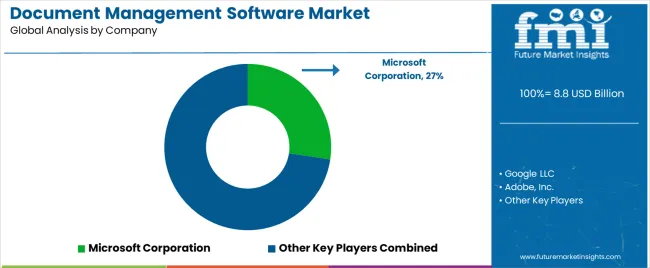
Companies like Microsoft, Oracle, IBM, and OpenText are dominating the market with presence of intense competition. They are ahead because they offer a wide range of products and can adapt their solutions for different industries. These companies keep improving by using advanced technologies like AI, machine learning, and blockchain to make document management more secure and automated.
The market is going towards consolidation, with smaller companies either being bought by bigger ones or teaming up to compete better. This competition is also driven by the increasing need for cloud-based DMS solutions, which are flexible and can grow with the business. This makes them popular with both big companies and small to medium-sized businesses.
Recent Market Developments
- In November 2025, Ideagen announced acquisition of Op Centeral and its portfolio of AI tools for ensuring compliance in large businesses. The acquisition is said to incorporate AI compliance management within the company’s document quality management software.
- In August 2025, Open Text announced partnership with Google Cloud to deliver AI-powered integrations that will help organizations, this will help OpenText bring vertex AI powered document insights into their product. As well as accelerating the cloud migration journey for customers on mainframe infrastructure utilizing solutions such as Google Cloud Dual Run.
- In March 2025, Xerox Corporation re-introduced its electronic document management system while transforming its workplace. The Xerox EDMS assures the proper handling of every document types and file formats including image, sound, audio or video.
Key Players in the Document Management Software Industry
- Google LLC
- Adobe, Inc.
- Microsoft Corporation
- Dropbox, Inc.
- IBM Corporation
- Autodesk, Inc.
- Toshiba Corporation
- Open Text Corporation
- MasterControl Solutions, Inc.
- Zoho Corporation
- DocuWare Europe GmbH
- Laserfiche
- Ideagen
- Revver, Inc.
Document Management Software Market Segmentation
By Solution:
Construction management software industry includes Integrated Document Management Software Suite and Standalone Software.
By Deployment:
The segment is divided into cloud and on premise.
By Enterprise Size:
Small Offices (1-9 employees), Small Enterprises (10-99 employees), Medium-sized Enterprise (100-499 employees), Large Enterprises (500-999 employees) and Very Large Enterprises (1,000+ employees) are segmented in this category.
By Industry:
Finance, Manufacturing & Resources, Distribution Services, Services, Public Sector and Infrastructure are segmented in this category.
By Region:
A regional analysis has been carried out in key countries of North America, Latin America, East Asia, South Asia & Pacific Western Europe, Eastern Europe and Middle East and Africa (MEA).
Frequently Asked Questions
How big is the document management software market in 2025?
The global document management software market is estimated to be valued at USD 8.8 billion in 2025.
What will be the size of document management software market in 2035?
The market size for the document management software market is projected to reach USD 27.2 billion by 2035.
How much will be the document management software market growth between 2025 and 2035?
The document management software market is expected to grow at a 12.0% CAGR between 2025 and 2035.
What are the key product types in the document management software market?
The key product types in document management software market are integrated document management software and standalone software.
Which deployment segment to contribute significant share in the document management software market in 2025?
In terms of deployment, cloud-based segment to command 63.7% share in the document management software market in 2025.
Preview the report firsthand - request a free sample
Get SampleGet the brochure for pricing and purchase details.
Get PDFTable of Content
- Executive Summary
- Global Market Outlook
- Demand-side Trends
- Supply-side Trends
- Technology Roadmap Analysis
- Analysis and Recommendations
- Market Overview
- Market Coverage / Taxonomy
- Market Definition / Scope / Limitations
- Market Background
- Market Dynamics
- Drivers
- Restraints
- Opportunity
- Trends
- Scenario Forecast
- Demand in Optimistic Scenario
- Demand in Likely Scenario
- Demand in Conservative Scenario
- Opportunity Map Analysis
- Product Life Cycle Analysis
- Supply Chain Analysis
- Investment Feasibility Matrix
- Value Chain Analysis
- PESTLE and Porter’s Analysis
- Regulatory Landscape
- Regional Parent Market Outlook
- Production and Consumption Statistics
- Import and Export Statistics
- Market Dynamics
- Global Market Analysis 2020 to 2025 and Forecast, 2025 to 2035
- Historical Market Size Value (USD Million) Analysis, 2020 to 2025
- Current and Future Market Size Value (USD Million) Projections, 2025 to 2035
- Y-o-Y Growth Trend Analysis
- Absolute $ Opportunity Analysis
- Global Market Pricing Analysis 2020 to 2025 and Forecast 2025 to 2035
- Global Market Analysis 2020 to 2025 and Forecast 2025 to 2035, By Solution
- Introduction / Key Findings
- Historical Market Size Value (USD Million) Analysis By Solution , 2020 to 2025
- Current and Future Market Size Value (USD Million) Analysis and Forecast By Solution , 2025 to 2035
- Integrated Document Management Software
- Standalone Software
- Y-o-Y Growth Trend Analysis By Solution , 2020 to 2025
- Absolute $ Opportunity Analysis By Solution , 2025 to 2035
- Global Market Analysis 2020 to 2025 and Forecast 2025 to 2035, By Deployment
- Introduction / Key Findings
- Historical Market Size Value (USD Million) Analysis By Deployment, 2020 to 2025
- Current and Future Market Size Value (USD Million) Analysis and Forecast By Deployment, 2025 to 2035
- Cloud-Based
- On-Premise
- Y-o-Y Growth Trend Analysis By Deployment, 2020 to 2025
- Absolute $ Opportunity Analysis By Deployment, 2025 to 2035
- Global Market Analysis 2020 to 2025 and Forecast 2025 to 2035, By Enterprise Size
- Introduction / Key Findings
- Historical Market Size Value (USD Million) Analysis By Enterprise Size, 2020 to 2025
- Current and Future Market Size Value (USD Million) Analysis and Forecast By Enterprise Size, 2025 to 2035
- Small Enterprises (10-99 Employees)
- Small Offices (1-9 Employees)
- Medium-Sized Enterprise (100-499 Employees)
- Large Enterprises (500-999 Employees)
- Very Large Enterprises (1,000+ Employees)
- Y-o-Y Growth Trend Analysis By Enterprise Size, 2020 to 2025
- Absolute $ Opportunity Analysis By Enterprise Size, 2025 to 2035
- Global Market Analysis 2020 to 2025 and Forecast 2025 to 2035, By Industry
- Introduction / Key Findings
- Historical Market Size Value (USD Million) Analysis By Industry, 2020 to 2025
- Current and Future Market Size Value (USD Million) Analysis and Forecast By Industry, 2025 to 2035
- Finance
- Manufacturing & Resources
- Distribution Services
- Services
- Public Sector
- Infrastructure
- Y-o-Y Growth Trend Analysis By Industry, 2020 to 2025
- Absolute $ Opportunity Analysis By Industry, 2025 to 2035
- Global Market Analysis 2020 to 2025 and Forecast 2025 to 2035, By Region
- Introduction
- Historical Market Size Value (USD Million) Analysis By Region, 2020 to 2025
- Current Market Size Value (USD Million) Analysis and Forecast By Region, 2025 to 2035
- North America
- Latin America
- Western Europe
- Eastern Europe
- East Asia
- South Asia and Pacific
- Middle East & Africa
- Market Attractiveness Analysis By Region
- North America Market Analysis 2020 to 2025 and Forecast 2025 to 2035, By Country
- Historical Market Size Value (USD Million) Trend Analysis By Market Taxonomy, 2020 to 2025
- Market Size Value (USD Million) Forecast By Market Taxonomy, 2025 to 2035
- By Country
- USA
- Canada
- Mexico
- By Solution
- By Deployment
- By Enterprise Size
- By Industry
- By Country
- Market Attractiveness Analysis
- By Country
- By Solution
- By Deployment
- By Enterprise Size
- By Industry
- Key Takeaways
- Latin America Market Analysis 2020 to 2025 and Forecast 2025 to 2035, By Country
- Historical Market Size Value (USD Million) Trend Analysis By Market Taxonomy, 2020 to 2025
- Market Size Value (USD Million) Forecast By Market Taxonomy, 2025 to 2035
- By Country
- Brazil
- Chile
- Rest of Latin America
- By Solution
- By Deployment
- By Enterprise Size
- By Industry
- By Country
- Market Attractiveness Analysis
- By Country
- By Solution
- By Deployment
- By Enterprise Size
- By Industry
- Key Takeaways
- Western Europe Market Analysis 2020 to 2025 and Forecast 2025 to 2035, By Country
- Historical Market Size Value (USD Million) Trend Analysis By Market Taxonomy, 2020 to 2025
- Market Size Value (USD Million) Forecast By Market Taxonomy, 2025 to 2035
- By Country
- Germany
- UK
- Italy
- Spain
- France
- Nordic
- BENELUX
- Rest of Western Europe
- By Solution
- By Deployment
- By Enterprise Size
- By Industry
- By Country
- Market Attractiveness Analysis
- By Country
- By Solution
- By Deployment
- By Enterprise Size
- By Industry
- Key Takeaways
- Eastern Europe Market Analysis 2020 to 2025 and Forecast 2025 to 2035, By Country
- Historical Market Size Value (USD Million) Trend Analysis By Market Taxonomy, 2020 to 2025
- Market Size Value (USD Million) Forecast By Market Taxonomy, 2025 to 2035
- By Country
- Russia
- Poland
- Hungary
- Balkan & Baltic
- Rest of Eastern Europe
- By Solution
- By Deployment
- By Enterprise Size
- By Industry
- By Country
- Market Attractiveness Analysis
- By Country
- By Solution
- By Deployment
- By Enterprise Size
- By Industry
- Key Takeaways
- East Asia Market Analysis 2020 to 2025 and Forecast 2025 to 2035, By Country
- Historical Market Size Value (USD Million) Trend Analysis By Market Taxonomy, 2020 to 2025
- Market Size Value (USD Million) Forecast By Market Taxonomy, 2025 to 2035
- By Country
- China
- Japan
- South Korea
- By Solution
- By Deployment
- By Enterprise Size
- By Industry
- By Country
- Market Attractiveness Analysis
- By Country
- By Solution
- By Deployment
- By Enterprise Size
- By Industry
- Key Takeaways
- South Asia and Pacific Market Analysis 2020 to 2025 and Forecast 2025 to 2035, By Country
- Historical Market Size Value (USD Million) Trend Analysis By Market Taxonomy, 2020 to 2025
- Market Size Value (USD Million) Forecast By Market Taxonomy, 2025 to 2035
- By Country
- India
- ASEAN
- Australia & New Zealand
- Rest of South Asia and Pacific
- By Solution
- By Deployment
- By Enterprise Size
- By Industry
- By Country
- Market Attractiveness Analysis
- By Country
- By Solution
- By Deployment
- By Enterprise Size
- By Industry
- Key Takeaways
- Middle East & Africa Market Analysis 2020 to 2025 and Forecast 2025 to 2035, By Country
- Historical Market Size Value (USD Million) Trend Analysis By Market Taxonomy, 2020 to 2025
- Market Size Value (USD Million) Forecast By Market Taxonomy, 2025 to 2035
- By Country
- Kingdom of Saudi Arabia
- Other GCC Countries
- Turkiye
- South Africa
- Other African Union
- Rest of Middle East & Africa
- By Solution
- By Deployment
- By Enterprise Size
- By Industry
- By Country
- Market Attractiveness Analysis
- By Country
- By Solution
- By Deployment
- By Enterprise Size
- By Industry
- Key Takeaways
- Key Countries Market Analysis
- USA
- Pricing Analysis
- Market Share Analysis, 2025
- By Solution
- By Deployment
- By Enterprise Size
- By Industry
- Canada
- Pricing Analysis
- Market Share Analysis, 2025
- By Solution
- By Deployment
- By Enterprise Size
- By Industry
- Mexico
- Pricing Analysis
- Market Share Analysis, 2025
- By Solution
- By Deployment
- By Enterprise Size
- By Industry
- Brazil
- Pricing Analysis
- Market Share Analysis, 2025
- By Solution
- By Deployment
- By Enterprise Size
- By Industry
- Chile
- Pricing Analysis
- Market Share Analysis, 2025
- By Solution
- By Deployment
- By Enterprise Size
- By Industry
- Germany
- Pricing Analysis
- Market Share Analysis, 2025
- By Solution
- By Deployment
- By Enterprise Size
- By Industry
- UK
- Pricing Analysis
- Market Share Analysis, 2025
- By Solution
- By Deployment
- By Enterprise Size
- By Industry
- Italy
- Pricing Analysis
- Market Share Analysis, 2025
- By Solution
- By Deployment
- By Enterprise Size
- By Industry
- Spain
- Pricing Analysis
- Market Share Analysis, 2025
- By Solution
- By Deployment
- By Enterprise Size
- By Industry
- France
- Pricing Analysis
- Market Share Analysis, 2025
- By Solution
- By Deployment
- By Enterprise Size
- By Industry
- India
- Pricing Analysis
- Market Share Analysis, 2025
- By Solution
- By Deployment
- By Enterprise Size
- By Industry
- ASEAN
- Pricing Analysis
- Market Share Analysis, 2025
- By Solution
- By Deployment
- By Enterprise Size
- By Industry
- Australia & New Zealand
- Pricing Analysis
- Market Share Analysis, 2025
- By Solution
- By Deployment
- By Enterprise Size
- By Industry
- China
- Pricing Analysis
- Market Share Analysis, 2025
- By Solution
- By Deployment
- By Enterprise Size
- By Industry
- Japan
- Pricing Analysis
- Market Share Analysis, 2025
- By Solution
- By Deployment
- By Enterprise Size
- By Industry
- South Korea
- Pricing Analysis
- Market Share Analysis, 2025
- By Solution
- By Deployment
- By Enterprise Size
- By Industry
- Russia
- Pricing Analysis
- Market Share Analysis, 2025
- By Solution
- By Deployment
- By Enterprise Size
- By Industry
- Poland
- Pricing Analysis
- Market Share Analysis, 2025
- By Solution
- By Deployment
- By Enterprise Size
- By Industry
- Hungary
- Pricing Analysis
- Market Share Analysis, 2025
- By Solution
- By Deployment
- By Enterprise Size
- By Industry
- Kingdom of Saudi Arabia
- Pricing Analysis
- Market Share Analysis, 2025
- By Solution
- By Deployment
- By Enterprise Size
- By Industry
- Turkiye
- Pricing Analysis
- Market Share Analysis, 2025
- By Solution
- By Deployment
- By Enterprise Size
- By Industry
- South Africa
- Pricing Analysis
- Market Share Analysis, 2025
- By Solution
- By Deployment
- By Enterprise Size
- By Industry
- USA
- Market Structure Analysis
- Competition Dashboard
- Competition Benchmarking
- Market Share Analysis of Top Players
- By Regional
- By Solution
- By Deployment
- By Enterprise Size
- By Industry
- Competition Analysis
- Competition Deep Dive
- Microsoft Corporation
- Overview
- Product Portfolio
- Profitability by Market Segments (Product/Age /Sales Channel/Region)
- Sales Footprint
- Strategy Overview
- Marketing Strategy
- Product Strategy
- Channel Strategy
- Google LLC
- Adobe, Inc.
- Dropbox, Inc.
- IBM Corporation
- Autodesk, Inc.
- Toshiba Corporation
- Open Text Corporation
- MasterControl Solutions, Inc.
- Zoho Corporation
- DocuWare Europe GmbH
- Laserfiche
- Ideagen
- Revver, Inc.
- Microsoft Corporation
- Competition Deep Dive
- Assumptions & Acronyms Used
- Research Methodology


