

- Industry Size (2026)
- USD 680.0 Mn
- Forecast (2036)
- USD 1026.0 Mn
- CAGR (2026 to 2036)
- 4.2%
Bulk Packaging for Computer Peripherals Market Forecast and Outlook 2026 to 2036
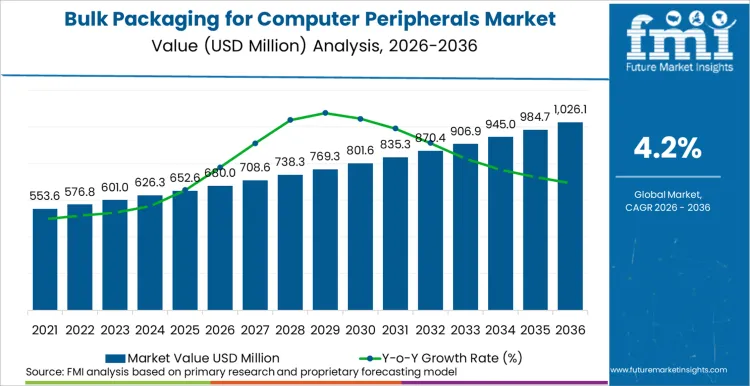
Bulk packaging for computer peripherals market revenue is likely to total USD 680.0 million in 2026, rising further to USD 1026.0 million by 2036, at a CAGR of 4.2%. As per Future Market Insights' analysis, the market is undergoing an operational transformation, characterized by a shift from disposable single-use shipping boxes to the deployment of intelligent, returnable, and unit-load optimized systems. As of 2026, this shift is propelled by the need for supply chain resilience, the rise of contract manufacturing, and stringent regulations on packaging waste in industrial logistics.
Growth is anchored by the strategic realignment of global electronics supply chains toward regional hubs. In January 2026, HP Inc. announced a multi-year partnership with several Southeast Asian contract manufacturers, mandating the adoption of standardized, returnable plastic tote systems for the intra-factory movement of keyboard and mouse components. This move aims to eliminate an estimated 300 metric tons of annual corrugated waste within its supply chain by 2028.
The USA Environmental Protection Agency’s 2026 update to its Waste Reduction Model (WARM) now includes enhanced emission factors for reusable industrial packaging. This quantification makes the financial and sustainability case for returnable systems more compelling for OEMs, accelerating investment in such platforms from bulk packaging suppliers.
The industry’s focus on reducing total landed cost is elevating the importance of packaging density and handling automation. Smurfit Kappa launched its "Performance Wave" corrugated shipper series in Q1 2026, featuring embedded RFID tags and compression-engineered walls that allow for a 15% increase in pallet load density for peripheral shipments. This innovation directly addresses the chronic freight capacity challenges highlighted in the 2026 Council of Supply Chain Management Professionals (CSCMP) State of Logistics Report.
WestRock’s 2025 financial disclosures reveal a strategic capital reallocation toward its multi-wall bag and industrial container division, explicitly citing growth in the protective logistics of high-volume, low-weight electronics accessories as a key driver.
The evolving demand is underscored by a strategic shift at Sealed Air Corporation, which in late 2025 consolidated its manufacturing assets to amplify production of engineered cushioning and dunnage specifically designed for the automated sortation systems used by major third-party logistics providers handling consumer electronics.
Summary of Bulk Packaging for Computer Peripherals Market
What is the Long-Term Growth Outlook for the Bulk Packaging for Computer Peripherals Market?
FMI projects the global bulk packaging for computer peripherals market to expand from USD 680.0 million in 2026 to USD 1026.0 million by 2036, registering a 4.2% CAGR over the forecast period. Market expansion reflects a structural shift in electronics logistics, where bulk packaging is evolving from generic transport containers into integrated, system-critical assets that ensure product integrity, optimize warehouse automation, and comply with circular economy mandates across complex manufacturing and distribution networks.
FMI Research Approach: This projection is derived from FMI's proprietary forecasting framework integrating analysis of global electronics production volumes, logistics automation investment disclosures, OEM sustainability roadmaps, and regulatory policies impacting industrial packaging waste across key trade corridors.
How do FMI Analysts Expect the Bulk Packaging for Computer Peripherals Market to Evolve Structurally?
FMI analysts anticipate the market transitioning from single-trip corrugated shippers toward a hybrid ecosystem of high-performance one-way and multi-trip returnable packaging systems. This evolution is driven by total cost of ownership models, the integration of Warehouse Management Systems with packaging data, and the need for flawless handling in increasingly automated distribution centers. Innovations such as RFID-embedded corrugated shippers, collapsible returnable totes, and lightweight plastic pallets are redefining bulk handling, enabling real-time supply chain visibility while reducing material waste and labor.
FMI Research Approach: Insights are informed by analysis of packaging supplier portfolios, patent filings related to reusable packaging systems, logistics provider disclosures on automation requirements, and OEM specifications for inbound component logistics.
Which Geographies Command the Largest Share of the Bulk Packaging for Computer Peripherals Market?
Asia-Pacific leads the global market, accounting for a 44.0% share in 2026, supported by its concentration of electronics manufacturing and the rapid growth of its domestic distribution networks. North America follows with a 24.0% share, driven by sophisticated retail and e-commerce logistics demanding high-speed handling. Europe holds a 22.0% share, characterized by advanced regulations on packaging waste that incentivize reusable systems for intra-industrial logistics.
FMI Research Approach: Regional forecasts are built using manufacturing output data, regional trade flow analyses, logistics infrastructure investment tracking, and the implementation timelines of extended producer responsibility schemes for industrial packaging.
What Will Be the Market Size of Bulk Packaging for Computer Peripherals by 2036?
By 2036, the bulk packaging for computer peripherals market is expected to reach USD 1026.0 million. This growth is supported by the continuous expansion of global electronics production, the deepening complexity of omnichannel distribution, and the irreversible trend toward packaging system standardization and reuse to meet corporate sustainability and efficiency targets.
FMI Research Approach: Long-term market sizing incorporates electronics production forecasts, logistics automation adoption rates, material price scenarios for corrugate and plastics, and corporate commitments to zero-waste and reusable packaging initiatives.
What are some Globally Distinct Trends Shaping the Bulk Packaging for Computer Peripherals Market?
Globally, the market is being shaped by the convergence of automation compatibility, regulatory pressure on industrial waste, and supply chain digitization. The rise of automated warehouses is demanding packaging with precise dimensional stability and machine-readable identifiers. Regulations are pushing for reusable system adoption, while digital supply chain twins require packaging that provides data on location, shock, and temperature, transforming passive containers into active data nodes within the logistics stream.
FMI Research Approach: Trend analysis is informed by tracking automation integrator specifications, reuse legislation in the EU and North America, technology adoption in logistics, and lifecycle assessment studies comparing single-use and multi-trip packaging systems.
Bulk Packaging for Computer Peripherals Market Key Takeaways
| Metrics | Values |
|---|---|
| Expected Value (2026E) | USD 680.0 million |
| Projected Value (2036F) | USD 1026.0 million |
| CAGR (2026-2036) | 4.2% |
Source: Future Market Insights (FMI) analysis, based on proprietary forecasting model and primary research
Why is the Bulk Packaging for Computer Peripherals Market Growing?
The relentless push for supply chain efficiency and cost reduction is fundamentally redesigning inbound and outbound logistics for peripherals. The Logistics Performance Index 2026 report from the World Bank identifies packaging optimization as a top-three lever for improving trade logistics efficiency, particularly for high-volume, moderate-value goods like computer accessories. This focus is driving investment in packaging that minimizes dimensional weight, maximizes trailer and container cube utilization, and withstands automated handling without failure.
Simultaneously, the regulatory landscape for industrial and transport packaging is tightening. The EU’s Packaging and Packaging Waste Regulation (PPWR) establishes specific reuse targets for transport packaging used within industrial operations. By 2026, large companies must report on their reuse system implementation, forcing OEMs and their contract manufacturers to partner with packaging suppliers that can provide certified returnable tote and pallet pooling services.
The growth of contract manufacturing and electronics ecosystem hubs necessitates robust, standardized bulk packaging protocols. Major OEMs are issuing stringent vendor certification programs that mandate specific packaging specifications for components arriving at assembly plants. Non-compliance results in fines and rejected shipments, creating a captive, high-compliance market for bulk packaging suppliers that can guarantee conformance to these technical data sheets.
How is Bulk Packaging for Computer Peripherals Market Segmented?
The bulk packaging for computer peripherals segment landscape is defined by the paramount need for cost-effective protection, handling efficiency, and scalability. Corrugated master shippers dominate as the workhorse of discrete product distribution, while the cables/adapters category presents unique challenges driving packaging innovation. The OEM to Distributor channel sets the technical and volume standards for the entire market.
How is Format Dominance Sustained in Discrete Product Distribution?
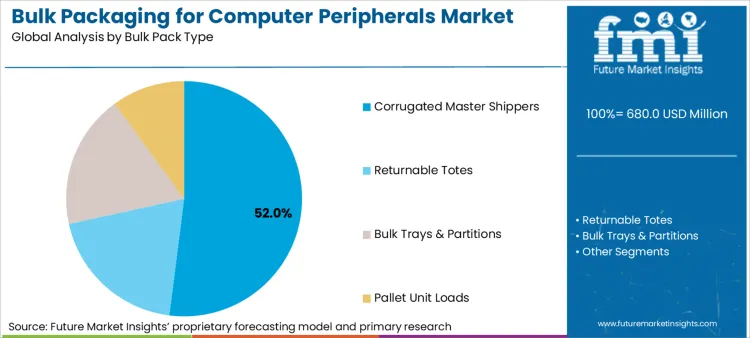
Corrugated master shippers account for a 52.0% share of the bulk pack type segment. This dominance is anchored in their unbeatable combination of low cost, high strength-to-weight ratio, and superior printability for shipping labels and barcodes. Amazon’s 2026 Sustainability Report detailed its "Ship in Own Container" (SIOC) program’s expansion to include peripheral accessories, which requires suppliers to use retailer-certified, right-sized corrugated shippers that can bypass fulfillment center prep stages, validating this format’s central role in streamlined e-commerce logistics.
The format’s technical evolution is highlighted by International Paper’s 2026 launch of its "Recover-Block" corrugated system. This design uses interlocking partitions made from 100% recycled fiber to secure multiple peripherals within a single master shipper, eliminating plastic foam dunnage and creating a fully recyclable unit load that meets both SIOC requirements and stringent EU PPWR recyclability criteria.
Which Peripheral Category Drives Unique Packaging Demand Due to High Volume and Tangling Risks?
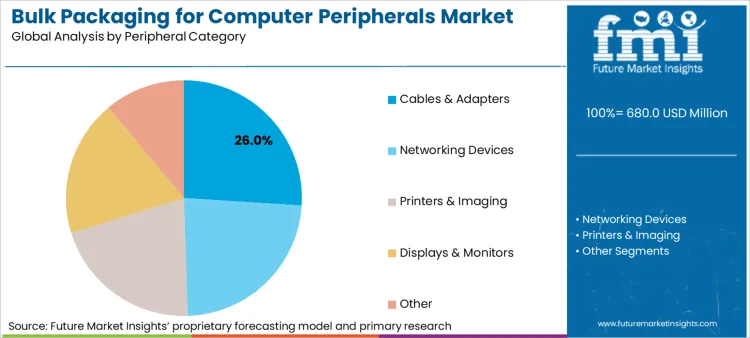
The cables/adapters category represents the largest peripheral segment with a 26.0% market share. Its packaging requirements are distinct, focusing on preventing tangles, enabling accurate counting, and allowing for easy picking of individual units from bulk containers. The Consumer Technology Association’s 2026 guidelines for packaging recyclability now include specific design recommendations for cable packaging, pushing suppliers toward paper-based wrap-and-tuck styles instead of plastic clamshells for bulk units.
This segment’s necessity drives innovation, as seen with Sonoco’s 2026 development of a patented "Spool-Tray" system. This returnable, compartmentalized plastic tote holds cables on individual spools, allowing for automated dispensing and precise inventory control at distribution centers, directly addressing the labor cost and error rate issues plaguing the logistics of this high-SKU-count category.
What Role does the OEM to Distributor Channel Play in defining Global Specifications?
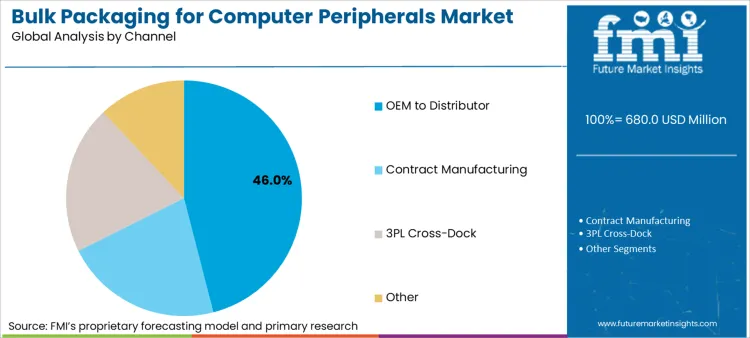
The OEM to Distributor channel commands a 46.0% share of the channel segment. It acts as the primary arena where packaging specifications are battle-tested for durability across long-haul logistics. Cisco Systems’ 2026 Global Logistics Standards mandate that all bulk packaging for networking devices must survive a 10-drop test from 1 meter and maintain stack strength for 90 days in humid warehouse conditions. These requirements set a de facto industry benchmark, forcing packaging material science to advance in moisture resistance and creep performance.
Current dynamics are exemplified by the 2026 partnership between Logitech and the CHEP pallet pooling network. The initiative standardizes pallet-sized corrugated bins for transporting keyboards and mice from Asian factories to regional distribution centers worldwide. This shift to a pooled asset model reduces wood waste, improves load stability, and provides granular data on packaging asset location and cycle time.
What Drivers, Restraints, Opportunities, and Trends Prevail in the Bulk Packaging for Computer Peripherals Market?
Market expansion is critically supported by the economics of freight optimization. With global freight rates exhibiting continued volatility as noted in the 2026 Drewry World Container Index, the reduction of package dimensional weight (dim weight) has become a direct contributor to corporate profitability. This drives relentless innovation in corrugated engineering to create shippers with minimal air space and maximal stacking strength, directly increasing demand for high-performance, custom-engineered bulk solutions over generic boxes.
While demand is stable, manufacturers face significant input cost pressure and complexity. The American Forest & Paper Association’s 2026 market report indicates sustained high costs for recycled paper fiber, a primary input for corrugated material. This margin pressure compels converters to invest in advanced manufacturing analytics and robotic forming equipment to reduce waste and labor costs, ensuring profitability on large-volume contracts.
The regulatory landscape presents both a constraint and an opportunity through digital product passports. The EU’s Digital Product Passport requirement, extending to electronics, means bulk packaging may need to facilitate the aggregation of individual product passport data. This could drive the integration of master-level RFID tags or QR codes on bulk shippers that digitally link to all contained units, adding a layer of required functionality and data management.
Technical innovation is defined by the integration of smart packaging sensors for high-value components. In early 2026, Hewlett Packard Enterprise began piloting bulk containers for server rack accessories equipped with low-cost Bluetooth shock indicators. These sensors log any impacts exceeding a 50g threshold during transit, allowing for automated damage claims and root-cause analysis in the supply chain, elevating packaging to a diagnostic tool.
The circular economy is driving a definitive shift toward reusable transport packaging systems. Companies like Toshiba and Lenovo have initiated closed-loop tote programs for peripheral components moving between their own facilities. Suppliers like Nefab and Returnable Packaging Association members are responding with lightweight, collapsible plastic container systems designed for thousands of trips, supported by IoT-based tracking for asset management and loss prevention.
Analysis of Bulk Packaging for Computer Peripherals Market by Key Countries
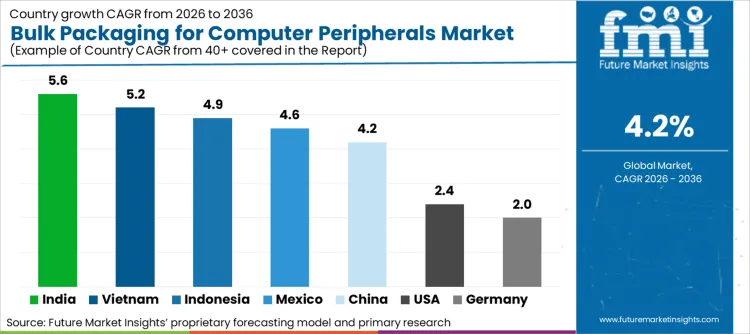
| Country | CAGR (2026-2036) |
|---|---|
| India | 5.6% |
| Vietnam | 5.2% |
| Indonesia | 4.9% |
| China | 4.2% |
| Mexico | 4.6% |
| USA | 2.4% |
| Germany | 2.0% |
| Japan | 1.7% |
Source: Future Market Insights (FMI) analysis, based on proprietary forecasting model and primary research
How is Domestic Manufacturing Growth Scaling the Indian Market?
India is projected to expand at a 5.6% CAGR through 2036. This growth is propelled by the success of the Production Linked Incentive (PLI) scheme for IT hardware, which has catalyzed domestic manufacturing of peripherals like keyboards, mice, and adapters. The India Cellular and Electronics Association (ICEA) reported in 2026 a 40% year-over-year increase in domestic production volume for these categories. This surge creates immediate, high-volume demand for standardized bulk packaging sourced locally to support new factory outputs and growing domestic distribution networks.
This growth is further intensified by India’s 2026 Plastic Waste Management (Amendment) Rules, which impose stricter enforcement on industrial packaging waste. The rules incentivize the use of recyclable corrugated shippers over plastic films or void fill for bulk unitization, creating a regulatory push that aligns with the expanding manufacturing base to fuel demand for compliant fiber-based packaging solutions.
Which Export-Led Manufacturing Sophistication is Elevating the Vietnamese Market?
Vietnam’s market is set for a 5.2% CAGR, fueled by its deepening integration into global electronics supply chains as a primary export hub. Major OEMs like Samsung and Apple have issued mandatory supplier guidelines effective 2026 requiring that all bulk packaging for exported components achieve a minimum 90% recycled content and be certified by the Forest Stewardship Council (FSC). This export-compliance requirement elevates local packaging suppliers' capabilities, demanding investment in certified material sourcing and quality control laboratories.
Simultaneously, Vietnam’s logistics modernization, evidenced by the 2026 opening of major deep-water port facilities in Lach Huyen, is increasing the average haul length and handling points for exports. This places a premium on bulk packaging with superior stacking strength and moisture resistance to withstand longer, more complex logistics journeys, moving the market toward higher-performance corrugated grades and composite materials.
What Role does Growing Domestic Integration Play in the Indonesian Market?
Indonesia’s market is forecasted at a 4.9% CAGR, largely influenced by government policies mandating increased domestic content in manufactured electronics. The Ministry of Industry’s 2026 "Level of Component" (TKDN) regulations for peripherals have been raised, compelling assemblers to source a higher percentage of components, including their bulk packaging, locally. This policy shields local packaging converters from international competition and drives investment in domestic corrugated sheet plants and partition fabrication.
The market is also shaped by the archipelago’s unique logistics challenges. Inter-island shipping of finished goods is vulnerable to high humidity and handling damage. This specific environment creates sustained demand for bulk packaging solutions with enhanced wet-strength treatments and robust corner protection, specifications that are becoming standard in requests for proposals from major Indonesian electronics conglomerates.
How is Market Maturity and Automation Driving Evolution in the Chinese Market?
China leads the regional market with a 4.2% CAGR, underpinned by its mature but evolving manufacturing ecosystem. The focus has shifted from pure output growth to logistics efficiency and automation compatibility. The 2026 "Made in China 2025" implementation guidelines for the electronics sector specifically subsidize investments in automated warehouse systems, which in turn require packaging with perfectly consistent dimensions and machine-readable identifiers on every master shipper.
Complementing this automation drive is China’s national Dual Carbon policy. Large electronics manufacturers are now required to report carbon emissions from their logistics packaging. This policy is driving a rapid shift from single-trip wooden pallets and non-recyclable stretch wrap to lightweight plastic pallet pools and pre-stretched, thin-gauge films, creating a high-volume market for optimized, circular bulk handling systems.
How is Nearshoring to Mexico Reshaping Packaging Requirements?
Mexico’s market, growing at a 4.6% CAGR, is being reshaped by its role in nearshoring for the North American market. The USMCA’s rules of origin necessitate detailed tracking of component movement. In response, bulk packaging for peripherals assembled in Mexico is increasingly being embedded with ultra-high frequency RFID tags that are read at border crossings, providing auditable proof of regional content and streamlining customs processes for manufacturers.
Which Domestic Logistics Intensity Defines the USA Market Landscape?
The United States market, with a 2.4% CAGR, is defined by the intensity of its domestic logistics and e-fulfillment networks. The high cost of last-mile delivery is forcing a re-evaluation of bulk packaging at the distribution center level. Retailers like Best Buy and Walmart now require vendors to ship peripherals in bulk packs that are easily "breakable" into shelf-ready displays or e-commerce singles without cutting tools or generating loose waste, driving demand for perforated, easy-open corrugated shipper designs.
What Role do EU-Wide Reuse Mandates Play in the German Market?
Germany’s market, expanding at a 2.0% CAGR, serves as the EU’s regulatory testing ground. The German implementation of the EU PPWR includes specific financial penalties for companies failing to implement reusable systems for transport packaging where "technically and economically feasible." This legal language is forcing negotiations between German automotive and electronics OEMs and their packaging suppliers to establish closed-loop reusable tote systems for accessory components, creating a new business model centered on packaging-as-a-service.
How is Extreme Space Optimization Influencing the Japanese Market?
Japan’s market, with a 1.7% CAGR, is driven by extreme spatial and efficiency constraints in its logistics infrastructure. The Japan Institute of Logistics Systems’ 2026 report highlights the industry-wide adoption of "Kei" (light) packaging principles, mandating the absolute minimization of packaging weight and volume. For bulk peripherals, this has led to the widespread use of returnable, collapsible plastic container systems that stack neatly when full and fold to 20% of their size when empty, optimizing both outbound freight and costly return logistics storage.
What is the Competition Outlook for Bulk Packaging for Computer Peripherals?
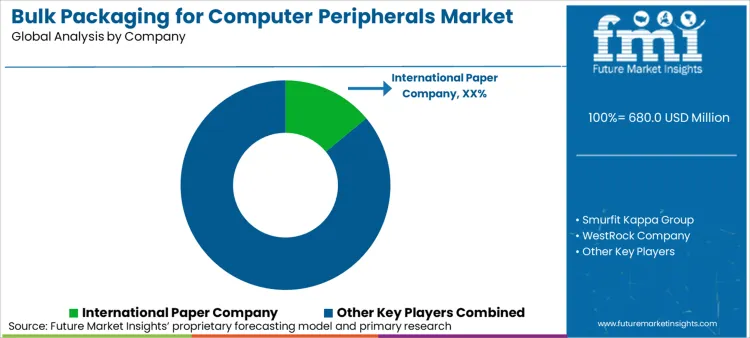
Competitive intensity reflects the packaging industry's pivotal role in enabling lean, resilient, and sustainable electronics supply chains. The environment is characterized by the rise of integrated service providers who offer not just containers, but full lifecycle management including reverse logistics, cleaning, repair, and tracking of reusable assets. Barriers to entry are elevated, favoring firms with global footprints, material science expertise, and digital tracking capabilities to serve multinational OEMs.
Macro-level trends are dictating a focus on regional self-sufficiency. In response to trade policy uncertainty and carbon border adjustment mechanisms, leading suppliers are establishing regional manufacturing and pooling networks. This "local loop" strategy ensures supply security for clients and reduces the carbon footprint of packaging logistics, making it a key differentiator in requests for proposals.
Strategic Evolution and Observable Direction pre-2024
Competition pre-2024 was defined by scale and geographic coverage in corrugated sheet production. Consolidation, such as WestRock's formation and International Paper's acquisition spree, aimed to control fiber costs and serve global clients with a consistent supply of brown-box shipping containers.
Suppliers competed on the breadth of their standard container offerings and sheet plant locations, focusing on serving the just-in-time delivery needs of electronics manufacturing clusters with reliable, low-cost corrugated solutions.
Observable Strategic Direction for 2026 and Beyond
A primary strategic direction for 2026 is diversification into reusable packaging systems and digital asset management. In February 2026, Smurfit Kappa announced a joint venture with a technology firm to launch KappaTrack, a digital platform for managing fleets of both its corrugated and new reusable plastic packaging assets, offering real-time visibility, condition reporting, and sustainability metrics to clients.
Strategic leadership is shifting toward firms that master the intersection of packaging and logistics data. Companies like Amcor are investing in printed electronics, piloting bulk shippers in 2026 with embedded printed sensors that monitor temperature and humidity for sensitive networking gear during ocean transit, thereby offering risk mitigation as a core service.
Recent Developments
- International Paper announced plans to split into two separate publicly traded packaging companies, spinning off its European packaging business to sharpen focus and productivity in North America and EMEA. The spin-off is expected to be completed within the next 12–15 months, with the new EMEA packaging entity listed on major exchanges and International Paper retaining a meaningful stake.
- Smurfit Westrock won 15 WorldStar Packaging Awards in 2026 for its innovative and sustainable paper-based packaging solutions across multiple categories, including packaging that replaces expanded polystyrene with corrugated alternatives, reducing plastic use and CO₂ emissions. This global recognition underscores its industry leadership in innovation and sustainability.
- Graphic Packaging named new leadership effective January 1, 2026, with Robbert Rietbroek appointed President and CEO. The move is a strategic transition at the top that is likely to shape the company’s packaging strategy and innovations going forward.
Key Players Profiled
- International Paper Company
- Smurfit Kappa Group
- WestRock Company
- Mondi Group
- Amcor plc
- Sealed Air Corporation
- Sonoco Products Company
- Huhtamaki Oyj
- Stora Enso Oyj
- Graphic Packaging Holding Company
Market Definition
The bulk packaging for computer peripherals market comprises revenue generated from the design, manufacture, and supply of intermediate and transport packaging solutions used for the consolidated handling, storage, and distribution of computer peripherals in volume. These solutions include corrugated shippers, returnable totes, bulk trays, palletized unit loads, and associated dunnage and partitions. The market serves the need to move multiple units efficiently between manufacturing sites, distribution centers, and retail hubs while ensuring product protection and handling efficiency.
The market scope covers packaging supplied for business-to-business logistics within the electronics supply chain. Revenue includes value-added services such as packaging design, testing, kitting, and managed services for reusable packaging asset pools. The market excludes primary retail packaging, packaging for individual consumer units, and general freight packaging not specifically engineered for computer peripherals.
Scope of Report
| Items | Values |
|---|---|
| Quantitative Units | USD 680 million |
| Bulk Pack Type | Corrugated Master Shippers, Returnable Totes, Bulk Trays/Partitions, Pallet Unit Loads, Other |
| Peripheral Category | Keyboards/Mice, Cables/Adapters, Networking Devices, Printers & Imaging, Displays/Monitors, Other |
| Channel | OEM to Distributor, Contract Manufacturing, 3PL Cross-Dock, Other |
| Regions Covered | Asia-Pacific, North America, Europe, Latin America, Middle East & Africa |
| Countries | U.S., Germany, China, India, Vietnam, Indonesia, Mexico, Japan and 40+ countries |
| Key Companies | International Paper, Smurfit Kappa, WestRock, Mondi, Amcor, Sealed Air, Sonoco, Huhtamaki, Stora Enso, Graphic Packaging |
Source: Future Market Insights (FMI) analysis, based on proprietary forecasting model and primary research
Bulk Packaging for Computer Peripherals Market Key Segments
Bulk Pack Type
- Corrugated Master Shippers
- Returnable Totes
- Bulk Trays & Partitions
- Pallet Unit Loads
- Other
Peripheral Category
- Keyboards & Mice
- Cables & Adapters
- Networking Devices
- Printers & Imaging
- Displays & Monitors
- Other
Channel
- OEM to Distributor
- Contract Manufacturing
- 3PL Cross-Dock
- Other
Region
- Asia-Pacific
- North America
- Europe
- Latin America
- Middle East & Africa
Bibliography
- Consumer Technology Association (CTA). (2026). Design guidelines for recyclable consumer electronics packaging.
- Council of Supply Chain Management Professionals (CSCMP). (2026). State of logistics report.
- India Cellular and Electronics Association (ICEA). (2026). Annual industry performance review.Japan Institute of Logistics Systems (JILS). (2026). Packaging optimization for modern logistics.
- Sealed Air Corporation. (2025, February 4). Q4 2025 earnings call transcript.
- U.S. Environmental Protection Agency (EPA). (2026). Documentation for Greenhouse Gas Emission and Energy Factors Used in the Waste Reduction Model (WARM).World Bank Group. (2026, April). Commodity markets outlook.
Frequently Asked Questions
How big is the bulk packaging for computer peripherals market in 2026?
The global bulk packaging for computer peripherals market is estimated to be valued at USD 680.0 million in 2026.
What will be the size of bulk packaging for computer peripherals market in 2036?
The market size for the bulk packaging for computer peripherals market is projected to reach USD 1,026.1 million by 2036.
How much will be the bulk packaging for computer peripherals market growth between 2026 and 2036?
The bulk packaging for computer peripherals market is expected to grow at a 4.2% CAGR between 2026 and 2036.
What are the key product types in the bulk packaging for computer peripherals market?
The key product types in bulk packaging for computer peripherals market are corrugated master shippers, returnable totes, bulk trays & partitions and pallet unit loads.
Which peripheral category segment to contribute significant share in the bulk packaging for computer peripherals market in 2026?
In terms of peripheral category, cables & adapters segment to command 26.0% share in the bulk packaging for computer peripherals market in 2026.
Preview the report firsthand - request a free sample
Get SampleGet the brochure for pricing and purchase details.
Get PDFTable of Content
- Executive Summary
- Global Market Outlook
- Demand-side Trends
- Supply-side Trends
- Technology Roadmap Analysis
- Analysis and Recommendations
- Market Overview
- Market Coverage / Taxonomy
- Market Definition / Scope / Limitations
- Research Methodology
- Chapter Orientation
- Analytical Lens and Working Hypotheses
- Market Structure, Signals, and Trend Drivers
- Benchmarking and Cross-market Comparability
- Market Sizing, Forecasting, and Opportunity Mapping
- Research Design and Evidence Framework
- Desk Research Programme (Secondary Evidence)
- Company Annual and Sustainability Reports
- Peer-reviewed Journals and Academic Literature
- Corporate Websites, Product Literature, and Technical Notes
- Earnings Decks and Investor Briefings
- Statutory Filings and Regulatory Disclosures
- Technical White Papers and Standards Notes
- Trade Journals, Industry Magazines, and Analyst Briefs
- Conference Proceedings, Webinars, and Seminar Materials
- Government Statistics Portals and Public Data Releases
- Press Releases and Reputable Media Coverage
- Specialist Newsletters and Curated Briefings
- Sector Databases and Reference Repositories
- FMI Internal Proprietary Databases and Historical Market Datasets
- Subscription Datasets and Paid Sources
- Social Channels, Communities, and Digital Listening Inputs
- Additional Desk Sources
- Expert Input and Fieldwork (Primary Evidence)
- Primary Modes
- Qualitative Interviews and Expert Elicitation
- Quantitative Surveys and Structured Data Capture
- Blended Approach
- Why Primary Evidence is Used
- Field Techniques
- Interviews
- Surveys
- Focus Groups
- Observational and In-context Research
- Social and Community Interactions
- Stakeholder Universe Engaged
- C-suite Leaders
- Board Members
- Presidents and Vice Presidents
- R&D and Innovation Heads
- Technical Specialists
- Domain Subject-matter Experts
- Scientists
- Physicians and Other Healthcare Professionals
- Governance, Ethics, and Data Stewardship
- Research Ethics
- Data Integrity and Handling
- Primary Modes
- Tooling, Models, and Reference Databases
- Desk Research Programme (Secondary Evidence)
- Data Engineering and Model Build
- Data Acquisition and Ingestion
- Cleaning, Normalisation, and Verification
- Synthesis, Triangulation, and Analysis
- Quality Assurance and Audit Trail
- Market Background
- Market Dynamics
- Drivers
- Restraints
- Opportunity
- Trends
- Scenario Forecast
- Demand in Optimistic Scenario
- Demand in Likely Scenario
- Demand in Conservative Scenario
- Opportunity Map Analysis
- Product Life Cycle Analysis
- Supply Chain Analysis
- Investment Feasibility Matrix
- Value Chain Analysis
- PESTLE and Porter’s Analysis
- Regulatory Landscape
- Regional Parent Market Outlook
- Production and Consumption Statistics
- Import and Export Statistics
- Market Dynamics
- Global Market Analysis 2021 to 2025 and Forecast, 2026 to 2036
- Historical Market Size Value (USD Million) Analysis, 2021 to 2025
- Current and Future Market Size Value (USD Million) Projections, 2026 to 2036
- Y-o-Y Growth Trend Analysis
- Absolute $ Opportunity Analysis
- Global Market Pricing Analysis 2021 to 2025 and Forecast 2026 to 2036
- Global Market Analysis 2021 to 2025 and Forecast 2026 to 2036, By Bulk Pack Type
- Introduction / Key Findings
- Historical Market Size Value (USD Million) Analysis By Bulk Pack Type , 2021 to 2025
- Current and Future Market Size Value (USD Million) Analysis and Forecast By Bulk Pack Type , 2026 to 2036
- Corrugated Master Shippers
- Returnable Totes
- Bulk Trays & Partitions
- Pallet Value (USD Million) Loads
- Corrugated Master Shippers
- Y-o-Y Growth Trend Analysis By Bulk Pack Type , 2021 to 2025
- Absolute $ Opportunity Analysis By Bulk Pack Type , 2026 to 2036
- Global Market Analysis 2021 to 2025 and Forecast 2026 to 2036, By Peripheral Category
- Introduction / Key Findings
- Historical Market Size Value (USD Million) Analysis By Peripheral Category, 2021 to 2025
- Current and Future Market Size Value (USD Million) Analysis and Forecast By Peripheral Category, 2026 to 2036
- Cables & Adapters
- Networking Devices
- Printers & Imaging
- Displays & Monitors
- Other
- Cables & Adapters
- Y-o-Y Growth Trend Analysis By Peripheral Category, 2021 to 2025
- Absolute $ Opportunity Analysis By Peripheral Category, 2026 to 2036
- Global Market Analysis 2021 to 2025 and Forecast 2026 to 2036, By Channel
- Introduction / Key Findings
- Historical Market Size Value (USD Million) Analysis By Channel, 2021 to 2025
- Current and Future Market Size Value (USD Million) Analysis and Forecast By Channel, 2026 to 2036
- OEM to Distributor
- Contract Manufacturing
- 3PL Cross-Dock
- Other
- OEM to Distributor
- Y-o-Y Growth Trend Analysis By Channel, 2021 to 2025
- Absolute $ Opportunity Analysis By Channel, 2026 to 2036
- Global Market Analysis 2021 to 2025 and Forecast 2026 to 2036, By Region
- Introduction
- Historical Market Size Value (USD Million) Analysis By Region, 2021 to 2025
- Current Market Size Value (USD Million) Analysis and Forecast By Region, 2026 to 2036
- North America
- Latin America
- Western Europe
- Eastern Europe
- East Asia
- South Asia and Pacific
- Middle East & Africa
- Market Attractiveness Analysis By Region
- North America Market Analysis 2021 to 2025 and Forecast 2026 to 2036, By Country
- Historical Market Size Value (USD Million) Trend Analysis By Market Taxonomy, 2021 to 2025
- Market Size Value (USD Million) Forecast By Market Taxonomy, 2026 to 2036
- By Country
- USA
- Canada
- Mexico
- By Bulk Pack Type
- By Peripheral Category
- By Channel
- By Country
- Market Attractiveness Analysis
- By Country
- By Bulk Pack Type
- By Peripheral Category
- By Channel
- Key Takeaways
- Latin America Market Analysis 2021 to 2025 and Forecast 2026 to 2036, By Country
- Historical Market Size Value (USD Million) Trend Analysis By Market Taxonomy, 2021 to 2025
- Market Size Value (USD Million) Forecast By Market Taxonomy, 2026 to 2036
- By Country
- Brazil
- Chile
- Rest of Latin America
- By Bulk Pack Type
- By Peripheral Category
- By Channel
- By Country
- Market Attractiveness Analysis
- By Country
- By Bulk Pack Type
- By Peripheral Category
- By Channel
- Key Takeaways
- Western Europe Market Analysis 2021 to 2025 and Forecast 2026 to 2036, By Country
- Historical Market Size Value (USD Million) Trend Analysis By Market Taxonomy, 2021 to 2025
- Market Size Value (USD Million) Forecast By Market Taxonomy, 2026 to 2036
- By Country
- Germany
- UK
- Italy
- Spain
- France
- Nordic
- BENELUX
- Rest of Western Europe
- By Bulk Pack Type
- By Peripheral Category
- By Channel
- By Country
- Market Attractiveness Analysis
- By Country
- By Bulk Pack Type
- By Peripheral Category
- By Channel
- Key Takeaways
- Eastern Europe Market Analysis 2021 to 2025 and Forecast 2026 to 2036, By Country
- Historical Market Size Value (USD Million) Trend Analysis By Market Taxonomy, 2021 to 2025
- Market Size Value (USD Million) Forecast By Market Taxonomy, 2026 to 2036
- By Country
- Russia
- Poland
- Hungary
- Balkan & Baltic
- Rest of Eastern Europe
- By Bulk Pack Type
- By Peripheral Category
- By Channel
- By Country
- Market Attractiveness Analysis
- By Country
- By Bulk Pack Type
- By Peripheral Category
- By Channel
- Key Takeaways
- East Asia Market Analysis 2021 to 2025 and Forecast 2026 to 2036, By Country
- Historical Market Size Value (USD Million) Trend Analysis By Market Taxonomy, 2021 to 2025
- Market Size Value (USD Million) Forecast By Market Taxonomy, 2026 to 2036
- By Country
- China
- Japan
- South Korea
- By Bulk Pack Type
- By Peripheral Category
- By Channel
- By Country
- Market Attractiveness Analysis
- By Country
- By Bulk Pack Type
- By Peripheral Category
- By Channel
- Key Takeaways
- South Asia and Pacific Market Analysis 2021 to 2025 and Forecast 2026 to 2036, By Country
- Historical Market Size Value (USD Million) Trend Analysis By Market Taxonomy, 2021 to 2025
- Market Size Value (USD Million) Forecast By Market Taxonomy, 2026 to 2036
- By Country
- India
- ASEAN
- Australia & New Zealand
- Rest of South Asia and Pacific
- By Bulk Pack Type
- By Peripheral Category
- By Channel
- By Country
- Market Attractiveness Analysis
- By Country
- By Bulk Pack Type
- By Peripheral Category
- By Channel
- Key Takeaways
- Middle East & Africa Market Analysis 2021 to 2025 and Forecast 2026 to 2036, By Country
- Historical Market Size Value (USD Million) Trend Analysis By Market Taxonomy, 2021 to 2025
- Market Size Value (USD Million) Forecast By Market Taxonomy, 2026 to 2036
- By Country
- Kingdom of Saudi Arabia
- Other GCC Countries
- Turkiye
- South Africa
- Other African Union
- Rest of Middle East & Africa
- By Bulk Pack Type
- By Peripheral Category
- By Channel
- By Country
- Market Attractiveness Analysis
- By Country
- By Bulk Pack Type
- By Peripheral Category
- By Channel
- Key Takeaways
- Key Countries Market Analysis
- USA
- Pricing Analysis
- Market Share Analysis, 2025
- By Bulk Pack Type
- By Peripheral Category
- By Channel
- Canada
- Pricing Analysis
- Market Share Analysis, 2025
- By Bulk Pack Type
- By Peripheral Category
- By Channel
- Mexico
- Pricing Analysis
- Market Share Analysis, 2025
- By Bulk Pack Type
- By Peripheral Category
- By Channel
- Brazil
- Pricing Analysis
- Market Share Analysis, 2025
- By Bulk Pack Type
- By Peripheral Category
- By Channel
- Chile
- Pricing Analysis
- Market Share Analysis, 2025
- By Bulk Pack Type
- By Peripheral Category
- By Channel
- Germany
- Pricing Analysis
- Market Share Analysis, 2025
- By Bulk Pack Type
- By Peripheral Category
- By Channel
- UK
- Pricing Analysis
- Market Share Analysis, 2025
- By Bulk Pack Type
- By Peripheral Category
- By Channel
- Italy
- Pricing Analysis
- Market Share Analysis, 2025
- By Bulk Pack Type
- By Peripheral Category
- By Channel
- Spain
- Pricing Analysis
- Market Share Analysis, 2025
- By Bulk Pack Type
- By Peripheral Category
- By Channel
- France
- Pricing Analysis
- Market Share Analysis, 2025
- By Bulk Pack Type
- By Peripheral Category
- By Channel
- India
- Pricing Analysis
- Market Share Analysis, 2025
- By Bulk Pack Type
- By Peripheral Category
- By Channel
- ASEAN
- Pricing Analysis
- Market Share Analysis, 2025
- By Bulk Pack Type
- By Peripheral Category
- By Channel
- Australia & New Zealand
- Pricing Analysis
- Market Share Analysis, 2025
- By Bulk Pack Type
- By Peripheral Category
- By Channel
- China
- Pricing Analysis
- Market Share Analysis, 2025
- By Bulk Pack Type
- By Peripheral Category
- By Channel
- Japan
- Pricing Analysis
- Market Share Analysis, 2025
- By Bulk Pack Type
- By Peripheral Category
- By Channel
- South Korea
- Pricing Analysis
- Market Share Analysis, 2025
- By Bulk Pack Type
- By Peripheral Category
- By Channel
- Russia
- Pricing Analysis
- Market Share Analysis, 2025
- By Bulk Pack Type
- By Peripheral Category
- By Channel
- Poland
- Pricing Analysis
- Market Share Analysis, 2025
- By Bulk Pack Type
- By Peripheral Category
- By Channel
- Hungary
- Pricing Analysis
- Market Share Analysis, 2025
- By Bulk Pack Type
- By Peripheral Category
- By Channel
- Kingdom of Saudi Arabia
- Pricing Analysis
- Market Share Analysis, 2025
- By Bulk Pack Type
- By Peripheral Category
- By Channel
- Turkiye
- Pricing Analysis
- Market Share Analysis, 2025
- By Bulk Pack Type
- By Peripheral Category
- By Channel
- South Africa
- Pricing Analysis
- Market Share Analysis, 2025
- By Bulk Pack Type
- By Peripheral Category
- By Channel
- USA
- Market Structure Analysis
- Competition Dashboard
- Competition Benchmarking
- Market Share Analysis of Top Players
- By Regional
- By Bulk Pack Type
- By Peripheral Category
- By Channel
- Competition Analysis
- Competition Deep Dive
- International Paper Company
- Overview
- Product Portfolio
- Profitability by Market Segments (Product/Age /Sales Channel/Region)
- Sales Footprint
- Strategy Overview
- Marketing Strategy
- Product Strategy
- Channel Strategy
- Smurfit Kappa Group
- WestRock Company
- Mondi Group
- Amcor plc
- Sealed Air Corporation
- International Paper Company
- Competition Deep Dive
- Assumptions & Acronyms Used


