

- Industry Size (2026)
- USD 10.88 Bn
- Forecast (2036)
- USD 16.89 Bn
- CAGR (2026 to 2036)
- 4.5%
High Performance Magnet Market size, market forecast and outlook by FMI
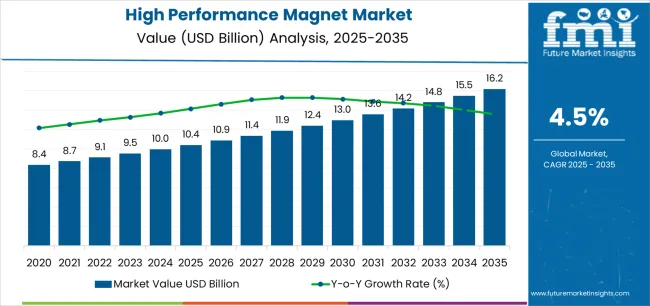
The high performance magnet market was valued at USD 10.41 billion in 2025, projected to reach USD 10.88 billion in 2026, and is forecast to expand to USD 16.89 billion by 2036 at a 4.5% CAGR. Accelerating electric vehicle production volumes and wind turbine installation programs are driving procurement of high-performance permanent magnets for traction motor and generator applications. EV powertrain designers specify sintered NdFeB magnets with elevated coercivity grades to maintain motor efficiency across operating temperature ranges. Wind turbine manufacturers are scaling direct-drive generator designs that consume larger per-unit magnet volumes compared to geared configurations, compounding demand growth beyond automotive applications.
Summary of High Performance Magnet Market
- Market Snapshot
- The high performance magnet market is valued at USD 10.41 billion in 2025 and is projected to reach USD 16.89 billion by 2036.
- The industry is expected to grow at a 4.5% CAGR from 2026 to 2036, creating an incremental opportunity of USD 6.01 billion.
- The market operates as a critical materials category where energy product density, coercivity retention at operating temperatures, and rare earth supply chain security define competitive dynamics.
- Demand and Growth Drivers
- Demand is driven by electric vehicle traction motor production ramps that require high-coercivity sintered NdFeB magnets meeting compact motor packaging and operating temperature specifications.
- Wind turbine direct-drive generator designs are scaling per-unit magnet consumption volumes as manufacturers transition from geared to gearless configurations for offshore and high-capacity onshore installations.
- Growth is further supported by industrial automation and factory robotics programs that specify high-performance permanent magnets for servo motor and precision actuator applications.
- Among key countries, China leads at 6.1% CAGR, India at 5.6%, Germany at 5.2%, Brazil at 4.7%, USA at 4.3%, UK at 3.8%.
- Product and Segment View
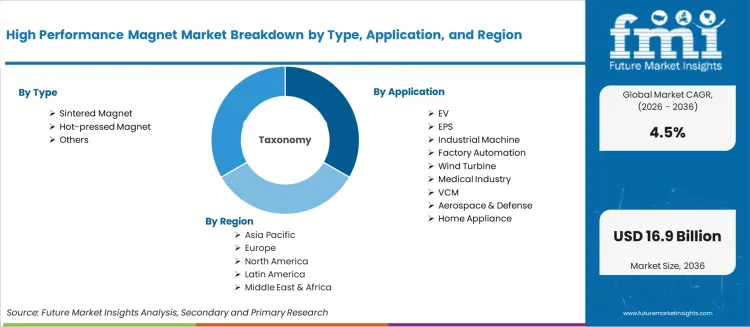
- The market includes sintered, hot-pressed, and other high-performance magnet types used across EV, EPS, industrial machinery, wind turbine, medical, aerospace, consumer electronics, and home appliance applications.
- Sintered Magnet leads by Type with 62.8% share in 2026.
- EV leads by Application with 41.3% share in 2026.
- Automotive Manufacturing leads by End-Use Industry with 38.7% share in 2026.
- Scope includes Type, Application, End-Use Industry segmentation with regional coverage across seven global regions.
- Geography and Competitive Outlook
- China and India are the fastest-growing markets, while North America and Europe remain mature demand bases.
- Competition is shaped by product quality, technical specifications, and supply chain reliability, with key players including Hitachi Metals Group, Shin-Etsu, TDK, VAC, Beijing Zhong Ke San Huan Hi-Tech, Yunsheng Company, YSMA, JL MAG, ZHmag, Jingci Material Science, AT&M, NBJJ, Innuovo Magnetics, SGM, Zhejiang Zhongyuan Magnetic, Earth-Panda, Daido Electronics, and Tianhe Magnetics.
High Performance Magnet Market key takeaways
| Metric | Details |
|---|---|
| Industry Size (2026) | USD 10.88 billion |
| Industry Value (2036) | USD 16.89 billion |
| CAGR (2026 to 2036) | 4.5% |
Source: Future Market Insights, 2026
Future Market Insights analysis indicates the high performance magnet sector is experiencing demand acceleration driven by the convergence of electric vehicle production ramp-ups and renewable energy installation targets. Sintered magnets account for the dominant type share as NdFeB sintering processes deliver the energy product densities required for compact EV traction motors and direct-drive wind generators. Hot-pressed magnets serve applications requiring near-net-shape manufacturing and specific grain alignment profiles. EV applications lead the application mix, followed by electric power steering (EPS), industrial machinery, factory automation, and wind turbine applications. Automotive manufacturing dominates the end-use industry segment, supported by industrial machinery, renewable energy, medical equipment, consumer electronics, and precision manufacturing sectors.
Country-level growth trajectories reflect EV production volume ramps and wind energy installation targets. China leads at 6.1% CAGR as the largest NdFeB magnet producer and EV manufacturing hub sustains integrated supply chain demand. India follows at 5.6%, where EV production expansion and industrial motor upgrades drive magnet procurement. Germany at 5.2% benefits from automotive OEM electrification programs and wind turbine generator manufacturing. Brazil at 4.7% and USA at 4.3% sustain demand through EV adoption growth and renewable energy installation programs. UK at 3.8% and Japan at 3.4% contribute volumes via automotive electrification and industrial automation upgrades.
High Performance Magnet Market definition
High Performance Magnet encompasses permanent magnet materials engineered to deliver high magnetic energy product, coercivity, and thermal stability for demanding electromechanical applications. The market covers sintered NdFeB magnets, hot-pressed magnets, and other advanced magnet compositions. Primary applications include electric vehicle traction motors, electric power steering systems, industrial machinery, factory automation, wind turbine generators, medical imaging equipment, voice coil motors, aerospace and defense systems, and home appliances.
High Performance Magnet Market inclusions
Market scope includes global and regional market sizes, a 2026 to 2036 forecast period, segment breakdowns by Type, Application, End-Use Industry, and regional analysis across North America, Latin America, Europe, East Asia, South Asia, Oceania, and Middle East and Africa. Pricing trend analysis and competitive positioning assessments are incorporated.
High Performance Magnet Market exclusions
The scope excludes ferrite (ceramic) magnets, flexible magnetic materials, and electromagnet assemblies. Rare earth raw materials (oxide and metal) prior to magnet fabrication are excluded from the valuation.
High Performance Magnet Market research methodology
- Primary Research: Analysts engaged with EV powertrain engineers, wind turbine generator designers, and industrial motor manufacturers to map magnet grade specifications, supply chain sourcing strategies, and performance validation requirements.
- Desk Research: Data collection aggregated EV production forecast databases, wind energy installation target publications, rare earth supply chain tracking reports, and permanent magnet performance standard specifications from IEC and JIS.
- Market-Sizing and Forecasting: Baseline values derive from a bottom-up aggregation of product-level revenues, applying region-specific adoption curves to project future demand velocity.
- Data Validation and Update Cycle: Projections are tested against publicly reported expenditure guidance from leading industry participants and cross-referenced with regulatory filings.
Why is the High Performance Magnet Market Growing?
Market expansion rests on three fundamental shifts driving adoption across automotive and industrial sectors. Electric vehicle growth creates compelling advantages through high performance magnet systems that provide comprehensive magnetic properties with operational compatibility, enabling manufacturers to manage increasing performance requirements and maintain quality standards while ensuring energy-efficient operations and justifying investment over traditional magnetic methods. Advanced efficiency modernization accelerates as companies worldwide seek reliable magnets that deliver superior performance directly to automotive systems, enabling energy reduction that aligns with operational expectations and maximizes manufacturing productivity. Industrial transformation drives adoption from equipment operators requiring specialized magnets that maximize performance while maintaining high-quality reliability during automotive and industrial operations.
Growth faces headwinds from advanced materials cost variations that differ across magnet suppliers regarding pricing stability and supply chain reliability, potentially limiting margin consistency in price-sensitive automotive categories. Manufacturing complexity also persists regarding magnet specifications and automotive requirements that may increase production costs in facilities with demanding quality standards.
Opportunity Pathways - High Performance Magnet Market
The High Performance Magnet market represents a compelling intersection of automotive innovation, magnetic performance advancement, and industrial optimization management. With robust growth projected from USD 10,408.1 million in 2025 to USD 16,163.5 million by 2035 at a 4.5% CAGR, this market is driven by increasing electric vehicle expansion trends, advanced magnetic requirements, and demand for high-performance material formats.
The market's expansion reflects a fundamental shift in how automotive facilities and industrial operators approach magnetic material infrastructure. Strong growth opportunities exist across diverse applications, from electric vehicle operations requiring high-performance magnets to industrial systems demanding reliable magnetic components. Geographic expansion is particularly pronounced in Asia-Pacific markets, led by China (6.1% CAGR) and India (5.6% CAGR), while established markets in North America and Europe drive innovation and specialized segment development.
The dominance of Sintered Magnet and electric vehicle applications underscores the importance of proven magnetic technology and automotive reliability in driving adoption. Material standardization and performance complexity remain key challenges, creating opportunities for companies that can deliver seamless magnetic performance while maintaining energy efficiency.
- Pathway A - Electric Vehicle Expansion. Development of specialized high performance magnets for electric vehicle applications, motor systems, and automotive infrastructure with enhanced magnetic performance, energy efficiency, and compatibility with automotive standards. Focus on operational efficiency and integration with electric vehicle protocols. Expected revenue pool: USD 6,465.4-8,652.1 million.
- Pathway B - Geographic Expansion & Industrial Penetration. Strong growth opportunities in China (6.1% CAGR) and India (5.6% CAGR) through partnerships with manufacturing companies, region-specific magnetic requirements, and compliance with local industrial standards. Localization addresses cost requirements and enables market penetration. Revenue opportunity: USD 5,204.1-6,965.5 million.
- Pathway C - Industrial Machinery Applications. Developing specialized magnets for industrial machinery, manufacturing equipment, and automation systems. Focus on magnetic strength, performance optimization, and compatibility with industrial manufacturing. Pool: USD 4,163.3-5,574.1 million.
- Pathway D - Advanced Sintered Magnet Technology Development. Specialized products incorporating enhanced magnetic technologies, improved material performance, advanced automotive capabilities, and superior magnetic characteristics where premium performance and electric vehicle applications justify enhanced specifications. Focus on high-performance automotive and energy efficiency. Revenue uplift: USD 3,322.6-4,447.3 million.
- Pathway E - Magnet Type Diversification Programs. Systems designed for specialized magnetic applications, custom material solutions, advanced automotive systems, and precision industrial operations that appeal to manufacturing companies and equipment producers. Integration of magnetic specifications and automotive requirements. Expected upside: USD 2,601.9-3,483.7 million.
- Pathway F - Custom Material Solutions & Application Engineering. Incorporating specialized magnetic compositions for custom applications, engineered solutions, technical services, and specialized automotive production that enhance magnetic capabilities while providing performance optimization. Focus on customer-specific requirements and technical support systems. Innovation pool: USD 2,081.6-2,786.7 million.
- Pathway G - Research & Development Integration. Tailored solutions incorporating laboratory-grade specifications, testing services, and precision magnetic systems for university research programs and automotive R&D facilities. Enhanced appeal for academic institutions and automotive research companies. Strategic value: USD 1,665.3-2,229.4 million.
Segmental Analysis
Primary Classification: The market segments by type into Sintered Magnet, Hot-pressed Magnet, and others categories, representing the evolution from standard magnetic solutions to high-performance specialized magnet systems for comprehensive operations.
Secondary Breakdown: Application segmentation divides the market into EV, EPS, Industrial Machine, Factory Automation, Wind Turbine, Medical Industry, VCM, Aerospace & Defense, and Home Appliance sectors, reflecting distinct requirements for magnetic characteristics, performance specifications, and operational capabilities.
Tertiary Classification: End-use industry segmentation covers automotive manufacturing, industrial machinery, renewable energy systems, medical equipment, consumer electronics, and precision manufacturing, representing diverse requirements for magnet specifications and application performance.
Regional Classification: Geographic distribution covers Asia Pacific, North America, Europe, Latin America, and the Middle East & Africa, with developed automotive markets leading innovation while emerging economies show accelerating growth patterns driven by industrialization programs.
The segmentation structure reveals technology progression from standard magnet systems toward integrated high-performance platforms with enhanced magnetic capabilities and precision performance, while application diversity spans from automotive systems to industrial applications requiring comprehensive magnetic properties and intelligent efficiency solutions.
By Type, the Sintered Magnet Segment Accounts for Dominant Market Share
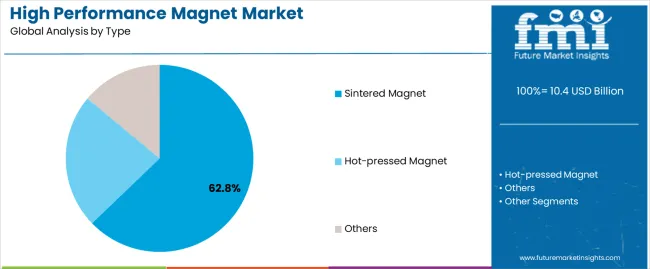
Sintered Magnet segment is estimated to account for 62.8% of the High Performance Magnet market share in 2026. The segment's leading position stems from its fundamental role as a critical component in modern electric vehicle applications and its extensive use across multiple automotive and industrial sectors. The Sintered Magnet range's dominance is attributed to its superior magnetic properties, including excellent performance characteristics, energy efficiency, and balanced cost-effectiveness that make it indispensable for automotive operations.
Market Position: Sintered Magnet commands the leading position in the High Performance Magnet market through advanced magnetic technologies, including comprehensive performance properties, uniform characteristics, and reliable magnetic capabilities that enable operators to deploy magnets across diverse automotive environments.
Value Drivers: The segment benefits from automotive preference for proven magnetic interfaces that provide exceptional performance without requiring ultra-premium material costs. Efficient magnetic implementation enables deployment in automotive, industrial, and manufacturing applications where magnet reliability and performance compatibility represent critical selection requirements.
Competitive Advantages: Sintered Magnet differentiates through excellent magnetic capacity, proven automotive reliability, and compatibility with standard manufacturing processes that enhance magnetic capabilities while maintaining economical performance profiles suitable for diverse automotive applications.
Key market characteristics:
- Advanced magnetic systems with precision performance control, consistent characteristics, and specialized manufacturing capabilities
- Magnet optimization enabling comprehensive automotive integration with minimal efficiency impact
- Automotive accessories, including magnetic equipment, performance systems, and quality control tools for high-volume operations
By Application, the EV Segment Accounts for the Largest Market Share
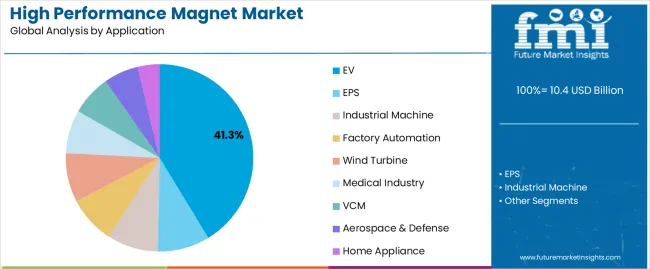
EV segment is projected to hold 41.3% of the High Performance Magnet market share in 2026. The segment's market leadership is driven by the extensive use of high performance magnets in electric motor systems, automotive manufacturing, vehicle infrastructure, and powertrain applications, where magnets serve as both a performance component and efficiency solution. The electric vehicle sector's consistent demand for reliable magnetic systems supports the segment's dominant position.
Market Context: Electric vehicle applications dominate the market due to widespread adoption of efficient magnetic solutions and increasing focus on automotive performance, energy optimization, and operational management that support vehicle operations while maintaining quality standards.
Appeal Factors: Electric vehicle consumers prioritize magnet durability, performance characteristics, and integration with standard automotive systems that enable coordinated deployment across multiple vehicle needs. The segment benefits from substantial automotive infrastructure growth and electric vehicle development that emphasize reliable magnets for powertrain applications.
Growth Drivers: Electric vehicle programs incorporate high performance magnets as standard components for motor systems and automotive programs. At the same time, automotive compliance initiatives are increasing demand for advanced features that comply with electric vehicle standards and enhance system performance.
Market Challenges: Magnet cost fluctuations and standardization requirements may limit deployment flexibility in ultra-price-sensitive markets or regions with varying automotive requirements.
Application dynamics include:
- Strong growth in electric vehicle companies and automotive manufacturers requiring standardized magnetic formats
- Increasing adoption in automotive manufacturers and system integrators for enhanced vehicle development
- Rising integration with automotive systems and powertrain infrastructure control programs
By End-Use Industry, the Automotive Manufacturing Segment Demonstrates Strong Growth
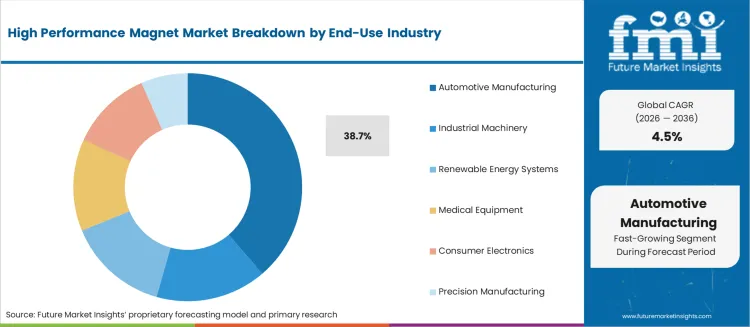
Automotive Manufacturing segment is anticipated to capture 38.7% of the High Performance Magnet market share in 2026. The segment's growth is driven by increasing vehicle production demand, automotive infrastructure initiatives, and sophisticated magnetic requirements that require high-quality performance systems. The automotive industry's expansion and focus on efficiency optimization support this segment's robust performance.
Market Position: Automotive applications leverage high performance magnets for vehicle systems in automotive equipment, manufacturing operations, assembly processes, and component integration where magnet quality and performance precision are critical operational factors.
Growth Catalysts: Rising vehicle production, automotive development trends, and expanding manufacturing capabilities drive demand for specialized magnets that deliver consistent performance across diverse automotive applications.
What are the Drivers, Restraints, and Key Trends of the High Performance Magnet Market?
Growth Accelerators: Electric vehicle expansion drives primary adoption as high performance magnet systems provide exceptional magnetic properties that enable automotive development without performance compromise, supporting efficiency advancement and operational optimization that require reliable magnetic formats. Advanced magnetic growth accelerates market expansion as companies seek specialized magnets that maintain performance during operation while enhancing automotive convenience through standardized specifications and compatibility. Industrial awareness increases worldwide, creating continued demand for high performance magnet systems that complement manufacturing routines and provide operational advantages in efficiency performance.
Growth Inhibitors: Advanced material cost volatility challenges differ across magnet markets regarding price stability and supply chain consistency, which may limit margin predictability and cost planning in price-sensitive automotive categories with demanding affordability requirements. Manufacturing complexity persists regarding magnet specifications and automotive standards that may increase production costs in facilities with complex quality protocols. Market fragmentation across multiple magnetic specifications and application standards creates compatibility concerns between different magnet systems and existing automotive infrastructure.
Market Evolution Patterns: Adoption accelerates in automotive and industrial sectors where magnetic benefits justify equipment investments, with geographic concentration in developed markets transitioning toward mainstream adoption in emerging economies driven by industrialization and automotive expansion. Technology advancement focuses on enhanced magnetic properties, improved automotive performance, and integration with automated systems that optimize manufacturing performance and quality control. The market could face disruption if alternative magnetic technologies or automotive changes significantly challenge traditional high performance magnet advantages in electric vehicle applications.
Analysis of the High Performance Magnet Market by Key Country
The high performance magnet market demonstrates varied regional dynamics with growth leaders including China (6.1% CAGR) and India (5.6% CAGR) driving expansion through automotive infrastructure growth and industrial modernization. Steady Performers encompass Germany (5.2% CAGR), Brazil (4.7% CAGR), and the USA (4.3% CAGR), benefiting from established automotive systems and advanced magnetic adoption.
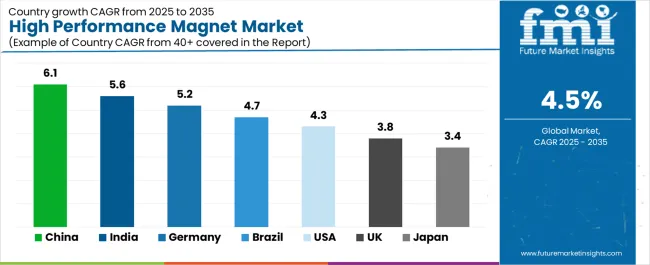
| Country | CAGR (2026-2036) |
|---|---|
| China | 6.1% |
| India | 5.6% |
| Germany | 5.2% |
| Brazil | 4.7% |
| USA | 4.3% |
| UK | 3.8% |
| Japan | 3.4% |
Regional synthesis reveals Asia-Pacific markets leading growth through automotive expansion and industrial development, while European countries maintain steady expansion supported by specialized applications and precision magnetic requirements. North American markets show strong growth driven by electric vehicle demand and automotive facility upgrades.
What Is China’s Influence on the High Performance Magnet Market?
China establishes regional leadership through rapid automotive development and comprehensive industrial modernization, integrating advanced high performance magnet systems as standard components in vehicle manufacturing and industrial operations. The country's 6.1% CAGR through 2036 reflects automotive growth promoting infrastructure efficiency and industrial development that mandate the use of reliable magnetic systems in manufacturing operations. Growth concentrates in major manufacturing centers, including Beijing, Shanghai, and Shenzhen, where automotive networks showcase integrated magnet systems that appeal to manufacturers seeking enhanced production efficiency and international quality standards.
Chinese manufacturers are developing innovative high performance magnet solutions that combine local production advantages with international automotive specifications, including advanced magnetic compositions and enhanced performance capabilities.
Strategic Market Indicators:
- Automotive infrastructure growth providing substantial support for domestic industrial development
- Manufacturing capacity expansion driven by automotive development and magnet demand
- Research sector development for cost-effective magnetic solutions targeting domestic and export applications
How Is India Contributing to the Growth of the High Performance Magnet Market?
The Indian market emphasizes automotive infrastructure applications, including rapid industrial development and comprehensive manufacturing expansion that increasingly incorporates high performance magnets for automotive enhancement and industrial applications. The country is projected to show a 5.6% CAGR through 2036, driven by massive automotive activity under industrialization initiatives and demand for standardized, high-quality magnetic systems. Indian automotive facilities prioritize cost-effectiveness with high performance magnets delivering industrial efficiency through economical magnet usage and reliable performance capabilities.
Technology deployment channels include major automotive companies, industrial integrators, and manufacturing institutions that support high-volume usage for automotive and industrial applications.
Performance Metrics:
- Automotive facilities in Delhi, Mumbai, and Chennai leading high performance magnet adoption for industrial operations
- Industrial development compliance with manufacturing standards, driving quality selection criteria
What Role Does Germany Play in the High Performance Magnet Market?
The German market emphasizes advanced automotive infrastructure features, including innovative magnetic technologies and integration with comprehensive industrial platforms that manage manufacturing operations, automotive facilities, and institutional applications through unified magnet systems. The country is projected to show a 5.2% CAGR through 2036, driven by automotive expansion under industrial development trends and demand for premium, reliable magnetic systems. German automotive institutions prioritize precision with high performance magnets delivering comprehensive industrial performance through enhanced quality protection and operational innovation.
Technology deployment channels include major automotive companies, industrial institutions, and magnet equipment manufacturers that support custom development for premium operations.
Performance Metrics:
- Automotive companies in Baden-Württemberg, Bavaria, and North Rhine-Westphalia leading high performance magnet adoption for industrial operations
- Industrial compatibility with manufacturing requirements, driving specification selection criteria
What Role Does Germany Play in the High Performance Magnet Market?
In São Paulo, Rio de Janeiro, and Belo Horizonte, Brazilian automotive facilities and industrial operators are implementing advanced high performance magnet systems to enhance efficiency capabilities and support operational performance that aligns with industrial protocols and manufacturing standards. The Brazilian market demonstrates continued growth with a 4.7% CAGR through 2036, driven by automotive compliance programs and industrial investments that emphasize reliable magnetic systems for automotive and manufacturing applications. Brazilian automotive facilities are prioritizing high performance magnet systems that provide exceptional magnetic properties while maintaining compliance with industrial standards and minimizing operational complexity, particularly important in automotive and manufacturing facility operations.
Market expansion benefits from industrial programs that mandate enhanced magnet compliance in manufacturing specifications, creating continued demand across Brazil's automotive and industrial sectors, where magnetic performance and system consistency represent critical requirements.
Strategic Market Indicators:
- Automotive operators and industrial companies leading adoption with compliance programs requiring reliable magnetic systems
- Manufacturing standards providing framework support for high-performance magnet acquisition
- Quality control requirements driving demand for certified systems with performance testing documentation
- Specialized industrial segments adopting comprehensive high performance magnet solutions for automotive facilities and manufacturing projects
How Is the United States Shaping the High Performance Magnet Market?
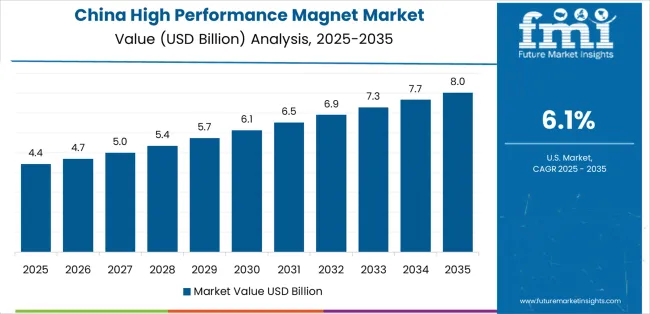
The USA market emphasizes automotive infrastructure features, including innovative magnetic technologies and integration with comprehensive industrial platforms that manage manufacturing operations, automotive facilities, and commercial applications through unified magnet systems. The country is projected to show a 4.3% CAGR through 2036, driven by automotive expansion under industrial development trends and industry demand for premium, reliable magnetic systems. American automotive companies prioritize innovation with high performance magnets delivering comprehensive industrial performance through enhanced quality protection and operational advancement.
Technology deployment channels include major automotive companies, industrial institutions, and magnet manufacturers that support custom development for automotive operations.
Performance Metrics:
- Automotive companies in California, Michigan, and Texas leading high performance magnet adoption for industrial operations
- Magnet compatibility with automotive development requirements, driving specification selection criteria
How Is the UK Impacting the High Performance Magnet Market?
The UK market demonstrates advanced automotive infrastructure deployment, growing at 3.8% CAGR, with documented operational excellence in industrial control and automotive applications through integration with existing industrial systems and quality assurance infrastructure. The country leverages engineering expertise in automotive manufacturing and magnet science to maintain market leadership. Industrial centers, including London, Manchester, and Birmingham, showcase advanced installations where high performance magnet systems integrate with comprehensive automotive platforms and industrial systems to optimize manufacturing development and operational efficiency.
British automotive facilities prioritize magnet precision and system consistency in product selection, creating demand for premium high performance magnet systems with advanced features, including enhanced magnetic compositions and integration with automated industrial systems. The market benefits from established automotive infrastructure and willingness to invest in specialized magnetic technologies that provide superior quality and industrial compliance.
Market Intelligence Brief:
- Precision focus on magnet quality and system uniformity, driving industrial segment growth
- Technology collaboration between British automotive manufacturers and international magnet companies
- Premium industrial systems expanding high performance magnet integration in manufacturing infrastructure and automotive applications
How Is Japan Advancing the High Performance Magnet Market?
Japan's advanced automotive market demonstrates meticulous high performance magnet deployment, growing at 3.4% CAGR, with documented operational excellence in industrial control and manufacturing applications through integration with existing automotive systems and quality assurance infrastructure. The country leverages engineering expertise in automotive manufacturing and magnetic technology to maintain market leadership. Manufacturing centers, including Tokyo, Osaka, and Nagoya, showcase advanced installations where high performance magnet systems integrate with comprehensive industrial platforms and quality systems to optimize automotive development and operational efficiency.
Japanese automotive facilities prioritize magnet precision and system consistency in product selection, creating demand for premium high performance magnet systems with advanced features, including ultra-high quality and integration with automated industrial protocols. The market benefits from established automotive infrastructure and willingness to invest in specialized magnetic technologies that provide superior performance and industrial compliance.
Market Intelligence Brief:
- Precision focus on magnet quality and performance uniformity, driving industrial segment growth
- Technology collaboration between Japanese automotive manufacturers and international magnet companies
- Premium industrial systems expanding high performance magnet integration in manufacturing infrastructure and automotive applications
How Is the European High Performance Magnet Market Split by Country?
The High Performance Magnet market in Europe is projected to grow from USD 2,847.2 million in 2026 to USD 4,129.8 million by 2036, registering a CAGR of 3.8% over the forecast period. Germany is expected to maintain its leadership position with a 34.7% market share in 2026, declining slightly to 34.2% by 2036, supported by its industrial excellence and major automotive centers, including Baden-Württemberg and Bavaria.
France follows with a 22.3% share in 2026, projected to reach 22.8% by 2036, driven by comprehensive automotive programs and industrial facility initiatives. The United Kingdom holds a 18.9% share in 2026, expected to maintain 19.1% by 2036 through established industrial sectors and manufacturing adoption. Italy commands a 13.6% share, while Spain accounts for 6.2% in 2026. The Rest of Europe region is anticipated to gain momentum, expanding its collective share from 4.3% to 4.6% by 2036, attributed to increasing automotive development in Eastern European countries and emerging manufacturing programs implementing standardized magnet systems.
What Does the Competitive Landscape Look Like in the High Performance Magnet Market?
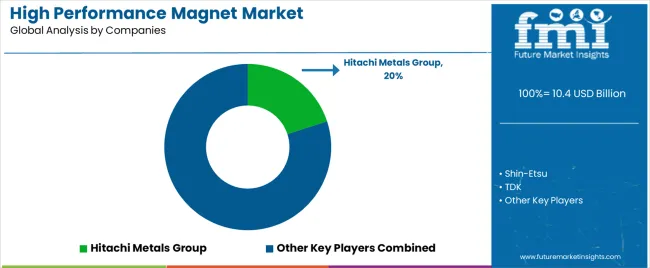
The High Performance Magnet market operates with moderate concentration, featuring approximately 18-25 participants, where leading companies control roughly 58-64% of the global market share through established distribution networks and comprehensive product portfolio capabilities. Competition emphasizes magnetic performance, automotive reliability, and efficiency optimization rather than premium feature rivalry.
Market leaders encompass Hitachi Metals Group, Shin-Etsu, and TDK, which maintain competitive advantages through extensive automotive infrastructure expertise, regional distribution networks, and comprehensive technical support capabilities that create industrial loyalty and support manufacturing requirements. These companies leverage decades of magnetic experience and ongoing automotive technology investments to develop advanced high performance magnet systems with exceptional quality and industrial features.
Specialty challengers include regional manufacturers and magnetic specialists, which compete through specialized application innovation focus and efficient production solutions that appeal to automotive buyers seeking reliable performance formats and custom magnet flexibility. These companies differentiate through operational efficiency emphasis and specialized market focus.
Market dynamics favor participants that combine consistent magnetic performance with advanced industrial support, including automated systems and distribution capabilities. Competitive pressure intensifies as traditional magnet manufacturers expand into high performance magnet systems. At the same time, specialized automotive producers challenge established players through innovative manufacturing methods and cost-effective production targeting emerging industrial segments.
Who are the Key Players in the High Performance Magnet Market?
- Hitachi Metals Group
- Shin-Etsu
- TDK
- VAC
- Beijing Zhong Ke San Huan Hi-Tech
- Yunsheng Company
- YSMA
- JL MAG
- ZHmag
- Jingci Material Science
- AT&M
- NBJJ
- Innuovo Magnetics
- SGM
- Zhejiang Zhongyuan Magnetic
- Earth-Panda
- Daido Electronics
- Tianhe Magnetics
Scope of the report
| Metric | Value |
|---|---|
| Quantitative Units | USD 10.88 billion to USD 16.89 billion, at a CAGR of 4.5% |
| Market Definition | High Performance Magnet encompasses permanent magnet materials engineered to deliver high magnetic energy product, coercivity, and thermal stability for demanding electromechanical applications. The m... |
| Type Segmentation | Sintered Magnet, Hot-pressed Magnet, Others |
| Application Segmentation | EV, EPS, Industrial Machine, Factory Automation, Wind Turbine, Medical Industry, VCM, Aerospace & Defense, Home Appliance |
| End-Use Industry Segmentation | Automotive Manufacturing, Industrial Machinery, Renewable Energy Systems, Medical Equipment, Consumer Electronics, Precision Manufacturing |
| Regions Covered | North America, Latin America, Europe, East Asia, South Asia, Oceania, Middle East and Africa |
| Countries Covered | China, India, Germany, Brazil, USA, UK, Japan, and 40 plus countries |
| Key Companies Profiled | Hitachi Metals Group, Shin-Etsu, TDK, VAC, Beijing Zhong Ke San Huan Hi-Tech, Yunsheng Company, YSMA, JL MAG, ZHmag, Jingci Material Science, AT&M, NBJJ, Innuovo Magnetics, SGM, Zhejiang Zhongyuan Magnetic, Earth-Panda, Daido Electronics, and Tianhe Magnetics |
| Forecast Period | 2026 to 2036 |
| Approach | Forecasting models apply a bottom-up methodology starting with global installed base metrics and projecting the conversion rate to advanced product adoption. |
High Performance Magnet Market by Segments
Type:
- Sintered Magnet
- Hot-pressed Magnet
- Others
Application:
- EV
- EPS
- Industrial Machine
- Factory Automation
- Wind Turbine
- Medical Industry
- VCM
- Aerospace & Defense
- Home Appliance
End-Use Industry:
- Automotive Manufacturing
- Industrial Machinery
- Renewable Energy Systems
- Medical Equipment
- Consumer Electronics
- Precision Manufacturing
Region:
- Asia Pacific
- China
- Japan
- India
- South Korea
- ASEAN
- Australia & New Zealand
- Rest of Asia Pacific
- North America
- United States
- Canada
- Mexico
- Europe
- Germany
- France
- United Kingdom
- Italy
- Spain
- Nordic
- BENELUX
- Rest of Europe
- Latin America
- Brazil
- Chile
- Rest of Latin America
- Middle East & Africa
- Kingdom of Saudi Arabia
- Other GCC Countries
- Turkey
- South Africa
- Other African Union
- Rest of Middle East & Africa
Bibliography
- 1. International Electrotechnical Commission. (2024). IEC 60404: Magnetic Materials, Permanent Magnet Specifications. IEC.
- 2. International Energy Agency. (2024). Global EV Outlook 2024. IEA.
- 3. USA Department of Energy. (2024). Critical Materials Strategy: Rare Earth Elements. DOE.
- 4. European Commission. (2024). Critical Raw Materials Act. EUR-Lex.
- 5. The World Bank. (2024). World Development Indicators: Energy and Mining. World Bank Group.
This bibliography is provided for reader reference. The full Future Market Insights report contains the complete reference list with primary research documentation.
Frequently Asked Questions
How large is the demand for High Performance Magnet in the global market in 2026?
Demand for high performance magnet in the global market is estimated to be valued at USD 10.88 billion in 2026.
What will be the market size of High Performance Magnet in the global market by 2036?
Market size for high performance magnet is projected to reach USD 16.89 billion by 2036.
What is the expected demand growth for High Performance Magnet between 2026 and 2036?
Demand for high performance magnet is expected to grow at a CAGR of 4.5% between 2026 and 2036.
Which Type is poised to lead global sales by 2026?
Sintered Magnet accounts for 62.8% share in 2026 as it addresses the primary demand requirements across global markets.
How significant is the role of EV in driving high performance magnet adoption in 2026?
EV represents 41.3% of segment share as end-user demand consolidates around established application pathways.
What is driving demand in China?
China is projected to grow at a CAGR of 6.1% during 2026 to 2036, driven by expanding infrastructure investment and industrial capacity growth.
What does market forecast mean on this page?
The market forecast represents a model-based projection built on defined industry and supply chain assumptions for strategic planning purposes.
How does FMI build and validate the high performance magnet forecast?
Forecasting models apply a bottom-up methodology starting with global installed base metrics and cross-validate projections against quarterly industry revenue volumes.
Preview the report firsthand - request a free sample
Get SampleGet the brochure for pricing and purchase details.
Get PDFTable of Content
- Executive Summary
- Global Market Outlook
- Demand-side Trends
- Supply-side Trends
- Technology Roadmap Analysis
- Analysis and Recommendations
- Market Overview
- Market Coverage / Taxonomy
- Market Definition / Scope / Limitations
- Research Methodology
- Chapter Orientation
- Analytical Lens and Working Hypotheses
- Market Structure, Signals, and Trend Drivers
- Benchmarking and Cross-market Comparability
- Market Sizing, Forecasting, and Opportunity Mapping
- Research Design and Evidence Framework
- Desk Research Programme (Secondary Evidence)
- Company Annual and Sustainability Reports
- Peer-reviewed Journals and Academic Literature
- Corporate Websites, Product Literature, and Technical Notes
- Earnings Decks and Investor Briefings
- Statutory Filings and Regulatory Disclosures
- Technical White Papers and Standards Notes
- Trade Journals, Industry Magazines, and Analyst Briefs
- Conference Proceedings, Webinars, and Seminar Materials
- Government Statistics Portals and Public Data Releases
- Press Releases and Reputable Media Coverage
- Specialist Newsletters and Curated Briefings
- Sector Databases and Reference Repositories
- FMI Internal Proprietary Databases and Historical Market Datasets
- Subscription Datasets and Paid Sources
- Social Channels, Communities, and Digital Listening Inputs
- Additional Desk Sources
- Expert Input and Fieldwork (Primary Evidence)
- Primary Modes
- Qualitative Interviews and Expert Elicitation
- Quantitative Surveys and Structured Data Capture
- Blended Approach
- Why Primary Evidence is Used
- Field Techniques
- Interviews
- Surveys
- Focus Groups
- Observational and In-context Research
- Social and Community Interactions
- Stakeholder Universe Engaged
- C-suite Leaders
- Board Members
- Presidents and Vice Presidents
- R&D and Innovation Heads
- Technical Specialists
- Domain Subject-matter Experts
- Scientists
- Physicians and Other Healthcare Professionals
- Governance, Ethics, and Data Stewardship
- Research Ethics
- Data Integrity and Handling
- Primary Modes
- Tooling, Models, and Reference Databases
- Desk Research Programme (Secondary Evidence)
- Data Engineering and Model Build
- Data Acquisition and Ingestion
- Cleaning, Normalisation, and Verification
- Synthesis, Triangulation, and Analysis
- Quality Assurance and Audit Trail
- Market Background
- Market Dynamics
- Drivers
- Restraints
- Opportunity
- Trends
- Scenario Forecast
- Demand in Optimistic Scenario
- Demand in Likely Scenario
- Demand in Conservative Scenario
- Opportunity Map Analysis
- Product Life Cycle Analysis
- Supply Chain Analysis
- Investment Feasibility Matrix
- Value Chain Analysis
- PESTLE and Porter’s Analysis
- Regulatory Landscape
- Regional Parent Market Outlook
- Production and Consumption Statistics
- Import and Export Statistics
- Market Dynamics
- Global Market Analysis 2021 to 2025 and Forecast, 2026 to 2036
- Historical Market Size Value (USD Million) Analysis, 2021 to 2025
- Current and Future Market Size Value (USD Million) Projections, 2026 to 2036
- Y-o-Y Growth Trend Analysis
- Absolute $ Opportunity Analysis
- Global Market Pricing Analysis 2021 to 2025 and Forecast 2026 to 2036
- Global Market Analysis 2021 to 2025 and Forecast 2026 to 2036, By Type
- Introduction / Key Findings
- Historical Market Size Value (USD Million) Analysis By Type , 2021 to 2025
- Current and Future Market Size Value (USD Million) Analysis and Forecast By Type , 2026 to 2036
- Sintered Magnet
- Hot-pressed Magnet
- Others
- Sintered Magnet
- Y-o-Y Growth Trend Analysis By Type , 2021 to 2025
- Absolute $ Opportunity Analysis By Type , 2026 to 2036
- Global Market Analysis 2021 to 2025 and Forecast 2026 to 2036, By Application
- Introduction / Key Findings
- Historical Market Size Value (USD Million) Analysis By Application, 2021 to 2025
- Current and Future Market Size Value (USD Million) Analysis and Forecast By Application, 2026 to 2036
- EV
- EPS
- Industrial Machine
- Factory Automation
- Wind Turbine
- Medical Industry
- VCM
- Aerospace & Defense
- Home Appliance
- EV
- Y-o-Y Growth Trend Analysis By Application, 2021 to 2025
- Absolute $ Opportunity Analysis By Application, 2026 to 2036
- Global Market Analysis 2021 to 2025 and Forecast 2026 to 2036, By End-Use Industry
- Introduction / Key Findings
- Historical Market Size Value (USD Million) Analysis By End-Use Industry, 2021 to 2025
- Current and Future Market Size Value (USD Million) Analysis and Forecast By End-Use Industry, 2026 to 2036
- Automotive Manufacturing
- Industrial Machinery
- Renewable Energy Systems
- Medical Equipment
- Consumer Electronics
- Precision Manufacturing
- Automotive Manufacturing
- Y-o-Y Growth Trend Analysis By End-Use Industry, 2021 to 2025
- Absolute $ Opportunity Analysis By End-Use Industry, 2026 to 2036
- Global Market Analysis 2021 to 2025 and Forecast 2026 to 2036, By Region
- Introduction
- Historical Market Size Value (USD Million) Analysis By Region, 2021 to 2025
- Current Market Size Value (USD Million) Analysis and Forecast By Region, 2026 to 2036
- North America
- Latin America
- Western Europe
- Eastern Europe
- East Asia
- South Asia and Pacific
- Middle East & Africa
- Market Attractiveness Analysis By Region
- North America Market Analysis 2021 to 2025 and Forecast 2026 to 2036, By Country
- Historical Market Size Value (USD Million) Trend Analysis By Market Taxonomy, 2021 to 2025
- Market Size Value (USD Million) Forecast By Market Taxonomy, 2026 to 2036
- By Country
- USA
- Canada
- Mexico
- By Type
- By Application
- By End-Use Industry
- By Country
- Market Attractiveness Analysis
- By Country
- By Type
- By Application
- By End-Use Industry
- Key Takeaways
- Latin America Market Analysis 2021 to 2025 and Forecast 2026 to 2036, By Country
- Historical Market Size Value (USD Million) Trend Analysis By Market Taxonomy, 2021 to 2025
- Market Size Value (USD Million) Forecast By Market Taxonomy, 2026 to 2036
- By Country
- Brazil
- Chile
- Rest of Latin America
- By Type
- By Application
- By End-Use Industry
- By Country
- Market Attractiveness Analysis
- By Country
- By Type
- By Application
- By End-Use Industry
- Key Takeaways
- Western Europe Market Analysis 2021 to 2025 and Forecast 2026 to 2036, By Country
- Historical Market Size Value (USD Million) Trend Analysis By Market Taxonomy, 2021 to 2025
- Market Size Value (USD Million) Forecast By Market Taxonomy, 2026 to 2036
- By Country
- Germany
- UK
- Italy
- Spain
- France
- Nordic
- BENELUX
- Rest of Western Europe
- By Type
- By Application
- By End-Use Industry
- By Country
- Market Attractiveness Analysis
- By Country
- By Type
- By Application
- By End-Use Industry
- Key Takeaways
- Eastern Europe Market Analysis 2021 to 2025 and Forecast 2026 to 2036, By Country
- Historical Market Size Value (USD Million) Trend Analysis By Market Taxonomy, 2021 to 2025
- Market Size Value (USD Million) Forecast By Market Taxonomy, 2026 to 2036
- By Country
- Russia
- Poland
- Hungary
- Balkan & Baltic
- Rest of Eastern Europe
- By Type
- By Application
- By End-Use Industry
- By Country
- Market Attractiveness Analysis
- By Country
- By Type
- By Application
- By End-Use Industry
- Key Takeaways
- East Asia Market Analysis 2021 to 2025 and Forecast 2026 to 2036, By Country
- Historical Market Size Value (USD Million) Trend Analysis By Market Taxonomy, 2021 to 2025
- Market Size Value (USD Million) Forecast By Market Taxonomy, 2026 to 2036
- By Country
- China
- Japan
- South Korea
- By Type
- By Application
- By End-Use Industry
- By Country
- Market Attractiveness Analysis
- By Country
- By Type
- By Application
- By End-Use Industry
- Key Takeaways
- South Asia and Pacific Market Analysis 2021 to 2025 and Forecast 2026 to 2036, By Country
- Historical Market Size Value (USD Million) Trend Analysis By Market Taxonomy, 2021 to 2025
- Market Size Value (USD Million) Forecast By Market Taxonomy, 2026 to 2036
- By Country
- India
- ASEAN
- Australia & New Zealand
- Rest of South Asia and Pacific
- By Type
- By Application
- By End-Use Industry
- By Country
- Market Attractiveness Analysis
- By Country
- By Type
- By Application
- By End-Use Industry
- Key Takeaways
- Middle East & Africa Market Analysis 2021 to 2025 and Forecast 2026 to 2036, By Country
- Historical Market Size Value (USD Million) Trend Analysis By Market Taxonomy, 2021 to 2025
- Market Size Value (USD Million) Forecast By Market Taxonomy, 2026 to 2036
- By Country
- Kingdom of Saudi Arabia
- Other GCC Countries
- Turkiye
- South Africa
- Other African Union
- Rest of Middle East & Africa
- By Type
- By Application
- By End-Use Industry
- By Country
- Market Attractiveness Analysis
- By Country
- By Type
- By Application
- By End-Use Industry
- Key Takeaways
- Key Countries Market Analysis
- USA
- Pricing Analysis
- Market Share Analysis, 2025
- By Type
- By Application
- By End-Use Industry
- Canada
- Pricing Analysis
- Market Share Analysis, 2025
- By Type
- By Application
- By End-Use Industry
- Mexico
- Pricing Analysis
- Market Share Analysis, 2025
- By Type
- By Application
- By End-Use Industry
- Brazil
- Pricing Analysis
- Market Share Analysis, 2025
- By Type
- By Application
- By End-Use Industry
- Chile
- Pricing Analysis
- Market Share Analysis, 2025
- By Type
- By Application
- By End-Use Industry
- Germany
- Pricing Analysis
- Market Share Analysis, 2025
- By Type
- By Application
- By End-Use Industry
- UK
- Pricing Analysis
- Market Share Analysis, 2025
- By Type
- By Application
- By End-Use Industry
- Italy
- Pricing Analysis
- Market Share Analysis, 2025
- By Type
- By Application
- By End-Use Industry
- Spain
- Pricing Analysis
- Market Share Analysis, 2025
- By Type
- By Application
- By End-Use Industry
- France
- Pricing Analysis
- Market Share Analysis, 2025
- By Type
- By Application
- By End-Use Industry
- India
- Pricing Analysis
- Market Share Analysis, 2025
- By Type
- By Application
- By End-Use Industry
- ASEAN
- Pricing Analysis
- Market Share Analysis, 2025
- By Type
- By Application
- By End-Use Industry
- Australia & New Zealand
- Pricing Analysis
- Market Share Analysis, 2025
- By Type
- By Application
- By End-Use Industry
- China
- Pricing Analysis
- Market Share Analysis, 2025
- By Type
- By Application
- By End-Use Industry
- Japan
- Pricing Analysis
- Market Share Analysis, 2025
- By Type
- By Application
- By End-Use Industry
- South Korea
- Pricing Analysis
- Market Share Analysis, 2025
- By Type
- By Application
- By End-Use Industry
- Russia
- Pricing Analysis
- Market Share Analysis, 2025
- By Type
- By Application
- By End-Use Industry
- Poland
- Pricing Analysis
- Market Share Analysis, 2025
- By Type
- By Application
- By End-Use Industry
- Hungary
- Pricing Analysis
- Market Share Analysis, 2025
- By Type
- By Application
- By End-Use Industry
- Kingdom of Saudi Arabia
- Pricing Analysis
- Market Share Analysis, 2025
- By Type
- By Application
- By End-Use Industry
- Turkiye
- Pricing Analysis
- Market Share Analysis, 2025
- By Type
- By Application
- By End-Use Industry
- South Africa
- Pricing Analysis
- Market Share Analysis, 2025
- By Type
- By Application
- By End-Use Industry
- USA
- Market Structure Analysis
- Competition Dashboard
- Competition Benchmarking
- Market Share Analysis of Top Players
- By Regional
- By Type
- By Application
- By End-Use Industry
- Competition Analysis
- Competition Deep Dive
- Hitachi Metals Group
- Overview
- Product Portfolio
- Profitability by Market Segments (Product/Age /Sales Channel/Region)
- Sales Footprint
- Strategy Overview
- Marketing Strategy
- Product Strategy
- Channel Strategy
- Shin-Etsu
- TDK
- VAC
- Beijing Zhong Ke San Huan Hi-Tech
- Yunsheng Company
- YSMA
- JL MAG
- ZHmag
- Jingci Material Science
- AT&M
- NBJJ
- Innuovo Magnetics
- SGM
- Zhejiang Zhongyuan Magnetic
- Earth-Panda
- Daido Electronics
- Tianhe Magnetics
- Hitachi Metals Group
- Competition Deep Dive
- Assumptions & Acronyms Used


