

- Market Size (2026)
- USD 4.5 Bn
- Forecast (2036)
- USD 7.6 Bn
- CAGR (2026 to 2036)
- 5.4%
Axle and Differential Remanufacturing Programs Market Size, Forecast, and Outlook By FMI
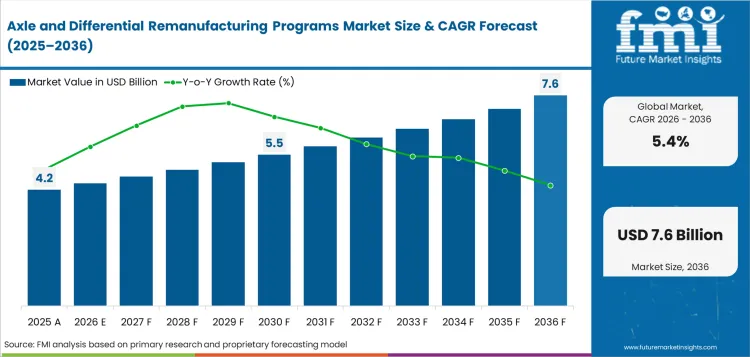
The axle and differential remanufacturing programs market was valued at USD 4.2 billion in 2025. The market is expected to reach USD 4.5 billion by 2026-end and expand at a CAGR of 5.4% between 2026 and 2036 to reach USD 7.6 billion by 2036.
Summary of the Axle and Differential Remanufacturing Programs Market
- Demand and Growth Drivers
- Aging vehicle fleets are creating structured demand for reman axle and differential programs with warranty-backed replacement value.
- Fleet uptime needs increase exchange unit use as workshops avoid long teardown cycles and uncertain repair timing.
- Core quality control reinforces specialist rebuilding as housings and carriers need repeatable inspection before sale.
- Product and Segment View
- Exchange units are poised to lead the program type segment with 42.0% share in 2026, reflecting faster installer job completion.
- Rear differentials are expected to lead component demand with 36.0% share in 2026, driven by pickup and van repair cycles.
- Core bank handling is forecast to hold high-value program demand as rebuilders need inspected parts before orders arrive.
- Geography and Competitive Outlook
- India is expected to record a CAGR of 7.2% through 2036, as vehicle output expands the repair base.
- China is projected to expand at 6.1% CAGR by 2036, as large vehicle production deepens service demand.
- Companies combining core inspection depth with exchange unit coverage are strengthening their position during the forecast period.
- Analyst Opinion
- Nikhil Kaitwade, Principal Consultant for Automotive domain at FMI, says, “Axle and differential remanufacturing is moving from spot repair into planned service programs. Fleet workshops need exchange availability and clear core credits before repeat contracts. Machining time and variable core quality raise cost while teardown discipline strengthens annual warranty confidence.”
- Axle and Differential Remanufacturing Programs Market Value Analysis
- The axle and differential remanufacturing programs market is moving from one-off rebuild work into structured exchange supply.
- Longer vehicle service life is increasing use across trucks and vans with heavy driveline load exposure.
- The market benefits from deeper use of automotive repair & maintenance services across regulated service networks.
- Demand is carried by warranty records and tested assemblies during repair approval work.
- Better records improve fleet confidence and help installers reduce repeat removal risk.
Key Takeaways, Market Size, and Forecast
- The axle and differential remanufacturing programs market was valued at USD 4.2 billion in 2025.
- By 2036, the axle and differential remanufacturing programs market is expected to be worth USD 7.6 billion.
- From 2026 to 2036, the market is projected to expand at a CAGR of 5.4%.
- The market is projected to create an incremental opportunity of USD 3.1 billion between 2026 and 2036.
- In 2026, exchange units are expected to account for 42.0% of program type demand worldwide.
- India leads the country outlook at 7.2% CAGR, followed by China at 6.1% CAGR through 2036.
Core quality and warranty cover are becoming the main decision points in axle and differential remanufacturing programs. Dana’s September 2024 Certified Reman program uses over 20 approval criteria and provides a Certificate of Conformity for remanufactured components. This helps fleet owners compare rebuilders on process quality instead of price alone. ZF’s April 2026 CorExpedia platform covers ZF, TRW, SACHS, and WABCO reman brands. ZF stated it produces over 7,300 remanufactured products across 20 locations, which makes core return control important for steady supply. Allison’s June 2025 agreement to acquire Dana’s off-highway business for about USD 2.7 billion adds scale across axle and drivetrain systems. The acquired business operates in over 25 countries with about 11,000 employees, giving larger suppliers a stronger service base for heavy-duty reman programs.
Axle and Differential Remanufacturing Programs Market Definition
The axle and differential remanufacturing programs market includes industrial rebuilding services for axle assemblies and differential units before aftermarket resale. Programs cover teardown, inspection, machining and reassembly for passenger vehicles and commercial vehicles. Scope includes exchange units, carrier rebuilds, axle shafts and core return systems. New OE axle production and simple used-part resale are outside the scope.
Axle and Differential Remanufacturing Programs Market Inclusions
Market scope covers all commercially traded axle and differential remanufacturing programs categorized by program type, including exchange units, repair programs, core rebuilds, dealer reman, and fleet programs; components, including rear differentials, front differentials, axle assemblies, carrier units, and axle shafts; vehicle types, including light trucks, passenger cars, heavy trucks, off-highway vehicles, and performance vehicles; and sales channels, including warehouse distributors, dealer networks, direct fleet supply, online stores, and installer networks. Revenue scope covers 2026 to 2036. Key stakeholders include remanufacturers, core suppliers, parts distributors, fleet operators, repair shops, dealer service networks, vehicle owners, logistics providers, and warranty administrators.
Axle and Differential Remanufacturing Programs Market Exclusions
Scope does not include new axle production, tire service, wheel alignment, crash-only repair or used-part resale without industrial rebuilding.
Axle and Differential Remanufacturing Programs Market Research Methodology
- Primary Research: FMI analysts talked to remanufacturers, parts distributors and fleet service managers in important markets.
- Desk Research: Combined data from vehicle parc records, automotive production releases and company remanufacturing portfolios.
- Market sizing and forecasting: Added program demand across exchange units and component groups from the bottom up.
- Data validation: Cross-checked every three months against service demand patterns and verified company program coverage.
Why is the Axle and Differential Remanufacturing Programs Market Growing?
- Older vehicles are using reman axle and differential units to control repair cost and avoid new assembly pricing.
- Fleet workshops are choosing exchange programs as finished units reduce bay time during urgent vehicle repairs.
- Core banks are becoming important as rebuilders need predictable housings and carrier units before installer orders.
Repair economics are pushing buyers toward tested reman units across driveline service jobs. FRED’s April 2026 BLS series for motor vehicle parts manufacturing recorded a PPI index of 132.503. This price context makes reman programs useful for fleets seeking cost control without moving to unknown used assemblies. Rebuilders with testing discipline can defend program value through reliable fitment and warranty cover. (fred.stlouisfed.org)
Fleet repair teams need faster replacement paths as vehicle uptime has become a budget issue. Exchange units reduce open teardown time and help installers quote labor with less uncertainty. Structured core returns protect rebuilders from supply gaps and lower unusable housing risk. Program demand stays active across pickup, van and vocational repair channels.
Market Segmentation Analysis
- Exchange units are forecast to hold 42.0% of program type value in 2026, as installers prefer finished assemblies for faster repair completion.
- Rear differentials are expected to capture 36.0% of component revenue during 2026 with steady replacement needs across trucks and vans.
- Light trucks are projected to represent 39.0% of vehicle type share in 2026, driven by fleet use and higher driveline stress.
- Warehouse distributors are projected at 34.0% of sales channel activity for 2026 as repair shops need quick access to matched units.
- Core bank systems are forecast to make up 41.0% of core handling share in 2026 as rebuilders plan stock before confirmed orders.
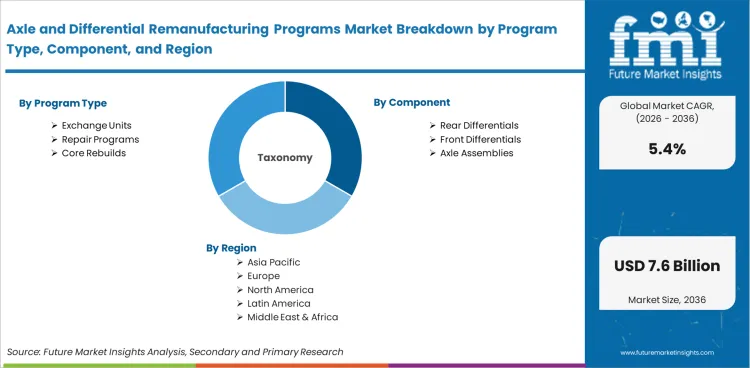
The market for axle and differential remanufacturing programs is divided into groups based on program type, component, vehicle type, sales channel, core handling, and region. Under program type, the market includes exchange units, repair programs, core rebuilds, dealer reman, and fleet programs. By component, the market covers rear differentials, front differentials, axle assemblies, carrier units, and axle shafts. By vehicle type, it includes light trucks, passenger cars, heavy trucks, off-highway vehicles, and performance vehicles. Based on sales channel, the market includes warehouse distributors, dealer networks, direct fleet supply, online stores, and installer networks. By core handling, the market is segmented into core bank systems, deposit return programs, core pickup, reverse logistics, and scrap recovery.
Insights into Axle and Differential Remanufacturing Programs Market by Program Type
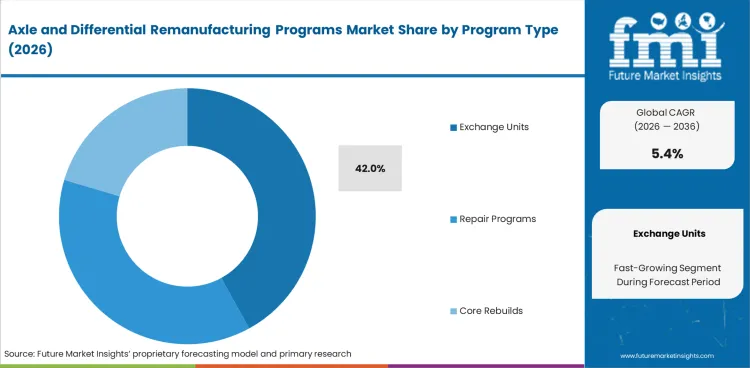
- In 2026, exchange units are expected to make up 42.0% of the program type segment. Finished assemblies shorten workshop bay time and reduce repair uncertainty across urgent axle replacement jobs.
- Repair programs address units with recoverable housings and controlled component damage. Their value improves in fleet workshops seeking lower replacement cost with documented rebuild quality.
Insights into Axle and Differential Remanufacturing Programs Market by Component
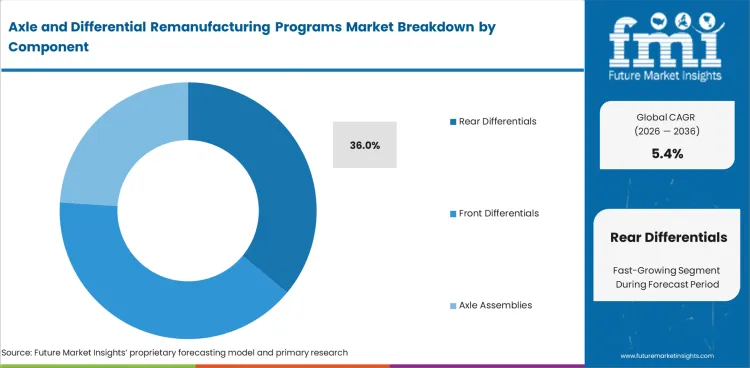
- Rear differentials are projected to account for 36.0% of the component segment in 2026. Pickup and van applications create steady demand as load cycles increase carrier wear and gear noise.
- Front differentials support selected four-wheel-drive repair needs across utility vehicles. Their demand improves in service channels handling off-road use and seasonal driveline maintenance.
Insights into Axle and Differential Remanufacturing Programs Market by Vehicle Type
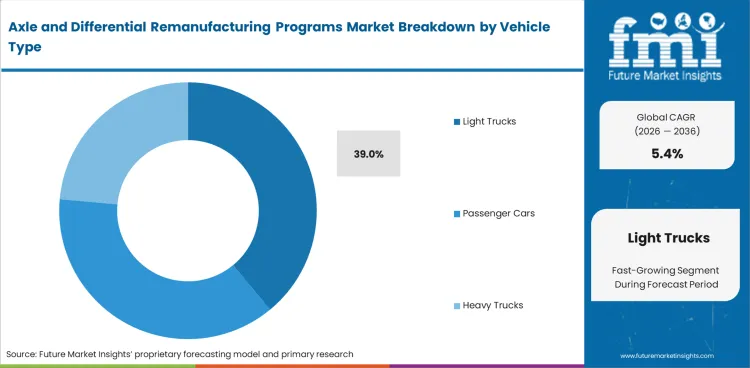
- Light trucks are estimated to account for 39.0% share in 2026. Payload use and towing cycles increase higher stress across axle assemblies and differential carrier systems.
- Heavy trucks enhance higher ticket value per reman unit across fleet service programs. Their demand is shaped by uptime needs and warranty confidence in rebuilt driveline assemblies.
Insights into Axle and Differential Remanufacturing Programs Market by Sales Channel
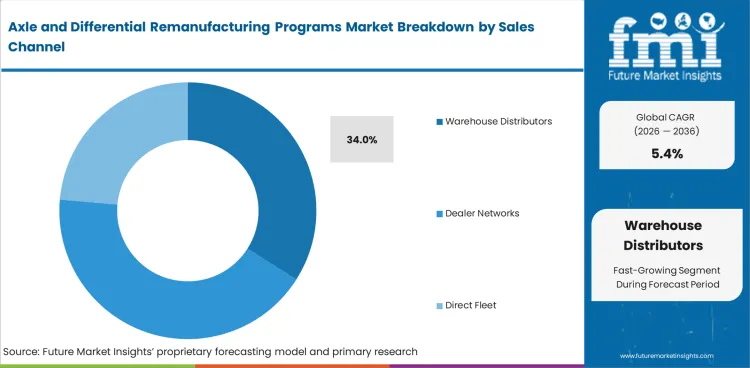
- Warehouse distributors are expected to represent 34.0% share in 2026. Installers prefer distributor supply for faster access and better fitment coverage across axle replacement jobs.
- Dealer networks serve structured service work requiring brand-approved parts and warranty alignment. Online channels address simpler orders, although complex axle fitment keeps many sales distributor-led.
Insights into Axle and Differential Remanufacturing Programs Market by Core Handling
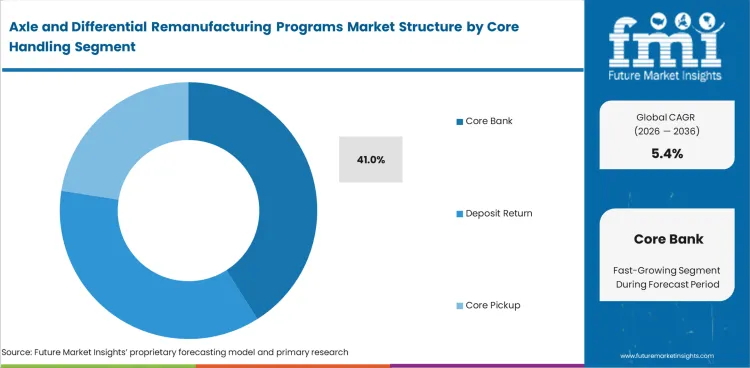
- Core bank systems are projected to hold 41.0% share in 2026. Rebuilders need inspected housings and carrier units before confirmed orders to protect turnaround time.
- Deposit return programs help recover usable cores from installers and fleet service centers. Their value improves as reman plants manage scrap risk and rebuildable part availability.
Axle and Differential Remanufacturing Programs Market Drivers, Restraints, and Opportunities
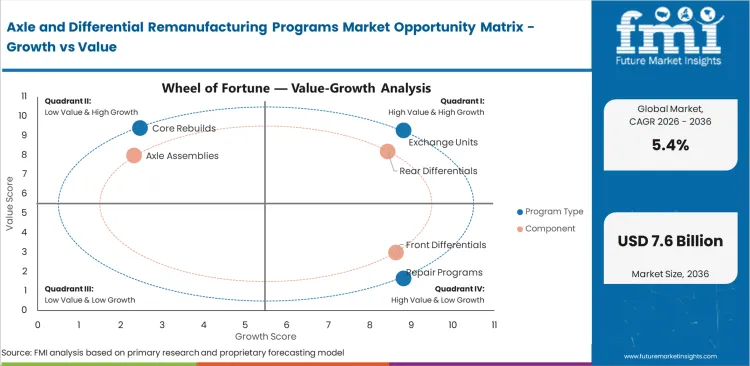
- Fleet age increases repeat demand for exchange units across pickup and commercial van repair cycles.
- Poor core quality raises pricing pressure for rebuilders as damaged housings need extra machining time.
- Digital return tools improve opportunity for better deposits and faster core credit decisions.
Axle and differential remanufacturing programs keep growing because fleets and repair shops need tested replacement units with shorter workshop downtime. Core quality variation and machining cost can slow broader program use. Growth continues through exchange units and warranty-backed fleet service programs.
Tariff Costs Are Lifting the Reman Price Floor
Axle and differential remanufacturing program pricing is being pushed upward as imported replacement components become more expensive. Rebuild kits and bearings feed the reman workflow and contribute to higher overall pricing pressure. Seals and housings influence costs within the remanufacturing process and raise pricing trends. In June 2025, the USA Department of Commerce stated that 25% tariffs on imports of automobile parts went into effect on May 3, 2025, while tariff offsets for eligible USA-assembled vehicles were set at 3.75% of aggregate MSRP through April 30, 2026 and 2.5% through April 30, 2027. For reman suppliers this supports firmer quotes because new replacement assemblies become more expensive benchmarks. Buyers should separate core credit from imported part exposure before comparing reman axle bids. They should evaluate labor content before comparing differential bids for accuracy.
Higher Road Use Is Tightening Core Economics
Axle and differential remanufacturing prices are responding to mileage intensity because higher road use increases wear-related failures while delaying clean core recovery into rebuild networks. In December 2025, the Federal Highway Administration reported that USA travel rose 0.6%, adding 1.6 billion vehicle miles versus December 2024. It reported cumulative 2025 travel of 3,323.8 billion vehicle miles, up 0.9% or 29.8 billion vehicle miles year over year. For reman programs, this supports stronger repair-through demand for driveline units, but it can lift core charges when distributors cannot recover matching axle and differential cores quickly enough. Sourcing teams should negotiate core-bank visibility alongside unit price.
Analysis of Axle and Differential Remanufacturing Programs Market By Key Countries
.webp "Top Country Growth Comparison Axle And Differential Remanufacturing Programs Market Cagr (2026 2036)")
| Country | CAGR |
|---|---|
| India | 7.2% |
| China | 6.1% |
| USA | 5.5% |
| Germany | 4.7% |
| UK | 4.3% |
Source: Future Market Insights, 2026.
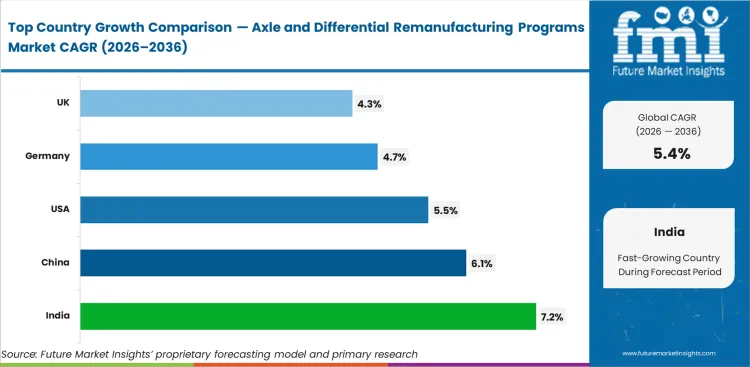
Axle and Differential Remanufacturing Programs Market CAGR Analysis By Country
- India is projected to lead country demand at 7.2% CAGR, driven by higher vehicle output and deeper workshop coverage during the forecast period.
- China is forecast at 6.1% CAGR as large vehicle production expands the future repair pool for commercial fleets.
- The USA is expected to advance at 5.5% CAGR by 2036, helped by mature reman channels and a large registered vehicle base.
- Germany and the UK are forecast at 4.7% and 4.3% CAGR, respectively, with stable repair systems and measured replacement activity.
Demand for axle and differential remanufacturing programs is forecast to rise at 5.4% CAGR from 2026 to 2036. Country-level analysis covers the major markets contributing to this forecast, with the key markets listed below.
Demand Outlook for Axle and Differential Remanufacturing Programs Market in India
India’s axle and differential remanufacturing programs industry is projected to record a CAGR of 7.2% through 2036. SIAM reported total vehicle production of 31.03 million units during April 2024 to March 2025. This manufacturing base drives demand for India axle and differential remanufacturing programs. Local rebuilders can gain from vehicle owners needing credible exchange units after warranty expiry.
- Local vehicle output drives demand for axle assemblies and differential rebuild programs.
- Fleet operators need finished units to reduce downtime across light commercial vehicle repair.
- Domestic rebuilders need testing records and core recovery systems to reduce rework.
Sales Analysis of Axle and Differential Remanufacturing Programs Market in China
The axle and differential remanufacturing programs sector in China is expected to expand at a CAGR of 6.1% during the assessment period. The State Council reported auto output of 34.531 million units in 2025. Large annual production expands future repair exposure for axle assemblies and differential units. Quality records will decide which rebuilders gain fleet program access.
- Commercial vehicle use drives demand for rear differential exchange and carrier rebuilds.
- Local repair channels need reliable inspection records across heavy-duty driveline assemblies.
- Electronic differential control module service needs can raise program depth over time.
Demand Outlook for Axle and Differential Remanufacturing Programs Market in the United States
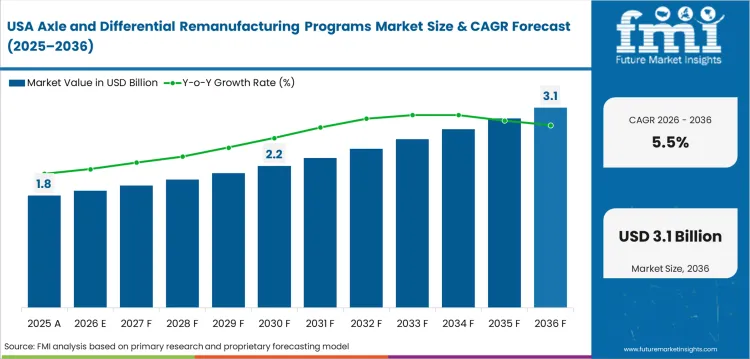
The USA axle and differential remanufacturing programs industry is forecast to grow at a CAGR of 5.5% by 2036. Established service channels drive demand for USA axle and differential remanufacturing programs. FHWA listed 297.5 million registered motor vehicles for 2024 in its January 2026 Highway Statistics table. This operating base gives reman suppliers a deep pool of aging driveline repair needs.
- Pickup ownership creates repeat demand for rear differential exchange programs.
- Installer networks need labor warranty cover and accurate fitment data for complex units.
- Automotive performance parts service demand strengthens selective carrier and axle repair work.
Opportunity Analysis of Axle and Differential Remanufacturing Programs Market in Germany
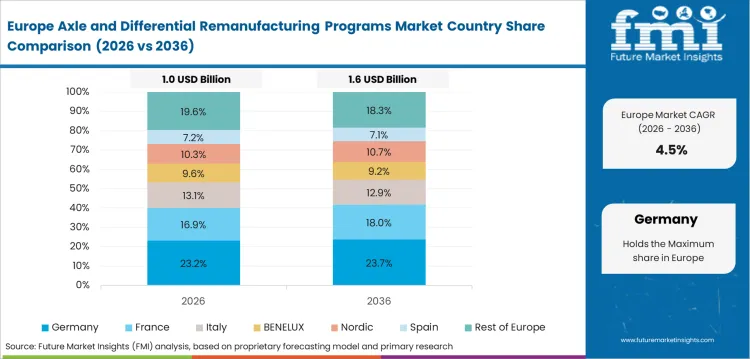
The axle and differential remanufacturing programs segment in Germany is poised to advance at 4.7% CAGR over the forecast years. Destatis reported over 49 million passenger cars on Germany’s roads in its May 2026 update. This vehicle base drives demand for Germany axle and differential remanufacturing programs. Service providers with controlled inspection and warranty evidence can serve quality-sensitive repair channels.
- Premium vehicle repair raises demand for quiet-running differential rebuilds.
- Dealer channels need documented inspection and stable warranty processes.
- Plain bearing wear patterns influence driveline service depth in older vehicles.
Future Outlook for Axle and Differential Remanufacturing Programs Market in the United Kingdom
The UK axle and differential remanufacturing programs industry is expected to post 4.3% CAGR through 2036. GOV.UK reported 42.3 million licensed vehicles at the end of 2025. This vehicle base drives demand for UK axle and differential remanufacturing programs as repair cost discipline increases. Service providers with quick supply and visible warranty terms can serve smaller garages.
- Light commercial vehicles boost practical demand for rear axle exchange programs.
- Core return discipline protects margins in a compact service market.
- Driveline additive use can extend service intervals and shape repair timing.
Competitive Landscape and Strategic Positioning
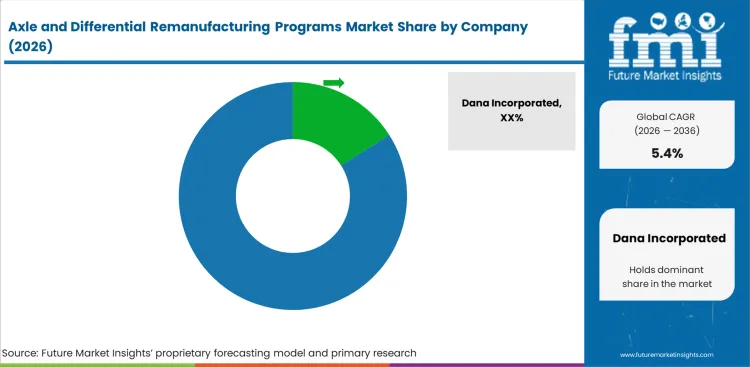
- Dana Incorporated leads through Spicer drivetrain knowledge and certified reman coverage across off-highway driveline programs.
- ZF Aftermarket and JASPER compete on reman product depth and structured core return systems for installers.
- Specialist providers focus on carrier rebuilds and axle assembly exchange with unit-specific testing records.
Competition in the axle and differential remanufacturing programs market centers on rebuild quality and exchange unit availability. Dana Incorporated holds strong positioning through OE driveline knowledge and off-highway reman program certification. ZF Aftermarket brings reman visibility through its ZF REMAN label and CorExpedia return platform. JASPER serves installers through differential catalog depth and nationwide warranty coverage. CARDONE and BBB Industries emphasize on distribution scale and access to used cores.
Damaged core supply and strict axle housing machining create important barriers for remanufacturers. Teardown control and warranty-backed exchange coverage are central priorities across long service cycles. Fleets and repair networks prefer tested assemblies with predictable core credit terms. Remanufacturers with strong product coverage and reliable core return systems can secure repeat program orders.
Key Companies in the Axle and Differential Remanufacturing Programs Market
Key global companies leading the axle and differential remanufacturing programs market include:
- Dana Incorporated, ZF Aftermarket and JASPER have strong remanufacturing infrastructure for drivetrain rebuilds and exchange supply.
- CARDONE Industries, BBB Industries and LKQ Corporation serve installers through catalog reach and core sourcing systems.
- Cummins-Meritor holds specialist positions across commercial driveline service and heavy-duty axle component coverage.
Competitive Benchmarking: Axle and Differential Remanufacturing Programs Market
| Company | Core Inspection Depth | Exchange Unit Coverage | Warranty Program Reach | Geographic Footprint |
|---|---|---|---|---|
| Dana Incorporated | High | High | Strong | Global footprint across North America, Europe, South America and Asia through driveline and off-highway operations |
| ZF Aftermarket | High | High | Strong | Global presence across Europe, North America, South America, Asia-Pacific, India, Middle East, Australia and Africa |
| JASPER Engines & Transmissions | High | High | Strong | United States-focused footprint with 53 branch and distributor locations |
| CARDONE Industries | Medium | High | Strong | North America-focused aftermarket footprint through distributor, reseller and installer channels |
| BBB Industries / TERREPOWER | Medium | Medium | Strong | Operations across North America and Europe with business coverage in over 90 countries |
| LKQ Corporation | Medium | Medium | Strong | Global footprint with over 1,400 locations across over 25 countries |
| Cummins-Meritor | High | Medium | Strong | Worldwide commercial vehicle support through Cummins service and components network |
Source: Future Market Insights, 2026.
Key Developments in Axle and Differential Remanufacturing Programs Market
- In March 2026, Jasper Engines & Transmissions announced the availability of a remanufactured Ford 10.5” differential for late-model Ford F-Series applications. The program covers multiple F-250 and F-350 applications through 2025 and includes JASPER’s remanufacturing process with housing disassembly, gear inspection, new bearings and seals, backlash adjustment, and synthetic gear oil. The unit carries a nationwide transferable warranty of up to 3 years/100,000 miles.
- In October 2025, Jasper Engines & Transmissions introduced the remanufactured Dana M300 differential for late-model Ford F-350, F-450, F-550, and F-600 applications. The 11.8” differential program is relevant to heavy-duty pickup and chassis-cab service channels, with remanufacturing steps covering cleaning, housing inspection, new bearings and seals, matched ring-and-pinion replacement, and final runout and backlash checks. The product is backed by up to 3 years/100,000 miles parts-and-labor warranty.
Key Players in the Axle and Differential Remanufacturing Programs Market
Major Global Players:
- Dana Incorporated
- ZF Aftermarket
- JASPER Engines & Transmissions
- CARDONE Industries
- BBB Industries
- LKQ Corporation
- Cummins-Meritor
Specialist Players:
- Detroit Axle
- National Differential
- Powertrain Products
- Midwest Transmission Center
Report Scope and Coverage
| Parameter | Details |
|---|---|
| Quantitative Units | USD 4.5 billion to USD 7.6 billion, at a CAGR of 5.4% |
| Market Definition | The axle and differential remanufacturing programs market encompasses industrial rebuilding services for axle assemblies and differential units used in aftermarket replacement. |
| Regions Covered | North America, Latin America, Europe, East Asia, South Asia and Pacific, Middle East and Africa |
| Countries Covered | USA, UK, Germany, China, India and 30 plus countries |
| Key Companies Profiled | Dana Incorporated, ZF Aftermarket, JASPER Engines & Transmissions, CARDONE Industries, BBB Industries, LKQ Corporation and Cummins-Meritor |
| Forecast Period | 2026 to 2036 |
| Approach | Hybrid bottom-up and top-down methodology starting with service demand and verified vehicle parc patterns. |
Axle and Differential Remanufacturing Programs Market by Segments
Axle and Differential Remanufacturing Programs Market Segmented by Program Type:
- Exchange Units
- Repair Programs
- Core Rebuilds
- Dealer Reman
- Fleet Programs
Axle and Differential Remanufacturing Programs Market Segmented by Component:
- Rear Differentials
- Front Differentials
- Axle Assemblies
- Carrier Units
- Axle Shafts
Axle and Differential Remanufacturing Programs Market Segmented by Vehicle Type:
- Light Trucks
- Passenger Cars
- Heavy Trucks
- Off-Highway
- Performance Vehicles
Axle and Differential Remanufacturing Programs Market Segmented by Sales Channel:
- Warehouse Distributors
- Dealer Networks
- Direct Fleet
- Online Stores
- Installer Networks
Axle and Differential Remanufacturing Programs Market Segmented by Core Handling:
- Core Bank
- Deposit Return
- Core Pickup
- Reverse Logistics
- Scrap Recovery
Axle and Differential Remanufacturing Programs Market Segmented by Region:
- North America
- USA
- Canada
- Mexico
- Latin America
- Brazil
- Chile
- Rest of Latin America
- Europe
- Germany
- UK
- Italy
- Spain
- France
- Rest of Europe
- East Asia
- China
- Japan
- South Korea
- South Asia and Pacific
- India
- ASEAN
- Australia & New Zealand
- Rest of South Asia and Pacific
- Middle East and Africa
- Saudi Arabia
- Other GCC Countries
- South Africa
- Rest of Middle East and Africa
Research Sources and Bibliography
- Dana Incorporated. (2024, September 24). Dana launches Dana Certified Reman™ program boosting sustainability and extending life cycles of drive technologies for off-highway. Dana Incorporated.
Source link: Dana Incorporated - ZF Friedrichshafen AG. (2026, April 22). Simpler and faster: ZF streamlines core returns and accelerates circularity in the aftermarket. ZF Press Center.
Source link: ZF Friedrichshafen AG - Allison Transmission Holdings Inc. (2025, June 11). Allison Transmission announces acquisition of Dana’s off-highway business, strengthening its global powertrain capabilities. Allison Transmission.
Source link: Allison Transmission - International Trade Administration. (2025, June 12). The Department of Commerce announces new auto tariff offset process. USA Department of Commerce. The Department of Commerce Announces New Auto Tariff Offset Process
- Federal Highway Administration. (2026, January 28). Traffic volume trends: December 2025. USA Department of Transportation. 25dectvt.pdf
- Jasper Engines & Transmissions. (2026, March 2). JASPER® offers Ford 10.5” differential for late-model applications. JASPER® Offers Ford 10.5” Differential for Late-Model Applications | JASPER® Engines & Transmissions
- Jasper Engines & Transmissions. (2025, October 30). JASPER® offers Dana M300 differential for late-model Ford applications. JASPER® Offers Dana M300 Differential for Late-Model Ford Applications | JASPER® Engines & Transmissions
- Allison Transmission Holdings Inc. (2025, June). Allison Transmission announces acquisition of Dana’s off-highway business.
Source link: Allison Transmission - Dana Incorporated. (2024, September). Dana launches Dana Certified Reman program for Spicer off-highway drivetrain components.
Source link: Dana Incorporated - Federal Highway Administration. (2026, January). Highway Statistics 2024: State motor-vehicle registrations.
Source link: Federal Highway Administration - Federal Reserve Bank of St. Louis. (2026, May). Producer Price Index by Industry: Motor Vehicle Parts Manufacturing.
Source link: FRED - Government of the United Kingdom. (2026, April). Vehicle licensing statistics, United Kingdom: 2025.
Source link: GOV.UK - Instituto Nacional de Estadística y Geografía. (2026, May). Administrative Record of the Light Vehicle Automotive Industry.
Source link: INEGI - JASPER Engines & Transmissions. (2024, September). JASPER expands late-model GM 9.5 differential availability.
Source link: JASPER Engines & Transmissions - Society of Indian Automobile Manufacturers. (2025, April). Auto industry performance from April 2024 to March 2025.
Source link: SIAM - Society of Indian Automobile Manufacturers. (2025, April 15). Auto industry performance of March 2025. SIAM. https://www.siam.in/pressrelease-details.aspx?mpgid=48&pgidtrail=50&pid=579
- Statistisches Bundesamt. (2026, May). Europe road transport: Car dominance unbroken.
Source link: Destatis - The State Council of the People’s Republic of China. (2026, January). China’s auto output and sales reach new highs in 2025.
Source link: The State Council of the People’s Republic of China - ZF Friedrichshafen AG. (2024, September). ZF Aftermarket presents remanufacturing and CorExpedia at Automechanika.
Source link: ZF Friedrichshafen AG
This Report Answers
- What is the current and future size of the axle and differential remanufacturing programs market?
- How fast is the axle and differential remanufacturing programs market expected to expand between 2026 and 2036?
- Which program type is expected to lead the market by 2026?
- Which component segment is expected to account for the highest demand by 2026?
- What factors are driving demand for axle and differential remanufacturing programs globally?
- How are core return systems influencing adoption of structured reman programs?
- Why are exchange units the main demand base for installer channels?
- Which countries are projected to record faster expansion through 2036?
- Who are the key companies active in the axle and differential remanufacturing programs market?
- How does FMI estimate and validate the market forecast?
Frequently Asked Questions
What is the global market demand for Axle and Differential Remanufacturing Programs in 2026?
In 2026, the global market for axle and differential remanufacturing programs is expected to be worth USD 4.5 billion.
How big will the market for Axle and Differential Remanufacturing Programs be in 2036?
By 2036, the market for axle and differential remanufacturing programs is expected to be worth USD 7.6 billion.
How much is demand for Axle and Differential Remanufacturing Programs expected to expand between 2026 and 2036?
Between 2026 and 2036, demand for axle and differential remanufacturing programs is expected to expand at a CAGR of 5.4%.
Which program type segment is likely to be the best seller globally by 2026?
Exchange Units will make up 42.0% of the program type segment in 2026.
What is causing demand to rise in India?
The India axle and differential remanufacturing programs market is projected to record 7.2% CAGR through 2036, driven by vehicle output and workshop depth.
What is causing demand to rise in China?
The China axle and differential remanufacturing programs market is projected to expand at 6.1% CAGR through 2036, driven by large vehicle production and fleet repair demand.
What does this report mean by Axle and Differential Remanufacturing Programs Market definition?
The axle and differential remanufacturing programs market includes industrial rebuilding services for axle assemblies and differential units before aftermarket resale.
· How does FMI make the Axle and Differential Remanufacturing Programs forecast and check it?
Forecasting models use a hybrid bottom-up and top-down approach, starting with service demand and checking it against vehicle parc patterns.
Preview the report firsthand - request a free sample
Get SampleGet the brochure for pricing and purchase details.
Get PDFTable of Content
- Executive Summary
- Global Market Outlook
- Demand-side Trends
- Supply-side Trends
- Technology Roadmap Analysis
- Analysis and Recommendations
- Market Overview
- Market Coverage / Taxonomy
- Market Definition / Scope / Limitations
- Research Methodology
- Chapter Orientation
- Analytical Lens and Working Hypotheses
- Market Structure, Signals, and Trend Drivers
- Benchmarking and Cross-market Comparability
- Market Sizing, Forecasting, and Opportunity Mapping
- Research Design and Evidence Framework
- Desk Research Programme (Secondary Evidence)
- Company Annual and Sustainability Reports
- Peer-reviewed Journals and Academic Literature
- Corporate Websites, Product Literature, and Technical Notes
- Earnings Decks and Investor Briefings
- Statutory Filings and Regulatory Disclosures
- Technical White Papers and Standards Notes
- Trade Journals, Industry Magazines, and Analyst Briefs
- Conference Proceedings, Webinars, and Seminar Materials
- Government Statistics Portals and Public Data Releases
- Press Releases and Reputable Media Coverage
- Specialist Newsletters and Curated Briefings
- Sector Databases and Reference Repositories
- FMI Internal Proprietary Databases and Historical Market Datasets
- Subscription Datasets and Paid Sources
- Social Channels, Communities, and Digital Listening Inputs
- Additional Desk Sources
- Expert Input and Fieldwork (Primary Evidence)
- Primary Modes
- Qualitative Interviews and Expert Elicitation
- Quantitative Surveys and Structured Data Capture
- Blended Approach
- Why Primary Evidence is Used
- Field Techniques
- Interviews
- Surveys
- Focus Groups
- Observational and In-context Research
- Social and Community Interactions
- Stakeholder Universe Engaged
- C-suite Leaders
- Board Members
- Presidents and Vice Presidents
- R&D and Innovation Heads
- Technical Specialists
- Domain Subject-matter Experts
- Scientists
- Physicians and Other Healthcare Professionals
- Governance, Ethics, and Data Stewardship
- Research Ethics
- Data Integrity and Handling
- Primary Modes
- Tooling, Models, and Reference Databases
- Desk Research Programme (Secondary Evidence)
- Data Engineering and Model Build
- Data Acquisition and Ingestion
- Cleaning, Normalisation, and Verification
- Synthesis, Triangulation, and Analysis
- Quality Assurance and Audit Trail
- Market Background
- Market Dynamics
- Drivers
- Restraints
- Opportunity
- Trends
- Scenario Forecast
- Demand in Optimistic Scenario
- Demand in Likely Scenario
- Demand in Conservative Scenario
- Opportunity Map Analysis
- Product Life Cycle Analysis
- Supply Chain Analysis
- Investment Feasibility Matrix
- Value Chain Analysis
- PESTLE and Porter’s Analysis
- Regulatory Landscape
- Regional Parent Market Outlook
- Production and Consumption Statistics
- Import and Export Statistics
- Market Dynamics
- Global Market Analysis 2021 to 2025 and Forecast, 2026 to 2036
- Historical Market Size Value (USD Million) Analysis, 2021 to 2025
- Current and Future Market Size Value (USD Million) Projections, 2026 to 2036
- Y-o-Y Growth Trend Analysis
- Absolute $ Opportunity Analysis
- Global Market Pricing Analysis 2021 to 2025 and Forecast 2026 to 2036
- Global Market Analysis 2021 to 2025 and Forecast 2026 to 2036, By Program Type
- Introduction / Key Findings
- Historical Market Size Value (USD Million) Analysis By Program Type , 2021 to 2025
- Current and Future Market Size Value (USD Million) Analysis and Forecast By Program Type , 2026 to 2036
- Exchange Value (USD Million)s
- Repair Programs
- Core Rebuilds
- Exchange Value (USD Million)s
- Y-o-Y Growth Trend Analysis By Program Type , 2021 to 2025
- Absolute $ Opportunity Analysis By Program Type , 2026 to 2036
- Global Market Analysis 2021 to 2025 and Forecast 2026 to 2036, By Component
- Introduction / Key Findings
- Historical Market Size Value (USD Million) Analysis By Component, 2021 to 2025
- Current and Future Market Size Value (USD Million) Analysis and Forecast By Component, 2026 to 2036
- Rear Differentials
- Front Differentials
- Axle Assemblies
- Rear Differentials
- Y-o-Y Growth Trend Analysis By Component, 2021 to 2025
- Absolute $ Opportunity Analysis By Component, 2026 to 2036
- Global Market Analysis 2021 to 2025 and Forecast 2026 to 2036, By Vehicle Type
- Introduction / Key Findings
- Historical Market Size Value (USD Million) Analysis By Vehicle Type, 2021 to 2025
- Current and Future Market Size Value (USD Million) Analysis and Forecast By Vehicle Type, 2026 to 2036
- Light Trucks
- Passenger Cars
- Heavy Trucks
- Light Trucks
- Y-o-Y Growth Trend Analysis By Vehicle Type, 2021 to 2025
- Absolute $ Opportunity Analysis By Vehicle Type, 2026 to 2036
- Global Market Analysis 2021 to 2025 and Forecast 2026 to 2036, By Sales Channel
- Introduction / Key Findings
- Historical Market Size Value (USD Million) Analysis By Sales Channel, 2021 to 2025
- Current and Future Market Size Value (USD Million) Analysis and Forecast By Sales Channel, 2026 to 2036
- Warehouse Distributors
- Dealer Networks
- Direct Fleet
- Warehouse Distributors
- Y-o-Y Growth Trend Analysis By Sales Channel, 2021 to 2025
- Absolute $ Opportunity Analysis By Sales Channel, 2026 to 2036
- Global Market Analysis 2021 to 2025 and Forecast 2026 to 2036, By Core Handling
- Introduction / Key Findings
- Historical Market Size Value (USD Million) Analysis By Core Handling, 2021 to 2025
- Current and Future Market Size Value (USD Million) Analysis and Forecast By Core Handling, 2026 to 2036
- Core Bank
- Deposit Return
- Core Pickup
- Core Bank
- Y-o-Y Growth Trend Analysis By Core Handling, 2021 to 2025
- Absolute $ Opportunity Analysis By Core Handling, 2026 to 2036
- Global Market Analysis 2021 to 2025 and Forecast 2026 to 2036, By Region
- Introduction
- Historical Market Size Value (USD Million) Analysis By Region, 2021 to 2025
- Current Market Size Value (USD Million) Analysis and Forecast By Region, 2026 to 2036
- North America
- Latin America
- Western Europe
- Eastern Europe
- East Asia
- South Asia and Pacific
- Middle East & Africa
- Market Attractiveness Analysis By Region
- North America Market Analysis 2021 to 2025 and Forecast 2026 to 2036, By Country
- Historical Market Size Value (USD Million) Trend Analysis By Market Taxonomy, 2021 to 2025
- Market Size Value (USD Million) Forecast By Market Taxonomy, 2026 to 2036
- By Country
- USA
- Canada
- Mexico
- By Program Type
- By Component
- By Vehicle Type
- By Sales Channel
- By Core Handling
- By Country
- Market Attractiveness Analysis
- By Country
- By Program Type
- By Component
- By Vehicle Type
- By Sales Channel
- By Core Handling
- Key Takeaways
- Latin America Market Analysis 2021 to 2025 and Forecast 2026 to 2036, By Country
- Historical Market Size Value (USD Million) Trend Analysis By Market Taxonomy, 2021 to 2025
- Market Size Value (USD Million) Forecast By Market Taxonomy, 2026 to 2036
- By Country
- Brazil
- Chile
- Rest of Latin America
- By Program Type
- By Component
- By Vehicle Type
- By Sales Channel
- By Core Handling
- By Country
- Market Attractiveness Analysis
- By Country
- By Program Type
- By Component
- By Vehicle Type
- By Sales Channel
- By Core Handling
- Key Takeaways
- Western Europe Market Analysis 2021 to 2025 and Forecast 2026 to 2036, By Country
- Historical Market Size Value (USD Million) Trend Analysis By Market Taxonomy, 2021 to 2025
- Market Size Value (USD Million) Forecast By Market Taxonomy, 2026 to 2036
- By Country
- Germany
- UK
- Italy
- Spain
- France
- Nordic
- BENELUX
- Rest of Western Europe
- By Program Type
- By Component
- By Vehicle Type
- By Sales Channel
- By Core Handling
- By Country
- Market Attractiveness Analysis
- By Country
- By Program Type
- By Component
- By Vehicle Type
- By Sales Channel
- By Core Handling
- Key Takeaways
- Eastern Europe Market Analysis 2021 to 2025 and Forecast 2026 to 2036, By Country
- Historical Market Size Value (USD Million) Trend Analysis By Market Taxonomy, 2021 to 2025
- Market Size Value (USD Million) Forecast By Market Taxonomy, 2026 to 2036
- By Country
- Russia
- Poland
- Hungary
- Balkan & Baltic
- Rest of Eastern Europe
- By Program Type
- By Component
- By Vehicle Type
- By Sales Channel
- By Core Handling
- By Country
- Market Attractiveness Analysis
- By Country
- By Program Type
- By Component
- By Vehicle Type
- By Sales Channel
- By Core Handling
- Key Takeaways
- East Asia Market Analysis 2021 to 2025 and Forecast 2026 to 2036, By Country
- Historical Market Size Value (USD Million) Trend Analysis By Market Taxonomy, 2021 to 2025
- Market Size Value (USD Million) Forecast By Market Taxonomy, 2026 to 2036
- By Country
- China
- Japan
- South Korea
- By Program Type
- By Component
- By Vehicle Type
- By Sales Channel
- By Core Handling
- By Country
- Market Attractiveness Analysis
- By Country
- By Program Type
- By Component
- By Vehicle Type
- By Sales Channel
- By Core Handling
- Key Takeaways
- South Asia and Pacific Market Analysis 2021 to 2025 and Forecast 2026 to 2036, By Country
- Historical Market Size Value (USD Million) Trend Analysis By Market Taxonomy, 2021 to 2025
- Market Size Value (USD Million) Forecast By Market Taxonomy, 2026 to 2036
- By Country
- India
- ASEAN
- Australia & New Zealand
- Rest of South Asia and Pacific
- By Program Type
- By Component
- By Vehicle Type
- By Sales Channel
- By Core Handling
- By Country
- Market Attractiveness Analysis
- By Country
- By Program Type
- By Component
- By Vehicle Type
- By Sales Channel
- By Core Handling
- Key Takeaways
- Middle East & Africa Market Analysis 2021 to 2025 and Forecast 2026 to 2036, By Country
- Historical Market Size Value (USD Million) Trend Analysis By Market Taxonomy, 2021 to 2025
- Market Size Value (USD Million) Forecast By Market Taxonomy, 2026 to 2036
- By Country
- Kingdom of Saudi Arabia
- Other GCC Countries
- Turkiye
- South Africa
- Other African Union
- Rest of Middle East & Africa
- By Program Type
- By Component
- By Vehicle Type
- By Sales Channel
- By Core Handling
- By Country
- Market Attractiveness Analysis
- By Country
- By Program Type
- By Component
- By Vehicle Type
- By Sales Channel
- By Core Handling
- Key Takeaways
- Key Countries Market Analysis
- USA
- Pricing Analysis
- Market Share Analysis, 2025
- By Program Type
- By Component
- By Vehicle Type
- By Sales Channel
- By Core Handling
- Canada
- Pricing Analysis
- Market Share Analysis, 2025
- By Program Type
- By Component
- By Vehicle Type
- By Sales Channel
- By Core Handling
- Mexico
- Pricing Analysis
- Market Share Analysis, 2025
- By Program Type
- By Component
- By Vehicle Type
- By Sales Channel
- By Core Handling
- Brazil
- Pricing Analysis
- Market Share Analysis, 2025
- By Program Type
- By Component
- By Vehicle Type
- By Sales Channel
- By Core Handling
- Chile
- Pricing Analysis
- Market Share Analysis, 2025
- By Program Type
- By Component
- By Vehicle Type
- By Sales Channel
- By Core Handling
- Germany
- Pricing Analysis
- Market Share Analysis, 2025
- By Program Type
- By Component
- By Vehicle Type
- By Sales Channel
- By Core Handling
- UK
- Pricing Analysis
- Market Share Analysis, 2025
- By Program Type
- By Component
- By Vehicle Type
- By Sales Channel
- By Core Handling
- Italy
- Pricing Analysis
- Market Share Analysis, 2025
- By Program Type
- By Component
- By Vehicle Type
- By Sales Channel
- By Core Handling
- Spain
- Pricing Analysis
- Market Share Analysis, 2025
- By Program Type
- By Component
- By Vehicle Type
- By Sales Channel
- By Core Handling
- France
- Pricing Analysis
- Market Share Analysis, 2025
- By Program Type
- By Component
- By Vehicle Type
- By Sales Channel
- By Core Handling
- India
- Pricing Analysis
- Market Share Analysis, 2025
- By Program Type
- By Component
- By Vehicle Type
- By Sales Channel
- By Core Handling
- ASEAN
- Pricing Analysis
- Market Share Analysis, 2025
- By Program Type
- By Component
- By Vehicle Type
- By Sales Channel
- By Core Handling
- Australia & New Zealand
- Pricing Analysis
- Market Share Analysis, 2025
- By Program Type
- By Component
- By Vehicle Type
- By Sales Channel
- By Core Handling
- China
- Pricing Analysis
- Market Share Analysis, 2025
- By Program Type
- By Component
- By Vehicle Type
- By Sales Channel
- By Core Handling
- Japan
- Pricing Analysis
- Market Share Analysis, 2025
- By Program Type
- By Component
- By Vehicle Type
- By Sales Channel
- By Core Handling
- South Korea
- Pricing Analysis
- Market Share Analysis, 2025
- By Program Type
- By Component
- By Vehicle Type
- By Sales Channel
- By Core Handling
- Russia
- Pricing Analysis
- Market Share Analysis, 2025
- By Program Type
- By Component
- By Vehicle Type
- By Sales Channel
- By Core Handling
- Poland
- Pricing Analysis
- Market Share Analysis, 2025
- By Program Type
- By Component
- By Vehicle Type
- By Sales Channel
- By Core Handling
- Hungary
- Pricing Analysis
- Market Share Analysis, 2025
- By Program Type
- By Component
- By Vehicle Type
- By Sales Channel
- By Core Handling
- Kingdom of Saudi Arabia
- Pricing Analysis
- Market Share Analysis, 2025
- By Program Type
- By Component
- By Vehicle Type
- By Sales Channel
- By Core Handling
- Turkiye
- Pricing Analysis
- Market Share Analysis, 2025
- By Program Type
- By Component
- By Vehicle Type
- By Sales Channel
- By Core Handling
- South Africa
- Pricing Analysis
- Market Share Analysis, 2025
- By Program Type
- By Component
- By Vehicle Type
- By Sales Channel
- By Core Handling
- USA
- Market Structure Analysis
- Competition Dashboard
- Competition Benchmarking
- Market Share Analysis of Top Players
- By Regional
- By Program Type
- By Component
- By Vehicle Type
- By Sales Channel
- By Core Handling
- Competition Analysis
- Competition Deep Dive
- Dana Incorporated
- Overview
- Product Portfolio
- Profitability by Market Segments (Product/Age /Sales Channel/Region)
- Sales Footprint
- Strategy Overview
- Marketing Strategy
- Product Strategy
- Channel Strategy
- ZF Aftermarket
- JASPER Engines & Transmissions
- CARDONE Industries
- BBB Industries
- LKQ Corporation
- Dana Incorporated
- Competition Deep Dive
- Assumptions & Acronyms Used


