

- Industry Size (2026)
- USD 1.2 Bn
- Forecast (2036)
- USD 3.0 Bn
- CAGR (2026 to 2036)
- 9.1%
Remanufacturing and Core Returns Logistics Management Market Size, Market Forecast and Outlook By FMI
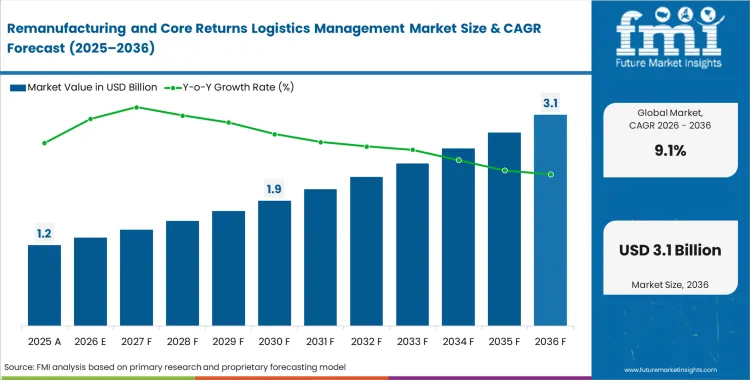
The remanufacturing and core returns logistics management market was valued at USD 1.18 billion in 2025. Revenue is expected to cross USD 1.2 billion in 2026 at a CAGR of 9.1% during the forecast period. Industry is projected to reach USD 3.0 billion by 2036 as OEMs strengthen closed-loop workflows to retain high-value component cores and prevent supply leakage into secondary rebuild channels. Demand analysis reflects growing financial pressure to recover, track, and reintegrate cores within controlled remanufacturing ecosystems.
Summary of Remanufacturing and Core Returns Logistics Management Market
- Market Snapshot
- The remanufacturing and core returns logistics management market is valued at USD 1.1 billion in 2025 and is projected to reach USD 3.0 billion by 2036.
- The industry is expected to grow at a 9.1% CAGR from 2026 to 2036, creating an incremental opportunity of USD 1.7 billion over the decade.
- This market covers the digital and managed coordination layer for core returns, grading, routing, depot receipt, and recovery settlement, excluding the full physical reverse-logistics spend.
- The market remains compliance- and process-driven, where value is shaped by turnaround speed, usable-core recovery, workflow visibility, and ERP service-logistics integration.
- Demand and Growth Drivers
- Demand is increasing as remanufacturing programs depend on consistent recovery of used cores, with core-return mechanisms remaining tightly embedded within large aftermarket replacement flows.
- Adoption is strengthening as enterprise platforms consolidate reverse logistics disposition, repair returns, decisioning engines, and depot service coordination into unified operational workflows.
- Circular economy pressure continues to support growth, with reverse supply chains now treated as critical infrastructure for reuse, remanufacturing, and long-term material security strategies.
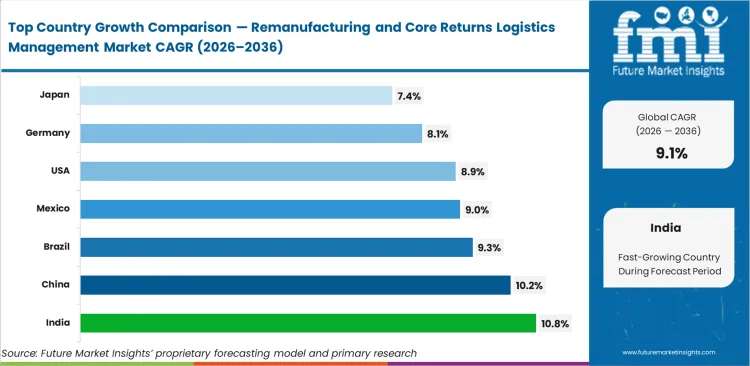
- India leads at 10.8% CAGR, driven by domestic recovery focus, followed by China at 10.2% with strong industrial mandates. Brazil (9.3%) and Mexico (9.0%) benefit from nearshore refurbishment roles, while the United States grows at 8.9%. Germany records 8.1%, and Japan advances at 7.4%, reflecting more mature remanufacturing ecosystems.
- Growth remains constrained by variability in core quality, fragmented return channels, and continued reliance on broader service-parts systems instead of dedicated remanufacturing-focused platforms.
- Product and Segment View
- The market covers software and managed workflows used mainly for authorization, tracking, grading, routing, depot intake, and partner settlement across closed-loop service supply chains.
- These tools are used across automotive, heavy equipment, industrial machinery, electronics, and aerospace where returned parts retain remanufacturable value.
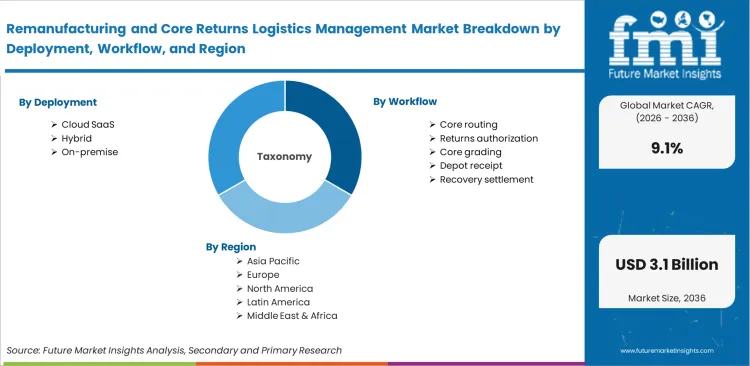
- Cloud SaaS leads the Deployment segment with a 61.0% share, supported by multi-site return visibility and faster integration across aftermarket networks.
- Core routing leads the Workflow segment with a 28.0% share, because return capture and routing determine whether usable cores reach the right remanufacturing node on time.
- Automotive leads the End Use segment with a 42.0% share, reflecting the long-standing use of core exchange programs in alternators, starters, brake components, and driveline assemblies.
- Tracking leads the Function segment with a 30.0% share, because core status visibility is the base layer for grading, disposition, billing, and recovery performance.
- OEMs lead the Buyer Type segment with a 37.0% share, driven by their control over service-parts policy, warranty rules, and remanufacturing program design.
- The scope includes core-return logistics management for remanufacturing and depot repair, but excludes full reverse-transport revenue, scrap recycling brokerage, and general e-commerce returns platforms that do not manage remanufacturable cores.
- Geography and Competitive Outlook
- India, China, and Brazil are the fastest-growing national markets, while the United States remains the largest stable value base because core programs and remanufacturing are already well established there.
- Competition is being shaped by ERP-native reverse-logistics modules, specialist returns orchestration, AI-based disposition engines, and tighter links between depot repair and service-parts planning.
- Key participants include Oracle, SAP, Blue Yonder, PTC Servigistics, Syncron, ReverseLogix, and Infor, with Oracle estimated as the largest single vendor.
- The market is moderately fragmented because many deployments still sit inside broader SCM, ERP, or aftermarket service suites preventing a single pure-play category.
Core leakage creates a direct financial problem once removed components leave service networks without proper tracking at the point of collection. Procurement teams are responding with reverse logistics systems that connect dealer activity to deposit recovery controls, improving accountability across the return cycle. Service-level digitization is reinforcing that structure. Dealer platforms requiring pre-approval grading and visual validation tend to lift return volumes and shorten reconciliation time, moving core recovery away from reactive follow-up and toward a more controlled real-time workflow.
Import tariffs on new automotive components are pushing faster adoption in India, where the market is expected to grow at a CAGR of 10.8% through 2036. Centralized mandates tied to industrial machinery recovery keep China on a strong path, with market growth projected at 10.2% CAGR over the forecast period. Nearshore refurbishment capacity is supporting United States expansion at 8.9%, while Brazil and Mexico reinforce the regional returns network with CAGRs of 9.3% and 9.0%, respectively. End-of-life vehicle regulation continues to shape demand in Germany, where the market is forecast to advance at 8.1% CAGR through 2036. Mature rebuild ecosystems keep Japan on a steadier trajectory, with demand expected to rise at a CAGR of 7.4% during the study period.
Segmental Analysis
Remanufacturing and Core Returns Logistics Management Market Analysis by Deployment
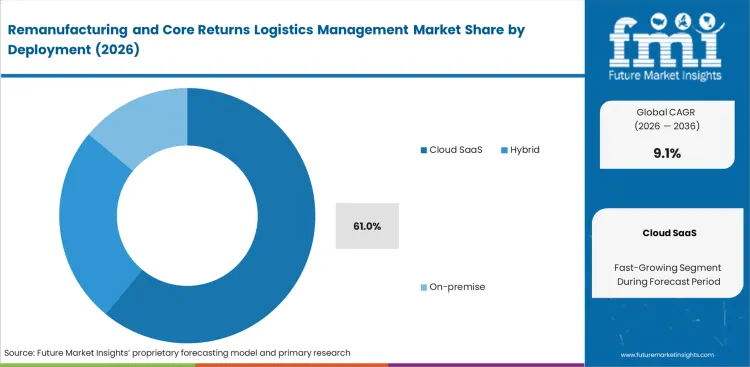
Coordinating core recovery across OEMs, dealers, and independent repair networks requires shared system access, making cloud-based deployment the dominant model. Cloud SaaS is expected to account for 61.0% share in 2026, as centralized visibility improves coordination across fragmented service ecosystems. Adoption success depends less on system sophistication and more on usability at the technician level, where overly complex interfaces reduce compliance. Platforms that integrate directly into existing dealer systems achieve higher participation than standalone portals.
- Embedded system integration: Platforms connect directly with dealer management systems, avoiding disruption to existing workflows and improving adoption rates.
- Mobile-first access: Lightweight mobile interfaces allow technicians to capture and upload return data quickly from service locations.
- Cross-network visibility: Shared cloud environments enable OEMs, dealers, and logistics partners to track core status in real time.
Remanufacturing and Core Returns Logistics Management Market Analysis by Workflow
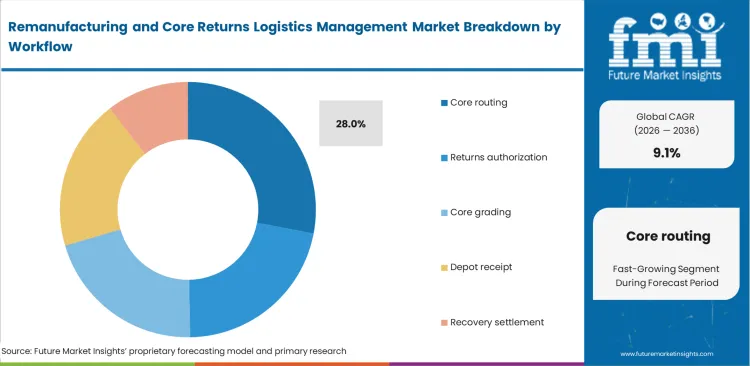
Core routing is set to capture around 28.0% share in 2026 as brands realize shipping every failed unit to a central mega-facility creates severe processing backlogs. Logistics managers deploy intelligent remanufacturing core routing systems alongside returnable transport packaging evaluating freight cost, facility capacity, and specific component demand before generating a waybill. According to FMI's estimates, these algorithms rarely optimize for pure geographic distance; they actively optimize for labor availability, deliberately diverting complex teardowns to facilities possessing current bandwidth. Procurement officers relying on static routing tables hemorrhage margin on double-handling and excessive transit fees.
- Dynamic diversion: Systems reroute low-value or non-repairable cores directly to scrap or secondary channels, avoiding unnecessary processing.
- Edge-level grading: Initial condition checks at collection points prevent unusable cores from entering high-cost sorting facilities.
- Capacity-aware routing: Algorithms factor in labor availability and facility workload when assigning destinations, improving throughput.
Remanufacturing and Core Returns Logistics Management Market Analysis by End Use
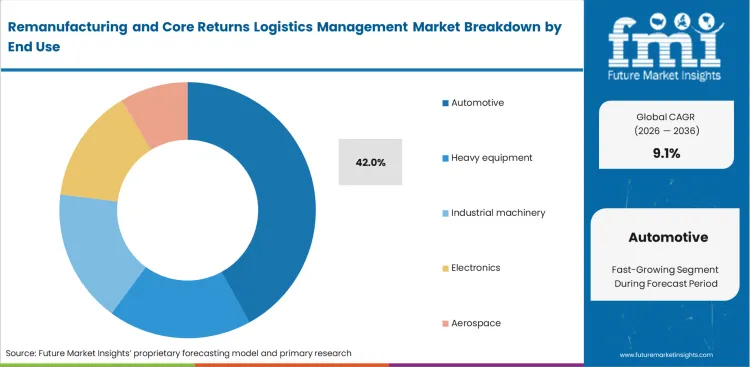
Automotive remains the dominant sector, with the segment expected to account for 42.0% share in 2026 as manufacturers strengthen closed-loop recovery for high-value components. The shift toward electrification is reshaping requirements, with battery systems introducing new handling, compliance, and tracking challenges. Legacy systems designed for mechanical components often fail to support these newer asset types, increasing operational and regulatory risk.
- Battery recovery systems: Specialized workflows manage collection, transport, and processing of high-voltage components under strict safety rules.
- Component traceability: Platforms track individual units across recovery cycles, ensuring compliance and preventing leakage into secondary markets.
- Material value capture: Systems prioritize recovery of high-value materials, aligning routing decisions with resale or reuse potential.
Remanufacturing and Core Returns Logistics Management Market Analysis by Function
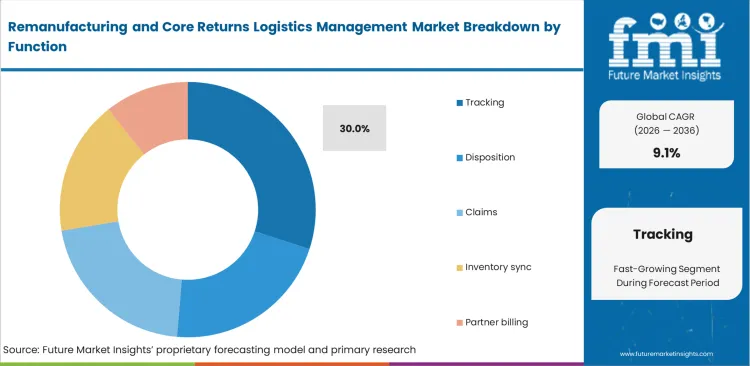
Knowing a component's location matters far less than knowing its financial status. Tracking commands 30.0% share, yet modern definition has evolved away from geographic coordinates. Finance directors require systems monitoring specific deposit liability associated with each physical unit, linking an in-motion dimensioning systems scan directly to a dealer's credit account. In FMI's view, geographic tracking alone is thoroughly commoditized; actual value lies in financial synchronization and proving the roi of core return management software to internal stakeholders. When a technician drops a fragile sensor during removal, software must instantly deduct the core charge from that specific franchise's ledger. Teams managing aftermarket service parts reverse logistics who utilize disconnected logistics and financial platforms spend millions annually attempting to reconcile unmatched transit receipts.
- Deposit linkage tracking: Platforms tie each returned core to dealer deposits, ensuring accurate financial reconciliation.
- Exception management: Systems flag damaged or missing cores and automatically adjust financial records.
- Integrated financial visibility: Logistics and accounting data are synchronized to provide a complete view of recovery performance.
Remanufacturing and Core Returns Logistics Management Market Analysis by Buyer Type
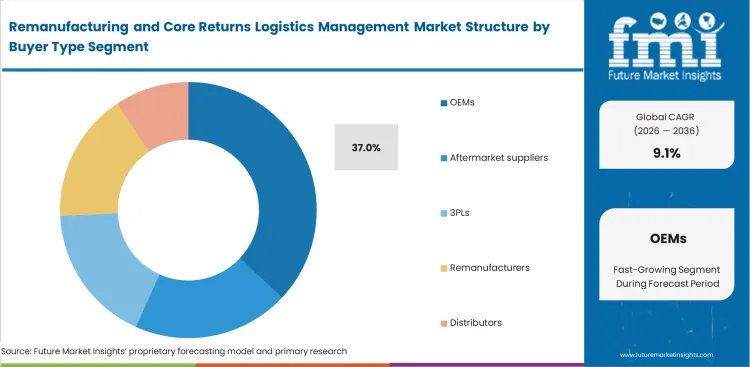
OEMs dominate adoption, with the segment projected to hold 37.0% share in 2026, as manufacturers seek tighter control over core recovery and secondary supply. These organizations use structured return systems to prevent high-value components from leaking into independent rebuild channels. Control over recovery flows directly impacts rebuild economics and aftermarket competitiveness.
- Dealer compliance enforcement: OEMs embed return requirements into service contracts, ensuring consistent participation across networks.
- Platform standardization: Centralized systems unify recovery workflows across regions and dealer networks.
- Supply retention strategy: Controlled return channels ensure cores remain within OEM ecosystems, supporting remanufacturing programs.
Remanufacturing and Core Returns Logistics Management Market Drivers, Restraints, and Opportunities
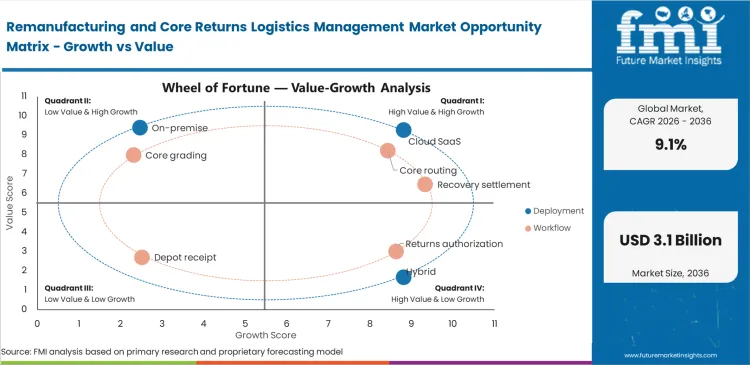
Severe raw material inflation combined with fragile international supply lines forces industrial manufacturers to furiously protect their proprietary component feedstock. Delaying deployment of robust manufacturing logistics software designed specifically for core recovery leaves organizations vulnerable to secondary market scavengers who aggressively purchase depleted assets directly from independent repair bays. Procurement directors realize they can no longer treat core returns as a passive, paper-based compliance exercise. This immediate threat compels heavy equipment and automotive brands to deploy strict digital tracking tools, financially penalizing any dealer failing to route rebuildable inventory back to centralized factory depots.
Deep operational friction at the dealer level actively sabotages widespread platform adoption. Independent repair facility technicians consistently reject complex authorization workflows because original equipment manufacturers rarely compensate them for administrative time required to properly photograph, grade, and document a depleted core. This fundamental misalignment means highly sophisticated cloud platforms frequently sit idle while mechanics bypass rules, opting to sell components to local scrap brokers demanding zero paperwork. Overcoming this barrier requires vendors to design frictionless, mobile-first data entry applications completing grading procedures in seconds.
Opportunities in the Remanufacturing and Core Returns Logistics Management Market
- AI decisioning: Operations directors deploy ai in reverse logistics decisioning models analyzing technician photographs to instantly verify rebuild eligibility. Claims managers eliminate human subjectivity during initial triage phases.
- Embedded diagnostics: Product engineering directors integrate internal sensor data with reverse logistics software, transmitting asset health reports before removal. Operations planners pre-order specific replacement parts based on proactive it asset disposition signals.
- Predictive staging: Supply chain leaders utilize historical failure rates to proactively stage empty shipping containers at high-volume dealerships. Transportation directors drastically reduce time critical cores sit waiting for proper packaging.
Regional Analysis
Based on regional analysis, Remanufacturing and Core Returns Logistics Management Market is segmented into North America, Europe, Asia Pacific, and Rest of World across 40 plus countries.
.webp "Top Country Growth Comparison Remanufacturing And Core Returns Logistics Management Market Cagr (2026 2036)")
| Country | CAGR (2026 to 2036) |
|---|---|
| India | 10.8% |
| China | 10.2% |
| Brazil | 9.3% |
| Mexico | 9.0% |
| United States | 8.9% |
| Germany | 8.1% |
| Japan | 7.4% |
Source: Future Market Insights (FMI) analysis, based on proprietary forecasting model and primary research
Asia Pacific Remanufacturing and Core Returns Logistics Management Market Analysis
Industrial policy across Asia Pacific is tightening control over component reuse and recovery, particularly in automotive and heavy machinery sectors. Governments are increasing tariffs on imported components while promoting domestic remanufacturing capacity. This is shifting logistics priorities toward capturing, tracking, and redistributing cores within national boundaries. Companies are redesigning reverse logistics systems to ensure consistent access to reusable parts, reducing exposure to currency volatility and supply disruptions. Digital tracking is becoming a requirement to maintain visibility over asset movement across fragmented industrial networks.
- India: Import restrictions on new components are pushing manufacturers to build tighter local recovery systems for high-value cores. From 2026 to 2036, remanufacturing and core returns logistics management demand in India is likely to advance at a CAGR of 10.8%. Automotive rebuilders and industrial operators are adding digital tracking tools to monitor core movement and availability across service networks. Better control over returns reduces dependence on outside sourcing and helps protect input cost stability. Preference for localized platforms is also improving the position of domestic software providers working within local compliance requirements.
- China: Industrial machinery remanufacturing in China is being shaped by centralized circularity mandates and stricter proof-of-custody expectations. Facility managers are replacing older tracking systems to document depleted asset movement more accurately across recovery loops. Expansion in country is expected to run at a CAGR of 10.2% through 2036, supported by compliance pressure tied to state-backed recovery targets. Failure to demonstrate digital custody can weaken eligibility for public infrastructure work, which is making traceability systems harder for operators to postpone.
North America Remanufacturing and Core Returns Logistics Management Market Analysis
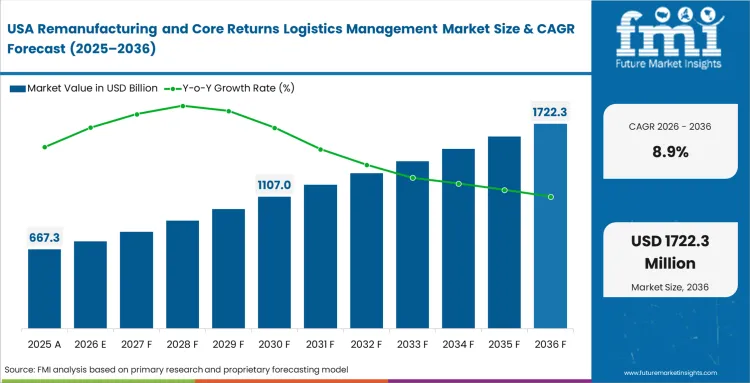
Corporate procurement structures, rather than regulation, are defining how reverse logistics systems are deployed across North America. Large OEMs are enforcing standardized platforms across dealer and service networks to manage warranty returns and core recovery. These requirements are embedded in commercial agreements, forcing suppliers and partners to adopt designated systems. Logistics design is focused on integrating independent repair networks into unified digital frameworks that ensure consistent tracking and reporting.
- United States: The United States is set to record a CAGR of 8.9% in the remanufacturing and core returns logistics management market through 2036. Automotive manufacturers and large retailers are requiring suppliers to align with centralized take-back systems. Independent repair operators must integrate with OEM platforms to maintain eligibility for warranty and deposit programs. Vendors that can bridge system gaps between large enterprise platforms and smaller service providers are securing long-term contracts and recurring revenue streams.
- Mexico: Mexico is projected to witness a CAGR of 9.0% during 2026 to 2036. Its role as a manufacturing extension for North America is increasing the need for structured core return systems across cross-border supply chains. Companies are investing in tracking platforms that connect production facilities with refurbishment and redistribution centers. Proximity to the United States supports integration into regional remanufacturing networks.
Europe Remanufacturing and Core Returns Logistics Management Market Analysis
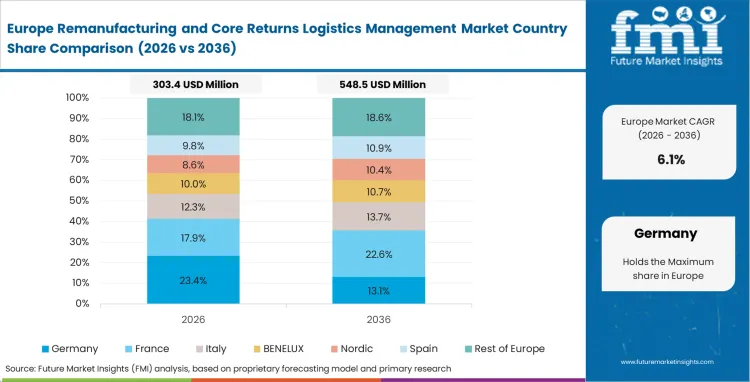
Comprehensive legislative frameworks dictating exact material recovery percentages dominate corporate IT strategy across European nations. Compliance officers deploy advanced tracking platforms purely generating auditable proof of circular performance. Based on FMI's assessment, aggressive taxation on linear waste models fundamentally alters software ROI calculations. Companies operating inside this regulatory environment treat specialized logistics design as mandatory tax-avoidance infrastructure, driving deep integration with recycling feedstock hub services.
- Germany: Germany’s market is expanding at a CAGR of 8.1% during 2026 to 2036, supported by strict end-of-life vehicle regulations. Companies are implementing advanced tracking systems to document component recovery, grading, and reuse. Integration between logistics platforms and recycling infrastructure ensures compliance with national standards. Strong engineering capabilities allow German providers to develop and export structured compliance systems to other regions.
Latin America Remanufacturing and Core Returns Logistics Management Market Analysis
Industrial recovery systems in Latin America are developing alongside manufacturing and export-oriented supply chains. Infrastructure constraints require flexible, cost-efficient logistics models that can operate across dispersed industrial zones. Companies are prioritizing mobile-enabled tracking systems to manage asset recovery where fixed infrastructure is limited.
- Brazil: Brazil is projected to witness growth in the remanufacturing and core returns logistics management market at a CAGR of 9.3% through 2036, supported by rising industrial activity and increasing demand for structured recovery and refurbishment systems. Companies are adopting mobile-first tracking tools to manage core collection and grading across large geographic areas. These systems support integration with both domestic and export-oriented remanufacturing operations.
FMI's report includes South American facilities increasingly serve as crucial testing grounds for mobile-first grading applications where traditional desktop infrastructure remains unreliable, establishing new reverse logistics platforms for reusable takeaway food packaging integration standards.
Competitive Aligners for Market Players
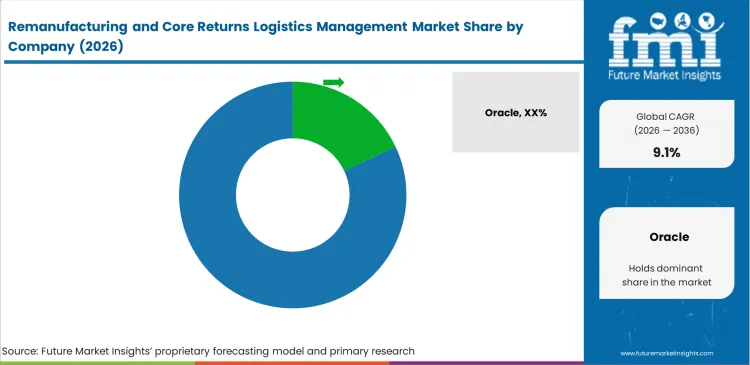
Legacy enterprise resource planning giants utilize extensive installed bases to dominate strategic high ground regarding component recovery. Oracle and SAP secure lucrative upgrade contracts by framing core returns management as natural extensions of existing financial ledger systems. Chief information officers inherently trust established vendors managing complex financial liabilities associated with deposit reconciliation. When teams draft an rfq for core return management platform, they frequently evaluate oracle vs sap for reverse logistics simply by activating dormant reverse modules within existing service-parts supply chain deployments.
Challengers lacking large ERP footprints attack the sector by solving exact problems legacy systems ignore: dealer-level user experience. Platforms win competitive bids against traditional core returns logistics software vendors by demonstrating frictionless, mobile-first interfaces independent mechanics actually tolerate. Strategic buyers increasingly prioritize partners demonstrating deep capability in edge-node condition grading over those offering generic corporate dashboarding. Startups attempting disruption discover beautiful analytics engines fail completely if the core tracking software tracking software proves too cumbersome for technicians wearing heavy gloves.
Significant manufacturing buyers actively resist vendor lock-in enforcing strict API interoperability standards across chosen logistics providers. When procurement directors compare oracle sap and blue yonder for core returns management, they systematically split contracts, utilizing specialized best-of-breed applications engaging dealers while retaining core financial clearing within proprietary systems. How to choose remanufacturing logistics software relies upon a vendor's ability to execute remanufacturing returns software integration with erp architectures smoothly. FMI observes successful challengers bypass traditional monolithic sales motions offering highly specific micro-services tailored for niche tasks like visual AI grading or integration with heavy equipment diagnostic systems.
Key Players in Remanufacturing and Core Returns Logistics Management Market
- Oracle
- SAP
- Blue Yonder
- PTC Servigistics
- Syncron
- ReverseLogix
- Infor
Scope of the Report
| Metric | Value |
|---|---|
| Quantitative Units | USD 1.29 billion to USD 3.08 billion, at a CAGR of 9.1% |
| Market Definition | Specialized software and coordinated digital workflows governing the retrieval, inspection, and financial reconciliation of depleted industrial components. Platforms coordinate reverse transit while simultaneously linking physical asset condition to specific financial deposit liabilities. |
| Segmentation | Deployment, Workflow, End Use, Function, Buyer Type, Region |
| Regions Covered | North America, Latin America, Europe, Asia Pacific, Middle East and Africa |
| Countries Covered | United States, Canada, Brazil, Mexico, Germany, United Kingdom, France, Italy, Spain, China, Japan, India, ASEAN, ANZ, GCC |
| Key Companies Profiled | Oracle, SAP, Blue Yonder, PTC Servigistics, Syncron, ReverseLogix, Infor |
| Forecast Period | 2026 to 2036 |
| Approach | Software contract values for enterprise-scale core recovery platforms served as baseline valuation anchors. Independent facility processing volume reports from major third-party remanufacturers cross-validated projected software deployment scales. |
Source: Future Market Insights (FMI) analysis, based on proprietary forecasting model and primary research
Remanufacturing and Core Returns Logistics Management Market Analysis by Segments
Deployment:
- Cloud SaaS
- Hybrid
- On-premise
Workflow:
- Core routing
- Returns authorization
- Core grading
- Depot receipt
- Recovery settlement
End Use:
- Automotive
- Heavy equipment
- Industrial machinery
- Electronics
- Aerospace
Function:
- Tracking
- Disposition
- Claims
- Inventory sync
- Partner billing
Buyer Type:
- OEMs
- Aftermarket suppliers
- 3PLs
- Remanufacturers
- Distributors
Region:
- North America
- Latin America
- Europe
- Asia Pacific
- Middle East and Africa
Bibliography
- AutoZone, Inc. (2025, October 28). 2025 Annual Report. U.S. Securities and Exchange Commission.
- Dorman Products, Inc. (2026). dorm-20251231. U.S. Securities and Exchange Commission.
- Huang, H., Li, B., & Li, K. W. (2024). Remanufacturing in global supply chains: Self-operating or outsourcing? Transportation Research Part E: Logistics and Transportation Review.
- Kim, Y. H., Ye, W., Kumar, R., Bail, F., Dvorak, J., Tan, Y., May, M. C., Chang, Q., Athinarayanan, R., & Lanza, G. (2024). Unlocking the potential of remanufacturing through machine learning and data-driven models-A survey. Algorithms
- LKQ Corporation. (2026, February 19). lkq-20251231. U.S. Securities and Exchange Commission.
This bibliography is provided for reader reference. The full FMI report contains the complete reference list with primary source documentation.
This Report Addresses
- Dealer-level workflow friction preventing widespread digital core tracking adoption across independent repair facilities.
- Financial liability synchronization mapping physical asset condition directly to original equipment manufacturer credit lines.
- Routing algorithm logic optimizing for processing facility labor capacity preventing pure geographic transit distance.
- High-voltage battery pack recovery requirements fracturing legacy automotive reverse logistics software architecture.
- Cloud deployment failures caused by overly complex user interfaces deployed to hostile third-party technician networks.
- Strategic white-labeling tactics executed by heavy equipment brands to monopolize secondary component supply chains.
Frequently Asked Questions
What is core returns logistics management?
It encompasses specialized software and coordinated digital workflows governing the retrieval, inspection, and financial reconciliation of depleted industrial components prior to remanufacturing.
How does remanufacturing reverse logistics work?
It links physical asset transit directly with dealer deposit liabilities, requiring technicians to photograph and grade a depleted core before a shipping authorization is generated, preventing useless scrap from entering the supply chain.
Why are core returns important in remanufacturing?
Raw material inflation makes reclaiming proprietary component feedstock essential. Depleted assets contain high-value metals and structural housings that are significantly cheaper to refurbish than to manufacture from scratch.
Why does cloud SaaS dominate deployment architectures?
Holding 61.0% share, cloud environments dominate because successful core retrieval requires synchronized data access across original equipment manufacturers, independent repair shops, and external freight carriers, feats impossible when restricted behind rigid corporate firewalls.
What makes core routing critical to workflow management?
Capturing 28.0% share, intelligent routing evaluates specific facility labor capacity alongside component demand before generating waybills. Logistics managers avoid severe processing backlogs deliberately diverting complex teardowns away from overwhelmed central inspection depots.
Why does the automotive sector lead end-use adoption?
Accounting for 42.0% share, automotive dominance is currently driven by significant shifts toward high-voltage battery pack recovery. Legacy software completely fails under strict hazmat reporting and quarantine rules required moving dangerous goods safely.
Why do OEMs represent the primary buyer type?
Securing 37.0% share, major manufacturers deploy strict digital tracking tools preventing franchised dealers selling premium cores toward external rebuilders. OEMs aggressively white-label platforms tightly monopolizing lucrative secondary supply chains.
Why does India present the fastest growth trajectory?
Tracking at 10.8% compound growth, India expands rapidly as stringent import tariffs force domestic rebuilders trapping local core inventory aggressively. Procurement officers utilize digital nets shielding critical production lines against costly international supply shocks.
How does capacity balancing improve processing facility economics?
Operations planners shift inbound volume between regional hubs based upon real-time technician availability. Plant managers prevent high-value components deteriorating inside holding yards, dramatically reducing total reverse transportation and storage costs.
Why do independent repair facilities resist platform adoption?
Technicians consistently reject complex authorization workflows because they receive zero compensation regarding administrative time required photographing and grading depleted units. Vendors must deploy frictionless, mobile-first applications overcoming fundamental structural friction.
How does API integration bypass change-management resistance?
Systems architects build headless connection points allowing repair shops processing returns within native, familiar software environments. IT directors secure much higher adoption rates avoiding friction forcing mechanics learning new web portals.
Preview the report firsthand - request a free sample
Get SampleGet the brochure for pricing and purchase details.
Get PDFTable of Content
- Executive Summary
- Global Market Outlook
- Demand-side Trends
- Supply-side Trends
- Technology Roadmap Analysis
- Analysis and Recommendations
- Market Overview
- Market Coverage / Taxonomy
- Market Definition / Scope / Limitations
- Research Methodology
- Chapter Orientation
- Analytical Lens and Working Hypotheses
- Market Structure, Signals, and Trend Drivers
- Benchmarking and Cross-market Comparability
- Market Sizing, Forecasting, and Opportunity Mapping
- Research Design and Evidence Framework
- Desk Research Programme (Secondary Evidence)
- Company Annual and Sustainability Reports
- Peer-reviewed Journals and Academic Literature
- Corporate Websites, Product Literature, and Technical Notes
- Earnings Decks and Investor Briefings
- Statutory Filings and Regulatory Disclosures
- Technical White Papers and Standards Notes
- Trade Journals, Industry Magazines, and Analyst Briefs
- Conference Proceedings, Webinars, and Seminar Materials
- Government Statistics Portals and Public Data Releases
- Press Releases and Reputable Media Coverage
- Specialist Newsletters and Curated Briefings
- Sector Databases and Reference Repositories
- FMI Internal Proprietary Databases and Historical Market Datasets
- Subscription Datasets and Paid Sources
- Social Channels, Communities, and Digital Listening Inputs
- Additional Desk Sources
- Expert Input and Fieldwork (Primary Evidence)
- Primary Modes
- Qualitative Interviews and Expert Elicitation
- Quantitative Surveys and Structured Data Capture
- Blended Approach
- Why Primary Evidence is Used
- Field Techniques
- Interviews
- Surveys
- Focus Groups
- Observational and In-context Research
- Social and Community Interactions
- Stakeholder Universe Engaged
- C-suite Leaders
- Board Members
- Presidents and Vice Presidents
- R&D and Innovation Heads
- Technical Specialists
- Domain Subject-matter Experts
- Scientists
- Physicians and Other Healthcare Professionals
- Governance, Ethics, and Data Stewardship
- Research Ethics
- Data Integrity and Handling
- Primary Modes
- Tooling, Models, and Reference Databases
- Desk Research Programme (Secondary Evidence)
- Data Engineering and Model Build
- Data Acquisition and Ingestion
- Cleaning, Normalisation, and Verification
- Synthesis, Triangulation, and Analysis
- Quality Assurance and Audit Trail
- Market Background
- Market Dynamics
- Drivers
- Restraints
- Opportunity
- Trends
- Scenario Forecast
- Demand in Optimistic Scenario
- Demand in Likely Scenario
- Demand in Conservative Scenario
- Opportunity Map Analysis
- Product Life Cycle Analysis
- Supply Chain Analysis
- Investment Feasibility Matrix
- Value Chain Analysis
- PESTLE and Porter’s Analysis
- Regulatory Landscape
- Regional Parent Market Outlook
- Production and Consumption Statistics
- Import and Export Statistics
- Market Dynamics
- Global Market Analysis 2021 to 2025 and Forecast, 2026 to 2036
- Historical Market Size Value (USD Million) Analysis, 2021 to 2025
- Current and Future Market Size Value (USD Million) Projections, 2026 to 2036
- Y-o-Y Growth Trend Analysis
- Absolute $ Opportunity Analysis
- Global Market Pricing Analysis 2021 to 2025 and Forecast 2026 to 2036
- Global Market Analysis 2021 to 2025 and Forecast 2026 to 2036, By Deployment
- Introduction / Key Findings
- Historical Market Size Value (USD Million) Analysis By Deployment , 2021 to 2025
- Current and Future Market Size Value (USD Million) Analysis and Forecast By Deployment , 2026 to 2036
- Cloud SaaS
- Hybrid
- On-premise
- Cloud SaaS
- Y-o-Y Growth Trend Analysis By Deployment , 2021 to 2025
- Absolute $ Opportunity Analysis By Deployment , 2026 to 2036
- Global Market Analysis 2021 to 2025 and Forecast 2026 to 2036, By Workflow
- Introduction / Key Findings
- Historical Market Size Value (USD Million) Analysis By Workflow, 2021 to 2025
- Current and Future Market Size Value (USD Million) Analysis and Forecast By Workflow, 2026 to 2036
- Core routing
- Returns authorization
- Core grading
- Depot receipt
- Recovery settlement
- Core routing
- Y-o-Y Growth Trend Analysis By Workflow, 2021 to 2025
- Absolute $ Opportunity Analysis By Workflow, 2026 to 2036
- Global Market Analysis 2021 to 2025 and Forecast 2026 to 2036, By End Use
- Introduction / Key Findings
- Historical Market Size Value (USD Million) Analysis By End Use, 2021 to 2025
- Current and Future Market Size Value (USD Million) Analysis and Forecast By End Use, 2026 to 2036
- Automotive
- Heavy equipment
- Industrial machinery
- Electronics
- Aerospace
- Automotive
- Y-o-Y Growth Trend Analysis By End Use, 2021 to 2025
- Absolute $ Opportunity Analysis By End Use, 2026 to 2036
- Global Market Analysis 2021 to 2025 and Forecast 2026 to 2036, By Function
- Introduction / Key Findings
- Historical Market Size Value (USD Million) Analysis By Function, 2021 to 2025
- Current and Future Market Size Value (USD Million) Analysis and Forecast By Function, 2026 to 2036
- Tracking
- Disposition
- Claims
- Inventory sync
- Partner billing
- Tracking
- Y-o-Y Growth Trend Analysis By Function, 2021 to 2025
- Absolute $ Opportunity Analysis By Function, 2026 to 2036
- Global Market Analysis 2021 to 2025 and Forecast 2026 to 2036, By Buyer Type
- Introduction / Key Findings
- Historical Market Size Value (USD Million) Analysis By Buyer Type, 2021 to 2025
- Current and Future Market Size Value (USD Million) Analysis and Forecast By Buyer Type, 2026 to 2036
- OEMs
- Aftermarket suppliers
- 3PLs
- Remanufacturers
- Distributors
- OEMs
- Y-o-Y Growth Trend Analysis By Buyer Type, 2021 to 2025
- Absolute $ Opportunity Analysis By Buyer Type, 2026 to 2036
- Global Market Analysis 2021 to 2025 and Forecast 2026 to 2036, By Region
- Introduction
- Historical Market Size Value (USD Million) Analysis By Region, 2021 to 2025
- Current Market Size Value (USD Million) Analysis and Forecast By Region, 2026 to 2036
- North America
- Latin America
- Western Europe
- Eastern Europe
- East Asia
- South Asia and Pacific
- Middle East & Africa
- Market Attractiveness Analysis By Region
- North America Market Analysis 2021 to 2025 and Forecast 2026 to 2036, By Country
- Historical Market Size Value (USD Million) Trend Analysis By Market Taxonomy, 2021 to 2025
- Market Size Value (USD Million) Forecast By Market Taxonomy, 2026 to 2036
- By Country
- USA
- Canada
- Mexico
- By Deployment
- By Workflow
- By End Use
- By Function
- By Buyer Type
- By Country
- Market Attractiveness Analysis
- By Country
- By Deployment
- By Workflow
- By End Use
- By Function
- By Buyer Type
- Key Takeaways
- Latin America Market Analysis 2021 to 2025 and Forecast 2026 to 2036, By Country
- Historical Market Size Value (USD Million) Trend Analysis By Market Taxonomy, 2021 to 2025
- Market Size Value (USD Million) Forecast By Market Taxonomy, 2026 to 2036
- By Country
- Brazil
- Chile
- Rest of Latin America
- By Deployment
- By Workflow
- By End Use
- By Function
- By Buyer Type
- By Country
- Market Attractiveness Analysis
- By Country
- By Deployment
- By Workflow
- By End Use
- By Function
- By Buyer Type
- Key Takeaways
- Western Europe Market Analysis 2021 to 2025 and Forecast 2026 to 2036, By Country
- Historical Market Size Value (USD Million) Trend Analysis By Market Taxonomy, 2021 to 2025
- Market Size Value (USD Million) Forecast By Market Taxonomy, 2026 to 2036
- By Country
- Germany
- UK
- Italy
- Spain
- France
- Nordic
- BENELUX
- Rest of Western Europe
- By Deployment
- By Workflow
- By End Use
- By Function
- By Buyer Type
- By Country
- Market Attractiveness Analysis
- By Country
- By Deployment
- By Workflow
- By End Use
- By Function
- By Buyer Type
- Key Takeaways
- Eastern Europe Market Analysis 2021 to 2025 and Forecast 2026 to 2036, By Country
- Historical Market Size Value (USD Million) Trend Analysis By Market Taxonomy, 2021 to 2025
- Market Size Value (USD Million) Forecast By Market Taxonomy, 2026 to 2036
- By Country
- Russia
- Poland
- Hungary
- Balkan & Baltic
- Rest of Eastern Europe
- By Deployment
- By Workflow
- By End Use
- By Function
- By Buyer Type
- By Country
- Market Attractiveness Analysis
- By Country
- By Deployment
- By Workflow
- By End Use
- By Function
- By Buyer Type
- Key Takeaways
- East Asia Market Analysis 2021 to 2025 and Forecast 2026 to 2036, By Country
- Historical Market Size Value (USD Million) Trend Analysis By Market Taxonomy, 2021 to 2025
- Market Size Value (USD Million) Forecast By Market Taxonomy, 2026 to 2036
- By Country
- China
- Japan
- South Korea
- By Deployment
- By Workflow
- By End Use
- By Function
- By Buyer Type
- By Country
- Market Attractiveness Analysis
- By Country
- By Deployment
- By Workflow
- By End Use
- By Function
- By Buyer Type
- Key Takeaways
- South Asia and Pacific Market Analysis 2021 to 2025 and Forecast 2026 to 2036, By Country
- Historical Market Size Value (USD Million) Trend Analysis By Market Taxonomy, 2021 to 2025
- Market Size Value (USD Million) Forecast By Market Taxonomy, 2026 to 2036
- By Country
- India
- ASEAN
- Australia & New Zealand
- Rest of South Asia and Pacific
- By Deployment
- By Workflow
- By End Use
- By Function
- By Buyer Type
- By Country
- Market Attractiveness Analysis
- By Country
- By Deployment
- By Workflow
- By End Use
- By Function
- By Buyer Type
- Key Takeaways
- Middle East & Africa Market Analysis 2021 to 2025 and Forecast 2026 to 2036, By Country
- Historical Market Size Value (USD Million) Trend Analysis By Market Taxonomy, 2021 to 2025
- Market Size Value (USD Million) Forecast By Market Taxonomy, 2026 to 2036
- By Country
- Kingdom of Saudi Arabia
- Other GCC Countries
- Turkiye
- South Africa
- Other African Union
- Rest of Middle East & Africa
- By Deployment
- By Workflow
- By End Use
- By Function
- By Buyer Type
- By Country
- Market Attractiveness Analysis
- By Country
- By Deployment
- By Workflow
- By End Use
- By Function
- By Buyer Type
- Key Takeaways
- Key Countries Market Analysis
- USA
- Pricing Analysis
- Market Share Analysis, 2025
- By Deployment
- By Workflow
- By End Use
- By Function
- By Buyer Type
- Canada
- Pricing Analysis
- Market Share Analysis, 2025
- By Deployment
- By Workflow
- By End Use
- By Function
- By Buyer Type
- Mexico
- Pricing Analysis
- Market Share Analysis, 2025
- By Deployment
- By Workflow
- By End Use
- By Function
- By Buyer Type
- Brazil
- Pricing Analysis
- Market Share Analysis, 2025
- By Deployment
- By Workflow
- By End Use
- By Function
- By Buyer Type
- Chile
- Pricing Analysis
- Market Share Analysis, 2025
- By Deployment
- By Workflow
- By End Use
- By Function
- By Buyer Type
- Germany
- Pricing Analysis
- Market Share Analysis, 2025
- By Deployment
- By Workflow
- By End Use
- By Function
- By Buyer Type
- UK
- Pricing Analysis
- Market Share Analysis, 2025
- By Deployment
- By Workflow
- By End Use
- By Function
- By Buyer Type
- Italy
- Pricing Analysis
- Market Share Analysis, 2025
- By Deployment
- By Workflow
- By End Use
- By Function
- By Buyer Type
- Spain
- Pricing Analysis
- Market Share Analysis, 2025
- By Deployment
- By Workflow
- By End Use
- By Function
- By Buyer Type
- France
- Pricing Analysis
- Market Share Analysis, 2025
- By Deployment
- By Workflow
- By End Use
- By Function
- By Buyer Type
- India
- Pricing Analysis
- Market Share Analysis, 2025
- By Deployment
- By Workflow
- By End Use
- By Function
- By Buyer Type
- ASEAN
- Pricing Analysis
- Market Share Analysis, 2025
- By Deployment
- By Workflow
- By End Use
- By Function
- By Buyer Type
- Australia & New Zealand
- Pricing Analysis
- Market Share Analysis, 2025
- By Deployment
- By Workflow
- By End Use
- By Function
- By Buyer Type
- China
- Pricing Analysis
- Market Share Analysis, 2025
- By Deployment
- By Workflow
- By End Use
- By Function
- By Buyer Type
- Japan
- Pricing Analysis
- Market Share Analysis, 2025
- By Deployment
- By Workflow
- By End Use
- By Function
- By Buyer Type
- South Korea
- Pricing Analysis
- Market Share Analysis, 2025
- By Deployment
- By Workflow
- By End Use
- By Function
- By Buyer Type
- Russia
- Pricing Analysis
- Market Share Analysis, 2025
- By Deployment
- By Workflow
- By End Use
- By Function
- By Buyer Type
- Poland
- Pricing Analysis
- Market Share Analysis, 2025
- By Deployment
- By Workflow
- By End Use
- By Function
- By Buyer Type
- Hungary
- Pricing Analysis
- Market Share Analysis, 2025
- By Deployment
- By Workflow
- By End Use
- By Function
- By Buyer Type
- Kingdom of Saudi Arabia
- Pricing Analysis
- Market Share Analysis, 2025
- By Deployment
- By Workflow
- By End Use
- By Function
- By Buyer Type
- Turkiye
- Pricing Analysis
- Market Share Analysis, 2025
- By Deployment
- By Workflow
- By End Use
- By Function
- By Buyer Type
- South Africa
- Pricing Analysis
- Market Share Analysis, 2025
- By Deployment
- By Workflow
- By End Use
- By Function
- By Buyer Type
- USA
- Market Structure Analysis
- Competition Dashboard
- Competition Benchmarking
- Market Share Analysis of Top Players
- By Regional
- By Deployment
- By Workflow
- By End Use
- By Function
- By Buyer Type
- Competition Analysis
- Competition Deep Dive
- Oracle
- Overview
- Product Portfolio
- Profitability by Market Segments (Product/Age /Sales Channel/Region)
- Sales Footprint
- Strategy Overview
- Marketing Strategy
- Product Strategy
- Channel Strategy
- SAP
- Blue Yonder
- PTC Servigistics
- Syncron
- ReverseLogix
- Infor
- Oracle
- Competition Deep Dive
- Assumptions & Acronyms Used


