

- Industry Size (2026)
- USD 3.6 Bn
- Forecast (2036)
- USD 15.4 Bn
- CAGR (2026 to 2036)
- 15.7%
Cargo E-Bike Fleet Logistics Management Market Forecast and Outlook 2026 to 2036
The cargo e-bike fleet logistics management market is valued at USD 3.6 billion in 2026 and is projected to reach USD 15.4 billion by 2036, reflecting a CAGR of 15.7%. Demand accelerates as urban delivery networks adopt low-emission, congestion-resilient mobility solutions suited for short-range freight. Courier services, retailers, and parcel operators shift toward e-bike fleets to reduce operating costs and meet sustainability commitments.
Two-wheel cargo e-bikes lead bike-type usage because they offer maneuverability, lower weight, and reliable performance in dense traffic corridors. China, India, USA, and Japan emerge as key growth regions due to strong e-mobility adoption, active last-mile logistics ecosystems, and supportive urban transport policies. Urban Arrow, Tern, Riese & Müller, Douze Cycles, and Rad Power Bikes remain central players focused on durable frame engineering, extended-range battery platforms, and connected fleet solutions that enhance reliability across commercial logistics operations. Their balance of speed, payload capacity, and battery efficiency supports high-frequency micro-deliveries. Integration with telematics, routing optimization systems, and fleet-wide diagnostics strengthens operational control and utilization rates.
Quick Stats for Cargo E-Bike Fleet Logistics Management Market
- Market Value (2026): USD 3.6 billion
- Market Forecast Value (2036): USD 15.4 billion
- Forecast CAGR (2026 to 2036): 15.7%
- Leading Bike Type in Global Demand: Two-Wheel Cargo E-Bikes
- Key Growth Regions in Global Demand: China, India, USA, Japan
- Top Players in Global Demand: Urban Arrow, Tern, Riese & Müller, Douze Cycles, Rad Power Bikes

Cargo E-Bike Fleet Logistics Management Market Key Takeaways
| Metric | Value |
|---|---|
| Market Value (2026) | USD 3.6 billion |
| Market Forecast Value (2036) | USD 15.4 billion |
| Forecast CAGR (2026 to 2036) | 15.7% |
How Are the Segments Classified in the Cargo E-Bike Fleet Logistics Management Market?
Demand for cargo e-bike fleet management is shaped by last-mile delivery needs, emission-reduction targets, and fleet-optimization requirements across dense urban zones. Buyers evaluate load capacity, maneuverability, fleet-tracking capability, and suitability for parcel, grocery, and micro-fulfillment operations. Adoption patterns reflect balanced interest in flexible fleet ownership, operational efficiency, and vehicle formats supporting varied delivery volumes.
Which Bike Type Accounts for the Largest Share of Global Demand?
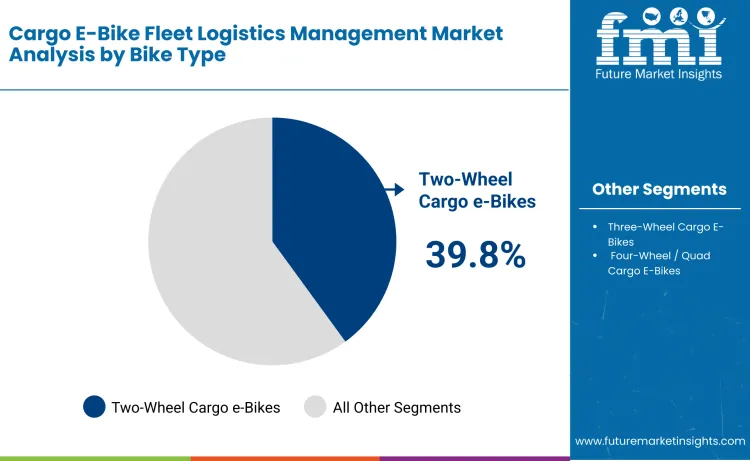
Two-wheel cargo e-bikes hold 39.8%, making them the largest bike-type segment globally. These bikes offer high maneuverability, narrow-lane accessibility, and efficient navigation in congested areas. Three-wheel cargo e-bikes support higher load stability and improved balance for medium-volume deliveries. Four-wheel or quad cargo e-bikes serve heavy-load operations requiring enhanced structural capacity and route stability. Bike-type distribution reflects operational density, payload targets, and infrastructure constraints across urban delivery routes.
Key Points:
- Two-wheel units support high maneuverability in tight spaces.
- Three-wheel models enhance balance for medium-volume loads.
- Quad units support heavy-load distribution.
- Selection aligns with payload, terrain, and delivery density.
Which Fleet Ownership Model Represents the Largest Share of Global Demand?
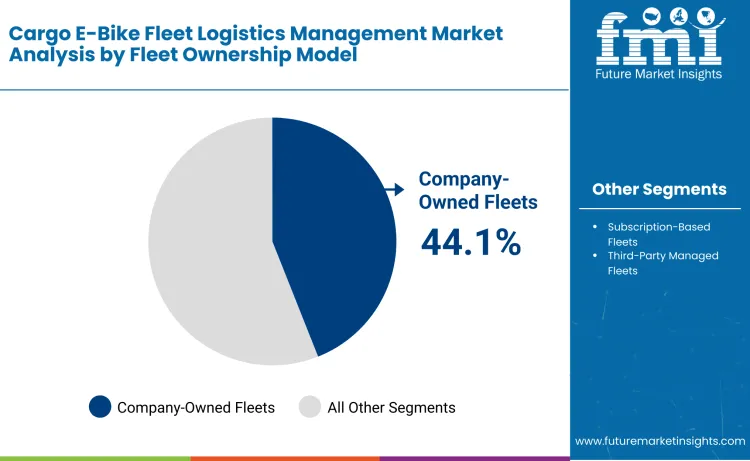
Company-owned fleets hold 44.1%, making them the leading ownership model globally. Operators maintain full control over maintenance schedules, fleet utilization, and branding consistency, which supports operational reliability. Subscription-based fleets serve businesses seeking flexible access without long-term capital commitments. Third-party managed fleets support outsourced logistics operations where external partners handle fleet operations, charging, and dispatch coordination. Ownership-model distribution reflects cost structure preferences, operational maturity, and fleet-scaling strategies.
Key Points:
- Company-owned fleets support centralized control and reliability.
- Subscription fleets offer flexible, low-commitment access.
- Third-party fleets support outsourced operational management.
- Distribution aligns with capital strategy and fleet-scaling needs.
Which Application Accounts for the Largest Share of Global Demand?
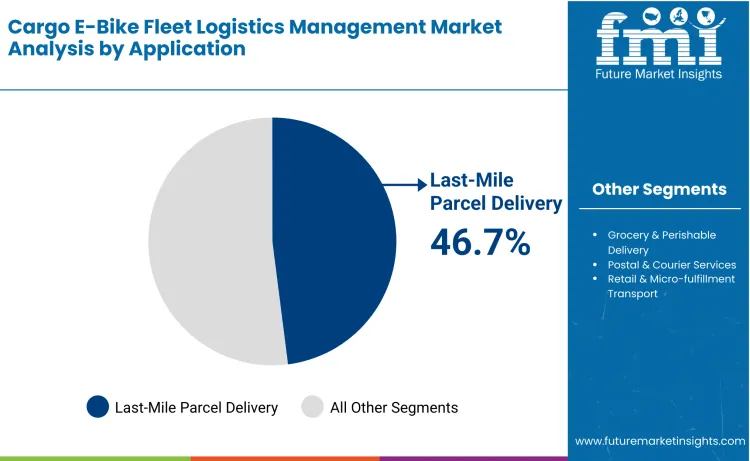
Last-mile parcel delivery holds 46.7%, making it the largest application segment in global demand. Delivery frequency, short-distance routing, and increasing parcel density drive strong adoption of cargo e-bikes for rapid urban fulfillment. Grocery and perishable delivery depends on time-sensitive transport and temperature-stable handling. Postal and courier services use e-bikes for predictable routes and consistent daily loads. Retail and micro-fulfillment transport supports store-to-customer and hub-to-store replenishment tasks. Application distribution reflects speed requirements, delivery density, and suitability of cargo e-bikes for urban logistics.
Key Points:
- Parcel delivery dominates due to high-volume last-mile workflows.
- Grocery operations rely on time-sensitive replenishment.
- Postal networks use e-bikes for predictable routing.
- Retail and micro-fulfillment depend on agile short-range transport.
What are the Key Dynamics in the Cargo E-Bike Fleet Logistics Management Market?
Global demand rises as logistics operators adopt cargo e-bikes to serve dense urban zones, expand zero emission delivery capability, and reduce congestion created by conventional vans. E-bikes support last mile distribution in areas with limited parking and narrow streets. Fleet platforms coordinate routing, charging schedules, and load allocation. Municipal sustainability initiatives reinforce interest in fleets that operate efficiently within short radius delivery corridors across commercial and residential districts.
How are urban delivery pressures and sustainability goals shaping adoption of cargo e-bike fleets?
Urban centres experience increasing parcel volumes and traffic restrictions that favour light electric vehicles capable of manoeuvring through dense areas. Logistics operators deploy cargo e-bikes for short trip deliveries where stop frequency is high and average payloads remain manageable. Retailers supporting same day fulfilment integrate e-bikes to reduce delivery times in crowded districts. Municipalities introduce low emission zones that incentivize modal shifts toward electric cargo fleets. E-commerce brands adopt microhub distribution models that align with e-bike routing. Operators value reduced energy consumption and simpler maintenance relative to traditional vans. Data platforms support fleet balancing across varying demand cycles.
How do operational costs, infrastructure gaps, and integration challenges influence scalability?
Fleet operators manage expenditure for vehicle acquisition, battery replacement, telematics, and maintenance, which affects cost structure in high volume networks. Charging availability varies across cities, limiting reliable deployment in zones lacking dedicated infrastructure. Weather conditions reduce utilization in areas experiencing heavy snowfall or prolonged rain. Integration with legacy routing systems requires software alignment and staff training. Payload limits restrict suitability for bulky goods. Storage requirements for e-bikes and spare batteries influence facility planning near service zones. Regulations regarding bike lane usage, parking, and right of way differ across municipalities, creating variability in operational predictability.
How is Demand for Cargo E-Bike Fleet Logistics Management Market Evolving Across Key Countries?
Demand for the cargo e-bike fleet logistics management market is rising due to increased interest in low-emission delivery modes, urban congestion challenges, and growth in short-range logistics activity. China records a CAGR of 17.4% supported by rapid fleet electrification and dense delivery networks. India shows a 16.3% CAGR driven by expanding e-commerce volumes and strong adoption of cost-efficient mobility solutions. USA posts a 15.2% CAGR supported by interest in sustainable last-mile systems. Japan holds a 14.1% CAGR linked with structured logistics planning and compact urban environments. UK records a 13.6% CAGR supported by clean-transport policy frameworks.
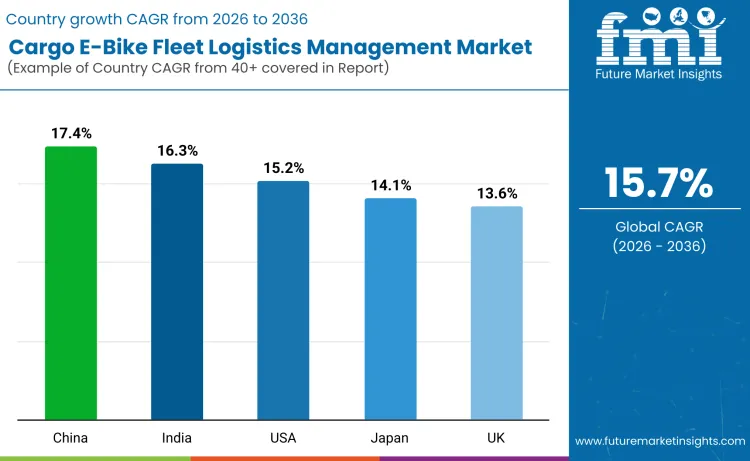
| Country | CAGR (%) |
|---|---|
| China | 17.4% |
| India | 16.3% |
| USA | 15.2% |
| Japan | 14.1% |
| UK | 13.6% |
How is China driving demand for Cargo E-Bike Fleet Logistics Management?
China drives demand due to strong electrification programs, dense courier networks, and rapid expansion of urban logistics platforms. The country’s CAGR of 17.4% reflects extensive adoption of cargo e-bike fleets across e-commerce, food-delivery, and parcel-distribution channels. Logistics operators deploy large e-bike fleets to reduce fuel costs and improve maneuverability in congested areas. Digital fleet-management systems support routing, battery monitoring, and load optimization. Municipal authorities promote low-emission delivery corridors that favor lightweight electric vehicles. High delivery density sustains continuous demand for efficient fleet-coordination tools across major cities.
- Strong urban courier and e-commerce activity
- Municipal programs supporting low-emission fleets
- Broad use of digital fleet-management platforms
- High delivery density requiring efficient routing systems
How is India driving demand for Cargo E-Bike Fleet Logistics Management?
India supports rising demand due to strong e-commerce growth, dense last-mile delivery networks, and increasing interest in cost-efficient electric mobility. The country’s CAGR of 16.3% reflects expanding use of cargo e-bikes across food-delivery, grocery, and parcel services. Logistics operators adopt e-bikes to navigate congested roads and reduce operational expenses. Digital fleet tools support battery-health monitoring, real-time routing, and vehicle-utilization tracking. Government incentives for electric mobility strengthen adoption across delivery fleets. Urban service providers incorporate e-bikes to achieve predictable short-range delivery performance.
- Growing e-commerce and food-delivery demand
- Need for cost-efficient mobility in congested cities
- Rising adoption of digital fleet-monitoring tools
- Government incentives supporting electric-fleet deployment
How is the USA driving demand for Cargo E-Bike Fleet Logistics Management?
USA drives demand through interest in sustainable last-mile logistics, broader commercial adoption of electric micro-mobility, and rising parcel volumes. The country’s CAGR of 15.2% reflects steady integration of cargo e-bikes into urban delivery networks for short-distance routes. Retailers and parcel carriers use e-bikes to reduce emissions and improve access in dense areas. Fleet-management software supports predictive maintenance, route clustering, and load-capacity planning. Municipal initiatives promote low-impact delivery modes, strengthening fleet-management adoption. Micro-fulfilment operations rely on e-bike fleets for consistent short-range distribution.
- Adoption of sustainable last-mile solutions
- Use of e-bikes in dense urban delivery zones
- Strong uptake of digital fleet-optimization software
- Municipal support for low-impact delivery modes
How is Japan driving demand for Cargo E-Bike Fleet Logistics Management?
Japan drives demand due to compact city layouts, high delivery precision requirements, and interest in low-noise, low-emission logistics systems. The country’s CAGR of 14.1% reflects growing reliance on cargo e-bike fleets for retail, parcel, and food-delivery operations. Logistics firms adopt fleet-management platforms for battery efficiency monitoring, navigational accuracy, and time-sensitive routing. Urban-mobility policies support small-format electric vehicles that reduce congestion. Retail networks utilize e-bikes for predictable local deliveries within dense commercial districts. Collaboration between logistics operators and municipal authorities supports structured deployment.
- Compact urban environments supporting e-bike logistics
- Strong emphasis on delivery precision
- Adoption of centralized fleet-management systems
- Municipal support for small-format electric delivery vehicles
How is the UK driving demand for Cargo E-Bike Fleet Logistics Management?
UK supports demand through clean-transport regulations, restricted vehicle-access zones, and rising interest in low-emission urban logistics. The country’s CAGR of 13.6% reflects steady adoption of cargo e-bike fleets for parcel, retail, and service-delivery applications. Logistics firms use digital fleet-management tools for route planning, compliance tracking, and performance assessment. Urban freight strategies encourage transition to lightweight electric vehicles to reduce congestion and emissions. Retailers integrate e-bike fleets to enhance delivery reliability within narrow urban corridors. Growth in micro-fulfilment networks reinforces the need for coordinated fleet-management systems.
- Clean-transport and congestion-reduction regulations
- Use of e-bikes in restricted urban delivery zones
- Broad adoption of digital fleet-planning tools
- Retail and logistics integration supporting reliable last-mile delivery
What is the competitive landscape of demand for cargo e-bike fleet logistics management globally?
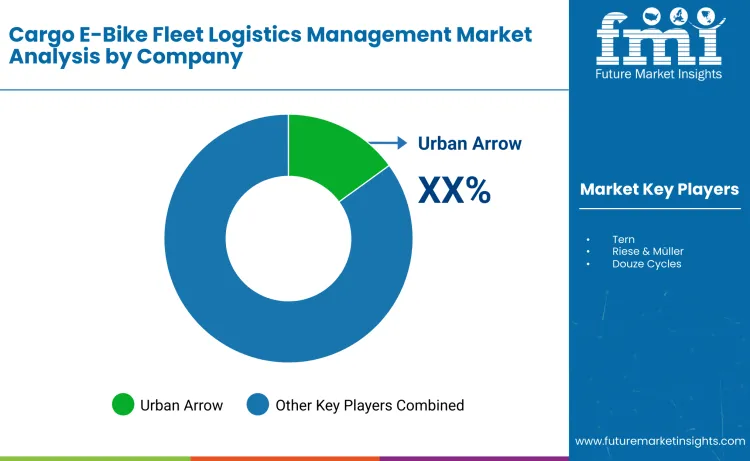
Demand for cargo e-bike fleet logistics management grows as operators adopt low-emission transport modes for parcel delivery, grocery fulfillment, and urban service operations. Requirements focus on payload stability, motor efficiency, assisted range, and telematics integration that supports fleet scheduling, route optimization, and battery management. Buyers evaluate frame durability, modular cargo configurations, braking performance, and software platforms linking rider data with dispatch centers. Procurement teams prioritize maintenance accessibility, spare-parts availability, and interoperability with broader last-mile systems. Trend in the global market reflects increased regulation of urban freight, expanded microhub deployment, and interest in replacing vans with compact electric cargo vehicles.
Urban Arrow holds an estimated 27% share. Position strengthens through purpose-built cargo frames, fleet-ready configurations, and established use across European logistics networks. Tern participates with modular long-tail and front-loader cargo e-bikes supported by commercial fleet programs and global dealer networks. Riese & Müller contributes premium cargo platforms designed for intensive daily use in dense urban environments. Douze Cycles maintains visibility with articulated front-loader systems that support large payloads and flexible configurations. Rad Power Bikes supports demand with high-volume commercial models used by delivery operators seeking cost-efficient fleet deployment. Competitive positioning globally reflects frame engineering quality, electric drivetrain performance, fleet software capability, and service network maturity supporting sustained logistics operations.
Key Players in the Cargo E-Bike Fleet Logistics Management Market
- Urban Arrow
- Tern
- Riese & Müller
- Douze Cycles
- Rad Power Bikes
Scope of the Report
| Items | Values |
|---|---|
| Quantitative Units | USD billion |
| Bike Type | Two-Wheel Cargo E-Bikes, Three-Wheel Cargo E-Bikes, Four-Wheel / Quad Cargo E-Bikes |
| Fleet Ownership Model | Company-Owned Fleets, Subscription-Based Fleets, Third-Party Managed Fleets |
| Application | Last-Mile Parcel Delivery, Grocery & Perishable Delivery, Postal & Courier Services, Retail & Micro-fulfillment Transport |
| End-User | Logistics Service Providers, Retail & E-commerce Companies, Postal Operators, Food & Grocery Delivery Firms |
| Regions Covered | Asia Pacific, Europe, North America, Latin America, Middle East & Africa |
| Countries Covered | India, China, USA, Germany, South Korea, Japan, Italy, and 40+ countries |
| Key Companies Profiled | Urban Arrow, Tern, Riese & Müller, Douze Cycles, Rad Power Bikes |
| Additional Attributes | Dollar sales by bike type, fleet ownership model, and application segments; adoption trends in dense urban logistics zones; growth driven by sustainability mandates, urban traffic restrictions, and demand for low-emission last-mile solutions; technology integration across fleet telematics, battery management, and route optimization platforms; competitive landscape of OEMs and fleet management technology providers; regulatory influences including cargo e-bike road permissions, safety standards, and micro-mobility infrastructure expansion. |
Cargo E-Bike Fleet Logistics Management Market by Segment
By Bike Type:
- Two-Wheel Cargo E-Bikes
- Three-Wheel Cargo E-Bikes
- Four-Wheel / Quad Cargo E-Bikes
By Fleet Ownership Model:
- Company-Owned Fleets
- Subscription-Based Fleets
- Third-Party Managed Fleets
By Application:
- Last-Mile Parcel Delivery
- Grocery & Perishable Delivery
- Postal & Courier Services
- Retail & Micro-fulfillment Transport
By End-User:
- Logistics Service Providers
- Retail & E-commerce Companies
- Postal Operators
- Food & Grocery Delivery Firms
Region:
- Asia Pacific
- China
- Japan
- South Korea
- India
- Australia & New Zealand
- ASEAN
- Rest of Asia Pacific
- Europe
- Germany
- United Kingdom
- France
- Italy
- Spain
- Nordic
- BENELUX
- Rest of Europe
- North America
- United States
- Canada
- Mexico
- Latin America
- Brazil
- Chile
- Rest of Latin America
- Middle East & Africa
- Kingdom of Saudi Arabia
- Other GCC Countries
- Turkey
- South Africa
- Other African Union
- Rest of Middle East & Africa
Frequently Asked Questions
What is the size of the cargo e-bike fleet logistics management market in 2026?
The market is valued at USD 3.6 billion in 2026 as operators adopt electric cargo bikes to reduce operating costs and improve urban mobility efficiency.
What will be the industry size by 2036?
Industry value will reach USD 15.4 billion by 2036 due to wider deployment of managed e-bike fleets and growth in sustainable last-mile delivery models.
What is the CAGR for 2026 to 2036?
The cargo e-bike fleet logistics management market expands at a 15.7% CAGR during the forecast period.
Which bike-type segment leads in 2026?
Two-wheel cargo e-bikes hold 39.8% share due to maneuverability advantages and suitability for narrow urban corridors.
Which fleet-ownership model segment holds the highest share?
Company-owned fleets lead with 44.1% share, supported by controlled maintenance schedules and standardized route management.
Preview the report firsthand - request a free sample
Get SampleGet the brochure for pricing and purchase details.
Get PDFTable of Content
- Executive Summary
- Market Overview
- Global Market Value, 2020 to 2026
- Global Market Forecast, 2026 to 2036
- Market Dynamics
- Drivers
- Restraints
- Opportunities
- Regulatory & Standards Landscape
- Technology & Fleet Innovation Outlook
- Market Segmentation Analysis
- By Bike Type
- Two-Wheel Cargo E-Bikes
- Three-Wheel Cargo E-Bikes
- Four-Wheel / Quad Cargo E-Bikes
- By Fleet Ownership Model
- Company-Owned Fleets
- Subscription-Based Fleets
- Third-Party Managed Fleets
- By Application
- Last-Mile Parcel Delivery
- Grocery & Perishable Delivery
- Postal & Courier Services
- Retail & Micro-fulfillment Transport
- By End-User
- Logistics Service Providers
- Retail & E-commerce Companies
- Postal Operators
- Food & Grocery Delivery Firms
- By Bike Type
- Regional Outlook
- Asia Pacific
- Europe
- North America
- Latin America
- Middle East & Africa
- Country-Level Outlook
- China
- India
- USA
- Japan
- United Kingdom
- Germany
- South Korea
- Italy
- Australia & New Zealand
- ASEAN
- Brazil
- Chile
- Turkey
- South Africa
- Other GCC Countries
- Rest of Europe
- Rest of Latin America
- Rest of Middle East & Africa
- Competitive Landscape
- Market Structure Overview
- Company Positioning
- Strategic Initiatives
- Key Player Profiles
- Scope of the Report
- Research Methodology
- Assumptions & Acronyms


