

- Industry Size (2026)
- USD 2450.0 Mn
- Forecast (2036)
- USD 3732.6 Mn
- CAGR (2026 to 2036)
- 4.3%
Woodcore Panel Market Forecast and Outlook 2026 to 2036
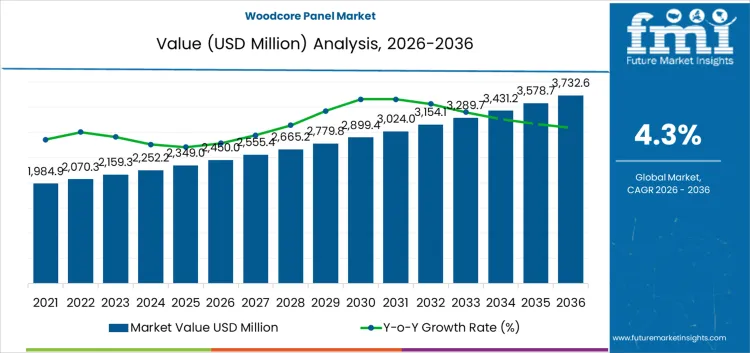
The woodcore panel market is likely to be valued at USD 2,450.0 million in 2026 and forecasted to reach USD 3,732.6 million by 2036 at a CAGR of 4.3%. Value behavior reflects its role as an intermediate material priced between commodity boards and engineered composites. Cost formation is anchored in timber input variability adhesive formulation and process yield rather than downstream pricing power. Manufacturers capture value through thickness control surface flatness and certification compliance which reduce rejection during furniture and interior fabrication. Demand stability is reinforced by repeat procurement from fabricators that standardize panel specifications across product lines and projects.
Procurement patterns favor suppliers that maintain consistent core density and moisture balance since downstream machining tolerance is narrow. Panels enter applications where replacement cycles follow refurbishment schedules not structural lifetimes which limits volume acceleration. Margins remain constrained by competition from MDF plywood and lightweight composites that substitute on price or weight. Transport cost and breakage risk influence regional sourcing decisions more than branding. Environmental compliance costs linked to emissions and chain of custody certification shape investment allocation. Scale advantages arise from batch production efficiency rather than proprietary technology which keeps the market fragmented and disciplined. This structure supports steady demand without abrupt pricing.
Scope of analysis focuses on interior-grade and access-floor-grade woodcore panels used in commercial interiors, technical floors, and modular infrastructure applications. Coverage excludes commodity furniture boards and low-spec residential panel stock where price-driven substitution dominates and system integration requirements are minimal. Competitive assessment therefore emphasizes suppliers aligned with raised floor systems, engineered interior panels, and specification-led projects where dimensional stability, load performance, and compliance govern procurement.
Quick Stats for Woodcore Panel Market
- Woodcore Panel Market Value (2026): USD 2,450.0 million
- Woodcore Panel Market Forecast Value (2036): USD 3,732.6 million
- Woodcore Panel Market Forecast CAGR 2026 to 2036: 4.3%
- Leading Core Construction by Demand Share: Particleboard Woodcore Panels
- Fastest-Growing Countries: India, China, Vietnam, Indonesia, Mexico
- Top Players in Global Demand: Tate (Kingspan), Lindner Group, MERO-TSK, Nesite, Unitile, CBI Europe, Polygroup, ASM Modular Systems, Lenzlinger
Woodcore Panel Market Key Takeaways
| Metric | Value |
|---|---|
| Market Value (2026) | USD 2,450.0 million |
| Market Forecast Value (2036) | USD 3,732.6 million |
| Forecast CAGR 2026 to 2036 | 4.3% |
Why is the Demand for Woodcore Panel Growing?
Demand for woodcore panels is growing as interior construction and furniture manufacturing require materials that balance dimensional stability, machinability, and surface compatibility. Woodcore panels provide controlled thickness, flatness, and edge performance that support wall partitions, access flooring substrates, doors, and built-in furniture across residential and commercial interiors. Specifiers favor panels with predictable bending strength, screw-holding capacity, and moisture balance because downstream tolerances in machining, lamination, and installation remain narrow. Consistent panel behavior reduces rejection rates during cutting, routing, and finishing operations, supporting production efficiency for fabricators.
Procurement decisions emphasize certification compliance, formaldehyde emission control, and traceability of wood inputs to meet regulatory and project requirements. Panels that accept laminates, veneers, and coatings without surface telegraphing or delamination enable standardized finishing systems and reduce rework risk. Contractors and installers value panels that integrate smoothly with modular construction and interior fit-out systems, shortening installation time and improving schedule reliability. Replacement demand follows refurbishment and renovation cycles rather than structural lifetimes, sustaining recurring consumption without reliance on new construction volume alone.
Growth is further supported by expansion of modular furniture, prefabricated interiors, and space-efficient design practices that prioritize lightweight panels with stable core construction. Advances in adhesive chemistry and core lay-up techniques improve resistance to moisture variation and reduce failure in kitchens, bathrooms, and conditioned commercial spaces. Coordination between designers, panel producers, and fabricators reinforces specification continuity across projects and product lines. These performance, compliance, and process-driven factors are contributing to steady demand for woodcore panels across interior construction and furniture manufacturing applications.
How Are the Segments Classified in the Woodcore Panel Market?
Demand for woodcore panels is shaped by raised flooring adoption, structural load requirements, and surface durability expectations across commercial interiors. Facilities require panels combining strength, dimensional stability, and finish compatibility with modular flooring systems. Adoption aligns with expansion of office spaces, technical rooms, and institutional infrastructure. Product selection prioritizes core density, finish resistance, and long-term performance under foot traffic and equipment loads. Segment classification reflects differentiation by core construction method, surface finish specification, and functional application setting influencing durability, aesthetics, and deployment density.
Which Core Construction Represents the Largest Share of Demand?
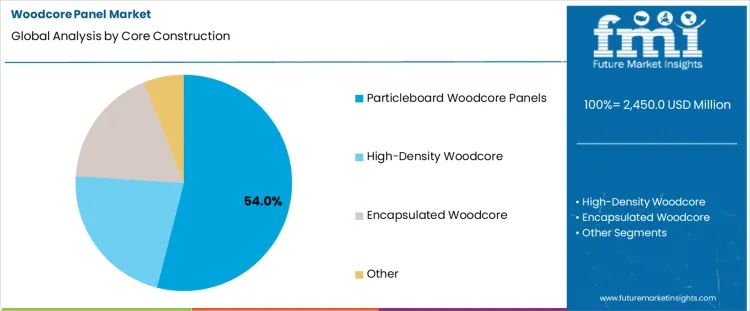
Particleboard woodcore panels hold 54.0%, representing the largest share among core construction types due to balanced strength and cost efficiency. Particleboard cores deliver uniform load distribution suitable for standard raised floor applications. Manufacturing consistency supports predictable performance and widespread availability. Weight characteristics enable easier handling during installation. High-density woodcore panels provide higher load ratings with increased material usage. Encapsulated woodcore panels offer moisture protection for controlled environments. Core construction segmentation reflects preference for reliable, economical solutions meeting common structural and installation requirements across commercial flooring deployments.
Key Points:
- Particleboard cores balance strength and cost efficiency.
- Uniform structure supports predictable load performance.
- Other constructions address higher loads or moisture protection needs.
Which Finish Type Accounts for the Highest Share of Demand?
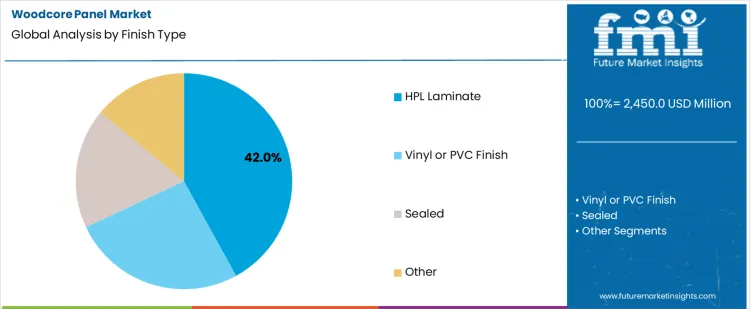
HPL laminate finishes hold 42.0%, representing the largest share among finish types due to durability and surface resistance. High-pressure laminates withstand abrasion, impact, and chemical exposure common in high-traffic environments. Surface consistency supports aesthetic uniformity across large floor areas. Ease of cleaning aligns with facility maintenance protocols. Vinyl or PVC finishes provide flexibility and acoustic benefits. Sealed finishes address environments requiring basic protection. Finish type segmentation reflects preference for robust surfaces combining durability, appearance stability, and maintenance practicality.
Key Points:
- HPL laminates provide abrasion and impact resistance.
- Consistent surfaces support large-area installations.
- Other finishes address flexibility or basic protection needs.
Which Application Drives the Largest Share of Demand?
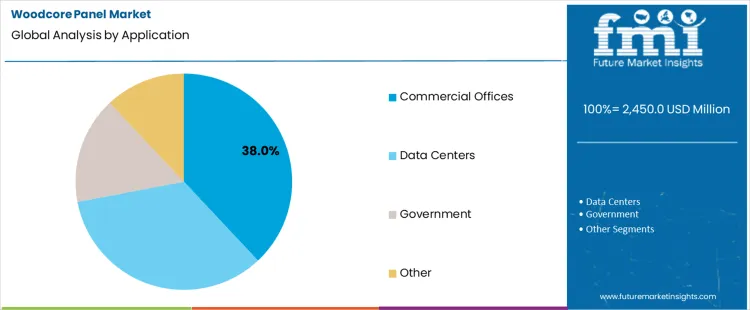
Commercial offices hold 38.0%, representing the largest share among application areas due to widespread raised floor adoption. Offices require adaptable flooring to support evolving workspace layouts and cabling needs. Foot traffic intensity necessitates durable core and surface combinations. Standardized panel sizes support modular deployment across large floor plates. Data centers apply woodcore panels for access flooring with higher load considerations. Government facilities adopt panels for standardized infrastructure projects. Application segmentation reflects concentration of demand where flexibility, durability, and scale drive consistent panel utilization.
Key Points
- Offices rely on modular flooring for layout flexibility.
- Traffic levels require durable core and finish combinations.
- Other applications apply panels under different load profiles.
What are the Key Dynamics in the Woodcore Panel Market?
Demand for woodcore panels reflects structural and functional requirements for interior partitions, doors, furniture carcasses, and architectural panels. Adoption concentrates in residential construction, commercial interiors, hospitality fit-outs, and modular furniture manufacturing. Global scope aligns with preference for lightweight panels offering dimensional stability and machinability. Usage centers on engineered panels combining wood strip cores with plywood, MDF, or veneer facings to balance strength, weight, and surface finish.
How do interior construction practices and material performance needs shape adoption?
Interior fit-out projects require panels that maintain flatness while reducing overall material weight. Demand increases where large-format doors, wall panels, and furniture components face warping risk with solid wood alternatives. Woodcore panels provide screw-holding strength along edges, supporting hinge mounting and repeated hardware installation. Furniture manufacturers value machinability for routing, edging, and lamination without excessive tool wear. Architectural applications rely on core construction to improve acoustic damping and surface rigidity. Use of real wood veneers supports aesthetic requirements in premium interiors. Adoption reflects need for predictable panel behavior under controlled indoor humidity rather than structural load-bearing performance.
How does raw material variability, cost pressure, and compliance constraints influence market scalability?
Woodcore panel production depends on consistent quality of internal wood strips, affecting panel uniformity and yield. Demand sensitivity rises where raw wood price volatility impacts cost stability. Moisture imbalance between core and facing layers increases delamination and surface telegraphing risk. Manufacturing requires tight process control, raising capital and quality assurance costs. Fire resistance and formaldehyde emission regulations increase testing and certification burden. Transport efficiency remains limited due to panel thickness and volume. Competition from lightweight honeycomb and composite panels constrains substitution scope. Custom sizing requirements reduce standardization, limiting high-volume scalability across cost-driven interior projects.
How Is Demand for Woodcore Panels Evolving Globally?
Demand for woodcore panels is expanding globally due to furniture manufacturing growth, interior fit-out activity, and preference for lightweight yet stable panel solutions. Adoption aligns with residential cabinetry, modular furniture, doors, and partitions where dimensional stability and surface finish consistency are required. Manufacturers value machinability, screw-holding strength, and compatibility with laminates and veneers. Replacement demand emerges from renovation cycles and export-oriented production. Growth rates in India at 6.6%, China at 6.2%, Vietnam at 5.8%, Indonesia at 5.5%, and Mexico at 5.1% indicate sustained expansion driven by furniture output intensity, interior refurbishment, and lifecycle replacement.
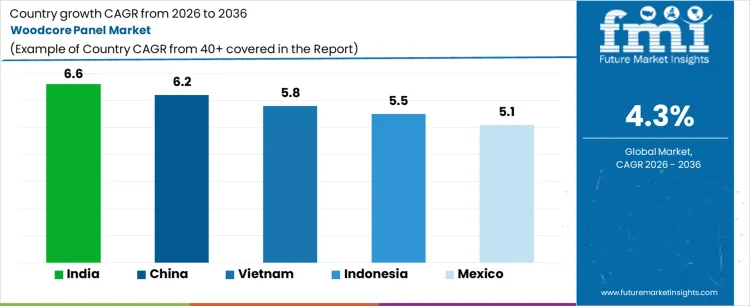
| Country | CAGR (%) |
|---|---|
| India | 6.6% |
| China | 6.2% |
| Vietnam | 5.8% |
| Indonesia | 5.5% |
| Mexico | 5.1% |
What Is Driving Strong Growth of Woodcore Panel Demand in India?
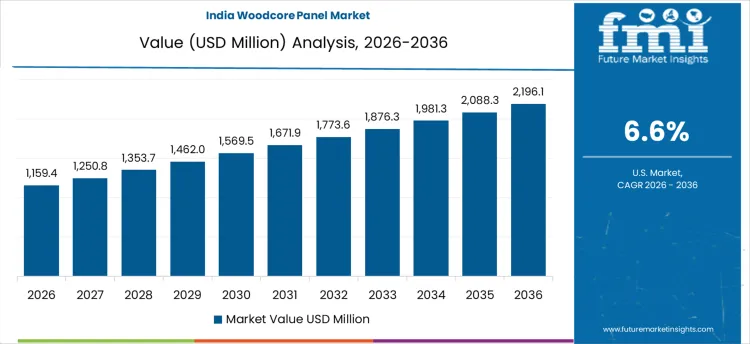
India is growing at a CAGR of 6.6%, supported by expansion of organized furniture manufacturing and interior fit-out projects. Residential construction and commercial refurbishment increase use of core panels for cabinets and partitions. Modular kitchen and wardrobe adoption raises preference for lightweight panels with consistent thickness. Local manufacturers improve bonding quality and surface compatibility with laminates. Export-oriented furniture production adds incremental volume. Demand growth reflects furniture sector formalization and renovation activity rather than structural construction substitution.
- Growth of modular furniture and cabinetry
- Residential and commercial interior refurbishment
- Lightweight panel preference for installation ease
- Export-oriented furniture manufacturing activity
Why Is China Sustaining Expansion in Woodcore Panel Demand?
Woodcore panel demand in China is expanding at a CAGR of 6.2%, driven by large-scale furniture manufacturing and interior component production. High output of ready-to-assemble furniture sustains steady panel consumption. Manufacturers value woodcore panels for machinability and surface uniformity. Domestic supply chains support consistent quality and volume. Replacement demand arises from renovation of residential interiors. Demand growth reflects manufacturing scale and interior consumption rather than shifts toward alternative structural materials.
- Large-scale ready-to-assemble furniture production
- Preference for machinable and uniform core panels
- Strong domestic panel manufacturing capacity
- Renovation-driven interior replacement demand
How Is Vietnam Influencing Growth of Woodcore Panel Adoption?
Woodcore panel demand in Vietnam is growing at a CAGR of 5.8%, shaped by expansion of export-oriented furniture manufacturing. Facilities serving North American and European buyers specify panels meeting dimensional and finish standards. Lightweight panels support efficient shipping and assembly. Local processing capacity improves consistency and cost control. Growth of industrial furniture parks sustains steady demand. Demand growth reflects export manufacturing alignment and capacity build-out rather than domestic housing volume expansion.
- Export-focused furniture manufacturing growth
- Compliance with international panel quality standards
- Lightweight panels supporting logistics efficiency
- Expansion of industrial furniture production zones
What Factors Are Supporting Woodcore Panel Demand in Indonesia?
Indonesia is expanding at a CAGR of 5.5%, influenced by domestic furniture consumption and wood processing activity. Residential interior upgrades increase use of panels in cabinets and doors. Availability of timber resources supports local panel production. Manufacturers emphasize cost-effective panels with acceptable dimensional stability. Small and mid-sized furniture workshops contribute steady demand. Growth reflects domestic consumption patterns and localized manufacturing rather than large-scale export acceleration.
- Residential interior upgrade activity
- Local timber availability supporting panel production
- Cost-efficient solutions for small manufacturers
- Stable demand from domestic furniture workshops
Why Is Mexico Experiencing Measured Growth in Woodcore Panel Demand?
Woodcore panel demand in Mexico is growing at a CAGR of 5.1%, supported by furniture production linked to regional supply chains. Manufacturers serving North American markets specify panels compatible with standardized designs. Modular furniture and interior components sustain consistent usage. Renovation activity contributes replacement demand. Supplier integration supports predictable procurement cycles. Growth remains measured, reflecting steady manufacturing output and refurbishment rather than rapid expansion of furniture capacity.
- Furniture manufacturing for regional supply chains
- Standardized panel specifications for export markets
- Renovation-driven replacement demand
- Predictable procurement from integrated suppliers
What is the competitive landscape of demand for the woodcore panel market globally?
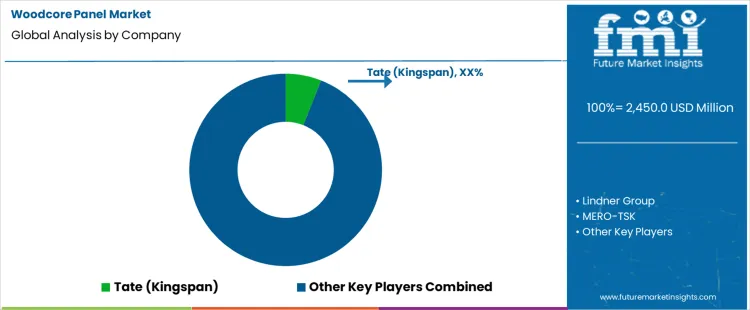
Demand for woodcore panels is driven by growth in construction, architectural interiors, furniture production, and sustainable building practices emphasizing renewable materials and structural performance. Woodcore panels are used for flooring, wall cladding, partitions, and decorative applications where strength, aesthetic appeal, and ecological credentials are prioritized. Buyers evaluate core material quality, surface finish options, load-bearing capacity, moisture tolerance, formaldehyde emissions, and compliance with building codes and sustainability certifications. Procurement teams prioritize suppliers with verified material sourcing, consistent production quality, compliance with regional safety and environmental standards, and ability to support design customization and scalability. Trend in the global market reflects increased adoption of engineered wood products, green building certifications, and demand for high-performance, low-emission panel solutions.
Tate (Kingspan) holds leading positioning through engineered woodcore and structural panel systems used in building envelopes and interior applications supported by extensive specification and technical support networks. Lindner Group supports demand with architectural and engineered panel solutions combining woodcore substrates with performance-oriented facings for commercial interiors. MERO-TSK participates with modular panel systems and engineered building components integrating woodcore materials. Nesite supplies advanced flooring and cladding panel products that leverage woodcore substrates for aesthetic and performance balance. Polygroup contributes woodcore and composite panel offerings utilized in furniture, interiors, and architectural applications with global distribution. Competitive differentiation depends on panel structural performance, sustainability credentials, surface finish versatility, regulatory readiness, and ability to meet diverse project specification requirements.
Key Players in the Woodcore Panel Market
- Tate (Kingspan)
- Lindner Group
- MERO-TSK
- Nesite
- Unitile
- CBI Europe
- Polygroup
- ASM Modular Systems
- Lenzlinger
- Regional Producers
Scope of the Report
| Items | Values |
|---|---|
| Quantitative Units | USD million |
| Core Construction | Particleboard Woodcore Panels; High-Density Woodcore; Encapsulated Woodcore; Other |
| Finish Type | HPL Laminate; Vinyl or PVC Finish; Sealed; Other |
| Application | Commercial Offices; Data Centers; Government; Other |
| Sales Channel | Flooring Contractors; EPC or Project Direct; Distributors; Other |
| Regions Covered | Asia Pacific, Europe, North America, Latin America, Middle East & Africa |
| Countries Covered | India, China, Vietnam, Indonesia, Mexico, and 40+ countries |
| Key Companies Profiled | Tate (Kingspan); Lindner Group; MERO-TSK; Nesite; Unitile; CBI Europe; Polygroup; ASM Modular Systems; Lenzlinger; Regional Producers |
| Additional Attributes | Dollar sales by core construction, finish type, and application; load-bearing performance metrics for particleboard and high-density woodcore panels; moisture resistance, edge sealing, and fire-performance characteristics influencing specification in data centers and government facilities; compatibility with raised floor pedestals and stringer systems; lifecycle durability and refurbishment considerations; procurement trends favoring EPC-led sourcing for large projects and distributor-led supply for commercial retrofits. |
Woodcore Panel Market by Segment
Core Construction:
- Particleboard Woodcore Panels
- High-Density Woodcore
- Encapsulated Woodcore
- Other
Finish Type:
- HPL Laminate
- Vinyl or PVC Finish
- Sealed
- Other
Application:
- Commercial Offices
- Data Centers
- Government
- Other
Sales Channel:
- Flooring Contractors
- EPC or Project Direct
- Distributors
- Other
Region:
- Asia Pacific
- China
- Japan
- South Korea
- India
- Australia & New Zealand
- ASEAN
- Rest of Asia Pacific
- Europe
- Germany
- United Kingdom
- France
- Italy
- Spain
- Nordic
- BENELUX
- Rest of Europe
- North America
- United States
- Canada
- Mexico
- Latin America
- Brazil
- Chile
- Rest of Latin America
- Middle East & Africa
- Kingdom of Saudi Arabia
- Other GCC Countries
- Turkey
- South Africa
- Other African Union
- Rest of Middle East & Africa
Bibliography
- European Committee for Standardization. (2023). EN 12825: Raised access floors-Performance requirements and test methods, reaffirmed applicability to woodcore panels used in access flooring systems. CEN.
- International Organization for Standardization. (2023). ISO 16893: Buildings and civil engineering works-Sustainability in buildings-Environmental performance of building materials, updated guidance applicable to engineered wood panels. International Organization for Standardization.
- International Organization for Standardization. (2024). ISO 12460 series: Wood-based panels-Determination of formaldehyde release, current editions applied under staged regulatory enforcement. International Organization for Standardization.
- European Committee for Standardization. (2023). EN 13986: Wood-based panels for use in construction-Characteristics, evaluation of conformity, and CE marking, amended applicability to engineered woodcore panels. CEN.
- American Society for Testing and Materials. (2024). ASTM E84 and ASTM D1037: Fire performance and physical property evaluation of wood-based panels, current revisions applied to interior construction materials. ASTM International.
Frequently Asked Questions
How big is the woodcore panel market in 2026?
The global woodcore panel market is estimated to be valued at USD 2,450.0 million in 2026.
What will be the size of woodcore panel market in 2036?
The market size for the woodcore panel market is projected to reach USD 3,732.6 million by 2036.
How much will be the woodcore panel market growth between 2026 and 2036?
The woodcore panel market is expected to grow at a 4.3% CAGR between 2026 and 2036.
What are the key product types in the woodcore panel market?
The key product types in woodcore panel market are particleboard woodcore panels, high-density woodcore, encapsulated woodcore and other.
Which finish type segment to contribute significant share in the woodcore panel market in 2026?
In terms of finish type, hpl laminate segment to command 42.0% share in the woodcore panel market in 2026.
Preview the report firsthand - request a free sample
Get SampleGet the brochure for pricing and purchase details.
Get PDFTable of Content
- Executive Summary
- Global Market Outlook
- Demand-side Trends
- Supply-side Trends
- Technology Roadmap Analysis
- Analysis and Recommendations
- Market Overview
- Market Coverage / Taxonomy
- Market Definition / Scope / Limitations
- Market Background
- Market Dynamics
- Drivers
- Restraints
- Opportunity
- Trends
- Scenario Forecast
- Demand in Optimistic Scenario
- Demand in Likely Scenario
- Demand in Conservative Scenario
- Opportunity Map Analysis
- Product Life Cycle Analysis
- Supply Chain Analysis
- Investment Feasibility Matrix
- Value Chain Analysis
- PESTLE and Porter’s Analysis
- Regulatory Landscape
- Regional Parent Market Outlook
- Production and Consumption Statistics
- Import and Export Statistics
- Market Dynamics
- Global Market Analysis 2021 to 2025 and Forecast, 2026 to 2036
- Historical Market Size Value (USD Million) Analysis, 2021 to 2025
- Current and Future Market Size Value (USD Million) Projections, 2026 to 2036
- Y-o-Y Growth Trend Analysis
- Absolute $ Opportunity Analysis
- Global Market Pricing Analysis 2021 to 2025 and Forecast 2026 to 2036
- Global Market Analysis 2021 to 2025 and Forecast 2026 to 2036, By Core Construction
- Introduction / Key Findings
- Historical Market Size Value (USD Million) Analysis By Core Construction , 2021 to 2025
- Current and Future Market Size Value (USD Million) Analysis and Forecast By Core Construction , 2026 to 2036
- Particleboard Woodcore Panels
- High-Density Woodcore
- Encapsulated Woodcore
- Other
- Particleboard Woodcore Panels
- Y-o-Y Growth Trend Analysis By Core Construction , 2021 to 2025
- Absolute $ Opportunity Analysis By Core Construction , 2026 to 2036
- Global Market Analysis 2021 to 2025 and Forecast 2026 to 2036, By Finish Type
- Introduction / Key Findings
- Historical Market Size Value (USD Million) Analysis By Finish Type, 2021 to 2025
- Current and Future Market Size Value (USD Million) Analysis and Forecast By Finish Type, 2026 to 2036
- HPL Laminate
- Vinyl or PVC Finish
- Sealed
- Other
- HPL Laminate
- Y-o-Y Growth Trend Analysis By Finish Type, 2021 to 2025
- Absolute $ Opportunity Analysis By Finish Type, 2026 to 2036
- Global Market Analysis 2021 to 2025 and Forecast 2026 to 2036, By Application
- Introduction / Key Findings
- Historical Market Size Value (USD Million) Analysis By Application, 2021 to 2025
- Current and Future Market Size Value (USD Million) Analysis and Forecast By Application, 2026 to 2036
- Commercial Offices
- Data Centers
- Government
- Other
- Commercial Offices
- Y-o-Y Growth Trend Analysis By Application, 2021 to 2025
- Absolute $ Opportunity Analysis By Application, 2026 to 2036
- Global Market Analysis 2021 to 2025 and Forecast 2026 to 2036, By Sales Channel
- Introduction / Key Findings
- Historical Market Size Value (USD Million) Analysis By Sales Channel, 2021 to 2025
- Current and Future Market Size Value (USD Million) Analysis and Forecast By Sales Channel, 2026 to 2036
- Flooring Contractors
- EPC or Project Direct
- Distributors
- Other
- Flooring Contractors
- Y-o-Y Growth Trend Analysis By Sales Channel, 2021 to 2025
- Absolute $ Opportunity Analysis By Sales Channel, 2026 to 2036
- Global Market Analysis 2021 to 2025 and Forecast 2026 to 2036, By Region
- Introduction
- Historical Market Size Value (USD Million) Analysis By Region, 2021 to 2025
- Current Market Size Value (USD Million) Analysis and Forecast By Region, 2026 to 2036
- North America
- Latin America
- Western Europe
- Eastern Europe
- East Asia
- South Asia and Pacific
- Middle East & Africa
- Market Attractiveness Analysis By Region
- North America Market Analysis 2021 to 2025 and Forecast 2026 to 2036, By Country
- Historical Market Size Value (USD Million) Trend Analysis By Market Taxonomy, 2021 to 2025
- Market Size Value (USD Million) Forecast By Market Taxonomy, 2026 to 2036
- By Country
- USA
- Canada
- Mexico
- By Core Construction
- By Finish Type
- By Application
- By Sales Channel
- By Country
- Market Attractiveness Analysis
- By Country
- By Core Construction
- By Finish Type
- By Application
- By Sales Channel
- Key Takeaways
- Latin America Market Analysis 2021 to 2025 and Forecast 2026 to 2036, By Country
- Historical Market Size Value (USD Million) Trend Analysis By Market Taxonomy, 2021 to 2025
- Market Size Value (USD Million) Forecast By Market Taxonomy, 2026 to 2036
- By Country
- Brazil
- Chile
- Rest of Latin America
- By Core Construction
- By Finish Type
- By Application
- By Sales Channel
- By Country
- Market Attractiveness Analysis
- By Country
- By Core Construction
- By Finish Type
- By Application
- By Sales Channel
- Key Takeaways
- Western Europe Market Analysis 2021 to 2025 and Forecast 2026 to 2036, By Country
- Historical Market Size Value (USD Million) Trend Analysis By Market Taxonomy, 2021 to 2025
- Market Size Value (USD Million) Forecast By Market Taxonomy, 2026 to 2036
- By Country
- Germany
- UK
- Italy
- Spain
- France
- Nordic
- BENELUX
- Rest of Western Europe
- By Core Construction
- By Finish Type
- By Application
- By Sales Channel
- By Country
- Market Attractiveness Analysis
- By Country
- By Core Construction
- By Finish Type
- By Application
- By Sales Channel
- Key Takeaways
- Eastern Europe Market Analysis 2021 to 2025 and Forecast 2026 to 2036, By Country
- Historical Market Size Value (USD Million) Trend Analysis By Market Taxonomy, 2021 to 2025
- Market Size Value (USD Million) Forecast By Market Taxonomy, 2026 to 2036
- By Country
- Russia
- Poland
- Hungary
- Balkan & Baltic
- Rest of Eastern Europe
- By Core Construction
- By Finish Type
- By Application
- By Sales Channel
- By Country
- Market Attractiveness Analysis
- By Country
- By Core Construction
- By Finish Type
- By Application
- By Sales Channel
- Key Takeaways
- East Asia Market Analysis 2021 to 2025 and Forecast 2026 to 2036, By Country
- Historical Market Size Value (USD Million) Trend Analysis By Market Taxonomy, 2021 to 2025
- Market Size Value (USD Million) Forecast By Market Taxonomy, 2026 to 2036
- By Country
- China
- Japan
- South Korea
- By Core Construction
- By Finish Type
- By Application
- By Sales Channel
- By Country
- Market Attractiveness Analysis
- By Country
- By Core Construction
- By Finish Type
- By Application
- By Sales Channel
- Key Takeaways
- South Asia and Pacific Market Analysis 2021 to 2025 and Forecast 2026 to 2036, By Country
- Historical Market Size Value (USD Million) Trend Analysis By Market Taxonomy, 2021 to 2025
- Market Size Value (USD Million) Forecast By Market Taxonomy, 2026 to 2036
- By Country
- India
- ASEAN
- Australia & New Zealand
- Rest of South Asia and Pacific
- By Core Construction
- By Finish Type
- By Application
- By Sales Channel
- By Country
- Market Attractiveness Analysis
- By Country
- By Core Construction
- By Finish Type
- By Application
- By Sales Channel
- Key Takeaways
- Middle East & Africa Market Analysis 2021 to 2025 and Forecast 2026 to 2036, By Country
- Historical Market Size Value (USD Million) Trend Analysis By Market Taxonomy, 2021 to 2025
- Market Size Value (USD Million) Forecast By Market Taxonomy, 2026 to 2036
- By Country
- Kingdom of Saudi Arabia
- Other GCC Countries
- Turkiye
- South Africa
- Other African Union
- Rest of Middle East & Africa
- By Core Construction
- By Finish Type
- By Application
- By Sales Channel
- By Country
- Market Attractiveness Analysis
- By Country
- By Core Construction
- By Finish Type
- By Application
- By Sales Channel
- Key Takeaways
- Key Countries Market Analysis
- USA
- Pricing Analysis
- Market Share Analysis, 2025
- By Core Construction
- By Finish Type
- By Application
- By Sales Channel
- Canada
- Pricing Analysis
- Market Share Analysis, 2025
- By Core Construction
- By Finish Type
- By Application
- By Sales Channel
- Mexico
- Pricing Analysis
- Market Share Analysis, 2025
- By Core Construction
- By Finish Type
- By Application
- By Sales Channel
- Brazil
- Pricing Analysis
- Market Share Analysis, 2025
- By Core Construction
- By Finish Type
- By Application
- By Sales Channel
- Chile
- Pricing Analysis
- Market Share Analysis, 2025
- By Core Construction
- By Finish Type
- By Application
- By Sales Channel
- Germany
- Pricing Analysis
- Market Share Analysis, 2025
- By Core Construction
- By Finish Type
- By Application
- By Sales Channel
- UK
- Pricing Analysis
- Market Share Analysis, 2025
- By Core Construction
- By Finish Type
- By Application
- By Sales Channel
- Italy
- Pricing Analysis
- Market Share Analysis, 2025
- By Core Construction
- By Finish Type
- By Application
- By Sales Channel
- Spain
- Pricing Analysis
- Market Share Analysis, 2025
- By Core Construction
- By Finish Type
- By Application
- By Sales Channel
- France
- Pricing Analysis
- Market Share Analysis, 2025
- By Core Construction
- By Finish Type
- By Application
- By Sales Channel
- India
- Pricing Analysis
- Market Share Analysis, 2025
- By Core Construction
- By Finish Type
- By Application
- By Sales Channel
- ASEAN
- Pricing Analysis
- Market Share Analysis, 2025
- By Core Construction
- By Finish Type
- By Application
- By Sales Channel
- Australia & New Zealand
- Pricing Analysis
- Market Share Analysis, 2025
- By Core Construction
- By Finish Type
- By Application
- By Sales Channel
- China
- Pricing Analysis
- Market Share Analysis, 2025
- By Core Construction
- By Finish Type
- By Application
- By Sales Channel
- Japan
- Pricing Analysis
- Market Share Analysis, 2025
- By Core Construction
- By Finish Type
- By Application
- By Sales Channel
- South Korea
- Pricing Analysis
- Market Share Analysis, 2025
- By Core Construction
- By Finish Type
- By Application
- By Sales Channel
- Russia
- Pricing Analysis
- Market Share Analysis, 2025
- By Core Construction
- By Finish Type
- By Application
- By Sales Channel
- Poland
- Pricing Analysis
- Market Share Analysis, 2025
- By Core Construction
- By Finish Type
- By Application
- By Sales Channel
- Hungary
- Pricing Analysis
- Market Share Analysis, 2025
- By Core Construction
- By Finish Type
- By Application
- By Sales Channel
- Kingdom of Saudi Arabia
- Pricing Analysis
- Market Share Analysis, 2025
- By Core Construction
- By Finish Type
- By Application
- By Sales Channel
- Turkiye
- Pricing Analysis
- Market Share Analysis, 2025
- By Core Construction
- By Finish Type
- By Application
- By Sales Channel
- South Africa
- Pricing Analysis
- Market Share Analysis, 2025
- By Core Construction
- By Finish Type
- By Application
- By Sales Channel
- USA
- Market Structure Analysis
- Competition Dashboard
- Competition Benchmarking
- Market Share Analysis of Top Players
- By Regional
- By Core Construction
- By Finish Type
- By Application
- By Sales Channel
- Competition Analysis
- Competition Deep Dive
- Tate (Kingspan)
- Overview
- Product Portfolio
- Profitability by Market Segments (Product/Age /Sales Channel/Region)
- Sales Footprint
- Strategy Overview
- Marketing Strategy
- Product Strategy
- Channel Strategy
- Lindner Group
- MERO-TSK
- Nesite
- Value (USD Million)ile
- CBI Europe
- Polygroup
- ASM Modular Systems
- Lenzlinger
- Regional Producers
- Tate (Kingspan)
- Competition Deep Dive
- Assumptions & Acronyms Used
- Research Methodology


