

- Industry Size (2026)
- USD 620.0 Mn
- Forecast (2036)
- USD 1069.0 Mn
- CAGR (2026 to 2036)
- 5.6%
Acoustic Louver Panels Market Forecast and Outlook 2026 to 2036
The acoustic louver panels market is forecasted to expand from USD 620.0 million in 2026 to USD 1,069.0 million by 2036, reflecting a CAGR of 5.6%. Revenue growth is anchored in functional requirements rather than volume-driven construction activity. Acoustic louvers sit at the intersection of ventilation engineering and environmental noise control, making them essential in buildings where mechanical systems operate close to occupied areas. Demand is strongest in data centers, hospitals, airports, and commercial towers, where uninterrupted airflow is non-negotiable and noise limits are tightly enforced. Purchasing decisions are influenced by insertion loss data, pressure drop implications, and long-term exposure to weather rather than aesthetic considerations. Aluminum dominates specifications because it allows large façade openings without excessive structural reinforcement, while still accommodating acoustic infill and corrosion protection.
Quick Stats for Acoustic Louver Panels Market
- Acoustic Louver Panels Market Value (2026): USD 620.0 million
- Acoustic Louver Panels Market Forecast Value (2036): USD 1,069.0 million
- Acoustic Louver Panels Market Forecast CAGR 2026 to 2036: 5.6%
- Leading Louver Type by Demand Share: Acoustic Intake Louvers
- Fastest-Growing Countries: India, Saudi Arabia, UAE, Vietnam, Indonesia
- Top Players in Global Demand: Greenheck, TROX, Systemair, FläktGroup, Johnson Controls (Ruskin)
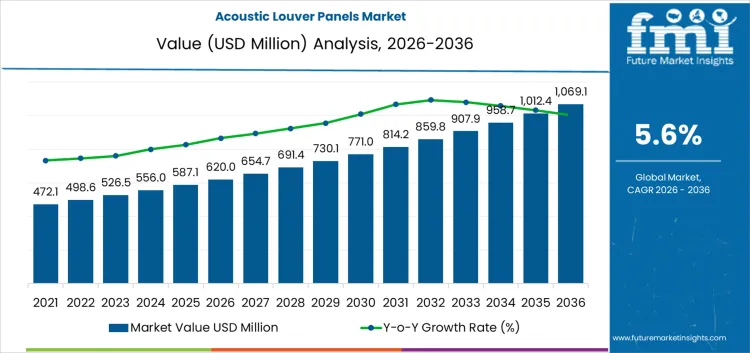
Growth dynamics remain uneven across end-use environments, shaped by regulatory scrutiny and system density rather than simple construction expansion. Projects with high equipment loads generate recurring demand for custom-engineered louver solutions, limiting standardization and encouraging early-stage coordination with mechanical consultants. Retrofit installations contribute steady volume as older ventilation openings fail updated noise criteria or attract complaints from adjacent occupancies. Cost sensitivity emerges where pressure drop penalties increase energy consumption, forcing trade-offs between acoustic performance and operating efficiency. Suppliers with validated test data and project-specific engineering support secure higher-value contracts. Market expansion reflects rising complexity in building services design and stricter noise accountability, not broad-based adoption across all ventilation applications.
Acoustic Louver Panels Market Key Takeaways
| Metric | Value |
|---|---|
| Market Value (2026) | USD 620.0 million |
| Market Forecast Value (2036) | USD 1,069.0 million |
| Forecast CAGR 2026 to 2036 | 5.6% |
Why is the Demand for Acoustic Louver Panels Growing?
Demand for acoustic louver panels is rising as building designers and facility engineers prioritize solutions that combine effective sound control with ventilation requirements in commercial, industrial, and institutional structures. Acoustic louvers are specified in applications where mechanical noise from HVAC equipment, generators, and exhaust systems must be mitigated while maintaining required airflow for environmental control and equipment performance. Engineers evaluate panels for insertion loss performance, airflow resistance, and structural durability because balanced acoustic attenuation and ventilation capacity directly influence indoor environmental quality and operational reliability.
Procurement teams assess material longevity, corrosion resistance, and compatibility with façade systems to ensure panels withstand exposure to weather and mechanical loading without compromising acoustic function. Growth in data centers, manufacturing facilities, and large institutional campuses reinforces need for acoustic louver panels that support noise reduction in perimeter walls, rooftop enclosures, and mechanical penthouses without blocking necessary air movement.
Expansion of urban construction and stringent building code requirements for interior sound levels reinforces uptake of acoustic louvers in projects where proximity to mechanical equipment and occupied spaces demands targeted noise control. Facility planners integrate acoustic louver panels with ducting, louvers, and barrier systems to maintain coordinated environmental performance while minimizing sound transmission into offices, meeting rooms, and patient care areas. Advances in panel design, including optimized baffle geometry and acoustic media selection, improve mid-to-high frequency attenuation while preserving pressure drop targets for ventilation systems. Installation contractors and architects specify panels that align with aesthetic and functional criteria, which streamlines coordination across mechanical, structural, and architectural trade scopes. These application-specific performance and integration considerations are contributing to sustained growth in the acoustic louver panels market.
How Are the Segments Classified in the Acoustic Louver Panels Market?
Demand for acoustic louver panels is shaped by ventilation noise control requirements, airflow management needs, and building compliance expectations. Facilities require solutions that attenuate sound while maintaining adequate air intake and exhaust performance. Adoption aligns with expansion of HVAC installations, industrial ventilation upgrades, and noise-sensitive infrastructure development. Product selection prioritizes insertion loss performance, weather resistance, and structural durability. Segment classification reflects differentiation by louver functional role, application environment, and material selection influencing acoustic effectiveness, installation scale, and long-term operational reliability.
Which Louver Type Represents the Largest Share of Demand?
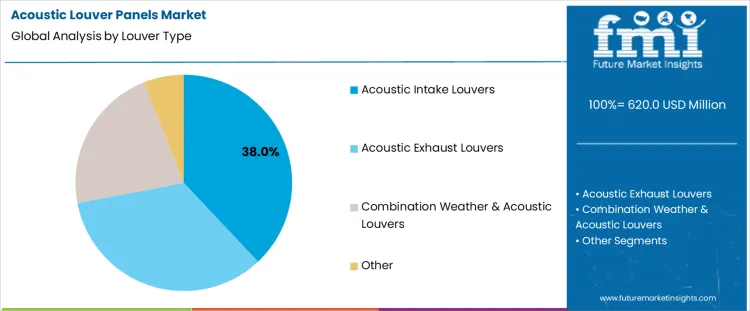
Acoustic intake louvers hold 38.0%, representing the largest share among louver types due to continuous air supply requirements. Intake points require effective noise attenuation to prevent external sound intrusion into occupied spaces. Design configurations balance airflow capacity with internal baffle arrangements for sound reduction. Placement at building facades increases specification frequency across projects. Acoustic exhaust louvers manage equipment discharge noise with comparable importance and slightly lower penetration. Combination weather and acoustic louvers address dual performance needs with higher design complexity. Louver type segmentation reflects emphasis on intake noise control where occupant comfort and regulatory thresholds drive specification decisions.
Key Points
- Intake louvers control external noise entering buildings.
- Continuous airflow needs increase installation frequency.
- Other types address exhaust noise or combined weather protection.
Which Application Accounts for the Highest Share of Demand?
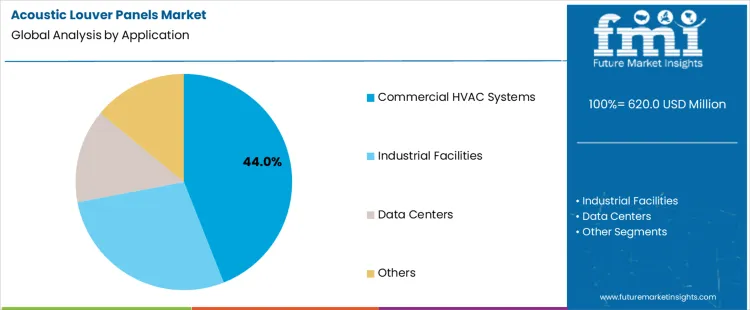
Commercial HVAC systems hold 44.0%, representing the largest share among application areas due to widespread ventilation requirements. Office buildings, retail spaces, and institutional facilities require acoustic control at air handling interfaces. Noise limits support occupant comfort and regulatory adherence. Centralized HVAC layouts increase reliance on acoustically treated louvers. Industrial facilities apply louvers for equipment ventilation with higher sound power levels. Data centers require controlled airflow with localized acoustic treatment. Application segmentation reflects concentration where building occupancy and comfort standards necessitate consistent noise-managed ventilation solutions.
Key Points
- Commercial HVAC installations prioritize occupant comfort.
- Centralized systems increase acoustic louver deployment.
- Other applications manage equipment or infrastructure noise.
Which Material Accounts for the Highest Share of Demand?
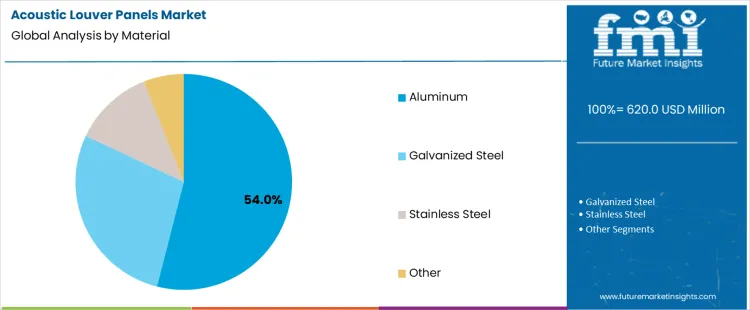
Aluminum holds 54.0%, representing the largest share among materials due to lightweight and corrosion resistance. Aluminum louvers support large façade installations without excessive structural load. Formability enables precise blade geometry supporting acoustic lining integration. Surface treatments enhance durability under outdoor exposure. Galvanized steel offers strength with added weight considerations. Stainless steel provides corrosion resistance for harsh environments with higher cost. Material segmentation reflects preference for lightweight metals balancing structural performance, acoustic integration, and long-term exterior durability.
Key Points
- Aluminum reduces structural load for façade installations.
- Formability supports acoustic blade design precision.
- Other materials address strength or severe environment needs.
What are the Key Dynamics in the Acoustic Louver Panels Market?
Demand for acoustic louver panels reflects requirement to attenuate noise while maintaining airflow through building and industrial openings. Adoption concentrates in data centers, power plants, HVAC plant rooms, industrial facilities, and commercial buildings with ventilation constraints. Global scope aligns with environmental noise compliance and equipment cooling needs. Usage centers on engineered louvers combining airflow paths with absorptive or dissipative acoustic treatments to limit sound transmission.
How do ventilation performance and noise compliance requirements shape adoption?
Facilities housing noisy equipment require continuous airflow for cooling and combustion while meeting external noise limits. Demand increases where conventional silencers restrict airflow or add excessive pressure drop. Acoustic louver panels enable intake and exhaust openings to meet sound level targets without compromising ventilation rates. Data centers rely on louvers to control fan and generator noise while preserving thermal performance. Industrial plants adopt panels to mitigate machinery noise at façade penetrations and roof openings. Design selection depends on insertion loss across specific frequency bands relevant to equipment spectra. Integration with weather protection and bird screening supports operational continuity. Adoption reflects need to balance airflow capacity with verifiable noise reduction at boundary points.
How do pressure drop constraints, site specificity, and cost pressure influence market scalability?
Acoustic performance trades off against airflow resistance, increasing engineering complexity for high-volume ventilation systems. Demand sensitivity rises where added pressure drop increases fan energy consumption or requires equipment resizing. Site-specific noise targets and opening geometries limit standardization across projects. Outdoor exposure requires corrosion-resistant materials and drainage design, elevating cost. Installation accuracy affects measured performance, increasing reliance on skilled contractors. Verification testing adds project expense and schedule impact. Large panel sizes complicate handling and retrofits. Project-based procurement and customized acoustic tuning constrain scalable, repeatable deployment across cost-driven building programs.
How Is Demand for Acoustic Louver Panels Evolving Globally?
Demand for acoustic louver panels is expanding globally due to noise attenuation requirements for ventilation openings across industrial and commercial buildings. Mechanical rooms, generator enclosures, HVAC plant areas, and infrastructure assets require airflow while meeting permissible noise limits. Urban density and proximity to occupied zones elevate specification of acoustically rated louvers. Retrofit activity rises where legacy ventilation fails updated noise criteria. Growth rates in the global market indicate steady expansion driven by compliance-led building design, infrastructure development, and operational noise control rather than aesthetic façade upgrades.
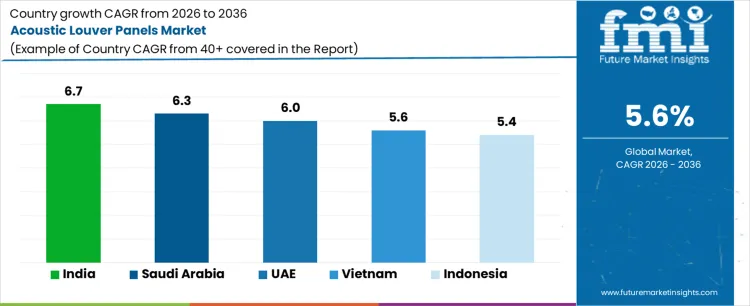
| Country | CAGR (%) |
|---|---|
| India | 6.7% |
| Saudi Arabia | 6.3% |
| UAE | 6.0% |
| Vietnam | 5.6% |
| Indonesia | 5.4% |
What Is Driving Expansion of Acoustic Louver Panel Demand in India?
Demand for acoustic louver panels in India is growing at a CAGR of 6.7%, supported by infrastructure expansion and stricter noise control around occupied buildings. Data centers, hospitals, and metro facilities require ventilation with controlled sound emission. Urban mixed-use developments place mechanical equipment closer to residential areas, increasing attenuation needs. Power backup systems in commercial buildings specify acoustic louvers for DG rooms. Retrofit demand emerges from compliance audits and tenant complaints. Growth reflects functional noise management and regulatory enforcement rather than façade-driven architectural preferences.
- Data center and hospital ventilation noise control
- Proximity of mechanical rooms to occupied spaces
- DG set enclosures in commercial buildings
- Compliance-driven retrofits and audits
Why Is Saudi Arabia Seeing Strong Uptake of Acoustic Louver Panels?
Acoustic louver panel demand in Saudi Arabia is expanding at a CAGR of 6.3%, driven by large-scale infrastructure and industrial projects. Power plants, desalination facilities, and transport hubs require airflow with controlled noise emission. High-capacity HVAC systems increase sound attenuation requirements. Government projects specify acoustic performance at design stage. Harsh climatic conditions necessitate durable louver construction. Growth reflects infrastructure-led specifications and operational noise management rather than retrofit-heavy building activity.
- Infrastructure and utility project specifications
- High-capacity HVAC noise attenuation needs
- Design-stage acoustic compliance requirements
- Durability needs under harsh climates
How Is the UAE Supporting Growth of Acoustic Louver Panel Sales?
Sales of acoustic louver panels in United Arab Emirates are growing at a CAGR of 6.0%, shaped by premium commercial construction and infrastructure assets. Airports, data centers, and commercial towers require controlled ventilation noise. Proximity of mechanical equipment to occupied zones increases specification of acoustically rated louvers. Building codes emphasize performance and quality. Retrofit demand arises from upgrades to existing plant rooms. Growth reflects quality-driven construction and infrastructure performance standards rather than expansion of basic industrial facilities.
- Airport and data center ventilation requirements
- Noise control near occupied commercial spaces
- Performance-focused building quality standards
- Plant room upgrade and retrofit activity
What Factors Are Supporting Acoustic Louver Panel Demand in Vietnam?
Acoustic louver panel demand in Vietnam is expanding at a CAGR of 5.6%, supported by industrial parks and urban commercial development. Manufacturing facilities require ventilation while limiting noise impact on adjacent zones. Office buildings and malls specify louvers for HVAC and generator areas. Urban density increases sensitivity to mechanical noise. Standardized industrial construction favors proven acoustic solutions. Growth reflects industrialization and urban proximity challenges rather than high-end architectural customization.
- Industrial park ventilation noise management
- Commercial building HVAC and generator rooms
- Urban density increasing noise sensitivity
- Standardized industrial construction practices
Why Is Indonesia Experiencing Measured Growth in Acoustic Louver Panels?
Demand for acoustic louver panels in Indonesia is growing at a CAGR of 5.4%, driven by urban infrastructure and institutional buildings. Hospitals, airports, and government facilities require airflow with reduced noise transmission. High ambient noise levels necessitate effective attenuation for mechanical systems. Budget constraints favor standardized louver designs with certified ratings. Retrofit demand emerges from operational upgrades. Growth remains measured, reflecting functional noise control needs and cost discipline rather than rapid expansion of heavy industrial projects.
- Institutional building ventilation requirements
- High ambient urban noise conditions
- Preference for standardized certified designs
- Upgrade-led retrofit demand
What is the competitive landscape of demand for the acoustic louver panels market globally?
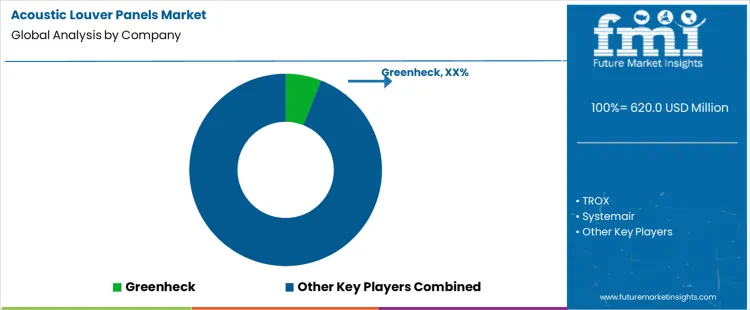
Demand for acoustic louver panels is driven by stricter environmental noise limits and HVAC noise control requirements in buildings. Buyers evaluate insertion loss ratings, airflow efficiency, pressure drop impact, weather resistance, and compliance with architectural specifications. Procurement behavior favors suppliers offering tested acoustic performance data, customization for façade integration, and coordination with mechanical consultants. Purchasing decisions emphasize lifecycle durability, corrosion protection, ease of installation, and compatibility with ventilation systems. Trend in the acoustic louver panels market shows increased specification in data centers, hospitals, and urban mixed-use projects requiring balanced airflow and noise mitigation.
Greenheck leads competitive positioning through extensive HVAC louver portfolios combining validated acoustic attenuation with airflow performance across commercial applications. TROX competes with engineered acoustic louver systems integrated within comprehensive air distribution and noise control solutions. Systemair supports demand by supplying standardized and project-specific acoustic louvers aligned with global ventilation standards. FläktGroup maintains relevance through high-performance louver designs addressing complex airflow and noise challenges in large facilities. Johnson Controls Ruskin participates with architectural louvers offering acoustic options suited for commercial façades and mechanical intakes. Competitive differentiation centers on certified acoustic data, airflow optimization, customization capability, and project support expertise.
Key Players in the Acoustic Louver Panels Market
- Greenheck
- TROX
- Systemair
- FläktGroup
- Johnson Controls (Ruskin)
- Price Industries
- Halton
- Lindab
- Nailor Industries
Scope of the Report
| Items | Values |
|---|---|
| Quantitative Units | USD million |
| Louver Type | Acoustic Intake Louvers; Acoustic Exhaust Louvers; Combination Weather & Acoustic Louvers; Other |
| Application | Commercial HVAC Systems; Industrial Facilities; Data Centers; Others |
| Material | Aluminum; Galvanized Steel; Stainless Steel; Other |
| Sales Channel | HVAC Contractors; Direct OEM Sales; Distributors; Other |
| Regions Covered | Asia Pacific, Europe, North America, Latin America, Middle East & Africa |
| Countries Covered | India, Saudi Arabia, UAE, Vietnam, Indonesia, and 40+ countries |
| Key Companies Profiled | Greenheck; TROX; Systemair; FläktGroup; Johnson Controls (Ruskin); Price Industries; Halton; Lindab; Nailor Industries |
| Additional Attributes | Dollar sales by louver type, application, material, and sales channel; acoustic attenuation performance and airflow efficiency across intake, exhaust, and combination louvers; corrosion resistance and structural durability for aluminum, galvanized steel, and stainless steel designs; compliance with HVAC noise standards for commercial, industrial, and data center installations; procurement dynamics driven by contractor-led projects, direct OEM supply, and distributor networks. |
Acoustic Louver Panels Market by Segment
Louver Type:
- Acoustic Intake Louvers
- Acoustic Exhaust Louvers
- Combination Weather & Acoustic Louvers
- Other
Application:
- Commercial HVAC Systems
- Industrial Facilities
- Data Centers
- Others
Material:
- Aluminum
- Galvanized Steel
- Stainless Steel
- Other
Sales Channel:
- HVAC Contractors
- Direct OEM Sales
- Distributors
- Other
Region:
- Asia Pacific
- China
- Japan
- South Korea
- India
- Australia & New Zealand
- ASEAN
- Rest of Asia Pacific
- Europe
- Germany
- United Kingdom
- France
- Italy
- Spain
- Nordic
- BENELUX
- Rest of Europe
- North America
- United States
- Canada
- Mexico
- Latin America
- Brazil
- Chile
- Rest of Latin America
- Middle East & Africa
- Kingdom of Saudi Arabia
- Other GCC Countries
- Turkey
- South Africa
- Other African Union
- Rest of Middle East & Africa
Bibliography
- International Organization for Standardization. (2023). Acoustics-Measurement of sound attenuation of silencers, ducts, and louvered air-handling components-Laboratory test procedures (ISO 7235:2023). ISO.
- International Organization for Standardization. (2024). Acoustics-Sound insulation ratings of building elements-Application to ventilation components (ISO 717-1:2024, revised edition). ISO.
- ASTM International. (2024). Standard guide for selection and installation of outdoor noise control treatments for mechanical equipment (ASTM E2924-24). ASTM International.
- European Committee for Standardization. (2023). Ventilation for buildings-Acoustic performance of air terminal devices and louvered openings (EN 13141-1:2023, amended edition). CEN.
- USA Environmental Protection Agency. (2023). Noise control guidance for stationary equipment and ventilation openings (EPA technical guidance update). USA EPA.
Frequently Asked Questions
How big is the acoustic louver panels market in 2026?
The global acoustic louver panels market is estimated to be valued at USD 620.0 million in 2026.
What will be the size of acoustic louver panels market in 2036?
The market size for the acoustic louver panels market is projected to reach USD 1,069.1 million by 2036.
How much will be the acoustic louver panels market growth between 2026 and 2036?
The acoustic louver panels market is expected to grow at a 5.6% CAGR between 2026 and 2036.
What are the key product types in the acoustic louver panels market?
The key product types in acoustic louver panels market are acoustic intake louvers, acoustic exhaust louvers, combination weather & acoustic louvers and other.
Which application segment to contribute significant share in the acoustic louver panels market in 2026?
In terms of application, commercial hvac systems segment to command 44.0% share in the acoustic louver panels market in 2026.
Preview the report firsthand - request a free sample
Get SampleGet the brochure for pricing and purchase details.
Get PDFTable of Content
- Executive Summary
- Global Market Outlook
- Demand-side Trends
- Supply-side Trends
- Technology Roadmap Analysis
- Analysis and Recommendations
- Market Overview
- Market Coverage / Taxonomy
- Market Definition / Scope / Limitations
- Market Background
- Market Dynamics
- Drivers
- Restraints
- Opportunity
- Trends
- Scenario Forecast
- Demand in Optimistic Scenario
- Demand in Likely Scenario
- Demand in Conservative Scenario
- Opportunity Map Analysis
- Product Life Cycle Analysis
- Supply Chain Analysis
- Investment Feasibility Matrix
- Value Chain Analysis
- PESTLE and Porter’s Analysis
- Regulatory Landscape
- Regional Parent Market Outlook
- Production and Consumption Statistics
- Import and Export Statistics
- Market Dynamics
- Global Market Analysis 2021 to 2025 and Forecast, 2026 to 2036
- Historical Market Size Value (USD Million) Analysis, 2021 to 2025
- Current and Future Market Size Value (USD Million) Projections, 2026 to 2036
- Y-o-Y Growth Trend Analysis
- Absolute $ Opportunity Analysis
- Global Market Pricing Analysis 2021 to 2025 and Forecast 2026 to 2036
- Global Market Analysis 2021 to 2025 and Forecast 2026 to 2036, By Louver Type
- Introduction / Key Findings
- Historical Market Size Value (USD Million) Analysis By Louver Type , 2021 to 2025
- Current and Future Market Size Value (USD Million) Analysis and Forecast By Louver Type , 2026 to 2036
- Acoustic Intake Louvers
- Acoustic Exhaust Louvers
- Combination Weather & Acoustic Louvers
- Other
- Acoustic Intake Louvers
- Y-o-Y Growth Trend Analysis By Louver Type , 2021 to 2025
- Absolute $ Opportunity Analysis By Louver Type , 2026 to 2036
- Global Market Analysis 2021 to 2025 and Forecast 2026 to 2036, By Application
- Introduction / Key Findings
- Historical Market Size Value (USD Million) Analysis By Application, 2021 to 2025
- Current and Future Market Size Value (USD Million) Analysis and Forecast By Application, 2026 to 2036
- Commercial HVAC Systems
- Industrial Facilities
- Data Centers
- Others
- Commercial HVAC Systems
- Y-o-Y Growth Trend Analysis By Application, 2021 to 2025
- Absolute $ Opportunity Analysis By Application, 2026 to 2036
- Global Market Analysis 2021 to 2025 and Forecast 2026 to 2036, By Material
- Introduction / Key Findings
- Historical Market Size Value (USD Million) Analysis By Material, 2021 to 2025
- Current and Future Market Size Value (USD Million) Analysis and Forecast By Material, 2026 to 2036
- Aluminum
- Galvanized Steel
- Stainless Steel
- Other
- Aluminum
- Y-o-Y Growth Trend Analysis By Material, 2021 to 2025
- Absolute $ Opportunity Analysis By Material, 2026 to 2036
- Global Market Analysis 2021 to 2025 and Forecast 2026 to 2036, By Sales Channel
- Introduction / Key Findings
- Historical Market Size Value (USD Million) Analysis By Sales Channel, 2021 to 2025
- Current and Future Market Size Value (USD Million) Analysis and Forecast By Sales Channel, 2026 to 2036
- HVAC Contractors
- Direct OEM Sales
- Distributors
- Other
- HVAC Contractors
- Y-o-Y Growth Trend Analysis By Sales Channel, 2021 to 2025
- Absolute $ Opportunity Analysis By Sales Channel, 2026 to 2036
- Global Market Analysis 2021 to 2025 and Forecast 2026 to 2036, By Region
- Introduction
- Historical Market Size Value (USD Million) Analysis By Region, 2021 to 2025
- Current Market Size Value (USD Million) Analysis and Forecast By Region, 2026 to 2036
- North America
- Latin America
- Western Europe
- Eastern Europe
- East Asia
- South Asia and Pacific
- Middle East & Africa
- Market Attractiveness Analysis By Region
- North America Market Analysis 2021 to 2025 and Forecast 2026 to 2036, By Country
- Historical Market Size Value (USD Million) Trend Analysis By Market Taxonomy, 2021 to 2025
- Market Size Value (USD Million) Forecast By Market Taxonomy, 2026 to 2036
- By Country
- USA
- Canada
- Mexico
- By Louver Type
- By Application
- By Material
- By Sales Channel
- By Country
- Market Attractiveness Analysis
- By Country
- By Louver Type
- By Application
- By Material
- By Sales Channel
- Key Takeaways
- Latin America Market Analysis 2021 to 2025 and Forecast 2026 to 2036, By Country
- Historical Market Size Value (USD Million) Trend Analysis By Market Taxonomy, 2021 to 2025
- Market Size Value (USD Million) Forecast By Market Taxonomy, 2026 to 2036
- By Country
- Brazil
- Chile
- Rest of Latin America
- By Louver Type
- By Application
- By Material
- By Sales Channel
- By Country
- Market Attractiveness Analysis
- By Country
- By Louver Type
- By Application
- By Material
- By Sales Channel
- Key Takeaways
- Western Europe Market Analysis 2021 to 2025 and Forecast 2026 to 2036, By Country
- Historical Market Size Value (USD Million) Trend Analysis By Market Taxonomy, 2021 to 2025
- Market Size Value (USD Million) Forecast By Market Taxonomy, 2026 to 2036
- By Country
- Germany
- UK
- Italy
- Spain
- France
- Nordic
- BENELUX
- Rest of Western Europe
- By Louver Type
- By Application
- By Material
- By Sales Channel
- By Country
- Market Attractiveness Analysis
- By Country
- By Louver Type
- By Application
- By Material
- By Sales Channel
- Key Takeaways
- Eastern Europe Market Analysis 2021 to 2025 and Forecast 2026 to 2036, By Country
- Historical Market Size Value (USD Million) Trend Analysis By Market Taxonomy, 2021 to 2025
- Market Size Value (USD Million) Forecast By Market Taxonomy, 2026 to 2036
- By Country
- Russia
- Poland
- Hungary
- Balkan & Baltic
- Rest of Eastern Europe
- By Louver Type
- By Application
- By Material
- By Sales Channel
- By Country
- Market Attractiveness Analysis
- By Country
- By Louver Type
- By Application
- By Material
- By Sales Channel
- Key Takeaways
- East Asia Market Analysis 2021 to 2025 and Forecast 2026 to 2036, By Country
- Historical Market Size Value (USD Million) Trend Analysis By Market Taxonomy, 2021 to 2025
- Market Size Value (USD Million) Forecast By Market Taxonomy, 2026 to 2036
- By Country
- China
- Japan
- South Korea
- By Louver Type
- By Application
- By Material
- By Sales Channel
- By Country
- Market Attractiveness Analysis
- By Country
- By Louver Type
- By Application
- By Material
- By Sales Channel
- Key Takeaways
- South Asia and Pacific Market Analysis 2021 to 2025 and Forecast 2026 to 2036, By Country
- Historical Market Size Value (USD Million) Trend Analysis By Market Taxonomy, 2021 to 2025
- Market Size Value (USD Million) Forecast By Market Taxonomy, 2026 to 2036
- By Country
- India
- ASEAN
- Australia & New Zealand
- Rest of South Asia and Pacific
- By Louver Type
- By Application
- By Material
- By Sales Channel
- By Country
- Market Attractiveness Analysis
- By Country
- By Louver Type
- By Application
- By Material
- By Sales Channel
- Key Takeaways
- Middle East & Africa Market Analysis 2021 to 2025 and Forecast 2026 to 2036, By Country
- Historical Market Size Value (USD Million) Trend Analysis By Market Taxonomy, 2021 to 2025
- Market Size Value (USD Million) Forecast By Market Taxonomy, 2026 to 2036
- By Country
- Kingdom of Saudi Arabia
- Other GCC Countries
- Turkiye
- South Africa
- Other African Union
- Rest of Middle East & Africa
- By Louver Type
- By Application
- By Material
- By Sales Channel
- By Country
- Market Attractiveness Analysis
- By Country
- By Louver Type
- By Application
- By Material
- By Sales Channel
- Key Takeaways
- Key Countries Market Analysis
- USA
- Pricing Analysis
- Market Share Analysis, 2025
- By Louver Type
- By Application
- By Material
- By Sales Channel
- Canada
- Pricing Analysis
- Market Share Analysis, 2025
- By Louver Type
- By Application
- By Material
- By Sales Channel
- Mexico
- Pricing Analysis
- Market Share Analysis, 2025
- By Louver Type
- By Application
- By Material
- By Sales Channel
- Brazil
- Pricing Analysis
- Market Share Analysis, 2025
- By Louver Type
- By Application
- By Material
- By Sales Channel
- Chile
- Pricing Analysis
- Market Share Analysis, 2025
- By Louver Type
- By Application
- By Material
- By Sales Channel
- Germany
- Pricing Analysis
- Market Share Analysis, 2025
- By Louver Type
- By Application
- By Material
- By Sales Channel
- UK
- Pricing Analysis
- Market Share Analysis, 2025
- By Louver Type
- By Application
- By Material
- By Sales Channel
- Italy
- Pricing Analysis
- Market Share Analysis, 2025
- By Louver Type
- By Application
- By Material
- By Sales Channel
- Spain
- Pricing Analysis
- Market Share Analysis, 2025
- By Louver Type
- By Application
- By Material
- By Sales Channel
- France
- Pricing Analysis
- Market Share Analysis, 2025
- By Louver Type
- By Application
- By Material
- By Sales Channel
- India
- Pricing Analysis
- Market Share Analysis, 2025
- By Louver Type
- By Application
- By Material
- By Sales Channel
- ASEAN
- Pricing Analysis
- Market Share Analysis, 2025
- By Louver Type
- By Application
- By Material
- By Sales Channel
- Australia & New Zealand
- Pricing Analysis
- Market Share Analysis, 2025
- By Louver Type
- By Application
- By Material
- By Sales Channel
- China
- Pricing Analysis
- Market Share Analysis, 2025
- By Louver Type
- By Application
- By Material
- By Sales Channel
- Japan
- Pricing Analysis
- Market Share Analysis, 2025
- By Louver Type
- By Application
- By Material
- By Sales Channel
- South Korea
- Pricing Analysis
- Market Share Analysis, 2025
- By Louver Type
- By Application
- By Material
- By Sales Channel
- Russia
- Pricing Analysis
- Market Share Analysis, 2025
- By Louver Type
- By Application
- By Material
- By Sales Channel
- Poland
- Pricing Analysis
- Market Share Analysis, 2025
- By Louver Type
- By Application
- By Material
- By Sales Channel
- Hungary
- Pricing Analysis
- Market Share Analysis, 2025
- By Louver Type
- By Application
- By Material
- By Sales Channel
- Kingdom of Saudi Arabia
- Pricing Analysis
- Market Share Analysis, 2025
- By Louver Type
- By Application
- By Material
- By Sales Channel
- Turkiye
- Pricing Analysis
- Market Share Analysis, 2025
- By Louver Type
- By Application
- By Material
- By Sales Channel
- South Africa
- Pricing Analysis
- Market Share Analysis, 2025
- By Louver Type
- By Application
- By Material
- By Sales Channel
- USA
- Market Structure Analysis
- Competition Dashboard
- Competition Benchmarking
- Market Share Analysis of Top Players
- By Regional
- By Louver Type
- By Application
- By Material
- By Sales Channel
- Competition Analysis
- Competition Deep Dive
- Greenheck
- Overview
- Product Portfolio
- Profitability by Market Segments (Product/Age /Sales Channel/Region)
- Sales Footprint
- Strategy Overview
- Marketing Strategy
- Product Strategy
- Channel Strategy
- TROX
- Systemair
- FläktGroup
- Johnson Controls (Ruskin)
- Price Industries
- Halton
- Lindab
- Nailor Industries
- Greenheck
- Competition Deep Dive
- Assumptions & Acronyms Used
- Research Methodology


