

- Industry Size (2026)
- USD 690 Mn
- Forecast (2036)
- USD 1517 Mn
- CAGR (2026 to 2036)
- 8.2%
Bamboo Fiber Reinforced Panels Market Size, Market Forecast and Outlook By FMI
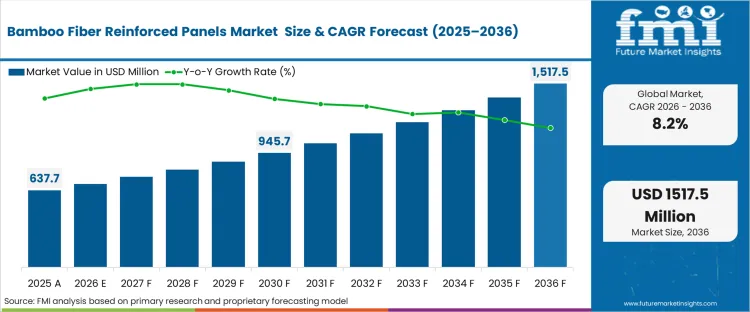
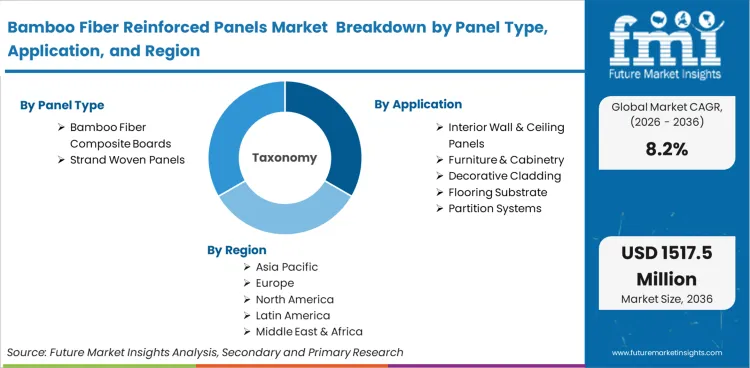
The global bamboo fiber reinforced panels market is estimated to reach USD 690 Million in 2026. According to analysis by Future Market Insights, the market is forecast to expand to USD 1,517 Million by 2036, registering a CAGR of 8.2% during 2026–2036. Growth is being shaped by the increasing specification of engineered bamboo panels in interior construction systems where dimensional stability and uniform mechanical properties are required.
Furniture manufacturers and modular building component suppliers are increasingly adopting bamboo fiber reinforced boards as they provide consistent machining behavior and improved fastening reliability compared with traditional wood-based panels. Additionally, the material’s compatibility with prefabricated and modular construction methods is strengthening its adoption across residential and commercial interior fit-out applications.
Between 2026 and 2036, the market is expected to generate an absolute dollar opportunity of USD 827 Mn, representing a growth multiple of approximately 1.8x. FMI analysis suggests that demand expansion will be driven by specification-based procurement in construction and furniture manufacturing rather than broad substitution of conventional panels. Institutional housing programs and modular construction frameworks are increasingly favoring engineered bamboo panels due to their repeatable performance across batches and documented compliance with building standards. Additionally, manufacturers with integrated bamboo sourcing and controlled fiber processing are capturing procurement preference from large project contractors seeking material consistency and supply reliability in panelized construction systems.
The bamboo fiber reinforced panels and engineered bamboo products industry is emerging as a viable segment within sustainable construction materials. Bamboo fibers can be processed into laminated boards and structural panels with high tensile strength, making them suitable for wall systems, prefabricated modules, and interior panels. As developers increasingly seek materials with lower embodied carbon, engineered bamboo composites are gaining attention due to their rapid renewability, structural efficiency, and ability to substitute certain timber-based boards in panelized construction systems.
Industry practitioners continue to emphasize bamboo’s long-term role in sustainable construction. Neil Thomas, founding director of Atelier One, noted that bamboo is “the most sustainable natural building material on the planet,” [1] adding that the industry is only at the beginning of using it in a much broader way.
Summary of Bamboo Fiber Reinforced Panels Market
- Bamboo Fiber Reinforced Panels Market Definition
- The Bamboo Fiber Reinforced Panels market refers to the industry producing engineered panels made by combining bamboo fibers with resins or binders to enhance structural strength and durability. These panels are used in construction, furniture, and interior applications as sustainable alternatives to conventional wood-based boards and synthetic composite panels.
- Demand Drivers
- Expansion of modular housing projects adopting engineered bamboo panels for lightweight, high-strength prefabricated wall systems.
- Furniture manufacturers shifting toward bamboo fiber composites to ensure stable supply versus volatile hardwood availability.
- Green building certification frameworks encouraging specification of rapidly renewable materials such as bamboo-based structural panels.
- Key Segments analysed in the FMI report
- By Panel Type, Bamboo Fiber Composite Boards hold the largest share of 44%. This dominance reflects widespread adoption in furniture boards and interior construction panels due to superior machinability, dimensional stability, and compatibility with existing wood-panel processing equipment.
- By Application, Interior Wall & Ceiling Panels hold the largest share of 30%. This segment leads as bamboo panels offer lightweight installation, aesthetic surface finishes, and improved moisture stability for residential and commercial interior architectural panel systems.
- By End Use, Residential segment holds the largest share of 38%. Growth is driven by increasing adoption of sustainable interior materials in housing developments, particularly for wall panels, wardrobes, cabinetry boards, and prefabricated interior structures.
- By Region, Asia-Pacific holds the largest share of 66%. Regional dominance stems from abundant bamboo resources, established processing industries in China and Southeast Asia, and strong demand from furniture manufacturing and interior construction supply chains.
- Analyst Opinion at FMI
- According to Nikhil Kaitwade, Associate Vice President at Future Market Insights with extensive experience in chemicals and materials markets, bamboo fiber reinforced panels are positioned to gain strategic importance in sustainable construction and engineered materials. The market is evolving from niche architectural use toward standardized panel products suitable for furniture manufacturing, interior construction systems, and modular building components. Increasing pressure on timber supply chains and the need for renewable structural materials are accelerating interest in engineered bamboo composites. Over the coming decade, advancements in fiber processing, resin bonding technologies, and panel standardization are expected to strengthen adoption across both construction and furniture manufacturing ecosystems.
- Executive Takeaways
- Engineered bamboo panels will increasingly integrate into modular construction supply chains as standardized composite boards replacing select timber panels.
- Asia-Pacific manufacturing ecosystems will shape global supply as bamboo processing clusters expand exports of engineered structural panels.
- Long-term competitiveness will depend on resin systems, fiber treatment technologies, and compliance with global building material certification standards.
- Methodology
- Primary interviews were conducted with engineered bamboo panel manufacturers, bamboo fiber processors, furniture OEM procurement managers, and sustainable construction material distributors to assess production capacities, pricing structures, and application-specific demand patterns.
- Secondary research reviewed company product portfolios, bamboo forestry production databases, engineered bamboo technical papers, construction material certification frameworks, and international bamboo trade statistics to map supply chain dynamics and regional production clusters.
- Market sizing was estimated through a bottom-up assessment of panel production volumes across major bamboo processing countries, supported by revenue benchmarking of composite panel manufacturers and application-level demand allocation.
- Forecast models incorporated construction activity indicators, bamboo cultivation expansion trends, and adoption of renewable construction materials across furniture, residential interiors, and modular building systems.
- Data triangulation validated estimates by reconciling manufacturer capacity data, trade flow statistics, and downstream consumption patterns across furniture manufacturing and interior construction sectors.
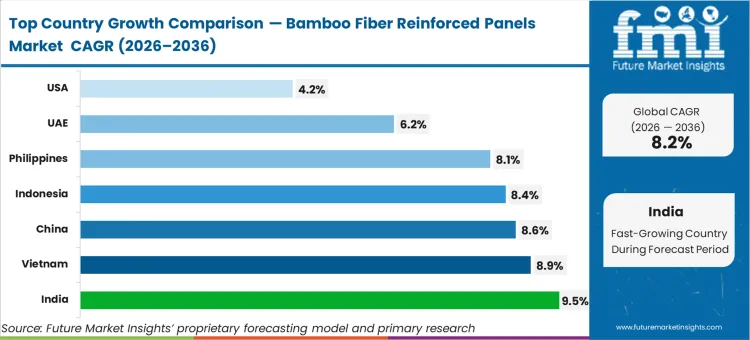
The bamboo fiber reinforced panels market shows strong momentum across Asia where bamboo availability, manufacturing ecosystems, and construction demand intersect. India (9.5% CAGR) is projected to lead growth as government-backed bamboo value-chain initiatives and increasing use of engineered bamboo boards in modular housing and furniture manufacturing expand demand. In China (8.6% CAGR), growth is supported by an established bamboo processing industry and scaling exports of laminated bamboo panels used in flooring and architectural interiors. Southeast Asian producers such as Vietnam (8.9% CAGR), Indonesia (8.4% CAGR), and the Philippines (8.1% CAGR) benefit from abundant bamboo resources and increasing investment in engineered bamboo products for global furniture and building material supply chains.
Growth moderates in developed markets where adoption remains niche. The United Arab Emirates (6.2% CAGR) is seeing interest from sustainable architecture projects using bamboo-based panels in hospitality interiors. Meanwhile, the United States (4.2%) and Germany (3.4% CAGR) show slower growth due to limited domestic bamboo supply and reliance on imports, though green building certifications and carbon-conscious design are gradually creating demand for engineered bamboo panels in premium architectural projects.
Bamboo Fiber Reinforced Panels Market Value CAGR Analysis, 2025-2036
| Year | Value CAGR |
|---|---|
| India | 9.5% |
| China | 8.6% |
| Vietnam | 8.9% |
| Indonesia | 8.4% |
| Philippines | 8.1% |
| U.A.E. | 6.2% |
| USA | 4.2% |
| Germany | 3.4% |
Bamboo Fiber Reinforced Panels Market Definition
The bamboo fiber reinforced panels market refers to the global industry involved in the production, processing, and commercialization of structural and semi-structural panels manufactured using bamboo fibers as the primary reinforcement material. These panels are typically formed by combining bamboo fibers or strands with polymeric or resin-based binders through compression, lamination, or molding processes to enhance mechanical strength, durability, and dimensional stability. Bamboo fiber reinforced panels are used across applications such as interior construction, furniture manufacturing, wall systems, flooring substrates, and modular building components. The market includes manufacturers, converters, and suppliers engaged in producing engineered bamboo composite boards designed to deliver sustainable alternatives to conventional wood-based or synthetic panels.
Bamboo Fiber Reinforced Panels Market Inclusions
The study includes bamboo fiber reinforced boards, laminated bamboo fiber panels, bamboo composite panels, and engineered bamboo boards used in construction, furniture, and interior applications. It also covers panels reinforced with bamboo fibers combined with polymer resins, adhesives, or binders and manufactured through compression, lamination, or composite molding technologies.
Bamboo Fiber Reinforced Panels Market Exclusions
It excludes raw bamboo poles, untreated bamboo boards, bamboo plywood without fiber reinforcement, bamboo flooring planks, bamboo textiles, bamboo pulp products, and bamboo-based decorative handicrafts. The scope also excludes non-panel bamboo construction materials such as scaffolding poles, bamboo lumber beams, and woven bamboo sheets used in traditional building systems.
Bamboo Fiber Reinforced Panels Market Research Methodology
- Primary Research: Primary research was conducted to obtain first-hand insights from industry stakeholders across the value chain. Interviews were carried out with bamboo composite panel manufacturers, raw material suppliers, construction material distributors, furniture manufacturers, and industry experts. Discussions focused on production technologies, raw material sourcing, application demand trends, pricing dynamics, and regional consumption patterns. Respondents also provided qualitative insights regarding technological developments, adoption barriers, and future market opportunities for bamboo fiber reinforced panels.
- Desk Research: Extensive desk research was undertaken to gather secondary data from credible sources such as company annual reports, sustainability disclosures, trade publications, government forestry databases, construction industry statistics, and technical papers on engineered bamboo materials. Industry association publications and regulatory frameworks related to sustainable building materials were also analyzed to understand market structure, technological developments, and regional policy influences affecting bamboo-based composite panels.
- Market Sizing and Forecasting: Market size was estimated using a combination of bottom-up and top-down analytical approaches. Production volumes of bamboo composite panels, revenue disclosures from manufacturers, and consumption trends across construction and furniture industries were assessed. Historical demand patterns and macroeconomic indicators influencing construction activity were analyzed to develop forward-looking forecasts and growth trajectories.
- Data Validation and Update Cycles: All findings were cross-verified through triangulation of primary inputs, secondary datasets, and internal analytical models. Market estimates were refined through iterative validation with industry participants. Periodic update cycles were incorporated to account for emerging regulatory changes, technological developments, and evolving demand trends across regional markets.
Segmental Analysis
Bamboo Fiber Reinforced Panels Market Analysis by Panel Type
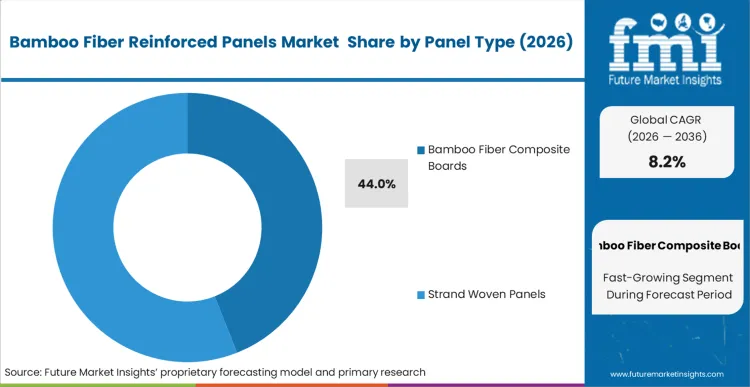
The panel type segmentation of the bamboo fiber reinforced panels market is led by Bamboo Fiber Composite Boards, accounting for about 44% share. This segment dominates because it delivers consistent fiber dispersion and resin bonding, enabling predictable mechanical strength, thickness stability, and machining reliability required by industrial furniture manufacturers and modular interior panel producers. These boards are widely used in furniture substrates, interior wall panels, and prefabricated construction systems where standardized dimensions and fastening reliability are critical. Additionally, engineered bamboo composite boards allow manufacturers to utilize bamboo fibers more efficiently than solid bamboo boards, supporting scalable panel manufacturing and lowering raw material variability across batches.
- In June 2025: Building materials startup Ocean announced the launch of a first-of-its-kind bamboo composite building panel, developed after multi-year R&D and manufactured at commercial scale with research support from Washington State University. [2]
- In June 2024: Researchers at IPB University (Indonesia) developed advanced engineered bamboo composite panels such as Bamboo Zephyr Boards and reinforced bamboo boards with significantly improved stiffness and strength. [3]
Bamboo Fiber Reinforced Panels Market Analysis by Application
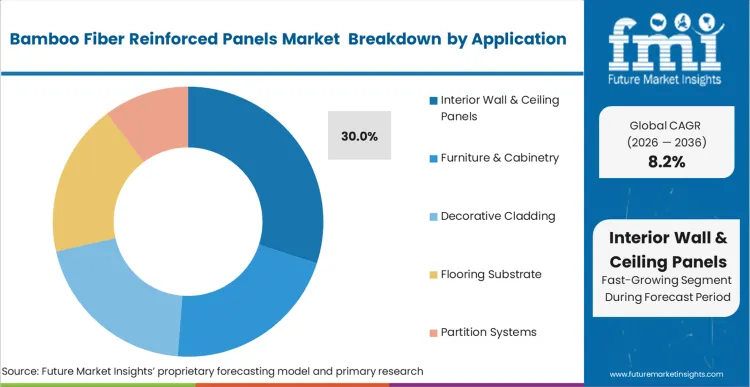
The application segmentation of the bamboo fiber reinforced panels market is led by Interior Wall & Ceiling Panels, accounting for around 30% of global demand. This segment dominates due to increasing use of bamboo composite boards in prefabricated interior construction systems where lightweight, dimensionally stable panels are required. Bamboo fiber panels provide uniform thickness, high screw-holding capacity, and natural surface aesthetics, making them suitable for wall lining, acoustic panels, and ceiling modules in residential and commercial interiors. Additionally, bamboo-based panels align with green building initiatives since bamboo is a rapidly renewable resource capable of storing carbon throughout its lifecycle, supporting sustainable construction practices.
- In December 2025: Arthaland launched Project BEAM, the Philippines’ first commercial-scale bamboo building structure, showcasing bamboo-based architectural materials for low-carbon building interiors and structural applications. [4]
- In August 2025: Bamboo U collaborated with researchers from the University of Hong Kong to build a bamboo pavilion prototype using digital design tools, demonstrating modern architectural applications of bamboo panels and components. [5]
Bamboo Fiber Reinforced Panels Market Drivers, Restraints and Opportunities
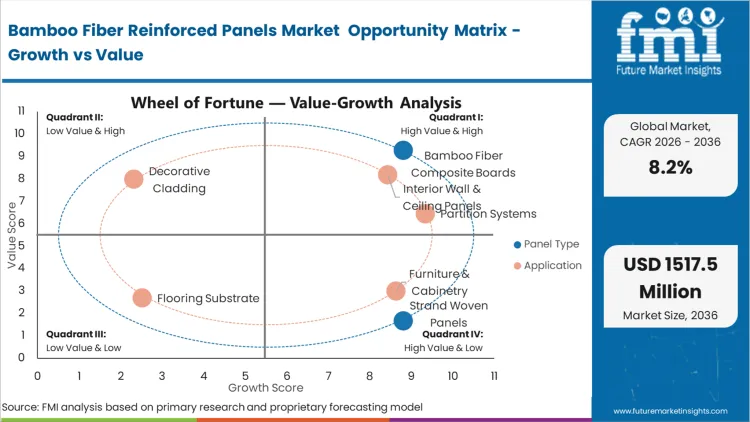
The bamboo fiber reinforced panels market is being driven by the convergence of sustainable material demand and the search for scalable alternatives to conventional wood-based boards. Rising constraints on hardwood supply chains, stricter environmental certifications in construction, and the need for renewable panel substrates are accelerating interest in engineered bamboo composites. Furniture manufacturers and interior system suppliers are particularly adopting bamboo fiber panels due to their consistent fiber structure, dimensional stability, and machinability in automated production lines. However, the market faces restraints related to limited industrial-scale fiber processing infrastructure outside Asia and the absence of widely harmonized building standards for bamboo composites in many developed markets. Over the long term, opportunities are emerging from modular construction, prefabricated interior systems, and engineered bio-materials innovation, where bamboo fibers can be integrated with advanced resin systems to deliver lightweight structural panels suitable for low-carbon buildings.
- A critical growth lever for the bamboo fiber reinforced panels industry lies in the industrialization of bamboo fiber processing. Regions that invest in fiber extraction, treatment technologies, and composite manufacturing clusters will control supply chains for engineered bamboo panels, influencing global availability, cost structures, and adoption across furniture and construction sectors.
- Market expansion will increasingly depend on building code recognition and performance certification of engineered bamboo composites. As structural testing standards and fire, durability, and load-bearing benchmarks become established, bamboo fiber reinforced panels will gain acceptance in mainstream architectural specifications and prefabricated building systems.
- The next wave of innovation is likely to emerge from hybrid composite formulations combining bamboo fibers with advanced resins, recycled polymers, or bio-based binders. Such material engineering could significantly expand the use of bamboo panels beyond interiors into semi-structural building components and lightweight infrastructure applications.
Regional Analysis
.webp "Top Country Growth Comparison Bamboo Fiber Reinforced Panels Market Cagr (2026 2036)")
As per Future Market Insights, the regional analysis is conducted for key seven regions across the globe, including North America, Latin America, Eastern Europe, Western Europe, South Asia and Pacific, East Asia and Middle East and Africa. The full report offers market attractiveness analysis and market potential assessment across 30+ countries based on regional dynamics and regional trends.
Region Wise Share Comparison of Bamboo Fiber Reinforced Panels Market
| Sub-Segment | Share (%) of Global (2026) |
|---|---|
| Asia-Pacific | 66% |
| Europe | 14% |
| North America | 12% |
| Latin America | 5% |
| Middle East & Africa | 3% |
Source: Future Market Insights (FMI) analysis, based on proprietary forecasting model and primary research
Asia Pacific Market Analysis
The bamboo fiber reinforced panels market in Asia-Pacific captures over 60% of global market share, supported by abundant bamboo resources, established processing industries, and strong regional furniture manufacturing ecosystems. Countries such as China, India, and Vietnam benefit from extensive bamboo cultivation and integrated value chains converting bamboo fibers into engineered panels. Rapid urbanization, expansion of modular housing, and increasing use of bamboo-based interior materials in construction are further accelerating demand across the region.
- Large-scale bamboo processing clusters in China support mass production of engineered bamboo panels for furniture and construction supply chains.
- Strong export-oriented furniture manufacturing in China continues driving demand for standardized bamboo composite panel substrates.
FMI's analysis of the Bamboo Fiber Reinforced Panels market in Asia Pacific includes country-level assessments for India, China, Vietnam, Indonesia, Philippines, Japan, South Korea, and Rest of Asia Pacific. Readers can find detailed analysis of infrastructure-driven demand, premium residential segment dynamics, labor constraint indicators, and channel structure for each country in the full report.
North America Market Analysis
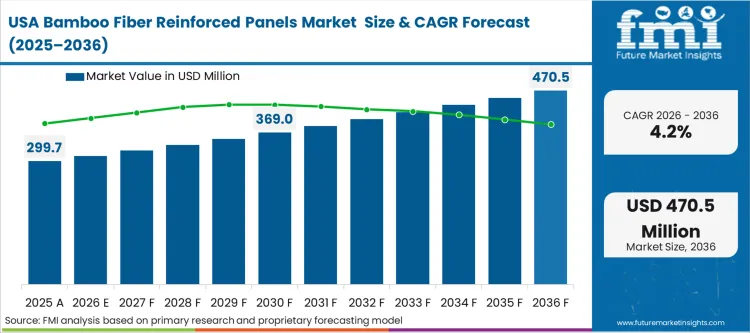
The bamboo fiber reinforced panels market in North America is growing gradually as architects and developers increasingly adopt renewable interior materials to reduce embodied carbon in buildings. Demand is supported by green building certification frameworks such as USA Green Building Council’s LEED, which encourages rapidly renewable materials. Additionally, rising interest in prefabricated construction and sustainable interior architecture is creating opportunities for bamboo-based composite panels in wall systems, cabinetry substrates, and decorative architectural elements.
- North American market to account for over 10% of bamboo fiber reinforced panels sales globally. Sustainable architecture firms in United States increasingly specify bamboo-based panels for interior finishes in LEED-certified residential and commercial projects.
- Growth of modular and prefabricated housing in the United States is expanding demand for lightweight, standardized engineered panel materials such as bamboo composites.
FMI’s report covers a detailed analysis of the North American market including USA, Canada and Mexico. Readers can find apt dynamics and pertinent market potential for these countries detailed in the report along with supporting facts and findings.
Latin America Market Analysis
The bamboo fiber reinforced panels market in Latin America is gaining traction due to expanding bamboo cultivation and increasing interest in sustainable construction materials. Countries such as Brazil, Colombia, and Ecuador are promoting bamboo-based building materials through forestry development programs and eco-construction initiatives. Growth is also supported by the use of bamboo composites in low-cost housing and interior construction systems where locally available bamboo resources can reduce dependence on imported wood-based panels.
- Architects in the United States increasingly explore bamboo composite panels for sustainable interior systems aligned with low-carbon building material specifications.
- Growing adoption of prefabricated housing in the United States supports demand for lightweight engineered bamboo panels in interior partitions and furniture substrates.
FMI’s assessment of Latin American market includes country level analysis for Brazil, Argentina, Chile, Peru and Rest of Latin America covering key aspects such as trends, pricing dynamics and market developments in detail.
Europe Market Analysis
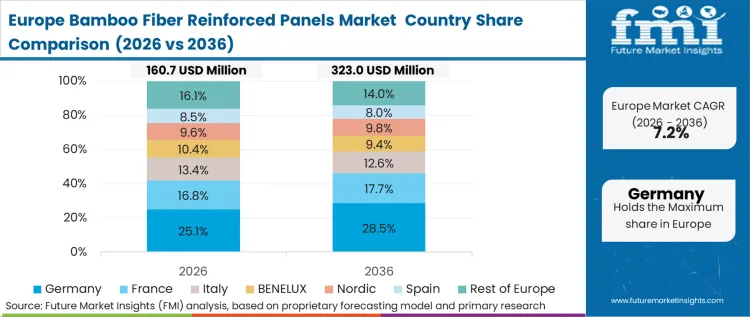
The bamboo fiber reinforced panels market in Europe is developing gradually as architects and interior product manufacturers increasingly prioritize renewable and low-carbon building materials. Demand is influenced by strict environmental regulations and circular economy policies promoted by the European Commission. Countries such as Germany, Netherlands, and France are witnessing growing use of bamboo-based panels in interior architecture, furniture substrates, and sustainable building projects where natural material aesthetics and environmental performance are prioritized.
- Architects in Germany increasingly specify bamboo composite panels in sustainable interior designs aligned with stringent building efficiency regulations.
- Expansion of eco-friendly furniture manufacturing in Germany is supporting demand for stable, renewable engineered bamboo panel substrates.
FMI's analysis of the Bamboo Fiber Reinforced Panels market in Europe includes country-level assessments for Germany, the United Kingdom, France, Italy, and Rest of Europe. Readers can find detailed analysis of replacement cycle dynamics, regulatory developments, and dealer network structure across the region.
Competitive aligners for market players
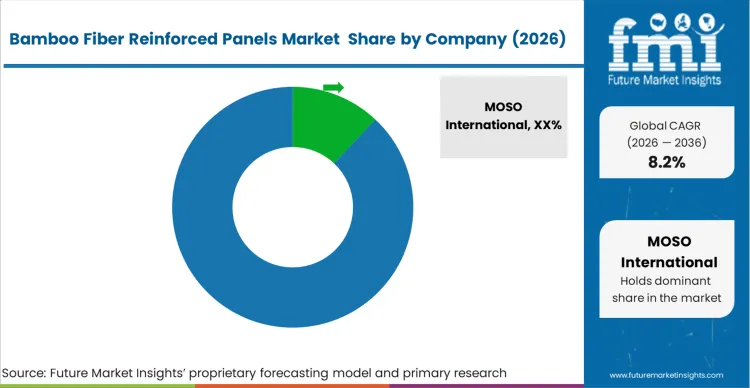
The bamboo fiber reinforced panels market is moderately fragmented, characterized by a mix of regional bamboo processing companies, engineered panel manufacturers, and emerging sustainable material innovators. A significant portion of production capacity remains concentrated in China, Vietnam, and India, where access to bamboo resources and established fiber processing infrastructure support cost-efficient manufacturing. Many manufacturers operate as vertically integrated players, controlling bamboo harvesting, fiber treatment, and panel manufacturing to ensure consistent raw material supply and quality.
Customer buying behavior is gradually shifting from purely price-based procurement toward performance and sustainability-driven selection criteria. Furniture manufacturers, modular construction firms, and interior system suppliers increasingly evaluate bamboo panels based on dimensional stability, machinability in automated production lines, and compliance with green building certifications. As a result, leading companies are investing in engineered composite technologies, resin bonding improvements, and standardized panel dimensions compatible with industrial furniture manufacturing processes.
In response to this shift, several producers are expanding export-oriented supply chains and collaborating with architectural firms and sustainable building material distributors. Companies are also focusing on certification, product traceability, and eco-labeling to align with procurement standards in developed construction markets where environmental compliance and material transparency increasingly influence purchasing decisions.
Recent Developments
- In January 2026 – Tokai Rika Co., Ltd. announced that its BAMBOO+® composite bamboo fiber material was adopted by Lexus for decorative interior panels in the new Lexus IS. The material, containing up to 55% bamboo fibers, demonstrates growing adoption of bamboo composite panels in high-performance industrial applications. [6]
- In June 2025 – Ocean (Eco‑Shelter building materials startup) announced the commercial launch of a patent-pending bamboo composite building panel, initially targeting prefabricated housing and interior wall systems. The panels were developed after large-scale manufacturing trials conducted with Washington State University. [7]
- In January 2024 – Council of Scientific and Industrial Research (CSIR) transferred bamboo composite manufacturing technology to Asili Bamboo Products, enabling industrial-scale production of bamboo composite panels with improved durability, fire resistance, and dimensional stability. [8]
- In July 2025 – ZhuoKang introduced advanced bamboo fiber-based wall panel systems incorporating recycled bamboo waste and bio-resins. The panels were designed for medical and commercial interiors requiring antibacterial surfaces and improved impact resistance. [9]
Key Players Covered in the Study
- MOSO International
- Dasso Group
- Anji Tianzhen
- Zhejiang Yongyu Bamboo
- Smith & Fong
- Teragren
- Fujian Huayu Bamboo
- Guangdong Vanach
- Huabao Bamboo
- Regional Composite Panel Makers
Report Scope
| Metric | Value |
|---|---|
| Quantitative Units | USD 690 million in 2026 to USD 1,517 million by 2036 at CAGR of 8.2% |
| Market Definition | The bamboo fiber reinforced panels market comprises engineered panel products manufactured by combining bamboo fibers with resins or binders to enhance structural strength and durability. These panels are used in construction, furniture manufacturing, and interior systems as sustainable alternatives to wood-based boards and conventional composite panel materials. |
| Panel Type | Bamboo Fiber Composite Boards, Strand Woven Panels, Hybrid Bamboo-Wood Panels, Bamboo Cement/Structural Boards |
| Application | Interior Wall & Ceiling Panels, Furniture & Cabinetry, Decorative Cladding, Flooring Substrate, Partition Systems |
| End Use | Residential, Commercial, Hospitality & Retail, Modular Construction, Other |
| Regions Covered | North America, Latin America, Europe, Asia Pacific, Middle East and Africa |
| Countries Covered | China, India, Vietnam, Indonesia, Philippines, Japan, Thailand, South Korea, Australia, US, Canada, Mexico, Brazil, Colombia, Germany, Netherlands, and other countries |
| Key Players Covered in the Study | MOSO International, Dasso Group, Anji Tianzhen, Zhejiang Yongyu Bamboo, Smith & Fong, Teragren, Fujian Huayu Bamboo, Guangdong Vanach, Huabao Bamboo, Regional Composite Panel Makers |
| Forecast Period | 2026 to 2036 |
| Approach | Market estimates were developed using hybrid top-down and bottom-up market modelling triangulated using trade data, production capacities, and application demand analysis. Findings were validated through interviews with bamboo panel manufacturers, raw material suppliers, construction material distributors, furniture OEMs, and industry consultants. |
Bamboo Fiber Reinforced Panels Market Analysis by Segments
By Panel Type
- Bamboo Fiber Composite Boards
- Strand Woven Panels
- Hybrid Bamboo-Wood Panels
- Bamboo Cement/Structural Boards
- Others
By Application
- Interior Wall & Ceiling Panels
- Furniture & Cabinetry
- Decorative Cladding
- Flooring Substrate
- Partition Systems
By End Use
- Residential
- Commercial
- Hospitality & Retail
- Modular Construction
- Others
By Region
- North America
- Latin America
- Europe
- Asia Pacific
- Middle East and Africa
Bibliography
- Neil Thomas. Interview on bamboo as a sustainable structural material.
- Ocean. (June 2025). Launch of sustainable bamboo composite building panels developed with Washington State University.
- IPB University. (June 2024). Development of engineered bamboo materials including Bamboo Zephyr Boards and reinforced bamboo composites.
- Arthaland. (December 2025). Launch of Project BEAM – the Philippines’ first commercial-scale bamboo structure.
- Bamboo U in collaboration with University of Hong Kong. (August 2025). Bamboo pavilion prototype demonstrating digitally designed bamboo construction.
- Tokai Rika Co., Ltd. (January 2026). Adoption of BAMBOO+® bamboo fiber composite material in the Lexus IS interior panels.
- Ocean. (June 2025). Commercial launch of patent-pending bamboo composite building panels targeting prefabricated housing and interior wall systems.
- Council of Scientific and Industrial Research (CSIR). (January 2024). Technology transfer of bamboo composite manufacturing to Asili Bamboo Products.
- ZhuoKang. (July 2025). Launch of bamboo fiber-based wall panel systems with recycled bamboo waste and bio-resins.
This report addresses
- Market intelligence enabling comprehensive assessment of leading countries and product segments across Bamboo Fiber Reinforced Panels market globally.
- Market volume (sales units) estimates and 10-year revenue forecasts from 2026 to 2036, validated through manufacturer shipment data, channel partner surveys, and country-level demand modeling.
- Growth opportunity mapping across Interior Wall & Ceiling Panels, Furniture & Cabinetry, Decorative Cladding, Flooring Substrate, and Partition Systems applications.
- Segment and regional revenue forecasts by level of autonomy, cutting deck width, sales channel, duty cycle, and geography across 30+ countries.
- Competition strategy analysis covering dealer network structure, recent developments, product portfolio, USPs and market share analysis.
- Analysis evaluated building material regulations, forestry policies, and sustainability certification frameworks influencing commercialization, trade, and construction adoption of bamboo panels.
- Report delivery in PDF, Excel, PowerPoint, and interactive dashboard formats for executive, procurement, and operational planning use.
Frequently Asked Questions
How large is the demand for Bamboo Fiber Reinforced Panels in the global market in 2026?
Demand for Bamboo Fiber Reinforced Panels in the global market is estimated to be valued at USD 690 million in 2026.
What will be the market size of Bamboo Fiber Reinforced Panels by 2036?
The market size for Bamboo Fiber Reinforced Panels is projected to reach USD 1,517 million by 2036.
What is the expected demand growth for Bamboo Fiber Reinforced Panels between 2026 and 2036?
Demand for Bamboo Fiber Reinforced Panels in the global market is expected to grow at a CAGR of 8.2% between 2026 and 2036.
Which panel type is expected to lead global sales in 2026?
Bamboo fiber composite boards dominate sales due to uniform fiber distribution, superior machinability, dimensional stability, and compatibility with automated furniture manufacturing lines.
How significant is the Interior wall and ceiling panels segment in driving market value?
Interior wall and ceiling panels dominate due to lightweight installation, aesthetic finishes, modular compatibility, and growing demand for sustainable interior construction materials.
Which end use segment is expected to garner most revenue in the market?
Residential end users dominate sales due to rising eco-friendly housing demand, interior renovations, modular homes, and increasing preference for sustainable construction materials.
Preview the report firsthand - request a free sample
Get SampleGet the brochure for pricing and purchase details.
Get PDFTable of Content
- Executive Summary
- Global Market Outlook
- Demand-side Trends
- Supply-side Trends
- Technology Roadmap Analysis
- Analysis and Recommendations
- Market Overview
- Market Coverage / Taxonomy
- Market Definition / Scope / Limitations
- Research Methodology
- Chapter Orientation
- Analytical Lens and Working Hypotheses
- Market Structure, Signals, and Trend Drivers
- Benchmarking and Cross-market Comparability
- Market Sizing, Forecasting, and Opportunity Mapping
- Research Design and Evidence Framework
- Desk Research Programme (Secondary Evidence)
- Company Annual and Sustainability Reports
- Peer-reviewed Journals and Academic Literature
- Corporate Websites, Product Literature, and Technical Notes
- Earnings Decks and Investor Briefings
- Government Statistics Portals and Public Data Releases
- Press Releases and Reputable Media Coverage
- Specialist Newsletters and Curated Briefings
- Sector Databases and Reference Repositories
- FMI Internal Proprietary Databases and Historical Market Datasets
- Subscription Datasets and Paid Sources
- Social Channels, Communities, and Digital Listening Inputs
- Additional Desk Sources
- Expert Input and Fieldwork (Primary Evidence)
- Primary Modes
- Qualitative Interviews and Expert Elicitation
- Quantitative Surveys and Structured Data Capture
- Blended Approach
- Why Primary Evidence is Used
- Field Techniques
- Interviews
- Surveys
- Focus Groups
- Observational and In-context Research
- Social and Community Interactions
- Stakeholder Universe Engaged
- C-suite Leaders
- Board Members
- Presidents and Vice Presidents
- R&D and Innovation Heads
- Technical Specialists
- Domain Subject-matter Experts
- Scientists
- Physicians and Other Healthcare Professionals
- Governance, Ethics, and Data Stewardship
- Research Ethics
- Data Integrity and Handling
- Primary Modes
- Tooling, Models, and Reference Databases
- Desk Research Programme (Secondary Evidence)
- Data Engineering and Model Build
- Data Acquisition and Ingestion
- Cleaning, Normalisation, and Verification
- Synthesis, Triangulation, and Analysis
- Quality Assurance and Audit Trail
- Market Background
- Market Dynamics
- Drivers
- Restraints
- Opportunity
- Trends
- Scenario Forecast
- Demand in Optimistic Scenario
- Demand in Likely Scenario
- Demand in Conservative Scenario
- Opportunity Map Analysis
- Product Life Cycle Analysis
- Supply Chain Analysis
- Investment Feasibility Matrix
- Value Chain Analysis
- PESTLE and Porter’s Analysis
- Regulatory Landscape
- Regional Parent Market Outlook
- Production and Consumption Statistics
- Import and Export Statistics
- Market Dynamics
- Global Market Analysis 2021 to 2025 and Forecast, 2026 to 2036
- Historical Market Size Value (USD Million) Analysis, 2021 to 2025
- Current and Future Market Size Value (USD Million) Projections, 2026 to 2036
- Y-o-Y Growth Trend Analysis
- Absolute $ Opportunity Analysis
- Global Market Pricing Analysis 2021 to 2025 and Forecast 2026 to 2036
- Global Market Analysis 2021 to 2025 and Forecast 2026 to 2036, By Panel Type
- Introduction / Key Findings
- Historical Market Size Value (USD Million) Analysis By Panel Type , 2021 to 2025
- Current and Future Market Size Value (USD Million) Analysis and Forecast By Panel Type , 2026 to 2036
- Bamboo Fiber Composite Boards
- Strand Woven Panels
- Bamboo Fiber Composite Boards
- Y-o-Y Growth Trend Analysis By Panel Type , 2021 to 2025
- Absolute $ Opportunity Analysis By Panel Type , 2026 to 2036
- Global Market Analysis 2021 to 2025 and Forecast 2026 to 2036, By Application
- Introduction / Key Findings
- Historical Market Size Value (USD Million) Analysis By Application, 2021 to 2025
- Current and Future Market Size Value (USD Million) Analysis and Forecast By Application, 2026 to 2036
- Interior Wall & Ceiling Panels
- Furniture & Cabinetry
- Decorative Cladding
- Flooring Substrate
- Partition Systems
- Interior Wall & Ceiling Panels
- Y-o-Y Growth Trend Analysis By Application, 2021 to 2025
- Absolute $ Opportunity Analysis By Application, 2026 to 2036
- Global Market Analysis 2021 to 2025 and Forecast 2026 to 2036, By Region
- Introduction
- Historical Market Size Value (USD Million) Analysis By Region, 2021 to 2025
- Current Market Size Value (USD Million) Analysis and Forecast By Region, 2026 to 2036
- North America
- Latin America
- Western Europe
- Eastern Europe
- East Asia
- South Asia and Pacific
- Middle East & Africa
- Market Attractiveness Analysis By Region
- North America Market Analysis 2021 to 2025 and Forecast 2026 to 2036, By Country
- Historical Market Size Value (USD Million) Trend Analysis By Market Taxonomy, 2021 to 2025
- Market Size Value (USD Million) Forecast By Market Taxonomy, 2026 to 2036
- By Country
- USA
- Canada
- Mexico
- By Panel Type
- By Application
- By Country
- Market Attractiveness Analysis
- By Country
- By Panel Type
- By Application
- Key Takeaways
- Latin America Market Analysis 2021 to 2025 and Forecast 2026 to 2036, By Country
- Historical Market Size Value (USD Million) Trend Analysis By Market Taxonomy, 2021 to 2025
- Market Size Value (USD Million) Forecast By Market Taxonomy, 2026 to 2036
- By Country
- Brazil
- Chile
- Rest of Latin America
- By Panel Type
- By Application
- By Country
- Market Attractiveness Analysis
- By Country
- By Panel Type
- By Application
- Key Takeaways
- Western Europe Market Analysis 2021 to 2025 and Forecast 2026 to 2036, By Country
- Historical Market Size Value (USD Million) Trend Analysis By Market Taxonomy, 2021 to 2025
- Market Size Value (USD Million) Forecast By Market Taxonomy, 2026 to 2036
- By Country
- Germany
- UK
- Italy
- Spain
- France
- Nordic
- BENELUX
- Rest of Western Europe
- By Panel Type
- By Application
- By Country
- Market Attractiveness Analysis
- By Country
- By Panel Type
- By Application
- Key Takeaways
- Eastern Europe Market Analysis 2021 to 2025 and Forecast 2026 to 2036, By Country
- Historical Market Size Value (USD Million) Trend Analysis By Market Taxonomy, 2021 to 2025
- Market Size Value (USD Million) Forecast By Market Taxonomy, 2026 to 2036
- By Country
- Russia
- Poland
- Hungary
- Balkan & Baltic
- Rest of Eastern Europe
- By Panel Type
- By Application
- By Country
- Market Attractiveness Analysis
- By Country
- By Panel Type
- By Application
- Key Takeaways
- East Asia Market Analysis 2021 to 2025 and Forecast 2026 to 2036, By Country
- Historical Market Size Value (USD Million) Trend Analysis By Market Taxonomy, 2021 to 2025
- Market Size Value (USD Million) Forecast By Market Taxonomy, 2026 to 2036
- By Country
- China
- Japan
- South Korea
- By Panel Type
- By Application
- By Country
- Market Attractiveness Analysis
- By Country
- By Panel Type
- By Application
- Key Takeaways
- South Asia and Pacific Market Analysis 2021 to 2025 and Forecast 2026 to 2036, By Country
- Historical Market Size Value (USD Million) Trend Analysis By Market Taxonomy, 2021 to 2025
- Market Size Value (USD Million) Forecast By Market Taxonomy, 2026 to 2036
- By Country
- India
- ASEAN
- Australia & New Zealand
- Rest of South Asia and Pacific
- By Panel Type
- By Application
- By Country
- Market Attractiveness Analysis
- By Country
- By Panel Type
- By Application
- Key Takeaways
- Middle East & Africa Market Analysis 2021 to 2025 and Forecast 2026 to 2036, By Country
- Historical Market Size Value (USD Million) Trend Analysis By Market Taxonomy, 2021 to 2025
- Market Size Value (USD Million) Forecast By Market Taxonomy, 2026 to 2036
- By Country
- Kingdom of Saudi Arabia
- Other GCC Countries
- Turkiye
- South Africa
- Other African Union
- Rest of Middle East & Africa
- By Panel Type
- By Application
- By Country
- Market Attractiveness Analysis
- By Country
- By Panel Type
- By Application
- Key Takeaways
- Key Countries Market Analysis
- USA
- Pricing Analysis
- Market Share Analysis, 2025
- By Panel Type
- By Application
- Canada
- Pricing Analysis
- Market Share Analysis, 2025
- By Panel Type
- By Application
- Mexico
- Pricing Analysis
- Market Share Analysis, 2025
- By Panel Type
- By Application
- Brazil
- Pricing Analysis
- Market Share Analysis, 2025
- By Panel Type
- By Application
- Chile
- Pricing Analysis
- Market Share Analysis, 2025
- By Panel Type
- By Application
- Germany
- Pricing Analysis
- Market Share Analysis, 2025
- By Panel Type
- By Application
- UK
- Pricing Analysis
- Market Share Analysis, 2025
- By Panel Type
- By Application
- Italy
- Pricing Analysis
- Market Share Analysis, 2025
- By Panel Type
- By Application
- Spain
- Pricing Analysis
- Market Share Analysis, 2025
- By Panel Type
- By Application
- France
- Pricing Analysis
- Market Share Analysis, 2025
- By Panel Type
- By Application
- India
- Pricing Analysis
- Market Share Analysis, 2025
- By Panel Type
- By Application
- ASEAN
- Pricing Analysis
- Market Share Analysis, 2025
- By Panel Type
- By Application
- Australia & New Zealand
- Pricing Analysis
- Market Share Analysis, 2025
- By Panel Type
- By Application
- China
- Pricing Analysis
- Market Share Analysis, 2025
- By Panel Type
- By Application
- Japan
- Pricing Analysis
- Market Share Analysis, 2025
- By Panel Type
- By Application
- South Korea
- Pricing Analysis
- Market Share Analysis, 2025
- By Panel Type
- By Application
- Russia
- Pricing Analysis
- Market Share Analysis, 2025
- By Panel Type
- By Application
- Poland
- Pricing Analysis
- Market Share Analysis, 2025
- By Panel Type
- By Application
- Hungary
- Pricing Analysis
- Market Share Analysis, 2025
- By Panel Type
- By Application
- Kingdom of Saudi Arabia
- Pricing Analysis
- Market Share Analysis, 2025
- By Panel Type
- By Application
- Turkiye
- Pricing Analysis
- Market Share Analysis, 2025
- By Panel Type
- By Application
- South Africa
- Pricing Analysis
- Market Share Analysis, 2025
- By Panel Type
- By Application
- USA
- Market Structure Analysis
- Competition Dashboard
- Competition Benchmarking
- Market Share Analysis of Top Players
- By Regional
- By Panel Type
- By Application
- Competition Analysis
- Competition Deep Dive
- MOSO International
- Overview
- Product Portfolio
- Profitability by Market Segments (Product/Age /Sales Channel/Region)
- Sales Footprint
- Strategy Overview
- Marketing Strategy
- Product Strategy
- Channel Strategy
- Dasso Group
- Anji Tianzhen
- Zhejiang Yongyu Bamboo
- Smith & Fong
- Teragren
- Fujian Huayu Bamboo
- Guangdong Vanach
- Huabao Bamboo
- MOSO International
- Competition Deep Dive
- Assumptions & Acronyms Used


