

- Industry Size (2026)
- USD 5351.0 Mn
- Forecast (2036)
- USD 7100.0 Mn
- CAGR (2026 to 2036)
- 2.9%
Truck Axle Shafts Market Forecast and Outlook 2026 to 2036
The truck axle shafts market is valued at USD 5,351.0 million in 2026 and is forecasted to reach USD 7,100.0 million by 2036, expanding at a CAGR of 2.9%. Recent developments in the market point at sustained replacement demand and stable OEM procurement rather than rapid platform expansion. Consumption remains concentrated in heavy-duty commercial vehicles operating under high payload and mileage conditions, where axle shafts function as safety-critical drivetrain components. Revenue formation is anchored to forged steel drive axle shafts specified for Class 7-8 trucks, supported by long-haul freight activity, infrastructure logistics, and regulated axle load limits. Aftermarket replacement contributes materially due to extended vehicle service life and predictable wear cycles.
Outlook across the forecast period is shaped by durability expectations, material cost exposure, and disciplined fleet maintenance practices. Growth remains moderate due to long component lifecycles and mature truck platforms in major regions. Specification priorities emphasize fatigue resistance, dimensional precision, and compatibility with high-torque drivetrains rather than aggressive weight reduction. Electrification introduces incremental design adaptation without materially altering volume dynamics. Manufacturing scalability is constrained by forging capacity, heat treatment requirements, and stringent quality validation. Demand expansion remains steady and controlled, supported by freight utilization intensity, infrastructure-related truck deployment, and maintenance-driven replacement rather than structural increases in global truck production.
Quick Stats for Truck Axle Shafts Market
- Truck Axle Shafts Market Value (2026): USD 5,351.0 million
- Truck Axle Shafts Market Forecast Value (2036): USD 7,100.0 million
- Truck Axle Shafts Market Forecast CAGR 2026 to 2036: 2.9%
- Leading Vehicle Segment by Demand Share: Class 7-8 Trucks
- Fastest-Growing Countries: China, Brazil, USA, Germany, South Korea
- Top Players in Global Demand: Dana, Meritor (Cummins), American Axle & Manufacturing, GKN Automotive, ZF, Eaton, Schaeffler, Neapco, Bharat Forge, Weichai
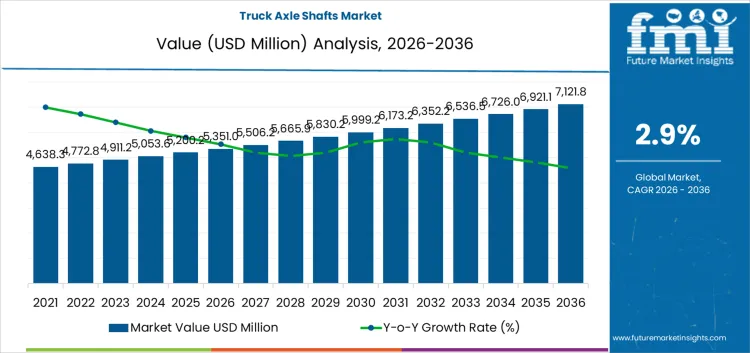
Truck Axle Shafts Market Key Takeaways
| Metric | Value |
|---|---|
| Market Value (2026) | USD 5,351.0 million |
| Market Forecast Value (2036) | USD 7,100.0 million |
| Forecast CAGR 2026 to 2036 | 2.9% |
Why is the Demand for Truck Axle Shafts Growing?
Demand for truck axle shafts is rising as commercial transport and logistics fleets require robust drivetrain components that support heavy load cycles and extended service intervals. Fleet operators and OEM engineers specify axle shafts that meet stringent strength, fatigue resistance, and dimensional accuracy criteria to ensure reliability across diverse road conditions. Infrastructure projects and freight activity increase utilization of medium and heavy duty trucks, prompting procurement teams to focus on component quality, supply continuity, and compliance with safety and regulatory standards. Engineering planners evaluate material grade, heat treatment processes, and bearing interface design to minimize driveline vibration and maintain torque transfer efficiency across long haul and regional operations.
Growth in vehicle electrification and advanced propulsion systems reinforces uptake of precision axle components that align with evolving drivetrain architectures. Maintenance supervisors prioritize shafts with predictable wear characteristics to support scheduled overhaul planning and reduce downtime in service facilities. Manufacturers of truck assemblies coordinate with part suppliers to verify compatibility with braking, suspension, and steering systems to preserve overall vehicle performance. Technical training for assembly and repair technicians supports correct installation practices and extends part life across commercial fleets. These factors support continued uptake of truck axle shaft solutions in complex transport and logistics environments.
How Are the Segments Classified in the Truck Axle Shafts Market?
Demand for truck axle shafts is shaped by freight movement intensity, vehicle load requirements, and durability expectations across commercial transport operations. Usage aligns with long-haul logistics, regional distribution, and public transport activity requiring reliable torque transmission. Component selection prioritizes fatigue resistance, load-bearing capability, and compatibility with drivetrain configurations. Regulatory norms on vehicle weight and safety influence axle design specifications. Segment classification reflects differentiation by vehicle class, axle function, and material composition. Structure highlights how duty cycle severity, axle positioning, and material strength determine specification priorities, replacement frequency, and consumption patterns across heavy and medium-duty truck platforms.
Which Vehicle Segment Represents the Largest Share of Demand?
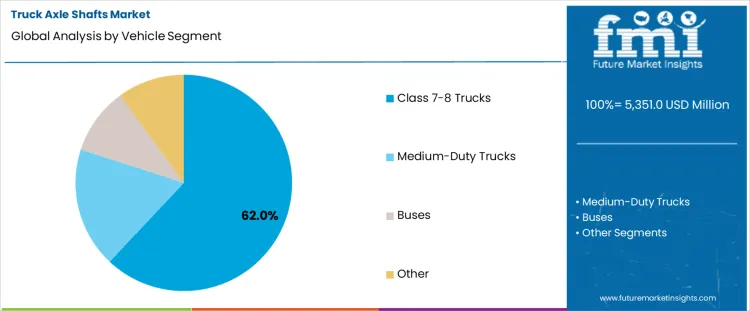
Class 7-8 Trucks hold 62.0%, representing the largest share among vehicle segments due to high payload and torque requirements. These trucks operate under demanding duty cycles involving long-distance hauling and heavy freight loads. Axle shafts in this segment must withstand sustained stress, variable road conditions, and high mileage accumulation. Fleet operators emphasize durability and reliability to minimize downtime and maintenance costs. Medium-duty trucks, buses, and other vehicles operate with lower load intensity and shorter cycles. Vehicle segment distribution reflects concentration of axle shaft consumption within heavy-duty platforms supporting core freight transportation activity.
Key Points:
- Heavy-duty trucks require axle shafts with high load tolerance.
- Long-haul operation increases wear and replacement intensity.
- Other segments operate under less severe duty conditions.
Which Axle Type Accounts for the Highest Share of Demand?
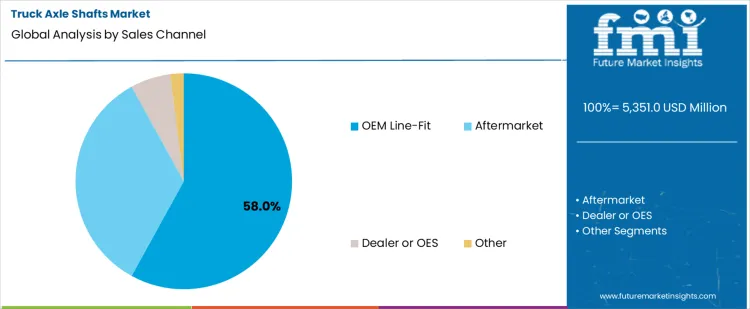
Drive axle shafts hold 58.0%, representing the largest share among axle types due to primary torque transmission responsibility. These shafts transfer engine power directly to the wheels, making them critical to vehicle propulsion. Continuous exposure to rotational stress and load variation drives higher replacement and specification requirements. Design emphasis includes strength, precision, and compatibility with differential systems. Tandem and steer axle shafts support load distribution and steering functions with lower torque exposure. Other axle types serve specialized configurations. Axle type segmentation reflects dominance of propulsion-related components within truck drivetrain systems.
Key Points:
- Drive axles handle primary power transmission loads.
- High stress exposure increases durability requirements.
- Other axle types support load balance and steering roles.
Which Material Accounts for the Highest Share of Demand?
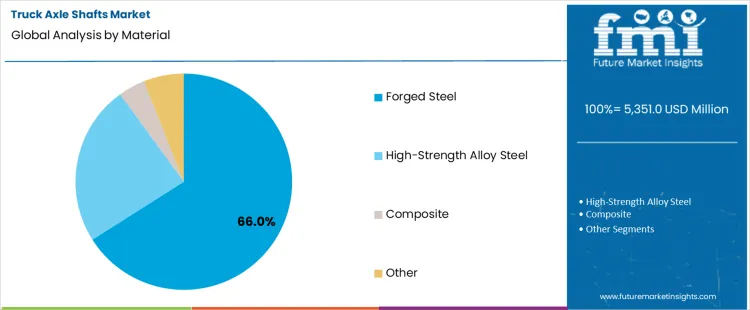
Forged steel holds 66.0%, representing the largest share among materials used in truck axle shafts. Forging processes enhance grain structure, improving strength and fatigue resistance under heavy loads. Steel shafts support consistent performance across temperature variation and high-stress operation. Manufacturing scalability and proven performance reinforce widespread adoption. High-strength alloy steel offers weight and performance optimization for selected applications. Composite materials address limited use cases requiring weight reduction. Material segmentation reflects preference for forged steel where reliability, cost efficiency, and long service life remain critical performance priorities.
Key Points:
- Forged steel provides strength and fatigue resistance.
- Proven manufacturing supports consistent quality.
- Other materials serve optimization-focused applications.
What are the Key Dynamics in the Truck Axle Shafts Market?
Demand for truck axle shafts reflects structural requirements for torque transmission and load bearing within commercial vehicle drivetrains. Adoption spans light, medium, and heavy-duty trucks used in logistics, construction, mining, and long-haul transport. Global scope aligns with freight movement intensity, vehicle durability expectations, and regulatory axle load limits. Usage integrates forged and heat-treated shafts designed to withstand cyclic stress, vibration, and variable terrain conditions.
How do payload intensity and drivetrain durability requirements shape adoption?
Truck operations involve sustained high-load cycles, requiring axle shafts capable of transferring torque without deformation or fatigue failure. Demand increases as fleet operators prioritize uptime and reduced drivetrain failure risk. Heavy-duty applications require shafts with higher tensile strength to support increased gross vehicle weight ratings. Adoption strengthens where multi-axle configurations distribute load while maintaining traction efficiency. Compatibility with differential systems and suspension geometry influences specification choices. Off-highway and construction use cases favor reinforced designs to handle shock loads and uneven surfaces. Longer service intervals reduce maintenance frequency, supporting total cost control. OEMs align axle shaft design with engine output and transmission characteristics to ensure drivetrain balance.
How do material cost pressures and manufacturing complexity influence market scalability?
Axle shaft production relies on alloy steel inputs subject to price volatility, affecting cost predictability. Demand sensitivity rises where fleet procurement emphasizes upfront vehicle pricing. Precision forging, machining, and heat treatment increase manufacturing complexity and capital intensity. Quality control requirements remain stringent due to safety-critical function. Weight reduction initiatives introduce material tradeoffs that complicate design validation. Regional regulatory standards governing axle load and durability testing vary, increasing compliance burden. Supply chain dependence on specialized steel grades limits sourcing flexibility. Failure risk and warranty exposure constrain aggressive cost reduction strategies, affecting scalable production across diverse truck platforms.
How Is Demand for Truck Axle Shafts Evolving Globally?
Demand for truck axle shafts is expanding globally due to sustained freight movement, infrastructure development, and replacement needs within commercial vehicle fleets. Consumption is closely linked to truck production volumes, axle load requirements, and operating intensity across logistics and construction activities. Growth remains moderate, reflecting maturity of heavy-duty vehicle platforms and long component lifecycles. Aftermarket replacement demand contributes materially where vehicle utilization rates remain high. Growth rates in China at 3.9%, Brazil at 3.8%, USA at 2.7%, Germany at 2.6%, and South Korea at 2.5% indicate steady expansion shaped by freight activity, infrastructure spending, and fleet maintenance cycles rather than rapid capacity additions.
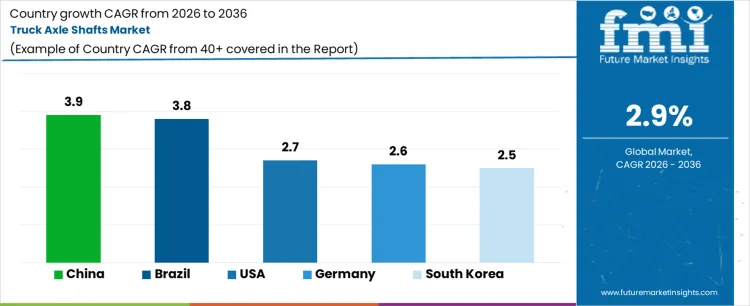
| Country | CAGR (%) |
|---|---|
| China | 3.9% |
| Brazil | 3.8% |
| USA | 2.7% |
| Germany | 2.6% |
| South Korea | 2.5% |
What Is Supporting Truck Axle Shaft Demand Growth in China?
Truck axle shaft demand in China is growing at a CAGR of 3.9%, supported by sustained freight transport activity and infrastructure construction. High utilization of medium and heavy-duty trucks increases wear-related replacement demand. Construction logistics and intercity freight movement continue to rely on high axle load vehicles. Domestic truck manufacturing maintains stable production volumes, supporting OEM demand. Regulatory enforcement on vehicle safety and load compliance influences replacement of worn drivetrain components. Demand growth remains moderate, reflecting a shift from fleet expansion toward maintenance and lifecycle-driven part replacement.
- High freight and construction vehicle utilization
- Stable domestic truck manufacturing output
- Wear-driven aftermarket replacement demand
- Regulatory focus on vehicle safety compliance
Why Is Brazil Experiencing Steady Expansion in Truck Axle Shaft Demand?
Truck axle shaft demand in Brazil is expanding at a CAGR of 3.8%, driven by long-haul freight transport and agricultural logistics. Extended transport distances increase mechanical stress on drivetrain components. Agricultural commodity movement supports consistent truck usage across rural corridors. Road-based logistics dominance reinforces dependence on heavy trucks. Fleet aging contributes to replacement demand within the aftermarket. Demand growth reflects operating intensity and maintenance requirements rather than significant increases in new truck sales.
- Long-distance freight transport conditions
- Agricultural logistics and commodity movement
- High mechanical stress on drivetrain components
- Aging fleet supporting aftermarket demand
How Is the USA Sustaining Demand for Truck Axle Shafts?
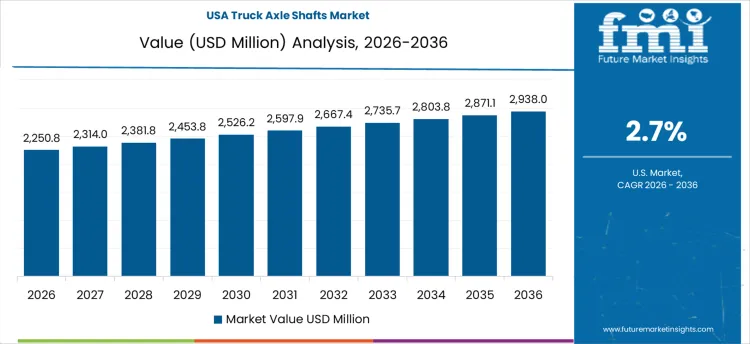
Truck axle shaft demand in the USA is growing at a CAGR of 2.7%, supported by stable freight volumes and fleet replacement cycles. Heavy-duty trucks operate under high mileage conditions, driving component wear. Aftermarket demand dominates due to long vehicle service life. Infrastructure spending supports construction truck usage without sharply increasing fleet size. Regulatory standards influence material and durability specifications. Demand growth remains measured, aligned with maintenance-driven replacement rather than rapid expansion of truck production.
- High mileage operation of heavy-duty trucks
- Strong aftermarket replacement demand
- Construction activity supporting truck utilization
- Durability-focused component specifications
What Factors Are Shaping Truck Axle Shaft Demand in Germany?
Truck axle shaft demand in Germany is expanding at a CAGR of 2.6%, influenced by mature logistics networks and efficiency-focused fleet management. High engineering standards extend component lifespan, moderating replacement frequency. Freight transport relies on well-maintained commercial fleets operating under regulated load limits. Export-driven manufacturing supports steady logistics demand. Replacement activity remains consistent due to preventive maintenance practices. Growth reflects disciplined fleet operation rather than expansion of truck populations.
- Mature logistics and freight transport networks
- Preventive maintenance reducing failure rates
- Regulated axle load and safety standards
- Stable export-driven logistics demand
Why Is South Korea Showing Controlled Growth in Truck Axle Shaft Demand?
Truck axle shaft demand in South Korea is growing at a CAGR of 2.5%, shaped by compact geography and efficient logistics operations. Freight movement relies on high vehicle turnover rather than long-haul transport. Advanced fleet maintenance practices reduce premature component wear. Manufacturing and port logistics support steady truck usage. Replacement demand arises mainly from scheduled maintenance cycles. Growth remains controlled, reflecting efficient fleet utilization and limited expansion of heavy-duty truck numbers.
- Shorter transport distances reducing axle stress
- Advanced fleet maintenance practices
- Manufacturing and port logistics activity
- Scheduled replacement within controlled fleet sizes
What is the competitive landscape of demand for the truck axle shafts market globally?
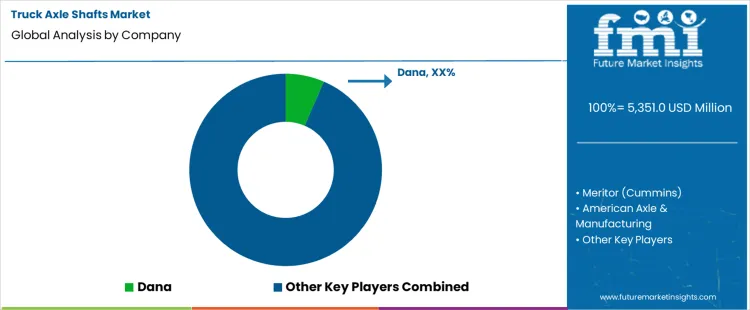
Demand for truck axle shafts is driven by commercial vehicle production, heavy-duty transport, construction equipment, and logistics fleet renewal cycles. Buyers evaluate product strength, fatigue resistance, dimensional precision, material quality, and compatibility with drivetrain and suspension systems. Procurement teams prioritize suppliers with validated testing standards, robust quality systems, and ability to deliver cost-competitive volumes to OEMs and aftermarket channels. Trend in the global market reflects growth of heavy truck segments in emerging economies, stricter emissions and load standards influencing drivetrain loads, and adoption of advanced materials that balance durability with weight reduction.
Dana holds leading positioning through a broad portfolio of heavy-duty truck axle shafts and driveline components integrated with comprehensive engineering and global service capabilities. American Axle & Manufacturing supports demand with high-strength axle solutions and metallurgical expertise tailored to heavy truck and commercial applications. Meritor, now part of Cummins, contributes integrated axle systems and shafts used widely by global truck OEMs. ZF supplies truck axle shafts and complete axle assemblies emphasizing load capacity, durability, and integration with electronic controls. GKN Automotive participates with drivetrain components including axle shafts engineered for reliability and performance across commercial vehicle platforms. Competitive differentiation depends on material performance, manufacturing precision, supply chain reliability, and ability to meet stringent OEM validation and aftersales support requirements.
Key Players in the Truck Axle Shafts Market
- Dana
- Meritor (Cummins)
- American Axle & Manufacturing
- GKN Automotive
- ZF
- Eaton
- Schaeffler
- Neapco
- Bharat Forge
- Weichai
Scope of the Report
| Items | Values |
|---|---|
| Quantitative Units | USD million |
| Vehicle Segment | Class 7-8 Trucks; Medium-Duty Trucks; Buses; Other |
| Axle Type | Drive Axle Shafts; Tandem Axle Shafts; Steer Axle Shafts; Other |
| Material | Forged Steel; High-Strength Alloy Steel; Composite; Other |
| Sales Channel | OEM Line-Fit; Aftermarket; Dealer or OES; Other |
| Regions Covered | Asia Pacific, Europe, North America, Latin America, Middle East & Africa |
| Countries Covered | China, Brazil, USA, Germany, South Korea, and 40+ countries |
| Key Companies Profiled | Dana; Meritor; American Axle & Manufacturing; GKN Automotive; ZF; Eaton; Schaeffler; Neapco; Bharat Forge; Weichai |
| Additional Attributes | Dollar sales by axle type and vehicle segment; adoption trends for high-strength alloy and lightweight axle shafts to improve payload efficiency and durability; torsional fatigue life, spline wear resistance, and surface treatment performance metrics; compatibility with tandem drive configurations and high-torque powertrains; aftermarket replacement cycles, remanufacturing, and warranty considerations; compliance with axle load regulations, OEM durability standards, and safety requirements influencing truck axle shaft selection. |
Truck Axle Shafts Market by Segment
By Vehicle Segment:
- Class 7-8 Trucks
- Medium-Duty Trucks
- Buses
- Other
By Axle Type:
- Drive Axle Shafts
- Tandem Axle Shafts
- Steer Axle Shafts
- Other
By Material:
- Forged Steel
- High-Strength Alloy Steel
- Composite
- Other
By Sales Channel:
- OEM Line-Fit
- Aftermarket
- Dealer or OES
- Other
By Region:
- Asia Pacific
- China
- Japan
- South Korea
- India
- Australia & New Zealand
- ASEAN
- Rest of Asia Pacific
- Europe
- Germany
- United Kingdom
- France
- Italy
- Spain
- Nordic
- BENELUX
- Rest of Europe
- North America
- United States
- Canada
- Mexico
- Latin America
- Brazil
- Chile
- Rest of Latin America
- Middle East & Africa
- Kingdom of Saudi Arabia
- Other GCC Countries
- Turkey
- South Africa
- Other African Union
- Rest of Middle East & Africa
Bibliography
- International Organization of Motor Vehicle Manufacturers (OICA). (2024). Commercial vehicle production, freight activity, and drivetrain component demand. OICA Statistical Publications.
- Society of Automotive Engineers International. (2023). Design, materials, and fatigue performance of heavy-duty truck axle shafts. SAE Technical Papers.
- European Automobile Manufacturers’ Association (ACEA). (2024). Heavy-duty vehicle fleets, axle load regulations, and component durability standards. ACEA Industry Reports.
- International Council on Clean Transportation. (2023). Freight transport intensity, vehicle utilization, and implications for heavy-duty drivetrain components. ICCT Working Papers.
Frequently Asked Questions
How big is the truck axle shafts market in 2026?
The global truck axle shafts market is estimated to be valued at USD 5,351.0 million in 2026.
What will be the size of truck axle shafts market in 2036?
The market size for the truck axle shafts market is projected to reach USD 7,121.8 million by 2036.
How much will be the truck axle shafts market growth between 2026 and 2036?
The truck axle shafts market is expected to grow at a 2.9% CAGR between 2026 and 2036.
What are the key product types in the truck axle shafts market?
The key product types in truck axle shafts market are class 7-8 trucks, medium-duty trucks, buses and other.
Which axle type segment to contribute significant share in the truck axle shafts market in 2026?
In terms of axle type, drive axle shafts segment to command 58.0% share in the truck axle shafts market in 2026.
Preview the report firsthand - request a free sample
Get SampleGet the brochure for pricing and purchase details.
Get PDFTable of Content
- Executive Summary
- Global Market Outlook
- Demand-side Trends
- Supply-side Trends
- Technology Roadmap Analysis
- Analysis and Recommendations
- Market Overview
- Market Coverage / Taxonomy
- Market Definition / Scope / Limitations
- Market Background
- Market Dynamics
- Drivers
- Restraints
- Opportunity
- Trends
- Scenario Forecast
- Demand in Optimistic Scenario
- Demand in Likely Scenario
- Demand in Conservative Scenario
- Opportunity Map Analysis
- Product Life Cycle Analysis
- Supply Chain Analysis
- Investment Feasibility Matrix
- Value Chain Analysis
- PESTLE and Porter’s Analysis
- Regulatory Landscape
- Regional Parent Market Outlook
- Production and Consumption Statistics
- Import and Export Statistics
- Market Dynamics
- Global Market Analysis 2021 to 2025 and Forecast, 2026 to 2036
- Historical Market Size Value (USD Million) Analysis, 2021 to 2025
- Current and Future Market Size Value (USD Million) Projections, 2026 to 2036
- Y-o-Y Growth Trend Analysis
- Absolute $ Opportunity Analysis
- Global Market Pricing Analysis 2021 to 2025 and Forecast 2026 to 2036
- Global Market Analysis 2021 to 2025 and Forecast 2026 to 2036, By Vehicle Segment
- Introduction / Key Findings
- Historical Market Size Value (USD Million) Analysis By Vehicle Segment , 2021 to 2025
- Current and Future Market Size Value (USD Million) Analysis and Forecast By Vehicle Segment , 2026 to 2036
- Class 7-8 Trucks
- Medium-Duty Trucks
- Buses
- Other
- Class 7-8 Trucks
- Y-o-Y Growth Trend Analysis By Vehicle Segment , 2021 to 2025
- Absolute $ Opportunity Analysis By Vehicle Segment , 2026 to 2036
- Global Market Analysis 2021 to 2025 and Forecast 2026 to 2036, By Axle Type
- Introduction / Key Findings
- Historical Market Size Value (USD Million) Analysis By Axle Type, 2021 to 2025
- Current and Future Market Size Value (USD Million) Analysis and Forecast By Axle Type, 2026 to 2036
- Drive Axle Shafts
- Tandem Axle Shafts
- Steer Axle Shafts
- Other
- Drive Axle Shafts
- Y-o-Y Growth Trend Analysis By Axle Type, 2021 to 2025
- Absolute $ Opportunity Analysis By Axle Type, 2026 to 2036
- Global Market Analysis 2021 to 2025 and Forecast 2026 to 2036, By Material
- Introduction / Key Findings
- Historical Market Size Value (USD Million) Analysis By Material, 2021 to 2025
- Current and Future Market Size Value (USD Million) Analysis and Forecast By Material, 2026 to 2036
- Forged Steel
- High-Strength Alloy Steel
- Composite
- Other
- Forged Steel
- Y-o-Y Growth Trend Analysis By Material, 2021 to 2025
- Absolute $ Opportunity Analysis By Material, 2026 to 2036
- Global Market Analysis 2021 to 2025 and Forecast 2026 to 2036, By Sales Channel
- Introduction / Key Findings
- Historical Market Size Value (USD Million) Analysis By Sales Channel, 2021 to 2025
- Current and Future Market Size Value (USD Million) Analysis and Forecast By Sales Channel, 2026 to 2036
- OEM Line-Fit
- Aftermarket
- Dealer or OES
- Other
- OEM Line-Fit
- Y-o-Y Growth Trend Analysis By Sales Channel, 2021 to 2025
- Absolute $ Opportunity Analysis By Sales Channel, 2026 to 2036
- Global Market Analysis 2021 to 2025 and Forecast 2026 to 2036, By Region
- Introduction
- Historical Market Size Value (USD Million) Analysis By Region, 2021 to 2025
- Current Market Size Value (USD Million) Analysis and Forecast By Region, 2026 to 2036
- North America
- Latin America
- Western Europe
- Eastern Europe
- East Asia
- South Asia and Pacific
- Middle East & Africa
- Market Attractiveness Analysis By Region
- North America Market Analysis 2021 to 2025 and Forecast 2026 to 2036, By Country
- Historical Market Size Value (USD Million) Trend Analysis By Market Taxonomy, 2021 to 2025
- Market Size Value (USD Million) Forecast By Market Taxonomy, 2026 to 2036
- By Country
- USA
- Canada
- Mexico
- By Vehicle Segment
- By Axle Type
- By Material
- By Sales Channel
- By Country
- Market Attractiveness Analysis
- By Country
- By Vehicle Segment
- By Axle Type
- By Material
- By Sales Channel
- Key Takeaways
- Latin America Market Analysis 2021 to 2025 and Forecast 2026 to 2036, By Country
- Historical Market Size Value (USD Million) Trend Analysis By Market Taxonomy, 2021 to 2025
- Market Size Value (USD Million) Forecast By Market Taxonomy, 2026 to 2036
- By Country
- Brazil
- Chile
- Rest of Latin America
- By Vehicle Segment
- By Axle Type
- By Material
- By Sales Channel
- By Country
- Market Attractiveness Analysis
- By Country
- By Vehicle Segment
- By Axle Type
- By Material
- By Sales Channel
- Key Takeaways
- Western Europe Market Analysis 2021 to 2025 and Forecast 2026 to 2036, By Country
- Historical Market Size Value (USD Million) Trend Analysis By Market Taxonomy, 2021 to 2025
- Market Size Value (USD Million) Forecast By Market Taxonomy, 2026 to 2036
- By Country
- Germany
- UK
- Italy
- Spain
- France
- Nordic
- BENELUX
- Rest of Western Europe
- By Vehicle Segment
- By Axle Type
- By Material
- By Sales Channel
- By Country
- Market Attractiveness Analysis
- By Country
- By Vehicle Segment
- By Axle Type
- By Material
- By Sales Channel
- Key Takeaways
- Eastern Europe Market Analysis 2021 to 2025 and Forecast 2026 to 2036, By Country
- Historical Market Size Value (USD Million) Trend Analysis By Market Taxonomy, 2021 to 2025
- Market Size Value (USD Million) Forecast By Market Taxonomy, 2026 to 2036
- By Country
- Russia
- Poland
- Hungary
- Balkan & Baltic
- Rest of Eastern Europe
- By Vehicle Segment
- By Axle Type
- By Material
- By Sales Channel
- By Country
- Market Attractiveness Analysis
- By Country
- By Vehicle Segment
- By Axle Type
- By Material
- By Sales Channel
- Key Takeaways
- East Asia Market Analysis 2021 to 2025 and Forecast 2026 to 2036, By Country
- Historical Market Size Value (USD Million) Trend Analysis By Market Taxonomy, 2021 to 2025
- Market Size Value (USD Million) Forecast By Market Taxonomy, 2026 to 2036
- By Country
- China
- Japan
- South Korea
- By Vehicle Segment
- By Axle Type
- By Material
- By Sales Channel
- By Country
- Market Attractiveness Analysis
- By Country
- By Vehicle Segment
- By Axle Type
- By Material
- By Sales Channel
- Key Takeaways
- South Asia and Pacific Market Analysis 2021 to 2025 and Forecast 2026 to 2036, By Country
- Historical Market Size Value (USD Million) Trend Analysis By Market Taxonomy, 2021 to 2025
- Market Size Value (USD Million) Forecast By Market Taxonomy, 2026 to 2036
- By Country
- India
- ASEAN
- Australia & New Zealand
- Rest of South Asia and Pacific
- By Vehicle Segment
- By Axle Type
- By Material
- By Sales Channel
- By Country
- Market Attractiveness Analysis
- By Country
- By Vehicle Segment
- By Axle Type
- By Material
- By Sales Channel
- Key Takeaways
- Middle East & Africa Market Analysis 2021 to 2025 and Forecast 2026 to 2036, By Country
- Historical Market Size Value (USD Million) Trend Analysis By Market Taxonomy, 2021 to 2025
- Market Size Value (USD Million) Forecast By Market Taxonomy, 2026 to 2036
- By Country
- Kingdom of Saudi Arabia
- Other GCC Countries
- Turkiye
- South Africa
- Other African Union
- Rest of Middle East & Africa
- By Vehicle Segment
- By Axle Type
- By Material
- By Sales Channel
- By Country
- Market Attractiveness Analysis
- By Country
- By Vehicle Segment
- By Axle Type
- By Material
- By Sales Channel
- Key Takeaways
- Key Countries Market Analysis
- USA
- Pricing Analysis
- Market Share Analysis, 2025
- By Vehicle Segment
- By Axle Type
- By Material
- By Sales Channel
- Canada
- Pricing Analysis
- Market Share Analysis, 2025
- By Vehicle Segment
- By Axle Type
- By Material
- By Sales Channel
- Mexico
- Pricing Analysis
- Market Share Analysis, 2025
- By Vehicle Segment
- By Axle Type
- By Material
- By Sales Channel
- Brazil
- Pricing Analysis
- Market Share Analysis, 2025
- By Vehicle Segment
- By Axle Type
- By Material
- By Sales Channel
- Chile
- Pricing Analysis
- Market Share Analysis, 2025
- By Vehicle Segment
- By Axle Type
- By Material
- By Sales Channel
- Germany
- Pricing Analysis
- Market Share Analysis, 2025
- By Vehicle Segment
- By Axle Type
- By Material
- By Sales Channel
- UK
- Pricing Analysis
- Market Share Analysis, 2025
- By Vehicle Segment
- By Axle Type
- By Material
- By Sales Channel
- Italy
- Pricing Analysis
- Market Share Analysis, 2025
- By Vehicle Segment
- By Axle Type
- By Material
- By Sales Channel
- Spain
- Pricing Analysis
- Market Share Analysis, 2025
- By Vehicle Segment
- By Axle Type
- By Material
- By Sales Channel
- France
- Pricing Analysis
- Market Share Analysis, 2025
- By Vehicle Segment
- By Axle Type
- By Material
- By Sales Channel
- India
- Pricing Analysis
- Market Share Analysis, 2025
- By Vehicle Segment
- By Axle Type
- By Material
- By Sales Channel
- ASEAN
- Pricing Analysis
- Market Share Analysis, 2025
- By Vehicle Segment
- By Axle Type
- By Material
- By Sales Channel
- Australia & New Zealand
- Pricing Analysis
- Market Share Analysis, 2025
- By Vehicle Segment
- By Axle Type
- By Material
- By Sales Channel
- China
- Pricing Analysis
- Market Share Analysis, 2025
- By Vehicle Segment
- By Axle Type
- By Material
- By Sales Channel
- Japan
- Pricing Analysis
- Market Share Analysis, 2025
- By Vehicle Segment
- By Axle Type
- By Material
- By Sales Channel
- South Korea
- Pricing Analysis
- Market Share Analysis, 2025
- By Vehicle Segment
- By Axle Type
- By Material
- By Sales Channel
- Russia
- Pricing Analysis
- Market Share Analysis, 2025
- By Vehicle Segment
- By Axle Type
- By Material
- By Sales Channel
- Poland
- Pricing Analysis
- Market Share Analysis, 2025
- By Vehicle Segment
- By Axle Type
- By Material
- By Sales Channel
- Hungary
- Pricing Analysis
- Market Share Analysis, 2025
- By Vehicle Segment
- By Axle Type
- By Material
- By Sales Channel
- Kingdom of Saudi Arabia
- Pricing Analysis
- Market Share Analysis, 2025
- By Vehicle Segment
- By Axle Type
- By Material
- By Sales Channel
- Turkiye
- Pricing Analysis
- Market Share Analysis, 2025
- By Vehicle Segment
- By Axle Type
- By Material
- By Sales Channel
- South Africa
- Pricing Analysis
- Market Share Analysis, 2025
- By Vehicle Segment
- By Axle Type
- By Material
- By Sales Channel
- USA
- Market Structure Analysis
- Competition Dashboard
- Competition Benchmarking
- Market Share Analysis of Top Players
- By Regional
- By Vehicle Segment
- By Axle Type
- By Material
- By Sales Channel
- Competition Analysis
- Competition Deep Dive
- Dana
- Overview
- Product Portfolio
- Profitability by Market Segments (Product/Age /Sales Channel/Region)
- Sales Footprint
- Strategy Overview
- Marketing Strategy
- Product Strategy
- Channel Strategy
- Meritor (Cummins)
- American Axle & Manufacturing
- GKN Automotive
- ZF
- Eaton
- Schaeffler
- Neapco
- Bharat Forge
- Weichai
- Dana
- Competition Deep Dive
- Assumptions & Acronyms Used
- Research Methodology


