

- Industry Size (2026)
- USD 9.35 Bn
- Forecast (2036)
- USD 17.22 Bn
- CAGR (2026 to 2036)
- 6.30%
Automotive Supply Chain Resilience Market Size, Market Forecast and Outlook By FMI
The automotive supply chain resilience market crossed a valuation of USD 8.8 billion in 2025. The industry is expected to surpass USD 9.35 billion in 2026 at a CAGR of 6.30% during the forecast period. Revenue expansion propels the total opportunity to USD 17.22 billion through 2036 as manufacturers transition from reactive crisis management to predictive, multi-tier supply chain visibility architectures.
The fundamental shift facing automotive procurement directors is no longer just about cost-optimization, but about solving the "black box" of Tier-2 and Tier-3 sub-suppliers. Buyers are now forced to decide between maintaining traditional linear relationships or investing in supply chain visibility platforms that map the entire ecosystem. The stakes of delay are catastrophic, a single micro-component shortage at a tertiary level can halt a multi-billion dollar OEM assembly line. FMI notes that the most resilient players are those treating data transparency as a mandatory supplier qualification rather than an optional digital perk, necessitating a robust automotive parts supply chain strategy.
Summary of Automotive Supply Chain Resilience Market
- Automotive Supply Chain Resilience Market Definition:
- The market represents a specialized segment of automotive procurement technology focused on ensuring manufacturing continuity. It defines the boundary between basic procurement and strategic risk orchestration, utilizing predictive analytics to safeguard the flow of parts from sub-tier suppliers to final assembly.
- Demand Drivers in the Market:
- Sustained geopolitical volatility forces procurement leads to abandon lean, single-source strategies in favor of diversified, regionalized vendor networks.
- The transition to electric vehicle production compels OEMs to secure an EV supply chain resilience strategy for critical minerals and battery components.
- Increasing regulatory mandates for supply chain transparency obligate manufacturers to track environmental and labor compliance down to the raw material level.
- Key Segments Analyzed in the FMI Report:
- Equipment Type: Software is anticipated to hold 65.0% share in 2026, driven by the immediate need for digital twins that can simulate global disruption scenarios.
- Deployment Stage: OEMs are likely to account for 54.0% of demand in 2026, as they bear the ultimate financial burden of assembly line stoppages.
- End User: Cloud-based with a 58.0% share, cloud deployment leads because it allows for the rapid, secure sharing of risk data across global partner ecosystems.
- India: Registering 8.9% compound growth, India leads due to the rapid expansion of its domestic component manufacturing base under "Make in India" initiatives.
- Analyst Opinion at FMI:
- Nikhil Kaitwade, Principal Analyst for Automotive at FMI suggests, "The generalist assumption is that resilience is a matter of stockpiling inventory. However, my research indicates that the most resilient automotive manufacturers are actually reducing physical safety stocks in favor of 'information stocks.' By investing in deep-tier visibility, these companies can identify a supplier failure three weeks before a physical part shortage occurs. The real value isn't in having a spare part in a warehouse; it's in having the decision-time to reroute a shipment or qualify an alternative source before the assembly line even senses a ripple."
- Strategic Implications / Executive Takeaways:
- Chief Procurement Officers must mandate data-sharing agreements with Tier-1 partners to unlock visibility into deeper sub-tier dependencies by 2027.
- Logistics managers should prioritize the deployment of control towers to mitigate the rising costs of expedited emergency freight during regional shocks.
- Sourcing teams face a structural requirement to integrate risk-scoring into every procurement contract to avoid long-term exposure to unmapped tertiary failures.
- Methodology:
- Primary Insights: Anchored by direct dialogue with industry decision-makers to capture real-world procurement friction points.
- Data Triangulation: Forecasts are built on a multi-factor model that weights regulatory pressure, capital availability, and historical disruption frequency.
- Market Modeling: Baseline figures are derived from actual contract values for supply chain risk software within the automotive sector.
- Validation: Ongoing update cycles ensure that projections reflect the latest shifts in global manufacturing policy and trade dynamics.
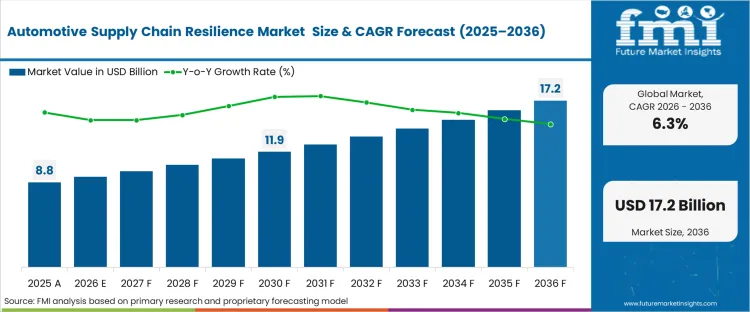
Growth enters a self-reinforcing cycle once the industry crosses the structural gate of multi-enterprise data inter operability. Currently, information silos between disparate ERP systems create lag times that mask emerging risks. Once OEMs and Tier-1 suppliers adopt unified data standards, the marginal cost of adding visibility to the next supplier tier drops significantly. This transition is being triggered by a collective realization that individual resilience is impossible without systemic transparency across the network, pushing the demand for automotive supply chain software.
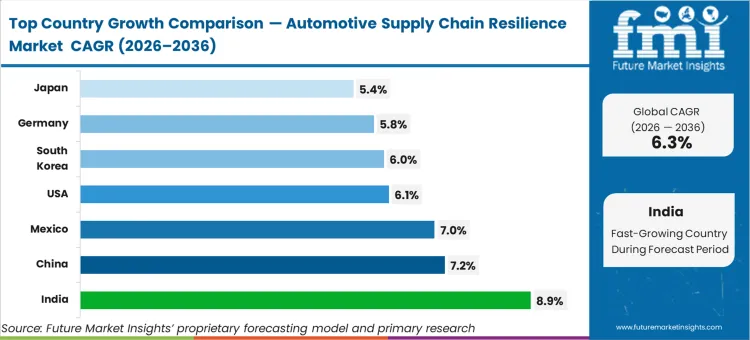
India's automotive sector is poised to record a CAGR of 8.9%, followed by China at 7.2% and Mexico at 7.0%. The United States market for resilience solutions is likely to post a CAGR of 6.1%, while South Korea is expected to see its industry grow at 6.0%. Germany is anticipated to increase by a CAGR of 5.8%, with Japan projected to witness growth at 5.4%. This geographic divergence reflects the varied pace of manufacturing localization; regions aggressively pursuing near-shoring strategies are digitizing their supply bases faster to manage the complexities of new, unproven local vendor networks.
Automotive Supply Chain Resilience Market Key Takeaways
| Metric | Details |
|---|---|
| Industry Size (2026) | USD 9.35 billion |
| Industry Value (2036) | USD 17.22 billion |
| CAGR (2026-2036) | 6.30% |
Source: Future Market Insights (FMI) analysis, based on proprietary forecasting model and primary research
Automotive Supply Chain Resilience Market Definition
This market includes logistics visibility software used for real-time tracking, digital twin platforms for scenario stress-testing, and supplier risk-scoring databases. It also covers professional services such as supply chain audit consulting, disaster recovery planning, and specialized insurance-linked risk management tools specifically designed for the complexities of automotive manufacturing workflows.
Automotive Supply Chain Resilience Market Exclusions
Excluded from this market are general-purpose ERP systems that lack specific risk-modeling modules, as well as standard warehouse management hardware. Functional exclusions also apply to generic cybersecurity software unless they are specifically integrated into a supply chain risk monitoring framework. These are excluded because they do not address the core functional requirement of anticipating and mitigating physical or structural supply network disruptions.
Automotive Supply Chain Resilience Market Research Methodology
- Primary Research: FMI interviewed Global Procurement Directors, Supply Chain Orchestration Leads, and Chief Risk Officers at major automotive OEMs and Tier-1 suppliers.
- Desk Research: Data was aggregated from international production statistics, regulatory filings regarding supply chain transparency, and procurement specification archives from the world’s leading automotive clusters.
- Market-Sizing and Forecasting: The baseline anchors to the total IT spend within the automotive procurement sector, triangulated against historical disruption-related loss data and subsequent technology investment cycles.
- Data Validation and Update Cycle: Forecasts were cross-validated using independent data streams from global freight movement indices and corporate sustainability reports that mandate supply chain disclosure.
Segmental Analysis
Automotive Supply Chain Resilience Market Analysis by Component
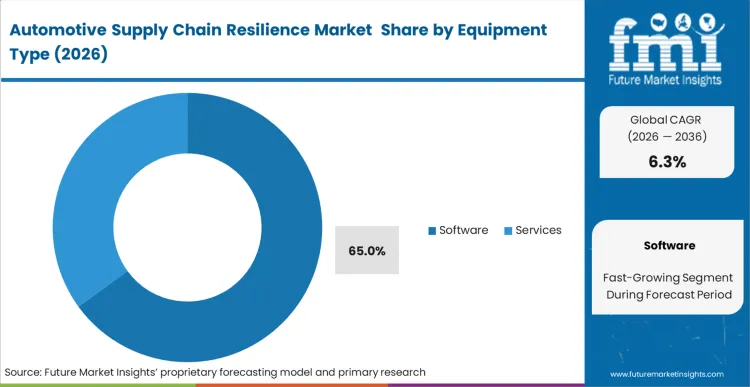
The reason software holds 65.0% of this market comes down to a single operational reality: human-led risk monitoring cannot scale to the thousands of nodes in a modern automotive network. This procurement software is not being purchased as a productivity tool, but as a survival mechanism that automates the detection of tier-three delays. FMI notes that as OEMs move toward electric platforms with simpler but more concentrated supply chains, the complexity of material sourcing increases. Buyers are prioritizing software that offers real-time mapping over traditional static databases. Organizations that fail to automate this monitoring layer find themselves perpetually in a reactive mode, paying high premiums for spot-market parts when preventable shortages occur.
- Automated Risk Triangulation: Algorithmic scanning of news, weather, and trade data allows logistics managers to identify potential bottlenecks before they manifest as physical delays.
- Digital Twin Simulation: Virtual replicas of the supply chain enable stress-testing of "what-if" scenarios, allowing planners to validate backup strategies without disrupting live operations.
- Interoperable Data Feeds: Cloud-native platforms aggregate fragmented information from disparate supplier ERPs into a single source of truth for procurement decision-makers.
Automotive Supply Chain Resilience Market Analysis by Deployment
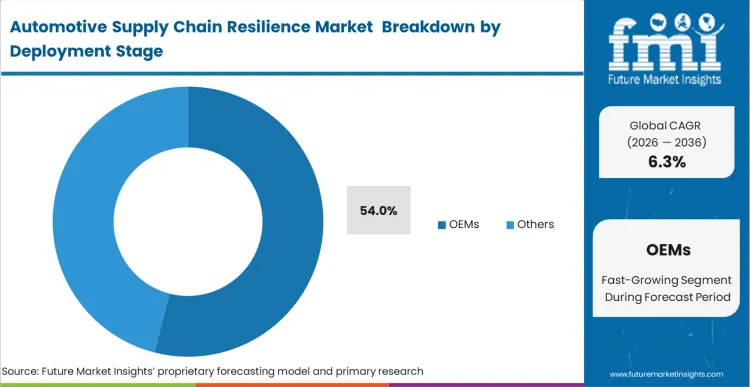
Cloud-based deployment has become a structural standard because resilience is a collaborative, not a solitary, effort. An on-premise solution may secure a single factory, but it cannot effectively ingest and process the live data streams required for logistics visibility across a global vendor base. OEMs are favoring cloud architectures for their ability to provide a "single pane of glass" view to stakeholders across multiple continents. This shift is driven by the need for rapid deployment; cloud systems can be stood up and integrated across a supplier network in a fraction of the time required for legacy installations. Those who cling to siloed, on-premise infrastructures face a growing information gap that leaves them blind to disruptions occurring outside their own immediate four walls.
- Network-Wide Accessibility: Cloud architectures ensure that regional logistics hubs and global headquarters are operating on the same real-time risk data simultaneously.
- Rapid Scalability: Manufacturers can onboard new supplier tiers or regional clusters onto the resilience platform without significant capital expenditure on local hardware.
- Elastic Computing Power: The high-velocity data processing required for predictive risk modeling is more cost-effectively managed in cloud environments than through localized servers.
Automotive Supply Chain Resilience Market Drivers, Restraints, and Opportunities
Automotive OEMs are moving away from a purely just-in-time supply model and putting more weight on resilience. The cost of even a short production stoppage has made supply continuity a much more serious priority. Procurement teams are now expected to show that sub-tier dependencies are visible and being monitored closely. This points to a broader change in capital allocation, where supply security is gaining importance alongside cost control.
A major barrier to wider adoption is the reluctance of lower-tier suppliers to share detailed sourcing information. OEMs want deeper visibility, yet many Tier-2 and Tier-3 suppliers still treat their vendor networks as commercially sensitive. Their concern is that greater disclosure could weaken margins or expose them to direct pressure from larger buyers. This makes the challenge partly organizational, not just technical. The market needs trusted data-sharing structures that support risk modeling without exposing sensitive commercial relationships. Until that becomes more common, many supply chains will continue to work with only partial visibility, which limits the full value of predictive analytics tools.
Opportunities in the Automotive Supply Chain Resilience Market
- Multi-Tier Supplier Mapping Services: Large OEMs are increasingly seeking specialized consultants to physically audit and digitally map their tertiary supply base to uncover hidden geographic concentrations of risk.
- Predictive Inbound Logistics: Integration of AI-driven transport management systems allows logistics providers to capture premiums by guaranteeing lead times through dynamic rerouting during port or border closures.
- Sustainability-Linked Resilience: Regulatory requirements for carbon tracking present an opportunity for vendors to bundle resilience mapping with ESG compliance, allowing buyers to capture two strategic outcomes through a single data architecture.
Regional Analysis
Based on the regional analysis, the Automotive Supply Chain Resilience market is segmented into North America, Latin America, Europe, East Asia, South Asia, Oceania, and Middle East & Africa across 40 plus countries.
.webp "Top Country Growth Comparison Automotive Supply Chain Resilience Market Cagr (2026 2036)")
| Country | CAGR (2026 to 2036) |
|---|---|
| India | 8.9% |
| China | 7.2% |
| Mexico | 7.0% |
| United States | 6.1% |
| South Korea | 6.0% |
| Germany | 5.8% |
| Japan | 5.4% |
Source: Future Market Insights (FMI) analysis, based on proprietary forecasting model and primary research
South Asia Automotive Supply Chain Resilience Market Analysis
Infrastructure-led growth defines South Asia's trajectory, as the region builds new automotive clusters that must compete with established global hubs. According to FMI's estimates, the adoption of supply chain analytics here is a prerequisite for participating in global value chains. The region is not just modernizing; it is leapfrogging legacy systems to attract OEMs who are diversifying away from East Asian concentration.
- India: India's rapid expansion as a global small-car export hub requires its local Tier-1 suppliers to meet stringent international standards for delivery reliability and part traceability. The market for resilience solutions in India is set to grow at a CAGR of 8.9% over the forecast period. Indian manufacturers who act now to digitize their sourcing networks gain a significant cost advantage in the high-volume, low-margin global export market.
North America Automotive Supply Chain Resilience Market Analysis
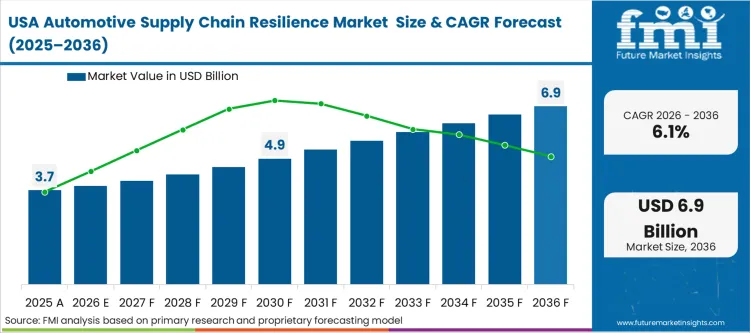
Buyer behavior-led dynamics shape the North American landscape, where the focus has pivoted toward near-shoring and regional robustness under trade agreements. FMI analysts opine that North American OEMs are increasingly using third party risk management as a competitive weapon to ensure product availability during volatile periods.
- Mexico: Mexico's transformation into a specialized hub for EV supply chain resilience necessitates a sophisticated digital infrastructure to manage the inbound flow of high-value electronics. Mexico is expected to see its resilience sector grow at a compound annual rate of 7.0%. Sourcing leads in Mexico capture preferred status with US-based OEMs by demonstrating a level of digital transparency that legacy suppliers cannot match.
- United States: The United States market for supply chain resilience is forecast to register a CAGR of 6.1%, as manufacturers integrate risk-modeling directly into their domestic production planning. US-based operators that prioritize these systems simplify their internal qualification processes, allowing for faster response times to market shifts.
East Asia Automotive Supply Chain Resilience Market Analysis
The regional analysis for the East Asia cluster, comprising China, South Korea, and Japan, is defined by a structural shift toward high-tech self-reliance and the integration of predictive analytics into some of the world’s most dense automotive manufacturing networks. According to FMI's assessment, these markets are moving beyond basic logistics tracking toward scenario planning & orchestration to mitigate risks associated with regional trade volatility and critical component dependencies.
- China: China’s pursuit of "Dual Circulation" creates a structural requirement for domestic suppliers to achieve digital transparency that allows for seamless switching between export and internal consumption lines. The market for resilience solutions in China is projected to grow at a CAGR of 7.2% as manufacturers adopt AI-driven transport management systems to navigate evolving regional trade corridors. Local Tier-1 suppliers that prioritize these systems capture significant commercial opportunities by becoming the "partners of choice" for global OEMs seeking stable, digitally-auditable production hubs.
- South Korea: The South Korean market is expected to witness growth at a CAGR of 6.0%, driven by the high concentration of global battery leaders who require specialized supplier quality & compliance software to manage sensitive material flows. For South Korean logistics operators, the adoption of cloud-based control towers is an operational outcome that allows them to maintain precision delivery schedules despite the rising frequency of global shipping disruptions.
- Japan: Japanese automotive sector is poised for a CAGR of 5.4% as legacy manufacturers integrate inventory management software with predictive analytics to evolve their traditional "Kanban" systems for a more volatile era. This structural trajectory signals a move toward "digital buffer stocks," where information transparency replaces physical excess, positioning Japanese buyers to respond to shocks faster than their less-integrated regional peers.
Europe Automotive Supply Chain Resilience Market Analysis
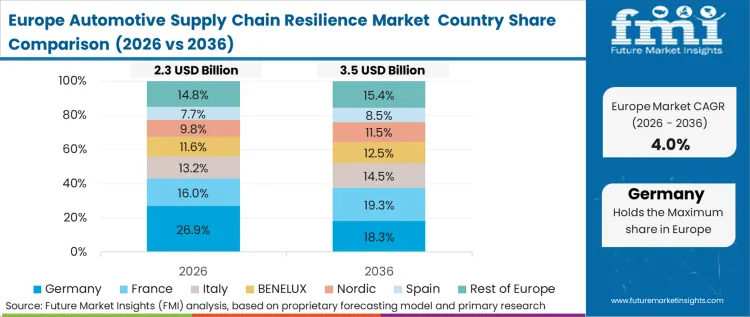
Policy-led shifts dominate European manufacturing, where recent legislation regarding supply chain due diligence forces a structural change in data collection. Based on FMI's assessment, the automotive logistics sector in Europe is integrating resilience tools primarily to meet these new compliance benchmarks while simultaneously protecting margins.
- Germany: The updated supply chain laws of Germany make deep-tier visibility a legal requirement, transforming resilience from an operational choice into a compliance mandate. The market for these solutions in Germany is likely to post a CAGR of 5.8%. Organizations that move first establish a structural trajectory that protects them from the heavy fines and reputational damage associated with unmapped supplier failures.
Competitive Aligners for Market Players
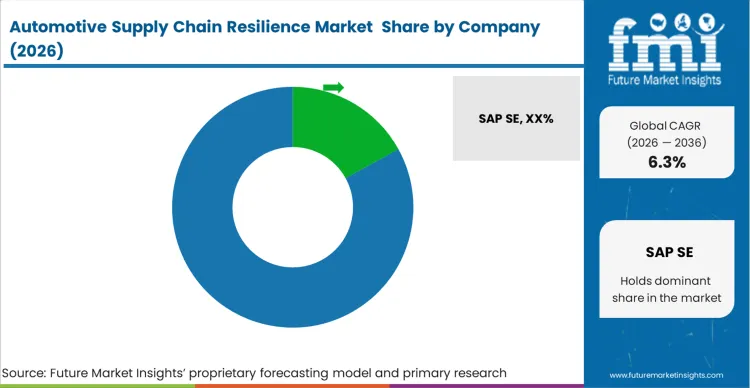
The automotive supply chain resilience market is moderately concentrated, with large software companies such as SAP and Oracle benefiting from their established presence inside OEM enterprise systems. Even so, buyers usually look beyond platform scale when making decisions. What matters more is the depth of supplier network data a vendor can already provide. Procurement teams place greater value on platforms that offer immediate visibility into global sub-supplier networks, since software alone has limited value without a strong underlying data foundation.
Companies such as Blue Yonder and Kinaxis also benefit from being more deeply embedded in the operating systems used by Tier-1 suppliers. That gives them an advantage in day-to-day workflow integration, especially when risk identification needs to connect directly with planning and production changes. Newer entrants often find it harder to compete at that level unless they bring clear strengths in more focused areas. FMI indicates that some of the more promising challengers are building relevance through supplier quality management niches that are still less fully covered by the larger platforms.
Buyer influence remains strong because major OEMs do not want to become too dependent on one software environment. Many are asking for API-first systems so resilience data can move more easily across different platforms. That keeps pressure on vendors to stay open while still trying to strengthen their own ecosystems. Over time, the market is likely to see more consolidation as larger platforms acquire niche risk-data providers to improve their predictive analytics capabilities.
Key Players in Automotive Supply Chain Resilience Market
- SAP SE
- Oracle Corporation
- Blue Yonder (Panasonic)
- Kinaxis Inc.
- project44
- Resilinc
- o9 Solutions, Inc.
- Coupa Software
- Infor
- E2open
Scope of the Report

| Metric | Value |
|---|---|
| Quantitative Units | USD 9.35 billion to USD 17.22 billion, at a CAGR of 6.30% |
| Market Definition | Software and services that enable automotive organizations to identify and mitigate risks across multi-tier supplier networks to ensure manufacturing continuity. |
| Component Segmentation | Software, Services |
| Deployment Segmentation | Cloud-based, On-premise, Hybrid |
| Application Segmentation | Supplier visibility & risk monitoring, Scenario planning & orchestration, Supplier quality & compliance, Inbound logistics control tower |
| Regions Covered | North America, Latin America, Europe, East Asia, South Asia, Oceania, Middle East & Africa |
| Countries Covered | India, China, Mexico, United States, South Korea, Germany, Japan, and 40 plus countries |
| Key Companies Profiled | SAP SE, Oracle Corporation, Blue Yonder, Kinaxis Inc., project44, Resilinc, o9 Solutions, Inc., Coupa Software, Infor, E2open |
| Forecast Period | 2026 to 2036 |
| Approach | Based on direct interviews with Global Procurement Leads and a multi-factor analysis of automotive IT spending patterns and disruption-related investment cycles. |
Source: Future Market Insights (FMI) analysis, based on proprietary forecasting model and primary research
Automotive Supply Chain Resilience Market Analysis by Segments
Component:
- Software
- Services
Deployment:
- Cloud-based
- On-premise
- Hybrid
Application:
- Supplier visibility & risk monitoring
- Scenario planning & orchestration
- Supplier quality & compliance
- Inbound logistics control tower
Region:
- Asia Pacific
- India
- China
- Japan
- South Korea
- Indonesia
- Australia & New Zealand
- ASEAN
- Rest of Asia Pacific
- Europe
- Germany
- Italy
- France
- United Kingdom
- Spain
- Benelux
- Nordics
- Central & Eastern Europe
- Rest of Europe
- North America
- United States
- Canada
- Mexico
- Latin America
- Brazil
- Argentina
- Chile
- Rest of Latin America
- Middle East & Africa
- Kingdom of Saudi Arabia
- United Arab Emirates
- South Africa
- Turkey
- Rest of Middle East & Africa
Bibliography
- ACEA. (2025, March 13). Economic and market report: Global and EU auto industry - full year 2024. European Automobile Manufacturers’ Association.
- Chen, X., Zhao, L., & Li, Y. (2025). Digital technology innovation, supply chain resilience and financial performance in auto parts manufacturing enterprises. PLOS ONE.
- NITI Aayog. (2025, April 11). Automotive industry: Powering India’s participation in global value chains. Government of India.
- International Renewable Energy Agency. (2024). Critical materials: Batteries for electric vehicles.
- USA Department of Energy. (2024, December). 2021-2024 four-year review of supply chains for the advanced batteries sector.
This bibliography is provided for reader reference. The full FMI report contains the complete reference list with primary source documentation.
This Report Addresses
- Market intelligence to support strategic decision making across supply chain visibility platforms, digital twin software, and risk-monitoring services
- Market size estimation and 10-year revenue forecasts from 2026 to 2036, supported by actual automotive IT procurement data
- Growth opportunity mapping across cloud-native architectures with emphasis on the structural gate of multi-tier data interoperability
- Segment and regional revenue forecasts covering India, China, and Mexico across the specialized near-shoring and EV transition contexts
- Competition strategy assessment including proprietary risk-data lakes and deep workflow integration as primary competitive variables
- Capability development tracking including real-time mapping, scenario stress-testing, and automated risk triangulation
- Market access analysis covering European supply chain due diligence laws and USMCA trade framework requirements
- Market report delivery in PDF, Excel, PPT, and interactive dashboard formats for executive strategy, procurement planning, and operational benchmarking use
Frequently Asked Questions
How large is the Automotive Supply Chain Resilience Market in 2025?What is the primary restraint on market growth?
The market was assessed at USD 8.8 billion in 2025. This figure represents the baseline investment in specialized risk-mitigation tools as OEMs move away from purely cost-focused sourcing.
What will the market be valued at by 2036?
The market is projected to reach USD 17.22 billion by 2036. This expansion signals a structural transition where resilience tech becomes a standard line item in every automotive IT budget.
What CAGR is projected for this market?
A CAGR of 6.30% is expected from 2026 to 2036. This rate reflects the multi-year cycle of digitizing complex, global sub-tier vendor networks across the traditional and EV sectors.
Which component leads the market?
Software leads with 65.0% share because the complexity of monitoring thousands of sub-tier nodes necessitates an automated, algorithmic approach that manual services cannot provide.
Which deployment segment is dominant?
Cloud-based deployment is dominant due to its ability to facilitate real-time data sharing across a global ecosystem of suppliers, which is a prerequisite for network-wide resilience.
Which end user segment accounts for the most demand?
OEMs lead because they bear the highest financial risk from production stoppages, making them the primary investors in the visibility tools required to protect their assembly lines.
What is the primary driver for rapid growth?
The driver is the transition from reactive crisis management to predictive analytics orchestration. Manufacturers are realizing that the cost of information is significantly lower than the cost of a line stoppage.
What is the primary restraint on market growth?
The "transparency paradox" among sub-tier suppliers who view their vendor lists as trade secrets creates a structural barrier to the deep-tier visibility that OEMs require.
Which country grows the fastest in this market?
India is the fastest-growing market at 8.9% CAGR. This is driven by the rapid build-out of new manufacturing clusters that are being designed with digital-first transparency as a core requirement.
How does the transition to EVs affect supply chain resilience?
EVs require entirely new and highly concentrated supply chains for battery minerals. This creates a structural need for deep-tier mapping to secure an EV supply chain resilience strategy.
What role does cloud technology play in resilience?
Cloud technology acts as the "connective tissue" that allows risk data to flow between OEMs and their tiers of suppliers instantly, eliminating the information lag that hides emerging disruptions.
How are large enterprises different from SMEs in this market?
Large enterprises focus on global orchestration and "control tower" deployments, while SMEs typically adopt these tools as a requirement for remaining qualified vendors on OEM approved lists.
Preview the report firsthand - request a free sample
Get SampleGet the brochure for pricing and purchase details.
Get PDFTable of Content
- Executive Summary
- Global Market Outlook
- Demand-side Trends
- Supply-side Trends
- Technology Roadmap Analysis
- Analysis and Recommendations
- Market Overview
- Market Coverage / Taxonomy
- Market Definition / Scope / Limitations
- Research Methodology
- Chapter Orientation
- Analytical Lens and Working Hypotheses
- Market Structure, Signals, and Trend Drivers
- Benchmarking and Cross-market Comparability
- Market Sizing, Forecasting, and Opportunity Mapping
- Research Design and Evidence Framework
- Desk Research Programme (Secondary Evidence)
- Company Annual and Sustainability Reports
- Peer-reviewed Journals and Academic Literature
- Corporate Websites, Product Literature, and Technical Notes
- Earnings Decks and Investor Briefings
- Statutory Filings and Regulatory Disclosures
- Technical White Papers and Standards Notes
- Government Statistics Portals and Public Data Releases
- Press Releases and Reputable Media Coverage
- Specialist Newsletters and Curated Briefings
- Sector Databases and Reference Repositories
- FMI Internal Proprietary Databases and Historical Market Datasets
- Subscription Datasets and Paid Sources
- Social Channels, Communities, and Digital Listening Inputs
- Additional Desk Sources
- Expert Input and Fieldwork (Primary Evidence)
- Primary Modes
- Qualitative Interviews and Expert Elicitation
- Quantitative Surveys and Structured Data Capture
- Blended Approach
- Why Primary Evidence is Used
- Field Techniques
- Interviews
- Surveys
- Focus Groups
- Observational and In-context Research
- Social and Community Interactions
- Stakeholder Universe Engaged
- C-suite Leaders
- Board Members
- Presidents and Vice Presidents
- R&D and Innovation Heads
- Technical Specialists
- Domain Subject-matter Experts
- Scientists
- Physicians and Other Healthcare Professionals
- Governance, Ethics, and Data Stewardship
- Research Ethics
- Data Integrity and Handling
- Primary Modes
- Tooling, Models, and Reference Databases
- Desk Research Programme (Secondary Evidence)
- Data Engineering and Model Build
- Data Acquisition and Ingestion
- Cleaning, Normalisation, and Verification
- Synthesis, Triangulation, and Analysis
- Quality Assurance and Audit Trail
- Market Background
- Market Dynamics
- Drivers
- Restraints
- Opportunity
- Trends
- Scenario Forecast
- Demand in Optimistic Scenario
- Demand in Likely Scenario
- Demand in Conservative Scenario
- Opportunity Map Analysis
- Product Life Cycle Analysis
- Supply Chain Analysis
- Investment Feasibility Matrix
- Value Chain Analysis
- PESTLE and Porter’s Analysis
- Regulatory Landscape
- Regional Parent Market Outlook
- Production and Consumption Statistics
- Import and Export Statistics
- Market Dynamics
- Global Market Analysis 2021 to 2025 and Forecast, 2026 to 2036
- Historical Market Size Value (USD Million) Analysis, 2021 to 2025
- Current and Future Market Size Value (USD Million) Projections, 2026 to 2036
- Y-o-Y Growth Trend Analysis
- Absolute $ Opportunity Analysis
- Global Market Pricing Analysis 2021 to 2025 and Forecast 2026 to 2036
- Global Market Analysis 2021 to 2025 and Forecast 2026 to 2036, By Equipment Type
- Introduction / Key Findings
- Historical Market Size Value (USD Million) Analysis By Equipment Type , 2021 to 2025
- Current and Future Market Size Value (USD Million) Analysis and Forecast By Equipment Type , 2026 to 2036
- Software
- Services
- Software
- Y-o-Y Growth Trend Analysis By Equipment Type , 2021 to 2025
- Absolute $ Opportunity Analysis By Equipment Type , 2026 to 2036
- Global Market Analysis 2021 to 2025 and Forecast 2026 to 2036, By Deployment Stage
- Introduction / Key Findings
- Historical Market Size Value (USD Million) Analysis By Deployment Stage, 2021 to 2025
- Current and Future Market Size Value (USD Million) Analysis and Forecast By Deployment Stage, 2026 to 2036
- OEMs
- Others
- OEMs
- Y-o-Y Growth Trend Analysis By Deployment Stage, 2021 to 2025
- Absolute $ Opportunity Analysis By Deployment Stage, 2026 to 2036
- Global Market Analysis 2021 to 2025 and Forecast 2026 to 2036, By End User
- Introduction / Key Findings
- Historical Market Size Value (USD Million) Analysis By End User, 2021 to 2025
- Current and Future Market Size Value (USD Million) Analysis and Forecast By End User, 2026 to 2036
- Cloud-Based
- Hybrid
- Others
- Cloud-Based
- Y-o-Y Growth Trend Analysis By End User, 2021 to 2025
- Absolute $ Opportunity Analysis By End User, 2026 to 2036
- Global Market Analysis 2021 to 2025 and Forecast 2026 to 2036, By Region
- Introduction
- Historical Market Size Value (USD Million) Analysis By Region, 2021 to 2025
- Current Market Size Value (USD Million) Analysis and Forecast By Region, 2026 to 2036
- North America
- Latin America
- Western Europe
- Eastern Europe
- East Asia
- South Asia and Pacific
- Middle East & Africa
- Market Attractiveness Analysis By Region
- North America Market Analysis 2021 to 2025 and Forecast 2026 to 2036, By Country
- Historical Market Size Value (USD Million) Trend Analysis By Market Taxonomy, 2021 to 2025
- Market Size Value (USD Million) Forecast By Market Taxonomy, 2026 to 2036
- By Country
- USA
- Canada
- Mexico
- By Equipment Type
- By Deployment Stage
- By End User
- By Country
- Market Attractiveness Analysis
- By Country
- By Equipment Type
- By Deployment Stage
- By End User
- Key Takeaways
- Latin America Market Analysis 2021 to 2025 and Forecast 2026 to 2036, By Country
- Historical Market Size Value (USD Million) Trend Analysis By Market Taxonomy, 2021 to 2025
- Market Size Value (USD Million) Forecast By Market Taxonomy, 2026 to 2036
- By Country
- Brazil
- Chile
- Rest of Latin America
- By Equipment Type
- By Deployment Stage
- By End User
- By Country
- Market Attractiveness Analysis
- By Country
- By Equipment Type
- By Deployment Stage
- By End User
- Key Takeaways
- Western Europe Market Analysis 2021 to 2025 and Forecast 2026 to 2036, By Country
- Historical Market Size Value (USD Million) Trend Analysis By Market Taxonomy, 2021 to 2025
- Market Size Value (USD Million) Forecast By Market Taxonomy, 2026 to 2036
- By Country
- Germany
- UK
- Italy
- Spain
- France
- Nordic
- BENELUX
- Rest of Western Europe
- By Equipment Type
- By Deployment Stage
- By End User
- By Country
- Market Attractiveness Analysis
- By Country
- By Equipment Type
- By Deployment Stage
- By End User
- Key Takeaways
- Eastern Europe Market Analysis 2021 to 2025 and Forecast 2026 to 2036, By Country
- Historical Market Size Value (USD Million) Trend Analysis By Market Taxonomy, 2021 to 2025
- Market Size Value (USD Million) Forecast By Market Taxonomy, 2026 to 2036
- By Country
- Russia
- Poland
- Hungary
- Balkan & Baltic
- Rest of Eastern Europe
- By Equipment Type
- By Deployment Stage
- By End User
- By Country
- Market Attractiveness Analysis
- By Country
- By Equipment Type
- By Deployment Stage
- By End User
- Key Takeaways
- East Asia Market Analysis 2021 to 2025 and Forecast 2026 to 2036, By Country
- Historical Market Size Value (USD Million) Trend Analysis By Market Taxonomy, 2021 to 2025
- Market Size Value (USD Million) Forecast By Market Taxonomy, 2026 to 2036
- By Country
- China
- Japan
- South Korea
- By Equipment Type
- By Deployment Stage
- By End User
- By Country
- Market Attractiveness Analysis
- By Country
- By Equipment Type
- By Deployment Stage
- By End User
- Key Takeaways
- South Asia and Pacific Market Analysis 2021 to 2025 and Forecast 2026 to 2036, By Country
- Historical Market Size Value (USD Million) Trend Analysis By Market Taxonomy, 2021 to 2025
- Market Size Value (USD Million) Forecast By Market Taxonomy, 2026 to 2036
- By Country
- India
- ASEAN
- Australia & New Zealand
- Rest of South Asia and Pacific
- By Equipment Type
- By Deployment Stage
- By End User
- By Country
- Market Attractiveness Analysis
- By Country
- By Equipment Type
- By Deployment Stage
- By End User
- Key Takeaways
- Middle East & Africa Market Analysis 2021 to 2025 and Forecast 2026 to 2036, By Country
- Historical Market Size Value (USD Million) Trend Analysis By Market Taxonomy, 2021 to 2025
- Market Size Value (USD Million) Forecast By Market Taxonomy, 2026 to 2036
- By Country
- Kingdom of Saudi Arabia
- Other GCC Countries
- Turkiye
- South Africa
- Other African Union
- Rest of Middle East & Africa
- By Equipment Type
- By Deployment Stage
- By End User
- By Country
- Market Attractiveness Analysis
- By Country
- By Equipment Type
- By Deployment Stage
- By End User
- Key Takeaways
- Key Countries Market Analysis
- USA
- Pricing Analysis
- Market Share Analysis, 2025
- By Equipment Type
- By Deployment Stage
- By End User
- Canada
- Pricing Analysis
- Market Share Analysis, 2025
- By Equipment Type
- By Deployment Stage
- By End User
- Mexico
- Pricing Analysis
- Market Share Analysis, 2025
- By Equipment Type
- By Deployment Stage
- By End User
- Brazil
- Pricing Analysis
- Market Share Analysis, 2025
- By Equipment Type
- By Deployment Stage
- By End User
- Chile
- Pricing Analysis
- Market Share Analysis, 2025
- By Equipment Type
- By Deployment Stage
- By End User
- Germany
- Pricing Analysis
- Market Share Analysis, 2025
- By Equipment Type
- By Deployment Stage
- By End User
- UK
- Pricing Analysis
- Market Share Analysis, 2025
- By Equipment Type
- By Deployment Stage
- By End User
- Italy
- Pricing Analysis
- Market Share Analysis, 2025
- By Equipment Type
- By Deployment Stage
- By End User
- Spain
- Pricing Analysis
- Market Share Analysis, 2025
- By Equipment Type
- By Deployment Stage
- By End User
- France
- Pricing Analysis
- Market Share Analysis, 2025
- By Equipment Type
- By Deployment Stage
- By End User
- India
- Pricing Analysis
- Market Share Analysis, 2025
- By Equipment Type
- By Deployment Stage
- By End User
- ASEAN
- Pricing Analysis
- Market Share Analysis, 2025
- By Equipment Type
- By Deployment Stage
- By End User
- Australia & New Zealand
- Pricing Analysis
- Market Share Analysis, 2025
- By Equipment Type
- By Deployment Stage
- By End User
- China
- Pricing Analysis
- Market Share Analysis, 2025
- By Equipment Type
- By Deployment Stage
- By End User
- Japan
- Pricing Analysis
- Market Share Analysis, 2025
- By Equipment Type
- By Deployment Stage
- By End User
- South Korea
- Pricing Analysis
- Market Share Analysis, 2025
- By Equipment Type
- By Deployment Stage
- By End User
- Russia
- Pricing Analysis
- Market Share Analysis, 2025
- By Equipment Type
- By Deployment Stage
- By End User
- Poland
- Pricing Analysis
- Market Share Analysis, 2025
- By Equipment Type
- By Deployment Stage
- By End User
- Hungary
- Pricing Analysis
- Market Share Analysis, 2025
- By Equipment Type
- By Deployment Stage
- By End User
- Kingdom of Saudi Arabia
- Pricing Analysis
- Market Share Analysis, 2025
- By Equipment Type
- By Deployment Stage
- By End User
- Turkiye
- Pricing Analysis
- Market Share Analysis, 2025
- By Equipment Type
- By Deployment Stage
- By End User
- South Africa
- Pricing Analysis
- Market Share Analysis, 2025
- By Equipment Type
- By Deployment Stage
- By End User
- USA
- Market Structure Analysis
- Competition Dashboard
- Competition Benchmarking
- Market Share Analysis of Top Players
- By Regional
- By Equipment Type
- By Deployment Stage
- By End User
- Competition Analysis
- Competition Deep Dive
- SAP SE
- Overview
- Product Portfolio
- Profitability by Market Segments (Product/Age /Sales Channel/Region)
- Sales Footprint
- Strategy Overview
- Marketing Strategy
- Product Strategy
- Channel Strategy
- Oracle Corporation
- Blue Yonder (Panasonic)
- Kinaxis Inc.
- project44
- Resilinc
- o9 Solutions, Inc.
- Coupa Software
- SAP SE
- Competition Deep Dive
- Assumptions & Acronyms Used


