

- Industry Size (2026)
- USD 525.1 Mn
- Forecast (2036)
- USD 732.0 Mn
- CAGR (2026 to 2036)
- 3.4%
Demand for Automotive Timing Chain and Belt in Japan Forecast and Outlook 2026 to 2036
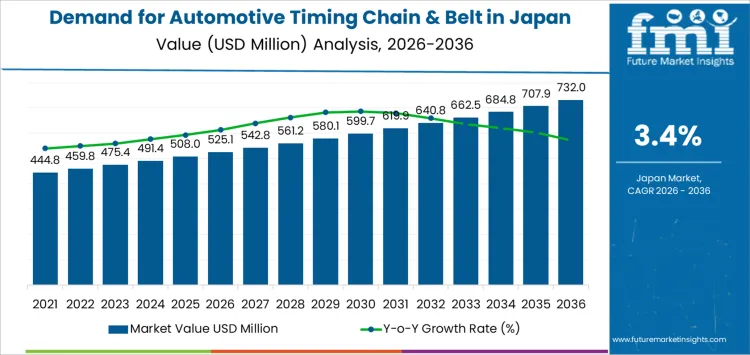
The demand for automotive timing chain and belt in Japan is valued at USD 525.1 million in 2026 and is projected to reach USD 732.0 million by 2036, reflecting a CAGR of 3.4%. The progression from 2020 to 2026 shows steady growth supported by consistent passenger car output and routine servicing needs across gasoline and diesel engines. Chains maintain a larger share due to durability and stable OEM installation rates. Early demand patterns reflect predictable maintenance cycles within Japan’s established vehicle fleet.
From 2027 onward, values rise from USD 542.8 million to USD 619.9 million by 2031, then move to USD 732.0 million by 2036 through incremental gains. Passenger cars remain the primary demand base, while aftermarket activity strengthens as vehicles reach higher mileage intervals. Belts retain a defined role in selected engine platforms with shorter replacement cycles. Light commercial and heavy commercial vehicles contribute stable secondary volumes. Growth remains tied to engine production schedules, part durability, and gradual increases in maintenance frequency across aging vehicle populations in Japan.
Quick Stats of the Demand for Automotive Timing Chain and Belt in Japan
- Demand for Automotive Timing Chain and Belt in Japan Value (2026): USD 525.1 million
- Demand for Automotive Timing Chain and Belt in Japan Forecast Value (2036): USD 732.0 million
- Demand for Automotive Timing Chain and Belt in Japan Forecast CAGR (2026-2036): 3.4%
- Demand for Automotive Timing Chain and Belt in Japan Leading Vehicle Type: Passenger Car (50%)
- Demand for Automotive Timing Chain and Belt in Japan Key Growth Regions: Kyushu & Okinawa, Kanto, Kansai
- Demand for Automotive Timing Chain and Belt in Japan Top Players: Tsubaki, Mitsuboshi Belting, BorgWarner Inc., Continental AG, Schaeffler AG, Tenneco Inc.
What is the Growth Forecast for Automotive Timing Chain & Belt in Japan through 2036?
Between 2026 and 2031, demand for automotive timing chain and belt in Japan increases from USD 525.1 million to USD 599.7 million, reflecting a gain of USD 74.6 million across five years. Growth during this period is shaped by routine maintenance cycles, steady replacement in aging passenger vehicles, and consistent production of internal combustion engine platforms. Earlier demand was supported by commuter vehicle usage, while near term progression reflects stable workshop activity and balanced domestic vehicle circulation.
From 2031 to 2036, demand rises from USD 599.7 million to USD 732.0 million, adding USD 132.3 million through the period. Expansion strengthens as hybrid vehicle adoption increases timing component requirements, and aftermarket servicing becomes more frequent due to extended ownership durations. Earlier growth relied on baseline replacement needs, while later gains are influenced by fleet aging, higher mileage accumulation, and the continued presence of combustion engine models within Japan’s vehicle mix despite broader electrification trends shaping long term transitions.
Automotive Timing Chain and Belt Industry in Japan Key Takeaways
| Metric | Value |
|---|---|
| Industry Value (2026) | USD 525.1 million |
| Forecast Value (2036) | USD 732.0 million |
| Forecast CAGR (2026-2036) | 3.4% |
What Is Driving the Demand for Automotive Timing Chains and Belts in Japan from 2026 to 2036?
Demand for automotive timing chains and belts in Japan has been supported by the country’s large vehicle production base and strong replacement market. Timing belts remain common in conventional petrol engines while many manufacturers use timing chains in modern engine designs. Replacement demand arose from routine maintenance schedules and periodic servicing across passenger cars, commercial vehicles, and light trucks. Buyers prioritised durability, noise performance, and compatibility with specific engine models. Domestic auto makers and aftermarket suppliers maintained close technical alignment, shaping procurement across dealer networks and independent garages.
From 2026 to 2036 demand is expected to reflect ongoing engine diversity, maintenance frequency, and powertrain transitions. Conventional internal combustion and hybrid vehicles will sustain replacement demand for both chains and belts as fleets age. Advanced timing chains designed for noise reduction and extended service life attract interest among premium and hybrid models. Timing belt demand continues in cost-focused segments where scheduled replacement intervals remain part of service plans. Forecast demand will depend on vehicle parc composition, service interval norms, and automotive maintenance behaviours across metropolitan and regional markets. Buyers weigh long term durability, serviceability, and cost when selecting components for scheduled maintenance and repair.
What Is the Demand for Automotive Timing Chain and Belt in Japan by Vehicle Type and Sales Channel for 2026 to 2036?
The demand for automotive timing chain and belt in Japan from 2026 to 2036 is shaped by long vehicle service life, stable passenger car ownership, and consistent maintenance requirements across aging fleets. Passenger cars lead by vehicle type because they represent the largest share of engines requiring scheduled belt replacement or chain system inspection. OEM channels lead by sales channel due to continuous production of new vehicles and platform based sourcing of timing drives. Procurement is driven by automotive manufacturers, engine system suppliers, and parts distributors. Import reliance remains present for precision chain links and high strength belt materials. Substitution pressure exists from chain to belt or belt to chain transitions depending on engine architecture.
Why do passenger cars account for 50% of the demand for automotive timing chain and belt in Japan by vehicle type from 2026 to 2036?
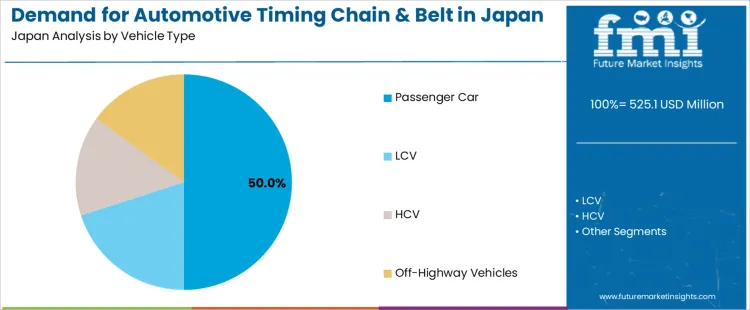
Passenger cars account for 50% of the demand for automotive timing chain and belt in Japan by vehicle type, reflecting their dominance in the national vehicle parc and continuous replacement cycles. Consumption intensity is driven by high mileage commuter usage, hybrid drivetrain growth, and extended ownership periods that increase timing system servicing. Usage remains stable because timing belt replacement and timing chain tensioning remain core engine maintenance tasks. Procurement is led by dealerships, independent workshops, and automotive component suppliers.
Passenger car timing systems generate steady repeat demand between 2026 and 2036 due to scheduled maintenance intervals and growing hybrid vehicle adoption. Repeat utilization remains predictable as maintenance schedules are clearly defined across models. Buyers favor components aligned with OEM material specifications to maintain reliability. Margin structure remains controlled through supplier consolidation and multiyear supply contracts. Regulatory exposure centers on emissions compliance and noise limits, influencing chain and belt design. Import reliance persists for advanced polymers, reinforcement fibers, and precision machined chain components. Substitution pressure from maintenance free chain concepts increases but does not eliminate belt applications across smaller engines.
Why does the OEM channel represent 70.0% of the demand for automotive timing chain and belt in Japan by sales channel?
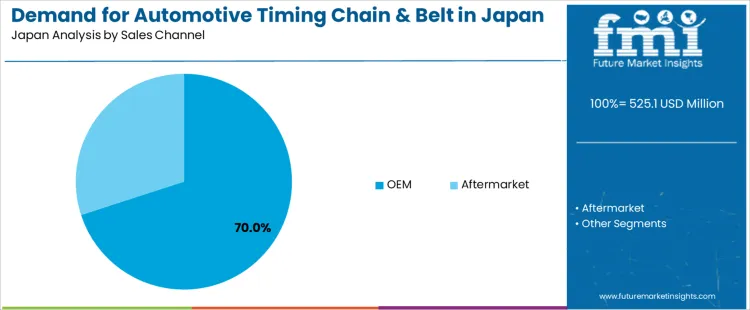
The OEM channel represents 70.0% of the demand for automotive timing chain and belt in Japan by sales channel, reflecting continuous new vehicle production and platform based sourcing of timing drives. Consumption intensity is driven by factory installed timing systems in passenger cars, light commercial vehicles, and selected heavy vehicles. Usage remains stable because each new engine requires complete timing assemblies. Procurement is dominated by automotive manufacturers and Tier 1 suppliers operating under long term agreements.
OEM linked demand remains consistent from 2026 to 2036 due to stable production planning and periodic model refresh cycles. Repeat utilization remains predictable as new engines replace older fleet segments. Buyers favor suppliers able to support synchronized production schedules and quality assurance programs. Margin structure remains controlled under volume based pricing and cost optimization initiatives. Regulatory exposure centers on compliance with fuel efficiency and emissions standards, influencing chain weight reduction and belt friction characteristics. Import reliance persists for high precision chain rollers and specialty elastomers. Substitution pressure from aftermarket channels remains limited due to the dominance of OEM installation in new vehicles.
What Is Driving the Demand for Automotive Timing Chain and Belt in Japan Across a Diversified and Aging Vehicle Fleet?
Demand for automotive timing chain and belt components in Japan grows through the coexistence of aging gasoline vehicles, expanding hybrid portfolios, and long ownership cycles. Timing systems face high duty from frequent short-trip driving, cold starts, and dense urban traffic that stresses chain guides and belt tension consistency. Independent workshops service older kei cars and compact sedans that continue operating well beyond ten years. Automakers maintain mixed timing architectures across engines, which sustains dual replacement streams. Demand follows fleet diversity, longevity expectations, and maintenance discipline rather than rapid electrification narratives that overlook Japan’s long-running internal combustion base.
How Are Hybrid Engines and Stop-Start Duty Cycles Reshaping Timing System Requirements in Japan?
Hybrid powertrains widely used in Japan cycle engines on and off repeatedly during urban driving. Each restart loads timing chains or belts with rapid torque pulses that accumulate wear. Systems must maintain phase accuracy under repeated warm-cold transitions and low-viscosity oil use. Belt-in-oil designs require stable lubrication control to prevent degradation. Workshops diagnose noise, stretch, and misalignment earlier in hybrids than in continuous-run engines. Automakers adjust material, coating, and damping specifications to suit Japanese driving profiles. Demand strengthens through hybrid upkeep patterns, urban commuting intensity, and long-term reliability expectations across compact and midsize vehicle classes nationwide.
Why Do Independent Workshops and Regional Service Networks Sustain Replacement Demand in Japan?
Independent garages across Japan handle high volumes of timing belt replacements on older kei cars, minivans, and regional delivery vehicles. These engines operate in mixed temperature zones where belts age differently under mountain cold or coastal humidity. Timing chain evaluation also rises as used vehicles circulate through secondary owners who prioritize preventive work before resale. Rural service networks maintain agricultural and small commercial fleets with long engine hours under irregular load. Replacement planning ties to mileage thresholds, noise inspections, or oil contamination signs. Demand persists through distributed workshop activity that maintains engines far beyond initial warranty periods.
What is the Demand for Automotive Timing Chain and Belt in Japan by Region?
| Region | CAGR (%) |
|---|---|
| Kyushu & Okinawa | 4.2% |
| Kanto | 3.9% |
| Kansai | 3.4% |
| Chubu | 3.0% |
| Tohoku | 2.6% |
| Rest of Japan | 2.5% |
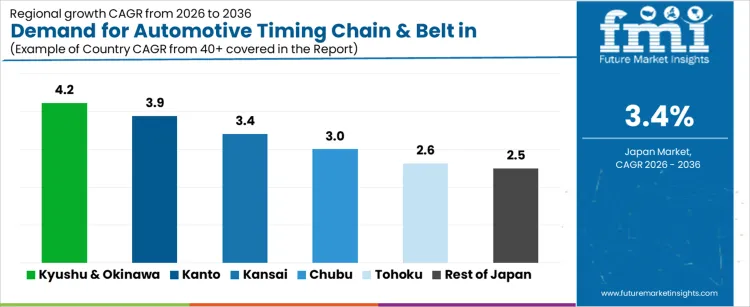
The demand for automotive timing chains and belts in Japan is increasing steadily across OEM production lines and the aftermarket, led by Kyushu and Okinawa at a 4.2% CAGR. Growth in this region is supported by active automotive assembly operations, commercial fleet servicing, and higher replacement cycles in humid operating environments. Kanto follows at 3.9%, driven by dense passenger vehicle ownership, periodic inspection requirements, and consistent servicing of aging vehicle fleets. Kansai records 3.4% growth, reflecting stable uptake across independent workshops and regional auto component distributors. Chubu at 3.0% shows moderate expansion tied to core automotive manufacturing hubs. Tohoku and the Rest of Japan, at 2.6% and 2.5%, reflect slower growth shaped by lower vehicle density, limited aftermarket activity, and extended replacement intervals.
How Is Engine Maintenance Activity Supporting Timing Chain and Belt Demand in Kyushu and Okinawa?
Demand for automotive timing chain and belt products in Kyushu and Okinawa is advancing at a CAGR of 4.2% from 2026 to 2036, supported by steady passenger vehicle ownership, routine engine servicing, and continuous repair center activity. Engines across compact cars, small vans, and regional transport vehicles require reliable timing components for synchronized operation. Workshops maintain consistent replacement cycles as vehicles accumulate mileage. Local driving patterns, mixed urban highway usage, and frequent short distance travel contribute to belt wear. Regional service providers maintain inventories of timing components to support predictable maintenance schedules across varied vehicle categories operating within island based transportation networks.
- Workshops handle routine timing component replacement
- Passenger cars generate consistent service demand
- Regional transport vehicles rely on stable timing systems
- Mileage accumulation shapes part replacement cycles
Why Are Urban Driving Patterns Influencing Timing Component Demand in Kanto?
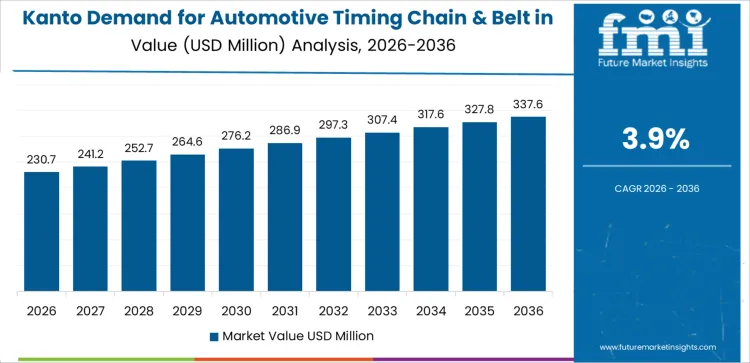
Demand for automotive timing chain and belt components in Kanto is increasing at a CAGR of 3.9% from 2026 to 2036, supported by dense traffic environments, high annual vehicle usage, and structured maintenance habits across service centers. Engines operating in congested zones experience sustained idling and stop start driving, raising long term wear on timing systems. Replacement demand reflects varied vehicle age groups across commuter fleets, commercial passenger services, and corporate mobility programs. Service workshops maintain planned inspection schedules as timing parts remain central to engine reliability. Kanto’s large vehicle population sustains ongoing requirements for timing chain and belt replacements in routine servicing.
- Stop start driving contributes to timing system wear
- High vehicle population supports steady demand
- Service centers maintain structured inspection routines
- Mixed fleet ages create varied replacement intervals
What Is Maintaining Steady Timing Component Usage Across Kansai?
Demand for automotive timing chain and belt products in Kansai is rising at a CAGR of 3.4% from 2026 to 2036, supported by manufacturing reliant commuting patterns, delivery fleets, and regional travel activity. Vehicles produce predictable wear across timing systems due to consistent engine loads and routine mileage accumulation. Workshops observe balanced replacement needs across compact cars, small commercial vehicles, and suburban commuter models. Timing component consumption reflects structured maintenance planning across independent garages and authorized service networks. Kansai’s roadway layouts, regional distribution routes, and sustained use of internal combustion vehicles contribute to ongoing timing chain and belt servicing requirements throughout the forecast period.
- Commuter vehicles require periodic timing system checks
- Delivery fleets generate ongoing replacement needs
- Suburban travel contributes to engine load cycles
- Workshops maintain steady part inventories
How Are Manufacturing Corridors Shaping Timing Component Demand in Chubu?
Demand for automotive timing chain and belt components in Chubu is progressing at a CAGR of 3.0% from 2026 to 2036, supported by automotive production zones, supplier clusters, and strong commuter activity. Engines used in regional travel patterns accumulate mileage that leads to predictable timing component servicing. Service centers observe consistent replacement cycles across small cars and commercial vehicles. Chubu’s industrial workforce contributes to daily commuting volumes, reinforcing regular engine operation across varied roadway conditions. Workshops prioritize reliable timing parts to support smooth engine synchronization. Replacement demand reflects planned maintenance habits, moderate fleet aging, and the continued use of combustion powered vehicles across regional mobility patterns.
- Industrial commuting shapes mileage accumulation
- Commercial vehicles rely on stable timing components
- Workshops conduct routine timing inspections
- Supplier networks support part availability
Which Factors Guide Timing Chain and Belt Usage Across Tohoku?
Demand for automotive timing chain and belt products in Tohoku is moving at a CAGR of 2.6% from 2026 to 2036, supported by regional travel distances, seasonal driving conditions, and localized fleet maintenance. Engines experience varied load cycles across rural and semi urban routes, shaping consistent wear patterns. Service facilities maintain timing component stocks to meet paced demand from passenger vehicles and light commercial fleets. Replacement occurs in alignment with mileage thresholds and inspection findings. Tohoku’s climate and variable road conditions contribute to regular maintenance needs where timing chains and belts remain essential for dependable engine synchronization across widespread transport networks.
- Rural travel influences engine usage patterns
- Seasonal conditions affect timing system wear
- Service centers maintain balanced inventories
- Fleet maintenance schedules guide replacements
How Are Local Transportation Patterns Sustaining Timing Component Demand in Rest of Japan?
Demand for automotive timing chain and belt components in Rest of Japan is increasing at a CAGR of 2.5% from 2026 to 2036, supported by small city travel, local delivery operations, and routine passenger vehicle usage. Engines across compact cars and community transport vehicles undergo continuous operation that leads to predictable wear on timing parts. Workshops conduct replacements following standard service intervals. Local fleets operate on consistent routes with steady mileage accumulation, creating a stable servicing rhythm. Timing components remain relevant for engine reliability in regions that depend on combustion powered vehicles for daily mobility, community logistics, and regional travel requirements.
- Local fleets require dependable timing systems
- Passenger vehicles follow routine service schedules
- Community transport shapes ongoing maintenance demand
- Workshops handle steady part replacement needs
What Is Driving the Demand for Automotive Timing Chain and Belt in Japan and Which Companies Shape OEM and Aftermarket Supply?
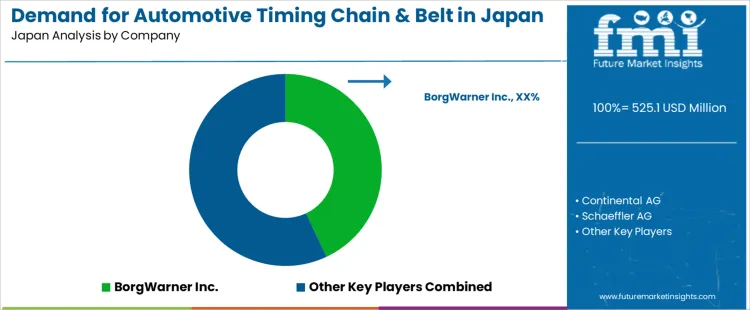
The demand for automotive timing chain and belt in Japan is shaped by steady output of passenger vehicles, continued use of internal combustion engines in hybrids, and routine replacement needs across national service networks. Tsubaki and Mitsuboshi Belting hold central domestic roles through chains and belts engineered for compact engines used by Japanese automakers. BorgWarner Inc. supports demand through chain systems supplied to global platforms assembled in Japan. Continental AG and Schaeffler AG participate through belt and tensioning components used in selected engine families.
System selection in Japan is governed by wear resistance, low noise operation, thermal stability, and long service intervals suited to urban driving. Tenneco Inc. contributes through valvetrain components that interact with timing systems in specific models. Buyer preference favors suppliers with domestic testing support, stable part availability, and documented performance on high mileage engines. Replacement demand aligns with inspection cycles, fleet maintenance schedules, and export oriented remanufacturing. Demand visibility tracks hybrid engine production, aging vehicle fleets in regional prefectures, and steady aftermarket activity across dealership and independent service networks.
Key Players in the Automotive Timing Chain and Belt Industry in Japan
- BorgWarner Inc.
- Continental AG
- Schaeffler AG
- Tenneco Inc.
Scope of the Report
| Items | Values |
|---|---|
| Quantitative Units (2026) | USD million |
| Type | Chain; Belt |
| Application | Passenger Car; Light Commercial Vehicle; Heavy Commercial Vehicle; Off-Highway Vehicles |
| End Users / Sales Channel | OEM; Aftermarket |
| Regions Covered | Kyushu and Okinawa; Kanto; Kansai; Chubu; Tohoku; Rest of Japan |
| Countries Covered | Japan |
| Key Companies Profiled | Tsubaki; Mitsuboshi Belting; BorgWarner Inc.; Continental AG; Schaeffler AG; Tenneco Inc. |
| Additional Attributes | Dollar sales by type and application; OEM versus aftermarket procurement structures; chain dominance in long-life platforms; belt replacement frequency in selected engines; import reliance for precision components; timing system wear factors under hybrid duty cycles; service interval alignment with inspection norms; aftermarket stocking patterns across regional workshops; specification drivers including noise control, thermal stability, and wear resistance. |
Automotive Timing Chain and Belt Industry in Japan Segmentation
Vehicle Type:
- Passenger Car
- LCV
- HCV
- Off-Highway Vehicles
Sales Channel:
- OEM
- Aftermarket
Product Type:
- Chain
- Belt
Engine Type:
- Gasoline
- Diesel
Region:
- Kyushu & Okinawa
- Kanto
- Kansai
- Chubu
- Tohoku
- Rest of Japan
Frequently Asked Questions
How big is the demand for automotive timing chain and belt in Japan in 2026?
The demand for automotive timing chain and belt in Japan is estimated to be valued at USD 525.1 million in 2026.
What will be the size of automotive timing chain and belt in Japan in 2036?
The market size for the automotive timing chain and belt in Japan is projected to reach USD 732.0 million by 2036.
How much will be the demand for automotive timing chain and belt in Japan growth between 2026 and 2036?
The demand for automotive timing chain and belt in Japan is expected to grow at a 3.4% CAGR between 2026 and 2036.
What are the key product types in the automotive timing chain and belt in Japan?
The key product types in automotive timing chain and belt in Japan are passenger car, lcv, hcv and off-highway vehicles.
Which sales channel segment is expected to contribute significant share in the automotive timing chain and belt in Japan in 2026?
In terms of sales channel, oem segment is expected to command 70.0% share in the automotive timing chain and belt in Japan in 2026.
Preview the report firsthand - request a free sample
Get SampleGet the brochure for pricing and purchase details.
Get PDFTable of Content
- Executive Summary
- Japan Market Outlook
- Demand-side Trends
- Supply-side Trends
- Technology Roadmap Analysis
- Analysis and Recommendations
- Market Overview
- Market Coverage / Taxonomy
- Market Definition / Scope / Limitations
- Market Background
- Market Dynamics
- Drivers
- Restraints
- Opportunity
- Trends
- Scenario Forecast
- Demand in Optimistic Scenario
- Demand in Likely Scenario
- Demand in Conservative Scenario
- Opportunity Map Analysis
- Product Life Cycle Analysis
- Supply Chain Analysis
- Investment Feasibility Matrix
- Value Chain Analysis
- PESTLE and Porter’s Analysis
- Regulatory Landscape
- Regional Parent Market Outlook
- Production and Consumption Statistics
- Import and Export Statistics
- Market Dynamics
- Japan Market Analysis 2020 to 2024 and Forecast, 2025 to 2035
- Historical Market Size Value (USD Million) Analysis, 2020 to 2024
- Current and Future Market Size Value (USD Million) Projections, 2025 to 2035
- Y-o-Y Growth Trend Analysis
- Absolute $ Opportunity Analysis
- Japan Market Pricing Analysis 2020 to 2024 and Forecast 2025 to 2035
- Japan Market Analysis 2020 to 2024 and Forecast 2025 to 2035, By Vehicle Type
- Introduction / Key Findings
- Historical Market Size Value (USD Million) Analysis By Vehicle Type , 2020 to 2024
- Current and Future Market Size Value (USD Million) Analysis and Forecast By Vehicle Type , 2025 to 2035
- Passenger Car
- LCV
- HCV
- Off-Highway Vehicles
- Y-o-Y Growth Trend Analysis By Vehicle Type , 2020 to 2024
- Absolute $ Opportunity Analysis By Vehicle Type , 2025 to 2035
- Japan Market Analysis 2020 to 2024 and Forecast 2025 to 2035, By Sales Channel
- Introduction / Key Findings
- Historical Market Size Value (USD Million) Analysis By Sales Channel, 2020 to 2024
- Current and Future Market Size Value (USD Million) Analysis and Forecast By Sales Channel, 2025 to 2035
- OEM
- Aftermarket
- Y-o-Y Growth Trend Analysis By Sales Channel, 2020 to 2024
- Absolute $ Opportunity Analysis By Sales Channel, 2025 to 2035
- Japan Market Analysis 2020 to 2024 and Forecast 2025 to 2035, By Product Type
- Introduction / Key Findings
- Historical Market Size Value (USD Million) Analysis By Product Type, 2020 to 2024
- Current and Future Market Size Value (USD Million) Analysis and Forecast By Product Type, 2025 to 2035
- Chain
- Belt
- Y-o-Y Growth Trend Analysis By Product Type, 2020 to 2024
- Absolute $ Opportunity Analysis By Product Type, 2025 to 2035
- Japan Market Analysis 2020 to 2024 and Forecast 2025 to 2035, By Engine Type
- Introduction / Key Findings
- Historical Market Size Value (USD Million) Analysis By Engine Type, 2020 to 2024
- Current and Future Market Size Value (USD Million) Analysis and Forecast By Engine Type, 2025 to 2035
- Gasoline
- Diesel
- Y-o-Y Growth Trend Analysis By Engine Type, 2020 to 2024
- Absolute $ Opportunity Analysis By Engine Type, 2025 to 2035
- Market Structure Analysis
- Competition Dashboard
- Competition Benchmarking
- Market Share Analysis of Top Players
- By Regional
- By Vehicle Type
- By Sales Channel
- By Product Type
- By Engine Type
- Competition Analysis
- Competition Deep Dive
- BorgWarner Inc.
- Overview
- Product Portfolio
- Profitability by Market Segments (Product/Age /Sales Channel/Region)
- Sales Footprint
- Strategy Overview
- Marketing Strategy
- Product Strategy
- Channel Strategy
- Continental AG
- Schaeffler AG
- Tenneco Inc.
- BorgWarner Inc.
- Competition Deep Dive
- Assumptions & Acronyms Used
- Research Methodology


