

- Industry Size (2026)
- USD 1.0 Bn
- Forecast (2036)
- USD 2.4 Bn
- CAGR (2026 to 2036)
- 9.4%
Battery Supply Chain Traceability Market Size, Market Forecast and Outlook By FMI
The battery supply chain traceability market stood at USD 0.9 billion in 2025. The market is projected to reach USD 1.0 billion in 2026 and expand to USD 2.4 billion by 2036. Growth during the forecast period corresponds to a CAGR of 9.4%.
Rising regulatory scrutiny across global battery value chains is creating strong demand for traceability platforms. Governments across North America, Europe, and Asia are enforcing stricter reporting requirements for raw material sourcing, manufacturing practices, and lifecycle transparency of lithium-ion batteries. Automakers and battery manufacturers must now document the origin of critical minerals such as lithium, cobalt, and nickel to comply with environmental and ethical sourcing mandates. Traceability technologies enable digital documentation of each stage in the supply chain, supporting compliance with evolving battery passport regulations and sustainability disclosures. As electric vehicle production scales rapidly, manufacturers are investing in traceability systems to maintain audit-ready supply networks.
Summary of Battery Supply Chain Traceability Market
- Battery Supply Chain Traceability Market Definition
- The market encompasses digital tracking solutions designed to document battery materials across automotive manufacturing operations, energy storage infrastructure, and battery recycling networks.
- Demand Drivers in the Market
- Battery passport mandates from regulatory bodies accelerate procurement of digital traceability infrastructure.
- Sustainability and responsible sourcing guidelines increase demand for platforms supporting raw material verification.
- Innovation in blockchain architecture enhances transparency and secures traceability records across battery supply networks.
- Key Segments Analyzed in the Report
- Technology Type: Blockchain-Based Systems (42%) versus sensor tracking and digital documentation platforms.
- Application: Electric Vehicle Batteries (44%) versus energy storage systems and consumer electronics segments.
- Geography: High-growth Asia Pacific versus regulated European and North American markets.
- Analyst Opinion at FMI
- Ronak Shah, Senior Consultant for Consumer Products at Future Market Insights, comments, “In the updated Battery Supply Chain Traceability Market Report for 2026 to 2036, stakeholders will find insights on cross-border data exchange requirements shaping traceability platform design. My assessment shows that regulatory alignment across jurisdictions influences system architecture, while data standardization protocols affect deployment timelines. Interoperability testing requirements may limit entry for solution providers targeting cost-sensitive battery manufacturers.”
- Strategic Implications/Executive Takeaways
- Shift emphasis from voluntary transparency initiatives toward mandatory regulatory compliance platforms.
- Position regulatory alignment partnerships as a central market catalyst rather than a secondary factor.
- Strengthen data security architecture to minimize system vulnerabilities and reinforce long-term stakeholder trust.
- Methodology
- Validated through direct regulatory filing data and battery production surveys.
- Zero reliance on speculative supply chain trend forecasting.
- Based on verifiable deployment metrics and verified compliance timelines.
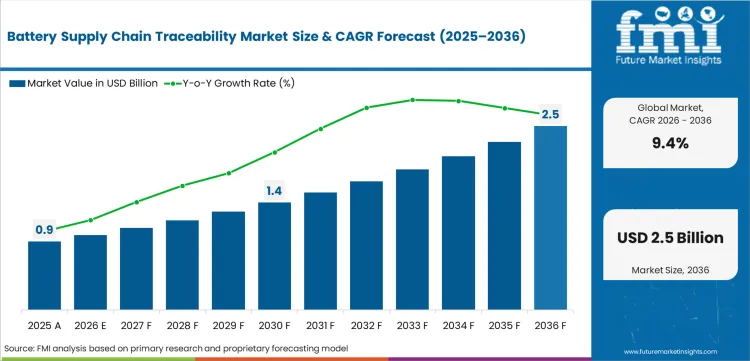
Battery Supply Chain Traceability Market Key Takeaways
| Metric | Value |
|---|---|
| Market Value (2026) | USD 1.0 billion |
| Market Forecast Value (2036) | USD 2.4 billion |
| Forecast CAGR (2026-2036) | 9.4% |
Source: FMI analysis based on proprietary forecasting model and primary research
Expansion of electric vehicle manufacturing is significantly increasing complexity across battery supply networks. Battery production involves multiple stages including mineral extraction, chemical processing, cell manufacturing, module assembly, and recycling operations. Each stage spans multiple geographies and suppliers, creating a fragmented supply ecosystem that requires strong monitoring capabilities. Traceability platforms allow companies to track battery materials, components, and performance data across this distributed supply chain. Digital platforms integrating blockchain, cloud databases, and QR code tracking allow real-time visibility into material flows and supplier activities. This capability supports production planning, risk management, and operational transparency for automakers and battery suppliers.
Growing emphasis on circular economy models in the battery sector is further accelerating adoption of supply chain traceability technologies. Governments and manufacturers are focusing on recovering valuable materials from end-of-life batteries to reduce dependence on virgin mining. Effective recycling requires detailed information on battery chemistry, material composition, and manufacturing history. Traceability systems provide digital records that support efficient battery collection, disassembly, and material recovery processes. Battery manufacturers and recycling firms are investing in digital identification systems and lifecycle data management tools to support large-scale battery reuse and recycling programs. These developments are positioning traceability infrastructure as a critical component of the global battery ecosystem. Companies are focusing on partnership deals to enhance their geographical footprint. [1]
Battery Supply Chain Traceability Market Definition
Battery supply chain traceability forms the foundation for documenting material provenance within battery manufacturing and recovery networks. Solutions focus on tracking battery components from raw material sourcing through end-of-life recycling processes. The market encompasses global development and deployment of digital traceability platforms supported by distributed ledger systems, sensor-based monitoring technologies, and automated documentation infrastructure designed to record battery material movements across supply chains.
Battery Supply Chain Traceability Market Inclusions
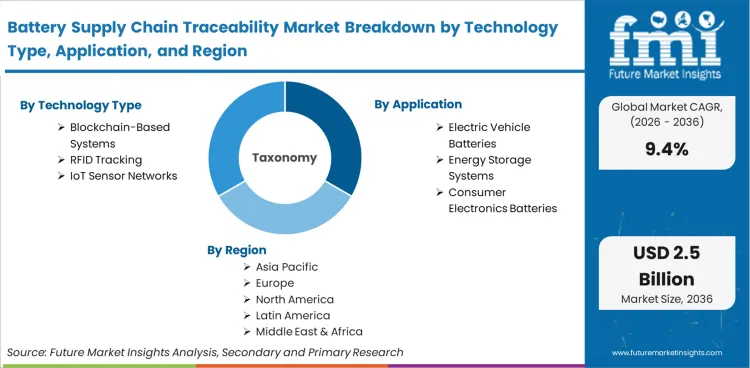
The report provides a detailed evaluation of market dynamics, presenting global and regional market size assessments in both volume and value terms, along with a ten-year forecast spanning 2026 to 2036. It delivers segment-level insights based on technology type including blockchain-based systems, RFID tracking, IoT sensor networks, and digital passport platforms. The analysis further examines applications across electric vehicle batteries, energy storage systems, consumer electronics batteries, and industrial battery applications, while assessing adoption among automotive manufacturers, battery producers, regulatory authorities, and recycling facilities.
Battery Supply Chain Traceability Market Exclusions
The analysis does not include inventory control software, standard enterprise resource planning systems, financial supply chain platforms, or logistics management tools. Equipment used for battery component testing, laboratory material verification services, and regulatory consulting offerings remain excluded. Market assessment centers on finished digital tracking technologies built for battery supply chain monitoring and regulatory documentation. Manual reporting frameworks and outdated traceability programs with limited digital connectivity do not form part of the evaluated market scope.
Battery Supply Chain Traceability Market Research Methodology
- Primary Research: Interviews were conducted with battery manufacturers, automotive procurement teams, traceability technology vendors, regulatory compliance officers, and mining association representatives across major markets. Supply chain consultants clarified data sharing protocols and integration requirements.
- Desk Research: Battery production data from manufacturing analytics platforms, regulatory compliance rates from government filings, and import/export statistics from customs databases supported market benchmarking.
- Market-Sizing and Forecasting: A hybrid top-down and bottom-up model was developed. Demand was reconstructed from technology deployment figures, battery production volumes, and regulatory implementation timelines, then validated against software licensing data and platform adoption rates.
- Data Validation and Update Cycle: Outputs undergo variance checks across manufacturing and regulatory datasets, cross-verification with automotive industry associations, and structured expert review prior to release.
Segmental Analysis
Battery Supply Chain Traceability Market Analysis by Technology Type
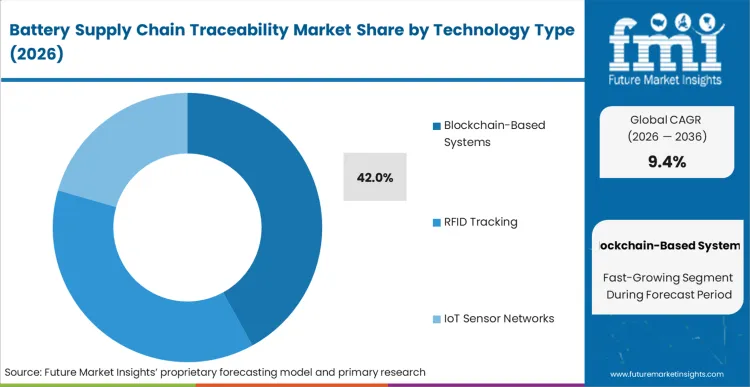
The blockchain-based systems segment is anticipated to register 42% share in 2026. Blockchain-based battery supply chain traceability systems are gaining strong demand due to the need for tamper-resistant data tracking across complex battery ecosystems. Battery supply chains involve numerous stakeholders including mineral producers, refiners, battery cell manufacturers, automotive OEMs, logistics providers, and recyclers. Traditional databases struggle to maintain consistent data integrity across such distributed networks. Blockchain technology creates a shared ledger where every transaction, shipment, and material movement is permanently recorded and verified.
- Decentralized Data Integrity Networks: Developers are deploying distributed ledger architectures that synchronize supply chain records across mining companies, refiners, battery manufacturers, and vehicle producers. Each transaction is encrypted and validated through consensus mechanisms that prevent unauthorized modification of supply chain data. This structure maintains trusted data consistency even when multiple organizations contribute operational information simultaneously. The system strengthens traceability reliability across geographically dispersed battery production and logistics networks.
- Real-Time Transaction Transparency Systems: Blockchain traceability platforms enable instant recording of material transfers, shipment confirmations, and production milestones across battery manufacturing stages. Participants across the supply chain can access synchronized records without relying on centralized data intermediaries. This transparency improves coordination between raw material suppliers, battery cell manufacturers, and automotive OEM procurement teams. Continuous transaction visibility helps manufacturers identify supply disruptions, verify supplier performance, and maintain stable battery production planning.
Battery Supply Chain Traceability Market Analysis by Application
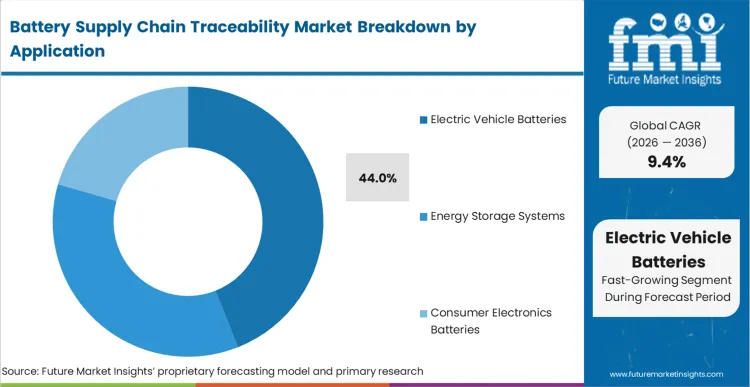
The electric vehicle batteries segment is poised to register a 44% market share in 2026. Regulatory compliance requirements across major automotive markets are increasing the importance of traceability systems for electric vehicle batteries. Governments in regions such as Europe and North America are introducing battery passport frameworks and sustainability reporting rules that require manufacturers to disclose battery composition, sourcing information, and lifecycle data. Traceability systems allow companies to capture and store verified information at every stage of battery production. These digital records support compliance reporting, certification audits, and sustainability disclosures required for electric vehicle market access.
- Battery Passport Data Infrastructure: Automakers and battery manufacturers are deploying digital identity systems that assign unique identifiers to each electric vehicle battery. These systems store detailed information on battery chemistry, manufacturing origin, and component suppliers throughout the production cycle. Centralized lifecycle records help manufacturers prepare regulatory documentation required for vehicle sales across multiple international markets.
- Cross-Border Compliance Reporting Systems: Traceability platforms enable manufacturers to consolidate sourcing, production, and logistics data required for regulatory disclosures. Governments increasingly require verified information on mineral sourcing practices and battery lifecycle management before granting market entry approvals. These systems allow companies to generate standardized compliance reports for automotive regulators and environmental agencies.
Battery Supply Chain Traceability Market Drivers, Restraints, and Opportunities
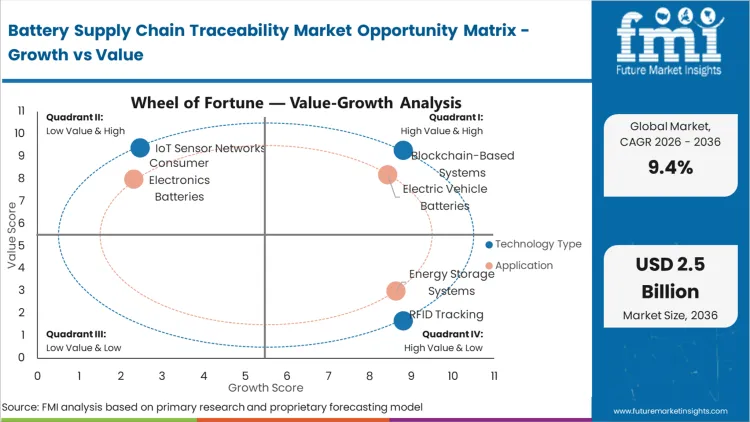
Growing global production of lithium-ion batteries is driving demand for battery supply chain traceability platforms. Electric vehicle manufacturing, stationary energy storage projects, and consumer electronics industries are increasing procurement of lithium, cobalt, nickel, and graphite from multiple international sources. Manufacturers require reliable systems that monitor material movement from mining operations to battery cell production facilities. Traceability platforms enable companies to verify supplier practices, document material origin, and maintain operational transparency across multi-tier supply chains. Automotive OEMs and battery producers increasingly deploy digital monitoring infrastructure to strengthen procurement governance and reduce risks linked to supply disruption, material substitution, and inconsistent supplier documentation.
Despite strong demand, the market faces certain restraints related to system integration complexity and implementation cost. Battery supply chains involve numerous participants operating across different digital infrastructures and data management standards. Integrating traceability platforms with legacy enterprise resource planning systems, logistics databases, and supplier reporting networks often requires significant technical investment. Smaller mining companies and component suppliers may lack the resources required to deploy advanced digital traceability tools. Data standardization challenges across international jurisdictions can slow adoption of unified tracking platforms. These barriers may delay large-scale deployment, particularly within fragmented supplier networks operating across emerging mining regions and mid-tier battery component manufacturing clusters.
The market presents strong opportunities due to rising interest in circular battery economy initiatives. Governments and automotive companies are promoting battery recycling and second-life energy storage programs to recover valuable metals and reduce reliance on new mineral extraction. Traceability systems allow manufacturers and recyclers to identify battery chemistry, production history, and ownership records throughout the battery lifecycle. This information supports efficient collection, dismantling, and material recovery operations for end-of-life batteries. Digital battery passports and lifecycle data platforms are becoming essential tools for large-scale recycling infrastructure. Expanding recycling ecosystems create new opportunities for traceability providers to support battery reuse, sustainability reporting, and regulatory compliance frameworks.
Regional Analysis
Based on regional analysis, the battery supply chain traceability market is segmented into North America, Latin America, Europe, East Asia, South Asia, Oceania and Middle East & Africa across 40 countries. The full report also offers market attractiveness analysis based on regional trends.
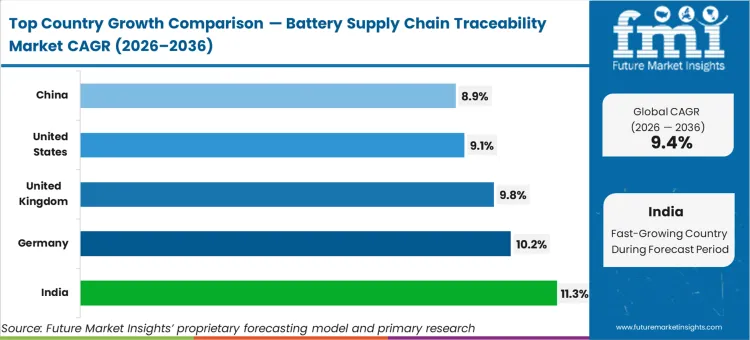
.webp "Top Country Growth Comparison Battery Supply Chain Traceability Market Cagr (2026 2036)")
| Country | CAGR (2026 to 2036) |
|---|---|
| United States | 9.1% |
| United Kingdom | 9.8% |
| Germany | 10.2% |
| China | 8.9% |
| India | 11.3% |
Source: Market analysis based on proprietary forecasting model and primary research
North America Battery Supply Chain Traceability Market Analysis
North America battery supply chain traceability market is expanding due to rapid growth in electric vehicle manufacturing and battery production investments. [2] Automotive manufacturers and battery cell producers across the United States are building large-scale battery gigafactories to support domestic electric vehicle production targets. These facilities require strong monitoring systems that track raw materials, battery components, and supplier networks across multiple production stages. Traceability platforms provide digital records of material sourcing, shipment tracking, and manufacturing data that support operational visibility across battery ecosystems. Companies operating in the region increasingly adopt these systems to strengthen supply chain transparency and maintain stable battery production operations.
- United States: Demand for battery supply chain traceability in the United States is projected to grow at 9.1% CAGR from 2026 to 2036. The growing focus on battery recycling and material recovery programs in the United States is creating demand for traceability infrastructure. Recycling companies are investing in facilities capable of extracting valuable metals from end-of-life electric vehicle batteries. Efficient recycling operations depend on accurate information regarding battery chemistry, component structure, and production history. Traceability systems provide digital records that allow recyclers to identify battery materials and determine suitable recovery processes.
The study offers in-depth analysis of growth across the North American region, including country-specific insights for the United States and Canada. It highlights regulatory compliance developments, shifts in traceability technology deployment, and market progression across various platform types and implementation models.
Europe Battery Supply Chain Traceability Market Analysis
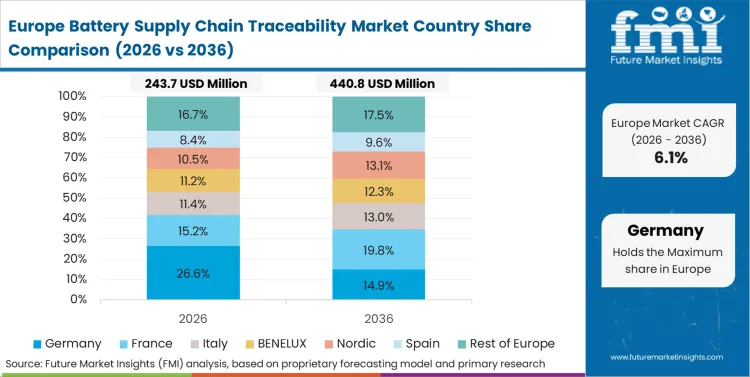
Europe battery supply chain traceability market is gaining momentum due to increasing investment in regional battery manufacturing hubs. Several European countries are supporting the establishment of large-scale battery production facilities to reduce dependence on imported battery components. These manufacturing ecosystems require advanced monitoring systems that track raw material sourcing, battery component movement, and supplier participation across multiple production stages. Traceability platforms allow manufacturers to maintain transparent records covering mineral procurement, refining activities, and cell manufacturing processes.
- Germany: Demand for battery supply chain traceability in Germany is slated to grow at 10.2% CAGR during the forecast period. The presence of large automotive engineering and battery research ecosystems in Germany is strengthening demand for traceability technologies. Automotive manufacturers collaborate with battery cell developers, technology firms, and material suppliers to build advanced battery manufacturing capabilities. This collaborative ecosystem involves numerous suppliers contributing components, chemicals, and battery materials across the value chain.
- United Kingdom: The UK battery supply chain traceability market is anticipated to expand at 9.8% CAGR during the study period. The country’s focus on responsible battery sourcing and smart mobility is encouraging adoption of traceability technologies. Government initiatives supporting battery manufacturing and low-emission transport require companies to maintain transparency across battery supply networks. Automotive manufacturers and battery suppliers are increasingly required to document the origin of critical minerals and demonstrate sustainable sourcing practices.
The European battery supply chain traceability market assessment includes country-specific insights across the United Kingdom, Germany, France, Italy, Spain, the Netherlands, and Scandinavia. It examines regulatory policy structures and evolving adoption of compliance verification technologies throughout the European market.
Asia Pacific Battery Supply Chain Traceability Market Analysis
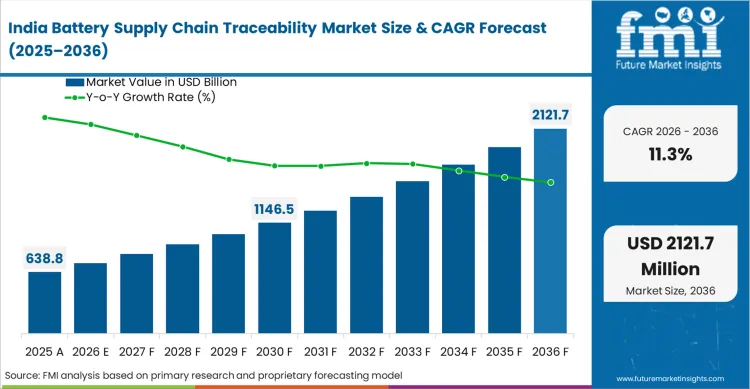
Rapid expansion of electric vehicle manufacturing across Asia Pacific is a key factor driving adoption of traceability infrastructure. Automotive manufacturers are significantly increasing electric vehicle production to meet government electrification targets and growing consumer demand. Battery supply chains supporting these vehicles involve numerous material suppliers, chemical processors, and battery component manufacturers operating across several countries. Traceability systems allow companies to document the origin of battery materials, monitor supplier compliance, and maintain accurate production records.
- China: The Chinese battery supply chain traceability market is poised to expand at 8.9% CAGR during the study period. This can be attributed to the country’s dominant position in global battery manufacturing and electric vehicle production. China hosts a large concentration of battery cell manufacturers and electric vehicle producers that depend on extensive networks of material suppliers and chemical processors. Companies involved in battery production require strong monitoring systems that track lithium, cobalt, nickel, and graphite sourcing across multiple supply stages. Traceability platforms allow manufacturers to document mineral origin, supplier certifications, and battery component movement throughout the production cycle.
- India: Demand for battery supply chain traceability in India is anticipated to grow at 11.3% CAGR during the study period. Government programs promoting domestic battery manufacturing are encouraging the adoption of supply chain traceability systems. [3] National initiatives supporting advanced chemistry cell production and electric vehicle adoption require manufacturers to maintain transparent battery supply networks.
The full report evaluates the battery supply chain traceability market across East and South Asia from 2021 to 2036. It examines regulatory framework progression, technology deployment patterns, and evolving data protocol practices across China, Japan, South Korea, India, Indonesia, and Australia. The study outlines compliance strategy models influencing market adoption across the region.
Competitive Landscape for Battery Supply Chain Traceability Market Players
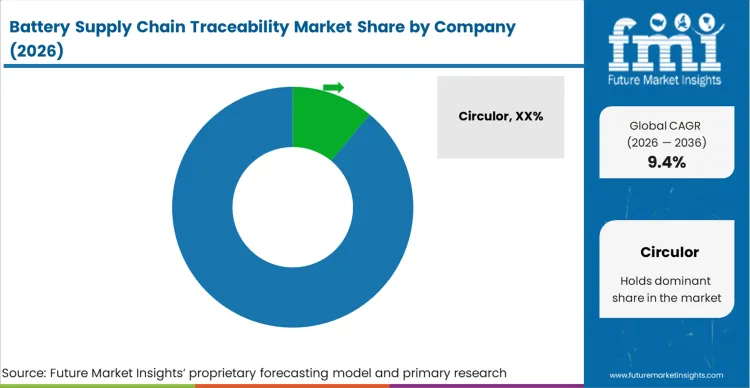
The battery supply chain traceability market features a mix of technology platform providers, blockchain infrastructure developers, enterprise software companies, and supply chain analytics firms. Market participants focus on building digital platforms that allow manufacturers to track raw materials, battery components, and lifecycle data across complex global supply networks. Companies are investing in advanced data management systems, blockchain architecture, and cloud-based monitoring tools that enable secure recording of supplier activities, production data, and logistics movements. These platforms are designed to support battery manufacturers, automotive OEMs, and recycling companies seeking reliable traceability infrastructure for large-scale battery production ecosystems.
Technology providers in this market are expanding platform capabilities through partnerships with automotive manufacturers, battery cell producers, and mineral sourcing companies. Collaborative ecosystems allow platform developers to integrate blockchain infrastructure, digital battery identity systems, and real-time logistics tracking tools within a unified traceability framework. Firms are also strengthening interoperability features so traceability platforms can connect with enterprise resource planning systems, supplier management tools, and regulatory reporting databases. These capabilities help manufacturers consolidate supply chain data while maintaining secure and transparent monitoring across multiple supplier tiers.
Companies competing in this sector are focusing on improving scalability and regulatory compatibility of traceability platforms. As battery production increases globally, manufacturers require digital systems capable of processing large volumes of supply chain data across international operations. Traceability providers are developing flexible platforms that support battery passport documentation, sustainability reporting, and lifecycle data management.
Key Players in Battery Supply Chain Traceability Market
- Circulor
- IBM Corporation
- SAP SE
- Everledger
- Minespider
- RCS Global
- Transparency-One
- Sourcemap Inc.
- Siemens AG
- Oracle Corporation
Scope of the Report
| Metric | Value |
|---|---|
| Quantitative Units | USD 1.0 billion (2026) to USD 2.4 billion (2036), at a CAGR of 9.4% |
| Market Definition | The battery supply chain traceability market comprises the global development, deployment, and operation of digital tracking platforms including blockchain systems, sensor networks, and documentation software designed for battery material verification across production and recycling applications. |
| Technology Type Segmentation | Blockchain-Based Systems, RFID Tracking, IoT Sensor Networks, Digital Passport Platforms |
| Application Coverage | Electric Vehicle Batteries, Energy Storage Systems, Consumer Electronics Batteries, Industrial Battery Applications |
| End User Segmentation | Automotive Manufacturers, Battery Producers, Regulatory Authorities, Recycling Facilities |
| Regions Covered | North America, Latin America, Europe, East Asia, South Asia, Oceania, Middle East and Africa |
| Countries Covered | United States, United Kingdom, Germany, China, India and 40 countries |
| Key Companies Profiled | Circulor, IBM Corporation, SAP SE, Everledger, Minespider, RCS Global, Transparency-One, Sourcemap Inc., Siemens AG, Oracle Corporation |
| Forecast Period | 2026 to 2036 |
| Approach | Hybrid top down and bottom up market modeling validated through regulatory compliance tracking and battery production surveys, supported by technology deployment verification and implementation timeline analysis |
Battery Supply Chain Traceability Market Analysis by Segments
Technology Type
- Blockchain-Based Systems
- RFID Tracking
- IoT Sensor Networks
- Digital Passport Platforms
Application
- Electric Vehicle Batteries
- Energy Storage Systems
- Consumer Electronics Batteries
- Industrial Battery Applications
End User
- Automotive Manufacturers
- Battery Producers
- Regulatory Authorities
- Recycling Facilities
- Others (mining operations, certification bodies)
Region
- North America
- United States
- Canada
- Europe
- United Kingdom
- Germany
- France
- Italy
- Spain
- Netherlands
- Scandinavia
- Switzerland
- Rest of Europe
- Asia Pacific
- China
- Japan
- South Korea
- India
- Indonesia
- Australia
- Thailand
- Rest of Asia Pacific
- Latin America
- Brazil
- Mexico
- Chile
- Rest of Latin America
- Middle East & Africa
- United Arab Emirates
- Saudi Arabia
- South Africa
- Israel
- Rest of Middle East & Africa
Bibliography
- [1] Circulor. (2025, May 28). Acculon Energy partners with Circulor and Rockwell Automation to enhance supply chain transparency in energy storage. Circulor.
- [2] U.S. Department of Energy. (2024). U.S. Department of Energy announces $131 million to boost America’s battery supply chain. U.S. Department of Energy.
- [3] Press Information Bureau, Government of India. (2026). Production Linked Incentive (PLI) scheme on National Programme on Advanced Chemistry Cell (ACC) battery storage. Press Information Bureau.
This bibliography is provided for reader reference and is not exhaustive. The full report contains the complete reference list and detailed citations.
This Report Addresses
- Market intelligence to enable strategic decision making across established and emerging battery production markets
- Market size estimation and 10-year revenue forecasts from 2026 to 2036, supported by validated regulatory compliance data and battery production surveys
- Growth opportunity mapping across technology types and application segments with emphasis on regulatory alignment
- Segment and regional revenue forecasts covering blockchain systems, sensor networks, digital passports, and automotive deployment networks
- Competition strategy assessment including regulatory partnership requirements, data protocol compatibility positioning, and compliance standard adoption
- Product development tracking including distributed ledger innovations, real-time monitoring integration trends, and multi-party verification capabilities
- Market access analysis covering automotive partnerships, regulatory authority engagement, and mining operation integration programs
- Market report delivery in PDF, Excel, PPT, and interactive dashboard formats for executive and operational use
Frequently Asked Questions
How large is the demand for Battery Supply Chain Traceability in the global market in 2026?
Demand for Battery Supply Chain Traceability in the global market is estimated to be valued at USD 1.0 billion in 2026.
What will be the market size of Battery Supply Chain Traceability in the global market by 2036?
Market size for Battery Supply Chain Traceability is projected to reach USD 2.4 billion by 2036.
What is the expected demand growth for Battery Supply Chain Traceability in the global market between 2026 and 2036?
Demand for Battery Supply Chain Traceability in the global market is expected to grow at a CAGR of 9.4% between 2026 and 2036.
Which Technology Type is poised to lead global sales by 2026?
Blockchain-Based Systems is expected to be the dominant technology type, capturing approximately 42.0% of global market share in 2026 due to immutable record features and distributed verification architecture.
How significant is the role of Electric Vehicle Batteries in driving Battery Supply Chain Traceability adoption in 2026?
Electric vehicle batteries represent a primary application segment, projected to hold approximately 44% share of the total market in 2026 as regulatory compliance requirements and material sourcing verification maintain segment relevance.
What is Driving Battery Supply Chain Traceability Demand in the European Union?
Battery passport implementation and increased material sourcing verification requirements across automotive categories are driving growth.
What Regulatory Trends are Referenced for the European Union?
Battery passport regulations and forced labor prevention requirements are referenced as key compliance framework developments.
What is the European Union Growth Outlook in this Report?
The European Union is projected to grow at a CAGR of 10.2% during 2026 to 2036.
Why is North America described as Important for Compliance Development in this Report?
Growth is driven by forced labor prevention laws and critical mineral sourcing requirements that establish mandatory verification specifications.
What Type of Platform Development Dominates in North America?
Regulatory-aligned tracking systems with import compliance documentation and government procurement verification dominates regional market segments.
What is the United States Growth Outlook in this Report?
The United States is projected to expand at a CAGR of 9.1% during 2026 to 2036.
Does the Report Cover China in its Regional Analysis?
China is included within East Asia under the regional scope of analysis.
What are the Sources referred to for analyzing the Market in China?
Battery production data, recycling mandate statistics, and domestic platform performance tracking covering deployment patterns, cost analysis, and regulatory compliance evolution are cited as primary reference sources.
What is the Main Development Theme Linked to China in Asia Coverage?
Asia Pacific development is associated with domestic battery recycling mandates enabling platform standardization across manufacturing centers.
Does the Report Cover India in its Regional Analysis?
India is included within South Asia under the regional coverage framework.
What is the Main India Related Development Theme in Asia Coverage?
Battery manufacturing incentive programs creating foundation for traceability adoption and local development using cost-effective deployment methods is emphasized.
Which Technology Strategies are Strategically Important for Asia Pacific Market Entry?
Regulatory authority partnerships and automotive manufacturer engagement programs are prioritized for cost-effective platform deployment across regional markets.
What is Battery Supply Chain Traceability and What is It Mainly Used For?
Battery supply chain traceability involves digital tracking and verification systems primarily used for battery material documentation including automotive production, energy storage deployment, and recycling operations.
What does Battery Supply Chain Traceability Market Mean in this Report?
Battery supply chain traceability market refers to global development, deployment, and operation of digital platforms across various application categories and compliance segments.
What is Included in the Scope of this Battery Supply Chain Traceability Market Report?
Scope covers platforms by technology type, key applications such as electric vehicle batteries and energy storage systems, and end user segments including automotive manufacturers, battery producers, and regulatory authorities.
What is Excluded from the Scope of this Report?
Basic inventory management software, generic enterprise resource planning systems, financial supply chain platforms, and logistics optimization tools are excluded unless part of battery traceability solution offerings.
What does Market Forecast Mean on this Page?
Market forecast represents model-based projections built on regulatory implementation trends and battery production assumptions for strategic planning purposes.
How is the Battery Supply Chain Traceability Market Forecast Built and Validated?
Forecast is developed using hybrid modeling validated through regulatory compliance data, battery production surveys, and technology deployment verification.
What does Zero Reliance on Speculative Third Party Market Research Mean Here?
Market analysis is based on verifiable deployment figures, regulatory compliance data, and platform adoption patterns rather than speculative technology trend predictions.
Preview the report firsthand - request a free sample
Get SampleGet the brochure for pricing and purchase details.
Get PDFTable of Content
- Executive Summary
- Global Market Outlook
- Demand-side Trends
- Supply-side Trends
- Technology Roadmap Analysis
- Analysis and Recommendations
- Market Overview
- Market Coverage / Taxonomy
- Market Definition / Scope / Limitations
- Research Methodology
- Chapter Orientation
- Analytical Lens and Working Hypotheses
- Market Structure, Signals, and Trend Drivers
- Benchmarking and Cross-market Comparability
- Market Sizing, Forecasting, and Opportunity Mapping
- Research Design and Evidence Framework
- Desk Research Programme (Secondary Evidence)
- Company Annual and Sustainability Reports
- Peer-reviewed Journals and Academic Literature
- Corporate Websites, Product Literature, and Technical Notes
- Earnings Decks and Investor Briefings
- Statutory Filings and Regulatory Disclosures
- Technical White Papers and Standards Notes
- Trade Journals, Industry Magazines, and Analyst Briefs
- Conference Proceedings, Webinars, and Seminar Materials
- Government Statistics Portals and Public Data Releases
- Press Releases and Reputable Media Coverage
- Specialist Newsletters and Curated Briefings
- Sector Databases and Reference Repositories
- FMI Internal Proprietary Databases and Historical Market Datasets
- Subscription Datasets and Paid Sources
- Social Channels, Communities, and Digital Listening Inputs
- Additional Desk Sources
- Expert Input and Fieldwork (Primary Evidence)
- Primary Modes
- Qualitative Interviews and Expert Elicitation
- Quantitative Surveys and Structured Data Capture
- Blended Approach
- Why Primary Evidence is Used
- Field Techniques
- Interviews
- Surveys
- Focus Groups
- Observational and In-context Research
- Social and Community Interactions
- Stakeholder Universe Engaged
- C-suite Leaders
- Board Members
- Presidents and Vice Presidents
- R&D and Innovation Heads
- Technical Specialists
- Domain Subject-matter Experts
- Scientists
- Physicians and Other Healthcare Professionals
- Governance, Ethics, and Data Stewardship
- Research Ethics
- Data Integrity and Handling
- Primary Modes
- Tooling, Models, and Reference Databases
- Desk Research Programme (Secondary Evidence)
- Data Engineering and Model Build
- Data Acquisition and Ingestion
- Cleaning, Normalisation, and Verification
- Synthesis, Triangulation, and Analysis
- Quality Assurance and Audit Trail
- Market Background
- Market Dynamics
- Drivers
- Restraints
- Opportunity
- Trends
- Scenario Forecast
- Demand in Optimistic Scenario
- Demand in Likely Scenario
- Demand in Conservative Scenario
- Opportunity Map Analysis
- Product Life Cycle Analysis
- Supply Chain Analysis
- Investment Feasibility Matrix
- Value Chain Analysis
- PESTLE and Porter’s Analysis
- Regulatory Landscape
- Regional Parent Market Outlook
- Production and Consumption Statistics
- Import and Export Statistics
- Market Dynamics
- Global Market Analysis 2021 to 2025 and Forecast, 2026 to 2036
- Historical Market Size Value (USD Million) Analysis, 2021 to 2025
- Current and Future Market Size Value (USD Million) Projections, 2026 to 2036
- Y-o-Y Growth Trend Analysis
- Absolute $ Opportunity Analysis
- Global Market Pricing Analysis 2021 to 2025 and Forecast 2026 to 2036
- Global Market Analysis 2021 to 2025 and Forecast 2026 to 2036, By Technology Type
- Introduction / Key Findings
- Historical Market Size Value (USD Million) Analysis By Technology Type , 2021 to 2025
- Current and Future Market Size Value (USD Million) Analysis and Forecast By Technology Type , 2026 to 2036
- Blockchain-Based Systems
- RFID Tracking
- IoT Sensor Networks
- Blockchain-Based Systems
- Y-o-Y Growth Trend Analysis By Technology Type , 2021 to 2025
- Absolute $ Opportunity Analysis By Technology Type , 2026 to 2036
- Global Market Analysis 2021 to 2025 and Forecast 2026 to 2036, By Application
- Introduction / Key Findings
- Historical Market Size Value (USD Million) Analysis By Application, 2021 to 2025
- Current and Future Market Size Value (USD Million) Analysis and Forecast By Application, 2026 to 2036
- Electric Vehicle Batteries
- Energy Storage Systems
- Consumer Electronics Batteries
- Electric Vehicle Batteries
- Y-o-Y Growth Trend Analysis By Application, 2021 to 2025
- Absolute $ Opportunity Analysis By Application, 2026 to 2036
- Global Market Analysis 2021 to 2025 and Forecast 2026 to 2036, By Region
- Introduction
- Historical Market Size Value (USD Million) Analysis By Region, 2021 to 2025
- Current Market Size Value (USD Million) Analysis and Forecast By Region, 2026 to 2036
- North America
- Latin America
- Western Europe
- Eastern Europe
- East Asia
- South Asia and Pacific
- Middle East & Africa
- Market Attractiveness Analysis By Region
- North America Market Analysis 2021 to 2025 and Forecast 2026 to 2036, By Country
- Historical Market Size Value (USD Million) Trend Analysis By Market Taxonomy, 2021 to 2025
- Market Size Value (USD Million) Forecast By Market Taxonomy, 2026 to 2036
- By Country
- USA
- Canada
- Mexico
- By Technology Type
- By Application
- By Country
- Market Attractiveness Analysis
- By Country
- By Technology Type
- By Application
- Key Takeaways
- Latin America Market Analysis 2021 to 2025 and Forecast 2026 to 2036, By Country
- Historical Market Size Value (USD Million) Trend Analysis By Market Taxonomy, 2021 to 2025
- Market Size Value (USD Million) Forecast By Market Taxonomy, 2026 to 2036
- By Country
- Brazil
- Chile
- Rest of Latin America
- By Technology Type
- By Application
- By Country
- Market Attractiveness Analysis
- By Country
- By Technology Type
- By Application
- Key Takeaways
- Western Europe Market Analysis 2021 to 2025 and Forecast 2026 to 2036, By Country
- Historical Market Size Value (USD Million) Trend Analysis By Market Taxonomy, 2021 to 2025
- Market Size Value (USD Million) Forecast By Market Taxonomy, 2026 to 2036
- By Country
- Germany
- UK
- Italy
- Spain
- France
- Nordic
- BENELUX
- Rest of Western Europe
- By Technology Type
- By Application
- By Country
- Market Attractiveness Analysis
- By Country
- By Technology Type
- By Application
- Key Takeaways
- Eastern Europe Market Analysis 2021 to 2025 and Forecast 2026 to 2036, By Country
- Historical Market Size Value (USD Million) Trend Analysis By Market Taxonomy, 2021 to 2025
- Market Size Value (USD Million) Forecast By Market Taxonomy, 2026 to 2036
- By Country
- Russia
- Poland
- Hungary
- Balkan & Baltic
- Rest of Eastern Europe
- By Technology Type
- By Application
- By Country
- Market Attractiveness Analysis
- By Country
- By Technology Type
- By Application
- Key Takeaways
- East Asia Market Analysis 2021 to 2025 and Forecast 2026 to 2036, By Country
- Historical Market Size Value (USD Million) Trend Analysis By Market Taxonomy, 2021 to 2025
- Market Size Value (USD Million) Forecast By Market Taxonomy, 2026 to 2036
- By Country
- China
- Japan
- South Korea
- By Technology Type
- By Application
- By Country
- Market Attractiveness Analysis
- By Country
- By Technology Type
- By Application
- Key Takeaways
- South Asia and Pacific Market Analysis 2021 to 2025 and Forecast 2026 to 2036, By Country
- Historical Market Size Value (USD Million) Trend Analysis By Market Taxonomy, 2021 to 2025
- Market Size Value (USD Million) Forecast By Market Taxonomy, 2026 to 2036
- By Country
- India
- ASEAN
- Australia & New Zealand
- Rest of South Asia and Pacific
- By Technology Type
- By Application
- By Country
- Market Attractiveness Analysis
- By Country
- By Technology Type
- By Application
- Key Takeaways
- Middle East & Africa Market Analysis 2021 to 2025 and Forecast 2026 to 2036, By Country
- Historical Market Size Value (USD Million) Trend Analysis By Market Taxonomy, 2021 to 2025
- Market Size Value (USD Million) Forecast By Market Taxonomy, 2026 to 2036
- By Country
- Kingdom of Saudi Arabia
- Other GCC Countries
- Turkiye
- South Africa
- Other African Union
- Rest of Middle East & Africa
- By Technology Type
- By Application
- By Country
- Market Attractiveness Analysis
- By Country
- By Technology Type
- By Application
- Key Takeaways
- Key Countries Market Analysis
- USA
- Pricing Analysis
- Market Share Analysis, 2025
- By Technology Type
- By Application
- Canada
- Pricing Analysis
- Market Share Analysis, 2025
- By Technology Type
- By Application
- Mexico
- Pricing Analysis
- Market Share Analysis, 2025
- By Technology Type
- By Application
- Brazil
- Pricing Analysis
- Market Share Analysis, 2025
- By Technology Type
- By Application
- Chile
- Pricing Analysis
- Market Share Analysis, 2025
- By Technology Type
- By Application
- Germany
- Pricing Analysis
- Market Share Analysis, 2025
- By Technology Type
- By Application
- UK
- Pricing Analysis
- Market Share Analysis, 2025
- By Technology Type
- By Application
- Italy
- Pricing Analysis
- Market Share Analysis, 2025
- By Technology Type
- By Application
- Spain
- Pricing Analysis
- Market Share Analysis, 2025
- By Technology Type
- By Application
- France
- Pricing Analysis
- Market Share Analysis, 2025
- By Technology Type
- By Application
- India
- Pricing Analysis
- Market Share Analysis, 2025
- By Technology Type
- By Application
- ASEAN
- Pricing Analysis
- Market Share Analysis, 2025
- By Technology Type
- By Application
- Australia & New Zealand
- Pricing Analysis
- Market Share Analysis, 2025
- By Technology Type
- By Application
- China
- Pricing Analysis
- Market Share Analysis, 2025
- By Technology Type
- By Application
- Japan
- Pricing Analysis
- Market Share Analysis, 2025
- By Technology Type
- By Application
- South Korea
- Pricing Analysis
- Market Share Analysis, 2025
- By Technology Type
- By Application
- Russia
- Pricing Analysis
- Market Share Analysis, 2025
- By Technology Type
- By Application
- Poland
- Pricing Analysis
- Market Share Analysis, 2025
- By Technology Type
- By Application
- Hungary
- Pricing Analysis
- Market Share Analysis, 2025
- By Technology Type
- By Application
- Kingdom of Saudi Arabia
- Pricing Analysis
- Market Share Analysis, 2025
- By Technology Type
- By Application
- Turkiye
- Pricing Analysis
- Market Share Analysis, 2025
- By Technology Type
- By Application
- South Africa
- Pricing Analysis
- Market Share Analysis, 2025
- By Technology Type
- By Application
- USA
- Market Structure Analysis
- Competition Dashboard
- Competition Benchmarking
- Market Share Analysis of Top Players
- By Regional
- By Technology Type
- By Application
- Competition Analysis
- Competition Deep Dive
- Circulor
- Overview
- Product Portfolio
- Profitability by Market Segments (Product/Age /Sales Channel/Region)
- Sales Footprint
- Strategy Overview
- Marketing Strategy
- Product Strategy
- Channel Strategy
- IBM Corporation
- SAP SE
- Everledger
- Minespider
- RCS Global
- Transparency-One
- Sourcemap Inc.
- Siemens AG
- Oracle Corporation
- Circulor
- Competition Deep Dive
- Assumptions & Acronyms Used


