

- Industry Size (2026)
- USD 3418.0 Mn
- Forecast (2036)
- USD 6599.1 Mn
- CAGR (2026 to 2036)
- 6.8%
Heavy-Duty Truck LED Headlamps and Signal Lamps Market Forecast and Outlook 2026 to 2036
The heavy-duty truck LED headlamps and signal lamps market is valued at USD 3,418.0 million in 2026 and is forecasted to reach USD 6,599.1 million by 2036, registering a CAGR of 6.8%. Value expansion reflects structural transition from halogen and xenon lighting toward LED systems across heavy-duty commercial vehicles. Demand concentration remains highest in headlamp applications due to continuous usage, safety criticality, and regulatory inspection requirements. Revenue formation is anchored to OEM line-fit adoption in heavy-duty trucks operating under long-haul, night-time, and adverse weather conditions, supported by aftermarket replacement in aging fleets. LED adoption is reinforced by longer service life, reduced electrical load, and improved vibration resistance under severe duty cycles.
Quick Stats for Heavy-Duty Truck LED Headlamps and Signal Lamps Market
- Heavy-Duty Truck LED Headlamps and Signal Lamps Market Value (2026): USD 3,418.0 million
- Heavy-Duty Truck LED Headlamps and Signal Lamps Market Forecast Value (2036): USD 6,599.1 million
- Heavy-Duty Truck LED Headlamps and Signal Lamps Market Forecast CAGR 2026 to 2036: 6.8%
- Leading Lamp Type by Demand Share: LED Headlamps
- Fastest-Growing Countries: China, Brazil, USA, Germany, South Korea
- Top Players in Global Demand: Koito, Hella, Valeo, Stanley Electric, Lumileds, Philips Automotive, Osram, Marelli, Truck-Lite, Hyundai Mobis
Operational adoption is driven by practical fleet considerations rather than feature-led differentiation. Fleet managers prioritize lighting components that maintain consistent beam output across extended operating hours and reduce inspection-related failures. Replacement decisions are influenced by durability under vibration, moisture exposure, and thermal cycling typical of long-haul and vocational duty cycles. Procurement emphasis remains on standardized LED configurations that simplify inventory management and technician training across mixed fleets. Adaptive and connected lighting functions remain limited to specific use cases due to higher system complexity and validation burden. Supply continuity, regulatory certification lead times, and semiconductor availability shape sourcing strategies more than aesthetic or branding factors. Demand progression reflects steady integration into new vehicle platforms and disciplined aftermarket replacement aligned with preventive maintenance schedules.
Heavy-Duty Truck LED Headlamps and Signal Lamps Market Key Takeaways
| Metric | Value |
|---|---|
| Market Value (2026) | USD 3,418.0 million |
| Market Forecast Value (2036) | USD 6,599.1 million |
| Forecast CAGR 2026 to 2036 | 6.8% |
Why is the Demand for Heavy-Duty Truck LED Headlamps and Signal Lamps Growing?
Demand for heavy-duty truck LED headlamps and signal lamps is rising as fleet operators require lighting solutions that support visibility, safety, and energy efficiency during long haul and regional operations. Truck manufacturers specify LED modules that deliver consistent luminance, longer service life, and resistance to vibration and environmental exposure when compared with legacy lighting types. Procurement teams evaluate photometric performance, ingress protection ratings, and thermal management design to ensure components meet regulatory standards for roadworthiness and driver comfort. Transport planners and safety regulators emphasize reliable illumination and signaling to reduce collision risk and maintain compliance with lighting requirements in diverse traffic environments.
Buyers prioritize products with predictable maintenance intervals and supported spare part availability to minimize service disruptions across commercial fleets. Growth in freight transport activity and night time operations reinforces uptake of LED headlamps and signal lamps that contribute to reduced energy draw from vehicle electrical systems and lower replacement frequency. Technical advances in optics, housing materials, and connector interfaces improve installation accuracy and reduce fault rates during service cycles. Fleet engineers integrate lighting modules with vehicle diagnostic systems that support predictive maintenance planning and fault reporting. These factors support sustained adoption of LED lighting solutions in heavy-duty truck applications.
How Are the Segments Classified in the Heavy-Duty Truck LED Headlamps and Signal Lamps Industry?
Demand for LED headlamps and signal lamps in heavy-duty trucks is shaped by safety visibility requirements, durability expectations, and regulatory lighting standards. Adoption reflects transition from halogen systems toward longer-life, energy-efficient lighting solutions. Fleet operators prioritize reduced maintenance cycles, consistent illumination, and resistance to vibration under severe operating conditions. Vehicle electrification and electronic architecture upgrades support integration of advanced lighting controls. Segment classification reflects differentiation by lamp function, vehicle category, and feature sophistication. Structure highlights how lighting role, vehicle duty severity, and feature integration influence specification choices, adoption intensity, and deployment consistency across commercial transport platforms.
Which Lamp Type Represents the Largest Share of Demand?
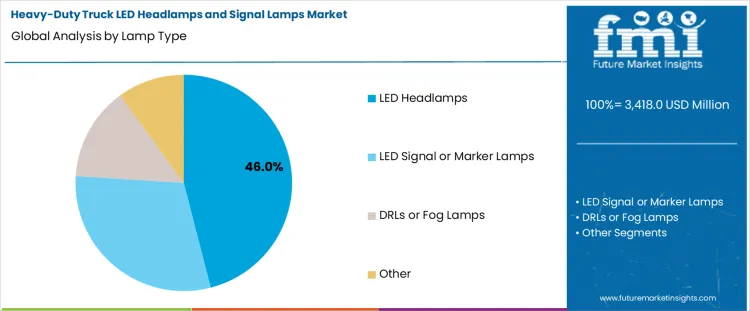
LED headlamps hold 46.0%, representing the largest share among lamp types due to primary safety and visibility function. Headlamps operate continuously during vehicle operation, driving higher replacement and specification priority. LED technology delivers consistent beam pattern, long service life, and lower power consumption. Improved illumination supports night driving and adverse weather visibility for long-haul operations. LED signal or marker lamps, DRLs, and fog lamps serve auxiliary safety and visibility roles with lower duty intensity. Lamp type segmentation reflects emphasis on core forward-lighting systems where performance reliability and regulatory compliance remain critical.
Key Points
- LED headlamps support primary night-time and low-visibility operation.
- Continuous use drives higher specification and durability requirements.
- Other lamp types serve supplementary visibility and signaling functions.
Which Vehicle Type Accounts for the Highest Share of Demand?
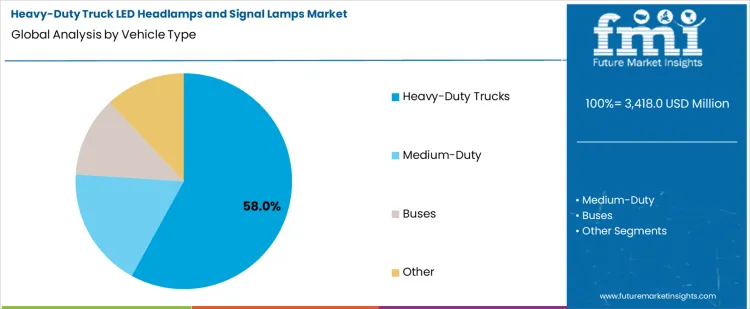
Heavy-duty trucks hold 58.0%, representing the largest share among vehicle types due to extensive operating hours and harsh duty cycles. Long-haul freight vehicles require robust lighting systems capable of sustained performance under vibration and weather exposure. Regulatory inspection regimes reinforce consistent lighting performance. Medium-duty trucks and buses operate with lower mileage intensity and varied duty patterns. Other vehicle categories contribute limited aggregate demand. Vehicle type segmentation reflects concentration of LED lighting adoption within heavy-duty platforms where safety, uptime, and compliance drive sustained component utilization.
Key Points
- Heavy-duty trucks operate under extended daily usage cycles.
- Lighting reliability directly affects safety and regulatory compliance.
- Other vehicle types face lower operating intensity.
Which Feature Level Drives the Largest Share of Demand?
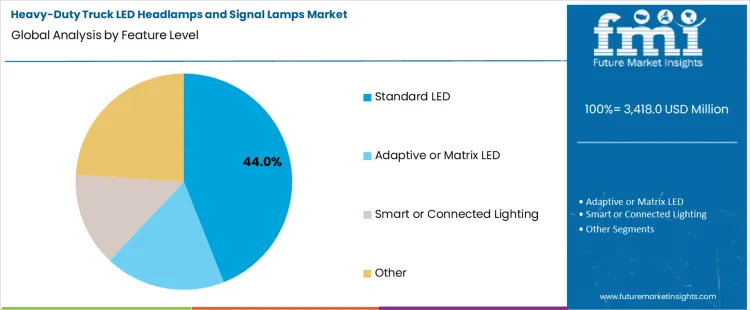
Standard LED systems hold 44.0%, representing the largest share among feature levels due to balance of performance and cost control. These systems deliver reliable illumination without complex control electronics. Integration aligns with existing vehicle electrical architectures and maintenance practices. Fleet operators favor proven configurations minimizing training and service complexity. Adaptive or matrix LEDs and smart lighting systems address advanced visibility and connectivity needs with higher system complexity. Other feature levels support niche configurations. Feature level segmentation reflects preference for dependable, scalable lighting solutions meeting core safety requirements across high-volume commercial vehicle production.
Key Points
- Standard LED systems balance reliability and cost efficiency.
- Simple integration supports fleet-wide standardization.
- Advanced features address specialized visibility requirements.
What are the Key Dynamics in the Heavy-Duty Truck LED Headlamps and Signal Lamps Market?
Demand for heavy-duty truck LED headlamps and signal lamps reflects safety, durability, and energy efficiency requirements in commercial vehicle operations. Adoption spans long-haul trucks, vocational fleets, construction vehicles, and off-highway applications. Global scope aligns with regulatory visibility standards, extended operating hours, and harsh duty cycles. Usage centers on headlamps, tail lamps, indicators, and marker lights designed for vibration resistance, long service life, and reduced electrical load.
How do safety compliance and operating efficiency requirements shape adoption?
Fleet operators prioritize lighting systems that improve road visibility and vehicle conspicuity under night, fog, and adverse weather conditions. Demand increases as LED lamps deliver higher luminance consistency and faster response times than halogen alternatives. Long service life reduces maintenance frequency and vehicle downtime, which supports fleet utilization targets. Lower power consumption aligns with electrical system efficiency, particularly in vehicles with multiple auxiliary loads. Regulatory requirements for daytime running lights and signal visibility reinforce standardized LED adoption. Ruggedized housings and sealed designs support operation under vibration, dust, and moisture exposure. Adoption reflects alignment between safety compliance, uptime reliability, and total operating cost control.
How do cost structure and integration constraints influence market scalability?
Initial unit cost remains higher than conventional lighting, affecting adoption in cost-sensitive fleet segments. Demand sensitivity rises where replacement decisions focus on upfront price rather than lifecycle economics. Integration challenges emerge with legacy electrical architectures and connector standards. Thermal management requirements add design complexity for high-output LED assemblies. Certification processes for road safety standards increase development and testing expense. Counterfeit products in aftermarket channels affect pricing discipline and quality perception. Supply chain dependence on semiconductor components introduces cost and availability variability. Harsh operating environments increase validation requirements, constraining rapid deployment across diverse truck platforms.
How Is Demand for Heavy-Duty Truck LED Headlamps and Signal Lamps Evolving Globally?
Demand for heavy-duty truck LED headlamps and signal lamps is expanding globally due to safety regulation tightening, durability requirements, and lifecycle cost advantages over halogen systems. Fleet operators prioritize lighting solutions offering longer service life, reduced maintenance, and improved visibility under harsh operating conditions. OEM adoption increases as LED modules integrate seamlessly with modern electrical architectures. Aftermarket replacement also contributes where fleets upgrade legacy lighting. Growth rates in China at 8.3%, Brazil at 8.1%, USA at 6.5%, Germany at 6.3%, and South Korea at 6.2% indicate sustained expansion driven by regulatory compliance, fleet modernization, and operating efficiency objectives.
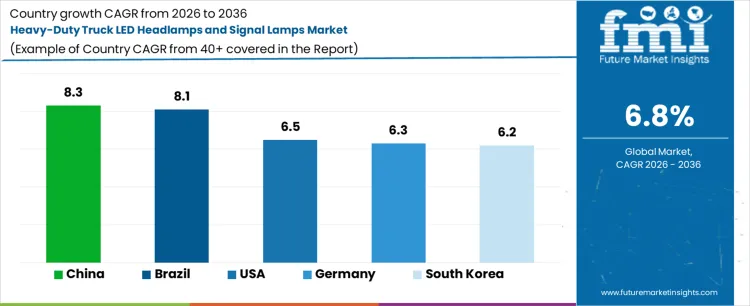
| Country | CAGR (%) |
|---|---|
| China | 8.3% |
| Brazil | 8.1% |
| USA | 6.5% |
| Germany | 6.3% |
| South Korea | 6.2% |
What Is Driving Strong Growth of Heavy-Duty Truck LED Lighting Demand in China?
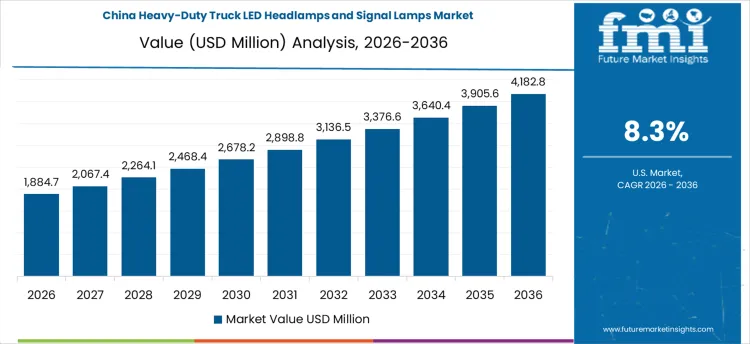
High commercial vehicle utilization is driving heavy-duty truck LED headlamp and signal lamp demand in China, expanding at a CAGR of 8.3%. Long operating hours in logistics and construction accelerate wear of conventional lighting systems. Fleet operators adopt LED lamps to reduce downtime and maintenance frequency. Regulatory enforcement on vehicle safety and visibility supports OEM-level integration. Expansion of night-time freight movement increases emphasis on illumination quality. Domestic lighting manufacturers supply cost-competitive LED modules, enabling rapid penetration across new truck production and aftermarket upgrades.
- High truck utilization across logistics and construction
- Safety regulations emphasizing visibility performance
- Growth of night-time freight operations
- Strong domestic LED lighting manufacturing base
Why Is Brazil Experiencing Rapid Adoption of LED Truck Headlamps?
Operating environment intensity is shaping LED headlamp and signal lamp demand growth in Brazil at a CAGR of 8.1%. Long-haul transport routes expose vehicles to vibration, dust, and weather stress, increasing failure rates of traditional lamps. Fleet operators prefer LED systems for durability and reduced replacement cycles. Road safety initiatives support improved lighting adoption. Agricultural and mining logistics sustain heavy-duty truck usage. Demand growth reflects operating condition resilience requirements rather than cosmetic upgrades.
- Long-haul routes increasing component stress
- Preference for durable, low-maintenance lighting
- Road safety initiatives supporting LED adoption
- Heavy usage in agricultural and mining logistics
How Is the USA Sustaining Demand for Heavy-Duty Truck LED Lighting Systems?
Fleet modernization strategies support heavy-duty truck LED headlamp and signal lamp demand in the USA, growing at a CAGR of 6.5%. Regulatory standards emphasize visibility, marker lighting, and signaling reliability. High annual mileage increases maintenance cost sensitivity among fleet operators. LED lamps offer longer service life and consistent illumination. Aftermarket upgrades remain significant across aging fleets. Adoption is strongest in long-distance freight and vocational trucks operating extended duty cycles.
- Regulatory focus on visibility and signaling standards
- High mileage increasing maintenance cost sensitivity
- Strong aftermarket upgrade activity
- Long-distance freight and vocational truck usage
What Factors Are Supporting LED Truck Lighting Demand in Germany?
Engineering standards and compliance requirements shape heavy-duty truck LED lighting demand in Germany, expanding at a CAGR of 6.3%. Strict vehicle safety and inspection regimes favor high-reliability lighting systems. OEMs integrate LED modules to meet durability and efficiency expectations. Night-time logistics serving export manufacturing increases emphasis on illumination performance. Fleet operators prioritize systems aligned with preventive maintenance schedules. Growth reflects structured upgrades within mature commercial vehicle fleets.
- Strict vehicle inspection and safety standards
- OEM integration of durable LED lighting modules
- Night-time logistics supporting illumination demand
- Preventive maintenance-oriented fleet management
Why Is South Korea Showing Steady Growth in Heavy-Duty Truck LED Lamps?
Operational efficiency and technology adoption influence heavy-duty truck LED headlamp and signal lamp demand in South Korea, growing at a CAGR of 6.2%. Dense logistics networks require reliable lighting for frequent urban and port operations. Fleet operators adopt LEDs to reduce service interruptions. Manufacturing and port logistics sustain steady truck utilization. Regulatory alignment with international safety standards supports LED penetration. Growth remains measured, driven by replacement and OEM standardization rather than rapid fleet expansion.
- Urban and port logistics requiring reliable lighting
- Reduction of downtime through longer lamp lifespan
- Manufacturing-driven freight activity
- Alignment with international vehicle safety standards
What is the competitive landscape of demand for heavy-duty truck LED headlamps and signal lamps globally?
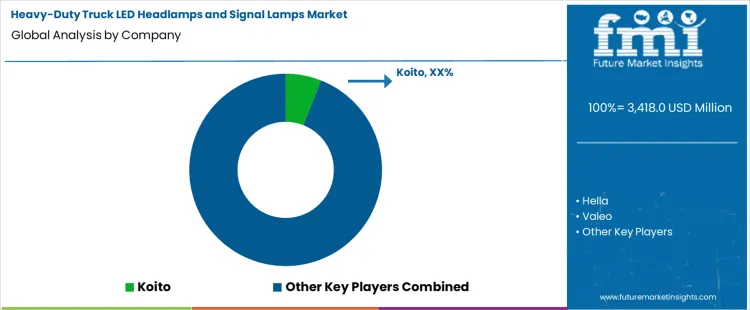
Demand for heavy-duty truck LED headlamps and signal lamps is driven by regulatory requirements for enhanced visibility, energy efficiency, and long service life in commercial vehicles. LED lighting offers higher luminous efficacy, faster warm-up, lower power draw, and improved durability compared with conventional halogen systems. Buyers evaluate beam pattern performance, thermal management, ingress protection ratings, compatibility with electrical architectures, and integration with driver assistance and signaling systems. Procurement teams prioritize suppliers with proven OEM qualifications, robust supply chains, and ability to deliver scalable lighting platforms that meet global standards. Trend in the global market reflects increasing adoption of LED lighting in heavy commercial vehicles and fleet operators seeking reduced maintenance costs and enhanced road safety.
Koito holds leading positioning through a broad portfolio of automotive and commercial LED lighting solutions supported by extensive OEM relationships and global manufacturing. Hella supports demand with modular LED headlamps and signal lamp systems optimized for heavy-duty and commercial truck applications. Valeo participates with advanced LED lighting platforms emphasizing efficient thermal design and regulatory compliance. Lumileds contributes high-performance LED light sources and modules used by tier-1 suppliers and direct OEM programs. Osram supplies LED lighting components and integrated lamp assemblies tailored to commercial vehicle performance and durability requirements. Competitive differentiation depends on optical performance, thermal management, system reliability, regulatory approval profiles, and ability to meet diverse regional specifications.
Key Players in the Heavy-Duty Truck LED Headlamps and Signal Lamps Market
- Koito
- Hella
- Valeo
- Stanley Electric
- Lumileds
- Philips Automotive
- Osram
- Marelli
- Truck-Lite
- Hyundai Mobis
Scope of the Report
| Items | Values |
|---|---|
| Quantitative Units | USD million |
| Lamp Type | LED Headlamps; LED Signal or Marker Lamps; DRLs or Fog Lamps; Other |
| Vehicle Type | Heavy-Duty Trucks; Medium-Duty; Buses; Other |
| Feature Level | Standard LED; Adaptive or Matrix LED; Smart or Connected Lighting; Other |
| Sales Channel | OEM Line-Fit; Aftermarket; Dealer or OES; Other |
| Regions Covered | Asia Pacific, Europe, North America, Latin America, Middle East & Africa |
| Countries Covered | China, Brazil, USA, Germany, South Korea, and 40+ countries |
| Key Companies Profiled | Koito; Hella; Valeo; Stanley Electric; Lumileds; Philips Automotive; Osram; Marelli; Truck-Lite; Hyundai Mobis |
| Additional Attributes | Dollar sales by lamp type and vehicle type; adoption trends for LED and adaptive lighting in heavy-duty commercial vehicles; luminous efficacy, beam pattern control, and thermal management performance metrics; durability under vibration, ingress protection, and operating temperature requirements; compatibility with advanced driver assistance and smart lighting controls; compliance with regional lighting regulations, photometric standards, and OEM validation protocols influencing product specification. |
Heavy-Duty Truck LED Headlamps and Signal Lamps Market by Segment
Lamp Type:
- LED Headlamps
- LED Signal or Marker Lamps
- DRLs or Fog Lamps
- Other
Vehicle Type:
- Heavy-Duty Trucks
- Medium-Duty
- Buses
- Other
Feature Level:
- Standard LED
- Adaptive or Matrix LED
- Smart or Connected Lighting
- Other
Sales Channel:
- OEM Line-Fit
- Aftermarket
- Dealer or OES
- Other
Region:
- Asia Pacific
- China
- Japan
- South Korea
- India
- Australia & New Zealand
- ASEAN
- Rest of Asia Pacific
- Europe
- Germany
- United Kingdom
- France
- Italy
- Spain
- Nordic
- BENELUX
- Rest of Europe
- North America
- United States
- Canada
- Mexico
- Latin America
- Brazil
- Chile
- Rest of Latin America
- Middle East & Africa
- Kingdom of Saudi Arabia
- Other GCC Countries
- Turkey
- South Africa
- Other African Union
- Rest of Middle East & Africa
Bibliography
- International Organization of Motor Vehicle Manufacturers (OICA). (2024). Commercial vehicle production trends and implications for exterior lighting demand. OICA Statistical Publications.
- Society of Automotive Engineers International. (2023). Performance, durability, and thermal management considerations for LED lighting in heavy-duty trucks. SAE Technical Papers.
- European Automobile Manufacturers’ Association (ACEA). (2024). Heavy-duty vehicle safety regulations, lighting standards, and compliance requirements. ACEA Industry Reports.
- OECD International Transport Forum. (2024). Road freight activity, night-time operations, and safety-related equipment adoption in commercial vehicles. ITF Transport Outlook.
Frequently Asked Questions
How big is the heavy-duty truck led headlamps and signal lamps market in 2026?
The global heavy-duty truck led headlamps and signal lamps market is estimated to be valued at USD 3,418.0 million in 2026.
What will be the size of heavy-duty truck led headlamps and signal lamps market in 2036?
The market size for the heavy-duty truck led headlamps and signal lamps market is projected to reach USD 6,599.1 million by 2036.
How much will be the heavy-duty truck led headlamps and signal lamps market growth between 2026 and 2036?
The heavy-duty truck led headlamps and signal lamps market is expected to grow at a 6.8% CAGR between 2026 and 2036.
What are the key product types in the heavy-duty truck led headlamps and signal lamps market?
The key product types in heavy-duty truck led headlamps and signal lamps market are led headlamps, led signal or marker lamps, drls or fog lamps and other.
Which vehicle type segment to contribute significant share in the heavy-duty truck led headlamps and signal lamps market in 2026?
In terms of vehicle type, heavy-duty trucks segment to command 58.0% share in the heavy-duty truck led headlamps and signal lamps market in 2026.
Preview the report firsthand - request a free sample
Get SampleGet the brochure for pricing and purchase details.
Get PDFTable of Content
- Executive Summary
- Global Market Outlook
- Demand-side Trends
- Supply-side Trends
- Technology Roadmap Analysis
- Analysis and Recommendations
- Market Overview
- Market Coverage / Taxonomy
- Market Definition / Scope / Limitations
- Market Background
- Market Dynamics
- Drivers
- Restraints
- Opportunity
- Trends
- Scenario Forecast
- Demand in Optimistic Scenario
- Demand in Likely Scenario
- Demand in Conservative Scenario
- Opportunity Map Analysis
- Product Life Cycle Analysis
- Supply Chain Analysis
- Investment Feasibility Matrix
- Value Chain Analysis
- PESTLE and Porter’s Analysis
- Regulatory Landscape
- Regional Parent Market Outlook
- Production and Consumption Statistics
- Import and Export Statistics
- Market Dynamics
- Global Market Analysis 2021 to 2025 and Forecast, 2026 to 2036
- Historical Market Size Value (USD Million) Analysis, 2021 to 2025
- Current and Future Market Size Value (USD Million) Projections, 2026 to 2036
- Y-o-Y Growth Trend Analysis
- Absolute $ Opportunity Analysis
- Global Market Pricing Analysis 2021 to 2025 and Forecast 2026 to 2036
- Global Market Analysis 2021 to 2025 and Forecast 2026 to 2036, By Lamp Type
- Introduction / Key Findings
- Historical Market Size Value (USD Million) Analysis By Lamp Type , 2021 to 2025
- Current and Future Market Size Value (USD Million) Analysis and Forecast By Lamp Type , 2026 to 2036
- LED Headlamps
- LED Signal or Marker Lamps
- DRLs or Fog Lamps
- Other
- LED Headlamps
- Y-o-Y Growth Trend Analysis By Lamp Type , 2021 to 2025
- Absolute $ Opportunity Analysis By Lamp Type , 2026 to 2036
- Global Market Analysis 2021 to 2025 and Forecast 2026 to 2036, By Vehicle Type
- Introduction / Key Findings
- Historical Market Size Value (USD Million) Analysis By Vehicle Type, 2021 to 2025
- Current and Future Market Size Value (USD Million) Analysis and Forecast By Vehicle Type, 2026 to 2036
- Heavy-Duty Trucks
- Medium-Duty
- Buses
- Other
- Heavy-Duty Trucks
- Y-o-Y Growth Trend Analysis By Vehicle Type, 2021 to 2025
- Absolute $ Opportunity Analysis By Vehicle Type, 2026 to 2036
- Global Market Analysis 2021 to 2025 and Forecast 2026 to 2036, By Feature Level
- Introduction / Key Findings
- Historical Market Size Value (USD Million) Analysis By Feature Level, 2021 to 2025
- Current and Future Market Size Value (USD Million) Analysis and Forecast By Feature Level, 2026 to 2036
- Standard LED
- Adaptive or Matrix LED
- Smart or Connected Lighting
- Other
- Standard LED
- Y-o-Y Growth Trend Analysis By Feature Level, 2021 to 2025
- Absolute $ Opportunity Analysis By Feature Level, 2026 to 2036
- Global Market Analysis 2021 to 2025 and Forecast 2026 to 2036, By Sales Channel
- Introduction / Key Findings
- Historical Market Size Value (USD Million) Analysis By Sales Channel, 2021 to 2025
- Current and Future Market Size Value (USD Million) Analysis and Forecast By Sales Channel, 2026 to 2036
- OEM Line-Fit
- Aftermarket
- Dealer or OES
- Other
- OEM Line-Fit
- Y-o-Y Growth Trend Analysis By Sales Channel, 2021 to 2025
- Absolute $ Opportunity Analysis By Sales Channel, 2026 to 2036
- Global Market Analysis 2021 to 2025 and Forecast 2026 to 2036, By Region
- Introduction
- Historical Market Size Value (USD Million) Analysis By Region, 2021 to 2025
- Current Market Size Value (USD Million) Analysis and Forecast By Region, 2026 to 2036
- North America
- Latin America
- Western Europe
- Eastern Europe
- East Asia
- South Asia and Pacific
- Middle East & Africa
- Market Attractiveness Analysis By Region
- North America Market Analysis 2021 to 2025 and Forecast 2026 to 2036, By Country
- Historical Market Size Value (USD Million) Trend Analysis By Market Taxonomy, 2021 to 2025
- Market Size Value (USD Million) Forecast By Market Taxonomy, 2026 to 2036
- By Country
- USA
- Canada
- Mexico
- By Lamp Type
- By Vehicle Type
- By Feature Level
- By Sales Channel
- By Country
- Market Attractiveness Analysis
- By Country
- By Lamp Type
- By Vehicle Type
- By Feature Level
- By Sales Channel
- Key Takeaways
- Latin America Market Analysis 2021 to 2025 and Forecast 2026 to 2036, By Country
- Historical Market Size Value (USD Million) Trend Analysis By Market Taxonomy, 2021 to 2025
- Market Size Value (USD Million) Forecast By Market Taxonomy, 2026 to 2036
- By Country
- Brazil
- Chile
- Rest of Latin America
- By Lamp Type
- By Vehicle Type
- By Feature Level
- By Sales Channel
- By Country
- Market Attractiveness Analysis
- By Country
- By Lamp Type
- By Vehicle Type
- By Feature Level
- By Sales Channel
- Key Takeaways
- Western Europe Market Analysis 2021 to 2025 and Forecast 2026 to 2036, By Country
- Historical Market Size Value (USD Million) Trend Analysis By Market Taxonomy, 2021 to 2025
- Market Size Value (USD Million) Forecast By Market Taxonomy, 2026 to 2036
- By Country
- Germany
- UK
- Italy
- Spain
- France
- Nordic
- BENELUX
- Rest of Western Europe
- By Lamp Type
- By Vehicle Type
- By Feature Level
- By Sales Channel
- By Country
- Market Attractiveness Analysis
- By Country
- By Lamp Type
- By Vehicle Type
- By Feature Level
- By Sales Channel
- Key Takeaways
- Eastern Europe Market Analysis 2021 to 2025 and Forecast 2026 to 2036, By Country
- Historical Market Size Value (USD Million) Trend Analysis By Market Taxonomy, 2021 to 2025
- Market Size Value (USD Million) Forecast By Market Taxonomy, 2026 to 2036
- By Country
- Russia
- Poland
- Hungary
- Balkan & Baltic
- Rest of Eastern Europe
- By Lamp Type
- By Vehicle Type
- By Feature Level
- By Sales Channel
- By Country
- Market Attractiveness Analysis
- By Country
- By Lamp Type
- By Vehicle Type
- By Feature Level
- By Sales Channel
- Key Takeaways
- East Asia Market Analysis 2021 to 2025 and Forecast 2026 to 2036, By Country
- Historical Market Size Value (USD Million) Trend Analysis By Market Taxonomy, 2021 to 2025
- Market Size Value (USD Million) Forecast By Market Taxonomy, 2026 to 2036
- By Country
- China
- Japan
- South Korea
- By Lamp Type
- By Vehicle Type
- By Feature Level
- By Sales Channel
- By Country
- Market Attractiveness Analysis
- By Country
- By Lamp Type
- By Vehicle Type
- By Feature Level
- By Sales Channel
- Key Takeaways
- South Asia and Pacific Market Analysis 2021 to 2025 and Forecast 2026 to 2036, By Country
- Historical Market Size Value (USD Million) Trend Analysis By Market Taxonomy, 2021 to 2025
- Market Size Value (USD Million) Forecast By Market Taxonomy, 2026 to 2036
- By Country
- India
- ASEAN
- Australia & New Zealand
- Rest of South Asia and Pacific
- By Lamp Type
- By Vehicle Type
- By Feature Level
- By Sales Channel
- By Country
- Market Attractiveness Analysis
- By Country
- By Lamp Type
- By Vehicle Type
- By Feature Level
- By Sales Channel
- Key Takeaways
- Middle East & Africa Market Analysis 2021 to 2025 and Forecast 2026 to 2036, By Country
- Historical Market Size Value (USD Million) Trend Analysis By Market Taxonomy, 2021 to 2025
- Market Size Value (USD Million) Forecast By Market Taxonomy, 2026 to 2036
- By Country
- Kingdom of Saudi Arabia
- Other GCC Countries
- Turkiye
- South Africa
- Other African Union
- Rest of Middle East & Africa
- By Lamp Type
- By Vehicle Type
- By Feature Level
- By Sales Channel
- By Country
- Market Attractiveness Analysis
- By Country
- By Lamp Type
- By Vehicle Type
- By Feature Level
- By Sales Channel
- Key Takeaways
- Key Countries Market Analysis
- USA
- Pricing Analysis
- Market Share Analysis, 2025
- By Lamp Type
- By Vehicle Type
- By Feature Level
- By Sales Channel
- Canada
- Pricing Analysis
- Market Share Analysis, 2025
- By Lamp Type
- By Vehicle Type
- By Feature Level
- By Sales Channel
- Mexico
- Pricing Analysis
- Market Share Analysis, 2025
- By Lamp Type
- By Vehicle Type
- By Feature Level
- By Sales Channel
- Brazil
- Pricing Analysis
- Market Share Analysis, 2025
- By Lamp Type
- By Vehicle Type
- By Feature Level
- By Sales Channel
- Chile
- Pricing Analysis
- Market Share Analysis, 2025
- By Lamp Type
- By Vehicle Type
- By Feature Level
- By Sales Channel
- Germany
- Pricing Analysis
- Market Share Analysis, 2025
- By Lamp Type
- By Vehicle Type
- By Feature Level
- By Sales Channel
- UK
- Pricing Analysis
- Market Share Analysis, 2025
- By Lamp Type
- By Vehicle Type
- By Feature Level
- By Sales Channel
- Italy
- Pricing Analysis
- Market Share Analysis, 2025
- By Lamp Type
- By Vehicle Type
- By Feature Level
- By Sales Channel
- Spain
- Pricing Analysis
- Market Share Analysis, 2025
- By Lamp Type
- By Vehicle Type
- By Feature Level
- By Sales Channel
- France
- Pricing Analysis
- Market Share Analysis, 2025
- By Lamp Type
- By Vehicle Type
- By Feature Level
- By Sales Channel
- India
- Pricing Analysis
- Market Share Analysis, 2025
- By Lamp Type
- By Vehicle Type
- By Feature Level
- By Sales Channel
- ASEAN
- Pricing Analysis
- Market Share Analysis, 2025
- By Lamp Type
- By Vehicle Type
- By Feature Level
- By Sales Channel
- Australia & New Zealand
- Pricing Analysis
- Market Share Analysis, 2025
- By Lamp Type
- By Vehicle Type
- By Feature Level
- By Sales Channel
- China
- Pricing Analysis
- Market Share Analysis, 2025
- By Lamp Type
- By Vehicle Type
- By Feature Level
- By Sales Channel
- Japan
- Pricing Analysis
- Market Share Analysis, 2025
- By Lamp Type
- By Vehicle Type
- By Feature Level
- By Sales Channel
- South Korea
- Pricing Analysis
- Market Share Analysis, 2025
- By Lamp Type
- By Vehicle Type
- By Feature Level
- By Sales Channel
- Russia
- Pricing Analysis
- Market Share Analysis, 2025
- By Lamp Type
- By Vehicle Type
- By Feature Level
- By Sales Channel
- Poland
- Pricing Analysis
- Market Share Analysis, 2025
- By Lamp Type
- By Vehicle Type
- By Feature Level
- By Sales Channel
- Hungary
- Pricing Analysis
- Market Share Analysis, 2025
- By Lamp Type
- By Vehicle Type
- By Feature Level
- By Sales Channel
- Kingdom of Saudi Arabia
- Pricing Analysis
- Market Share Analysis, 2025
- By Lamp Type
- By Vehicle Type
- By Feature Level
- By Sales Channel
- Turkiye
- Pricing Analysis
- Market Share Analysis, 2025
- By Lamp Type
- By Vehicle Type
- By Feature Level
- By Sales Channel
- South Africa
- Pricing Analysis
- Market Share Analysis, 2025
- By Lamp Type
- By Vehicle Type
- By Feature Level
- By Sales Channel
- USA
- Market Structure Analysis
- Competition Dashboard
- Competition Benchmarking
- Market Share Analysis of Top Players
- By Regional
- By Lamp Type
- By Vehicle Type
- By Feature Level
- By Sales Channel
- Competition Analysis
- Competition Deep Dive
- Koito
- Overview
- Product Portfolio
- Profitability by Market Segments (Product/Age /Sales Channel/Region)
- Sales Footprint
- Strategy Overview
- Marketing Strategy
- Product Strategy
- Channel Strategy
- Hella
- Valeo
- Stanley Electric
- Lumileds
- Philips Automotive
- Osram
- Marelli
- Truck-Lite
- Hyundai Mobis
- Koito
- Competition Deep Dive
- Assumptions & Acronyms Used
- Research Methodology


