

- Market Size (2026)
- USD 4.4 Bn
- Forecast (2036)
- USD 7.0 Bn
- CAGR (2026 to 2036)
- 4.8%
Heavy-Duty Differential Systems for Commercial Vehicles Market Size, Market Forecast and Outlook By FMI
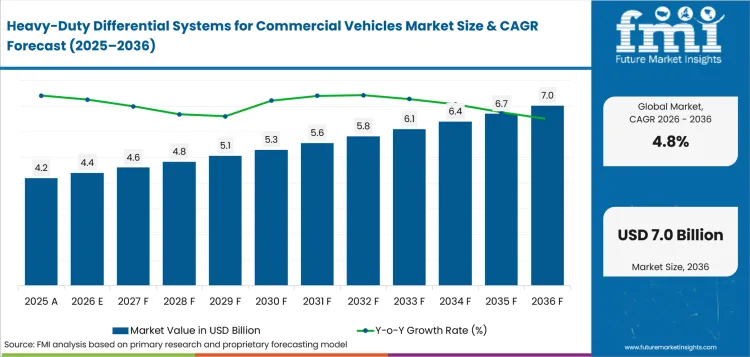
The heavy-duty differential systems for commercial vehicles market is expected to grow from USD 4.2 billion in 2025 to USD 7.0 billion by 2036 at a 4.8% CAGR, driven by rising commercial vehicle load cycles and axle durability needs with OEM fitment accounting for 66.0% share and rear axle systems contributing 48.5% share as companies prioritize uptime and maintenance cost control.
Key Takeaways, Market Size, and Forecast
- The heavy-duty differential systems for commercial vehicles market size stood at USD 4.2 billion in 2025.
- The market value is set to surpass USD 4.4 billion in 2026.
- Industry value is projected to reach USD 7.0 billion by 2036 as truck axle programs need stronger torque control.
- From 2026 to 2036, the sector is likely to expand at 4.8% CAGR.
- Industry revenue is expected to create an incremental opportunity of USD 2.6 billion during forecast period.
- OEM fitment is anticipated to secure 66.0% share in 2026, driven by factory axle programs guiding system selection.
- Rear axle systems are set to garner 48.5% share in 2026 as drive axles handle most loaded truck torque.
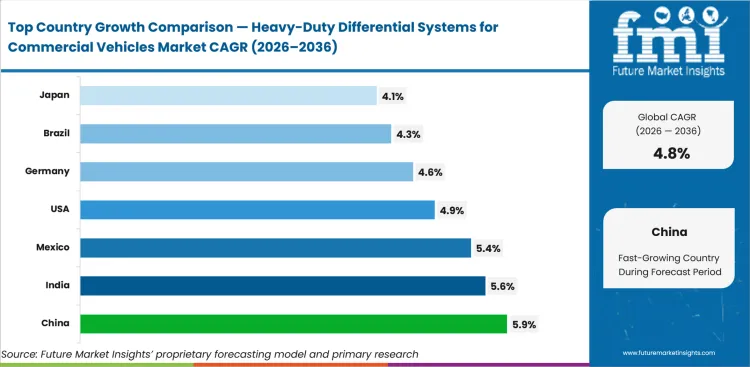
- China leads country set with a predicted 5.9% CAGR, followed by India at 5.6% CAGR by 2036.
Summary of Heavy-Duty Differential Systems for Commercial Vehicles Market
- Demand and Growth Drivers
- Heavy truck axle loads keep differential replacement active due to carriers facing torque stress during freight movement.
- Electrified commercial vehicles raise interest in controlled torque split and stronger axle interface parts.
- Reman exchange programs gain value as fleets need faster repair cycles for vehicles away from home workshops.
- Product and Segment View
- OEM fitment is estimated to hold 66.0% share in 2026, driven by axle programs specifying differential systems during vehicle build.
- Rear axle systems are projected to secure 48.5% share in 2026, led by heavy-duty drive axles carry traction loads.
- Locking differential systems are expected to represent 42.0% share in 2026, reflecting vocational fleets needing traction control.
- Geography and Competitive Outlook
- China is likely to record 5.9% CAGR by 2036, backed by heavy truck output and electric truck adoption.
- India is expected to expand at 5.6% CAGR by 2036, influenced by commercial vehicle sales and service channel growth.
- Cummins Inc. (Meritor Portfolio) and Dana compete on axle carrier depth and fleet service access.
- ZF Group and Eaton compete through electronic control depth and torque-management components.
- Analyst Opinion
- Nikhil Kaitwade, Principal Consultant for Automotive at FMI, opines, “Heavy-duty differential systems are shifting from a basic axle hardware purchase toward a torque control decision. Truck makers and service networks will favor suppliers able to prove carrier strength and fast replacement coverage. System suppliers with electronic control depth and reman service reach should protect repeat orders.”
- Heavy-Duty Differential Systems for Commercial Vehicles Market Value Analysis
- Market value is tied to axle torque ratings before electronic control features affect system price.
- Supplier pricing reflects carrier casting strength and gear machining before service margins affect delivered cost.
- Revenue improves as fleets move from single-part repair toward complete carrier and actuator replacement.
- Supplier trust rises as warranty support and validated torque ratings reduce vehicle downtime during freight duty.
Commercial vehicle driveline selection is moving from basic open carriers toward stronger limited-slip and locking systems for loaded routes. International Organization of Motor Vehicle Manufacturers reported in April 2026, global vehicle production increased from 92.7 million units in 2024 to 96.4 million units in 2025. Axle suppliers are expected to balance mechanical durability with electronic control as electric drive axles for heavy-duty trucks add instant torque to heavy-duty truck platforms. Fleet service networks compare new assemblies against reman exchange units as downtime risk shapes service choices.
Heavy-Duty Differential Systems for Commercial Vehicles Market Definition
Heavy-duty differential systems for commercial vehicles include axle differential carriers, gear sets, locking mechanisms, limited-slip units, electronic actuators, housings, and control modules used in medium and heavy commercial vehicles. Scope connects with automotive differential hardware but excludes passenger car packages outside class 5 and heavier duty cycles. Factory-installed systems and replacement units for trucks, buses, and vocational vehicles are included.
Heavy-Duty Differential Systems for Commercial Vehicles Market Inclusions
Scope includes open differentials, locking differentials, limited-slip differentials, torque-vectoring systems, and electronically controlled differential assemblies. Sales through truck OEMs, fleet service channels, axle and differential remanufacturing programs, and export axle suppliers are counted. Axle housing and carrier assembly components are included only if sold as part of differential system value.
Heavy-Duty Differential Systems for Commercial Vehicles Market Exclusions
Scope excludes passenger car differential kits, light pickup accessories, standalone lubricants, plain axle shafts, and trailer axles without drive differential function. General driveline parts are counted only if attached to a differential assembly sale. Electric axle motors are excluded unless differential gearing or torque split hardware forms part of supplied system value.
Heavy-Duty Differential Systems for Commercial Vehicles Market Research Methodology
- Primary Research: FMI analysts reviewed axle supplier programs and fleet service channel feedback for heavy commercial vehicles.
- Desk Research: Official vehicle output data and heavy truck policy updates supported scope mapping and country checks.
- Market Sizing and Forecasting: Forecast values used workbook anchors for automotive differential and axle carrier component pools.
- Data Validation: Checks compared 2026 value with 2036 value and tested CAGR consistency across seven country rates.
Why is the Heavy-Duty Differential Systems for Commercial Vehicles Market Growing?
- Truck makers are specifying stronger differential carriers as payload and route severity keep torque stress high.
- Fleet workshops are shifting toward complete assemblies as repair time has a direct cost in freight operations.
- Electric truck programs are raising interest in controlled torque transfer across drive axles and e-axle layouts.
Growth is clearer as heavy truck production and electrified freight platforms increase differential stress across duty cycles. International Energy Agency reported in June 2026 electric truck sales exceeded 400.0 thousand in 2025 and doubled from 2024. Electric trucks reached 9.0% of global truck sales in 2025. China accounted for roughly 25.0% of trucks sold as electric units in 2025. Higher electric torque raises interest in axle durability and electronic torque management. Axle suppliers with validated gear design and actuator control can convert fleet repair needs into repeat system orders.
Market Segmentation Analysis
- Locking differential systems are forecast to capture 42.0% share in 2026 due to off-road duty cycles needing sure traction under load.
- Rear axle systems are expected to represent 48.5% share in 2026, influenced by drive axle torque concentration in heavy trucks.
- Class 8 vehicles are projected at 44.0% share in 2026 as long-haul and vocational trucks use high-rated axle carriers.
- OEM fitment is anticipated to hold 66.0% share in 2026 since axle packages are specified during vehicle platform design.
- Ductile iron is estimated to secure 46.0% share in 2026, guided by carrier strength and casting availability.
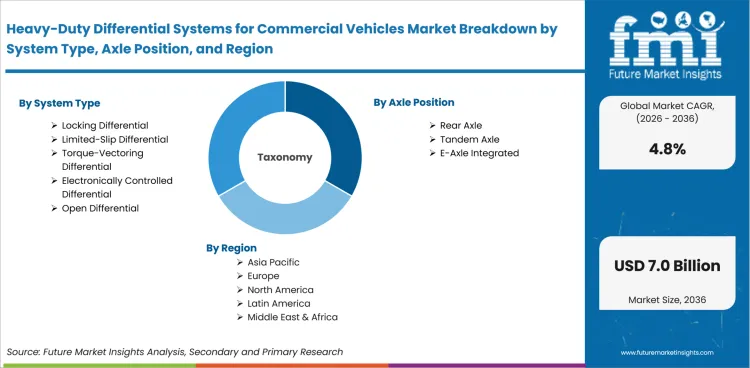
Heavy-duty differential systems for commercial vehicles are divided into groups based on system type, axle position, vehicle class, sales channel, material type, and region. There are open differential, locking differential, limited-slip differential, torque-vectoring differential, and electronically controlled differential formats under system type. By axle position, the market includes rear axle, tandem axle, and e-axle integrated systems, with demand related to truck axle shafts and heavy truck axle service. Based on vehicle class, it includes class 5 to 6, class 7, class 8, heavy buses, and vocational trucks. Regionally, the market covers North America, Latin America, Europe, East Asia, South Asia and Pacific, and the Middle East and Africa.
Insights into Heavy-Duty Differential Systems for Commercial Vehicles Market by System Type
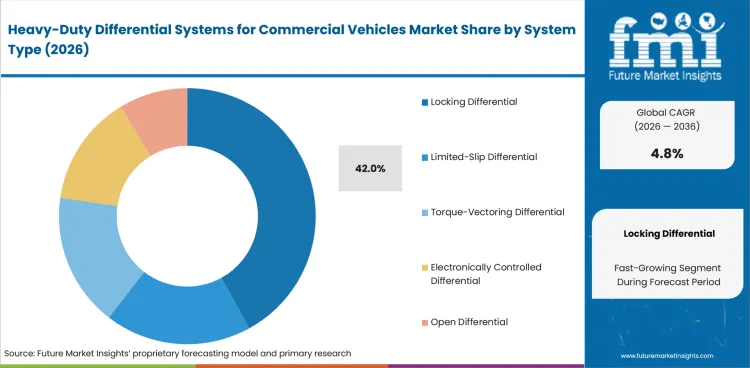
- Locking differential systems are projected to account for 42.0% share in 2026 as construction and mining trucks need traction under uneven loads.
- Electronically controlled differentials gain attention as electric trucks need smoother torque split across axle positions and wheel-speed events.
Insights into Heavy-Duty Differential Systems for Commercial Vehicles Market by Axle Position
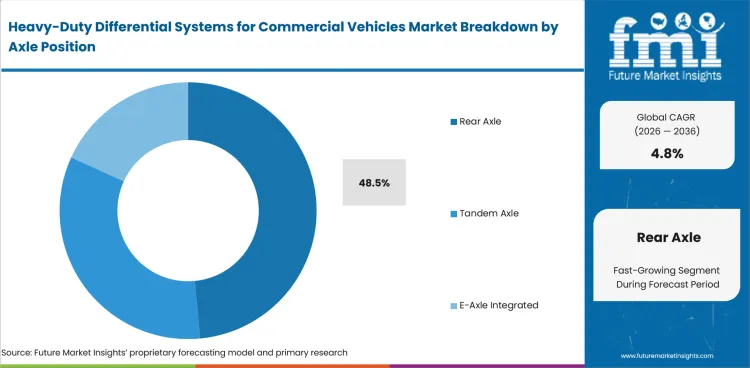
- Rear axle systems are forecast to hold 48.5% share in 2026 since most heavy commercial vehicles rely on rear drive traction.
- Tandem axle systems advance as high-payload trucks need differential balance across two drive axles during long-distance haulage.
Insights into Heavy-Duty Differential Systems for Commercial Vehicles Market by Vehicle Class
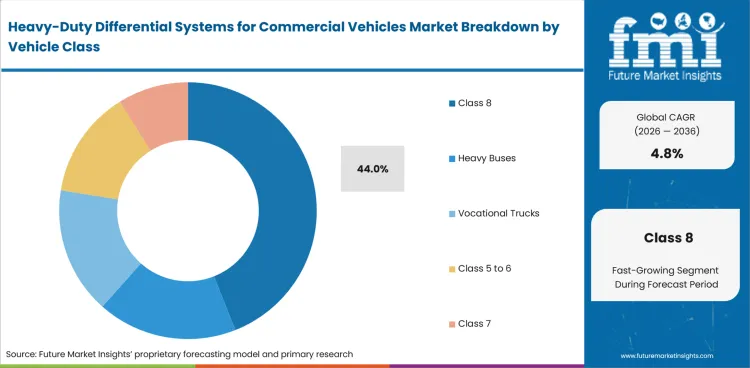
- Class 8 vehicles are expected to account for 44.0% share in 2026 due to higher torque ratings across highway tractors and vocational trucks.
- Heavy buses create stable replacement needs as city and intercity fleets keep axle uptime tied to service availability.
Insights into Heavy-Duty Differential Systems for Commercial Vehicles Market by Sales Channel
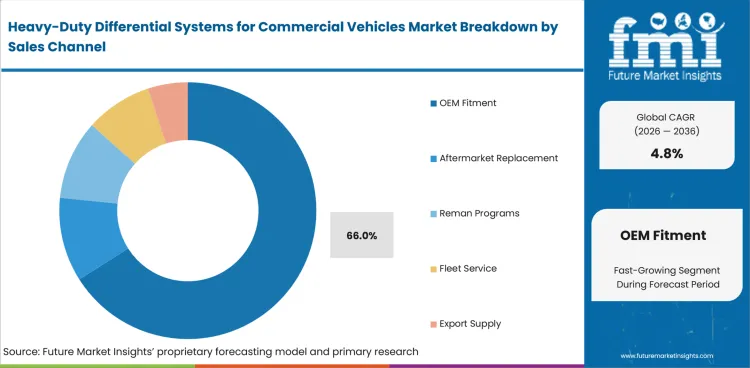
- OEM fitment is projected to represent 66.0% share in 2026, driven by vehicle platforms locking axle system design before volume build starts.
- Aftermarket replacement expands as fleets replace carrier assemblies after wear or actuator issues in heavy-use vehicles.
Insights into Heavy-Duty Differential Systems for Commercial Vehicles Market by Material Type
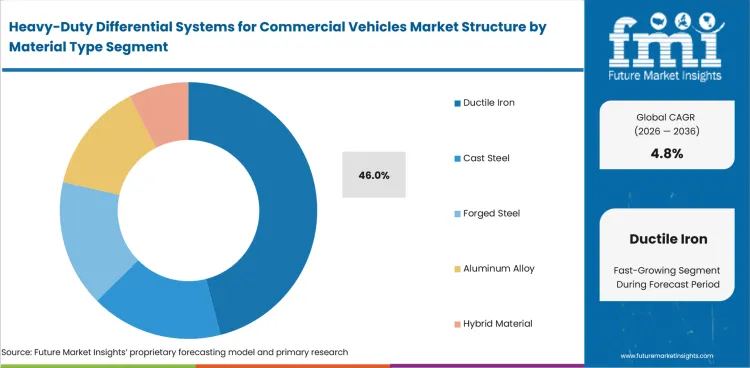
- Ductile iron is anticipated to capture 46.0% share in 2026, led by carrier housings needing strength and cost control together.
- Cast steel gains use in severe-duty trucks as axle makers address shock loads across mining and refuse applications.
Heavy-Duty Differential Systems for Commercial Vehicles Market Drivers, Restraints and Opportunities
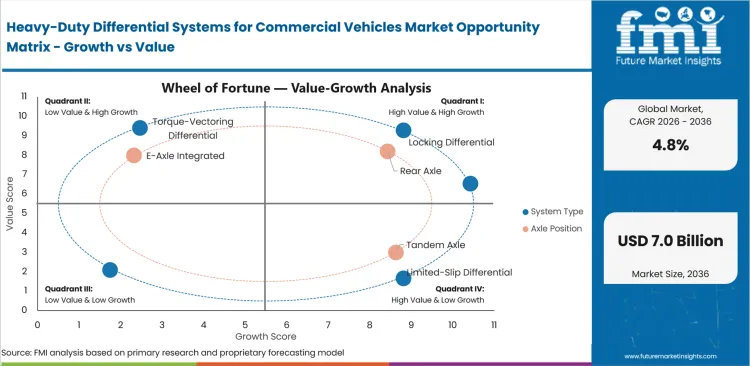
- Driver: Heavy freight duty is pushing axle suppliers toward higher-rated differential carriers and stronger locking systems.
- Restraint: Gear machining cost can slow replacement of complete carriers among smaller fleet service outlets.
- Opportunity: Electric truck platforms can expand demand for integrated torque control and axle cooling packages.
Heavy-duty differential demand is shaped by payload stress and vehicle uptime economics. International Energy Agency reported in June 2026, global electric truck production reached around 440.0 thousand units in 2025, more than double the 2024 level. Electric drivetrains place high instant torque through axle assemblies, leading differential suppliers to need stronger gear sets and better thermal control. Smaller repair outlets face cost pressure as precision-machined carriers and actuators raise replacement value. Suppliers with reman exchange coverage and validated e-axle integration can gain service orders as fleets shorten repair windows.
Equipment Price Benchmarking Analysis
Equipment price benchmarking should treat industrial control parts and motor-control accessories as the clearest cost signal for automation packages used around axle machining and assembly. USA Bureau of Labor Statistics data hosted by FRED shows the producer price index for industrial control parts and motor-control accessories rising from 283.513 in December 2025 to 297.538 in April 2026. Price movement points to firmer cost baselines for control panels and actuators. Motion interfaces and robotic cell integration will likely face similar budget pressure as differential suppliers upgrade precision gear machining lines and carrier assembly validation.
Installed Base and Replacement Cycle Analysis
Installed base and replacement cycle analysis should treat truck fleet age as a direct signal for differential service demand. ACEA reported in January 2026, the European Union had 6.2 million trucks on the road in 2024. Trucks averaged 14 years old and electrically chargeable trucks represented only 0.3% of the fleet. An aging diesel truck fleet points to steady replacement of carriers and locking units before full powertrain turnover. Suppliers should align reman exchange and service parts coverage with older fleet density during the forecast period.
Analysis of Heavy-Duty Differential Systems for Commercial Vehicles Market by Key Countries
.webp "Top Country Growth Comparison Heavy Duty Differential Systems For Commercial Vehicles Market Cagr (2026 2036)")
| Country | CAGR |
|---|---|
| China | 5.9% |
| India | 5.6% |
| Mexico | 5.4% |
| United States | 4.9% |
| Germany | 4.6% |
| Brazil | 4.3% |
| Japan | 4.1% |
Source: Future Market Insights, 2026.
Sales Analysis of Heavy-Duty Differential Systems for Commercial Vehicles Market in China
Fastest-growing heavy truck differential market · 2026 to 2036
China Market Outlook
China leads country growth by 2036, driven by heavy truck output and electric commercial vehicle programs. Local axle makers serve large truck builders and export service channels. Demand for heavy-duty differential systems is rising as fleets need durable carriers for high-load freight and construction routes.
Key Growth Drivers
- China’s commercial vehicle sales reached 4.296 million units in 2025, up 10.9% year over year according to China Association of Automobile Manufacturers data cited by SteelOrbis, keeping axle and carrier programs active near truck plants.
- Heavy truck sales in China reached 84,000 units in August 2025 according to CV World data cited by SteelOrbis, raising replacement need for locking and limited-slip systems.
- Zero-emission medium and heavy-duty vehicle sales in China grew 115% year over year in the first half of 2025 according to the International Council on Clean Transportation, creating added torque-control needs across electric drive axles.
Key Restraints
- China’s vehicle sales are forecast to rise only 1.0% in 2026 after 9.4% growth in 2025 according to China Association of Automobile Manufacturers data cited by CnEVPost, limiting near-term new carrier order acceleration.
- Vehicle export growth is forecast to ease to 4.3% in 2026 from 21.1% in 2025 according to China Association of Automobile Manufacturers data cited by CnEVPost, so export axle programs and service kit orders may advance more slowly.
What makes China unique?
China combines truck production depth with fast electric commercial vehicle uptake. Supplier choice favors local axle validation and fast access to carrier assemblies near truck manufacturing clusters.
Key Companies
- ZF China
- Cummins Inc. (Meritor Portfolio) China
- Dana China
- Eaton China
- Dauch Corporation China
- Dongfeng Dana Axle
- Shaanxi Hande Axle
- FAW axle units
Sales & Marketing Channels
- Truck OEM programs
- Axle system integrators
- Fleet service networks
- Export parts channels
- Dealer workshops
- Industrial parts platforms
Market Taxonomy & Sub-Regions Covered
| Segment | Sub-Segments |
|---|---|
| By System Type | Open Differential · Locking Differential · Limited-Slip Differential · Torque-Vectoring Differential · Electronically Controlled Differential |
| By Axle Position | Rear Axle · Tandem Axle · E-Axle Integrated |
| By Vehicle Class | Class 5 to 6 · Class 7 · Class 8 · Heavy Buses · Vocational Trucks |
| By Sales Channel | OEM Fitment · Aftermarket Replacement · Reman Programs · Fleet Service · Export Supply |
| By Material Type | Ductile Iron · Cast Steel · Forged Steel · Aluminum Alloy · Hybrid Material |
| Key Sub-Regions Covered - Provinces / Municipalities | Guangdong, Jiangsu, Zhejiang, Shandong, Beijing, Shanghai, Sichuan, Hubei |
Frequently Asked Questions
How fast is China heavy-duty differential systems for commercial vehicles market growing?
China is anticipated to grow at 5.9% CAGR from 2026 to 2036.
Who leads China heavy-duty differential systems for commercial vehicles market?
ZF China, Cummins Inc. (Meritor Portfolio) China, Dana China, and Eaton China compete across axle system and service channels.
What is driving demand in China?
Demand is led by heavy truck duty cycles and replacement needs across axle service networks.
Sales Analysis of Heavy-Duty Differential Systems for Commercial Vehicles Market in India
High-growth commercial vehicle driveline market · 2026 to 2036
India Market Outlook
India records one of faster country rates by 2036, influenced by freight vehicle sales and service channel expansion. Domestic axle suppliers serve truck OEMs and replacement networks across major logistics corridors. Differential demand improves as fleet operators seek longer service life and faster repair access.
Key Growth Drivers
- Society of Indian Automobile Manufacturers recorded 1.08 million commercial vehicle sales in fiscal 2025 to 2026, strengthening differential system needs across freight fleets.
- Commercial vehicle sales grew 12.6% in fiscal 2025 to 2026 according to Society of Indian Automobile Manufacturers, lifting OEM axle build demand.
- Exports of commercial vehicles rose 17.4% in fiscal 2025 to 2026 and improved prospects for axle assemblies meeting overseas service standards.
Key Restraints
- Commercial vehicle demand can be sensitive to freight rates, so repair channels may favor reman carriers over new differential assemblies.
- Price competition in mid-duty trucks can limit uptake of electronic differential controls outside premium fleet contracts.
What makes India unique?
India’s opportunity comes from growing truck fleets and strong local component manufacturing. Validated axle programs and reman exchange support can decide supplier preference across major fleet workshops.
Key Companies
- Automotive Axles Limited
- Cummins Inc. (Meritor Portfolio) India
- ZF India
- Dana India
- Eaton India
- Bharat Forge
- Tata AutoComp
- Sona Comstar
Sales & Marketing Channels
- Truck OEM programs
- Fleet maintenance workshops
- Aftermarket distributors
- Reman exchange outlets
- Export axle suppliers
- Online B2B parts sellers
Market Taxonomy & Sub-Regions Covered
| Segment | Sub-Segments |
|---|---|
| By System Type | Open Differential · Locking Differential · Limited-Slip Differential · Torque-Vectoring Differential · Electronically Controlled Differential |
| By Axle Position | Rear Axle · Tandem Axle · E-Axle Integrated |
| By Vehicle Class | Class 5 to 6 · Class 7 · Class 8 · Heavy Buses · Vocational Trucks |
| By Sales Channel | OEM Fitment · Aftermarket Replacement · Reman Programs · Fleet Service · Export Supply |
| By Material Type | Ductile Iron · Cast Steel · Forged Steel · Aluminum Alloy · Hybrid Material |
| Key Sub-Regions Covered - States / Union Territories | Maharashtra, Tamil Nadu, Gujarat, Karnataka, Haryana, Uttar Pradesh, Telangana, Delhi NCR |
Frequently Asked Questions
How fast is India heavy-duty differential systems for commercial vehicles market growing?
India is projected to expand at 5.6% CAGR from 2026 to 2036.
Who leads India heavy-duty differential systems for commercial vehicles market?
Automotive Axles Limited, Cummins Inc. (Meritor Portfolio) India, ZF India, and Dana India compete across axle system and service channels.
What is driving demand in India?
Demand is driven by heavy truck duty cycles and replacement needs across axle service networks.
Sales Analysis of Heavy-Duty Differential Systems for Commercial Vehicles Market in Mexico
Truck assembly and export driveline market · 2026 to 2036
Mexico Market Outlook
Mexico grows faster than several established driveline countries by 2036, led by heavy vehicle assembly and cross-border parts movement. Component suppliers serving United States routes need differential systems suited to long highway duty. Export supply creates steady demand for carrier assemblies and service kits.
Key Growth Drivers
- United States International Trade Administration counted 14 heavy-duty vehicle manufacturers and assemblers in Mexico in February 2026, guiding axle supplier activity near plants.
- Mexico had 12 heavy-duty vehicle manufacturing plants in February 2026 guidance, improving local access for approved differential system suppliers.
- Heavy-duty vehicle exports reached about USD 52.9 billion in 2024 according to February 2026 trade guidance, promoting export-ready driveline assemblies.
Key Restraints
- United States received 79.7% of Mexico’s vehicle exports in 2024, so border policy changes can affect axle order timing.
- Rules of origin increases under regional trade agreements may push suppliers to raise local content before 2027.
What makes Mexico unique?
Mexico combines truck assembly with export part movement. Differential suppliers gain by serving plant-linked channels and border freight routes with validated carrier programs.
Key Companies
- Dana Mexico
- ZF Mexico
- Cummins Inc. (Meritor Portfolio) Mexico
- Eaton Mexico
- Dauch Corporation Mexico
- Sisamex
- Quimmco Autopartes
- Fersa Mexico
Sales & Marketing Channels
- Truck assembly plants
- Export parts suppliers
- Border service networks
- Industrial parts distributors
- Fleet repair outlets
- National axle importers
Market Taxonomy & Sub-Regions Covered
| Segment | Sub-Segments |
|---|---|
| By System Type | Open Differential · Locking Differential · Limited-Slip Differential · Torque-Vectoring Differential · Electronically Controlled Differential |
| By Axle Position | Rear Axle · Tandem Axle · E-Axle Integrated |
| By Vehicle Class | Class 5 to 6 · Class 7 · Class 8 · Heavy Buses · Vocational Trucks |
| By Sales Channel | OEM Fitment · Aftermarket Replacement · Reman Programs · Fleet Service · Export Supply |
| By Material Type | Ductile Iron · Cast Steel · Forged Steel · Aluminum Alloy · Hybrid Material |
| Key Sub-Regions Covered - States / Industrial Corridors | Nuevo León, Coahuila, Estado de México, Guanajuato, Querétaro, Jalisco, Chihuahua, Baja California |
Frequently Asked Questions
How fast is Mexico heavy-duty differential systems for commercial vehicles market growing?
Mexico is likely to scale at 5.4% CAGR from 2026 to 2036.
Who leads Mexico heavy-duty differential systems for commercial vehicles market?
Dana Mexico, ZF Mexico, Cummins Inc. (Meritor Portfolio) Mexico, and Eaton Mexico compete across axle system and service channels.
What is driving demand in Mexico?
Demand is influenced by heavy truck duty cycles and replacement needs across axle service networks.
Sales Analysis of Heavy-Duty Differential Systems for Commercial Vehicles Market in the United States
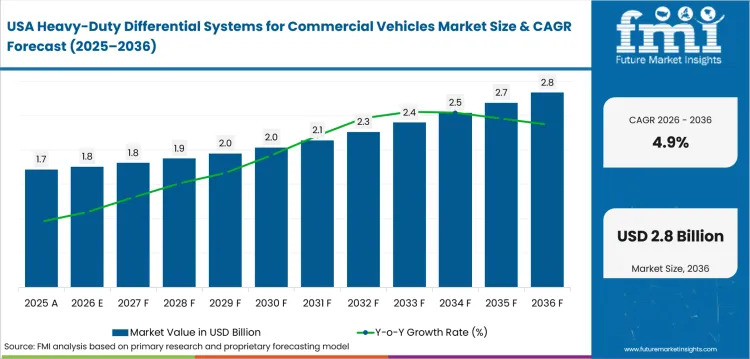
High-value truck differential systems market · 2026 to 2036
United States Market Outlook
United States demand stays high-value by 2036, shaped by class 8 freight vehicles and established service channels. Large fleets assess differential systems through uptime and warranty coverage. OEM axle programs favor suppliers able to support factory validation and national repair coverage.
Key Growth Drivers
- International Organization of Motor Vehicle Manufacturers placed United States vehicle production at 10.2 million units in 2025, keeping axle supply chains active.
- United States Environmental Protection Agency finalized Phase 3 heavy-duty greenhouse gas standards in March 2024, driving efficient driveline design from model year 2027.
- Cummins announced in October 2024 a USD 55.0 million investment to raise North American Meritor rear axle production capacity by 50.0 thousand units per year.
Key Restraints
- Americas vehicle production declined 2.1% in 2025 according to April 2026 vehicle data, disrupting some cross-border axle schedules.
- Electric truck uptake trails China in current sales mix, limiting near-term demand for e-axle integrated differential systems.
What makes the United States unique?
United States demand links heavy freight use with deep service coverage. Suppliers with reman exchange and national support can protect premium fleet accounts.
Key Companies
- Cummins-Meritor
- Dana Incorporated
- Eaton
- Dauch Corporation
- ZF North America
- Marmon-Herrington
- Detroit Locker
- Sisu Axles North America
Sales & Marketing Channels
- Truck OEM programs
- National fleet workshops
- Reman exchange channels
- Dealer service centers
- Export parts houses
- Industrial parts distributors
Market Taxonomy & Sub-Regions Covered
| Segment | Sub-Segments |
|---|---|
| By System Type | Open Differential · Locking Differential · Limited-Slip Differential · Torque-Vectoring Differential · Electronically Controlled Differential |
| By Axle Position | Rear Axle · Tandem Axle · E-Axle Integrated |
| By Vehicle Class | Class 5 to 6 · Class 7 · Class 8 · Heavy Buses · Vocational Trucks |
| By Sales Channel | OEM Fitment · Aftermarket Replacement · Reman Programs · Fleet Service · Export Supply |
| By Material Type | Ductile Iron · Cast Steel · Forged Steel · Aluminum Alloy · Hybrid Material |
| Key Sub-Regions Covered - States / Regions | Michigan, Ohio, Texas, Tennessee, Kentucky, Alabama, South Carolina, California |
Frequently Asked Questions
How fast is United States heavy-duty differential systems for commercial vehicles market growing?
United States is anticipated to rise at 4.9% CAGR from 2026 to 2036.
Who leads United States heavy-duty differential systems for commercial vehicles market?
Cummins-Meritor, Dana Incorporated, Eaton, and Dauch Corporation compete across axle system and service channels.
What is driving demand in United States?
Demand is backed by heavy truck duty cycles and replacement needs across axle service networks.
Sales Analysis of Heavy-Duty Differential Systems for Commercial Vehicles Market in Germany
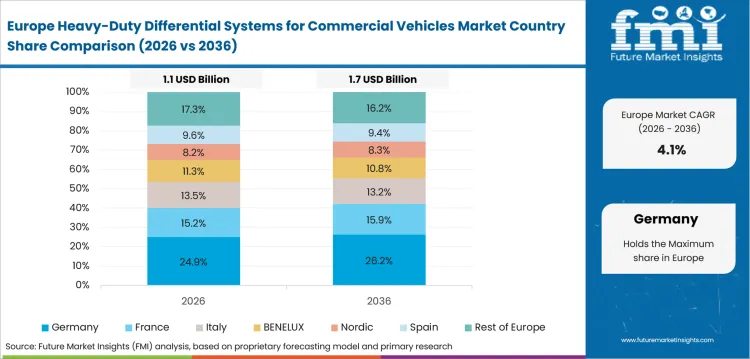
Specification-driven truck driveline market · 2026 to 2036
Germany Market Outlook
Germany progresses by 2036 through engineering-led truck production and strict supplier validation. Truck makers prefer differential systems with repeatable torque ratings and proven electronic control. Demand is linked with electric truck programs and high-value parts exports across Europe.
Key Growth Drivers
- Verband der Automobilindustrie forecast heavy commercial vehicle registrations in Europe to rise 8.0% to 312.0 thousand in 2026, supporting German axle suppliers.
- European Union Regulation 2024/1610 revised heavy-duty carbon dioxide standards in 2024, adding pressure for efficient driveline systems.
- German engineering programs in electric trucks increase interest in controlled torque split and low-loss carrier designs.
Key Restraints
- Europe production slipped 0.8% in 2025 according to International Organization of Motor Vehicle Manufacturers, limiting short-term supplier volume upside.
- High power and labor costs can restrain local machining margins for precision differential gears and carrier assemblies.
What makes Germany unique?
Germany stands out for specification-led service culture and high expectations around component validation. Differential suppliers need close ties with truck engineers and certified repair networks.
Key Companies
- ZF Group
- Daimler Truck components
- MAN Truck & Bus components
- BPW
- SAF-Holland
- Schaeffler
- Rheinmetall
- Bosch Mobility
Sales & Marketing Channels
- Truck OEM programs
- Tier-one axle suppliers
- Certified service networks
- Export component channels
- Fleet repair outlets
- Industrial distributors
Market Taxonomy & Sub-Regions Covered
| Segment | Sub-Segments |
|---|---|
| By System Type | Open Differential · Locking Differential · Limited-Slip Differential · Torque-Vectoring Differential · Electronically Controlled Differential |
| By Axle Position | Rear Axle · Tandem Axle · E-Axle Integrated |
| By Vehicle Class | Class 5 to 6 · Class 7 · Class 8 · Heavy Buses · Vocational Trucks |
| By Sales Channel | OEM Fitment · Aftermarket Replacement · Reman Programs · Fleet Service · Export Supply |
| By Material Type | Ductile Iron · Cast Steel · Forged Steel · Aluminum Alloy · Hybrid Material |
| Key Sub-Regions Covered - States / Industrial Regions | Bavaria, Baden-Württemberg, North Rhine-Westphalia, Lower Saxony, Hesse, Saxony, Hamburg, Bremen |
Frequently Asked Questions
How fast is Germany heavy-duty differential systems for commercial vehicles market growing?
Germany is projected to expand at 4.6% CAGR from 2026 to 2036.
Who leads Germany heavy-duty differential systems for commercial vehicles market?
ZF Group, Daimler Truck components, MAN Truck & Bus components, and BPW compete across axle system and service channels.
What is driving demand in Germany?
Demand is fueled by heavy truck duty cycles and replacement needs across axle service networks.
Sales Analysis of Heavy-Duty Differential Systems for Commercial Vehicles Market in Brazil
Aftermarket-sensitive heavy truck differential market · 2026 to 2036
Brazil Market Outlook
Brazil progresses by 2036 through long freight routes and strong replacement activity across heavy trucks. Axle service demand is tied to road quality and vehicle age. Differential systems gain value as workshops replace carriers and locking units for haulage vehicles.
Key Growth Drivers
- Truck sales fell 9.2% to 113,477 units in 2025 according to Anfavea data cited by Truck & Bus Builder, raising aftermarket focus over new build volume.
- Truck exports rose 50.8% in 2025 according to Anfavea data cited by Truck & Bus Builder, supporting export-oriented axle service parts.
- Bus chassis production reached 28,191 units in 2025 according to Anfavea data cited by Truck & Bus Builder, sustaining differential part needs in people-mover fleets.
Key Restraints
- Lower new truck sales in 2025 can slow OEM differential system orders for Brazil-based assembly programs.
- Steel import tariff and quota changes can raise cost uncertainty for machined carriers, pushing fleet workshops toward partial repair instead of full differential carrier replacement.
What makes Brazil unique?
Brazil’s market is shaped by heavy road freight and service-intensive vehicle use. Suppliers can gain through robust reman coverage and parts availability outside main manufacturing hubs.
Key Companies
- Dana Brazil
- ZF Brazil
- Eaton Brazil
- Cummins Inc. (Meritor Portfolio) Brazil
- Randoncorp
- Suspensys
- Max Gear
- Agrale components
Sales & Marketing Channels
- Truck OEM programs
- Fleet service workshops
- Aftermarket distributors
- Reman channels
- Export parts suppliers
- Industrial parts retailers
Market Taxonomy & Sub-Regions Covered
| Segment | Sub-Segments |
|---|---|
| By System Type | Open Differential · Locking Differential · Limited-Slip Differential · Torque-Vectoring Differential · Electronically Controlled Differential |
| By Axle Position | Rear Axle · Tandem Axle · E-Axle Integrated |
| By Vehicle Class | Class 5 to 6 · Class 7 · Class 8 · Heavy Buses · Vocational Trucks |
| By Sales Channel | OEM Fitment · Aftermarket Replacement · Reman Programs · Fleet Service · Export Supply |
| By Material Type | Ductile Iron · Cast Steel · Forged Steel · Aluminum Alloy · Hybrid Material |
| Key Sub-Regions Covered - States / Regions | São Paulo, Minas Gerais, Paraná, Rio Grande do Sul, Santa Catarina, Bahia, Goiás, Pernambuco |
Frequently Asked Questions
How fast is Brazil heavy-duty differential systems for commercial vehicles market growing?
Brazil is likely to expand at 4.3% CAGR from 2026 to 2036.
Who leads Brazil heavy-duty differential systems for commercial vehicles market?
Dana Brazil, ZF Brazil, Eaton Brazil, and Cummins Inc. (Meritor Portfolio) Brazil compete across axle system and service channels.
What is driving demand in Brazil?
Demand is led by heavy truck duty cycles and replacement needs across axle service networks.
Sales Analysis of Heavy-Duty Differential Systems for Commercial Vehicles Market in Japan
Precision-focused commercial vehicle driveline market · 2026 to 2036
Japan Market Outlook
Japan records steadier growth by 2036, supported by high service standards and durable truck fleets. Commercial vehicle makers favor compact and reliable differential systems. Replacement demand is shaped by disciplined maintenance and export-oriented component quality.
Key Growth Drivers
- United States International Trade Administration reported Japan truck sales at 686.2 thousand units in 2024 in its November 2025 automotive guide, supporting axle service demand.
- Japan bus sales reached 10.1 thousand units in 2024 according to November 2025 trade guidance, adding service volume for heavy passenger vehicles.
- Used truck movement supports replacement parts as operators extend fleet life across regional freight and service routes.
Key Restraints
- Japan’s aging commercial vehicle park can limit new OEM differential orders compared with faster-growing Asian truck markets.
- Strict supplier approval cycles can slow entry for foreign differential system brands lacking local service proof.
What makes Japan unique?
Japan is unique for precision manufacturing and disciplined maintenance. Differential suppliers must prove low noise and repair consistency to gain from truck maker channels.
Key Companies
- Aisin
- JTEKT
- Musashi Seimitsu
- NTN
- ZF Japan
- Dana Japan
Sales & Marketing Channels
- Truck OEM programs
- Dealer service centers
- Fleet workshops
- Export component suppliers
- Aftermarket distributors
- Industrial parts platforms
Market Taxonomy & Sub-Regions Covered
| Segment | Sub-Segments |
|---|---|
| By System Type | Open Differential · Locking Differential · Limited-Slip Differential · Torque-Vectoring Differential · Electronically Controlled Differential |
| By Axle Position | Rear Axle · Tandem Axle · E-Axle Integrated |
| By Vehicle Class | Class 5 to 6 · Class 7 · Class 8 · Heavy Buses · Vocational Trucks |
| By Sales Channel | OEM Fitment · Aftermarket Replacement · Reman Programs · Fleet Service · Export Supply |
| By Material Type | Ductile Iron · Cast Steel · Forged Steel · Aluminum Alloy · Hybrid Material |
| Key Sub-Regions Covered - Prefectures / Industrial Regions | Aichi, Tokyo, Kanagawa, Shizuoka, Osaka, Hiroshima, Fukuoka, Hokkaido |
Frequently Asked Questions
How fast is Japan heavy-duty differential systems for commercial vehicles market growing?
Japan is anticipated at 4.1% CAGR from 2026 to 2036.
Who leads Japan heavy-duty differential systems for commercial vehicles market?
Aisin, JTEKT, Musashi Seimitsu, NTN, ZF Japan, and Dana Japan compete across axle system and service channels.
What is driving demand in Japan?
Demand is reflected by heavy truck duty cycles and replacement needs across axle service networks.
Competitive Landscape and Strategic Positioning
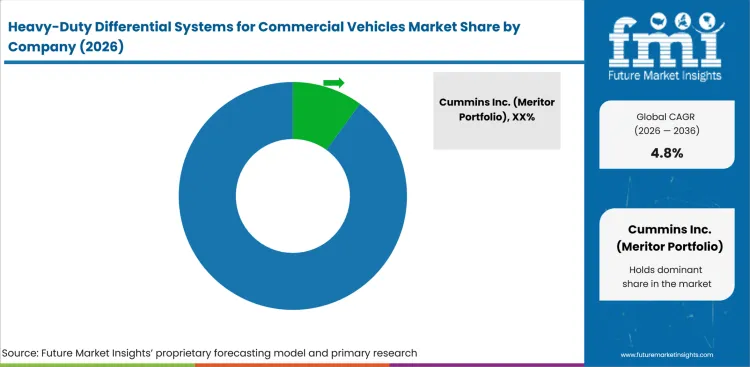
- Cummins Inc. (Meritor Portfolio) leads with rear axle production depth and service channel reach across North America.
- Dana holds value through axle carrier programs and drivetrain supply experience across commercial vehicle platforms.
- ZF Group stands out with electric axle and control capability for commercial vehicle programs.
- Eaton strengthens torque-management coverage through limited-slip and locking differential programs.
Competition is shaped by axle validation depth and service coverage instead of product catalog size alone. Truck OEMs need suppliers able to deliver carrier assemblies and warranty support across long vehicle life. Cummins Inc. (Meritor Portfolio) and Dana hold strong positions in conventional heavy axle systems. ZF and Eaton gain attention as electronic control and electric truck platforms change torque transfer needs. Regional firms can win by machining strength and fast replacement access near truck hubs.
Supplier strategy is moving toward complete assemblies and reman exchange services. Cummins said in October 2024 its USD 55.0 million investment would lift North American Meritor rear axle output by 50.0 thousand units per year during 2025. ZF said in April 2025 it secured a significant India order for AxTrax 2 electric axles for commercial vehicles. Eaton introduced new differential programs in 2025 and 2026 for limited-slip and electric vehicle e-axle applications. Such moves show supplier focus shifting toward torque control and axle service readiness.
Key Companies in the Heavy-Duty Differential Systems for Commercial Vehicles Market
Companies are classified by drivetrain system depth and service reach. Global axle system suppliers compete on carrier design and validated torque ratings. Control-focused suppliers gain from locking actuators and electronic differential modules. Regional producers remain useful for machining and local fleet support.
- Global axle system suppliers: Cummins Inc. (Meritor Portfolio) and Dana Incorporated compete on rear axle carrier depth and service coverage. ZF Group adds electric axle control strength for commercial vehicle programs.
- Torque control specialists: Eaton and Sisu Axles compete on limited-slip and planetary axle systems used across severe-duty and service-intensive vehicle routes.
- Regional drivetrain participants: Automotive Axles Limited, Bharat Forge, Rába Automotive, and Kessler + Co. gain orders through local axle program and replacement part access.
Competitive Benchmarking: Heavy-Duty Differential Systems for Commercial Vehicles Market
| Company | Carrier Strength | Locking Control | Reman Access | EV Axle Readiness | Footprint |
|---|---|---|---|---|---|
| Cummins Inc. (Meritor Portfolio) | High | Medium | High | Medium | Global |
| Dana Incorporated | High | Medium | High | Medium | Global |
| ZF Group | Medium | High | Medium | High | Global |
| Eaton | Medium | High | Medium | Medium | Global |
| Dauch Corporation | Medium | Medium | Medium | Medium | Regional |
| Sisu Axles | Medium | Medium | Medium | Low | Regional |
| Automotive Axles Limited | Medium | Low | Medium | Low | India-focused |
| Bharat Forge | Medium | Low | Medium | Low | India-focused |
| Rába Automotive | Medium | Low | Medium | Low | Europe-focused |
| Kessler + Co. | High | Medium | Medium | Medium | Europe-focused |
Source: Future Market Insights competitive analysis, 2026.
Key Developments in Heavy-Duty Differential Systems for Commercial Vehicles Market
- In October 2024, Cummins announced a USD 55.0 million investment to boost North American Meritor rear axle production capacity by 50.0 thousand units per year.
- In April 2025, ZF secured an India order for several thousand AxTrax 2 electric axles for commercial vehicles serving intercity bus use.
- In July 2025, Bharat Forge completed the acquisition of AAM India Manufacturing Private Limited at an equity value of Rs 7,464.6 million.
Key Players in the Heavy-Duty Differential Systems for Commercial Vehicles Market
- Cummins Inc.
- Dana Incorporated
- ZF Group
- Eaton
- Dauch Corporation
- Sisu Axles
- Automotive Axles Limited
- Bharat Forge
- Rába Automotive
- Kessler + Co.
Market Report Scope
| Parameter | Details |
|---|---|
| Quantitative units | USD 4.4 billion to USD 7.0 billion at 4.8% CAGR |
| Market definition | Differential carriers, gear sets, locking units, actuators, housings, and control modules for commercial vehicles |
| System type | Open differential, locking differential, limited-slip differential, torque-vectoring differential, electronically controlled differential |
| Axle position | Rear axle, tandem axle, e-axle integrated |
| Vehicle class | Class 5 to 6, class 7, class 8, heavy buses, vocational trucks |
| Sales channel | OEM fitment, aftermarket replacement, reman programs, fleet service, export supply |
| Material type | Ductile iron, cast steel, forged steel, aluminum alloy, hybrid material |
| Regions covered | North America, Latin America, Europe, East Asia, South Asia and Pacific, Middle East and Africa |
| Countries covered | China, India, Mexico, United States, Germany, Brazil, Japan |
| Key companies profiled | Cummins-Meritor, Dana Incorporated, ZF Group, Eaton, Dauch Corporation, Sisu Axles, Kessler + Co. |
| Forecast period | 2026 to 2036 |
| Approach | Workbook anchor review, official vehicle data, supplier development checks, and FMI analyst validation |
Source: Future Market Insights competitive analysis, 2026.
Heavy-Duty Differential Systems for Commercial Vehicles Market Breakdown by System Type, Axle Position, Vehicle Class, Sales Channel, Material Type, and Region
By System Type
- Open Differential
- Locking Differential
- Limited-Slip Differential
- Torque-Vectoring Differential
- Electronically Controlled Differential
By Axle Position
- Rear Axle
- Tandem Axle
- E-Axle Integrated
By Vehicle Class
- Class 5 to 6
- Class 7
- Class 8
- Heavy Buses
- Vocational Trucks
By Sales Channel
- OEM Fitment
- Aftermarket Replacement
- Reman Programs
- Fleet Service
- Export Supply
By Material Type
- Ductile Iron
- Cast Steel
- Forged Steel
- Aluminum Alloy
- Hybrid Material
By Region
- North America
- Latin America
- Europe
- East Asia
- South Asia and Pacific
- Middle East and Africa
Research Sources and Bibliography
- International Organization of Motor Vehicle Manufacturers. (2026, April 23). Auto industry growth shifted east in 2025 amid global repositioning. OICA.
- International Energy Agency. (2026, June). Trends in other EV modes. Global EV Outlook 2026. IEA.
- United States Environmental Protection Agency. (2026, February 18). Final rule: Rescission of the greenhouse gas endangerment finding and motor vehicle greenhouse gas emission standards under the Clean Air Act. EPA.
- European Parliament and Council of the European Union. (2024, June 6). Regulation (EU) 2024/1610 amending Regulation (EU) 2019/1242 as regards strengthening the carbon dioxide emission performance standards for new heavy-duty vehicles and integrating reporting obligations. Official Journal of the European Union.
- Truck & Bus Builder. (2026, February 9). Truck sales in Brazil fall 9.2% in 2025. Truck & Bus Builder.
- Truck & Bus Builder. (2026, February 10). Truck production in Brazil falls 12.1% in 2025. Truck & Bus Builder.
- Truck & Bus Builder. (2026, February 13). Bus chassis production in Brazil grows by 1.6% in 2025. Truck & Bus Builder.
- GMK Center. (2025, May 29). Brazil renews and expands safeguard measures on steel imports. GMK Center.
- SteelOrbis. (2026, January 15). CAAM: Commercial vehicle sales in China up 10.9 percent in 2025. SteelOrbis.
- SteelOrbis. (2025, September 2). Heavy truck sales in China up 13 percent in January-August 2025. SteelOrbis.
- International Council on Clean Transportation. (2025, September 30). Zero-emission medium- and heavy-duty vehicle market in China: H1 2025. ICCT.
- CnEVPost. (2026, January 14). CAAM forecasts China NEV sales to grow 15.2% to 19 million units in 2026. CnEVPost.
- Society of Indian Automobile Manufacturers. (2026, April 14). Auto industry performance of Q4 (Jan-March 2026) and FY 2025-26. SIAM.
- International Trade Administration. (2026, February 11). Mexico: Automotive industry. USA Department of Commerce.
- Verband der Automobilindustrie. (2025, December 7). Forecasts for 2026: New car registrations in Germany rise slightly. VDA.
- International Council on Clean Transportation. (2026, May 11). Zero-emission bus and truck market in Brazil (2025). ICCT.
- International Trade Administration. (2025, November). Japan: Automotive industry. USA Department of Commerce.
- Cummins Inc. (2024, October 3). Cummins Drivetrain and Braking Systems invests to boost production capacity. Cummins.
- ZF Group. (2025, April 16). India business win: ZF secures significant order for AxTrax 2 electric axle for commercial vehicles. ZF.
- Bharat Forge Limited. (2025, July 2). Bharat Forge successfully completes acquisition of AAM India Manufacturing Private Limited. Bharat Forge.
- USA Bureau of Labor Statistics. (2026, May 13). Producer Price Index by Industry: Relay and industrial control manufacturing: Parts for industrial controls and motor-control accessories. FRED, Federal Reserve Bank of St. Louis.
- European Automobile Manufacturers’ Association. (2026, January 15). Report: Vehicles on European roads 2026. ACEA.
Bibliography uses official public body, industry association, company, and sector sources.
This Report Answers
- What is the current and forecast value of the heavy-duty differential systems for commercial vehicles market from 2026 to 2036?
- Which system type is projected to hold the leading 2026 share in the heavy-duty differential systems for commercial vehicles market?
- How do axle position and vehicle class affect heavy-duty differential systems for commercial vehicles market demand?
- How do electric trucks affect differential carrier and control needs in the heavy-duty differential systems for commercial vehicles market?
- Which seven countries show the most important commercial movement for suppliers and investors?
- How do key companies compete across carrier strength and reman access?
- Which developments changed heavy-duty differential systems for commercial vehicles market positioning in OEM and service channels?
- How should suppliers position locking units and reman programs?
Frequently Asked Questions
What is the heavy-duty differential systems for commercial vehicles market size in 2026?
The heavy-duty differential systems for commercial vehicles market is anticipated to cross USD 4.4 billion in 2026.
What is the heavy-duty differential systems for commercial vehicles market forecast for 2036?
Industry value is projected to reach USD 7.0 billion by 2036 with a 4.8% CAGR.
Which system type leads heavy-duty differential systems for commercial vehicles market?
Locking differential systems are set to garner 42.0% share in 2026 due to severe-duty traction needs.
Which axle position leads heavy-duty differential systems for commercial vehicles market?
Rear axle systems are expected to account for 48.5% share in 2026 as drive axles handle major torque loads.
Which country grows fastest in heavy-duty differential systems for commercial vehicles market?
China is forecast to record 5.9% CAGR from 2026 to 2036 due to truck output and electrification.
Who are key suppliers in heavy-duty differential systems for commercial vehicles market?
Cummins Inc. (Meritor Portfolio), Dana, ZF Group, Eaton, and Dauch Corporation compete across differential system and axle service channels.
Preview the report firsthand - request a free sample
Get SampleGet the brochure for pricing and purchase details.
Get PDFTable of Content
- Key Takeaways
- Market Size and CAGR
- Top Growth Driver
- Fastest Growing Segment
- Leading Region
- Key Companies
- Emerging Opportunities
- Executive Summary
- Global Market Outlook
- Demand-side Trends
- Supply-side Trends
- Technology Roadmap Analysis
- Analysis and Recommendations
- Analyst Perspective (What is happening? Why now? What should investors know?)
- Key Questions Answered
- How large is the market?
- What is the CAGR?
- What are key trends?
- Which region dominates?
- Who are the leaders?
- Market Overview
- Market Coverage / Taxonomy
- Market Definition / Scope / Limitations
- Research Methodology
- Chapter Orientation
- Analytical Lens and Working Hypotheses
- Market Structure, Signals, and Trend Drivers
- Benchmarking and Cross-market Comparability
- Market Sizing, Forecasting, and Opportunity Mapping
- Research Design and Evidence Framework
- Desk Research Programme (Secondary Evidence)
- Expert Input and Fieldwork (Primary Evidence)
- Tooling, Models, and Reference Databases
- Data Engineering and Model Build
- Quality Assurance and Audit Trail
- Market Background
- Market Dynamics (Drivers, Restraints, Opportunity, Trends)
- Scenario Forecast (Optimistic, Likely, Conservative)
- Impact Analysis
- AI Impact
- Sustainability Impact
- Regulatory Impact
- Technology Impact
- Consumer / Buyer Analysis
- Purchase Drivers
- Adoption Barriers
- Buyer Journey
- Opportunity Map Analysis
- Product Life Cycle Analysis
- Supply Chain Analysis
- Investment Feasibility Matrix
- Value Chain Analysis
- PESTLE and Porter's Analysis
- Regulatory Landscape
- Regional Parent Market Outlook
- Production and Consumption Statistics
- Import and Export Statistics
- Global Market Analysis and Forecast, 2021 to 2036
- Historical Market Size Value (USD Billion) & Volume (Unit) Analysis, 2021 to 2025
- Current and Future Market Size Value (USD Billion) & Volume (Unit) Projections, 2026 to 2036
- Y-o-Y Growth Trend Analysis
- Absolute $ Opportunity Analysis
- Global Market Pricing Analysis, 2021 to 2036
- Global Market Analysis and Forecast, By System Type, 2021 to 2036
- Introduction / Key Findings
- Historical Market Size Value (USD Billion) & Volume (Unit) Analysis By System Type, 2021 to 2025
- Current and Future Market Size Value (USD Billion) & Volume (Unit) Analysis and Forecast By System Type, 2026 to 2036
- Open Differential
- Locking Differential
- Limited-Slip Differential
- Torque-Vectoring Differential
- Electronically Controlled Differential
- Open Differential
- Y-o-Y Growth Trend Analysis By System Type, 2021 to 2025
- Absolute $ Opportunity Analysis By System Type, 2026 to 2036
- Global Market Analysis and Forecast, By Axle Position, 2021 to 2036
- Introduction / Key Findings
- Historical Market Size Value (USD Billion) & Volume (Unit) Analysis By Axle Position, 2021 to 2025
- Current and Future Market Size Value (USD Billion) & Volume (Unit) Analysis and Forecast By Axle Position, 2026 to 2036
- Rear Axle
- Tandem Axle
- E-Axle Integrated
- Rear Axle
- Y-o-Y Growth Trend Analysis By Axle Position, 2021 to 2025
- Absolute $ Opportunity Analysis By Axle Position, 2026 to 2036
- Global Market Analysis and Forecast, By Vehicle Class, 2021 to 2036
- Introduction / Key Findings
- Historical Market Size Value (USD Billion) & Volume (Unit) Analysis By Vehicle Class, 2021 to 2025
- Current and Future Market Size Value (USD Billion) & Volume (Unit) Analysis and Forecast By Vehicle Class, 2026 to 2036
- Class 5 to 6
- Class 7
- Class 8
- Heavy Buses
- Vocational Trucks
- Class 5 to 6
- Y-o-Y Growth Trend Analysis By Vehicle Class, 2021 to 2025
- Absolute $ Opportunity Analysis By Vehicle Class, 2026 to 2036
- Global Market Analysis and Forecast, By Sales Channel, 2021 to 2036
- Introduction / Key Findings
- Historical Market Size Value (USD Billion) & Volume (Unit) Analysis By Sales Channel, 2021 to 2025
- Current and Future Market Size Value (USD Billion) & Volume (Unit) Analysis and Forecast By Sales Channel, 2026 to 2036
- OEM Fitment
- Aftermarket Replacement
- Reman Programs
- Fleet Service
- Export Supply
- OEM Fitment
- Y-o-Y Growth Trend Analysis By Sales Channel, 2021 to 2025
- Absolute $ Opportunity Analysis By Sales Channel, 2026 to 2036
- Global Market Analysis and Forecast, By Material Type, 2021 to 2036
- Introduction / Key Findings
- Historical Market Size Value (USD Billion) & Volume (Unit) Analysis By Material Type, 2021 to 2025
- Current and Future Market Size Value (USD Billion) & Volume (Unit) Analysis and Forecast By Material Type, 2026 to 2036
- Ductile Iron
- Cast Steel
- Forged Steel
- Aluminum Alloy
- Hybrid Material
- Ductile Iron
- Y-o-Y Growth Trend Analysis By Material Type, 2021 to 2025
- Absolute $ Opportunity Analysis By Material Type, 2026 to 2036
- Global Market Analysis and Forecast, By Region, 2021 to 2036
- Introduction
- Historical Market Size Value (USD Billion) & Volume (Unit) Analysis By Region, 2021 to 2025
- Current Market Size Value (USD Billion) & Volume (Unit) Analysis and Forecast By Region, 2026 to 2036
- North America
- Latin America
- Western Europe
- Eastern Europe
- East Asia
- South Asia and Pacific
- Middle East & Africa
- Market Attractiveness Analysis By Region
- North America Market Analysis and Forecast, By Country, 2021 to 2036
- Historical Market Size Value (USD Billion) & Volume (Unit) Trend Analysis By Market Taxonomy, 2021 to 2025
- Market Size Value (USD Billion) & Volume (Unit) Forecast By Market Taxonomy, 2026 to 2036
- By Country
- USA
- Canada
- Mexico
- By System Type
- By Axle Position
- By Vehicle Class
- By Sales Channel
- By Material Type
- By Country
- Market Attractiveness Analysis
- By Country
- By System Type
- By Axle Position
- By Vehicle Class
- By Sales Channel
- By Material Type
- Key Takeaways
- Latin America Market Analysis and Forecast, By Country
- Historical Market Size Value (USD Billion) & Volume (Unit) Trend Analysis By Market Taxonomy, 2021 to 2025
- Market Size Value (USD Billion) & Volume (Unit) Forecast By Market Taxonomy, 2026 to 2036
- By Country
- Brazil
- Chile
- Rest of Latin America
- By System Type
- By Axle Position
- By Vehicle Class
- By Sales Channel
- By Material Type
- By Country
- Market Attractiveness Analysis
- By Country
- By System Type
- By Axle Position
- By Vehicle Class
- By Sales Channel
- By Material Type
- Key Takeaways
- Western Europe Market Analysis and Forecast, By Country
- Historical Market Size Value (USD Billion) & Volume (Unit) Trend Analysis By Market Taxonomy, 2021 to 2025
- Market Size Value (USD Billion) & Volume (Unit) Forecast By Market Taxonomy, 2026 to 2036
- By Country
- Germany
- UK
- Italy
- Spain
- France
- Nordic
- BENELUX
- Rest of Western Europe
- By System Type
- By Axle Position
- By Vehicle Class
- By Sales Channel
- By Material Type
- By Country
- Market Attractiveness Analysis
- By Country
- By System Type
- By Axle Position
- By Vehicle Class
- By Sales Channel
- By Material Type
- Key Takeaways
- Eastern Europe Market Analysis and Forecast, By Country
- Historical Market Size Value (USD Billion) & Volume (Unit) Trend Analysis By Market Taxonomy, 2021 to 2025
- Market Size Value (USD Billion) & Volume (Unit) Forecast By Market Taxonomy, 2026 to 2036
- By Country
- Russia
- Poland
- Hungary
- Balkan & Baltic
- Rest of Eastern Europe
- By System Type
- By Axle Position
- By Vehicle Class
- By Sales Channel
- By Material Type
- By Country
- Market Attractiveness Analysis
- By Country
- By System Type
- By Axle Position
- By Vehicle Class
- By Sales Channel
- By Material Type
- Key Takeaways
- East Asia Market Analysis and Forecast, By Country
- Historical Market Size Value (USD Billion) & Volume (Unit) Trend Analysis By Market Taxonomy, 2021 to 2025
- Market Size Value (USD Billion) & Volume (Unit) Forecast By Market Taxonomy, 2026 to 2036
- By Country
- China
- Japan
- South Korea
- By System Type
- By Axle Position
- By Vehicle Class
- By Sales Channel
- By Material Type
- By Country
- Market Attractiveness Analysis
- By Country
- By System Type
- By Axle Position
- By Vehicle Class
- By Sales Channel
- By Material Type
- Key Takeaways
- South Asia and Pacific Market Analysis and Forecast, By Country
- Historical Market Size Value (USD Billion) & Volume (Unit) Trend Analysis By Market Taxonomy, 2021 to 2025
- Market Size Value (USD Billion) & Volume (Unit) Forecast By Market Taxonomy, 2026 to 2036
- By Country
- India
- ASEAN
- Australia & New Zealand
- Rest of South Asia and Pacific
- By System Type
- By Axle Position
- By Vehicle Class
- By Sales Channel
- By Material Type
- By Country
- Market Attractiveness Analysis
- By Country
- By System Type
- By Axle Position
- By Vehicle Class
- By Sales Channel
- By Material Type
- Key Takeaways
- Middle East & Africa Market Analysis and Forecast, By Country
- Historical Market Size Value (USD Billion) & Volume (Unit) Trend Analysis By Market Taxonomy, 2021 to 2025
- Market Size Value (USD Billion) & Volume (Unit) Forecast By Market Taxonomy, 2026 to 2036
- By Country
- Kingdom of Saudi Arabia
- Other GCC Countries
- Türkiye
- South Africa
- Other African Union
- Rest of Middle East & Africa
- By System Type
- By Axle Position
- By Vehicle Class
- By Sales Channel
- By Material Type
- By Country
- Market Attractiveness Analysis
- By Country
- By System Type
- By Axle Position
- By Vehicle Class
- By Sales Channel
- By Material Type
- Key Takeaways
- Key Countries Market Analysis
- USA
- Pricing Analysis
- Market Share Analysis, 2025
- By System Type
- By Axle Position
- By Vehicle Class
- By Sales Channel
- By Material Type
- Canada
- Pricing Analysis
- Market Share Analysis, 2025
- By System Type
- By Axle Position
- By Vehicle Class
- By Sales Channel
- By Material Type
- Mexico
- Pricing Analysis
- Market Share Analysis, 2025
- By System Type
- By Axle Position
- By Vehicle Class
- By Sales Channel
- By Material Type
- Brazil
- Pricing Analysis
- Market Share Analysis, 2025
- By System Type
- By Axle Position
- By Vehicle Class
- By Sales Channel
- By Material Type
- Chile
- Pricing Analysis
- Market Share Analysis, 2025
- By System Type
- By Axle Position
- By Vehicle Class
- By Sales Channel
- By Material Type
- Germany
- Pricing Analysis
- Market Share Analysis, 2025
- By System Type
- By Axle Position
- By Vehicle Class
- By Sales Channel
- By Material Type
- UK
- Pricing Analysis
- Market Share Analysis, 2025
- By System Type
- By Axle Position
- By Vehicle Class
- By Sales Channel
- By Material Type
- Italy
- Pricing Analysis
- Market Share Analysis, 2025
- By System Type
- By Axle Position
- By Vehicle Class
- By Sales Channel
- By Material Type
- Spain
- Pricing Analysis
- Market Share Analysis, 2025
- By System Type
- By Axle Position
- By Vehicle Class
- By Sales Channel
- By Material Type
- France
- Pricing Analysis
- Market Share Analysis, 2025
- By System Type
- By Axle Position
- By Vehicle Class
- By Sales Channel
- By Material Type
- India
- Pricing Analysis
- Market Share Analysis, 2025
- By System Type
- By Axle Position
- By Vehicle Class
- By Sales Channel
- By Material Type
- ASEAN
- Pricing Analysis
- Market Share Analysis, 2025
- By System Type
- By Axle Position
- By Vehicle Class
- By Sales Channel
- By Material Type
- Australia & New Zealand
- Pricing Analysis
- Market Share Analysis, 2025
- By System Type
- By Axle Position
- By Vehicle Class
- By Sales Channel
- By Material Type
- China
- Pricing Analysis
- Market Share Analysis, 2025
- By System Type
- By Axle Position
- By Vehicle Class
- By Sales Channel
- By Material Type
- Japan
- Pricing Analysis
- Market Share Analysis, 2025
- By System Type
- By Axle Position
- By Vehicle Class
- By Sales Channel
- By Material Type
- South Korea
- Pricing Analysis
- Market Share Analysis, 2025
- By System Type
- By Axle Position
- By Vehicle Class
- By Sales Channel
- By Material Type
- Russia
- Pricing Analysis
- Market Share Analysis, 2025
- By System Type
- By Axle Position
- By Vehicle Class
- By Sales Channel
- By Material Type
- Poland
- Pricing Analysis
- Market Share Analysis, 2025
- By System Type
- By Axle Position
- By Vehicle Class
- By Sales Channel
- By Material Type
- Hungary
- Pricing Analysis
- Market Share Analysis, 2025
- By System Type
- By Axle Position
- By Vehicle Class
- By Sales Channel
- By Material Type
- Kingdom of Saudi Arabia
- Pricing Analysis
- Market Share Analysis, 2025
- By System Type
- By Axle Position
- By Vehicle Class
- By Sales Channel
- By Material Type
- Türkiye
- Pricing Analysis
- Market Share Analysis, 2025
- By System Type
- By Axle Position
- By Vehicle Class
- By Sales Channel
- By Material Type
- South Africa
- Pricing Analysis
- Market Share Analysis, 2025
- By System Type
- By Axle Position
- By Vehicle Class
- By Sales Channel
- By Material Type
- USA
- Market Structure Analysis
- Competition Dashboard
- Competition Benchmarking
- Market Share Analysis of Top Players
- By Regional
- By System Type
- By Axle Position
- By Vehicle Class
- By Sales Channel
- By Material Type
- Emerging Startups
- Innovation Benchmarking
- Competition Analysis
- Competition Deep Dive
- Cummins Inc. (Meritor Portfolio) China
- Overview
- Product Portfolio
- Profitability by Market Segments (Product/Region/Sales Channel)
- Sales Footprint
- Strategy Overview
- Marketing Strategy
- Product Strategy
- Channel Strategy
- ZF China
- Dana China
- Eaton China
- Dauch Corporation China
- Dongfeng Dana Axle
- Shaanxi Hande Axle
- FAW axle units
- Cummins Inc. (Meritor Portfolio) China
- Case Studies
- Success Stories
- Recent Developments
- Competition Deep Dive
- Assumptions & Acronyms Used


