

- Industry Size (2026)
- USD 2.1 Bn
- Forecast (2036)
- USD 3.1 Bn
- CAGR (2026 to 2036)
- 3.8%
Off-Road Driveline Couplings Market Forecast and Outlook (2026-2036)
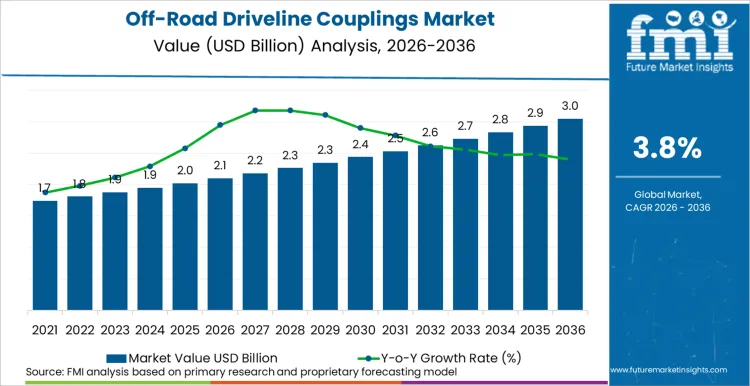
The global off-road driveline couplings market is forecasted to reach USD 2.1 billion in 2026 and expand to USD 3.1 billion by 2036, advancing at a CAGR of 3.8%. Market expansion is driven by rising demand for enhanced power transmission efficiency in heavy-duty applications, with manufacturers developing advanced coupling technologies that accommodate higher torque loads and operational stresses across diverse terrain conditions.
By leveraging advanced materials engineering and precision manufacturing techniques, producers can now develop coupling systems that offer enhanced durability and improved vibration dampening through optimized elastomeric compounds and reinforced mechanical interfaces. This technological advancement allows for the creation of maintenance-friendly products with extended service life capabilities and reduced operational variability, effectively addressing equipment manufacturer demands for consistent performance while maintaining reliability throughout demanding operational cycles.
"We closed 2025 with strong momentum and executed on every major strategic commitment, from completing the Off Highway divestiture to delivering substantial cost savings," said R. Bruce McDonald, Chairman and Chief Executive Officer of Dana Incorporated. "Our actions have reshaped Dana into a more streamlined, higher margin company with greater financial flexibility. In 2026, we expect to complete the remainder of our now $325 million cost reduction program, continue executing our $1 billion capital return plan, and expand adjusted EBITDA margins to 10–11 percent—positioning Dana for durable, long term value creation. We are entering the year with a strengthened balance sheet, higher margin new business, and an ongoing commitment to shareholder returns and operational excellence."
The industry's value proposition is shifting from basic power transmission functionality toward comprehensive driveline solutions that address specific operational requirements. Advanced manufacturers are integrating vibration control systems, misalignment accommodation features, and customizable torque handling options to reduce maintenance requirements while improving equipment performance. Specialized coupling providers are gaining preference among equipment manufacturers, enabling direct supply partnerships and customized solutions across heavy-duty applications and industrial channels.
Summary of Off-Road Driveline Couplings Market
- The off-road driveline couplings market comprises power transmission components used in construction equipment, agricultural machinery, mining systems, and specialized heavy-duty applications requiring reliable torque transfer across varied terrain conditions and operational environments.
- Market scope includes flexible elastomeric couplings, gear couplings, spline and universal joint interfaces, and specialized coupling technologies designed for off-road equipment applications, excluding standard automotive driveline components and stationary industrial coupling systems.
- The off-road driveline couplings market is projected to grow at a CAGR of 3.8% from 2026 to 2036, expanding from USD 2.1 billion in 2026 to USD 3.1 billion by 2036, based on equipment production forecasts, replacement demand analysis, and technological advancement assessments.
- Market growth is supported by increasing mechanization in developing regions, equipment modernization requirements, and advancing coupling technologies that improve operational efficiency and reduce maintenance requirements across heavy-duty applications.
- Competition centers on major manufacturers including Dana Incorporated, ZF Group, Schaeffler Group, and Regal Rexnord Corporation, with market leadership established through technological innovation, distribution network strength, and comprehensive product portfolios serving diverse equipment applications.
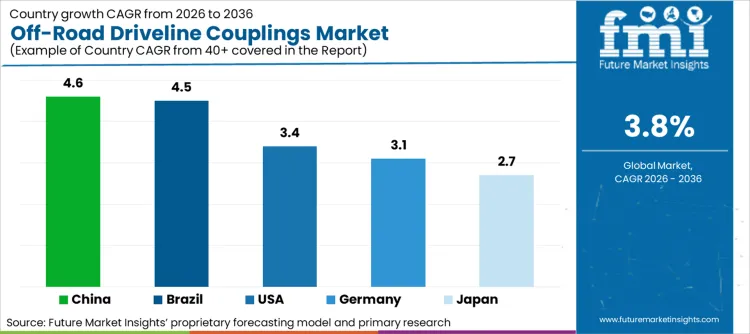
- China is projected to record the fastest growth at 4.6% CAGR through 2036, while the United States maintains the largest market value share supported by extensive construction activity and agricultural mechanization across diverse operational environments.
Off-Road Driveline Couplings Market Key Takeaways
| Metric | Value |
|---|---|
| Market Value (2026) | USD 2.1 billion |
| Market Forecast Value (2036) | USD 3.1 billion |
| Forecast CAGR (2026-2036) | 3.8% |
What is Driving the Demand for Off-Road Driveline Couplings?
Demand for off-road driveline couplings is propelled by expanding mechanization across construction, agriculture, and mining sectors, where equipment manufacturers require reliable power transmission components capable of handling variable loads and operational stresses. The increasing complexity of heavy machinery designs necessitates advanced coupling technologies that accommodate misalignment, reduce vibration transmission, and maintain operational efficiency under demanding conditions.
Rising construction activity in developing economies drives demand for earth-moving equipment, excavators, and specialized machinery requiring robust coupling systems. Infrastructure development projects across Asia-Pacific and Latin America regions create sustained demand for construction equipment equipped with advanced driveline components designed for extended operational life and reduced maintenance requirements.
Agricultural mechanization trends support market growth as farming operations adopt larger, more powerful equipment capable of handling diverse field conditions. Modern agricultural machinery requires coupling systems that accommodate seasonal operational variations, soil condition changes, and the integration of precision farming technologies while maintaining reliable power transmission across extended operational cycles.
How is the Off-Road Driveline Couplings Market Segmented?
The off-road driveline couplings market is segmented by equipment type, coupling type, torque class, and sales channel. Equipment type categories include construction equipment, agricultural machinery, mining equipment, and specialized applications. Coupling type segmentation encompasses flexible elastomeric systems, gear couplings, spline and universal joint interfaces, and alternative technologies. Torque class divisions include up to 500 Nm, 500-1,500 Nm, above 1,500 Nm, and specialized applications. Sales channel segmentation covers original equipment manufacturer line-fit, aftermarket and maintenance services, dealer networks, and alternative distribution methods.
Why Do Construction Equipment Dominate the Off-Road Driveline Couplings Market?
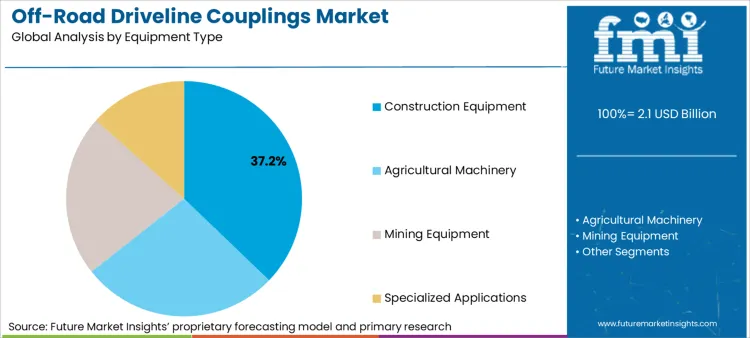
Construction equipment types maintain market leadership with 37.2% share, driven by extensive global infrastructure development and urbanization trends requiring diverse earth-moving and material handling equipment. Construction machinery operates under variable load conditions and demanding environmental factors, necessitating coupling systems capable of handling sudden torque variations, impact loads, and continuous operational stresses while maintaining power transmission efficiency.
The construction sector requires equipment designs that accommodate diverse operational environments, from urban construction sites to remote infrastructure projects. Coupling systems must provide reliable performance across temperature extremes, dust exposure, and moisture conditions while enabling equipment mobility and operational flexibility. These requirements drive demand for advanced coupling technologies that integrate durability features with maintenance accessibility.
Agricultural machinery represents 29.5% of market demand, supported by ongoing mechanization in emerging markets and equipment modernization in developed regions. Modern farming operations require coupling systems that handle seasonal operational variations and accommodate the integration of precision agriculture technologies while maintaining reliable power transmission across extended operational periods.
How Do Application Requirements Influence Off-Road Driveline Coupling Selection?
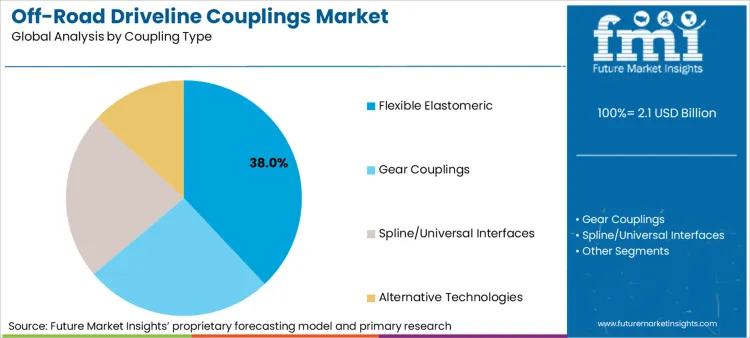
Flexible elastomeric couplings stand as the dominant segment, commanding 38.0% of the market share. Off-road driveline couplings remain centered on applications requiring vibration dampening and misalignment accommodation due to the exceptional performance these coupling types offer in power transmission reliability and maintenance accessibility. Heavy-duty operations often require precise torque handling and shock absorption capabilities, making flexible elastomeric systems ideal for controlled power transfer while maintaining equipment protection throughout demanding operational environments.
The market is shaped by the development of application-specific coupling technologies and enhanced durability features that require extensive testing to establish performance consistency and operational reliability. Torque class requirements demand specialized coupling designs that integrate capacity optimization and safety features to prevent equipment damage while ensuring consistent power delivery. Companies are expanding their capabilities to address these specialized requirements. Advanced validation protocols help developers optimize coupling performance and ensure reliable operation across different equipment applications, making these engineering services essential for equipment approval and market acceptance.
How Is Technological Evolution Reshaping Off-Road Driveline Couplings?
The off-road driveline couplings sector is evolving from traditional mechanical coupling designs toward integrated systems that combine vibration dampening, misalignment accommodation, and enhanced durability features. Advanced materials engineering enables coupling designs that withstand higher operational stresses while reducing weight and maintenance requirements. These developments allow manufacturers to address specific application requirements while improving equipment performance and operational efficiency.
Improved coupling designs incorporate condition monitoring capabilities and predictive maintenance features that reduce unplanned downtime during critical operational periods. The integration of sensor technologies and diagnostic systems enables equipment operators to monitor coupling performance and schedule maintenance activities based on actual operational conditions rather than predetermined intervals.
Manufacturing processes incorporate precision machining and advanced quality control systems that ensure consistent performance characteristics and extended operational life. These technological improvements reduce variability in coupling performance while enabling customization for specific equipment applications and operational requirements.
How Is the Off-Road Driveline Couplings Market Evolving Globally?
Global demand for off-road driveline couplings reflects increasing mechanization across developing economies and equipment modernization requirements in established markets. Market growth demonstrates rising adoption of advanced coupling technologies that improve operational efficiency, reduce maintenance costs, and enhance equipment reliability across diverse operational environments.
United States records 3.4% CAGR, Germany records 3.1% CAGR, China records 4.6% CAGR, Japan records 2.7% CAGR, and Brazil records 4.5% CAGR. Adoption patterns vary based on local infrastructure development requirements, agricultural mechanization trends, and mining activity levels across different regions.
| Country | CAGR (2026-2036) |
|---|---|
| United States | 3.4% |
| Germany | 3.1% |
| China | 4.6% |
| Japan | 2.7% |
| Brazil | 4.5% |
United States: How is Infrastructure Development Driving Market Growth?
The United States market benefits from extensive construction activity and agricultural mechanization requirements that drive demand for advanced coupling technologies. American equipment manufacturers focus on developing systems that accommodate diverse operational environments, from urban construction projects to large-scale agricultural operations across varied geographic conditions.
Infrastructure modernization projects and equipment replacement cycles support sustained market growth as operators adopt advanced coupling systems that provide improved reliability and reduced maintenance requirements. The United States market is projected to grow at 3.4% CAGR during the study period, driven by ongoing construction activity and agricultural equipment modernization across diverse operational environments.
Germany: Will Engineering Excellence Drive Premium Coupling Adoption?
Germany's market emphasizes precision engineering and advanced manufacturing capabilities that enable the development of high-performance coupling systems for demanding applications. German manufacturers focus on developing coupling technologies that integrate advanced materials and manufacturing processes to provide superior operational performance and extended service life.
The German market benefits from strong domestic equipment manufacturing and export demand for premium coupling technologies. Market growth at 3.1% CAGR reflects ongoing technological advancement and the development of specialized coupling systems that address specific application requirements across construction, agricultural, and industrial sectors.
China: Is Manufacturing Expansion Supporting Production Growth?
China's market growth at 4.6% CAGR reflects extensive infrastructure development and increasing agricultural mechanization that drives demand for reliable coupling systems. Chinese manufacturers focus on developing cost-effective solutions that meet international quality standards while addressing local market requirements for diverse equipment applications.
Rapid urbanization and infrastructure development create sustained demand for construction equipment equipped with advanced coupling technologies. The expanding manufacturing sector and agricultural modernization trends support market growth as domestic equipment producers integrate advanced coupling systems to improve product competitiveness and operational performance.
Japan: How is Precision Manufacturing Shaping Market Development?
Japan's market at 2.7% CAGR emphasizes advanced manufacturing technologies and precision engineering capabilities that enable the development of high-quality coupling systems for specialized applications. Japanese manufacturers focus on integrating advanced materials and manufacturing processes to create coupling solutions that provide superior performance characteristics.
The market benefits from strong domestic demand for construction and agricultural equipment, combined with export opportunities for premium coupling technologies. Japanese companies continue to develop innovative coupling designs that incorporate advanced features and manufacturing techniques to address evolving market requirements.
Brazil: How is Agricultural Expansion Driving Coupling Demand?
Brazil's market growth at 4.5% CAGR is driven by extensive agricultural operations and infrastructure development projects that require reliable coupling systems for heavy-duty equipment. The agricultural sector's modernization and expansion create sustained demand for advanced coupling technologies that accommodate diverse operational conditions.
Infrastructure development and mining activities support market growth as operators adopt equipment equipped with advanced coupling systems designed for demanding operational environments. The Brazilian market benefits from increasing mechanization across agricultural and construction sectors, driving demand for coupling technologies that provide reliable performance and reduced maintenance requirements.
Who are the Major Players Active in the Off-Road Driveline Couplings Market?
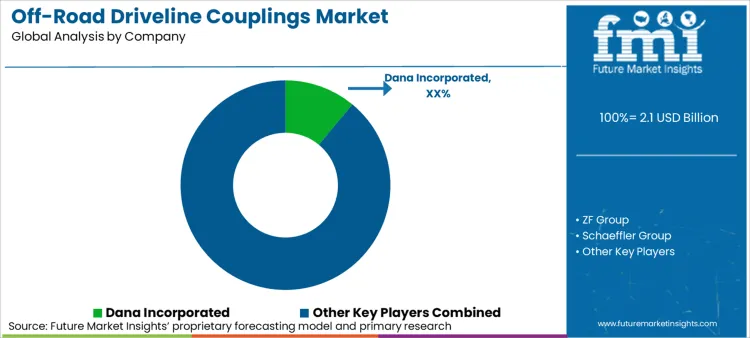
Major manufacturers including Dana Incorporated, ZF Group, Schaeffler Group, and Regal Rexnord Corporation compete based on technological innovation, product quality, and comprehensive service capabilities. These industry leaders invest in advanced manufacturing processes and engineering capabilities to develop coupling systems that address specific application requirements while maintaining competitive pricing and delivery performance.
Regional market dynamics create opportunities for specialized manufacturers to develop coupling systems tailored to local equipment requirements and operational conditions. North American companies maintain leadership through proximity to major equipment manufacturers and comprehensive engineering support capabilities, while European manufacturers focus on precision engineering and advanced materials applications.
Asian manufacturers continue to expand their market presence through competitive pricing strategies and localized manufacturing capabilities that address regional market requirements. This competitive environment drives continuous innovation in coupling design, materials engineering, and manufacturing processes to meet evolving customer requirements across diverse application sectors.
Key Industry Developments:
- In February 2026, ZF Friedrichshafen AG and the BMW Group signed a long-term supply agreement in the field of passenger car drive systems.
- In June 2025, Dana Incorporated announced that it has reached a definitive agreement to sell its Off-Highway business to Allison Transmission Holdings, Inc.
Key Players in the Off-Road Driveline Couplings Market
- Dana Incorporated
- ZF Group
- Schaeffler Group
- Regal Rexnord Corporation
- KTR Corporation
- Flender GmbH
- Voith Group
- Timken Company
- GKN Automotive
Market Definition
The off-road driveline couplings market encompasses specialized power transmission components designed for heavy-duty equipment applications in construction, agriculture, mining, and related sectors. These systems provide reliable torque transfer while accommodating operational stresses, misalignment conditions, and environmental factors common in off-road applications. Market analysis covers the period from 2026 to 2036 with values measured in USD billions.
The market includes coupling systems categorized by equipment type, coupling technology, torque capacity, and distribution channel, utilized across diverse heavy-duty applications requiring reliable power transmission under demanding operational conditions. Market expansion reflects growing mechanization requirements, technological advancement, and increasing demand for improved operational efficiency across equipment sectors.
Market Inclusion
The market scope includes coupling systems designed for construction equipment, agricultural machinery, mining systems, and specialized heavy-duty applications. Product categories encompass flexible elastomeric couplings, gear couplings, spline and universal joint interfaces, and alternative coupling technologies designed for off-road applications. Distribution channels include original equipment manufacturer integration, aftermarket services, and dealer networks.
Geographic coverage includes North America, Europe, Asia-Pacific, Latin America, and other regions with significant construction, agricultural, and mining activity. Country-level analysis covers major markets including the United States, Germany, China, Japan, Brazil, and other regions with substantial equipment manufacturing and operational activity.
Market Exclusion
Excluded from market scope are standard automotive driveline components, stationary industrial coupling systems, and marine propulsion applications. Products not designed for heavy-duty off-road applications, including light commercial and passenger vehicle coupling systems, fall outside the defined market boundaries.
The market excludes coupling systems designed exclusively for highway transportation, fixed industrial installations, and specialized marine or aerospace applications. Custom engineering services and individual component sales not integrated into complete coupling systems are not included in market calculations.
Scope of the Report
| Items | Values |
|---|---|
| Quantitative Units | USD 2.1 billion |
| Equipment Type | Construction Equipment; Agricultural Machinery; Mining Equipment; Specialized Applications |
| Coupling Type | Flexible Elastomeric; Gear Couplings; Spline/Universal Interfaces; Alternative Technologies |
| Torque Class | Up to 500 Nm; 500-1,500 Nm; Above 1,500 Nm; Specialized Applications |
| Sales Channel | OEM Line-Fit; Aftermarket/MRO; Dealer Networks; Alternative Distribution |
| Regions Covered | North America, Europe, Asia-Pacific, Latin America, Middle East & Africa |
| Countries Covered | United States, Germany, China, Japan, Brazil, United Kingdom, and 40+ countries |
| Key Companies Profiled | Dana Incorporated; ZF Group; Schaeffler Group; Regal Rexnord Corporation; Others |
| Additional Attributes | Revenue analysis by equipment type and application; performance in heavy-duty applications and durability capabilities across equipment manufacturers, coupling suppliers, and industrial facilities; coupling efficiency enhancement, operational reliability optimization, and performance consistency under various application scenarios; impact on equipment performance, operational efficiency, and maintenance requirements during procurement processes; compatibility with equipment specifications and operational requirements; procurement dynamics driven by performance positioning, reliability compliance programs, and long-term supply partnerships. |
Off-Road Driveline Couplings Market by Segment
Equipment Type:
- Construction Equipment
- Agricultural Machinery
- Mining Equipment
- Specialized Applications
Coupling Type:
- Flexible Elastomeric
- Gear Couplings
- Spline/Universal Interfaces
- Alternative Technologies
Torque Class:
- Up to 500 Nm
- 500-1,500 Nm
- Above 1,500 Nm
- Specialized Applications
Sales Channel:
- OEM Line-Fit
- Aftermarket/MRO
- Dealer Networks
- Alternative Distribution
Region:
- North America
- United States
- Canada
- Mexico
- Europe
- Germany
- United Kingdom
- France
- Italy
- Spain
- Rest of Europe
- Asia-Pacific
- China
- Japan
- South Korea
- India
- Australia
- Rest of Asia-Pacific
- Latin America
- Brazil
- Argentina
- Chile
- Rest of Latin America
- Middle East & Africa
- South Africa
- Saudi Arabia
- Rest of Middle East & Africa
Bibliography
- Kruppa, J., & Müller, T. (2023). Innovations in off-road driveline systems: Advanced coupling technologies for heavy-duty machinery. Journal of Mechanical Engineering and Technology, 59(4), 234-245.
- Society of Automotive Engineers. (2023). SAE International. Society of Automotive Engineers.
- USA Department of Energy. (2023). Office of Energy Efficiency and Renewable Energy (EERE). U.S. Department of Energy.
Frequently Asked Questions
How big is the off-road driveline couplings market in 2026?
The global off-road driveline couplings market is estimated to be valued at USD 2.1 billion in 2026.
What will be the size of off-road driveline couplings market in 2036?
The market size for the off-road driveline couplings market is projected to reach USD 3.0 billion by 2036.
How much will be the off-road driveline couplings market growth between 2026 and 2036?
The off-road driveline couplings market is expected to grow at a 3.8% CAGR between 2026 and 2036.
What are the key product types in the off-road driveline couplings market?
The key product types in off-road driveline couplings market are construction equipment , agricultural machinery, mining equipment and specialized applications.
Which coupling type segment to contribute significant share in the off-road driveline couplings market in 2026?
In terms of coupling type, flexible elastomeric segment to command 38.0% share in the off-road driveline couplings market in 2026.
Preview the report firsthand - request a free sample
Get SampleGet the brochure for pricing and purchase details.
Get PDFTable of Content
- Executive Summary
- Global Market Outlook
- Demand-side Trends
- Supply-side Trends
- Analysis and Recommendations
- Market Overview
- Market Coverage / Taxonomy
- Market Definition / Scope / Limitations
- Research Methodology
- Chapter Orientation
- Analytical Lens and Working Hypotheses
- Market Structure, Signals, and Trend Drivers
- Research Design and Evidence Framework
- Desk Research Programme (Secondary Evidence)
- Company Annual and Sustainability Reports
- Peer-reviewed Journals and Academic Literature
- Corporate Websites, Product Literature, and Technical Notes
- Earnings Decks and Investor Briefings
- Statutory Filings and Regulatory Disclosures
- Technical White Papers and Standards Notes
- Trade Journals, Industry Magazines, and Analyst Briefs
- Conference Proceedings, Webinars, and Seminar Materials
- Government Statistics Portals and Public Data Releases
- Press Releases and Reputable Media Coverage
- Specialist Newsletters and Curated Briefings
- Sector Databases and Reference Repositories
- FMI Internal Proprietary Databases and Historical Market Datasets
- Subscription Datasets and Paid Sources
- Social Channels, Communities, and Digital Listening Inputs
- Additional Desk Sources
- Expert Input and Fieldwork (Primary Evidence)
- Primary Modes
- Qualitative Interviews and Expert Elicitation
- Quantitative Surveys and Structured Data Capture
- Blended Approach
- Why Primary Evidence is Used
- Field Techniques
- Interviews
- Surveys
- Focus Groups
- Observational and In-context Research
- Social and Community Interactions
- Stakeholder Universe Engaged
- C-suite Leaders
- Board Members
- Presidents and Vice Presidents
- R&D and Innovation Heads
- Technical Specialists
- Domain Subject-matter Experts
- Scientists
- Physicians and Other Healthcare Professionals
- Governance, Ethics, and Data Stewardship
- Research Ethics
- Data Integrity and Handling
- Primary Modes
- Tooling, Models, and Reference Databases
- Desk Research Programme (Secondary Evidence)
- Data Engineering and Model Build
- Data Acquisition and Ingestion
- Cleaning, Normalisation, and Verification
- Synthesis, Triangulation, and Analysis
- Quality Assurance and Audit Trail
- Market Background
- Market Dynamics
- Drivers
- Restraints
- Opportunity
- Trends
- Scenario Forecast
- Demand in Optimistic Scenario
- Demand in Likely Scenario
- Demand in Conservative Scenario
- Opportunity Map Analysis
- Product Life Cycle Analysis
- Supply Chain Analysis
- Investment Feasibility Matrix
- Value Chain Analysis
- PESTLE and Porter’s Analysis
- Regulatory Landscape
- Regional Parent Market Outlook
- Production and Consumption Statistics
- Import and Export Statistics
- Market Dynamics
- Global Market Analysis 2021 to 2025 and Forecast, 2026 to 2036
- Historical Market Size Value (USD Million) Analysis, 2021 to 2025
- Current and Future Market Size Value (USD Million) Projections, 2026 to 2036
- Y-o-Y Growth Trend Analysis
- Absolute $ Opportunity Analysis
- Global Market Pricing Analysis 2021 to 2025 and Forecast 2026 to 2036
- Global Market Analysis 2021 to 2025 and Forecast 2026 to 2036, By Equipment Type
- Introduction / Key Findings
- Historical Market Size Value (USD Million) Analysis By Equipment Type , 2021 to 2025
- Current and Future Market Size Value (USD Million) Analysis and Forecast By Equipment Type , 2026 to 2036
- Construction Equipment
- Agricultural Machinery
- Mining Equipment
- Specialized Applications
- Y-o-Y Growth Trend Analysis By Equipment Type , 2021 to 2025
- Absolute $ Opportunity Analysis By Equipment Type , 2026 to 2036
- Global Market Analysis 2021 to 2025 and Forecast 2026 to 2036, By Coupling Type
- Introduction / Key Findings
- Historical Market Size Value (USD Million) Analysis By Coupling Type, 2021 to 2025
- Current and Future Market Size Value (USD Million) Analysis and Forecast By Coupling Type, 2026 to 2036
- Flexible Elastomeric
- Gear Couplings
- Spline/Universal Interfaces
- Alternative Technologies
- Y-o-Y Growth Trend Analysis By Coupling Type, 2021 to 2025
- Absolute $ Opportunity Analysis By Coupling Type, 2026 to 2036
- Global Market Analysis 2021 to 2025 and Forecast 2026 to 2036, By Region
- Introduction
- Historical Market Size Value (USD Million) Analysis By Region, 2021 to 2025
- Current Market Size Value (USD Million) Analysis and Forecast By Region, 2026 to 2036
- North America
- Latin America
- Western Europe
- Eastern Europe
- East Asia
- South Asia and Pacific
- Middle East & Africa
- Market Attractiveness Analysis By Region
- North America Market Analysis 2021 to 2025 and Forecast 2026 to 2036, By Country
- Historical Market Size Value (USD Million) Trend Analysis By Market Taxonomy, 2021 to 2025
- Market Size Value (USD Million) Forecast By Market Taxonomy, 2026 to 2036
- By Country
- USA
- Canada
- Mexico
- By Equipment Type
- By Coupling Type
- By Country
- Market Attractiveness Analysis
- By Country
- By Equipment Type
- By Coupling Type
- Key Takeaways
- Latin America Market Analysis 2021 to 2025 and Forecast 2026 to 2036, By Country
- Historical Market Size Value (USD Million) Trend Analysis By Market Taxonomy, 2021 to 2025
- Market Size Value (USD Million) Forecast By Market Taxonomy, 2026 to 2036
- By Country
- Brazil
- Chile
- Rest of Latin America
- By Equipment Type
- By Coupling Type
- By Country
- Market Attractiveness Analysis
- By Country
- By Equipment Type
- By Coupling Type
- Key Takeaways
- Western Europe Market Analysis 2021 to 2025 and Forecast 2026 to 2036, By Country
- Historical Market Size Value (USD Million) Trend Analysis By Market Taxonomy, 2021 to 2025
- Market Size Value (USD Million) Forecast By Market Taxonomy, 2026 to 2036
- By Country
- Germany
- UK
- Italy
- Spain
- France
- Nordic
- BENELUX
- Rest of Western Europe
- By Equipment Type
- By Coupling Type
- By Country
- Market Attractiveness Analysis
- By Country
- By Equipment Type
- By Coupling Type
- Key Takeaways
- Eastern Europe Market Analysis 2021 to 2025 and Forecast 2026 to 2036, By Country
- Historical Market Size Value (USD Million) Trend Analysis By Market Taxonomy, 2021 to 2025
- Market Size Value (USD Million) Forecast By Market Taxonomy, 2026 to 2036
- By Country
- Russia
- Poland
- Hungary
- Balkan & Baltic
- Rest of Eastern Europe
- By Equipment Type
- By Coupling Type
- By Country
- Market Attractiveness Analysis
- By Country
- By Equipment Type
- By Coupling Type
- Key Takeaways
- East Asia Market Analysis 2021 to 2025 and Forecast 2026 to 2036, By Country
- Historical Market Size Value (USD Million) Trend Analysis By Market Taxonomy, 2021 to 2025
- Market Size Value (USD Million) Forecast By Market Taxonomy, 2026 to 2036
- By Country
- China
- Japan
- South Korea
- By Equipment Type
- By Coupling Type
- By Country
- Market Attractiveness Analysis
- By Country
- By Equipment Type
- By Coupling Type
- Key Takeaways
- South Asia and Pacific Market Analysis 2021 to 2025 and Forecast 2026 to 2036, By Country
- Historical Market Size Value (USD Million) Trend Analysis By Market Taxonomy, 2021 to 2025
- Market Size Value (USD Million) Forecast By Market Taxonomy, 2026 to 2036
- By Country
- India
- ASEAN
- Australia & New Zealand
- Rest of South Asia and Pacific
- By Equipment Type
- By Coupling Type
- By Country
- Market Attractiveness Analysis
- By Country
- By Equipment Type
- By Coupling Type
- Key Takeaways
- Middle East & Africa Market Analysis 2021 to 2025 and Forecast 2026 to 2036, By Country
- Historical Market Size Value (USD Million) Trend Analysis By Market Taxonomy, 2021 to 2025
- Market Size Value (USD Million) Forecast By Market Taxonomy, 2026 to 2036
- By Country
- Kingdom of Saudi Arabia
- Other GCC Countries
- Turkiye
- South Africa
- Other African Union
- Rest of Middle East & Africa
- By Equipment Type
- By Coupling Type
- By Country
- Market Attractiveness Analysis
- By Country
- By Equipment Type
- By Coupling Type
- Key Takeaways
- Key Countries Market Analysis
- USA
- Pricing Analysis
- Market Share Analysis, 2025
- By Equipment Type
- By Coupling Type
- Canada
- Pricing Analysis
- Market Share Analysis, 2025
- By Equipment Type
- By Coupling Type
- Mexico
- Pricing Analysis
- Market Share Analysis, 2025
- By Equipment Type
- By Coupling Type
- Brazil
- Pricing Analysis
- Market Share Analysis, 2025
- By Equipment Type
- By Coupling Type
- Chile
- Pricing Analysis
- Market Share Analysis, 2025
- By Equipment Type
- By Coupling Type
- Germany
- Pricing Analysis
- Market Share Analysis, 2025
- By Equipment Type
- By Coupling Type
- UK
- Pricing Analysis
- Market Share Analysis, 2025
- By Equipment Type
- By Coupling Type
- Italy
- Pricing Analysis
- Market Share Analysis, 2025
- By Equipment Type
- By Coupling Type
- Spain
- Pricing Analysis
- Market Share Analysis, 2025
- By Equipment Type
- By Coupling Type
- France
- Pricing Analysis
- Market Share Analysis, 2025
- By Equipment Type
- By Coupling Type
- India
- Pricing Analysis
- Market Share Analysis, 2025
- By Equipment Type
- By Coupling Type
- ASEAN
- Pricing Analysis
- Market Share Analysis, 2025
- By Equipment Type
- By Coupling Type
- Australia & New Zealand
- Pricing Analysis
- Market Share Analysis, 2025
- By Equipment Type
- By Coupling Type
- China
- Pricing Analysis
- Market Share Analysis, 2025
- By Equipment Type
- By Coupling Type
- Japan
- Pricing Analysis
- Market Share Analysis, 2025
- By Equipment Type
- By Coupling Type
- South Korea
- Pricing Analysis
- Market Share Analysis, 2025
- By Equipment Type
- By Coupling Type
- Russia
- Pricing Analysis
- Market Share Analysis, 2025
- By Equipment Type
- By Coupling Type
- Poland
- Pricing Analysis
- Market Share Analysis, 2025
- By Equipment Type
- By Coupling Type
- Hungary
- Pricing Analysis
- Market Share Analysis, 2025
- By Equipment Type
- By Coupling Type
- Kingdom of Saudi Arabia
- Pricing Analysis
- Market Share Analysis, 2025
- By Equipment Type
- By Coupling Type
- Turkiye
- Pricing Analysis
- Market Share Analysis, 2025
- By Equipment Type
- By Coupling Type
- South Africa
- Pricing Analysis
- Market Share Analysis, 2025
- By Equipment Type
- By Coupling Type
- USA
- Market Structure Analysis
- Competition Dashboard
- Competition Benchmarking
- Market Share Analysis of Top Players
- By Regional
- By Equipment Type
- By Coupling Type
- Competition Analysis
- Competition Deep Dive
- Dana Incorporated
- Overview
- Product Portfolio
- Profitability by Market Segments (Product/Age /Sales Channel/Region)
- Sales Footprint
- Strategy Overview
- Marketing Strategy
- Product Strategy
- Channel Strategy
- ZF Group
- Schaeffler Group
- Regal Rexnord Corporation
- KTR Corporation
- Flender GmbH
- Voith Group
- Timken Company
- Dana Incorporated
- Competition Deep Dive
- Assumptions & Acronyms Used


