

- Market Size (2026)
- USD 13.1 Bn
- Forecast (2036)
- USD 35.6 Bn
- CAGR (2026 to 2036)
- 10.5%
Dual-Clutch Hybrid Driveline Integration Components Market Size, Forecast, and Outlook By FMI
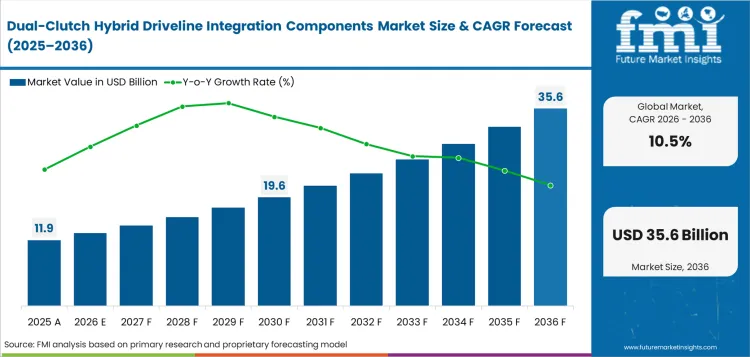
The dual-clutch hybrid driveline integration components market was valued at USD 11.9 billion in 2025 and is estimated to reach USD 13.1 billion in 2026. Demand is forecast to rise to USD 35.6 billion by 2036 at 10.5% CAGR. OEM fitment is expected to represent 88.4% share in 2026. Passenger cars are projected to hold 68.3% share by vehicle type in the same period.
Summary of the Dual-Clutch Hybrid Driveline Integration Components Market
- Demand and Growth Drivers
- Automakers need compact e-motor placement inside transmission housings so cabin space can be protected without major platform changes.
- Dual-clutch systems support hybrid vehicles by moving torque smoothly between engine power and electric support.
- Plug-in hybrid programs need tested control units since clutch movement and motor torque must work together during each drive cycle.
- Product and Segment View
- Clutch modules form the core product area as shift feel depends on friction control and heat handling.
- Plug-in hybrid architecture needs better thermal control as electric torque places more load on clutch and actuator systems.
- Mid-range torque systems support wider use across passenger cars and compact SUVs without raising system cost too much.
- Geography and Competitive Outlook
- China and the United States show better readiness as hybrid vehicle launches continue across mainstream passenger car platforms.
- Germany and France support demand through transmission engineering depth and active eDCT production.
- Competition is moving toward suppliers that combine clutch hardware with control-ready systems and clear validation proof.
- Analyst Opinion
- Nikhil Kaitwade, Principal Consultant at FMI says “Hybrid driveline sourcing is moving from single clutch parts to complete integration packages. Automakers need systems that protect shift quality and manage engine power with electric support. Suppliers with proven durability and clear calibration data will have a better chance of entering vehicle programs. Dual-clutch hybrid platforms will stay useful as automakers work on emissions targets and familiar driving feel.”
- Dual-Clutch Hybrid Driveline Integration Components Market Value Analysis
- Dual-clutch hybrid driveline integration components are moving from stand-alone clutch parts into a defined hybrid powertrain integration area.
- Automakers need compact systems that place electric support inside the transmission without major vehicle redesign.
- The market gains support from plug-in hybrid programs that need smoother torque control and better heat handling.
- Supplier value is rising as OEMs prefer tested clutch modules and control-ready systems that reduce launch risk.
Key Takeaways, Market Size, and Forecast
- Dual-clutch hybrid driveline integration components market value stood at USD 11.9 billion in 2025.
- By 2036, market value is expected to reach USD 35.6 billion.
- Demand is projected to expand at 10.5% CAGR from 2026 to 2036 under the base forecast.
- Market expansion is estimated to create USD 22.5 billion in incremental opportunity between 2026 and 2036.
- OEM fitment is set to hold 88.4% share in 2026 because car makers approve most hybrid driveline parts during factory validation.
- China is expected to post 12.6% CAGR by 2036, followed by the United States at 11.4% CAGR.
Hybrid DCT systems need to place an electric motor close to the gearbox without changing the full vehicle design. In October 2024, Magna stated that its DCT Eco gearbox can work in engine cars and hybrid cars with small changes. Its system covers 48V mild hybrids and 120 kW 400 V hybrid setups. This helps car makers control cost because the same basic gearbox can serve more than one powertrain type. Volkswagen’s Passat eHybrid shows how compact designs are taking shape. In March 2024, Volkswagen stated that the HEM80evo electric motor is built into the DQ400e evo six-speed DSG. Its battery size increased from 10.6 kWh to 19.7 kWh. Suppliers now need parts that handle space limits and heat inside one compact unit.
Dual-Clutch Hybrid Driveline Integration Components Market Definition
Dual-clutch hybrid driveline integration components cover clutch packs and e-motor interfaces used to combine electric torque with a dual-clutch transmission path.
Dual-Clutch Hybrid Driveline Integration Components Market Inclusions
Scope includes clutch modules and e-motor modules used in hybrid dual-clutch driveline systems. Control units and shift actuators are included when they support torque blending between engine power and electric support. Revenue covers 2026 to 2036 across OEM fitment and replacement supply. Key stakeholders include automakers and transmission suppliers. Remanufacturers and engineering service providers are included when their work supports hybrid DCT platforms.
Dual-Clutch Hybrid Driveline Integration Components Market Exclusions
Scope excludes complete battery packs and stand-alone traction motors. Conventional manual clutch kits and BEV single-speed drive units are outside the market. Routine repair labor and transmission fluids are excluded.
Dual-Clutch Hybrid Driveline Integration Components Market Research Methodology
- Primary Research: Supplier portfolios and hybrid transmission programs were reviewed to confirm active participation in hybrid DCT systems.
- Desk Research: Official company releases and automotive data sources were checked to support supplier and technology validation.
- Market Sizing and Forecasting: Market value was built through hybrid platform volumes and average component value across key driveline parts.
- Data Validation: Forecast checks compared DCT fitment signals with verified supplier activity in current hybrid vehicle programs.
Why is the Dual-Clutch Hybrid Driveline Integration Components Market Expanding?
- Automakers need compact hybrid DCT systems since electric support must fit inside existing transmission space.
- Plug-in hybrid platforms need better clutch heat control as electric torque places more stress on driveline parts.
- OEMs prefer tested integration packages given that shift quality and torque blending must be proven before vehicle launch.
- Replacement demand is rising when older DCT vehicles need reliable clutch modules for cost-effective repair work.
Hybrid transmissions need compact clutch modules able to handle engine torque and electric boost without rough shift behavior. Plug-in hybrid programs increase value content since e-motor interfaces must work inside tight housing space. Local production contracts reduce sourcing risk for OEMs building hybrid platforms across China and Europe. Remanufactured dual wet clutches create a service route as DCT fleets age and repair cost pressure rises.
Electric car sales topped 17.0 million worldwide in 2024 according to the International Energy Agency in May 2025. Plug-in hybrids are part of this sales count, so PHEV demand shows the need for hybrid driveline parts. Hybrid DCT systems help automakers add electric driving range without shifting to a full battery electric vehicle platform. Component suppliers are anticipated to find lucrative opportunities as these programs use existing transmission designs and add motor torque control inside the same housing.
Recent OEM developments highlight the shift toward integrated hybrid transmission systems. For instance, Stellantis confirmed in January 2025 that eDCT production in France and Italy integrates a 21.0 kW electric motor into a dual-clutch transmission. The packaged unit helps automakers save space and simplify assembly. BorgWarner’s May 2025 China DCT awards show that OEMs continue to need proven clutch modules for hybrid and conventional platforms. Suppliers with friction control and calibration proof are better placed for hybrid DCT programs.
Market Segmentation Analysis
- By 2036, clutch modules are projected to account for 34.2% share.
- Plug-in hybrid architecture is likely to hold 36.7% share in 2026.
- Passenger cars are anticipated to grow at 68.3% share during the forecast period.
- For 250 to 500 Nm systems, 41.6% share is forecasted between 2026 and 2036.
- From 2026 to 2036, OEM fitment is expected to rise at 88.4% share.
Dual-clutch hybrid driveline integration components market is divided into five segment groups based on system design and vehicle use. Component type includes clutch modules, e-motor modules, control units, shift actuators and dampers. Hybrid architecture includes mild hybrid, plug-in hybrid, full hybrid and range extender. Vehicle type includes passenger cars, light commercial, performance vehicles and compact SUVs. Torque rating includes below 250 Nm, 250 to 500 Nm, 500 to 750 Nm and above 750 Nm. Sales channel includes OEM fitment, replacement supply, remanufacturing and engineering programs.
Insights into Dual-Clutch Hybrid Driveline Integration Components Market by Component Type
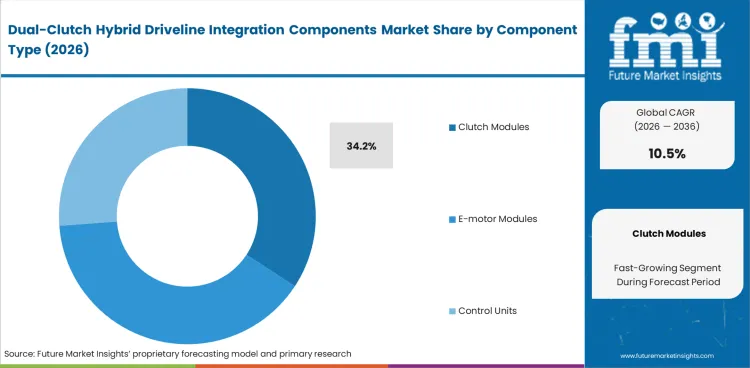
- Clutch modules are likely to account for 34.2% share in 2026 since hybrid DCT programs need stable friction behavior under engine torque and electric boost.
- Control units are gaining value because automatic gearbox valves support faster response and accurate clutch actuation during hybrid torque changes.
Insights into Dual-Clutch Hybrid Driveline Integration Components Market by Hybrid Architecture
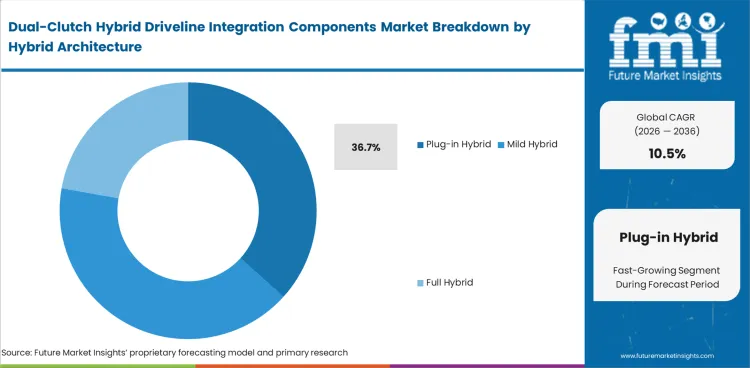
- Driven by higher electric torque raising the need for better clutch heat control, plug-in hybrid architecture is expected to represent 36.7% share in 2026.
- Mild hybrid systems are likely to stay useful for cost-sensitive platforms needing lower emissions without major powertrain redesign.
Insights into Dual-Clutch Hybrid Driveline Integration Components Market by Vehicle Type
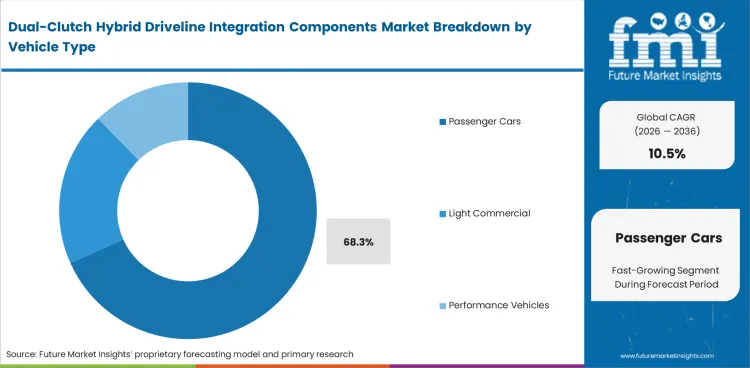
- Passenger cars are projected to capture 68.3% share by 2036 as sedans and hatchbacks use hybrid DCT layouts for smoother fuel-saving performance.
- Compact SUVs are expected to add steady demand as higher torque needs must be balanced with limited powertrain space.
Insights into Dual-Clutch Hybrid Driveline Integration Components Market by Torque Rating
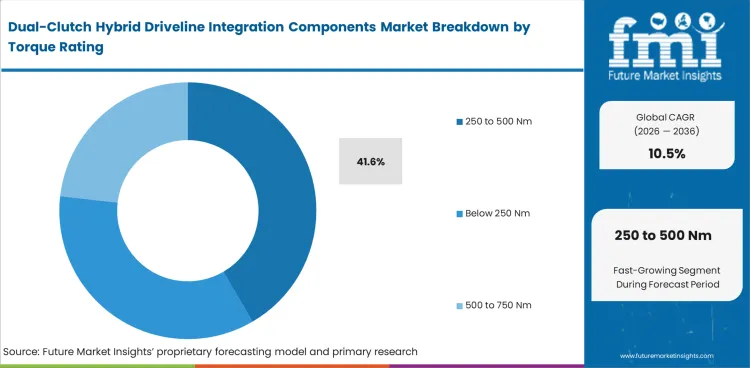
- Systems rated 250 to 500 Nm are anticipated to account for 41.6% share in 2026 with compact SUVs and mid-size cars needing balanced torque capacity.
- The 500 to 750 Nm range is expected to gain use in performance hybrids that need higher capacity clutch packs and improved heat control.
Insights into Dual-Clutch Hybrid Driveline Integration Components Market by Sales Channel
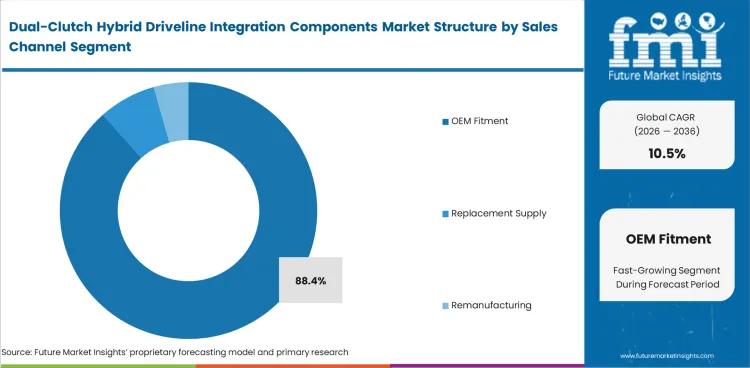
- In 2026, OEM fitment is forecast to hold 88.4% share influenced by hybrid driveline integration needing early validation during vehicle design.
- Replacement supply is expected to rise as older DCT vehicles need qualified clutch modules for reliable repair work.
Dual-Clutch Hybrid Driveline Integration Components Market Drivers, Restraints, and Opportunities
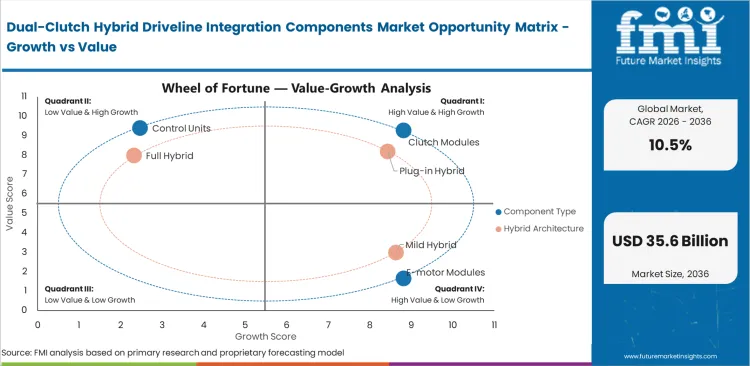
- Hybrid vehicle programs are promoting the need for compact driveline systems that place electric support inside the transmission without major vehicle redesign.
- Plug-in hybrid programs create stronger need for heat control as plug-in hybrid electric vehicle (PHEV) platforms place higher load on driveline parts.
- High validation cost can slow supplier entry because clutch behavior and software timing must be proven before vehicle launch.
- Remanufacturing and replacement supply create a steady opportunity as older DCT vehicles need reliable clutch modules and control-ready repair parts.
Hybrid dual‑clutch transmission (DCT) integration depends on friction stability and software-ready actuation. A supplier cannot win only with a clutch pack. OEMs require fully integrated modules that can coordinate engine output with electric motor torque during every shift. Early involvement in vehicle programs allows suppliers to influence transmission housing design and reduce calibration complexity at later stages.
Cost pressure remains a constraint, particularly in smaller vehicle segments. Hybrid DCT hardware needs precise machining and control software. Smaller suppliers can lose ground if test data is thin or thermal validation is incomplete. Opportunity will favor suppliers that can prove long service life and support repair needs after warranty.
Analysis of Dual-Clutch Hybrid Driveline Integration Components Market by Key Countries
.webp "Top Country Growth Comparison Dual Clutch Hybrid Driveline Integration Components Market Cagr (2026 2036)")
| Country | CAGR |
|---|---|
| China | 12.6% |
| United States | 11.4% |
| India | 11.2% |
| Germany | 10.3% |
| France | 9.8% |
| Japan | 9.4% |
| South Korea | 9.1% |
Source: Future Market Insights, 2026.
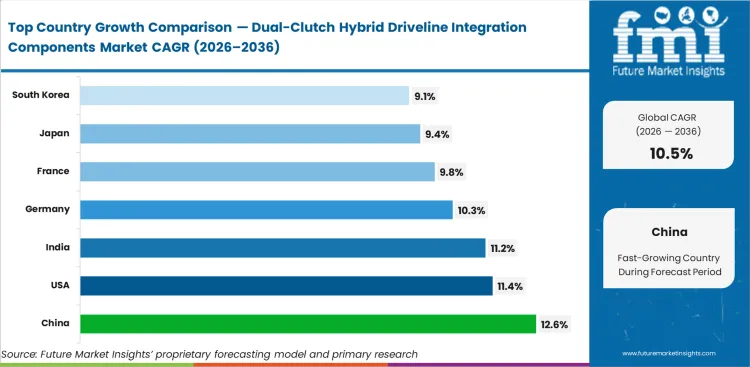
Dual-Clutch Hybrid Driveline Integration Components Market CAGR Analysis by Country
- China is projected to expand at 12.6% CAGR by 2036, supported by localized hybrid DCT programs and rising demand for clutch modules.
- During the forecast period, United States demand is forecast to rise at 11.4% CAGR, with hybrid sales supporting efficient transmission packages.
- India is expected to record 11.2% CAGR by the end of 2036 since automakers are assessing cost-aware hybrid driveline systems.
- Germany is projected to move at 10.3% CAGR over the study period, led by transmission engineering depth and premium hybrid programs.
- Across the assessment period, France is forecast to register 9.8% CAGR as eDCT production supports compact hybrid cars.
- Japan is likely to post 9.4% CAGR in this market by 2036, backed by hybrid unit expertise and compact vehicle platforms.
- South Korea is anticipated to rise at 9.1% CAGR from 2026 to 2036, with export-focused automakers assessing hybrid driveline options.
Outlook for Dual-Clutch Hybrid Driveline Integration Components Market in China
The market in China is projected to expand at 12.6% CAGR by 2036 as local hybrid vehicle programs move into volume passenger cars. Local production depth can help suppliers support OEM programs with shorter lead times. Demand will favor clutch modules that balance cost control with stable shift performance. Suppliers with strong validation support will have better access to hybrid DCT programs.
- Local hybrid launches increase demand for compact clutch modules that support smooth torque blending.
- Domestic transmission programs create openings for suppliers with local manufacturing support.
- Cost pressure will push suppliers toward modular designs that reduce OEM testing time.
Demand Outlook for Dual-Clutch Hybrid Driveline Integration Components Market in the United States
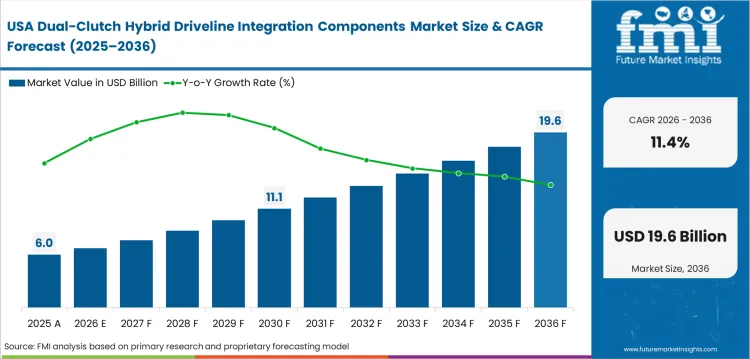
United States demand is forecast to advance during the forecast period at 11.4% CAGR as hybrid vehicles keep a clear role in fuel-saving fleets. USA Bureau of Transportation Statistics data updated in March 2026 tracks hybrid-electric and plug-in hybrid-electric vehicle sales as part of national light-duty vehicle sales. This data helps suppliers judge service demand and future platform planning. Automakers in the country will value integration parts that improve efficiency without changing vehicle use patterns.
- Hybrid sales support demand for clutch modules in high-volume passenger vehicles.
- OEMs need integration packages that reduce calibration work and protect shift feel.
- Replacement demand can rise as older DCT vehicles need qualified repair parts.
Sales Outlook for Dual-Clutch Hybrid Driveline Integration Components Market in India
Industry outlook in India is likely to account for 11.2% CAGR by the end of 2036 with automakers testing hybrid options for fuel efficiency and cost control. India electric mobility policy focus leans toward zero-emission vehicles. Full BEV cost is harder to absorb in some vehicle segments, which keeps compact hybrid DCT systems relevant. Suppliers with local engineering support will have a significant chance in platform trials.
- Hybrid DCT systems can support fuel-saving passenger cars without a full BEV cost structure.
- Local manufacturing plans create interest in parts that can be validated at lower program cost.
- Compact hardware will remain important for vehicle platforms built around space and price discipline.
Future Outlook for Dual-Clutch Hybrid Driveline Integration Components Market in Germany
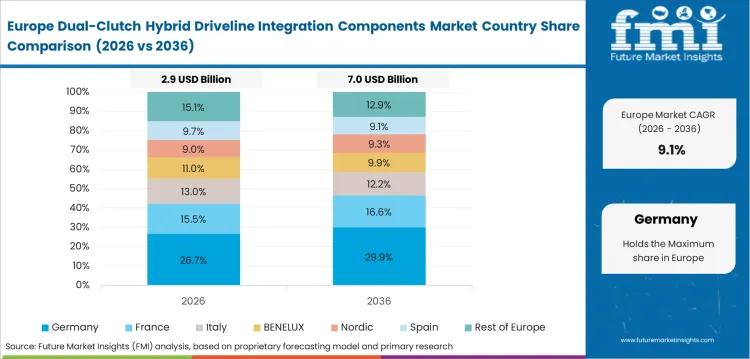
Established transmission engineering supports complex hybrid platforms in Germany. The market is expected to move ahead at 10.3% CAGR over the forecast period as automakers focus on driving feel and durability. Premium hybrid programs need improved control units and proven clutch validation. Suppliers with long test records and close OEM engineering support will have stronger access to platform work.
- Transmission engineering depth supports demand for advanced clutch modules.Premium hybrid vehicles need better torque control and smoother shift response.
- Suppliers with validated mechatronics can support platform work earlier in design.
Opportunity Analysis for Dual-Clutch Hybrid Driveline Integration Components Market in France
The market in France is forecast to advance at 9.8% CAGR between 2026 and 2036 as eDCT production supports local hybrid vehicle output. Small and mid-size hybrid cars need packaged transmission systems that save space and simplify assembly. Local production support can reduce sourcing risk for automakers using compact hybrid driveline layouts. Suppliers with validated clutch modules and control-ready parts can gain repeat orders from local programs.
- eDCT production supports demand for clutch modules and integrated controls.
- Compact hybrid cars need transmission packages that save space and reduce assembly effort.
- Local supply can reduce sourcing risk for high-volume European programs.
Sales Analysis of Dual-Clutch Hybrid Driveline Integration Components Market in Japan
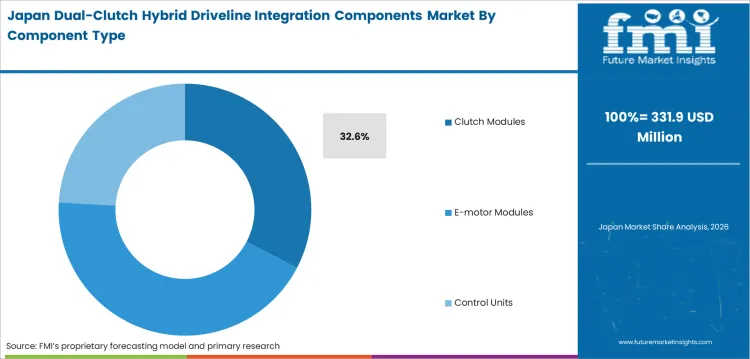
Japan is likely to post 9.4% CAGR in the market by 2036 through hybrid system expertise and compact vehicle platforms. Automakers in Japan need quiet shifts and efficient torque transfer for smaller passenger cars. Compact hybrid layouts support demand for clutch modules that save space and improve driving smoothness.
- Hybrid unit expertise supports demand for compact e-motor and gearbox integration.
- Small vehicle platforms need clutch systems with tight packaging and smooth low-speed response.
- Validated assemblies can reduce calibration work for automakers using hybrid DCT systems.
Demand Analysis for Dual-Clutch Hybrid Driveline Integration Components Market in South Korea
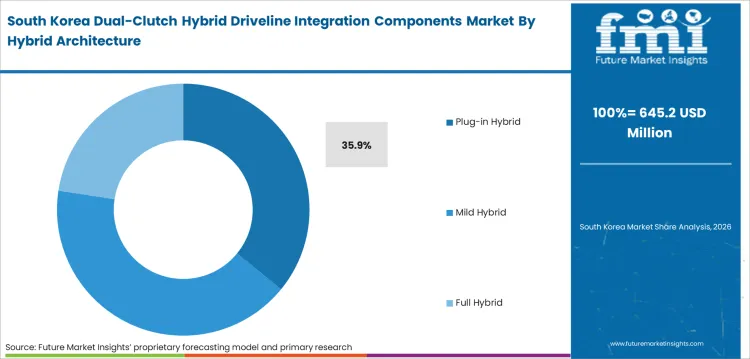
Export-focused vehicle programs support South Korea in this market as domestic automakers serve regions with different electrification speeds. Hybrid DCT components can support models sold in countries with uneven charging readiness. Compact powertrain planning keeps these systems useful for passenger cars and smaller SUVs. From 2026 to 2036, South Korea is expected to post 9.1% CAGR. Suppliers that meet durability and cost targets can gain clearer access to global vehicle programs.
- Export-focused automakers need hybrid driveline options for different regional rules.
- Compact powertrain packaging supports passenger cars and smaller SUVs.
- Component suppliers must prove durability and cost control for global platform use.
Competitive Landscape and Strategic Positioning
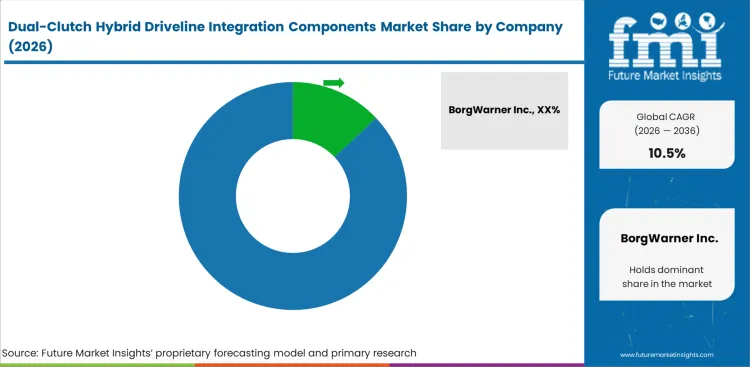
- Competitive outlook depends on hybrid DCT integration with companies competing on shift quality and heat control proof.
- Established suppliers gain advantage through automaker relationships and proven transmission program experience before vehicle launch decisions.
- Smaller specialists can win in remanufactured clutch modules or actuator support by lowering repair cost.
- New suppliers must prove durability and software timing before OEMs approve their parts for hybrid DCT programs.
Competitive position in this market is influenced by hybrid DCT integration depth and clutch validation capability. Among the key players, BorgWarner is estimated to hold a significant share in 2026 through dual-clutch module contracts and program depth in China. Schaeffler and ZF compete through hybrid transmission systems that support electric torque control. Magna and AISIN add value through integrated hybrid unit development across regional vehicle platforms. Valeo supports the service side through remanufactured wet clutch work. Stellantis strengthens the supply base through eDCT production control.
Supplier strength depends on proven friction behavior and heat control before vehicle launch. OEMs need lower integration risk and shorter validation cycles. Early program access will shape supplier position since hybrid driveline choices are fixed during vehicle design. Companies that combine clutch modules with control-ready hardware can protect pricing compared with suppliers selling stand-alone parts.
Key Companies in the Dual-Clutch Hybrid Driveline Integration Components Market
- Hybrid DCT Module Leaders: BorgWarner and Schaeffler serve hybrid driveline programs with clutch modules and integrated transmission hardware.
- Transmission System Specialists: ZF Friedrichshafen and Magna International focus on hybrid transmission systems for electrified driveline programs.
- OEM Production Specialists: Stellantis and AISIN strengthen eDCT and hybrid unit output for vehicle platform programs.
- Service and Remanufacturing Players: Valeo serves DCT repair demand with remanufactured wet clutch solutions.
Competitive Benchmarking: Dual-Clutch Hybrid Driveline Integration Components Market
| Company | Hybrid DCT Integration Depth | Clutch Module Validation | OEM Program Access | Geographic Footprint |
|---|---|---|---|---|
| BorgWarner | High | High | High | China and North America program depth |
| Schaeffler | High | Medium | High | Europe centered with global hybrid reach |
| ZF Friedrichshafen | Medium | Medium | High | Global transmission and software reach |
| Magna International | High | Medium | Medium | Europe and North America driveline presence |
| AISIN Corporation | Medium | Medium | High | Japan and ASEAN hybrid unit depth |
| Valeo | Medium | High | Medium | Europe aftermarket and electrification footprint |
| Stellantis | Medium | Medium | High | France and Italy eDCT production footprint |
Source: Future Market Insights competitive analysis, 2026.
Key Developments in Dual-Clutch Hybrid Driveline Integration Components Market
- In April 2026, Schaeffler presented its MultiMode hybrid transmission with volume production launch planned in 2026. The launch supports integrated modules combining electric machines and clutch actuation.
- In September 2025, Vauxhall opened orders for Astra Plug-In Hybrid models with a new seven-speed dual-clutch automatic transmission. Order launch confirms continued OEM use of eDCT in PHEV models.
Key Players in the Dual-Clutch Hybrid Driveline Integration Components Market
- BorgWarner Inc.
- Schaeffler AG
- ZF Friedrichshafen AG
- Magna International Inc.
- AISIN Corporation
- Valeo SE
- Stellantis N.V.
Report Scope and Coverage
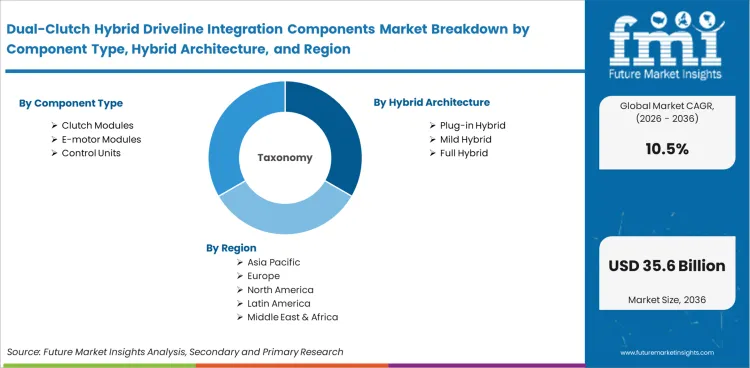
| Parameter | Details |
|---|---|
| Quantitative Units | USD 13.1 billion to USD 35.6 billion at 10.5% CAGR |
| Market Definition | Integration-ready clutch with control and actuator parts used in dual-clutch hybrid drivelines |
| Component Type | Clutch Modules, E-motor Modules, Control Units, Shift Actuators, Dampers |
| Hybrid Architecture | Mild Hybrid, Plug-in Hybrid, Full Hybrid, Range Extender |
| Vehicle Type | Passenger Cars, Light Commercial, Performance Vehicles, Compact SUVs |
| Torque Rating | Below 250 Nm, 250 to 500 Nm, 500 to 750 Nm, Above 750 Nm |
| Sales Channel | OEM Fitment, Replacement Supply, Remanufacturing, Engineering Programs |
| Countries Covered | China, United States, India, Germany, France, Japan, South Korea |
| Key Companies Profiled | BorgWarner, Schaeffler, ZF Friedrichshafen, Magna, AISIN, Valeo, Stellantis |
| Forecast Period | 2026 to 2036 |
| Approach | Hybrid bottom-up and top-down model using platform count and component value checks |
Dual-Clutch Hybrid Driveline Integration Components Market by Component Type, Hybrid Architecture, Vehicle Type, Torque Rating, and Sales Channel
By Component Type:
- Clutch Modules
- E-motor Modules
- Control Units
- Shift Actuators
- Dampers
By Hybrid Architecture:
- Mild Hybrid
- Plug-in Hybrid
- Full Hybrid
- Range Extender
By Vehicle Type:
- Passenger Cars
- Light Commercial
- Performance Vehicles
- Compact SUVs
By Torque Rating:
- Below 250 Nm
- 250 to 500 Nm
- 500 to 750 Nm
- Above 750 Nm
By Sales Channel:
- OEM Fitment
- Replacement Supply
- Remanufacturing
- Engineering Programs
Research Sources and Bibliography
- AISIN Corporation. (2025, March 21). AISIN’s hybrid unit adopted for Mitsubishi’s Xforce HEV: Production of the first electric unit in ASEAN based on a global production system. AISIN Corporation.
- AISIN Corporation. (2025, April 24). AISIN begins contract production of hybrid units for Guangzhou Automobile Group. AISIN Corporation.
- BorgWarner Inc. (2025, May 6). BorgWarner secures two dual-clutch programs in China. BorgWarner Inc.
- Bosch Mobility. (2026). Pressure- or flow-activated direct electric shift control. Robert Bosch GmbH.
- Bureau of Transportation Statistics. (2026, March 25). Hybrid-electric, plug-in hybrid-electric and electric vehicle sales. USA Department of Transportation.
- International Energy Agency. (2025, May 14). Global EV Outlook 2025: Trends in electric car markets. International Energy Agency.
- Magna International Inc. (2024, October 29). Magna debuts scalable, eco-friendly ICE to hybrid transmission for European OEM. Magna International Inc.
- Schaeffler AG. (2026, April 27). Not just a bridging technology: Schaeffler offers extensive range from components to systems for all hybrid powertrains. Schaeffler AG.
- Stellantis N.V. (2025, January 29). Stellantis takes full control of eDCT transmission production activities in France and Italy. Stellantis Media.
- Valeo Group. (2025, October 9). Valeo wins the EQUIP AUTO Paris 2025 International Automotive Innovation Award for its remanufactured dual wet clutch. Valeo.
- Vauxhall. (2025, September 10). Orders open on new Astra Plug-In Hybrid and Astra GSE offering increased range at no extra cost. Stellantis Media.
- ZF Friedrichshafen AG. (2025, November 7). Further development for hybrid drive: ZF presents 8HP evo transmission update at IAA 2025. ZF Press Center.
This Report Answers
- What is the current and future size of the dual-clutch hybrid driveline integration components market?
- What value is the market estimated to reach by 2036 in the forecast?
- What CAGR is estimated for dual-clutch hybrid driveline integration components from 2026 to 2036?
- Which component type is estimated to lead the market by 2026?
- Which hybrid architecture is estimated to hold the leading share during the base year?
- How does OEM fitment affect revenue quality?
- Which countries show clearer readiness for hybrid DCT integration demand?
- Which companies are active in DCT clutch modules and hybrid driveline packages?
- How is the dual-clutch hybrid driveline integration components forecast validated?
Frequently Asked Questions
What is global demand for dual-clutch hybrid driveline integration components in 2026?
Global demand is estimated at USD 13.1 billion in 2026 as hybrid programs need integrated clutch modules and control hardware.
How big will the dual-clutch hybrid driveline integration components market be in 2036?
Market value is forecast to reach USD 35.6 billion by 2036 as plug-in hybrid and mild hybrid programs expand.
How fast is demand estimated to expand during the forecast period?
Demand is estimated to expand at 10.5% CAGR from 2026 to 2036 under the base forecast.
Which component type is estimated to lead the market in 2026?
Clutch modules are projected to lead component type demand with 34.2% share in 2026.
Which hybrid architecture is estimated to lead in 2026?
Plug-in hybrid architecture is expected to hold 36.7% share in 2026 as electric torque rises.
Which vehicle type is the main demand center in 2026?
Passenger cars are forecast to represent 68.3% share in 2026 through high-volume sedan and compact SUV programs.
What is included in the scope?
Market scope includes clutch modules and e-motor modules for hybrid DCT systems. Control units and shift actuators are included as integration hardware.
How is the market forecast validated?
Forecast validation uses hybrid platform mapping and component value modeling. Supplier verification and country-level electrification checks support the final forecast.
Preview the report firsthand - request a free sample
Get SampleGet the brochure for pricing and purchase details.
Get PDFTable of Content
- Executive Summary
- Global Market Outlook
- Demand-side Trends
- Supply-side Trends
- Technology Roadmap Analysis
- Analysis and Recommendations
- Market Overview
- Market Coverage / Taxonomy
- Market Definition / Scope / Limitations
- Research Methodology
- Chapter Orientation
- Analytical Lens and Working Hypotheses
- Market Structure, Signals, and Trend Drivers
- Benchmarking and Cross-market Comparability
- Market Sizing, Forecasting, and Opportunity Mapping
- Research Design and Evidence Framework
- Desk Research Programme (Secondary Evidence)
- Company Annual and Sustainability Reports
- Peer-reviewed Journals and Academic Literature
- Corporate Websites, Product Literature, and Technical Notes
- Earnings Decks and Investor Briefings
- Statutory Filings and Regulatory Disclosures
- Technical White Papers and Standards Notes
- Trade Journals, Industry Magazines, and Analyst Briefs
- Conference Proceedings, Webinars, and Seminar Materials
- Government Statistics Portals and Public Data Releases
- Press Releases and Reputable Media Coverage
- Specialist Newsletters and Curated Briefings
- Sector Databases and Reference Repositories
- FMI Internal Proprietary Databases and Historical Market Datasets
- Subscription Datasets and Paid Sources
- Social Channels, Communities, and Digital Listening Inputs
- Additional Desk Sources
- Expert Input and Fieldwork (Primary Evidence)
- Primary Modes
- Qualitative Interviews and Expert Elicitation
- Quantitative Surveys and Structured Data Capture
- Blended Approach
- Why Primary Evidence is Used
- Field Techniques
- Interviews
- Surveys
- Focus Groups
- Observational and In-context Research
- Social and Community Interactions
- Stakeholder Universe Engaged
- C-suite Leaders
- Board Members
- Presidents and Vice Presidents
- R&D and Innovation Heads
- Technical Specialists
- Domain Subject-matter Experts
- Scientists
- Physicians and Other Healthcare Professionals
- Governance, Ethics, and Data Stewardship
- Research Ethics
- Data Integrity and Handling
- Primary Modes
- Tooling, Models, and Reference Databases
- Desk Research Programme (Secondary Evidence)
- Data Engineering and Model Build
- Data Acquisition and Ingestion
- Cleaning, Normalisation, and Verification
- Synthesis, Triangulation, and Analysis
- Quality Assurance and Audit Trail
- Market Background
- Market Dynamics
- Drivers
- Restraints
- Opportunity
- Trends
- Scenario Forecast
- Demand in Optimistic Scenario
- Demand in Likely Scenario
- Demand in Conservative Scenario
- Opportunity Map Analysis
- Product Life Cycle Analysis
- Supply Chain Analysis
- Investment Feasibility Matrix
- Value Chain Analysis
- PESTLE and Porter’s Analysis
- Regulatory Landscape
- Regional Parent Market Outlook
- Production and Consumption Statistics
- Import and Export Statistics
- Market Dynamics
- Global Market Analysis 2021 to 2025 and Forecast, 2026 to 2036
- Historical Market Size Value (USD Million) Analysis, 2021 to 2025
- Current and Future Market Size Value (USD Million) Projections, 2026 to 2036
- Y-o-Y Growth Trend Analysis
- Absolute $ Opportunity Analysis
- Global Market Pricing Analysis 2021 to 2025 and Forecast 2026 to 2036
- Global Market Analysis 2021 to 2025 and Forecast 2026 to 2036, By Component Type
- Introduction / Key Findings
- Historical Market Size Value (USD Million) Analysis By Component Type , 2021 to 2025
- Current and Future Market Size Value (USD Million) Analysis and Forecast By Component Type , 2026 to 2036
- Clutch Modules
- E-motor Modules
- Control Value (USD Million)s
- Clutch Modules
- Y-o-Y Growth Trend Analysis By Component Type , 2021 to 2025
- Absolute $ Opportunity Analysis By Component Type , 2026 to 2036
- Global Market Analysis 2021 to 2025 and Forecast 2026 to 2036, By Hybrid Architecture
- Introduction / Key Findings
- Historical Market Size Value (USD Million) Analysis By Hybrid Architecture, 2021 to 2025
- Current and Future Market Size Value (USD Million) Analysis and Forecast By Hybrid Architecture, 2026 to 2036
- Plug-in Hybrid
- Mild Hybrid
- Full Hybrid
- Plug-in Hybrid
- Y-o-Y Growth Trend Analysis By Hybrid Architecture, 2021 to 2025
- Absolute $ Opportunity Analysis By Hybrid Architecture, 2026 to 2036
- Global Market Analysis 2021 to 2025 and Forecast 2026 to 2036, By Vehicle Type
- Introduction / Key Findings
- Historical Market Size Value (USD Million) Analysis By Vehicle Type, 2021 to 2025
- Current and Future Market Size Value (USD Million) Analysis and Forecast By Vehicle Type, 2026 to 2036
- Passenger Cars
- Light Commercial
- Performance Vehicles
- Passenger Cars
- Y-o-Y Growth Trend Analysis By Vehicle Type, 2021 to 2025
- Absolute $ Opportunity Analysis By Vehicle Type, 2026 to 2036
- Global Market Analysis 2021 to 2025 and Forecast 2026 to 2036, By Torque Rating
- Introduction / Key Findings
- Historical Market Size Value (USD Million) Analysis By Torque Rating, 2021 to 2025
- Current and Future Market Size Value (USD Million) Analysis and Forecast By Torque Rating, 2026 to 2036
- 250 to 500 Nm
- Below 250 Nm
- 500 to 750 Nm
- 250 to 500 Nm
- Y-o-Y Growth Trend Analysis By Torque Rating, 2021 to 2025
- Absolute $ Opportunity Analysis By Torque Rating, 2026 to 2036
- Global Market Analysis 2021 to 2025 and Forecast 2026 to 2036, By Sales Channel
- Introduction / Key Findings
- Historical Market Size Value (USD Million) Analysis By Sales Channel, 2021 to 2025
- Current and Future Market Size Value (USD Million) Analysis and Forecast By Sales Channel, 2026 to 2036
- OEM Fitment
- Replacement Supply
- Remanufacturing
- OEM Fitment
- Y-o-Y Growth Trend Analysis By Sales Channel, 2021 to 2025
- Absolute $ Opportunity Analysis By Sales Channel, 2026 to 2036
- Global Market Analysis 2021 to 2025 and Forecast 2026 to 2036, By Region
- Introduction
- Historical Market Size Value (USD Million) Analysis By Region, 2021 to 2025
- Current Market Size Value (USD Million) Analysis and Forecast By Region, 2026 to 2036
- North America
- Latin America
- Western Europe
- Eastern Europe
- East Asia
- South Asia and Pacific
- Middle East & Africa
- Market Attractiveness Analysis By Region
- North America Market Analysis 2021 to 2025 and Forecast 2026 to 2036, By Country
- Historical Market Size Value (USD Million) Trend Analysis By Market Taxonomy, 2021 to 2025
- Market Size Value (USD Million) Forecast By Market Taxonomy, 2026 to 2036
- By Country
- USA
- Canada
- Mexico
- By Component Type
- By Hybrid Architecture
- By Vehicle Type
- By Torque Rating
- By Sales Channel
- By Country
- Market Attractiveness Analysis
- By Country
- By Component Type
- By Hybrid Architecture
- By Vehicle Type
- By Torque Rating
- By Sales Channel
- Key Takeaways
- Latin America Market Analysis 2021 to 2025 and Forecast 2026 to 2036, By Country
- Historical Market Size Value (USD Million) Trend Analysis By Market Taxonomy, 2021 to 2025
- Market Size Value (USD Million) Forecast By Market Taxonomy, 2026 to 2036
- By Country
- Brazil
- Chile
- Rest of Latin America
- By Component Type
- By Hybrid Architecture
- By Vehicle Type
- By Torque Rating
- By Sales Channel
- By Country
- Market Attractiveness Analysis
- By Country
- By Component Type
- By Hybrid Architecture
- By Vehicle Type
- By Torque Rating
- By Sales Channel
- Key Takeaways
- Western Europe Market Analysis 2021 to 2025 and Forecast 2026 to 2036, By Country
- Historical Market Size Value (USD Million) Trend Analysis By Market Taxonomy, 2021 to 2025
- Market Size Value (USD Million) Forecast By Market Taxonomy, 2026 to 2036
- By Country
- Germany
- UK
- Italy
- Spain
- France
- Nordic
- BENELUX
- Rest of Western Europe
- By Component Type
- By Hybrid Architecture
- By Vehicle Type
- By Torque Rating
- By Sales Channel
- By Country
- Market Attractiveness Analysis
- By Country
- By Component Type
- By Hybrid Architecture
- By Vehicle Type
- By Torque Rating
- By Sales Channel
- Key Takeaways
- Eastern Europe Market Analysis 2021 to 2025 and Forecast 2026 to 2036, By Country
- Historical Market Size Value (USD Million) Trend Analysis By Market Taxonomy, 2021 to 2025
- Market Size Value (USD Million) Forecast By Market Taxonomy, 2026 to 2036
- By Country
- Russia
- Poland
- Hungary
- Balkan & Baltic
- Rest of Eastern Europe
- By Component Type
- By Hybrid Architecture
- By Vehicle Type
- By Torque Rating
- By Sales Channel
- By Country
- Market Attractiveness Analysis
- By Country
- By Component Type
- By Hybrid Architecture
- By Vehicle Type
- By Torque Rating
- By Sales Channel
- Key Takeaways
- East Asia Market Analysis 2021 to 2025 and Forecast 2026 to 2036, By Country
- Historical Market Size Value (USD Million) Trend Analysis By Market Taxonomy, 2021 to 2025
- Market Size Value (USD Million) Forecast By Market Taxonomy, 2026 to 2036
- By Country
- China
- Japan
- South Korea
- By Component Type
- By Hybrid Architecture
- By Vehicle Type
- By Torque Rating
- By Sales Channel
- By Country
- Market Attractiveness Analysis
- By Country
- By Component Type
- By Hybrid Architecture
- By Vehicle Type
- By Torque Rating
- By Sales Channel
- Key Takeaways
- South Asia and Pacific Market Analysis 2021 to 2025 and Forecast 2026 to 2036, By Country
- Historical Market Size Value (USD Million) Trend Analysis By Market Taxonomy, 2021 to 2025
- Market Size Value (USD Million) Forecast By Market Taxonomy, 2026 to 2036
- By Country
- India
- ASEAN
- Australia & New Zealand
- Rest of South Asia and Pacific
- By Component Type
- By Hybrid Architecture
- By Vehicle Type
- By Torque Rating
- By Sales Channel
- By Country
- Market Attractiveness Analysis
- By Country
- By Component Type
- By Hybrid Architecture
- By Vehicle Type
- By Torque Rating
- By Sales Channel
- Key Takeaways
- Middle East & Africa Market Analysis 2021 to 2025 and Forecast 2026 to 2036, By Country
- Historical Market Size Value (USD Million) Trend Analysis By Market Taxonomy, 2021 to 2025
- Market Size Value (USD Million) Forecast By Market Taxonomy, 2026 to 2036
- By Country
- Kingdom of Saudi Arabia
- Other GCC Countries
- Turkiye
- South Africa
- Other African Union
- Rest of Middle East & Africa
- By Component Type
- By Hybrid Architecture
- By Vehicle Type
- By Torque Rating
- By Sales Channel
- By Country
- Market Attractiveness Analysis
- By Country
- By Component Type
- By Hybrid Architecture
- By Vehicle Type
- By Torque Rating
- By Sales Channel
- Key Takeaways
- Key Countries Market Analysis
- USA
- Pricing Analysis
- Market Share Analysis, 2025
- By Component Type
- By Hybrid Architecture
- By Vehicle Type
- By Torque Rating
- By Sales Channel
- Canada
- Pricing Analysis
- Market Share Analysis, 2025
- By Component Type
- By Hybrid Architecture
- By Vehicle Type
- By Torque Rating
- By Sales Channel
- Mexico
- Pricing Analysis
- Market Share Analysis, 2025
- By Component Type
- By Hybrid Architecture
- By Vehicle Type
- By Torque Rating
- By Sales Channel
- Brazil
- Pricing Analysis
- Market Share Analysis, 2025
- By Component Type
- By Hybrid Architecture
- By Vehicle Type
- By Torque Rating
- By Sales Channel
- Chile
- Pricing Analysis
- Market Share Analysis, 2025
- By Component Type
- By Hybrid Architecture
- By Vehicle Type
- By Torque Rating
- By Sales Channel
- Germany
- Pricing Analysis
- Market Share Analysis, 2025
- By Component Type
- By Hybrid Architecture
- By Vehicle Type
- By Torque Rating
- By Sales Channel
- UK
- Pricing Analysis
- Market Share Analysis, 2025
- By Component Type
- By Hybrid Architecture
- By Vehicle Type
- By Torque Rating
- By Sales Channel
- Italy
- Pricing Analysis
- Market Share Analysis, 2025
- By Component Type
- By Hybrid Architecture
- By Vehicle Type
- By Torque Rating
- By Sales Channel
- Spain
- Pricing Analysis
- Market Share Analysis, 2025
- By Component Type
- By Hybrid Architecture
- By Vehicle Type
- By Torque Rating
- By Sales Channel
- France
- Pricing Analysis
- Market Share Analysis, 2025
- By Component Type
- By Hybrid Architecture
- By Vehicle Type
- By Torque Rating
- By Sales Channel
- India
- Pricing Analysis
- Market Share Analysis, 2025
- By Component Type
- By Hybrid Architecture
- By Vehicle Type
- By Torque Rating
- By Sales Channel
- ASEAN
- Pricing Analysis
- Market Share Analysis, 2025
- By Component Type
- By Hybrid Architecture
- By Vehicle Type
- By Torque Rating
- By Sales Channel
- Australia & New Zealand
- Pricing Analysis
- Market Share Analysis, 2025
- By Component Type
- By Hybrid Architecture
- By Vehicle Type
- By Torque Rating
- By Sales Channel
- China
- Pricing Analysis
- Market Share Analysis, 2025
- By Component Type
- By Hybrid Architecture
- By Vehicle Type
- By Torque Rating
- By Sales Channel
- Japan
- Pricing Analysis
- Market Share Analysis, 2025
- By Component Type
- By Hybrid Architecture
- By Vehicle Type
- By Torque Rating
- By Sales Channel
- South Korea
- Pricing Analysis
- Market Share Analysis, 2025
- By Component Type
- By Hybrid Architecture
- By Vehicle Type
- By Torque Rating
- By Sales Channel
- Russia
- Pricing Analysis
- Market Share Analysis, 2025
- By Component Type
- By Hybrid Architecture
- By Vehicle Type
- By Torque Rating
- By Sales Channel
- Poland
- Pricing Analysis
- Market Share Analysis, 2025
- By Component Type
- By Hybrid Architecture
- By Vehicle Type
- By Torque Rating
- By Sales Channel
- Hungary
- Pricing Analysis
- Market Share Analysis, 2025
- By Component Type
- By Hybrid Architecture
- By Vehicle Type
- By Torque Rating
- By Sales Channel
- Kingdom of Saudi Arabia
- Pricing Analysis
- Market Share Analysis, 2025
- By Component Type
- By Hybrid Architecture
- By Vehicle Type
- By Torque Rating
- By Sales Channel
- Turkiye
- Pricing Analysis
- Market Share Analysis, 2025
- By Component Type
- By Hybrid Architecture
- By Vehicle Type
- By Torque Rating
- By Sales Channel
- South Africa
- Pricing Analysis
- Market Share Analysis, 2025
- By Component Type
- By Hybrid Architecture
- By Vehicle Type
- By Torque Rating
- By Sales Channel
- USA
- Market Structure Analysis
- Competition Dashboard
- Competition Benchmarking
- Market Share Analysis of Top Players
- By Regional
- By Component Type
- By Hybrid Architecture
- By Vehicle Type
- By Torque Rating
- By Sales Channel
- Competition Analysis
- Competition Deep Dive
- BorgWarner Inc.
- Overview
- Product Portfolio
- Profitability by Market Segments (Product/Age /Sales Channel/Region)
- Sales Footprint
- Strategy Overview
- Marketing Strategy
- Product Strategy
- Channel Strategy
- Schaeffler AG
- ZF Friedrichshafen AG
- Magna International Inc.
- AISIN Corporation
- Valeo SE
- BorgWarner Inc.
- Competition Deep Dive
- Assumptions & Acronyms Used


