

- Market Size (2026)
- USD 174.0 Mn
- Forecast (2036)
- USD 926.2 Mn
- CAGR (2026 to 2036)
- 18.2%
Hybrid-Electric Propulsion System MRO Services Market Size, Forecast, and Outlook By FMI
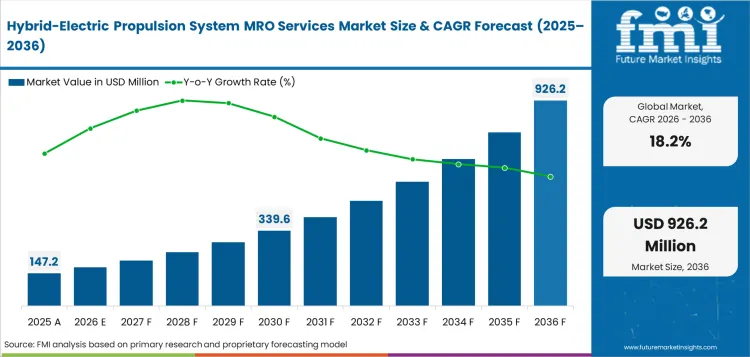
The hybrid-electric propulsion system MRO services market size was valued at USD 147.2 million in 2025. Industry is anticipated to reach USD 174.0 million in 2026 and rise to USD 926.2 million by 2036 at 18.2% CAGR.
Summary of the Hybrid-Electric Propulsion System MRO Services Market
- Demand and Growth Drivers
- EASA continuing-airworthiness updates create a service path for electric and hybrid aircraft after January 2025.
- NASA electrified propulsion tests support future MRO needs for megawatt-class systems and flight demonstration hardware.
- High-voltage battery checks are shifting into a paid service line as operators need traceable state-of-health records.
- Product and Segment View
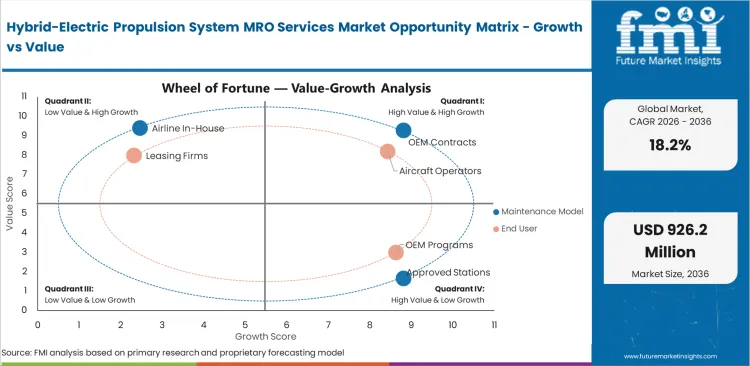
- OEM contracts are projected to account for 46.0% share in 2026 due to software access and proprietary repair data.
- Aircraft operators are expected to secure 43.0% share in 2026 as fleet uptime depends on routine battery and inverter checks.
- Parallel hybrid systems are anticipated to hold 41.0% share in 2026 since transitional aircraft designs use turbine support with electric assist.
- Geography and Competitive Outlook
- India is expected to record 20.1% CAGR by 2036 as tax reform and foreign investment rules improve MRO economics.
- United States is projected to advance at 19.4% CAGR by 2036 through FAA certification work and NASA test activity.
- Safran Electrical & Power and GE Aerospace hold established positions through certified electric propulsion and megawatt test depth.
- Analyst Opinion
- Nikhil Kaitwade, Principal Analyst for Aerospace and Industrial Technologies at FMI, observes, “Hybrid-electric MRO is not a normal engine shop extension. Buyers will require proof for high-voltage systems safe for use after each service event. Early service contracts will favor suppliers with certified manuals and live battery records. Growth should follow as operators treat propulsion data as part of airworthiness by 2036.”
- Hybrid-Electric Propulsion System MRO Services Market Value Analysis
- Hybrid-electric propulsion MRO services are shifting from early support work into a defined maintenance requirement for electrified aircraft programs.
- Aircraft operators are expected to increase service planning as battery packs and power electronics need stricter inspection cycles.
- OEM contract formats draw preference as operators need certified repair access and propulsion software support.
- Demand is supported by regional aircraft and advanced air mobility fleets because downtime can affect route economics.
Key Takeaways, Market Size, and Forecast
- The hybrid-electric propulsion system MRO services market value stood at USD 147.2 million in 2025.
- Industry revenue is projected to reach USD 926.2 million by 2036 as operators prepare high-voltage maintenance routines.
- The sector is expected to expand at 18.2% CAGR from 2026 to 2036 across aircraft operators and OEM support channels.
- Industry is projected to create an incremental revenue opportunity of USD 752.2 million between 2026 and 2036.
- OEM contracts are projected to account for 46.0% share in 2026 as early fleets need proprietary data access and certified manuals.
- Aircraft operators are expected to hold 43.0% share in 2026 due to flight readiness depending on battery health and powertrain logs.
- India at 20.1% CAGR and the United States at 19.4% CAGR are expected to record a faster pace by 2036.
Hybrid electric propulsion maintenance is not a simple extension of engine overhaul because aircraft combine electrical power and conventional propulsion hardware. The European Union Aviation Safety Agency’s July 2024 guidance lists electric engines, turbine engines, piston engines, generators, wiring, batteries, cooling systems and controllers within the possible system scope. MRO providers therefore need cross-domain inspection capability. December 2024 EASA material adds that distributed propulsion can require new ratings, which creates training and authorization issue for repair organizations.
Commercial readiness is already visible among electric aircraft developers. Archer Aviation received FAA Part 145 certification in February 2024 for specialized aircraft repair services. Joby Aviation also stated in February 2024 that its Part 145 certificate allows select maintenance activities. Supplier control is tightening at the same time. Archer requires certified FAA Part 145 repair stations for product repairs. Service providers with approvals, electrical skills and OEM documentation discipline are better positioned.
Hybrid-Electric Propulsion System MRO Services Market Definition
Sector scope covers maintenance and repair for hybrid-electric propulsion systems. Covered work includes overhaul and inspection. Testing and software checks complete the service boundary. Component replacement is included under the same scope. Covered assets include the aircraft electric motor and inverter. Battery pack and power electronics fall within the same service scope. Generator work and wiring harness checks complete the asset scope. Cooling-loop service and supervisory control hardware are included. Conventional turbine overhaul is included only when supplied as part of an integrated hybrid-electric propulsion service contract.
Hybrid-Electric Propulsion System MRO Services Market Inclusions
Market scope covers commercially billed services for hybrid-electric aircraft propulsion systems categorized by maintenance model and end user. Propulsion architecture and service type complete the segmentation. Aircraft type is used for fleet-level demand review. Scope includes aircraft generators used inside turboelectric layouts. Service scope includes the aeroengine accessory drive train work needed around hybrid power transfer. Stakeholders include propulsion OEMs and approved repair stations. Aircraft operators and regulators influence service approval. Leasing firms, battery specialists, test laboratories, and training providers complete the network.
Hybrid-Electric Propulsion System MRO Services Market Exclusions
Study scope excludes standard aircraft engine MRO not tied to hybrid-electric propulsion service. General avionics repair and cabin electrical maintenance are outside the revenue scope. Charging infrastructure ownership is excluded unless sold as a support service tied to aircraft propulsion maintenance. Hydrogen fuel production and airport grid upgrades are treated as adjacent infrastructure categories.
Hybrid-Electric Propulsion System MRO Services Market Research Methodology
- Primary Research: FMI analysts reviewed electric propulsion OEMs and repair station capability signals. Interviews focused on operator service readiness for high-voltage aircraft systems.
- Desk Research: Desk review used aviation authority updates and NASA program material. Official company actions after January 2024 were checked against public aircraft certification records.
- Market Sizing and Forecasting: Forecast work combined parent aircraft MRO spending with expected hybrid-electric fleet penetration and service cost per aircraft.
- Data Validation: Segment shares were checked against certification dependency and battery service intervals. Repair station approval needs were compared with country-level MRO policy activity.
Why is the Hybrid-Electric Propulsion System MRO Services Market Growing?
- Hybrid-electric propulsion MRO services are expected to grow as flight demonstrator programs move closer to certification and routine service planning.
- Aircraft operators are expected to adopt specialized MRO support as battery packs alongside power electronics and thermal systems require new inspection routines.
- EASA’s electric and hybrid-propulsion airworthiness rules set a clearer maintenance pathway for repair stations and certified service providers.
Regulatory language sets a service pathway before large commercial fleets arrive. EASA adopted Commission Implementing Regulation (EU) 2025/111 on January 23, 2025 and listed it under continuing airworthiness for electric and hybrid-propulsion aircraft. Electric propulsion maintenance cannot rely on turbine routines alone since battery history and insulation checks and power electronics affect flight safety. NASA’s Electrified Powertrain Flight Demonstration project conducts ground and flight tests of electrified aircraft propulsion technologies for future hybrid electric-powered aircraft. The practical result is a paid service opportunity around technician training and propulsion health records.
Prototype activity is moving into maintenance planning as OEMs shift from bench tests to flight programs. Pratt & Whitney Canada introduced a mobile charging unit in January 2024 capable of delivering up to 280 kW and 1,500 volts for its hybrid-electric flight demonstrator. Safran’s ENGINeUS 100 certification involved 1,500 hours of motor certification tests and over 100 flight hours in real-world conditions. Hybrid-electric propulsion raises the service burden by placing energy storage and thermal control inside the propulsion safety chain. Suppliers with clear test data and service manuals should face fewer approval delays.
Market Segmentation Analysis
- OEM contracts are anticipated to lead with 46.0% share in 2026, led by early fleets depending on proprietary software and repair data.
- Aircraft operators are projected to hold 43.0% share in 2026 with uptime tied to battery logs and powertrain health records.
- Parallel hybrid architecture is estimated to reach 41.0% share in 2026 due to turbine-electric combinations integrating in near-term aircraft programs.
- Component diagnostics are expected to secure 34.0% share in 2026 since service teams test motors and inverters before overhaul. Insulation checks shape repair decisions.
Regional aircraft are projected to represent 38.5% share in 2026, reflected by longer routes requiring hybrid range and scheduled repair support.
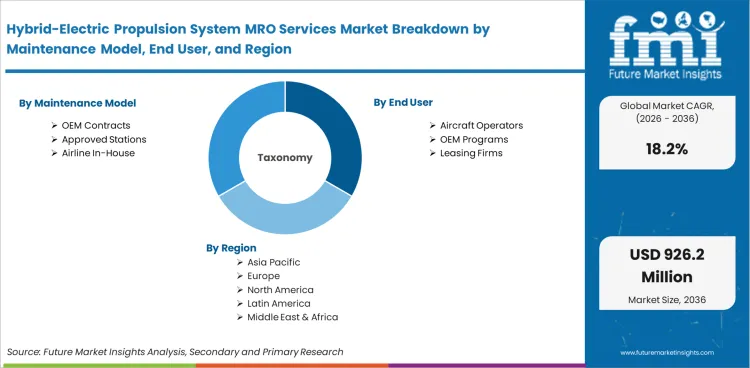
The market is segmented by maintenance model and end user, propulsion architecture, service type and aircraft type complete the scope. Maintenance model segmentation includes OEM contracts, independent MRO contracts and in-house maintenance with OEM contracts leading due to certification control and propulsion software access. End user scope covers aircraft operators, OEMs and leasing companies with aircraft operators holding the strongest use case. Propulsion architecture includes series hybrid, parallel hybrid and turboelectric systems with parallel hybrid favored for retrofit-linked service planning. Service type covers battery inspection, power electronics repair and propulsion diagnostics with battery inspection leading through safety checks and cycle-life tracking. Aircraft type covers regional aircraft, advanced air mobility aircraft and training aircraft with regional aircraft favored due to longer route use and higher service needs.
Insights into the OEM Contracts Maintenance Model Segment
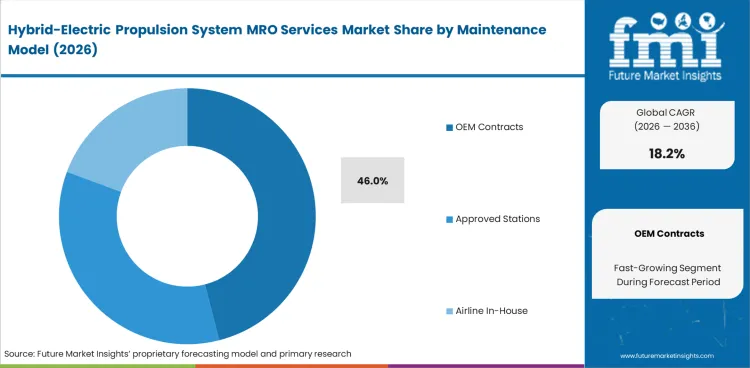
- OEM contracts are expected to account for 46.0% share in 2026 since early hybrid-electric aircraft require controlled software access and battery pack records.
- Approved repair stations can gain share after they secure OEM data rights and high-voltage test equipment, lowering dependence on factory centers for routine diagnostics.
Insights into the Aircraft Operators End User Segment
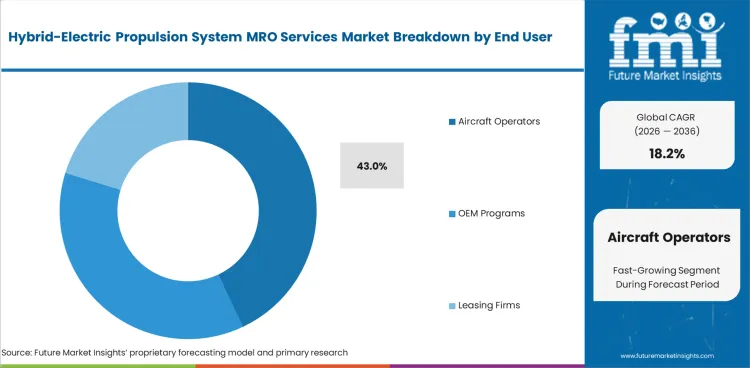
- Aircraft operators are projected to hold 43.0% share in 2026, led by service buying depending on dispatch reliability and scheduled checks.
- Leasing firms should influence service terms once hybrid-electric aircraft enter multi-operator use, as residual value will depend on battery history and certified component life.
Insights into the Parallel Hybrid Propulsion Architecture Segment
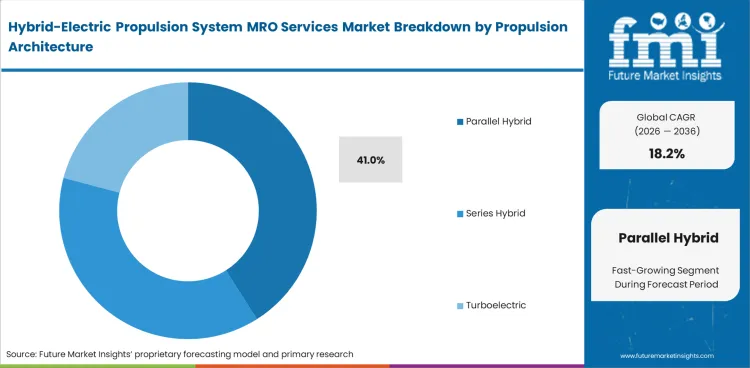
- Parallel hybrid systems are anticipated to account for 41.0% share in 2026, driven by near-term aircraft programs pair turbine power with electric assist without fully replacing known propulsion maintenance routines.
- Turboelectric layouts are likely to create higher-value overhaul work later since generators and power electronics need deeper thermal checks.
Insights into the Component Diagnostics Service Type Segment
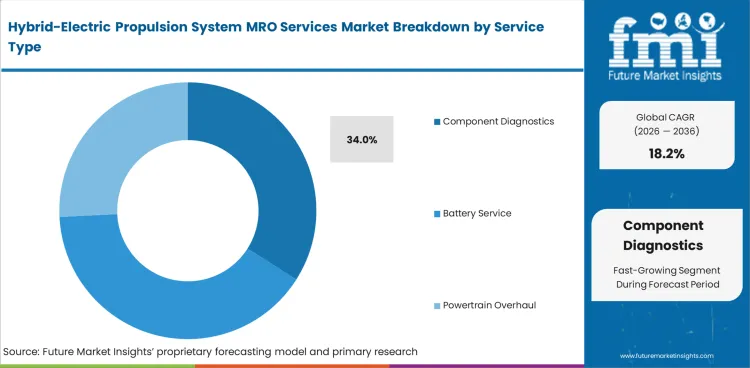
- Component diagnostics are expected to represent 34.0% share in 2026, reflecting high-voltage motors and inverters requiring isolation checks before replacement decisions raise repair costs.
- Battery service will expand as operators ask for state-of-health evidence and cycle history review. Thermal event screening will shape every major return-to-service action.
Insights into the Regional Aircraft Type Segment
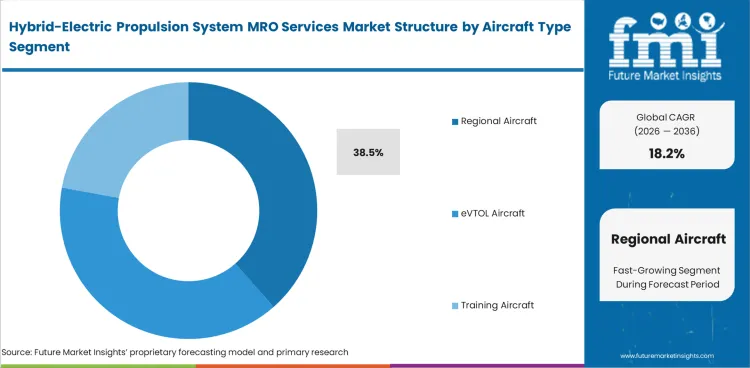
- Regional aircraft are projected to account for 38.5% share in 2026 as hybrid-electric platforms are aimed at routes needing better range than early eVTOL operations can support.
- Training aircraft should support smaller service packages led by schools requiring predictable battery checks and quick component swaps to protect daily flight schedules.
Hybrid-Electric Propulsion System MRO Services Market Drivers, Restraints, and Opportunities
- High-voltage return-to-service checks are expected to raise service spending as battery and inverter faults need logged proof before flight release.
- OEM data access is anticipated to slow independent repair entry as software calibration and component life records stay under controlled manuals.
- Repair station training should create prospects as operators convert electric propulsion trials into certified line and hangar routines.
Certification work is the first service filter for hybrid-electric propulsion MRO services. EASA adopted continuing-airworthiness changes in January 2025 for electric and hybrid-propulsion aircraft that make maintenance approval and technician qualification more relevant before fleet volumes rise. Pratt & Whitney Canada’s January 2024 charging unit supports high-power batteries at up to 1,500 volts and 280 kW, and shows why repair stations will need safer tools and clearer test records for electric propulsion work. Safran’s ENGINeUS 100 gained EASA certification in February 2025 after 1,500 hours of motor certification tests and over 100 flight hours, giving service providers a stronger reference for inspection routines and documentation. OEM control over manuals and software access will limit fast independent entry during the early phase. Service demand will favor providers that combine technician training, insulation testing and propulsion diagnostics with airworthiness paperwork after each repair event. Aviation test equipment demand should connect with this shift as repair shops prepare for electrical checks and fault validation.
After-sales Service and Lifecycle Cost Analysis
As hybrid-electric propulsion advances toward fleet adoption, after-sales service is expected to play a larger role in controlling operating costs. GE Aerospace’s 2025 update states that open MRO networks reduce maintenance cost over the lifecycle through OEM support with engine manual access and on-site training. Hybrid-electric propulsion service providers should build value around uptime economics and spare-part planning. Maintenance contracts are likely to favor providers able to lower turnaround time while keeping access to approved manuals and technical support.
Regulatory Compliance and Operating Standards Analysis
Regulatory compliance is expected to be a one of the significant growth factor for hybrid-electric propulsion system MRO services. EASA adopted Commission Implementing Regulation (EU) 2025/111 in January 2025 under continuing airworthiness, covering electric and hybrid-propulsion aircraft. Service providers will need approved procedures for battery systems alongside electric motors and non-conventional propulsion records before wider commercial use. Growth should favor MRO providers aligning with technician training with repair station approval and return-to-service checks with evolving airworthiness rules.
Regional Analysis
.webp "Top Country Growth Comparison Hybrid Electric Propulsion System Mro Services Market Cagr (2026 2036)")
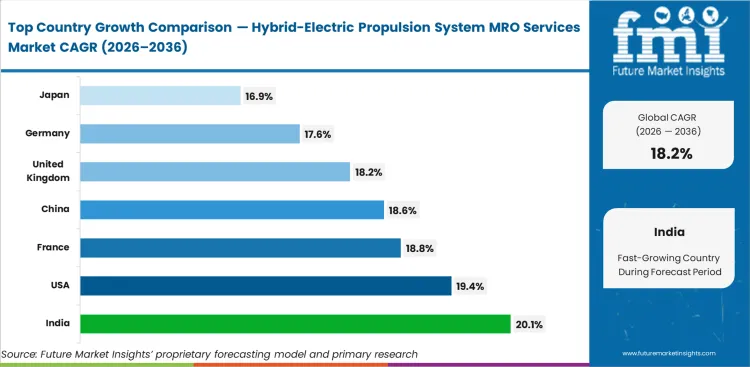
| Country | CAGR 2026 to 2036 |
|---|---|
| India | 20.1% |
| United States | 19.4% |
| France | 18.8% |
| China | 18.6% |
| United Kingdom | 18.2% |
| Germany | 17.6% |
| Japan | 16.9% |
Source: Future Market Insights analysis, 2026.
Analysis of Hybrid-Electric Propulsion System MRO Services Market by Key Countries
- India is expected to expand at 20.1% CAGR by 2036 as fleet modernization and electric aviation trials raise service readiness needs.
- United States is projected to record 19.4% CAGR by 2036 since hybrid-electric demonstrator activity supports technician training and repair planning.
- France is forecast to grow at 18.8% CAGR by 2036 due to electric propulsion certification work and aerospace supplier depth.
- China is expected to advance at 18.6% CAGR by 2036 with aircraft electrification programs supporting future MRO service demand.
- United Kingdom at 18.2% CAGR and Germany at 17.6% CAGR expand through aviation engineering depth and regulatory readiness. Japan follows at 16.9% CAGR through careful service adoption for advanced aircraft systems.
Country performance differs by certification readiness and electric aviation program activity. India leads due to wider aviation expansion and stronger interest in future propulsion support. United States follows through demonstrator programs and established MRO infrastructure. France advances through electric propulsion certification activity and supplier concentration. China benefits from aircraft electrification planning and domestic aerospace investment. United Kingdom and Germany progress through technical service capability and compliance discipline. Japan maintains steady uptake as aircraft operators focus on safe integration of new propulsion systems.
Demand Outlook for Hybrid-Electric Propulsion System MRO Services in India
Industry in India is projected to record a 20.1% CAGR by 2036, driven by MRO tax reform and foreign investment rules that reduce the cost of building new repair capability. Aviation ministry material in July 2024 placed uniform IGST on aircraft parts at 5.0%, improving spare part economics for high-voltage propulsion support. Domestic airline orders of more than 1,100 aircraft widen the future service pipeline. Suppliers with training programs and component testing support should convert faster than parts-only sellers.
- National tax reform lowers the cost of imported aircraft engine parts and supports earlier stocking of electric propulsion spares.
- Automatic 100% FDI approval for aircraft MRO provides foreign OEMs opportunity to place repair knowledge base with Indian partners.
- Airline order depth creates a larger technician training pool before certified hybrid-electric regional aircraft arrive.
In-Depth Analysis of Hybrid-Electric Propulsion System MRO Services in United States
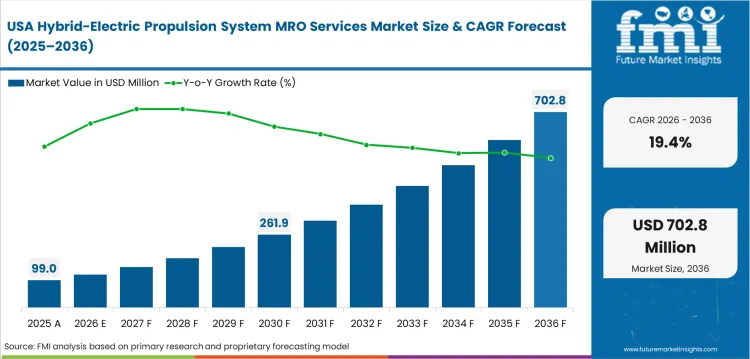
FAA and NASA activity place the United States among the more advanced in regulated service planning. The sector in the United States is expected to expand at 19.4% CAGR by 2036, led by advanced aircraft certification work meeting a large repair station network. Archer received FAA Part 145 repair station certification in February 2024 for specialized aircraft repair work. Such early approvals give MRO suppliers a practical template for electric aircraft return-to-service controls.
- FAA certification planning for advanced air mobility supports repair manuals and maintenance training before broad passenger service.
- NASA electrified propulsion ground and flight testing creates engineering evidence for future megawatt-class maintenance routines.
- Part 145 repair station approvals give electric aircraft operators a regulated path for specialized service support.
Opportunity Analysis of Hybrid-Electric Propulsion System MRO Services in France
Industry prospects in France are forecast to grow at 18.8% CAGR by 2036 since certified electric propulsion hardware and European demonstration programs support early service demand. Safran’s ENGINeUS 100 certificate in February 2025 gives French suppliers a certified electric motor reference for maintenance planning. Clean Aviation work on hybrid-electric powertrains reinforces local test and integration capability. MRO buyers should value French suppliers with certification records and OEM engineering depth.
- French propulsion suppliers gain from EASA certification familiarity across electric motor testing and safety documentation.
- Clean Aviation program work supports maintenance knowledge around thermal management and powertrain integration.
- Regional aircraft service prospects improve as European demonstrators move toward passenger-class hybrid-electric platforms.
Sales Analysis of Hybrid-Electric Propulsion System MRO Services in China
Sector in China is expected to advance at 18.6% CAGR by 2036 due to low-altitude aircraft certification and production approvals creating new service needs. Civil aviation statements in 2024 highlighted EH216-S production certificate progress after type certification. Civil aviation oversight will influence operators toward traceable maintenance logs and approved component replacement. Local MRO firms should gain by combining battery safety with regulator-ready documentation.
- Civil aviation approval for certified electric vertical aircraft creates a closer link between production and maintenance planning.
- Low-altitude economy policy gives repair providers a broader operator pool for battery and motor checks.
- Domestic aircraft production reduces import reliance and supports local spare part availability for electric propulsion systems.
Sales Analysis of Hybrid-Electric Propulsion System MRO Services in United Kingdom
Industry in the United Kingdom are projected to rise at 18.2% CAGR by 2036 as Future Flight funding and aviation authority work support service readiness. UK public investment in Future Flight reached GBP 125 million under the national action plan in March 2024. Aviation authority progress on battery handling and eVTOL continuing airworthiness provide practical service guidance. Suppliers should see demand from training and test support. Early operator trials are likely to create the next service entry point.
- UK aviation authority work on battery handling strengthens safety expectations for electric aircraft service providers.
- Future Flight program funding supports projects requiring technician training and operational support planning.
- Design approval activity provides OEMs and service partners clearer evidence routes for maintenance manual development.
Demand Outlook for Hybrid-Electric Propulsion System MRO Services in Germany
Demand in Germany is forecast at 17.6% CAGR by 2036, influenced by European aircraft suppliers and component specialists building service cases around regulated hybrid-electric programs. Clean Aviation reporting in 2025 noted hybrid-electric powertrain review progress for regional aircraft work. German suppliers should gain from precision testing and power electronics know-how. Germany stays below India and United States as commercial fleet entry takes longer.
- European demonstrator work gives German component suppliers a path into power electronics and thermal service packages.
- Certification-heavy buying favors test evidence and engineering records over simple parts replacement pricing.
- Independent MRO expansion will depend on OEM data access and trained high-voltage technicians.
Opportunity Analysis of Hybrid-Electric Propulsion System MRO Services in Japan
Growth for the sector in Japan is expected to post 16.9% CAGR by 2036 due to advanced air mobility planning that moves toward commercial operation between 2027 and 2028. METI’s March 2026 roadmap revision sets traffic management and remote passenger transport steps for the early 2030s. Maintenance need should center on short-cycle aircraft checks and battery health tracking. Operators will prefer service partners able to work under civil aviation approval rules.
- National AAM roadmap work promotes future service planning for electric aircraft used in passenger and emergency missions.
- Airline-backed air mobility projects create demand for repair training before regular commercial routes scale.
- Battery monitoring and certified service logs gain importance as operators manage frequent short flights.
Competitive Landscape and Strategic Positioning
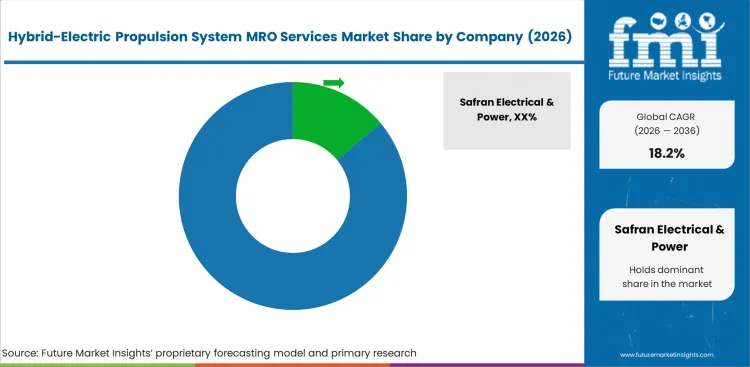
- Safran Electrical & Power holds an established position through certified electric motor hardware and aviation-grade service documentation.
- GE Aerospace and RTX stand out based on megawatt-class testing and hybrid propulsion demonstrator work for larger aircraft.
- Specialist firms can gain focused service work led by battery packs and flight test support. Training tied to electric propulsion service provides another service opening.
- Entry barriers are high as repair providers need OEM data access and high-voltage tools. Trained staff and regulator confidence complete the barrier.
Competition is expected to center on certified propulsion evidence, service documentation and repair capacity. Safran’s February 2025 ENGINeUS 100 certificate gives the company a clear reference for electric propulsion service planning. GE Aerospace’s November 2024 megawatt-class hybrid-electric demonstration shows how power electronics can integrate into support models for larger aircraft. Established suppliers hold an advantage because operators need fault isolation and release support after each repair. Factory-connected providers are therefore better placed than small independent shops during early fleet introduction.
Specialist firms can gain focused work packages before full fleet overhaul activity develops. magniX battery activity and ZeroAvia training partnerships indicate service lines built around battery life and technician readiness. Electric propulsion checks need deeper data access and stronger safety records. Suppliers with OEM access and trained staff and approved documentation are better placed to win early service contracts.
Key Companies in Hybrid-Electric Propulsion System MRO Services Market
Competition spans propulsion OEMs and electric powertrain specialists. Approved repair providers are preparing for certified hybrid-electric aircraft service.
- Propulsion OEMs: Safran Electrical & Power and GE Aerospace compete through certified hardware and megawatt testing. RTX adds aircraft-grade service manuals and demonstrator support. Safran leads with ENGINeUS certification depth. GE Aerospace adds hybrid-electric power demonstration work. RTX connects Pratt & Whitney propulsion experience with Collins electric systems.
- Electric powertrain specialists: magniX and ZeroAvia build positions in battery systems and electric propulsion. H55 adds energy system depth for aircraft developers. magniX brings aviation battery evidence through Samson lines. ZeroAvia adds maintenance training links through FlightSafety. H55 supports battery service routines.
- Approved repair and operator-linked specialists: Archer Aviation and selected MRO partners are building repair station readiness for electric aircraft. Archer’s FAA Part 145 status gives a service signal. Training firms and approved stations should gain once aircraft operators require line checks, component swaps, and return-to-service documents.
Competitive Benchmarking: Hybrid-Electric Propulsion System MRO Services Market
| Company | Certification Evidence Depth | High-Voltage Test Capability | MRO Training Reach | Footprint |
|---|---|---|---|---|
| Safran Electrical & Power | High | High | Large | Global |
| GE Aerospace | Large | High | Large | Global |
| RTX | Large | High | High | Global |
| magniX | Moderate | High | Moderate | North America |
| ZeroAvia | Large | Large | High | Europe and United States |
| H55 | Moderate | Large | Moderate | Europe |
| Archer Aviation | Moderate | Moderate | High | United States |
Source: Future Market Insights competitive analysis based on public product portfolios and company activity in 2026.
Key Developments in the Hybrid-Electric Propulsion System MRO Services Market
- In February 2025, Safran Electrical & Power received EASA certification for the ENGINeUS 100 electric motor.
- In March 2025, ZeroAvia and FlightSafety International signed an MOU to develop pilot and maintenance technician training resources for hydrogen-electric propulsion adoption.
- In March 2026, the FAA finalized special conditions for ZeroAvia’s ZA601 electric engine.
Key Players in the Hybrid-Electric Propulsion System MRO Services Market
Propulsion OEMs and system integrators
- Safran Electrical & Power
- GE Aerospace
- RTX
- Pratt & Whitney Canada
- Collins Aerospace
Electric powertrain specialists
- magniX
- ZeroAvia
- H55
- AeroTEC
- BETA Technologies
Approved service and training ecosystem
- Archer Aviation
- FlightSafety International
- FEAM Aero
- Lufthansa Technik
- AFI KLM E&M
Report Scope and Coverage
| Item | Value |
|---|---|
| Market value in 2025 | USD 147.2 million |
| Market value in 2026 | USD 174.0 million |
| Market value in 2036 | USD 926.2 million |
| CAGR from 2026 to 2036 | 18.2% |
| Quantitative units | USD million |
| Market definition | Maintenance and overhaul services for hybrid-electric propulsion systems used in aircraft |
| By maintenance model | OEM contracts, approved stations, airline in-house, mobile teams |
| By end user | Aircraft operators, OEM programs, leasing firms, defense users |
| By propulsion architecture | Parallel hybrid, series hybrid, turboelectric, distributed hybrid |
| By service type | Component diagnostics, battery service, powertrain overhaul, software calibration, retrofit support |
| By aircraft type | Regional aircraft, eVTOL aircraft, training aircraft, utility aircraft |
| Regions covered | North America, Latin America, Western Europe, Eastern Europe, East Asia, South Asia and Pacific, Middle East and Africa |
| Countries covered | India, United States, France, China, United Kingdom, Germany, Japan |
| Key companies profiled | Safran Electrical & Power, GE Aerospace, RTX, magniX, ZeroAvia, H55, Archer Aviation |
| Forecast period | 2026 to 2036 |
| Approach | Bottom-up hybrid-electric fleet service modeling with country and segment cross-checks |
Source: Future Market Insights analysis, 2026. Adjacent aircraft design references such as lightweight passenger window systems were reviewed only for aerospace technology context.
Hybrid-Electric Propulsion System MRO Services Market Breakdown by Maintenance Model, End User, Propulsion Architecture, Service Type, Aircraft Type, and Region
Hybrid-Electric Propulsion System MRO Services Market Segmented by Maintenance Model
- OEM Contracts
- Approved Stations
- Airline In-House
- Mobile Teams
Hybrid-Electric Propulsion System MRO Services Market Segmented by End User
- Aircraft Operators
- OEM Programs
- Leasing Firms
- Defense Users
Hybrid-Electric Propulsion System MRO Services Market Segmented by Propulsion Architecture
- Parallel Hybrid
- Series Hybrid
- Turboelectric
- Distributed Hybrid
Hybrid-Electric Propulsion System MRO Services Market Segmented by Service Type
- Component Diagnostics
- Battery Service
- Powertrain Overhaul
- Software Calibration
- Retrofit Support
Hybrid-Electric Propulsion System MRO Services Market Segmented by Aircraft Type
- Regional Aircraft
- eVTOL Aircraft
- Training Aircraft
- Utility Aircraft
Hybrid-Electric Propulsion System MRO Services Market by Region
- North America
- United States
- Canada
- Mexico
- Latin America
- Brazil
- Chile
- Rest of Latin America
- Western Europe
- Germany
- United Kingdom
- Italy
- Spain
- France
- Nordic
- BENELUX
- Rest of Western Europe
- Eastern Europe
- Poland
- Hungary
- Rest of Eastern Europe
- East Asia
- China
- Japan
- South Korea
- South Asia and Pacific
- India
- ASEAN
- Australia and New Zealand
- Rest of South Asia and Pacific
- Middle East and Africa
- Kingdom of Saudi Arabia
- Other GCC Countries
- Turkiye
- South Africa
- Rest of Middle East and Africa
Research Sources and Bibliography
- GE Aerospace. (2025). 2025 GE Aerospace product and technology update. GE Aerospace.
- European Union Aviation Safety Agency. (2025). Commission Implementing Regulation (EU) 2025/111. EASA.
- European Commission. (2025, January 23). Commission Implementing Regulation (EU) 2025/111 of 23 January 2025 amending Regulation (EU) No 1321/2014 as regards continuing airworthiness for electric- and hybrid-propulsion aircraft and other non-conventional aircraft. EUR-Lex.
- European Union Aviation Safety Agency. (2025, February 3). How EASA certified Safran’s ENGINeUS 100 electric engine.
- European Union Aviation Safety Agency. (2024, July 30). Proposed CM-21.A-004 Issue 01: Acceptable approaches for certification of electric and hybrid propulsion systems.
- Federal Aviation Administration. (2025, April). Roadmap for advanced air mobility aircraft type certification.
- National Aeronautics and Space Administration. (2025, April 30). Electrified Powertrain Flight Demonstration Project.
- International Air Transport Association. (2025, October 13). Supply chain challenges could cost airlines more than USD 11 billion in 2025.
- Clean Aviation Joint Undertaking. (2025, July). Consolidated annual activity report 2024.
- Clean Aviation Joint Undertaking. (2025, December). Work programme and budget 2026-2027.
- Press Information Bureau. (2024, July 15). “India aims to become leading aviation hub with $4 billion MRO industry by 2030” - Union Minister Shri Rammohan Naidu. Government of India.
- Press Information Bureau. (2024, August 2). Government permits 100% Foreign Direct Investment via automatic route for aircraft Maintenance, Repair and Overhaul (MRO). Government of India.
- Press Information Bureau. (2024, August 9). Unification of GST slabs and the increase in aircraft fleet by domestic airlines are expected to double India’s MRO industry from $2 billion to $4 billion in seven years. Government of India.
- Department for Transport. (2025, September 29). Over £4 million government backing for next-gen aviation technology projects. GOV.UK.
- Ministry of Economy, Trade and Industry. (2026, March 27). Advanced Air Mobility Roadmap revised. Government of Japan.
- RTX. (2024, January 22). RTX’s Pratt & Whitney Canada unveils high voltage bidirectional mobile charging unit for hybrid-electric flight demonstrator.
- RTX. (2024, July 22). RTX to collaborate on hybrid-electric system for Airbus PioneerLab helicopter demonstrator.
- GE Aerospace. (2024, November 21). GE Aerospace demonstrates hybrid electric propulsion system for USA Army.
- Safran. (2025, February 3). Safran obtains EASA certification of the first electric motor for new air mobility.
- magniX. (2024, June 24). magniX launches battery product.
- ZeroAvia. (2025, March 27). ZeroAvia and FlightSafety International to partner on pilot, maintenance training for zero-emission flight.
- Archer Aviation. (2024, February 8). Archer receives Part 145 certification from the Federal Aviation Administration.
- Federal Aviation Administration. (2026, March 18). Special conditions: ZeroAvia, Inc. Model ZA601 electric engines. Federal Register.
- Department for Transport. (2024, March 18). Future of Flight action plan. GOV.UK.
Bibliography uses primary government, regulatory, official trade body, or official company publications.
This Report Answers
- What is the current and future value of the hybrid-electric propulsion system MRO services market from 2026 to 2036?
- What CAGR is expected for the hybrid-electric propulsion system MRO services market during the forecast period?
- Which maintenance model is projected to lead hybrid-electric propulsion system MRO services in 2026?
- Which end user segment is expected to hold the strongest share in hybrid-electric propulsion service demand?
- What factors are driving MRO adoption for hybrid-electric aircraft propulsion systems?
- How do certification rules and high-voltage safety needs affect supplier selection in this sector?
- Which countries are expected to grow fastest in hybrid-electric propulsion system MRO services?
- Which companies are positioned across electric propulsion, battery service, and approved repair station readiness?
- How does FMI define the hybrid-electric propulsion system MRO services revenue scope?
- What forecasting approach was used to estimate hybrid-electric propulsion service demand from 2026 to 2036?
Frequently Asked Questions
What is the global market demand for hybrid-electric propulsion system MRO services in 2026?
The global hybrid-electric propulsion system MRO services market is expected to reach USD 174.0 million in 2026 as certified service routines expand.
What will the hybrid-electric propulsion system MRO services market be worth by 2036?
Industry revenue is projected to reach USD 926.2 million by 2036 as operators add battery and electric powertrain service contracts.
What is the expected CAGR for the hybrid-electric propulsion system MRO services market?
Hybrid-electric propulsion system MRO services are expected to expand at 18.2% CAGR from 2026 to 2036 across regulated aircraft channels.
Which maintenance model leads the hybrid-electric propulsion system MRO services market?
OEM contracts are projected to account for 46.0% share in 2026 due to software access and approved repair data.
Which end user leads the hybrid-electric propulsion system MRO services market?
Aircraft operators are anticipated to hold 43.0% share in 2026 as fleet uptime depends on battery health and service logs.
Which country records the strongest rate in the hybrid-electric propulsion system MRO services market?
India is forecast to record 20.1% CAGR by 2036 as tax changes and MRO investment rules improve repair economics.
What does the hybrid-electric propulsion system MRO services market include?
Scope includes maintenance, testing, overhaul, software calibration, battery service, and diagnostics for hybrid-electric aircraft propulsion systems.
How was the hybrid-electric propulsion system MRO services market forecast prepared?
Forecast work used hybrid-electric fleet adoption, service cost assumptions, certification progress, and country-level MRO policy checks for validation.
How do hybrid-electric aircraft MRO services work?
Service teams check the electric motor, inverter, battery pack, cooling loop, and control software before approving return to flight. Each repair event needs safety records that regulators and operators can review.
Preview the report firsthand - request a free sample
Get SampleGet the brochure for pricing and purchase details.
Get PDFTable of Content
- Key Takeaways
- Market Size and CAGR
- Top Growth Driver
- Fastest Growing Segment
- Leading Region
- Key Companies
- Emerging Opportunities
- Executive Summary
- Global Market Outlook
- Demand-side Trends
- Supply-side Trends
- Technology Roadmap Analysis
- Analysis and Recommendations
- Analyst Perspective (What is happening? Why now? What should investors know?)
- Key Questions Answered
- How large is the market?
- What is the CAGR?
- What are key trends?
- Which region dominates?
- Who are the leaders?
- Market Overview
- Market Coverage / Taxonomy
- Market Definition / Scope / Limitations
- Research Methodology
- Chapter Orientation
- Analytical Lens and Working Hypotheses
- Market Structure, Signals, and Trend Drivers
- Benchmarking and Cross-market Comparability
- Market Sizing, Forecasting, and Opportunity Mapping
- Research Design and Evidence Framework
- Desk Research Programme (Secondary Evidence)
- Expert Input and Fieldwork (Primary Evidence)
- Tooling, Models, and Reference Databases
- Data Engineering and Model Build
- Quality Assurance and Audit Trail
- Market Background
- Market Dynamics (Drivers, Restraints, Opportunity, Trends)
- Scenario Forecast (Optimistic, Likely, Conservative)
- Impact Analysis
- AI Impact
- Sustainability Impact
- Regulatory Impact
- Technology Impact
- Consumer / Buyer Analysis
- Purchase Drivers
- Adoption Barriers
- Buyer Journey
- Opportunity Map Analysis
- Product Life Cycle Analysis
- Supply Chain Analysis
- Investment Feasibility Matrix
- Value Chain Analysis
- PESTLE and Porter's Analysis
- Regulatory Landscape
- Regional Parent Market Outlook
- Production and Consumption Statistics
- Import and Export Statistics
- Global Market Analysis and Forecast, 2021 to 2036
- Historical Market Size Value (USD Million) & Volume (Unit) Analysis, 2021 to 2025
- Current and Future Market Size Value (USD Million) & Volume (Unit) Projections, 2026 to 2036
- Y-o-Y Growth Trend Analysis
- Absolute $ Opportunity Analysis
- Global Market Pricing Analysis, 2021 to 2036
- Global Market Analysis and Forecast, By Maintenance Model, 2021 to 2036
- Introduction / Key Findings
- Historical Market Size Value (USD Million) & Volume (Unit) Analysis By Maintenance Model, 2021 to 2025
- Current and Future Market Size Value (USD Million) & Volume (Unit) Analysis and Forecast By Maintenance Model, 2026 to 2036
- OEM Contracts
- Approved Stations
- Airline In-House
- Mobile Teams
- OEM Contracts
- Y-o-Y Growth Trend Analysis By Maintenance Model, 2021 to 2025
- Absolute $ Opportunity Analysis By Maintenance Model, 2026 to 2036
- Global Market Analysis and Forecast, By End User, 2021 to 2036
- Introduction / Key Findings
- Historical Market Size Value (USD Million) & Volume (Unit) Analysis By End User, 2021 to 2025
- Current and Future Market Size Value (USD Million) & Volume (Unit) Analysis and Forecast By End User, 2026 to 2036
- Aircraft Operators
- OEM Programs
- Leasing Firms
- Defense Users
- Aircraft Operators
- Y-o-Y Growth Trend Analysis By End User, 2021 to 2025
- Absolute $ Opportunity Analysis By End User, 2026 to 2036
- Global Market Analysis and Forecast, By Propulsion Architecture, 2021 to 2036
- Introduction / Key Findings
- Historical Market Size Value (USD Million) & Volume (Unit) Analysis By Propulsion Architecture, 2021 to 2025
- Current and Future Market Size Value (USD Million) & Volume (Unit) Analysis and Forecast By Propulsion Architecture, 2026 to 2036
- Parallel Hybrid
- Series Hybrid
- Turboelectric
- Distributed Hybrid
- Parallel Hybrid
- Y-o-Y Growth Trend Analysis By Propulsion Architecture, 2021 to 2025
- Absolute $ Opportunity Analysis By Propulsion Architecture, 2026 to 2036
- Global Market Analysis and Forecast, By Service Type, 2021 to 2036
- Introduction / Key Findings
- Historical Market Size Value (USD Million) & Volume (Unit) Analysis By Service Type, 2021 to 2025
- Current and Future Market Size Value (USD Million) & Volume (Unit) Analysis and Forecast By Service Type, 2026 to 2036
- Component Diagnostics
- Battery Service
- Powertrain Overhaul
- Software Calibration
- Retrofit Support
- Component Diagnostics
- Y-o-Y Growth Trend Analysis By Service Type, 2021 to 2025
- Absolute $ Opportunity Analysis By Service Type, 2026 to 2036
- Global Market Analysis and Forecast, By Aircraft Type, 2021 to 2036
- Introduction / Key Findings
- Historical Market Size Value (USD Million) & Volume (Unit) Analysis By Aircraft Type, 2021 to 2025
- Current and Future Market Size Value (USD Million) & Volume (Unit) Analysis and Forecast By Aircraft Type, 2026 to 2036
- Regional Aircraft
- eVTOL Aircraft
- Training Aircraft
- Utility Aircraft
- Regional Aircraft
- Y-o-Y Growth Trend Analysis By Aircraft Type, 2021 to 2025
- Absolute $ Opportunity Analysis By Aircraft Type, 2026 to 2036
- Global Market Analysis and Forecast, By Region, 2021 to 2036
- Introduction
- Historical Market Size Value (USD Million) & Volume (Unit) Analysis By Region, 2021 to 2025
- Current Market Size Value (USD Million) & Volume (Unit) Analysis and Forecast By Region, 2026 to 2036
- North America
- Latin America
- Western Europe
- Eastern Europe
- East Asia
- South Asia and Pacific
- Middle East & Africa
- Market Attractiveness Analysis By Region
- North America Market Analysis and Forecast, By Country, 2021 to 2036
- Historical Market Size Value (USD Million) & Volume (Unit) Trend Analysis By Market Taxonomy, 2021 to 2025
- Market Size Value (USD Million) & Volume (Unit) Forecast By Market Taxonomy, 2026 to 2036
- By Country
- USA
- Canada
- Mexico
- By Maintenance Model
- By End User
- By Propulsion Architecture
- By Service Type
- By Aircraft Type
- By Country
- Market Attractiveness Analysis
- By Country
- By Maintenance Model
- By End User
- By Propulsion Architecture
- By Service Type
- By Aircraft Type
- Key Takeaways
- Latin America Market Analysis and Forecast, By Country
- Historical Market Size Value (USD Million) & Volume (Unit) Trend Analysis By Market Taxonomy, 2021 to 2025
- Market Size Value (USD Million) & Volume (Unit) Forecast By Market Taxonomy, 2026 to 2036
- By Country
- Brazil
- Chile
- Rest of Latin America
- By Maintenance Model
- By End User
- By Propulsion Architecture
- By Service Type
- By Aircraft Type
- By Country
- Market Attractiveness Analysis
- By Country
- By Maintenance Model
- By End User
- By Propulsion Architecture
- By Service Type
- By Aircraft Type
- Key Takeaways
- Western Europe Market Analysis and Forecast, By Country
- Historical Market Size Value (USD Million) & Volume (Unit) Trend Analysis By Market Taxonomy, 2021 to 2025
- Market Size Value (USD Million) & Volume (Unit) Forecast By Market Taxonomy, 2026 to 2036
- By Country
- Germany
- UK
- Italy
- Spain
- France
- Nordic
- BENELUX
- Rest of Western Europe
- By Maintenance Model
- By End User
- By Propulsion Architecture
- By Service Type
- By Aircraft Type
- By Country
- Market Attractiveness Analysis
- By Country
- By Maintenance Model
- By End User
- By Propulsion Architecture
- By Service Type
- By Aircraft Type
- Key Takeaways
- Eastern Europe Market Analysis and Forecast, By Country
- Historical Market Size Value (USD Million) & Volume (Unit) Trend Analysis By Market Taxonomy, 2021 to 2025
- Market Size Value (USD Million) & Volume (Unit) Forecast By Market Taxonomy, 2026 to 2036
- By Country
- Russia
- Poland
- Hungary
- Balkan & Baltic
- Rest of Eastern Europe
- By Maintenance Model
- By End User
- By Propulsion Architecture
- By Service Type
- By Aircraft Type
- By Country
- Market Attractiveness Analysis
- By Country
- By Maintenance Model
- By End User
- By Propulsion Architecture
- By Service Type
- By Aircraft Type
- Key Takeaways
- East Asia Market Analysis and Forecast, By Country
- Historical Market Size Value (USD Million) & Volume (Unit) Trend Analysis By Market Taxonomy, 2021 to 2025
- Market Size Value (USD Million) & Volume (Unit) Forecast By Market Taxonomy, 2026 to 2036
- By Country
- China
- Japan
- South Korea
- By Maintenance Model
- By End User
- By Propulsion Architecture
- By Service Type
- By Aircraft Type
- By Country
- Market Attractiveness Analysis
- By Country
- By Maintenance Model
- By End User
- By Propulsion Architecture
- By Service Type
- By Aircraft Type
- Key Takeaways
- South Asia and Pacific Market Analysis and Forecast, By Country
- Historical Market Size Value (USD Million) & Volume (Unit) Trend Analysis By Market Taxonomy, 2021 to 2025
- Market Size Value (USD Million) & Volume (Unit) Forecast By Market Taxonomy, 2026 to 2036
- By Country
- India
- ASEAN
- Australia & New Zealand
- Rest of South Asia and Pacific
- By Maintenance Model
- By End User
- By Propulsion Architecture
- By Service Type
- By Aircraft Type
- By Country
- Market Attractiveness Analysis
- By Country
- By Maintenance Model
- By End User
- By Propulsion Architecture
- By Service Type
- By Aircraft Type
- Key Takeaways
- Middle East & Africa Market Analysis and Forecast, By Country
- Historical Market Size Value (USD Million) & Volume (Unit) Trend Analysis By Market Taxonomy, 2021 to 2025
- Market Size Value (USD Million) & Volume (Unit) Forecast By Market Taxonomy, 2026 to 2036
- By Country
- Kingdom of Saudi Arabia
- Other GCC Countries
- Türkiye
- South Africa
- Other African Union
- Rest of Middle East & Africa
- By Maintenance Model
- By End User
- By Propulsion Architecture
- By Service Type
- By Aircraft Type
- By Country
- Market Attractiveness Analysis
- By Country
- By Maintenance Model
- By End User
- By Propulsion Architecture
- By Service Type
- By Aircraft Type
- Key Takeaways
- Key Countries Market Analysis
- USA
- Pricing Analysis
- Market Share Analysis, 2025
- By Maintenance Model
- By End User
- By Propulsion Architecture
- By Service Type
- By Aircraft Type
- Canada
- Pricing Analysis
- Market Share Analysis, 2025
- By Maintenance Model
- By End User
- By Propulsion Architecture
- By Service Type
- By Aircraft Type
- Mexico
- Pricing Analysis
- Market Share Analysis, 2025
- By Maintenance Model
- By End User
- By Propulsion Architecture
- By Service Type
- By Aircraft Type
- Brazil
- Pricing Analysis
- Market Share Analysis, 2025
- By Maintenance Model
- By End User
- By Propulsion Architecture
- By Service Type
- By Aircraft Type
- Chile
- Pricing Analysis
- Market Share Analysis, 2025
- By Maintenance Model
- By End User
- By Propulsion Architecture
- By Service Type
- By Aircraft Type
- Germany
- Pricing Analysis
- Market Share Analysis, 2025
- By Maintenance Model
- By End User
- By Propulsion Architecture
- By Service Type
- By Aircraft Type
- UK
- Pricing Analysis
- Market Share Analysis, 2025
- By Maintenance Model
- By End User
- By Propulsion Architecture
- By Service Type
- By Aircraft Type
- Italy
- Pricing Analysis
- Market Share Analysis, 2025
- By Maintenance Model
- By End User
- By Propulsion Architecture
- By Service Type
- By Aircraft Type
- Spain
- Pricing Analysis
- Market Share Analysis, 2025
- By Maintenance Model
- By End User
- By Propulsion Architecture
- By Service Type
- By Aircraft Type
- France
- Pricing Analysis
- Market Share Analysis, 2025
- By Maintenance Model
- By End User
- By Propulsion Architecture
- By Service Type
- By Aircraft Type
- India
- Pricing Analysis
- Market Share Analysis, 2025
- By Maintenance Model
- By End User
- By Propulsion Architecture
- By Service Type
- By Aircraft Type
- ASEAN
- Pricing Analysis
- Market Share Analysis, 2025
- By Maintenance Model
- By End User
- By Propulsion Architecture
- By Service Type
- By Aircraft Type
- Australia & New Zealand
- Pricing Analysis
- Market Share Analysis, 2025
- By Maintenance Model
- By End User
- By Propulsion Architecture
- By Service Type
- By Aircraft Type
- China
- Pricing Analysis
- Market Share Analysis, 2025
- By Maintenance Model
- By End User
- By Propulsion Architecture
- By Service Type
- By Aircraft Type
- Japan
- Pricing Analysis
- Market Share Analysis, 2025
- By Maintenance Model
- By End User
- By Propulsion Architecture
- By Service Type
- By Aircraft Type
- South Korea
- Pricing Analysis
- Market Share Analysis, 2025
- By Maintenance Model
- By End User
- By Propulsion Architecture
- By Service Type
- By Aircraft Type
- Russia
- Pricing Analysis
- Market Share Analysis, 2025
- By Maintenance Model
- By End User
- By Propulsion Architecture
- By Service Type
- By Aircraft Type
- Poland
- Pricing Analysis
- Market Share Analysis, 2025
- By Maintenance Model
- By End User
- By Propulsion Architecture
- By Service Type
- By Aircraft Type
- Hungary
- Pricing Analysis
- Market Share Analysis, 2025
- By Maintenance Model
- By End User
- By Propulsion Architecture
- By Service Type
- By Aircraft Type
- Kingdom of Saudi Arabia
- Pricing Analysis
- Market Share Analysis, 2025
- By Maintenance Model
- By End User
- By Propulsion Architecture
- By Service Type
- By Aircraft Type
- Türkiye
- Pricing Analysis
- Market Share Analysis, 2025
- By Maintenance Model
- By End User
- By Propulsion Architecture
- By Service Type
- By Aircraft Type
- South Africa
- Pricing Analysis
- Market Share Analysis, 2025
- By Maintenance Model
- By End User
- By Propulsion Architecture
- By Service Type
- By Aircraft Type
- USA
- Market Structure Analysis
- Competition Dashboard
- Competition Benchmarking
- Market Share Analysis of Top Players
- By Regional
- By Maintenance Model
- By End User
- By Propulsion Architecture
- By Service Type
- By Aircraft Type
- Emerging Startups
- Innovation Benchmarking
- Competition Analysis
- Competition Deep Dive
- Safran Electrical & Power
- Overview
- Product Portfolio
- Profitability by Market Segments (Product/Region/Sales Channel)
- Sales Footprint
- Strategy Overview
- Marketing Strategy
- Product Strategy
- Channel Strategy
- GE Aerospace
- RTX
- Pratt & Whitney Canada
- Collins Aerospace
- magniX
- ZeroAvia
- H55
- AeroTEC
- BETA Technologies
- Archer Aviation
- FlightSafety International
- FEAM Aero
- Lufthansa Technik
- AFI KLM E&M
- Safran Electrical & Power
- Case Studies
- Success Stories
- Recent Developments
- Competition Deep Dive
- Assumptions & Acronyms Used


