

- Market Size (2026)
- USD 0.8 Bn
- Forecast (2036)
- USD 1.4 Bn
- CAGR (2026 to 2036)
- 6.5%
AdBlue and SCR System Performance Additives Market Size, Forecast, and Outlook By FMI
AdBlue and SCR system performance additives market was valued at USD 0.7 billion in 2025 and is projected to reach USD 0.8 billion in 2026. Industry is forecast to reach USD 1.4 billion by 2036 at 6.5% CAGR.
Summary of the AdBlue and SCR System Performance Additives Market
- Demand and Growth Drivers
- Commercial fleets use anti-crystal additives to lower urea deposit risk in dosing lines and injectors during high idle duty.
- Workshop users are shifting toward SCR cleaners with clearer dosing instructions as diesel emission faults create avoidable downtime.
- Fuel retailers and service chains use additive bundles to widen service revenue from diesel exhaust fluid refills.
- Product and Segment View
- Anti-crystallization additives are projected to account for 38.2% share in 2026 as repeat service use rises around urea deposits.
- Deposit control is forecast to capture 44.7% share in 2026 as blocked injectors create repair cost pressure for fleets.
- Direct fleet supply is expected to hold 58.4% share in 2026 as larger operators need training and documented dosing rules.
- Geography and Competitive Outlook
- India is projected to record 8.3% CAGR by 2036 as commercial vehicle growth and Bharat Stage VI service needs support service demand.
- China is expected to expand at 7.8% CAGR by 2036 as heavy truck volume and strict diesel aftertreatment rules support service demand.
- Companies such as BASF, Yara, Brenntag, GreenChem, Rislone, Wynn’s, and Liqui Moly are focusing on fluid quality and service reach.
- Analyst Opinion
- Nikhil Kaitwade, Principal Consultant for Industrial Automation & Equipment at FMI, observes, “AdBlue additive buying is moving from simple bottle availability toward service evidence. Fleets want fewer SCR warnings and lower injector cleaning cost. Suppliers able to show safe dosing along with clean handling and workshop training will hold a more defensible position.”
- AdBlue and SCR System Performance Additives Market Value Analysis
- Industry revenue is moving from general diesel exhaust fluid resale toward anti-crystal treatments and SCR service products.
- Operator spending comes from urea deposit prevention as repair bills often exceed additive cost by a wide margin.
- Service chains are linking additives with scheduled fleet maintenance to reduce repeat SCR warning events.
- Diesel trucks and off-road machinery support additive demand through SCR aftertreatment.
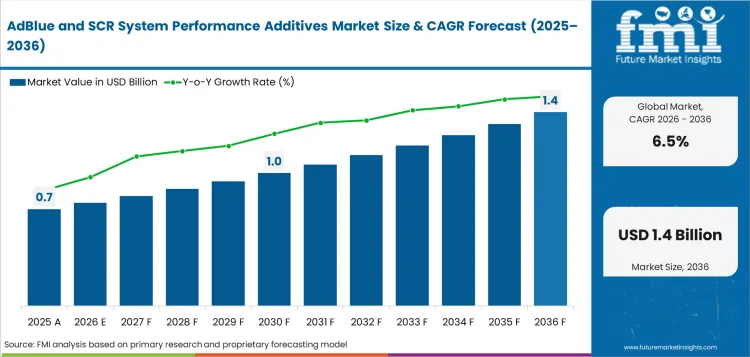
- The AdBlue and SCR system performance additives market size stood at USD 0.7 billion in 2025.
- By 2036, AdBlue and SCR system performance additives value is forecast to reach USD 1.4 billion.
- From 2026 to 2036, the sector is projected to expand at 6.5% CAGR.
- Industry revenue is projected to create an incremental opportunity of USD 657.0 million between 2026 and 2036.
- Direct fleet supply is estimated to account for 58.4% share of sales channel in 2026.
- Heavy commercial vehicles are projected to hold 53.6% share of vehicle class in 2026.
- India is expected to expand at 8.3% CAGR by 2036. China follows at 7.8% CAGR as service readiness differs by country.
SCR system failures often occur due to urea crystal buildup, which is driving the use of additives as part of preventive maintenance. MOTUL’s January 2026 product follows the same dosing approach and adds that it can also help remove existing crystal deposits without affecting the urea quality. This standardized dosing makes it easy for workshops to integrate additives into routine AdBlue refills, creating a simple and repeatable service process with minimal training. In addition, aligning pack sizes with typical refill volumes helps both retailers and fleet operators streamline usage and inventory management.
Regulatory changes are also increasing the importance of proper SCR system maintenance. The Euro 7 regulations introduced in April 2024 apply stricter lifetime emission requirements across both passenger and heavy-duty vehicles. Maintaining SCR system cleanliness is becoming critical for ensuring consistent emissions performance.
AdBlue and SCR System Performance Additives Market Definition
AdBlue and SCR system performance additives cover treatment products sold for selective catalytic reduction service support. Scope includes anti-crystallization liquids, DEF stabilizers, injector cleaners, tank cleaners, and dosing system cleaners. Commodity AdBlue is excluded unless additive value is sold as a separate performance product. Hardware such as pumps, tanks, sensors, and catalysts is outside the revenue boundary.
AdBlue and SCR System Performance Additives Market Inclusions
Scope includes additives used by fleet workshops, service centers, retailers, and distributors for AdBlue and SCR system care. Products used to reduce urea deposits and improve dosing line cleanliness are included. Bulk fleet formats and small retail bottles are included. Adjacent data from automotive additives, specialty fuel additives, and lubricant additives support the demand view. Fuel additives are not treated as direct substitutes.
AdBlue and SCR System Performance Additives Market Exclusions
Scope excludes standard AdBlue sold as bulk diesel exhaust fluid with no additive treatment value. Scope excludes catalytic converters, urea tanks, dosing pumps, and NOx sensors sold as replacement parts. Fuel injector additives poured into diesel tanks are excluded unless positioned for SCR or DEF system care.
AdBlue and SCR System Performance Additives Market Research Methodology
- Primary Research: FMI analysts reviewed fleet service workflows, distributor catalogues, and additive label positioning across SCR maintenance channels.
- Desk Research: Public vehicle production data and emission rules supported the demand view. Company releases added supplier context.
- Market Sizing and Forecasting: Forecast values used vehicle fleet exposure, additive attach rates, and segment-level share estimates.
- Data Validation: Checks compared truck production trends with AdBlue supply evidence and SCR component service demand.
Why is the AdBlue and SCR System Performance Additives Market Growing?
- Fleet workshops use SCR cleaners to reduce repeat dosing faults after urea crystals affect injector spray quality.
- Commercial vehicle owners are extending diesel asset use as zero emission truck rollout stays uneven across freight operations.
- Service retailers are bundling AdBlue refills with anti-crystal treatments to increase value from routine maintenance visits.
SCR service demand comes from diesel fleet uptime and emissions control. United States Environmental Protection Agency’s March 2024 final standards fact sheet covers heavy-duty vehicles for model year 2027 and later, keeping compliance linked to active aftertreatment care. Europe adds another route as Euro 7 rules were adopted in April 2024 for cars and trucks. Tight rules make poor dosing and contaminated fluid more costly for fleet owners. SCR cleaners and SCR dosing control modules is gaining attention as preventive service tools.
Vehicle output and fleet use keep the addressable pool broad across mature and fast-moving regions. International Organization of Motor Vehicle Manufacturers reported that global vehicle production rose from 92.7 million units in 2024 to 96.4 million units in 2025. Global vehicle sales increased from 95.3 million units to 99.8 million units in the same period. Diesel vehicles with SCR hardware continue to support freight and off-road work as electric truck penetration develops unevenly. Growth comes from maintenance frequency and workshop awareness of urea crystallization.
Market Segmentation Analysis
- Direct fleet supply is forecast to capture 58.4% share in 2026 as large operators require controlled dosing rules and repeat stock access for multi-site workshops.
- Heavy commercial vehicles are projected to account for 53.6% share in 2026 as long duty cycles raise AdBlue use and make SCR fault prevention more valuable.
- Deposit control is expected to hold 44.7% share in 2026 as crystallized urea around injectors can interrupt dosing and force workshop cleaning.
- DEF tank and dosing module care is forecast to account for 42.5% share in 2026 as pumps and lines carry most additive service touchpoints.
- Anti-crystallization additives are anticipated to capture 38.2% share in 2026 as fleets use small-dose treatments before deposits turn into fault codes.
- Fleet maintenance users are expected to account for 47.8% share in 2026 as central workshops manage repeat SCR service across trucks and buses.
Market segmentation is divided into six primary groups based on additive type and service role. Product type separates anti-crystal products from cleaners and stabilizers. Additive function explains why users buy the treatment. Vehicle class shows diesel platform exposure. SCR component identifies the service point. End user and sales channel show how products reach fleets and workshops.
Insights into AdBlue and SCR System Performance Additives Market by Product Type
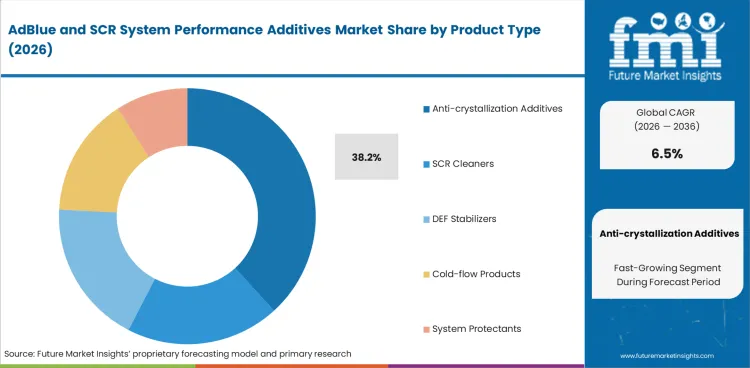
- Anti-crystallization additives are projected to account for 38.2% share in 2026 as urea deposits create dosing errors and service delays in high-use diesel fleets.
- SCR cleaners retain a prominent role as workshops need products positioned for injector deposits and tank residue after fault code checks.
Insights into AdBlue and SCR System Performance Additives Market by Additive Function
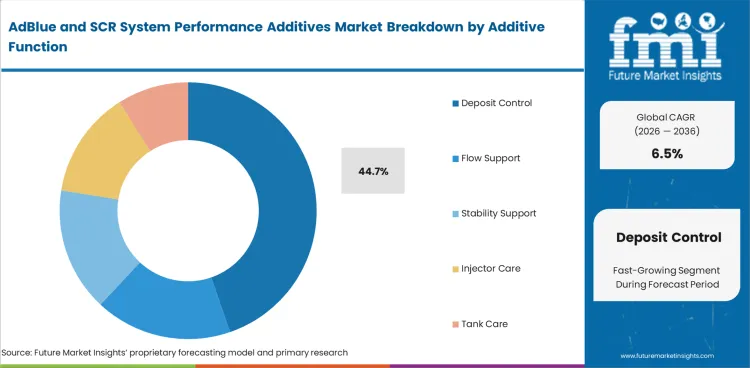
- Deposit control is forecast to capture 44.7% share in 2026 as residue prevention offers a clear maintenance case for trucks working long idle hours.
- Flow support gains attention in winter regions as cold starts and short trips can worsen crystallization around dosing hardware.
Insights into AdBlue and SCR System Performance Additives Market by Vehicle Class
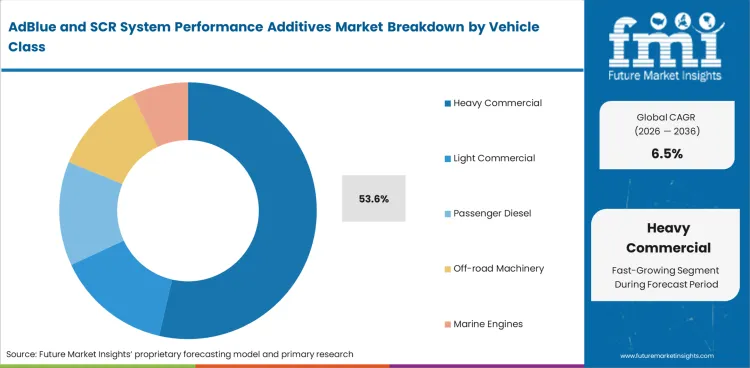
- Heavy commercial vehicles are anticipated to represent 53.6% share in 2026 as freight operators consume larger AdBlue volumes and face higher downtime losses from SCR faults.
- Light commercial vehicles add steady retail demand as vans move through independent workshops and packaged additive channels.
Insights into AdBlue and SCR System Performance Additives Market by SCR Component
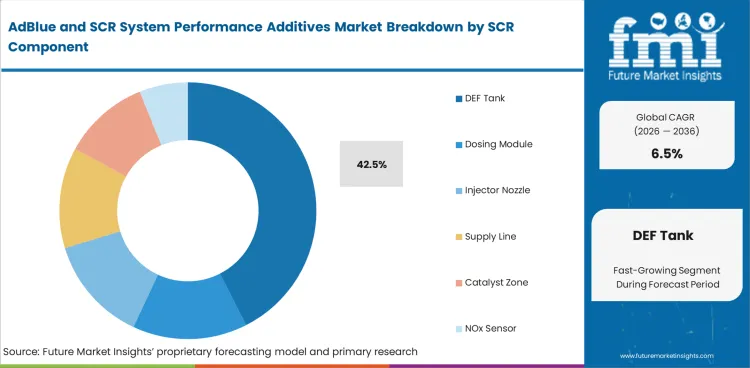
- DEF tank and dosing module care is projected to account for 42.5% share in 2026 as service technicians treat tanks and pumps before replacing expensive parts.
- Injector nozzle care gains share as crystal deposits near the spray point reduce dosing accuracy and raise fault recurrence.
Insights into AdBlue and SCR System Performance Additives Market by End User
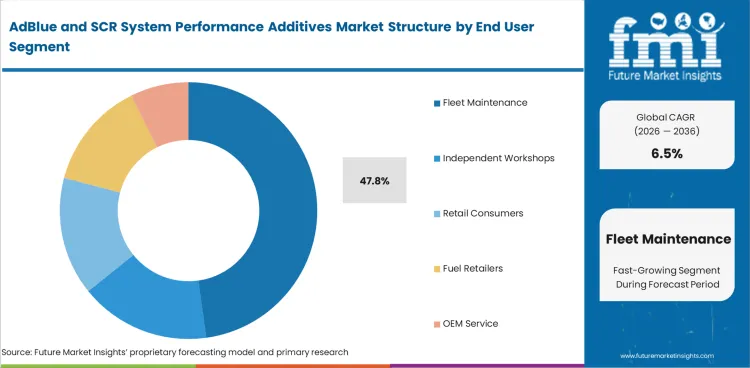
- Fleet maintenance users are forecast to hold 47.8% share in 2026 as depot workshops standardize AdBlue handling and SCR cleaning routines across vehicle pools.
- Independent workshops gain share through retail bottles and quick-service checks for diesel vans and owner-operated trucks.
Insights into AdBlue and SCR System Performance Additives Market by Sales Channel
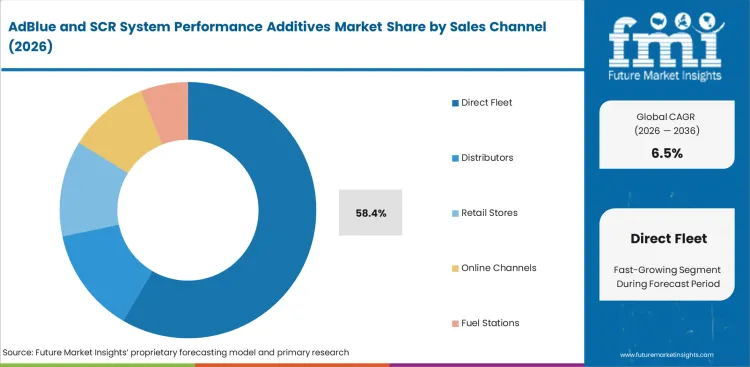
- Direct fleet supply is expected to represent 58.4% share in 2026 as large operators prefer technical support and product traceability over ad hoc retail buying.
- Aftermarket distributors remain important for smaller repair shops needing local access and flexible pack sizes.
AdBlue and SCR System Performance Additives Market Drivers, Restraints and Opportunities
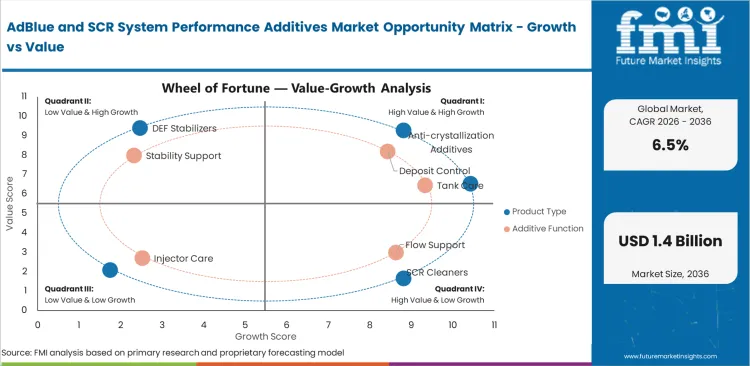
- SCR uptime focus is making anti-crystal dosing part of preventive diesel fleet service.
- Warranty caution can slow additive use as ISO 22241 quality rules leave little tolerance for poorly documented products.
- Low carbon AdBlue supply creates an opening for service programs built around cleaner fluid sourcing and dosing discipline.
Diesel fleet maintenance pressure and stricter aftertreatment compliance should lift demand. European Automobile Manufacturers’ Association reported in April 2026 that diesel trucks accounted for 92.4% of new EU truck registrations in Q1 2026. Electric chargeable trucks held 4.4% share in the same period. United Kingdom Department for Transport data recorded diesel combustion engines at 98.1% of new heavy goods vehicle sales in 2024. Zero emission heavy goods vehicles accounted for 0.6% share in 2024. Diesel aftertreatment remains an extensive service type for SCR dosing control modules and commercial vehicle urea tanks. BASF’s March 2024 AdBlue ZeroPCF launch adds a cleaner fluid sourcing angle, with certified product carbon footprint below 0.05 kg CO₂ per kg of AdBlue. Additive suppliers is predicted to observe growth as products reduce urea deposits and show compatibility with certified AdBlue quality rules.
Equipment Price Benchmarking Analysis
Equipment cost trends indicate a gradual rise in replacement expenses for fleets and service centers. USA Bureau of Labor Statistics series for industrial machinery manufacturing recorded an index of 267.561 in April 2026 against 264.249 in December 2025. The nearly 1.3% rise points to firmer equipment replacement costs for fleets and service centers. Additive suppliers can position SCR dosing module care and anti-crystal dosing as lower-cost maintenance tools before hardware replacement becomes necessary.
After-sales Service and Lifecycle Cost Analysis
Lifecycle cost analysis should focus on service frequency and parts dependency. American Transportation Research Institute’s 2025 update covered 178,091 combination truck tractors and placed 2024 average operating cost at USD 2.26 per mile. Lease or purchase payments rose 8.3%. Repair and maintenance costs fell 2.0%. Fleet operators should value commercial vehicle SCR system care after additives reduce warning lights and spare part exposure across the service cycle.
Analysis of AdBlue and SCR System Performance Additives Market by Key Countries
.webp "Top Country Growth Comparison Adblue And Scr System Performance Additives Market Cagr (2026 2036)")
| Country | CAGR |
|---|---|
| India | 8.3% |
| China | 7.8% |
| Brazil | 7.1% |
| United States | 6.6% |
| Germany | 5.9% |
| Japan | 5.4% |
| United Kingdom | 5.2% |
Source: Future Market Insights, 2026.
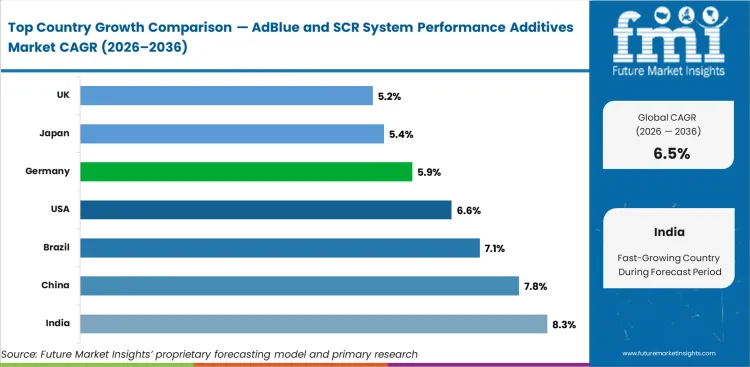
AdBlue and SCR System Performance Additives Market CAGR Analysis by Country
- India is projected to record 8.3% CAGR by 2036 as Bharat Stage VI fleets need more SCR service discipline.
- China is expected to expand at 7.8% CAGR by 2036 as heavy truck volume and National VI aftertreatment needs support service demand.
- Brazil is forecast to grow at 7.1% CAGR by 2036 as ARLA 32 use supports diesel freight compliance.
- United States is expected to advance at 6.6% CAGR by 2036 as heavy-duty standards sustain the frequent need for SCR maintenance.
- Germany is projected to rise at 5.9% CAGR by 2036 through dense freight activity and strict AdBlue quality checks.
- Japan is forecast at 5.4% CAGR by 2036 as careful service practice favors documented SCR treatments.
- United Kingdom is expected to post 5.2% CAGR by 2036 as diesel HGVs continue to dominate road freight.
Country performance differs by diesel fleet scale and regulatory timing. India, China, and Brazil track above the global rate as commercial vehicle growth and diesel freight reliance stay high. United States stays near the global line as standards tighten across new vehicles. Germany, Japan, and United Kingdom show measured expansion as workshop discipline is already more established.
Demand Outlook for AdBlue and SCR System Performance Additives in India
Industry in India is projected to record an 8.3% CAGR by 2036 as commercial vehicle growth creates more SCR service occasions. OICA’s April 2026 update recorded over 1 million trucks and buses sold in fiscal year 2025 to 2026. Domestic fleet operators are likely to prefer additive products with clear dosing guidance and local workshop training.
- Bharat Stage VI fleets can use anti-crystal products as part of preventive SCR service planning.
- Transport operators are expected to standardize AdBlue storage practices to avoid contamination and dosing faults.
- Local distributors can build repeat demand through fleet-size packs and mechanic training.
Sales Analysis of AdBlue and SCR System Performance Additives in China
Sales in China are expected to expand at 7.8% CAGR by 2036 as heavy truck volume and strict aftertreatment rules support service need. OICA reported China produced 34.53 million vehicles in 2025 and added roughly 3.25 million units over the previous year. Large diesel fleets create recurring demand for fluid handling and SCR component care.
- Truck workshops can use deposit control treatments around dosing modules during scheduled service.
- Fleet owners are expected to screen additives against China VI compliance and OEM warranty guidance.
- Regional producers with large pack formats can serve logistics fleets and construction equipment users.
Future Outlook for AdBlue and SCR System Performance Additives in Brazil
The market in Brazil is forecast to grow at 7.1% CAGR by 2036 as freight diesel use promotes ARLA 32 and SCR service routines. OICA reported Brazilian vehicle output reached 2.64 million units in 2025. Commercial vehicle service centers are likely to use anti-crystal products for high-temperature and long-haul operation.
- ARLA 32 distributors can attach SCR cleaning products to refill programs serving logistics routes.
- Repair workshops are expected to prefer additives with simple instructions and clear system compatibility.
- Agricultural and construction equipment users create service demand beyond highway trucks.
Opportunity Analysis of AdBlue and SCR System Performance Additives in United States
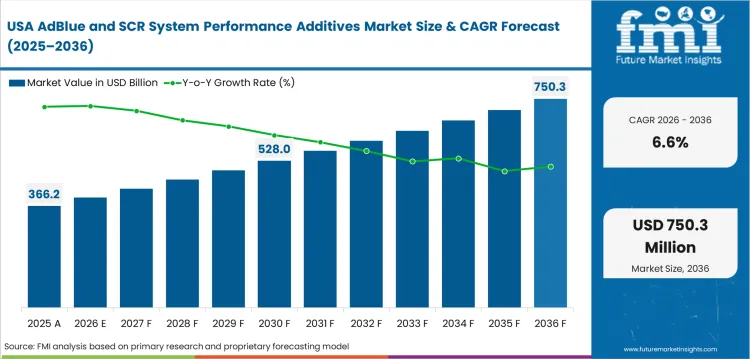
Demand in the United States is expected to advance at 6.6% CAGR by 2036 as heavy-duty emission rules keep SCR maintenance important. OICA reported United States vehicle sales of 16.7 million units in 2025. Long-distance trucking and diesel vocational fleets should support direct fleet supply for documented products.
- Large fleets can use additive programs to reduce avoidable DEF system repair events.
- Retail channels will remain useful for owner-operators needing small bottle formats.
- EPA heavy-duty rules keep compliance pressure visible for trucks entering model year 2027 onward.
Demand Outlook for AdBlue and SCR System Performance Additives in Germany
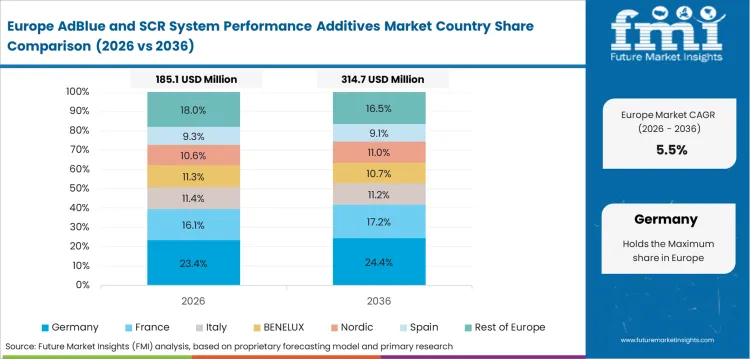
Sector in Germany is projected to rise at 5.9% CAGR by 2036 through dense freight activity and strict fluid handling practice. ACEA reported diesel trucks accounted for 92.4% of new EU registrations in the first quarter of 2026. German workshops should favor products tied to quality documentation and controlled dosing.
- Certified AdBlue supply supports clearer trust in additive programs tied to service routines.
- Fleet workshops can use SCR cleaners during inspections before replacing pumps or injectors.
- Cold-weather operation creates a steady case for crystallization prevention in dosing lines.
In-depth Analysis of AdBlue and SCR System Performance Additives in Japan
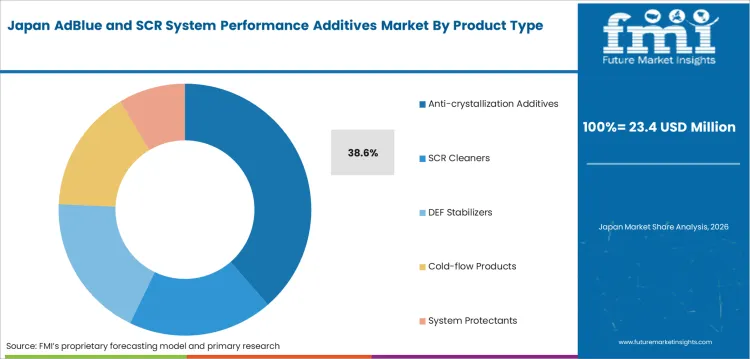
Industry growth in Japan is forecast at 5.4% CAGR by 2036 as careful maintenance practice supports selective additive use. OICA reported Japan produced 8.41 million vehicles in 2025. Operators are expected to use SCR performance additives mainly through trusted workshops and branded distributors.
- Truck and bus operators can favor low-risk products with clean labeling and dosing records.
- Service centers are expected to avoid poorly documented additives that may affect SCR warranties.
- Supplier advantage comes from consistent batch control and training for workshop technicians.
Demand Analysis of AdBlue and SCR System Performance Additives in United Kingdom
Demand in the United Kingdom is expected to post 5.2% CAGR by 2036 as diesel HGVs continue to dominate freight. Department for Transport recorded over 495,000 licensed HGVs at the end of 2024. Fleet managers are expected to use additives only after clear workshop guidance and supplier accountability.
- Road freight users can apply anti-crystal products in scheduled maintenance for high-mileage HGVs.
- Independent workshops remain important for diesel vans moving through local repair channels.
- Direct fleet supply suits operators needing repeat orders and staff instructions across depots.
Competitive Landscape and Strategic Positioning
- AdBlue producers hold an advantage through certified fluid access and established fleet relationships.
- Aftermarket additive brands compete through anti-crystal claims and workshop visibility.
- Distributors gain ground by combining AdBlue storage and add-on treatment availability.
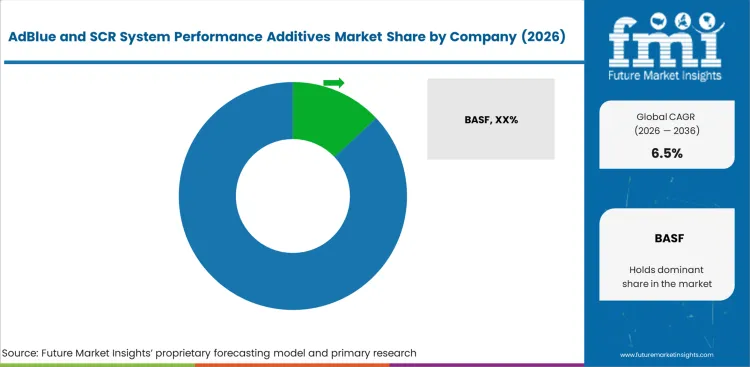
Competition in the AdBlue and SCR system performance additives market is driven by trust and service reach. Fleet managers compare products based on AdBlue compatibility and the risk of warranty questions around SCR hardware. BASF and Yara benefit from established AdBlue supply positions. Brenntag and GreenChem add value through distribution strength and regional supply coverage. Additive specialists such as Rislone and Wynn’s address workshop demand through smaller treatment packs suited to routine service visits.
Adjacent hardware markets explain why additive brands need clear technical proof. Urea tanks and diesel power engines keep SCR service aligned to the broader diesel emissions chain. Automotive exhaust systems and emission control catalysts show how fleets judge maintenance value against downtime risk and component replacement cost. Suppliers cannot position additives as simple chemical add-ons. Brands with certified fluid access and broad workshop reach can win repeat fleet accounts.
Key Companies in the AdBlue and SCR System Performance Additives Market
Competition structure is shown by role as fluid producers and aftermarket treatment brands serve different service needs.
- Certified Fluid Producers: BASF and Yara support large fleet accounts through AdBlue supply credibility and low-carbon product development.
- Distribution Specialists: Brenntag and GreenChem support regional access through certified sites and AdBlue-focused networks.
- Aftermarket Treatment Brands: Rislone, Wynn’s, and Liqui Moly serve workshops through anti-crystal and SCR cleaner products.
Competitive Benchmarking: AdBlue and SCR System Performance Additives Market
| Company | AdBlue Access | Anti-Crystal Range | Fleet Service Reach | Geographic Footprint |
|---|---|---|---|---|
| BASF | High | Medium | Strong | Europe and global chemical channels |
| Yara | High | Medium | Strong | Europe, North America, Asia and South America |
| Brenntag | High | Medium | Strong | Global distribution with Asia Pacific expansion |
| GreenChem | High | Medium | Strong | Europe and Adriatic regional reach |
| Rislone | Medium | High | Medium | North America and retail channels |
| Wynn’s | Medium | High | Medium | European workshop and retail channels |
| Liqui Moly | Medium | High | Medium | Europe and export aftermarket reach |
| CYCLON | Medium | Low | Medium | Greece and regional channels |
| Ceroil | Low | Medium | Low | United Kingdom online aftermarket |
Source: Future Market Insights competitive analysis, 2026. Ratings reflect relative positioning based on certified fluid access, anti-crystal range, and fleet service reach.
Key Developments in AdBlue and SCR System Performance Additives Market
- In March 2024, BASF launched AdBlue ZeroPCF as a reduced product carbon footprint diesel exhaust fluid.
- In February 2025, GreenChem acquired Adeco Blue to strengthen its AdBlue supply position in Serbia and the Adriatic region.
- In March 2026, Brenntag opened its first VDA-certified AdBlue production site in Asia Pacific at Samut Prakan, Thailand.
Key Players in the AdBlue and SCR System Performance Additives Market
Major Global Players:
- BASF SE
- Yara International ASA
- Brenntag SE
- GreenChem Holding B.V.
- Rislone
- Wynn’s
- Liqui Moly GmbH
Specialist and Regional Players:
- CYCLON Lubricants
- Ceroil Products
- Fertiberia
- Stockmeier Group
- EverBlue Chemical
- PROTICKS
- Powerflow Protect
Report Scope and Coverage
| Parameter | Details |
|---|---|
| Quantitative Units | USD 0.8 billion to USD 1.4 billion, at 6.5% CAGR |
| Market Definition | Additives and treatment products sold for AdBlue and SCR system performance care. |
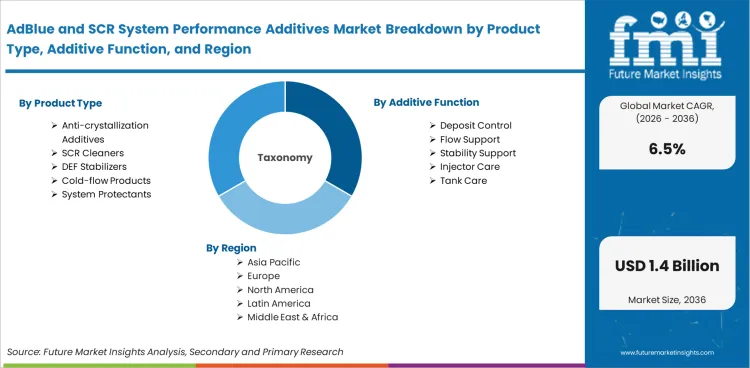
| Product Type | Anti-crystallization additives, SCR cleaners, DEF stabilizers, cold-flow products, system protectants. |
| Additive Function | Deposit control, flow support, stability support, injector care, tank care. |
| Vehicle Class | Heavy commercial vehicles, light commercial vehicles, passenger diesel cars, off-road machinery, marine engines. |
| SCR Component | DEF tank and dosing module, injector nozzle, supply line, SCR catalyst zone, NOx sensor zone. |
| End User | Fleet maintenance, independent workshops, retail consumers, fuel retailers, OEM service centers. |
| Sales Channel | Direct fleet supply, distributors, retail stores, online channels, fuel station channels. |
| Regions Covered | North America, Latin America, Western Europe, Eastern Europe, East Asia, South Asia and Pacific, Middle East and Africa. |
| Countries Covered | United States, China, India, Germany, Brazil, Japan, United Kingdom, and other countries. |
| Key Companies Profiled | BASF, Yara, Brenntag, GreenChem, Rislone, Wynn’s, Liqui Moly, CYCLON, Ceroil. |
| Forecast Period | 2026 to 2036 |
| Approach | Hybrid top-down and bottom-up model using diesel fleet exposure, SCR service need, additive attach rate, sales channel mix, and supplier validation. |
Source: Future Market Insights, 2026.
AdBlue and SCR System Performance Additives Market Breakdown by Product Type, Additive Function, Vehicle Class, SCR Component, End User, Sales Channel, and Region
AdBlue and SCR System Performance Additives Market Segmented by Product Type:
- Anti-crystallization Additives
- SCR Cleaners
- DEF Stabilizers
- Cold-flow Products
- System Protectants
AdBlue and SCR System Performance Additives Market Segmented by Additive Function:
- Deposit Control
- Flow Support
- Stability Support
- Injector Care
- Tank Care
AdBlue and SCR System Performance Additives Market Segmented by Vehicle Class:
- Heavy Commercial
- Light Commercial
- Passenger Diesel
- Off-road Machinery
- Marine Engines
AdBlue and SCR System Performance Additives Market Segmented by SCR Component:
- DEF Tank
- Dosing Module
- Injector Nozzle
- Supply Line
- Catalyst Zone
- NOx Sensor
AdBlue and SCR System Performance Additives Market Segmented by End User:
- Fleet Maintenance
- Independent Workshops
- Retail Consumers
- Fuel Retailers
- OEM Service
AdBlue and SCR System Performance Additives Market Segmented by Sales Channel:
- Direct Fleet
- Distributors
- Retail Stores
- Online Channels
- Fuel Stations
AdBlue and SCR System Performance Additives Market by Region:
- North America
- United States
- Canada
- Mexico
- Latin America
- Brazil
- Argentina
- Western Europe
- Germany
- United Kingdom
- France
- Italy
- Eastern Europe
- Poland
- Romania
- East Asia
- China
- Japan
- South Korea
- South Asia and Pacific
- India
- ASEAN
- Australia and New Zealand
- Middle East and Africa
- Saudi Arabia
- United Arab Emirates
- South Africa
Research Sources and Bibliography
- American Transportation Research Institute. (2025, July). An analysis of the operational costs of trucking: 2025 update.
- BASF SE. (2024, March 26). AdBlue® ZeroPCF by BASF is launched on the market as the first AdBlue® product with reduced carbon footprint.
- Brenntag SE. (2026, March 24). First VDA-certified AdBlue site in Asia Pacific.
- Council of the European Union. (2024, April 12). Euro 7: Council adopts new rules on emission limits for cars, vans and trucks.
- Department for Transport, & Office for Zero Emission Vehicles. (2026, January 6). New HGV CO₂ emissions regulatory framework for the UK. GOV.UK.
- European Automobile Manufacturers’ Association. (2026, April 29). New commercial vehicle registrations: Vans +2.3%, trucks +10.7%, buses +24.5% in Q1 2026.
- GreenChem Holding B.V. (2025, February 1). GreenChem’s new subsidiary in Serbia.
- International Organization of Motor Vehicle Manufacturers. (2026, April 23). Auto industry growth shifted east in 2025 amid global repositioning.
- Kurp, R. D. (2025). Urea based diesel exhaust fluid with additive (European Patent No. EP4259911B1). European Patent Office.
- MOTUL. (2026, January 30). Reduce nitrogen oxides without risks: MOTUL CRYSTAL PROTECT AdBlue® additive protects modern passenger car diesel engines.
- TUNAP. (2026, April 30). 987 System Agent SCR [Product information].
- USA Bureau of Labor Statistics. (2026, May 13). Producer Price Index by Industry: Industrial Machinery Manufacturing [Data set]. Federal Reserve Bank of St. Louis.
- USA Environmental Protection Agency. (2024, March 29). Final Rule: Greenhouse Gas Emissions Standards for Heavy-Duty Vehicles - Phase 3
- Yara International ASA. (2025, October 6). Marking 20 years of AdBlue® and cleaner air.
Bibliography uses government sources, official company evidence, and non-commercial automotive data relevant to AdBlue and SCR system performance additives.
This Report Answers
- What is the current and future size of the AdBlue and SCR system performance additives market?
- How fast is the AdBlue and SCR system performance additives market expected to expand between 2026 and 2036?
- Which sales channel is expected to account for the leading AdBlue and SCR system performance additives share in 2026?
- Which vehicle class is projected to account for the leading AdBlue and SCR system performance additives share in 2026?
- Why are anti-crystallization additives important for AdBlue and SCR system performance additives demand?
- How does deposit control support AdBlue and SCR system performance additives adoption?
- Which countries are projected to record faster expansion during the forecast period?
- Who are the main companies active in AdBlue and SCR system performance additives supply?
- How does FMI define the AdBlue and SCR system performance additives market scope?
- How does FMI estimate and validate the AdBlue and SCR system performance additives forecast?
Frequently Asked Questions
What is the global market demand for AdBlue and SCR system performance additives in 2026?
In 2026, AdBlue and SCR system performance additives market value is expected to cross USD 0.8 billion as fleet workshops widen preventive SCR service.
How big will the AdBlue and SCR system performance additives market be in 2036?
By 2036, the industry is anticipated to reach USD 1.4 billion as diesel aftertreatment maintenance needs expand across fleet channels and workshop service programs.
How much is demand for AdBlue and SCR system performance additives expected to expand between 2026 and 2036?
Between 2026 and 2036, the sector is projected to expand at 6.5% CAGR as anti-crystal treatments enter fleet service routines and planned maintenance schedules.
Which sales channel is expected to lead AdBlue and SCR system performance additives demand in 2026?
Direct fleet supply is projected to represent 58.4% share in 2026 as large operators need product guidance and repeat supply across depots.
Which vehicle class is expected to lead AdBlue and SCR system performance additives demand in 2026?
Heavy commercial vehicles are projected to account for 53.6% share in 2026 as higher AdBlue use raises SCR service need for long duty cycles.
Which country is forecast to grow faster in the AdBlue and SCR system performance additives market?
India is projected to record 8.3% CAGR by 2036 as commercial vehicle growth raises SCR maintenance and AdBlue service needs for fleets.
What does the AdBlue and SCR system performance additives market include?
Scope includes anti-crystal additives, SCR cleaners, DEF stabilizers, tank cleaners, and dosing system protectants sold as performance treatments for SCR care.
How does FMI estimate the AdBlue and SCR system performance additives market forecast?
FMI uses diesel fleet exposure, SCR service incidence, additive attach rates, sales channel checks, and supplier evidence to validate forecasts across regions.
Why is deposit control important in AdBlue and SCR system performance additives?
Deposit control reduces crystallized urea buildup around dosing parts and lowers avoidable warning lights and service delays for fleet operators during operations.
Who uses AdBlue and SCR system performance additives?
Main users include fleet workshops and independent repair centers. Fuel retailers and owner-operated diesel vehicle users complete the demand pool.
Preview the report firsthand - request a free sample
Get SampleGet the brochure for pricing and purchase details.
Get PDFTable of Content
- Executive Summary
- Global Market Outlook
- Demand-side Trends
- Supply-side Trends
- Technology Roadmap Analysis
- Analysis and Recommendations
- Market Overview
- Market Coverage / Taxonomy
- Market Definition / Scope / Limitations
- Research Methodology
- Chapter Orientation
- Analytical Lens and Working Hypotheses
- Market Structure, Signals, and Trend Drivers
- Benchmarking and Cross-market Comparability
- Market Sizing, Forecasting, and Opportunity Mapping
- Research Design and Evidence Framework
- Desk Research Programme (Secondary Evidence)
- Company Annual and Sustainability Reports
- Peer-reviewed Journals and Academic Literature
- Corporate Websites, Product Literature, and Technical Notes
- Earnings Decks and Investor Briefings
- Statutory Filings and Regulatory Disclosures
- Technical White Papers and Standards Notes
- Trade Journals, Industry Magazines, and Analyst Briefs
- Conference Proceedings, Webinars, and Seminar Materials
- Government Statistics Portals and Public Data Releases
- Press Releases and Reputable Media Coverage
- Specialist Newsletters and Curated Briefings
- Sector Databases and Reference Repositories
- FMI Internal Proprietary Databases and Historical Market Datasets
- Subscription Datasets and Paid Sources
- Social Channels, Communities, and Digital Listening Inputs
- Additional Desk Sources
- Expert Input and Fieldwork (Primary Evidence)
- Primary Modes
- Qualitative Interviews and Expert Elicitation
- Quantitative Surveys and Structured Data Capture
- Blended Approach
- Why Primary Evidence is Used
- Field Techniques
- Interviews
- Surveys
- Focus Groups
- Observational and In-context Research
- Social and Community Interactions
- Stakeholder Universe Engaged
- C-suite Leaders
- Board Members
- Presidents and Vice Presidents
- R&D and Innovation Heads
- Technical Specialists
- Domain Subject-matter Experts
- Scientists
- Physicians and Other Healthcare Professionals
- Governance, Ethics, and Data Stewardship
- Research Ethics
- Data Integrity and Handling
- Primary Modes
- Tooling, Models, and Reference Databases
- Desk Research Programme (Secondary Evidence)
- Data Engineering and Model Build
- Data Acquisition and Ingestion
- Cleaning, Normalisation, and Verification
- Synthesis, Triangulation, and Analysis
- Quality Assurance and Audit Trail
- Market Background
- Market Dynamics
- Drivers
- Restraints
- Opportunity
- Trends
- Scenario Forecast
- Demand in Optimistic Scenario
- Demand in Likely Scenario
- Demand in Conservative Scenario
- Opportunity Map Analysis
- Product Life Cycle Analysis
- Supply Chain Analysis
- Investment Feasibility Matrix
- Value Chain Analysis
- PESTLE and Porter’s Analysis
- Regulatory Landscape
- Regional Parent Market Outlook
- Production and Consumption Statistics
- Import and Export Statistics
- Market Dynamics
- Global Market Analysis 2021 to 2025 and Forecast, 2026 to 2036
- Historical Market Size Value (USD Million) Analysis, 2021 to 2025
- Current and Future Market Size Value (USD Million) Projections, 2026 to 2036
- Y-o-Y Growth Trend Analysis
- Absolute $ Opportunity Analysis
- Global Market Pricing Analysis 2021 to 2025 and Forecast 2026 to 2036
- Global Market Analysis 2021 to 2025 and Forecast 2026 to 2036, By Product Type
- Introduction / Key Findings
- Historical Market Size Value (USD Million) Analysis By Product Type , 2021 to 2025
- Current and Future Market Size Value (USD Million) Analysis and Forecast By Product Type , 2026 to 2036
- Pump Modules
- Injector Nozzles
- Dosing Valves
- Repair Kits
- Pump Modules
- Y-o-Y Growth Trend Analysis By Product Type , 2021 to 2025
- Absolute $ Opportunity Analysis By Product Type , 2026 to 2036
- Global Market Analysis 2021 to 2025 and Forecast 2026 to 2036, By Vehicle Type
- Introduction / Key Findings
- Historical Market Size Value (USD Million) Analysis By Vehicle Type, 2021 to 2025
- Current and Future Market Size Value (USD Million) Analysis and Forecast By Vehicle Type, 2026 to 2036
- Heavy Trucks
- Light Commercial Vehicles
- Passenger Cars
- Buses
- Off-highway Equipment
- Heavy Trucks
- Y-o-Y Growth Trend Analysis By Vehicle Type, 2021 to 2025
- Absolute $ Opportunity Analysis By Vehicle Type, 2026 to 2036
- Global Market Analysis 2021 to 2025 and Forecast 2026 to 2036, By Sales Channel
- Introduction / Key Findings
- Historical Market Size Value (USD Million) Analysis By Sales Channel, 2021 to 2025
- Current and Future Market Size Value (USD Million) Analysis and Forecast By Sales Channel, 2026 to 2036
- Independent Aftermarket
- Authorized Service
- OEM Dealers
- Online Parts
- Independent Aftermarket
- Y-o-Y Growth Trend Analysis By Sales Channel, 2021 to 2025
- Absolute $ Opportunity Analysis By Sales Channel, 2026 to 2036
- Global Market Analysis 2021 to 2025 and Forecast 2026 to 2036, By Emission Standard
- Introduction / Key Findings
- Historical Market Size Value (USD Million) Analysis By Emission Standard, 2021 to 2025
- Current and Future Market Size Value (USD Million) Analysis and Forecast By Emission Standard, 2026 to 2036
- Euro VI
- Bharat Stage VI
- China VI
- EPA 2010
- Other Standards
- Euro VI
- Y-o-Y Growth Trend Analysis By Emission Standard, 2021 to 2025
- Absolute $ Opportunity Analysis By Emission Standard, 2026 to 2036
- Global Market Analysis 2021 to 2025 and Forecast 2026 to 2036, By Failure Type
- Introduction / Key Findings
- Historical Market Size Value (USD Million) Analysis By Failure Type, 2021 to 2025
- Current and Future Market Size Value (USD Million) Analysis and Forecast By Failure Type, 2026 to 2036
- Crystallization
- Pump Wear
- Injector Clogging
- Electrical Faults
- Freeze Damage
- Crystallization
- Y-o-Y Growth Trend Analysis By Failure Type, 2021 to 2025
- Absolute $ Opportunity Analysis By Failure Type, 2026 to 2036
- Global Market Analysis 2021 to 2025 and Forecast 2026 to 2036, By End User
- Introduction / Key Findings
- Historical Market Size Value (USD Million) Analysis By End User, 2021 to 2025
- Current and Future Market Size Value (USD Million) Analysis and Forecast By End User, 2026 to 2036
- Fleet Workshops
- Dealership Service
- Repair Chains
- Parts Distributors
- Owner Operators
- Fleet Workshops
- Y-o-Y Growth Trend Analysis By End User, 2021 to 2025
- Absolute $ Opportunity Analysis By End User, 2026 to 2036
- Global Market Analysis 2021 to 2025 and Forecast 2026 to 2036, By Region
- Introduction
- Historical Market Size Value (USD Million) Analysis By Region, 2021 to 2025
- Current Market Size Value (USD Million) Analysis and Forecast By Region, 2026 to 2036
- North America
- Latin America
- Western Europe
- Eastern Europe
- East Asia
- South Asia and Pacific
- Middle East & Africa
- Market Attractiveness Analysis By Region
- North America Market Analysis 2021 to 2025 and Forecast 2026 to 2036, By Country
- Historical Market Size Value (USD Million) Trend Analysis By Market Taxonomy, 2021 to 2025
- Market Size Value (USD Million) Forecast By Market Taxonomy, 2026 to 2036
- By Country
- USA
- Canada
- Mexico
- By Product Type
- By Vehicle Type
- By Sales Channel
- By Emission Standard
- By Failure Type
- By End User
- By Country
- Market Attractiveness Analysis
- By Country
- By Product Type
- By Vehicle Type
- By Sales Channel
- By Emission Standard
- By Failure Type
- By End User
- Key Takeaways
- Latin America Market Analysis 2021 to 2025 and Forecast 2026 to 2036, By Country
- Historical Market Size Value (USD Million) Trend Analysis By Market Taxonomy, 2021 to 2025
- Market Size Value (USD Million) Forecast By Market Taxonomy, 2026 to 2036
- By Country
- Brazil
- Chile
- Rest of Latin America
- By Product Type
- By Vehicle Type
- By Sales Channel
- By Emission Standard
- By Failure Type
- By End User
- By Country
- Market Attractiveness Analysis
- By Country
- By Product Type
- By Vehicle Type
- By Sales Channel
- By Emission Standard
- By Failure Type
- By End User
- Key Takeaways
- Western Europe Market Analysis 2021 to 2025 and Forecast 2026 to 2036, By Country
- Historical Market Size Value (USD Million) Trend Analysis By Market Taxonomy, 2021 to 2025
- Market Size Value (USD Million) Forecast By Market Taxonomy, 2026 to 2036
- By Country
- Germany
- UK
- Italy
- Spain
- France
- Nordic
- BENELUX
- Rest of Western Europe
- By Product Type
- By Vehicle Type
- By Sales Channel
- By Emission Standard
- By Failure Type
- By End User
- By Country
- Market Attractiveness Analysis
- By Country
- By Product Type
- By Vehicle Type
- By Sales Channel
- By Emission Standard
- By Failure Type
- By End User
- Key Takeaways
- Eastern Europe Market Analysis 2021 to 2025 and Forecast 2026 to 2036, By Country
- Historical Market Size Value (USD Million) Trend Analysis By Market Taxonomy, 2021 to 2025
- Market Size Value (USD Million) Forecast By Market Taxonomy, 2026 to 2036
- By Country
- Russia
- Poland
- Hungary
- Balkan & Baltic
- Rest of Eastern Europe
- By Product Type
- By Vehicle Type
- By Sales Channel
- By Emission Standard
- By Failure Type
- By End User
- By Country
- Market Attractiveness Analysis
- By Country
- By Product Type
- By Vehicle Type
- By Sales Channel
- By Emission Standard
- By Failure Type
- By End User
- Key Takeaways
- East Asia Market Analysis 2021 to 2025 and Forecast 2026 to 2036, By Country
- Historical Market Size Value (USD Million) Trend Analysis By Market Taxonomy, 2021 to 2025
- Market Size Value (USD Million) Forecast By Market Taxonomy, 2026 to 2036
- By Country
- China
- Japan
- South Korea
- By Product Type
- By Vehicle Type
- By Sales Channel
- By Emission Standard
- By Failure Type
- By End User
- By Country
- Market Attractiveness Analysis
- By Country
- By Product Type
- By Vehicle Type
- By Sales Channel
- By Emission Standard
- By Failure Type
- By End User
- Key Takeaways
- South Asia and Pacific Market Analysis 2021 to 2025 and Forecast 2026 to 2036, By Country
- Historical Market Size Value (USD Million) Trend Analysis By Market Taxonomy, 2021 to 2025
- Market Size Value (USD Million) Forecast By Market Taxonomy, 2026 to 2036
- By Country
- India
- ASEAN
- Australia & New Zealand
- Rest of South Asia and Pacific
- By Product Type
- By Vehicle Type
- By Sales Channel
- By Emission Standard
- By Failure Type
- By End User
- By Country
- Market Attractiveness Analysis
- By Country
- By Product Type
- By Vehicle Type
- By Sales Channel
- By Emission Standard
- By Failure Type
- By End User
- Key Takeaways
- Middle East & Africa Market Analysis 2021 to 2025 and Forecast 2026 to 2036, By Country
- Historical Market Size Value (USD Million) Trend Analysis By Market Taxonomy, 2021 to 2025
- Market Size Value (USD Million) Forecast By Market Taxonomy, 2026 to 2036
- By Country
- Kingdom of Saudi Arabia
- Other GCC Countries
- Turkiye
- South Africa
- Other African Union
- Rest of Middle East & Africa
- By Product Type
- By Vehicle Type
- By Sales Channel
- By Emission Standard
- By Failure Type
- By End User
- By Country
- Market Attractiveness Analysis
- By Country
- By Product Type
- By Vehicle Type
- By Sales Channel
- By Emission Standard
- By Failure Type
- By End User
- Key Takeaways
- Key Countries Market Analysis
- USA
- Pricing Analysis
- Market Share Analysis, 2025
- By Product Type
- By Vehicle Type
- By Sales Channel
- By Emission Standard
- By Failure Type
- By End User
- Canada
- Pricing Analysis
- Market Share Analysis, 2025
- By Product Type
- By Vehicle Type
- By Sales Channel
- By Emission Standard
- By Failure Type
- By End User
- Mexico
- Pricing Analysis
- Market Share Analysis, 2025
- By Product Type
- By Vehicle Type
- By Sales Channel
- By Emission Standard
- By Failure Type
- By End User
- Brazil
- Pricing Analysis
- Market Share Analysis, 2025
- By Product Type
- By Vehicle Type
- By Sales Channel
- By Emission Standard
- By Failure Type
- By End User
- Chile
- Pricing Analysis
- Market Share Analysis, 2025
- By Product Type
- By Vehicle Type
- By Sales Channel
- By Emission Standard
- By Failure Type
- By End User
- Germany
- Pricing Analysis
- Market Share Analysis, 2025
- By Product Type
- By Vehicle Type
- By Sales Channel
- By Emission Standard
- By Failure Type
- By End User
- UK
- Pricing Analysis
- Market Share Analysis, 2025
- By Product Type
- By Vehicle Type
- By Sales Channel
- By Emission Standard
- By Failure Type
- By End User
- Italy
- Pricing Analysis
- Market Share Analysis, 2025
- By Product Type
- By Vehicle Type
- By Sales Channel
- By Emission Standard
- By Failure Type
- By End User
- Spain
- Pricing Analysis
- Market Share Analysis, 2025
- By Product Type
- By Vehicle Type
- By Sales Channel
- By Emission Standard
- By Failure Type
- By End User
- France
- Pricing Analysis
- Market Share Analysis, 2025
- By Product Type
- By Vehicle Type
- By Sales Channel
- By Emission Standard
- By Failure Type
- By End User
- India
- Pricing Analysis
- Market Share Analysis, 2025
- By Product Type
- By Vehicle Type
- By Sales Channel
- By Emission Standard
- By Failure Type
- By End User
- ASEAN
- Pricing Analysis
- Market Share Analysis, 2025
- By Product Type
- By Vehicle Type
- By Sales Channel
- By Emission Standard
- By Failure Type
- By End User
- Australia & New Zealand
- Pricing Analysis
- Market Share Analysis, 2025
- By Product Type
- By Vehicle Type
- By Sales Channel
- By Emission Standard
- By Failure Type
- By End User
- China
- Pricing Analysis
- Market Share Analysis, 2025
- By Product Type
- By Vehicle Type
- By Sales Channel
- By Emission Standard
- By Failure Type
- By End User
- Japan
- Pricing Analysis
- Market Share Analysis, 2025
- By Product Type
- By Vehicle Type
- By Sales Channel
- By Emission Standard
- By Failure Type
- By End User
- South Korea
- Pricing Analysis
- Market Share Analysis, 2025
- By Product Type
- By Vehicle Type
- By Sales Channel
- By Emission Standard
- By Failure Type
- By End User
- Russia
- Pricing Analysis
- Market Share Analysis, 2025
- By Product Type
- By Vehicle Type
- By Sales Channel
- By Emission Standard
- By Failure Type
- By End User
- Poland
- Pricing Analysis
- Market Share Analysis, 2025
- By Product Type
- By Vehicle Type
- By Sales Channel
- By Emission Standard
- By Failure Type
- By End User
- Hungary
- Pricing Analysis
- Market Share Analysis, 2025
- By Product Type
- By Vehicle Type
- By Sales Channel
- By Emission Standard
- By Failure Type
- By End User
- Kingdom of Saudi Arabia
- Pricing Analysis
- Market Share Analysis, 2025
- By Product Type
- By Vehicle Type
- By Sales Channel
- By Emission Standard
- By Failure Type
- By End User
- Turkiye
- Pricing Analysis
- Market Share Analysis, 2025
- By Product Type
- By Vehicle Type
- By Sales Channel
- By Emission Standard
- By Failure Type
- By End User
- South Africa
- Pricing Analysis
- Market Share Analysis, 2025
- By Product Type
- By Vehicle Type
- By Sales Channel
- By Emission Standard
- By Failure Type
- By End User
- USA
- Market Structure Analysis
- Competition Dashboard
- Competition Benchmarking
- Market Share Analysis of Top Players
- By Regional
- By Product Type
- By Vehicle Type
- By Sales Channel
- By Emission Standard
- By Failure Type
- By End User
- Competition Analysis
- Competition Deep Dive
- Bosch
- Overview
- Product Portfolio
- Profitability by Market Segments (Product/Age /Sales Channel/Region)
- Sales Footprint
- Strategy Overview
- Marketing Strategy
- Product Strategy
- Channel Strategy
- PHINIA
- Dinex
- Meat&Doria
- Standard Motor Products
- Schaeffler
- DENSO
- Nissens
- Bosch
- Competition Deep Dive
- Assumptions & Acronyms Used


