

- Market Size (2026)
- USD 0.48 Bn
- Forecast (2036)
- USD 2.04 Bn
- CAGR (2026 to 2036)
- 15.6%
Distributed Electric Propulsion Power Distribution Systems Market Size, Forecast, and Outlook By FMI
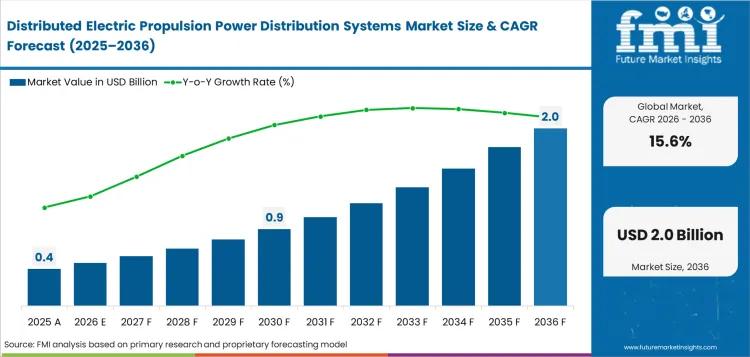
Distributed electric propulsion power distribution systems market was valued at USD 0.42 billion in 2025 and is estimated to reach USD 0.48 billion in 2026. Demand is projected to reach USD 2.04 billion by 2036 at 15.6% CAGR.
Summary of the Distributed Electric Propulsion Power Distribution Systems Market
- Demand and Growth Drivers
- Electric aircraft programs need safer power distribution as propulsion power moves across several electric motors.
- Certification work is pushing aircraft makers to use tested hardware with better fault control and documented safety performance.
- High-voltage aircraft designs need compact systems that can handle heat and keep power flow stable.
- Product and Segment View
- OEM integration has a larger role since aircraft makers prefer electrical systems qualified during the aircraft design stage.
- HVDC bus systems are gaining attention as developers look for lighter wiring across electric propulsion layouts.
- Distribution units are important since they manage switching and fault response inside the aircraft power network.
- Geography and Competitive Outlook
- United States and China lead early demand as aircraft electrification programs move through testing and certification stages. Europe adds demand through hybrid-electric aircraft trials and strict safety qualification needs.
- Suppliers with aerospace power experience can gain better access to electric aircraft programs that need high-voltage system knowledge.
- Analyst Opinion
- Nikhil Kaitwade, Principal Consultant at FMI, says, “Distributed electric propulsion brings aircraft electrical design into focus much earlier in the development cycle. Power distribution hardware must protect the aircraft and control faults across high-voltage propulsion systems during operation. Suppliers with aerospace qualification experience and practical high-voltage knowledge are likely to have better access to aircraft programs.”
- Distributed Electric Propulsion Power Distribution Systems Market Value Analysis
- The distributed electric propulsion power distribution systems market is moving from prototype electrical layouts into a more defined aerospace power systems segment.
- Demand is rising as electric aircraft programs need safer high-voltage power flow across multiple propulsors.
- Aircraft makers are placing higher value on distribution hardware that can manage faults and protect propulsion systems during flight.
- Market value is increasing as OEMs prefer qualified systems that reduce wiring weight and improve electrical safety.
Key Takeaways, Market Size, and Forecast
- The market was valued at USD 0.42 billion in 2025.
- By 2036, market value is estimated to reach USD 2.04 billion as certified aircraft programs need protected high-voltage paths.
- Demand is projected to expand at 15.6% CAGR from 2026 to 2036.
- Market expansion is estimated to create USD 1.56 billion in incremental opportunity between 2026 and 2036.
- OEM integration is anticipated to represent 64.0% share in 2026 led by aircraft manufacturers preferring factory-qualified power distribution hardware.
- United States demand is estimated at 16.8% CAGR through 2036, followed by China at 16.2% CAGR as electric aircraft programs advance.
High-voltage aircraft need power distribution systems that are safe and easy to install. Collins Aerospace reached TRL5 on HECATE after testing a system above 500 kW. This shows that aircraft makers need proof that the full system works before choosing suppliers. NASA’s 2025 fault protection work shows that HVDC fault testing is still a major technical challenge. Suppliers that can test faults early may help aircraft makers lower certification risk. Safran’s 800-volt Cassio 330 wiring work shows that wire harness design must be planned along with power distribution hardware.
Distributed Electric Propulsion Power Distribution Systems Market Definition
Distributed electric propulsion power distribution systems cover hardware and control interfaces used to distribute high-voltage electric power across aircraft with multiple electric propulsors.
Distributed Electric Propulsion Power Distribution Systems Market Inclusions
Scope includes distribution units, power converters, protection modules, contactors, and high-voltage harness assemblies. Revenue scope covers 2026 to 2036 for hardware and integrated power distribution assemblies used in distributed electric propulsion aircraft. Key stakeholders include aircraft OEMs, electric propulsion suppliers, power electronics manufacturers, high-voltage harness suppliers, system integrators and certification authorities.
Distributed Electric Propulsion Power Distribution Systems Market Exclusions
Scope excludes standalone aircraft batteries, electric motors, charging infrastructure and routine propulsion repair services. Maintenance revenue is separately mapped under Distributed Electric Propulsion System MRO Services.
Distributed Electric Propulsion Power Distribution Systems Market Research Methodology
- Primary Research: FMI analysts reviewed aircraft electrical system portfolios, power distribution product pages and advanced air mobility certification sources.
- Desk Research: NASA, FAA, EASA, company pages, and public technical sources were used for technology checks.
- Market Sizing and Forecasting: Market value was built through a hybrid aircraft-platform and component-value model.
- Data Validation: Forecast checks compared power electronics adoption, aircraft electrification programs and verified company participation.
Why is the Distributed Electric Propulsion Power Distribution Systems Market Expanding?
- Electric aircraft designs need high-voltage distribution units with fault protection and steady power control during flight.
- Powered-lift certification raises the need for documented safety evidence across flight-critical electrical systems.
- Megawatt-class propulsion testing increases focus on power density and heat control inside aircraft electrical systems.
- Voltage and current monitoring are becoming part of system protection as electric aircraft carry higher propulsion loads.
FAA’s powered-lift rule covers aircraft with airplane and helicopter characteristics. It improves planning for eVTOL aircraft used in air taxi and cargo operations. EASA’s updated SC-VTOL guidance gives European aircraft developers a more structured certification path.
NASA’s electrified propulsion work explains why aircraft electrical systems need more testing before commercial use. Its NEAT facility is used for megawatt-class powertrain research and power quality testing. Power distribution hardware plays a central role as electric propulsion systems move closer to aircraft qualification.
Market Segmentation Analysis
- OEM integration holds 64.0% for 2026, reflecting aircraft program preference for factory-qualified distribution hardware.
- HVDC bus architecture reaches 48.0% during 2026 through lighter wiring needs across distributed propulsion layouts.
- eVTOL aircraft represent 46.0% for the base year, as multiple propulsors require protected power paths.
- In 2026, 250 kW to 1 MW systems hold 44.0% through demonstrator aircraft entering qualification planning.
- Distribution units capture 42.0% for 2026 due to switching and isolation needs inside electric propulsion systems.
Distributed electric propulsion power distribution systems market is divided into five primary segment groups based on system design and aircraft use. Component type includes distribution units, power converters, protection modules, contactors, and harness assemblies. Voltage architecture includes HVDC bus, AC distribution, hybrid bus, and multi-bus systems. Aircraft platform includes eVTOL aircraft, hybrid regional aircraft, unmanned aircraft, and general aviation aircraft. Power rating includes below 250 kW, 250 kW to 1 MW, and above 1 MW. Installation type includes OEM integration, retrofit programs, and testbed programs.
Insights into Distributed Electric Propulsion Power Distribution Systems Market by Component Type
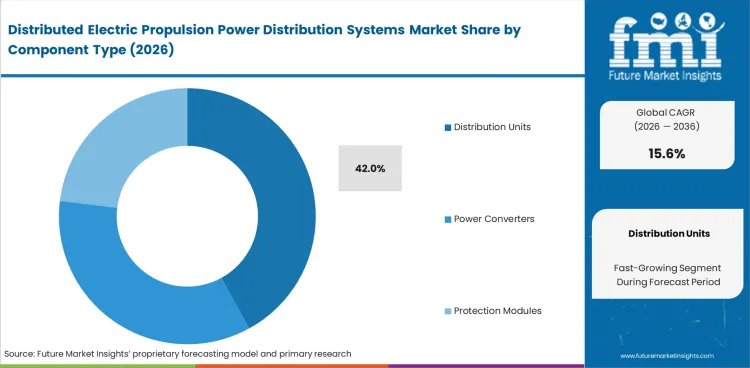
- Distribution units stand at 42.0% for 2026, mainly for centralized switching and protected load control.
- Power converters and protection modules help stabilize voltage and improve fault response in electric propulsion systems.
Insights into Distributed Electric Propulsion Power Distribution Systems Market by Voltage Architecture
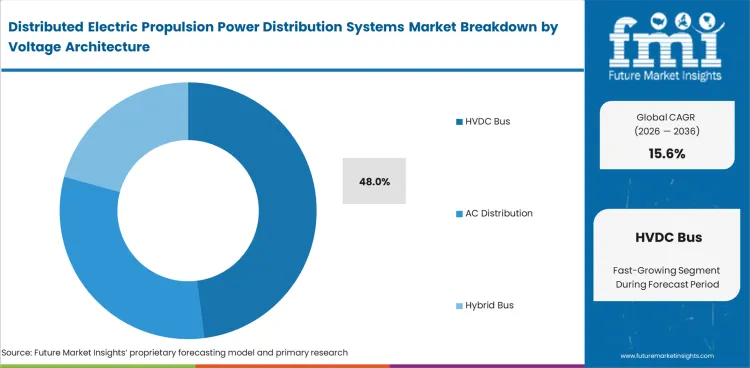
- HVDC bus systems lead the base estimate at 48.0% aided by lower cable weight across propulsion layouts.
- Hybrid bus systems suit aircraft designs combining conventional generation and electric propulsion assistance during early planning.
Insights into Distributed Electric Propulsion Power Distribution Systems Market by Aircraft Platform
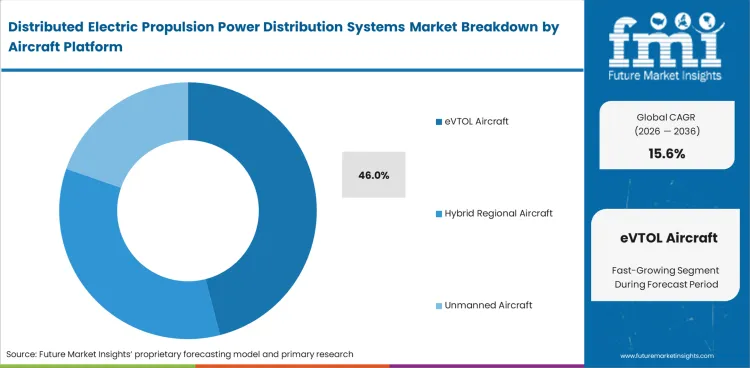
- eVTOL aircraft are assessed at 46.0% for the base year, as several propulsors need protected power delivery.
- Hybrid regional aircraft need larger distribution hardware as propulsion power rises toward megawatt-class aircraft systems.
Insights into Distributed Electric Propulsion Power Distribution Systems Market by Power Rating
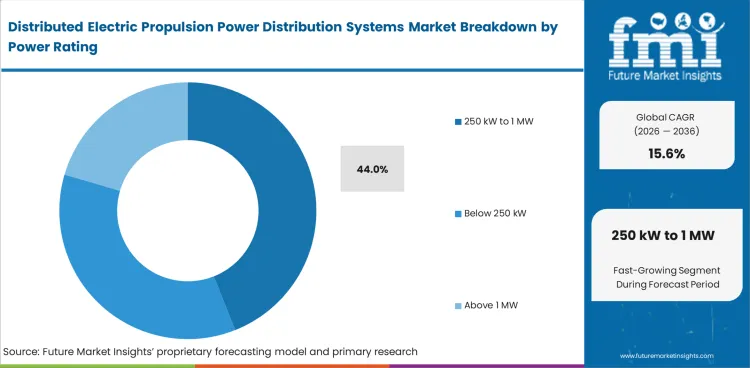
- Systems rated 250 kW to 1 MW represent 44.0% in the year 2026, reflecting modular channels in demonstrator aircraft.
- Above 1 MW systems draw attention as regional aircraft concepts need higher power density and better heat control.
Insights into Distributed Electric Propulsion Power Distribution Systems Market by Installation Type
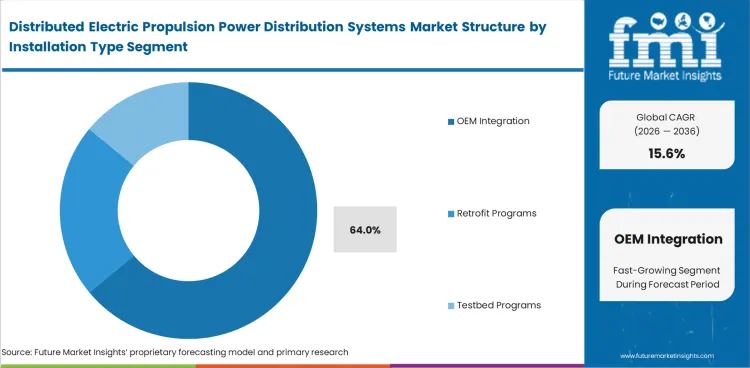
- OEM integration captures 64.0% in 2026, reflecting aircraft certification preference for factory-built electrical architecture.
- Testbed programs create early demand as developers validate power quality and fault behavior before aircraft certification.
Distributed Electric Propulsion Power Distribution Systems Market Drivers, Restraints, and Opportunities
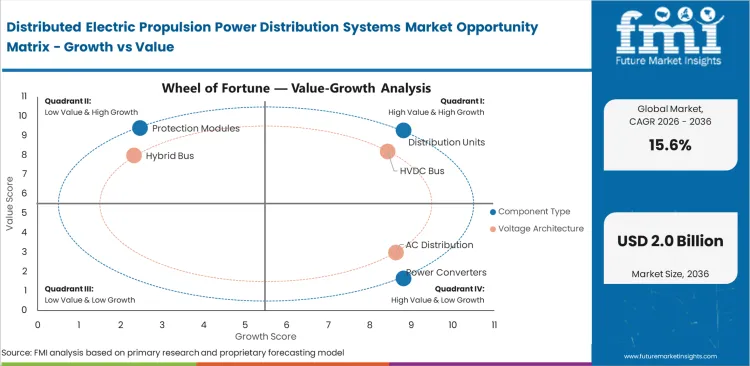
- High-voltage aircraft designs are creating demand for compact distribution units that can isolate faults and control power flow.
- Certification cost can slow adoption since each electrical architecture needs proof for safety and failure behavior.
- Silicon carbide and solid-state protection can create lighter power electronics for future electric aircraft programs.
- Adjacent demand in aerospace avionics raises the need for stable aircraft electrical performance.
High-voltage aircraft architecture
Collins Aerospace completed prototype work on a solid-state power controller and distribution panel for the SWITCH hybrid-electric project. This work is relevant to distributed electric propulsion since future aircraft need compact hardware for high-voltage power movement and fault control.
Certification and validation constraint
Distributed electric propulsion systems need proof across power quality and fault behavior before aircraft programs move closer to certification. NASA research identifies HVDC fault verification as a key need for future aviation power systems. FAA special conditions for Safran electric engines mention high-voltage systems used as the primary propulsion source for an aircraft.
Analysis of Distributed Electric Propulsion Power Distribution Systems Market by Key Countries
.webp "Top Country Growth Comparison Distributed Electric Propulsion Power Distribution Systems Market Cagr (2026 2036)")
| Country | CAGR |
|---|---|
| United States | 16.8% |
| China | 16.2% |
| UAE | 15.9% |
| United Kingdom | 15.4% |
| India | 15.1% |
| Germany | 14.8% |
| Japan | 14.5% |
Source: Future Market Insights, 2026.
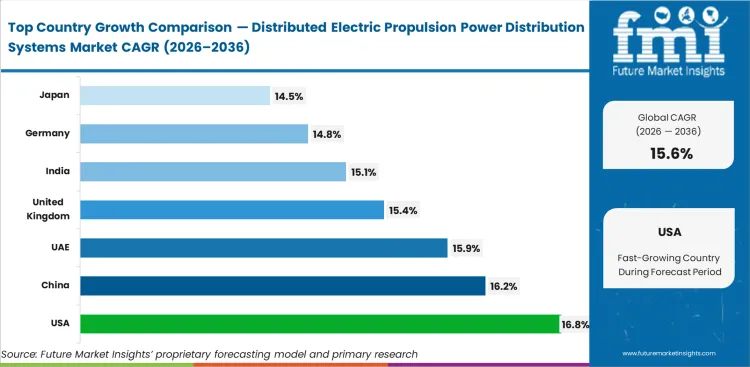
Distributed Electric Propulsion Power Distribution Systems Market CAGR Analysis by Country
- The United States is estimated to lead with 16.8% CAGR from 2026 to 2036.
- China reaches 16.2% CAGR during the assessment period, helped by large aviation activity.
- UAE air mobility planning places the country at 15.9% CAGR by the assessment period.
- Between 2026 and 2036, the United Kingdom records 15.4% CAGR through aerospace R&D investment.
- Through 2036, India is assessed at 15.1% CAGR, helped by airport expansion.
- Germany is expected to reach 14.8% CAGR during the forecast period, backed by aerospace turnover.
- Japan records 14.5% CAGR by 2036 through advanced air mobility planning and phased commercial operation targets.
Outlook for Distributed Electric Propulsion Power Distribution Systems Market in the United States
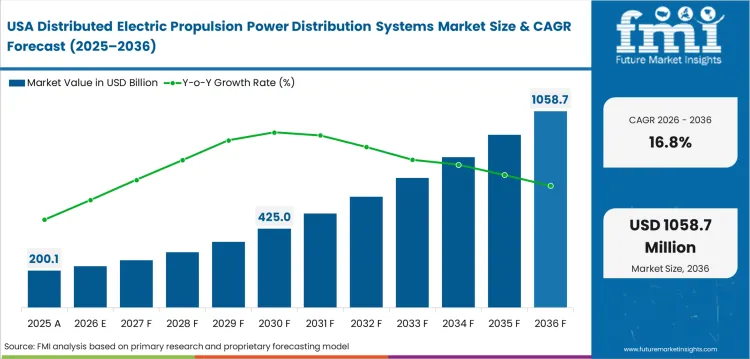
The United States is likely to lead the 2026 to 2036 outlook at 16.8% CAGR helped by electric aircraft testing and advanced aerospace engineering activity. Aircraft developers need high-voltage systems that can manage safer power movement across multiple propulsion points. Supplier value will come from qualified hardware and reliable fault control. Early design-stage involvement will also support supplier selection.
- Electric aircraft testing raises use of high-voltage distribution units.
- Aerospace engineering depth helps suppliers enter early aircraft programs.
- Fault control performance will influence supplier selection during platform planning.
Sales Analysis of Distributed Electric Propulsion Power Distribution Systems Market in China
Civil aviation carried 770 million passengers in 2025, up 5.5% from the prior year. China is likely to grow at 16.2% CAGR in the forecast period. Cargo and mail volume reached 10.17 million tonnes, rising 13.3% year over year. This aviation scale creates a useful base for electric aircraft systems and high-voltage power electronics.
- Domestic aircraft activity increases the need for compact power distribution hardware.
- Power electronics manufacturing can help local suppliers reduce system cost.
- Hybrid propulsion concepts need safer layouts for higher electrical loads.
Opportunity Analysis of Distributed Electric Propulsion Power Distribution Systems Market in the UAE
Advanced aviation planning is expected to place the UAE at 15.9% CAGR through 2036. UAE authorities began air corridor mapping for air taxis and cargo drones in 2025. The same plan targets aerial corridor and regulation definition within 20 months. Early airspace planning can create pilot-scale openings for certified electric aircraft power systems.
- Air taxi corridors increase the need for approved aircraft electrical systems.
- Airport and city planning raise interest in safer high-voltage architecture.
- Service readiness will affect supplier selection during early operations.
Outlook for Distributed Electric Propulsion Power Distribution Systems Market in the United Kingdom
UK aerospace turnover stood at £34 billion in 2024. Business R&D spending reached £1.9 billion, which gives electric aircraft programs a stronger innovation base. The United Kingdom is forecast to reach 15.4% CAGR between 2026 and 2036. Power distribution suppliers can benefit from local engineering depth and future aircraft technology investment.
- Aerospace R&D spending helps qualified electrical systems enter early programs.
- eVTOL testing increases use of protected power paths across propulsors.
- Certification planning raises the need for documented safety evidence.
Sales Outlook for Distributed Electric Propulsion Power Distribution Systems Market in India
India’s market is anticipated to grow at 15.1% CAGR through 2036. India’s airport count rose from 74 in 2014 to 163 in 2025. The national vision targets 350 to 400 airports by 2047. Aviation network expansion gives the country a long-term base for electric aircraft trials and related power systems.
- Airport expansion can create future use cases for electric aircraft systems.
- Local manufacturing plans require cost-aware high-voltage distribution designs.
- Aircraft developer partnerships can help suppliers enter platform planning.
Future Outlook for Distributed Electric Propulsion Power Distribution Systems Market in Germany
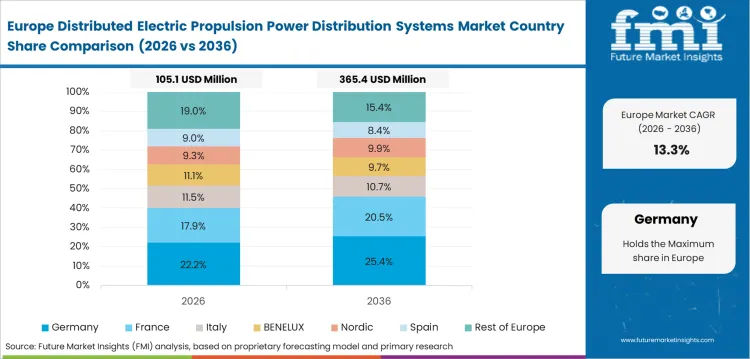
Hybrid-electric aircraft work is expected to grow Germany at 14.8% CAGR during the forecast period. German aerospace turnover reached €52 billion in 2024, rising 13% from the prior year. Civil aviation accounted for €39 billion, which points to a strong base for aircraft electrical suppliers. Power distribution hardware will need strict validation before wider use in flight programs.
- Hybrid-electric aircraft work increases use of high-voltage power control hardware.
- Aerospace quality standards raise the need for tested switching systems.
- Supplier selection will rely on qualification records and integration skill.
Demand Outlook for Distributed Electric Propulsion Power Distribution Systems Market in Japan
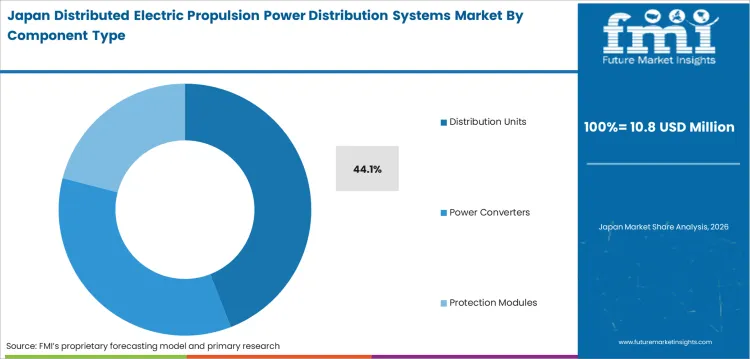
Japan is forecast to grow at 14.5% CAGR by 2036 through advanced air mobility planning. METI revised Japan’s AAM roadmap in March 2026 after the twelfth public-private committee meeting. The roadmap targets commercial AAM operations in selected regions between 2027 and 2028. This phased plan gives power electronics suppliers a clearer planning base for aircraft electrification work.
- Electronics manufacturing depth creates a base for aircraft power components.
- Aviation safety requirements raise use of reliable fault protection hardware.
- Precision component suppliers can serve electric propulsion programs through tested subassemblies.
Competitive Landscape and Strategic Positioning
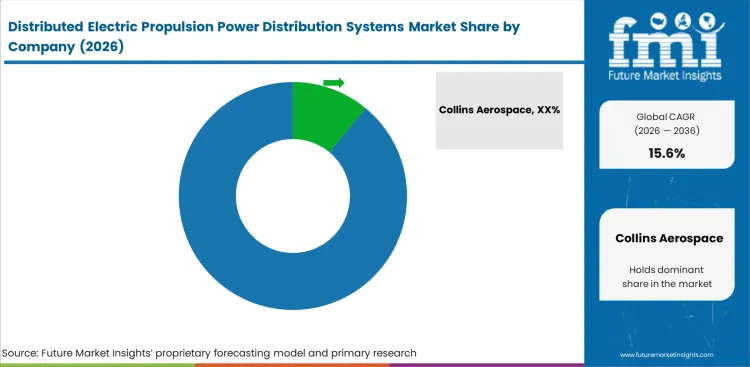
- Competition centers on aerospace qualification and high-voltage power system depth.
- Suppliers with proven aircraft power distribution portfolios have better access to early electric aircraft programs.
- Program selection favors companies that can manage safety needs and fault response requirements.
Competitive strength in this market depends on certified aircraft electrical experience and safe high-voltage system integration. Collins Aerospace is estimated to lead with 14.0% share in 2026. Safran Electrical & Power has a broad position across distribution and wiring systems. GE Aerospace brings experience in power conversion and control systems. Eaton adds AC, DC and HV DC distribution capabilities for aerospace applications.
Astronics Corporation competes through CorePower aircraft power distribution systems using solid-state switches. Honeywell Aerospace Technologies serves advanced air mobility through avionics and propulsion systems for electric aircraft. Parker Meggitt participates through aircraft power and control capabilities within Parker Aerospace.
Companies with qualified hardware and practical integration knowledge are better placed for program selection. Suppliers that reduce wiring weight and improve fault response can build a stronger position in electric aircraft programs.
Key Companies in the Distributed Electric Propulsion Power Distribution Systems Market
- High-Voltage Architecture Leaders: Collins Aerospace and Safran Electrical & Power compete through certified aircraft electrical systems and high-voltage distribution depth.
- Power Conversion Suppliers: GE Aerospace and Eaton serve hybrid-electric aircraft programs through power conversion and distribution capability.
- Aircraft Power Specialists: Astronics Corporation, Honeywell Aerospace Technologies and Parker Meggitt support onboard power systems for electric aircraft validation.
Competitive Benchmarking: Distributed Electric Propulsion Power Distribution Systems Market
| Company | Aerospace Qualification Depth | High-Voltage Power Distribution Depth | Electric Aircraft Program Access | Geographic Footprint |
|---|---|---|---|---|
| Collins Aerospace | High | High | High | Global aerospace depth with USA program strength |
| Safran Electrical & Power | High | High | Medium | Global aircraft electrical systems footprint |
| GE Aerospace | High | Medium | High | Global propulsion and aircraft systems reach |
| Eaton | Medium | High | Medium | Global aerospace electrical systems presence |
| Astronics Corporation | Medium | Medium | Medium | North America centered aircraft power systems base |
| Honeywell Aerospace Technologies | High | Medium | High | Global avionics and advanced air mobility reach |
| Parker Meggitt | High | Medium | Medium | Global aircraft systems and controls footprint |
Source: Future Market Insights competitive analysis, 2026.
Recent developments in the Distributed Electric Propulsion Power Distribution Systems Market
- In April 2025, Astronics was selected to provide an advanced frequency converter for the NASA-Boeing X-66 demonstrator aircraft. This converter will feed the aircraft’s main power buses and help manage onboard electrical load compatibility.
Key Companies in the Distributed Electric Propulsion Power Distribution Systems Market
- Collins Aerospace
- Safran Electrical & Power
- GE Aerospace
- Eaton
- Astronics Corporation
- Honeywell Aerospace Technologies
- Parker Meggitt
Report Scope and Coverage
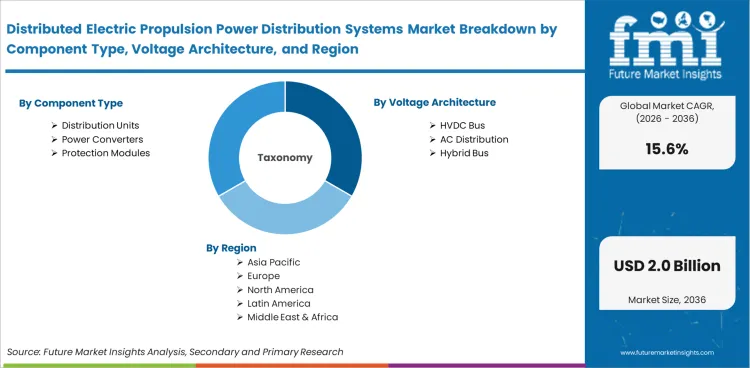
| Parameter | Details |
|---|---|
| Quantitative Units | USD 0.48 billion to USD 2.04 billion at 15.6% CAGR |
| Market Definition | High-voltage power distribution hardware used in distributed electric propulsion aircraft |
| Component Type | Distribution Units, Power Converters, Protection Modules, Contactors, Harness Assemblies |
| Voltage Architecture | HVDC Bus, AC Distribution, Hybrid Bus, Multi-bus Systems |
| Aircraft Platform | eVTOL Aircraft, Hybrid Regional Aircraft, Unmanned Aircraft, General Aviation Aircraft |
| Power Rating | Below 250 kW, 250 kW to 1 MW, Above 1 MW |
| Installation Type | OEM Integration, Retrofit Programs, Testbed Programs |
| Countries Covered | United States, China, UAE, United Kingdom, India, Germany, Japan |
| Key Companies Profiled | Collins Aerospace, Safran Electrical & Power, GE Aerospace, Eaton, Astronics Corporation, Honeywell Aerospace Technologies, Parker Meggitt |
| Forecast Period | 2026 to 2036 |
| Approach | Hybrid bottom-up and top-down model using platform count and component value checks |
Distributed Electric Propulsion Power Distribution Systems Market by Component Type, Voltage Architecture, Aircraft Platform, Power Rating, and Installation Type
By Component Type:
- Distribution Units
- Power Converters
- Protection Modules
- Contactors
- Harness Assemblies
By Voltage Architecture:
- HVDC Bus
- AC Distribution
- Hybrid Bus
- Multi-bus Systems
By Aircraft Platform:
- eVTOL Aircraft
- Hybrid Regional Aircraft
- Unmanned Aircraft
- General Aviation Aircraft
By Power Rating:
- Below 250 kW
- 250 kW to 1 MW
- Above 1 MW
By Installation Type:
- OEM Integration
- Retrofit Programs
- Testbed Programs
Research Sources and Bibliography
- Astronics Corporation. (2025, April 3). Astronics to provide advanced frequency converter for NASA-Boeing X-66 demonstrator aircraft. Astronics Corporation.
- RTX. (2026, March 17). RTX’s Collins Aerospace announces completion of Clean Aviation Joint Undertaking HECATE project. RTX.
- Safran. (2024, April 17). Safran unveils GENeUSCONNECT, its range of high-power electrical harnesses. Safran.
- Safran. (2024, January 11). VoltAero chooses Safran electrical wiring to equip the Cassio 330 electric-hybrid certification aircraft. Safran.
- Federal Aviation Administration. (2024, December 27). Special conditions: Safran Electric & Power S.A. Model ENGINeUS 100A1 electric engines. Federal Register.
- RTX. (2024, October 28). RTX’s Collins Aerospace completes prototype development of high-voltage power distribution components for Clean Aviation SWITCH project. RTX.
- Rupp, T. D., Malone, B. P., Sadey, D. J., Carbone, N. A., Birchenough, A. G., & Schmiedlin, M. D. (2025). High-impedance and low-impedance fault protection requirements and verification testing for electric aircraft power systems. NASA Technical Reports Server.
- European Union Aviation Safety Agency. (2025, July 18). Special condition for VTOL and means of compliance. EASA.
- Federal Aviation Administration. (2024, October 22). With new rule, FAA is ready for air travel of the future. FAA.
- National Aeronautics and Space Administration. (2024, November 18). NASA Electric Aircraft Testbed (NEAT). NASA.
- State Council of the People’s Republic of China. (2026, January 6). China’s civil aviation sector achieves steady growth in 2025.
- Technology Innovation Institute. (2025, February 13). UAE begins mapping air corridors for air taxis and cargo drones to transform urban transportation.
- Department for Business and Trade. (2025, June 17). £250m for green aerospace projects ahead of Industrial Strategy. GOV.UK.
- Press Information Bureau. (2025, October 23). India’s Aviation Vision 2047. Government of India.
- German Aerospace Industries Association. (2025, May 22). Industry data 2024: German aerospace industry on the rise. BDLI.
- Ministry of Economy, Trade and Industry. (2026, March 27). Advanced Air Mobility Roadmap Revised. METI.
This Report Answers
- What is the current and future size of the distributed electric propulsion power distribution systems market?
- What value is the market estimated to reach by 2036 in the forecast?
- What CAGR is estimated for distributed electric propulsion power distribution systems from 2026 to 2036?
- Which component type is estimated to lead the market by 2026?
- Which voltage architecture is estimated to hold the leading share during the base year?
- How does OEM integration affect revenue quality in this market?
- Which companies are active in aircraft power distribution and high-voltage integration?
- How is the distributed electric propulsion power distribution systems forecast validated?
Frequently Asked Questions
What is the global demand for distributed electric propulsion power distribution systems in 2026?
Global demand is estimated at USD 0.48 billion in 2026 as aircraft programs qualify high-voltage distribution hardware.
How big will the Distributed Electric Propulsion Power Distribution Systems Market be in 2036?
The market is estimated to reach USD 2.04 billion by 2036 as electric propulsion architectures mature.
How fast is demand estimated to expand during the forecast period?
Demand is estimated to expand at 15.6% CAGR from 2026 to 2036 under the base forecast.
Which component type is estimated to lead the market in 2026?
Distribution units are estimated to lead component type demand with 42.0% share in 2026.
Which voltage architecture is estimated to lead in 2026?
HVDC bus architecture is estimated to lead with 48.0% share in 2026 as aircraft programs reduce cable weight.
Which aircraft platform is the main demand base in 2026?
eVTOL aircraft are estimated to represent 46.0% share in 2026 through multi-propulsor aircraft designs.
What does this market include?
Market scope includes distribution units, power converters, protection modules, contactors, and harness assemblies for electric aircraft.
How is the market forecast validated?
Forecast validation uses aircraft program mapping, component value modeling, supplier verification, and certification-stage checks.
Preview the report firsthand - request a free sample
Get SampleGet the brochure for pricing and purchase details.
Get PDFTable of Content
- Executive Summary
- Global Market Outlook
- Demand-side Trends
- Supply-side Trends
- Technology Roadmap Analysis
- Analysis and Recommendations
- Market Overview
- Market Coverage / Taxonomy
- Market Definition / Scope / Limitations
- Research Methodology
- Chapter Orientation
- Analytical Lens and Working Hypotheses
- Market Structure, Signals, and Trend Drivers
- Benchmarking and Cross-market Comparability
- Market Sizing, Forecasting, and Opportunity Mapping
- Research Design and Evidence Framework
- Desk Research Programme (Secondary Evidence)
- Company Annual and Sustainability Reports
- Peer-reviewed Journals and Academic Literature
- Corporate Websites, Product Literature, and Technical Notes
- Earnings Decks and Investor Briefings
- Statutory Filings and Regulatory Disclosures
- Technical White Papers and Standards Notes
- Trade Journals, Industry Magazines, and Analyst Briefs
- Conference Proceedings, Webinars, and Seminar Materials
- Government Statistics Portals and Public Data Releases
- Press Releases and Reputable Media Coverage
- Specialist Newsletters and Curated Briefings
- Sector Databases and Reference Repositories
- FMI Internal Proprietary Databases and Historical Market Datasets
- Subscription Datasets and Paid Sources
- Social Channels, Communities, and Digital Listening Inputs
- Additional Desk Sources
- Expert Input and Fieldwork (Primary Evidence)
- Primary Modes
- Qualitative Interviews and Expert Elicitation
- Quantitative Surveys and Structured Data Capture
- Blended Approach
- Why Primary Evidence is Used
- Field Techniques
- Interviews
- Surveys
- Focus Groups
- Observational and In-context Research
- Social and Community Interactions
- Stakeholder Universe Engaged
- C-suite Leaders
- Board Members
- Presidents and Vice Presidents
- R&D and Innovation Heads
- Technical Specialists
- Domain Subject-matter Experts
- Scientists
- Physicians and Other Healthcare Professionals
- Governance, Ethics, and Data Stewardship
- Research Ethics
- Data Integrity and Handling
- Primary Modes
- Tooling, Models, and Reference Databases
- Desk Research Programme (Secondary Evidence)
- Data Engineering and Model Build
- Data Acquisition and Ingestion
- Cleaning, Normalisation, and Verification
- Synthesis, Triangulation, and Analysis
- Quality Assurance and Audit Trail
- Market Background
- Market Dynamics
- Drivers
- Restraints
- Opportunity
- Trends
- Scenario Forecast
- Demand in Optimistic Scenario
- Demand in Likely Scenario
- Demand in Conservative Scenario
- Opportunity Map Analysis
- Product Life Cycle Analysis
- Supply Chain Analysis
- Investment Feasibility Matrix
- Value Chain Analysis
- PESTLE and Porter’s Analysis
- Regulatory Landscape
- Regional Parent Market Outlook
- Production and Consumption Statistics
- Import and Export Statistics
- Market Dynamics
- Global Market Analysis 2021 to 2025 and Forecast, 2026 to 2036
- Historical Market Size Value (USD Million) Analysis, 2021 to 2025
- Current and Future Market Size Value (USD Million) Projections, 2026 to 2036
- Y-o-Y Growth Trend Analysis
- Absolute $ Opportunity Analysis
- Global Market Pricing Analysis 2021 to 2025 and Forecast 2026 to 2036
- Global Market Analysis 2021 to 2025 and Forecast 2026 to 2036, By Component Type
- Introduction / Key Findings
- Historical Market Size Value (USD Million) Analysis By Component Type , 2021 to 2025
- Current and Future Market Size Value (USD Million) Analysis and Forecast By Component Type , 2026 to 2036
- Distribution Value (USD Million)s
- Power Converters
- Protection Modules
- Distribution Value (USD Million)s
- Y-o-Y Growth Trend Analysis By Component Type , 2021 to 2025
- Absolute $ Opportunity Analysis By Component Type , 2026 to 2036
- Global Market Analysis 2021 to 2025 and Forecast 2026 to 2036, By Voltage Architecture
- Introduction / Key Findings
- Historical Market Size Value (USD Million) Analysis By Voltage Architecture, 2021 to 2025
- Current and Future Market Size Value (USD Million) Analysis and Forecast By Voltage Architecture, 2026 to 2036
- HVDC Bus
- AC Distribution
- Hybrid Bus
- HVDC Bus
- Y-o-Y Growth Trend Analysis By Voltage Architecture, 2021 to 2025
- Absolute $ Opportunity Analysis By Voltage Architecture, 2026 to 2036
- Global Market Analysis 2021 to 2025 and Forecast 2026 to 2036, By Aircraft Platform
- Introduction / Key Findings
- Historical Market Size Value (USD Million) Analysis By Aircraft Platform, 2021 to 2025
- Current and Future Market Size Value (USD Million) Analysis and Forecast By Aircraft Platform, 2026 to 2036
- eVTOL Aircraft
- Hybrid Regional Aircraft
- Unmanned Aircraft
- eVTOL Aircraft
- Y-o-Y Growth Trend Analysis By Aircraft Platform, 2021 to 2025
- Absolute $ Opportunity Analysis By Aircraft Platform, 2026 to 2036
- Global Market Analysis 2021 to 2025 and Forecast 2026 to 2036, By Power Rating
- Introduction / Key Findings
- Historical Market Size Value (USD Million) Analysis By Power Rating, 2021 to 2025
- Current and Future Market Size Value (USD Million) Analysis and Forecast By Power Rating, 2026 to 2036
- 250 kW to 1 MW
- Below 250 kW
- Above 1 MW
- 250 kW to 1 MW
- Y-o-Y Growth Trend Analysis By Power Rating, 2021 to 2025
- Absolute $ Opportunity Analysis By Power Rating, 2026 to 2036
- Global Market Analysis 2021 to 2025 and Forecast 2026 to 2036, By Installation Type
- Introduction / Key Findings
- Historical Market Size Value (USD Million) Analysis By Installation Type, 2021 to 2025
- Current and Future Market Size Value (USD Million) Analysis and Forecast By Installation Type, 2026 to 2036
- OEM Integration
- Retrofit Programs
- Testbed Programs
- OEM Integration
- Y-o-Y Growth Trend Analysis By Installation Type, 2021 to 2025
- Absolute $ Opportunity Analysis By Installation Type, 2026 to 2036
- Global Market Analysis 2021 to 2025 and Forecast 2026 to 2036, By Region
- Introduction
- Historical Market Size Value (USD Million) Analysis By Region, 2021 to 2025
- Current Market Size Value (USD Million) Analysis and Forecast By Region, 2026 to 2036
- North America
- Latin America
- Western Europe
- Eastern Europe
- East Asia
- South Asia and Pacific
- Middle East & Africa
- Market Attractiveness Analysis By Region
- North America Market Analysis 2021 to 2025 and Forecast 2026 to 2036, By Country
- Historical Market Size Value (USD Million) Trend Analysis By Market Taxonomy, 2021 to 2025
- Market Size Value (USD Million) Forecast By Market Taxonomy, 2026 to 2036
- By Country
- USA
- Canada
- Mexico
- By Component Type
- By Voltage Architecture
- By Aircraft Platform
- By Power Rating
- By Installation Type
- By Country
- Market Attractiveness Analysis
- By Country
- By Component Type
- By Voltage Architecture
- By Aircraft Platform
- By Power Rating
- By Installation Type
- Key Takeaways
- Latin America Market Analysis 2021 to 2025 and Forecast 2026 to 2036, By Country
- Historical Market Size Value (USD Million) Trend Analysis By Market Taxonomy, 2021 to 2025
- Market Size Value (USD Million) Forecast By Market Taxonomy, 2026 to 2036
- By Country
- Brazil
- Chile
- Rest of Latin America
- By Component Type
- By Voltage Architecture
- By Aircraft Platform
- By Power Rating
- By Installation Type
- By Country
- Market Attractiveness Analysis
- By Country
- By Component Type
- By Voltage Architecture
- By Aircraft Platform
- By Power Rating
- By Installation Type
- Key Takeaways
- Western Europe Market Analysis 2021 to 2025 and Forecast 2026 to 2036, By Country
- Historical Market Size Value (USD Million) Trend Analysis By Market Taxonomy, 2021 to 2025
- Market Size Value (USD Million) Forecast By Market Taxonomy, 2026 to 2036
- By Country
- Germany
- UK
- Italy
- Spain
- France
- Nordic
- BENELUX
- Rest of Western Europe
- By Component Type
- By Voltage Architecture
- By Aircraft Platform
- By Power Rating
- By Installation Type
- By Country
- Market Attractiveness Analysis
- By Country
- By Component Type
- By Voltage Architecture
- By Aircraft Platform
- By Power Rating
- By Installation Type
- Key Takeaways
- Eastern Europe Market Analysis 2021 to 2025 and Forecast 2026 to 2036, By Country
- Historical Market Size Value (USD Million) Trend Analysis By Market Taxonomy, 2021 to 2025
- Market Size Value (USD Million) Forecast By Market Taxonomy, 2026 to 2036
- By Country
- Russia
- Poland
- Hungary
- Balkan & Baltic
- Rest of Eastern Europe
- By Component Type
- By Voltage Architecture
- By Aircraft Platform
- By Power Rating
- By Installation Type
- By Country
- Market Attractiveness Analysis
- By Country
- By Component Type
- By Voltage Architecture
- By Aircraft Platform
- By Power Rating
- By Installation Type
- Key Takeaways
- East Asia Market Analysis 2021 to 2025 and Forecast 2026 to 2036, By Country
- Historical Market Size Value (USD Million) Trend Analysis By Market Taxonomy, 2021 to 2025
- Market Size Value (USD Million) Forecast By Market Taxonomy, 2026 to 2036
- By Country
- China
- Japan
- South Korea
- By Component Type
- By Voltage Architecture
- By Aircraft Platform
- By Power Rating
- By Installation Type
- By Country
- Market Attractiveness Analysis
- By Country
- By Component Type
- By Voltage Architecture
- By Aircraft Platform
- By Power Rating
- By Installation Type
- Key Takeaways
- South Asia and Pacific Market Analysis 2021 to 2025 and Forecast 2026 to 2036, By Country
- Historical Market Size Value (USD Million) Trend Analysis By Market Taxonomy, 2021 to 2025
- Market Size Value (USD Million) Forecast By Market Taxonomy, 2026 to 2036
- By Country
- India
- ASEAN
- Australia & New Zealand
- Rest of South Asia and Pacific
- By Component Type
- By Voltage Architecture
- By Aircraft Platform
- By Power Rating
- By Installation Type
- By Country
- Market Attractiveness Analysis
- By Country
- By Component Type
- By Voltage Architecture
- By Aircraft Platform
- By Power Rating
- By Installation Type
- Key Takeaways
- Middle East & Africa Market Analysis 2021 to 2025 and Forecast 2026 to 2036, By Country
- Historical Market Size Value (USD Million) Trend Analysis By Market Taxonomy, 2021 to 2025
- Market Size Value (USD Million) Forecast By Market Taxonomy, 2026 to 2036
- By Country
- Kingdom of Saudi Arabia
- Other GCC Countries
- Turkiye
- South Africa
- Other African Union
- Rest of Middle East & Africa
- By Component Type
- By Voltage Architecture
- By Aircraft Platform
- By Power Rating
- By Installation Type
- By Country
- Market Attractiveness Analysis
- By Country
- By Component Type
- By Voltage Architecture
- By Aircraft Platform
- By Power Rating
- By Installation Type
- Key Takeaways
- Key Countries Market Analysis
- USA
- Pricing Analysis
- Market Share Analysis, 2025
- By Component Type
- By Voltage Architecture
- By Aircraft Platform
- By Power Rating
- By Installation Type
- Canada
- Pricing Analysis
- Market Share Analysis, 2025
- By Component Type
- By Voltage Architecture
- By Aircraft Platform
- By Power Rating
- By Installation Type
- Mexico
- Pricing Analysis
- Market Share Analysis, 2025
- By Component Type
- By Voltage Architecture
- By Aircraft Platform
- By Power Rating
- By Installation Type
- Brazil
- Pricing Analysis
- Market Share Analysis, 2025
- By Component Type
- By Voltage Architecture
- By Aircraft Platform
- By Power Rating
- By Installation Type
- Chile
- Pricing Analysis
- Market Share Analysis, 2025
- By Component Type
- By Voltage Architecture
- By Aircraft Platform
- By Power Rating
- By Installation Type
- Germany
- Pricing Analysis
- Market Share Analysis, 2025
- By Component Type
- By Voltage Architecture
- By Aircraft Platform
- By Power Rating
- By Installation Type
- UK
- Pricing Analysis
- Market Share Analysis, 2025
- By Component Type
- By Voltage Architecture
- By Aircraft Platform
- By Power Rating
- By Installation Type
- Italy
- Pricing Analysis
- Market Share Analysis, 2025
- By Component Type
- By Voltage Architecture
- By Aircraft Platform
- By Power Rating
- By Installation Type
- Spain
- Pricing Analysis
- Market Share Analysis, 2025
- By Component Type
- By Voltage Architecture
- By Aircraft Platform
- By Power Rating
- By Installation Type
- France
- Pricing Analysis
- Market Share Analysis, 2025
- By Component Type
- By Voltage Architecture
- By Aircraft Platform
- By Power Rating
- By Installation Type
- India
- Pricing Analysis
- Market Share Analysis, 2025
- By Component Type
- By Voltage Architecture
- By Aircraft Platform
- By Power Rating
- By Installation Type
- ASEAN
- Pricing Analysis
- Market Share Analysis, 2025
- By Component Type
- By Voltage Architecture
- By Aircraft Platform
- By Power Rating
- By Installation Type
- Australia & New Zealand
- Pricing Analysis
- Market Share Analysis, 2025
- By Component Type
- By Voltage Architecture
- By Aircraft Platform
- By Power Rating
- By Installation Type
- China
- Pricing Analysis
- Market Share Analysis, 2025
- By Component Type
- By Voltage Architecture
- By Aircraft Platform
- By Power Rating
- By Installation Type
- Japan
- Pricing Analysis
- Market Share Analysis, 2025
- By Component Type
- By Voltage Architecture
- By Aircraft Platform
- By Power Rating
- By Installation Type
- South Korea
- Pricing Analysis
- Market Share Analysis, 2025
- By Component Type
- By Voltage Architecture
- By Aircraft Platform
- By Power Rating
- By Installation Type
- Russia
- Pricing Analysis
- Market Share Analysis, 2025
- By Component Type
- By Voltage Architecture
- By Aircraft Platform
- By Power Rating
- By Installation Type
- Poland
- Pricing Analysis
- Market Share Analysis, 2025
- By Component Type
- By Voltage Architecture
- By Aircraft Platform
- By Power Rating
- By Installation Type
- Hungary
- Pricing Analysis
- Market Share Analysis, 2025
- By Component Type
- By Voltage Architecture
- By Aircraft Platform
- By Power Rating
- By Installation Type
- Kingdom of Saudi Arabia
- Pricing Analysis
- Market Share Analysis, 2025
- By Component Type
- By Voltage Architecture
- By Aircraft Platform
- By Power Rating
- By Installation Type
- Turkiye
- Pricing Analysis
- Market Share Analysis, 2025
- By Component Type
- By Voltage Architecture
- By Aircraft Platform
- By Power Rating
- By Installation Type
- South Africa
- Pricing Analysis
- Market Share Analysis, 2025
- By Component Type
- By Voltage Architecture
- By Aircraft Platform
- By Power Rating
- By Installation Type
- USA
- Market Structure Analysis
- Competition Dashboard
- Competition Benchmarking
- Market Share Analysis of Top Players
- By Regional
- By Component Type
- By Voltage Architecture
- By Aircraft Platform
- By Power Rating
- By Installation Type
- Competition Analysis
- Competition Deep Dive
- Collins Aerospace
- Overview
- Product Portfolio
- Profitability by Market Segments (Product/Age /Sales Channel/Region)
- Sales Footprint
- Strategy Overview
- Marketing Strategy
- Product Strategy
- Channel Strategy
- Safran Electrical & Power
- GE Aerospace
- Eaton
- Astronics Corporation
- Honeywell Aerospace Technologies
- Collins Aerospace
- Competition Deep Dive
- Assumptions & Acronyms Used


