

- Industry Size (2026)
- USD 14.50 Bn
- Forecast (2036)
- USD 28.20 Bn
- CAGR (2026 to 2036)
- 6.9%
Smart Junction Box and Power Distribution Box Systems Market Size, Market Forecast and Outlook By FMI
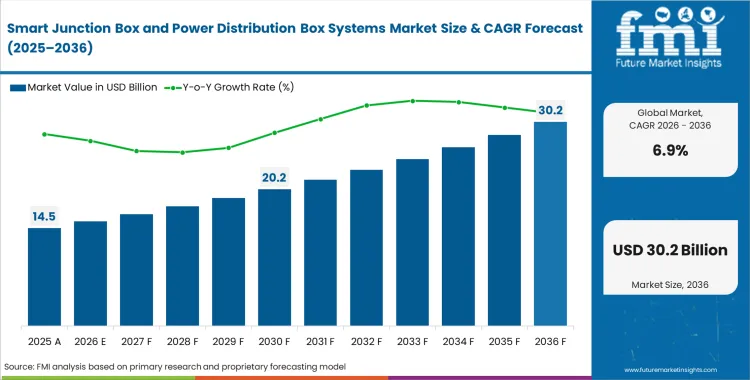
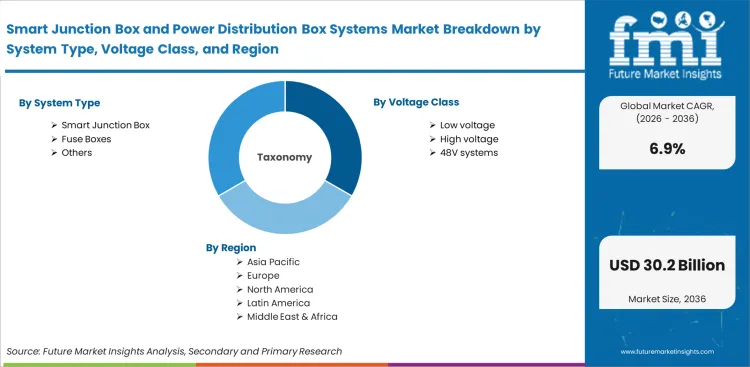
The smart junction box and power distribution box systems market was valued at USD 13.56 billion in 2025. Total output from the automotive smart junction box segment is estimated to reach USD 14.50 billion in 2026 and is expected to record a CAGR of 6.9% over the forecast period. Continued investment is projected to push the market value to USD 28.20 billion by 2036, as electrical architecture teams move away from centralized power systems toward zonal load control structures.
In legacy vehicle architectures, wiring harness weight has reached a point that limits automated assembly and creates immediate operational challenges for automakers. Electrical engineering teams must either continue routing extensive copper networks to centralized hubs and deal with assembly inefficiencies, or shift toward zonal power distribution. Moving to distributed power logic removes the need for mechanical relays, reduces harness weight, and supports over-the-air diagnostics. This transition also shifts internal decision-making, with software teams taking a more active role in hardware sourcing replacing traditional wiring procurement structures. Integrating smart vehicle architecture brings new vendor qualification requirements and forces broader supply chain realignment.
Summary of Smart Junction Box and Power Distribution Box Systems Market
- Market Snapshot
- The smart junction box and power distribution box systems market is valued at USD 13.56 billion in 2025 and is expected to reach USD 28.20 billion by 2036.
- The industry is anticipated to grow at a CAGR of 6.9% from 2026 to 2036, generating an incremental opportunity of USD 13.70 billion over the same period.
- The market continues to operate as a specification-driven segment within automotive electrical architecture, where factors such as thermal management, fuse protection, switching density, sealing performance, and OEM integration define competitiveness.
- Demand remains closely linked to rising electrical content per vehicle, particularly across electric vehicles, hybrids, premium segments, and software-defined or zonal platforms.
- Demand and Growth Drivers
- Demand is increasing as vehicle platforms consolidate a larger number of circuits, relays, fuses, and load control functions into compact power distribution units, raising the value contribution of junction boxes per vehicle.
- Smart junction boxes are seeing faster adoption as they enable real-time monitoring, fault detection, diagnostics, and safer control of expanding electrical loads within vehicles.
- The shift toward zonal and centralized E/E architectures is supporting adoption, as these designs require more intelligent and modular low- and high-voltage power distribution nodes.
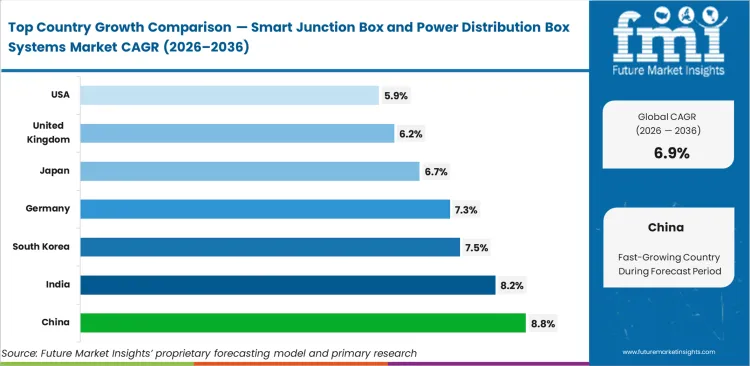
- Among key countries, China is expected to record a CAGR of 8.8%, followed by India at 8.2%, South Korea at 7.5%, Germany at 7.3%, Japan at 6.7%, the United Kingdom at 6.2%, and the United States at 5.9% over the forecast period.
- Market expansion remains constrained by thermal management limits, connector qualification requirements, EMI and EMC compliance challenges, and cost pressures associated with higher-content smart assemblies.
- Product and Segment View
- The market includes smart junction boxes, fuse boxes, battery junction boxes, and power distribution units built using fuses, relays, busbars, connectors, sensing electronics, and protective enclosures.
- These systems are deployed across passenger cars, light commercial vehicles, heavy commercial vehicles, and select off-highway applications for switching, protection, and controlled power distribution.
- Smart junction boxes are expected to hold 48.2% share within the System Type segment, supported by their ability to enable fault diagnostics, integrate controllers, and align with higher electronic content vehicle platforms.
- Low voltage is estimated to hold 61.5% share in the Voltage Class segment, as 12V and 48V systems continue to represent the largest installed base despite the expansion of high-voltage EV architectures.
- Passenger cars are anticipated to capture 72.1% share in the Vehicle Type segment, reflecting higher production volumes and wider use of content-intensive electrical architectures.
- Power switching is projected to account for 54.1% of the Function segment, as current routing and subsystem control remain the primary role of these systems.
- OEM sales are expected to hold 69.2% share in the Sales Channel segment, given that these systems are integrated early into vehicle platforms and require close alignment with electrical architecture design.
- The scope covers integrated automotive electrical distribution assemblies and intelligent junction modules, while excluding standalone wiring harness revenues, generic industrial enclosures, and discrete semiconductor power modules sold outside box-level systems.
- Geography and Competitive Outlook
- China, India, and South Korea are expected to remain the fastest-expanding national markets, while the United States continues to serve as a stable, high-value base supported by replacement demand and ongoing platform refresh cycles.
- Competitive positioning is shaped by OEM platform awards, integration within vehicle electrical architecture programs, advancements in e-fuse and diagnostic capabilities, and packaging solutions suited for both low- and high-voltage applications.
- Key participants include Lear Corporation, Aptiv, Yazaki, Sumitomo Wiring Systems, TE Connectivity, Eaton, and MTA, with Lear maintaining a strong position in smart junction box supply based on available disclosures.
- The market shows moderate concentration, with leading Tier-1 suppliers controlling platform-critical programs, while regional players compete across fuse box, power distribution unit, and application-specific design segments.
Solid-state switching for critical safety functions is reducing reliance on mechanical fuses across vehicle platforms. The shift hinges on demonstrating fail-operational performance in steering and braking systems under microsecond fault conditions. After this threshold is met, conventional fuse modules are removed from cabin layouts creating space for more advanced power distribution systems.
Demand for smart junction box systems in China is anticipated to rise at a CAGR of 8.8% during the forecast period, supported by aggressive adoption of zonal architectures among domestic electric vehicle manufacturers. In India, sales are set to record a CAGR of 8.2% through ongoing premiumization of passenger vehicles. South Korea is expected to grow at 7.5%, driven by its strong battery and electronics ecosystem, while Germany is projected to register a CAGR of 7.3% due to continued electrification of premium vehicle platforms. Japan is anticipated to record 6.7% growth, reflecting a steady, reliability-focused transition. The United Kingdom is set to expand at 6.2%, while the United States is expected to post a CAGR of 5.9%, influenced by slower platform refresh cycles in larger vehicle segments. Overall, growth across regions reflects a steady shift toward distributed electrical architectures supported by electrification trends.
Segmental Analysis
Smart Junction Box and Power Distribution Box Systems Market Analysis by System Type
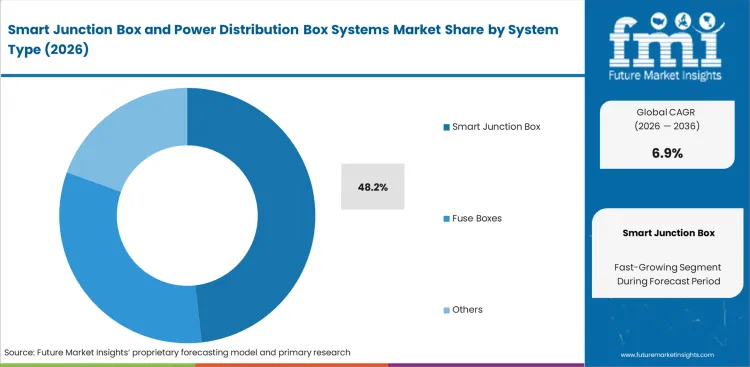
Mechanical relays fail to deliver the microsecond response times required for software-defined safety networks, which is why smart junction boxes are now estimated to hold 48.2% share of the market, replacing passive melting fuses with intelligent solid-state switches. Electrical architecture leads are specifying these advanced modules to enable over-the-air reset capabilities, and the shift from a conventional fuse box to a smart junction box is fundamentally changing vehicle assembly sequences. Zonal architectures rely on these smart nodes to break large central wiring harnesses into more manageable local loops. Behind these gains sits a strong layer of software dependency that share figures alone do not capture. Hardware teams increasingly depend on advanced battery management systems alongside automotive integrated power module capabilities to keep these systems functioning reliably. Platform architects who delay this transition face clear penalties, as heavier wiring harnesses continue to impact electric vehicle range.
- Adoption trigger: Software-defined vehicle architectures are pushing electrical engineering managers to move away from mechanical relays toward solid-state logic, with early adopters already gaining assembly line efficiencies.
- Follow-on impact: As semiconductor costs normalize, these technologies move into high-volume platforms, requiring procurement teams to shift from straightforward copper sourcing to more complex silicon supply agreements.
- Final conversion: Heavy commercial vehicles transition later, as payload efficiency begins to outweigh legacy reliability concerns, with fleet operators ultimately prioritizing the remote diagnostic capabilities these modules enable.
Smart Junction Box and Power Distribution Box Systems Market Analysis by Voltage Class
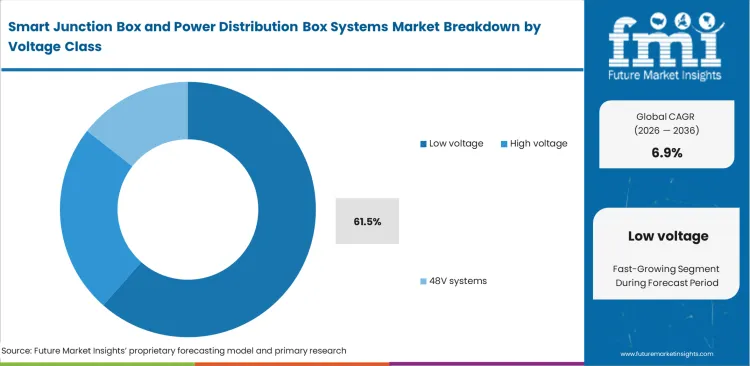
Legacy 12V infrastructure continues to support critical cabin systems regardless of propulsion type, and is anticipated to hold 61.5% share as lighting and basic body electronics remain fully dependent on established standards. Harness engineering managers continue to design power distribution around 12V availability, even within high-voltage electric platforms. FMI notes that low-voltage power distribution through automotive down-conversion enables OEMs to deploy standard load controllers across varied vehicle portfolios. A less obvious shift is underway: 12V smart boxes are becoming more complex than their high-voltage counterparts, as they are required to manage dozens of variable micro-loads simultaneously. Evolving platform requirements are driving the need for more advanced global automotive wiring harness optimization and precise wire harness engineering. Electrical design teams that underestimate the thermal density within tightly packed low-voltage nodes face a real risk of severe melting incidents.
- Hidden thermal limits: Integrating multiple solid-state switches within compact plastic enclosures creates concentrated heat zones. Thermal engineering teams must rely on effective passive cooling designs to avoid long-term module degradation.
- Warranty exposure: Software faults in low-voltage load management can lead to overnight battery drain in parked vehicles. Quality teams face significant warranty risks if sleep-state consumption exceeds microampere limits.
- Mitigation necessity: Redundant fail-safe mechanisms are essential to safeguard critical steering and braking systems. Validation teams must demonstrate uninterrupted performance under extreme thermal conditions.
Smart Junction Box and Power Distribution Box Systems Market Analysis by Vehicle Type
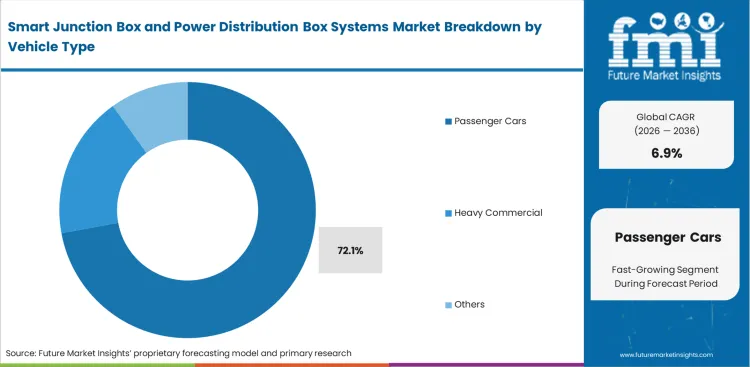
Standardizing electronic power distribution is driving clear economies of scale for volume automakers. Passenger cars are estimated to hold 72.1% share, supported by the large number of units moving toward more advanced electrical architectures. Platform architects use junction box demand in passenger vehicles to differentiate interior features across trim levels without changing the physical wiring. Software-defined power routing allows a single hardware module to support both base models and higher-end variants. Passenger car volumes also support the development of heavy-duty applications, as commercial truck manufacturers cannot justify the cost of dedicated silicon without that scale. Teams are aligning vehicle electrification progress with broader automotive electronics developments. OEMs that do not adopt unified cross-platform architectures face margin pressure from excessive part number proliferation.
- Volume leverage: Securing tier-1 production capacity depends on large order commitments. Procurement teams rely on passenger car volumes to negotiate pricing for solid-state switching components.
- Silicon dependence: Consolidating power management onto specialized microcontrollers increases exposure to supply chain disruptions. Semiconductor shortages can halt vehicle assembly lines.
- Lifecycle reality: Cost benefits are only achieved when the same hardware is carried across multiple vehicle generations. Strategic sourcing teams must avoid design changes that break cross-platform compatibility.
Smart Junction Box and Power Distribution Box Systems Market Analysis by Function
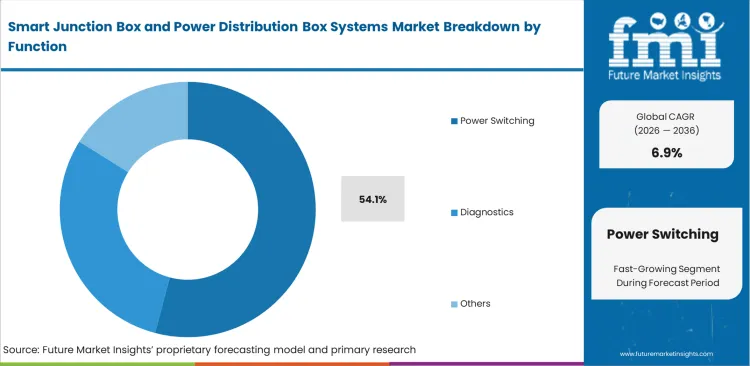
Active energy management defines how modern vehicles make the most of limited battery capacity. Power switching accounts are estimated to account for 54.1% share of the market, as intelligent load shedding becomes essential for preserving electric vehicle range. Electrical architecture leads are prioritizing active power switching automotive junction boxes to ensure safety-critical systems maintain uninterrupted power. FMI estimates that replacing traditional relays with smart switches removes mechanical wear while enabling pulse-width modulation for handling variable loads. Active power switching introduces electromagnetic interference that can disrupt nearby sensor networks. Routing teams must account for this by shielding data cables from electrical noise. The use of automotive relays and fuses, alongside automotive fuse block structures helps control this interference. Designs that overlook electromagnetic shielding often face intermittent sensor failures that are difficult to trace through standard diagnostics.
- Component durability: Solid-state switches last significantly longer than mechanical relays, often by millions of cycles. Warranty teams factor in lower failure rates for interior load management systems.
- Edge-case vulnerabilities: Extreme cold conditions can shift semiconductor resistance in unpredictable ways. Winter testing teams must validate cold-crank performance to ensure safety-critical loads engage reliably.
- Qualification gates: Strict automotive temperature cycling requirements rule out lower-grade components. Quality teams reject any silicon that does not meet AEC-Q100 standards.
Smart Junction Box and Power Distribution Box Systems Market Analysis by Sales Channel
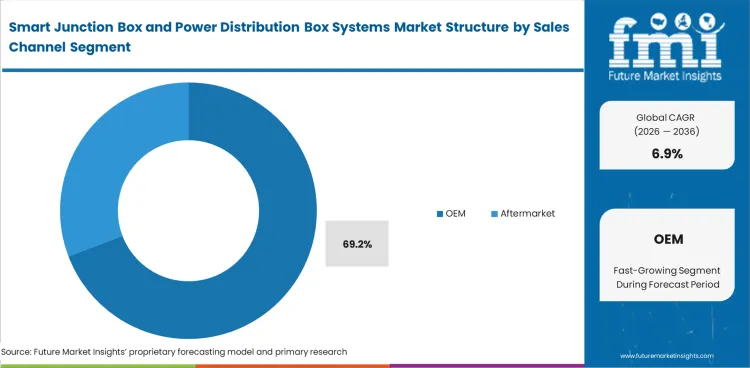
Factory integration requirements continue to conflict with aftermarket repairability needs. OEM installation is expected to hold 69.2% share, as smart junction boxes now function as core nodes within secure vehicle networks. During initial assembly, cybersecurity teams lock these modules using cryptographic controls to prevent unauthorized power commands. This level of integration leaves little room for third-party replacement. Independent repair shops are often unable to replace failed smart junction boxes, since new units must be authenticated through OEM servers to communicate with central gateways. Connectivity control units and integrated electronic control unit in automotive systems reinforce this closed architecture. Some automakers are using these network security structures to steer customers back to authorized dealer service channels, particularly as right-to-repair pressures increase.
- Initial architecture choice: Embedding power distribution modules deep within dashboards improves assembly efficiency. Manufacturing teams tend to prioritize installation speed over long-term service access.
- Validation hurdles: Securing vehicle networks requires extensive penetration testing. Cybersecurity teams must ensure that external actors cannot gain control over load-switching functions.
- Expansion friction: Adding aftermarket accessories becomes difficult within closed OEM power networks. Fleet upfitters often face challenges when integrating auxiliary systems without triggering diagnostic faults.
Smart Junction Box and Power Distribution Box Systems Market Drivers, Restraints, and Opportunities
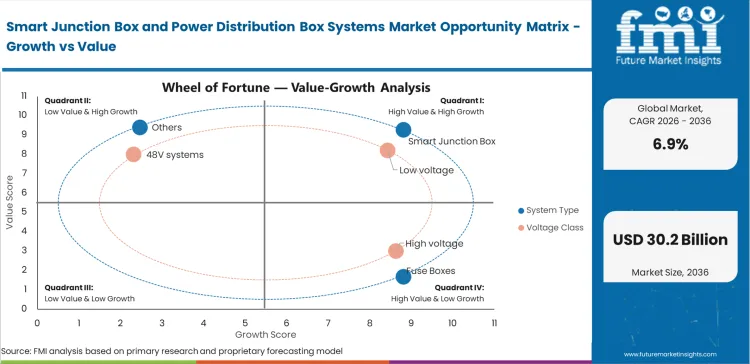
Weight reduction imperatives mandate complete redesigns of vehicle electrical architectures. Harness engineering managers face strict limits on copper mass. This constraint forces them to abandon centralized relay boxes connected by heavy wiring bundles. Moving to automotive zonal architecture slashes wire length drastically by placing load controllers near actual devices. Understanding what drives growth in automotive power distribution boxes requires looking at assembly line efficiency. Delaying this transition severely penalizes electric vehicle manufacturers by reducing achievable range metrics. Utilizing optimized automotive wires accelerates this transition timeline.
Semiconductor qualification cycles severely restrict pace of solid-state module deployment. Hardware engineering leads discover consumer-grade silicon cannot survive extreme temperature fluctuations. This persistent thermal reality forces suppliers to utilize specialized automotive-grade wafers. While advanced packaging techniques attempt mitigating heat dissipation, thermal management in automotive junction boxes remains a fundamental physics constraint slowing high-power solid-state adoption.
Opportunities in the Smart Junction Box and Power Distribution Box Systems Market
- 48V network transition: Upgrading auxiliary power nets to 48V reduces current draw for heavy loads. Electrical architects capture significant wiring weight reductions.
- Predictive maintenance logic: Embedding software to detect degrading wire insulation before short circuits occur. Fleet managers avoid catastrophic vehicle fires and unplanned downtime.
- Zonal gateway integration: Combining data routing and power switching into single physical nodes. Packaging engineers reclaim valuable cabin space using advanced automotive ecu capabilities.
Regional Analysis
Based on regional analysis, Smart Junction Box and Power Distribution Box Systems is segmented into North America, Latin America, Western Europe, Eastern Europe, East Asia, South Asia and Pacific, and Middle East and Africa across 40 plus countries.
.webp "Top Country Growth Comparison Smart Junction Box And Power Distribution Box Systems Market Cagr (2026 2036)")
| Country | CAGR (2026 to 2036) |
|---|---|
| China | 8.8% |
| India | 8.2% |
| South Korea | 7.5% |
| Germany | 7.3% |
| Japan | 6.7% |
| United Kingdom | 6.2% |
| United States | 5.9% |
Source: Future Market Insights (FMI) analysis, based on proprietary forecasting model and primary research
East Asia Smart Junction Box and Power Distribution Box Systems Market Analysis
Local electric vehicle players are moving faster on zonal architecture integration than established competitors. Platform architects are rolling out software-defined power nodes even in entry-level models, accelerating adoption at scale. This pace is driving strong domestic demand for high-current solid-state switches. Dependence on local semiconductor supply chains is also helping manufacturers reduce exposure to global logistics disruptions. The rapid iteration cycles are pushing tier-1 suppliers to shorten hardware development timelines to just a few months.
- China: Demand for smart junction box systems in China is being reshaped by frequent platform redesigns across passenger and electric vehicle programs, pushing electrical engineering teams to prioritize standardized smart junction architectures. Early alignment with these modular designs is expected to hold of 8.8% CAGR for the smart junction box market, as large production volumes accelerate cost efficiencies. Rapid scaling has also strengthened the position of domestic suppliers, enabling them to offer competitively priced modules that increasingly pressure global Tier‑1 pricing models and shorten sourcing cycles for local OEMs.
- South Korea: High levels of battery integration across domestic electric vehicle platforms are prompting continued innovation in high‑voltage power distribution systems. Safety certification requirements and thermal management standards play a central role in product selection, shaping adoption patterns. Sales of smart junction boxes in South Korea are anticipated to record a CAGR of 7.5% over the forecast period, supported by ongoing upgrades to electrical architectures aimed at improving system reliability and fault tolerance. These advancements contribute directly to the strong durability and performance metrics observed in domestically produced electric vehicles.
- Japan: Long‑standing reliability expectations in Japan continue to dictate a cautious approach to electrical system integration, with solid‑state load controllers undergoing extensive validation before commercial deployment. Rather than rapid rollout, manufacturers emphasize controlled adoption tied to proven field performance. This measured pace is expected to sustain an average annual expansion of about 6.7% share in Japan’s smart junction box market, as quality assurance teams favor established supplier relationships. Strict vendor qualification processes reinforce long‑term sourcing continuity, limiting supplier churn and prioritizing consistency over short‑term cost advantages.
FMI's report includes Taiwan and broader regional assembly hubs not detailed in the primary country breakdown. Component manufacturers in these adjacent markets actively convert legacy printed circuit board fabrication lines to support the heavy copper tracing required for solid‑state power nodes. Malaysia is also highlighted as an emerging beneficiary, where electronics manufacturing clusters are upgrading process controls to meet automotive‑grade power distribution requirements.
South Asia and Pacific Smart Junction Box and Power Distribution Box Systems Market Analysis
Domestic automakers are steadily premiumizing passenger car portfolios to meet rising demand for enhanced features. Upgrading legacy electrical systems is becoming necessary to support advanced infotainment and basic driver assistance functions. Localized manufacturing of power distribution boxes helps regional OEMs avoid import tariffs and manage costs more effectively. Supplying these complex modules requires substantial investment in regional surface-mount technology assembly capabilities.
- India: Rising demand for electronically equipped cabins is accelerating the shift away from centralized wiring architectures, prompting harness engineering teams to adopt decentralized power distribution nodes. This transition is expected to support an average annual increase of about 8.2% in India’s automotive power distribution box market, as vehicle platforms scale domestic production. Suppliers that invest early in local validation and testing infrastructure are increasingly favored by OEMs, allowing them to displace import‑only competitors and secure long‑term sourcing positions.
FMI's report includes ASEAN manufacturing hubs and Oceania markets alongside the primary Indian growth analysis. Automakers utilize Thailand and Indonesia as critical testing grounds for standardizing power distribution modules across high‑humidity commercial vehicle platforms before global rollout. Vietnam is also emerging as an important contributor, with contract manufacturers expanding capacity for automotive power electronics to support regional export programs.
Western Europe Smart Junction Box and Power Distribution Box Systems Market Analysis
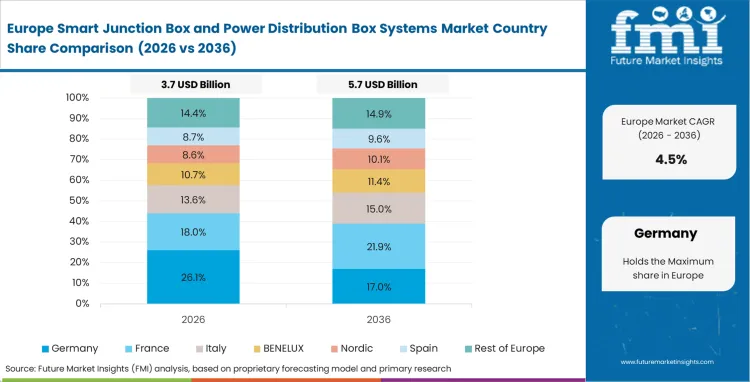
Premium automotive brands are leading the shift toward fully software-defined vehicle networks. Electrical architecture teams are prioritizing precise control over power states to support more advanced autonomous driving functions. Strict safety regulations require redundant power routing for critical steering and braking systems. Meeting these requirements involves deploying dual-path smart junction boxes with independent fail-operational capability.
- Germany: Electrification of high‑end vehicle platforms is increasing the need for extremely dense high‑voltage power distribution networks, particularly where packaging constraints and safety requirements converge. Demand for automotive power distribution box systems is expected to rise at a CAGR of 7.3% during the forecast period, reflecting the regulatory and compliance environment associated with premium vehicle programs in Germany. Tier‑1 suppliers that can demonstrate effective thermal management in compact node housings are better positioned to secure premium pricing and long‑term platform inclusion.
- United Kingdom: Adoption of zonal electrical architectures, particularly in the United Kingdom, is occurring at a more measured pace, led by niche luxury manufacturers that rely on shared vehicle platforms developed by larger parent OEMs. Sales of automotive power distribution box solutions in UK are anticipated to record a CAGR of 6.2%, supported primarily by replacement demand rather than full electrical redesigns. Procurement teams continue to adjust to post‑Brexit supply conditions by dual‑sourcing critical semiconductor components to reduce exposure to cross‑border disruptions.
FMI's report includes France, Italy, Spain, and the broader Western European automotive corridor. Regional safety regulators increasingly evaluate mandatory fail‑operational power requirements for all new vehicles equipped with level‑two driver assistance systems. Sweden is also highlighted as an emerging point of influence, where OEMs are advancing redundant power architectures to support higher safety benchmarks in semi‑autonomous platforms.
Competitive Aligners for Market Players
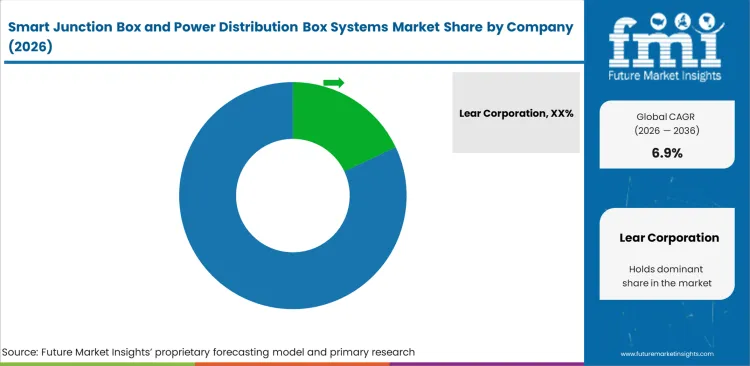
Automotive electrical architecture depends on tight system integration. Companies such as Lear Corporation and Aptiv PLC hold a strong position as they design complete vehicle network topologies rather than standalone components. Electrical engineering teams award contracts to suppliers that can reduce overall wiring harness weight while maintaining performance. This also requires strong software capabilities, particularly for secure diagnostic code built into hardware nodes. Smart junction box manufacturers are therefore expected to deliver complete, integrated systems rather than individual parts.
Long-established suppliers retain a clear advantage, supported by pre-validated component libraries that meet strict automotive safety integrity requirements. Companies such as Sumitomo Wiring Systems, Ltd. and TE Connectivity Ltd. rely on decades of accumulated thermal modeling data that new entrants lack. FMI analysis highlights that extensive failure-mode datasets enable established automotive power distribution unit suppliers to support solid-state switch reliability over typical fifteen-year vehicle lifecycles. Startups attempting to enter this space often struggle, as they are unable to accurately replicate long-term thermal cycling conditions. Engineering teams continue to assess traditional electrical fuses alongside solid-state alternatives in day-to-day design decisions.
Automakers are actively limiting deep supplier lock-in by standardizing hardware communication protocols. Platform architects are separating physical power distribution units from the software that controls them, allowing hardware to be replaced without altering proprietary load management logic. Evaluating automotive power distribution box suppliers has become a key part of modern procurement strategy. Market influence is gradually shifting toward suppliers that move beyond supplying copper components and focus on offering intelligent power management architectures.
Key Players in Smart Junction Box and Power Distribution Box Systems Market
- Lear Corporation
- Aptiv PLC
- Yazaki Corporation
- Sumitomo Wiring Systems, Ltd.
- TE Connectivity Ltd.
- Eaton Corporation plc
- MTA S.p.A.
Scope of the Report
| Metric | Value |
|---|---|
| Quantitative Units | USD 14.5 Billion to USD 28.2 Billion, at a CAGR of 6.90% |
| Market Definition | Smart Junction Box and Power Distribution Box Systems encompasses electronic hardware nodes responsible for routing, protecting, and switching electrical loads across vehicle networks. Equipment incorporates solid-state relays, diagnostic logic, and microcontroller-driven power management forming structural backbones for modern zonal architectures. |
| Segmentation | System Type, Voltage Class, Vehicle Type, Function, Sales Channel, and Region |
| Regions Covered | North America, Latin America, Western Europe, Eastern Europe, East Asia, South Asia and Pacific, Middle East and Africa |
| Countries Covered | China, India, South Korea, Germany, Japan, United Kingdom, United States |
| Key Companies Profiled | Lear Corporation, Aptiv PLC, Yazaki Corporation, Sumitomo Wiring Systems, Ltd., TE Connectivity Ltd., Eaton Corporation plc, MTA S.p.A. |
| Forecast Period | 2026 to 2036 |
| Approach | Global passenger vehicle production volumes cross-referenced against zonal topology penetration rates. |
Source: Future Market Insights (FMI) analysis, based on proprietary forecasting model and primary research
Smart Junction Box and Power Distribution Box Systems Market Analysis by Segments
System Type
- Smart junction boxes
- Power distribution boxes
- Fuse boxes
- Battery junction boxes
Voltage Class
- Low voltage
- High voltage
- 48V systems
Vehicle Type
- Passenger cars
- Light commercial
- Heavy commercial
- Off-highway
Function
- Power switching
- Circuit protection
- Load control
- Diagnostics
Sales Channel
- OEM
- Aftermarket
Region
- North America
- United States
- Canada
- Latin America
- Brazil
- Mexico
- Rest of Latin America
- Western Europe
- Germany
- United Kingdom
- France
- Italy
- Spain
- Rest of Western Europe
- Eastern Europe
- Poland
- Russia
- Czech Republic
- Rest of Eastern Europe
- East Asia
- China
- Japan
- South Korea
- South Asia and Pacific
- India
- ASEAN
- Oceania
- Rest of South Asia and Pacific
- Middle East and Africa
- GCC Countries
- South Africa
- Rest of Middle East and Africa
Bibliography
- Aptiv PLC. (2025, February 7). Annual report 2024.
- Braun, L., Fuchs, J., Kerler, M., & Lienkamp, M. (2024). Novel approach to diagnose safe electrical power distribution in automotive onboard power nets. Energies, 17(22), 5685.
- International Organization of Motor Vehicle Manufacturers. (2025). Production statistics.
- Jagfeld, S., Mauser, L., & Lienkamp, M. (2025). A data-driven approach to zonal LV architecture. EVS38 Proceedings.
- UK Vehicle Certification Agency. (2024, May 14). Cyber security and software updating
- IEEE Vehicular Technology Society. (2025). Power distribution electronics.
This bibliography is provided for reader reference. The full FMI report contains the complete reference list with primary source documentation.
This Report Addresses
- Component level transitions from passive melting fuses to solid-state active load switching.
- Structural implications of software-defined vehicle architectures on legacy hardware procurement.
- Thermal management constraints limiting dense power node packaging inside sealed cabin environments.
- Identifying OEM smart junction box suppliers utilizing varied software tuning.
- Assembly line time reductions achieved by eliminating massive central wiring harnesses.
- Cybersecurity network requirements blocking independent aftermarket junction box replacements.
- Qualification barriers preventing consumer-grade silicon from entering automotive load switching roles.
- Battery-electric platform iterations driving rapid localized architecture scaling in East Asia.
Frequently Asked Questions
What is a smart junction box in a vehicle?
A smart junction box replaces traditional mechanical fuses and relays with solid-state silicon switches. These intelligent modules route power, provide active circuit protection, and communicate dynamically with central vehicle computers to enable precise, software-controlled energy management across the vehicle network.
How big is the smart junction box sector?
The global industry valuation reached USD 13.6 billion in 2025. Rising adoption of electrical zonal architectures across passenger and commercial vehicle platforms pushes near-term demand to an estimated USD 14.5 billion in 2026.
What is the smart junction box forecast 2036 trajectory?
Total revenue expands at a 6.90% CAGR, crossing USD 28.2 billion by 2036. Sustained transition away from heavy copper wiring harnesses toward decentralized solid-state load controllers underpins this long-term structural growth.
What drives growth in automotive power distribution boxes?
Automakers face strict weight reduction mandates forcing them to eliminate heavy central wiring bundles. Decentralizing power switching through smart nodes slashes harness mass, accelerates factory floor assembly times, and enables dynamic power routing for high-drain electric vehicle systems.
What is the difference between a smart junction box vs fuse box?
A conventional fuse box relies on passive, melting metal links that permanently break electrical circuits during overload conditions. Smart junction boxes utilize solid-state relays that detect microsecond current spikes, shut off power instantly, and allow remote over-the-air resetting without physical component replacement.
Which countries lead smart junction box demand?
China expands fastest at 8.8% driven by rapid local electric vehicle platform iterations. India follows at 8.2% through aggressive domestic premiumization. South Korea and Germany maintain strong growth trajectories supported by deep battery ecosystems and luxury electrification mandates.
Who are the top smart junction box suppliers?
Leading tier-1 system integrators include Lear Corporation, Aptiv PLC, Yazaki Corporation, Sumitomo Wiring Systems, Ltd., TE Connectivity Ltd., Eaton Corporation plc, and MTA S.p.A. These companies dominate by blending hardware manufacturing scale with complex diagnostic software integration.
How does automotive zonal architecture affect power distribution?
Zonal architecture physically partitions the vehicle into localized zones rather than routing all wires back to a single central hub. Smart junction boxes act as the critical power gateways within each zone, drastically reducing required copper wire lengths and simplifying manufacturing.
What are the biggest challenges for thermal management in automotive junction boxes?
Packing dozens of active solid-state semiconductor switches into small, sealed plastic housings generates intense localized heat. Engineering passive cooling solutions to prevent module degradation without adding costly active liquid cooling remains a fundamental physics constraint.
Explain the smart junction box sector in simple terms.
Automakers are replacing heavy, complex copper wiring systems and mechanical fuses with decentralized, intelligent power modules. These smart boxes use computer-controlled silicon switches to route electricity efficiently, reduce vehicle weight, and allow remote software updates for critical electrical components.
Preview the report firsthand - request a free sample
Get SampleGet the brochure for pricing and purchase details.
Get PDFTable of Content
- Executive Summary
- Global Market Outlook
- Demand-side Trends
- Supply-side Trends
- Technology Roadmap Analysis
- Analysis and Recommendations
- Market Overview
- Market Coverage / Taxonomy
- Market Definition / Scope / Limitations
- Research Methodology
- Chapter Orientation
- Analytical Lens and Working Hypotheses
- Market Structure, Signals, and Trend Drivers
- Benchmarking and Cross-market Comparability
- Market Sizing, Forecasting, and Opportunity Mapping
- Research Design and Evidence Framework
- Desk Research Programme (Secondary Evidence)
- Company Annual and Sustainability Reports
- Peer-reviewed Journals and Academic Literature
- Corporate Websites, Product Literature, and Technical Notes
- Earnings Decks and Investor Briefings
- Statutory Filings and Regulatory Disclosures
- Technical White Papers and Standards Notes
- Trade Journals, Industry Magazines, and Analyst Briefs
- Conference Proceedings, Webinars, and Seminar Materials
- Government Statistics Portals and Public Data Releases
- Press Releases and Reputable Media Coverage
- Specialist Newsletters and Curated Briefings
- Sector Databases and Reference Repositories
- FMI Internal Proprietary Databases and Historical Market Datasets
- Subscription Datasets and Paid Sources
- Social Channels, Communities, and Digital Listening Inputs
- Additional Desk Sources
- Expert Input and Fieldwork (Primary Evidence)
- Primary Modes
- Qualitative Interviews and Expert Elicitation
- Quantitative Surveys and Structured Data Capture
- Blended Approach
- Why Primary Evidence is Used
- Field Techniques
- Interviews
- Surveys
- Focus Groups
- Observational and In-context Research
- Social and Community Interactions
- Stakeholder Universe Engaged
- C-suite Leaders
- Board Members
- Presidents and Vice Presidents
- R&D and Innovation Heads
- Technical Specialists
- Domain Subject-matter Experts
- Scientists
- Physicians and Other Healthcare Professionals
- Governance, Ethics, and Data Stewardship
- Research Ethics
- Data Integrity and Handling
- Primary Modes
- Tooling, Models, and Reference Databases
- Desk Research Programme (Secondary Evidence)
- Data Engineering and Model Build
- Data Acquisition and Ingestion
- Cleaning, Normalisation, and Verification
- Synthesis, Triangulation, and Analysis
- Quality Assurance and Audit Trail
- Market Background
- Market Dynamics
- Drivers
- Restraints
- Opportunity
- Trends
- Scenario Forecast
- Demand in Optimistic Scenario
- Demand in Likely Scenario
- Demand in Conservative Scenario
- Opportunity Map Analysis
- Product Life Cycle Analysis
- Supply Chain Analysis
- Investment Feasibility Matrix
- Value Chain Analysis
- PESTLE and Porter’s Analysis
- Regulatory Landscape
- Regional Parent Market Outlook
- Production and Consumption Statistics
- Import and Export Statistics
- Market Dynamics
- Global Market Analysis 2021 to 2025 and Forecast, 2026 to 2036
- Historical Market Size Value (USD Million) Analysis, 2021 to 2025
- Current and Future Market Size Value (USD Million) Projections, 2026 to 2036
- Y-o-Y Growth Trend Analysis
- Absolute $ Opportunity Analysis
- Global Market Pricing Analysis 2021 to 2025 and Forecast 2026 to 2036
- Global Market Analysis 2021 to 2025 and Forecast 2026 to 2036, By System Type
- Introduction / Key Findings
- Historical Market Size Value (USD Million) Analysis By System Type , 2021 to 2025
- Current and Future Market Size Value (USD Million) Analysis and Forecast By System Type , 2026 to 2036
- Smart Junction Box
- Fuse Boxes
- Others
- Smart Junction Box
- Y-o-Y Growth Trend Analysis By System Type , 2021 to 2025
- Absolute $ Opportunity Analysis By System Type , 2026 to 2036
- Global Market Analysis 2021 to 2025 and Forecast 2026 to 2036, By Voltage Class
- Introduction / Key Findings
- Historical Market Size Value (USD Million) Analysis By Voltage Class, 2021 to 2025
- Current and Future Market Size Value (USD Million) Analysis and Forecast By Voltage Class, 2026 to 2036
- Low voltage
- High voltage
- 48V systems
- Low voltage
- Y-o-Y Growth Trend Analysis By Voltage Class, 2021 to 2025
- Absolute $ Opportunity Analysis By Voltage Class, 2026 to 2036
- Global Market Analysis 2021 to 2025 and Forecast 2026 to 2036, By Vehicle Type
- Introduction / Key Findings
- Historical Market Size Value (USD Million) Analysis By Vehicle Type, 2021 to 2025
- Current and Future Market Size Value (USD Million) Analysis and Forecast By Vehicle Type, 2026 to 2036
- Passenger Cars
- Heavy Commercial
- Others
- Passenger Cars
- Y-o-Y Growth Trend Analysis By Vehicle Type, 2021 to 2025
- Absolute $ Opportunity Analysis By Vehicle Type, 2026 to 2036
- Global Market Analysis 2021 to 2025 and Forecast 2026 to 2036, By Function
- Introduction / Key Findings
- Historical Market Size Value (USD Million) Analysis By Function, 2021 to 2025
- Current and Future Market Size Value (USD Million) Analysis and Forecast By Function, 2026 to 2036
- Power Switching
- Diagnostics
- Others
- Power Switching
- Y-o-Y Growth Trend Analysis By Function, 2021 to 2025
- Absolute $ Opportunity Analysis By Function, 2026 to 2036
- Global Market Analysis 2021 to 2025 and Forecast 2026 to 2036, By Sales Channel
- Introduction / Key Findings
- Historical Market Size Value (USD Million) Analysis By Sales Channel, 2021 to 2025
- Current and Future Market Size Value (USD Million) Analysis and Forecast By Sales Channel, 2026 to 2036
- OEM
- Aftermarket
- OEM
- Y-o-Y Growth Trend Analysis By Sales Channel, 2021 to 2025
- Absolute $ Opportunity Analysis By Sales Channel, 2026 to 2036
- Global Market Analysis 2021 to 2025 and Forecast 2026 to 2036, By Region
- Introduction
- Historical Market Size Value (USD Million) Analysis By Region, 2021 to 2025
- Current Market Size Value (USD Million) Analysis and Forecast By Region, 2026 to 2036
- North America
- Latin America
- Western Europe
- Eastern Europe
- East Asia
- South Asia and Pacific
- Middle East & Africa
- Market Attractiveness Analysis By Region
- North America Market Analysis 2021 to 2025 and Forecast 2026 to 2036, By Country
- Historical Market Size Value (USD Million) Trend Analysis By Market Taxonomy, 2021 to 2025
- Market Size Value (USD Million) Forecast By Market Taxonomy, 2026 to 2036
- By Country
- USA
- Canada
- Mexico
- By System Type
- By Voltage Class
- By Vehicle Type
- By Function
- By Sales Channel
- By Country
- Market Attractiveness Analysis
- By Country
- By System Type
- By Voltage Class
- By Vehicle Type
- By Function
- By Sales Channel
- Key Takeaways
- Latin America Market Analysis 2021 to 2025 and Forecast 2026 to 2036, By Country
- Historical Market Size Value (USD Million) Trend Analysis By Market Taxonomy, 2021 to 2025
- Market Size Value (USD Million) Forecast By Market Taxonomy, 2026 to 2036
- By Country
- Brazil
- Chile
- Rest of Latin America
- By System Type
- By Voltage Class
- By Vehicle Type
- By Function
- By Sales Channel
- By Country
- Market Attractiveness Analysis
- By Country
- By System Type
- By Voltage Class
- By Vehicle Type
- By Function
- By Sales Channel
- Key Takeaways
- Western Europe Market Analysis 2021 to 2025 and Forecast 2026 to 2036, By Country
- Historical Market Size Value (USD Million) Trend Analysis By Market Taxonomy, 2021 to 2025
- Market Size Value (USD Million) Forecast By Market Taxonomy, 2026 to 2036
- By Country
- Germany
- UK
- Italy
- Spain
- France
- Nordic
- BENELUX
- Rest of Western Europe
- By System Type
- By Voltage Class
- By Vehicle Type
- By Function
- By Sales Channel
- By Country
- Market Attractiveness Analysis
- By Country
- By System Type
- By Voltage Class
- By Vehicle Type
- By Function
- By Sales Channel
- Key Takeaways
- Eastern Europe Market Analysis 2021 to 2025 and Forecast 2026 to 2036, By Country
- Historical Market Size Value (USD Million) Trend Analysis By Market Taxonomy, 2021 to 2025
- Market Size Value (USD Million) Forecast By Market Taxonomy, 2026 to 2036
- By Country
- Russia
- Poland
- Hungary
- Balkan & Baltic
- Rest of Eastern Europe
- By System Type
- By Voltage Class
- By Vehicle Type
- By Function
- By Sales Channel
- By Country
- Market Attractiveness Analysis
- By Country
- By System Type
- By Voltage Class
- By Vehicle Type
- By Function
- By Sales Channel
- Key Takeaways
- East Asia Market Analysis 2021 to 2025 and Forecast 2026 to 2036, By Country
- Historical Market Size Value (USD Million) Trend Analysis By Market Taxonomy, 2021 to 2025
- Market Size Value (USD Million) Forecast By Market Taxonomy, 2026 to 2036
- By Country
- China
- Japan
- South Korea
- By System Type
- By Voltage Class
- By Vehicle Type
- By Function
- By Sales Channel
- By Country
- Market Attractiveness Analysis
- By Country
- By System Type
- By Voltage Class
- By Vehicle Type
- By Function
- By Sales Channel
- Key Takeaways
- South Asia and Pacific Market Analysis 2021 to 2025 and Forecast 2026 to 2036, By Country
- Historical Market Size Value (USD Million) Trend Analysis By Market Taxonomy, 2021 to 2025
- Market Size Value (USD Million) Forecast By Market Taxonomy, 2026 to 2036
- By Country
- India
- ASEAN
- Australia & New Zealand
- Rest of South Asia and Pacific
- By System Type
- By Voltage Class
- By Vehicle Type
- By Function
- By Sales Channel
- By Country
- Market Attractiveness Analysis
- By Country
- By System Type
- By Voltage Class
- By Vehicle Type
- By Function
- By Sales Channel
- Key Takeaways
- Middle East & Africa Market Analysis 2021 to 2025 and Forecast 2026 to 2036, By Country
- Historical Market Size Value (USD Million) Trend Analysis By Market Taxonomy, 2021 to 2025
- Market Size Value (USD Million) Forecast By Market Taxonomy, 2026 to 2036
- By Country
- Kingdom of Saudi Arabia
- Other GCC Countries
- Turkiye
- South Africa
- Other African Union
- Rest of Middle East & Africa
- By System Type
- By Voltage Class
- By Vehicle Type
- By Function
- By Sales Channel
- By Country
- Market Attractiveness Analysis
- By Country
- By System Type
- By Voltage Class
- By Vehicle Type
- By Function
- By Sales Channel
- Key Takeaways
- Key Countries Market Analysis
- USA
- Pricing Analysis
- Market Share Analysis, 2025
- By System Type
- By Voltage Class
- By Vehicle Type
- By Function
- By Sales Channel
- Canada
- Pricing Analysis
- Market Share Analysis, 2025
- By System Type
- By Voltage Class
- By Vehicle Type
- By Function
- By Sales Channel
- Mexico
- Pricing Analysis
- Market Share Analysis, 2025
- By System Type
- By Voltage Class
- By Vehicle Type
- By Function
- By Sales Channel
- Brazil
- Pricing Analysis
- Market Share Analysis, 2025
- By System Type
- By Voltage Class
- By Vehicle Type
- By Function
- By Sales Channel
- Chile
- Pricing Analysis
- Market Share Analysis, 2025
- By System Type
- By Voltage Class
- By Vehicle Type
- By Function
- By Sales Channel
- Germany
- Pricing Analysis
- Market Share Analysis, 2025
- By System Type
- By Voltage Class
- By Vehicle Type
- By Function
- By Sales Channel
- UK
- Pricing Analysis
- Market Share Analysis, 2025
- By System Type
- By Voltage Class
- By Vehicle Type
- By Function
- By Sales Channel
- Italy
- Pricing Analysis
- Market Share Analysis, 2025
- By System Type
- By Voltage Class
- By Vehicle Type
- By Function
- By Sales Channel
- Spain
- Pricing Analysis
- Market Share Analysis, 2025
- By System Type
- By Voltage Class
- By Vehicle Type
- By Function
- By Sales Channel
- France
- Pricing Analysis
- Market Share Analysis, 2025
- By System Type
- By Voltage Class
- By Vehicle Type
- By Function
- By Sales Channel
- India
- Pricing Analysis
- Market Share Analysis, 2025
- By System Type
- By Voltage Class
- By Vehicle Type
- By Function
- By Sales Channel
- ASEAN
- Pricing Analysis
- Market Share Analysis, 2025
- By System Type
- By Voltage Class
- By Vehicle Type
- By Function
- By Sales Channel
- Australia & New Zealand
- Pricing Analysis
- Market Share Analysis, 2025
- By System Type
- By Voltage Class
- By Vehicle Type
- By Function
- By Sales Channel
- China
- Pricing Analysis
- Market Share Analysis, 2025
- By System Type
- By Voltage Class
- By Vehicle Type
- By Function
- By Sales Channel
- Japan
- Pricing Analysis
- Market Share Analysis, 2025
- By System Type
- By Voltage Class
- By Vehicle Type
- By Function
- By Sales Channel
- South Korea
- Pricing Analysis
- Market Share Analysis, 2025
- By System Type
- By Voltage Class
- By Vehicle Type
- By Function
- By Sales Channel
- Russia
- Pricing Analysis
- Market Share Analysis, 2025
- By System Type
- By Voltage Class
- By Vehicle Type
- By Function
- By Sales Channel
- Poland
- Pricing Analysis
- Market Share Analysis, 2025
- By System Type
- By Voltage Class
- By Vehicle Type
- By Function
- By Sales Channel
- Hungary
- Pricing Analysis
- Market Share Analysis, 2025
- By System Type
- By Voltage Class
- By Vehicle Type
- By Function
- By Sales Channel
- Kingdom of Saudi Arabia
- Pricing Analysis
- Market Share Analysis, 2025
- By System Type
- By Voltage Class
- By Vehicle Type
- By Function
- By Sales Channel
- Turkiye
- Pricing Analysis
- Market Share Analysis, 2025
- By System Type
- By Voltage Class
- By Vehicle Type
- By Function
- By Sales Channel
- South Africa
- Pricing Analysis
- Market Share Analysis, 2025
- By System Type
- By Voltage Class
- By Vehicle Type
- By Function
- By Sales Channel
- USA
- Market Structure Analysis
- Competition Dashboard
- Competition Benchmarking
- Market Share Analysis of Top Players
- By Regional
- By System Type
- By Voltage Class
- By Vehicle Type
- By Function
- By Sales Channel
- Competition Analysis
- Competition Deep Dive
- Lear Corporation
- Overview
- Product Portfolio
- Profitability by Market Segments (Product/Age /Sales Channel/Region)
- Sales Footprint
- Strategy Overview
- Marketing Strategy
- Product Strategy
- Channel Strategy
- Aptiv PLC
- Yazaki Corporation
- Sumitomo Wiring Systems, Ltd.
- TE Connectivity Ltd.
- Eaton Corporation plc
- Lear Corporation
- Competition Deep Dive
- Assumptions & Acronyms Used


