

- Industry Size (2026)
- USD 132.1 Mn
- Forecast (2036)
- USD 413.8 Mn
- CAGR (2026 to 2036)
- 12.1%
Automotive HV Junction Box Busbar Insulator Market Size, Market Forecast and Outlook By FMI
The automotive HV junction box busbar insulator market valuation was around at USD 117.8 million in 2025. Demand analysis points to industry expanding to USD 132.1 million in 2026 at a CAGR of 12.1% during the forecast period. Total sector revenue is expected to reach USD 413.8 million by 2036 as high-voltage architectures move from limited premium programs into broader production use.
Summary of Automotive HV Junction Box Busbar Insulator Market
- Automotive HV Junction Box Busbar Insulator Market Snapshot
- Automotive HV junction box busbar insulator industry valuation stands at USD 117.8 million in 2025 and is projected to reach USD 413.8 million by 2036.
- Industry outlook points to a 12.1% CAGR from 2026 to 2036, translating into an incremental opportunity of USD 281.6 million across the forecast period.
- Market scope covers molded and coated insulation elements that separate, position, and secure busbars inside high-voltage automotive junction boxes, where dielectric reliability, creepage distance, and thermal tolerance decide product suitability.
- Product development remains specification-led because EV battery and power-distribution systems must comply with voltage-class-B electrical safety requirements and tighter propulsion-battery integrity standards.
- Automotive HV Junction Box Busbar Insulator Demand and Growth Drivers
- Industry expansion is closely tied to the rise in global electric-car volumes widening the installed base for high-voltage battery junction architectures.
- Higher-voltage platforms and faster-charging vehicle programs are raising the need for tighter insulation spacing and thermally stable busbar carriers inside increasingly compact battery systems.
- Resin-fixed busbar layouts are gaining preference as they simplify assembly, maintain insulation distances more consistently, and support dense high-current packaging within EV junction boxes.
- Industry outlook in China is set to rise at a 13.4% CAGR from 2026 to 2036, followed by India at 12.7%, Germany at 11.3%, the United Kingdom at 10.4%, the United States at 9.4%, South Korea at 8.8%, and Japan at 7.9% through 2036.
- Industry expansion is moderated by OEM pressure on vehicle-level cost, long qualification cycles for under-bonnet and in-pack polymers, and the fact that this content is usually sourced within broader junction-box or battery-pack programs.
- Automotive HV Junction Box Busbar Insulator Product and Segment View
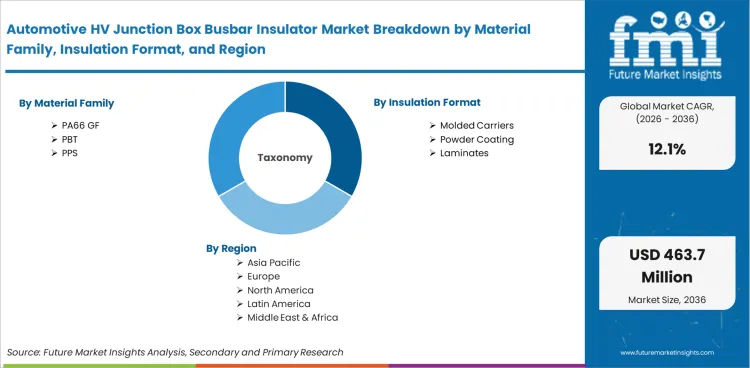
- Market coverage includes insulators built mainly from PA66 GF, PBT, PPS, and LCP, supplied as molded carriers, coatings, tubing, or laminates for high-voltage busbar routing and fixation inside EV junction boxes.
- Within the material family segment, PA66 GF is estimated to account for 34.0% share in 2026 because glass-reinforced polyamides continue to offer a practical balance of dielectric stability, temperature capability, and automotive processing ease.
- Molded carriers are expected to represent 46.0% share in 2026 within insulation format, as they combine physical support and insulation-distance control in compact HVJB packaging.
- Voltage class analysis indicates 400V is likely to account for 58.0% share in 2026, reflecting its larger installed base even as 800 V platforms continue to expand.
- BEV is projected to secure 72.0% share in 2026 in the vehicle type segment since full battery-electric platforms carry the highest concentration of pack-internal high-voltage distribution content.
- OEM supply is anticipated to capture 81.0% of market share in 2026 in the sales channel segment because junction-box insulator sets are engineered into pack architecture and rarely procured as stand-alone service components.
- Scope includes busbar insulators integrated into battery junction boxes, molded busbar carriers, dielectric sleeves, and insulation components used for HV power distribution inside EV packs, while complete junction boxes, contactors, fuses, wiring harnesses, and external charging connectors remain outside the market boundary.
- Automotive HV Junction Box Busbar Insulator Geography and Competitive Outlook
- China, India, and Germany form the fastest-rising country set in this study, while the United States remains an important large-volume demand base.
- Competitive positioning is influenced by integrated EV electrical-architecture capability rather than stand-alone insulation branding, which gives an edge to suppliers combining junction boxes, busbars, connectors, harnesses, and thermal-management expertise.
- Key participants include Yazaki, Sumitomo Wiring Systems, Furukawa Automotive Systems, LEONI, Aptiv, TE Connectivity, and Rogers Corporation.
- Market concentration remains moderate because busbar-insulator content is usually awarded through broader EV battery-connectivity programs rather than through a stand-alone component channel. Competitive advantage comes from electrical-architecture integration, materials validation, and program-level supply reliability.
| Metric | Details |
|---|---|
| Industry Size (2026) | USD 132.1 million |
| Industry Value (2036) | USD 413.8 million |
| CAGR (2026 to 2036) | 12.1% |
Source: Future Market Insights (FMI) analysis, based on proprietary forecasting model and primary research
Next-generation 800V systems generate intense corona discharge risks within confined junction boundaries, leading component evaluators to move away from legacy heat-shrink methods. Delayed migration to advanced polymeric carriers raises reliability risk during rapid DC charging events. FMI observes this tension driving immediate automotive junction box specification upgrades across global platforms, especially where cabin space constraints limit physical air-gap clearances. EV junction box busbar insulator demand directly correlates with these tighter packaging mandates.
Component qualification cycles trigger self-reinforcing adoption patterns. Once automakers validate specific dielectric compounds for a flagship platform, secondary vehicle lines quickly adopt identical specifications to reduce testing overhead. Sourcing executives prefer locked-in vendor relationships for these critical safety barriers.
China is likely to witness expansion with a 13.4% CAGR from 2026 to 2036 as domestic battery manufacturers increasingly specify integrated distribution solutions. India inclines at 12.7% via rapid commercial fleet electrification. Germany is expected to expand at an estimated 11.3% CAGR through 2036 as premium OEM programs scale 800V electrical platforms, tightening thermal and dielectric requirements inside increasingly compact junction boxes.
Demand in the United Kingdom is projected to rise at about 10.4%, driven mainly by urban EV architectures where limited packaging space places a premium on thin, dimensionally stable insulation formats. The United States market is forecast to grow near 9.4% as electrification penetrates heavy‑duty pickups and commercial vehicles, shifting material preference toward vibration‑resistant, mechanically durable insulators. South Korea is likely to post roughly 8.8% growth, supported by strong tier‑1 integration and standardized material validation, while Japan’s estimated 7.9% pace reflects conservative, reliability‑led engineering choices.
Segmental Analysis
Automotive HV Junction Box Busbar Insulator Industry Analysis by Material family
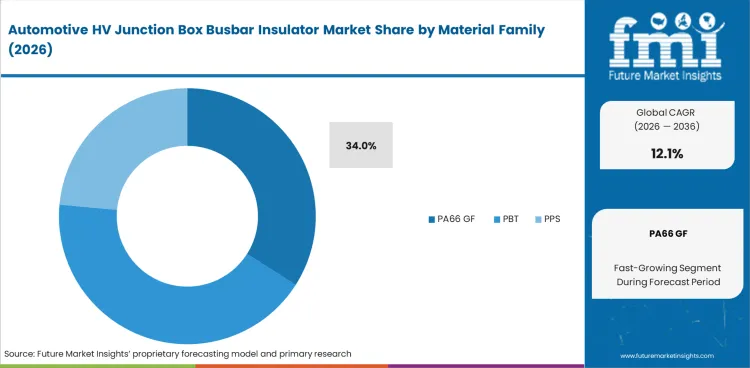
Thermoplastic stability under continuous thermal stress dictates material selection across modern architectures. PA66 GF is estimated to capture 34.0% segment share in 2026, because glass-fiber reinforcement prevents dielectric breakdown during violent temperature fluctuations. It has been noted that high-voltage systems engineers select this compound specifically for its tracking resistance index under high-humidity conditions. Reality involves stubborn validation lock-in; swapping out validated ultra thin dielectric ev busbar coatings requires completely restarting multi-year electric vehicle plastics homologation. Sourcing executives effectively remain chained to legacy PA66 GF busbar insulator automotive formulations for current generation platforms, negotiating on volume rather than seeking alternatives. Formulators failing to meet automotive-grade purity standards face immediate disqualification.
- Initial validation: Glass-fiber polyamides pass initial thermal shock screening required for baseline junction box approval. OEM engineers prioritize known performance histories.
- Secondary screening: Long-term vibration testing exposes brittle alternatives, cementing PA66 GF selection. Tier-1 assemblers require materials capable of surviving rough automated handling.
- Lifecycle retention: Expanding existing material approvals to new vehicle platforms saves millions in compliance testing. Sourcing teams renew incumbent contracts automatically.
Automotive HV Junction Box Busbar Insulator Industry Analysis by Insulation format
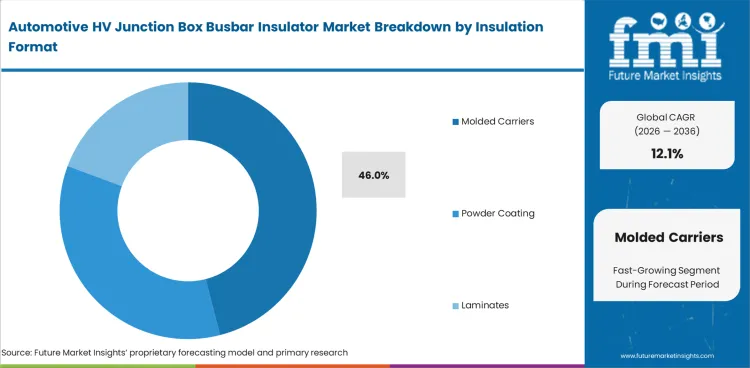
Complex routing geometries inside shrinking junction boxes force a pivot away from flexible wrapping. Molded carriers represent a projected 46.0% share of format demand in 2026 as rigid electric vehicle battery connector frameworks allow automated robotic assembly. Manual application of heat-shrink tubing introduces unacceptable tolerance variations, prompting manufacturing engineers to demand pre-molded insulation blocks. An overlooked operational reality that the molded busbar carrier market automotive segment doubles as physical support scaffolding, eliminating secondary fastening brackets typically found near separator material platforms. Dual-functionality disguises true component cost within broader bills of materials. Purchasing teams evaluating simple unit prices often miscalculate total assembly savings, penalizing vendors who pitch raw material cost reductions instead of total process efficiency. Overlooking automated insertion compatibility guarantees vendor exclusion from high-volume contracts.
- Production line integration: Pre-molded geometries drop directly into automated assembly jigs. Manufacturing engineers eliminate manual taping bottlenecks entirely.
- Hidden assembly costs: Manual heat-shrink application requires specialized heating tunnels and intensive quality control. Facility managers absorb hidden scrap rates from uneven shrinkage.
- Total lifecycle economics: Rigid carriers prevent vibration-induced chafing over extended mileage. Warranty directors avoid costly field failures linked to insulation rub-through.
Automotive HV Junction Box Busbar Insulator Industry Analysis by Voltage class
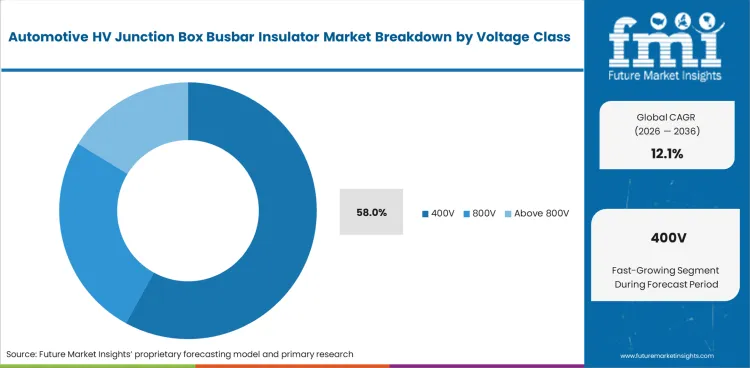
Established commuter EV platforms maintain reliable 400V electrical architectures. This voltage class is anticipated to secure 58.0% of segment sales in 2026, relying on widely available automotive connectors and standard dielectric thresholds. System architects designing entry-level vehicles refuse to absorb premium costs associated with 800V-capable tracking resistance. Based on industry attention obsessively focuses on ultra-fast charging 800V platforms, yet 400V systems generate consistent baseload volume for resin suppliers. High-voltage hardware designers at mass-market brands intentionally limit voltage to utilize standard FR4 or basic PBT formulations. Component suppliers ignoring this massive middle segment to chase 800V prestige projects forfeit guaranteed baseload revenue.
- Creepage prevention: Standard 400V systems demand specific clearance distances easily met by traditional insulators. Safety architects deploy proven geometries without redesign.
- Arcing mitigation: Baseline dielectric strength requirements prevent flashovers during normal operation. Quality control teams rely on established testing parameters.
- Performance margins: Pushing 400V materials beyond rated limits during fast charging introduces thermal degradation. Battery engineers must strictly throttle charging software.
Automotive HV Junction Box Busbar Insulator Industry Analysis by Vehicle type
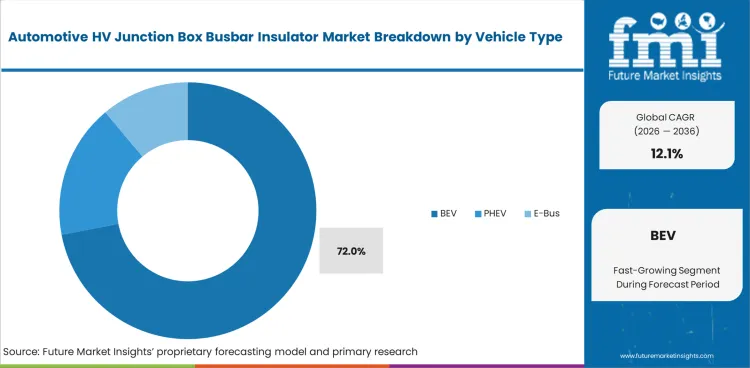
Maximum power distribution density occurs inside dedicated battery-electric vehicles. The BEV category is estimated to dominate with 72.0% segment share in 2026, requiring extensive busbar networking connecting massive floor-mounted battery packs to complex junction boxes. Powertrain engineers designing these vehicles face absolute zero-emission mandates, leaving zero space for internal combustion components and expanding automotive data connectors alongside high-voltage routing. The total busbar length per BEV often triples that of comparable PHEVs. Observers track battery chemistry advancements, missing how raw conductor length exponentially increases EV battery junction box application volume requirements. Suppliers who optimize resin flow characteristics for long extrusion processes capture this specific volume advantage. Failing to match extrusion speeds with OEM production rates leads to immediate vendor replacement.
- Resin synthesis: Chemical companies formulate specific polymer blends offering high flowability. Production chemists prioritize consistent viscosity for long busbar runs.
- Capacity scaling: Tier-1 suppliers must dedicate entire manufacturing lines to BEV-specific components. Supply chain executives demand guaranteed battery materials allocations.
- Long-term consolidation: Dominant BEV manufacturers eventually vertically integrate busbar insulation. External vendors must offer proprietary formulations to remain relevant.
Automotive HV Junction Box Busbar Insulator Industry Analysis by Sales channel
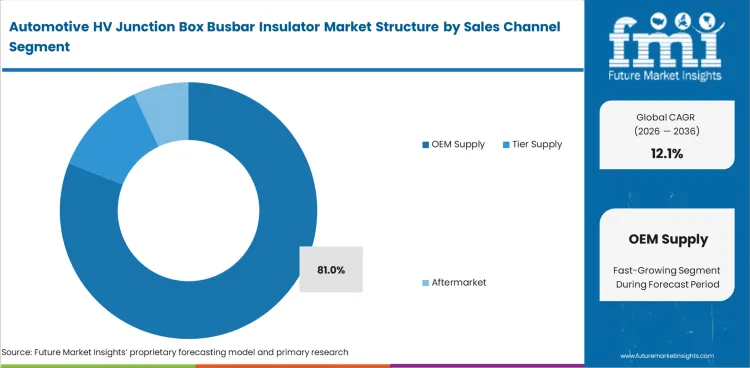
Safety homologation strictly limits aftermarket tampering with high-voltage enclosures. OEM supply is poised to capture 81.0% of channel volume in 2026, representing direct integration at the factory level. It has been observed that electric vehicle battery junction boxes are sealed units; warranty terms instantly void if unauthorized personnel breach casings. Generalists assume independent repair shops will eventually drive aftermarket volume. High-voltage component replacement remains exclusively tethered to authorized dealership networks using OEM-mandated parts. Sourcing executives at automakers control this closed loop, dictating supplier terms with absolute authority. Vendors attempting to bypass OEM qualification to sell directly to independent distributors find zero buyers willing to assume liability risk.
- Pioneer integration: Elite tier-1 suppliers partner with automakers during initial vehicle design phases. Systems engineers co-develop custom insulation profiles.
- Follower adoption: Mid-tier suppliers replicate proven geometries for secondary vehicle platforms. Purchasing teams benchmark pricing against pioneer components.
- Late-stage conversion: Legacy combustion-engine part suppliers attempt entering the EV space last. Entrants struggle passing stringent high-voltage certification hurdles.
Automotive HV Junction Box Busbar Insulator Industry Drivers, Restraints, and Opportunities
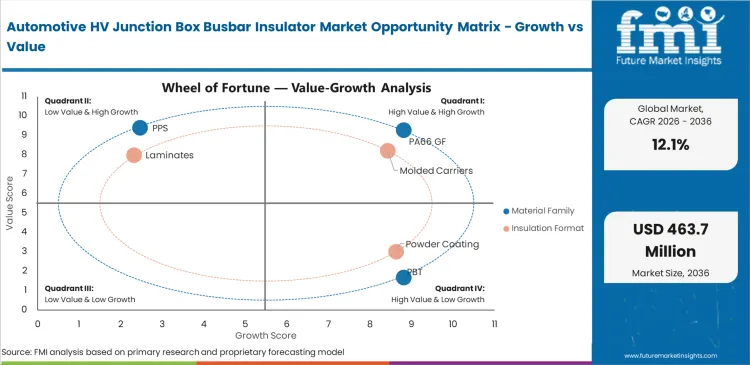
High-voltage systems architects actively redesign junction enclosures to handle extreme thermal loads generated by 350kW fast-charging stations. Systemic pressure forces sourcing executives to abandon standard PVC or basic heat-shrink materials in favor of high-performance engineered polymers capable of surviving 150°C continuous operating temperatures. Delaying material transition risks thermal runaway events within junction enclosures, potentially causing vehicle fires. Automakers cannot afford reputational damage from safety recalls, prompting immediate adoption of advanced ev battery pack thermal interface materials and specialized busbar insulators across all new vehicle platforms to mitigate busbar insulation failure modes in EV battery packs.
Rigid homologation timelines present fundamental friction slowing novel material adoption. Once automakers approve specific dielectric compounds for junction enclosures, swapping to superior alternatives requires repeating full vehicle-level crash and fire safety certifications. This barrier means even when chemical suppliers invent vastly improved insulators, tier-1 engineers cannot implement them until next complete vehicle redesign cycles. Minor incremental updates involving nylon 6 and nylon 66 currently offer the only viable pathway for introducing new formulations.
Opportunities in the Automotive HV Junction Box Busbar Insulator Industry
- Automated powder coating integration: Suppliers developing high-speed fluidized bed coating systems reduce manual labor costs. Manufacturing engineers achieve consistent dielectric thickness on complex geometries.
- Intumescent material formulation: Creating polymers that expand during thermal events prevents fire propagation. Safety architects actively seek active-defense ultra fast charging ev battery components.
- Multi-layer co-extrusion: Combining rigid cores with soft insulating outer layers simplifies installation. Assembly line workers avoid material tearing during tight-radius bending.
Regional Analysis
.webp "Top Country Growth Comparison Automotive Hv Junction Box Busbar Insulator Market Cagr (2026 2036)")
Based on regional analysis, Automotive HV Junction Box Busbar Insulator is segmented into North America, Latin America, Europe, East Asia, South Asia, Oceania, and Middle East & Africa across 40 plus countries.
| Country | CAGR (2026 to 2036) |
|---|---|
| China | 13.4% |
| India | 12.7% |
| Germany | 11.3% |
| United Kingdom | 10.4% |
| United States | 9.4% |
| South Korea | 8.8% |
| Japan | 7.9% |
Source: Future Market Insights (FMI) analysis, based on proprietary forecasting model and primary research
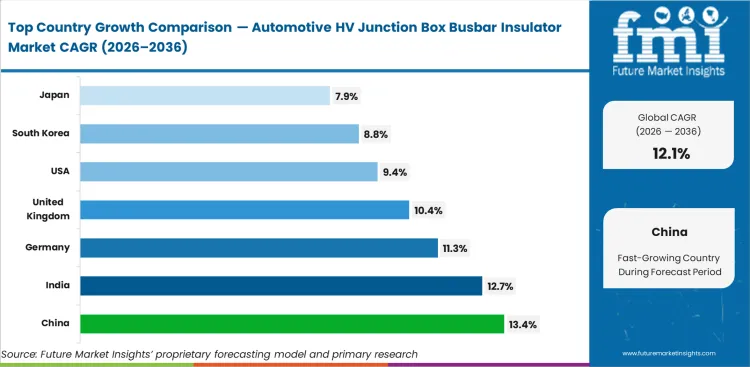
East Asia Automotive HV Junction Box Busbar Insulator Industry Analysis
Battery cell manufacturing concentration shapes how quickly this industry is advancing across East Asia. China and South Korea benefit from close alignment between cell production, pack assembly, and insulation molding, which shortens development cycles for new busbar layouts and improves coordination during design revisions. Future Market Insights analysis indicates this proximity supports faster validation of revised junction box configurations while also improving responsiveness on material selection and tooling changes. Regional EV output remains large enough that volume efficiency often carries more weight than highly customized formulation work, which is why local resin compounding capacity continues to matter in supplier selection and program awards.
- China: National NEV rollout targets keep vehicle programs on an upward curve, and domestic material ecosystems continue to benefit from large-volume electrification schedules. At 13.4% CAGR through 2036, China remains the fastest-expanding country in East Asia for this industry. Scale, local processing depth, and rapid model turnover keep the country at the center of regional program allocation.
- South Korea: Export-oriented EV programs place greater emphasis on globally compliant insulation materials and tightly controlled performance consistency. South Korea’s industry outlook remains favorable as manufacturers align domestic component systems with international safety expectations, and the country is projected to expand at 8.8% CAGR through 2036. This keeps the country well positioned in cross-border supply programs tied to advanced high-voltage architectures.
- Japan: Hybrid-led engineering legacies continue to influence current material choices, with proven reliability and low-defect execution carrying more importance than aggressive material experimentation. Japan is projected to register 7.9% CAGR through 2036, reflecting a steadier but technically disciplined path for this industry. Preference for qualified formulations and stable process control continues to define the country’s role in the region.
FMI’s report includes Taiwan and other automotive hubs across East Asia. Regional material alignment is inclining toward common specification frameworks, which is helping reduce fragmentation in qualification and part design across major production centers.
Europe Automotive HV Junction Box Busbar Insulator Industry Analysis
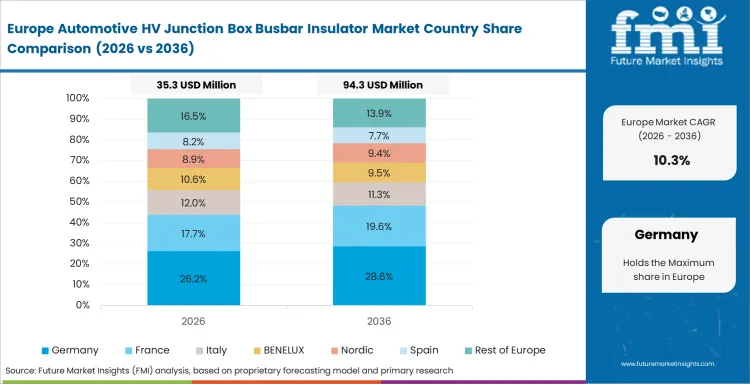
Premium EV platforms and higher-voltage vehicle programs shape product requirements across Europe. German and British vehicle platforms increasingly require insulators that can withstand higher continuous thermal loads inside compact junction enclosures, especially where 800V systems are moving from niche performance applications into broader platform planning. The engineers across this region treat enclosure heat management and insulation reliability as closely linked design priorities, which is lifting interest in higher-performance materials such as polyphenylene sulfide. Chemical compliance also remains a gatekeeping factor, since qualification under European regulatory requirements directly affects access to advanced busbar and enclosure programs.
- Germany: High-performance EV platforms continue to push insulation requirements toward greater thermal shock resistance and tighter performance tolerance. Germany is anticipated to expand at 11.3% CAGR through 2036, supported by premium vehicle programs that continue to stretch technical limits in high-voltage packaging. This keeps the country on a positive trend for higher-specification resin and insulator formats.
- United Kingdom: Compact EV layouts place greater pressure on packaging efficiency, which raises interest in thin-wall insulation approaches and space-saving busbar routing designs. Industry analysis of automotive HV junction box busbar insulators in the United Kingdom points to a 10.4% CAGR through 2036, with growth tied to tighter packaging requirements rather than sheer production scale. Small-footprint vehicle programs continue to create room for differentiated insulation formats.
FMI’s report includes France, Italy, and the Nordic countries. End-of-life and material compliance requirements across Europe are also accelerating the shift toward halogen-free flame-retardant compounds in qualified automotive insulation systems.
North America Automotive HV Junction Box Busbar Insulator Industry Analysis
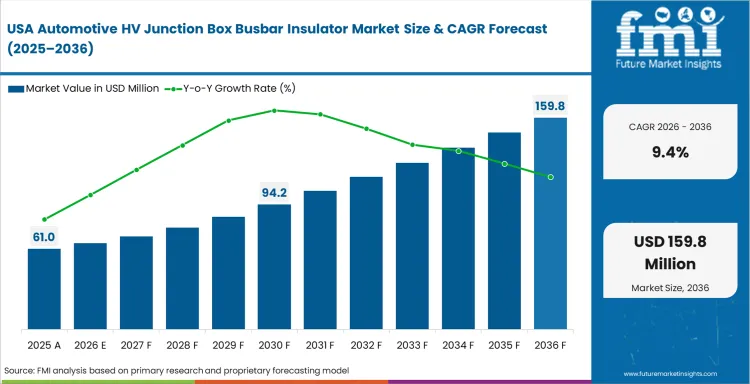
Vehicle electrification in North America is shaped more heavily by pickup, SUV, and commercial vehicle requirements than in many other regions, which changes how insulation materials are evaluated. Busbar insulators used in these platforms must perform under higher vibration loads, wider temperature swings, and heavier current stress linked to towing and utility-duty operation. The mechanical durability carries weight alongside dielectric strength in regional qualification cycles, which favors materials with stronger impact resistance and stable thermal behavior. Product positioning in this region is therefore tied less to minimum compliance and more to whether the material can perform consistently in demanding duty conditions.
- United States: Electric pickups and larger battery-electric utility vehicles are pushing junction enclosure requirements toward thicker and more durable insulation profiles. At 9.4% CAGR through 2036, the United States remains the main driver of regional expansion for this industry. Platform mix and operating severity continue to support above-average interest in heavy-duty compatible insulation materials.
FMI's report includes Canada and Mexico. Cross-border component assembly operations demand highly consistent material handling characteristics across varying climates.
Competitive Aligners for Market Players
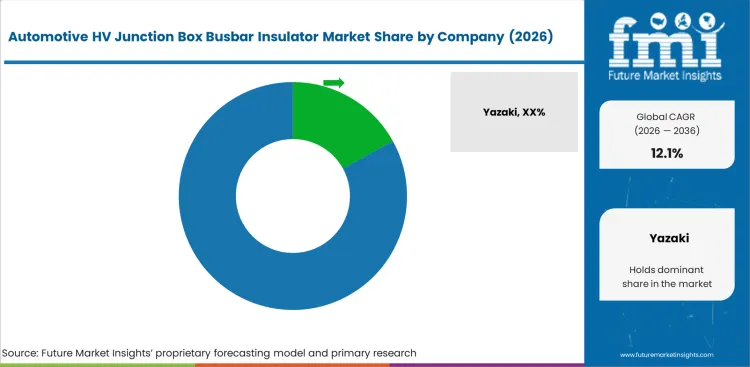
Consolidated tier-1 wiring harness manufacturers heavily dominate high-voltage power distribution routing. Companies like Yazaki, Sumitomo Wiring Systems, and LEONI dictate global material specifications because they control complete vehicle electrical architecture designs. Formulators pitching raw flame retardant polyamide compounds cannot sell directly to automakers; they must convince tier-1 gatekeepers to validate resins. Competition among automotive HV junction box busbar insulator key players centers entirely on passing grueling thermal-shock and vibration test matrices defined by dominant harness integrators. Independent insulator manufacturers survive only by securing secondary sourcing contracts when primary suppliers face capacity constraints.
Established resin producers maintain deeply embedded material approval libraries. Rogers Corporation and TE Connectivity possess catalogs of pre-validated dielectric formulations already cleared for automotive use. Challengers attempting to introduce novel polymers face millions in independent testing costs just to secure preliminary meetings with tier-1 hardware engineers. Incumbents leverage massive certification libraries to bundle junction box insulators alongside battery cell barriers, creating unified sourcing packages purely focused startups cannot match.
Automakers actively resist complete reliance on single regional polymer suppliers. Sourcing executives intentionally qualify parallel material streams from Furukawa Automotive Systems and Aptiv to prevent assembly line shutdowns during localized chemical shortages. Large buyers wield dual-sourcing mandates to force incumbent pricing down, threatening to shift volume to secondary approved vendors. True competitive separation requires localized compounding facilities adjacent to major vehicle assembly plants, ensuring unbroken supply continuity during global shipping disruptions.
Key Players in Automotive HV Junction Box Busbar Insulator Market
- Yazaki
- Sumitomo Wiring Systems
- Furukawa Automotive Systems
- LEONI
- Aptiv
- TE Connectivity
- Rogers Corporation
Scope of the Report
| Metric | Value |
|---|---|
| Quantitative Units | USD 132.1 million to USD 413.8 million, at a CAGR of 12.1% |
| Market Definition | Specialized dielectric barrier materials encasing high-voltage power distribution rails within electric vehicle junction boxes, preventing arcing and managing thermal loads. |
| Segmentation | Material family, Insulation format, Voltage class, Vehicle type, Sales channel |
| Regions Covered | North America, Latin America, Europe, East Asia, South Asia, Oceania, Middle East & Africa |
| Countries Covered | China, India, Germany, United Kingdom, United States, South Korea, Japan |
| Key Companies Profiled | Yazaki, Sumitomo Wiring Systems, Furukawa Automotive Systems, LEONI, Aptiv, TE Connectivity, Rogers Corporation |
| Forecast Period | 2026 to 2036 |
| Approach | Global BEV production volumes cross-referenced with average busbar length per vehicle architecture |
Source: Future Market Insights (FMI) analysis, based on proprietary forecasting model and primary research
Automotive HV Junction Box Busbar Insulator Market Analysis by Segments
Material family
- PA66 GF
- PBT
- PPS
- LCP
- Others
Insulation format
- Molded carriers
- Powder coating
- Heat-shrink tubing
- Laminates
Voltage class
- 400V
- 800V
- Above 800V
Vehicle type
- BEV
- PHEV
- E-bus
- E-truck
Sales channel
- OEM supply
- Tier supply
- Aftermarket
Region
- North America
- Latin America
- Europe
- East Asia
- South Asia
- Oceania
- Middle East & Africa
Bibliography
- Farooq, U., et al. (2026, February 20). Enhancing electric vehicle battery performance and safety through busbar optimization: A multi-physics modeling and experimental approach. Journal of Power Sources Advances.
- Furukawa Electric Co., Ltd. (2024). High Voltage Junction Boxes for Isuzu ELF EV. Furukawa Electric Review, 55.
- Gomes, V. B., Kasaei, M. M., Carbas, R. J. C., & Marques, E. A. S. (2025, March 04). A new joining by forming process for busbar-prismatic cell interconnections in electric vehicle batteries. The International Journal of Advanced Manufacturing Technology.
- Haghbin, S., et al. (2025, July 01). Automotive battery pack standards and design characteristics: A review. Discover Applied Sciences.
- International Energy Agency. (2025, May 14). Global EV Outlook 2025.
This bibliography is provided for reader reference. The full FMI report contains the complete reference list with primary source documentation.
This Report Addresses
- Detailed component volume mapping for PA66 GF and molded carrier adoption across global EV platforms.
- Strategic assessment highlighting thermal shock validation timelines and barrier-to-entry realities.
- Regional divergence tracking between East Asian rapid prototyping and European thermal tolerance limits.
- Safety homologation impacts dictating OEM supply channel dominance over aftermarket distributors.
- Voltage architecture transitions shifting from baseline 400V commuters to 800V premium platforms.
- Vendor lock-in mechanisms preventing rapid substitution of validated dielectric resins.
- Production integration economics favoring pre-molded carriers over manual heat-shrink application.
- Supply chain vulnerabilities associated with dual-sourcing mandates from major tier-1 harness integrators.
Frequently Asked Questions
What limits aftermarket penetration for busbar insulators?
Safety homologation prohibits unauthorized tampering, tethering high-voltage component replacement exclusively to certified OEM dealership networks globally.
Why does PA66 GF maintain material dominance?
Glass-fiber reinforcement prevents catastrophic dielectric breakdown during thermal cycling, allowing automakers to avoid costly recertification protocols.
How do molded carriers reduce total assembly costs?
Pre-molded geometries drop directly into automated assembly jigs, completely eliminating manual taping bottlenecks and uneven shrinkage.
Why do 400V systems still hold majority share?
System architects designing mass-market commuter vehicles deploy proven geometries, avoiding premium costs associated with 800V tracking resistance.
What barrier slows new insulator adoption?
Approving novel dielectric compounds requires repeating full vehicle-level crash and fire safety certifications during complete redesigns.
How does regional proximity benefit East Asian suppliers?
Co-locating insulation molding facilities adjacent to battery hubs eliminates shipping delays and accelerates rapid prototype iterations.
Why do European automakers specify PPS formulations?
Flagship performance EVs demand specialized PPS resins to survive extreme thermal shock during high-speed Autobahn driving.
What mechanical pressure defines North American adoption?
Engineers designing electric pickups require durable insulators capable of surviving intense off-road vibration and heavy towing heat.
How do tier-1 wiring harness manufacturers control specifications?
Formulators must convince dominant harness integrators to validate resins through grueling thermal-shock and vibration test matrices.
What advantage do incumbent resin producers hold?
Established producers maintain deeply embedded material approval libraries, creating unified sourcing packages that startups cannot match.
Why do large buyers enforce dual-sourcing mandates?
Sourcing executives qualify parallel material streams to prevent assembly line shutdowns during localized chemical supply shortages.
What advantage does powder coating offer over laminates?
High-speed fluidized bed coating systems achieve consistent dielectric thickness on complex geometries without material tearing risks.
Why do BEVs consume substantially more insulation volume?
BEVs require extensive busbar networking, tripling raw conductor length compared to PHEVs and exponentially increasing insulation needs.
How does fast-charging influence insulator material choice?
Next-generation 800V systems generate intense corona discharge risks, forcing evaluators to discard legacy heat-shrink methods immediately.
What role do intumescent materials play in future architectures?
Polymers expanding during thermal events actively prevent fire propagation, mitigating thermal runaway risks inside dense battery packs.
How do extrusion flow characteristics impact vendor selection?
Suppliers must optimize resin flow for continuous extrusion processes, matching automaker production rates to secure volume contracts.
What hidden operational costs plague heat-shrink tubing applications?
Manual application requires specialized heating tunnels and intensive quality control, causing hidden scrap rates from uneven shrinkage.
Why is initial validation critical for long-term component retention?
Expanding existing material approvals to new vehicle platforms saves automakers millions in compliance testing and recertification overhead.
How do tight cabin space constraints influence insulation choices?
Shrinking junction boxes compel engineers to mandate pre-molded insulation blocks, eliminating physical air-gap clearances entirely.
What forces automakers to trade component cost for speed-to-market?
High-voltage systems architects need unified 800V systems immediately, granting immense pricing leverage to suppliers possessing validated materials.
Preview the report firsthand - request a free sample
Get SampleGet the brochure for pricing and purchase details.
Get PDFTable of Content
- Executive Summary
- Global Market Outlook
- Demand-side Trends
- Supply-side Trends
- Technology Roadmap Analysis
- Analysis and Recommendations
- Market Overview
- Market Coverage / Taxonomy
- Market Definition / Scope / Limitations
- Research Methodology
- Chapter Orientation
- Analytical Lens and Working Hypotheses
- Market Structure, Signals, and Trend Drivers
- Benchmarking and Cross-market Comparability
- Market Sizing, Forecasting, and Opportunity Mapping
- Research Design and Evidence Framework
- Desk Research Programme (Secondary Evidence)
- Company Annual and Sustainability Reports
- Peer-reviewed Journals and Academic Literature
- Corporate Websites, Product Literature, and Technical Notes
- Earnings Decks and Investor Briefings
- Statutory Filings and Regulatory Disclosures
- Technical White Papers and Standards Notes
- Trade Journals, Industry Magazines, and Analyst Briefs
- Conference Proceedings, Webinars, and Seminar Materials
- Government Statistics Portals and Public Data Releases
- Press Releases and Reputable Media Coverage
- Specialist Newsletters and Curated Briefings
- Sector Databases and Reference Repositories
- FMI Internal Proprietary Databases and Historical Market Datasets
- Subscription Datasets and Paid Sources
- Social Channels, Communities, and Digital Listening Inputs
- Additional Desk Sources
- Expert Input and Fieldwork (Primary Evidence)
- Primary Modes
- Qualitative Interviews and Expert Elicitation
- Quantitative Surveys and Structured Data Capture
- Blended Approach
- Why Primary Evidence is Used
- Field Techniques
- Interviews
- Surveys
- Focus Groups
- Observational and In-context Research
- Social and Community Interactions
- Stakeholder Universe Engaged
- C-suite Leaders
- Board Members
- Presidents and Vice Presidents
- R&D and Innovation Heads
- Technical Specialists
- Domain Subject-matter Experts
- Scientists
- Physicians and Other Healthcare Professionals
- Governance, Ethics, and Data Stewardship
- Research Ethics
- Data Integrity and Handling
- Primary Modes
- Tooling, Models, and Reference Databases
- Desk Research Programme (Secondary Evidence)
- Data Engineering and Model Build
- Data Acquisition and Ingestion
- Cleaning, Normalisation, and Verification
- Synthesis, Triangulation, and Analysis
- Quality Assurance and Audit Trail
- Market Background
- Market Dynamics
- Drivers
- Restraints
- Opportunity
- Trends
- Scenario Forecast
- Demand in Optimistic Scenario
- Demand in Likely Scenario
- Demand in Conservative Scenario
- Opportunity Map Analysis
- Product Life Cycle Analysis
- Supply Chain Analysis
- Investment Feasibility Matrix
- Value Chain Analysis
- PESTLE and Porter’s Analysis
- Regulatory Landscape
- Regional Parent Market Outlook
- Production and Consumption Statistics
- Import and Export Statistics
- Market Dynamics
- Global Market Analysis 2021 to 2025 and Forecast, 2026 to 2036
- Historical Market Size Value (USD Million) Analysis, 2021 to 2025
- Current and Future Market Size Value (USD Million) Projections, 2026 to 2036
- Y-o-Y Growth Trend Analysis
- Absolute $ Opportunity Analysis
- Global Market Pricing Analysis 2021 to 2025 and Forecast 2026 to 2036
- Global Market Analysis 2021 to 2025 and Forecast 2026 to 2036, By Material Family
- Introduction / Key Findings
- Historical Market Size Value (USD Million) Analysis By Material Family , 2021 to 2025
- Current and Future Market Size Value (USD Million) Analysis and Forecast By Material Family , 2026 to 2036
- PA66 GF
- PBT
- PPS
- PA66 GF
- Y-o-Y Growth Trend Analysis By Material Family , 2021 to 2025
- Absolute $ Opportunity Analysis By Material Family , 2026 to 2036
- Global Market Analysis 2021 to 2025 and Forecast 2026 to 2036, By Insulation Format
- Introduction / Key Findings
- Historical Market Size Value (USD Million) Analysis By Insulation Format, 2021 to 2025
- Current and Future Market Size Value (USD Million) Analysis and Forecast By Insulation Format, 2026 to 2036
- Molded Carriers
- Powder Coating
- Laminates
- Molded Carriers
- Y-o-Y Growth Trend Analysis By Insulation Format, 2021 to 2025
- Absolute $ Opportunity Analysis By Insulation Format, 2026 to 2036
- Global Market Analysis 2021 to 2025 and Forecast 2026 to 2036, By Voltage Class
- Introduction / Key Findings
- Historical Market Size Value (USD Million) Analysis By Voltage Class, 2021 to 2025
- Current and Future Market Size Value (USD Million) Analysis and Forecast By Voltage Class, 2026 to 2036
- 400V
- 800V
- Above 800V
- 400V
- Y-o-Y Growth Trend Analysis By Voltage Class, 2021 to 2025
- Absolute $ Opportunity Analysis By Voltage Class, 2026 to 2036
- Global Market Analysis 2021 to 2025 and Forecast 2026 to 2036, By Vehicle Type
- Introduction / Key Findings
- Historical Market Size Value (USD Million) Analysis By Vehicle Type, 2021 to 2025
- Current and Future Market Size Value (USD Million) Analysis and Forecast By Vehicle Type, 2026 to 2036
- BEV
- PHEV
- E-Bus
- BEV
- Y-o-Y Growth Trend Analysis By Vehicle Type, 2021 to 2025
- Absolute $ Opportunity Analysis By Vehicle Type, 2026 to 2036
- Global Market Analysis 2021 to 2025 and Forecast 2026 to 2036, By Sales Channel
- Introduction / Key Findings
- Historical Market Size Value (USD Million) Analysis By Sales Channel, 2021 to 2025
- Current and Future Market Size Value (USD Million) Analysis and Forecast By Sales Channel, 2026 to 2036
- OEM Supply
- Tier Supply
- Aftermarket
- OEM Supply
- Y-o-Y Growth Trend Analysis By Sales Channel, 2021 to 2025
- Absolute $ Opportunity Analysis By Sales Channel, 2026 to 2036
- Global Market Analysis 2021 to 2025 and Forecast 2026 to 2036, By Region
- Introduction
- Historical Market Size Value (USD Million) Analysis By Region, 2021 to 2025
- Current Market Size Value (USD Million) Analysis and Forecast By Region, 2026 to 2036
- North America
- Latin America
- Western Europe
- Eastern Europe
- East Asia
- South Asia and Pacific
- Middle East & Africa
- Market Attractiveness Analysis By Region
- North America Market Analysis 2021 to 2025 and Forecast 2026 to 2036, By Country
- Historical Market Size Value (USD Million) Trend Analysis By Market Taxonomy, 2021 to 2025
- Market Size Value (USD Million) Forecast By Market Taxonomy, 2026 to 2036
- By Country
- USA
- Canada
- Mexico
- By Material Family
- By Insulation Format
- By Voltage Class
- By Vehicle Type
- By Sales Channel
- By Country
- Market Attractiveness Analysis
- By Country
- By Material Family
- By Insulation Format
- By Voltage Class
- By Vehicle Type
- By Sales Channel
- Key Takeaways
- Latin America Market Analysis 2021 to 2025 and Forecast 2026 to 2036, By Country
- Historical Market Size Value (USD Million) Trend Analysis By Market Taxonomy, 2021 to 2025
- Market Size Value (USD Million) Forecast By Market Taxonomy, 2026 to 2036
- By Country
- Brazil
- Chile
- Rest of Latin America
- By Material Family
- By Insulation Format
- By Voltage Class
- By Vehicle Type
- By Sales Channel
- By Country
- Market Attractiveness Analysis
- By Country
- By Material Family
- By Insulation Format
- By Voltage Class
- By Vehicle Type
- By Sales Channel
- Key Takeaways
- Western Europe Market Analysis 2021 to 2025 and Forecast 2026 to 2036, By Country
- Historical Market Size Value (USD Million) Trend Analysis By Market Taxonomy, 2021 to 2025
- Market Size Value (USD Million) Forecast By Market Taxonomy, 2026 to 2036
- By Country
- Germany
- UK
- Italy
- Spain
- France
- Nordic
- BENELUX
- Rest of Western Europe
- By Material Family
- By Insulation Format
- By Voltage Class
- By Vehicle Type
- By Sales Channel
- By Country
- Market Attractiveness Analysis
- By Country
- By Material Family
- By Insulation Format
- By Voltage Class
- By Vehicle Type
- By Sales Channel
- Key Takeaways
- Eastern Europe Market Analysis 2021 to 2025 and Forecast 2026 to 2036, By Country
- Historical Market Size Value (USD Million) Trend Analysis By Market Taxonomy, 2021 to 2025
- Market Size Value (USD Million) Forecast By Market Taxonomy, 2026 to 2036
- By Country
- Russia
- Poland
- Hungary
- Balkan & Baltic
- Rest of Eastern Europe
- By Material Family
- By Insulation Format
- By Voltage Class
- By Vehicle Type
- By Sales Channel
- By Country
- Market Attractiveness Analysis
- By Country
- By Material Family
- By Insulation Format
- By Voltage Class
- By Vehicle Type
- By Sales Channel
- Key Takeaways
- East Asia Market Analysis 2021 to 2025 and Forecast 2026 to 2036, By Country
- Historical Market Size Value (USD Million) Trend Analysis By Market Taxonomy, 2021 to 2025
- Market Size Value (USD Million) Forecast By Market Taxonomy, 2026 to 2036
- By Country
- China
- Japan
- South Korea
- By Material Family
- By Insulation Format
- By Voltage Class
- By Vehicle Type
- By Sales Channel
- By Country
- Market Attractiveness Analysis
- By Country
- By Material Family
- By Insulation Format
- By Voltage Class
- By Vehicle Type
- By Sales Channel
- Key Takeaways
- South Asia and Pacific Market Analysis 2021 to 2025 and Forecast 2026 to 2036, By Country
- Historical Market Size Value (USD Million) Trend Analysis By Market Taxonomy, 2021 to 2025
- Market Size Value (USD Million) Forecast By Market Taxonomy, 2026 to 2036
- By Country
- India
- ASEAN
- Australia & New Zealand
- Rest of South Asia and Pacific
- By Material Family
- By Insulation Format
- By Voltage Class
- By Vehicle Type
- By Sales Channel
- By Country
- Market Attractiveness Analysis
- By Country
- By Material Family
- By Insulation Format
- By Voltage Class
- By Vehicle Type
- By Sales Channel
- Key Takeaways
- Middle East & Africa Market Analysis 2021 to 2025 and Forecast 2026 to 2036, By Country
- Historical Market Size Value (USD Million) Trend Analysis By Market Taxonomy, 2021 to 2025
- Market Size Value (USD Million) Forecast By Market Taxonomy, 2026 to 2036
- By Country
- Kingdom of Saudi Arabia
- Other GCC Countries
- Turkiye
- South Africa
- Other African Union
- Rest of Middle East & Africa
- By Material Family
- By Insulation Format
- By Voltage Class
- By Vehicle Type
- By Sales Channel
- By Country
- Market Attractiveness Analysis
- By Country
- By Material Family
- By Insulation Format
- By Voltage Class
- By Vehicle Type
- By Sales Channel
- Key Takeaways
- Key Countries Market Analysis
- USA
- Pricing Analysis
- Market Share Analysis, 2025
- By Material Family
- By Insulation Format
- By Voltage Class
- By Vehicle Type
- By Sales Channel
- Canada
- Pricing Analysis
- Market Share Analysis, 2025
- By Material Family
- By Insulation Format
- By Voltage Class
- By Vehicle Type
- By Sales Channel
- Mexico
- Pricing Analysis
- Market Share Analysis, 2025
- By Material Family
- By Insulation Format
- By Voltage Class
- By Vehicle Type
- By Sales Channel
- Brazil
- Pricing Analysis
- Market Share Analysis, 2025
- By Material Family
- By Insulation Format
- By Voltage Class
- By Vehicle Type
- By Sales Channel
- Chile
- Pricing Analysis
- Market Share Analysis, 2025
- By Material Family
- By Insulation Format
- By Voltage Class
- By Vehicle Type
- By Sales Channel
- Germany
- Pricing Analysis
- Market Share Analysis, 2025
- By Material Family
- By Insulation Format
- By Voltage Class
- By Vehicle Type
- By Sales Channel
- UK
- Pricing Analysis
- Market Share Analysis, 2025
- By Material Family
- By Insulation Format
- By Voltage Class
- By Vehicle Type
- By Sales Channel
- Italy
- Pricing Analysis
- Market Share Analysis, 2025
- By Material Family
- By Insulation Format
- By Voltage Class
- By Vehicle Type
- By Sales Channel
- Spain
- Pricing Analysis
- Market Share Analysis, 2025
- By Material Family
- By Insulation Format
- By Voltage Class
- By Vehicle Type
- By Sales Channel
- France
- Pricing Analysis
- Market Share Analysis, 2025
- By Material Family
- By Insulation Format
- By Voltage Class
- By Vehicle Type
- By Sales Channel
- India
- Pricing Analysis
- Market Share Analysis, 2025
- By Material Family
- By Insulation Format
- By Voltage Class
- By Vehicle Type
- By Sales Channel
- ASEAN
- Pricing Analysis
- Market Share Analysis, 2025
- By Material Family
- By Insulation Format
- By Voltage Class
- By Vehicle Type
- By Sales Channel
- Australia & New Zealand
- Pricing Analysis
- Market Share Analysis, 2025
- By Material Family
- By Insulation Format
- By Voltage Class
- By Vehicle Type
- By Sales Channel
- China
- Pricing Analysis
- Market Share Analysis, 2025
- By Material Family
- By Insulation Format
- By Voltage Class
- By Vehicle Type
- By Sales Channel
- Japan
- Pricing Analysis
- Market Share Analysis, 2025
- By Material Family
- By Insulation Format
- By Voltage Class
- By Vehicle Type
- By Sales Channel
- South Korea
- Pricing Analysis
- Market Share Analysis, 2025
- By Material Family
- By Insulation Format
- By Voltage Class
- By Vehicle Type
- By Sales Channel
- Russia
- Pricing Analysis
- Market Share Analysis, 2025
- By Material Family
- By Insulation Format
- By Voltage Class
- By Vehicle Type
- By Sales Channel
- Poland
- Pricing Analysis
- Market Share Analysis, 2025
- By Material Family
- By Insulation Format
- By Voltage Class
- By Vehicle Type
- By Sales Channel
- Hungary
- Pricing Analysis
- Market Share Analysis, 2025
- By Material Family
- By Insulation Format
- By Voltage Class
- By Vehicle Type
- By Sales Channel
- Kingdom of Saudi Arabia
- Pricing Analysis
- Market Share Analysis, 2025
- By Material Family
- By Insulation Format
- By Voltage Class
- By Vehicle Type
- By Sales Channel
- Turkiye
- Pricing Analysis
- Market Share Analysis, 2025
- By Material Family
- By Insulation Format
- By Voltage Class
- By Vehicle Type
- By Sales Channel
- South Africa
- Pricing Analysis
- Market Share Analysis, 2025
- By Material Family
- By Insulation Format
- By Voltage Class
- By Vehicle Type
- By Sales Channel
- USA
- Market Structure Analysis
- Competition Dashboard
- Competition Benchmarking
- Market Share Analysis of Top Players
- By Region
- By Material Family
- By Insulation Format
- By Voltage Class
- By Vehicle Type
- By Sales Channel
- Competition Analysis
- Competition Deep Dive
- Yazaki
- Overview
- Product Portfolio
- Profitability by Market Segments (Product/Age /Sales Channel/Region)
- Sales Footprint
- Strategy Overview
- Marketing Strategy
- Product Strategy
- Channel Strategy
- Sumitomo Wiring Systems
- Furukawa Automotive Systems
- LEONI
- Aptiv
- TE Connectivity
- Yazaki
- Competition Deep Dive
- Assumptions & Acronyms Used


