

- Industry Size (2026)
- USD 1.9 Bn
- Forecast (2036)
- USD 4.6 Bn
- CAGR (2026 to 2036)
- 9.2%
Flame-Retardant Polyamide Compounds for EV Powertrains and Batteries Market Forecast and Outlook 2026 to 2036
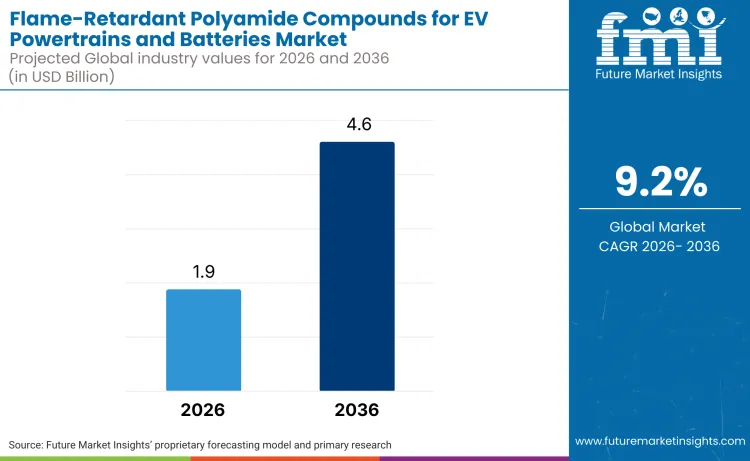
With an expected valuation of USD 1.9 billion in 2026, the flame-retardant polyamide compounds for EV powertrains and batteries market is slated to reach USD 4.6 billion by 2036, advancing at a CAGR of 9.2%. As per FMI’s insights, the flame-retardant polyamide compounds market for EV powertrains and batteries entering a decisive phase of structural transformation as the industry advances into the mid-decade period. Escalating electrification intensity, combined with increasingly stringent safety and performance standards, is redefining material selection across high-voltage EV systems.
A principal growth catalyst is the accelerated transition from conventional electrical platforms to next-generation high-voltage architectures, particularly within premium and performance-oriented EV segments. This transition places unprecedented demands on polymer compounds, requiring exceptional dielectric strength, enhanced arc resistance, and elevated CTI performance to ensure electrical integrity within compact, high-density battery modules and power electronics assemblies.
Concurrently, the market is witnessing a pronounced shift away from halogenated flame-retardant systems toward HFFR. This transition is driven by regulatory pressures, OEM sustainability mandates, and heightened awareness of safety risks associated with smoke toxicity and electro-corrosion in high-voltage components. HFFR-based polyamide compounds offer improved thermal stability and reduced corrosive by-products, making them increasingly indispensable for inverters, busbars, connectors, and battery management systems.
As EV manufacturers prioritize thinner wall sections, weight reduction, and enhanced safety performance, the consolidation of electrical insulation, flame retardancy, mechanical strength, and thermal endurance into single molded components has emerged as a defining design paradigm for the coming generation of electric vehicles.
This strategic reorientation is reinforced by executive leadership across the engineering plastics value chain. In this context, BASF’s Asia-Pacific leadership has articulated the company’s forward-looking material strategy for high-voltage EV applications: "As safety becomes increasingly vital in the design and material selection for metal components in EVs, such as wiring terminals and busbars, BASF is committed to developing innovative solutions for the EV industry. Our goal is not only to meet today’s design needs but also to equip our customers with the tools to develop cutting-edge technologies that address future technical requirements and safety standards." Source Analyst/Executive: Eng Guan Soh, Vice President, Business Management Engineering Plastics, Performance Materials Asia Pacific, BASF
Summary of Flame-Retardant Polyamide Compounds for EV Powertrains and Batteries Market
What is Growth Outlook for Flame-Retardant Polyamide Compounds for EV Powertrains and Batteries Market as per Future Market Insights Projection?
Future Market Insights projects the flame-retardant polyamide compounds for EV powertrains and batteries market to expand at a CAGR of 9.2% from 2026 to 2036, increasing from USD 1.9 billion in 2026 to USD 4.6 billion by 2036.
FMI Research Approach: FMI proprietary forecasting model integrating EV electrification intensity, high-voltage system adoption, and safety-driven polymer substitution across global automotive platforms.
How do FMI Analysts Perceive Flame-Retardant Polyamide Compounds for EV Powertrains and Batteries Market to Evolve?
FMI analysts perceive the market evolving toward specification-locked adoption of high-performance, halogen-free polyamide systems, where dielectric strength, arc resistance, and long-term thermal durability are treated as non-negotiable design requirements. Material selection is increasingly embedded early in EV platform architecture, limiting post-design substitution and reinforcing long-term demand visibility.
FMI Research Approach: Assessment of OEM material qualification pathways, high-voltage EV architecture trends, and regulatory-driven flame-retardant chemistry shifts.
Which Country Holds the Largest Share in Global Flame-Retardant Polyamide Compounds for EV Powertrains and Batteries Market?
China holds the largest share in the global flame-retardant polyamide compounds market for EV powertrains and batteries, supported by deep vertical integration across battery manufacturing, chemical production, and EV assembly, alongside accelerating deployment of high-voltage electric platforms.
FMI Research Approach: Country-level modeling based on EV battery production capacity, polymer compounding scale, and alignment with domestic electrification policies.
How large will Flame-Retardant Polyamide Compounds for EV Powertrains and Batteries Market be by 2036?
The global flame-retardant polyamide compounds for EV powertrains and batteries market is projected to reach USD 4.6 billion by 2036.
FMI Research Approach: Long-term revenue forecasting derived from high-voltage EV penetration rates, battery system material intensity, and sustained qualification of flame-retardant polymers across multiple vehicle generations.
What is Definition of Flame-Retardant Polyamide Compounds for EV Powertrains and Batteries Market?
The flame-retardant polyamide compounds for EV powertrains and batteries market comprises engineered polyamide formulations designed to provide electrical insulation, flame resistance, and thermal stability in high-voltage electric vehicle systems, including battery packs, power electronics, connectors, and busbar components.
FMI Research Approach: FMI market taxonomy and inclusion-exclusion framework covering halogen-free, halogenated, and specialty flame-retardant polyamide systems used in EV-specific electrical and thermal management applications.
What are Globally Unique Trends Shaping Flame-Retardant Polyamide Compounds for EV Powertrains and Batteries Market?
Globally unique trends include the rapid shift toward halogen-free flame-retardant systems, rising specification of integrated electrical insulation and fire-containment polymers, and increasing reliance on polyamide-based metal substitution to meet lightweighting, safety, and packaging-density requirements in next-generation electric vehicles.
FMI Research Approach: Synthesis of EV safety regulations, battery fire-risk mitigation strategies, and OEM sustainability mandates influencing polymer formulation choices.
Flame-Retardant Polyamide Compounds for EV Powertrains and Batteries Market Key Takeaways
| Metric | Value |
|---|---|
| Expected Value (2026E) | USD 1.9 billion |
| Projected Value (2036F) | USD 4.6 billion |
| CAGR (2026-2036) | 9.2% |
Source: FMI analysis based on primary research and proprietary forecasting model
Why is the Flame-Retardant Polyamide Compounds for EV Powertrains and Batteries Market Growing?
The flame-retardant polyamide market is experiencing structurally driven growth, supported by electrification, regulatory change, and evolving material requirements across automotive and energy infrastructure sectors. Demand is anchored in high-voltage electric mobility, energy storage systems, and sustainability-led material substitution rather than short-term vehicle production cycles.
The shift toward ultra-fast charging electric vehicle architectures is establishing a baseline requirement for high-performance insulating polymers. At elevated voltage levels, conventional engineering plastics face limitations in dielectric stability, tracking resistance, and long-term thermal performance. Enhanced FR polyamides are becoming standard materials across battery modules, power electronics, and high-voltage connectors.
OEMs such as Hyundai Motor Group and Porsche have adopted high-voltage architectures across flagship electric platforms, accelerating the qualification of advanced FR polyamide grades. In parallel, suppliers including LANXESS are developing reinforced polyamides engineered for electrical insulation, resistance to aggressive cooling media, and durability under sustained electrical load. These developments are establishing a durable demand floor for FR polyamides in next-generation electric vehicles.
Environmental regulation is playing an increasingly decisive role in material selection. The implementation of the EU Battery Regulation, including mandatory disclosure of hazardous substances, is accelerating the phase-out of brominated flame retardants. This regulatory environment is driving OEMs toward halogen-free alternatives across global supply chains.
Phosphorus-based and halogen-free FR polyamides are gaining preference, particularly in applications requiring low smoke emissions, reduced corrosion, and high surface quality. Producers such as Syensqo have introduced halogen-free and partially bio-based polyamide grades designed for advanced electrical systems, reinforcing this shift toward compliant and sustainable formulations.
Lightweighting objectives continue to support metal-to-plastic substitution in electric vehicles, particularly in large-format battery enclosures. Reinforced FR polyamides now offer a combination of mechanical strength, flame resistance, and thermal insulation, enabling their use in structural battery system components. Validation efforts by material suppliers demonstrate that plastic enclosures can meet stringent fire and safety standards across multiple regulatory regimes.
Segmental Analysis
Why are Halogen-Free Flame-Retardant Systems Preferred in EV Polyamide Compounds?
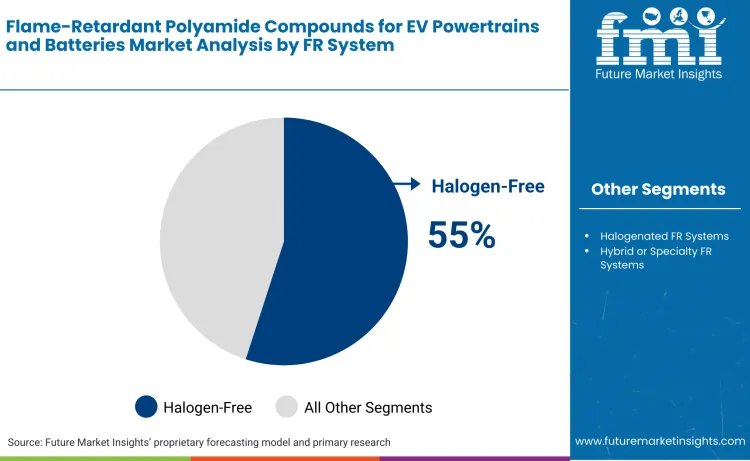
Halogen-free flame-retardant systems account for 55% of formulation demand because they align more closely with thermal stability, low-smoke requirements, and evolving regulatory scrutiny within electric vehicle platforms. EV powertrains and battery environments expose polyamide compounds to sustained heat, electrical stress, and confined enclosure conditions where smoke density and corrosive gas generation become critical risks. Halogen-free chemistries based on phosphorus and mineral systems provide consistent flame resistance while reducing damage to sensitive electronic components.
This is reinforced by OEM material qualification strategies that prioritize long-term platform reuse across multiple vehicle architectures. Halogen-free systems simplify compliance with internal material blacklists and regional chemical restrictions while supporting higher operating temperatures demanded by fast-charging and high-power-density designs. Their compatibility with glass-fiber-reinforced polyamides also sustains mechanical performance in structural electrical components.
What drives High-Voltage Connectors and Busbars to Lead Application Demand?
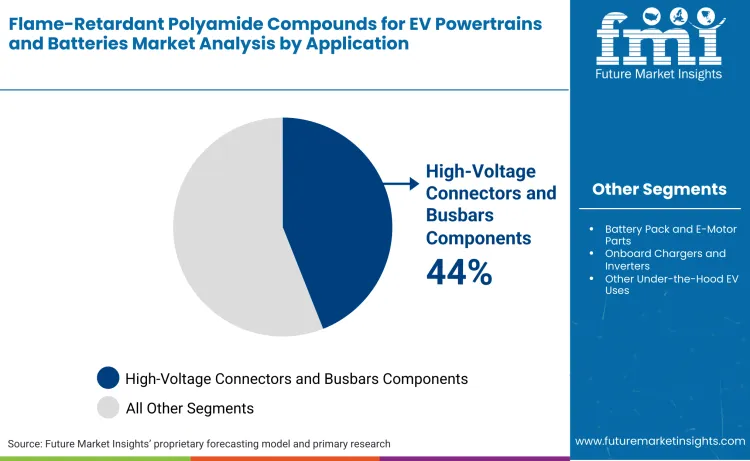
High-voltage connectors and busbar components represent 44% of application usage because they sit at the intersection of electrical safety, thermal exposure, and mechanical integrity. These components operate under continuous current loads and are positioned close to heat-generating systems where flame retardancy is a non-negotiable requirement. Polyamide compounds offer dimensional stability and dielectric strength that are critical for maintaining insulation performance under vibration and thermal cycling.
This reflects the rapid scaling of high-voltage architectures across passenger and commercial electric vehicles. Increasing system voltages and compact powertrain layouts intensify fire risk concentration at connection points, driving OEMs to specify higher-performing flame-retardant polyamide grades. Once qualified, these materials are deployed across multiple connector families, reinforcing sustained volume demand within this application segment.
What Drivers, Restraints, Opportunities, and Trends present themselves in the Flame-Retardant Polyamide Compounds for EV Powertrains and Batteries Market?
The role of flame-retardant polyamides in electric vehicles is being reshaped by a clear shift in durability expectations. EV components are required to operate for longer periods under sustained thermal, chemical, and electrical stress than those used in internal combustion platforms. Continuous exposure to elevated temperatures, aggressive coolants, and high electrical loads has pushed material qualification beyond earlier benchmarks. Polyamides deployed in battery thermal management systems, high-voltage connectors, and power electronics are now expected to maintain mechanical and electrical integrity after prolonged hydrolysis, water-glycol exposure, and heat aging. Material suppliers such as BASF have responded by developing polyamide grades engineered and validated specifically for long-term performance in aggressive coolant environments, aligning material lifetimes with the extended operating horizons of EV platforms.
Electro-corrosion has emerged as a significant limitation for conventional flame-retardant formulations used in electrified systems. In high-humidity, high-voltage operating conditions, halogenated flame-retardant additives can accelerate metal degradation at electrical contact interfaces. This degradation has been linked to reliability failures in connectors and power conversion components. These risks are driving a shift toward halogen-free and specialty polyamide chemistries designed to suppress electro-chemical activity while maintaining fire performance. In direct-current architectures, electro-chemical stability now carries the same weight as flame resistance in material selection decisions.
Market opportunities are increasingly tied to functional consolidation within battery and powertrain systems. OEMs are prioritizing polymers capable of delivering structural support, electrical insulation, and fire containment within a single component. Industry analysis from IDTechEx shows growing adoption of integrated fire-protection materials as battery designs move toward reduced part counts and higher packaging density. Flame-retardant polyamides that can function simultaneously as cell holders and thermal barriers are positioned to benefit from this design simplification trend.
Emerging battery technologies present a structural shift in how flame-retardant materials may be used. Solid-state battery designs reduce dependence on flammable liquid electrolytes, potentially lowering the need for flame-retardant materials at the cell level. Demonstrations by developers such as Welion, including collaborative work with BASF, indicate that flame-retardant polyamides remain essential for structural and electrical insulation roles even as electrolyte containment requirements evolve.
Analysis of Flame-Retardant Polyamide Compounds for EV Powertrains and Batteries Market by Key Countries
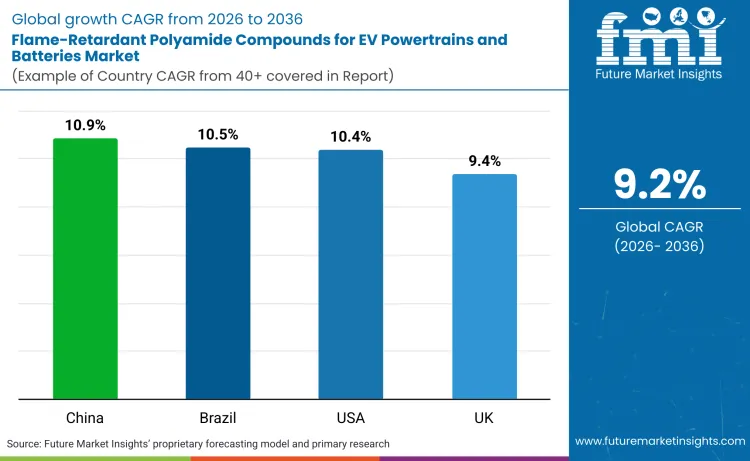
| Country | CAGR (2026-2036) |
|---|---|
| China | 10.9% |
| Brazil | 10.5% |
| USA | 10.4% |
| UK | 9.4% |
Source: Future Market Insights’ proprietary forecasting model and primary research
China: Is Vertical Integration Becoming an Unassailable Competitive Moat in the Global Battery and Chemicals Ecosystem?
China’s strength in batteries and advanced materials now rests less on sheer manufacturing scale and more on deep vertical integration across the value chain. The startup of BASF’s Zhanjiang Verbund complex shows how global chemical leaders are embedding themselves directly into China’s domestic demand engine. By placing petrochemicals and engineering plastics production close to EV and battery customers, BASF is lowering exposure to trade friction while aligning its cost base with Chinese manufacturers. This proximity tightens collaboration, shortens development cycles, and makes supplier relationships harder to displace.
Battery manufacturing concentration reinforces this position. A small group of Chinese players led by CATL now account for a dominant share of global EV battery deployments. Their influence is no longer confined to China. Capital is flowing into overseas facilities, especially in Europe, where production is localized while technology control, material sourcing, and standards remain centralized. This approach reduces geopolitical risk without surrendering leverage, allowing Chinese firms to export their supply chains rather than just finished batteries.
Brazil: Can Regulatory Momentum and Resource Endowment Converge into a Globally Relevant Battery Hub?
Brazil’s position in the battery landscape is shifting as regulation begins to unlock long-dormant demand for energy storage. The creation of a formal legal framework for battery energy storage systems changes how storage is treated in the power market. Batteries are now recognized as capacity assets with clearer revenue pathways. This clarity improves bankability and is likely to draw in both domestic utilities and international infrastructure investors, positioning Brazil as a key storage market in Latin America.
The regulatory push is reinforced by Brazil’s mineral base. Sigma Lithium’s rapid operational ramp-up reflects global demand for lower-carbon lithium supply, while Vale continues to anchor Brazil’s role in battery-grade nickel. Unlike regions dependent on imported critical minerals, Brazil has the option to align domestic storage growth with domestic raw materials. If processing and cell manufacturing follow, the country could move beyond raw material exports and become an integrated player in the battery value chain.
USA: Is Industrial Policy Sufficient to Offset Structural Disadvantages in Cost and Scale?
The US battery strategy remains heavily shaped by public policy, reflecting long-standing gaps in cost competitiveness, speed, and supply chain density compared with Asia. Federal funding aimed at mineral processing and battery manufacturing targets parts of the value chain that private capital has historically avoided. These measures acknowledge that without sustained support, domestic ecosystems struggle to reach scale or compete on price. The unresolved question is whether policy can accelerate learning curves fast enough to build lasting competitiveness rather than temporary capacity.
Market execution exposes the trade-offs. Battery manufacturing is expanding across multiple chemistries and formats, but sourcing rules tied to clean-energy incentives add friction. Foreign Entity of Concern guidance narrows access to globally dominant suppliers, raising costs and complicating procurement. The strategy strengthens supply chain independence but weakens near-term efficiency. The highest risk sits in the midstream, where alternatives to established suppliers remain limited and timelines for maturity are uncertain.
UK: Can Targeted Innovation Funding Compensate for Late Entry into Gigafactory Scale?
The UK has chosen a battery strategy built around technological differentiation rather than immediate scale. Public funding through national battery programs prioritizes advanced chemistries, manufacturing processes, and pilot-to-industrial translation. This positions the UK as a development and validation hub focused on intellectual property and process know-how. The risk is that without sufficient domestic manufacturing demand, innovation may be commercialized outside the country.
Manufacturing capacity is beginning to take shape through anchor investments. Tata Group’s decision to build a UK gigafactory provides a critical foundation for the domestic EV supply chain and aligns closely with Jaguar Land Rover’s electrification roadmap. JLR’s emphasis on material traceability and ethical sourcing reflects rising regulatory and consumer pressure. Together, these moves point to an attempt to combine innovation leadership with compliant local production, though long-term success will depend on whether this model can withstand global cost pressure and execution risk.
Competitive Landscape
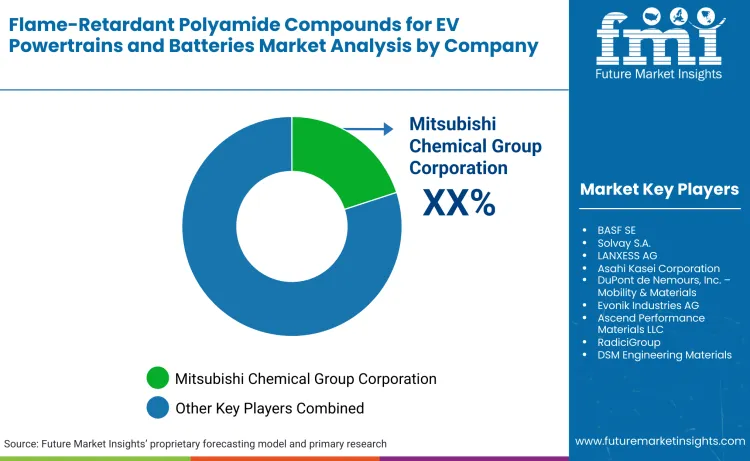
Years of expansion-led decision making gave way to a more defensive posture centered on balance sheet strength, cash preservation, and operational control. This shift did not stem from a single disruption, but from a convergence of pressures that accumulated over time. Energy and feedstock volatility remained unresolved, demand recovery across key end markets proved uneven, and investors became less tolerant of capital-heavy strategies with delayed payback.
Management teams began reassessing what truly belonged in their core portfolios versus assets that absorbed capital without reinforcing long-term positioning. Cost discipline moved beyond temporary austerity and became embedded into operating structures. Inventory normalization, asset rationalization, and margin protection replaced volume-led growth as primary performance metrics. The industry’s strategic center shifted away from scale expansion toward resilience and durability.
Looking toward 2026, regionalization is emerging as one of the clearest structural outcomes of this reset. The assumptions that supported highly globalized and tightly synchronized supply chains have weakened. Geopolitical exposure, trade friction, and logistical fragility are now viewed as persistent risks rather than episodic disruptions. Chemical producers are responding by placing production closer to demand centers, especially in value chains linked to electrification and energy storage. Integrated regional manufacturing platforms are being treated as core infrastructure rather than optional diversification.
These investments prioritize supply security, regulatory alignment, and customer proximity, even where capital intensity is higher. Executive decision making has adjusted accordingly. Reliability, political insulation, and customer access are assigned explicit economic value. This is particularly evident in battery materials, advanced polymers, and mobility-related chemistries where supply continuity has become strategically decisive.
Innovation priorities are narrowing, with capital increasingly directed toward material platforms that combine technical differentiation with realistic pathways to scale. Broad exploratory research has given way to targeted bets on advanced chemistries that can be industrialized within the decade. Solid-state and hybrid battery materials reflect this recalibration. What once sat firmly in long-horizon research portfolios is now progressing into pilot-scale and early commercial development. Manufacturing complexity and cost challenges remain unresolved, yet suppliers are moving early to influence specifications and standards before competitive intensity accelerates.
Key Players Profiled
- Mitsubishi Chemical Group Corporation
- BASF SE
- Solvay S.A.
- LANXESS AG
- Asahi Kasei Corporation
- DuPont de Nemours, Inc.-Mobility & Materials
- Evonik Industries AG
- Ascend Performance Materials LLC
- RadiciGroup
- DSM Engineering Materials
Market Definition
The flame-retardant polyamide compounds for EV powertrains and batteries market comprises engineered polyamide-based materials formulated to deliver flame resistance, electrical insulation, and thermal stability in high-voltage electric vehicle systems. These compounds are used in environments exposed to elevated temperatures, electrical stress, and confined spaces, where fire containment, dielectric integrity, and long-term material reliability are critical to vehicle safety and regulatory compliance .
The report includes halogen-free, halogenated, and hybrid flame-retardant polyamide compounds used in EV-specific applications such as high-voltage connectors, busbars, battery pack components, e-motor housings, onboard chargers, and inverters. It covers reinforced and unreinforced formulations designed to meet stringent requirements for comparative tracking index, arc resistance, thermal aging, and mechanical performance across global EV platforms and powertrain architectures .
The scope excludes non-flame-retardant engineering plastics, elastomers, and thermosets, as well as metal components, coatings, and external fire-protection systems not based on polyamide compounds. It also excludes materials used in internal combustion powertrains, low-voltage automotive wiring, and non-automotive electrical applications outside EV powertrains and battery systems.
Scope of Report
| Items | Values |
|---|---|
| Quantitative Units (2026) | USD 1.9 billion |
| FR System | Halogen-Free FR Systems, Halogenated FR Systems, Hybrid or Specialty FR Systems |
| Application | High-Voltage Connectors and Busbar Components, Battery Pack and E-Motor Parts, Onboard Chargers and Inverters, Other Under-the-Hood EV Uses |
| Regions Covered | North America, Western Europe, Eastern Europe, East Asia, South Asia & Pacific, Latin America, Middle East & Africa |
| Countries Covered | India, China, USA, South Korea and 40+ Countries |
| Key Companies Profiled | Mitsubishi Chemical Group Corporation, BASF SE, Solvay S.A., LANXESS AG, Asahi Kasei Corporation, DuPont de Nemours, Inc.-Mobility & Materials, Evonik Industries AG, Ascend Performance Materials LLC, RadiciGroup, DSM Engineering Materials |
Key Segments Profiled
FR System
- Halogen-Free FR Systems
- Halogenated FR Systems
- Hybrid or Specialty FR Systems
Application
- High-Voltage Connectors and Busbar Components
- Battery Pack and E-Motor Parts
- Onboard Chargers and Inverters
- Other Under-the-Hood EV Uses
Region
- North America
- Western Europe
- Eastern Europe
- East Asia
- South Asia & Pacific
- Latin America
- Middle East & Africa
Bibliography
- BASF SE. (2025). Engineering plastics for high-voltage electric vehicle systems: Flame-retardant polyamides and safety performance. BASF Performance Materials Technical White Paper.
- IEC. (2024). IEC 60112: Method for the determination of the proof and the comparative tracking indices of solid insulating materials. International Electrotechnical Commission.
- LANXESS AG. (2025). Halogen-free flame-retardant polyamides for e-mobility powertrain and battery applications. LANXESS Engineering Plastics Application Report.
- Solvay S.A. (2024). High-performance polyamides for electric vehicle electrification and battery safety. Solvay Materials Science & Innovation Brief.
- Zhang, Y., Liu, J., Wang, H., & Chen, L. (2024). Flame-retardant polymeric materials for lithium-ion battery safety: Materials, mechanisms, and challenges. Progress in Polymer Science, 142, 101702.
- Zhao, X., Sun, J., & Qiu, Y. (2025). Halogen-free flame-retardant polyamides for high-voltage electrical insulation in electric vehicles. Polymer Degradation and Stability, 221, 110267.
Frequently Asked Questions
How large is the flame-retardant polyamide compounds market for EV powertrains and batteries?
The market is valued at around USD 1.9 billion in 2026, reflecting rising material intensity per vehicle as EV architectures shift toward higher voltage and power density.
What material properties are driving demand for flame-retardant polyamide compounds?
Demand is driven by the need for high dielectric strength, arc resistance, thermal endurance, and flame retardancy within compact, high-voltage EV environments where multiple performance requirements must be met simultaneously.
Why are halogen-free flame-retardant systems gaining preference in polyamide formulations?
Halogen-free systems are preferred due to lower smoke toxicity, reduced electro-corrosion risk, and closer alignment with evolving chemical regulations and OEM material blacklists in electric vehicle platforms.
Which applications account for the highest consumption of these compounds?
High-voltage connectors and busbar components lead demand, followed by battery pack parts, inverters, and onboard chargers, where continuous electrical load and thermal stress make flame-retardant performance non-negotiable.
What constraints affect faster adoption of advanced flame-retardant polyamide compounds?
Key constraints include higher formulation and compounding costs, long qualification cycles tied to vehicle platforms, and the need to balance flame retardancy with mechanical durability and long-term electrical stability.
Preview the report firsthand - request a free sample
Get SampleGet the brochure for pricing and purchase details.
Get PDFTable of Content
- Executive Summary
- Flame-Retardant Polyamide Compounds for EV Powertrains and Batteries Market Introduction
- Market Definition
- Market Scope
- Market Taxonomy
- Research Methodology
- Study Framework
- Assumptions and Limitations
- Data Sources
- Market Estimation and Forecasting Approach
- Flame-Retardant Polyamide Compounds for EV Powertrains and Batteries Market Forecast and Outlook (2026–2036)
- Flame-Retardant Polyamide Compounds for EV Powertrains and Batteries Market Key Takeaways
- Flame-Retardant Polyamide Compounds for EV Powertrains and Batteries Market Dynamics
- Drivers
- Restraints
- Opportunities
- Trends
- Flame-Retardant Polyamide Compounds for EV Powertrains and Batteries Market Segmentation Analysis
- By FR System
- By Application
- By Region
- Flame-Retardant Polyamide Compounds for EV Powertrains and Batteries Market Analysis by Region
- North America
- Western Europe
- Eastern Europe
- East Asia
- South Asia & Pacific
- Latin America
- Middle East & Africa
- Flame-Retardant Polyamide Compounds for EV Powertrains and Batteries Market Analysis by Key Countries
- China
- Brazil
- United States
- United Kingdom
- Competitive Landscape
- Key Players Profiled
- Market Definition
- Scope of Report
- Key Segments Profiled
- Bibliography
- Frequently Asked Questions


