

- Industry Size (2026)
- USD 351.2 Mn
- Forecast (2036)
- USD 617.2 Mn
- CAGR (2026 to 2036)
- 5.80%
Polyamide 12 Powder for High-Performance 3D Printing Market Size, Market Forecast and Outlook By FMI
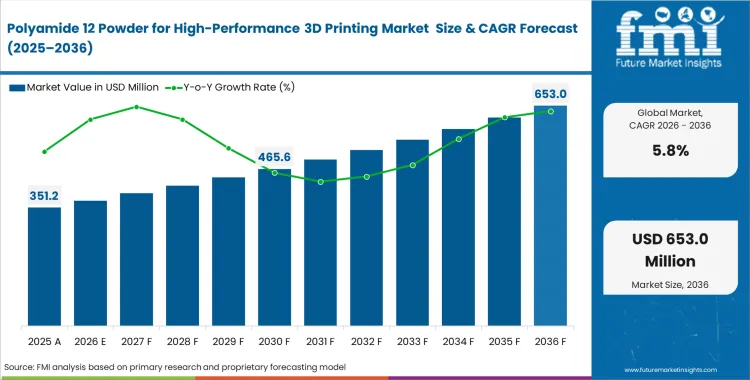
The polyamide 12 powder for high-performance 3D printing market was valued at USD 332.0 million in 2025. Industry is poised to cross USD 351.2 million in 2026, and reach USD 617.2 million by 2036, at a 5.80% CAGR over the forecast period. Growth is driven by strict certification lock-in across the aerospace and medical sectors and the steady consumption of validated blends. Production teams face immense commercial pressure to validate high-reuse PA12 powder loops in order to move unit economics closer to conventional injection molding across repeat manufacturing programs.
Summary of Polyamide 12 Powder for High-Performance 3D Printing Market
- The market is estimated at USD 351.2 million in 2026.
- The market is projected to reach USD 617.2 million by 2036.
- The market is expected to grow at a CAGR of 5.8% from 2026 to 2036.
- The forecast period represents an incremental opportunity of USD 266.0 million.
- MJF leads the technology segment with a 38.0% share.
- Standard PA12 dominates the grade segment with a 48.0% share.
- Functional parts lead the application segment with a 44.0% share.
- Automotive dominates the end use segment with a 28.0% share.
- Virgin powder leads the feedstock model segment with a 58.0% share.
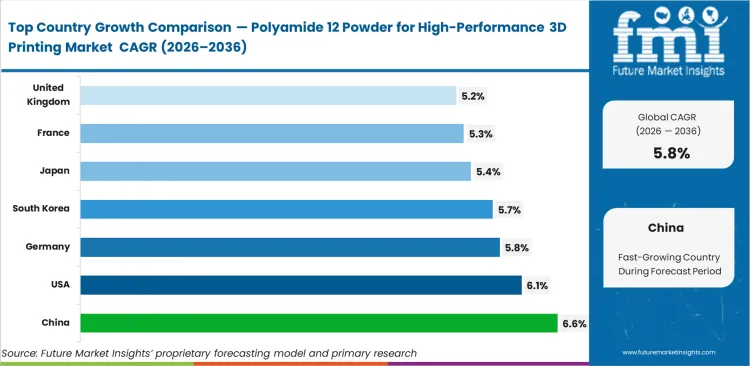
- China (6.6%), the United States (6.1%), and Germany (5.8%) are among the fastest-growing markets.
Polyamide 12 Powder for High-Performance 3D Printing Market Key Takeaways
| Metric | Details |
|---|---|
| Industry Size (2026) | USD 351.2 Million |
| Industry Value (2036) | USD 617.2 Million |
| CAGR (2026 to 2036) | 5.80% |
Source: Future Market Insights (FMI) analysis, based on proprietary forecasting model and primary research
Consistent refresh ratios give production managers greater confidence in bidding for serialized manufacturing programs, since predictable powder behavior supports tighter dimensional control and more repeatable mechanical performance. Technical progress in closed-loop recycling and recycled-powder conditioning is also expanding commercial potential, with recent research showing that optimized recycled PA12 powders can approach virgin-powder flowability and viscosity under controlled blending conditions. Predictable material performance therefore moves additive manufacturing material beyond isolated prototyping cells and deeper into mainstream factory production with steadier long-term material consumption.
China is expected to register a 6.6% CAGR during the forecast period, owing to heavy state subsidies directly funding additive equipment procurement across primary industrial hubs. The United States is estimated to expand at a 6.1% CAGR over the forecast period, as strict defense qualification programs mandate traceable material origins for specialized polymer formulations. Over the forecast period, growth in Germany is poised to expand at a 5.8% CAGR, South Korea at 5.7% CAGR, Japan at 5.4% CAGR, France and the United Kingdom at a 5.3% and 5.2% CAGR respectively. Eastern service bureaus heavily prioritize maximum throughput velocity during daily operations, whereas western manufacturing facilities demand absolute material traceability for critical automotive safety components.
Segmental Analysis
Polyamide 12 Powder for High-Performance 3D Printing Market Analysis by Technology
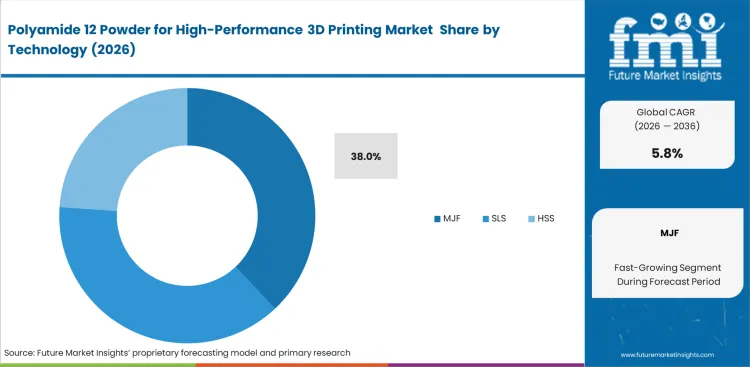
Platform architecture fundamentally dictates powder consumption profiles inside modern industrial additive manufacturing facilities globally. Operations managers strongly value closed-loop powder handling systems effectively eliminating operator exposure while standardizing refresh cycles. Precise thermal control across entire build layers successfully prevents warping across highly dense nested layouts. The MIF segment is expected to hold 38.0% share in 2026.
Expansion is propelled by rapid print speeds alleviating severe throughput constraints on high-volume runs, and extensive qualification by automotive tier-1 suppliers seeking scalable production networks. Equipment buyers rarely factor into unit-cost projections the reality of platform-specific fusing agents permanently altering surrounding powder chemistry to complicate long-term recyclability.
- Throughput optimization: Advanced dosing systems distribute uniform powder layers quickly across large build platforms during extended production runs. Operations teams achieve stronger machine utilization and lower per-part amortization costs, allowing service bureaus to compete more effectively for serialized production contracts without increasing physical capacity.
- Thermal bed management: Integrated heating lamps keep powder temperatures slightly below melting thresholds, reducing internal stress during the printing cycle. Process engineers limit part curling and cut down expensive post-processing annealing requirements, directly improving yield across dense multi-part nesting arrangements.
- Agent interaction mapping: Fusing and detailing agents alter local polymer behavior without relying on complete laser melting across the entire geometry. R&D teams move complex designs into production more efficiently through predictable voxel-level control, enabling precise adjustment of mechanical properties within a single monolithic component.
Polyamide 12 Powder for High-Performance 3D Printing Market Analysis by Grade
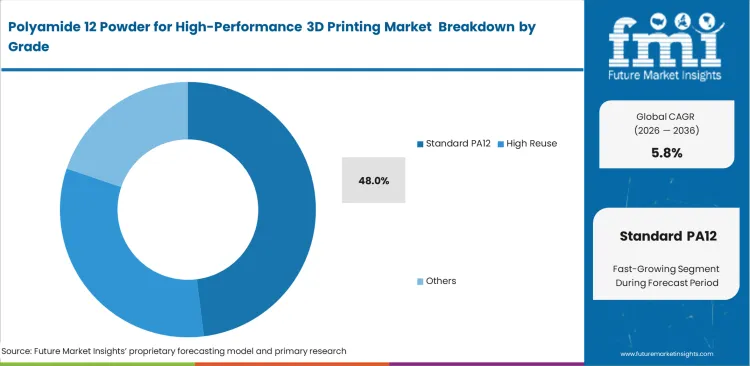
Material qualification data historically acts as an invisible barrier protecting legacy formulations from novel chemical entrants. Aerospace compliance officers strictly require decades of proven tensile fatigue data prior to approving new components. The standard PA12 segment is predicted to hold 48.0% revenue share in 2026. This is driven by a deep legacy of regulatory qualification across the medical and aerospace sectors, highly predictable isotropic shrinkage rates simplifying tooling design, exceptional spherical particle morphology preventing machine jamming, and a broad supplier base insulating buyers against regional supply chain shocks. Comparing PA12 vs PA11 powder highlights the reality of consistency mattering far more than theoretical peak strength during the validation of polyamide share analysis benchmarks against traditional injection molding. Specialized additives negatively compromise powder flowability inside feed hoppers, quietly causing short-feeds and ruined builds during unattended weekend operation.
- Shrinkage predictability: Consistent molecular weight distribution supports uniform cooling behavior and controlled contraction after sintering across demanding production runs. Tooling engineers can achieve tight geometric tolerances without repeated design iterations, materially reducing time-to-market for complex industrial fixtures and specialized brackets.
- Flowability maintenance: Spherical particle morphology limits clumping inside machine feed systems and across recoater blade movement during extended print operations. Night-shift supervisors can sustain multi-day builds with lower risk of mechanical jamming, protecting margin performance by reducing catastrophic failures linked to powder starvation.
- Regulatory data anchoring: Extensive historical testing data supports compliance with stringent FAA and FDA material requirements across regulated application areas. Compliance teams can move past basic material characterization stages more efficiently and accelerate final part approvals, allowing medical device manufacturers to deploy custom surgical guides and prosthetics with reduced regulatory friction.
Polyamide 12 Powder for High-Performance 3D Printing Market Analysis by Application
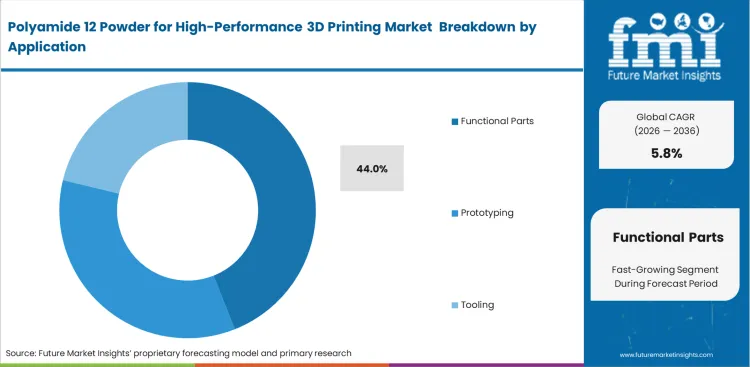
Engineering teams consistently design complex geometries impossible to manufacture entirely through traditional subtractive methods. Manufacturing executives specify robust high performance polymer powder for custom robotic grippers, fluid manifolds, and assembly jigs designed to withstand industrial floor abuse. The functional parts segment is likely to secure 44.0% share in 2026. This is driven by the proven fatigue resistance of sintered structures under dynamic loads, exceptional chemical survivability against harsh factory lubricants, unique topological freedom enabled by powder-bed support, and a massive industry-wide shift away from conceptual prototyping toward durable end-use production. Chemical resistance against factory lubricants and cutting fluids makes PA12 uniquely suited for exceptionally demanding environments.
- Dynamic load bearing: Sintered structures maintain strong fatigue resistance under repeated mechanical cycling, supporting dependable long-term performance in demanding operational settings. Design engineers can replace heavier machined aluminum brackets with lighter polymer alternatives, reducing assembly weight substantially without sacrificing integrity or creating frequent replacement needs.
- Chemical environment survival: Molecular structures resist severe degradation caused by automotive fluids, caustic industrial solvents, and continuous thermal exposure across harsh production environments. Plant managers can deploy custom fixtures directly on demanding machining lines with greater confidence, avoiding premature failure and overcoming material limitations commonly associated with standard thermoplastics.
- Topology realization: Powder support inside the build chamber enables direct formation of complex internal channels without the need for temporary and wasteful support structures. Fluid dynamics engineers can consolidate multi-part welded assemblies into single integrated components, improving internal flow characteristics while removing weak joints from the final design.
Polyamide 12 Powder for High-Performance 3D Printing Market Analysis by End Use
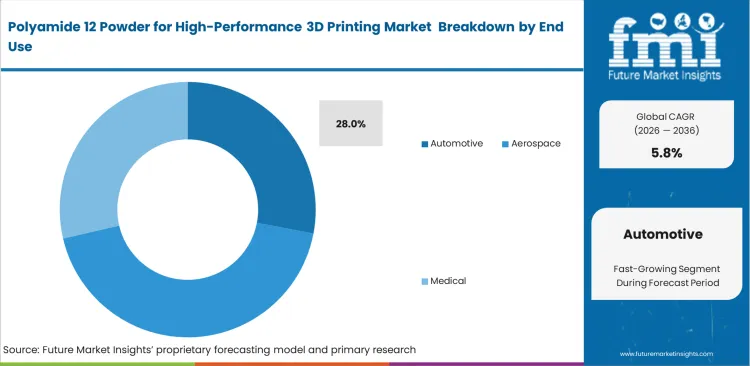
The automotive segment is estimated to account for 28.0% share in 2026. This is driven by strict corporate mandates targeting overall vehicle weight reduction, the elimination of expensive steel tooling for low-volume interior trims, the necessity to rapidly iterate complex geometries between production batches, and the highly predictable crash-splintering behavior of the material. Strict weight reduction mandates heavily dictate material selection across all global transportation sectors today. Supply chain managers utilize powder-bed fusion to bypass costly steel tooling for low-volume luxury vehicle trims alongside customized performance parts. Rapid iteration cycles successfully allow continuous improvement of complex air duct geometries between active production batches.
- Tooling bypass economics: Direct printing removes tooling lead times and avoids expensive mold machining across specialized component programs.
- Weight reduction execution: Optimized internal lattice structures reduce unnecessary mass while preserving strict rigidity in demanding component applications.
- Inventory virtualization: Digital design files replace physical spare parts stored across costly global warehouse networks.
Polyamide 12 Powder for High-Performance 3D Printing Market Analysis by Feedstock Model
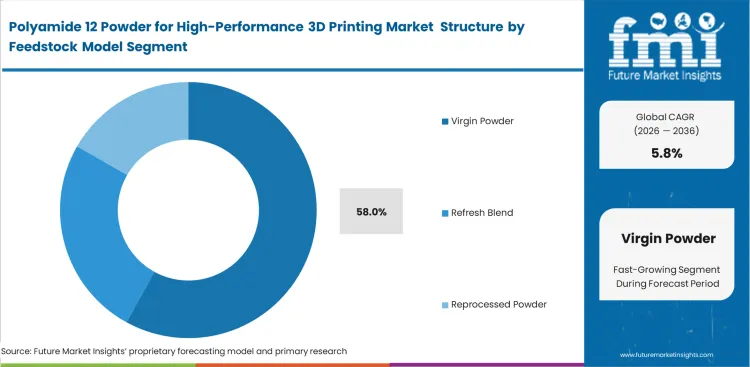
Traceability requirements shape supply chain structures regardless of underlying technical capabilities. Quality assurance personnel refuse mixed powder batches to eliminate any possibility of degraded mechanical performance in flight-critical or implantable parts. Purchasing departments buy fresh polyamide resins explicitly to bypass internal re-qualification protocols required for recycled material streams. The virgin powder segment is expected to account for 58.0% revenue share in 2026, driven by strict medical and aerospace regulations demanding unbroken material provenance, quality assurance policies that categorically reject mixed powder batches, the necessity to bypass complex internal re-qualification protocols for aged material, and the requirement to extract absolute peak tensile properties for flight-critical components.
- Provenance assurance: Sealed containers preserve continuous documentation from chemical reactor output to printer hopper loading across tightly controlled production workflows.
- Performance maximization: Pure unaged particles support optimal melt viscosity and stronger layer adhesion across the full vertical build structure during demanding print jobs.
- Qualification bypass: Exclusive use of virgin material removes the need to establish complicated internal testing protocols for aged powder behavior across repeated print cycles.
Polyamide 12 Powder for High-Performance 3D Printing Market Drivers, Restraints, and Opportunities
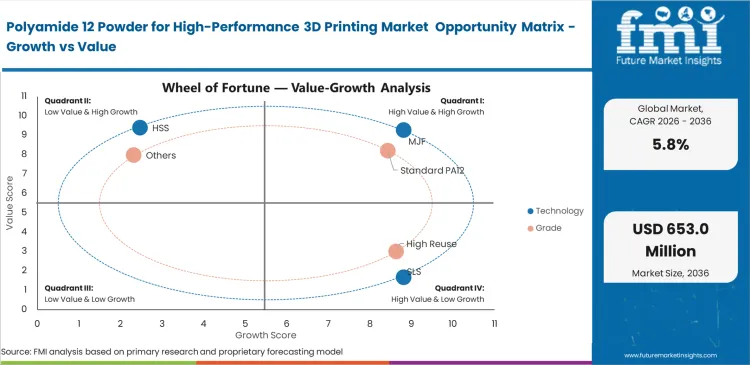
Margin pressure is pushing production teams toward materials capable of sustaining high reuse ratios across repeated print cycles without severe performance drift. Manufacturers are under intense pressure to validate closed-loop powder systems and secure workable cost-per-part economics against established injection molding routes. Movement beyond single-use prototyping is forcing a disciplined assessment of bio polyamide specialty performance under prolonged thermal exposure inside powder bed fusion environments. Any delay in validating high-reuse operating loops leaves mid-sized service bureaus at a disadvantage in large manufacturing tenders.
Powder aging and oxidation inside heated build chambers erode dimensional accuracy and generate scrap across demanding end-use print programs. Thermal degradation changes melt viscosity and surface finish, creating mechanical inconsistency across different heights within a single print build. Quality teams face serious difficulty maintaining aerospace-grade tolerances once localized powder bed temperatures begin to drift beyond stable operating windows. Current nitrogen-inerting systems reduce surface oxidation, yet available research indicates that inert conditions do not fully stop chain scission and other aging mechanisms during multi-day builds.
Opportunities in Polyamide 12 Powder for High-Performance 3D Printing Market
- Automated blending algorithms: Software-driven systems dose virgin material with high precision using real-time analysis of aged powder conditions. Operations teams reduce reliance on estimation and maintain more stable mechanical output across demanding high-volume production schedules.
- Bio-circular formulations: Chemical producers are advancing castor-oil-based polymers that deliver performance levels comparable to fossil-derived grades in industrial printing environments. Sustainability teams gain a more practical route toward carbon reduction targets while expanding qualification pathways for biodegradable polyamide alternatives in industrial applications.
- In-situ thermal monitoring: Integration of thermal imaging systems inside build chambers supports dynamic laser-power adjustment during active print cycles. Process engineers limit localized overheating and preserve nylon powder integrity throughout dense, geometrically complex nesting configurations.
Regional Analysis
Based on regional analysis, the polyamide 12 powder for high-performance 3D printing market is segmented into North America, Latin America, Europe, Asia Pacific, and Middle East & Africa across 40 plus countries.
.webp "Top Country Growth Comparison Polyamide 12 Powder For High Performance 3d Printing Market Cagr (2026 2036)")
| Country | CAGR (2026 to 2036) |
|---|---|
| China | 6.6% |
| United States | 6.1% |
| Germany | 5.8% |
| South Korea | 5.7% |
| Japan | 5.4% |
| France | 5.3% |
| United Kingdom | 5.2% |
Source: Future Market Insights (FMI) analysis, based on proprietary forecasting model and primary research
Asia Pacific Polyamide 12 Powder for High-Performance 3D Printing Market Analysis
State-backed smart factory initiatives subsidize additive equipment procurement across eastern manufacturing hubs. Heavy industrial investment pushes domestic service bureaus to consume massive volumes of polymer powder for serialized production. Government policy dictates rapid transition from traditional tooling toward flexible digital manufacturing platforms. Operations personnel utilize these subsidies to build massive powder-bed fusion farms capable of out-competing western facilities on pure volume. Local chemical suppliers rapidly scale domestic PA12 capacity to break reliance on imported European feedstocks.
- China: Mandates for intelligent manufacturing infrastructure force automotive suppliers to integrate additive workflows directly into their primary production lines. Polyamide 12 powder for high-performance 3D printing market in China is estimated to expand at a 6.6% CAGR during the forecast period. Expansion is driven by heavy state subsidies substantially reducing initial capital expenditure required for hardware procurement. In China, rapid deployment of powder-bed systems specifically designed for end-use electric vehicle components are also propelling expansion during the forecast. Intensive localization of high-performance polymer synthesis to break import reliance and export-driven manufacturing policies firmly incentivizes high-throughput digital production architectures.
- South Korea: Advanced electronics manufacturers demand ultra-precise fixtures and robotic end-effectors capable of surviving intensive chemical washdowns during daily operational cycles. South Korea is predicted to rise at a CAGR of 5.7% during the forecast period, propelled by the intensive replacement of machined aluminum with lightweight PA12 alternatives on factory floors. Industry is likely to garner stable expansion owing to heavy capital investments injected by top-tier electronics conglomerates, government-backed incentives designed for digital manufacturing transitions, and the absolute necessity to deploy customized automated assembly components without tooling delays.
- Japan: Aging workforce demographics compel heavy, sustained investment in automated flexible manufacturing systems to maintain global output parity. Japan is predicted to grow at a rate of 5.4% during the forecast period. Growth is propelled by the need to print custom automation components on demand to support continuous operations. Some factors include deep integration of additive technologies within legacy robotics manufacturing, corporate mandates to reduce physical spare parts inventory across distributed warehouses, and localized development of specialized high-temperature polymer blends.
FMI's report includes detailed analysis of broader Asian dynamics including emerging hubs in Taiwan and Southeast Asia. Expanding supply chains prioritize localized additive capabilities to mitigate future shipping disruptions.
North America Polyamide 12 Powder for High-Performance 3D Printing Market Analysis
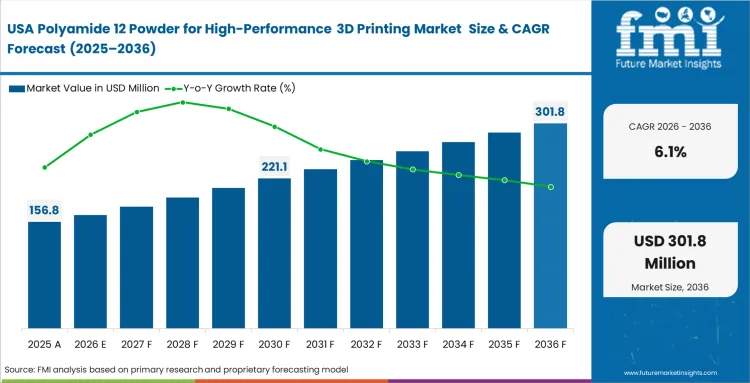
Defense qualification programs mandate traceable material origins and secure domestic supply chains. Federal funding accelerates industrial additive commercialization to protect critical manufacturing infrastructure. Procurement personnel at major aerospace contractors establish rigorous PA12 qualification frameworks that smaller suppliers must adopt. Strict intellectual property protection laws encourage medical device startups to utilize local service bureaus rather than outsourcing overseas. Strong venture capital backing allows local bureaus to invest heavily in advanced automated powder handling equipment.
- United States: Strict FAA and FDA material tracking requirements fundamentally dictate purchasing behavior across advanced manufacturing sectors. Adoption in the country is estimated to incline at a CAGR of 6.1% during the forecast period, driven by defense qualification programs that mandate secure domestic supply chains. Factors include heavy venture capital backing directed toward automated service bureau infrastructure and robust federal funding initiatives accelerating industrial additive commercialization. Quality assurance personnel generate stable demand by insisting entirely on premium virgin PA12 for critical load-bearing applications.
FMI's report includes analysis of Canadian industrial adoption and Mexican automotive integration. Cross-border manufacturing clusters rely heavily on localized 3D printing for rapid tooling turnaround.
Europe Polyamide 12 Powder for High-Performance 3D Printing Market Analysis
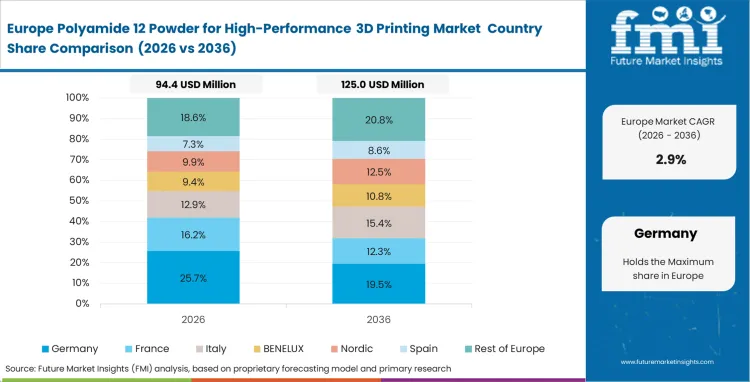
Legacy chemical engineering expertise anchors global PA12 formulation and production leadership. Stringent regulatory frameworks force automotive OEMs to evaluate full lifecycle carbon footprints of manufactured components. Engineering personnel utilize powder-bed fusion to create complex lightweight structures that reduce vehicle emissions. Deep collaboration between machine builders and chemical suppliers accelerates validation of specialized industrial powder grades across the continent.
- Germany: Deep automotive engineering heritage dictates exceptionally strict material validation protocols for all functional components entering the supply chain. Demand in Germany records a 5.8% CAGR during the forecast period, driven by rigorous automotive transition from metal tooling to durable PA12 alternatives, and heavy investments by major companies dedicated to full lifecycle carbon footprint reduction. Deep collaboration between domestic machine builders and chemical suppliers, and establishment of Germany material standards as default global baselines for powder quality also support market growth in the country. R&D heads continuously push the boundaries of selective laser sintering, ensuring that local engineering clusters remain the primary proving ground for novel powder bed fusion applications across Europe.
- France: France previously faced heavy challenges optimizing next-generation aircraft components; however, aerospace consolidation now unlocks major commercial opportunities regarding weight reduction strategies. This internal capability expansion directly positions regional aviation suppliers to dominate interior component manufacturing utilizing advanced polymer powder bed fusion. Demand is expected to progress at a 5.3% CAGR during the forecast period, owing to the existence of state-backed defense investments focusing entirely on localized supply chain resilience. Engineers constantly optimizing cabin components to minimize overall aircraft weight and rapid qualification frameworks designed specifically for flame retardant polyamide compounds.
- United Kingdom: Medical device innovation clusters continuously push the and biological boundaries of customized patient-specific orthotics. United Kingdom is estimated to expand at a 5.2% CAGR during the forecast period. Growth is firmly anchored by rapid deployment of biocompatible PA12 materials by clinical personnel and increasing utilization of digital manufacturing for complex surgical guides. Secondary factors include robust university-industry partnerships accelerating material characterization, and rapid regional expansion of highly specialized medical service bureaus. Operators navigate complex healthcare procurement structures by offering fully traceable, ISO-certified additive solutions that dramatically reduce patient wait times for highly customized wearable devices.
FMI's report includes evaluation of Italian industrial design applications and Nordic sustainability-focused adoption. Environmental directives continue shaping material formulation strategies across continental supply chains.
Competitive Aligners for Market Players
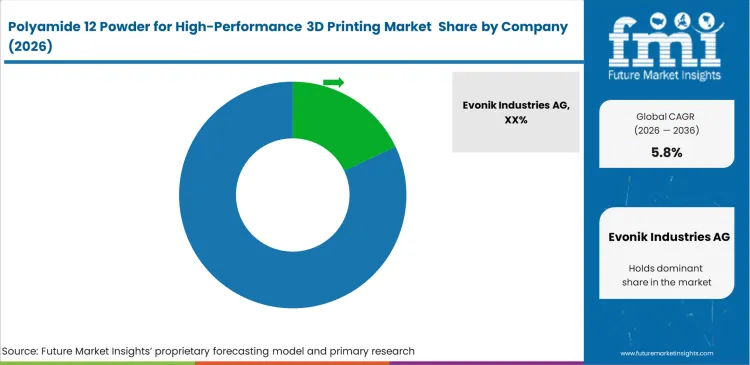
Ecosystem compatibility defines supplier success far more than pure chemical manufacturing capacity. Facilities running complex MJF or SLS hardware rarely risk voiding warranties by pouring uncertified third-party powders into active machines. Toray Industries, Inc. recently launched specialized spherical particles, yet penetration requires exhaustive collaboration with major printer manufacturers to optimize laser or thermal absorption profiles. Procurement teams purchase certified material ecosystems, not isolated chemical commodities. Strategic positioning relies on demonstrating superior powder aging characteristics during multi-day builds rather than offering lower upfront bulk pricing.
Deep certification libraries protect established chemical giants from aggressive low-cost entrants. Evonik Industries AG and Arkema S.A. hold decades of tensile fatigue data, biocompatibility testing, and aerospace material characterization. Emerging suppliers must fund expensive independent validation testing before conservative aerospace or medical buyers consider trials. Established players leverage these data moats to command premium pricing for guaranteed isotropic performance. Introducing a new polyamide intermediate chemicals formulation requires proving flowability, refresh stability, and surface finish simultaneously across multiple hardware brands.
Key Players in Polyamide 12 Powder for High-Performance 3D Printing Market
- Evonik Industries AG
- Arkema S.A.
- EOS GmbH
- 3D Systems Corporation
- Stratasys Ltd.
- Toray Industries, Inc.
- HP Inc.
Scope of the Report
| Metric | Value |
|---|---|
| Quantitative Units | USD 351.2 Million to USD 617.2 Million, at a CAGR of 5.80% |
| Market Definition | Industrial polymer feedstock engineered specifically for powder bed fusion systems, characterized by precise thermal windows and spherical particle morphology necessary for laser binding processes. |
| Segmentation | Technology, Grade, Application, End Use, Feedstock Model, and Region |
| Regions Covered | North America, Latin America, Western Europe, Eastern Europe, East Asia, South Asia and Pacific, Middle East and Africa |
| Countries Covered | China, United States, Germany, South Korea, Japan, France, United Kingdom |
| Key Companies Profiled | Evonik Industries AG, Arkema S.A., EOS GmbH, 3D Systems Corporation, Stratasys Ltd., Toray Industries, Inc., HP Inc. |
| Forecast Period | 2026 to 2036 |
| Approach | Annual powder consumption volumes cross-referenced against installed base utilization rates of major powder-bed fusion platforms. |
Source: Future Market Insights (FMI) analysis, based on proprietary forecasting model and primary research
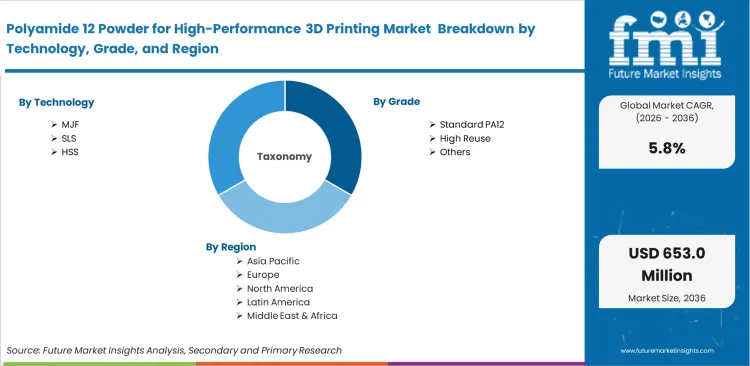
Polyamide 12 Powder for High-Performance 3D Printing Market Analysis by Segments
Technology
- MJF
- SLS
- HSS
- SAF
Grade
- Standard PA12
- High Reuse
- Flame Retardant
- Filled PA12
- Bio Circular
Application
- Functional Parts
- Prototyping
- Tooling
- Medical Devices
- Spare Parts
End Use
- Automotive
- Aerospace
- Medical
- Consumer Goods
- Industrial
Feedstock Model
- Virgin Powder
- Refresh Blend
- Reprocessed Powder
Region
- North America
- United States
- Canada
- Europe
- Germany
- United Kingdom
- France
- Italy
- Spain
- Asia Pacific
- China
- Japan
- South Korea
- Taiwan
- Singapore
- Latin America
- Brazil
- Mexico
- Argentina
- Middle East & Africa
- GCC Countries
- South Africa
- Israel
- Rest of Middle East & Africa
Bibliography
- Sanders, B., Cant, E., Amel, H., & Jenkins, M. (2024, January). Re-use of polyamide-12 in powder bed fusion and its effect on process-relevant powder characteristics and final part properties. Additive Manufacturing, 79.
- Kemnitzer, J., Wimmer, M., Tarasova, A., & Döpper, F. (2024, December). High Speed Sintering of Polyamide 12: From powder to part properties. Polymers, 16(24), 3605.
- Lupone, F., Padovano, E., Lambertini, V. G., Sampieri, R., Casamento, F., Zecchi, S., et al. (2024, January). Selective Laser Sintering versus Multi Jet Fusion: A comprehensive comparison study based on the properties of glass beads-reinforced Polyamide 12. Advanced Engineering Materials, 26(3).
- Kubeczek, A., Olejarczyk, M., Gruber, P., & Antonczak, A. J. (2025, July). Continuous reuse of polyamide 12 in powder bed fusion. Scientific Reports.
- Gebhardt, U., et al. (2025, May). Accessing process-property linkages of polyamide 12 manufactured by the multi jet fusion printing process. Progress in Additive Manufacturing.
- García Rodríguez, A., et al. (2025, February). The influence of mixed powder ageing on the structural, thermal, and mechanical properties of Polyamide 12 in laser sintering. Polymers, 17(5), 577.
- Vendittoli, V., et al. (2025, September). Degradation effects of reused PA12 powder in selective laser sintering on material characteristics, dimensional accuracy and mechanical strength. Polymers.
This bibliography is provided for reader reference. The full FMI report contains the complete reference list with primary source documentation.
This Report Addresses
- Material qualification bottlenecks slowing aerospace PA12 implementation.
- Refresh ratio economics dominating Multi Jet Fusion hardware scaling.
- Bio-circular formulation strategies replacing fossil-derived feedstock dependence.
- Automotive lightweighting mandates accelerating powder-bed part production.
- Thermal degradation risks limiting closed-loop powder recyclability.
- State subsidies driving Chinese additive manufacturing hardware proliferation.
- FDA tracking requirements restricting medical device virgin powder consumption.
- Specialized flowability metrics required for uninterrupted continuous factory printing.
Frequently Asked Questions
What is the market size of PA12 powder for 3D printing?
Industry is set to reach USD 617.2 million through 2036. Certification lock-in across aerospace and medical sectors ensures steady consumption of validated blends. Operations depend entirely on securing consistent global powder supply.
How fast is the PA12 powder sector growing?
Industry is set to expand at a 5.80% CAGR through 2036. Rapid hardware deployments across Asian service bureaus accelerate overall powder consumption volumes globally. Sustaining this rate requires overcoming powder aging issues inside heated chambers.
Why is PA12 used in powder bed fusion?
Extensive historical testing data satisfies strict FAA and FDA material requirements effortlessly. Regulatory anchoring protects legacy formulations from novel chemical entrants. Consistency matters far more than theoretical peak strength.
Which companies lead the PA12 powder ecosystem for 3D printing?
Evonik Industries AG, Arkema S.A., EOS GmbH, and HP Inc. anchor the supply base. Deep certification libraries protect established giants. Demonstrating superior powder aging characteristics during multi-day builds secures long-term industrial contracts.
Compare PA12 powder demand across MJF, SLS, and SAF?
MJF is estimated to hold 38.0% share in 2026, driven by rapid voxel control and closed-loop powder management capabilities. SLS remains critical for specialized medical validation. Platform architecture determines material flow entirely across these ecosystems.
How reusable is PA12 powder in MJF and SLS?
Reaching a 70% powder recovery threshold triggers hardware expansion. Thermal degradation alters melt viscosity and surface finish during multi-day builds. Process engineers discard un-sintered material to save final part quality.
What industries use PA12 powder in additive manufacturing?
Automotive is predicted to secure 28.0% share for lightweight brackets and custom interior housings in 2026. Medical and aerospace engineering teams design geometries impossible to manufacture through subtractive methods, anchoring high-margin industrial consumption.
Is PA12 better than PA11 for functional parts?
Comparing PA12 vs PA11 powder highlights that isotropic shrinkage predictability defines success. Tooling engineers hit tight geometric tolerances without requiring multiple iterative design adjustments, ensuring PA12 maintains 48.0% standard grade share.
What drives growth in the PA12 powder space?
Margin compression forces production engineers to prioritize materials offering high reuse ratios across consecutive print cycles. Medical regulatory requirements compel device designers to specify biocompatible grades for custom surgical guides and prosthetics.
Which countries are growing fastest for PA12 3D printing powders?
China is estimated to expand at a 6.6% CAGR through 2036. State subsidies fund additive equipment procurement aggressively. Government policy dictates a rapid transition from traditional tooling toward flexible digital platforms.
How does PA12 powder for automotive parts reduce production costs?
Direct printing eliminates expensive steel tooling lead times for low-volume luxury vehicle trims. Flexible production shields automakers from sudden supply chain shocks. Inventory virtualization replaces physical spare parts stored in expensive global warehouses.
Why do aerospace engineers prefer virgin PA12 powder?
Virgin powder is predicted to hold 58.0% share in 2026. Medical and aerospace regulators mandate unbroken material provenance for critical components. Quality assurance personnel refuse mixed powder batches to guarantee mechanical reliability.
What defines competitive advantage for PA12 powder suppliers?
Deep certification libraries protect established giants. Demonstrating superior powder aging characteristics during multi-day builds matters more to industrial buyers than merely offering lower upfront bulk pricing.
How do fusing agents alter recyclability?
Detailing agents modify local polymer characteristics. R&D personnel push complex geometries into production faster using voxel-level controls. Agent interaction permanently alters surrounding powder chemistry.
What role do state subsidies play in Asian markets?
Heavy industrial investment pushes domestic service bureaus. Operations personnel utilize subsidies to build massive powder-bed fusion farms capable of out-competing western facilities on pure volume.
How does automated thermal monitoring protect builds?
Integrated heating lamps maintain powder temperatures. Process engineers avoid part curling and reduce costly post-processing annealing steps. Thermal bed management ensures integrity.
What software capabilities enhance blend consistency?
Automated blending algorithms precisely dose virgin material. Real-time aged powder analysis eliminates guesswork and stabilizes mechanical output quality. Software solutions optimize total powder economics.
How do bio-circular formulations impact corporate sustainability?
Chemical companies develop castor-oil based polymers. Sustainability personnel meet corporate carbon reduction targets without sacrificing part durability. Renewable feedstocks break reliance on fossil-derived material.
Why do medical device startups avoid offshore printing?
Strict intellectual property protection laws dictate local sourcing. Clinical personnel manage production scaling through aggressive deployment of biocompatible materials at trusted domestic service bureaus.
How does inventory virtualization reduce automotive costs?
Digital files replace physical spare parts. Logistics personnel print legacy replacement components on-demand close to end customers. Flexible production shields automakers from sudden supply chain shocks.
What friction slows advanced powder deployment?
Powder aging ruins dimensional accuracy. Thermal degradation alters melt viscosity and surface finish during multi-day builds. Process engineers discard un-sintered material to save final part quality.
How do procurement teams bypass proprietary hardware lock-in?
Large service bureaus utilize massive purchasing volumes. Consolidating volume around specific open-source machines allows aggressive procurement teams to source directly from primary chemical manufacturers.
Preview the report firsthand - request a free sample
Get SampleGet the brochure for pricing and purchase details.
Get PDFTable of Content
- Executive Summary
- Global Market Outlook
- Demand-side Trends
- Supply-side Trends
- Technology Roadmap Analysis
- Analysis and Recommendations
- Market Overview
- Market Coverage / Taxonomy
- Market Definition / Scope / Limitations
- Research Methodology
- Chapter Orientation
- Analytical Lens and Working Hypotheses
- Market Structure, Signals, and Trend Drivers
- Benchmarking and Cross-market Comparability
- Market Sizing, Forecasting, and Opportunity Mapping
- Research Design and Evidence Framework
- Desk Research Programme (Secondary Evidence)
- Company Annual and Sustainability Reports
- Peer-reviewed Journals and Academic Literature
- Corporate Websites, Product Literature, and Technical Notes
- Earnings Decks and Investor Briefings
- Statutory Filings and Regulatory Disclosures
- Technical White Papers and Standards Notes
- Trade Journals, Industry Magazines, and Analyst Briefs
- Conference Proceedings, Webinars, and Seminar Materials
- Government Statistics Portals and Public Data Releases
- Press Releases and Reputable Media Coverage
- Specialist Newsletters and Curated Briefings
- Sector Databases and Reference Repositories
- FMI Internal Proprietary Databases and Historical Market Datasets
- Subscription Datasets and Paid Sources
- Social Channels, Communities, and Digital Listening Inputs
- Additional Desk Sources
- Expert Input and Fieldwork (Primary Evidence)
- Primary Modes
- Qualitative Interviews and Expert Elicitation
- Quantitative Surveys and Structured Data Capture
- Blended Approach
- Why Primary Evidence is Used
- Field Techniques
- Interviews
- Surveys
- Focus Groups
- Observational and In-context Research
- Social and Community Interactions
- Stakeholder Universe Engaged
- C-suite Leaders
- Board Members
- Presidents and Vice Presidents
- R&D and Innovation Heads
- Technical Specialists
- Domain Subject-matter Experts
- Scientists
- Physicians and Other Healthcare Professionals
- Governance, Ethics, and Data Stewardship
- Research Ethics
- Data Integrity and Handling
- Primary Modes
- Tooling, Models, and Reference Databases
- Desk Research Programme (Secondary Evidence)
- Data Engineering and Model Build
- Data Acquisition and Ingestion
- Cleaning, Normalisation, and Verification
- Synthesis, Triangulation, and Analysis
- Quality Assurance and Audit Trail
- Market Background
- Market Dynamics
- Drivers
- Restraints
- Opportunity
- Trends
- Scenario Forecast
- Demand in Optimistic Scenario
- Demand in Likely Scenario
- Demand in Conservative Scenario
- Opportunity Map Analysis
- Product Life Cycle Analysis
- Supply Chain Analysis
- Investment Feasibility Matrix
- Value Chain Analysis
- PESTLE and Porter’s Analysis
- Regulatory Landscape
- Regional Parent Market Outlook
- Production and Consumption Statistics
- Import and Export Statistics
- Market Dynamics
- Global Market Analysis 2021 to 2025 and Forecast, 2026 to 2036
- Historical Market Size Value (USD Million) Analysis, 2021 to 2025
- Current and Future Market Size Value (USD Million) Projections, 2026 to 2036
- Y-o-Y Growth Trend Analysis
- Absolute $ Opportunity Analysis
- Global Market Pricing Analysis 2021 to 2025 and Forecast 2026 to 2036
- Global Market Analysis 2021 to 2025 and Forecast 2026 to 2036, By Technology
- Introduction / Key Findings
- Historical Market Size Value (USD Million) Analysis By Technology , 2021 to 2025
- Current and Future Market Size Value (USD Million) Analysis and Forecast By Technology , 2026 to 2036
- MJF
- SLS
- HSS
- MJF
- Y-o-Y Growth Trend Analysis By Technology , 2021 to 2025
- Absolute $ Opportunity Analysis By Technology , 2026 to 2036
- Global Market Analysis 2021 to 2025 and Forecast 2026 to 2036, By Grade
- Introduction / Key Findings
- Historical Market Size Value (USD Million) Analysis By Grade, 2021 to 2025
- Current and Future Market Size Value (USD Million) Analysis and Forecast By Grade, 2026 to 2036
- Standard PA12
- High Reuse
- Others
- Standard PA12
- Y-o-Y Growth Trend Analysis By Grade, 2021 to 2025
- Absolute $ Opportunity Analysis By Grade, 2026 to 2036
- Global Market Analysis 2021 to 2025 and Forecast 2026 to 2036, By Application
- Introduction / Key Findings
- Historical Market Size Value (USD Million) Analysis By Application, 2021 to 2025
- Current and Future Market Size Value (USD Million) Analysis and Forecast By Application, 2026 to 2036
- Functional Parts
- Prototyping
- Tooling
- Functional Parts
- Y-o-Y Growth Trend Analysis By Application, 2021 to 2025
- Absolute $ Opportunity Analysis By Application, 2026 to 2036
- Global Market Analysis 2021 to 2025 and Forecast 2026 to 2036, By End Use
- Introduction / Key Findings
- Historical Market Size Value (USD Million) Analysis By End Use, 2021 to 2025
- Current and Future Market Size Value (USD Million) Analysis and Forecast By End Use, 2026 to 2036
- Automotive
- Aerospace
- Medical
- Automotive
- Y-o-Y Growth Trend Analysis By End Use, 2021 to 2025
- Absolute $ Opportunity Analysis By End Use, 2026 to 2036
- Global Market Analysis 2021 to 2025 and Forecast 2026 to 2036, By Feedstock Model
- Introduction / Key Findings
- Historical Market Size Value (USD Million) Analysis By Feedstock Model, 2021 to 2025
- Current and Future Market Size Value (USD Million) Analysis and Forecast By Feedstock Model, 2026 to 2036
- Virgin Powder
- Refresh Blend
- Reprocessed Powder
- Virgin Powder
- Y-o-Y Growth Trend Analysis By Feedstock Model, 2021 to 2025
- Absolute $ Opportunity Analysis By Feedstock Model, 2026 to 2036
- Global Market Analysis 2021 to 2025 and Forecast 2026 to 2036, By Region
- Introduction
- Historical Market Size Value (USD Million) Analysis By Region, 2021 to 2025
- Current Market Size Value (USD Million) Analysis and Forecast By Region, 2026 to 2036
- North America
- Latin America
- Western Europe
- Eastern Europe
- East Asia
- South Asia and Pacific
- Middle East & Africa
- Market Attractiveness Analysis By Region
- North America Market Analysis 2021 to 2025 and Forecast 2026 to 2036, By Country
- Historical Market Size Value (USD Million) Trend Analysis By Market Taxonomy, 2021 to 2025
- Market Size Value (USD Million) Forecast By Market Taxonomy, 2026 to 2036
- By Country
- USA
- Canada
- Mexico
- By Technology
- By Grade
- By Application
- By End Use
- By Feedstock Model
- By Country
- Market Attractiveness Analysis
- By Country
- By Technology
- By Grade
- By Application
- By End Use
- By Feedstock Model
- Key Takeaways
- Latin America Market Analysis 2021 to 2025 and Forecast 2026 to 2036, By Country
- Historical Market Size Value (USD Million) Trend Analysis By Market Taxonomy, 2021 to 2025
- Market Size Value (USD Million) Forecast By Market Taxonomy, 2026 to 2036
- By Country
- Brazil
- Chile
- Rest of Latin America
- By Technology
- By Grade
- By Application
- By End Use
- By Feedstock Model
- By Country
- Market Attractiveness Analysis
- By Country
- By Technology
- By Grade
- By Application
- By End Use
- By Feedstock Model
- Key Takeaways
- Western Europe Market Analysis 2021 to 2025 and Forecast 2026 to 2036, By Country
- Historical Market Size Value (USD Million) Trend Analysis By Market Taxonomy, 2021 to 2025
- Market Size Value (USD Million) Forecast By Market Taxonomy, 2026 to 2036
- By Country
- Germany
- UK
- Italy
- Spain
- France
- Nordic
- BENELUX
- Rest of Western Europe
- By Technology
- By Grade
- By Application
- By End Use
- By Feedstock Model
- By Country
- Market Attractiveness Analysis
- By Country
- By Technology
- By Grade
- By Application
- By End Use
- By Feedstock Model
- Key Takeaways
- Eastern Europe Market Analysis 2021 to 2025 and Forecast 2026 to 2036, By Country
- Historical Market Size Value (USD Million) Trend Analysis By Market Taxonomy, 2021 to 2025
- Market Size Value (USD Million) Forecast By Market Taxonomy, 2026 to 2036
- By Country
- Russia
- Poland
- Hungary
- Balkan & Baltic
- Rest of Eastern Europe
- By Technology
- By Grade
- By Application
- By End Use
- By Feedstock Model
- By Country
- Market Attractiveness Analysis
- By Country
- By Technology
- By Grade
- By Application
- By End Use
- By Feedstock Model
- Key Takeaways
- East Asia Market Analysis 2021 to 2025 and Forecast 2026 to 2036, By Country
- Historical Market Size Value (USD Million) Trend Analysis By Market Taxonomy, 2021 to 2025
- Market Size Value (USD Million) Forecast By Market Taxonomy, 2026 to 2036
- By Country
- China
- Japan
- South Korea
- By Technology
- By Grade
- By Application
- By End Use
- By Feedstock Model
- By Country
- Market Attractiveness Analysis
- By Country
- By Technology
- By Grade
- By Application
- By End Use
- By Feedstock Model
- Key Takeaways
- South Asia and Pacific Market Analysis 2021 to 2025 and Forecast 2026 to 2036, By Country
- Historical Market Size Value (USD Million) Trend Analysis By Market Taxonomy, 2021 to 2025
- Market Size Value (USD Million) Forecast By Market Taxonomy, 2026 to 2036
- By Country
- India
- ASEAN
- Australia & New Zealand
- Rest of South Asia and Pacific
- By Technology
- By Grade
- By Application
- By End Use
- By Feedstock Model
- By Country
- Market Attractiveness Analysis
- By Country
- By Technology
- By Grade
- By Application
- By End Use
- By Feedstock Model
- Key Takeaways
- Middle East & Africa Market Analysis 2021 to 2025 and Forecast 2026 to 2036, By Country
- Historical Market Size Value (USD Million) Trend Analysis By Market Taxonomy, 2021 to 2025
- Market Size Value (USD Million) Forecast By Market Taxonomy, 2026 to 2036
- By Country
- Kingdom of Saudi Arabia
- Other GCC Countries
- Turkiye
- South Africa
- Other African Union
- Rest of Middle East & Africa
- By Technology
- By Grade
- By Application
- By End Use
- By Feedstock Model
- By Country
- Market Attractiveness Analysis
- By Country
- By Technology
- By Grade
- By Application
- By End Use
- By Feedstock Model
- Key Takeaways
- Key Countries Market Analysis
- USA
- Pricing Analysis
- Market Share Analysis, 2025
- By Technology
- By Grade
- By Application
- By End Use
- By Feedstock Model
- Canada
- Pricing Analysis
- Market Share Analysis, 2025
- By Technology
- By Grade
- By Application
- By End Use
- By Feedstock Model
- Mexico
- Pricing Analysis
- Market Share Analysis, 2025
- By Technology
- By Grade
- By Application
- By End Use
- By Feedstock Model
- Brazil
- Pricing Analysis
- Market Share Analysis, 2025
- By Technology
- By Grade
- By Application
- By End Use
- By Feedstock Model
- Chile
- Pricing Analysis
- Market Share Analysis, 2025
- By Technology
- By Grade
- By Application
- By End Use
- By Feedstock Model
- Germany
- Pricing Analysis
- Market Share Analysis, 2025
- By Technology
- By Grade
- By Application
- By End Use
- By Feedstock Model
- UK
- Pricing Analysis
- Market Share Analysis, 2025
- By Technology
- By Grade
- By Application
- By End Use
- By Feedstock Model
- Italy
- Pricing Analysis
- Market Share Analysis, 2025
- By Technology
- By Grade
- By Application
- By End Use
- By Feedstock Model
- Spain
- Pricing Analysis
- Market Share Analysis, 2025
- By Technology
- By Grade
- By Application
- By End Use
- By Feedstock Model
- France
- Pricing Analysis
- Market Share Analysis, 2025
- By Technology
- By Grade
- By Application
- By End Use
- By Feedstock Model
- India
- Pricing Analysis
- Market Share Analysis, 2025
- By Technology
- By Grade
- By Application
- By End Use
- By Feedstock Model
- ASEAN
- Pricing Analysis
- Market Share Analysis, 2025
- By Technology
- By Grade
- By Application
- By End Use
- By Feedstock Model
- Australia & New Zealand
- Pricing Analysis
- Market Share Analysis, 2025
- By Technology
- By Grade
- By Application
- By End Use
- By Feedstock Model
- China
- Pricing Analysis
- Market Share Analysis, 2025
- By Technology
- By Grade
- By Application
- By End Use
- By Feedstock Model
- Japan
- Pricing Analysis
- Market Share Analysis, 2025
- By Technology
- By Grade
- By Application
- By End Use
- By Feedstock Model
- South Korea
- Pricing Analysis
- Market Share Analysis, 2025
- By Technology
- By Grade
- By Application
- By End Use
- By Feedstock Model
- Russia
- Pricing Analysis
- Market Share Analysis, 2025
- By Technology
- By Grade
- By Application
- By End Use
- By Feedstock Model
- Poland
- Pricing Analysis
- Market Share Analysis, 2025
- By Technology
- By Grade
- By Application
- By End Use
- By Feedstock Model
- Hungary
- Pricing Analysis
- Market Share Analysis, 2025
- By Technology
- By Grade
- By Application
- By End Use
- By Feedstock Model
- Kingdom of Saudi Arabia
- Pricing Analysis
- Market Share Analysis, 2025
- By Technology
- By Grade
- By Application
- By End Use
- By Feedstock Model
- Turkiye
- Pricing Analysis
- Market Share Analysis, 2025
- By Technology
- By Grade
- By Application
- By End Use
- By Feedstock Model
- South Africa
- Pricing Analysis
- Market Share Analysis, 2025
- By Technology
- By Grade
- By Application
- By End Use
- By Feedstock Model
- USA
- Market Structure Analysis
- Competition Dashboard
- Competition Benchmarking
- Market Share Analysis of Top Players
- By Regional
- By Technology
- By Grade
- By Application
- By End Use
- By Feedstock Model
- Competition Analysis
- Competition Deep Dive
- Evonik Industries AG
- Overview
- Product Portfolio
- Profitability by Market Segments (Product/Age /Sales Channel/Region)
- Sales Footprint
- Strategy Overview
- Marketing Strategy
- Product Strategy
- Channel Strategy
- Arkema S.A.
- EOS GmbH
- 3D Systems Corporation
- Stratasys Ltd.
- Toray Industries, Inc.
- Evonik Industries AG
- Competition Deep Dive
- Assumptions & Acronyms Used


