

- Industry Size (2026)
- USD 878.1 Mn
- Forecast (2036)
- USD 1543.1 Mn
- CAGR (2026 to 2036)
- 5.80%
Polyamide 12 Powder Market Forecast and Outlook (2026 to 2036)
Global revenues for polyamide 12 powder are expected to increase from USD 878.1 million in 2026 to USD 1,543.1 million by 2036, reflecting a compound annual growth rate of 5.80%. The polyamide 12 (PA12) powder market is expanding steadily as manufacturers increasingly adopt high-performance polymer powders for additive manufacturing and precision industrial applications. PA12 powder is widely used in selective laser sintering and other powder-based processes due to its low moisture absorption, dimensional stability, and balanced mechanical properties. These characteristics enable consistent part quality, high reuse rates, and reduced post-processing requirements, making the material suitable for both prototyping and serial production. Demand is also supported by applications beyond additive manufacturing, including automotive tubing, medical devices, and specialty industrial components that require chemical resistance and long-term durability. Supplier differentiation is increasingly based on powder consistency, particle size control, and predictable thermal behavior across multiple build cycles. Supply concentration and feedstock sensitivity influence pricing and procurement strategies, encouraging buyers to qualify multiple sources.
Quick Stats for Polyamide 12 Powder Market
- Polyamide 12 Powder Market Value (2026): USD 878.1 Million
- Polyamide 12 Powder Market Forecast Value (2036): USD 1,543.1 Million
- Polyamide 12 Powder Market Forecast CAGR (2026 to 2036): 5.80%
- Leading Application in Polyamide 12 Powder Market: Powder Bed Fusion & 3D Printing (40% share)
- Leading Powder Grade in Polyamide 12 Powder Market: Standard PA12 Powder (48% share)
- Key Growth Regions in Polyamide 12 Powder Market: Asia Pacific, Europe, North America, Latin America, Middle East & Africa
- Top Key Players in Polyamide 12 Powder Market: Evonik Industries AG, Arkema, BASF SE, EMS-Chemie, UBE Corporation, SABIC, Clariant, Lehmann&Voss&Co., CRP Technology

Polyamide 12 Powder Market Key Takeaways
| Metric | Value |
|---|---|
| Polyamide 12 Powder Market Value (2026) | USD 878.1 Million |
| Polyamide 12 Powder Market Forecast Value (2036) | USD 1,543.1 Million |
| Polyamide 12 Powder Market Forecast CAGR (2026 to 2036) | 5.80% |
How are Additive Manufacturing Adoption and Performance Consistency Driving the Polyamide 12 Powder Market?
The polyamide 12 (PA12) powder market is expanding as manufacturers increasingly rely on additive manufacturing and high-performance polymer applications that demand dimensional accuracy, chemical resistance, and mechanical stability. PA12 powders are widely used in selective laser sintering (SLS) and other powder-based processes due to their narrow melting window, low moisture absorption, and excellent balance of toughness and flexibility. For industrial users, these properties translate into repeatable part quality and reduced post-processing complexity.
Supplier selection is strongly influenced by powder consistency and reuse performance. End users evaluate PA12 powders based on particle size distribution, flowability, thermal aging behavior, and recyclability across multiple print cycles. Powder producers that can deliver tight batch-to-batch control and predictable refresh ratios are gaining preference among service bureaus and OEMs scaling serial production. Beyond additive manufacturing, demand from automotive tubing, medical devices, and specialty components is reinforcing the need for high-purity, application-specific PA12 grades.
Supply reliability and cost control are shaping long-term procurement strategies. PA12 production is concentrated among a limited number of suppliers, making availability and pricing sensitive to capacity constraints and feedstock dynamics. This is encouraging customers to qualify multiple sources and explore modified or blended PA12 formulations that balance performance with cost efficiency. For producers and distributors, competitive advantage increasingly depends on powder quality assurance, technical support, and the ability to support customers transitioning from prototyping to full-scale production positioning PA12 powder as a steady-growth, performance-driven material across advanced manufacturing applications.
How Is the Polyamide 12 Powder Market Structured By Application and Powder Grade?
The polyamide 12 powder market is segmented by application and powder grade, reflecting how processing method, flow behavior, and end-part performance influence material selection. By application, powder bed fusion and 3D printing represent the leading segment, as PA12 powders are widely used for producing durable, lightweight, and dimensionally stable components. Other applications include coatings and functional layers, metal coating and protection, and other niche uses where chemical resistance and toughness are required. By powder grade, standard PA12 powder dominates the market, while high-flow and specialty grades and recycled or blended grades address specific processing speed, surface finish, and cost optimization needs.
Why Does Powder Bed Fusion And 3D Printing Lead Application Demand In The Polyamide 12 Powder Market?
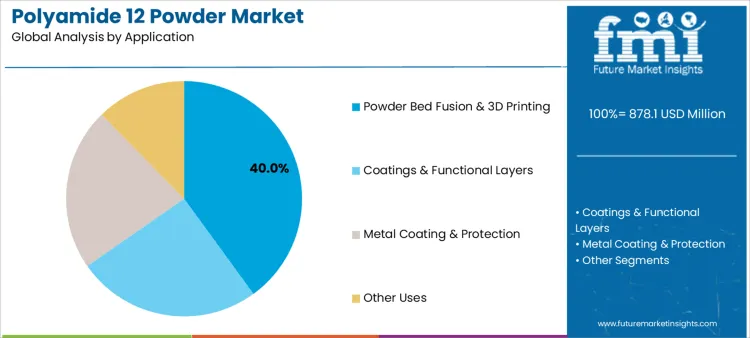
Powder bed fusion and 3D printing account for 40% share of the polyamide 12 powder market because PA12 offers an optimal balance of mechanical strength, flexibility, and thermal stability for additive manufacturing. The material enables production of complex geometries with consistent layer bonding and minimal warpage. Industries such as automotive, aerospace, medical devices, and consumer goods rely on PA12 powders for functional prototypes and end-use parts. High reuse rates and stable processing behavior make PA12 cost-effective for serial production. Growing adoption of additive manufacturing for low-volume and customized parts further supports demand. These performance reliability and manufacturing flexibility factors explain why powder bed fusion and 3D printing dominate application usage.
Why Does Standard PA12 Powder Dominate Powder Grade Adoption In The Polyamide 12 Powder Market?

Standard PA12 powder holds 48% share of the polyamide 12 powder market because it provides consistent particle size distribution, flowability, and thermal behavior suitable for a wide range of applications. Manufacturers favor standard grades due to predictable sintering performance and repeatable part quality across production runs. These powders integrate easily into existing powder bed fusion systems without requiring parameter adjustments. Broad availability and established qualification data support adoption across multiple industries. For material suppliers, standard PA12 grades enable higher production volumes and streamlined quality control. These consistency, compatibility, and scalability advantages explain why standard PA12 powder remains the most widely used grade.
What Are The Key Dynamics Of The Polyamide 12 Powder Market?
The polyamide 12 (PA12) powder market is driven by demand for high-performance polymer powders used in additive manufacturing, selective laser sintering (SLS), industrial coatings, and specialty compounding. PA12 powder delivers excellent mechanical strength, chemical resistance, low moisture absorption, and dimensional stability, which make it suitable for functional prototyping and end-use parts across automotive, aerospace, medical, and consumer electronics applications. For polymer powder producers, compounders, and system OEMs, particle size distribution, consistent blend quality, flowability, and process reproducibility are essential factors that influence customer adoption and repeat purchase decisions in precision manufacturing environments.
How Are Technology And Application Trends Shaping The PA12 Powder Market?
Technology and application trends are shaping the PA12 powder market through the expansion of additive manufacturing, advanced SLS system capabilities, and material innovation. Growth in industrial 3D printing for production-grade components is increasing demand for powders with narrow particle size distributions and optimized thermal properties that ensure consistent layer fusion and part performance. Emerging applications such as customized medical devices, robotics components, and lightweight structural parts in mobility sectors emphasize both functional performance and repeatability. Suppliers are developing tailored PA12 grades with improved thermal stability, enhanced elongation at break, and predictable shrinkage characteristics that expand design freedom and improve process window flexibility for manufacturers.
Why Do Supply, Cost, And Qualification Challenges Restrain Market Growth?
Supply, cost, and qualification challenges restrain the polyamide 12 powder market due to the technical and economic intensity of producing high-quality polymer powder. PA12 powder production requires controlled polymerization and post-processing (e.g., micronization, classification, drying) to meet tight particle size and distribution specifications. High manufacturing costs driven by energy input, quality control, and specialized equipment increase unit prices relative to commodity polymer powders. Qualification cycles for critical applications (such as aerospace or medical parts) involve exhaustive performance validation, regulatory documentation, and repeatability testing, which extend time to adoption for converters and end-users. Supply chain constraints for key monomers and feedstocks can also impact price stability and lead times.
How is the Polyamide 12 Powder Market Growing across Key Countries?

| Country | CAGR (%) |
|---|---|
| China | 7.0% |
| Brazil | 6.6% |
| United States | 5.5% |
| Germany | 5.4% |
| South Korea | 5.0% |
The polyamide 12 (PA12) powder market is expanding steadily as additive manufacturing, industrial coating, and specialty molding applications gain wider acceptance across manufacturing sectors. PA12 powder is valued for its mechanical strength, chemical resistance, dimensional stability, and suitability for selective laser sintering (SLS) and multi jet fusion (MJF) processes. Country-wise growth varies based on adoption of industrial 3D printing, automotive lightweighting demand, and expansion of high-performance polymer applications. High-growth markets are driven by scaling additive manufacturing capacity and localized production, while mature regions focus on precision components, qualification-driven demand, and consistent material performance.
Why is China Leading the Polyamide 12 Powder Market?
Demand for polyamide 12 powder in China is expanding at a CAGR of 7.0% during 2026 to 2036, driven by rapid growth in industrial additive manufacturing and expanding use of high-performance polymers in automotive, electronics, and industrial equipment. Chinese manufacturers are increasingly adopting PA12 powder for selective laser sintering and multi jet fusion processes to produce lightweight, complex, and customized components at scale. Demand is particularly strong in automotive interior parts, electrical housings, tooling, and industrial components requiring durability and dimensional accuracy. PA12 powder is favored for its balance of toughness, chemical resistance, and process stability, enabling consistent part quality across high-volume production runs. Chinese buyers prioritize powders with controlled particle size distribution, good flowability, and repeatable thermal behavior to support reliable printing performance. Domestic material suppliers benefit from expanding polymer production capacity and improving quality control standards.
Why is Brazil Seeing Rising Demand for Polyamide 12 Powder?
Sale of polyamide 12 powder in Brazil is growing at a CAGR of 6.6% during 2026 to 2036, supported by gradual adoption of industrial additive manufacturing and expanding demand for high-performance plastic components. Growth is most visible in automotive aftermarket parts, tooling, fixtures, and small-batch industrial components where PA12 powder enables design flexibility and reduced lead times. Brazilian manufacturers value PA12 powder for its durability, impact resistance, and ability to perform under varying temperature and humidity conditions. The material is increasingly used for functional parts rather than purely visual prototypes. Buyers prioritize cost-effective solutions that deliver stable print quality and mechanical consistency across repeated builds. Adoption remains selective, reflecting capital investment considerations and the need for workforce skill development. Procurement decisions often favor suppliers offering reliable logistics, technical support, and compatibility with existing SLS systems.
What is Driving Growth of Polyamide 12 Powder in the United States?
The United States polyamide 12 powder market is expanding at a CAGR of 5.5% during 2026 to 2036, driven by strong adoption of additive manufacturing for end-use production in aerospace, automotive, medical devices, and industrial equipment. PA12 powder is widely used for producing lightweight, high-strength components with tight dimensional tolerances. Demand is strongest in applications requiring repeatability, material qualification, and regulatory compliance. USA buyers emphasize consistent powder quality, recyclability within build cycles, and validated mechanical performance. PA12 powder is preferred for its stable processing window and proven track record in certified applications. Adoption is less volume-driven and more focused on high-value, performance-critical parts. Procurement decisions prioritize long-term supplier reliability, technical documentation, and compatibility with leading SLS and MJF platforms.
How is Germany Supporting Demand for Polyamide 12 Powder?
Demand for polyamide 12 powder in Germany is growing at a CAGR of 5.4% during 2026 to 2036, supported by the country’s leadership in engineering, automotive manufacturing, and precision industrial components. German manufacturers use PA12 powder extensively for functional prototypes, tooling, and end-use parts where dimensional accuracy and mechanical reliability are critical. PA12 powder is valued for its predictable performance, chemical resistance, and suitability for automated production environments. Buyers prioritize tight control over powder morphology, batch consistency, and process repeatability. Adoption is concentrated in automotive interiors, industrial machinery components, and specialized consumer products. Procurement decisions favor suppliers with certified quality systems, detailed material data, and the ability to support long qualification cycles.
How is South Korea Expanding Use of Polyamide 12 Powder?
Demand for polyamide 12 powder in South Korea is expanding at a CAGR of 5.0% during 2026 to 2036, driven by adoption of additive manufacturing in electronics, automotive components, and industrial tooling. Manufacturers increasingly use PA12 powder to produce lightweight, compact, and geometrically complex parts suited for modern product designs. Buyers emphasize powder flow consistency, print reliability, and compatibility with high-precision manufacturing systems. PA12 powder is increasingly applied in functional components rather than prototyping, particularly for export-oriented products requiring high quality standards. Procurement decisions are influenced by supplier technical capability, stable material supply, and alignment with global manufacturing requirements. Market growth is supported by investments in smart manufacturing, expansion of industrial 3D printing capacity, and increasing integration of additive manufacturing into conventional production workflows.
How are Producers Competing in the Polyamide 12 Powder Market?
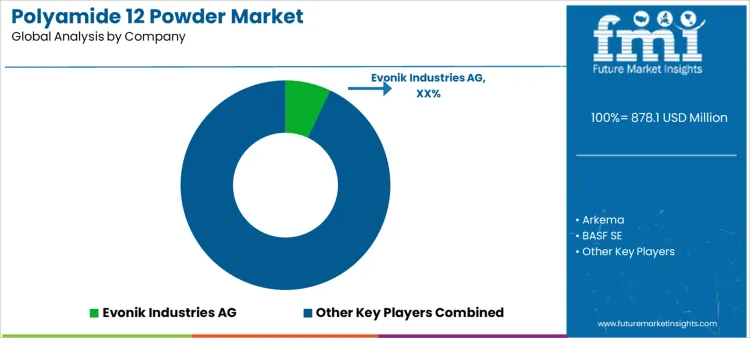
Competition in the polyamide 12 (PA12) powder market is driven by powder consistency, flow behavior, and mechanical performance in additive manufacturing and specialty coating applications. Evonik Industries AG anchors the market through its Vestamid portfolio, positioning PA12 powders around tight particle size distribution, high recyclability, and repeatable performance in powder bed fusion processes. Its strategy emphasizes qualification with leading 3D printer OEMs and long-term supply reliability for industrial users. Arkema competes with PA12 powders optimized for balanced toughness and surface finish, highlighting process stability and compatibility with high-throughput additive manufacturing systems.
Large chemical groups reinforce competition through scale and application breadth. BASF SE and SABIC position PA12 powders within broader engineering plastics portfolios, focusing on material consistency, global distribution, and suitability for both 3D printing and specialty coatings. EMS-Chemie and UBE Corporation emphasize high-purity PA12 powders engineered for demanding industrial and automotive applications, with attention to thermal stability and long-term mechanical retention.
Specialty compounders and application-focused suppliers add differentiation through customization. Lehmann&Voss&Co. focuses on tailored PA12 powder grades and customer-specific modifications, supporting niche additive manufacturing requirements. Clariant contributes through additives and surface treatments that enhance powder flow and print performance. CRP Technology differentiates by aligning PA12 powders with proprietary 3D printing processes and end-use qualification. Across the market, competitive advantage is defined by powder quality consistency, print repeatability, and OEM qualification depth rather than material pricing alone.
Key Players in Polyamide 12 Powder Market
- Evonik Industries AG
- Arkema
- BASF SE
- EMS-Chemie
- UBE Corporation
- Evonik Vestamid business
- Lehmann&Voss&Co.
- SABIC
- Clariant
- CRP Technology
Scope of Report
| Attribute | Details |
|---|---|
| Market Size Unit | USD Million |
| Application Covered | Powder Bed Fusion & 3D Printing, Coatings & Functional Layers, Metal Coating & Protection, Other Industrial Uses |
| Powder Grade Covered | Standard PA12 Powder, High-Flow & Specialty Grades, Recycled or Blended Grades |
| Countries Covered | China, Japan, South Korea, India, Australia & New Zealand, ASEAN, Rest of Asia Pacific, Germany, United Kingdom, France, Italy, Spain, Nordic, BENELUX, Rest of Europe, United States, Canada, Mexico, Brazil, Chile, Rest of Latin America, Kingdom of Saudi Arabia, Other GCC Countries, Turkey, South Africa, Other African Union, Rest of Middle East & Africa |
| Regions Covered | Asia Pacific, Europe, North America, Latin America, Middle East & Africa |
| Key Companies Profiled | Evonik Industries AG, Arkema, BASF SE, EMS-Chemie, UBE Corporation, Evonik Vestamid Business, Lehmann&Voss&Co., SABIC, Clariant, CRP Technology |
| Additional Attributes | Dollar sales by application and powder grade are evaluated across additive manufacturing and industrial coating use cases. The scope analyzes powder flowability, particle size distribution, thermal stability, recyclability, and laser sintering performance. Country-level assessment reflects adoption of industrial 3D printing, localized powder production, and demand from automotive, aerospace, and industrial prototyping sectors. |
Polyamide 12 Powder Market by Key Segments
Application:
- Powder Bed Fusion & 3D Printing
- Coatings & Functional Layers
- Metal Coating & Protection
- Other Uses
Powder Grade:
- Standard PA12 Powder
- High-Flow & Specialty Grades
- Recycled or Blended Grades
Region:
- Asia Pacific
- China
- Japan
- South Korea
- India
- Australia & New Zealand
- ASEAN
- Rest of Asia Pacific
- Europe
- Germany
- United Kingdom
- France
- Italy
- Spain
- Nordic
- BENELUX
- Rest of Europe
- North America
- United States
- Canada
- Mexico
- Latin America
- Brazil
- Chile
- Rest of Latin America
- Middle East & Africa
- Kingdom of Saudi Arabia
- Other GCC Countries
- Turkey
- South Africa
- Other African Union
- Rest of Middle East & Africa
Bibliography
- International Organization for Standardization. (2023). ISO 52900: Additive manufacturing – General principles – Fundamentals and vocabulary. ISO.
- International Organization for Standardization & ASTM International. (2023). ISO/ASTM 52921: Additive manufacturing – Reference terminology for additive manufacturing – General principles – Terminology. ISO/ASTM.
- European Commission. (2023). A sustainable carbon cycles framework for bio-based and advanced polymers. European Union.
- International Energy Agency. (2023). The future of industrial materials: Polymers, performance plastics, and manufacturing efficiency. International Energy Agency.
- ASTM International. (2023). ASTM F2792-12a: Standard terminology for additive manufacturing technologies. ASTM International.
Frequently Asked Questions
How big is the polyamide 12 powder market in 2026?
The global polyamide 12 powder market is estimated to be valued at USD 878.1 million in 2026.
What will be the size of polyamide 12 powder market in 2036?
The market size for the polyamide 12 powder market is projected to reach USD 1,543.1 million by 2036.
How much will be the polyamide 12 powder market growth between 2026 and 2036?
The polyamide 12 powder market is expected to grow at a 5.8% CAGR between 2026 and 2036.
What are the key product types in the polyamide 12 powder market?
The key product types in polyamide 12 powder market are powder bed fusion & 3d printing, coatings & functional layers, metal coating & protection and other uses.
Which powder grade segment to contribute significant share in the polyamide 12 powder market in 2026?
In terms of powder grade, standard pa12 powder segment to command 48.0% share in the polyamide 12 powder market in 2026.
Preview the report firsthand - request a free sample
Get SampleGet the brochure for pricing and purchase details.
Get PDFTable of Content
- Executive Summary
- Global Market Outlook
- Demand-side Trends
- Supply-side Trends
- Technology Roadmap Analysis
- Analysis and Recommendations
- Market Overview
- Market Coverage / Taxonomy
- Market Definition / Scope / Limitations
- Market Background
- Market Dynamics
- Drivers
- Restraints
- Opportunity
- Trends
- Scenario Forecast
- Demand in Optimistic Scenario
- Demand in Likely Scenario
- Demand in Conservative Scenario
- Opportunity Map Analysis
- Product Life Cycle Analysis
- Supply Chain Analysis
- Investment Feasibility Matrix
- Value Chain Analysis
- PESTLE and Porter’s Analysis
- Regulatory Landscape
- Regional Parent Market Outlook
- Production and Consumption Statistics
- Import and Export Statistics
- Market Dynamics
- Global Market Analysis 2021 to 2025 and Forecast, 2026 to 2036
- Historical Market Size Value (USD Million) Analysis, 2021 to 2025
- Current and Future Market Size Value (USD Million) Projections, 2026 to 2036
- Y-o-Y Growth Trend Analysis
- Absolute $ Opportunity Analysis
- Global Market Pricing Analysis 2021 to 2025 and Forecast 2026 to 2036
- Global Market Analysis 2021 to 2025 and Forecast 2026 to 2036, By Application
- Introduction / Key Findings
- Historical Market Size Value (USD Million) Analysis By Application , 2021 to 2025
- Current and Future Market Size Value (USD Million) Analysis and Forecast By Application , 2026 to 2036
- Powder Bed Fusion & 3D Printing
- Coatings & Functional Layers
- Metal Coating & Protection
- Other Uses
- Powder Bed Fusion & 3D Printing
- Y-o-Y Growth Trend Analysis By Application , 2021 to 2025
- Absolute $ Opportunity Analysis By Application , 2026 to 2036
- Global Market Analysis 2021 to 2025 and Forecast 2026 to 2036, By Powder Grade
- Introduction / Key Findings
- Historical Market Size Value (USD Million) Analysis By Powder Grade, 2021 to 2025
- Current and Future Market Size Value (USD Million) Analysis and Forecast By Powder Grade, 2026 to 2036
- Standard PA12 Powder
- High-Flow & Specialty Grades
- Recycled or Blended Grades
- Standard PA12 Powder
- Y-o-Y Growth Trend Analysis By Powder Grade, 2021 to 2025
- Absolute $ Opportunity Analysis By Powder Grade, 2026 to 2036
- Global Market Analysis 2021 to 2025 and Forecast 2026 to 2036, By Region
- Introduction
- Historical Market Size Value (USD Million) Analysis By Region, 2021 to 2025
- Current Market Size Value (USD Million) Analysis and Forecast By Region, 2026 to 2036
- North America
- Latin America
- Western Europe
- Eastern Europe
- East Asia
- South Asia and Pacific
- Middle East & Africa
- Market Attractiveness Analysis By Region
- North America Market Analysis 2021 to 2025 and Forecast 2026 to 2036, By Country
- Historical Market Size Value (USD Million) Trend Analysis By Market Taxonomy, 2021 to 2025
- Market Size Value (USD Million) Forecast By Market Taxonomy, 2026 to 2036
- By Country
- USA
- Canada
- Mexico
- By Application
- By Powder Grade
- By Country
- Market Attractiveness Analysis
- By Country
- By Application
- By Powder Grade
- Key Takeaways
- Latin America Market Analysis 2021 to 2025 and Forecast 2026 to 2036, By Country
- Historical Market Size Value (USD Million) Trend Analysis By Market Taxonomy, 2021 to 2025
- Market Size Value (USD Million) Forecast By Market Taxonomy, 2026 to 2036
- By Country
- Brazil
- Chile
- Rest of Latin America
- By Application
- By Powder Grade
- By Country
- Market Attractiveness Analysis
- By Country
- By Application
- By Powder Grade
- Key Takeaways
- Western Europe Market Analysis 2021 to 2025 and Forecast 2026 to 2036, By Country
- Historical Market Size Value (USD Million) Trend Analysis By Market Taxonomy, 2021 to 2025
- Market Size Value (USD Million) Forecast By Market Taxonomy, 2026 to 2036
- By Country
- Germany
- UK
- Italy
- Spain
- France
- Nordic
- BENELUX
- Rest of Western Europe
- By Application
- By Powder Grade
- By Country
- Market Attractiveness Analysis
- By Country
- By Application
- By Powder Grade
- Key Takeaways
- Eastern Europe Market Analysis 2021 to 2025 and Forecast 2026 to 2036, By Country
- Historical Market Size Value (USD Million) Trend Analysis By Market Taxonomy, 2021 to 2025
- Market Size Value (USD Million) Forecast By Market Taxonomy, 2026 to 2036
- By Country
- Russia
- Poland
- Hungary
- Balkan & Baltic
- Rest of Eastern Europe
- By Application
- By Powder Grade
- By Country
- Market Attractiveness Analysis
- By Country
- By Application
- By Powder Grade
- Key Takeaways
- East Asia Market Analysis 2021 to 2025 and Forecast 2026 to 2036, By Country
- Historical Market Size Value (USD Million) Trend Analysis By Market Taxonomy, 2021 to 2025
- Market Size Value (USD Million) Forecast By Market Taxonomy, 2026 to 2036
- By Country
- China
- Japan
- South Korea
- By Application
- By Powder Grade
- By Country
- Market Attractiveness Analysis
- By Country
- By Application
- By Powder Grade
- Key Takeaways
- South Asia and Pacific Market Analysis 2021 to 2025 and Forecast 2026 to 2036, By Country
- Historical Market Size Value (USD Million) Trend Analysis By Market Taxonomy, 2021 to 2025
- Market Size Value (USD Million) Forecast By Market Taxonomy, 2026 to 2036
- By Country
- India
- ASEAN
- Australia & New Zealand
- Rest of South Asia and Pacific
- By Application
- By Powder Grade
- By Country
- Market Attractiveness Analysis
- By Country
- By Application
- By Powder Grade
- Key Takeaways
- Middle East & Africa Market Analysis 2021 to 2025 and Forecast 2026 to 2036, By Country
- Historical Market Size Value (USD Million) Trend Analysis By Market Taxonomy, 2021 to 2025
- Market Size Value (USD Million) Forecast By Market Taxonomy, 2026 to 2036
- By Country
- Kingdom of Saudi Arabia
- Other GCC Countries
- Turkiye
- South Africa
- Other African Union
- Rest of Middle East & Africa
- By Application
- By Powder Grade
- By Country
- Market Attractiveness Analysis
- By Country
- By Application
- By Powder Grade
- Key Takeaways
- Key Countries Market Analysis
- USA
- Pricing Analysis
- Market Share Analysis, 2025
- By Application
- By Powder Grade
- Canada
- Pricing Analysis
- Market Share Analysis, 2025
- By Application
- By Powder Grade
- Mexico
- Pricing Analysis
- Market Share Analysis, 2025
- By Application
- By Powder Grade
- Brazil
- Pricing Analysis
- Market Share Analysis, 2025
- By Application
- By Powder Grade
- Chile
- Pricing Analysis
- Market Share Analysis, 2025
- By Application
- By Powder Grade
- Germany
- Pricing Analysis
- Market Share Analysis, 2025
- By Application
- By Powder Grade
- UK
- Pricing Analysis
- Market Share Analysis, 2025
- By Application
- By Powder Grade
- Italy
- Pricing Analysis
- Market Share Analysis, 2025
- By Application
- By Powder Grade
- Spain
- Pricing Analysis
- Market Share Analysis, 2025
- By Application
- By Powder Grade
- France
- Pricing Analysis
- Market Share Analysis, 2025
- By Application
- By Powder Grade
- India
- Pricing Analysis
- Market Share Analysis, 2025
- By Application
- By Powder Grade
- ASEAN
- Pricing Analysis
- Market Share Analysis, 2025
- By Application
- By Powder Grade
- Australia & New Zealand
- Pricing Analysis
- Market Share Analysis, 2025
- By Application
- By Powder Grade
- China
- Pricing Analysis
- Market Share Analysis, 2025
- By Application
- By Powder Grade
- Japan
- Pricing Analysis
- Market Share Analysis, 2025
- By Application
- By Powder Grade
- South Korea
- Pricing Analysis
- Market Share Analysis, 2025
- By Application
- By Powder Grade
- Russia
- Pricing Analysis
- Market Share Analysis, 2025
- By Application
- By Powder Grade
- Poland
- Pricing Analysis
- Market Share Analysis, 2025
- By Application
- By Powder Grade
- Hungary
- Pricing Analysis
- Market Share Analysis, 2025
- By Application
- By Powder Grade
- Kingdom of Saudi Arabia
- Pricing Analysis
- Market Share Analysis, 2025
- By Application
- By Powder Grade
- Turkiye
- Pricing Analysis
- Market Share Analysis, 2025
- By Application
- By Powder Grade
- South Africa
- Pricing Analysis
- Market Share Analysis, 2025
- By Application
- By Powder Grade
- USA
- Market Structure Analysis
- Competition Dashboard
- Competition Benchmarking
- Market Share Analysis of Top Players
- By Regional
- By Application
- By Powder Grade
- Competition Analysis
- Competition Deep Dive
- Evonik Industries AG
- Overview
- Product Portfolio
- Profitability by Market Segments (Product/Age /Sales Channel/Region)
- Sales Footprint
- Strategy Overview
- Marketing Strategy
- Product Strategy
- Channel Strategy
- Arkema
- BASF SE
- EMS-Chemie
- UBE Corporation
- Evonik Vestamid business
- Evonik Industries AG
- Competition Deep Dive
- Assumptions & Acronyms Used
- Research Methodology


