

- Industry Size (2026)
- USD 239.8 Mn
- Forecast (2036)
- USD 622.0 Mn
- CAGR (2026 to 2036)
- 10.0%
Automotive Inverter Busbar Laminates Market Size, Market Forecast and Outlook By FMI
The automotive inverter busbar laminates market reached a valuation of USD 218.0 million in 2025. The market is estimated at USD 239.8 million in 2026 and is projected to reach USD 622.0 million by 2036, reflecting a CAGR of 10.0% over the forecast period.
Summary of Automotive Inverter Busbar Laminates Market
- The market is forecast to reach USD 622.0 million by 2036.
- The market is expected to grow at a CAGR of 10.0% from 2026 to 2036.
- The market was estimated at USD 218.0 million in 2025.
- The forecast period represents an incremental opportunity of USD 382.2 million.
- The market is projected to reach USD 239.8 million in 2026.
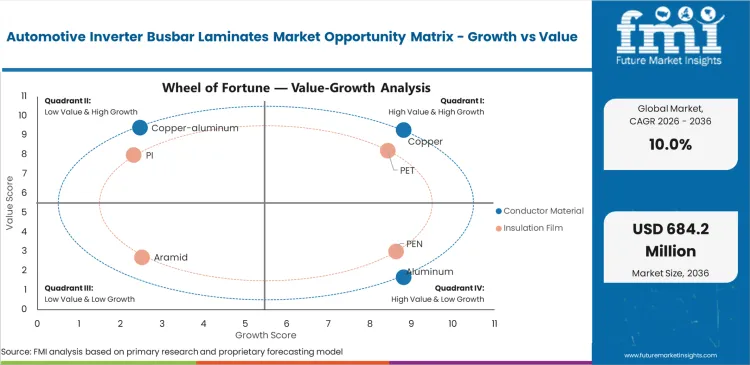
- Copper leads the conductor material segment with a 71.0% share, driven by high conductivity and thermal performance needs.
- PET leads the insulation film segment with a 34.0% share, supported by cost efficiency in mainstream EV platforms.
- Three-layer structures dominate with a 46.0% share, balancing insulation performance and compact design.
- 400V systems lead the voltage class segment with a 57.0% share, reflecting the large installed EV base.
- BEVs dominate the vehicle type segment with a 68.0% share, supported by pure-electric platform expansion.
- Key companies in the market include Rogers Corporation, Mersen, Amphenol Auxel, ENNOVI, and SUN.KING Technology.
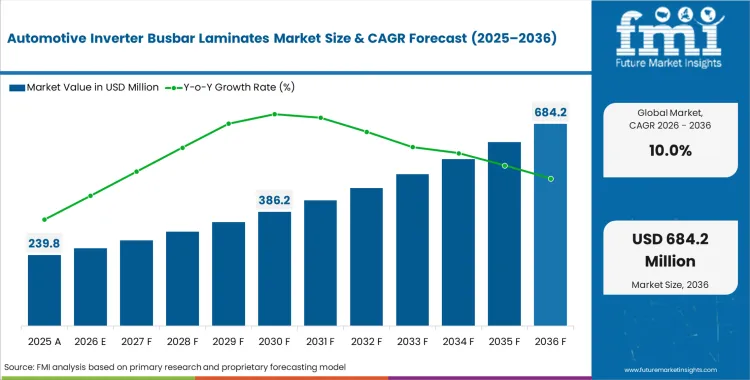
FMI analysis indicates that wider use of high-voltage silicon carbide architectures is raising the need for tighter parasitic inductance control, which keeps laminated busbar designs central to inverter packaging, thermal stability, and switching efficiency.
Automotive inverters are being redesigned under stricter space, heat, and power-density constraints. Conventional cabling adds thermal and packaging inefficiencies that become harder to manage as current loads rise, which is pushing manufacturers to reassess laminated busbar versus cable harness configurations inside inverter assemblies. Integrated inverter layouts also change how power is distributed across the drive unit, making conductor geometry, insulation structure, and heat performance more important than in earlier platform designs. Busbar laminate materials for traction inverters are no longer selected as simple electrical components. They are increasingly evaluated as part of a broader effort to control switching losses, reduce weight, and protect efficiency at the vehicle level.
Silicon carbide module adoption is accelerating this shift. Higher switching speeds expose stray inductance weaknesses that legacy layouts could absorb more easily, which is increasing the importance of low-inductance laminated busbar designs for EV automotive inverters. Requirements become even tighter as voltage systems move toward 800-volt configurations, where laminate performance has a more direct influence on electrical stability and thermal control. Manufacturers that align production capacity early with expected platform transitions are better placed to secure long program cycles once OEM architectures are finalized.
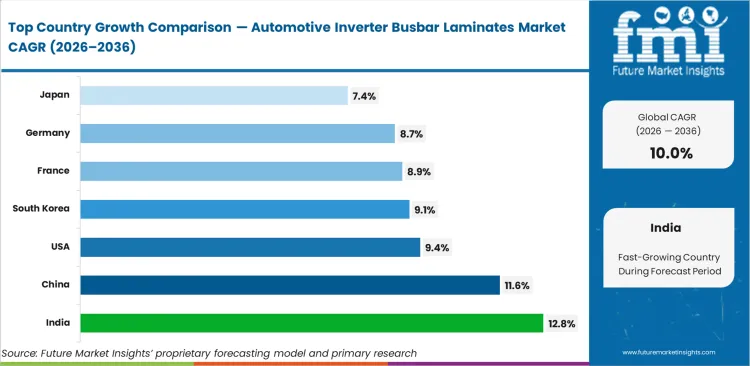
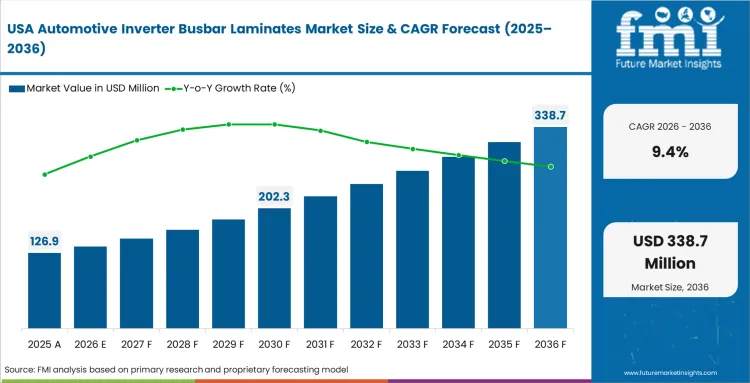
India is projected to expand at a CAGR of 12.8% through 2036 as domestic EV component manufacturing broadens and vehicle electrification programs continue to deepen. China is estimated to grow at 11.6%, supported by its large electric vehicle production base and continued integration of advanced automotive inverters across high-volume platforms. The United States and South Korea are expected to register CAGRs of 9.4% and 9.1%, respectively, where higher inverter content in premium and dual-motor vehicles supports laminate demand. France is likely to record 8.9% CAGR, slightly ahead of Germany at 8.7%, reflecting steady but more mature adoption conditions. Japan is anticipated to rise at 7.4% during the forecast period, as hybrid-led product strategies still moderate the pace of battery electric inverter penetration.
Segmental Analysis
Automotive Inverter Busbar Laminates Market Analysis by Conductor Material
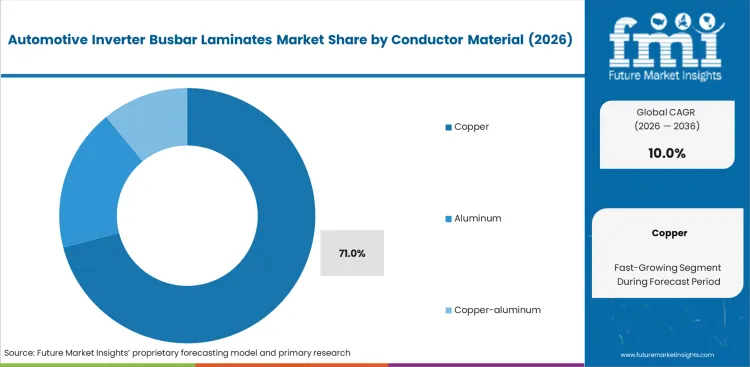
Thermal performance remains the first filter in conductor selection for traction inverters. Power density targets, switching frequency, and packaging limits leave little room for compromise when current loads rise. Copper is estimated to account for 71.0% share in 2026, reflecting its continued fit for compact inverter designs where conductivity, thermal stability, and dimensional control matter at the same time. A lower-conductivity substitute usually forces wider sections or thicker profiles, which disrupts tightly engineered layouts. Edge quality also carries more weight than basic material purity in laminated busbar production, since microscopic burrs can intensify electrical stress and gradually weaken adjacent insulation over extended switching cycles. Advanced laminated busbar designs help reduce these high-frequency failure risks when conductor finishing is tightly controlled.
- Baseline conductivity: Standard copper grades support predictable heat dissipation under continuous electrical load and help maintain stable inverter performance across repeated duty cycles.
- Package optimization: High current density allows smaller conductor geometry, which supports tighter module packaging and preserves space for adjacent powertrain components.
- Edge condition vulnerability: Poorly finished stamped edges can concentrate electrical stress and increase the risk of dielectric failure over long operating periods.
Automotive Inverter Busbar Laminates Market Analysis by Insulation Film
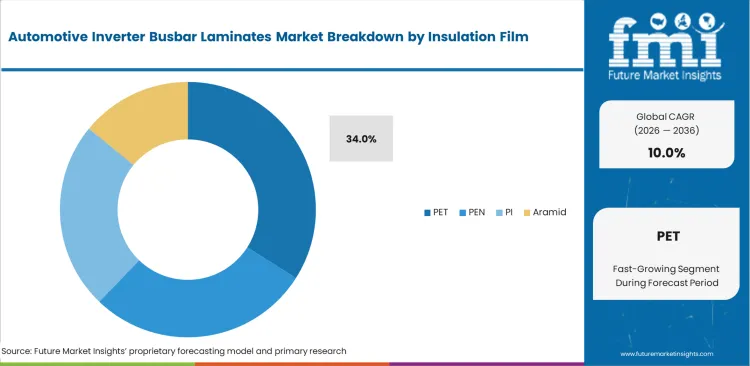
Dielectric film selection is shaped by a direct trade-off between cost, temperature tolerance, and long-term mechanical durability. Mass-market vehicle platforms continue to favor materials that work within established thermal windows without pushing laminate cost too high. PET is expected to hold 34.0% share in 2026, supported by its compatibility with mainstream inverter requirements and existing lamination processes. Comparisons across PET, PEN, and PI often focus heavily on temperature rating, yet electrical insulation materials also need to withstand continuous vibration and mechanical flex over vehicle life. That point becomes more important in rough-use conditions, where film fatigue can progress faster than thermal degradation alone. Programs that delay film upgrades on higher-stress platforms increase the chance of late-stage redesign pressure once cracking or insulation weakness becomes visible in validation.
- Standardization advantage: PET works well with established lamination equipment and supports smoother production changeovers across large-volume manufacturing lines.
- Cost equilibrium: Base polymer economics keep laminate assemblies aligned with cost targets for high-volume vehicle programs.
- Vibration degradation: Repeated road-induced stress can weaken polymer structure over time and raise the probability of micro-cracking within the insulation layer.
Automotive Inverter Busbar Laminates Market Analysis by Layer Structure
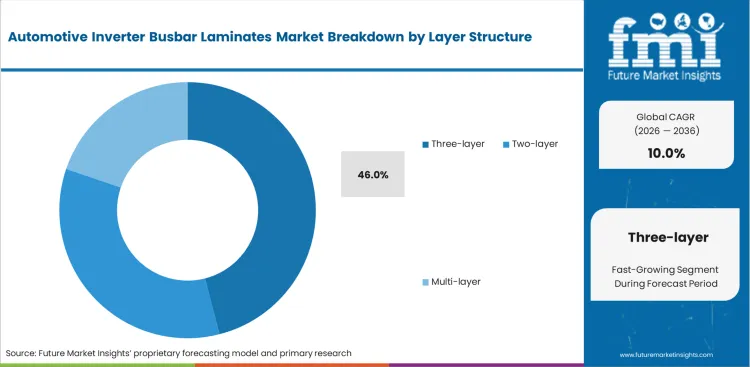
Layer architecture directly influences inductance control, thermal behavior, and phase separation inside inverter assemblies. Three-layer is anticipated to capture 46.0% share in 2026 because it offers a practical balance between routing efficiency and manufacturability in high-volume traction inverter programs. The structure allows positive, negative, and output phases to be arranged in a compact stacked form, which helps reduce stray inductance versus discrete wiring approaches. Heat movement inside the laminate also needs close attention, since intermediate dielectric layers can restrict dissipation from inner conductive paths. Localized hot spots often build quietly in these internal sections when thermal modeling is simplified too early. Delamination risk rises once internal temperature gradients are underestimated during design validation.
- Inductance cancellation: Closely aligned conductive paths help suppress magnetic field buildup and support switching stability in demanding inverter operation.
- Phase isolation: Separate conductive levels improve electrical separation and reduce the risk of cross-phase contact inside compact assemblies.
- Trapped heat phenomena: Inner conductive layers can face restricted cooling access, which makes accurate internal thermal modeling essential during development.
Automotive Inverter Busbar Laminates Market Analysis by Voltage Class
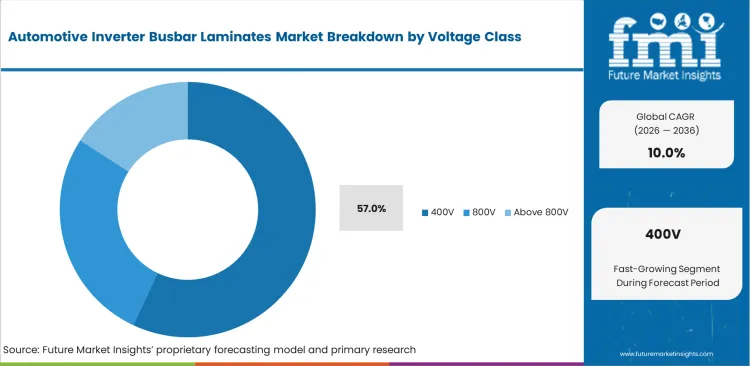
Voltage architecture choices remain closely linked to platform maturity, charging strategy, and the strength of installed supply chains. Many legacy electric vehicle programs still depend on established validation routines, proven electrical systems, and supplier networks built around lower-voltage operation. 400V is estimated to account for 57.0% share in 2026. That position is more closely tied to the scale of existing vehicle platforms than to any lack of pressure to shift toward higher-voltage systems. Fast-charging requirements are pushing these architectures to manage higher current loads, which increases thermal and mechanical stress across laminated connections used in the electric drive system. Reliability margins become tighter when manufacturers demand stronger performance from layouts originally optimized for more moderate operating conditions.
- Ecosystem stability: Existing validation setups, component sourcing networks, and manufacturing processes continue to support 400V architectures efficiently.
- Current load penalty: Delivering high power at lower voltage increases amperage demand and raises heat stress across laminated interconnections.
- Migration reluctance: Re-tooling cost and platform conversion complexity continue to slow faster movement toward higher-voltage system designs.
Automotive Inverter Busbar Laminates Market Analysis by Vehicle Type
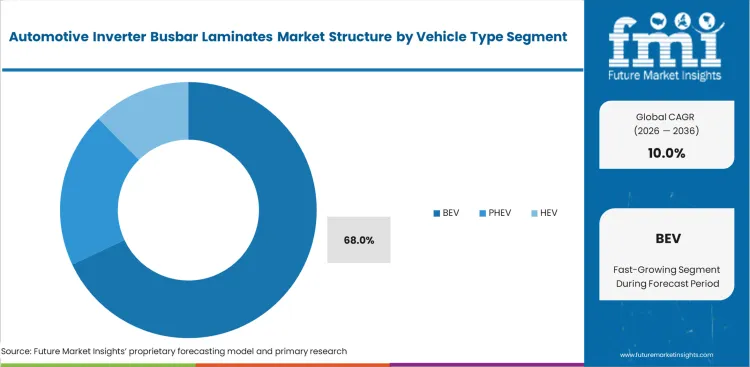
Vehicle architecture determines how much electrical load, switching intensity, and connection density an inverter laminate must handle. BEV platforms place the full propulsion burden on electric systems, which raises the technical importance of busbar layout, dielectric reliability, and thermal control. FMI analysts note that BEV is forecast to command 68.0% share in 2026, supported by the higher electrical intensity of pure battery platforms relative to hybrid formats. Demand also scales faster than vehicle output alone suggests because multi-motor configurations increase laminate content per unit. Power electronics integration becomes more demanding in these layouts as energy transfer volumes rise and packaging windows remain tight. Forecasting based only on vehicle production can understate actual laminate requirement across high-performance BEV programs.
- Component multiplier: Dual-motor and all-wheel-drive BEV layouts increase inverter count and raise laminate requirement per vehicle platform.
- Continuous operation: Pure electric platforms subject inverter assemblies to heavier and more consistent electrical duty than hybrid alternatives.
- Volume miscalculation: Demand planning based only on unit production can miss the higher laminate intensity built into advanced BEV configurations.
Automotive Inverter Busbar Laminates Market Drivers, Restraints, and Opportunities
Powertrain designers face high pressure to shrink electric drive units while simultaneously handling higher power loads. Understanding how does SiC adoption affect busbar laminate demand is critical; replacing round wires with flat EV power module interconnections saves critical millimeters inside cast aluminum housings. Delaying this transition severely limits battery capacity upgrades, as bulky inverters consume valuable chassis space. Rapid migration toward these structures becomes mandatory for maintaining vehicle range competitiveness.
Thermal expansion mismatch causes fatigue over time. Copper conductors and polymer films expand at different rates during aggressive acceleration and rapid charging cycles. This physical friction degrades adhesive bonds, complicating any inverter busbar laminate thickness comparison by forcing trade-offs between electrical clearance and thermal stress. Material scientists struggle to formulate bonding agents capable of surviving extreme temperature swings without losing dielectric integrity. Until advanced adhesives become commercially viable, assembly durability remains compromised under heavy loads.
Opportunities in Automotive Inverter Busbar Laminates Market
- Silicon carbide integration: Developing high-temperature busbar laminate for SiC inverter configurations optimized specifically for ultra-fast switching frequencies. Component suppliers capture premium pricing by matching SiC traction modules performance requirements.
- Direct cooling architectures: Integrating micro-channels directly into conductive plates for active liquid heat dissipation. Consulting an EV inverter busbar laminate design guide helps thermal engineering firms establish intellectual property moats supplying power discrete and modules developers against legacy stampers.
- Recyclable polymer adoption: Formulating easily separable automotive electrical insulation laminates to meet strict end-of-life vehicle regulations. Sustainable material developers secure long-term contracts supporting modern electric powertrain systems for environmentally focused automakers.
Regional Analysis
Based on regional analysis, automotive inverter busbar laminates market is segmented into North America, Latin America, Western Europe, Eastern Europe, East Asia, South Asia and Pacific, and Middle East and Africa across 40 plus countries.
.webp "Top Country Growth Comparison Automotive Inverter Busbar Laminates Market Cagr (2026 2036)")
| Country | CAGR (2026 to 2036) |
|---|---|
| India | 12.8% |
| China | 11.6% |
| United States | 9.4% |
| South Korea | 9.1% |
| France | 8.9% |
| Germany | 8.7% |
| Japan | 7.4% |
Source: Future Market Insights (FMI) analysis, based on proprietary forecasting model and primary research
South Asia and Pacific Automotive Inverter Busbar Laminates Market Analysis
Policy-led localization is reshaping component sourcing across the region. Manufacturers are expanding domestic production capacity to support rising electric vehicle output and reduce dependence on imported electrical parts. Supply chains are becoming more regionally anchored, which is increasing the importance of local lamination capability for inverter systems. Preference is shifting toward suppliers that can meet automotive electronics standards while offering stable delivery for new vehicle programs.
- India: India is likely to remain a high-growth market as local electric vehicle production continues to widen. Demand for automotive inverter busbar laminates in India is projected to expand at a CAGR of 12.8% during 2026-2036. Growth is being supported by the need for domestic component availability, closer supplier integration, and better alignment with expanding vehicle assembly activity. Local manufacturing presence also improves supply continuity, which remains important as inverter programs move into larger production volumes.
East Asia Automotive Inverter Busbar Laminates Market Analysis
Production targets dictate massive component consumption across major industrial hubs. Regional automakers drive innovation in battery electric vehicle (BEV) architectures. FMI's estimates suggest companies prioritize securing high-volume supply agreements over incremental technical upgrades. Rivalry forces suppliers to optimize manufacturing efficiency continuously, supporting advanced electric vehicle battery ecosystems across the Asia Pacific automotive inverter busbar laminates market.
- China: China is projected to remain a high-volume market as domestic electric vehicle production continues to scale. Demand for automotive inverter busbar laminates in China is expected to rise at a CAGR of 11.6% during 2026-2036. Growth is being supported by strong manufacturing depth, broad platform rollout, and the need for reliable local sourcing across expanding vehicle programs. Scale remains a key advantage in this market, especially where suppliers can support large production runs with consistent quality and delivery.
- South Korea: South Korea is likely to see steady growth in demand for automotive inverter busbar laminates, supported by the rising presence of premium and dual-motor electric vehicle platforms. Automotive inverter busbar laminates demand in South Korea is estimated to expand at a CAGR of 9.1% over 2026-2036. High-performance inverter layouts require laminates with tighter thermal control, stronger insulation performance, and dependable reliability under demanding operating conditions. Engineering capability remains important here because product quality must support both domestic vehicle output and export-oriented manufacturing standards.
- Japan: Japan is expected to post more measured growth as hybrid-heavy product strategies continue to shape the pace of pure battery electric vehicle adoption. Demand for automotive inverter busbar laminates in Japan is likely to increase at a CAGR of 7.4% during 2026-2036. Many vehicle programs are still moving through gradual electrical upgrades rather than complete architecture shifts, which keeps adoption growth more controlled than in faster-scaling battery electric markets. Long qualification cycles and a strong focus on durability continue to shape supplier selection in this market.
North America Automotive Inverter Busbar Laminates Market Analysis
Heavy vehicle electrification demands extreme power handling capabilities. Consumers expect electric trucks and large SUVs to match combustion engine towing performance. FMI's assessment indicates powertrain engineers specify heavy-duty laminated structures to manage massive current draws safely. Upgrading electrical backbones with advanced electric vehicle insulation becomes critical for sustained high-load operations.
- United States: High inverter content in premium architectures shapes the United States traction inverter busbar laminates industry directly. Sales of automotive inverter busbar laminates in the United States are expected to increase at a CAGR of 9.4% during the forecast period. Large vehicle platforms require extensive power distribution networks to manage dual-motor configurations efficiently. Delivering heavy-duty components secures preferred supplier status domestically.
Western Europe Automotive Inverter Busbar Laminates Market Analysis
Mature adoption curves transition from early growth into established volume production. Established automakers refine existing architectures to improve manufacturing margins. FMI observes engineering focus shifting toward incremental efficiency gains rather than radical redesigns. Tightening environmental regulations force continuous improvement in powertrain performance. FMI's report includes the United Kingdom, Italy, and Spain. Deeply integrated supply networks supporting EV traction inverter production ensure stable component availability.
- France: Steady domestic consumption sustains continuous operations across the France EV inverter busbar laminates segment. Local manufacturers optimize supply networks to support consistent vehicle output seamlessly. Automotive inverter busbar laminates demand in France is poised to expand at a CAGR of 8.9% from 2026 to 2036. Streamlined component sourcing reduces assembly delays significantly, aligning perfectly with established regional production capacities and infrastructure limits.
- Germany: Germany is likely to see steady demand growth in automotive inverter busbar laminates, supported by its established electric vehicle manufacturing base and continued use of proven inverter designs. Demand in Germany is projected to expand at a CAGR of 8.7% during 2026-2036. Manufacturers are focusing on design refinement, process consistency, and long-term system reliability rather than abrupt architecture changes. Strong quality control remains important in this market, as durability performance and warranty risk continue to influence component selection in premium vehicle programs.
Competitive Aligners for Market Players
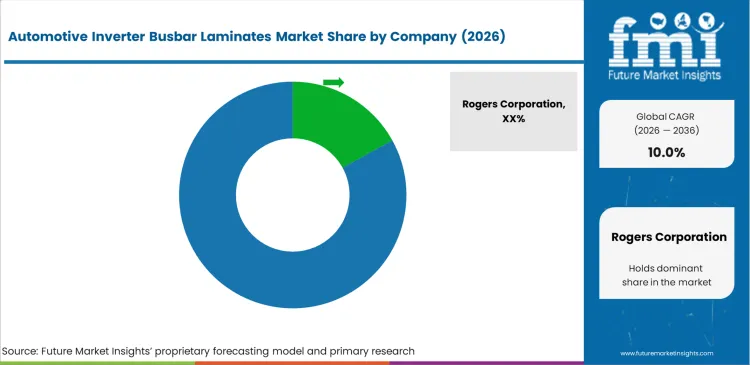
Specialized engineering capability continues to separate established inverter busbar laminate suppliers from basic metal fabricators. Strong positioning in this space depends on close coordination between laminate design, inverter architecture, and semiconductor packaging needs. Manufacturers usually favor suppliers that can assess parasitic inductance, current distribution, and thermal behavior before prototype validation begins. Busbar programs tied to high-voltage drivetrains leave little room for trial-and-error execution, which keeps technically limited stampers out of demanding vehicle platforms.
Established suppliers hold an advantage because qualification in this category depends on proven durability data, not fabrication capacity alone. Long-term validation records on polymer insulation, bonding stability, and vibration resistance remain central to supplier approval for traction inverter applications. New entrants may offer competitive production capability, yet weak historical reliability evidence often slows acceptance in safety-critical power electronics programs. Confidence in endurance performance still matters more than short-term pricing when busbar laminates are integrated into core inverter assemblies.
Automakers continue to limit supplier dependence by keeping mounting points and interface requirements more standardized across vehicle platforms. Volume allocation often remains split across more than one source to preserve pricing leverage during sourcing cycles. Suppliers try to protect their position by moving beyond passive conductor supply and adding sensing capability within the laminated structure itself. Temperature and voltage monitoring improve system visibility and raise functional value, which makes replacement less straightforward once a design is validated.
Key Players in Automotive Inverter Busbar Laminates Market
- Rogers Corporation
- Mersen
- Amphenol Auxel
- ENNOVI
- SUN.KING Technology
Scope of the Report
| Metric | Value |
|---|---|
| Quantitative Units | USD 239.8 million to USD 622.0 million, at a CAGR of 10.0% |
| Market Definition | Automotive inverter busbar laminates are engineered conductors separated by ultra-thin dielectric materials designed specifically for high-voltage powertrain distribution to minimize parasitic inductance. |
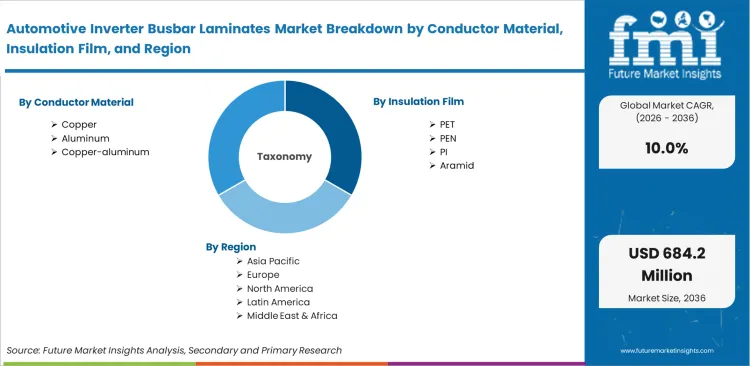
| Segmentation | Conductor material, Insulation film, Layer structure, Voltage class, Vehicle type, Region |
| Regions Covered | North America, Latin America, Western Europe, Eastern Europe, East Asia, South Asia and Pacific, Middle East and Africa |
| Countries Covered | India, China, United States, South Korea, France, Germany, Japan |
| Key Companies Profiled | Rogers Corporation, Mersen, Amphenol Auxel, ENNOVI, SUN.KING Technology |
| Forecast Period | 2026 to 2036 |
| Approach | Traction inverter production volumes mapped against dual-motor architecture adoption rates. |
Source: Future Market Insights (FMI) analysis, based on proprietary forecasting model and primary research
Automotive Inverter Busbar Laminates Market Analysis by Segments
Conductor material:
- Copper
- Aluminum
- Copper-aluminum
Insulation film:
- PET
- PEN
- PI
- Aramid
Layer structure:
- Three-layer
- Two-layer
- Multi-layer
Voltage class:
- 400V
- 800V
- Above 800V
Vehicle type:
- BEV
- PHEV
- HEV
Region:
- North America
- United States
- Canada
- Europe
- Germany
- United Kingdom
- France
- Italy
- Spain
- Asia Pacific
- China
- Japan
- South Korea
- Taiwan
- Singapore
- Latin America
- Brazil
- Mexico
- Argentina
- Middle East & Africa
- GCC Countries
- South Africa
Bibliography
- Montanari, G. C., & Cambareri, P. (2024). PD-Free Design of Insulation Systems: An Application to Laminated Busbars. Applied Sciences, 14(22), 10171.
- USA DRIVE Partnership. (2024). Electric Drive Technical Team Roadmap. USA Department of Energy.
- National Renewable Energy Laboratory. (2024). Vehicle and Mobility Technologies 2024 Annual Impact Report.
- International Energy Agency. (2025). Global EV Outlook 2025.
- Fleischer, J., Ceglarek, D., Franke, J., & Herrmann, C. (2025). Production technologies and systems for electric mobility. CIRP Annals, 74(2), 1047-1072.
This bibliography is provided for reader reference. The full FMI report contains the complete reference list with primary source documentation.
This Report Addresses
- Constraints limiting copper laminate thickness in 800V silicon carbide inverters.
- Qualification barriers preventing rapid transition from PET to polyimide insulation films.
- Inductance cancellation methodologies driving three-layer adoption across OEM platforms.
- Regional component localization targets accelerating Indian and Chinese laminated busbar production.
- Commercial stakes for tier-1 suppliers failing to secure high-frequency validation capabilities.
- Impact of dual-motor premium vehicle architectures on aggregate busbar volume requirements.
- Thermal expansion mismatch risks degrading adhesive bonds during extremely rapid charging cycles.
- Strategic supplier efforts to integrate temperature sensing directly into multi-layer geometries.
Frequently Asked Questions
What is an automotive inverter busbar laminate?
It is a multi-layered conductor assembly incorporating dielectric films to manage high-current power distribution. These laminates minimize stray inductance within electric vehicle traction systems, allowing for tighter packaging and efficient thermal management.
How big is the automotive inverter busbar laminates market?
The industry was valued at USD 218.0 million in 2025. Demand is projected to reach USD 239.8 million in 2026 and expand to a cumulative valuation of USD 622.0 million by 2036.
What materials are used in EV inverter busbar laminates?
Copper and aluminum serve as the primary conductors. Specialized polymer films, including PET, PEN, and advanced polyimides (PI), provide necessary dielectric boundaries and electrical isolation between the conductive layers.
Why are laminated busbars used in traction inverters?
Replacing traditional wiring harnesses with laminated structures reduces stray inductance significantly. This precise geometric flattening allows safe operation of high-frequency power modules while minimizing the overall physical footprint of the inverter unit.
Which countries lead EV inverter busbar laminate demand?
India and China lead adoption rates with 12.8% and 11.6% compound growth respectively. Accelerated local component manufacturing and aggressive domestic electric vehicle production targets push forward the volume consumption across these regions.
Compare 400V and 800V busbar laminate demand in EVs?
Standard 400V architectures dominate mass-market production due to established ecosystems and predictable unit economics. Transitioning to 800V systems requires upgraded, high-temperature dielectric films and specialized laminates capable of withstanding high thermal stress during rapid charging.
Who are the main suppliers in automotive inverter busbar laminates?
Primary manufacturers include Rogers Corporation, Mersen, Amphenol Auxel, ENNOVI, and SUN.KING Technology. These companies specialize in co-developing advanced geometries directly with semiconductor designers.
How does SiC adoption affect inverter interconnect materials?
Silicon carbide allows for ultra-fast switching frequencies, which subsequently exposes stray inductance vulnerabilities in legacy power setups. Powertrain engineers must specify low-inductance, highly specialized laminates to prevent module destruction during these rapid cycles.
Can laminated busbars reduce inverter losses in EVs?
Yes. Parallel conductive plates carrying opposite currents neutralize magnetic fields naturally. This inductance cancellation reduces voltage spikes during rapid switching, ensuring efficient power transfer and minimizing thermal energy waste.
Explain the growth outlook for automotive inverter busbar laminates?
The sector is anticipated to grow at a 10.0% CAGR through 2036. Continuous investment in high-voltage silicon carbide architectures and the industry-wide shift away from bulky traditional cabling propel continuous component demand.
Which EV architectures need laminated inverter busbars most?
High-performance dual-motor setups and premium 800V platforms require these components most critically. Pure battery-electric vehicles push modules harder than hybrid equivalents, mandating stricter dielectric controls and advanced laminated pathways.
How do copper and aluminum busbars compare in inverter applications?
Copper provides unmatched current density handling within tightly constrained physical footprints. Substituting aluminum forces designers to expand cross-sectional areas to achieve similar conductivity, which ruins carefully optimized spatial packaging dimensions.
What limits copper laminate adoption in higher voltage classes?
Weight penalties force powertrain engineers to evaluate aluminum alternatives strictly. Pushing higher currents through standard copper geometries increases overall inverter mass significantly. Designers must balance optimal thermal conductivity against aggressive vehicle lightening mandates.
Why does PET film dominate current vehicle platforms?
Predictable unit economics make PET the preferred choice for mass-market 400V applications. Upgrading to high-temperature polyimides alters profitability on entry-level models immediately. Manufacturers avoid re-specifying polymers until thermal loads demand categorical upgrades.
How do three-layer structures manage stray inductance?
Parallel conductive plates carrying opposite currents neutralize magnetic fields naturally. Hardware architects flatten these pathways to reduce switching spikes compared to discrete wiring. This geometry provides essential stability for sensitive silicon carbide power modules.
What accelerates Indian component manufacturing growth?
Aggressive localization policies force suppliers to establish domestic production capacity quickly. Automakers scaling local electric vehicle assembly lines require immediate access to validated laminates. Securing these regional contracts guarantees long-term volume stability for new manufacturing facilities.
Why do premium architectures multiply busbar requirements?
High-performance vehicles utilize independent traction motors per axle. Firms must purchase twin inverter setups for every premium chassis rolling off assembly lines. Such a configuration moves component volume faster than basic vehicle production metrics suggest.
How does rapid charging impact laminate durability?
Extreme power delivery demands massive amperage across electrical boundaries. Heat generation stresses every laminated joint continuously during fast-charge events. Copper conductors and polymer films expanding at different rates slowly weaken internal adhesive bonds.
What prevents simple metal stampers from entering this supply chain?
Specialized high-frequency electrical simulation capabilities form strict qualification barriers. Generalist fabrication shops cannot model parasitic inductance or thermal gradients accurately. OEMs require proven reliability data before approving high-voltage components.
How do automakers avoid vendor lock-in?
Purchasing departments mandate standardized mounting interfaces across different vehicle models. Firms deliberately split volumes among multiple advanced suppliers to maintain competitive price tension. This strategy prevents single-source dependencies during critical production ramp-ups.
Why are thermal blanketing effects dangerous in multi-layer designs?
Intermediate dielectric layers act as unintended insulators, trapping heat generated by inner conductors. Middle conductive paths lack direct access to external cooling plates. Failing to model this internal thermal flow causes localized melting and delamination.
What dictates material selection for traction inverters?
High thermal limits and tight physical packaging envelopes define conductor specifications. Companies secure copper to maximize current density within restricted housing spaces. Choosing inferior metals forces dimension expansion that ruins carefully engineered module layouts.
Why does China dominate raw production volume?
Aggressive domestic production targets support massive component consumption. Government mandates push local automakers to maximize electric vehicle output at unprecedented scales. Regional suppliers optimize manufacturing efficiency continuously to capture these immediate platform wins.
How do vibration profiles degrade insulation films?
Continuous road shock slowly weakens polymer chains over extended operational lifespans. Brittle films degrade faster through mechanical fatigue than through pure thermal cycling alone. Quality assurance heads mandate aggressive shake-table testing to expose these vulnerabilities early.
Preview the report firsthand - request a free sample
Get SampleGet the brochure for pricing and purchase details.
Get PDFTable of Content
- Executive Summary
- Global Market Outlook
- Demand-side Trends
- Supply-side Trends
- Technology Roadmap Analysis
- Analysis and Recommendations
- Market Overview
- Market Coverage / Taxonomy
- Market Definition / Scope / Limitations
- Research Methodology
- Chapter Orientation
- Analytical Lens and Working Hypotheses
- Market Structure, Signals, and Trend Drivers
- Benchmarking and Cross-market Comparability
- Market Sizing, Forecasting, and Opportunity Mapping
- Research Design and Evidence Framework
- Desk Research Programme (Secondary Evidence)
- Company Annual and Sustainability Reports
- Peer-reviewed Journals and Academic Literature
- Corporate Websites, Product Literature, and Technical Notes
- Earnings Decks and Investor Briefings
- Statutory Filings and Regulatory Disclosures
- Technical White Papers and Standards Notes
- Trade Journals, Industry Magazines, and Analyst Briefs
- Conference Proceedings, Webinars, and Seminar Materials
- Government Statistics Portals and Public Data Releases
- Press Releases and Reputable Media Coverage
- Specialist Newsletters and Curated Briefings
- Sector Databases and Reference Repositories
- FMI Internal Proprietary Databases and Historical Market Datasets
- Subscription Datasets and Paid Sources
- Social Channels, Communities, and Digital Listening Inputs
- Additional Desk Sources
- Expert Input and Fieldwork (Primary Evidence)
- Primary Modes
- Qualitative Interviews and Expert Elicitation
- Quantitative Surveys and Structured Data Capture
- Blended Approach
- Why Primary Evidence is Used
- Field Techniques
- Interviews
- Surveys
- Focus Groups
- Observational and In-context Research
- Social and Community Interactions
- Stakeholder Universe Engaged
- C-suite Leaders
- Board Members
- Presidents and Vice Presidents
- R&D and Innovation Heads
- Technical Specialists
- Domain Subject-matter Experts
- Scientists
- Physicians and Other Healthcare Professionals
- Governance, Ethics, and Data Stewardship
- Research Ethics
- Data Integrity and Handling
- Primary Modes
- Tooling, Models, and Reference Databases
- Desk Research Programme (Secondary Evidence)
- Data Engineering and Model Build
- Data Acquisition and Ingestion
- Cleaning, Normalisation, and Verification
- Synthesis, Triangulation, and Analysis
- Quality Assurance and Audit Trail
- Market Background
- Market Dynamics
- Drivers
- Restraints
- Opportunity
- Trends
- Scenario Forecast
- Demand in Optimistic Scenario
- Demand in Likely Scenario
- Demand in Conservative Scenario
- Opportunity Map Analysis
- Product Life Cycle Analysis
- Supply Chain Analysis
- Investment Feasibility Matrix
- Value Chain Analysis
- PESTLE and Porter’s Analysis
- Regulatory Landscape
- Regional Parent Market Outlook
- Production and Consumption Statistics
- Import and Export Statistics
- Market Dynamics
- Global Market Analysis 2021 to 2025 and Forecast, 2026 to 2036
- Historical Market Size Value (USD Million) Analysis, 2021 to 2025
- Current and Future Market Size Value (USD Million) Projections, 2026 to 2036
- Y-o-Y Growth Trend Analysis
- Absolute $ Opportunity Analysis
- Global Market Pricing Analysis 2021 to 2025 and Forecast 2026 to 2036
- Global Market Analysis 2021 to 2025 and Forecast 2026 to 2036, By Conductor Material
- Introduction / Key Findings
- Historical Market Size Value (USD Million) Analysis By Conductor Material , 2021 to 2025
- Current and Future Market Size Value (USD Million) Analysis and Forecast By Conductor Material , 2026 to 2036
- Copper
- Aluminum
- Copper-aluminum
- Copper
- Y-o-Y Growth Trend Analysis By Conductor Material , 2021 to 2025
- Absolute $ Opportunity Analysis By Conductor Material , 2026 to 2036
- Global Market Analysis 2021 to 2025 and Forecast 2026 to 2036, By Insulation Film
- Introduction / Key Findings
- Historical Market Size Value (USD Million) Analysis By Insulation Film, 2021 to 2025
- Current and Future Market Size Value (USD Million) Analysis and Forecast By Insulation Film, 2026 to 2036
- PET
- PEN
- PI
- Aramid
- PET
- Y-o-Y Growth Trend Analysis By Insulation Film, 2021 to 2025
- Absolute $ Opportunity Analysis By Insulation Film, 2026 to 2036
- Global Market Analysis 2021 to 2025 and Forecast 2026 to 2036, By Layer Structure
- Introduction / Key Findings
- Historical Market Size Value (USD Million) Analysis By Layer Structure, 2021 to 2025
- Current and Future Market Size Value (USD Million) Analysis and Forecast By Layer Structure, 2026 to 2036
- Three-layer
- Two-layer
- Multi-layer
- Three-layer
- Y-o-Y Growth Trend Analysis By Layer Structure, 2021 to 2025
- Absolute $ Opportunity Analysis By Layer Structure, 2026 to 2036
- Global Market Analysis 2021 to 2025 and Forecast 2026 to 2036, By Voltage Class
- Introduction / Key Findings
- Historical Market Size Value (USD Million) Analysis By Voltage Class, 2021 to 2025
- Current and Future Market Size Value (USD Million) Analysis and Forecast By Voltage Class, 2026 to 2036
- 400V
- 800V
- Above 800V
- 400V
- Y-o-Y Growth Trend Analysis By Voltage Class, 2021 to 2025
- Absolute $ Opportunity Analysis By Voltage Class, 2026 to 2036
- Global Market Analysis 2021 to 2025 and Forecast 2026 to 2036, By Vehicle Type
- Introduction / Key Findings
- Historical Market Size Value (USD Million) Analysis By Vehicle Type, 2021 to 2025
- Current and Future Market Size Value (USD Million) Analysis and Forecast By Vehicle Type, 2026 to 2036
- BEV
- PHEV
- HEV
- BEV
- Y-o-Y Growth Trend Analysis By Vehicle Type, 2021 to 2025
- Absolute $ Opportunity Analysis By Vehicle Type, 2026 to 2036
- Global Market Analysis 2021 to 2025 and Forecast 2026 to 2036, By Region
- Introduction
- Historical Market Size Value (USD Million) Analysis By Region, 2021 to 2025
- Current Market Size Value (USD Million) Analysis and Forecast By Region, 2026 to 2036
- North America
- Latin America
- Western Europe
- Eastern Europe
- East Asia
- South Asia and Pacific
- Middle East & Africa
- Market Attractiveness Analysis By Region
- North America Market Analysis 2021 to 2025 and Forecast 2026 to 2036, By Country
- Historical Market Size Value (USD Million) Trend Analysis By Market Taxonomy, 2021 to 2025
- Market Size Value (USD Million) Forecast By Market Taxonomy, 2026 to 2036
- By Country
- USA
- Canada
- Mexico
- By Conductor Material
- By Insulation Film
- By Layer Structure
- By Voltage Class
- By Vehicle Type
- By Country
- Market Attractiveness Analysis
- By Country
- By Conductor Material
- By Insulation Film
- By Layer Structure
- By Voltage Class
- By Vehicle Type
- Key Takeaways
- Latin America Market Analysis 2021 to 2025 and Forecast 2026 to 2036, By Country
- Historical Market Size Value (USD Million) Trend Analysis By Market Taxonomy, 2021 to 2025
- Market Size Value (USD Million) Forecast By Market Taxonomy, 2026 to 2036
- By Country
- Brazil
- Chile
- Rest of Latin America
- By Conductor Material
- By Insulation Film
- By Layer Structure
- By Voltage Class
- By Vehicle Type
- By Country
- Market Attractiveness Analysis
- By Country
- By Conductor Material
- By Insulation Film
- By Layer Structure
- By Voltage Class
- By Vehicle Type
- Key Takeaways
- Western Europe Market Analysis 2021 to 2025 and Forecast 2026 to 2036, By Country
- Historical Market Size Value (USD Million) Trend Analysis By Market Taxonomy, 2021 to 2025
- Market Size Value (USD Million) Forecast By Market Taxonomy, 2026 to 2036
- By Country
- Germany
- UK
- Italy
- Spain
- France
- Nordic
- BENELUX
- Rest of Western Europe
- By Conductor Material
- By Insulation Film
- By Layer Structure
- By Voltage Class
- By Vehicle Type
- By Country
- Market Attractiveness Analysis
- By Country
- By Conductor Material
- By Insulation Film
- By Layer Structure
- By Voltage Class
- By Vehicle Type
- Key Takeaways
- Eastern Europe Market Analysis 2021 to 2025 and Forecast 2026 to 2036, By Country
- Historical Market Size Value (USD Million) Trend Analysis By Market Taxonomy, 2021 to 2025
- Market Size Value (USD Million) Forecast By Market Taxonomy, 2026 to 2036
- By Country
- Russia
- Poland
- Hungary
- Balkan & Baltic
- Rest of Eastern Europe
- By Conductor Material
- By Insulation Film
- By Layer Structure
- By Voltage Class
- By Vehicle Type
- By Country
- Market Attractiveness Analysis
- By Country
- By Conductor Material
- By Insulation Film
- By Layer Structure
- By Voltage Class
- By Vehicle Type
- Key Takeaways
- East Asia Market Analysis 2021 to 2025 and Forecast 2026 to 2036, By Country
- Historical Market Size Value (USD Million) Trend Analysis By Market Taxonomy, 2021 to 2025
- Market Size Value (USD Million) Forecast By Market Taxonomy, 2026 to 2036
- By Country
- China
- Japan
- South Korea
- By Conductor Material
- By Insulation Film
- By Layer Structure
- By Voltage Class
- By Vehicle Type
- By Country
- Market Attractiveness Analysis
- By Country
- By Conductor Material
- By Insulation Film
- By Layer Structure
- By Voltage Class
- By Vehicle Type
- Key Takeaways
- South Asia and Pacific Market Analysis 2021 to 2025 and Forecast 2026 to 2036, By Country
- Historical Market Size Value (USD Million) Trend Analysis By Market Taxonomy, 2021 to 2025
- Market Size Value (USD Million) Forecast By Market Taxonomy, 2026 to 2036
- By Country
- India
- ASEAN
- Australia & New Zealand
- Rest of South Asia and Pacific
- By Conductor Material
- By Insulation Film
- By Layer Structure
- By Voltage Class
- By Vehicle Type
- By Country
- Market Attractiveness Analysis
- By Country
- By Conductor Material
- By Insulation Film
- By Layer Structure
- By Voltage Class
- By Vehicle Type
- Key Takeaways
- Middle East & Africa Market Analysis 2021 to 2025 and Forecast 2026 to 2036, By Country
- Historical Market Size Value (USD Million) Trend Analysis By Market Taxonomy, 2021 to 2025
- Market Size Value (USD Million) Forecast By Market Taxonomy, 2026 to 2036
- By Country
- Kingdom of Saudi Arabia
- Other GCC Countries
- Turkiye
- South Africa
- Other African Union
- Rest of Middle East & Africa
- By Conductor Material
- By Insulation Film
- By Layer Structure
- By Voltage Class
- By Vehicle Type
- By Country
- Market Attractiveness Analysis
- By Country
- By Conductor Material
- By Insulation Film
- By Layer Structure
- By Voltage Class
- By Vehicle Type
- Key Takeaways
- Key Countries Market Analysis
- USA
- Pricing Analysis
- Market Share Analysis, 2025
- By Conductor Material
- By Insulation Film
- By Layer Structure
- By Voltage Class
- By Vehicle Type
- Canada
- Pricing Analysis
- Market Share Analysis, 2025
- By Conductor Material
- By Insulation Film
- By Layer Structure
- By Voltage Class
- By Vehicle Type
- Mexico
- Pricing Analysis
- Market Share Analysis, 2025
- By Conductor Material
- By Insulation Film
- By Layer Structure
- By Voltage Class
- By Vehicle Type
- Brazil
- Pricing Analysis
- Market Share Analysis, 2025
- By Conductor Material
- By Insulation Film
- By Layer Structure
- By Voltage Class
- By Vehicle Type
- Chile
- Pricing Analysis
- Market Share Analysis, 2025
- By Conductor Material
- By Insulation Film
- By Layer Structure
- By Voltage Class
- By Vehicle Type
- Germany
- Pricing Analysis
- Market Share Analysis, 2025
- By Conductor Material
- By Insulation Film
- By Layer Structure
- By Voltage Class
- By Vehicle Type
- UK
- Pricing Analysis
- Market Share Analysis, 2025
- By Conductor Material
- By Insulation Film
- By Layer Structure
- By Voltage Class
- By Vehicle Type
- Italy
- Pricing Analysis
- Market Share Analysis, 2025
- By Conductor Material
- By Insulation Film
- By Layer Structure
- By Voltage Class
- By Vehicle Type
- Spain
- Pricing Analysis
- Market Share Analysis, 2025
- By Conductor Material
- By Insulation Film
- By Layer Structure
- By Voltage Class
- By Vehicle Type
- France
- Pricing Analysis
- Market Share Analysis, 2025
- By Conductor Material
- By Insulation Film
- By Layer Structure
- By Voltage Class
- By Vehicle Type
- India
- Pricing Analysis
- Market Share Analysis, 2025
- By Conductor Material
- By Insulation Film
- By Layer Structure
- By Voltage Class
- By Vehicle Type
- ASEAN
- Pricing Analysis
- Market Share Analysis, 2025
- By Conductor Material
- By Insulation Film
- By Layer Structure
- By Voltage Class
- By Vehicle Type
- Australia & New Zealand
- Pricing Analysis
- Market Share Analysis, 2025
- By Conductor Material
- By Insulation Film
- By Layer Structure
- By Voltage Class
- By Vehicle Type
- China
- Pricing Analysis
- Market Share Analysis, 2025
- By Conductor Material
- By Insulation Film
- By Layer Structure
- By Voltage Class
- By Vehicle Type
- Japan
- Pricing Analysis
- Market Share Analysis, 2025
- By Conductor Material
- By Insulation Film
- By Layer Structure
- By Voltage Class
- By Vehicle Type
- South Korea
- Pricing Analysis
- Market Share Analysis, 2025
- By Conductor Material
- By Insulation Film
- By Layer Structure
- By Voltage Class
- By Vehicle Type
- Russia
- Pricing Analysis
- Market Share Analysis, 2025
- By Conductor Material
- By Insulation Film
- By Layer Structure
- By Voltage Class
- By Vehicle Type
- Poland
- Pricing Analysis
- Market Share Analysis, 2025
- By Conductor Material
- By Insulation Film
- By Layer Structure
- By Voltage Class
- By Vehicle Type
- Hungary
- Pricing Analysis
- Market Share Analysis, 2025
- By Conductor Material
- By Insulation Film
- By Layer Structure
- By Voltage Class
- By Vehicle Type
- Kingdom of Saudi Arabia
- Pricing Analysis
- Market Share Analysis, 2025
- By Conductor Material
- By Insulation Film
- By Layer Structure
- By Voltage Class
- By Vehicle Type
- Turkiye
- Pricing Analysis
- Market Share Analysis, 2025
- By Conductor Material
- By Insulation Film
- By Layer Structure
- By Voltage Class
- By Vehicle Type
- South Africa
- Pricing Analysis
- Market Share Analysis, 2025
- By Conductor Material
- By Insulation Film
- By Layer Structure
- By Voltage Class
- By Vehicle Type
- USA
- Market Structure Analysis
- Competition Dashboard
- Competition Benchmarking
- Market Share Analysis of Top Players
- By Region
- By Conductor Material
- By Insulation Film
- By Layer Structure
- By Voltage Class
- By Vehicle Type
- Competition Analysis
- Competition Deep Dive
- Rogers Corporation
- Overview
- Product Portfolio
- Profitability by Market Segments (Product/Age /Sales Channel/Region)
- Sales Footprint
- Strategy Overview
- Marketing Strategy
- Product Strategy
- Channel Strategy
- Mersen
- Amphenol Auxel
- ENNOVI
- SUN.KING Technology
- Rogers Corporation
- Competition Deep Dive
- Assumptions & Acronyms Used


