

- Industry Size (2026)
- USD 5.5 Bn
- Forecast (2036)
- USD 22.3 Bn
- CAGR
- 15.00 (2026 to 2036)
SiC Traction Modules Market Forecast and Outlook 2026 to 2036
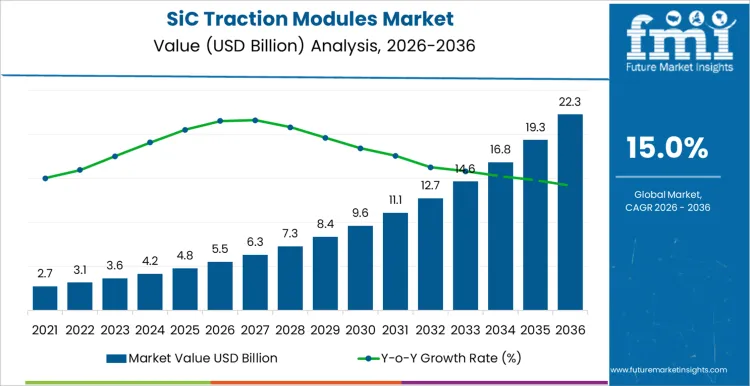
The SiC traction modules market is expected to expand from USD 5.5 billion in 2026 to USD 22.3 billion by 2036, progressing at a CAGR of 15.0%. For decision-makers, this market represents a shift from optional performance enhancement to foundational powertrain infrastructure. Economic exposure is concentrated around wide-bandgap material supply, long qualification cycles, and capital commitments tied to 800 V vehicle platforms. SiC traction modules materially influence vehicle efficiency, charging speed, and thermal design, making them tightly coupled to platform competitiveness rather than incremental cost optimization.
Prioritization decisions increasingly revolve around where SiC delivers defensible value premium passenger EVs, high-duty commercial vehicles, and architectures pushing power density limits. Timing is critical, as early platform lock-in can create multi-year supplier dependencies, while delayed adoption risks efficiency and range disadvantages. Boards should recognize that value capture depends less on near-term volume and more on securing resilient supply, validated reliability, and scalable module designs aligned with future vehicle roadmaps.
Quick Stats for SiC Traction Modules Market
- SiC Traction Modules Market Value (2026): USD 5.5 Billion
- SiC Traction Modules Market Forecast Value (2036): USD 22.3 Billion
- SiC Traction Modules Market Forecast CAGR (2026 to 2036): 15.0%
- Leading Module Adoption Trend in SiC Traction Modules Market: 800 V Traction Platforms (dominant adoption across new EV architectures)
- Key Growth Regions in SiC Traction Modules Market: Asia Pacific, Europe, North America, Latin America, Middle East & Africa
- Top Key Players in SiC Traction Modules Market: Wolfspeed, STMicroelectronics, onsemi, Mitsubishi Electric, ROHM, Hitachi Astemo, Fuji Electric, Semikron Danfoss, CRRC Power
SiC Traction Modules Market Key Takeaways
| Metric | Value |
|---|---|
| SiC Traction Modules Market Value (2026) | USD 5.5 Billion |
| SiC Traction Modules Market Forecast Value (2036) | USD 22.3 Billion |
| SiC Traction Modules Market Forecast CAGR (2026 to 2036) | 15.00% |
How are Power Density Targets and Platform Electrification Accelerating the SiC Traction Modules Market?
The SiC traction modules market is expanding rapidly as automotive OEMs pursue higher drivetrain efficiency, longer driving range, and faster charging capability. Silicon carbide devices enable higher switching frequencies and lower conduction losses compared with silicon, directly improving inverter efficiency and reducing thermal management burden. For vehicle platforms migrating to 800-V architectures, SiC traction modules have moved from a premium option to a strategic requirement, particularly in performance-oriented and long-range EV segments.
Supplier competitiveness is increasingly defined by integration depth and reliability validation rather than chip performance alone. OEMs and Tier-1s are prioritizing traction modules that combine SiC MOSFETs with optimized substrates, advanced packaging, and robust thermal interfaces. Consistent performance under high junction temperatures, vibration, and power cycling is critical for automotive qualification. Vendors that can support PPAP, long-term endurance testing, and co-design with inverter and motor teams are securing platform-level nominations instead of single-program wins.
Scale manufacturing and cost-down roadmaps are shaping long-term market leadership. As EV volumes rise, OEMs are pressuring suppliers to reduce $/kW while maintaining automotive-grade quality and multi-region supply resilience. This is driving investments in vertical integration, larger wafer formats, automated module assembly, and standardized package architectures. For manufacturers and ecosystem partners, competitive advantage in the SiC traction modules market increasingly depends on yield control, supply assurance, and the ability to scale proven designs across multiple vehicle platforms positioning SiC traction modules as a core enabler of next-generation electric powertrains.
How is the SiC Traction Modules Market Structured by Module Type and End Use?
The SiC (Silicon Carbide) traction modules market is segmented by module type and end use, reflecting how power density, efficiency, and vehicle type influence component selection. By module type, half-bridge or full-bridge modules lead adoption, due to their simplicity and effectiveness in converting DC to AC power, especially in traction drive applications. Other types, such as six-pack or three-phase modules, offer high-power handling and are used in heavier-duty applications. By end use, passenger electric vehicles (EVs) represent the largest demand, with bus or truck and off-highway vehicles requiring tailored, robust power stacks for heavier and more demanding applications.
Why Do Half-Bridge or Full-Bridge Modules Lead Module Type Adoption In The SiC Traction Modules Market?
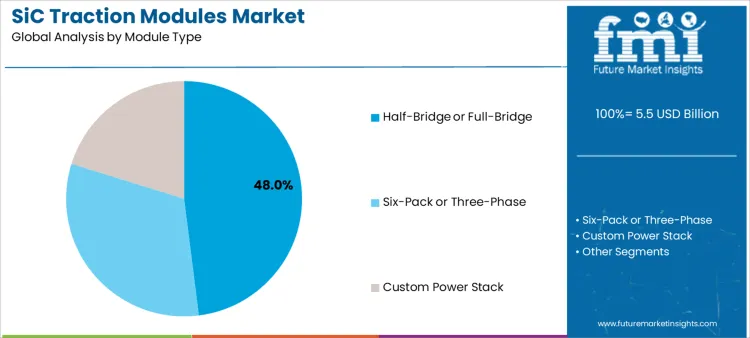
Half-bridge or full-bridge modules hold 48% share of the SiC traction modules market because they offer a practical balance of high efficiency, cost-effectiveness, and simplicity, making them ideal for passenger EVs and light-duty applications. These modules convert DC to AC power efficiently, providing optimal energy utilization in electric drivetrains while minimizing size and complexity. Their straightforward design and ability to handle moderate power levels make them suitable for smaller electric vehicles and cost-sensitive applications. The increasing demand for EVs, paired with a need for reliable, compact solutions, leads to their widespread use in both high-volume markets and price-conscious sectors. These advantages explain why half-bridge or full-bridge modules remain the most adopted module type in the market.
Why Do Passenger EVs Dominate End-Use Demand In The SiC Traction Modules Market?
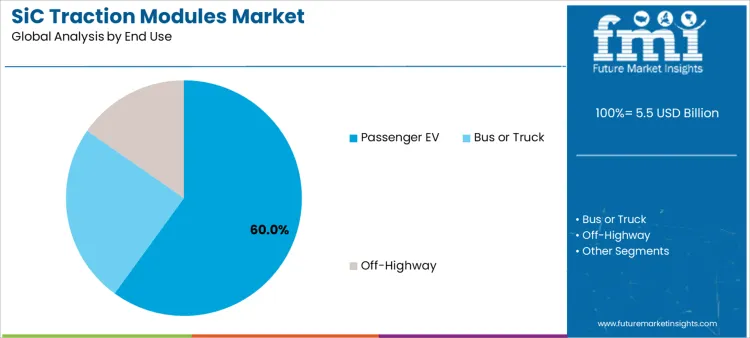
Passenger electric vehicles account for 60% share of the SiC traction modules market due to the rapid global adoption of electric mobility. SiC traction modules are crucial in enhancing EV powertrain performance by offering high efficiency, superior thermal conductivity, and energy-saving capabilities, all of which contribute to extended driving range, faster charging, and improved overall vehicle performance. As demand for more efficient, high-performance passenger EVs rises, automakers increasingly turn to SiC-based solutions. This growth, coupled with the lower manufacturing cost resulting from large-scale production, explains why passenger EVs are the dominant segment in the SiC traction modules market. The combination of superior performance and cost-efficiency positions passenger EVs as the leading end-use application.
What Are The Key Dynamics Of The SiC Traction Modules Market?
The SiC traction modules market is driven by rapid electrification across automotive, commercial vehicle, and industrial segments, where silicon carbide (SiC) power modules deliver higher efficiency, reduced energy loss, and superior thermal performance compared with traditional silicon devices. SiC traction modules used in inverters and drives for electric vehicles (EVs), hybrid systems, and high-power industrial drives enable faster switching speeds, lighter cooling requirements, and extended driving range. For manufacturers and system suppliers, power density, reliability under high temperature and high voltage stress, packaging quality, and integration with vehicle control systems are critical performance and procurement considerations.
How Are Technology And Vehicle Architectures Shaping This Market?
Technology trends and evolving vehicle architectures are shaping the SiC traction modules market by accelerating adoption of high-efficiency power electronics and consolidated drive systems. EV platforms with 800 V battery architectures increasingly favor SiC modules, as they support reduced current draw, lighter wiring, and faster charging capability. Advancements in 3D packaging, optimized thermal interfaces, and integrated gate drivers further improve module performance and simplify system integration. For suppliers, delivering modules that balance high switching frequency, low losses, and robust fault tolerance while supporting standardized automotive test cycles (thermal shock, vibration, humidity) enhances compatibility with next-generation traction inverters and control units.
Why Do Cost, Qualification, And Supply Constraints Restrain Market Growth?
Cost, qualification, and supply constraints restrain growth in the SiC traction modules market due to the relative expense of wide-bandgap materials and rigorous automotive qualification demands. SiC wafers and devices currently carry higher unit costs compared with conventional silicon, which can temper adoption in value-sensitive segments or price-competitive vehicle models. Achieving automotive grade qualification involves extended reliability testing, safety certifications, and long lead times, increasing development expense and project cycle time. Supply chain constraints for high-quality SiC substrates, processing capacity, and packaging materials also create bottlenecks that can limit rapid capacity expansion. These factors can slow uptake, especially in emerging EV markets with constrained infrastructure or price pressures.
What is The Country-Wise Growth Outlook For The SiC Traction Modules Market?
The SiC traction modules market is expanding rapidly as electric vehicle manufacturers transition toward high-efficiency power electronics to support higher driving range, faster charging, and improved thermal performance. Silicon carbide (SiC) traction modules enable lower switching losses, higher operating temperatures, and greater power density compared to conventional silicon-based solutions, making them increasingly preferred for next-generation EV platforms. Growth varies by country based on EV production scale, penetration of 800 V architectures, availability of SiC semiconductor supply, and OEM readiness to adopt advanced powertrain technologies.
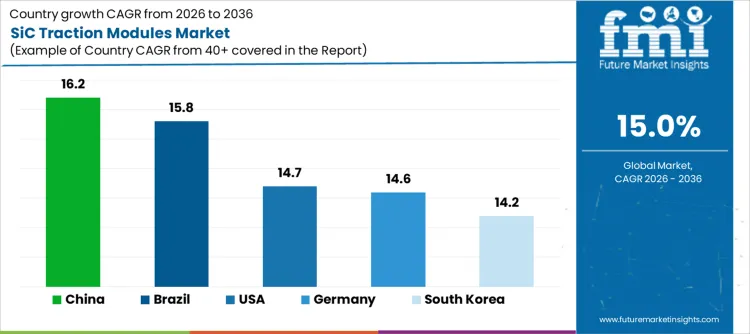
| Country | CAGR (%) |
|---|---|
| China | 16.2 |
| Brazil | 15.8 |
| United States | 14.7 |
| Germany | 14.6 |
| South Korea | 14.2 |
Why Is China Setting The Pace For SiC Traction Module Adoption?
Demand for SiC traction modules in China is expanding at a CAGR of 16.2% during 2026 to 2036, driven by the country’s aggressive electrification strategy and large-scale deployment of high-performance EV platforms. Chinese OEMs are rapidly transitioning from silicon-based inverters to SiC-based traction systems to improve driving range, reduce energy losses, and support fast-charging architectures. SiC traction modules are increasingly integrated into 800 V powertrains used in premium and mid-range EVs. Buyers prioritize power density, thermal robustness, and cost optimization at scale. Strong domestic SiC wafer production and module packaging capacity support rapid adoption and price reduction. Procurement decisions favor suppliers capable of high-volume delivery, consistent quality, and fast design iteration cycles. Market value is driven by massive EV production volumes, platform standardization across multiple models, and tight integration between battery, inverter, and motor systems.
How Is Brazil Emerging As A High-Growth Market For SiC Traction Modules?
Sale of SiC traction modules in Brazil is growing at a CAGR of 15.8% during 2026 to 2036, supported by rising EV adoption and gradual introduction of higher-voltage electric powertrains. OEMs operating in Brazil are beginning to deploy SiC-based traction modules in premium passenger vehicles, electric buses, and commercial fleets to improve efficiency and reduce thermal constraints. Buyers emphasize cost-performance balance, modular integration, and compatibility with imported battery and inverter systems. Adoption is often phased, with SiC modules initially used in higher-end variants before broader rollout. Procurement decisions are influenced by supplier flexibility, local technical support, and ability to support mixed powertrain portfolios. Brazil represents an emerging transition market where supplier success depends on adaptable module designs, localized integration support, and the ability to scale as EV penetration accelerates.
What Is Driving Strong Uptake Of SiC Traction Modules In The United States?
The United States SiC traction modules market is expanding at a CAGR of 14.7% during 2026 to 2036, driven by performance-focused EV development and large investments in domestic battery and power electronics manufacturing. USA OEMs are adopting SiC traction modules to support high-power drivetrains, fast charging, and demanding duty cycles in electric pickups, SUVs, and commercial vehicles. Buyers prioritize efficiency at high load, thermal stability, and integration with advanced cooling systems. SiC modules are often co-developed with OEMs to meet specific performance and safety targets. Procurement decisions favor suppliers with strong engineering collaboration capabilities, extensive testing infrastructure, and compliance with stringent automotive standards. Market value is driven by innovation-led demand, domestic manufacturing incentives, and growing use of 800 V platforms. The United States represents a technology-driven market where success depends on advanced design expertise, reliability validation, and early involvement in vehicle platform development.
Why Is Germany Integrating SiC Traction Modules Into Premium EV Architectures?
Demand for SiC traction modules in Germany is growing at a CAGR of 14.6% during 2026 to 2036, shaped by the country’s strong focus on engineering excellence and premium EV manufacturing. German OEMs are deploying SiC modules to improve drivetrain efficiency, extend vehicle range, and support high-speed charging without compromising durability. Buyers emphasize precise switching behavior, long-term thermal reliability, and strict compliance with automotive qualification standards. Adoption is tightly integrated into centralized inverter and powertrain architectures designed for modular vehicle platforms. Procurement processes involve long validation cycles, extensive simulation, and close Tier-1 collaboration. Market value is driven by premium vehicle production, platform refinement, and gradual migration toward higher-voltage systems. Germany represents a quality-driven market where supplier success depends on engineering credibility, documentation depth, and the ability to meet exacting OEM performance and safety expectations.
How Is South Korea Advancing SiC Traction Module Deployment?
Sale of SiC traction modules in South Korea is expanding at a CAGR of 14.2% during 2026 to 2036, supported by strong integration between EV OEMs, battery manufacturers, and semiconductor suppliers. SiC traction modules are increasingly adopted to complement advanced battery systems and compact inverter designs used in export-oriented EV platforms. Buyers prioritize high switching efficiency, compact packaging, and compatibility with centralized power electronics architectures. Adoption is driven by continuous performance optimization and global supply commitments. Procurement decisions favor suppliers with deep semiconductor process knowledge, automated manufacturing capability, and long-term reliability data. Market value is driven by export-focused EV production and rapid technology iteration. South Korea represents a performance-oriented market where success depends on precision manufacturing, materials expertise, and close collaboration across the EV powertrain ecosystem.
How Are Power Electronics Suppliers Competing in the SiC Traction Modules Market?
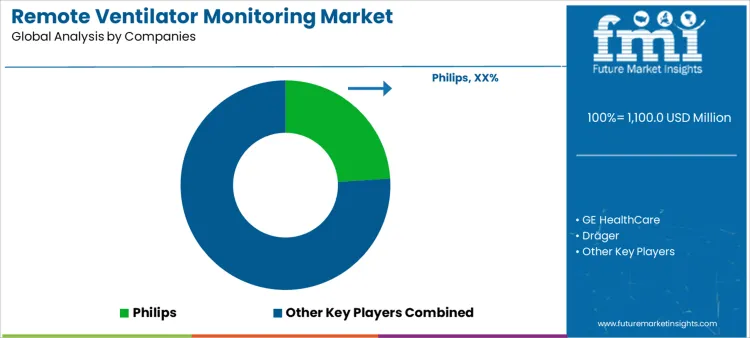
Competition in the SiC traction modules market is driven by switching efficiency, power density, thermal robustness, and long-term reliability under high-voltage automotive duty cycles. As EV platforms migrate toward 800 V architectures, silicon carbide has become central to reducing inverter losses and extending driving range. Infineon anchors the market with automotive-qualified SiC MOSFET modules optimized for high switching frequencies and advanced cooling concepts, positioning its portfolio for scalable use across passenger and commercial EVs. Wolfspeed differentiates through vertical integration from SiC wafers to power devices, emphasizing material quality, high breakdown voltage, and stable performance at elevated junction temperatures.
Integrated device manufacturers compete on module design and system readiness. STMicroelectronics and onsemi focus on automotive-grade SiC traction modules with balanced efficiency and manufacturability, highlighting compatibility with standard inverter platforms and strong OEM qualification pipelines. Mitsubishi Electric and ROHM leverage deep expertise in module packaging and reliability engineering, positioning their SiC traction modules around low inductance layouts, robust insulation, and proven thermal cycling endurance.
Tier-1 system suppliers and regional specialists extend competition through system-level integration. Hitachi Astemo integrates SiC modules directly into traction inverters aligned with OEM drivetrain requirements, focusing on real-world efficiency and NVH performance. Fuji Electric competes through high-reliability modules suited for both automotive and industrial traction. Semikron Danfoss emphasizes advanced module packaging and press-fit technologies that improve power density and service life. CRRC Power strengthens the market through high-power SiC modules tailored for heavy-duty EV and rail traction. Across the market, competitive advantage is defined by SiC material quality, thermal management, and OEM trust in long-term reliability rather than device cost alone.
Key Players in SiC Traction Modules Market
- Wolfspeed
- STMicroelectronics
- onsemi
- Mitsubishi Electric
- ROHM
- Hitachi Astemo
- Fuji Electric
- Semikron Danfoss
- CRRC Power
Scope of Report
| Attribute | Details |
|---|---|
| Market Size Unit | USD Billion |
| Module Type Covered | Half-Bridge or Full-Bridge Modules, Six-Pack or Three-Phase Modules, Custom Power Stack Modules |
| End Use Covered | Passenger Electric Vehicles, Electric Buses and Trucks, Off-Highway Electric Vehicles |
| Countries Covered | China, Japan, South Korea, India, Australia & New Zealand, ASEAN, Rest of Asia Pacific, Germany, United Kingdom, France, Italy, Spain, Nordic, BENELUX, Rest of Europe, United States, Canada, Mexico, Brazil, Chile, Rest of Latin America, Kingdom of Saudi Arabia, Other GCC Countries, Turkey, South Africa, Other African Union, Rest of Middle East & Africa |
| Regions Covered | Asia Pacific, Europe, North America, Latin America, Middle East & Africa |
| Key Companies Profiled | Wolfspeed, STMicroelectronics, onsemi, Mitsubishi Electric, ROHM, Hitachi Astemo, Fuji Electric, Semikron Danfoss, CRRC Power |
| Additional Attributes | Dollar sales by module type and end use are evaluated across high-voltage electric drivetrain architectures. The scope analyzes power density, switching efficiency, thermal performance, and system integration with 800 V platforms. Country-level assessment reflects EV production scale-up, localization of SiC supply chains, and OEM adoption of wide-bandgap semiconductor technologies. |
SiC Traction Modules Market by Key Segments
Module Type:
- Half‑Bridge or Full‑Bridge
- Six‑Pack or Three‑Phase
- Custom Power Stack
End Use:
- Passenger EV
- Bus or Truck
- Off‑Highway
Region:
- Asia Pacific
- China
- Japan
- South Korea
- India
- Australia & New Zealand
- ASEAN
- Rest of Asia Pacific
- Europe
- Germany
- United Kingdom
- France
- Italy
- Spain
- Nordic
- BENELUX
- Rest of Europe
- North America
- United States
- Canada
- Mexico
- Latin America
- Brazil
- Chile
- Rest of Latin America
- Middle East & Africa
- Kingdom of Saudi Arabia
- Other GCC Countries
- Turkey
- South Africa
- Other African Union
- Rest of Middle East & Africa
Bibliography
- U.S. Department of Energy. (2024). Silicon carbide power electronics for electric vehicle traction inverters and fast-charging systems. U.S. Department of Energy.
- National Renewable Energy Laboratory. (2024). High-efficiency power conversion enabled by wide-bandgap semiconductors (SiC and GaN). National Renewable Energy Laboratory.
- Institute of Electrical and Electronics Engineers (IEEE). (2024). Advanced packaging and double-sided cooling technologies for SiC power modules in electric vehicle applications. IEEE.
- International Energy Agency. (2024). Power electronics and thermal management challenges in electric vehicle drivetrains. International Energy Agency.
- Sandia National Laboratories. (2024). Reliability and power-cycling performance of Ag-sintered versus soldered SiC MOSFET power modules. Sandia National Laboratories.
Frequently Asked Questions
How big is the sic traction modules market in 2026?
The global sic traction modules market is estimated to be valued at USD 5.5 billion in 2026.
What will be the size of sic traction modules market in 2036?
The market size for the sic traction modules market is projected to reach USD 22.3 billion by 2036.
How much will be the sic traction modules market growth between 2026 and 2036?
The sic traction modules market is expected to grow at a 15.0% CAGR between 2026 and 2036.
What are the key product types in the sic traction modules market?
The key product types in sic traction modules market are half‑bridge or full‑bridge, six‑pack or three‑phase and custom power stack.
Which end use segment to contribute significant share in the sic traction modules market in 2026?
In terms of end use, passenger ev segment to command 60.0% share in the sic traction modules market in 2026.
Preview the report firsthand - request a free sample
Get SampleGet the brochure for pricing and purchase details.
Get PDFTable of Content
- Executive Summary
- Global Market Outlook
- Demand-side Trends
- Supply-side Trends
- Technology Roadmap Analysis
- Analysis and Recommendations
- Market Overview
- Market Coverage / Taxonomy
- Market Definition / Scope / Limitations
- Market Background
- Market Dynamics
- Drivers
- Restraints
- Opportunity
- Trends
- Scenario Forecast
- Demand in Optimistic Scenario
- Demand in Likely Scenario
- Demand in Conservative Scenario
- Opportunity Map Analysis
- Product Life Cycle Analysis
- Supply Chain Analysis
- Investment Feasibility Matrix
- Value Chain Analysis
- PESTLE and Porter’s Analysis
- Regulatory Landscape
- Regional Parent Market Outlook
- Production and Consumption Statistics
- Import and Export Statistics
- Market Dynamics
- Global Market Analysis 2021 to 2025 and Forecast, 2026 to 2036
- Historical Market Size Value (USD Million) Analysis, 2021 to 2025
- Current and Future Market Size Value (USD Million) Projections, 2026 to 2036
- Y-o-Y Growth Trend Analysis
- Absolute $ Opportunity Analysis
- Global Market Pricing Analysis 2021 to 2025 and Forecast 2026 to 2036
- Global Market Analysis 2021 to 2025 and Forecast 2026 to 2036, By Module Type
- Introduction / Key Findings
- Historical Market Size Value (USD Million) Analysis By Module Type , 2021 to 2025
- Current and Future Market Size Value (USD Million) Analysis and Forecast By Module Type , 2026 to 2036
- Half‑Bridge or Full‑Bridge
- Six‑Pack or Three‑Phase
- Custom Power Stack
- Half‑Bridge or Full‑Bridge
- Y-o-Y Growth Trend Analysis By Module Type , 2021 to 2025
- Absolute $ Opportunity Analysis By Module Type , 2026 to 2036
- Global Market Analysis 2021 to 2025 and Forecast 2026 to 2036, By End Use
- Introduction / Key Findings
- Historical Market Size Value (USD Million) Analysis By End Use, 2021 to 2025
- Current and Future Market Size Value (USD Million) Analysis and Forecast By End Use, 2026 to 2036
- Passenger EV
- Bus or Truck
- Off‑Highway
- Passenger EV
- Y-o-Y Growth Trend Analysis By End Use, 2021 to 2025
- Absolute $ Opportunity Analysis By End Use, 2026 to 2036
- Global Market Analysis 2021 to 2025 and Forecast 2026 to 2036, By Region
- Introduction
- Historical Market Size Value (USD Million) Analysis By Region, 2021 to 2025
- Current Market Size Value (USD Million) Analysis and Forecast By Region, 2026 to 2036
- North America
- Latin America
- Western Europe
- Eastern Europe
- East Asia
- South Asia and Pacific
- Middle East & Africa
- Market Attractiveness Analysis By Region
- North America Market Analysis 2021 to 2025 and Forecast 2026 to 2036, By Country
- Historical Market Size Value (USD Million) Trend Analysis By Market Taxonomy, 2021 to 2025
- Market Size Value (USD Million) Forecast By Market Taxonomy, 2026 to 2036
- By Country
- USA
- Canada
- Mexico
- By Module Type
- By End Use
- By Country
- Market Attractiveness Analysis
- By Country
- By Module Type
- By End Use
- Key Takeaways
- Latin America Market Analysis 2021 to 2025 and Forecast 2026 to 2036, By Country
- Historical Market Size Value (USD Million) Trend Analysis By Market Taxonomy, 2021 to 2025
- Market Size Value (USD Million) Forecast By Market Taxonomy, 2026 to 2036
- By Country
- Brazil
- Chile
- Rest of Latin America
- By Module Type
- By End Use
- By Country
- Market Attractiveness Analysis
- By Country
- By Module Type
- By End Use
- Key Takeaways
- Western Europe Market Analysis 2021 to 2025 and Forecast 2026 to 2036, By Country
- Historical Market Size Value (USD Million) Trend Analysis By Market Taxonomy, 2021 to 2025
- Market Size Value (USD Million) Forecast By Market Taxonomy, 2026 to 2036
- By Country
- Germany
- UK
- Italy
- Spain
- France
- Nordic
- BENELUX
- Rest of Western Europe
- By Module Type
- By End Use
- By Country
- Market Attractiveness Analysis
- By Country
- By Module Type
- By End Use
- Key Takeaways
- Eastern Europe Market Analysis 2021 to 2025 and Forecast 2026 to 2036, By Country
- Historical Market Size Value (USD Million) Trend Analysis By Market Taxonomy, 2021 to 2025
- Market Size Value (USD Million) Forecast By Market Taxonomy, 2026 to 2036
- By Country
- Russia
- Poland
- Hungary
- Balkan & Baltic
- Rest of Eastern Europe
- By Module Type
- By End Use
- By Country
- Market Attractiveness Analysis
- By Country
- By Module Type
- By End Use
- Key Takeaways
- East Asia Market Analysis 2021 to 2025 and Forecast 2026 to 2036, By Country
- Historical Market Size Value (USD Million) Trend Analysis By Market Taxonomy, 2021 to 2025
- Market Size Value (USD Million) Forecast By Market Taxonomy, 2026 to 2036
- By Country
- China
- Japan
- South Korea
- By Module Type
- By End Use
- By Country
- Market Attractiveness Analysis
- By Country
- By Module Type
- By End Use
- Key Takeaways
- South Asia and Pacific Market Analysis 2021 to 2025 and Forecast 2026 to 2036, By Country
- Historical Market Size Value (USD Million) Trend Analysis By Market Taxonomy, 2021 to 2025
- Market Size Value (USD Million) Forecast By Market Taxonomy, 2026 to 2036
- By Country
- India
- ASEAN
- Australia & New Zealand
- Rest of South Asia and Pacific
- By Module Type
- By End Use
- By Country
- Market Attractiveness Analysis
- By Country
- By Module Type
- By End Use
- Key Takeaways
- Middle East & Africa Market Analysis 2021 to 2025 and Forecast 2026 to 2036, By Country
- Historical Market Size Value (USD Million) Trend Analysis By Market Taxonomy, 2021 to 2025
- Market Size Value (USD Million) Forecast By Market Taxonomy, 2026 to 2036
- By Country
- Kingdom of Saudi Arabia
- Other GCC Countries
- Turkiye
- South Africa
- Other African Union
- Rest of Middle East & Africa
- By Module Type
- By End Use
- By Country
- Market Attractiveness Analysis
- By Country
- By Module Type
- By End Use
- Key Takeaways
- Key Countries Market Analysis
- USA
- Pricing Analysis
- Market Share Analysis, 2025
- By Module Type
- By End Use
- Canada
- Pricing Analysis
- Market Share Analysis, 2025
- By Module Type
- By End Use
- Mexico
- Pricing Analysis
- Market Share Analysis, 2025
- By Module Type
- By End Use
- Brazil
- Pricing Analysis
- Market Share Analysis, 2025
- By Module Type
- By End Use
- Chile
- Pricing Analysis
- Market Share Analysis, 2025
- By Module Type
- By End Use
- Germany
- Pricing Analysis
- Market Share Analysis, 2025
- By Module Type
- By End Use
- UK
- Pricing Analysis
- Market Share Analysis, 2025
- By Module Type
- By End Use
- Italy
- Pricing Analysis
- Market Share Analysis, 2025
- By Module Type
- By End Use
- Spain
- Pricing Analysis
- Market Share Analysis, 2025
- By Module Type
- By End Use
- France
- Pricing Analysis
- Market Share Analysis, 2025
- By Module Type
- By End Use
- India
- Pricing Analysis
- Market Share Analysis, 2025
- By Module Type
- By End Use
- ASEAN
- Pricing Analysis
- Market Share Analysis, 2025
- By Module Type
- By End Use
- Australia & New Zealand
- Pricing Analysis
- Market Share Analysis, 2025
- By Module Type
- By End Use
- China
- Pricing Analysis
- Market Share Analysis, 2025
- By Module Type
- By End Use
- Japan
- Pricing Analysis
- Market Share Analysis, 2025
- By Module Type
- By End Use
- South Korea
- Pricing Analysis
- Market Share Analysis, 2025
- By Module Type
- By End Use
- Russia
- Pricing Analysis
- Market Share Analysis, 2025
- By Module Type
- By End Use
- Poland
- Pricing Analysis
- Market Share Analysis, 2025
- By Module Type
- By End Use
- Hungary
- Pricing Analysis
- Market Share Analysis, 2025
- By Module Type
- By End Use
- Kingdom of Saudi Arabia
- Pricing Analysis
- Market Share Analysis, 2025
- By Module Type
- By End Use
- Turkiye
- Pricing Analysis
- Market Share Analysis, 2025
- By Module Type
- By End Use
- South Africa
- Pricing Analysis
- Market Share Analysis, 2025
- By Module Type
- By End Use
- USA
- Market Structure Analysis
- Competition Dashboard
- Competition Benchmarking
- Market Share Analysis of Top Players
- By Regional
- By Module Type
- By End Use
- Competition Analysis
- Competition Deep Dive
- Infineon
- Overview
- Product Portfolio
- Profitability by Market Segments (Product/Age /Sales Channel/Region)
- Sales Footprint
- Strategy Overview
- Marketing Strategy
- Product Strategy
- Channel Strategy
- Wolfspeed
- STMicroelectronics
- onsemi
- Mitsubishi Electric
- ROHM
- Hitachi Astemo
- Fuji Electric
- Semikron Danfoss
- CRRC Power
- Infineon
- Competition Deep Dive
- Assumptions & Acronyms Used
- Research Methodology


