

- Industry Size (2026)
- USD 2.94 Bn
- Forecast (2036)
- USD 4.30 Bn
- CAGR (2026 to 2036)
- 3.9%
Hybrid E-scooter Market Size, Market Forecast and Outlook By FMI
The hybrid e-scooter market was valued at USD 2.82 billion in 2025, projected to reach USD 2.94 billion in 2026, and is forecast to expand to USD 4.30 billion by 2036 at a 3.9% CAGR. Growing urban micro-mobility adoption, expanding last-mile delivery fleet electrification, and increasing consumer preference for extended-range two-wheeler alternatives in markets with limited charging infrastructure are sustaining demand for hybrid electric scooter platforms combining electric propulsion with small internal combustion range extenders.
Summary of Hybrid E-scooter Market
- The market is forecast to touch USD 4.30 billion by 2036.
- Annual growth of 3.9% is projected across the 2026-2036 forecast horizon.
- In 2025, market value was pegged at USD 2.82 billion.
- The forecast period unlocks an incremental opportunity worth USD 1.37 billion.
- 60 to 80 Km leads by Range with 32.4% share in 2026.
- Personal leads by Application with 54.8% share in 2026.
- Offline leads by Sales with 57.2% share in 2026.
- Demand is driven by urban commuters in markets with limited electric charging infrastructure seeking fuel cost reduction through hybrid two-wheeler platforms that maintain all-day range capability.
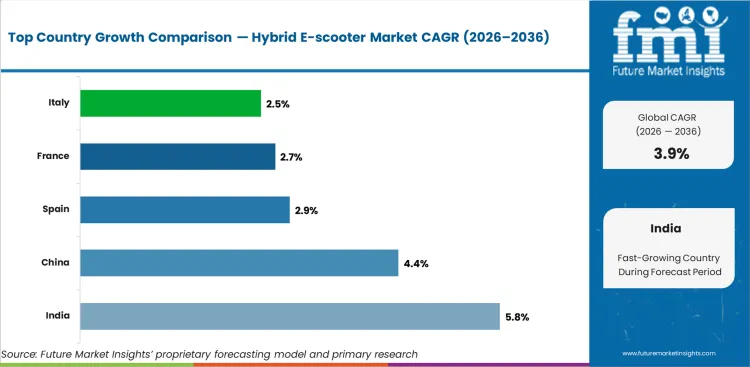
- Among key countries, India leads at 5.8% CAGR, followed by China at 4.4%, Spain at 2.9%, France at 2.7%, Italy at 2.5%.
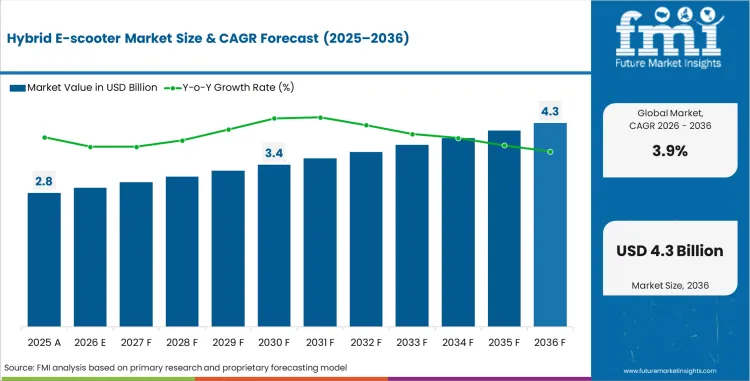
As per FMI, hybrid e-scooter adoption occupies a transitional market position between conventional fuel-powered scooters and pure battery electric two-wheelers, serving riders in regions where charging infrastructure gaps and range anxiety limit full-electric adoption. The personal use segment accounts for the majority of demand as commuters in South and Southeast Asian markets seek fuel cost reduction without sacrificing the all-day range capability that pure electric scooters cannot yet consistently deliver. Commercial fleet operators in last-mile delivery and ride-sharing segments are evaluating hybrid scooter platforms as transitional fleet vehicles capable of maintaining operational uptime during electric charging infrastructure build-out periods.
Country-level growth trajectories reflect urban two-wheeler usage intensity, charging infrastructure maturity, and fuel price dynamics. India at 5.8%, China at 4.4%, Spain at 2.9%, France at 2.7%, Italy at 2.5%. India leads growth driven by the massive two-wheeler commuter base, rising fuel costs driving hybrid interest, and government incentives for electrified two-wheeler adoption under the FAME scheme. China follows with measured expansion as the mature electric two-wheeler market absorbs some hybrid demand while range-extended configurations serve rural and peri-urban corridors with limited charging access. Spain, France, and Italy reflect European growth through urban shared mobility fleet adoption and last-mile delivery electrification programs.
Hybrid E-scooter Market Key Takeaways
| Metric | Details |
|---|---|
| Industry Size (2026) | USD 2.94 billion |
| Industry Value (2036) | USD 4.30 billion |
| CAGR (2026-2036) | 3.9% |
Source: Future Market Insights, 2026
Hybrid E-scooter Market Definition
The Hybrid E-scooter Market encompasses two-wheeled personal mobility vehicles that combine battery-electric propulsion systems with small internal combustion range extender engines to deliver extended operating range beyond pure electric scooter capability. Core product configurations span range categories from 40 km to above 100 km per combined charge and fuel cycle. These vehicles serve personal urban commuting, commercial ride-sharing fleet operations, and last-mile delivery applications across markets where electric charging infrastructure limitations constrain pure battery electric two-wheeler adoption.
Hybrid E-scooter Market Inclusions
Market scope includes hybrid electric scooter vehicle units combining electric motor and internal combustion range extender propulsion, associated battery and fuel system components integrated into vehicle platforms, and aftermarket parts revenue directly tied to hybrid scooter models. Revenue from personal and commercial application segments across offline and online sales channels and all regional markets is included.
Hybrid E-scooter Market Exclusions
The scope excludes pure battery electric scooters without internal combustion components, conventional fuel-powered scooters without electric propulsion, electric bicycles and e-bikes classified under separate micro-mobility categories, and hybrid motorcycle platforms above scooter displacement classification thresholds.
Hybrid E-scooter Market Research Methodology
- Primary Research: Analysts conducted structured interviews with two-wheeler OEM product planning managers, shared mobility fleet procurement directors, last-mile delivery operations managers, and urban transportation planning officials to map hybrid scooter adoption dynamics and competitive positioning against pure electric alternatives.
- Desk Research: Data collection phases aggregated national two-wheeler registration databases, government electrified vehicle incentive program documentation, urban mobility survey data, and published two-wheeler total cost of ownership comparison studies.
- Market-Sizing and Forecasting: Baseline values derive from a bottom-up aggregation of product-level and service-level revenue data, applying region-specific adoption curves and regulatory timeline assumptions to project future demand trajectories through the forecast period.
- Data Validation and Update Cycle: Projections are cross-validated against publicly reported revenue guidance from leading industry participants, government procurement disclosures, and published market data from recognized multilateral organizations.
Key Industry Highlights in Hybrid E-scooter Market
Integration of Hybrid E-scooters in Delivery Services Pushes Sales
Hybrid e-scooters are being increasingly used for last-mile delivery services. These deliveries are critical to improve logistics efficiency in urban areas. Electrification of last-mile deliveries makes these extra sustainable and assists in reducing congestion in city centers.
Ride-sharing is also gaining traction in various countries. Growth in the urban population creates a surging demand for convenient and flexible transportation options. This requirement is perfectly fulfilled by hybrid e-scooters owing to their sustainability and cost-effectiveness for short-distance trips.
Recent technological developments in hybrid e-scooters further support their integration into delivery services and ride-sharing. Key industry players are joining hands to integrate hybrid e-scooters in delivery services.
Adoption of Lightweight Materials and Connected Technologies is a Key Trend
Improvements in battery life and charging efficiency are crucial for enhancing the operational range of hybrid e-scooters. Companies are focusing on developing energy-efficient motors to increase the performance of hybrid e-scooters. The deployment of lightweight materials assists in reducing the environmental impact of these scooters.
Integration of IoT and connected technologies is gaining traction. This incorporation enables the inclusion of features like real-time performance monitoring, smart charging, and GPS tracking. Research and development efforts are also directed toward utilizing sustainable materials in manufacturing processes to align with the growing consumer preference for eco-friendly products.
Vagueness of Norms like Unclear Speed Limits May Hamper Demand through 2034
Inconsistent regulations across several regions are likely to hinder the expansion of services and further complicate operators' compliance. This can result in increased operational costs and limit entry for new players.
Consumers are becoming aware of the regulatory landscape and several others are demanding clear regulations governing e-scooter usage, such as speed limits and designated riding areas. This indicates that the user acceptance of hybrid e-scooters may hinge on the establishment of comprehensive safety regulations.
Regulatory frameworks that are reactive rather than proactive are likely to create uncertainty, influencing future investments in infrastructure and technology required for the growth of these hybrid e-scooters. Restrictive or poorly designed regulations are likely to limit the potential of these e-scooters in public transport, stunting growth in urban mobility solutions.
Hybrid E-scooter Market Concentration Insights
Key characteristics that differentiate Tier 1 companies are their stability and brand awareness. Tier 1 companies make up a significant portion of the global industry. They employ modern technologies in their production processes to boost output.
The businesses have an extensive product portfolio and manufacturing facilities spread across several regions. Piaggio Group, BMW Motorrad, Yamaha Motor Company, Honda Motor Co., Ltd., and KTM AG are the prominent businesses in Tier 1.
A huge portion of Tier 2 comprises companies operating in specific regions. These businesses are renowned on the global stage. They have a significant impact on the local economy. These companies also possess broad industry knowledge. Prominent companies in Tier 2 include Segway, Gogoro, Mahindra GenZe, Ninebot, and Levy Electric.
Tier 2 is primarily made up of medium-to small-sized companies with regional headquarters. Compared to the industry giants in Tier 1 and Tier 2, Tier 3 businesses are less structured and formalized. The limited geographic reach of Tier 3 companies leads to less competition among them. Key enterprises in Tier 3 are Inokim, Ujet, NIU Technologies, EcoReco, and Taiga Motors.
Country-wise Analysis of Hybrid E-scooter Market
The section offers organizations with an overview of the industry. It consists of a detailed examination of the emerging trends and opportunities on a country-by-country basis. This country-specific analysis of the dynamics is anticipated to assist businesses in understanding the complex nature of the business.
The analysis contains key factors, potential challenges, and forecasts impacting the demand, production, and consumption of the product within each country. It aims to help companies make informed decisions and develop effective strategies tailored to individual countries.
India is projected to emerge as a dominating country during the assessment period with an estimated CAGR of 5.8%. China, Spain, and France are projected to follow closely behind to become the key countries with anticipated CAGRs of 4.4%, 2.9%, and 2.7%, respectively.
.webp "Top Country Growth Comparison Hybrid E Scooter Market Cagr (2026 2036)")
| Countries | CAGR 2026 to 2036 |
|---|---|
| India | 5.8% |
| China | 4.4% |
| Spain | 2.9% |
| France | 2.7% |
| Italy | 2.5% |
Citizens of India Residing in Crowded Cities Look for Hybrid E-scooters
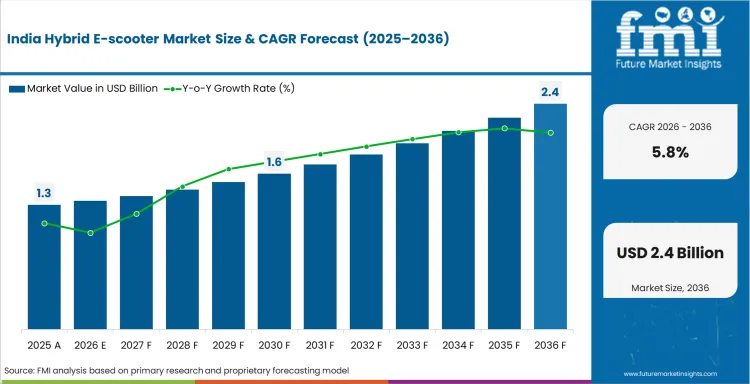
The hybrid e-scooter market is projected to rise at a CAGR of 5.8% in India during the forecast period. The Government of India is continuously promoting the adoption of electric vehicles through various initiatives. It is constantly providing subsidies to make hybrid e-scooters affordable and accessible to local consumers.
The e-scooters are an efficient and sustainable mobility solution in crowded and polluted cities like Delhi, Mumbai, and Bengaluru. With lower fuel requirements, these e-scooters are cost-effective to operate compared to petrol-dependent scooters. India’s vast consumer base is experiencing a growing awareness regarding the benefits of electric mobility and is therefore turning toward these e-scooters.
Sustainable Profile of Hybrid E-scooters is Accelerating Demand in Japan
Japan is anticipated to showcase a CAGR of 1.6% throughout the assessment period. Consumers in the country prefer hybrid e-scooters due to their high reliability and safe use. They are willing to pay premium prices in turn for good value.
The expansion of the industry is prominently driven by their eco-friendly, carbon emission-free operations. Urban areas in Japan are experiencing significant traffic congestion, especially during peak commute hours. These e-scooters offer a practical solution to commuters owing to their compact size and maneuverability.
Continuous technological innovations in hybrid e-scooter technology in Japan are enhancing their appeal and functionality. The country’s government is increasingly supporting electric mobility solutions.
It is constantly implementing policies aimed at promoting green transportation. The government is also investing in research and development activities to drive innovation in the country.
Government to Invest in Charging Infrastructure and New Lanes in the United States
The demand for hybrid e-scooters in the United States is projected to rise at a CAGR of 2.2% during the forecast period. The country has a mature automotive industry with a high penetration rate of cutting-edge technologies.
The government of the country is progressively supporting the growth of hybrid e-scooters by heavily investing in the charging infrastructure in residential buildings, workplaces, and various other public places. In order to boost convenience for drivers, the government is also assisting rapid infrastructure development for the construction of new lanes for e-scooters.
Hybrid E-scooter Market Analysis by Top Investment Segments
The section offers companies with insightful data and analysis of the two leading segments. Segmentation of these categories helps businesses understand the dynamics and invest in the beneficial zones.
Analysis of the growth enables organizations to gain a thorough understanding of the trends, opportunities, and challenges. This examination is likely to assist companies in navigating the complex business environment and making informed decisions.
In terms of stroke, four-stroke is estimated to dominate the market with a value share of 65% in 2026. E-commerce is likely to lead in terms of distribution channels with a value share of 50% in the same year.
Long Operational Life of Four Stroke Engines to Propel Demand
| Segment | Four Stroke (Stroke) |
|---|---|
| Value Share (2026) | 65% |
Four-stroke engines are usually robust as these are designed for long operational life. They endure a complete combustion process, reducing wear and tear, which makes them suitable for installation in hybrid e-scooters.
They provide better fuel efficiency and emit lower emissions compared to two-stroke engines. This efficiency perfectly aligns with the increasing consumer demand for sustainable transportation options, particularly in urban settings where pollution is a prominent concern.
The engines offer consistent and manageable power delivery. This is especially beneficial for the varying speeds and conditions encountered during urban commutes.
The hybrid e-scooter market is witnessing significant growth, particularly in regions like Asia Pacific. In these regions, four-stroke engines are favored owing to their performance characteristics and compliance with stringent emission regulations.
Extra Convenience in Purchasing from E-commerce Platforms Accelerating Growth
| Segment | E-commerce (Distribution Channel) |
|---|---|
| Value Share (2026) | 50% |
E-commerce is likely to attain a value share of 50% in 2026 in the distribution channel segment. Millennials are turning to e-commerce platforms to purchase these e-scooters as they offer great convenience.
Consumers can choose from a wide variety of products listed on several e-commerce platforms. This accessibility opens up the prospect of comparing the specifications of each product and choosing the most suitable one.
E-commerce platforms provide numerous offers and discounts on the overall price of the product. A few e-commerce platforms have subscription models that reduce the price of purchased products or give cash back. These factors encourage consumers to purchase from e-commerce platforms, thereby increasing their value share.
Leading Suppliers, Distributors, and Manufacturers of Hybrid E-scooter Market
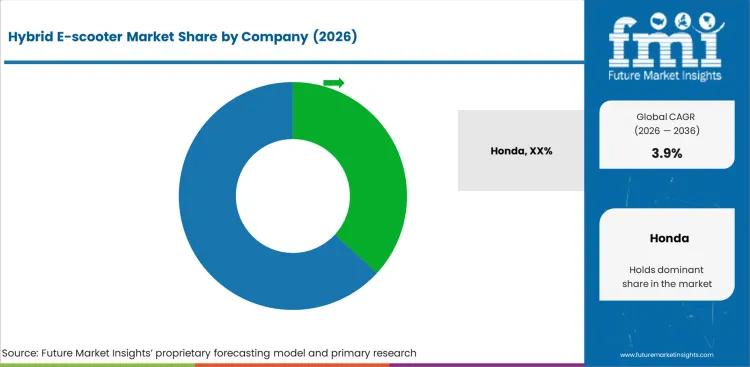
Key players in the industry include Yadea Group Holdings Ltd., Jiangsu Xinri E-Vehicle Co., Ltd., NIU International, and Silence Urban Ecomobility. The market is dominated by both established players and innovative start-ups. The competition between manufacturers is set to intensify as the product gains traction, and this competition is anticipated to lead to innovation.
Companies are increasingly investing in research and development activities to improve battery technology, range, and performance of hybrid e-scooters. Partnerships with ride-sharing platforms and last-mile delivery services are becoming predominant to expand their reach. Manufacturers are progressively tapping into the growing market segments. They are enhancing their brand image by ensuring sustainable production processes.
Brands are also working toward incorporating IoT features and connectivity to offer smart e-scooters with improved functionalities. They are further exploring battery-swapping stations to cater to the concerns regarding charging and extending the range of e-scooters. Government authorities are collaborating with private companies to establish an extensive network of charging stations, supporting growth in the market.
The focus on affordability is set to attract a broad consumer base. Manufacturers are therefore working toward reducing the upfront costs of their hybrid electric scooters. Rising concerns regarding climate change and innovations in technology are projected to bolster demand in the coming years.
Industry Updates
- In June 2024, TVS, headquartered in Chennai, announced the development of the iQube Hybrid, featuring a 110cc single-cylinder engine combined with a full electric kit, including a battery pack and an electric motor. The launch is supposed to take place in 2025.
- In May 2024, SYM, a Taiwan-based motorcycle manufacturer, announced its plan to develop a PE 3 hybrid scooter that can provide an unlimited range to electric scooters. It would boast a 3-liter gasoline engine that will kick in when its battery dips below 60 volts.
- In January 2024, Surge, headquartered in Delhi, and wholly owned by Hero MotoCorp, launched its Surge S32 hybrid that quickly and efficiently converts between a two-wheeler and a three-wheeler. This innovative concept required Surge and Hero to work with the Ministry of Road Transport and Highways to create a new registration category called L2-5, which is defined as 2-wheeler-3-wheeler combi module.
- In January 2024, Yamaha, a Japan-based automaker, announced the launch of the Yamaha Fascino 125 Hybrid, a hybrid electric scooter in India. This e-scooter is set to be an economical choice for eco-conscious consumers.
Scope of the Report
| Metric | Value |
|---|---|
| Quantitative Units | USD 2.94 billion to USD 4.30 billion, at a CAGR of 3.9% |
| Market Definition | The Hybrid E-scooter Market encompasses two-wheeled personal mobility vehicles that combine battery-electric propulsion systems with small internal combustion range extender engines to deliver extended operating range beyond pure electric scooter capability. Core product configurations span range categories from 40 km to above 100 km per combined charge and fuel cycle. These vehicles serve personal urban commuting, commercial ride-sharing fleet operations, and last-mile delivery applications across markets where electric charging infrastructure limitations constrain pure battery electric two-wheeler adoption. |
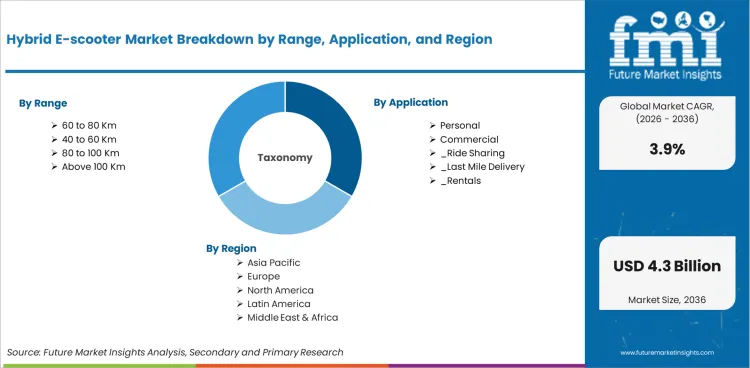
| Segmentation | Range: 60 to 80 Km, 40 to 60 Km, 80 to 100 Km, Above 100 Km; Application: Personal, Commercial, _Ride Sharing, _Last Mile Delivery, _Rentals; Sales: Offline, _Retail Stores, _Supermarkets, Online, _E-Commerce Platform, _Company Website |
| Regions Covered | North America, Latin America, Europe, East Asia, South Asia, Oceania, Middle East & Africa |
| Countries Covered | India, China, Spain, France, Italy, and 40 plus countries |
| Key Companies Profiled | Honda, YAMAHA Motor Pvt. Ltd., Green Tiger Mobility |
| Forecast Period | 2026 to 2036 |
| Approach | Forecasting models apply a bottom-up methodology starting with product-level revenue metrics and cross-validate projections against enterprise spending guidance and regulatory adoption timelines. |
Hybrid E-scooter Market Segmentation Overview
By Range:
Based on Range40 to 60Km, 60 to 80Km, 80 to 100Km, and Above 100Km
By Application:
By Application, the industry is divided into Personal and Commercial (Ride sharing, Last Mile Delivery and Rentals)
By Sales Channel:
By Sales channel, the market is divided into Online and (E- Commerce Platform, Company Website), Offline (Retail Stores, Supermarkets)
By Region:
The market is spread across North America, Latin America, Western Europe, South Asia and Pacific, East Asia, and the Middle East and Africa.
Bibliography
- 1. International Energy Agency. (2024). Global EV Outlook 2024: Two and Three-Wheeler Electrification Analysis. IEA.
- 2. Ministry of Heavy Industries, India. (2024). FAME II Scheme: Implementation Progress and Incentive Disbursement Report. Government of India.
- 3. European Commission. (2024). Urban Mobility Framework: Micro-Mobility Regulation Progress Report. European Commission.
- 4. Society of Indian Automobile Manufacturers. (2024). SIAM Statistical Profile: Two-Wheeler Production and Sales Data 2024. SIAM.
- 5. Honda Motor Co., Ltd. (2024). Annual Report 2024. Honda investor relations filing.
- 6. World Health Organization. (2024). Global Status Report on Road Safety: Two-Wheeler Safety Analysis. WHO.
This bibliography is provided for reader reference. The full Future Market Insights report contains the complete reference list with primary research documentation.
Frequently Asked Questions
How large is the demand for Hybrid E-scooter Market in the global market in 2026?
Demand for hybrid e-scooter market in the global market is estimated to be valued at USD 2.94 billion in 2026.
What will be the market size of Hybrid E-scooter Market in the global market by 2036?
Market size for hybrid e-scooter market is projected to reach USD 4.30 billion by 2036.
What is the expected demand growth for Hybrid E-scooter Market in the global market between 2026 and 2036?
Demand for hybrid e-scooter market is expected to grow at a CAGR of 3.9% between 2026 and 2036.
Which Range is poised to lead global sales by 2026?
60 to 80 Km accounts for 32.4% share in 2026, leading the range segment based on FMI analysis.
How significant is the role of Personal in driving Hybrid E-scooter Market adoption in 2026?
Personal represents 54.8% of segment share in 2026, reflecting sustained demand across the application category.
What is driving demand in India?
India is projected to grow at a CAGR of 5.8% during 2026 to 2036, driven by targeted infrastructure investments and favorable policy frameworks supporting market expansion.
What is Hybrid E-scooter Market and what is it mainly used for?
The Hybrid E-scooter Market encompasses two-wheeled personal mobility vehicles that combine battery-electric propulsion systems with small internal combustion range extender engines to deliver extended operating range beyond pure electric scooter capability. Core product configurations span range categories from 40 km to above 100 km per combined charge and fuel cycle.
How does FMI build and validate the Hybrid E-scooter Market forecast?
Forecasting models apply a bottom-up methodology starting with product-level and service-level revenue metrics and cross-validate projections against publicly reported enterprise guidance and regulatory adoption data.
Preview the report firsthand - request a free sample
Get SampleGet the brochure for pricing and purchase details.
Get PDFTable of Content
- Executive Summary
- Global Market Outlook
- Demand-side Trends
- Supply-side Trends
- Technology Roadmap Analysis
- Analysis and Recommendations
- Market Overview
- Market Coverage / Taxonomy
- Market Definition / Scope / Limitations
- Research Methodology
- Chapter Orientation
- Analytical Lens and Working Hypotheses
- Market Structure, Signals, and Trend Drivers
- Benchmarking and Cross-market Comparability
- Market Sizing, Forecasting, and Opportunity Mapping
- Research Design and Evidence Framework
- Desk Research Programme (Secondary Evidence)
- Company Annual and Sustainability Reports
- Peer-reviewed Journals and Academic Literature
- Corporate Websites, Product Literature, and Technical Notes
- Earnings Decks and Investor Briefings
- Statutory Filings and Regulatory Disclosures
- Technical White Papers and Standards Notes
- Trade Journals, Industry Magazines, and Analyst Briefs
- Conference Proceedings, Webinars, and Seminar Materials
- Government Statistics Portals and Public Data Releases
- Press Releases and Reputable Media Coverage
- Specialist Newsletters and Curated Briefings
- Sector Databases and Reference Repositories
- FMI Internal Proprietary Databases and Historical Market Datasets
- Subscription Datasets and Paid Sources
- Social Channels, Communities, and Digital Listening Inputs
- Additional Desk Sources
- Expert Input and Fieldwork (Primary Evidence)
- Primary Modes
- Qualitative Interviews and Expert Elicitation
- Quantitative Surveys and Structured Data Capture
- Blended Approach
- Why Primary Evidence is Used
- Field Techniques
- Interviews
- Surveys
- Focus Groups
- Observational and In-context Research
- Social and Community Interactions
- Stakeholder Universe Engaged
- C-suite Leaders
- Board Members
- Presidents and Vice Presidents
- R&D and Innovation Heads
- Technical Specialists
- Domain Subject-matter Experts
- Scientists
- Physicians and Other Healthcare Professionals
- Governance, Ethics, and Data Stewardship
- Research Ethics
- Data Integrity and Handling
- Primary Modes
- Tooling, Models, and Reference Databases
- Desk Research Programme (Secondary Evidence)
- Data Engineering and Model Build
- Data Acquisition and Ingestion
- Cleaning, Normalisation, and Verification
- Synthesis, Triangulation, and Analysis
- Quality Assurance and Audit Trail
- Market Background
- Market Dynamics
- Drivers
- Restraints
- Opportunity
- Trends
- Scenario Forecast
- Demand in Optimistic Scenario
- Demand in Likely Scenario
- Demand in Conservative Scenario
- Opportunity Map Analysis
- Product Life Cycle Analysis
- Supply Chain Analysis
- Investment Feasibility Matrix
- Value Chain Analysis
- PESTLE and Porter’s Analysis
- Regulatory Landscape
- Regional Parent Market Outlook
- Production and Consumption Statistics
- Import and Export Statistics
- Market Dynamics
- Global Market Analysis 2021 to 2025 and Forecast, 2026 to 2036
- Historical Market Size Value (USD Million) Analysis, 2021 to 2025
- Current and Future Market Size Value (USD Million) Projections, 2026 to 2036
- Y-o-Y Growth Trend Analysis
- Absolute $ Opportunity Analysis
- Global Market Pricing Analysis 2021 to 2025 and Forecast 2026 to 2036
- Global Market Analysis 2021 to 2025 and Forecast 2026 to 2036, By Range
- Introduction / Key Findings
- Historical Market Size Value (USD Million) Analysis By Range , 2021 to 2025
- Current and Future Market Size Value (USD Million) Analysis and Forecast By Range , 2026 to 2036
- 60 to 80 Km
- 40 to 60 Km
- 80 to 100 Km
- Above 100 Km
- 60 to 80 Km
- Y-o-Y Growth Trend Analysis By Range , 2021 to 2025
- Absolute $ Opportunity Analysis By Range , 2026 to 2036
- Global Market Analysis 2021 to 2025 and Forecast 2026 to 2036, By Application
- Introduction / Key Findings
- Historical Market Size Value (USD Million) Analysis By Application, 2021 to 2025
- Current and Future Market Size Value (USD Million) Analysis and Forecast By Application, 2026 to 2036
- Personal
- Commercial
- Ride Sharing
- Last Mile Delivery
- Rentals
- Personal
- Y-o-Y Growth Trend Analysis By Application, 2021 to 2025
- Absolute $ Opportunity Analysis By Application, 2026 to 2036
- Global Market Analysis 2021 to 2025 and Forecast 2026 to 2036, By Sales
- Introduction / Key Findings
- Historical Market Size Value (USD Million) Analysis By Sales, 2021 to 2025
- Current and Future Market Size Value (USD Million) Analysis and Forecast By Sales, 2026 to 2036
- Offline
- Retail Stores
- Supermarkets
- Online
- E-Commerce Platform
- Company Website
- Offline
- Y-o-Y Growth Trend Analysis By Sales, 2021 to 2025
- Absolute $ Opportunity Analysis By Sales, 2026 to 2036
- Global Market Analysis 2021 to 2025 and Forecast 2026 to 2036, By Region
- Introduction
- Historical Market Size Value (USD Million) Analysis By Region, 2021 to 2025
- Current Market Size Value (USD Million) Analysis and Forecast By Region, 2026 to 2036
- North America
- Latin America
- Western Europe
- Eastern Europe
- East Asia
- South Asia and Pacific
- Middle East & Africa
- Market Attractiveness Analysis By Region
- North America Market Analysis 2021 to 2025 and Forecast 2026 to 2036, By Country
- Historical Market Size Value (USD Million) Trend Analysis By Market Taxonomy, 2021 to 2025
- Market Size Value (USD Million) Forecast By Market Taxonomy, 2026 to 2036
- By Country
- USA
- Canada
- Mexico
- By Range
- By Application
- By Sales
- By Country
- Market Attractiveness Analysis
- By Country
- By Range
- By Application
- By Sales
- Key Takeaways
- Latin America Market Analysis 2021 to 2025 and Forecast 2026 to 2036, By Country
- Historical Market Size Value (USD Million) Trend Analysis By Market Taxonomy, 2021 to 2025
- Market Size Value (USD Million) Forecast By Market Taxonomy, 2026 to 2036
- By Country
- Brazil
- Chile
- Rest of Latin America
- By Range
- By Application
- By Sales
- By Country
- Market Attractiveness Analysis
- By Country
- By Range
- By Application
- By Sales
- Key Takeaways
- Western Europe Market Analysis 2021 to 2025 and Forecast 2026 to 2036, By Country
- Historical Market Size Value (USD Million) Trend Analysis By Market Taxonomy, 2021 to 2025
- Market Size Value (USD Million) Forecast By Market Taxonomy, 2026 to 2036
- By Country
- Germany
- UK
- Italy
- Spain
- France
- Nordic
- BENELUX
- Rest of Western Europe
- By Range
- By Application
- By Sales
- By Country
- Market Attractiveness Analysis
- By Country
- By Range
- By Application
- By Sales
- Key Takeaways
- Eastern Europe Market Analysis 2021 to 2025 and Forecast 2026 to 2036, By Country
- Historical Market Size Value (USD Million) Trend Analysis By Market Taxonomy, 2021 to 2025
- Market Size Value (USD Million) Forecast By Market Taxonomy, 2026 to 2036
- By Country
- Russia
- Poland
- Hungary
- Balkan & Baltic
- Rest of Eastern Europe
- By Range
- By Application
- By Sales
- By Country
- Market Attractiveness Analysis
- By Country
- By Range
- By Application
- By Sales
- Key Takeaways
- East Asia Market Analysis 2021 to 2025 and Forecast 2026 to 2036, By Country
- Historical Market Size Value (USD Million) Trend Analysis By Market Taxonomy, 2021 to 2025
- Market Size Value (USD Million) Forecast By Market Taxonomy, 2026 to 2036
- By Country
- China
- Japan
- South Korea
- By Range
- By Application
- By Sales
- By Country
- Market Attractiveness Analysis
- By Country
- By Range
- By Application
- By Sales
- Key Takeaways
- South Asia and Pacific Market Analysis 2021 to 2025 and Forecast 2026 to 2036, By Country
- Historical Market Size Value (USD Million) Trend Analysis By Market Taxonomy, 2021 to 2025
- Market Size Value (USD Million) Forecast By Market Taxonomy, 2026 to 2036
- By Country
- India
- ASEAN
- Australia & New Zealand
- Rest of South Asia and Pacific
- By Range
- By Application
- By Sales
- By Country
- Market Attractiveness Analysis
- By Country
- By Range
- By Application
- By Sales
- Key Takeaways
- Middle East & Africa Market Analysis 2021 to 2025 and Forecast 2026 to 2036, By Country
- Historical Market Size Value (USD Million) Trend Analysis By Market Taxonomy, 2021 to 2025
- Market Size Value (USD Million) Forecast By Market Taxonomy, 2026 to 2036
- By Country
- Kingdom of Saudi Arabia
- Other GCC Countries
- Turkiye
- South Africa
- Other African Union
- Rest of Middle East & Africa
- By Range
- By Application
- By Sales
- By Country
- Market Attractiveness Analysis
- By Country
- By Range
- By Application
- By Sales
- Key Takeaways
- Key Countries Market Analysis
- USA
- Pricing Analysis
- Market Share Analysis, 2025
- By Range
- By Application
- By Sales
- Canada
- Pricing Analysis
- Market Share Analysis, 2025
- By Range
- By Application
- By Sales
- Mexico
- Pricing Analysis
- Market Share Analysis, 2025
- By Range
- By Application
- By Sales
- Brazil
- Pricing Analysis
- Market Share Analysis, 2025
- By Range
- By Application
- By Sales
- Chile
- Pricing Analysis
- Market Share Analysis, 2025
- By Range
- By Application
- By Sales
- Germany
- Pricing Analysis
- Market Share Analysis, 2025
- By Range
- By Application
- By Sales
- UK
- Pricing Analysis
- Market Share Analysis, 2025
- By Range
- By Application
- By Sales
- Italy
- Pricing Analysis
- Market Share Analysis, 2025
- By Range
- By Application
- By Sales
- Spain
- Pricing Analysis
- Market Share Analysis, 2025
- By Range
- By Application
- By Sales
- France
- Pricing Analysis
- Market Share Analysis, 2025
- By Range
- By Application
- By Sales
- India
- Pricing Analysis
- Market Share Analysis, 2025
- By Range
- By Application
- By Sales
- ASEAN
- Pricing Analysis
- Market Share Analysis, 2025
- By Range
- By Application
- By Sales
- Australia & New Zealand
- Pricing Analysis
- Market Share Analysis, 2025
- By Range
- By Application
- By Sales
- China
- Pricing Analysis
- Market Share Analysis, 2025
- By Range
- By Application
- By Sales
- Japan
- Pricing Analysis
- Market Share Analysis, 2025
- By Range
- By Application
- By Sales
- South Korea
- Pricing Analysis
- Market Share Analysis, 2025
- By Range
- By Application
- By Sales
- Russia
- Pricing Analysis
- Market Share Analysis, 2025
- By Range
- By Application
- By Sales
- Poland
- Pricing Analysis
- Market Share Analysis, 2025
- By Range
- By Application
- By Sales
- Hungary
- Pricing Analysis
- Market Share Analysis, 2025
- By Range
- By Application
- By Sales
- Kingdom of Saudi Arabia
- Pricing Analysis
- Market Share Analysis, 2025
- By Range
- By Application
- By Sales
- Turkiye
- Pricing Analysis
- Market Share Analysis, 2025
- By Range
- By Application
- By Sales
- South Africa
- Pricing Analysis
- Market Share Analysis, 2025
- By Range
- By Application
- By Sales
- USA
- Market Structure Analysis
- Competition Dashboard
- Competition Benchmarking
- Market Share Analysis of Top Players
- By Regional
- By Range
- By Application
- By Sales
- Competition Analysis
- Competition Deep Dive
- Honda
- Overview
- Product Portfolio
- Profitability by Market Segments (Product/Age /Sales Channel/Region)
- Sales Footprint
- Strategy Overview
- Marketing Strategy
- Product Strategy
- Channel Strategy
- YAMAHA Motor Pvt. Ltd.
- Green Tiger Mobility
- Honda
- Competition Deep Dive
- Assumptions & Acronyms Used


