

- Industry Size (2025)
- USD 10495.7 Mn
- Forecast (2035)
- USD 17428.6 Mn
- CAGR (2025 to 2035)
- 5.2%
Hybrid Endoscopy Market Forecast and Outlook 2025 to 2035
The global hybrid endoscopy market is projected to reach USD 17,428.6 million by 2035, recording an absolute increase of USD 6,932.9 million over the forecast period. This market is valued at USD 10,495.7 million in 2025 and is set to rise at a CAGR of 5.2% during the assessment period. Growth is primarily driven by rising demand for minimally invasive diagnostic and surgical procedures, integration of digital imaging systems, and increasing adoption of hybrid operating room infrastructure across hospitals and specialized surgical centers worldwide.
Technological innovation continues to reshape the hybrid endoscopy landscape. Advancements in digital optics, image sensors, and integration software have led to improved image resolution, reduced latency, and enhanced 3D visualization capabilities. The incorporation of advanced image processing and robotic-assisted endoscopic navigation strengthens surgical precision and workflow efficiency. Leading manufacturers focus on system miniaturization, modular configuration, and ergonomic design to enable flexible deployment across hybrid operating rooms and ambulatory surgical environments.
Quick Stats for Hybrid Endoscopy Market
- Hybrid Endoscopy Market Value (2025): USD 10,495.7 million
- Hybrid Endoscopy Market Forecast Value (2035): USD 17,428.6 million
- Hybrid Endoscopy Market Forecast CAGR: 5.2%
- Leading Product Type in Hybrid Endoscopy Market: Hybrid video endoscopy platforms (42.7% share)
- Key Growth Regions in Hybrid Endoscopy Market: Asia Pacific, Europe, and North America
- Top Players in Hybrid Endoscopy Market: Olympus, FUJIFILM, Pentax Medical (HOYA), Karl Storz, Boston Scientific, Ambu, Medtronic, Stryker and Others
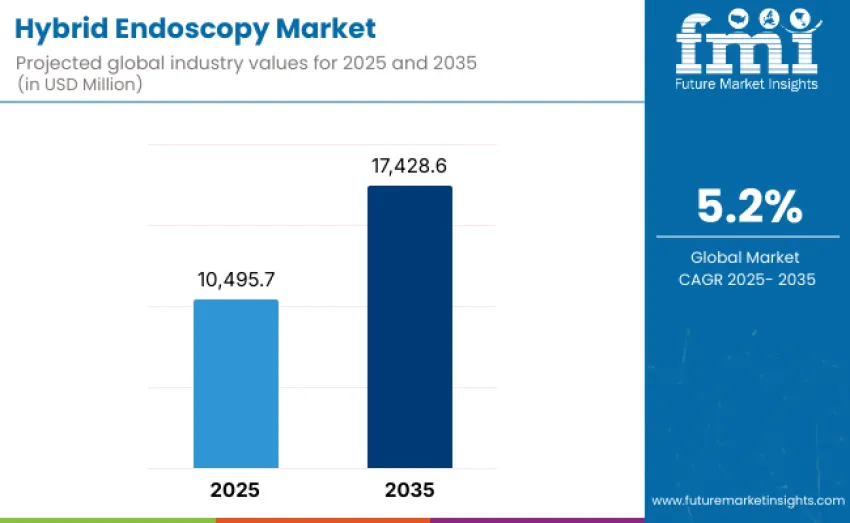
Government healthcare modernization programs, rising investments in surgical infrastructure, and growing focus on patient safety and clinical outcomes are key accelerators for growth. Medical institutions worldwide are upgrading to hybrid operating rooms that integrate multimodal imaging systems, allowing clinicians to perform both diagnostic and interventional procedures in a single setting. Corporate partnerships between medical device manufacturers, hospital networks, and digital imaging software companies foster innovation in hybrid endoscopy solutions through enhanced interoperability, standardization, and real-time data management capabilities.
Hybrid Endoscopy Market Year-over-Year Forecast (2025 to 2035)
Between 2025 and 2030, the hybrid endoscopy market is projected to expand from USD 10,495.7 million to USD 13,525 million, resulting in a value increase of USD 3,029.3 million, which represents 43.7% of total forecast growth for the decade. This phase will be driven by increasing adoption of minimally invasive surgical procedures, integration of advanced imaging technologies, and growing hospital investments in hybrid operating rooms. Key growth enablers include enhanced workflow efficiency, improved intraoperative visualization, and technological convergence between endoscopic, fluoroscopic, and robotic-assisted systems.
From 2030 to 2035, growth is forecast from USD 13,525 million to USD 17,428.6 million, adding USD 3,903.6 million, which constitutes 56.3% of overall ten-year expansion. Growth during this phase will be shaped by wider deployment of hybrid endoscopy systems in emerging healthcare regions, standardization of digital connectivity protocols, and integration of advanced diagnostic support and real-time data analytics.
Hybrid Endoscopy Market Key Takeaways
| Metric | Value |
|---|---|
| Market Value (2025) | USD 10,495.7 million |
| Market Forecast Value (2035) | USD 17,428.6 million |
| Forecast CAGR (2025 to 2035) | 5.2% |
Why Is the Hybrid Endoscopy Market Growing Worldwide?
The hybrid endoscopy market is growing worldwide due to increasing demand for advanced visualization and precision tools in minimally invasive and image-guided surgical procedures. Hybrid endoscopy enables surgeons to achieve superior diagnostic accuracy and intraoperative control by combining endoscopic imaging with complementary modalities such as fluoroscopy, ultrasound, and navigation systems. This integration allows for better surgical outcomes, reduced procedural times, and lower complication rates compared to conventional techniques. Hospitals and surgical centers are rapidly adopting hybrid endoscopy systems to support the shift toward precision medicine.
Technological innovations in advanced imaging, 3D visualization, and robotic-assisted endoscopy are improving workflow efficiency and expanding clinical applications of hybrid systems. High equipment costs, installation complexity, and the need for specialized operator training may limit adoption among smaller healthcare facilities, particularly in low- and middle-income regions. Despite these challenges, demonstrated clinical benefits continue driving worldwide acceptance.
How Are the Hybrid Endoscopy Market Segmented by Product Type, Application, and Region?
The hybrid endoscopy market is segmented by product type, application, and region. By product type, division includes hybrid video endoscopy platforms, single-use or disposable hybrid scopes, imaging modes and modules, EUS/ERCP hybrid suites & equipment, and accessories & consumables. Based on application, categorization covers gastrointestinal endoscopy, pulmonology/bronchoscopy, urology, ear-nose-throat, and gynecology & other minimally invasive surgical procedures. Regionally, segmentation spans Asia Pacific, Europe, North America, Latin America, and Middle East & Africa.
By Product Type, Hybrid Video Endoscopy Platforms Account for Largest Share
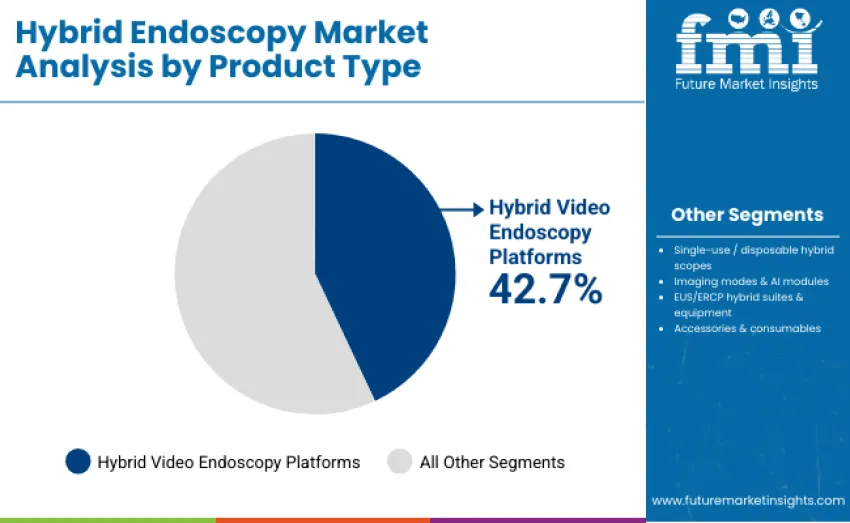
The hybrid video endoscopy platforms segment represents the dominant force, capturing 42.7% of total revenue share in 2025. This leading category includes advanced systems that integrate video processors and scopes to deliver high-definition and 4K imaging, digital signal processing, and real-time visualization for precision-guided procedures. Dominance stems from its critical role in supporting complex surgical interventions and providing superior diagnostic accuracy in hybrid operating rooms where multimodal imaging and interconnectivity are essential for clinical efficiency and patient safety.
The single-use or disposable hybrid scopes segment holds 12.9% share, driven by increasing focus on infection control, reduced cross-contamination risk, and operational efficiency in healthcare facilities. Imaging modes and modules account for 18.5%, supporting enhanced visualization capabilities. EUS/ERCP hybrid suites & equipment contribute 14.2%, while accessories & consumables represent 11.7% of revenue.
Key advantages driving the hybrid video endoscopy platforms segment include:
- High-definition and 4K visualization enabling superior tissue differentiation and precise intraoperative guidance
- Seamless integration with imaging, robotic, and data management systems supporting efficient hybrid OR workflows
- Advanced image processing capabilities providing enhanced color contrast and real-time clarity in complex surgical fields
By Application, GI Endoscopy Accounts for Largest Share
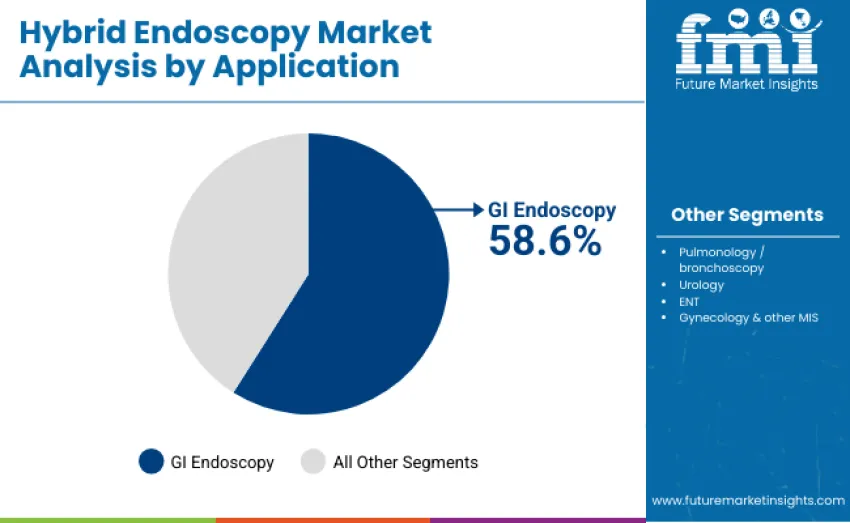
GI endoscopy applications dominate with 58.6% of total share in 2025, reflecting high procedural volume and increasing clinical adoption of advanced hybrid visualization systems in gastroenterology. Leadership is driven by growing prevalence of gastrointestinal disorders, rising cancer screening programs, and adoption of minimally invasive diagnostic and therapeutic procedures such as polypectomy, mucosal resection, and biliary interventions. Integration of imaging modalities such as endoscopic ultrasound, narrow-band imaging, and advanced lesion detection enhances diagnostic accuracy and procedural safety.
Pulmonology and bronchoscopy applications account for 14.7%, supported by growing demand for real-time visualization and navigation in interventional pulmonology and thoracic surgery. Urology contributes 12.8%, ENT represents 8.2%, and gynecology & other minimally invasive surgical procedures account for 5.7% of revenue.
Key market dynamics supporting application preferences include:
- Dominance of GI endoscopy driven by early disease detection programs and expanding adoption of AI and fluorescence imaging systems
- Rising utilization in pulmonology through integration of hybrid imaging for biopsy precision and minimally invasive lung interventions
- Growth in urology and gynecology applications supported by demand for compact, high-definition visualization tools in outpatient and day-surgery settings
What Are the Major Drivers, Restraints, and Emerging Trends Influencing the Hybrid Endoscopy Market?
The hybrid endoscopy market is driven by three core demand factors linked to advancements in minimally invasive procedures, hospital infrastructure modernization, and imaging technology integration. Global rise in minimally invasive and image-guided surgeries creates strong need for advanced visualization systems that improve diagnostic precision and procedural safety. Surgeons increasingly rely on hybrid endoscopy platforms that combine endoscopic, fluoroscopic, and ultrasound imaging to enhance clinical outcomes and reduce operative risks. Rapid expansion of hybrid operating rooms across tertiary care hospitals drives system adoption as healthcare providers seek integrated solutions.
How Do Clinical Demand and Disease Prevalence Influence Market Adoption?
Growing prevalence of chronic gastrointestinal, pulmonary, and urological conditions worldwide fuels consistent procedural demand, with endoscopic interventions becoming a preferred alternative to open surgeries due to reduced recovery times and hospital stays. Restraints include high system costs and infrastructure requirements, as hybrid endoscopy suites require significant capital investment. Smaller hospitals and ambulatory centers face budget constraints and limited space availability, hindering adoption. The need for specialized operator training presents barriers, as hybrid endoscopy systems involve complex interfaces.
What Emerging Trends Are Shaping the Hybrid Endoscopy Market?
Key emerging trends highlight increasing integration of advanced visualization, robotics, and data analytics into hybrid endoscopy workflows. Advanced visualization tools are being adopted for real-time lesion detection, tissue classification, and decision support, enhancing procedural precision and reducing diagnostic variability. Technological advancements such as 3D and 4K/8K imaging, fluorescence-guided surgery, and augmented reality overlays are redefining intraoperative visualization standards. Strategic collaborations between medical device manufacturers, imaging technology developers, and software providers shape next-generation systems.
How Are Leading Countries Driving Growth in the Hybrid Endoscopy Market?
| Country | CAGR (2025 to 2035)% |
|---|---|
| United States | 4.9 |
| Brazil | 6.5 |
| China | 5.9 |
| India | 8.2 |
| Europe | 4.7 |
| Germany | 4.8 |
| United Kingdom | 4.6 |
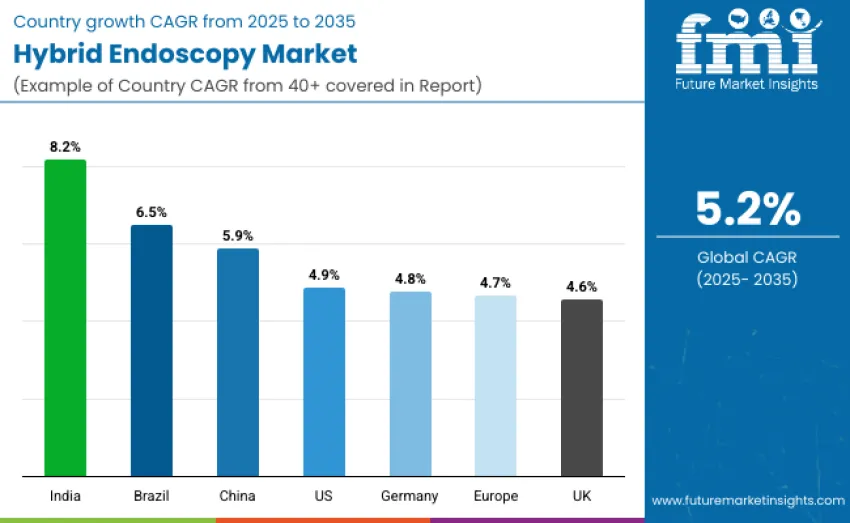
The hybrid endoscopy market is expanding globally, with India leading at an 8.2% CAGR due to rapid healthcare infrastructure growth, government-backed minimally invasive surgery programs, and strong hospital investment in hybrid ORs. China follows at 5.9%, supported by large-scale equipment upgrades and domestic imaging technology production. Brazil grows at 6.5% through healthcare modernization and rising medical tourism. The United States records 4.9% growth, reflecting a mature market with strong reimbursement systems and continuous technology upgrades. Europe grows at 4.7%, with Germany at 4.8% and the UK at 4.6%, driven by digital transformation and integrated visualization adoption.
The report covers an in-depth analysis of 40+ countries top-performing countries are highlighted below.
How Is Healthcare Infrastructure Modernization Accelerating Growth in China?
China demonstrates one of the strongest growth trajectories with a projected CAGR of 5.9% through 2035. Leadership stems from large-scale healthcare infrastructure modernization, expansion of tertiary hospitals, and government-driven initiatives to upgrade surgical and diagnostic capabilities. Growth is concentrated in major metropolitan regions such as Beijing, Shanghai, Guangzhou, and Chengdu, where advanced hospitals and medical universities are adopting hybrid endoscopy platforms to improve clinical precision, workflow integration, and patient outcomes.
National healthcare reform policies emphasizing minimally invasive surgery, digital healthcare innovation, and medical device localization accelerate widespread adoption across both public and private sectors. National investment under the "Healthy China 2030" initiative promotes hospital modernization, surgical innovation, and deployment of advanced endoscopic and imaging systems across major urban centers. Expansion of high-end tertiary hospitals and hybrid operating rooms equipped with multi-modality imaging integration supports complex interventions in gastroenterology, pulmonology, and oncology.
Why Are Surgical Skill Development and Healthcare Training Programs Enhancing Adoption in India?
India's hybrid endoscopy market expands rapidly, supported by strong healthcare capacity building, medical education reforms, and government focus on advancing minimally invasive surgical expertise. Growth is projected at a robust CAGR of 8.2% through 2035, driven by integration of hybrid endoscopy systems in tertiary hospitals, medical colleges, and specialty centers. Nationwide health infrastructure initiatives, coupled with training programs under the National Health Mission and Skill India's Healthcare Sector Skill Council, strengthen clinician capabilities in endoscopic and image-guided procedures.
These programs enhance the proficiency of surgeons, gastroenterologists, and pulmonologists in using advanced imaging and navigation technologies, fostering widespread adoption across both public and private healthcare facilities. Rapid adoption across leading healthcare hubs such as Delhi, Mumbai, Bangalore, and Chennai includes tertiary care hospitals and medical universities upgrading surgical suites with hybrid imaging systems. Government-led training and certification programs provide structured education in endoscopic surgery and device handling.
How Does Medical Technology Excellence Sustain Leadership in Germany?
Germany's hybrid endoscopy market reflects long-standing leadership in medical technology innovation, precision engineering, and hospital infrastructure modernization. With a projected CAGR of 4.8% through 2035, Germany demonstrates steady growth supported by integration of hybrid operating room systems, advanced imaging technologies, and strong clinician adoption of minimally invasive surgical techniques. Healthcare ecosystem anchored by major medical technology hubs emphasizes clinical precision, equipment reliability, and adherence to stringent regulatory and quality standards.
German hospitals and surgical centers are early adopters of hybrid endoscopy solutions, combining intraoperative imaging, fluoroscopy, and endoscopic visualization within single integrated surgical environments. Leading university hospitals and specialized surgical centers implement hybrid operating suites that combine 3D imaging, navigation, and endoscopic visualization systems to enhance intraoperative accuracy. National focus on medical device innovation through government-supported research funding programs and public-private research collaborations with academic institutions strengthens technological excellence.
Why Is Expanding Surgical Infrastructure Fueling Demand in Brazil?
Brazil's hybrid endoscopy market demonstrates strong potential as the country rapidly expands healthcare infrastructure and invests in advanced minimally invasive surgical technologies. With a projected CAGR of 6.5% through 2035, Brazil leads Latin America in hybrid endoscopy adoption, supported by hospital modernization programs, growth in private healthcare investment, and increasing demand for integrated imaging and surgical visualization systems. Key metropolitan centers serve as primary hubs for medical technology deployment, where tertiary hospitals and specialized surgical clinics adopt hybrid operating room solutions.
Expansion of tertiary care hospitals and surgical centers invest in hybrid operating suites integrating fluoroscopy, 3D imaging, and endoscopic visualization technologies. Government and private sector healthcare modernization initiatives support acquisition of advanced minimally invasive surgical platforms through public-private partnerships and financing programs. Growing network of medical training institutions and professional societies provide surgeon education and certification in hybrid surgical techniques. Strategic collaborations between multinational manufacturers and local distributors ensure equipment availability and localized service support.
How Do Advanced Healthcare Networks Strengthen Performance in the United States?
The United States hybrid endoscopy market demonstrates mature adoption driven by advanced healthcare infrastructure, established hospital networks, and high procedural demand across leading medical institutions. Growth maintains steady momentum with a CAGR of 4.9% through 2035, supported by continuous technological innovation, strong manufacturer presence, and clinical focus on precision-guided minimally invasive procedures. Major medical centers across states including California, Texas, New York, and Massachusetts are standardizing hybrid endoscopy platforms to improve surgical accuracy and patient outcomes.
The USA serves as a global innovation hub, where close collaboration between manufacturers, healthcare providers, and regulatory agencies accelerates clinical validation and technology refinement. Established hospital systems implement hybrid operating rooms with integrated endoscopy, fluoroscopy, and 3D imaging technologies to support multi-specialty surgical applications. Continuous investment in research by domestic manufacturers and academic medical institutions drives innovation in image-guided surgery, advanced visualization, and real-time data analytics.
How Is Healthcare Infrastructure Modernization Supporting Growth in the United Kingdom?
In major healthcare hubs such as London, Manchester, Birmingham, and Edinburgh, hospitals and medical universities are rapidly adopting hybrid endoscopy systems to enhance diagnostic precision and procedural efficiency across gastrointestinal, urology, and pulmonology applications. The United Kingdom hybrid endoscopy market exhibits steady growth momentum with a CAGR of 4.6% through 2035, supported by ongoing National Health Service modernization programs, public-private partnerships, and strong clinical focus on minimally invasive surgical innovation.
Integration of advanced visualization systems and digital imaging platforms across leading NHS trusts and private hospital groups demonstrates commitment to technology-driven healthcare improvement and patient safety enhancement. NHS infrastructure modernization initiatives prioritize hybrid operating room deployment and advanced imaging suite integration for multi-specialty surgical procedures. Increasing collaboration between British research institutions, clinical societies, and medical device manufacturers accelerate clinical validation and training in hybrid endoscopic techniques.
How Are Healthcare Infrastructure Investments Advancing Expansion Across Europe?
The hybrid endoscopy market in Europe is projected to grow from USD 2,466.5 million in 2025 to USD 3,904 million by 2035, registering a CAGR of 4.7% over the forecast period. Germany is expected to maintain leadership with a 28.5% share in 2025, declining slightly to 27.8% by 2035, supported by advanced healthcare infrastructure and major medical centers including Berlin, Munich, and Hamburg. France follows with a 22.3% share in 2025, projected to reach 22.6% by 2035, driven by strong hospital networks and research institutions.
The United Kingdom holds a 19.5% share in 2025, expected to reach 19.8% by 2035 through expansion of clinical screening programs and digital health initiatives. Italy commands a 13.2% share in both 2025 and 2035, backed by specialized oncology centers in Milan, Rome, and Florence. Spain accounts for 9.5% in 2025, rising to 9.7% by 2035 on adoption of advanced imaging and preventive healthcare programs. The Netherlands maintains 6.8% share throughout the forecast period.
How Competitive Is the Global Hybrid Endoscopy Market and What Defines Its Structure?
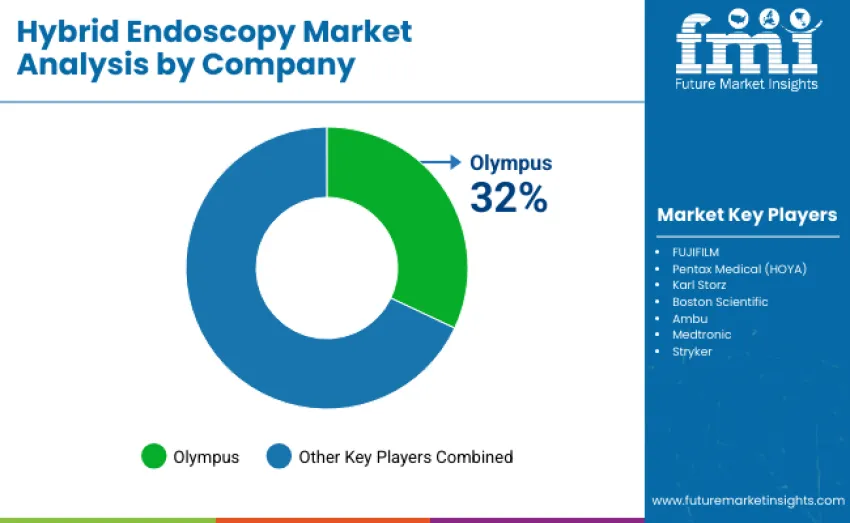
The hybrid endoscopy market is moderately concentrated, with 12-15 players competing globally. The top three, Olympus, FUJIFILM, and Pentax Medical (HOYA), collectively hold around 55-60% of total share, driven by strong brand equity, advanced imaging technologies, and comprehensive endoscopy portfolios. Olympus leads with a 32% share, supported by its extensive professional product line, decades of industry leadership, and robust clinical support networks. Competition is defined by imaging performance, procedural versatility, ergonomic design, and workflow integration rather than price alone.
Olympus, FUJIFILM, and Pentax Medical maintain competitive advantages through deep patent portfolios in imaging optics and endoscopic instrument engineering, along with long-standing clinical user communities that drive feedback-based innovation and trusted product adoption. Their R&D investments focus on high-definition visualization, narrow-band imaging, advanced diagnostic enhancements, and durable scope construction to support mission-critical hospital workflows across gastroenterology, minimally invasive surgery, and diagnostic suites.
Challengers such as Karl Storz, Stryker, Boston Scientific, Medtronic, and Ambu expand competition by offering differentiated, procedure-specific systems and leveraging strong regional presence in Europe, North America, and Asia-Pacific. Meanwhile, emerging manufacturers increase pressure with aggressive pricing and faster development cycles, appealing to hospitals and outpatient centers seeking cost-efficient alternatives without compromising performance.
Key Players in the Hybrid Endoscopy Market
- Olympus
- FUJIFILM
- Pentax Medical (HOYA)
- Karl Storz
- Boston Scientific
- Ambu
- Medtronic
- Stryker
Scope of the Report
| Items | Values |
|---|---|
| Quantitative Units | USD 10,495.7 million |
| Product Type | Hybrid Video Endoscopy Platforms, Single-Use or Disposable Hybrid Scopes, Imaging Modes and Modules, EUS/ERCP Hybrid Suites & Equipment and Accessories & Consumables |
| Application | Gastrointestinal Endoscopy, Pulmonology/Bronchoscopy, Urology, Ear-Nose-Throat, Gynecology & Other Minimally Invasive Surgical Procedures |
| Regions Covered | Asia Pacific, Europe, North America, Latin America, Middle East & Africa |
| Country Covered | USA, Brazil, China, India, Europe, Germany, France, UK |
| Key Companies Profiled | Olympus, FUJIFILM, Pentax Medical (HOYA), Karl Storz, Boston Scientific, Ambu, Medtronic, Stryker, Others |
| Additional Attributes | Dollar sales by product type and application, regional trends across Asia Pacific, Europe, and North America, competitive landscape of hybrid endoscopy system manufacturers, technical specifications, integration with hospital IT and surgical workflows, innovations in imaging optics, AI-assisted diagnostics, scope design, and advanced ergonomic system configurations |
Hybrid Endoscopy Market by Segments
By Product Type:
- Hybrid video endoscopy platforms
- Single-use / disposable hybrid scopes
- Imaging modes & AI modules
- EUS/ERCP hybrid suites & equipment
- Accessories & consumables
By Application:
- GI endoscopy
- Pulmonology / bronchoscopy
- Urology
- ENT
- Gynecology & other MIS
By Region:
- Asia Pacific
- China
- India
- Japan
- South Korea
- Vietnam
- Australia & New Zealand
- ASEAN
- Rest of Asia Pacific
- Europe
- Germany
- United Kingdom
- France
- Italy
- Spain
- Netherlands
- Nordic
- BENELUX
- Rest of Europe
- North America
- United States
- Canada
- Mexico
- Latin America
- Brazil
- Argentina
- Rest of Latin America
- Middle East & Africa
- Kingdom of Saudi Arabia
- Other GCC Countries
- Turkey
- South Africa
- Other African Union
- Rest of Middle East & Africa
Frequently Asked Questions
How big is the hybrid endoscopy market in 2025?
The global hybrid endoscopy market is valued at USD 10,495.7 million in 2025.
What will be the size of the hybrid endoscopy market in 2035?
The market is projected to reach USD 17,428.6 million by 2035.
How fast will the hybrid endoscopy market grow between 2025 and 2035?
The market will grow at a CAGR of 5.2% from 2025 to 2035.
Which product type leads the hybrid endoscopy market in 2025?
Hybrid video endoscopy platforms lead the market with a 42.7% share in 2025.
Who are the major players in the hybrid endoscopy market?
Key players include Olympus, FUJIFILM, Pentax Medical, Karl Storz, Boston Scientific, Ambu, Medtronic, and Stryker.
Preview the report firsthand - request a free sample
Get SampleGet the brochure for pricing and purchase details.
Get PDFTable of Content
- Executive Summary
- Regional Level Market Outlook
- Demand-side Trends
- Supply-side Trends
- Technology Roadmap Analysis
- Analysis and Recommendations
- Market Overview
- Market Coverage / Taxonomy
- Market Definition / Scope / Limitations
- Market Background
- Market Dynamics
- Drivers
- Restraints
- Opportunity
- Trends
- Scenario Forecast
- Demand in Optimistic Scenario
- Demand in Likely Scenario
- Demand in Conservative Scenario
- Opportunity Assessment
- Market Trade Assessment
- Value Chain Analysis
- Participants and their Roles
- Raw Material Suppliers
- Manufacturers
- Mid-Level Participants
- Wholesalers and Distributors
- Profit Margin Analysis
- Operating Margins By Region
- Notes on Value Added at Each Node in the Value Chain
- Participants and their Roles
- Strategic Divestments/ Investments
- Products Market Assessment
- PESTLE and Porter’s Analysis
- Regulatory Landscape
- By Key Regions
- By Key Countries
- Regional Parent Market Outlook
- Product Launches & Development
- Technological Innovation
- Market Dynamics
- Regional Level Market Analysis 2020 to 2024 and Forecast, 2025 to 2035
- Historical Market Size USD Million Analysis, 2020 to 2024
- Current and Future Market Size USD Million Projections, 2025 to 2035
- Y-o-Y Growth Trend Analysis
- Absolute $ Opportunity Analysis
- Regional Level Market Analysis 2020 to 2024 and Forecast 2025 to 2035, By Product Type
- Introduction / Key Findings
- Historical Market Size USD Million Analysis By Product Type, 2020 to 2024
- Current and Future Market Size USD Million Analysis and Forecast By Product Type, 2025 to 2035
- Hybrid video endoscopy platforms (processors + scopes)
- Single-use / disposable hybrid scopes
- Imaging modes & AI modules (NBI/BLI/i-scan/SPIES/AI)
- EUS/ERCP hybrid suites & equipment
- Accessories & consumables
- Y-o-Y Growth Trend Analysis By Product Type, 2020 to 2024
- Absolute $ Opportunity Analysis By Product Type, 2025 to 2035
- Regional Level Market Analysis 2020 to 2024 and Forecast 2025 to 2035, By Application
- Introduction / Key Findings
- Historical Market Size USD Million Analysis By Application, 2020 to 2024
- Current and Future Market Size USD Million Analysis and Forecast By Application, 2025 to 2035
- GI endoscopy
- Pulmonology / bronchoscopy
- Urology
- ENT
- Gynecology & other MIS
- Y-o-Y Growth Trend Analysis By Application, 2020 to 2024
- Absolute $ Opportunity Analysis By Application, 2025 to 2035
- Regional Level Market Analysis 2020 to 2024 and Forecast 2025 to 2035, By End User
- Introduction / Key Findings
- Historical Market Size USD Million Analysis By End User, 2020 to 2024
- Current and Future Market Size USD Million Analysis and Forecast By End User, 2025 to 2035
- Hospitals (tertiary & teaching)
- Ambulatory surgery centers (ASCs)
- Specialty clinics
- Others (office-based, mobile)
- Y-o-Y Growth Trend Analysis By End User, 2020 to 2024
- Absolute $ Opportunity Analysis By End User, 2025 to 2035
- Regional Level Market Analysis 2020 to 2024 and Forecast 2025 to 2035, By Region
- Introduction
- Historical Market Size USD Million Analysis By Region, 2020 to 2024
- Current Market Size USD Million Analysis and Forecast By Region, 2025 to 2035
- North America
- Latin America
- East Asia
- South Asia
- Western Europe
- Eastern Europe
- Middle East & Africa
- Market Attractiveness Analysis By Region
- North America Market Analysis 2020 to 2024 and Forecast 2025 to 2035, By Country
- Historical Market Size USD Million Trend Analysis By Market Taxonomy, 2020 to 2024
- Market Size USD Million Forecast By Market Taxonomy, 2025 to 2035
- By Country
- USA
- Canada
- Mexico
- By Product Type
- By Application
- By End User
- By Country
- Market Attractiveness Analysis
- By Country
- By Product Type
- By Application
- By End User
- Key Takeaways
- Latin America Market Analysis 2020 to 2024 and Forecast 2025 to 2035, By Country
- Historical Market Size USD Million Trend Analysis By Market Taxonomy, 2020 to 2024
- Market Size USD Million Forecast By Market Taxonomy, 2025 to 2035
- By Country
- Brazil
- Argentina
- Rest of Latin America
- By Product Type
- By Application
- By End User
- By Country
- Market Attractiveness Analysis
- By Country
- By Product Type
- By Application
- By End User
- Key Takeaways
- East Asia Market Analysis 2020 to 2024 and Forecast 2025 to 2035, By Country
- Historical Market Size USD Million Trend Analysis By Market Taxonomy, 2020 to 2024
- Market Size USD Million Forecast By Market Taxonomy, 2025 to 2035
- By Country
- China
- Japan
- South Korea
- By Product Type
- By Application
- By End User
- By Country
- Market Attractiveness Analysis
- By Country
- By Product Type
- By Application
- By End User
- Key Takeaways
- South Asia Market Analysis 2020 to 2024 and Forecast 2025 to 2035, By Country
- Historical Market Size USD Million Trend Analysis By Market Taxonomy, 2020 to 2024
- Market Size USD Million Forecast By Market Taxonomy, 2025 to 2035
- By Country
- India
- ASEAN Countries
- Australia & New Zealand
- Rest of South Asia
- By Product Type
- By Application
- By End User
- By Country
- Market Attractiveness Analysis
- By Country
- By Product Type
- By Application
- By End User
- Key Takeaways
- Western Europe Market Analysis 2020 to 2024 and Forecast 2025 to 2035, By Country
- Historical Market Size USD Million Trend Analysis By Market Taxonomy, 2020 to 2024
- Market Size USD Million Forecast By Market Taxonomy, 2025 to 2035
- By Country
- Germany
- UK
- France
- Italy
- Spain
- BENELUX
- Nordic Countries
- Rest of Western Europe
- By Product Type
- By Application
- By End User
- By Country
- Market Attractiveness Analysis
- By Country
- By Product Type
- By Application
- By End User
- Key Takeaways
- Eastern Europe Market Analysis 2020 to 2024 and Forecast 2025 to 2035, By Country
- Historical Market Size USD Million Trend Analysis By Market Taxonomy, 2020 to 2024
- Market Size USD Million Forecast By Market Taxonomy, 2025 to 2035
- By Country
- Russia
- Hungary
- Poland
- Rest of Eastern Europe
- By Product Type
- By Application
- By End User
- By Country
- Market Attractiveness Analysis
- By Country
- By Product Type
- By Application
- By End User
- Key Takeaways
- Middle East & Africa Market Analysis 2020 to 2024 and Forecast 2025 to 2035, By Country
- Historical Market Size USD Million Trend Analysis By Market Taxonomy, 2020 to 2024
- Market Size USD Million Forecast By Market Taxonomy, 2025 to 2035
- By Country
- Saudi Arabia
- Other GCC Countries
- Türkiye
- South Africa
- Rest of MEA
- By Product Type
- By Application
- By End User
- By Country
- Market Attractiveness Analysis
- By Country
- By Product Type
- By Application
- By End User
- Key Takeaways
- Market Structure Analysis
- Competition Dashboard
- Competition Benchmarking
- Market Share Analysis of Top Players
- By Regional
- By Product Type
- By Application
- By End User
- Competition Analysis
- Competition Deep Dive
- Olympus
- Overview
- Product Portfolio
- Key Financials
- Key Developments
- Global/Regional Footprint
- Strategy Overview
- Marketing Strategy
- SWOT
- Analyst Comment
- FUJIFILM
- Overview
- Product Portfolio
- Key Financials
- Key Developments
- Global/Regional Footprint
- Strategy Overview
- Marketing Strategy
- SWOT
- Analyst Comment
- Pentax Medical (HOYA)
- Overview
- Product Portfolio
- Key Financials
- Key Developments
- Global/Regional Footprint
- Strategy Overview
- Marketing Strategy
- SWOT
- Analyst Comment
- Karl Storz
- Overview
- Product Portfolio
- Key Financials
- Key Developments
- Global/Regional Footprint
- Strategy Overview
- Marketing Strategy
- SWOT
- Analyst Comment
- Boston Scientific
- Overview
- Product Portfolio
- Key Financials
- Key Developments
- Global/Regional Footprint
- Strategy Overview
- Marketing Strategy
- SWOT
- Analyst Comment
- Ambu
- Overview
- Product Portfolio
- Key Financials
- Key Developments
- Global/Regional Footprint
- Strategy Overview
- Marketing Strategy
- SWOT
- Analyst Comment
- Medtronic
- Overview
- Product Portfolio
- Key Financials
- Key Developments
- Global/Regional Footprint
- Strategy Overview
- Marketing Strategy
- SWOT
- Analyst Comment
- Stryker
- Overview
- Product Portfolio
- Key Financials
- Key Developments
- Global/Regional Footprint
- Strategy Overview
- Marketing Strategy
- SWOT
- Analyst Comment
- Olympus
- Competition Deep Dive
- Assumptions & Acronyms Used
- Research Methodology


