

- Industry Size (2026)
- USD 1918.5 Mn
- Forecast (2036)
- USD 2759.0 Mn
- CAGR (2026 to 2036)
- 3.7%
Driveline Torsional Vibration Dampers and Couplings Market Forecast and Outlook 2026 to 2036
The driveline torsional vibration dampers and couplings market is valued at USD 1,918.5 million in 2026 and is expected to reach USD 2,759.0 million by 2036 at a CAGR of 3.7%. Value formation reflects mechanical stress management within rotating power transmission systems rather than expansion in vehicle volumes. Dampers and couplings are specified to control torsional oscillations arising from combustion irregularity, load reversals, and driveline compliance. Component demand is tied to torque density, firing frequency, and shaft length characteristics defined at platform level. OEM integration remains anchored to validated tuning envelopes and durability margins because improper damping accelerates fatigue in gears, bearings, and shafts.
Aftermarket demand follows mileage accumulation, vibration thresholds detected during service, and replacement triggered by elastomer degradation or loss of stiffness rather than discretionary upgrades. Electrified and hybrid drivetrains alter excitation patterns but retain the need for torsional control at interfaces between motors, gearsets, and shafts. Design change remains constrained by packaging limits, heat exposure, and material aging behavior under cyclic strain. Manufacturing economics depend on elastomer formulation stability, bonding quality, and machining precision. Procurement favors proven damper families with predictable decay profiles, since validation cost and failure risk restrict aggressive redesign. Demand progression remains maintenance led.
Quick Stats for Driveline Torsional Vibration Dampers and Couplings Market
- Driveline Torsional Vibration Dampers and Couplings Market Value (2026): USD 1,918.5 million
- Driveline Torsional Vibration Dampers and Couplings Market Forecast Value (2036): USD 2,759.0 million
- Driveline Torsional Vibration Dampers and Couplings Market Forecast CAGR 2026 to 2036: 3.7%
- Leading Product Type by Demand Share: Torsional Dampers
- Fastest-Growing Countries: China, Brazil, USA, Germany, South Korea
- Top Players in Global Demand: Schaeffler, ZF, Dana, BorgWarner, American Axle & Manufacturing, GKN Automotive, Vibracoustic, Tenneco, MAHLE, Nexteer
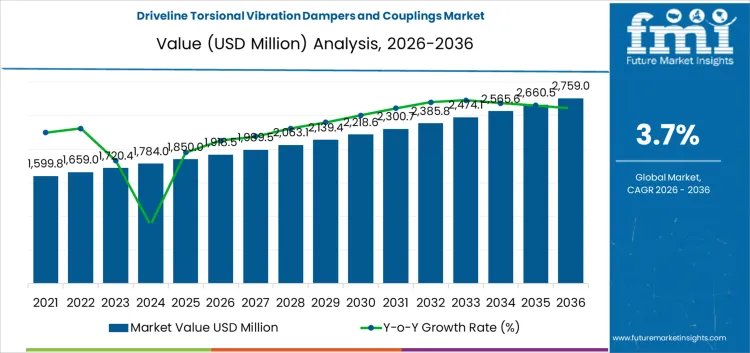
Driveline Torsional Vibration Dampers and Couplings Market Key Takeaways
| Metric | Value |
|---|---|
| Market Value (2026) | USD 1,918.5 million |
| Market Forecast Value (2036) | USD 2,759.0 million |
| Forecast CAGR 2026 to 2036 | 3.7% |
Why is the Demand for Driveline Torsional Vibration Dampers and Couplings Growing?
Demand for driveline torsional vibration dampers and couplings is rising as vehicle and equipment designers require components that improve driveline smoothness and reduce fatigue in power transmission systems. Commercial vehicle manufacturers specify dampers and couplings that meet criteria for dynamic balance, torque capacity, and resistance to cyclic stress because reducing vibration extends component life and supports driver comfort. Fleet engineers evaluate product material quality, precision machining, and integration compatibility with transmissions and axles when selecting parts for new platforms and retrofit programs. Maintenance teams emphasize solutions that minimize noise, vibration, and harshness in heavy duty and off highway applications to support operational reliability and predictable service intervals.
Regulatory frameworks for vehicle safety and performance influence selection of certified components with documented performance records across supplier portfolios. Growth in electrified propulsion and high torque powertrains reinforces adoption of advanced vibration control solutions that align with evolving drivetrain architectures. System integrators coordinate selection with simulation and testing protocols to verify performance under variable load cycles. Workshops and service networks prioritize availability of replacement dampers and couplings that match engineering specifications to reduce downtime in repair facilities. These technical and operational factors support sustained uptake of torsional vibration dampers and couplings across transport and industrial machinery fleets.
How Are the Segments Classified in the Driveline Torsional Vibration Dampers and Couplings Market?
Demand for driveline torsional vibration dampers and couplings is shaped by noise reduction requirements, drivetrain durability expectations, and refinement targets across vehicle platforms. Powertrain torque irregularities and rotational oscillations necessitate damping solutions to protect components and improve ride quality. Adoption aligns with tighter NVH standards and increasing drivetrain complexity. Component selection emphasizes fatigue resistance, tuning accuracy, and compatibility with transmission systems. Segment classification reflects differentiation by damping solution type, vehicle application, and propulsion architecture. Structure highlights how vibration control function, vehicle duty profile, and power delivery characteristics influence specification intensity, integration depth, and deployment scale across automotive driveline systems.
Which Product Type Represents the Largest Share of Demand?
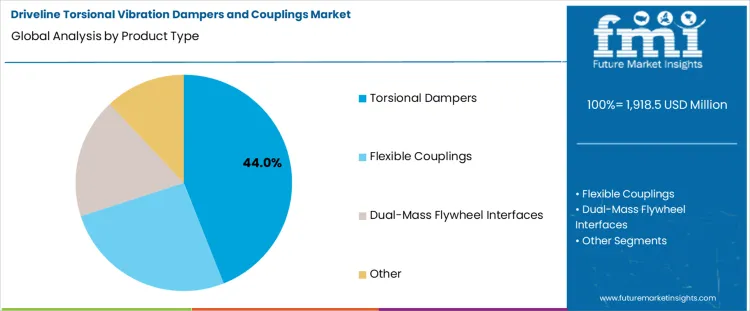
Torsional dampers hold 44.0%, representing the largest share among product types due to direct mitigation of rotational vibration. These components absorb and dissipate torsional energy generated by engine firing pulses and drivetrain load changes. Integration protects transmissions, shafts, and bearings from fatigue damage. Design tuning aligns damping characteristics with specific torque profiles. Flexible couplings accommodate misalignment while contributing limited vibration isolation. Dual-mass fly wheel interfaces provide integrated damping for specific powertrain layouts. Product type segmentation reflects preference for dedicated damping solutions delivering consistent vibration attenuation across varied operating conditions.
Key Points
- Torsional dampers directly control rotational vibration.
- Component protection improves drivetrain durability.
- Other products address alignment or integrated damping needs.
Which Vehicle Segment Accounts for the Highest Share of Demand?
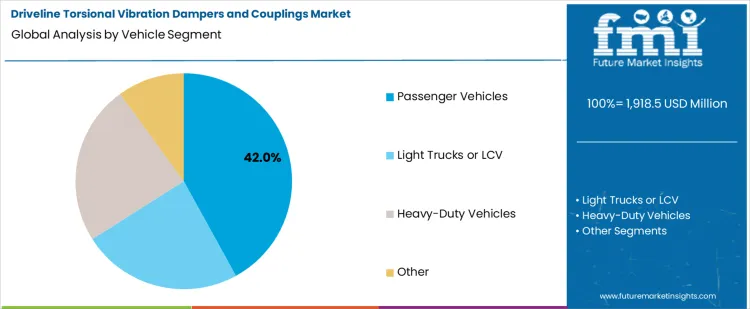
Passenger vehicles hold 42.0%, representing the largest share among vehicle segments requiring driveline vibration control. High production volumes and comfort expectations increase focus on smooth power delivery. Refinement targets drive integration of damping components across mainstream platforms. Driveline layouts prioritize noise suppression under varied driving conditions. Light trucks and heavy-duty vehicles apply dampers under higher torque loads with different tuning priorities. Other vehicles contribute limited volume. Vehicle segmentation reflects concentration of vibration control solutions within passenger platforms emphasizing ride comfort and acoustic performance.
Key Points
- Passenger vehicles emphasize refinement and NVH control.
- High volumes support standardized damper integration.
- Other segments address vibration under heavier load profiles.
Which Powertrain Category Drives the Largest Share of Demand?
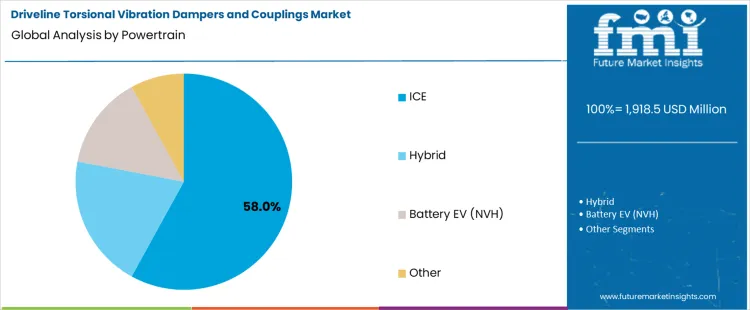
ICE powertrains hold 58.0%, representing the largest share among powertrain categories due to inherent combustion-induced torque fluctuations. Engine firing irregularities generate torsional oscillations requiring damping solutions. Established driveline architectures rely on tuned dampers to maintain component longevity. Hybrid systems combine engine and motor torque, increasing control complexity. Battery electric vehicles apply damping primarily for NVH control rather than combustion effects. Other powertrains contribute limited usage. Powertrain segmentation reflects dominance of combustion-driven systems where torsional vibration management remains a fundamental design requirement.
Key Points
- ICE powertrains generate inherent torsional vibration.
- Dampers protect components from oscillation fatigue.
- Electrified systems apply damping for NVH refinement.
What are the Key Dynamics in the Driveline Torsional Vibration Dampers and Couplings Market?
Demand for driveline torsional vibration dampers and couplings reflects need to manage rotational irregularities and torque fluctuations within power transmission systems. Adoption spans commercial vehicles, industrial machinery, rail propulsion, and off-highway equipment. Global scope aligns with increasing drivetrain power density and durability requirements. Usage integrates with engines, gearboxes, and shafts to protect components, reduce noise, and stabilize mechanical performance under variable load conditions.
How do drivetrain stress management and durability requirements shape adoption?
Modern powertrains operate under higher torque loads and frequent speed variation, increasing exposure to torsional vibration. Demand increases as dampers and couplings absorb shock loads generated during acceleration, gear shifts, and uneven load transfer. Commercial vehicle drivelines rely on these components to reduce fatigue stress on shafts, gears, and bearings. Adoption strengthens where engine downsizing and turbocharging amplify torque pulses. Noise, vibration, and harshness control requirements drive integration to improve operator comfort and mechanical smoothness. Heavy-duty and off-highway equipment adopts robust coupling designs to handle cyclic loading and misalignment. Compatibility with high-speed operation and extended service intervals supports widespread incorporation across drivetrain architectures.
How do material cost, customization, and operating limits influence market scalability?
Component performance depends on elastomer, composite, or metallic material behavior under heat and cyclic stress. Demand sensitivity rises where material cost volatility affects pricing stability. Customization requirements for torque rating, stiffness, and dimensional fit limit standardization across platforms. Degradation under extreme temperatures or chemical exposure affects service life predictability. Installation accuracy influences effectiveness, increasing dependence on skilled assembly. Validation and endurance testing extend development cycles. Replacement intervals vary by duty cycle, influencing fleet maintenance planning. Supply chain dependence on specialized materials and precision machining constrains rapid scaling across diverse drivetrain applications.
How Is Demand for Driveline Torsional Vibration Dampers and Couplings Evolving Globally?
Demand for driveline torsional vibration dampers and couplings is expanding globally due to durability requirements, noise control expectations, and lifecycle-driven replacement across commercial vehicle fleets. Adoption aligns with need to manage torque fluctuations, protect drivetrain components, and improve operating smoothness under variable load conditions. Increasing vehicle utilization intensity reinforces importance of vibration mitigation solutions. OEM integration remains stable, while aftermarket demand grows where mileage accumulation is high. Growth rates in China at 4.7%, Brazil at 4.6%, USA at 3.5%, Germany at 3.4%, and South Korea at 3.3% indicate steady expansion driven by operating stress management and preventive maintenance practices.
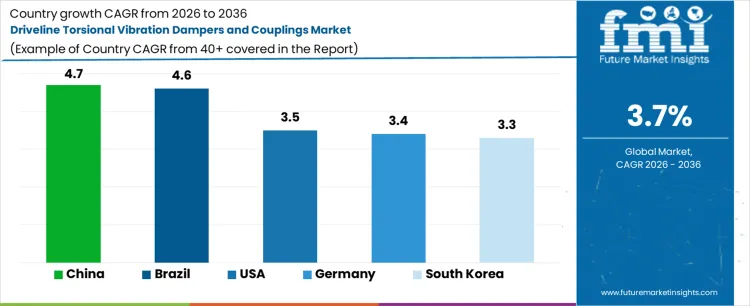
| Country | CAGR (%) |
|---|---|
| China | 4.7% |
| Brazil | 4.6% |
| USA | 3.5% |
| Germany | 3.4% |
| South Korea | 3.3% |
What Is Supporting Growth of Driveline Vibration Control Demand in China?
Driveline torsional vibration damper and coupling demand in China is growing at a CAGR of 4.7%, shaped by intensive commercial vehicle operation across logistics and construction. High torque variation during stop-start driving increases stress on driveline components. Fleet operators deploy dampers to reduce fatigue and extend service life of shafts and gearboxes. Domestic truck manufacturing sustains OEM-level integration. Regulatory inspections emphasize driveline integrity and NVH control. Demand growth remains maintenance-led, reflecting high utilization rather than rapid drivetrain redesign.
- High torque fluctuation in urban logistics operations
- Preventive vibration control to protect driveline components
- Stable OEM integration from domestic truck production
- Regulatory focus on driveline durability
Why Is Brazil Experiencing Steady Expansion in Driveline Damper Demand?
Operating conditions underpin driveline torsional vibration damper and coupling demand growth in Brazil at a CAGR of 4.6%. Long-haul freight movement increases cyclic torque loading across driveline assemblies. Road surface variability contributes to vibration and misalignment stress. Agricultural and mining logistics sustain heavy-duty vehicle utilization. Fleet aging drives aftermarket replacement as operators extend service life. Demand growth reflects operating stress mitigation and maintenance needs rather than expansion of vehicle production volumes.
- Long-distance freight increasing cyclic torque exposure
- Road condition-induced vibration stress
- Agricultural and mining transport activity
- Aging fleets driving aftermarket replacement
How Is the USA Sustaining Demand for Driveline Vibration Dampers?
Driveline torsional vibration damper and coupling demand in the USA is expanding at a CAGR of 3.5%, supported by high mileage accumulation in commercial fleets. Heavy-duty trucks operate under sustained torque loads, accelerating wear on driveline components. Fleet operators emphasize vibration control to reduce downtime and protect transmissions. Aftermarket replacement dominates demand due to long vehicle service life. Growth remains measured, aligned with preventive maintenance cycles rather than increases in fleet size.
- High mileage operation in heavy-duty trucks
- Focus on vibration reduction to protect transmissions
- Strong aftermarket replacement orientation
- Preventive maintenance-driven replacement cycles
What Factors Are Shaping Driveline Vibration Control Demand in Germany?
Engineering discipline shapes driveline torsional vibration damper and coupling demand in Germany, growing at a CAGR of 3.4%. Strict NVH standards influence component specification and integration. Regulated axle loads and torque limits reduce extreme stress events. Preventive maintenance practices create predictable replacement intervals. Export-driven logistics sustain consistent vehicle utilization. Demand growth reflects structured servicing within mature fleets rather than adoption driven by drivetrain complexity changes.
- Strict NVH and engineering standards
- Regulated torque and axle load conditions
- Predictable replacement under preventive maintenance
- Stable export-driven logistics utilization
Why Is South Korea Showing Controlled Growth in Driveline Damper Demand?
Driveline torsional vibration damper and coupling demand in South Korea is growing at a CAGR of 3.3%, influenced by efficient logistics operations and compact geography. Shorter transport distances limit cumulative torsional stress. High maintenance discipline reduces unscheduled failures. Manufacturing and port logistics sustain steady commercial vehicle usage. Fleet operators favor standardized components with extended service intervals. Growth remains controlled, reflecting efficiency-focused fleet management rather than expansion of heavy-duty vehicle populations.
- Shorter routes limiting cumulative torsional stress
- Strong maintenance discipline across fleets
- Manufacturing and port logistics activity
- Standardized components with long service intervals
What is the competitive landscape of demand for the driveline torsional vibration dampers and couplings market globally?
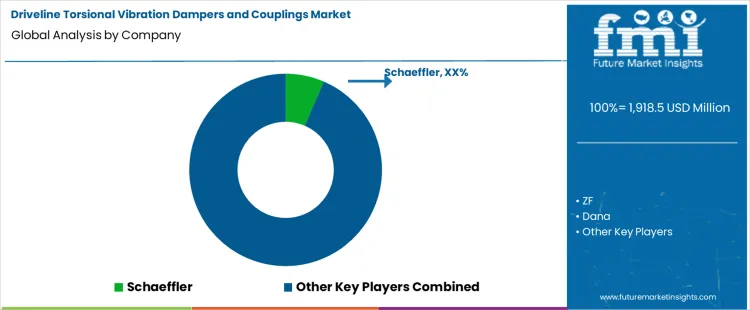
Demand for driveline torsional vibration dampers and couplings is driven by vehicle powertrain refinement needs, NVH (noise, vibration, and harshness) reduction targets, and growth of electrified and hybrid driveline architectures. These components help absorb and mitigate torsional oscillations between the engine/transmission and driveline, improving ride quality, component life, and driveline smoothness. Buyers evaluate damping effectiveness, fatigue resistance, material durability, compatibility with powertrain control systems, and packaging constraints within vehicle platforms. Procurement teams prioritize suppliers with validated engineering expertise, global manufacturing footprint, rigorous testing protocols, and strong OEM qualification records. Trend in the global market reflects increasing torque demands from electrified powertrains, tighter customer expectations for comfort, and integration of advanced materials for improved dynamic performance.
Schaeffler holds leading positioning through a wide portfolio of torsional vibration dampers and couplings engineered for internal combustion, hybrid, and electric vehicle drivetrains supported by extensive research and testing capabilities. ZF supports demand with advanced dampers and coupling technologies integrated into comprehensive driveline and transmission systems adopted by global OEMs. Dana contributes torsional vibration solutions and coupling systems tailored to heavy-duty, light vehicle, and electrified applications. BorgWarner participates with engineered dampers and flexible couplings designed to improve NVH and power delivery consistency. American Axle & Manufacturing supplies torsional vibration damper systems and coupling components supported by global production and engineering networks. Competitive differentiation depends on damping precision, fatigue life performance, integration expertise, and ability to meet evolving powertrain requirements.
Key Players in the Driveline Torsional Vibration Dampers and Couplings Market
- Schaeffler
- ZF
- Dana
- BorgWarner
- American Axle & Manufacturing
- GKN Automotive
- Vibracoustic
- Tenneco
- MAHLE
- Nexteer
Scope of the Report
| Items | Values |
|---|---|
| Quantitative Units | USD million |
| Product Type | Torsional Dampers; Flexible Couplings; Dual-Mass Flywheel Interfaces; Other |
| Vehicle Segment | Passenger Vehicles; Light Trucks or LCV; Heavy-Duty Vehicles; Other |
| Powertrain | ICE; Hybrid; Battery EV (NVH); Other |
| Sales Channel | OEM Line-Fit; Aftermarket; Dealer or OES; Other |
| Regions Covered | Asia Pacific, Europe, North America, Latin America, Middle East & Africa |
| Countries Covered | China, Brazil, USA, Germany, South Korea, and 40+ countries |
| Key Companies Profiled | Schaeffler; ZF; Dana; BorgWarner; American Axle & Manufacturing; GKN Automotive; Vibracoustic; Tenneco; MAHLE; Nexteer |
| Additional Attributes | Dollar sales by product type and vehicle segment; adoption trends for advanced torsional damping to manage NVH in downsized and electrified powertrains; damping coefficient, frequency tuning range, and fatigue life performance metrics; effectiveness across ICE, hybrid, and EV driveline architectures; material selection, elastomer aging, and thermal stability considerations; aftermarket replacement cycles and serviceability; compliance with OEM NVH targets, durability standards, and driveline safety requirements influencing damper and coupling selection. |
Driveline Torsional Vibration Dampers and Couplings Market by Segment
Product Type:
- Torsional Dampers
- Flexible Couplings
- Dual-Mass Flywheel Interfaces
- Other
Vehicle Segment:
- Passenger Vehicles
- Light Trucks or LCV
- Heavy-Duty Vehicles
- Other
Powertrain:
- ICE
- Hybrid
- Battery EV (NVH)
- Other
Sales Channel:
- OEM Line-Fit
- Aftermarket
- Dealer or OES
- Other
Region:
- Asia Pacific
- China
- Japan
- South Korea
- India
- Australia & New Zealand
- ASEAN
- Rest of Asia Pacific
- Europe
- Germany
- United Kingdom
- France
- Italy
- Spain
- Nordic
- BENELUX
- Rest of Europe
- North America
- United States
- Canada
- Mexico
- Latin America
- Brazil
- Chile
- Rest of Latin America
- Middle East & Africa
- Kingdom of Saudi Arabia
- Other GCC Countries
- Turkey
- South Africa
- Other African Union
- Rest of Middle East & Africa
Bibliography
- Society of Automotive Engineers International. (2023). Torsional vibration control, damper tuning, and durability considerations in automotive and commercial vehicle drivelines. SAE Technical Papers.
- International Organization of Motor Vehicle Manufacturers (OICA). (2024). Global vehicle production trends and implications for driveline component demand. OICA Statistical Publications.
- European Automobile Manufacturers’ Association (ACEA). (2024). Powertrain refinement, NVH requirements, and driveline system design in passenger and commercial vehicles. ACEA Industry Reports.
- OECD International Transport Forum. (2024). Commercial vehicle utilization, drivetrain loading patterns, and maintenance-driven component replacement. ITF Transport Outlook.
Frequently Asked Questions
How big is the driveline torsional vibration dampers and couplings market in 2026?
The global driveline torsional vibration dampers and couplings market is estimated to be valued at USD 1,918.5 million in 2026.
What will be the size of driveline torsional vibration dampers and couplings market in 2036?
The market size for the driveline torsional vibration dampers and couplings market is projected to reach USD 2,759.0 million by 2036.
How much will be the driveline torsional vibration dampers and couplings market growth between 2026 and 2036?
The driveline torsional vibration dampers and couplings market is expected to grow at a 3.7% CAGR between 2026 and 2036.
What are the key product types in the driveline torsional vibration dampers and couplings market?
The key product types in driveline torsional vibration dampers and couplings market are torsional dampers, flexible couplings, dual-mass flywheel interfaces and other.
Which vehicle segment segment to contribute significant share in the driveline torsional vibration dampers and couplings market in 2026?
In terms of vehicle segment, passenger vehicles segment to command 42.0% share in the driveline torsional vibration dampers and couplings market in 2026.
Preview the report firsthand - request a free sample
Get SampleGet the brochure for pricing and purchase details.
Get PDFTable of Content
- Executive Summary
- Global Market Outlook
- Demand-side Trends
- Supply-side Trends
- Technology Roadmap Analysis
- Analysis and Recommendations
- Market Overview
- Market Coverage / Taxonomy
- Market Definition / Scope / Limitations
- Market Background
- Market Dynamics
- Drivers
- Restraints
- Opportunity
- Trends
- Scenario Forecast
- Demand in Optimistic Scenario
- Demand in Likely Scenario
- Demand in Conservative Scenario
- Opportunity Map Analysis
- Product Life Cycle Analysis
- Supply Chain Analysis
- Investment Feasibility Matrix
- Value Chain Analysis
- PESTLE and Porter’s Analysis
- Regulatory Landscape
- Regional Parent Market Outlook
- Production and Consumption Statistics
- Import and Export Statistics
- Market Dynamics
- Global Market Analysis 2021 to 2025 and Forecast, 2026 to 2036
- Historical Market Size Value (USD Million) Analysis, 2021 to 2025
- Current and Future Market Size Value (USD Million) Projections, 2026 to 2036
- Y-o-Y Growth Trend Analysis
- Absolute $ Opportunity Analysis
- Global Market Pricing Analysis 2021 to 2025 and Forecast 2026 to 2036
- Global Market Analysis 2021 to 2025 and Forecast 2026 to 2036, By Product Type
- Introduction / Key Findings
- Historical Market Size Value (USD Million) Analysis By Product Type , 2021 to 2025
- Current and Future Market Size Value (USD Million) Analysis and Forecast By Product Type , 2026 to 2036
- Torsional Dampers
- Flexible Couplings
- Dual-Mass Flywheel Interfaces
- Other
- Torsional Dampers
- Y-o-Y Growth Trend Analysis By Product Type , 2021 to 2025
- Absolute $ Opportunity Analysis By Product Type , 2026 to 2036
- Global Market Analysis 2021 to 2025 and Forecast 2026 to 2036, By Vehicle Segment
- Introduction / Key Findings
- Historical Market Size Value (USD Million) Analysis By Vehicle Segment, 2021 to 2025
- Current and Future Market Size Value (USD Million) Analysis and Forecast By Vehicle Segment, 2026 to 2036
- Passenger Vehicles
- Light Trucks or LCV
- Heavy-Duty Vehicles
- Other
- Passenger Vehicles
- Y-o-Y Growth Trend Analysis By Vehicle Segment, 2021 to 2025
- Absolute $ Opportunity Analysis By Vehicle Segment, 2026 to 2036
- Global Market Analysis 2021 to 2025 and Forecast 2026 to 2036, By Powertrain
- Introduction / Key Findings
- Historical Market Size Value (USD Million) Analysis By Powertrain, 2021 to 2025
- Current and Future Market Size Value (USD Million) Analysis and Forecast By Powertrain, 2026 to 2036
- ICE
- Hybrid
- Battery EV (NVH)
- Other
- ICE
- Y-o-Y Growth Trend Analysis By Powertrain, 2021 to 2025
- Absolute $ Opportunity Analysis By Powertrain, 2026 to 2036
- Global Market Analysis 2021 to 2025 and Forecast 2026 to 2036, By Sales Channel
- Introduction / Key Findings
- Historical Market Size Value (USD Million) Analysis By Sales Channel, 2021 to 2025
- Current and Future Market Size Value (USD Million) Analysis and Forecast By Sales Channel, 2026 to 2036
- OEM Line-Fit
- Aftermarket
- Dealer or OES
- Other
- OEM Line-Fit
- Y-o-Y Growth Trend Analysis By Sales Channel, 2021 to 2025
- Absolute $ Opportunity Analysis By Sales Channel, 2026 to 2036
- Global Market Analysis 2021 to 2025 and Forecast 2026 to 2036, By Region
- Introduction
- Historical Market Size Value (USD Million) Analysis By Region, 2021 to 2025
- Current Market Size Value (USD Million) Analysis and Forecast By Region, 2026 to 2036
- North America
- Latin America
- Western Europe
- Eastern Europe
- East Asia
- South Asia and Pacific
- Middle East & Africa
- Market Attractiveness Analysis By Region
- North America Market Analysis 2021 to 2025 and Forecast 2026 to 2036, By Country
- Historical Market Size Value (USD Million) Trend Analysis By Market Taxonomy, 2021 to 2025
- Market Size Value (USD Million) Forecast By Market Taxonomy, 2026 to 2036
- By Country
- USA
- Canada
- Mexico
- By Product Type
- By Vehicle Segment
- By Powertrain
- By Sales Channel
- By Country
- Market Attractiveness Analysis
- By Country
- By Product Type
- By Vehicle Segment
- By Powertrain
- By Sales Channel
- Key Takeaways
- Latin America Market Analysis 2021 to 2025 and Forecast 2026 to 2036, By Country
- Historical Market Size Value (USD Million) Trend Analysis By Market Taxonomy, 2021 to 2025
- Market Size Value (USD Million) Forecast By Market Taxonomy, 2026 to 2036
- By Country
- Brazil
- Chile
- Rest of Latin America
- By Product Type
- By Vehicle Segment
- By Powertrain
- By Sales Channel
- By Country
- Market Attractiveness Analysis
- By Country
- By Product Type
- By Vehicle Segment
- By Powertrain
- By Sales Channel
- Key Takeaways
- Western Europe Market Analysis 2021 to 2025 and Forecast 2026 to 2036, By Country
- Historical Market Size Value (USD Million) Trend Analysis By Market Taxonomy, 2021 to 2025
- Market Size Value (USD Million) Forecast By Market Taxonomy, 2026 to 2036
- By Country
- Germany
- UK
- Italy
- Spain
- France
- Nordic
- BENELUX
- Rest of Western Europe
- By Product Type
- By Vehicle Segment
- By Powertrain
- By Sales Channel
- By Country
- Market Attractiveness Analysis
- By Country
- By Product Type
- By Vehicle Segment
- By Powertrain
- By Sales Channel
- Key Takeaways
- Eastern Europe Market Analysis 2021 to 2025 and Forecast 2026 to 2036, By Country
- Historical Market Size Value (USD Million) Trend Analysis By Market Taxonomy, 2021 to 2025
- Market Size Value (USD Million) Forecast By Market Taxonomy, 2026 to 2036
- By Country
- Russia
- Poland
- Hungary
- Balkan & Baltic
- Rest of Eastern Europe
- By Product Type
- By Vehicle Segment
- By Powertrain
- By Sales Channel
- By Country
- Market Attractiveness Analysis
- By Country
- By Product Type
- By Vehicle Segment
- By Powertrain
- By Sales Channel
- Key Takeaways
- East Asia Market Analysis 2021 to 2025 and Forecast 2026 to 2036, By Country
- Historical Market Size Value (USD Million) Trend Analysis By Market Taxonomy, 2021 to 2025
- Market Size Value (USD Million) Forecast By Market Taxonomy, 2026 to 2036
- By Country
- China
- Japan
- South Korea
- By Product Type
- By Vehicle Segment
- By Powertrain
- By Sales Channel
- By Country
- Market Attractiveness Analysis
- By Country
- By Product Type
- By Vehicle Segment
- By Powertrain
- By Sales Channel
- Key Takeaways
- South Asia and Pacific Market Analysis 2021 to 2025 and Forecast 2026 to 2036, By Country
- Historical Market Size Value (USD Million) Trend Analysis By Market Taxonomy, 2021 to 2025
- Market Size Value (USD Million) Forecast By Market Taxonomy, 2026 to 2036
- By Country
- India
- ASEAN
- Australia & New Zealand
- Rest of South Asia and Pacific
- By Product Type
- By Vehicle Segment
- By Powertrain
- By Sales Channel
- By Country
- Market Attractiveness Analysis
- By Country
- By Product Type
- By Vehicle Segment
- By Powertrain
- By Sales Channel
- Key Takeaways
- Middle East & Africa Market Analysis 2021 to 2025 and Forecast 2026 to 2036, By Country
- Historical Market Size Value (USD Million) Trend Analysis By Market Taxonomy, 2021 to 2025
- Market Size Value (USD Million) Forecast By Market Taxonomy, 2026 to 2036
- By Country
- Kingdom of Saudi Arabia
- Other GCC Countries
- Turkiye
- South Africa
- Other African Union
- Rest of Middle East & Africa
- By Product Type
- By Vehicle Segment
- By Powertrain
- By Sales Channel
- By Country
- Market Attractiveness Analysis
- By Country
- By Product Type
- By Vehicle Segment
- By Powertrain
- By Sales Channel
- Key Takeaways
- Key Countries Market Analysis
- USA
- Pricing Analysis
- Market Share Analysis, 2025
- By Product Type
- By Vehicle Segment
- By Powertrain
- By Sales Channel
- Canada
- Pricing Analysis
- Market Share Analysis, 2025
- By Product Type
- By Vehicle Segment
- By Powertrain
- By Sales Channel
- Mexico
- Pricing Analysis
- Market Share Analysis, 2025
- By Product Type
- By Vehicle Segment
- By Powertrain
- By Sales Channel
- Brazil
- Pricing Analysis
- Market Share Analysis, 2025
- By Product Type
- By Vehicle Segment
- By Powertrain
- By Sales Channel
- Chile
- Pricing Analysis
- Market Share Analysis, 2025
- By Product Type
- By Vehicle Segment
- By Powertrain
- By Sales Channel
- Germany
- Pricing Analysis
- Market Share Analysis, 2025
- By Product Type
- By Vehicle Segment
- By Powertrain
- By Sales Channel
- UK
- Pricing Analysis
- Market Share Analysis, 2025
- By Product Type
- By Vehicle Segment
- By Powertrain
- By Sales Channel
- Italy
- Pricing Analysis
- Market Share Analysis, 2025
- By Product Type
- By Vehicle Segment
- By Powertrain
- By Sales Channel
- Spain
- Pricing Analysis
- Market Share Analysis, 2025
- By Product Type
- By Vehicle Segment
- By Powertrain
- By Sales Channel
- France
- Pricing Analysis
- Market Share Analysis, 2025
- By Product Type
- By Vehicle Segment
- By Powertrain
- By Sales Channel
- India
- Pricing Analysis
- Market Share Analysis, 2025
- By Product Type
- By Vehicle Segment
- By Powertrain
- By Sales Channel
- ASEAN
- Pricing Analysis
- Market Share Analysis, 2025
- By Product Type
- By Vehicle Segment
- By Powertrain
- By Sales Channel
- Australia & New Zealand
- Pricing Analysis
- Market Share Analysis, 2025
- By Product Type
- By Vehicle Segment
- By Powertrain
- By Sales Channel
- China
- Pricing Analysis
- Market Share Analysis, 2025
- By Product Type
- By Vehicle Segment
- By Powertrain
- By Sales Channel
- Japan
- Pricing Analysis
- Market Share Analysis, 2025
- By Product Type
- By Vehicle Segment
- By Powertrain
- By Sales Channel
- South Korea
- Pricing Analysis
- Market Share Analysis, 2025
- By Product Type
- By Vehicle Segment
- By Powertrain
- By Sales Channel
- Russia
- Pricing Analysis
- Market Share Analysis, 2025
- By Product Type
- By Vehicle Segment
- By Powertrain
- By Sales Channel
- Poland
- Pricing Analysis
- Market Share Analysis, 2025
- By Product Type
- By Vehicle Segment
- By Powertrain
- By Sales Channel
- Hungary
- Pricing Analysis
- Market Share Analysis, 2025
- By Product Type
- By Vehicle Segment
- By Powertrain
- By Sales Channel
- Kingdom of Saudi Arabia
- Pricing Analysis
- Market Share Analysis, 2025
- By Product Type
- By Vehicle Segment
- By Powertrain
- By Sales Channel
- Turkiye
- Pricing Analysis
- Market Share Analysis, 2025
- By Product Type
- By Vehicle Segment
- By Powertrain
- By Sales Channel
- South Africa
- Pricing Analysis
- Market Share Analysis, 2025
- By Product Type
- By Vehicle Segment
- By Powertrain
- By Sales Channel
- USA
- Market Structure Analysis
- Competition Dashboard
- Competition Benchmarking
- Market Share Analysis of Top Players
- By Regional
- By Product Type
- By Vehicle Segment
- By Powertrain
- By Sales Channel
- Competition Analysis
- Competition Deep Dive
- Schaeffler
- Overview
- Product Portfolio
- Profitability by Market Segments (Product/Age /Sales Channel/Region)
- Sales Footprint
- Strategy Overview
- Marketing Strategy
- Product Strategy
- Channel Strategy
- ZF
- Dana
- BorgWarner
- American Axle & Manufacturing
- GKN Automotive
- Vibracoustic
- Tenneco
- Mahle
- Nexteer
- Schaeffler
- Competition Deep Dive
- Assumptions & Acronyms Used
- Research Methodology


